What is JacketFlap

  • JacketFlap connects you to the work of more than 200,000 authors, illustrators, publishers and other creators of books for Children and Young Adults. The site is updated daily with information about every book, author, illustrator, and publisher in the children's / young adult book industry. Members include published authors and illustrators, librarians, agents, editors, publicists, booksellers, publishers and fans.
    Join now (it's free).

Sort Blog Posts

Sort Posts by:

  • in
    from   

Suggest a Blog

Enter a Blog's Feed URL below and click Submit:

Most Commented Posts

In the past 7 days

Recent Posts

(tagged with 'imagery')

Recent Comments

JacketFlap Sponsors

Spread the word about books.
Put this Widget on your blog!
  • Powered by JacketFlap.com

Are you a book Publisher?
Learn about Widgets now!

Advertise on JacketFlap

MyJacketFlap Blogs

  • Login or Register for free to create your own customized page of blog posts from your favorite blogs. You can also add blogs by clicking the "Add to MyJacketFlap" links next to the blog name in each post.

Blog Posts by Date

Click days in this calendar to see posts by day or month
new posts in all blogs
Viewing: Blog Posts Tagged with: imagery, Most Recent at Top [Help]
Results 1 - 25 of 35
1. Part III – Journey of a Book – the Launch, 13th July, 2012

The launch was wonderful, a chance to  see everything in place, admire friends’ exhibits, show it all off to friends and family and network! Sheryl Gwyther, Prue Mason of SCBWI and Michelle Richards [our wonderful Exhibition coordinator from Brisbane Square Library] organised the launch event. Jenny Stubbs, Coordinator of one of Australia’s leading children’s book festivals, “Ipswich Festival of Children’s Literature”,  came down from Ipswich to open the exhibition. Jenny gave a stirring and encouraging speech to gathered authors, illustrators and friends, despite protesting she didn’t fancy herself a speaker . :)

Visitors included Dr. Virginia Lowe of “Create a Kid’s Book” fame and Lucia Masciullio of Blue Quoll Publishing, teachers and teacher librarians from Brisbane and Ipswich. Feedback has been excellent. It is vindicating, as an author or as an illustrator, to have people acknowledge the work that goes into a book’s creation and to have a new appreciation of the end result!

Read other reports of the Exhibition on Anil Tortop’s Blog and the SCBWI Facebook page. Better still, go along and have a squizz – Level 2, Brisbane Square Library, George Street Brisbane CBD, from 13th July to 31st August, 2012!

Click to view slideshow.

0 Comments on Part III – Journey of a Book – the Launch, 13th July, 2012 as of 1/1/1900
Add a Comment
2. Journey of a Book – children’s literature creation under the microscope

Click to view slideshow.Books are created from the imagination and inspiration of authors and the insightful vision of illustrators. They are then crafted. The authorial crafting may be right brain with a touch of editing or slow and laborious left brain plotting. For an illustrator, it may be  inspiration flowing like rivers from brush or  stylus or it may be  storybook or dummy creation then rethinks, scrap some ideas, adapt others. Eventually, a book emerges that is then ‘ready for submission’. These days, that may mean  adding animation and audio to make the book a digital production for app developers like  Utales or Flying Books, or for YA, formatting it for Kindle or Nook e-publishers. It may mean self publishing on Createspace  or Lightningsource, Smashwords or Lulu.  Or it will mean the long road via submission to traditional publishers.

If the latter is chosen, the publisher will often require more editing, changes and perhaps more changes. My own book, started under contract to one publisher, was already well underway with the inimitable Sarah Davis as illustrator. We were having a ball creating our book. Then our publisher was taken over and the new publisher wanted  to  institute changes. At first, the major change – ‘get rid of the dead bird’ – seemed straight forward. Then we realised  the book needed the bird but, to keep it, we had to  make some big adjustments. An injured bird can’t just disappear in a children’s book, it has to get better and be released, which, in our picture book, meant its story  had to be woven into the fabric of the main story seamlessly. No problem, a few days and Sarah and I had nailed it! As book creators, you have to be flexible and, especially if going the traditional publisher route, you can’t be too precious about your creation.

SO! This exhibition is about the journey numbers of wonderful children’s and YA books took from creation to  bookshelf! Each book has a different creation story to reveal - something the public doesn’t see, it’s behind the scenes. Now the reader can take a peek backstage, behind the scenes to how it all came together!

THE SET UP

Setting up was not straight forward. The spaces has to be utilised to best advantage and the  items displayed needed to be seen from as many angles as possible given I had a two shelf rectangular glass case.  I didn’t end up using everything I brought with me. It would have been too cluttered. Last minute inclusion, bulldog clips, proved life-savers! They held the  photographic prints in place.

I had never ‘hung’ a painting before at an exhibition and that proved ‘interesting. Sarah Davis sent up her wonderful original painting via kindly courier, Peter Taylor, but it was unframed. I had no time to find a frame. Fortunately, I had one around the house that was  a good match colour-wise though not quite the  perfect size.

Given my exhibit was about my close collaboration with Sarah, the items displayed needed to reflect the two minds working together to make a new creative whole – our book! Sources of inspiration, stages in text change, changes in images, cover and trivia relating to the characters, objects and places in the book all combined to make a successful ( I hope you agree) exhibit!

Click to view slideshow.

THE LAUNCH


0 Comments on Journey of a Book – children’s literature creation under the microscope as of 1/1/1900
Add a Comment
3. Collaborating, incorporating an Interview with Joanna Marple on uTales

Interview: Joanna Marple on uTales.

Darshana Shah Khiani‘s interview on her Children’s Book Review site, “Flowering Minds”, with new children’s picture book author, Joanna Marple, is revealing on lots lof levels.

Joanna and Darshana met on children’s writer and illustrator FaceBook site, 12 x 12 , a very lively, supportive, share and learn community set up by Julie Hedlund. When Joanna released her very first picture book, a collaboration with the very talented Maja Sereda, Darshana jumped in with the interview offer.

“Snow Games” is a fun tumble and rumpus in winter’s wonderland aimed at 3 to 7 year olds. Maja’s wonderfully endearing little animal characterisations beautifully complement the story.

Joanna  shares what it was like to collaborate with Maja to create “Snow Games”. Close collaboration between author  and illustrator is a circumstance largely [and sadly] foreign to most traditional print publishing. For Joanna and Maja it was a fun and very rewarding experince. But the interview goes beyond the creation of  ”Snow Games”. It also details Joanna’s experience of the uTales website and her thoughts on traditional and digital publishing.

Joanna mentions my collaboration with noted animal and wildlife illustrator, Muza Ulasowski, a story about surviving change, “The Sea Cat Dreams”. Muza was one of many wonderful illustrators I met on the uTales Facebook group and have since worked with to create a varied range of children’s books.

I have found the opportunity to collaborate with illustrators something eminently rewarding, an experience that  enriches both participants and results in a more vibrant and much richer work. My first picture book, “Mending Lucille” was also a result of a collaboration. Working with the amazing Sarah Davis was inspirational! I have gone on to collaborate closely with illustrators all over the world to create numbers of other picture books, some digitally published**, some in process with p

3 Comments on Collaborating, incorporating an Interview with Joanna Marple on uTales, last added: 5/18/2012
Display Comments Add a Comment
4. Nicola’s Monsters! An interview with illustrator turned author, Nicola L. Robinson

Interview with Nicola L. Robinson, illustrator turned author and the trials, tribulations and triumphs of a change of hats!

Hi Nicola

First off, HEARTY CONGRATULATIONS on the release of “The Monster Machine” with Pavilion Books – a sort of mad inventor meets Granny’s knitted nightmares joy of a book!

Have you always had a strong visual sense of story?

Yes I have, I’ve always loved drawing (like all illustrators I should imagine!) but particularly loved drawing pictures with something happening in them, be it a big thing chasing a small thing or any kind of interaction between my creations. As a child I’d name the characters and make up stories around them..

I grew up and went to university and did a degree in Fine Art, which was fantastic, but I realised my work was more illustration and less ‘Fine Art’. I have always looked for the story in the picture, and love adding narrative details to things, be it a little mouse hiding behind a teapot or something more sinister watching through a crack in the curtain... I am a visual thinker, but at this point I didn’t consider writing the actual words down to go with the illustrations.

What were your favourite storybook images as a child and how did they influence you as an illustrator and the style you adopted as ‘you’?

I didn’t have many traditional picture books, I did however pour over photos of crocodiles and snakes from a really old book on ‘The Animal Kingdom’. One of my favourite storybooks was a book of Greek Myths which had a lot of colour plates inside of the various mythological beasts and some nice black and white ink illustrations, fairly traditional in style. My favourites were always the ones I could imagine myself being in, something with some perspective, or one where you can see inside an open door or window. I also loved the Hobbit by JRR Tolkien, with Smaug the dragon. I have drawn many dragons since then and continue to do so today.

I have always loved the traditional fairytale illustrators like Arthur Rackham and others like Aubrey Beardsley and more recently Edward Gorey. Black and white ink illustrations in particular have always appealed to me, as has the sinister so I expect I have absorbed a little of their influence into my current working style. I certainly hope so!

Do you have a favourite among your previous illustrative projects? Would you tell us something of the creative process involved in bringing the images to light?

 My favourites change all the time, but I am still very attached to a detailed illustration from last year titled ‘Downtown’

It started off like so many drawings as a few scribbles on the page, I could see a cityscape of sorts in my head… I often write lists of words and ideas to include in a piece, little descriptions like ‘Dark alleys’ and ‘Iron Bridges’ just as little word pictures, alongside thumbnails which I find very helpful.

1 The Rough idea is drawn

From here it gets its structure and is drawn out. If I’m going to be working in colour I usually stretch some paper at this point before transferring the idea to it.

I work up the details in pencil…

Display Comments Add a Comment
5. Ian Beck, Award Winning Illustrator, Describes the Creative Process as Bestselling Author

Ian Beck on Visualizing the Characters in his YA novels,  

Hi Ian,

Hearty congratulations on the release of your two new YA novels, both in the one year! That is some achievement! I’m fascinated by  how you come up with such a range of amazing and vastly different characters and all so vividly drawn.  

Do you ‘see’ with your illustrator’s eye, the characters before you flesh them out? What part of the author is still the illustrator? Does the  novel roll out in movie sequence in your mind?

Firstly, the characters in “The Hidden Kingdom” [see review below]-  

What was the origin of Prince Osamu, the arrogant prat turned soldier king?

The whole book started with a single  sentence.  I wrote it for inclusion in a book which was intended to kick start ideas in children and encourage their own writing . The original sentence went something like, ‘The Prince woke to the howling of wolves’, and I thought, ‘well I would like to write that story myself and see what happens’, and so my Prince was the first settled character around which the story built. I imagined him as  a pampered princeling in a fairy tale forced to confront something very big but I wasn’t sure what it might be at the beginning of the process.

Why Baku and the Snow Maiden? Is this a tip of the hat to the Brothers Grimm with their tales of transformation and  tragic love, thinking particularly of The Little Mermaid, but with role reversal?

Not quite, Baku and the Snow Maiden were in a separate book, based on a Japanese myth story.  It was only after working on both discretely for  a few months that I realised in a flash of inspiration, (which now seems obvious but didn’t at the time), that they belonged in the same book as Prince Osamu.

Lissa, the warrior maid, is a thoroughly modern miss.  What were her antecedents?

I think Lissa is to me quite clearly based on the character and beauty of Zhang Zi Yi in the film Crouching Tiger Hidden Dragon, that is exctly how I saw her  in my mind, fiery and difficult, but dedicated to the saving of the Prince even though she begins the story despising his weakness.

Secondly, the lead roles in the very visually realized, “The Haunting of Charity Delafield” [see review below]-

Charity Delafield, is a quintessential heroine for a disaffected generation. The working woman’s children, tossed from home to childcare, child care to school and back and never long enough in one place to identify with it as ‘home’, whom I suspect ask ‘Who is Mum? Is she really the hollow eyed lady who picks me up late afternoon/early evening, rushes me through dinner to bed and pulls me out in the morning, drives me and drops me off with a stress fraught kiss and a wave?’  Charity is a brave new kind of heroine, finding her way, finding herself. In a seemingly disaffected world.  What inspired her?

Charity began life as picture book idea. I had drawn some rough sketches of a girl in a long red coat out in the snow in an old fashioned formal garden. I liked the place and time of the story, the only difficulty was that there was no story. At about the same time my daughter started leaving notes for the Fairy she believed to be in the house and I started to leave replies in minute hand writing, which developed into a nice game. I mentioned them to my agent and she thought it might be worth developing as a book. My editor at Random House, Annie Eaton, always liked the initial drawings and would occasionally enquire if I had done anything with them. After I had finished the Tom Trueheart books, I finally saw a way to develop the story as a novel with the girl in the red coat in the garden. It went through three very different drafts before it was finished.

<

0 Comments on Ian Beck, Award Winning Illustrator, Describes the Creative Process as Bestselling Author as of 1/1/1900
Add a Comment
6. Wow of a launch results in 3 titles in reprint already!

Andrea has gotten it spectacularly right! The CEO of Tell Me a Story launched 10 new titles on 30th June, this year. I was privileged to be guest speaker at an event that had even seasoned politicians, Ian Rickuss, MP Lockyer, and Steve Jones, Mayor, Lockyer Valley Regional Council,  commenting on attendance numbers!

Assembled authors, illustrators and guest panelists with Andrea Kwast

Muza Ulasowski [Panelist] and Guest Speaker, J.R.Poulter

The audience was rapt. I have seldom been at a publishing event where everyone’s eyes shone! Andrea has the  devoted support of her very wide community of readers and growing. She also has the  good fortune to have a very devoted group of assistants in administrator, Rel, and local photographer and budding author herself, Jenni Smith.

Research and innovation, preparedness to think out of the box, are hallmarks of Andrea and her team. She believes stories are lurking everywhere and it just takes the right determination, editing and dedication to bring them out. That she is succeeding over and above expetaction is more than demonstrated by the sellout and reprint, within the first few weeks since the launch, of no fewer than 3 titles!

Hearty Congratulations Andrea and Team and to all her authors – keep writing!

Click to view slideshow.
0 Comments on Wow of a launch results in 3 titles in reprint already! as of 1/1/1900
Add a Comment
7. Children’s Book Festival, Family Day 3rd April 2011 – State Library Victoria & Wheeler Centre

“Books Are Fun”

Children’s Book Festival 2011,  Family Day 3rd April 2011, 10.00am to 4.00pm

State Library of Victoria and the Wheeler Centre

This free programme of ‘events’ over the Sunday was hugely popular.  It was described as “the biggest celebration of children’s books that Melbourne has ever seen”. Families and children’s book lovers crammed into venues to hear a wonderful assemblage of Australia’s leading authors and illustrators. They queued for meter after meter to meet authors and illustrators and have their load of precious books signed.  They waited for hours to be able to get into workshops, storytelling and performances.

The ‘Family Day’ was the brainchild of the State Library of Victoria and the Wheeler Centre who held, coordinated and promoted  the various sessions.  Authors and illustrators were fully utilised, most doing at least two events on the programme. [http://wheelercentre.com/static/files/assets/087ddc27/CBW_Childrensbooks_A4programme-DR7.pdf ]

Some notes from the day:


John Nicholson/Roland Harvey interview with SLV staffer

John Nicholson (architect) – author and illustrator

John started writing fiction. His publisher suggested he write non-fiction.

Working with A&U -  John has an idea and approaches them with it or they have an idea and approach John. At one stage they seemed to take a turn about with this process. He now just develops ‘the ideas I want to’. He prefers to work alone now.

John agreed with Roland, in  creating an authentic “Sense of place” it was important, if at all possible, to do the research for the text and images on location.

Roland Harvey (architect)  author and illustrator

History was something that always fascinated him and which initially led him to writing and illustrating books.

Family activities have inspired  some of his books – “At the Beach” and ‘To the Top End”.  “You need to know, to “feel” the place you are writing about. To research you should “be there to be really successful”. Otherwise ther is the internet but Roland considered this sort of research “much harder” in trying to create a real sense of ‘place’.

He collaborates a lot. His latest book is a collaboration with Mem Fox which was launched at the Family Day. He doesn’t publish any more  and mainly works with Penguin and A&U. He liked the freedom he had  as publisher. He surrounded himself with experts in each area. He found his best books were done “against the advice of others”. It was risky but he LOVED the freedom to do what he was passionate about.

His next project is another picture book based on family travels. He is also avidly exploring Apps and is excited about this development in children’s books.

Terry Denton/Chris Morpeth interview with SLV staffer

Terry Denton  author/illustrator

The place where I like to write/draw:

I have a studio in my backyard. It is quiet, no distractions.

“Gasp” is my favourite of my creations.

Denton and Andy Griffith go away for a week together when working on a new joint project to ‘get it started’.

Chris Morpeth (former teacher) author

The place where I like to write:

In a café over coffee – there are no distractions. At home, I get distracted with Nintendo and Mario. I make my stories up as I go along. I think the more you do the better you get.

Terry & Chris agreed  re book writing/creation, “If it is too organised, it doesn’t work!”

Leigh Hobbs interview with SLV staffer

0 Comments on Children’s Book Festival, Family Day 3rd April 2011 – State Library Victoria & Wheeler Centre as of 1/1/1900
Add a Comment
8. Projects – TOOFS – Monica/Andrea & Jennifer/Estelle

Take a peak at what we are doing -
http://www.theartofpuro.com/Toofs.htm
Monica Rondino and Andrea Pucci are creating the images and J.R.Poulter has written the humorous story with rhyming elements, Estelle A. Poulter is the co-author and childcare practice adviser.
What is it about – how to cope with a biting baby!


1 Comments on Projects – TOOFS – Monica/Andrea & Jennifer/Estelle, last added: 6/2/2011
Display Comments Add a Comment
9. Forbidden images


By Justyna Zajac and Michelle Rafferty

“Growth of Overt homosexuality in City Provokes Wide Concern”

-New York Times (headline in 1963)


The world recoiled when the gay community started receiving credit for its influence in fashion and culture, but at least, according to Christopher Reed, they were being acknowledged. In his new book Art and Homosexuality: A History of Ideas, Reed argues that for some time the professional art world plain ignored the gay presence.

We had the chance to speak with Reed recently at his Williams Club talk, where he laid out the tumultuous relationship between art and activism. Below we present a few of the controversial things we learned.

1.) Art that didn’t get a chance…

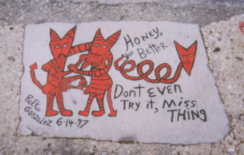
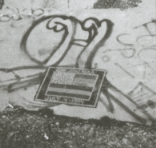
During the most formative years of the gay rights movement in the 70s and on through the late 80s, arts publications and professionals, and even museums like the Museum of Modern Art, ignored imagery associated with gay and lesbian identity. Imagery like the graffiti pictured below which emerged in urban areas during the 70s:

Grafitti on “The Rocks,” Lincoln Park, Chicago, mid-1990s.

According to Reed, “These sites of visual history were destroyed with no organized documentation when rising property values prompted local governments to reclaim these areas.”

2.) Censorship…

Is right for people to ban art today? Even if it’s in the imaginary town of Pawnee, Indiana? Reed surprised us with his answer, making us consider that there’s actually a worse kind of censorship. Listen below to hear what he said.

Transcript:

Censorship is an interesting question because there are overt examples of censorship like what just happened with the Hide/Seek show and the David Wojnarowicz piece, where particular politicians make a statement to their constituency by removing something that’s on exhibition. And then the kind of thing that you’re talking about where institutions simply don’t show things or don’t buy things – in the case of libraries – or don’t do things or don’t let particular people in, which often doesn’t read as censorship because people never realize what they could be seeing or could be reading, or could be going on, because the institution has already created a kind of logic in which that kind of thing doesn’t exist.

And so in a lot of ways I actually think that’s the most dangerous kind of censorship because people aren’t aware of it and they can’t make a

0 Comments on Forbidden images as of 1/1/1900
Add a Comment
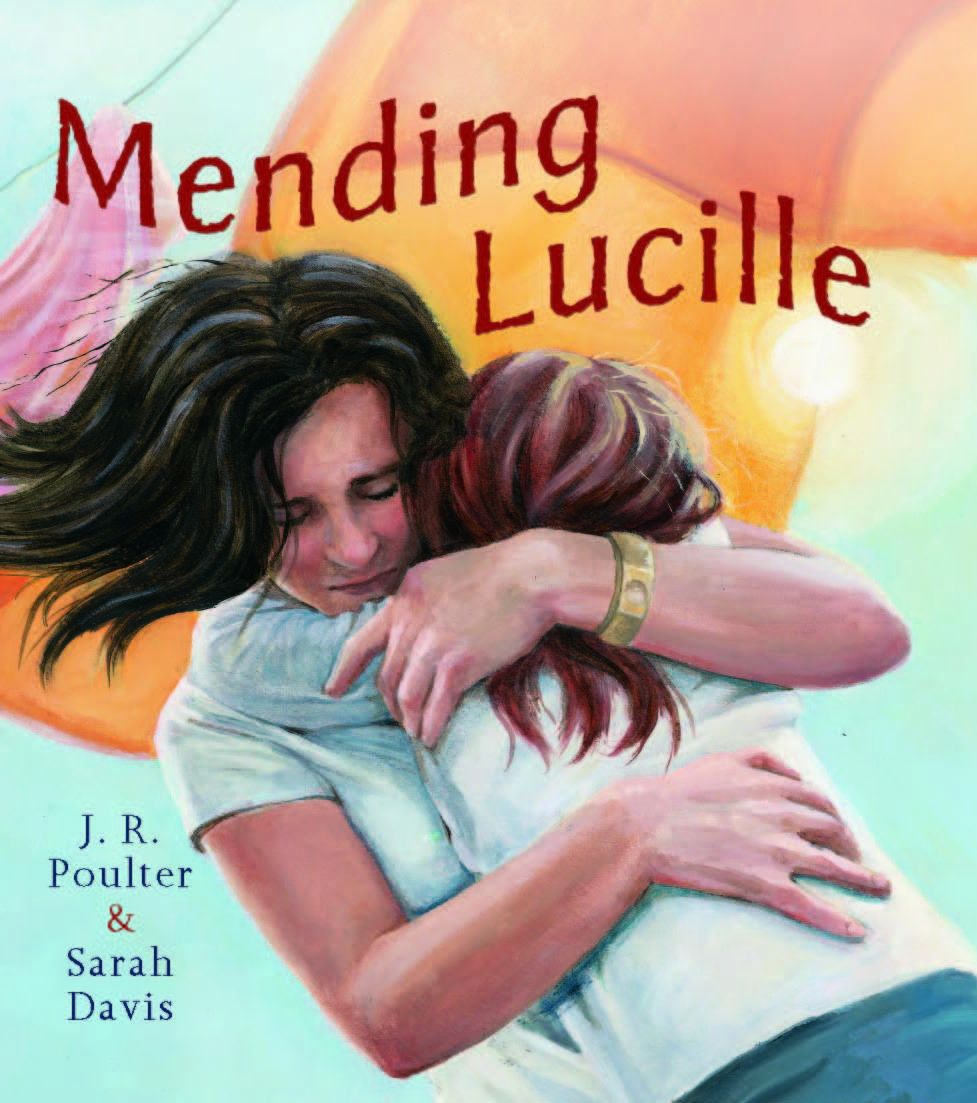
10. “Mending Lucille”, Radio New Zealand review by John McIntyre

Cover, "Mending Lucille"

I thought I had probably long gone received the last of the reviews for my Crichton Award winning picture book, “Mending Lucille”. WRONG! Just got the loveliest, very belated review -
RADIO NEW ZEALAND: http://www.radionz.co.nz/search/results?mode=results&q=Mending+Lucille

http://podcast.radionz.co.nz/ntn/ntn-20110617-1037-childrens_book_review_with_john_mcintyre-048.mp3

Sarah Davis [my amazing collaborator, illustrator on this wonderful project] sent it to me today. It came out on 17th June this year! Better late than never!


John McIntyre gave a very thoughtful, in depth review citing the use of “Mending Lucille” by the Monash Centre for Grief Education in the training of counselors working with children experiencing grief, loss or separation from a parent.


3 Comments on “Mending Lucille”, Radio New Zealand review by John McIntyre, last added: 7/7/2011
Display Comments Add a Comment
11. “All in the Woods” first review through and first from the USA

“With sensitive and humorous prose, J.R. McRae tells a story of family life, love, and acceptance with beautiful illustrations by Linda Gunn. When Pete finds a furry hero, Ink, to solve his dinnertime woes, a nosey neighbor jumps to conclusions that enlarge as Pete’s grandpa comes to visit. When Mrs. Allan’s mother-in-law, Nanny, and Pete’s grandpa take off for an early-morning drive, the assumptions increase until Ink and Grandpa solve the mystery. Perfect for young readers, this book speaks of a boy and his grandpa, a mother defending her son from gossip, and the surprise of love at any age.”  ~Janice Phelps Williams, author, illustrator www.janicephelps.com

Promotional poster, by Tara Hale, for “All in the Woods”, Pixiefoot Press, 2011


2 Comments on “All in the Woods” first review through and first from the USA, last added: 7/11/2011
Display Comments Add a Comment
12. Fright Factors: Regenerate Decrepit Imagery

There was a summer storm brewing last night. Although the rain never came the thunderheads gathered across the sunset turning the sky an ominous shade of orange. Visibility was low and as I gazed across the street I thought of sinister plots and London fog. Why is it, I thought, that so many writers still use fog to build atmosphere? Surely creepy things can happen in dust storms as well. An apt conversation as this is the time to be writing Halloween tales.


Part of the charm of the Halloween tale is the nostalgia, a traditional telling of a tale set in autumn. But tradition can border on boredom if we refuse to see it through new eyes and refresh the imagery. The dark and stormy night with the dilapidated old mansion in a heavily wooded middle-of-nowhere place doesn’t reflect our current day experience. What about that creepy foreclosure at the end of the street though? You know, the one that keeps changing hands—people move in, people move out—they’re gone before you can make an introduction.

What are some of the elements we usually use to build a frightening tale? We touched on a couple, abandoned houses and, of course, the fog. What are some other images that might be over used? What can we substitute for them?

A fun exercise is to take your favorite traditional tale and re-work it. What substitutions can you make to bring this tale into modern times? Can you change the elements around so that the story takes place in a different part of the country without loosing the fright factor?

As my mother once told me, “There is nothing there in the dark that wasn’t there when the lights were on.” Which leads me to my next question… what is that standing next to you?

photos and text by Robyn Chausse

2 Comments on Fright Factors: Regenerate Decrepit Imagery, last added: 8/20/2011
Display Comments Add a Comment
13. How not to do a Book Launch?!

When Jenny Stubbs, Festival Coordinator Extraordinaire, told me I had a slot to launch ”All in the Woods” I was ecstatic! It was my first book to be published in the UK and a launch venue at the Ipswich Festival of Children’s Literature, Woodlands, was almost too good to be true. Jenny facilitated a link to Aleesa Darlison who agreed to MC. BRILLIANT! What could go wrong?

The Ipswich Festival is always an exciting event! It is held at Woodlands, a stunning, heritage listed venue set amongst rural fields, magnificent trees and rolling hills – what a setting for a launch! The lead up to the day, Tuesday, 13th September 2011, was a real buzz! Then the unthinkable happened… The weekend before, my throat started to get that irritating little scratch and that niggly cough that sometime precedes worse. Sunday night it started to hit! Laryngitis!

Friends, good friends can be the saving of such worst case scenarios. I spoke (whilst I still had a voice) to Tara Hale, who designed the promo poster, would she be Guest Artist “Pink” the possum [cousin of "Ink" the animal hero of my book]. Next I contacted  Nooroa Te Hira, he has worked as a tour guide so I knew he would ace a reading of my book. Then I rang Christian Bocquee and asked would he help with nitty grittys like directing teachers and students to seats, distributing prizes and being event photographer! Bless them, they all ‘volunteered’ unstintingly!

Result? Fun, fun, fun!  We had a ball, the book launch was a total success! The author having to use copious amounts of sign language but, hey, she has 5 kids so she speaks the  lingo with hands and fingers! :)

You can see some of the fun in the gallery below. [Sadly, Pink, being a nocturnal creature, was shy of the  camera flash and hid!]

And the book, which was illustrated by wonderful watercolourist Linda Gunn? It had been a truly international effort – written by an Aussie, illustrated by an American and published by a Brit! The icing on the cake was a nomination for the OPSO Award!

Here is a recent review by Kathy Schneider!

Where can you get it? Here!

Tara Hales'  Promotional Poster for "All in the Woods 0 Comments on How not to do a Book Launch?! as of 2/3/2012 4:20:00 AM
Add a Comment
14. Lockyer Arts Festival – just the beginning – 13 to 16 January

The Lockyer is a fascinating and fruitful area and I don’t mean just crops. They grow talent there. This was very evident at the Lockyer Arts Festival where I was honoured to be a presenter recently.  All the arts were represented.

The Nolan family alone included an artist, a potter and a jeweler. KCMinis beautiful miniature 3D creations using recycled materials and Sheryl Lothian’s bread jewelry revived old arts that are ‘new’ again. Couture, millinery, original art for t-shirts, art for the garden, art on stone, art with icing, quilting, aboriginal art, lapidary work, woodwork and culinary arts were just some of the wide and wonderful variety of artistic skills displayed.

Music was high on the agenda with the  Battle of the Bands resulting in a win for country singer, Reanna Leschke, and her band [Open] and runners up, Third Eye Alchemy. In the under 18 division, the very talented classical guitar trio, Un Dia Antes wowed with their  original work. Winners joined  the inimitable Marcia Hines as supporting acts in a first rate live concert.

The  writers and poets of the Lockyer had their work displayed by local poet and editor, Andrea Kwast.  Andrea’s bookshop is the Lockyer’s writing hub!

Presenters for the Festival, whose theme was focussed on ‘resilience’, came from Western Australia, Victoria, Northern Territory and Brisbane, led workshops on writing a novel, memoir writing, non fiction writing with an emphasis on culinary arts.  Workshops on writing children’s books, illustrating picture books, cartooning and animation and landscape painting drew presenters from Perth, Melbourne and Brisbane. This will be discussed in more detail in another blog.

My own photo images from the Festival, focussing on the talents of the Lockyerites themselves, are reproduced below. Click to view slideshow.


0 Comments on Lockyer Arts Festival – just the beginning – 13 to 16 January as of 1/1/1900
Add a Comment
15. Vivid Images: Sensory Details

Create Vivid Images to Bring a Novel to Life

“Vivid imagery makes a story world come alive,” says Stacy Whitman, Associate Editor at Wizards of the Coast (Update March, 2010: Whitman is now editorial director of the Tu Books imprint at Lee & Low.) Everyone agrees that a writer’s ability to create an image in a reader’s head through their words is integral to fiction and effective novels. When writers and editors push toward imagery vivid enough to transport readers to new worlds, there are many options.

A book Whitman has edited is In the Serpent’s Coils: Hallomere (Wizards of the Coast, 2007), by Tiffany Trent, the first of a ten-book dark-fantasy novel series called Hallomere. (Update: Wizards of the Coast is no longer publishing stand alone fantasy novels and this series is out of print, only available from used book sources.) The series features six girls from around the world who are drawn together to rescue their missing schoolmates and prevent catastrophe in an epic battle between dark fey (or supernatural) worlds and the mortal world.

Vivid nature imagery sets mood. Whitman describes this short scene as having vivid nature imagery that sets a dreamy, magical tone for the novel, while emphasizing the Fey’s connection to nature:

hallomereBut then she saw a dark shimmer by the hemlocks again. The tall man turned, as though he felt her gaze. He wore shadows deeper than twilight, and, as before, she couldn’t see his face. But she felt his gaze, felt it through the swift gasp of her heart, the seizure in her knees. The Captain raised his hand to her, and she saw, despite the dusk, that his hand was shiny and scarlet, as though wet with blood.

Stark, direct description sets mood. Alan Gratz creates a different sort of mood in his award winning book, The Samurai Shortshop (Dial Books, 2006), through what he describes as stark and direct description. In one of the most emotional openings of a story in young adult literature, Toyo helps his Uncle Koji perform the Japanese ritual suicide, seppuku.

samuraiNow Toyo sat in the damp grass outside the shrine as his uncle moved to the center of the mats. Uncle Koji’s face was a mask of calm. He wore a ceremonial white kimono with brilliant red wings–the wings he usually wore only into battle. He was clean-shaven and recently bathed, and he wore his hair in a tight topknot like the samurai of old. Uncle Koji knelt on the tatami mats keeping his hands on his hips and his arms akimbo.

Both Gratz and Trent are paying particular

Add a Comment
16. Use Imagination and Trigger Emotions


Writers need to develop deep imagery. It doesn't matter if it's real story or a fictional one; it's the authors' duty to induce reactions from the reader.

Use Imagination—Take a deep breath and read the following paragraph. See if your mind reacts to the stimulus.

It's a hot summer day. You pull a lemon from the fridge. You're holding it in your hand. Look at the outside; run your thumb over it's yellow waxy skin, notice the tiny green bits. Feel how cold it is in your hand. Raise it to your nose and smell it. Mmm. Press it gently and notice the weight of the lemon in the palm of your hand. Pick up a knife and cut it in half. Hear the juices, feel the little spray and notice the smell as it increases. Bite deeply into the lemon and allow the juice to swirl around in your mouth. Did your mouth react?

2 Comments on Use Imagination and Trigger Emotions, last added: 5/2/2010
Display Comments Add a Comment
17. E-Book Publishing – iphone/ipad/e-book – some notes

Hi All

Thought I’d share some notes on e-publishing, especially with all the excitement generated by ipad. I have two picture books coming out myself on iphone and am looking forward to having picture books on ipad!

Iphone

Pros

Most of the iphone publishers pay better [some much better] royalties than book publishers.

Though the RRP cost of books is low, volume of sales is high compared to hard copy books.

Folk buying an e-book for iphone often buy the hardcopy too if the child likes the book.

If you are publishing with an iphone company who works with  the big publishers or with big children’s media companies, then it potentially brings your work to the attention of  some important networks/people. It puts you book into good company!

Cons

Starts with costing you the author.

There is a setup fee or the set up cost is taken out of your royalties.

You have to make your own audio and ensure it is of ‘professional’ quality or pay to have  the iphone publisher produce it for you. American iphone book producers like to use American accents [sorry Aussies].

If they format the text into the images for you that is a cost as well.

You have to submit the completed book upfront  [not such a hassle for the author/illustrator] as a pdf. For author working with illustrator  it means either you pay the illustrator upfront or they work with you with  royalties in mind. If it is accepted  you may find you have to then submit each frame [individual jpeg image] resized to iphone format . This can mean force sizing, which can distort the image slightly.  If you do not do this yourself, there is a cost for them to do it.

Like all publishers, they are selective.

I have books soon to come out with PicPocket Books and istorytime. [See my website for updates www.jenniferrpoulter.weebly.com - more excitement!]

e-book

kindle

Pro

Good format for b&w and has growing audience.

Con

No colour.

e-book

ipad

Pro

Is all the buzz – is touted as new direction in children’s publishing [most recently at CAL seminar in Brisbane recently].  Not seen as replacing hard copy but as important new outlet.

Penguin are already there, are going for interactive stories on ipad. Exciting! [see UTube and www.engadget.com/.../penguins-ipad-formatted-books-shown-off-making- waves/ ] All the same pluses for iphone also apply here and more.

Con

Same companies doing iphone are now doing ipad as well so the cost  structure may still apply – may change too as ipad is much more flexible than iphone and is beautifully suited to picbooks. Because of this, there may not [note may not] be the same need for audio.

Ripple Reader

Pro

If your book is already in hardcopy, it is ‘free’ [yep that’s right] to load your book onto Ripple Reader and free to join the company.  Ripple Reader pays royalties! It is an exciting innovation that makes your published book accessible much, much more widely.

Con

Your book must exist in a published version first, so that the editing process it has gone through ensures production quality.

Recommended Reading

Latest SCBWI Newsletter [March/April 2010] page 22 – article by Elizabeth O. Dulemba titled, “My 1st iPhone Picture Book App”. Elizabeth was published with a company called Rhodesoft.com [“Reading Rhino”]. I don’t know as much about them, but they do also require a set up fee.

LINKS

www.jenniferrpoulter

7 Comments on E-Book Publishing – iphone/ipad/e-book – some notes, last added: 6/20/2010
Display Comments Add a Comment
18. Review – “Mirror” by Jeannie Baker


"Mirror" by Jeannie Baker


In her new book, “Mirror”, Jeannie celebrates the  differences that makes up the diversity of world cultures and the elements that unite us, the bonds of family and the mundanities of every day life.

Even the presentation, as two books united within one cover, highlights  ’same and different’, but highlights it in a way that draws us closer to both families, the traditional Moroccan family and the modern Australian family.

Turning pages of each book simultaneously, reveals parallel aspects of the daily lives of these very different families.  We see them with the intimacy and immediacy of a fly on the wall. They are at work,  at meals, settling for the night, shopping and sharing. The colours are luminous and the details absorptive. Words are superfluous!

I have always been a fan of Jeannie Baker’s beautiful, evocative, detailed collages. This latest book is a treasure!

“Mirror” by Jeannie Baker, Walker Books, ISBN 978-1-4063-0914-0.


0 Comments on Review – “Mirror” by Jeannie Baker as of 1/1/1900
Add a Comment
19. Deepening Your Novel with Imagery, Symbolism & Figurative Language

What makes you love your WIP? Is it the characters? The plot? The premise?

For  me, it's a combination of the above, but it's also that indefinable magic that suddenly makes symbols and images appear in the writing without my knowledge, the overarching, structural metaphors and symbols that bring disparate elements together and illuminate what the story is about. Often I don't have any idea where they come from. Sometimes they are purely conscious. Either way, they form the connective web between the images, themes, characters, and settings. They're the unifying force that gives life to the work, and the surprise and delight I find when they work is a big part of what makes writing--and reading--fun.

As writers, we have a whole arsenal of tools we can use to deepen our work and engage readers on additional levels. Among other things, we use:
  • establishing or anchoring images to set a scene.
  • closing images to underscore tone or heighten emotion.
  • symbols to build a wordless emotional vocabulary.
  • figurative language to simplify explanation at the sentence or paragraph level.
  • recurring symbols or echoes to draw attention to a theme.
  • recurring images to underscore turning points, build emotional intensity, point to what characters are feeling or thinking, or make a characters voice unique.
Chaining or repeating symbols, metaphors, or images together can be one of the simplest and most powerful ways tie scenes or subplots together.

Symbols, imagery, and figurative language are usually simple to spot and identify, but there are so many different kinds it an be hard to remember that we have a much wider range of tools than we commonly use. Each type is unique, but each is an important in shaping our language, pages, scenes, chapters, and overall work.

  • Establishing Shots: Usually discussed in reference to film or television, establishing shots work beautifully in written form to set up the context of a scene. In addition to providing the traditional elements of setting, they create the relationships between the characters and objects in the setting. You can build them through a quick, straight description at the beginning of your scene, but figuritive language or symbols can make them especially powerful. Think of every scene as a scene in a film, and provide an establishing shot for each.
  • Anchoring Images: An image for your readers to visualize as they move through the scene. Judicious use of props and actions can link establishing shots and various anchor images within a scene to make it play out as visually as a film.
  • Concluding Image: Underscores the emotional note of a scene and resonates with the reader longer. By using a powerful concluding image, you can say much less explicitly and achieve a greater payoff.
  • Symbols: Derived from the Greek word for "throw together" symbols draw invisible comparisons to bring additional layers of meaning into your work.  Angela Ackerman has a brilliant symbolism thesaurus on her blog, the bookshelf muse: http://thebookshelfmuse.blogspot.com/2010/02/new-symbolism-thesaurus.html.
  • Similes: A type of figurative language that explicitely compares one things to another using the words 'like' or 'as.'
    • Lips as red as roses
    • Cheeks as white as snow
    • Reeling her in like a fish on the line
  • Simple Metaphors: At their most basic, metaphors use a handful of words to liken one thing to another without explicitly saying they are alike.
    • The roses of her lips
      16 Comments on Deepening Your Novel with Imagery, Symbolism & Figurative Language, last added: 11/12/2010
      Display Comments Add a Comment
20. Every Picture Tells a Story: Adding Depth through Symbolism


Movie makers have it easy, it seems. To convey an emotional tone they have sets, lighting, props, music and the ability to show the foreground action and the background action. As writers we need to focus the lens. We don’t have “extras” or lights or music; but we do have symbols.

Throughout the ages storytellers have relied on symbolism to add nuance; images which speak to our subconscious, emotional mind. Too much symbolism and you risk falling into allegory but done correctly your pictures will blend seamlessly adding depth.

Settings are perhaps the easiest place to add imagery. For example, if your MC is upset and running, where she is running can lend additional information as to her emotional state. If she is running through a dry river bed or an empty parking lot she may be feeling lost. If she is running through the forest she may be confused—her thoughts convoluted. The setting and how she relates to it can be just as telling as a string of self-dialogue. Or, perhaps your story is about conflict within a family. A large tree can provide a setting for several dialogue scenes while symbolizing the underlying strength of the family.

Beats are helpful in showing a character’s internal emotional journey when that journey is different from the dialogue. Tommy is visiting Aunt Mabel who has not been feeling well. During their conversation Tommy asks Aunt Mabel if she will be attending his sister’s wedding in the spring. Aunt Mabel assures Tommy that she "wouldn't miss it for the world"but what feeling do you get if Aunt Mabel turns away from Tommy and tosses out a wilted plant while she says this?

Foreshadow a character’s role with imagery. A possessor of essential knowledge might be associated with light in several scenes--lighting a candle, turning on a lamp or standing under a lamppost.

Colors, seasons, flowers and weather are all examples of commonly used universal symbolism. Black is evil; Red is danger, passion or power; winter is death… What are some of your favorite examples? When has a picture saved a thousand words for you?


Robyn Chausse

0 Comments on Every Picture Tells a Story: Adding Depth through Symbolism as of 1/1/1900
Add a Comment
21. Links for Writers – a growing resource

This series of links were included as part of an article I wrote for WQ Magazine,”Markets – from woe to go and getting a foot in overseas! ” [March issue 2011] . Sadly, the actual links had to be removed due to space restrictions so I have placed most of them here.

This list of resources, sources and publishing opportunities on the internet and elsewhere is far from exhaustive. Please do contact me if you have or know of a resource that can be included!

Review Blogs and sites

Book Review blogs

Debra Sloan – The Picnic Basket http://www.thepicnic-basket.com/

Carol Denbow – A Book Inside http://abookinside.blogspot.com/ Magdalena Ball – Compulsive Reader http://www.compulsivereader.com/html/

Susan Whitfield http://susanwhitfield.blogspot.com/

Jo Linsdell – Writers and Authors http://writersandauthors.blogspot.com

Betty Dravis & co-bloggers  - Dames of Dialogue http://damesofdialogue.wordpress.com/

New Zealand Writer – http://new-zealand-writer.blogspot.com

Sarah Chavez-Detka        http://minorreads.blogspot.com/

Kerry Neary  http://kerryneary.blogspot.com/

Free Press Relese DIY site - http://www.prlog.org/submit-free-press-release.html

Sites

All genres:

Goodreads – http://www.goodreads.com/

Children’s Literature:

The Reading Tub

Terry Doherty Reading Tub http://www.thereadingtub.com/

Reading Tub Blog http://readingtub.wordpress.com/

Magazines that publish short stories and poetry

[I have submitted a list of online journals most on Facebook, some with links - http://www.facebook.com/note.php?note_id=10150093435850908 and growing.] New additions

Leaf Garden Press http://leafgardenpress.blogspot.com/

http://leafgardenpress.blogspot.com/2009/01/submissions-open.html

Dash Literary Journal

Rose and Thorn http://www.roseandthornjournal.com/Home_Page.html

Cross genre:

Good Reading – http://www.goodr

4 Comments on Links for Writers – a growing resource, last added: 2/2/2011
Display Comments Add a Comment
22. Links for Illustrators

This list is the illustrators version of what I have created for Writers. Fair’s fair! :)

It will be added to…

Lou Simeone’s illustrationpages.com, highlights the Facebook pages and online stores of visual artists from around the world. It also has great interviewsarticlesinspirationresources and giveaways.

Storybookillustrators.com has an illustrator’s gallery and a trends gallery.

Thomas James’ Escape from Illustration Island is replete with tutorials, resource library, articles and podasts and more.


1 Comments on Links for Illustrators, last added: 2/2/2011
Display Comments Add a Comment
23. Opportunity for writers

CHILDREN AND WAR ANTHOLOGY
http://jlpowers.net/?page_id=1438

This anthology, to be published by Cinco Puntos Press in
2011 or 2012, will explore all angles of children’s and
teenagers’ experiences in war. The core of the book will
be personal essays, memoirs, journalistic accounts, and
historical narratives, both previously published and
original pieces. It may also include photos, artwork,
posters, and other debris that depicts the effects of war
on children and teens. Though the book will be primarily
non-fiction, we may include some fiction, and we are willing
to consider pieces about both current and past wars. “War”
is defined liberally to include both “official” declared
wars as well as secret, unofficial wars, such as those carried
out by governments on civilians in places like Chile, Argentina,
and Zimbabwe. All submissions, queries, and suggestions should
be sent to J.L. Powers at jlpowers@evaporites.com by June
1, 2011.

NOTE: While the guidelines do not state the payment rate, I
spoke with Jessica Powers, editor of the anthology, and the
payment is $200 per story accepted.


0 Comments on Opportunity for writers as of 1/1/1900
Add a Comment
24. Opportunities for writers, artists, poets –

Writers:

Basics of Life anthology open till 28th Feb – Austlit http://auslit.net/2010/11/27/australian-literature-anthology-basics-of-life/

Artists/Illustrators/Poets, Short story writers ++ :

Going Down Swinging taking submissions till 28th February – http://goingdownswinging.org.au/submissions/

Poets, Artists and Illustrators:

Haijinx still open for submissions till 1st March! Haiku, haiga, renku, sumi-e and haibun – http://www.haijinx.com/I-1/

Writers:

Peter Cowan 600 Short Story Competition open -http://www.pcwc.org.au/index.php?p=1_10


0 Comments on Opportunities for writers, artists, poets – as of 1/1/1900
Add a Comment
25. JAPAN – New Rising Sun anthology – to be an e-book – Poets, writers, artists

This  fundraising anthology is to be an e-book – poets writers, artists, please give of your talents to help the Japanese peope in their hour of need!

The link : http://booksthathelp.org/

New Sun Rising
booksthathelp.org 
Stories for Japan

0 Comments on JAPAN – New Rising Sun anthology – to be an e-book – Poets, writers, artists as of 1/1/1900
Add a Comment

View Next 9 Posts