new posts in all blogs
Viewing: Blog Posts Tagged with: Writing, Most Recent at Top [Help]
Results 1 - 25 of 6,951
How to use this Page
You are viewing the most recent posts tagged with the words: Writing in the JacketFlap blog reader. What is a tag? Think of a tag as a keyword or category label. Tags can both help you find posts on JacketFlap.com as well as provide an easy way for you to "remember" and classify posts for later recall. Try adding a tag yourself by clicking "Add a tag" below a post's header. Scroll down through the list of Recent Posts in the left column and click on a post title that sounds interesting. You can view all posts from a specific blog by clicking the Blog name in the right column, or you can click a 'More Posts from this Blog' link in any individual post.
Maybe I should have titled this post, "What I Learned in 2016." It was a tough year, but I did learn a few very important things. Here they are in no particular order:
- Cover design ~ I've been designing covers (in secret) for years, but this year I learned a lot about cover design and even did my own cover for Fading Into the Shadows, which I love.
- ebook formatting ~ I've been doing paperback formatting for a while, but this year, I learned fancy ebook formatting thanks to some awesome programs.
- Self-Publishing is the way to go for me ~ I've been traditionally published, but I'm not interested in that route anymore. I've worked on both sides of publishing for years now, and I'm ready to take my future in my own hands and self-publish from here on out. (I'm very excited about this!)
- I love writing adult mysteries ~ For years I swore I wouldn't write adult books, but look at me now. I don't know why I didn't think I'd like it, but I find the 25-30 age group really fun to write about.
- Balance ~ I'm particularly proud of this one because I've had the goal of finding balance between editing for clients and working on my own books for the longest time. I just couldn't figure out how to pull it off until I participated in NaNoWriMo this year. Now, I know I can balance the two and get all my work done on time.
Those are my top five writing lessons learned in 2016. What did you learn this year?
Today's topic comes from Sheena-Kay, who asked:
What is the best way to create an author's website? How can you do it yourself or affordably without it looking cheap and do expensive looking sites really sell books?
Great question, Sheena-Kay. My answer may seem confusing at first, but I promise I'll explain. First, I don't think websites sell books. However, you need to have one. ;)
Okay, here's what I mean. A reader comes across your book title or name in conversation or on Amazon. You want to make sure that if that reader googles you, they find something. So you need a website that has all the information they might need about you:
- your social media links
- your newsletter
- information about your books
- buy links for your books
- a press kit with your author bio
- contact information
The danger with having that information on sites that sell your book, like Amazon, is that some retailers (AMAZON!!!!) will check to see who follows you on social media and will not allow that reader to review your book because you're "friends." Don't even get me started on this. Don't link your social media to your Amazon account! Just don't! But do put those links on your website. Also, you don't really want to give out your email to the world, right? Maybe if you have a separate email for fans, but otherwise, I wouldn't. Websites offer contact forms for readers to get in touch with you without giving out your email address. I love this feature. Many will also offer an email address attached to your website to keep it separate from your personal email.
So, how do you set up a website now that you know you need one. (You know that now, right?) I'm a huge proponent for doing it yourself. Yes, this takes more time, but it also takes less money, so it evens out. You should know how to operate your own website though because you don't want to have to run to your website designer every time you need to update the site. Find a website host that seems relatively easy to use. Some people love Wordpress. I hate it! Truly hate it. You have to go with what works for you. So look around and take tours of the sites to see what will work for you. Then take the time to get your site looking professional (with all those things I mentioned above) before you publish it. You want the site you create to be something you're proud of, not something that you're still fiddling with and that looks amateurish.
Sheena-Kay, I hope that answers your question. If anyone has tips for creating a website or website hosts you can recommend, please feel free to share!
*If you have a question you'd like me to answer from the other side of the editor's desk, feel free to leave it in the comments and I'll schedule it for a future post.
Lately, I've noticed more than a few writers switching genres and/or age groups. I've written across both for years, but I've noticed a definite trend in the books I've been drafting over the past year. They're all adult.
My first love was middle grade because I taught middle school. Then I had my daughter and was reading picture books, so I turned to writing those. I never set out to write young adult, but I got an idea one day that suited a young adult novel better than middle grade, so I ran with it. The one thing I swore I'd never write was adult. ;) We all know how that went.
I guess part of growing (both as a person and a writer) is recognizing the stories that you need to tell. I know changing genres and age groups affects readership, but I firmly believe you can't force a story. If I were to continue writing MG because readers wanted it, the writing wouldn't be as good because it's not where my heart is at the moment. That's not to say I'll never write another MG. All of this has proven we can't predict what ideas will come and when.
So, to those of you who are scared of following that new idea because it's out of your comfort genre or age level, I say go for it. Why not try it and see what happens? At the very worst, you can chalk it up to writing for experience, which is never a bad thing.
*If you have a question you'd like me to answer from the other side of the editor's desk, feel free to leave it in the comments and I'll schedule it for a future post.
Happy Monday! Monday Mishmash is a weekly meme dedicated to sharing what's on your mind. Feel free to grab the button and post your own Mishmash.
Here's what's on my mind today:
- Editing I'm finishing a client edit today, moving on to a proofread after that, and getting ready for another edit later this week.
- Lies We Tell Production Files I'm in the process of getting my April 2017 release ready for production. I really love being indie. After working on both sides of publishing for years, I'm excited to have my future in my own hands. I get to do all sorts of fun stuff with my production files. Plus, I can pick my own editors, which is awesome.
- Balance While I decided NaNoWriMo is not designed for fast drafters, I did learn to balance working for clients and working for myself, and I'm really grateful for that. I'm continuing to do that each day now, and I'm much happier.
- Fading Into the Shadows Only a little over a month until Fading Into the Shadows releases! This was one of my favorite books to write. It just flowed really well, and I fell hard for these characters. I'm a little sad it's a standalone, but I felt like the story was complete at the end.
- Deciding What to Write Next I drafted two books in November, and I have two waiting to be written. They're both scheduled as 2019 releases, so I'm not sure which one to tackle first. Hmm... Maybe I'll do some more plotting on each and see which one takes over my brain.
That's it for me. What's on your mind today?
I've had a rough fall season. If you've been following my blog or any of my social media outlets, you're aware of that. But here's what I've learned. No matter what is happening in your personal life, the world continues to spin. Time keeps flying by. I took some time to myself to regroup and care for my dog, but what I didn't do was allow myself to stop living.
In November, I committed to National Novel Writing Month (NaNoWriMo), but more than that, I promised myself that I'd not only write book one in my adult psychic mystery but that I'd take my Ashelyn Drake adult romance novella and turn it into a full-length novel. When my grandfather passed away, I almost let that second promise go out the window. I didn't write for days and told myself I was allowed to not finish that goal in the month of November.
But something happened.
I realized I'm not the type to let a goal go without doing everything in my power to see it through. Yes, between my grandfather passing and my dog getting seriously injured, I had every right to step away from my writing. But I couldn't. I found that stepping away was worse for me. I needed to keep doing the things I love because that's how we get through tough times. Writing became therapeutic. My pace slowed drastically since I couldn't focus for long periods of time and I had to keep constant watch on my dog so she didn't rip out her stitches. But I finished both books.
Why am I sharing this with you today? Because I see writers who get stuck with a bad publisher or bad agent (I've lived through both!) or who experience hard times in their personal lives and feel like giving up all together. To those writers I want to say, live goes on. Even though you might feel like things couldn't get worse, I can assure you they will get better. You can pick yourself up and carry on.
I also want to thank all of you. Thanksgiving was tough for me because I always spent it with my grandfather. This year, I just wanted it to be over. But now that I've had some time, I want to thank those of you who reached out when I needed it. There was one day when I got a comment from a total stranger who found me on another person's blog and made a point to seek me out and offer condolences. That made my day. Seriously. And it reminded me how a small act of kindness can make such a difference in a person's life. So thank you. Writing might feel lonely at times, but this community of authors is nothing short of amazing. I'm thankful to have each and every one of you in my life.
*If you have a question you'd like me to answer from the other side of the editor's desk, feel free to leave it in the comments and I'll schedule it for a future post.
I didn't win NaNoWriMo this year, and guess what? I'm not one bit sorry. In fact, I'm actually celebrating that I took care of myself and my sanity this November. Instead of stressing over word counts, I simply made sure I wrote a little every day, kept sketching every day, and just stayed on track with being creative every day. It was more than good enough--it was fantastic!
There were a number of reasons why this year's 30-day, 50K challenge didn't work for me, but the number one thing going on was a serious case of "monkey mind." Every time I sat down to work on my NaNoWriMo manuscript, I wanted to collage and paint it rather than write it. Or I wanted to find new writing prompts from old magazines. Or . . . or . . . I just couldn't settle on one way of working on it. At the same time, I still wanted to express what was running through my head: images, colors, even musical themes, but I just needed to play with my subject matter rather than write it. So I followed my heart and:- Made 7 new pieces of pottery inspired by my story.
- Finished the art journal I started earlier this summer with my writer's group by adding collages based on my story.
- Finished an art journal I started three years ago by writing poetry connected to my story. (Yes, three years is a long time for one journal, I know, I know.)
- Practiced drawing the horses that were part of my story.
- Went through a stack of magazines for new pictures and ideas for writing prompts that I can keep using next year for my story.
- And yes . . . I wrote 19,252 words of my NaNoWriMo story! Not so bad, after all.
Why I'm glad I chose this route:- I now have enough greenware to fill my kiln for a bisque firing.
- Finishing my art journals got rid of my guilt at neglecting them and boosted my energy. And I love having collages to go with my plot, characters, and settings.
- I've won plenty of NaNoWriMos over the years to know I can do it, but now I also know when to say "no." A very good lesson.
- And it was still fun to participate, even on a minor scale. I enjoyed following the progress of other writers and encouraging them to continue. I was part of a writing community and it was a good place to be.
It's difficult to balance our real world obligations with our creative desires--sometimes near impossible. If you're anything like me, from the minute I get up in the morning I feel besieged by an entire litany of unrelated tasks: Buy milk; go to Staples; return library books; write Chapter Four. When I threw NaNoWriMo into the mix (write 2900 words today or die), all I wanted to do was go back to bed. That's when I decided to a) go slow, keep writing, but stop chasing the 50K. And, b) make sure that I sat down for at least an hour every day at my art table and just played. It was a good plan. Now I just have another 30K to go, but entirely at my leisure.
Tip of the Day: The key to accomplishing any goal is one step at a time. It doesn't matter how big or small that step is, just give yourself the space to do it. And if you did win NaNoWriMo this year: CONGRATULATIONS!! My hat's off to you. Enjoy your victory!
Today's topic comes from Lidy, who asked:
"The trouble comes with which tense to use. Simple past or past progressive? But then I end up mixing and switching tenses. Is there a trick or tip to keep your tenses straight/consistent?"
First, for anyone not familiar with the term past progressive, let me explain it. Past progressive can indicate a continuing action or an action that was interrupted or happening when something else occurred. You write this tense by using a form of "to be" and a verb ending in -ing. Here are some examples with the past progressive in italics:
Continuing action:
Tom was being a bad friend.
I was writing all afternoon.
Interrupted/happening when something else occurred:
I was sleeping when my dog suddenly started to bark.
I was leaving the house when the phone rang.
Okay, so here's my advice. Avoid "to be" (helping verbs) at all costs. This is something I learned when I took writing courses. "To be" (in all its forms: is, am, was, were, are) is a sign of weak writing. Let me rewrite the examples above to remove the use of "to be" verbs.
Tom's actions made him a bad friend.
I drafted my book all afternoon.
As I walked out the front door, the phone rang.
My dog's loud bark woke me from a deep sleep.
Now I could've constructed better sentences, but this is just to give you an idea of how to do this so I kept my examples simple. Basically, avoiding "to be" will result in stronger sentences. However, if you are mixing past and past progressive, don't assume you're incorrect in doing so. There is a time and place for past progressive. The real question is, do you want to use past progressive when "to be" verbs are stereotyped as weak writing and can be avoided?
*If you have a question you'd like me to answer from the other side of the editor's desk, feel free to leave it in the comments and I'll schedule it for a future post.

By: Deb Frazier,
on 11/28/2016
Blog:
TWO WRITING TEACHERS
(
Login to Add to MyJacketFlap)
JacketFlap tags:
writing process,
writing,
writers,
Write: It's good for you!,
writing workshop,
teacher of writing,
young authors,
Teachers who write,
teacher writing,
writer identity,
community,
Add a tag
The realization of this moment gave me chills and led me to share my writing backstory with Dana. Dana listened and encouraged me to open my presentation with this story. I was hesitant, the experience had halted my inner writer for years. What if sharing it again had the same result? 
Happy Monday! Monday Mishmash is a weekly meme dedicated to sharing what's on your mind. Feel free to grab the button and post your own Mishmash.
Here's what's on my mind today:
- Nursing Hadley Back To Health After my dog collided with a rock wall, she needed stitches and has wounds on her mouth, cheek, and shoulder. She wants to scratch all the time, which opens those wounds again. We can't cone her because the cone would lay on the wounds, so we have to watch her every second. Needless to say I'm not sleeping or able to leave the house.
- Editing I have a small break in edits (off until Thursday), which is good considering Hadley is taking most of my time and attention these days.
- Cover Design This weekend I designed the cover for Lies We Tell, my first adult book! It's a suspense and will release in April 2017.
- Drafting With the death of my grandfather and Hadley's injury, I had to stop drafting. I just couldn't. I'm taking a break from writing to get my thoughts together and come to terms with things.
- Book Signing On Saturday, my daughter and I will be signing together at Middle Smithfield Elementary school for their local vendor event.
That's it for me. What's on your mind today?
Last weekend was the annual SCBWI (Society of Children's Book Writers and Illustrators) conference in Winchester, which was as ever educating and inspiring.
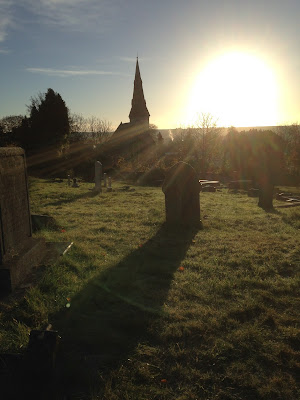 |
| Sunrise over Winchester on the first morning of the SCBWI Conference |
I've volunteered with SCBWI for very many years now, initially when I was in Japan, and, since my return to the UK, with the British Isles chapter. Apart from supporting Anne-Marie Perks on the illustrator's committee I co-run our network in East Anglia with writer Helen Moss, and edit the Friday (illustration themed) page of our web-journal
Words & Pictures. As the Conference is such a key part of the SCBWI calendar I wish I could go every year, but picture book deadlines and other concerns have often intervened. As a volunteer I try to attend once every other year at least, though I'm not directly involved in organising the Conference itself (I may be raising my hand next year though!).
One of the highlights of the weekend - and there were many - was receiving a small prize in recognition for volunteering, I was greatly surprised and absolutely delighted - thank you SCBWI!!
There are full reports of the Conference on
Words & Pictures, so these are just my thoughts. This year I was there to help out, but also on a personal level with the hope of reviving interest in my own picture book ideas. All my children's book work over recent years has been commissioned texts for publishers in the US and Japan, written by others. These titles have been sometimes complex projects that completely absorbed my attention, just looking at the past three years -
Stone Giant - Michelangelo's David and How He Came to Be (written by Jane Sutcliffe),
Crinkle, Crackle, Crack - It's Spring (written by Marion Dane Bauer)
Will's Words: How William Shakespeare Changed the Way You Talk (also by Jane Sutcliffe)
Yozora o Miage-yo (written by Yuriko Matsuoka) and, forthcoming from Holiday House in 2017,
Magic For Sale (written by Carrie Clickard).
All of these books have been wonderful projects, fine texts by marvelously talented writers, but concentrating on these has meant I've neglected my own stories, which remain as rough idea notes and little more, I've not submitted dummies to publishers for a very long time. However right now I'm working on black and white ink drawings for novels, so taking a break from commissioned picture books, this slight breather is encouraging me to once more look over my story concepts and ideas.
I've lived in the UK for almost nine years now since leaving Japan and returning to these shores after 21 years away. After an initial enthusiasm for UK publishing I focused on my Japanese and American connections, hence most of my work still comes from overseas, it's about time I really tackled British publishing head on and started submitting!
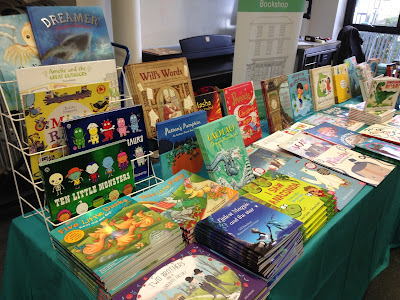 |
| Will's Words on sale through P & G Wells bookshop at the Conference |
So, was the Conference as inspiring as I'd hoped? Absolutely! The activities for illustrators were as hoped brilliant, from the fringe event sketchcrawl around Winchester, which really got the creative cells buzzing, to the illustration keynote from Leigh Hodgkinson, and really excellent Pulse events - a hands-on picture book workshop from Viv Schwarz, and thorough session on promotion from Paul Strickland. Plus the sheer energy of seeing all my old friends, new faces, discussion, companionship - it was terrific.
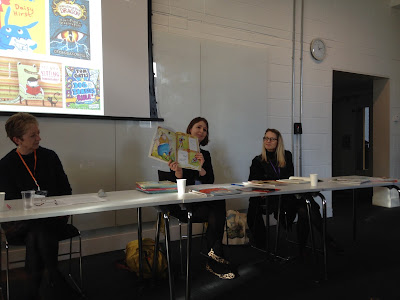 |
| Industry Picture Book Panel talk, with Miranda Baker (Nosy Crow) seen here with the book, David McDougall (Walker), Caroline Walsh (agent) and Polly Whybrow (Bloomsbury) |
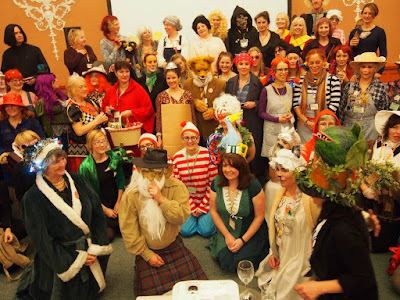 |
| Some of the costumes at the Mass Book Launch (photo: George Kirk) |
 |
| Hard at work during Viv Schwarz's workshop |
 |
| Leigh Hodgkinson artwork |
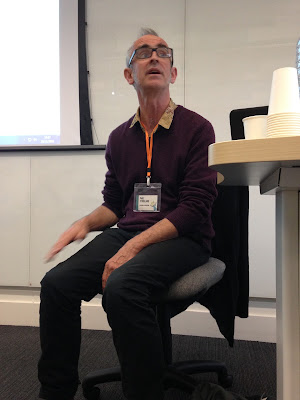 |
| The Marvellous Paul Strickland |
But what about my plan to get writing? In addition to the illustrator activities two key-note presentations particularly inspired me, one from author David Almond (who I've known since he spoke to our Tokyo SCBWI group many years ago) and another from Sarah Davies of the Greenhouse Literary Agency. Both these had me squirming in my seat, their passion for the story really shook me up, I've got to write, I've got to write!!!
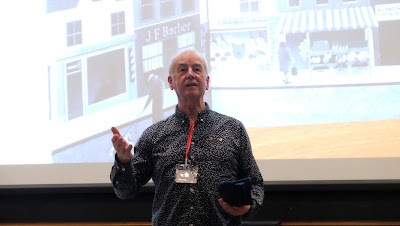 |
| David Almond (photo: Candy Gourlay) |
This isn't the first time I've been to an SCBWI conference and been inspired to write, but with no major picture book projects on now I've no excuse NOT to write now, to actually do something about it.
My problem is that I regard myself as a professional illustrator, with years of experience and a back catalogue of over 50 published children's books illustrated, and the confidence that brings. I've struggled with creative writing though, it's not my natural form of expression, I don't feel I'm a comfortable picture book writer, my pictures already tell stories, but expanding them to create a binding narrative is a struggle. When I write I'd rather do it without thinking of images, then come back to illustrate it with my 'artist' hat on. I wonder if I'd feel a little more comfortable writing longer fiction than picture books. Because I don't feel my words are as professional as my drawings, I've not much confidence when it comes to submitting to publishers. Also I don't take story rejection well, my one attempt at writing a novel when I was 16 was shelved after two publisher rejections (it really was not very good though!), previous dummies sent to publishers have also been shelved rather than worked on and improved.
Although I've had stories published in Japanese through children's publishers in Tokyo, I've not been published as a writer in the West, only as an illustrator. This really has to change!
Anyway, the Conference really helped me feel a bit more focused on this, I've a lot to thank SCBWI for, not only the award, but the companionship and encouragement. Maybe this time I will get writing again, it really is about time! As a US editor once told me, "if you want to make a mark you have to produce your own stories, it's no good sharing your royalties and glory, your books should all be yours". Indeed!
Today's topic comes curtesy of Fiona Phillips, who asked:
"In your opinion, does writing from first person perspective limit the amount of description you can use (of surroundings, characters, etc.)?"
First, that's a great question, so thank you for posing it, Fi. If you're comparing first person to third person, then the answer is yes. Unless you have a main character who is extremely perceptive, you're not going to get the same level of description in first person as you would in third person. However, that doesn't mean you can't have a good level of description in first person POV. It just means you have to tackle it in a different way.
In third person POV, you can easily set the scene, describing as much as you want. But with first person POV, you have to make sure the description is coming across in a more natural way. If the character is entering a scene that's unfamiliar to him/her, it's natural to take in the scene, thus describing it for the reader. However, a character wouldn't naturally walk into the house they've lived in for the past ten years and comment on all the details of the layout. What you would need to do is describe that layout in terms of where the MC is and what the MC is doing. The MC might toss his/her keys on the mahogany table against the wall as he/she walks in the front door. He/she might trip over the runner in the hallway on his/her way to the living room, where he/she flops down on the brown, leather couch and puts his/her feet up on the glass coffee table. See what I did there? I'm giving details to describe the scene as it pertains to the MC.
So, yes, you can have that description, but you need to tie it to the MC and present it as it makes sense. It's different from third person POV, but it can be done. I hope that answers your question, Fi!
*If you have a question you'd like me to answer from the other side of the editor's desk, feel free to leave it in the comments and I'll schedule it for a future post.
Happy Monday! Monday Mishmash is a weekly meme dedicated to sharing what's on your mind. Feel free to grab the button and post your own Mishmash.
Here's what's on my mind today:
- NaNoWriMo Winner! Yesterday, I was finally able to claim my November 7th victory of writing 50K. My word count continues to count against me, but at least I am officially a winner now.
- Drafting I'm working on book two for this month, but it's going very slowly due to client edits.
- New Author Banner I decided to finally splurge and get myself a banner to stand behind my tables at book signings. I opted for the four-foot one since I don't think the six-foot ones are fully seen anyway since the table covers them. Here's the banner I designed:
- December 3rd Signing My banner I just mentioned is arriving December 1st, days before my next signing, which is taking place at Middle Smithfield Elementary School during their local vendor event. My daughter, Ayla, will be signing with me. Her first signing!
- Editing I'm trying to stay on schedule with the holiday and the days off from school. Wish me luck!
- Happy Thanksgiving! I hope you all have a safe and happy thanksgiving!
That's it for me. What's on your mind today?
I was saddened to learn today that Castle Miranda (also known as Château de Noisy) in Belgium was slated to be torn down this month. Back in 2012 I stumbled across the gorgeous pictures from PROJ3CT M4YH3M of this heart-breaking, beautiful, decaying castle. The ceilings especially inspired me to put pen to paper and write the scene in my novel Glimmer of Steel where Jennica comes to terms with her fate while staring up at her bedroom’s ceiling.
Since I don’t own any of the copyrights for the images I saw back in 2012, nor have I paid for licensing rights, I have the next best thing… links to the owners’ sites so you can hop over a view them yourself.
The first link is for a website (in German) with historical photos/drawings of the Castle in its original state. http://www.lipinski.de/noisy-historical/index.php
The second link is from Ian Moone’s and PROJ3CT M4YH3M’s website page that covered their first visit to Castle Miranda in 2012:
Urbex: Castle Miranda aka Château de Noisy Belgium – December 2012 (Part 1)
The third link is from Ian Moone’s and PROJ3CT M4YH3M’s second visit in 2014:
Urbex: Castle Miranda aka Château de Noisy Belgium – May 2014 (revisit)
So just as I’m getting ready to release Glimmer of Steel to Kindle Scout this month, and I’m looking for Castle Miranda pictures to share as an important visual inspiration for my writing, I learned the castle is being dismantled. Pascal Dermien recently photographed the start of the demolition and shared his photos on YouTube. You can see former turrets cast upon the ground, including the weather vane that used to spin atop the highest peak. Only the blogs, and photographs, memories, videos, and the occasional book will live on.
My participation in NaNoWriMo this month has taught me something. NaNo isn't designed for people like me. I fast draft—sometimes writing crazy amounts of words in a single day. I finished my 50,000 words on November 7th, but NaNo won't let me verify my word count and ultimately win because I achieved that word count too soon. What?!?!?!? I can't wrap my head around that.
So now, I can't earn all my badges, like writing every day this month. I almost feel like I'm being penalized for writing too quickly. And that's crazy! I wrote the entire book in seven days! Of course I won! But yet, I didn't according to NaNo. So I've decided to cheat. Yup. I'm cheating and working on another novel and adding that to my word count. This book is one I started last year and had to put aside. I'm editing for clients right now and so far I've only been writing about 1,500-2,500 words a day on this book. But still, even if I continue to write until November 30 (though I highly doubt the book will take that long to finish) I won't get my badge for writing every day this month. I guess I should have read up on NaNo before I decided to join in on the fun, because I'm going to have two completed novels by the end of the month and I still don't feel good about it.
I most likely won't participate in NaNo again. It's just not designed for me. It's making me feel like a failure even though I've already won, and let's face it. This industry is hard enough on our egos. I don't need this on top of it.
Anyone else find that NaNo makes you feel bad instead of encouraging you to write more?
*If you have a question you'd like me to answer from the other side of the editor's desk, feel free to leave it in the comments and I'll schedule it for a future post.
Happy Monday! Monday Mishmash is a weekly meme dedicated to sharing what's on your mind. Feel free to grab the button and post your own Mishmash.
Here's what's on my mind today:
- NaNoWriMo So I won NaNo a week ago today, but they won't let me validate and confirm my win. On Wednesday I'll be sharing what I've learned from NaNo and why it's not geared toward writers like me.
- Editing I'm editing for a newish client this week. I did a one-chapter edit over the summer for her, and now I'm editing her full book.
- Thank You I want to thank everyone who visited my daughter's blog. She was so excited to see your comments. Since she has books by several of you, it was even more exciting for her to recognize your names. If you haven't checked out her blog, you can find it here.
- Parent-Teacher Conferences My daughter is home today and tomorrow because it's conference time at her school. My conference is tomorrow morning.
- Continuing to Draft Even though my NaNo book is finished, I'm going to keep this momentum and finish a book I started last year and had to put aside to meet other deadlines.
That's it for me. What's on your mind today?
Today's topic comes curtesy of Sheena-Kay. Thanks, Sheena-Kay! She wants to know:
What do you do when a freelancer (cover artist, editor, etc) suddenly up and cancels on you or what advice would you give to someone else in that position?
Okay, this is something you hope never happens to you, but I've seen it a lot. Most freelancers are good because this is how they make their money. They need repeat clients, and so they do their best to meet deadlines and make their clients happy. But...
There are times when freelancers go MIA or cancel on you. The first thing I recommend is trying to figure out why. Life happens. A death in the family can cause a freelancer to go offline. Let's face it. When a loved one passes, the last thing we think about is checking our email, and that's understandable. So if this is a freelancer you really like, try to find out if something like this happened. If you don't know the freelancer and you can't wait for them to respond, do what you have to do. Deadlines are deadlines.
Now if a freelancer cancels on you with no explanation, I wouldn't advise working with them again in the future. And to be honest, I'm in several groups where people share info on freelancers—ones who don't meet deadlines, ones who take payment and then don't follow through on the work, etc. They do get blacklisted, so they don't want to be talked about this way.
I think the best way to get involved with a freelancer is by word of mouth. See who others recommend after having used that freelancer. Like anything else, do some research and protect yourself.
*If you have a question you'd like me to answer from the other side of the editor's desk, feel free to leave it in the comments and I'll schedule it for a future post.
Happy Monday! Monday Mishmash is a weekly meme dedicated to sharing what's on your mind. Feel free to grab the button and post your own Mishmash.
Here's what's on my mind today:
- NaNoWriMo According to NaNo, I'm supposed to finish today. Last week, I wrote way more than I thought I would. Of course, winning NaNo doesn't mean the book is finished, so I'll still be writing after today.
- Editing I have two edits on my plate after finishing one this weekend. One is my backward read, which is the slow read to catch those pesky grammar and punctuation issues. The other is a short story, so I'll be doing a content read and the backward read on that one this week.
- See numbers one and two I don't have time to tackle anything else this week! LOL
That's it for me. What's on your mind today?
We are officially two days into NaNoWriMo, so I thought I'd share how it's going and why I decided to finally participate. I wanted to try NaNo as a way to convince myself that I don't have to fast draft like a crazy person in between client edits and do nothing but edit when I have editing jobs on my schedule. I guess I take things to extremes, doing one or the other like a mad woman. I need to stop this. I know it, and I keep saying I'm going to, but it hasn't happened yet. So NaNo is about forcing myself to split my days between editing in the morning and writing in the afternoons. So far, I'm doing it.
The odd thing is that most people do NaNo to get a book drafted quicker than they normally would. For me, it's the opposite. When I draft, I usually hit anywhere between 10,000 and 18,000 words a day. (Yes, you read that correctly!) But splitting my days and committing to NaNo while I have edits on my plate, means I have to aim much lower, like 3,000 to 5,000 words a day. So I feel like NaNo is very different for me than most people. It's forcing me to slow down. Will I like this? It's too soon to tell.
How about you? Are you NaNoing? How do you approach it? (And feel free to buddy me. I'm khashway.)
*If you have a question you'd like me to answer from the other side of the editor's desk, feel free to leave it in the comments and I'll schedule it for a future post.
Happy Monday! Monday Mishmash is a weekly meme dedicated to sharing what's on your mind. Feel free to grab the button and post your own Mishmash.
Here's what's on my mind today:
- Happy Halloween! I hope everyone has a happy and safe Halloween.
- NaNoWriMo Starts Tomorrow! If you're taking part in NaNo, buddy me. My name is khashway on the site. And good luck!
- Editing Even though I'm drafting a new book, I have client edits to tackle this month. Eek! NaNo is pretty much my way of showing myself I can find balance between doing work for others and doing work for myself.
- Field Trip I'm chaperoning my daughter's field trip on Friday. Um, when am I supposed to write for NaNo? I'm not panicking. Nope. Not at all. Okay, maybe a little. I guess I'll be writing in the evening on Friday. Send coffee please.
- Fading Into the Shadows Fading Into the Shadows is fully edited, proofed, and ready to go over two months early! I'm so excited for this book. E-ARCs are in, so if you have time to read the book before January 16, 2017 and would like an ARC in exchange for an honest review, sign up here. The cover reveal will take place November 16th-18th. If you're interested in sharing the cover on any social media site, you can sign up for that here.
That's it for me. What's on your mind today?
Today's topic comes from Mirka, who said, "...tell us some more about your adult suspense book, and how writing for grown-ups is different than MG or YA, beyond the MC's age."
Great topic, Mirka! Thanks!
Okay, well my adult books are very different from my YA or MG novels. It almost seems like there are different rules for writing for adult. Let me start with what I've noticed from reading adult books. First, things are described in much more detail. Second, backstory is common and often told upfront. Third, there are more dialogue tags.
I could go on, but these three blew my mind. For years, I listened to everyone say, "No info dumping!" and "Try not to use dialogue tags!" Yet every adult book I've read does both. Now I don't mean pages of backstory. Not at all. But a brief paragraph of who the MC is and how they go where they are is totally common. I've even see the dreaded "My name is..." format. Again, this blew my mind. And no, I'm not doing that. I've been conditioned not to.
So writing for adults is tough for me. I have to remind myself to step back, observe the scene, and give more details than I would to a teenager whose attention span isn't very long. I also need to make sure my characters are all introduced in ways that the reader will remember them from one book to the next, which means reintroducing them in books two, three, four, etc. Again, this is so different for me. But my adult beta readers are telling me this is normal, and from the books I've been reading, they are correct.
The easy things for me are writing characters who are closer to my age. Mine tend to be in the mid/late twenties to early thirties. I know how people this age speak, act, think, etc. Teens can be challenging because they change so much! Adults, not so much. I also think it's fun to write about adults in different professions. I'm exploring some that I've considered but never followed through on for various reasons, and that's kind of amazing.
In many ways, writing for adults is freeing. I feel like a rebel, breaking rules I've always been told to follow. ;) Who doesn't like to break a few rules, right? And the dialogue and actions come more naturally for me. So yeah, I'm enjoying it, and I think I'll keep writing for adults.
*If you have a question you'd like me to answer from the other side of the editor's desk, feel free to leave it in the comments and I'll schedule it for a future post.
Happy Monday! Monday Mishmash is a weekly meme dedicated to sharing what's on your mind. Feel free to grab the button and post your own Mishmash.
Here's what's on my mind today:
- NaNoWriMo I have decided to officially participate in NaNoWriMo next month. I've unofficially participated in the past, writing a novel in the month of November, but since I have an adult mystery that needs to be written, I'm committing to doing this. Who else will be participating?
- Editing I'm finishing up another client edit this week.
- Plotting I have the research done for my adult mystery, but I need to flesh out my plot before NaNo begins.
- Fading Into the Shadows e-ARCs e-ARCS for my YA paranormal (releasing January 16, 2017) Fading Into the Shadows are being formatted tomorrow! I'm so excited for this book. If you'd like to sign up for an e-ARC, you can do so here.
- Cover Reveal Signups If you're interested in signing up to help me reveal the cover of Fading Into the Shadows on November 16th-18th, you can find the form here. This is a social media cover reveal, so you don't need a blog to participate.
That's it for me. What's on your mind today?
The Philippine Board on Books for Young People (PBBY) is now accepting entries for the 2017 PBBY-Salanga Prize. The contest is co-sponsored by the Cultural Center of the Philippines (CCP) and the National Library of the Philippines (NLP). The winner shall receive twenty-five thousand (25,000) pesos and a medal. Prizes will be awarded in an appropriate ceremony to be held during the celebration of National Children’s Book Day in July 2017. Contest Rules
- The contest is open to all Filipino citizens except those who are related to any PBBY member up to the third degree of consanguinity.
- Stories should be intended for children aged 6 to 12 years old. The plot and the sequence must be capable of sustaining an illustrated book of 28 to 32 pages.
- Entries may be in Filipino or English.
- Entries must be in hard copy, double-spaced, on short bond paper. Maximum length is five (5) pages.
- A contestant may send in more than one (1) entry.
- Each entry must be signed by a pen name only. Five (5) copies of each entry should be placed in an envelope, on the face of which only the pen name of the contestant should appear.
- Together with each entry, contestants must submit a second envelope, on the face of which the pen name shall appear. The second envelope must contain the contestant’s full name, address, contact numbers, a short literary background, and a notarized certification from the author, vouching for the originality of the entry and for the freedom of the organizers from any liability arising from the infringement of copyright in case of publication, and affirming that the entry or any variant thereof has (a) never been published nor (b) won any other contest i.e. that it has never won 1st, 2nd, 3rd, or honorable mention in any other contest or otherwise been awarded a medal, a citation, or included in a publicized list of meritorious entries to a literary contest.
- All entries must be sent through snail mail to the PBBY Secretariat, c/o Adarna House, Inc., Scout Torillo cor. Scout Fernandez Sts., Barangay Sacred Heart, Quezon City.
- All entries must be received by the PBBY Secretariat no later than 5:00 p.m., December 2, 2016.
- Winners will be announced no later than February 3, 2017. Non-winning entries will be disposed of by the PBBY Secretariat.
Grand prize and honorable mention winners shall be subject to a bidding process to be facilitated by the PBBY, to determine which publisher/s will publish their winning stories.
For more details, interested parties may contact the PBBY at (02) 3526765 local 203, or email pbby[at]adarna.com.ph.
Dawn again,
and I switch off the light.
On the table a tattered moth
shrugs its wings.
I agree.
Nothing is ever quite
what we expect it to be.
—Robert Dunn
Katherine Towler's deeply affecting and thoughtful portrait of Robert Dunn is subtitled "A Memoir of Place, Solitude, and Friendship". It's an accurate label, but one of the things that makes the book such a rewarding reading experience is that it's a memoir of struggles with place, solitude, and friendship — struggles that do not lead to a simple Hallmark card conclusion, but rather something far more complex. This is a story that could have been told superficially, sentimentally, and with cheap "messages" strewn like sugarcubes through its pages. Instead, it is a book that honors mysteries.
You are probably not familiar with the poetry of
Robert Dunn, nor even his name, unless you happen to live or have lived in or around Portsmouth, New Hampshire. Even then, you may not have noticed him. He was Portsmouth's second
poet laureate, and an important figure within the Portsmouth poetry scene from the late 1970s to his death in
2008. But he only published a handful of poems in literary journals, and his chapbooks were printed and distributed only locally — and when he sold them himself, he charged 1 cent. (Towler tells a story of trying to pay him more, which proved impossible.) He was insistently local, insistently uncommercial.
 |
| Robert Dunn |
Dunn was also about as devoted to his writing as a person could be. When Towler met him in the early '90s, he lived in a single room in an old house, owned almost nothing, and made what little money he made from working part-time at the
Portsmouth Athenaeum. He seemed to live on cigarettes and coffee. When Towler first saw him around town, she, like probably many other people, thought he was homeless.
If a person could start a conversation with Dunn, which wasn't always easy, they would discover that he was very well read and eloquent. He was not, though, effusive, and he was deeply private. It was only late in his life, wracked with lung disease, that he opened up to anyone, and the person he seems to have opened up most to is Towler, though even then, she was able to learn very little about his past.
Towler got to know him because she was a neighbor, because she was intrigued by him, and because she was a writer on a different career track, with different ambitions. Dunn certainly wanted his poems to be read — he wouldn't have made chapbooks and sold them (even if only for a penny) if not — but he didn't want to subject himself to the quest-for-fame machine, he didn't want to do what everybody now says you must do if you want to have a successful writing career: become a "brand". He didn't bother with any sort of copyright, and Towler quotes a disclaimer from one of his books: "1983 and no nonsense about copyright. When I wrote these things they belonged to me. When you read them they belong to you. And perhaps one other." In 1999, he told a reporter from the
Boston Globe, "It just feels kind of silly posting no trespassing signs on my poems."
His motto, written on slips of paper he occasionally gave to people, was "Minor poets have more fun."
When Towler met him, she was struggling with writing a novel. She had lived peripatetically for a while, but had recently gotten married. She wanted to be published far and wide, and in her most honest moments she probably would have admitted that she would have liked to sell millions of copies of her books, get a great movie deal or two, get interviewed by Terry Gross and Charlie Rose, win a Pulitzer and a National Book Award and, heck, maybe even a Nobel. Success.
Once her first novel was published, Towler discovered what many people do in their first experiences with publication: It doesn't fill the hole. It is never enough. There are always other books selling better, getting more or better reviews, always other writers with more money and fame, and in American book culture these days, once a book is a month or two old, it's past its expiration date and rarely of much interest to booksellers, reviewers, or the public, because there's always something new, new, new to grab attention. You might as well sell your poems for a penny in Market Square.
By the time Towler's first novel is published, Portsmouth is deep in the process of gentrification. Not only have the local market, five-and-dime store, and hardware store been put out of business by rising rents and big box stores, but all seven of the downtown bookstores have disappeared. (Downtown is no longer bookstoreless. Bookstores, at least, can appeal to the gentrifiers, though it's still tough to be profitable with the cost of the rent what it is.) Towler gives a reading at a Barnes & Noble out at the mall, a perfect symbol of pretty much everything Robert Dunn had lived his life against: a mall, a chain bookstore. He attends the reading, though, and seems happy for Towler's success. He stands in line to get his book signed, and then says something that cuts Towler to the bone: "I'll let you get to your public."
As Robert turned away, leaving me to face a line of people waiting to have books signed, I felt that he had seen through me to the deep need for approval, the great strivings of ego, that lay at the heart of my desire to publish a book. Only by divorcing myself from the hunger for affirmation, his quip suggested, would I find what I truly desired. This is what he wanted for me, what he wanted for anyone who wrote.
The Penny Poet of Portsmouth continues to think through these ideas, and to work through the contrast between Dunn's fierce localism and solitude and Towler's own conflicting desires, hopes, dreams, and fears. She begins in great admiration of Dunn, who seems to have sacrificed absolutely everything to his writing and has somehow overcome any yearning for fame or reward. In that sense, he seems saintly.
But at what cost? This question is always in the background as Dunn becomes ill and more dependent on other people. If he wants to stay alive, the sort of solitude he cultivated and cherished is no longer possible, leading to some difficult confrontations and tensions.
Towler does her best not to impose her own values on Dunn's life, but she can't help wondering what it would be like to live as Dunn does. Though she sympathizes with him, and shares some of his ideals, she's no ascetic. She can't help but think of Dunn as lonely, since she would be, especially in illness. She cherishes her husband, she likes the house they buy together, she enjoys (at least sometimes) traveling to readings and leading writing workshops.
Dunn's life, as Towler presents it at least, shows the inadequacy of the question, "Are you happy?" In illness, Dunn was obviously not comfortable, and when he couldn't be at home, he was often not content. But happiness is a fleeting thing, not a state of being. Even if you believe that happiness is something that can be captured for more than a moment, there's no reason to think that, except for illness, Robert Dunn was
unhappy. He sculpted a life for himself that was, it seems, quite close to whatever life he might have desired having. I doubt having a life partner of some sort would have led to more moments of happiness for him, as Towler wonders at one point. The accommodations and annoyances of having another person around a lot of the time are insufferable for someone inclined toward solitude. Was this the case for Dunn? It's difficult to know, because he was difficult to know. Towler is remarkably restrained, I think, in not trying to impose her own pleasures on Dunn — she doesn't ever record saying to him what the partnered often say to the unpartnered, "Wouldn't you be happy with someone else in your life?" (I often think partnered people work a bit too hard to justify their own life choices, as if the presence of other types of lives are somehow an indictment of their own.) But even still, it does seem to be one of the more unbridgeable gulfs between types of people: the contentedly partnered seem as terrified of being unpartnered as the contentedly unpartnered are of being partnered, and so one looks on the other's life as a nightmare.
What
The Penny Poet of Portsmouth shows is the necessity of community. Robert Dunn was, for many reasons, lucky that he lived in Portsmouth when he did, because there was a real community of writers and people interested in writing and reading, and these people looked out for each other. Before the rents went whacko, it was possible to live in Portsmouth if you weren't rich. This is why the word
place in Towler's subtitle is so important. The book is not only a portrait of Robert Dunn, but a chronicle of the city that allowed him to be Robert Dunn. Towler is careful to chronicle the details of the place and community, both its people and its institutions. She shows the frustrations of dealing with bureaucracies of illness, and without being heavy-handed she depicts the ways that poverty is perceived in a place as ruggedly individualistic as New Hampshire — once she gets to know Robert Dunn, she also gets to see, feel, and struggle against the assumptions people who don't know him make. (In some of what she described him experiencing from nurses, doctors, and pharmacists, I couldn't help but think of my father, who did not have health insurance and who died of congestive heart failure. After he had a heart attack, he felt patronized and dismissed by hospitals that knew he couldn't pay his bills. Whether the hospital employees themselves actually felt this way, I don't know, but he perceived it deeply, and it contributed to his determination never to see another doctor or hospital. I'll forever remember the way his voice sounded when he told me, briefly, of this: the shattered pride, the humiliation, the rage all fraying his words.)
In its attention to the details of community — and a number of other ways —
The Penny Poet of Portsmouth makes a perfect companion to Samuel Delany's
Dark Reflections, another story of a poet, though in a very different environment. Arnold Hawley in Delany's novel is far less content than Robert Dunn in Towler's memoir, but their commitments are similar. Arnold is more seduced by the desire for fame and success than Dunn seems to have been, and so his personality is perhaps a bit more like Towler's, but without her relative success in everyday living. Having known Dunn, Towler is perhaps more capable of imagining Dunn as content in his life than Delany is quite able to imagine Arnold content — I've sometimes wondered whether Arnold is so tormented by his life because Delany himself would be tormented by that life, a life that is the opposite, in nearly every way, of his own. No matter. The books have much to say to (and with) each other.
There is much in Towler's memoir that is moving. She takes her time and doesn't rush the story. At first, I thought perhaps her pacing was unnecessarily slow, perhaps padding out what was a thin tale. I was wrong, though, because Towler is up to many things in the book, and needs her portrait of the place and person to be built carefully for her ideas and concerns to have resonance and real meaning. It's a tale of growing into knowledge and into something like intimacy, but also, at the same time, of coming to terms with unsolveable mysteries and uncrossable borders.
By the time I got to the fragmentary biography Towler offers as an appendix, those few pages were the most powerful of the book for me, because they show just how much we can't know. (I suppose the power was also one of some sort of personal recognition: Robert Dunn grew up only a dozen or so miles from where I grew up. The soil of his early years is as familiar to me as any other place on Earth. He was a graduate of the University of New Hampshire, where I finished my undergraduate degree and am now working on a Ph.D. I've only spent occasional time in Portsmouth, though enough over the decades to have seen some of the changes Towler writes about.) Primed by all the rest of Towler's story, it was this paragraph that most deeply affected me:
He went south in the summer of 1965 with the civil rights movement with a small group of Episcopalians from New Hampshire. Jonathan Daniels, who was shot and killed as he protected a young African-American woman attempting to enter a store in Hayneville, Alabama, had gone down ahead of the group. Robert would not talk about this experience, though others and I asked him about it directly. He did say once that he had known Daniels.
Had Towler rushed her story more, the resonances and mysteries in that paragraph wouldn't have been nearly as affecting. (It helps if you already know the story of Daniels, I suppose.)
The book ends with a delightful collection of what we might call "Robert Dunn's wit and wisdom", taken from various interviews and profiles in local papers that Dunn had stuck in a folder labeled "Vanity". Of the civil rights movement, he told Clare Kittredge of the
Boston Globe in 1999: "We had our hearts thoroughly broken."
Let's end these musings with what mattered most to Robert Dunn, though: the poetry. His poems remind me of
Frank O'Hara (whom he discusses with Towler) and
Samuel Menashe. They're colloquial and compressed, full of surprises. Thanks to Towler's book, I expect, Dunn's selected poems have finally been collected in
One of Us Is Lost, and a few are reprinted in
The Penny Poet. Here's one that seems particularly appropriate:
Public Notice
They've taken away the pigeon lady,
who used to scatter breadcrumbs from an old
brown hand and then do a little pigeon dance,
right there on the sidewalk, with a flashing
of purple socks. To the scandal of the
neighborhood. This is no world for pigeon
ladies.
There's a certain wild gentleness in
this world that holds it all together. And
there's a certain tame brutality that just
naturally tends to ruin and scatteration and
nothing left over. Between them it's a very
near thing. This is no world without pigeon
ladies.
Now world, I know you're almost
uglied out, but . . . just think! Try to
remember: What have you done with the
pigeon lady?
—Robert Dunn
Dawn again,
and I switch off the light.
On the table a tattered moth
shrugs its wings.
I agree.
Nothing is ever quite
what we expect it to be.
—Robert Dunn
Katherine Towler's deeply affecting and thoughtful portrait of Robert Dunn is subtitled "A Memoir of Place, Solitude, and Friendship". It's an accurate label, but one of the things that makes the book such a rewarding reading experience is that it's a memoir of struggles with place, solitude, and friendship — struggles that do not lead to a simple Hallmark card conclusion, but rather something far more complex. This is a story that could have been told superficially, sentimentally, and with cheap "messages" strewn like sugarcubes through its pages. Instead, it is a book that honors mysteries.
You are probably not familiar with the poetry of
Robert Dunn, nor even his name, unless you happen to live or have lived in or around Portsmouth, New Hampshire. Even then, you may not have noticed him. He was Portsmouth's second
poet laureate, and an important figure within the Portsmouth poetry scene from the late 1970s to his death in
2008. But he only published a handful of poems in literary journals, and his chapbooks were printed and distributed only locally — and when he sold them himself, he charged 1 cent. (Towler tells a story of trying to pay him more, which proved impossible.) He was insistently local, insistently uncommercial.
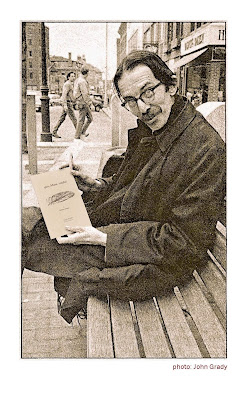 |
| Robert Dunn |
Dunn was also about as devoted to his writing as a person could be. When Towler met him in the early '90s, he lived in a single room in an old house, owned almost nothing, and made what little money he made from working part-time at the
Portsmouth Athenaeum. He seemed to live on cigarettes and coffee. When Towler first saw him around town, she, like probably many other people, thought he was homeless.
If a person could start a conversation with Dunn, which wasn't always easy, they would discover that he was very well read and eloquent. He was not, though, effusive, and he was deeply private. It was only late in his life, wracked with lung disease, that he opened up to anyone, and the person he seems to have opened up most to is Towler, though even then, she was able to learn very little about his past.
Towler got to know him because she was a neighbor, because she was intrigued by him, and because she was a writer on a different career track, with different ambitions. Dunn certainly wanted his poems to be read — he wouldn't have made chapbooks and sold them (even if only for a penny) if not — but he didn't want to subject himself to the quest-for-fame machine, he didn't want to do what everybody now says you must do if you want to have a successful writing career: become a "brand". He didn't bother with any sort of copyright, and Towler quotes a disclaimer from one of his books: "1983 and no nonsense about copyright. When I wrote these things they belonged to me. When you read them they belong to you. And perhaps one other." In 1999, he told a reporter from the
Boston Globe, "It just feels kind of silly posting no trespassing signs on my poems."
His motto, written on slips of paper he occasionally gave to people, was "Minor poets have more fun."
When Towler met him, she was struggling with writing a novel. She had lived peripatetically for a while, but had recently gotten married. She wanted to be published far and wide, and in her most honest moments she probably would have admitted that she would have liked to sell millions of copies of her books, get a great movie deal or two, get interviewed by Terry Gross and Charlie Rose, win a Pulitzer and a National Book Award and, heck, maybe even a Nobel. Success.
Once her first novel was published, Towler discovered what many people do in their first experiences with publication: It doesn't fill the hole. It is never enough. There are always other books selling better, getting more or better reviews, always other writers with more money and fame, and in American book culture these days, once a book is a month or two old, it's past its expiration date and rarely of much interest to booksellers, reviewers, or the public, because there's always something new, new, new to grab attention. You might as well sell your poems for a penny in Market Square.
By the time Towler's first novel is published, Portsmouth is deep in the process of gentrification. Not only have the local market, five-and-dime store, and hardware store been put out of business by rising rents and big box stores, but all seven of the downtown bookstores have disappeared. (Downtown is no longer bookstoreless. Bookstores, at least, can appeal to the gentrifiers, though it's still tough to be profitable with the cost of the rent what it is.) Towler gives a reading at a Barnes & Noble out at the mall, a perfect symbol of pretty much everything Robert Dunn had lived his life against: a mall, a chain bookstore. He attends the reading, though, and seems happy for Towler's success. He stands in line to get his book signed, and then says something that cuts Towler to the bone: "I'll let you get to your public."
As Robert turned away, leaving me to face a line of people waiting to have books signed, I felt that he had seen through me to the deep need for approval, the great strivings of ego, that lay at the heart of my desire to publish a book. Only by divorcing myself from the hunger for affirmation, his quip suggested, would I find what I truly desired. This is what he wanted for me, what he wanted for anyone who wrote.
The Penny Poet of Portsmouth continues to think through these ideas, and to work through the contrast between Dunn's fierce localism and solitude and Towler's own conflicting desires, hopes, dreams, and fears. She begins in great admiration of Dunn, who seems to have sacrificed absolutely everything to his writing and has somehow overcome any yearning for fame or reward. In that sense, he seems saintly.
But at what cost? This question is always in the background as Dunn becomes ill and more dependent on other people. If he wants to stay alive, the sort of solitude he cultivated and cherished is no longer possible, leading to some difficult confrontations and tensions.
Towler does her best not to impose her own values on Dunn's life, but she can't help wondering what it would be like to live as Dunn does. Though she sympathizes with him, and shares some of his ideals, she's no ascetic. She can't help but think of Dunn as lonely, since she would be, especially in illness. She cherishes her husband, she likes the house they buy together, she enjoys (at least sometimes) traveling to readings and leading writing workshops.
Dunn's life, as Towler presents it at least, shows the inadequacy of the question, "Are you happy?" In illness, Dunn was obviously not comfortable, and when he couldn't be at home, he was often not content. But happiness is a fleeting thing, not a state of being. Even if you believe that happiness is something that can be captured for more than a moment, there's no reason to think that, except for illness, Robert Dunn was
unhappy. He sculpted a life for himself that was, it seems, quite close to whatever life he might have desired having. I doubt having a life partner of some sort would have led to more moments of happiness for him, as Towler wonders at one point. The accommodations and annoyances of having another person around a lot of the time are insufferable for someone inclined toward solitude. Was this the case for Dunn? It's difficult to know, because he was difficult to know. Towler is remarkably restrained, I think, in not trying to impose her own pleasures on Dunn — she doesn't ever record saying to him what the partnered often say to the unpartnered, "Wouldn't you be happy with someone else in your life?" (I often think partnered people work a bit too hard to justify their own life choices, as if the presence of other types of lives are somehow an indictment of their own.) But even still, it does seem to be one of the more unbridgeable gulfs between types of people: the contentedly partnered seem as terrified of being unpartnered as the contentedly unpartnered are of being partnered, and so one looks on the other's life as a nightmare.
What
The Penny Poet of Portsmouth shows is the necessity of community. Robert Dunn was, for many reasons, lucky that he lived in Portsmouth when he did, because there was a real community of writers and people interested in writing and reading, and these people looked out for each other. Before the rents went whacko, it was possible to live in Portsmouth if you weren't rich. This is why the word
place in Towler's subtitle is so important. The book is not only a portrait of Robert Dunn, but a chronicle of the city that allowed him to be Robert Dunn. Towler is careful to chronicle the details of the place and community, both its people and its institutions. She shows the frustrations of dealing with bureaucracies of illness, and without being heavy-handed she depicts the ways that poverty is perceived in a place as ruggedly individualistic as New Hampshire — once she gets to know Robert Dunn, she also gets to see, feel, and struggle against the assumptions people who don't know him make. (In some of what she described him experiencing from nurses, doctors, and pharmacists, I couldn't help but think of my father, who did not have health insurance and who died of congestive heart failure. After he had a heart attack, he felt patronized and dismissed by hospitals that knew he couldn't pay his bills. Whether the hospital employees themselves actually felt this way, I don't know, but he perceived it deeply, and it contributed to his determination never to see another doctor or hospital. I'll forever remember the way his voice sounded when he told me, briefly, of this: the shattered pride, the humiliation, the rage all fraying his words.)
In its attention to the details of community — and a number of other ways —
The Penny Poet of Portsmouth makes a perfect companion to Samuel Delany's
Dark Reflections, another story of a poet, though in a very different environment. Arnold Hawley in Delany's novel is far less content than Robert Dunn in Towler's memoir, but their commitments are similar. Arnold is more seduced by the desire for fame and success than Dunn seems to have been, and so his personality is perhaps a bit more like Towler's, but without her relative success in everyday living. Having known Dunn, Towler is perhaps more capable of imagining Dunn as content in his life than Delany is quite able to imagine Arnold content — I've sometimes wondered whether Arnold is so tormented by his life because Delany himself would be tormented by that life, a life that is the opposite, in nearly every way, of his own. No matter. The books have much to say to (and with) each other.
There is much in Towler's memoir that is moving. She takes her time and doesn't rush the story. At first, I thought perhaps her pacing was unnecessarily slow, perhaps padding out what was a thin tale. I was wrong, though, because Towler is up to many things in the book, and needs her portrait of the place and person to be built carefully for her ideas and concerns to have resonance and real meaning. It's a tale of growing into knowledge and into something like intimacy, but also, at the same time, of coming to terms with unsolveable mysteries and uncrossable borders.
By the time I got to the fragmentary biography Towler offers as an appendix, those few pages were the most powerful of the book for me, because they show just how much we can't know. (I suppose the power was also one of some sort of personal recognition: Robert Dunn grew up only a dozen or so miles from where I grew up. The soil of his early years is as familiar to me as any other place on Earth. He was a graduate of the University of New Hampshire, where I finished my undergraduate degree and am now working on a Ph.D. I've only spent occasional time in Portsmouth, though enough over the decades to have seen some of the changes Towler writes about.) Primed by all the rest of Towler's story, it was this paragraph that most deeply affected me:
He went south in the summer of 1965 with the civil rights movement with a small group of Episcopalians from New Hampshire. Jonathan Daniels, who was shot and killed as he protected a young African-American woman attempting to enter a store in Hayneville, Alabama, had gone down ahead of the group. Robert would not talk about this experience, though others and I asked him about it directly. He did say once that he had known Daniels.
Had Towler rushed her story more, the resonances and mysteries in that paragraph wouldn't have been nearly as affecting. (It helps if you already know the story of Daniels, I suppose.)
The book ends with a delightful collection of what we might call "Robert Dunn's wit and wisdom", taken from various interviews and profiles in local papers that Dunn had stuck in a folder labeled "Vanity". Of the civil rights movement, he told Clare Kittredge of the
Boston Globe in 1999: "We had our hearts thoroughly broken."
Let's end these musings with what mattered most to Robert Dunn, though: the poetry. His poems remind me of
Frank O'Hara (whom he discusses with Towler) and
Samuel Menashe. They're colloquial and compressed, full of surprises. Thanks to Towler's book, I expect, Dunn's selected poems have finally been collected in
One of Us Is Lost, and a few are reprinted in
The Penny Poet. Here's one that seems particularly appropriate:
Public Notice
They've taken away the pigeon lady,
who used to scatter breadcrumbs from an old
brown hand and then do a little pigeon dance,
right there on the sidewalk, with a flashing
of purple socks. To the scandal of the
neighborhood. This is no world for pigeon
ladies.
There's a certain wild gentleness in
this world that holds it all together. And
there's a certain tame brutality that just
naturally tends to ruin and scatteration and
nothing left over. Between them it's a very
near thing. This is no world without pigeon
ladies.
Now world, I know you're almost
uglied out, but . . . just think! Try to
remember: What have you done with the
pigeon lady?
—Robert Dunn
View Next 25 Posts



.jpeg?picon=2691) By: LAURIE WALLMARK,
on 12/29/2016
By: LAURIE WALLMARK,
on 12/29/2016


 By: Valerie Storey,
on 12/1/2016
By: Valerie Storey,
on 12/1/2016


 By: John Shelley,
on 11/26/2016
By: John Shelley,
on 11/26/2016


 By: K. E. Blask,
on 11/19/2016
By: K. E. Blask,
on 11/19/2016


 By: Tarie Sabido,
on 10/21/2016
By: Tarie Sabido,
on 10/21/2016

.jpg?picon=160) By: Matthew Cheney,
on 10/19/2016
By: Matthew Cheney,
on 10/19/2016

