new posts in all blogs
Viewing Blog: Justine Larbalestier, Most Recent at Top
Results 1 - 25 of 1,534

Justine Larbalestier is a writer. Her current project is the great Australian cricket, mangosteen, Elvis, young adult (YA) novel. Or possibly a werewolf snowboarding epic. Depends. She is the author of the Magic or Madness trilogy, in which the door of a house in Sydney opens onto a street in New York City.
Statistics for Justine Larbalestier
Number of Readers that added this blog to their MyJacketFlap: 24
This weekend I’ll be a Guest of Honour at WisCon in Madison Wisconsin. WisCon is the longest running feminist science fiction convention in the USA.
I used to be a regular attendee and always had an amazing time. This will be my first time back in ten years. Pretty cool to return as a Guest of Honour, eh? I’m thrilled. Disbelieving, but thrilled, and in such company: Nalo Hopkinson is one of the finest writers of science fiction and fantasy ever. Sofia Samatar is an astonishing new voice. Her debut novel was rapturously received.
In addition to my convention schedule I’ll be doing one event open to the public:
Thursday, May 26, 2016 – 5:00pm to 6:45pm
WisCon Guest of Honour Reception and Reading
A Room Of One’s Own
315 W. Gorham Street,
Madison, Wisconsin
Nalo Hopkinson, Justine Larbalestier, Sofia Samatar
As well as my Guest of Honour duties of speechifying etc. I’ll be on the following panels:
Fri, 9:00–10:15 pm
Genre Blending
Whether it’s a steampunk fairytale or an end of the world love story between science and magic or a Hong Kong-style revenge space opera, stories are spilling over the edges of genre. When is it done well? What is left to explore?
M: Rebecca Holden. Alex Jennings, Justine Larbalestier, Loren Rhoads, Kristine Smith, Brooke Wonders
Sat, 10:00–11:15 am
AMA with GOHs
Have a question for Guests of Honor Sofia Samatar, Justine Larbalestier, or Nalo Hopkinson about writing craft, writing life, or their fiction? Come to this Ask Me Anything session with your questions!
M: K. Tempest Bradford. Nalo Hopkinson, Justine Larbalestier, Sofia Samatar
Sat, 1:00–2:15 pm
#KeepYAKind and Other Nice Tools of the Oppressor
There is always a point in the midst of heated Internet discussions where someone lifts their voice to make a call for Kindness, Niceness, Civility, or any other adjacent concept. These calls often go up when the issue at hand concerns an individual with privilege being called out by folks with significantly less privilege or cultural power. And Kind, Nice, and Civil become synonyms for Keep Your Mouth Shut. When this happens again, what tools can we use to dismantle this toxic dynamic and get back to the core matter? Are there secret code words we can deploy to neutralize the terms?
M: K. Tempest Bradford. Becky Allen, Betsy Haibel, Justine Larbalestier, Mark Oshiro
Sat, 2:30–3:45 pm
Science Fiction and Social Change
Many people believe science fiction/fantasy is escape from reality into made up worlds. But all sci fi is based and rooted in this world’s problems and issues, and will reflect those back. Often times mainstream science fiction reflects back visions of the future or alternative realities that reinforce systems of power. But throughout history science fiction has been used as a means of envisioning progressive new worlds, and has also been used by those organizing to transform power dynamics and create a more fair and equitable today, rooted in the experiences of those who have been marginalized and silenced historically. Come hear a panel of presenters discuss the ways science fiction is being used on the ground to create social change.
M: Jacquelyn Gill. Carlie Forsythe, Justine Larbalestier, Fred Schepartz, Sheree Renée Thomas
Sun, 10:00–11:15 am
Women Can Be Evil Too
Mikki Kendall and Justine Larbalestier discuss their research on women serial killers and psychopaths long thought to not exist.
M: Tanya D.. Mikki Kendall, Justine Larbalestier
Sun, 1:00–2:15 pm
GOH Kaeseklatsch: Justine Larbalestier
Come hang out with Guest of Honour Justine Larbalestier and talk about whatever comes to mind! In honour of Wisconsin, we will sample cheeses. Note: Since this is in a parlor room, it may get crowded and attendance may be limited. Sign up at the Registration desk to reserve a seat.
Sun, 2:30–3:45 pm
Women Writing SFF, All Around The World!
A reading recommendation panel! What books would be of interest to WisCon members? Whether Anglophone, in translation, or in different languages, from Indigenous to diaspora works, let’s share SFF we’ve read recently that encourages USian WisCon members to step out of our cultural bubbles.
M: Jaymee Goh. Jackie Hatton, Arrate Hidalgo, Emily Jiang, Justine Larbalestier
Sunday 4:00-5:15 PM
How Not To Think About Women Characters
Debbie Notkin, Becky Allen, Megan Arkenberg, Claire Humphrey, Justine Larbalestier
“She’s such a Mary Sue.” “She’s only there to serve the story of a male character.” “Her characterization is so inconsistent” or “She’s too flat to be interesting.” As consumers of media;even feminist consumers;we have a whole language at our disposal when we need to justify disinterest or dislike towards a woman character. But as often as these idioms are accurate criticisms of a work, they can also be ways to avoid actually talking about the character AS a character. Some questions to consider: Do the ways in which we critique women characters result in a denial of their agency? Is describing women characters as “inconsistently characterized” a way to avoid seeking out their motivations? Is being a “foil” or a parallel always a subordinate role?
Quite the schedule, eh? I’m especially excited about talking evil women with Mikki Kendall. But I reckon they’ll all be fun.
If you’re going to be at WisCon I look forward to seeing/meeting you. I’ll be at the big sign out on Monday and am happy to sign whatever you want. Well, almost anything.
See you soon, Madison! I’ve missed you!

By:
Justine Larbalestier,
on 3/3/2016
Blog:
Justine Larbalestier
(
Login to Add to MyJacketFlap)
JacketFlap tags:
Daughters of Earth,
Vainglory,
Reading,
Battle of the Sexes in Science Fiction,
Love is Hell,
Magic or Madness trilogy,
Razorhurst,
Eat the Sky Drink the Ocean,
My Sister Rosa,
Add a tag
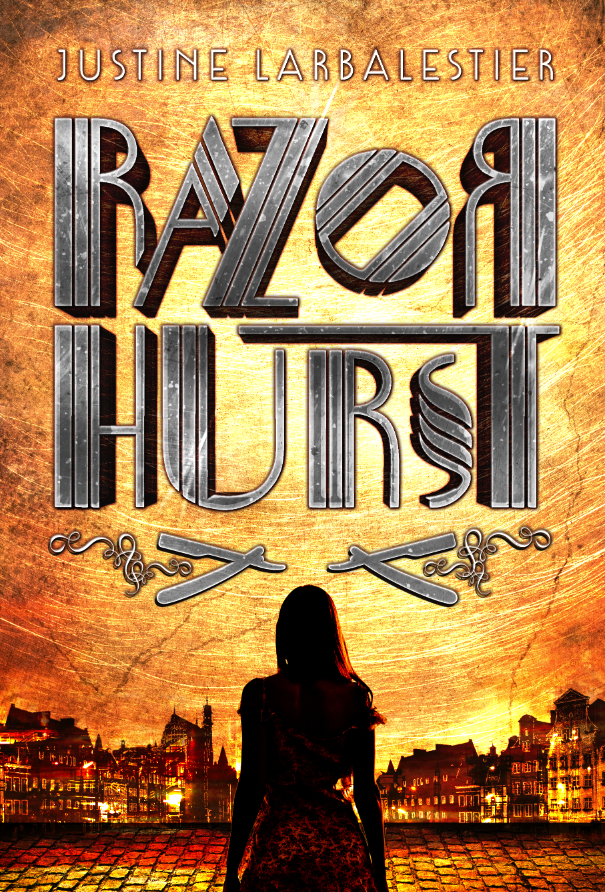
This post is so I have somewhere to send people when they ask me which book of mine they should read first. Click on the links to learn more about each book.
WARNING: If you consider knowing whether a book has a happy or a sad ending to be a spoiler do not read this:
Novels with unambiguously happy endings:
How To Ditch Your Fairy
Team Human
Novels with endings that might make you tear your hair out:
Liar
Razorhurst
My Sister Rosa
“Thinner than Water” in Love is Hell (though I consider this novella to have a happy ending many readers disagree with me)
Novels with endings that might make you cry in a sad way:
Razorhurst
My Sister Rosa
“Thinner than Water” in Love is Hell (Beats me why, but many readers have reported crying.)
Novels that just end with no resolution and WHY DID YOU DO THAT, JUSTINE?!
Liar
Fantasies:
Magic or Madness trilogy (contemporary with magic)
How to Ditch Your Fairy (contemporary, different world, very mild superpowers)
Liar (contemporary [redacted] because it might be a lie)
“Thinner than Water” in Love is Hell (contemporary with faerie)
Zombies v Unicorns (self-explanatory)
Team Human (contemporary, vampires and zombies)
Razorhurst (historical, ghosts)
Realist novels:
Liar
My Sister Rosa (Though I could mount a strong argument that psychopaths are monsters.)
Historicals:
Razorhurst (1932 Sydney)
Thrillers:
Liar (psychological)
Razorhurst (gangsters and cops trying to kill protags)
My Sister Rosa (psychological)
Anthologies/Short stories:
Daughters of Earth (I edited this collection of 20th century feminist science fiction with accompanying essays by feminist scholars)
Zombies v Unicorns (I edited this one with Holly Black)
“Thinner than Water” in Love is Hell
“Little Red Suit” in Eat the Sky, Drink the Ocean
Non-fiction:
Battle of the Sexes in Science Fiction
Daughters of Earth
Novels with sex:
Magic or Madness trilogy
Liar
Razorhurst (very little)
My Sister Rosa
Novels without sex:
How To Ditch Your Fairy
Team Human
Humorous Books:
How To Ditch Your Fairy
Team Human
Zombies v Unicorns (Mine and Holly Black’s bantering in between the short stories is funny and so are some of the stories.)
My biggest writing struggle is getting started. My current novel, the Psychopath Book, was going well until My Sister Rosa came out in Australia and New Zealand. Suddenly there was promotion to be done, interviews, book launches, travelling.
I’ve been for home more than a week and this is how it’s gone:
Day One: I catch up on admin, which includes interview questions, paying bills, laundry etc as well as tweeting. Because Twitter is a vital part of my process. *cough*
Day Two: More admin. How does admin build up so quickly? Why can’t bills pay themselves? Why can’t Twitter pay my bills?
Day Three: More admin. More tweeting. I open Psychopath Book file. I have no idea who any of these characters are or what this book is about. Not entirely convinced I wrote these words. Who has been messing with my computer while I was away? I ask Twitter. Answers are unsatisfactory.
Day Four: More admin. Way more tweeting. I stare at Pyschopath Book file and read some of it and recoil in horror. Why is this so hard? There are plenty of writers with full time jobs, who are carers for children and elderly parents, who write ten books a year. I am the worst. I ask Twitter. Twitter overwhelmingly confirms my worst-ness.
Day Five: I ignore admin. Time to get back to actually writing this damn book. After I’ve delivered a very important rant on Twitter and commiserated with friends over the dread ways in which Twitter algorithms are trying to destroy Twitter. I read my notes on Psychopath Book. They don’t make any sense. Staring at this stalled novel fills me with despair. I watch Attack the Block for the millionth time. Surely it will inspire me? It does. To write an entirely different book.
Day Six: I continue to ignore admin but not Twitter. I make myself read more Psychopath Book. I edit some sentences. Some of them are okay. Most are not. I start to have vague memories about these characters. I marvel at the many ways I have misspelled pyschopath. It’s impressive.
Day Seven: I continue to ignore admin and am on Twitter slightly less than usual. I blog. What? It’s important for an author with a new book out to stay abreast of social media and blog the rants that are too long for Twitter. It’s also important to watch the cricket in case I one day get around to writing that highly commercial cricket novel I’ve been thinking about writing for years.
Day Eight: I finally write some actual new sentence of the Psychopath Book. They’re total shite.
Day Nine: I write more shitey sentences of the Psychopath Book. I know who these characters are! I can write this book! Shitely! I just have to make sure I never take more than a day or two off ever again.
And repeat. A lot.
TL;DR: Getting started is really hard.
I think we’ve all had the experience of meeting one of your favourite writers and them turning out to be horrible. They bark at their fans, they’re rude to their publicists. Sometimes you don’t even have to meet them. They launch online attacks on anyone who doesn’t give them five-star reviews, tweet racist “jokes”, or they’re arrested for beating up their partner.
Some writers are truly awful people. Yet some of those truly awful people write brilliant books. How?!
One of my favourite writers is Knut Hamsun, a Norwegian writer, who deservedly won the Nobel Prize in 1920. His 1890 novel Hunger blew my teenaged mind. I’ve read it many times since and still find it amazing. It’s about a bloke wandering around Oslo (then called Christiania) starving. It should be boring; it isn’t. I keep rereading it to try and figure out why. All I’ve got is compelling character + amazing writing.
Hamsun was also a card-carrying fascist. He thought Hitler totally had the right idea. He was tried for being a traitor to Norway after World War 2 and found guilty. You know, because he was.
How could Hamsun, who wrote moving, beautiful, psychologically insightful books, be a fascist? I don’t know. I have theories though.
The first is the fairly obvious one. People compartmentalise. They decide whole groups of people aren’t really people. They only see the psychological complexity of people like them and that’s who they write about: the ones they see as fully human. I suspect that’s what was going on with Hamsun. White Scandinavian/German people = yes. Everyone else = no.
My other theories are a bit more woo woo.
Sometimes something extraordinary happens in the process of creating. I’m convinced that even the worst people can produce magic because of it.
It’s hard to describe, but most creatives will know what I’m talking about. There are times when the writing is going so well it feels like words are pouring out of me, that they have nothing to do with me, even though obviously, I’m the one typing. When I’m in that magical zone I can write for hours and have almost no memory of what I wrote. It’s almost an out-of-body experience, like being high.
There are other times when the writing is going well, and the words are flowing, when I’m fully aware of what I’m writing, but somehow I’m making connections I wasn’t previously and I’m smarter. I can see more, and write deeper, and truly understand all the characters, even the villains. This is my favourite kind of writing zone.
During those moments it feels like the act of creating has changed me. I’ve become my best self, full of empathy and insight that I don’t always have. I assume this happens for other writers. Even the evil ones. Because I have met some truly horrible human beings whose books are wonderful. Magic is the only explanation.
TL;DR: Writing is so magical it can even transform nasty people into empathetic souls.
Today’s the day you can buy My Sister Rosa in Australia and New Zealand! Woo hoo! A new book by me! Out today! *dances*
I hope you enjoy this charming tale of seventeen-year-old Australian Che Taylor’s adventures in New York City looking after his precocious psychopathic sister, Rosa Klein. Already critics are calling it, “Heartwarming and touching.” Would you believe they called it “Adorable”? Okay, fine, no one is calling it heartwarming, touching or adorable. More like “Creepy” and “soul-destroying.” But, remember, it’s a fine line between heartwarming and soul-destroying.
You can read the first chapter here and about what inspired the book here.
This is also release day for Kirsty Eagar’s fabulous Summer Skin, which is a sexy contemporary take on Romeo and Juliet set amongst Queensland university students. It’s funny and hot and wonderful. You are in for such a treat with this book.
We will be celebrating their release next week:
Thursday, 4 February 2016 at 6:00pm for a 6:30pm
Kirsty Eagar and me will discuss our books
and talk of Sex and Psychopaths
And answer all your questions for we love Q&A!
Kinokuniya
Level 2, The Galleries,
500 George St,
Sydney, NSW
Hope to see you there, Sydney!
Fear not, lovely Melbourne peeps, we will be there doing our double launch with extra bonus Ellie Marney introducing us a week later on the tenth. And while we’re having our Sydney launch, if you’re in Melbourne, you can go to Leanne Hall’s launch for Iris and the Tiger. I’ve heard nothing but good things. Can’t wait to read it!
My US publisher, Soho Teen, have come up with an amazing cover for My Sister Rosa. Feast your eyes:
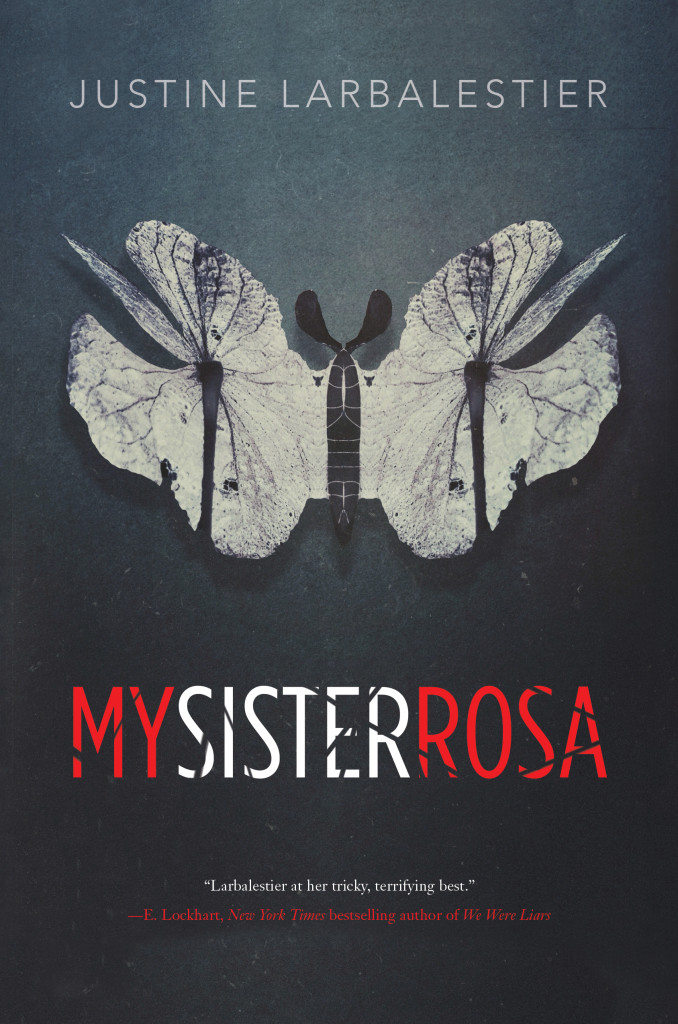
What do you think? I love it. I love the echoes of the famous Silence of the Lambs poster. It also reminds me of the cover of my parents’ edition of John Fowles’ The Collector, which I read as a kid, which I can’t find online. Boo! Which also had a pinned butterfly. It’s a wonderful evocation of psychopathy. Well done!
I honestly can’t decide which cover I like best: the Australian one or the US one.
My Sister Rosa will be out in the US in November. You can read the first chapter here and more about where I got the idea here.
Meanwhile it will be out in Australia and New Zealand in two weeks. SO SOON!
Recently I critiqued two unpublished novels. Their authors wanted to know whether they should give up or not.
There’s no clear cut answer to that question. Some great novels had unspeakably bad early drafts. Some that their author never feels happy with, and are never published, have pretty good early drafts. Who am I to say this particular novel has no hope of one day being excellent?
I have novels started years ago I’ve never managed to get into a publishable state. But who knows? Some day I might. I never give up on a novel. I just kind of abandon them for, um, a while. Sometimes a really long while.
It’s also true that I rarely go back to these abandoned novels. There’s always a newer, more shiny novel to write.
Other writers do go back to them. I know someone who only got an agent after they pulled out a long forgotten novel, rewrote it, and sent that out. It was exactly what the agent they most wanted was looking for.
However, I would definitely suggest you give up on a novel (however temporarily) if you’ve been writing and rewriting it for years. Particularly if it’s the only novel you’ve ever written. It’s more than past time to write a new one. Who knows maybe in the process of writing a second novel you’ll figure out what was wrong with the first one?
Almost every novelist I know has given up on a novel. The important thing to remember is that writing that novel was not a waste. What you learned writing the abandoned novel will help with the next one. Bigger than that: YOU WROTE A NOVEL. You did it once so odds are good you can do it again.
Sadly, the lessons learnt from writing the previous novels don’t always directly apply to the next novel. Usually the lessons are more of a what-not-to-do kind of a thing. You’ve learned not to write novels with only one character locked in an empty room. Maybe you’ve learned about creating believable characters, but sadly not much about world building or setting, because you only had that one empty room to describe.
Each novel tends to present different problems. They do this in order to keep things interesting. Thanks, novels.
So, yes, feel free to give up on a novel. But only once you have a complete draft.
If you’ve never finished a novel before, no matter how much you hate it, no matter how convinced you are that it will never work, you need to see it through to a complete draft. Especially if you’ve never completed a draft before. Scott has some cogent words to say on the necessity of writing endings as well as beginnings and middles.
It’s also good to keep trying to make a novel work. I know too many (mostly) unpublished novelists who don’t rewrite. Instead of continuing to work on the newly completed draft to make it work they move on to a brand new novel. The problem with doing that is rewriting requires a different set of skills from first drafting. You’ll never write a good novel if you can’t stand to work past that initial draft.
“But I don’t know how to rewrite!” I hear you cry.
For your convenience I have written this handy guide to rewriting. You’re welcome.
Whatever decision you make it’s going to be okay.
TL;DR There is no definitive answer on whether you should give up on your novel or not. It all depends.
This is my annual recap of the year that was as well as a squiz at what’s gunna happen in 2016. By which I mean what’s going to happen in my publishing life. I am not Nostradamus. (Actually neither was Nostradamus. He was not an accurate prognosticator.) Nor would I want to be. I’m convinced being able to tell the future is the worst superpower. I’d rather be invisible and being invisible never ends well. Just read H. G. Wells!
Um, I digress:
How my books did in 2015
 At the beginning of the year my story, “Little Red Suit,” in Eat the Sky, Drink the Ocean edited by Kirsty Murray, Payal Dhar and Anita Roy, was published in Australia and New Zealand by Allen and Unwin.
The anthology is an Indian-Australian collaboration with half the contributors from each country. Some worked in collaboration with each other to produce comics as well as short stories. I was partnered with Anita Roy. We critiqued each other’s stories. Hers is a corker: future Masterchef. I chortled. There’s not a single dud in Eat the Sky.
 In March Soho Teen published the North American edition of Razorhurst. It received four starred reviews from Publishers Weekly, School Library Journal, Kirkus and em>The Bulletin of The Center for Children’s Books (BCCB). As well as making the Tayshas 2016 list.
Meanwhile in Australia Razorhurst was shortlisted for the following awards: Adelaide Festival Award 2016, Young Adult Fiction Award, New South Wales Premier’s Literary Awards 2015, Ethel Turner Prize for Young People’s Literature, Victorian Premier’s Literary Award 2015, Golden Inky Award, Queensland Literary Awards 2015, The Griffith University Young Adult Book Awardand the Norma K. Hemming Award 2015. Razorhurst won the Aurealis Award for Best Horror Novel.
The acclaim for Razorhurst means even more to me than usual because, let’s be honest, Razorhurst is weird. It sits uneasily in a bunch of different genres. Some said it wasn’t really YA. Thus making the shortlist for the Inkys—entirely voted on by teen readers—was particularly gratifying. We struggled figuring out how to market the book. I worried it was going to disappear without a trace. So as you can imagine the enthusiastic reception has been way beyond what I let myself hope for. For awhile there all I let myself hope for was that Razorhurst would get published.
Books Out in 2016
 A year ago I thought my next novel would be out already. But then I had a nasty bout of pneumonia in January and it took forever to recover. Lungs, they do not like to be messed with. I give pneumonia one star and that’s for the silent p.
My Sister Rosa was bumped from the schedule. None of my books has ever been bumped before. It freaked me out. OMG! I’m never going to finish this book! It’s never going to be published! My career is over! But—spoiler—I finished the book. Turns out it’s better to take the time to write the best book possible than to rush into print something half-baked. In the end, I’m proud of Rosa but it was the most gruelling writing experience of my career.
My Sister Rosa is my eleventh book, my eighth novel, and seventh solo novel. It’s my sixth book with my Australian/New Zealand publisher, Allen and Unwin, which makes them the publisher I’ve been with the longest anywhere in the world. Thank you, Allen and Unwin, for sticking with me! Youse mob are a joy to work with.
For those of you who don’t know, My Sister Rosa is my take on the bad seed told from the point of view a seventeen year old boy whose ten year old sister is a psychopath. Spoiler: this does not lead to fun times. You can read the first chapter here and how I came to write it here. It’s my first novel that I can accurately describe in one short sentence. High concept! I finally managed it.
 The Australian edition will hit shops at the end of January. So soon! The finished book is gorgeous. Look at that cover. It’s beautiful and creepy, which is perfect. Also it has the popping-est spine.
Okay, I admit it doesn’t look that popping in this photo, but trust me, in real life it totally pops. People are going to see it on shelves and be compelled to pick it up and take it home. It is the Pied Piper of book spines.
There will be not one, but two, My Sister Rosa launches. For the first time I’ll be launching with someone else. Kirsty Eagar’s brilliant new book Summer Skin publishes on the same day. I’m a huge Eagar fan so launching our books together is going to be amazing. The first launch is in Sydney, the second in Melbourne:
Thursday, 4 February 2016 at 6:00pm for a 6:30pm
Double book launch My Sister Rosa/Summer Skin book launch
with the fabulous Kirsty Eagar
We will discuss
Sex and Psychopaths
And answer all your questions for we love Q&A!
Kinokuniya
Level 2, The Galleries,
500 George St,
Sydney, NSW
Wednesday 10 February 2016 at 6:00pm for a 6:30pm
Double book launch of My Sister Rosa/Summer Skin
With the brilliant Kirsty Eagar
By the wonderful Ellie Marney
Readings
309 Lygon St,
Carlton, Victoria
Hope to see you some of you there!
My Sister Rosa will be published in the USA and Canada by Soho Press in November 2016. That’s my second book with them. So far it’s been a very enjoyable experience working with the lovely folk at Soho. Wait till you see Rosa’s Soho cover! It’s every bit as good (and grey) as the Allen and Unwin cover but also very different. I’ve been blessed by the cover gods on this book.
What I wrote in 2015
I spent this year writing and rewriting and rewriting and going through copyedits and proofs of My Sister Rosa. This took longer than I thought it would and not just because of the pneumonia. Rosa was a tough book to write. For the first time in my writing life I struggled to find the voice of my protagonist. I didn’t get it right until I was well into the second or third draft. (Or was it the fourth? It’s all a blur now.) Since I’d already sold the book it was pretty terrifying. I had a finished draft and yet the narrative voice didn’t work. What even?!
Since this is my first book told entirely from the point of view of a boy some assumed it was his maleness that made finding his voice difficult. Not at all. It was how nice he is. Che Taylor is possibly the nicest point of view character I’ve ever written. He genuinely thinks the best of everyone. Even his psychopathic sister. Writing someone that nice is hard. Ridiculously hard.
I suspect this reflects poorly on me. I’m sure other writers have no difficulties writing nice. Oh, well. We all have our flaws. I got there in the end and the early responses to Che are very positive. So far no one finds him so nice they want to throw up. Phew.
I also wrote forty thousand words of a new novel this year. It’s told from the point of view of the least nice character I’ve ever written. She’s a psychopath. Yup, having written from Che’s point of view about living with a psychopath, and doing all the research to make that convincing, I started writing a novel from the monster’s point of view. It has its own difficulties but, I’m ashamed to say, it’s much easier writing from a psychopath’s point of view than from that of their empathetic opposite.
I continued blogging, but between illness and deadlines, did not manage to blog nearly as much as last year. I’m hoping to do better in 2016. I love blogging, even though apparently it’s still dying, and hate it when I have too much going on to do so regularly.
So, yeah, I plan to blog more next year, illness, weather, deadlines willing. Blogging, I love you no matter how out of fashion you are. *hugs blogging*
Writing Plans for 2016
I plan to finish the psychopath novel. It’s unsold so I can’t tell you when it will be published. My experience with My Sister Rosa showed me, once again, that I have a much easier time of it if I sell my novels after I finish them, not before. I’m lucky that I’m in a position where I’m able to do that. I think I’ve finally learned to stop worrying about how big the gaps are between my novels’ publication.
All of this writing is possible because I’m still managing my RSI as I described here. Being ill did make it worse. The fitter I am, the less trouble I have with it, and I lost a lot of fitness this year. But I’m almost back to being able to write as much as six hours a day now.
Travel in 2015
I was in the USA in April and May to promote Razorhurst and had a wonderful time. The Houston Teen Book Con was amazing. If you’re ever invited, fellow YA authors, go. It’s the first YA con I’ve been to that was overwhelming populated by teens. Wonderful!
For my travel plans in 2016 go here. I’ll be in the USA in May for the paperback publication of Razorhurst and to be guest of honour (!) at Wiscon. I’ll return in November for the North American publication of My Sister Rosa (and to complain about how cold it is).
Reading and Watching in 2015
One of the good things about being really sick is that I read a lot more than I usually do this year. I read so many wonderful books I don’t know where to start. I tweet about books and tv shows I love so if you’re looking for more recommendations you can check my Twitter feed.
As mentioned above I discovered the writing of Kirsty Eagar this year and was blown away. Everyone needs to read her NOW. I know many consider, Raw Blue, to be her best book, and don’t get me wrong, it’s excellent, but my favourite is Night Beach which is one of the best explorations of teenage female desire I’ve read. Night Beach takes on one of the dominant tropes in YA: teen girl lusting after a little bit older hot guy. The teen girl is not punished for this desire. She is not seen as freakish or slut-shamed. I could hug this book.
In Eagar’s version the guy turns out to not be perfect. He is not a wish fulfilment, but a real person with flaws, some of them misogynistic. I’ve been working on my own take on this trope and getting no where with it for years and years. Eagar has written the book I haven’t been able to and it’s amazing. She manages to write about the toxicity of masculinity, while portraying believable, not villainous, male characters. She shows how that toxic mix of masculinity and misogyny is harmful to men as well as women.
Another favourite huge favourite this year was Marjorie M. Liu and Sana Takeda‘s Monstress. Wow. Words fail. The writing. The art. It’s one of the best graphic novels I’ve ever read and we’re only two issues in. MORE PLEASE.
Then there was Nnedi Okorafor‘s Lagoon. I’ve never read a book like it before. Big and sprawling with a million points of view, including sea creatures. It’s about an alien invasion that starts in Lagos, Nigeria but, really, that’s just the starting point. It’s about much more than that. It’s one of those books you’ll get something different out of ever time you read it. Yes, I’ve already read it twice.
I also loved Ashley Hope Perez’s heartbreaking Out of Darkness set in late the 1930s in a small town Texas. It should win all the YA awards.
This year I decided to read something I normally hate: a cosy mystery. You know one of those mysteries where everything is tidily wrapped up at the end and everyone lives happily ever after? An Agatha Christie kind of mystery. They are so not my thing. But then someone was raving about Barbara Neely’s Blanche White books and they sounded interesting. I read the first one, Blanche on the Lam about a black domestic worker who escapes after a judge gives her a custodial sentence for being late paying a fine. She winds up being housekeeper to a deeply dysfunctional wealthy white family, and solving their assorted crimes, while delivering much pungent, and often funny, commentary on racism and misogyny while resisting her employers’ desires to turn her into a mammy. I really enjoyed it and can’t wait to read the rest of the series.
I also read much non-fiction this year. I re-read The History of White People by Nell Irvin Painter. It’s a book every one should read, particularly Americans, as the USA is her primary focus. Her book demonstrates that white is not universal, that white is not neutral, that it has a history, which she eloquently delineates. It’s not often you finish a book understanding how the world operates better than before you read it.
I was wowed by Margo Jefferson’s memoir, Negroland, which is about growing up black and privileged in Chicago in the fifties and sixties. It was a window into an alien world. Obviously, I’m not black, but what was really alien to me was her family’s focus on respectability. I was never taught when to wear white gloves, what length skirt is appropriate. The only reason I’ve ever had to wear a hat is to avoid skin cancer. But I’ve known white Australian girls from wealthy families who were sent to posh private schools, who knew all of that stuff, and I think would recognise much in Jefferson’s book. What I related to most strongly was the sexism and misogyny she had to battle.
One of my fave new TV shows is Into the Badlands because martial arts staged well and magically and saturated colours and eye candy and coherent plot and world building. It has a strong diverse cast. Except, well, I’ve been noticing this a lot lately in US TV shows and movies, even when several of the big roles are given to PoC, the extras are still overwhelmingly white. And there’s never any world-building to explain why in the future the world is 90% white.
I also enjoyed Ready For This, which was created by the people behind Dance Academy and Redfern Now, and really it’s what you’d get if you crossed Redfern Now with Dance Academy. I.e. heaven.
2015 was awful but there’s always hope
I was sicker this year than I’ve been in years. It made everything else much harder. I spent the year behind on deadlines and everything else. It’s only now in December that I feel even slightly caught up. 2016 has to be better.
2015 was an awful year in both of my home countries, Australia and the USA, and in way too many other parts of the world. I would love to say that I’m full of hope for change in the future. I try to be. But then more awful shit happens and nothing is done to stop it from repeating. History, we are not learning from it.
In Australia we have a government actively undoing what little progress had been made on climate change and stripping money from all the important institutions such as the ABC, CSIRO and SBS. The new PM, Turnbull, while a vast improvement on his predecessor is not doing much, if anything, to slow that process done. Sure, he’s less anti-science and anti-culture than Abbott, but low bar, and there’s not a lot to show for it beyond rhetoric. We still have disgraceful policies on asylum seekers and Aboriginal Australians continue to die in custody.
Last year I wrote: May you have a wonderful 2016 full of whatever you love best and may the world become less unjust. Speaking out and creating art that truly reflects the world we live in goes part of the way towards doing that. At least that’s what I hope.
I feel the same way now. Happy new year! May 2016 not be vile.
This poem was first published when I was nine. First in the Newcastle Morning Herald and then later in the feminist magazine, Refractory Girl.
I can fly.
They say I can’t.
They don’t exist.
I can fly.
They won’t believe me.
They aren’t real.
They can’t understand me
They won’t understand me
They don’t understand me
They say I’m mad
no-one can fly.
I can fly
They’re dead.
The day after it published in the local newspaper some of the kids at school demanded that I fly for them. They recited the poem back at me and laughed in my face. I spent the day wishing I’d never written it but also basking in my teachers’ praise.
The next day the other kids had forgotten about it but the teachers were still praising me. Yup, I was still buzzing about being an actual published poet. I enjoyed and was weirded out by the publication and attention thing. Praise = good! Kids laughing at me = oogie!
It was an early lesson in the gap between writing and publication. The writing part is private and often wonderful. Publication and public responses to the writing is a whole other thing. I’ve been doing my best to keep that in mind ever since.
My NaNoWriMo ends today. The following is what I thought of the NaNo experience, which let’s be honest, is not aimed at someone like me, who’s already a professional writer with multiple novels already published for whom writing is my job. So take it with a massive grain of salt.
I have been writing every day for 56 days in a row. Twenty-five of those days took place during NaNo. Before NaNo I was averaging about 300 words a day. During NaNo I averaged 700 words a day.
I already knew that gamification works on me. I’ve been using Scriveners’ Project Targets for years so that when I reach my word count goal my program congratulates me. Why, yes, I do take a bow.
Obviously, for me the NaNoWriMo word count goal is too high. It’s been at least a decade since I averaged anything like 1,667 words a day. So I went in with the lower goal of 10k words for the month in mind. I passed that goal on Day 12.
 I enjoyed watching the word counts of my “writing buddies” going up. There definitely was an increased sense of camaraderie. I am not in this alone! Look at all these other people striving to finish their novels! Look at their bar graphs going up! I would love to have a stats page like the NaNo one for all my novels. I loved that bar graph.
But . . . by the second week the 1,667 words a day expectation was starting to get to me and the ever-increasing words per day in order to finish on time was really freaking me out. The line on the bar graph shows you every day where you’re supposed to be and I was never even close. I only hit 1,667 twice. I was starting to feel like a failure for not hitting 1,667 words a day and falling into the bad habit of typing in order to hit the word count, rather than choosing the right words. I was starting to hate that bar graph.
On day 16 I had a stern talk with myself: Are you a writer, Justine, or are you a typist?
I spent that day reading everything I’d written of this new novel, rearranging and deleting loads of it. It was my best writing day of the month. Not because it was a 1k day but because I was really happy with those words. I’d started to figure out what the novel’s about and where it’s going. I was beaming.
From that day on I went back to my usual practice of starting each writing day by reading over what I wrote the day before, editing it, and only then writing new words. I was back in the rhythm of my novel and feeling happy. I wasn’t thinking about word counts, I was thinking about the novel.
NaNo didn’t work for me because I struggled to get that massive word count goal out of my head. Yes, I wrote more, but much of that excess of words was more typing than writing.
I would have loved NaNoWriMo back when I was a teen writing obsessively and feeling like I was the only one on the planet who was trying to write novels. It would have given me a structure and a community. I would have been in heaven. And, wow, would I have blitzed that measly 1,667 words a day goal. Those were the days when I could write a 5k story in a day without breaking a sweat.
Also back then I had no clue about rewriting. I thought you were supposed to produce perfection in your first draft. NaNo dedicating January and February to Now What? would have clued me into the whole rewriting thing much much sooner. How lucky you all are!
I won’t be doing NaNo again. I’m too competitive. I really wanted to hit that word count goal even though it would have played havoc with my RSI. Despite my self-pep talk I’m still annoyed I didn’t come close to 50k. But I’m really glad I tried it. I’ve been recommending NaNo for years without actually knowing how it worked. It really is a pretty sweet and easy to use interface.
It’s proven itself over and over again to be just the thing for new writers who keep getting in their own way. Finally, someone is giving them permission to just write! And they do.
It also had the lovely side effect of getting me to check in more frequently with my writer friends on where they are with the latest. Knowing that you’re not alone with your novel, that there other people sweating over theirs, is reassuring. We humans are social creatures. We mostly prefer to suffer together.
The following are some little tweaks I’d love to see on the NaNo pages:
I would love it if you could edit your stats page to put your own word count goal in. Mine would have been 300. It would have made that line on the bar graph far less intimidating.
More writing achievement badges! At the very least one for ever 5k increment would be lovely. The jump from the 10k badge to the 25k badge and then from the 25k one to the 40k one is too steep. More rewards = more better!
I’d also love it if the word counts continued to be visible even after people hit their 50k goal. So instead of just seeing that those writing buddies are WINNERS! you can see that they’ve continued writing. It would be a good reminder that hitting 50k is not the end goal—finishing a novel is. (For those who didn’t know 50k is a very short novel. Most are at least 60k. Razorhurst was 90k. It’s not a long novel.)
TL;DR: NaNo’s fab but didn’t work for me. However, my younger self would’ve loved it.
National Novel Writing Month begins on the 1st of November every year. I’ve been a supporter since I first heard of it way back when and in 2009 Scott and me turned our blogs over to a month-long series of NaNo writing tips which start here.
Despite being aware of it for more than a decade this will be the first time I’ve formally done NaNoWriMo myself. I figured I’d give it a go because I was asked to do a NaNo pep talk, also Scott’s doing it this year, as well as many other friends, and I’ve met some of the people who run NaNoWriMo, like Rebecca Stern, and they all seem lovely.
But mostly I’m doing it because I already have the first 17k words of a new novel. I thought it would be fun to spend the next month writing it in the company of thousands of others all over the world.
I doubt I’ll hit the 1,667 per day you need to write 50k words in a month. The most I’ve written in a day over the last few years is about 3k and that was followed by a few days of not writing at all. Mostly I manage around 300-400 words a day. My personal goal is 10k words for the month. We’ll see.
Good luck to all you Wrimos! Take frequent breaks! Stretch! Drink lots of water! Don’t forget to eat and go for walks! May you all write like the wind.
No, not in that way. Stop snickering.
Not all of them, obviously. Like adults, some are lovely, some are complete shitheads, and some are a bit meh. But unlike the majority of adults, teens mostly don’t temper their enthusiasms, they haven’t had their enthusiasms squashed down for them yet. Yes, some have a wall of fuck-you, but when you break through that wall of fuck you, it stays broken.
On my first book tour, for How To Ditch Your Fairy, I was sent around the USA to talk to mostly years 6, 7 and 8. In the US they segregate those years into what they call middle schools. Middle schools are notoriously hellish. All my YA/middle grade writer friends who were veterans of many tours were deeply sympathetic and told me horror stories of being pelted with rotten fruit and being asked probing literary questions such as, “Why are your clothes so shit?”
Thanks, you bastard writer friends, for filling my heart with terror.
On that first tour I visited gazillions of middle schools. They were all fabulous. Not a single projectile was thrown and my western boots were beloved. So was my accent. I highly recommend touring the US if you have a non US English-as-a-native-language accent and cool boots.
A quick aside: what I was meant to be doing was flogging my books, which was pointless as most teens do not show up at school with the money to buy books. (The only exception is the insanely rich private schools with stables and croquet courts where each kids has an expense account and three hundred copies of my book sold in a day. STABLES, people!) What I actually did was not talk about my book much at all.
My favourite visit of the entire tour was at a public school (without a hint of a stable) in the Midwest. I was abandoned in the library by my publicist and the librarian in front of three classes of mostly 13 and 14 year olds. There were at least 60 teens and me. Every writer in this situation develops an if-all-else-fails move. Mine is vomit stories. This is the story I told them. Their response was to ask me to tell more vomit stories. Much fun was had.
When we got to Q&A they wanted to know everything there is to know about Australians, a people with whom they clearly had a lot in common. So I may or may not have told them that wombats fly and echolocate and aerate the earth, which, is, in fact, why they’re called “wombats” because they’re a cross between a worm and a bat. The questions and answers went on in that mode. We all laughed our arses off.
You’ll be pleased to hear they DID NOT BELIEVE A SINGLE WORD. One actually said, “You are the best liar ever.”
I conceded that, yes, bullshit is an art and that I have studied with the very best.
They all cheered.
Sadly, I praised the fine art of bullshitting just as the librarian and publicist walked back in. They were unswayed by the approval of my audience.
Cue lecture on not swearing in front of students. To which I did not respond by pointing out that in my culture shit does not count as swearing. Mainly because I wasn’t a hundred per cent sure I hadn’t said any of the words that count as swearing for all cultures ever. Their main concern, of course, was not the students, it was the parents. The librarian really didn’t want to deal with all the complaints they were sure they were going to get because of my praise of bullshit.
No teen has ever told me not to swear or complained about the shits and fucks and arseholes in my books. Nor have they ever complained about the sex. Or violence. They have, however, complained that my books start too slow, that no teen would ever be allowed the freedom that the teens in my books have, and that I don’t write fast enough, what am I? The laziest writer in the world?
Teens also, you’ll be stunned to hear, do not complain about the so-called fact that teens don’t read.
My hairdresser does. He has apparently read every single one of the gazillion panicked articles about the the current generation’s total lack of literacy. Seriously every time I go in he will say, once we’ve gotten past all the neighbourhood gossip, “I hear kids aren’t reading much these days.”
And I will say for the gazillionth time, “Actually, teens today read more than any previous generation of teens. They are readaholics. They are a huge part of why the genre I write, YA, is such a huge seller with double digit growth every year for well over a decade.”
“My kids only read comic books.”
“That’s reading! Reading graphic novels and manga requires a level of literacy with images and language that many adult readers struggle with. Furthermore, not only are teens reading more than ever before. They are also writing more. They write novels! Did you write a novel when you were thirteen? I didn’t. Teens today are a literacy advocate’s wet dream. Also, my lovely hairdresser, you need to stop reading the [redacted name of tabloid newspaper].”
This is why I love teens. They don’t get their information from [redacted name of tabloid newspaper]. Most of them are a lot better at spotting bullshit than your average adult and they’re way less prone to repeating the warmed over moral panics of the last hundred years. The sheer breadth of their reading is astonishing. They read novels, and comic books—sometimes backwards—and airplane manuals and games reviews and they write songs and poetry and stories and novels and think about words and language and invent slang in ways that most adults have long since ceased to do.
Can you imagine a better audience?
My comments on white people writing People of Colour in these two posts has created a wee bit of consternation. This post is to clarify my position.
First of all: I am not the boss of who writes what. This is what I have decided for myself after much trial and error and listening and thinking and like that. Do what works for you.
I have decided to stick to white povs when I write a book from a single point of view. This does not mean will I no longer write PoC characters. There are people of different races and ethnicities in all my books. I have never written an all-white book. I doubt I ever will.
I didn’t make this decision because I was called out for writing PoC. Before Razorhurst all my main characters were PoC. The response has been overwhelmingly positive.
The decision has more to do with the way the debate about diversity in Young Adult literature plays out. Almost every time the overwhelming whiteness of YA is discussed a well-meaning white authors says, “I shall fix this. My next book will have a PoC protagonist!”
I cringe. All too often the white folks saying that don’t know many people who aren’t white. They rarely socialise with them. There’s a reason for that. As many as 75% of white people in the USA have entirely white social networks. I’m sure the numbers are similar in Australia.
That’s why I now largely recommend that white people with little experience of PoC don’t write from the point of view of PoC characters. Research will only take you so far.
Writing about PoC when none of your friends are PoC is not the same as writing about an historical period you weren’t alive for. If you perpetuate stereotypes you hurt living people. When you don’t know any PoC, even with the best research in the world, you’ll get things wrong. Stereotypes are harmful. Especially when you don’t realise you have written a stereotype.
Who are you going to get to read and critique your work if everyone in your social circle is white? Are you going to ask someone you don’t know very well? It’s a huge thing asking someone to critique your work. It takes a lot of work and if they don’t know you well how do they know that you’ll be receptive to them pointing out racism in your work?
We whites are notorious for freaking out when PoC so much as hint that something we did or said is racist. Many of us seem to think it’s worse to be called on our racism than it is for a PoC to experience racism. Even though being called racist can not kill us.
On top of all that I’m increasingly unconvinced that white people writing more people of colour solves anything. According to the Cooperative Children’s Book Center this year whites wrote most of the YA books with African-Americans, American Indian, Asian Pacifics/Asian Pacific Americans and Latino main characters.
Representation is improving but it’s mostly whites doing the representing, which is part of the problem. We need more writers and editors and publicists and publishers and booksellers of colour. We need publishing to be more representative of the countries we live in. Right now US publishing is 89% white. Australian publishing is at least that white.
We white writers could do more to increase diversity in our industry by drawing attention to the work of writers of colour. By mentoring, introducing them to our agents, by blurbing their books, by making space for them at conventions and conferences, by listening. Check out Diversity in YA. Malinda Lo and Cindy Pon and the others involved with that organisation have lost of concrete ideas of how we can make YA more diverse and inclusive.
The other reason I’ve shifted to predominately white points of view is in response to all the critics who’ve pointed out for many, many years that too many white writers think they can only tackle race through the pov of a person of colour. The implication is that race is something white people don’t have. We just are. We’re colourless neutrals.
No, we’re not.
Expectations about our race—our whiteness—shapes our lives as much as our gender or our sexuality or our class. Yet all too many whites are unaware of it.
I wanted to write about how whiteness obscures our understandings of how we are who we are and of how the world operates. For the next few books, including Razorhurst, I’ve been pushing myself to examine whiteness in my fiction.
A recent book that does this well is All American Boys by Jason Reynolds and Brendan Kiely. The character written by Kiely has to confront the ways in which his whiteness makes him complicit in the racist violence inflicted on Jason Reynolds’ character and what he can do about it.
Overt racist violence is not at the centre of Razorhurst or My Sister Rosa or of the book I’m currently writing. I’m looking at the less overt ways in which whiteness shapes lives.
I fully expect many of the people who read these books won’t notice. That’s okay. Many readers didn’t notice that everyone in How To Ditch Your Fairy is a person of colour. Books do many different things. No one reader is going to notice them all and many readers are going to see things the writer didn’t intend. It’s how it goes.
In all my books I try to tell a story that engrosses readers and lets them forget the real world for a few hours. That my books do that for even a handful of readers is glorious.
TL;DR: I’m writing predominately white pov characters because of reasons listed above. You do as works best for you.
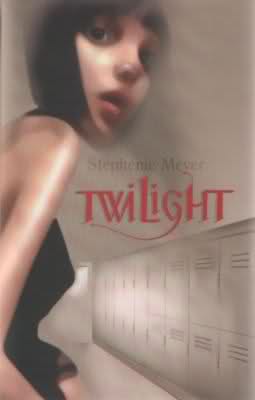 In 2006 when Twilight was published in the UK it looked like this. What were they thinking? This cover conveys nothing about Twilight. You’d never think it was an angsty romance between cranky teen girl, Bella, and perennial teenage virgin vampire, Edward.
This would be a great cover if it was about a terrifying three-metre tall alien takeover of a high school. Or as Jennifer Laughran suggested a tale of about an elven princess who joins the military. I would totally read either one of those books. But it does not match Twilight. Especially when you compare this cover to the US stark black with red apple in hands one, which perfectly captures the book.
You will be unsurprised to learn that Twilight tanked when it first came out in the UK. It only took off after rejacketing with the original US cover.
Jackets matter. OMG do they matter. They have to convey what the book is about, they have to make you want to pick up the book. If you read the book and it doesn’t resemble the cover—in a way that makes you feel lied to—you are likely to be cross.
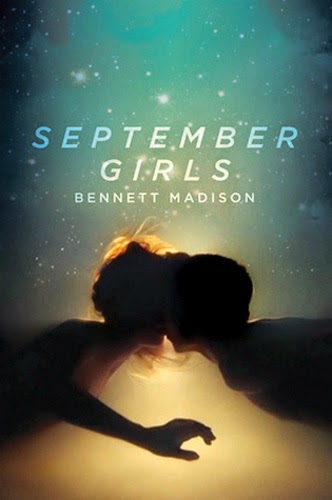 A few years ago the wonderful Bennett Madison had a book out called September Girls, which is a gorgeous and weird poetic meditation on masculinity, femininity and misogyny. Yet look at the cover.
To me it screams summer romance. Possibly one that will tug at your heart strings, be a bit melancholy and wry. But definitely a romance. September Girls is not a romance. This is entirely the wrong cover.
A book that is published as a romance—as opposed to a book that is romantic or a love story—has to have a happy ever after ending and the romance has to be the A plot. The very centre of the novel. September Girls is not remotely a romance. It’s almost the opposite of a romance.
Some of the book’s first readers reacted badly to it. I’m convinced that part of that was because of the misleading jacket. (Though it didn’t put off the leading review journals who gave September Girls many much-deserved starred reviews.)
I am sympathetic to this reaction. I have read books that were billed as romances that did not have happy endings and I was most displeased. I read romances at least partly because of the surety of that happy ending. I often read them when I really need a happy ending. It feels like a punch in the stomach if I don’t get one. The cover lied to me! Unacceptable!
But there are other books where the cover doesn’t match the story and I’m not angry because it feels more surprising than a lie. For example, I find both Jenny Han and Sarah Dessen’s books to be more complicated and interesting than their breezy, summery covers led me to believe. But it felt like a bonus not a minus.
Why does this happen? Many people have input into the final jacket of a book. Not just the editor, but also sales and marketing, as well as the major accounts they’re trying to sell to. Some of those people won’t have read the book. That means they’re only looking at what they think will sell. It’s harder for them to judge whether the cover is a good match for the book.
The other factor is that many readers don’t seem to care. Publishers have seen books with misleading covers do really well. And as with Han and Dessen sometimes misleading is not a bad thing.
It’s incredibly hard to get the right cover. I celebrate every time my books get a cover that doesn’t make me cry. Which, I hasten to add, has been for most of my career. I’ve been very lucky. What covers do you think most successfully convey the book within?
Not all white people are racist.
True. Also irrelevant. Not all white people are racist but we all benefit from being white because we live in a world that is structured to give white people advantages and that makes whiteness the default.
#notallwhitepeople is also an attempt to change the subject from people of colour and racism to how most white people are good and why are talking about racism anyway?
Sexism is much worse than racism.
Unknowable. However, we do know that being a white woman is easier than being a woman who is not white. The funny thing about oppression is that it operates on multiple axes, you can be black AND a woman. You can be black and a woman and disabled and a lesbian. These are not separate categories, which is why intersectionality is so important. Thank you Kimberlé Crenshaw for giving us a way to talk about oppression in a more nuanced way.
Some white women bring up sexism in conversations about racism with women of colour. We change the subject to sexism because it is something we can talk about with authority, unlike race, where we often feel uncomfortable because we have a vague feeling that it’s somehow our fault. Quick! Let’s talk about something else! We white women need to remember that WoC know as much, if not more, about sexism as we do. They do not need to have sexism explained to them. They are aware. So. Very. Aware.
We white women also need to remember that feminism does not have an entirely unracist history. Some of the suffragettes in the USA were also members of the Klu Klux Klan and fought for the vote for women because they were outraged that black men could vote and they couldn’t. Even though in practise many black men were prevented from voting. Always know your history.
I don’t see colour.
Get your eyes checked.
When white people say they don’t see colour what they’re saying is that they don’t notice what race someone is. Let’s just say that’s possible and you really can’t tell what race anyone is—how is that contributing to a discussion about racism? You’re making the conversation about you and your perceptions of the world. The people who experience racism see the world differently. We’re talking about them, not you.
Why aren’t we talking about class? Lots of white people are poor, you know. Capitalism is the root cause of all suffering. Discrimination against the working class is worse than racism.
Unknowable. Once again instead of talking about racism the subject is changed. Let’s not talk about race, let’s talk about class! Let’s not.
And once again with forgetting that people of colour can also be working class and thus suffer the double whammy. Or triple whammy if they’re a woman. Or quadruple if they’re disabled. Etc.
Let’s not forget that rich, famous POC still suffer racism. Oprah has been discriminated against because she’s black. More recently tennis star James Blake was attacked by the New York Police. There are endless examples.
Me? Privileged? My parents worked in a coal mine! My mum was murdered! I have no legs! I live in a hole on the side of the road!
I’m sorry for your suffering but you’re changing the subject. We’re talking about racism not about how you have suffered. Everyone has suffered. Most of us have been discriminated against in one way or the other. But that’s not what this conversation about. We’re talking about race.
I’m not racist. My ancestors didn’t own slaves. This is not my fault.
Congratulations. Also irrelevant. White supremacy gives all whites an advantage PoC don’t have regardless of their individual actions. Systemic racism is not about individuals being good or bad. It’s about whole systems discriminating. Those systems need to be torn down.
White is a broad category. You can’t put wealthy USians in the same category as poor Romanians.
White is indeed a broad category. So are statements that can be used to change the topic from talking about racism like this one.
Whiteness is also a changing category. It used to be that Jews and the Irish and Italians weren’t included as white. But now they are. Talking about past constructions of white when we’re trying to talk about racism here and now is changing the subject. Don’t.
You know what else is a broad category? People of colour. Think about how many different peoples are encompassed by that term in the USA. Many of them with little else in common other than being discriminated against because they’re not white.
Why do we have to keep talking about racism? Obama is in the white house.
Because racism still rules our lives. Mango is a fruit.
In case you don’t get it that’s me sarcastically pointing out that there is little connection between those two statements. There have always been exceptional PoC—Harriet Tubman, Sojourner Truth—who’ve managed to succeed despite the overwhelming odds against them. It says little about systemic racism.
Slavery was ages ago. Blacks people should stop using it as an excuse.
Actually slavery wasn’t ages ago. Trust me on this. Or, you know, read this book or watch the movie.
Long-term institutional oppression is not an “excuse”. Read this. No, really, you need to read Ta-Nehisi Coates explaining the systemic reasons black people in the USA are worse off than whites. It was true in the past and it is true today.
Asian people earn more than whites in the USA! They’re not oppressed.
How many Asian actors are there playing leads in Hollywood movies? How often do you see Asians on your tv screen? How many books are there by Asians on bestseller lists? And this is a problem even in Asian countries like Singapore.
Leaving aside representation Asian-Americans do extremely well in high school yet a lower percentage go to elite universities in the US than whites.
Being held up as the “model minority” has a myriad of downsides.
Yes, racism is terrible I’m going to fix it by writing novels with more POC characters even though I know very few POC.
We absolutely need more books with PoC characters but we also need those books to be written by PoC. Sometimes write what you know is good advice. If you only know white people stick to writing white people. Right now in YA publishing there are more PoC characters written by whites than by PoC. That’s part of the problem.
Also, while I agree that representation is hugely important, better representation won’t automatically fix everything. If only . . .
My great great great great grandmother was Comanche so I understand.
*head desk* Okay, yes, if you go far enough back we all have mixed backgrounds. I’m a descendent of Genghis Khan. But so is a 0.5% of the world’s population. In my day to day life no one is looking at my epicanthic fold and thinking I’m anything but white. There are, obviously, many white passing PoC. I am not one of them. Nor are you with your great great great great grandmother. We were both raised white by white parents. Every day we benefit from our white privilege. We are white.
We white people need to stop trying to make everything about us. Every one of these strategies is about changing the subject to make us the centre of the conversation. Enough already. Often the best strategy is to sit and listen and read and learn.
Here are some other posts on what white people shouldn’t be saying when discussing racism. Via @fonticulus and @SamJBrody
TL;DR We white people need to stop changing the subject so that we talk about anything other than racism.
Note: While much of what I’m saying here applies more broadly, I’m largely talking about the USA because that is the country whose history I know the best. And, yes, before you say anything, I am a US citizen. I am an Australian-USian.
There are many many more examples of what not to say. Please add them to the comments. Thank you!
I have written many times over the years about people criticising our work being an inevitable part of being a writer. I also think it’s essential. We need criticism.
Lately I’m seeing people arguing that there’s too much criticism of Young Adult literature and it’s now stopping people from writing because they’re too scared their work will be shredded. I’m bummed people feel that way because I wish there were more criticism.
While we have a broader and better conversation about intersectional representation then we’ve ever had it’s still not enough. Far too many popular books get a pass for pretty appalling representations. And far too many people who speak up to criticise those books and writers get yelled at for not being nice.
According to the Cooperative Children’s Book Center this year whites wrote most of the YA books with African-Americans, American Indian, Asian Pacifics/Asian Pacific Americans and Latino main characters. So while representation is improving it’s mostly whites doing the representing.
We need more books about POC written by POC. Those books must outnumber the books by whites about POC. It matters that there’s space for everyone to tell their own story.
Until we reach that glorious future it’s essential books about other ethnicities and races written by whites are criticised by the members of those communities. Stereotypical and harmful books need to be pointed out.
Will every POC agree that a book is problematic? Of course not. None of these communities are monolithic. Liar has been criticised for being racist by African-American readers. It’s also been defended against those charges by African-American readers.
It is also not saying that those books that are criticised for stereotypical portrayals of POC should be burnt. No one’s calling for book burning or banning. That seems to get lost in these debates.
The problem is not criticism. The problem is there are too many books about white people and there are too many books about POC written by white people. The problem is our book culture keeps reinforcing the message that white people are more important.
If you are being stopped from writing a book about people of a different race or ethnicity by the fear of being criticised maybe you shouldn’t write that book? Write a book about white people. You will then be criticised for writing yet another book about whites. Which do you think is the bigger problem? There is no option you get to pick where you don’t get criticised.
I’ve heard many POC critics point out that most white writers only feel they can write about race from the point of view of POC. This feeds into the idea that “race” is not something that white people have. We are neutral. We are somehow outside race. Newsflash: no one is outside race.
That criticism really made me think. What is whiteness? What does it mean? How is it constituted? Why is it so harmful? Out of that I wrote Razorhurst and now My Sister Rosa. Two books with white main characters that are about race.
I now agree that me writing from the point of view of POC characters is part of the problem. I won’t stop doing it—I have a large multi-viewpoint book I’ve been working on for many year that has many POC povs—but right now I want to keep writing about race from white points of view.
Writing for many of us is an act of courage. It was years before I showed my work to anyone. I couldn’t risk myself by letting anyone see what mattered most to me: my writing. I survived.
Having my work described as racist hurt. But that pain is nothing compared to the harm experienced by the readers who found my work racist.
Everyone who writes, no matter what their skin colour, gets criticised. We white writers need to remember that POC writers tend to get more criticism for writing about their own people than we do.
What we should do in response to criticism is not demand that the criticism go away. We should listen. We should learn. We should keep on writing.
We should keep demanding that there be more books about POC by POC. A great way to do that is to buy the ones that are already out there.
One of my favourite TV writers, Sarah Dollard, recently wrote some beautiful writing advice, which is applicable to all kinds of writing. Go read it!
I want to bring particular attention to this:
Be critical of film and TV, even the stuff you love . . . If you want to be a truly good writer, you can’t have sacred cows. If other people think an episode of your favourite show is sexist or racist or short-sighted in some way, hear them out and consider their point of view. You can enjoy a piece of media while also acknowledging its shortcomings. However, if you hold your favourite writer or producer above criticism, then you’ll likely fall into the same traps as they do, and you too may alienate or hurt people with your work. Accept that no one is perfect, not even your hero. Accept that no one’s writing is perfect, even if it’s hugely entertaining; we all have unconscious hang-ups and prejudices, and many of us write from a position of privilege. One of the best things you can do as a writer (and a person) is to listen to the way other people receive stories.
Because every word is the truth. We do not write in a vacuum. We write about the real world while living in the real world. That’s true whether we are writing about zombies or vampires or high school or genocide or butterflies or all five. Our words have effects on other people.
We need to be mindful of the history of the genre we write. For example, I’m watching Fear of the Walking Dead because I love zombies and will watch anything with even the slight possibility that a zombie might show up. Fear is a spin off from The Walking Dead. One of the biggest criticisms of that show is how few black people there are. There were hardly any black extras either, which is particularly weird given that it’s set near Atlanta which has one of the largest African-American populations in the USA. You would think that the creators and writers of Fear of the Walking Dead would be aware of that criticism. Yet the only named characters killed in the first two episodes were black. Seriously? You couldn’t kill a white named character? You couldn’t let one black character survive?
They ignored the history of their particular franchise and the broader history of US TV where black characters have always been treated as disposable. What were they thinking? They weren’t. They sat inside their blinkered world and wrote from there. Don’t do that.
Critiquing the things we love can also give us insight into the failings of our own work. As Sarah says “listen[ing] to the way other people receive stories” gives you a richer understanding of how our stories can be read and of what stories can do.
I wrote about the racism in my own work three years ago. I would write a very similar post if I were to write it today. It is essential to know as much as we can about our genre and its pitfalls when we write. Otherwise we’ll make the same mistakes.
I write YA. It’s a genre that in Australia, the UK and the US is overwhelmingly about white, straight, middle-class teenagers and overwhelmingly written by white, straight, middle-class authors. The blind spots of my beloved genre are many. This is why we have organisations like Diversity in YA founded by Malinda Lo and Cindy Pon. They have a whole section where they look at the statistics on diversity in YA. I highly recommend checking it out.
All too often white writers who create POC characters expect to be congratulated for having made the effort and do not deal well with criticism of those characters. We forget that POC writing POC get criticism too. Have a look at the criticism African-Americans get for not representing their community in a positive way and for not writing uplifting books.
We must also remember that diversity is not just about who is represented in the story and on the covers of those books, which, yes, is deeply important, but also about who is writing and publishing the books. Having most of the POC characters in YA written by white authors is not a huge improvement.
Everyone gets criticised. No writer is perfect. Jane Austen couldn’t write a satisfying ending to save her life. Her books just end, people! So annoying. Georgette Heyer was a racist, anti-semite, full of horrible class prejudices. If she were alive today she’d be embarrassing the shit our of her fans on twitter every day. She and Rupert Murdoch would probably be besties. I still think Heyer’s one of the best comic writers of the twentieth century.
TL;DR: Read Sarah’s wonderful writing advice. Our writing heroes are fallible so are we. We must know the history of what we write. Listen to how other people respond to stories. Just listen!
The publishing category of YA (Young Adult) started as a category about and for teens. But it has always been controlled by adults.
Right now YA is one of the most profitable publishing categories in the USA. That’s largely because of the huge growth of the adult readership. Put it this way: the Hunger Games has sold more copies than there are teens in the USA. Adults reading YA has transformed it from a sleepy back water to a mainstay of publishing, film and TV.
But make no mistake, the initial readers of The Hunger Games who clamoured for it loud and long were teenagers, who bugged their friends and their siblings and their parents to read it. Teens are almost always the first adopters.
Before Harry Potter the big market for YA books was schools and public libraries. The trade market (bookstores) was relatively small. That meant that for a YA book to do well it had to sell to adult gatekeepers. Which mostly meant YA couldn’t have sex or too much swearing or be too weird. It also meant most YA taught a clear cut lesson. Rereading YA from the 1970s and 1980s I was struck by how moralistic and earnest a lot of it was. Reread The Chocolate War some time. PREACHY! No wonder the Sweet Valley High books were such a hit. Those books ignored what adults wanted teens to read and gave teens what they wanted to read.
The schools and library gatekeepers were, and still are, under a lot of pressure to keep their book collections “clean”. You only have to look at the American Library Association’s annual list of challenged books to get an inkling of the kinds of pressures many school librarians are under. I salute each and every one of them. They bring those challenged books into their schools because the teens want to read them.
Like it or not, the influx of adult readership has expanded the range of YA books that can be published. It is now possible for a YA book with content that would keep it out of many school libraries to make money. Lots of money. This is a huge development and has led to the existence of books like The Hunger Games, Octavian Nothing, The Legend series and We Were Liars. In other words all the books we now think of as YA.
Teens have more say about YA books now than they did when The Chocolate War came out. Publishers are listening to teens more because social media has given teens a bigger voice.
But, yes, publishers will always listen hardest to money.
I write books that many adults say are more adult that YA. Yet I know I have teen readers who love my books. I tender as proof the fact that Razorhurst is currently on the shortlist for the Inkys, an award entirely chosen by teens. They choose the longlist, the shortlist and the winner.
It’s unlikely Razorhurst would have been published as YA in the olden days. I’ve already been told by librarians in conservative parts of the US that they can’t keep it in their library much as they want to. So I am personally very grateful for the ways in which YA has changed. Without it I would not be able to write YA.
It’s never been teens demanding YA be “clean”. That demand mostly comes from concerned parents.
This is the case with all the books that are popular right now with teenagers. YA as it is now exists because publishers stopped listening to adults about what teens wanted—moral lessons! upstanding characters!—and started publishing books teens wanted—plot driven! exciting! romantic! complex!—which had the ironic result of more adults wanting to read YA.
Adults still control YA and always will but there never was a teen YA utopia where the books were chosen by teens. There are reasons me and many of my peers refused to read YA back in the 80s when we were teens. Those books were mostly unbelievably boring. We read Flowers in the Attic instead, which, I’m pretty convinced would be published as YA now.
Because of social media the contact between authors and readers is closer than it’s ever been. For me one of the many delights of Twitter is being contacted by readers enthusiastic about my books or blog posts. Wonderful! I have many readers from all over the world I’ve known for years through my blog and Twitter. We’ve become friends. I love how Twitter enables me to fangirl my favourite authors, such as Laura Lippmann and Courtney Milan.
Twitter makes it easier to rave about the books I love. The thought of writing a proper review daunts me. Fortunately blathering on Twitter takes seconds. Why, yes, I have spent much time this year tweeting about how Nnedi Okorafor’s Lagoon is one of the most complex, dense, witty, wondrous science fiction novels I’ve ever read. Seriously, people, READ IT!
I also use Twitter to discuss politics, basketball, cricket, social justice, history, fashion, the publishing industry, Hollywood, food, wine, quokkas, So Many Things. I dispense and receive writing advice. I gossip with friends. I occasionally let people know when my books are out, share news about how my books are doing, especially when they’ve won an award or something like that, because, WOO HOO!
I don’t, however, view social media as a sales tool, or my readers as customers. I’m not on Twitter to sell books. I’m there to have fun and to learn.
There are authors who view Twitter differently, who feel it is a sales tool and that their job is to broaden their brand, and that part of doing that is to be as inoffensive as possible, as “nice” as possible—particularly to potential readers. Their golden rule is never be rude to a fan because they’ll stop buying your books.
I totally agree we authors shouldn’t be rude. I don’t think anyone of any profession should be rude. The problem, alas, is that no one can agree on what constitutes rudeness. Rude is in the eye of the beholder.
I’ve only been accused of rudeness a few times on Twitter but it’s always for the same thing. Someone asks me to explain an acronym or phrase and I sarcastically remind them of google or ask if their google is broken. If the answer can’t be found via google which does happen occasionally I explain.
Now the folks of the Twitter-is-a-sales-tool, my-every-book-sale-depends-on-being-“nice” camp are not fans of sarcasm. They see my reminder of Google’s existence as rudeness beyond redemption, they unfollow me, and tell me they will never buy my books again.
Which fair enough. There are plenty of authors I’ve unfollowed and whose books I’ll never buy again because I found what they say on Twitter appalling. If I’ve offended you by all means never buy a book of mine again.
Meanwhile, I find it rude when folks come at me on Twitter to lecture me on my supposed rudeness and on how to be a “nice” author. I think it’s rude to tell people you’re unfollowing them. Why tell them except in an effort to make them feel bad? How is that not rude?
Like I said, rudeness is in the eye of the beholder.
I also think their underlying belief that rudeness will lose sales is, at best, questionable. Most readers don’t look into what their favourite authors are up to online. To those of us who are online most of the time that’s a shocking idea. But it’s true, I swear. I’ll never forget being on tour for Liar in 2009. There was a huge online scandal about the book’s cover I was bracing myself to have to talk about it at every event. Not only had most of the readers who came to my events not heard of the cover scandal, quite a few of the librarians and booksellers hadn’t either. All most of my fans knew about me was what they’d gleaned from reading my books. It was quite the lesson on the lack of overlap between my online and offline book worlds.
You’ll notice I keep putting “nice” in quote marks. That’s because it’s a word I’m deeply suspicious of. Telling people to be nice is often a way to get them to shut up. Frankly, as a woman, I’ve had a few too many people tell me I’m not being nice when I express an opinion they disagree with. I cannot lie, there are days when I’ve wanted to take the word “nice” and beat it into a slurry. I know. I know. That really wouldn’t be nice.
The people who argue you should do folks’ research for them tend to also argue you should keep your opinions on controversial subjects like politics and religion and social justice to yourself. John Scalzi has a couple of cogent responses to that line of argument.
Twisting yourself in knots to conform to someone else’s notion of “nice” is not going to help you sell books and even if it did—at what cost? You’re so much better off being yourself. If you have strong opinions and enjoy discussing them, have at it. It’s what Twitter’s for. If you hate getting into arguments and want everything to be calm blue ocean then don’t. Do what feels right for you.
None of the bestselling authors I know are quiet about their opinions online. Being honest and themselves has not affected their sales.
As an author we’re going to offend people. Given that some people are offended when told of the existence of search engines it’s a low bar.
At the same time I believe in doing no harm. Being kind and thoughtful is not something we should do because it sells books, it’s something we should do because we’re human beings. When someone tells us something we’ve said hurts them, we should listen.
TL;DR: Be yourself! Be thoughtful and kind! Don’t be silenced! Sarcasm is fun but some people are never going to get it or like it. Book sales are not much affected by what you do online.
My next novel, My Sister Rosa, will be out from Allen & Unwin in February 2016 in Australia and New Zealand and from Soho Teen in North America in November 2016.
Here’s what the Allen & Unwin cover looks like:

Pretty creepy eh? What is she going to do to that poor wee little sparrow?
My Sister Rosa is not a cheerful tale of a happy family. Nope it’s a novel of misery and woe told from the point of view of a seventeen-year-old boy whose ten-year-old sister, Rosa, is a psychopath.
It’s up to Che to protect Rosa from the world; and the world from Rosa.
[Cue ominous music.]
My Sister Rosa is my take on the bad seed narrative, which I’ve always been fascinated by. Creepy children? What’s not to love? Research for this book consisted of reading as many bad seed novels as I could. Including, of course, William March’sThe Bad Seed. I also read many books on psychopathy and, following a suggestion from Lili Wilkinson, books on empathy because you can’t understand psychopaths without understanding what they lack: empathy.
All that research has left me seeing psychopaths everywhere. The world is even scarier than I thought. Get my book when it comes out and you’ll be seeing psychopaths everywhere too. You’re welcome.
A big deal is made of the first sentence of novels. There’s gazillions of pages listing good ones. Almost every obsessive reader can quote their favourite ones. Every Jane Austen fan can reel off:
“It is a truth universally acknowledged, that a single man in possession of a good fortune, must be in want of a wife.”
I mean even I know that one off by heart and I have the world’s worst memory. Tragically it’s just about the only first sentence I do know. No, not even the first sentences of my own novels. I have to look them up.
Pretty much every agent or editor or writer when giving advice will tell you that the first sentence is crucial. That you have to get it right! When they talk about what a first sentence should do they tend to say it should make you want to read on, which, well, yes, yes it should. But that’s kind of vague, isn’t it? How do you write a sentence that will make readers want to read on?
I think a more useful way of thinking about the first sentence is to think about its relationship to the rest of the novel. Many first sentences operate as a kind of shorthand for the entire novel, giving the reader a sense of what’s to come, who’s telling the story, and what kind of story it is. Or, almost the opposite, messing with the reader, getting them to think it’s one kind of book when it’s not, which perversely also gives the reader a sense of what’s to come: a novel that will mess with the reader.
But you don’t have to be all show-offy to achieve that. Here are two simple first sentences. The first from one of my favourite novels, I Capture the Castle, by Dodie Smith (1948):
I write this sitting in the kitchen sink.
The narrator is a writer, possibly an eccentric who likes to sit in places not traditionally used for sitting, or perhaps a child who hasn’t quite figured out where it is or isn’t appropriate to sit or doesn’t care, or it could be someone with some kind of foot or ankle or lower leg disorder which means their feet need to be soaked, though why in the kitchen sink and not in a bucket? What is the “this” that she’s writing? Is is a journal? Does that mean “this” is a novel told in journal entries? Or is it a letter? Is this an epistolary novel? Or is it a novel that’s telling us it’s a novel? So many questions. Such an arresting image. And now I want to read the book all over again.
The second one is from another favourite, Courtney Milan’s marvellous The Suffragette Scandal (2014):
“Edward Clark was disgusted with himself.”
This is the opening sentence and, boy, does it sum up the whole book in which Edward Clark continues to be disgusted with himself throughout. I’d argue that a big part of the plot is him learning to do something about that disgust, to change himself into someone who doesn’t disgust himself. Though it becomes clear that the initial incident that he’s being disgusted about is not, in fact, a big deal. Nor is he that disgusted. It’s more a figure of speech.
So, how do you write a good first sentence?
Buggered if I know. But I will suggest that it helps to not think about that first sentence when writing your first, raw, zero draft. For me that’s a recipe for sitting there staring at the blank page, coming up with nothing, and developing an increasingly strong urge to tweet, or go kill zombies, or clean the kitchen, or go for a run, or anything else that isn’t writing.
If I think about writing a perfect pearl of a first sentence I cry. So instead I just type, banging out the story, characters, ideas that are pushing me into starting a new novel.
I started my next novel in September 2013. I didn’t write the first sentence—or indeed the first chapter—until January 2015. The previous first chapter I threw out because it wasn’t working. This has been true of most of my published novels.
That said, you might be one of those writers who has to have a perfectly formed first sentence in order to keep writing. There are such writers. Many of whom manage to write many novels. So do not despair if you turn out to be one of them. Every kind of writer has their own burdens and to keep us own our toes what those burdens can change from story to story.
For me it’s impossible to write a good first sentence until I know what the novel is about and not being an outliner I can’t know what the book is about until I’ve written the first draft. Perhaps outliners bang out the perfect opening sentence straight away? Perhaps some of them have that perfect sentence in their outline? Sometimes I am very envious of how I imagine outliners write.
Of course not all opening sentences sum up the entire book in a neat way. Or at least that’s not all they do. Consider the opening of Toni Morrison’s Beloved (1987):
124 was spiteful.
So many questions it raises. How is 124 a who? How has a number become a name? Who is 124? Why are they spiteful? How can a number be spiteful? I must read and find out.
Then there’s massive generalisation openings, which Jane Austen brilliantly skewers with the opening sentence of Pride and Prejudice. These kind of overblown aphoristic openings are a hallmark of nineteenth century literature, and though oft quoted, are way harder to get away with these days—unless you’re writing a novel set in the nineteenth century. Though that makes me want to try one of these openings with a contemporary novel. Take Dickens’ opening to A Tale of Two Cities from 1859:
It was the best of times, it was the worst of times, it was the age of wisdom, it was the age of foolishness, it was the epoch of belief, it was the epoch of incredulity, it was the season of Light, it was the season of Darkness, it was the spring of hope, it was the winter of despair.
While Dickens’ opening here is overblown it’s hard to deny that period of French history was kind of intense.
Then there’s Tolstoy’s Anna Karenina (1877):
Happy families are all alike; every unhappy family is unhappy in its own way.
I call total bullshit on this opening. There are as many different kinds of happiness as there are of misery. So, boo to you, Tolstoy. Maybe it’s less stupid in the original Russian?
There is, however, no denying the poetry of both those openings. They trip off the tongue and are very easy to remember. Though, most people only ever quote the first two clauses of the
Tale of Two Cities opening because we are lazy creatures. Maybe that’s why long, elegiac opening sentences went out of fashion?
TL;DR First sentences. They are important. But don’t sweat them unless you have to. The beauty of writing as opposed to, say, live debating, is that you can rewrite until you get it right.
I have two events in New York in the next week and a bit. The first is in Manhattan and the other is a little bit upstate in Rhinebeck, a gorgeous town I’ve heard much about, but never visited before:
Wednesday, 6 May, 6-7:30pm
Teen Author Reading Night
Melissa Grey, Corey Ann Haydu,
Justine Larbalestier, Lance Rubin,
Melissa Walker, Tommy Wallach.
Jefferson Market Branch of NYPL
Corner of 6th Ave and 10th St
New York, New York
Look at that star-studded line up! It shall be a wonderful night. I’ll be reading a very short amusing bit from Razorhurst. Yes, even a book that’s been repeatedly described as “bloody” and “blood-soaked” and just won the Aurealis award for best Australian horror novel has funny bits. Honest.
Sunday, 10 May, 4:00pm
Justine Larbalestier and Scott Westerfeld
Hudson Valley YA Society
Oblong Books
6422 Montgomery Street
Rhinebeck, New York, 12572
Me and the old man will talk about our latest books, what books are coming next, what it’s like living with another writer—HELL ON EARTH! heavenly—and many other things.
We’ll also be at the Romantic Times Conference in Dallas in May. Where we’ll both be reading our juvenilia to an audience that may regret attending that particular session. I found a demented Raymond Chandler pastiche from when I was around fourteen. Breathtakingly awful. You’ll laugh till you expire.
Here’s hoping I get to see some of you soon!
Today is the official publication of Razorhurst in the USA and Canada by Soho Press. For those of you who have been waiting since last July when it was published in Australia and New Zealand the wait is over!
For those of who you have no idea what I’m talking about: Razorhurst takes place on a winter’s day in 1932 when Dymphna Campbell, a gangster’s moll, and Kelpie, a street urchin who can see ghosts, tip the balance in a bloody underworld power struggle. As you do . . . You can read the first chapter here.
Razorhurst is my first solo novel since Liar in 2009. Loads of extremely fun research went into the writing of it. I walked every street in the inner-city Sydney suburbs of Surry Hills, Darlinghurst, and Kings Cross, trying to imagine what they looked like, smelled like, tasted like, back in 1932 when, according to Sydney tabloid Truth, the streets were crowded with “bottle men, dope pedlars, razor slashers, sneak thieves, confidence men, women of ill repute, pickpockets, burglars, spielers, gunmen and every brand of racecourse parasite.”
 I talk more about my influences here and here on Scalzi’s Whatever. Alert readers may notice that I contradict myself in those two pieces. What can I say? The influences on this book were many! But in short: blood, razors and ghosts.
So far the response in the USA has been pretty stellar with starred reviews from Publishers Weekly, School Library Journal and Kirkus (“a dark, unforgettable and blood-soaked tale of outlaws and masterminds”). The Horn Book Magazine said this: “Yoking paranormal thriller, roman noir, and historical fiction, Razorhurst teems with precisely realized period details and an expansive cast of unsavory characters, as well as numerous allusions to the films noirs and Sydney history that inspired Larbalestier . . . intensely lucid and sharp.” Yes, I am blushing.
 Razorhurst was just named as one of Publishers Weekly Books of the Week along side the likes of Kazuo Ishiguro. Double blush! It’s also one of the twenty books picked for Amazon’s Big Spring Books: Teen & Young Adult. Really thrilled to be on that list alongside books like Courtney Summers’ brilliant All the Rage. I may spend the rest of my life blushing.
Go forth and borrow or purchase from your favourite library or bookshop. Here’s hoping you enjoy!
Note: For those wondering why I’ve not been responding to tweets, emails, comments here etc. I’m still not 100% recovered and have to save my keyboard time for rewriting my next novel, which publishes in the US a year from now and in Australia in November. I still love you all and hope to be less silent soon.
Short answer: pneumonia. Longer answer: mycoplasma pneumoniae
Apparently there’s a fair amount of it going around in Sydney in summer right now. So unjust. My bout was nasty and not short and my recovery is slow and annoying. Thus my silence online. I am now behind with everything and I have a rewrite due so my focus is on recovering and finishing the book. That’s why I’m not responding to emails and tweets etc.
Being so sick reminded me—once again—that we build our worlds as if everyone is able bodied all the time—yet nobody is. Even if you’ve never had a day of sickness in your life, even if you’ve never even sprained an ankle, once you were a child.
We are all born utterly helpless unable to even raise our heads. As we learn to walk uneven surfaces are a challenge, stairs are a challenge. The built world is a challenge. And very little of it is altered to make things easier for littlies.
Your strength and fitness will decline as you age. Even the fittest, healthiest ninety year old walks at a fraction of the speed they managed in their youth. They’re also a good deal weaker.
Yet pedestrian lights are all too often designed with barely enough time for someone young and fit to get across the road, let alone someone on crutches, or someone in their nineties, or someone looking after small children. Fire doors are too heavy for many people to open.
There are a million such examples. I’m too tired to list them all. We need to stop thinking that disability issues have nothing to do with the able-bodied. Being able-bodied is transitory, not fixed. We are all of us at some point in our lives going to be deeply grateful for ramps, automatic doors, and pedestrian lights that allow us to cross the road without being honked at by angry drivers.
If you’re a man and you write a realist YA novel you’re more likely to win an award for it than a woman is.
Big claim I know.
Here’s some evidence about the awards side of the equation, an examination of most of the big awards in the Young Adult genre since 2000, compiled by Lady Business. They looked at not only US awards but the big Australian, Canadian and New Zealand awards too.
Here’s where I’m going by my own experience, i.e., yes, it’s anecdotal evidence. I believe the majority of authors published by mainstream YA publishers are women. Despite some—admittedly slapdash googling—What? I’m on a deadline—I don’t have the numbers to back that up. If you do have them please let me know and I’ll amend this paragraph. But I am pretty confident in asserting that YA is one of the most women-dominated genres there is.
Here’s why: I’ve been told by many organisers of YA conferences and conventions that they struggle to get enough male authors to take part. Every time I’m at one of those conferences there are way more women than men. When I look through catalogues and lists of forthcoming titles from publishers they seem to run around 75% female authors. Yes, that’s a guestimate.
So let’s say that more than 70% of YA is written by women that means men are way overrepresented when it comes to award time winning 42% of the time rather than the 30% which would line up with their actual representation.
We women writers of YA talk about this. We speculate about why it keeps happening. One of the reasons I’ve heard is that the givers of these awards are largely heterosexual women and they have crushes on the male authors and thus are more inclined to reward them. I think that’s total bullshit. Worse, it’s sexist bullshit.
Here’s what I think is going on. You’ll have to bear with me because it’s complicated.
First of all, we live in a sexist, misogynist world. Alas, awards are not given in a special sexism-free bubble. We have been taught from an early age that men are more important than women. There have been a tonne of studies—and if I wasn’t on a deadline and aware that I shouldn’t be writing this right now I’d link to some of them—that show that both men and women listen to men more than to women, that we value men more. That’s the culture we live in.
This permeates how we learn to read. Think back to picture books and those early primers. Now they’ve gotten a better over the years. But I have a two-year-old niece and, frankly, I’m shocked at how sexist many of these books are. Women are still predominately shown as parents and housewives and nurses and teachers and, well, you get the picture. I have to hunt to find books with girls and women shown as active and powerful as boys and men. Those books are out there, but wow are they lost in a sea of boys are everything. It correlates closely to what Geena Davis’s institute has found about movies and TVs. The majority of talking animals are still male.
From an early age we’re learning boys are more important and boys have adventures. Then when we start reading proper novels we learn over and over, up through high school and then into college/university, that books by men are considered to be better than books by women. Look at the reading lists for most high schools and universities. Pretty much anywhere in the English-speaking world. Boy book after boy book after boy book. Plus some Jane Austen and Virginia Woolf.
We’ve been taught that good books, on the whole, are written by men and that good books, on the whole, are about men. Is it any wonder that we carry those unconscious views with us into our reading lives? Into our award-giving lives?
I’ve been on juried awards and I know many people who’ve been on juried awards. I guarantee you we are not going onto them deciding to give awards to men, deciding that women don’t deserve awards. Everyone on a jury wants to give the award to the best book. But unconsciously we’re valuing stories about boys, stories by men, more than those about girls or women. Even when we’re damned sure we’re not doing that. Yes, I have done this. Yes, it’s insidious.
But that is not the whole story.
There’s more to what stories are valued than who the protag is. Most romances are told from the point of a woman, but also of a man. That’s right in the majority of mainstream romances the man is telling fifty per cent of the story. Yet romance is rarely valued. Both fantasy and science fiction frequently have male protags. But they’re not valued highly either. That’s born out in these awards. Look through the winners of any YA award—other than the ones specifically for fantasy/science fiction/romance—the majority are realist. The majority of the nominees are too. In my cursory glance through I couldn’t find a single winner that could even at a stretch be called a romance and only a handful that fit the bill of being a crime novel.
The only literary genre we are consistently taught to value during our formal education is realism i.e. Literature, which historically is a recent genre. Fantasy has been with us since we started telling stories. It’s by far the oldest kind of story we tell. But two centuries of realism dominating has left us consistently undervaluing fantasy and not considering it to be Literature.
Learning to read is hard. I’m watching my niece take her first steps in letter recognition. She’s able to recognise her written name about half the time. It’s tough. But that’s just the beginning. We’re also taught how to read stories and novels. As I’ve noted, what we’re overwhelmingly taught to read, once we leave children’s books behind, is realism. So that’s what most of us are best at reading.
I’ve heard reports from frustrated genre loving friends on juried awards where the other jurors literally did not know how to read the fantasy, science fiction, romances etc. The non-genre reader jurors saw a book with a dragon in it and instantly decided it was derivative rubbish. Read a book where someone’s learning magic and said “Well, isn’t that just Harry Potter all over again?” They wondered why books were marred by “inserting” vampires/ghosts/werewolves/etc into the story.
They did not have the reading skills to recognise the ways in which this particular dragon book, and this particular learning magic book, this particular vampire/ghost/werewolf book was doing something that had never been done in that genre before because they’d never read that genre before. They had no idea. All these book read the same to them. Ditto with romance. They could not see how that particular romance was basically reinventing the genre because they’d never read a romance before.
Pity the poor genre-literate juror. They do not struggle to grapple with realism. They know how to read it. Everyone knows how to read it. But they have to sit and watch every single genre book be discounted simply because the other jurors don’t have the skills to read them. It’s mightily frustrating.
Romance, of course, cops it worst of all. Love stories are silly girls’ business. YA romances by women do not make it on to award shortlists. I suspect the publishers don’t even bother submitting them for awards. What’s the point? They’re discounted before they’re even read.
There are other factors to do with reputation and who is perceived to write the same kinds of books over and over again and who isn’t. Not to mention how a woman writing a traumatic story from a girl’s point of view is perceived to not be stretching themselves as much as a man doing ditto. How funny books are not valued as much as serious books. Domestic stories are less important than stories about war and so on and so forth. How certain writing styles are closer to the styles of writing we were taught in university/college were good writing: no adverbs! “said” as the verb of utterance! Blah blah blah! Basically a funny, romantic, fantasy book by a woman has close to zero chance of winning an award.
There are, of course, many other things going on—I did say it was complicated, didn’t I?—but that’s all I’ve got time for now.
Disclaimer: I want to point out that I felt free to write this post as a women who writes YA precisely because my books have not been overlooked. They’ve been shortlisted for and won awards. I have no sour grapes. I’ve been very lucky. If I didn’t feel that way I would not have written this.
I don’t believe anyone’s story is more important than anyone else’s. I don’t believe any genre is more valuable than any other genre.
View Next 25 Posts