new posts in all blogs
Viewing Blog: Reeling and Writhing, Most Recent at Top
Results 1 - 25 of 505

A student librarian with a family who likes to keep an eye on cyberspace and the specialised writing and journalism happening there.
Statistics for Reeling and Writhing
Number of Readers that added this blog to their MyJacketFlap: 4
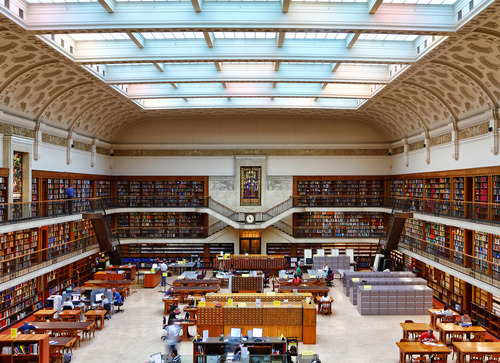
As reported here and there. Evelyn Juers, one half of Giramondo Publishing and independent scholar and author, has been keeping me posted on this absorbing struggle.
Having had struggles of my own at granular level here, patiently bashing out a community based program for my son with financial and moral support only, (heck, we take what we can and run with it, don't we?) I neglected to send out her media statement a while back.
She did faithfully send through links on the battle, which I tweeted, including one to a petition which eventually gathered almost 10,000 signatures.
And two some days ago, the exciting news appeared in the Sydney Morning Herald that the wishes of Australian scholars would be respected and their space inside this iconic study room extended and soundproofed, without diminution of the visual and practical support they usually enjoy there.
Service enhancements and improvements to the Mitchell Reading Room include a glass wall, extended study space for scholars and the maintenance of access to special collections, though the future of specialist librarians in these areas remains uncertain. Books previously removed (and even a card catalogue) will be returned to the reading room.
Glass walls. Serious Strong stuff. Sending a powerful message to beancounters in beautiful libraries everywhere - Scholars Matter.
(Cross-blogged from Mulberry Road.)
Aieeee.
I've already quietly filed away a personal post on the illnesses of other family members this year, in the drafts section, as this has never really been that kind of a blog. However, it is true that people close to me have been very sick this year, and will be for some time. But on top of that, I am going to be having a strange life for the next couple of months.
I threw a tantrum with unexpected rewards attached last week, after hearing my son's behaviour in care had deteriorated to new lows, not previously recorded. As I said to the manager over the phone, "if they haven't told me about this, then what else is going on that I haven't heard about?" Oh. My. Goodness. So bear with me because this site will be on hold for quite some time while I get that all sorted.
In the meantime, some literary people, and an 'early adopting' kind of blogger deserve serious gold stars:
Lisa Dempster, director of the 2013 Melbourne Writers Festival, for an expansive and exciting programme. I thoroughly enjoyed the London Review of Books sessions I attended, as well as taking in a thought provoking session with music writer Simon Reynolds. And I could have gone to plenty more...!!!!
The Sydney Review of Books - subscribe to their newsletter now, if you haven't already. Between the freebies at LARB, LRB and SRB (as well as the Literary Saloon at the Complete Review) you will have a lot of things covered book review -wise.
Alexis Wright and Giramondo, for another stellar outing with The Swan Book - I have mentioned this briefly in a post I've written for Readmill, the ebook app. The ABR review carries more information than I can put down right now and you can find it here.
And something to look forward to, and buy: new books from Richard Flanagan and Thomas Pynchon.
Finally, someone I began my blogging days reading has started posting again. This is always a good thing. Welcome back, Dervala Hanley.
Don't be good while I'm away, HAVE FUN. I will work hard, and I will have fun and think of you all.
And yes, I will keep scrapbooking at the little place, because it's faster.
Faster is my son's favourite word. Say no more.

By: Genevieve Tucker,
on 8/8/2013
Blog:
Reeling and Writhing
(
Login to Add to MyJacketFlap)
JacketFlap tags:
Add a tag
Whitmore Press is delighted to announce that Lucy Todd’s debut poetry collection, Listening to the Mopokes Go, will be launched in Melbourne on 16th August. The details:
The Alderman (upstairs)
134 Lygon St, Brunswick East
Friday 16th August, from 6.30pm
Launch by Cassandra Atherton – poet, novelist, critic and academic.

Lucy was the winner of the 2012 Whitmore Press Manuscript Prize. All welcome.
By: Genevieve Tucker,
on 8/7/2013
Blog:
Reeling and Writhing
(
Login to Add to MyJacketFlap)
JacketFlap tags:
Add a tag
"To those claiming "Twitter" (singular mass) is "this" or "that" (insert blanket generalisation), some perspective." (Simon Sellars @ballardian on Twitter.)
Tweetping offers visualisation of global Twitter usage in real time.
Make sure you have a look next time you're awake in the dead of the night. The world is twittering away while we (do not) sleep.
By: Genevieve Tucker,
on 8/7/2013
Blog:
Reeling and Writhing
(
Login to Add to MyJacketFlap)
JacketFlap tags:
Add a tag
Now if I wanted to attend Texts In The City at the Wheeler Centre, as a Books 101 kind of thing, I guess I would. And usually I don't want to.
But even without viewing them, and given that these sessions would be pitched to Year 12 students, I still think it's timely to recommend Alison Croggon talking about Wuthering Heights, and Josephine Rowe discussing Ray Carver's stories.
Enjoy.
By: Genevieve Tucker,
on 8/7/2013
Blog:
Reeling and Writhing
(
Login to Add to MyJacketFlap)
JacketFlap tags:
Add a tag
A seed library, in Ohio. (No returns, obviously.) Via the Melville House blog.
Also from Melville House, here is a fine slide show of some old New York bookshops. The first Scribner's was astonishing, was it not?
This compelling eulogy by Joanna Murray-Smith for her mother Nita was published on the Overland website in early July.
At Cordite, Geoff Page reviews Chris Wallace-Crabbe's New and Selected Poems.
Expanding the canon after death doesn't just happen in writing. Scholars and performers have revived some sonatas Beethoven wrote when he was 12, and 20, and added them to the 'iconic' 32. What this achieves, I do not like to guess.
By: Genevieve Tucker,
on 7/7/2013
Blog:
Reeling and Writhing
(
Login to Add to MyJacketFlap)
JacketFlap tags:
Add a tag
The cartoonist Ernie Bushmiller's letters were recently catalogued in preparation for auction and The American Reader has published several letters between Bushmiller and Samuel Beckett:
Beckett and Bushmiller were born within nine months of each other (Bushmiller in 1905, Beckett in 1906) but their material circumstances couldn’t have been more different at the time these letters were written. Bushmiller was at the top of his profession. He had been a successful syndicated cartoonist for almost thirty years by 1952. Nancy appeared in about 500 US papers and appeared in translation in many others worldwide. Circulation of the strip was therefore somewhere around 40 million people.
Beckett, it is assumed, read Nancy in English in the Paris-based international edition of the New York Herald Tribune. By 1952, Beckett had published a study of Proust, a collection of short stories, a volume of poems, one novel in English and two in French. Although the French novels Molloy and Malone Dies were beginning to receive attention from the Paris literati, none of the books had sold much. Beckett eked out a living as a translator of Mexican poetry. No play of his had yet been produced, although Waiting for Godot would receive its world premiere in January of 1953. Significantly, it is then that Beckett’s correspondence with Bushmiller breaks off.
Read More(Via Maud Newton on Twitter.)
By: Genevieve Tucker,
on 7/7/2013
Blog:
Reeling and Writhing
(
Login to Add to MyJacketFlap)
JacketFlap tags:
Add a tag
City Lights Books has been around for 60 years. Party On!!
Jeannette Winterson will get a shot at a cover version of The Winter's Tale. And Anne Tyler will follow up with her rendition of The Taming Of The Shrew.
I’m not the sort of person who wishes things had stayed as they were. I like Tumblr and Twitter, etc., etc., and I’m interested to see what comes next. But I do feel a little wistful from time to time for the newness of the experience of typing some stream-of-consciousness thing like this — which is not at all what I was expecting to write when I opened up WordPress — and setting it loose into the world.
-Maud Newton, on what happens after blogging.
At Cordite, Jacinta Le Plastrier rereads Ariel.
Here, Ron Silliman links to a few recordings of Sylvia reading from it.
And it's GOODBYE GOOGLE READER. I am writing this links post with the help of the nifty Newsblur, which allows me to save stories in the reader. Pretty damn fine feature. I decided it was nice enough to pay a little money to use Newsblur properly, and so far they are managing just fine with all the refugees from Google.
By: Genevieve Tucker,
on 7/7/2013
Blog:
Reeling and Writhing
(
Login to Add to MyJacketFlap)
JacketFlap tags:
Add a tag
'Kushner's gifts as a poet war with the more practical intentions of the novelist – like perfectly rendered pearls in a life-size portrait, her specificity draws the eye too close and muddles the focus on the whole.
The most successfully realised section takes place in Italy, at the family home of Reno's aristocratic boyfriend, Sandro, son of Valera. Here, Kushner is all novelist, portraying the rich with a cruel rapture that bears comparison with Alan Hollinghurst's. Suddenly, her characters breathe. Even the inscrutable Reno enjoys a moment of primal conquest. Up in their bedroom, as Sandro shoos a moth out of the window, she thinks, "He didn't care about moths. He did it for me. I was the only American girl here, I reminded myself as he chased it around the room in his underwear. The only one."'
Talitha Stevenson has not enjoyed Rachel Kushner's new book. Unlike
James Wood, and a host of other fans.
Well, well. We shall see. I have
The Flamethrowers to read (and encouraged another potential reader at the point of sale! doesn't happen to me often!) and I'm not going to be put off that easily.
By: Genevieve Tucker,
on 6/9/2013
Blog:
Reeling and Writhing
(
Login to Add to MyJacketFlap)
JacketFlap tags:
Add a tag
The letters of Italo Calvino have recently been published in a translation by Martin McLaughlin, and were reviewed in The Guardian a couple of weeks ago:
The bulk of the correspondence in this collection concerns Calvino's tireless work on behalf of Einaudi and his struggle to succeed as a writer in post-fascist Italy. Along the way are letters sent to fellow Italian writers (Alberto Moravia, Natalia Ginzburg, Elsa Morante) in support of abortion and workers rights, as well as bulletins dispatched from 50s New York and Communist Cuba (where Calvino met Che Guevara). The correspondence is distinguished by its sly philosophic humour and mandarin diversity of interests, ranging from the chivalric romances of Charlemagne to French structuralist theory.
Above all, the letters illuminate the politics of book publishing in Italy after the overthrow of Mussolini. Calvino's first novel, The Path to the Nest of Spiders (1947), was born directly out of his experience as a partisan during Italy's anti-fascist resistance. It was influenced by Ernest Hemingway and Italy's "news-reel" school of realism, which aimed for an unpolished immediacy of the street. Hemingway served as an antidote to fascist rhetoric and obfuscation. Yet Calvino's writing was already marked by a fabulous gothic undertow, with allusions to medieval artists such as Hieronymus Bosch and Albrecht Atldorfer. In his letters, he styles himself both "the fabulist Calvino" and "the realist Calvino": which was the real one?
The novelist and poet Cesare Pavese, Einaudi's managing editor, was among the first to detect the virtuoso fable-maker in Calvino. The 24-year-old was a "squirrel with a quill", Pavese said, whose fiction read like a "folk tale from the forests".
Read more...
I need to tell a little story about the pictures in this blog's header, particularly the one on the right.
When I first selected it from a collection of pins on Pinterest marked "Libraries", I did not realise that each pinned picture in the collection corresponded to a whole article on the library in the picture.
Talking to someone the other day about this, I went back to my note in the sidebar to check where both shots came from and clicked right through to a brilliant article at Dezeen, an architecture and design blog now in its seventh year.
The article carries several more shots of the Liyuan library, designed by Li Xiadong. It was like opening a door.
Here is the outside of the library, on the outskirts of Beijing:

This next shot shows the rest of the library travelling back from the window shown in my header:

It is rather stunning. The whole library is covered on the outside with firewood, so that it blends in with the nearby village.
Read more at Dezeen: there's also a newer article on this library. Then, enjoy clicking through all their pins on Pinterest devoted to libraries to read other articles, or follow their library tag for some very attractive bookish spaces.
Last weekend was a great one for reading about Australian writing, with the launch of two new e-publications.
The University of Western Sydney is supporting the brand spanking new Sydney Review of Books, which launched with several articles on Friday. There will be fresh reading every week for the next two months of this pilot project headed up by critic and editor James Ley, so get along there.
First postings include critical essays and reviews by Kate Middleton, Evelyn Juers, Kerryn Goldsworthy, Peter Pierce, Mo Yan and Nicholas Jose, as well as a call to arms for a watch on criticism by Ben Etherington.
Charlotte Wood, author and essayist, has begun a series of interviews available by subscription, The Writer's Room Interviews. You can sign up for them here, at an annual cost of $27.50 for six issues. The first interview was with Tasmanian writer and Patrick White prizewinner Amanda Lohrey, and I found it completely absorbing, probably because I love her work.
There were two things from the interview, among many, that struck me.
Firstly, I liked what Lohrey had to say about how taste affects the reading of fiction:
CW: A painter friend of mine says people think they don’t know what good art is, but that in every show he’s ever had, the best pictures sell first. You don’t understand it,but you know it.
AL: You do know it. It’s instinctive. But at the same time I think that’s more true of the visual arts than of literature. For it’s also true with fiction that there is no single standard of excellence. A book is a meeting of subjectivities and the subjectivity of one writer will speak to one reader but not to another. There are some writers who don’t speak to me at all but I can see why they speak to other readers, can see that they are in the same zone in terms of their preoccupations, and their conditioning, what’s important to them. It’s just not important to me and I’m not interested. So I don’t mean to say — I’m not trying to posit an idea of excellence that everybody responds to. I think literature is very much a one-to one conversation, which is why I cannot argue with someone who says The Alchemist is their favourite book when they’ve obviously got a lot out of it.
Secondly, Lohrey made some useful remarks about what she called 'inventive' realism:
I’ve always been interested in exploratory and inventive modes of realism, not for their own sake but because each new project demands its own aesthetic. I could get very technical on the subject but this is probably not the time or place. I would say, however, that one of the important functions of university writing courses is to encourage students to interrogate taken-for-granted modes of representation. If you decide to write in a conventional way, at least know why you’ve made that decision. Traditionally, film-makers have been much more concerned with issues of representation and more innovative. And to be fair, the camera gives them more scope, but that doesn’t mean that we as writers shouldn’t think about it. You don’t have to be obviously ‘experimental’, you don’t have to write like Gertrude Stein or James Joyce — small unorthodox manoeuvres can have potent effects.
Small and unorthodox. I like the sound of that.
I've been so busy reading these two publications that I did not have time to blog about them at the time. Which speaks for itself. Go, enjoy, be enlightened or enraged, as you will.
To mark its 25th anniversary, the Australian Network for Art and Technology is presenting an intriguing residency, The Subjects, at a sleep research institute:
Acclaimed author, Sean Williams, will be joined by artists Thom Buchanan and Fee Plumley and writer Jennifer Mills for a week-long residency at the Appleton Institute, Central Queensland University’s Adelaide-based sleep research centre.
Isolated from contact with the outside world, The Subjects will experience severely disrupted sleep patterns, loss of subjective control and constant surveillance. Each day – or is it night? – they will produce creative accounts of their experience. These will be posted to the project blog, enabling those of us on the outside to respond directly with comments and questions.
As the residency progresses we expect The Subjects’ to become increasingly stressed by their privations. Will they go mad – quietly or otherwise? Will they lose their creative mojo? Will they find new ways of expressing themselves, personally and creatively? You be the judge.
The Subjects and The Scientist (that's Professor Drew Dawson) will also be participating in a special panel discussion for Adelaide Writers’ Week.
All four participants have started posting, and I'm looking forward to reading about their time at Appleton.
Oh dear, busy 2013. Busy, busy. Children boating and flying past fires and floods, as they do. (Yes, mine. It astounds me.)
But I did find these fine things recently:
According to Maud, this lady is the Flannery O'Connor of the internet age.
Everyone needs to know how to do this. Yes, you! From Pat Grant.
Patti Smith sings William Blake. From Jacket2.
Via things magazine: what happens when you photograph a car on fire, asks J.M. Colberg?
The act of photographing, the gesture, has become part of our interaction with the world. You photograph just like you look. You know that you can never look at all of those photographs again (in all likelihood you never will - who has the time?), but it’s not about the photographs - it’s about the photographing. The act of photography might have turned into the equivalent of whistling a song, something you do, something that might or might not have beauty, a communicative act just as much as an affirmative act: I was there, and me being there means I had to photograph it.
And from Jessamyn West, a link to a NYT discussion, "Do We Still Need Libraries?"
(Crossposted at Mulberry Road.)
On February 12, fortyfivedownstairs is holding a poetry reading in honour of former MP Barry Jones' 80th birthday:
Barry Jones is one of the more remarkable politicians to have sat in the House of Representatives in Canberra, a much loved and respected figure on both sides of politics.
As a tribute for his 80th birthday late last year, the Chair of fortyfivedownstairs, Julian Burnside, has curated a night of some of Barry’s favourite poetry and music.
Readers include Race Matthews, Gareth Evans, Peter Craven, Marieke Hardy, Dr. Joan Grant, Max Gillies and John Stanton.
The Flinders Quartet will also perform on this memorable evening.
Get your tickets here.
Well, what a time that took! Hope you were not holding your breath waiting for my review of Jennifer Mills' rich and rewarding story collection, released in June last year.
Many things got in the way, including another delayed review...
But, here it is, at The Ember.
This excellent book, The Rest Is Weight, provoked an interesting observation from Peter Pierce at the Sydney Morning Herald:
Maybe the short story, not the novel, is the mainstream of Australian fiction. There are echoes of Lawson and Baynton here, as well as Carey. Mills is aware of the tradition to which she is indebted and in which she works adroitly and imaginatively. If the stories can feel like self-imposed tests of what Mills can do, they are also daring, unsettling and assured.
The only sad thing about this substantial and beautiful collection is that now we have to wait till Jennifer writes some more. So. Please Consider.
(Crossblogged at Mulberry Road.)

Young Men's Magazine on display
More here, but don't expect to find out anything as useful as where this early Glass Town booklet of Charlotte Bronte's is being displayed. The report is a very general article indeed....
Crossposted here.
Top 10 non-fic and fiction picks of 2012 - from Longreads. Enjoy.
Probably everyone on Twitter knew this but me - you will soon be able to download all your tweets. (At present it is invite only). Via ReadWrite (they dropped the "Web" a while ago.)
Find yourself some books that deserved a wider audience, according to people in British publishing, in this article from The Guardian on publishing in 2012.
The boat installation, A Room For London, wraps up with this podcast from Colm Toibin, which includes a reading of his story about the old age of Joseph Conrad's character Marlow.
Finally, some Tumblr treasure from Maud Newton - a list of favourite New Yorker articles from the archive.
I was at the Rivoli in Camberwell last night waiting for my daughter, and spying on folks as Helen Garner has trained us all to do.
I saw three young fellows meeting up, and overheard them picking their film. One said, "I can't bear to sit through that musical again." The other said, "The Hobbit, then?" and when the reply was affirmative, said, "for the second time!"
(I went to Les Miz, came home and googled this fellow. Goodness, he was fabulous!)
But in the meantime, since Christmas and a massive relocation of our books around a larger family of shelves, a biography of J.R.R. Tolkien that I forgot I had made its casual reappearance on my occasional table. So I have just completed Humphrey Carpenter's concise and gentle 1976 appraisal of Tolkien's life and his rise to fame. (There are of course many other things I could have read, if I'd had the inclination.)
There were many chuckles: there are some hilarious moments in this book. Just as a taste, here's Tolkien on the letter he received from a real Sam Gamgee while he was still attending to fan mail himself:
"For some time I lived in fear of receiving a letter signed "S. Gollum". That would have been more difficult to deal with."
The Carpenter bio is the only one I've ever read, and only now. For some reason Tolkien's life never interested me before. But in these pages I learned about another astonishing person, one whom Carpenter calls 'extraordinary' for good reason. The philologist Joseph Wright apparently went to work as a mill hand in Yorkshire aged six - taught himself to read at fifteen, and rose through his own night-school and a walking study tour of Germany to a doctorate, and from there to becoming a professor at Oxford, where he trained Tolkien, one of the most brilliant, if dilatory, philologists at the university. 'Oh, we used to dream of living in a corridor....'
I think reading this readable, dare I say personable biography, which was reissued in 2000, is a great antidote to escaping the monster truck that The Hobbit films seem to have turned into. Though it is sobering to research collectible copies of Tolkien's works. And Les Miserables was fine, though I did struggle with the vertiginous camera work. (Would it have really hurt to have a few more shots of FX-ed Paris, the barricades and the people, instead of chasing the leads around like Lars von Trier?)
I have a niece who is apparently spending her holidays reading Les Miserables. I'll be content to reread some snippets in the introduction to my undergrad collection of Hugo's poetry, which I never read properly when I was her age anyhow. Like Boaz, I was asleep then.
Happy New Year, everyone.
I know, I know. It's only the third of December.
Traditionally (a tradition of 24 years standing this year), we have four birthdays in January. So I am preparing about ten days earlier than everyone else. (Who else saw that hilarious Kikki K insert in The Age on Saturday? that calendar had NO TIME FOR SHOPPING in it. Just 'list' seguing effortlessly into 'wrapping'.)
Some of these are quite old. So forgive me if you have seen them already.
If you are feeling the pull to slow down over this busy time of year, the ABC has been running a program introducing meditation over the past six weeks. I heard about it through the Melbourne Meditation Centre, but it may well have been bruited elsewhere. Here's the toolkit. (You can easily trawl down the page to week 1 and begin at the beginning.)
I was interested to see this app, Flipboard, mentioned on the Killings blog by publishing researcher Caroline Hamilton, as I follow one of its developers on Twitter. And it looks to be a very pretty way of aggregating all your stuff on your iPad, too.
Caroline also mentions a 2010 article by Craig Mod that I really thought I'd read already. As it's not in my bookmarks, then I guess I will have to read it now, but it sure looks familiar...Books In The Age Of The iPad.
It's probably a bit late for Australians to order these and have them by Christmas, but this gorgeous Swiss toymaker's website is fun to look at, and I dare you not to order something one day. Via Things magazine. (Being the non-starting quilter I am, I have this on the wishlist.)
Something else I still haven't read - Terry Eagleton's review of a new bio of Derrida, from The Guardian.
Robert Crum, a couple of weeks back, had things to say about book marketing, coming up as a result with a list of lit-labels of his own which included the rather clumsy 'lit-lit':
The development of the literary marketplace in the past 30-something years has been echoed by a new, and acute, sensitivity to the place of genre within the trade. In a market-savvy creative economy, you could say that genre has become everything. I have been able to identify 15 contemporary shades of "literature".
I'll leave it to you to decide if his colours of writing are to your taste. Happy Christmas - if Typepad is listening, I want a better clipping tool, please. Like the one I have already on this blog, where, regrettably, you will be more likely to find me in the lazy, hazy days of summer. Thanks for reading the very intermittent postings here this year.
From ndis.gov.au, 29 November:
Today the Prime Minister introduced legislation for the National Disability Insurance Scheme into the Commonwealth Parliament. You can watch her speech online here, just as people with disability, their families and carers and NDIS campaigners from around the country did this morning, from the public gallery of the House of Representatives.
The legislation sets out the framework for a national scheme – a framework that will initially operate in five launch sites from mid-next year.
The legislation has been referred to a Senate Committee for their consideration. During their inquiry, the Senate Committee will hear evidence from people with disability, their families and carers about the Bill, which means everyone will have another opportunity to consider the details, and to input into the drafting and design of this important legislation.
Following conversation with people with disability, their families and carers, with service providers and advocates through the Senate Committee, and ongoing work with the states and territories, the Parliament will vote on the Bill next year.
You can also read the Bill and provide feedback through our online forum Your Say.
I have been hearing from various professionals all year about younger families who are at breaking point, and it breaks my heart - I was raising my children at a time when there still wasn't enough support, but there was less, shall we say blockage? in the system. We need this so badly, and we need it now.
If you haven't yet joined the campaign to support this important reform, you can still sign up at everyaustraliancounts.com.au, and share the details of the campaign with your friends. The money for this insurance scheme is still not guaranteed, and we need Australians to stay tuned and make sure we build this right. Congratulations to the Gillard government for getting it this far - now we all need to pull together to get the job done well.
Not only that, the bloggers wrote over 1000 reviews of books by Australian women writers. Yes, we're talking about the Australian Women Writers' challenge, people.
Elizabeth Lhuede has been running this reviewing challenge since early this year Recently, at the Huffington Post, she summarised the reasons for staging a blog-led intervention to raise the profile of Australian women writers in their own country:
Last year when I went hunting for books by Australian women at my local library in the World Heritage area of Katoomba in the Blue Mountains, I couldn't find any. The librarians weren't much help. They said, "Look for the kangaroo on the spine."
I asked friends. Like me, they'd heard of Geraldine Brooks (who lives in the US), Kate Grenville (who won the Orange Prize), and multi-award-winning author Helen Garner. Familiar, too, were names like Shirley Hazzard, Janette Turner Hospital and Kathy Lette (all non-Australian residents). But what about women living and writing in Australia - women of my own (younger) generation? Their books weren't being reviewed in Australian literary magazines.
She goes on to discuss the foundation this year of the Stella Prize for Australian women's writing, which will be awarded for the first time in 2013.
Around the time that her entry at the Huffington Post blog was posted, she also discovered that the librarians at Nowra library had noticed a rise in the circulation of books by Australian women since they had promoted the Australian Women Writers' Challenge at their library.
That is the kind of story I just love to hear. Bloggers and librarians making a difference for a group of writers who deserve more attention. Very, very cool stuff, and every one of you must take a bow.
And on top of that, there's a massive database of reviews at the Australian Women Writers' Challenge website, and a new challenge planned for 2013. So all interested bloggers and librarians should go and have a look around, and consider joining up.
And here's two posts from the site I've saved for later:
Overland fiction editor and writer Jennifer Mills, on classics
WTF is women's fiction? by author Paddy Reilly
By: Genevieve Tucker,
on 12/2/2012
Blog:
Reeling and Writhing
(
Login to Add to MyJacketFlap)
JacketFlap tags:
Reviews,
Add a tag
In the Los Angeles Review of Books, Morten Høi Jensen has reviewed James Wood's new book, The Fun Stuff and Other Essays:
Criticism, like fiction itself, is a paradoxical endeavor. It is always tempted by a need for order. In the book-soaked gloom of his study, the enterprising critic will scan his teeming bookscape, with its shuddering shelves and teetering towers, and go about his systematizing. These systems — and they can be aesthetic, political, sexual — will approach Literature like new management: merging, sacking, restructuring. And for all its achievements, the literary system will ultimately distinguish itself by the writers it leaves at its door (consider, for instance, the poverty of the Leavisite canon). The trick, therefore, is to contain one’s compulsion for wholeness, for systems. “Readers may want to push reconciliation onto a text,” Wood writes, “but this may be just our fantasy of wholeness, not the text’s, which may want to persist in being contradictory.” By sharing that elusiveness, and by engaging in its metaphorical movement, Wood delights in the unsystematic, playful nature of fiction — in the fun stuff.
By: Genevieve Tucker,
on 11/5/2012
Blog:
Reeling and Writhing
(
Login to Add to MyJacketFlap)
JacketFlap tags:
Add a tag
Among some engrossing things about adaptation, Japan, new writers and childhood reading in this NYT interview with David Mitchell, this:
And if you were forced to name your one favorite author?
I’d have to say, “I’m sorry, but books just don’t work like that, and neither does music, Amen” and take the consequences.
By: Genevieve Tucker,
on 11/5/2012
Blog:
Reeling and Writhing
(
Login to Add to MyJacketFlap)
JacketFlap tags:
Add a tag
I found some very welcome news in the weekend Age on Saturday in Jason Steger's Bookmarks column. A university-supported online reviews publication is on its way:
The idea, according to editor and critic James Ley, is to create a critical journal that ''takes up some of the slack from the shrinkage of coverage of books''. The SRB is being produced under the aegis of the University of Western Sydney's Writing and Society group, run by Ivor Indyk (the man behind Giramondo Publishing), novelist Gail Jones and professor Anthony Uhlmann. Ley says it will be a ''literary journal with an Australian emphasis but not exclusively - hopefully it will be a bit more catholic in its tastes''.
Ley is an appropriate editor of the new journal. His recent PhD thesis was called The Secular Wood, which is about literary criticism in the public sphere. He says he has plenty of articles for when the site launches this month. Among them is what will be a regular feature called ''Critic Watch'', in which all the commentary on a particular book is scrutinised.
Read more.
Not only this, but an exquisite review from Gerald Murnane was also published in the books pages. There was much rejoicing chez nous, particularly over the opening line: "I must confess I wasn't eager to read this book." A very fine tease in store if you haven't read this one.
Few people take me seriously when I say that I've got more out of horse racing than from Shakespeare or Beethoven. Even fewer believe me when I argue for the existence of an afterlife on the grounds that we must be able one day to properly compare the champions of different eras.
Surely, on some vast, green racecourse in the Elysian Fields, on one of those incomparable autumn afternoons that settle over Melbourne in early March, we will watch one day the Newmarket of Newmarkets; we will rise to our feet as the field approaches the grandstands; and while Black Caviar is about to break clear, Bernborough, far back in the ruck, is about to make his move.
Read more:
http://www.theage.com.au/entertainment/books/off-my-high-horse-20121102-28orf.html#ixzz2BKovlXjp
View Next 25 Posts


