JacketFlap connects you to the work of more than 200,000 authors, illustrators, publishers and other creators of books for Children and Young Adults. The site is updated daily with information about every book, author, illustrator, and publisher in the children's / young adult book industry. Members include published authors and illustrators, librarians, agents, editors, publicists, booksellers, publishers and fans. Join now (it's free).
Login or Register for free to create your own customized page of blog posts from your favorite blogs. You can also add blogs by clicking the "Add to MyJacketFlap" links next to the blog name in each post.
Blog Posts by Tag
In the past 7 days
Blog Posts by Date
Click days in this calendar to see posts by day or month
Viewing: Blog Posts Tagged with: Publishing, Most Recent at Top [Help]
Results 1 - 25 of 3,060
How to use this Page
You are viewing the most recent posts tagged with the words: Publishing in the JacketFlap blog reader. What is a tag? Think of a tag as a keyword or category label. Tags can both help you find posts on JacketFlap.com as well as provide an easy way for you to "remember" and classify posts for later recall. Try adding a tag yourself by clicking "Add a tag" below a post's header. Scroll down through the list of Recent Posts in the left column and click on a post title that sounds interesting. You can view all posts from a specific blog by clicking the Blog name in the right column, or you can click a 'More Posts from this Blog' link in any individual post.
Maybe I should have titled this post, "What I Learned in 2016." It was a tough year, but I did learn a few very important things. Here they are in no particular order:
Cover design ~ I've been designing covers (in secret) for years, but this year I learned a lot about cover design and even did my own cover for Fading Into the Shadows, which I love.
ebook formatting ~ I've been doing paperback formatting for a while, but this year, I learned fancy ebook formatting thanks to some awesome programs.
Self-Publishing is the way to go for me ~ I've been traditionally published, but I'm not interested in that route anymore. I've worked on both sides of publishing for years now, and I'm ready to take my future in my own hands and self-publish from here on out. (I'm very excited about this!)
I love writing adult mysteries ~ For years I swore I wouldn't write adult books, but look at me now. I don't know why I didn't think I'd like it, but I find the 25-30 age group really fun to write about.
Balance ~ I'm particularly proud of this one because I've had the goal of finding balance between editing for clients and working on my own books for the longest time. I just couldn't figure out how to pull it off until I participated in NaNoWriMo this year. Now, I know I can balance the two and get all my work done on time.
Those are my top five writing lessons learned in 2016. What did you learn this year?
Happy Monday! Monday Mishmash is a weekly meme dedicated to sharing what's on your mind. Feel free to grab the button and post your own Mishmash.
Here's what's on my mind today:
Sunday is Christmas! It's Practically Here! Can you tell I'm a fan of the Grinch? I love the original cartoon movie. I'm all ready for Sunday.
Editing I'll be doing a client edit this week before the holidays.
Publishing Since Fading Into the Shadows is ready to go for it's January 16, 2017 release, I'm busy getting my April release ready. The digital proof of Lies We Tell has been proofed, and the paperback proof has been ordered!
Taxes It's getting to be that time again where I need to update my expense and earning logs for taxes. Ick!
Snow I'm done with snow and winter hasn't even officially begun yet. :(
For the last eight years, I have worked for a small Seattle book publisher called Chin Music Press.
I've done everything from fact checking and copy editing to developmental- and line-editing, from setting up book tours to reading through the slush pile (a task I actually enjoyed).
But during all that time, my name never appeared on the cover of a book.
That changed this September with the release of my first title, Are You an Echo?: The Lost Poetry of Misuzu Kaneko. A picture book, it's both biography and anthology of a much-loved Japanese children's poet, whose work has yet to be introduced to English-language readers.
Becoming an author, I learned, is a humbling experience. I had to endure the red-penciling of my not-so-flawless prose (something I used to dish out myself), and the frustration of waiting for each cog in the publishing machine to take its spin—editing, illustrating, book designing, leveling, printing, marketing, reviewing, even mailing—as deadlines came and went.
The experience opened my eyes to the anxiety authors feel as they lose more and more control over their creation, something that had not really dawned on me despite my years working in publishing.
As a staff member at a publisher, I had dealt with authors who continued to rework small details of their text until the bitter end, who agonized over each cover illustration, or who fretted over how their book page appeared on Amazon. Indeed, the degree to which authors continued "meddling" in their books sometimes affected how well we worked with them.
But being on the author side of the equation taught me just how important it is to give up control, regardless of the anxiety it might cause. That was particularly true of my interactions with Are You an Echo? illustrator Toshikado Hajiri.
David
When it came time to decide which cover to use, I requested multiple cover sketches, asking for one thing after another to be changed. But I couldn't get satisfied.
Finally, since I was unsure of how to proceed, I asked our book designer Dan Shafer for advice. He recommended limiting how much I was trying to steer the illustrator. Illustrators, he said, do their best work when they have freedom to react to the text in their own way.
Ultimately, I left Toshi to his own devices and he ended up producing a glorious painting of Misuzu and her daughter at sunset.
We went with that.
During my time at Chin Music, there have been many occasions when interactions between writer and editor, or writer and designer have produced unexpected results.
Current author A. V. Crofts tells of her own positive experience of letting go how she thought the cover of her book should look. In another of our titles, Todd Shimoda's Oh! a Mystery of Mono no Aware, book designer Josh Powell brilliantly conceived of the idea of printing the entire book (both text and illustrations) in shades of black-and-white except for the very end.
Photo credit below.
Though initially intended to reduce the cost of the book, his solution resulted in a final explosion of color that dramatically enhanced the conclusion.
Writing is often thought to be a solo activity where one can wield total control over ones craft.
Oddly enough, its twin, publishing—the business of connecting writers to readers—is more of a team sport, requiring the combined input of different players with different skills and sensibilities.
So, as an author, don't try to control everything in your book. Find really good people to join your team. Then let your editor, illustrator, designer, or translator bring something of him or herself to the process.
The result may surprise you.
interior illustration from the book
Cynsational Notes
Photo of Misuzu, Courtesy of Preservation Association of Misuzu Kaneko's Work.
Review of the Day: Are You An Echo? by David Jacobson from Elizabeth Bird at A Fuse #8 Production. Peek: "I hope that the fame that came to Kaneko after the 2011 tsunami will take place in America, without the aid of a national disaster. And I hope that every child that reads, or is read, one of her poems feels that little sense of empathy she conveyed so effortlessly in her life."
Add a Comment
Today's topic comes curtesy of Sheena-Kay. Thanks, Sheena-Kay! She wants to know:
What do you do when a freelancer (cover artist, editor, etc) suddenly up and cancels on you or what advice would you give to someone else in that position?
Okay, this is something you hope never happens to you, but I've seen it a lot. Most freelancers are good because this is how they make their money. They need repeat clients, and so they do their best to meet deadlines and make their clients happy. But...
There are times when freelancers go MIA or cancel on you. The first thing I recommend is trying to figure out why. Life happens. A death in the family can cause a freelancer to go offline. Let's face it. When a loved one passes, the last thing we think about is checking our email, and that's understandable. So if this is a freelancer you really like, try to find out if something like this happened. If you don't know the freelancer and you can't wait for them to respond, do what you have to do. Deadlines are deadlines.
Now if a freelancer cancels on you with no explanation, I wouldn't advise working with them again in the future. And to be honest, I'm in several groups where people share info on freelancers—ones who don't meet deadlines, ones who take payment and then don't follow through on the work, etc. They do get blacklisted, so they don't want to be talked about this way.
I think the best way to get involved with a freelancer is by word of mouth. See who others recommend after having used that freelancer. Like anything else, do some research and protect yourself.
*If you have a question you'd like me to answer from the other side of the editor's desk, feel free to leave it in the comments and I'll schedule it for a future post.
I had no idea how beneficial an agent could be when I attended my first SCBWI conference in October 2013.
I quickly realized how much about the industry I did not know.
I began to network with other children's writers, especially fellow Native Americans, and when it came time to look for an agent, I utilized that network extensively.
I questioned fellow writers with representation, especially those from Native/people of color backgrounds, about their experience. I asked how agents had presented themselves at conferences or other events. I read agent online interviews and social media posts.
I wanted my agent to be a steadfast partner with a strong work ethic. It is a long-term relationship, so both people have to be dedicated to maintaining it. I required someone who was excited about my work and associated with a well-respected agency.
Traci's Reading Chair
Ideally, I wanted someone who had editorial experience that reflects what I write—fiction, nonfiction, and Native/POC subjects. To be honest, this makes for a small submission list, so I did expand beyond that.
When I communicated with agents via email and telephone, I tracked whether what they shared reflected my list.
My gut got an extreme workout when I received two offers of representation on the same day. I cannot stress enough the importance of developing and checking in with trusted mentors.
Ultimately, I accepted Emily Mitchell's offer of representation with Wernick & Pratt Agency. She met every single item on my list. Her clients contacted me quickly and gave their honest feedback about her representation.
Emily had vetted me with my editor at Charlesbridge, her former employer. We had both done our homework.
To me, it is kismet that Emily presented at that first conference I attended—and in my home state of Oklahoma too! That day, she shared her desired client attributes—voice, authority, pragmatism and flexibility. I'd like to think I resemble her list, too.
Traci Sorell writes fiction and nonfiction for children featuring contemporary characters and compelling biographies. She has been an active member of SCBWI since August 2013.
In April 2016, Charlesbridge acquired her first nonfiction picture book, We are Grateful: Otsaliheliga, from the slush pile.
The story features a panorama of modern-day Cherokee cultural practices and experiences, presented through the four seasons. It conveys a universal spirit of gratitude common in many cultures.
Traci is an enrolled citizen of the Cherokee Nation. She grew up in northeastern Oklahoma, where her tribe is located.
She is a first-generation college graduate with a bachelor's degree in Native American Studies from the University of California, Berkeley, where she graduated Phi Beta Kappa.
She also worked as an attorney assisting tribal courts nationwide, advocated for national Native American health care, and directed a national nonprofit serving American Indian and Alaska Native elders. She now lives in the Kansas City area.
See also Story to Contract: Traci Sorell’s Incredible Journey by Suzanne Slade from Picture Book Builders. Peek: "Be grateful. Every day. If you approach your creativity and the process of writing from a place of gratitude, it opens you up. You will be more aware of story ideas, available to hear critiques that improve your craft, and connected to others around you in the kidlit world. Gratitude opens up receptivity."
Emily Mitchell began her career at Sheldon Fogelman Agency, handling submissions, subsidiary rights, and coffee. She spent eleven years at Charlesbridge Publishing as senior editor, contracts manager, and director of corporate strategy. After a brief post-MBA stint in the non-publishing world, Emily returned to children's books at Wernick & Pratt.
I've moved into indie publishing lately, where it is entirely my choice which books I release into the world. So, I've been thinking about branding.
One thing it has taken me a while to realize is that just because you don't write the most popular thing and you get some bad reviews because of it, doesn't mean you need to change anything.
My second novel, Between the Sea and Sky (Bloomsbury, 2001), is my favorite of my published books. Its review average on Amazon and Goodreads was never great, which initially made me feel like there was no place in the world for what I most love to write.
However, as the years have gone by, I've gotten many fan letters for that book from both kids and adult women who tell me it's one of their favorite books and they've read it many times. It took me all those years for the fan mail to trickle in before it finally dawned on me that it is the most beloved of all my books, as far as I can tell.
My brand is: cozy romantic fantasy about a couple in healthy relationship with lots of details about food, clothes, and domestic life, and bits of humor. The fantasy backdrop is more in the "courtly politics" vein rather than physical action, although there is a little of that.
The characters are always somewhat on the fringe of society, your lovable outcasts and weirdos, and if I've done my job, you keep reading because you find the characters delightful and you want to know what happens to them and see them find a place in the world.
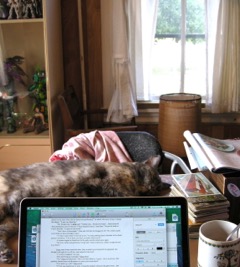
Betsy the Cat
They are the kind of books you might read when you're sick or having a bad day; where the characters are friends, the world is home, and you can trust that your heart won't get ripped out of your chest.
A lot of readers like having their heart ripped out of their chest. They give me reviews that say they wanted more action, more magic, more highs and lows. It's always tempting to listen to the bad reviews instead of the good.
And sometimes I love reading stuff that is epic, sweeping, dark. But when I try to write it feels like when I wear my disco dress with the fluttery sleeves. I love that dress but it just isn't me the way my plain 1960s navy blue librarian dress is.
Other people might even like the disco dress better, but it doesn't matter, I still would be happier living in the librarian dress.
As a reader, too, the cozy reads are the ones that fall apart on my shelf, because I pick them up again and again. So I realize now that it is more important to keep writing books that are the most me, and retain those readers who appreciate them too, than it is to try and chase the next big fantasy bestseller.
Mark Twain is reputed to have quipped, “Reports of my death have been greatly exaggerated.” Such hyperbole aptly applies to predictions that digital reading will soon triumph over print.
In late 2012, Ben Horowitz (co-founder of Andreessen Horowitz Venture Capital) declared, “Babies born today will probably never read anything in print.” Now four years on, the plausibility of his forecast has already faded.
This week, Oxford University Press (OUP) and The Reader announced an exciting new partnership, working together to build a core classics library and to get great literature into the hands of people who need it most, with the Oxford World’s Classics series becoming The Reader’s "house brand" for use in their pioneering Shared Reading initiatives.
This week we are celebrating the 500th title in the Very Short Introductions series, Measurement: A Very Short Introduction, which will publish on 6th October. Our expert authors combine facts, analysis, new ideas, and enthusiasm to make often challenging topics highly readable. To mark its publication editors Andrea Keegan and Jenny Nugee have put together a list of Very Short Facts about the series.
Now that I'm officially going indie, I can do exciting things like set my own production schedule. Why is this so exciting? Because over the years, I've had to either months between releases or releases stacked so close together it was tough to market my books. No more.
I have 2017 and 2018 mapped out and my release schedule looks like this:
January
April
July
October
That's two months between releases. Will it be tough? Yes! But I think the schedule is going to keep readers happy, and I work better on a schedule so I think I'll be happy too.
Right now, my January 2017 release is so close to being completely finished (and it's only September!). My April release is with my editor, and I'll be polishing up my July release to get that ready for my editor as well. Things are looking good so far. :)
Do you like when authors release books a few months apart?
*If you have a question you'd like me to answer from the other side of the editor's desk, feel free to leave it in the comments and I'll schedule it for a future post.
Happy Monday! Monday Mishmash is a weekly meme dedicated to sharing what's on your mind. Feel free to grab the button and post your own Mishmash.
Here's what's on my mind today:
Only One Week Until After Loving You Releases! I can't believe October 3rd is almost here!
Editing I'm finishing up a client edit this week in time for a new one on October 1st.
Two Work Days With Extended Hours This week my daughter has student council and chorus after school, so thus begins my longer work hours on Tuesdays AND Wednesdays.
2017 Publication Schedule I'm going to be releasing books every two months in 2017. Stay tuned for more information on that this Wednesday.
Fall! My favorite season is here! I love the smell of fall, specifically the smell of October. October has been my favorite month all my life. There's something special about it.
With the number of authors moving in the direction of self-publishing, I've decided to share some things you should know before you dive into self-publishing as an option.
First, understand that the costs are all on you. You are the publisher, so you are responsible for editing, cover design, formatting, and promotion. The good news is that you get to make all the decisions and hire the people you want to help you with your book. Let's break down the big costs involved.
Editing: There are a lot of great editors out there and their rates differ. You have to do your research and find one that's affordable and offering the type of edits you're looking for. Don't skimp on editing though. I'm not just saying that because I'm an editor. I'm saying it because every author (I don't care if you're famous or not) needs an editor.
Cover Design: Again, there are a ton of designers out there and they all have different prices. Premade covers are also an option, and they are less expensive. The difficult part is finding one that works for your book. Join some Facebook groups for cover design. Designers post covers, sales, and even ask for suggestions for future premades. They're also happy to work with you on custom made covers.
Formatting: I know a lot of authors who do their own formatting. Print is a pain, but it's not that difficult. You can teach yourself to do it. There are tons of programs to download and convert your file to all the different ebook files, too. Or you can hire a formatter. I hire a formatter for my ebooks and I format my print books myself.
Promotion: This is the one that makes all our eyes twitch. I have a social media manager, and she's worth way more than her weight in gold. You can hire a publicist or blog tour companies, or you can choose to do the promotional efforts on your own. Just keep in mind they take a lot of time, so plan accordingly. Advertising is available on Facebook, newsletter subscriptions, and book sites. Teaming up with other authors to offer a big giveaway is also great for exposure and it's inexpensive.
Now this is just touching the surface, but I hope it gives you and idea of what to expect when you go into self-publishing. Yes, you will have to put out money, but the good news is that whatever money comes in from sales is all yours. See which efforts work well for you and where you need to focus that money. It took me years, but I taught myself cover design. I'm lucky enough to have a graphic artist for a sister and she bails me out when I can't do something, but you can learn different aspects of this business and lessen costs that way. I've been on both sides of publishing, and I've made it a point to learn every step along the way. The experience has been so valuable.
*If you have a question you'd like me to answer from the other side of the editor's desk, feel free to leave it in the comments and I'll schedule it for a future post.
I recently made a big decision for my writing career. I've decided to go indie. Why now after I've had many books traditionally published? To be honest, I've been burned too many times in this industry. I know as writers we aren't supposed to talk about this, but I'm going to anyway. I've been burned by both publishers. And it hurts. Really hurts. As writers we put our dreams in the hands of others and sometimes that works out great. I've had some really great experiences. Fantastic support and more than I've ever dreamed possible.
But that isn't always the case. Sometimes your dreams are shattered by the people you thought were going to help you succeed. I will not be naming names because that isn't the point of this post and I choose to focus on those who have helped me succeed and for whom I'm forever grateful. The point of the post is that I finally realized I have to do what's best for me, and right now, that's going indie. I want control over my career. Yes, it's a lot of work. A LOT! But I've worked in this industry long enough that I've been involved in each aspect of publishing, and I believe I'm ready to take on this challenge. And it will be a challenge. I have no doubt about that.
Does this mean I'll never seek a traditional deal again? Of course not. I've learned not to say "never" because it's like tempting the devil. ;) But for now, I'm going indie and I'm really excited about it.
What decision have you made lately that was tough but for the betterment of your career?
*If you have a question you'd like me to answer from the other side of the editor's desk, feel free to leave it in the comments and I'll schedule it for a future post.
Today's topic comes from Sheena-Kay, who posed the question:
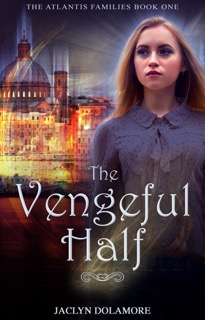
How do you avoid ending up with duplicate covers to other authors? Especially with use of stock photo images? Is digital manipulation enough and is going custom always viable with meager pockets?
Duplicate or similar covers happen more than we'd like. There's even a list on Goodreads called cover clones. And I have books on that list. It happens because of stock images. Those images are bought countless times. In fact, my cover for Touch of Death even appears on a slot machine! So how do you avoid this?
The only way to be absolutely sure your cover image won't appear anywhere else is to have it custom made, either by means of a photo shoot or illustrator (who promises not to sell that image to anyone else). That can be costly though. So if you have to use stock images, you want to make sure that the image is manipulated enough to make it unique.
Filters, layers, zoom, and rotation can all be used to help. Filters will create a different effect on the photo, playing with lighting and contrast. Layers are wonderful because it means you are using other images and layering them together to create a new image. Zooming in on a photo will remove background and can sometimes make the original image hard to recognize if it's an extreme close-up. Rotation is good, but it doesn't change the image much. Using a combination of all of these would yield the most results.
So if you want a unique cover, you can accomplish that with stock photos as long as you do enough manipulation. But keep in mind that your cover model WILL appear on other covers. It's going to happen if you use stock photos. But you can change that model's hair color, eye color, clothing color, etc to make her slightly different.
Do any of you have books with cover clones?
*If you have a question you'd like me to answer from the other side of the editor's desk, feel free to leave it in the comments and I'll schedule it for a future post.
Since I became a part of this crazy world that is book publishing, my goals and perspective have shifted several times. At first, I dreamed of book deals and best-seller lists. Then I learned that this industry is can be harsh. I'm not talking about bad reviews from readers. I'm talking about the industry itself. It's slow. Publishers go under or don't honor contracts, which leads to rights reversions. Agents can come and go as well.
I've been through a lot, and it's made me change my perspective. I no longer stalk my spreadsheet when my agent has one of my books on submission. It's not that I don't care. I definitely do. But I've come to the conclusion that not every book needs to be published traditionally. So if a good publisher wants my book, that's fantastic. If a book doesn't get picked up, I know it's not the end of the world. I'll hire a great editor and self-publish. If I have too much time between releases, I look at the books I have written, decide which would be better suited for self-publishing, and get that in the works so readers are continuing to get new books from me.
Being a hybrid author is freeing. I don't feel the stress I once did in this industry, and I'm much happier for it. Has your perspective changed after being in this industry for a while?
*If you have a question you'd like me to answer from the other side of the editor's desk, feel free to leave it in the comments and I'll schedule it for a future post.
GOODNIGHT GRIZZLE GRUMP! Published by HarperCollins(October 2015) My first picture book as author and illustrator!
- Grizzle Grump's page on the HarperCollins site FIVE STARS- San Francisco Book Review "This is a good choice for read-alouds and great fun, especially for those readers who can appreciate a good nap." - Kirkus Book Review "Goodnight, Grizzle Grump! is a great bedtime read. Warm and funny illustrations and the use of repetition are sure to connect with readers." - YA Books Central
0 Comments on Goodnight, Grizzle Grump! as of 7/11/2016 11:36:00 AM
Burps and sharks! I've been fortunate to illustrate some super fun chapter books over the years but George and Harry are like sons to me! I've worked on over 25 books combined on the two series.
George Brown, Class Clown (Grosset Dunlap, Penguin Random House) latest is It's a Bird! It's a Plane! It's Toiletman (#17)!
Find out more at George's own website. Or purchase the books here- Penguin Amazon
Shark School (Simon & Schuster) upcoming release is Tooth or Dare! (#7) in November 2016. Find out more at Harry Hammer's own website. Purchase the books here- Simon & Schuster Amazon
0 Comments on George Brown, Class Clown & Shark School as of 7/11/2016 11:24:00 AM
Happy Monday! Monday Mishmash is a weekly meme dedicated to sharing what's on your mind. Feel free to grab the button and post your own Mishmash.
Here's what's on my mind today:
Happy Independence Day! I hope everyone has a safe and happy Fourth of July!
Blogging Break Just a reminder that I'll be on a blogging break for one week beginning this Friday. I'll return to blogging on Friday, July 15th.
Computer Issues I've been putting off adding memory to my laptop, but it's causing serious issues now so I really need to do this soon.
Editing I'm editing for a new client this week.
New Author Logo Since I'll be self-publishing my new adult and adult titles, I decided I wanted an author logo to put on the back of the books where a publisher logo would go. Here it is! (I love it!)
We here at PubCrawl try our best to elucidate different aspects of the industry for you via our posts and podcast, but we are also available to answer questions (as best we can) if you email us or send us an ask through Tumblr. PubCrawl alumna Alex Bracken used to do a feature for us called Ask Alex where she would answer more industry-focused questions, and we’ve gotten a few about publishing programs.
From Bev:
Hi, I hope I’m directing this question to the right place—I’m a graduating senior English major and I’m potentially looking at two options in Professional Publishing programs for the summer, NYU SPI and the Columbia Publishing Course. Does anyone have any insight into what the differences are between the two? From what I can tell, Columbia seems more focused on book publishing: is this true, and can anyone testify to whether this helped you more as a writer? I know that Columbia doesn’t provide a professional certificate and that NYU does, but I’m not really sure what a professional certificate merits. Overall, I’d be extremely grateful for insight from anyone who employs students from these programs (or doesn’t) or anyone who’s attended or had experience with either. Thank you!
Hi Bev, I have not attended a professional publishing course, but I have known several people who have, including our very own Alex, who wrote about summer publishing programs here. In her post, she says that it appears that Columbia focuses more on book publishing while NYU focuses more on digital/magazine publishing.
As for whether or not this has helped anyone as a writer, I can confidently say probably not. Both of these professional programs are focused on the business of publishing, not the craft of writing. However, if you are looking for insight into how the industry works, they ‘re incredibly useful and enlightening. A few of my editor colleagues attended these programs before and after they began working in publishing, for various reasons, and they say the mileage they’ve gotten from them depends on the work they’ve put into it. Another one of my editor colleagues used to teach a seminar about editing at NYU.
As for who employs students from these programs, I do know that the Big 5 routinely recruits from these programs; one of my good friends went to CPC and she was hired based on her interview from their job fair. I would say both publishing programs are about equal in terms of post-course hiring; like any industry, the connections you make are just as important as what you learn about it. In addition to publishing courses, I would highly recommend internships. Each of the Big 5 and other midsize and small presses offer them, as well as literary agencies. I got my start in publishing via an internship at a literary agency; I did not attend a publishing course.
From Liv:
Hi Pub Crawl! I was recently accepted to Columbia’s Publishing Program at Exeter College and can’t wait to get started! It’s might hope to find a career in book marketing or publicity. However, I’m a little concerned and have a couple of questions I hope you’ll be able to answer… 1) I just graduated with a Bachelor’s of Business Administration, so I don’t exactly have an extensive education in literature studies. How essential is it to be familiar with the classics and/or things like common literary themes, narrative structures, critical theories, etc. when you work in publishing? 2) For the past couple of months, I’ve been trying to learn as much as I can about the industry (that’s how I found your amazing blog!), but I was wondering if you might have any recommendations for other sources? Thank you so much! Sorry that this is such a long message. Love you guys and your posts! Best, Liv
Hi Liv, many people who work in publishing did not major in literature in college. Some majored in communications, and others majored in the sciences. It is not essential to be familiar with the “canon” of literature to work in publishing; all you need is a genuine love and enthusiasm for books. I was an English major in undergrad and I can tell you that as an editor, I employed exactly zero percentof the knowledge I gained in class. Academic criticism has no place in publishing. And even some of literary terms you might have learned in school mean something different in the business, like genre. I would also argue that studying writing and not literature is far more useful in the industry, in terms of narrative structure and tropes. As an editor, some of this would be important, but to be honest, as an editor, I was more concerned with whether or not the book I was editing was a good story (if fiction) and/or written in a clear, engaging, and readable way (if nonfiction).
As for other sources on the industry, I would recommend you check out the archives of Kristin Nelson’s blog Pub Rants. She is a literary agent, so much of her advice is author-focused, but she also has incredibly useful information about contracts, royalties, and money. If you’re interested in an editorial perspective, I would recommend you check out Cheryl Klein‘s website, where she’s posted some of her speeches and talks, and will be coming out with a nonfiction book about editing and writing.
Hope this helps, y’all! If you have any more questions, let us know in the comments or via email and Tumblr!
Join LEE & LOW representatives at the following panels:
Saturday, June 25
Director of Marketing & Publicity Hannah Ehrlich at the Library for All panel: Diverse Books from Across the Globe, 10:30-11:30 AM, Hyatt Regency Orlando, Room Regency Ballroom T
Publisher Jason Low at Ideas Exchange: Increasing Diversity in the Publishing and Library Workforce, 2:45-3:30 PM, Convention Center, Room W414CD
Sunday, June 26
LEE & LOW BookBuzz: Diverse and Fabulous Books from LEE & LOW, 3:30-4:15 PM, Convention Center, Room Exhibit Hall – Book Buzz Theater
Monday, June 27
Pop Top Panel on Bilingual Books: The State of Bilingual Children’s Books, 9:00-9:50 AM, Convention Center, Room Exhibit Hall – PopTop Stage
Hope to see you there!
0 Comments on Come Meet LEE & LOW BOOKS at ALA 2016! as of 1/1/1900
Over the past several months, this industry has seen many publishers go south. I'm referring to them closing for various reasons and/or getting exposed for not paying their authors. First, let's be clear that I'm not going to name any publishers or speak ill of any either. The intent of this post is to simply inform authors and help them in seeking a publisher for their work.
One question that seems to pop up a lot in writer forums is how to know if you're signing with a "good" publisher. To be honest, sometimes you can sign with a great publisher and then that publisher is bought out, which changes everything. Other times you sign with a publisher that has good intentions but winds up going under. And other times still, things look great on the surface but there's another world happening behind the scenes and it's not good in the least.
So what's an author to do? The best advice I can give you is to find out which authors are with the publisher you're interested in and then contact those authors to hear what their experiences have been like. I have people do this with me all the time, and I'm very honest about my experiences, both good and bad (and yes, there have been bad ones). Also, if you notice an author has left that publisher, find out why. Keep in mind that nondisclosure agreements might keep some authors from dishing the gory details, but that should also send up a red flag. Nondisclosure agreements are set in place for a reason. As a writer, you should question that reason.
Please, research and contact authors to find out what's really going on outside of the public eye. Protect yourself and your work.
*If you have a question you'd like me to answer from the other side of the editor's desk, feel free to leave it in the comments and I'll schedule it for a future post.
I often work with clients who are writing a blend of fiction and non-fiction in their picture books. This is a tough proposition to publish. Let me explain what I mean. The book features characters and a plot, and also a sizeable number of facts. For example, a girl finds an unusual frog, learns that it belongs in a rain forest, and journeys there to return it. In the process, we have a character with a strong objective, plot points, as well as a lot of interesting information.
In theory, this is a great idea. We have all the charm and imagination of fiction, as well as that all-important educational value. So what goes wrong with this type of manuscript? It lies in the non-fiction part that the writer is attempting to attach to the fiction. There are two problems that usually arise. Too much information, and too little.
When there is too much information, that means the character and plot elements of the fiction part are too thin. The issue is usually that a person really wants to write non-fiction, but they worry that it won’t have enough pizzazz in the marketplace, so they try to spice it up with a protagonist. There are characters, but they don’t do much of anything, for example. It’s if we had Dora the Explorer but we didn’t know anything about her. She just had a name and a little bit of a personality, but she was only really there to have a learning experience. A glorified tour guide, if you will. In my original frog premise, it would be if the girl just went to the rain forest (without a frog or a mission to return it) and walked around, learning about the various plants and animals. There’s technically a fictional “frame” on this book (the girl whose eyes we are seeing things through) but it’s mostly non-fiction.
My recommendation, in that case, would be to rewrite the manuscript as straight non-fiction. It’s going to be easier to place, anyway, if it’s easier to categorize. A fact-based look at the rain forest (or any other topic) without any distracting character element is the bread and butter of school and library NF picture book programs. The lesson? You don’t have to tack a character on to a manuscript if your passion is non-fiction. If you are qualified to write factually on a subject, do your best at that and pitch it as NF.
When there is too little information, it raises a lot of questions. It would be if the girl went to the rain forest, had some really awesome adventures, but only learned about one plant and two other animals. Why that plant? Why those animals? Why those facts about that plant and those animals? If your goal is to teach, why not teach more comprehensively? Why pick only five facts to span the course of a book?
I recently encountered this issue in a client’s premise. (I’m going to change the details of the premise for the sake of confidentiality.) The writer a century’s worth of decades, let’s say the 20th century. And their character stopped in each decade for one page. They learned one thing about each decade. Why that thing? Out of everything that happened in that decade, why that one thing? The educational element was too thin.
If you’re going to cover a topic (the 20th century), then you need to pick a specific angle and really dive in. A picture book on the 20th century isn’t going to sell that well, no matter how charismatic your characters are. It’s too broad. Now, a tour of the Roaring 20s? Getting there. Maybe just the music of the Roaring 20s or the fashion of the Roaring 20s? Very specific. A character recreating the fashion of the 1920s for a fashion show? Bingo. That represents a good blend of fiction and non-fiction.
I would say that a good blend of fiction and non-fiction is the Magic Schoolbus franchise. The class is always up to something. There’s action involved, a mystery to solve, etc. The learning happens almost “under the table” as they pursue an objective. But the books are chock-full of information, and they represent a very comprehensive look at a particular topic.
If you find yourself stuck halfway between fiction and non-fiction, make sure you have enough substance for each category, otherwise, you may be better off committing fully in one direction or the other.
Little Pickle Press is an award-winning creator of high quality, high impact media and products for children and teens.
From our founding in 2009, we’ve done things differently. Here are seven steps we’ve taken to lead—and BE—the change we want to see:
1. Be Responsible.
Print all titles, not just the environmentally-themed ones, on recycled paper, with soy inks, in the Americas.
And lose the dust-jacket on picture books. They’re not kid-friendly, or necessary.
2. Make every project count.
“Media For A Better World” isn’t just a slogan, it’s a guiding principle.
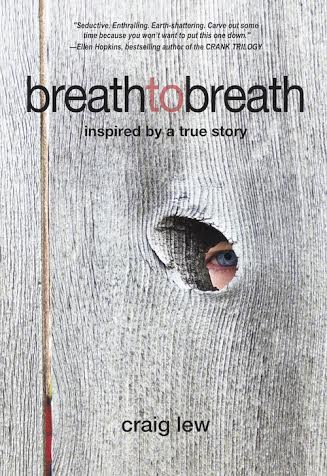
From Your Fantastic Elastic Brain, one of our growth-mindset picture books, to Spaghetti is NOT a Finger Food, a chapter book highlighting the challenges – and triumphs – of an 8-year-old boy with Asperger Syndrome, to Breath To Breath, a powerful YA novel-in-verse inspired by the true story of a survivor of child abuse, every Little Pickle and Relish Media story makes a difference for the better.
3. Give Back.
Forge partnerships with organizations that promote the same values we do in our titles.
Like how we donated 15% of net sales of What Does It Mean To Be Kind? print books to the Great Kindness Challenge, along with thousands of e-books to schools who participated in their spread-the-kindness challenge. And how 15% of net sales of our Farm2Table app go to KaBOOM!, to support their efforts to bring active play into the lives of kids growing up in poverty in America.
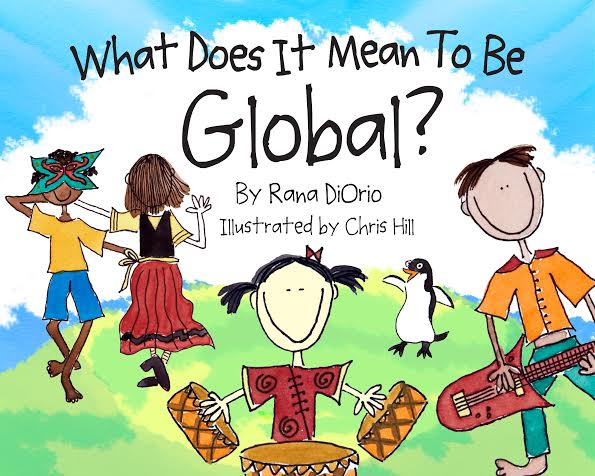
Teaming Up: What Does It Mean To Be Kind? written by Rana DiOrio and illustrated by by Stéphane Jorisch, three-time winner of Canada’s Governor General Literary Award for Children’s Illustration, and The Great Kindness Challenge that reached over 5 million students!
Farm2Table is an iPad adventure that helps kids explore where their food comes from. It’s based on The Cow in Patrick O’Shanahan’s Kitchen, written by farmer and agriculture writer Diana Prichard and illustrated by Heather Devlin Knopf. For this app, we teamed up with KaBOOM!, who believes that “cities need to be designed with opportunities to play everywhere.” Patrick would certainly agree!
4. Innovate.
We’re early adopters of technology, focused on what can make things better. Even our submission platform with Authors.me changes the game, with an eye to empowering authors throughout the submission process.
5. Be Kind.
It’s our mission: “Little Pickle Press is dedicated to creating media that fosters kindness in young people—and doing so in a manner congruent with that mission.” And kindness, as our founder Rana DiOrio explains, “is not simply being affable. …We define ‘kindness’ as treating others as one would wish to be treated in similar circumstance, and we consider it the foundational concept upon which civilization was built and the key to society’s future.”
So when we heard about Library For All, and how they’re using technology to spread literacy in Rwanda, Haiti, Democratic Republic of the Congo, Cambodia, and Mongolia, we donated our entire digital library to the cause.
Students reading Library for All titles in Cambodia
6. Walk the walk.
From who we partner with to the wheat straw paper in my printer, as a B-Corp, everything we do and every decision we make is driven by sustainability, and the question, what’s going to make our world a better place for us all?
7. Be Grateful.
What we’re doing is working. We’ve won awards (85 so far), and our titles have gotten some great reviews (Jerry Greenfield of Ben & Jerry’s said What Does It Mean To Be An Entrepreneur? “inspires young dreamers to find the courage to be doers.”)
Maybe most of all it’s hearing from kids, teens and their caring adults about how our stories have made a difference to them that lets us know we’re on track.
Comments like this one about our picture book Ripple’s Effect, from John A.,
“Just recently I was chatting with a first grader about his experience being bullied. It's hard to get over those kinds of hurdles as a child. What a great book for kids who are smart, fun, and joyful except when they are around ‘sharks.’
"Every child can be a great influence but the power of a positive kid in the midst of adversity can change lives. Children's literature needs this book. I'm glad it's here.”
And we’re grateful for the opportunity to share with you.
Students reading Library for All titles in Cambodia
Cynsational Notes
Lee Wind is the Vice President of Digital, Communications and Community Engagement at Little Pickle Press.
Spaghetti is NOT a Finger Food (and other life lessons), written by Jodi Carmichael, is a nominee for the Mantioba Book Awards’ John Hirsch Award for Most Promising Writer.
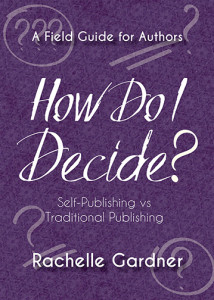
How Do I Decide? is a concise, definitive resource that will guide you through the decision, allowing you to ignore the noise and hype and focus on the right path for YOU. This is a fair and balanced approach that avoids favoring one choice over the other—and instead shows you how to determine which best fits your own situation.
About 50 pages jammed full of insider information, How Do I Decide? gives you the facts you need to make an informed choice. It walks you through the various steps of the publishing process so you can determine which road best suits your personal goals, temperament, and level of previous publishing experience.
How Do I Decide? is brief yet comprehensive, and includes:
• an overview of the current publishing landscape
• an outline of the path to publishing
• a user-friendly checklist to help you figure out your path
• pros and cons of traditional publishing
• pros and cons of self-publishing
SPECIAL FEATURES:
• An eye-opening infographic that’ll help you decide
• A “quiz” to streamline your decision-making process
• Additional resources with links to further information
The e-book is only $2.99 on Amazon. Check it out if you’re considering which path to take!







.jpeg?picon=3451)