new posts in all blogs
Viewing: Blog Posts Tagged with: biography, Most Recent at Top [Help]
Results 1 - 25 of 785
How to use this Page
You are viewing the most recent posts tagged with the words: biography in the JacketFlap blog reader. What is a tag? Think of a tag as a keyword or category label. Tags can both help you find posts on JacketFlap.com as well as provide an easy way for you to "remember" and classify posts for later recall. Try adding a tag yourself by clicking "Add a tag" below a post's header. Scroll down through the list of Recent Posts in the left column and click on a post title that sounds interesting. You can view all posts from a specific blog by clicking the Blog name in the right column, or you can click a 'More Posts from this Blog' link in any individual post.
Six Dots. Jen Bryant. Illustrated by Boris Kulikov. 2016. Random House. 40 pages. [Source: Review copy]
First sentence: On the day I was born, Papa announced me to the village: "Here is my son Loo-Wee!"
Premise/plot: Six Dots is a picture book biography of Louis Braille. It is probably best for older readers because there is a lot of text.
Here's one of my favorite quotes, "I didn't want people to feel sorry for me. I just wanted to read and to write on my own, like everyone else."
The end papers include the braille alphabet, just not in braille. (It would have been great fun if the braille alphabet and the quote by Helen Keller, "We the blind, are as indebted to Louis Braille as mankind is to Gutenberg." had actually been in braille so readers--of all ages--could feel Braille for themselves.)
My thoughts: I liked this one. It is a very personal, compelling story.
Text: 4 out of 5
Illustrations: 4 out of 5
Total: 8 out of 10
© 2016 Becky Laney of
Becky's Book Reviews
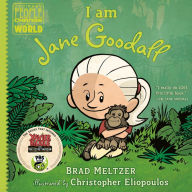
I Am Jane Goodall. Brad Meltzer. 2016. 40 pages. [Source: Library]
First sentence: I am Jane Goodall. On my first birthday, my father bought me a cuddly toy chimpanzee named Jubilee.
Premise/plot: I Am Jane Goodall is a picture book biography of Jane Goodall for young readers by Brad Meltzer. It uses text and speech bubbles throughout to give details of her life and her work. It is packed with plenty of information, and a great message or two.
My thoughts: I found this one slightly problematic. Not because of the text itself necessarily. But because of the illustrations. Jane Goodall is illustrated exactly the same throughout the book. It doesn't matter if she's one or eighty. As a one year old, she's got white hair pulled back in a ponytail. As an adult working in the jungle, she's the exact same height as when she's one and in a baby carriage. She's surrounded by ADULTS, during ADULT WORK, supposed to be one of the best, most qualified, most experienced in her field, and she's the size of a toddler. Why is this okay?!
That being said. I found the text interesting enough.
© 2016 Becky Laney of
Becky's Book Reviews

By:
Cynthia Leitich Smith,
on 11/16/2016
Blog:
cynsations
(
Login to Add to MyJacketFlap)
JacketFlap tags:
David Jacobson,
Toshikado Hajiri,
picture book,
biography,
picture books,
publishing,
inspiration,
book design,
Misuzu Kaneko,
Add a tag
By
David Jacobsonfor
Cynthia Leitich Smith's
CynsationsFor the last eight years, I have worked for a small Seattle book publisher called
Chin Music Press.
I've done everything from fact checking and copy editing to developmental- and line-editing, from setting up book tours to reading through the slush pile (a task I actually enjoyed).
But during all that time, my name never appeared on the cover of a book.
That changed this September with the release of my first title,
Are You an Echo?: The Lost Poetry of Misuzu Kaneko. A picture book, it's both biography and anthology of a much-loved Japanese children's poet, whose work has yet to be introduced to English-language readers.
Becoming an author, I learned, is a humbling experience. I had to endure the red-penciling of my not-so-flawless prose (something I used to dish out myself), and the frustration of waiting for each cog in the publishing machine to take its spin—editing, illustrating, book designing, leveling, printing, marketing, reviewing, even mailing—as deadlines came and went.
The experience opened my eyes to the anxiety authors feel as they lose more and more control over their creation, something that had not really dawned on me despite my years working in publishing.
As a staff member at a publisher, I had dealt with authors who continued to rework small details of their text until the bitter end, who agonized over each cover illustration, or who fretted over how their book page appeared on Amazon. Indeed, the degree to which authors continued "meddling" in their books sometimes affected how well we worked with them.
But being on the author side of the equation taught me just how important it is to give up control, regardless of the anxiety it might cause. That was particularly true of my interactions with Are You an Echo? illustrator
Toshikado Hajiri.
 |
| David |
When it came time to decide which cover to use, I requested multiple cover sketches, asking for one thing after another to be changed. But I couldn't get satisfied.
Finally, since I was unsure of how to proceed, I asked our book designer Dan Shafer for advice. He recommended limiting how much I was trying to steer the illustrator. Illustrators, he said, do their best work when they have freedom to react to the text in their own way.
Ultimately, I left Toshi to his own devices and he ended up producing a glorious painting of Misuzu and her daughter at sunset.
We went with that.
During my time at Chin Music, there have been many occasions when interactions between writer and editor, or writer and designer have produced unexpected results.
Current author
A. V. Crofts tells of her own positive experience of letting go how she thought the cover of her book should look. In another of our titles,
Todd Shimoda's Oh! a Mystery of Mono no Aware, book designer Josh Powell brilliantly conceived of the idea of printing the entire book (both text and illustrations) in shades of black-and-white except for the very end.
 |
| Photo credit below. |
Though initially intended to reduce the cost of the book, his solution resulted in a final explosion of color that dramatically enhanced the conclusion.
Writing is often thought to be a solo activity where one can wield total control over ones craft.
Oddly enough, its twin, publishing—the business of connecting writers to readers—is more of a team sport, requiring the combined input of different players with different skills and sensibilities.
So, as an author, don't try to control everything in your book. Find really good people to join your team. Then let your editor, illustrator, designer, or translator bring something of him or herself to the process.
The result may surprise you.
 |
| interior illustration from the book |
Cynsational NotesPhoto of Misuzu, Courtesy of Preservation Association of Misuzu Kaneko's Work.
Review of the Day: Are You An Echo? by David Jacobson from
Elizabeth Bird at A Fuse #8 Production. Peek: "I hope that the fame that came to Kaneko after the 2011 tsunami will take place in America, without the aid of a national disaster. And I hope that every child that reads, or is read, one of her poems feels that little sense of empathy she conveyed so effortlessly in her life."
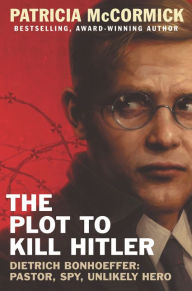
The Plot to Kill Hitler. Patricia McCormick. 2016. 192 pages. [Source: Library]
First sentence: The Gestapo would arrive any minute.
Premise/plot: Patricia McCormick tells the story of Dietrich Bonhoeffer for elementary-aged readers. It is subtitled pastor, spy, and unlikely hero. Young people likely haven't heard of him at all. So this is a great introduction. The prologue starts at the climax. The first chapter takes us back to his childhood days where we learn that he is a thoughtful, sensitive, intelligent dreamer. This one is very family-focused for the conspiracy to kill Hitler involved many of his family. Year by year, readers learn the how and the why. Notably, readers learn of many opportunities that would have kept him safe and out of the war and the dangers and risks of being in Nazi Germany. Bonhoeffer rejected the easy way out believing that no action was still an action. In other words, failure to rebel and speak out against Hitler was to support him. Silence and escape were unthinkable.
My thoughts: I knew of him as a Christian writer and thinker. I have read The Cost of Discipleship. I knew he died during the war at a concentration camp, I did not know that he was there not just for preaching and proclaiming against the regime, but was in fact an actual spy and co-conspirator. So I learned something!
This one was a quick read.
© 2016 Becky Laney of
Becky's Book Reviews
By
Cynthia Leitich Smithfor
CynsationsHappy Election Day! Go vote! We welcome author Debbie Levy to talk about her new picture book biography. From the promotional copy of I Dissent: Ruth Bader Ginsburg Makes Her Mark, illustrated by Elizabeth Baddeley (Simon & Schuster, 2016): Ruth Bader Ginsburg has spent her lifetime disagreeing . . . with creaky old ideas. With unfairness. With inequality. She has disagreed. She has disapproved. She has objected and resisted. She has dissented!
Disagreeable? No. Determined? Yes! Ruth Bader Ginsburg has changed her life, and ours, by voicing her disagreements and standing up for what’s right. This picture book about the first female Jewish justice of the U.S. Supreme Court shows that disagreeing does not make you disagreeable and that important change can happen one disagreement at a time. See also the
Glorious RBG Blog (click to view 11 entries).
Welcome to Cynsations, Debbie! We're both graduates of The University of Michigan Law School. Did you practice law or go straight to writing for young readers like I did (or rather like I did after clerking)? I did practice law for several years after law school. But writing books for children is the only job I’ve held for more than six years. Lawyer at a big Washington, D.C. law firm: six years. Newspaper editor: six years. Then I took a class at the
Writer’s Center in Bethesda, Maryland, with the excellent
Mary Quattlebaum. (Check out
her books, and her reviewing work!)
Writing for children: This was a vocation with long-term potential.
 |
| Michigan Law School Reading Room |
Hey, I have a newspaper background, too--so much in common! You write fiction and nonfiction across formats and age levels. Often I hear from new writers that they feel pressured to pick one focus. What has your range of pursuits done for you in terms of craft and career?I think the writers you’re hearing from are telling a truth: There can be pressure to pick one focus or, to put it otherwise, to establish a “brand.”
I think I must have subconsciously scoffed at the notion that I could ever be a brand—ha, a Debbie Levy brand!—so, for better or worse, I’ve mostly followed my interests and allowed serendipity a role in choosing projects.
Also, one solution for writers who do want to be multi-focal is to have more than publisher. I realize that doesn’t solve a beginning writer’s problem, who may be looking for Publisher #1. But it is an option once you start getting published.
Congratulations on the release of I Dissent: Ruth Bader Ginsburg Makes Her Mark, illustrated by Elizabeth Baddeley (Simon & Schuster, 2016)! What about Ruth Bader Ginsburg called to you as a writer? Thank you! Like many people, I knew that the Glorious RBG was the second woman to serve on the Supreme Court of the United States and the first Jewish woman on the Court.
I knew that, before that, she was a federal appeals court judge in Washington, D.C., and, before that, one of leading lawyers in the field of equal rights for women and girls.
What I didn’t know, until I started researching more deeply about her, is that she has been disagreeing with unfairness and with things that are just plain wrong from the time she was a little girl.
I mean, she objected to being excluded from shop class in grade school, and being required to take cooking and sewing instead! When on a car trip with her parents, she disagreed with she saw a sign outside a hotel that read “No Dogs or Jews Allowed.” Later, of course, she went on to disagree, resist, object, and dissent her way into big things.
And she’s been doing this for years with a voice that is not loud (people lean in to hear her words), in a manner that is not obnoxious (more benefit of the doubt than bashing, more insight than invective), and in service of justice.
So, I realized, the story of her life offers this inspiring lesson: Disagreeing does not make you disagreeable, and important change happens one disagreement at a time. Is it any wonder, then, that I thought she was a great person to introduce to young people in a picture book?
Agreed! Many of my favorite people disagree strongly with injustice. What were the challenges (research, psychological, logistical) in bringing the story to life?I feel lucky to live in the Washington, D.C. area, because although Justice Ginsburg didnot find time for an interview with me last summer when I was working on this book, she did grant me access to her papers on deposit in the
Manuscript Division at the Library of Congress (practically next door to the Supreme Court!).
I’ve gone through at least one Manuscript Division collection before, but none like this. So tidy! Meticulous! Her speeches typed on 4 x 6 cards: impeccable! Her handwritten notes on yellow legal sheets discussing and advocating for the Equal Rights Amendment that never got adopted!
Although I didn’t absolutely need to read piles of drafts of legal briefs and memoranda, I dived into this stuff with gusto; you do get a sense of a person from their papers.
Oh, wait. You asked for challenges. It is a challenge to write about someone, a living, active person, without having an interview. But there were many, many print and video interviews of RBG for me to consult. Many scholarly articles, by and about her.
And she did review the manuscript last October. She sent a nice little note, and wrote in some handwritten notes in the margins of my typescript. I took all her edits!
Since you’ve specifically mentioned “psychological challenges”—I lost my mother three years ago.
 |
| Debbie's mother kayaking on the Wye River |
She was a vibrant, ever-curious, outgoing woman, someone always interested in another person’s story, someone who as a girl dreamed of being a journalist (she ended up in the wholesale costume jewelry business instead), and she would have been over the moon to know that I was writing a book about RBG, to know that I was elbow-deep in RBG materials at the Library of Congress, to know that RBG looked over my manuscript pre-publication.
I’m answering your questions, Cyn, the morning after the book launch for
I Disssent, which we held at D.C.’s great
Politics & Prose Bookstore. Many friends who had known my mother attended.
I said there, “I cannot help but think that had my mother still been alive, she would have figured out a way to get me into RBG’s chambers for an interview—and she along with me!”
The room was filled with knowing smiles and laughter. Someone even called out my mother’s signature phrase: “Let me ask you a question”—her way of getting people to open up to her.
That helped with the pain of not having Mom there. (And, really, she would have snagged me an interview.)
Talk to us about disagreeing. It sounds like a negative focus for a children's book. Is it? In either case, why do you think it's important in the conversation of youth literature?Yes, let’s talk about disagreeing! The theme of disagreeing is really what sold my editor at Simon & Schuster on this book.
From the very beginning, we were really excited about creating a book that said to all kids, and to girls in particular, that disagreeing does not make a person disagreeable, and that you can accomplish big things for yourself and for the world through dissent and by finding another way when the world says “no” to you.
It’s a positive message, but it’s also a message that says you don’t have to be positive—that is, you don’t have to sound or look positive, you don’t have to just say yes and smile and go along with things that you believe are wrong—to be a good person.
At the same time, simply disagreeing without more isn’t really enough if you want to change your life or anyone else’s. On the back of the book, we’ve put this RBG quote: “Fight for the things that you care about. But do it in a way that will lead others to join you.”
Seems simple, right? But it’s that second sentence that is so hard to pull off.
Many authors discover reoccurring themes in their work? Is this true of you? If so, could you tell us about it and how I Dissent fits in? 
I seem to return to the theme of Outsiderness. My mother, protagonist of the nonfiction-in-verse
The Year of Goodbyes (Hyperion, 2010), being an outsider as a girl in Nazi Germany in 1938. Danielle, protagonist of my young adult novel
Imperfect Spiral (Bloomsbury, 2013), who finds an unexpected antidote to her feelings of being the outsider in an unlikely friendship with the six-year-old boy she babysits one summer.
The African American individuals and communities, outsiders in their own country, in my nonfiction picture book
We Shall Overcome: The Story of A Song (Disney-Jump at the Sun, 2013).
Today we may look at RBG and see the ultimate insider—she’s a U.S. Supreme Court Justice, for heaven’s sake! But she overcame the outsiderness of being a Jew in a sometimes hostile Gentile world, of being a young woman in the (then) overwhelmingly male-dominated world of law school, of being a female lawyer in a (then) man’s profession, and of being an advocate for legal and social changes that went against the grain of society’s traditional norms. There’s my theme.
What do you love about your writing life? Other writers. What good communities and friendships I’ve found!
What do you do when you're not writing or out-and-about in your author hat?Walk in the woods or along the nearby Chesapeake and Ohio Canal. Kayak in the Chesapeake Bay area. Fish in the Chesapeake Bay area. Read.
Think about whoever my next dog will be.
Apologize to my cat for thinking about my next dog.
You know, the usual.
What can your readers look forward to next? In February 2017,
Soldier Song, A True Story of the Civil War (Disney-Hyperon). An 80-page picture book for older children about a remarkable event that occurred after the Battle of Fredericksburg. Illustrated by the excellent, creative
Gilbert Ford, with lots of room for excerpts from soldier’s letters and diaries. I’m excited about this!
By
Cynthia Leitich Smithfor
CynsationsDonna Janell Bowman is the first-time author of
Step Right Up: How Doc and Jim Key Taught the World About Kindness, illustrated by
Daniel Minter (Lee & Low, 2016). From the promotional copy:
A Horse that can read, write, and do math?Ridiculous! That’s what people thought until former slave and self-taught veterinarian Dr. William Key, with his “educated” horse Beautiful Jim Key, proved that, with kindness, anything is possible. Over nine years of exhibiting across the country, Doc and “Jim” broke racial barriers, fueled the humane movement, and inspired millions of people to step right up and choose kindness. What was your initial inspiration for writing this book?This question ties so perfectly into my belief that there’s a piece of us in everything we write.
In 2006, I read a
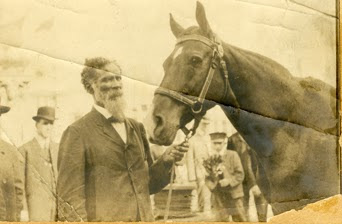
book about Beautiful Jim Key, authored by Mim Eichler Rivas (William Morrow 2005/Harper Paperbacks 2006). It was a given that I would be drawn to a horse book. I grew up on a Quarter Horse ranch, where life revolved around raising, training, and showing horses, and caring for the myriad livestock and other animals. I have always been an animal lover, and I know firsthand how powerful the human-animal bond can be—how the combination of time, trust, and affection can create such synergy that you can practically read each other’s minds.
 |
Courtesy of Tennessee State Library and Archives. |
That kind of relationship bonded William “Doc” Key and his horse, Beautiful Jim Key. While the horse was what drew me to the story, I was immediately awed by Doc. His greatest historical contribution was an unmistakable message about kindness, in a time of extreme racial prejudice, and brutal treatment of animals.
How could I not love the story of a man who overcame so much to make a real difference in the world?
Thanks to Doc, “Jim,” the horse, became a sort of poster child for the emerging humane movement, while Doc overcame injustices, broke racial barriers, and helped change the way people thought about and treated animals. Doc was awarded a Service to Humanity Award, and Jim was awarded a “Living Example” award.
So, back to your question, Cyn, about what inspired me to write this story—it spoke to my heart. I dived into research with zeal.
What were the challenges (literary, research, psychological, logistical) in bringing the text to life?There were a number of challenges to writing this story, but three that most stand out:
First, the research. It was claimed that Beautiful Jim Key could read, write, calculate math problems, compete in spelling bees, identify playing cards, operate a cash register, and more. I had to get to the bottom of how this could be possible.
I used the adult book as my jumping off point, but I wasn’t satisfied to rely solely on somebody else’s research.
This is a story that straddles the 19th and 20th centuries, so I read a great deal about the period, including slavery, the Reconstruction Era in the distinct regions of Tennessee, the history of the humane organizations; the related World’s Fairs, Doc’s business interests, etc.
Emotionally, the most difficult part was reading about how animals were treated in the 19th century, and, more importantly, how enslaved people were often treated with similar brutality. Only a tiny fraction of my research appears in the book’s back matter, but it all deeply affected my approach to the story.
I visited the
Shelbyville (TN) Public Library and skimmed through their microfilm. Then I spent some time at the Tennessee State Archives, donning white gloves as I perused the crumbling scrapbooks from the BJK collection.
During that 2009 trip, I also visited the humble Beautiful Jim Key memorial in Shelbyville, TN, and Doc’s grave site at the Willow Mount Cemetery. (I might have shed a few sentimental tears.) We then tracked down what I think was Doc’s former property, though the house is long gone.
This kind of onsite research, along with old photos and local news accounts, allowed me to imagine the setting of Doc’s hometown. Back home, I collected binders-full of newspaper articles, playbills, and promotional booklets. Through these, I got a feel for how people thought about Doc and Jim.
And, most importantly, I found some of Doc’s explanations for how he taught the horse. What became clear was, though we may never know exactly how the horse was able to do so many remarkable things, the countless news reporters and professors who tried to prove trickery or a hoax, never found anything beyond “education.” Jim only rarely made mistakes.
Ultimately, what Doc and Jim did for the humane movement is even more significant than what the horse performed on stage.
Originally, I had planned the story for middle grade audiences until my agent (who wasn’t my agent yet) suggested that I try a picture book version. I already had half of the chapters written by this time, so I was aghast at the thought of starting over. And I didn’t know how to write a picture book biography. I spent the next two years analyzing and dissecting a couple hundred picture book biographies to figure out how they work.
I decided to
blog about some of my craft observations, using the platform as a quasi-classroom for myself and anyone else who might happen upon my site.
Many, many, many drafts later, I had a manuscript that attracted the attention of a few editors. Lee and Low was the perfect home for Doc and Jim.
There was a built-in challenge in writing this story about a formerly-enslaved African American man. Because I don’t fit any of Doc’s descriptors, it was doubly important that I approach the subject with respect and sensitivity.
I couldn’t merely charge through with the mindset that I’m just the historian sharing documented facts.
How are you approaching the transition from writer to author in terms of your self-image, marketing and promotion, moving forward with your literary art?It is so exciting to finally be crossing the threshold into this new role. The past nine years, which is how long I’ve had the story in my head and in my heart, have felt like the longest-ever pregnancy.
There’s a mixture of joy, relief, and fear during this delivery stage. Fortunately, so far, very nice starred reviews have praised the book, and each reviewer wisely sings the praises of Daniel Minter’s spectacular lino-cut acrylic art.
As I think ahead to marketing and promotion, I’m planning for the Oct. 15 release, the Oct. 23 launch party, and how the book might raise awareness of the need for more kindness in the world—not only toward animals but toward each other.
From my very first draft, nine years ago, I knew I’d revive the original Beautiful Jim Key Pledge—originally signed by two million people during Doc and Jim’s time.
I plan to incorporate the pledge into my author presentations, and it will be downloadable from my website soon. I also hope to align with some humane organizations to help them raise awareness.
I have two more books under contract, several others on submission or in revision, and a novel-in-progress.
In 2018, Peachtree Publishers will release En Garde! Abraham Lincoln’s Dueling Words, illustrated by
S.D. Schindler, followed in 2019 by King of the Tightrope: When the Great Blondin Ruled Niagara, illustrated by
Adam Gustavson.
Such is the author’s life, right? We write, we rewrite, we revise, we sell, we wait, we celebrate, then we do it all over again. Because we can’t imagine not writing something that moves us. And we can’t imagine not writing for young people.
Cynsational GiveawayBook Launch! Join
Donna Janell Bowman at 3 p.m. Oct. 23 at BookPeople in Austin. Donna will be speaking and signing.
Fundraiser: Step Right Up and Help The Rescued Horses of Bluebonnet Equine Human Society: "They are horses, donkeys, and ponies that are helpless and hopeless. And they are hurting. The lucky ones land at Bluebonnet Equine Humane Society. Under the loving care of professional staff and volunteers, the animals are medically and nutritionally rehabilitated, then placed with trainers to prepare them for re-homing/adoption." See also
Interview: Step Right Up Author Donna Janell Bowman by Terry Pierce from Emu's Debuts.
Enter to win two author-signed copies of
Step Right Up: How Doc and Jim Key Taught the World About Kindness by
Donna Janell Bowman, illustrated by
Daniel Minter (Lee & Low, 2016).
a Rafflecopter giveaway

By: VictoriaD,
on 10/7/2016
Blog:
OUPblog
(
Login to Add to MyJacketFlap)
JacketFlap tags:
Music,
History,
violin,
Biography,
Music History,
art history,
Ashmolean,
musical instruments,
American National Biography,
Online products,
Arts & Humanities,
italian renaissance,
Carleen Hutchins,
Hidden History of New Hampshire,
Quincy Whitney,
Add a tag
Biography chooses us when there is alchemy between biographer and subject—a perfect fit of interlocking puzzle pieces. In my case, a lifelong fascination with objects and the craftsmen who make them led me to the story of a pioneering violinmaker—American Luthier: Carleen Hutchins—the Art and Science of the Violin.
The post Fiddle parts and sound: how objects tell stories appeared first on OUPblog.
By: DanP,
on 9/28/2016
Blog:
OUPblog
(
Login to Add to MyJacketFlap)
JacketFlap tags:
British,
odnb,
early modern england,
British history,
*Featured,
oxford dictionary of national biography,
oxford dnb,
Online products,
british biography,
british education,
Emily Hansen,
schoolmasters,
History,
Biography,
school,
Education,
Add a tag
In 2015 the Oxford Dictionary of National Biography introduced an annual research bursary scheme for scholars in the humanities. As the first year of the scheme comes to a close, we ask the second of the 2015-16 recipients—the early modern historian, Dr Emily Hansen—about her research project, and how it’s developed through her association with the Oxford DNB.
The post Profiling schoolmasters in early modern England appeared first on OUPblog.
The Grand Tour: The Life and Music of George Jones. Rich Kienzle. 2016. 288 pages. [Source: Library]
First sentence: Would he or wouldn't he show up?
Premise/plot: The Grand Tour is a biography of George Jones that seeks to balance a focus on his life and on his music. The author takes on the role of music critic and biographer. In the prologue he explains his approach, "Jones's life and music are inseparable. The music often triumphed even during his worst personal moments. His evolution from twangy imitator to distinctive new voice, from influential vocalist to master of his craft, is as important as his personal failings. Exploring that musical side--how he found songs and recorded them; the perspectives of the public, those involved in creating his records, and Jones himself--is pivotal to understanding the story. I've attempted to take the long view, examining not only his life and the events that shaped him from start to present, but simultaneously exploring his immense musical legacy, all in a clear chronological context." (13)
My thoughts: I started listening to George Jones' music this summer. And what I loved, I really, really LOVED. So I was curious to pick this new biography up at the library. I picked it up as a new fan and not an expert, so perhaps keep that in mind. But I enjoyed this biography very much. I think I might have appreciated aspects of it even more if I was familiar with more of his albums, more of his songs.
The prologue of this one had me hooked. Here is how the author describes Jones' voice: "The voice was raw nerve put to music...Yet above all that was his consummate ability to explore pain, sorrow, heartbreak, and emotional desolation." (9)
It was an often absorbing read full of highs and lows. I would definitely recommend it.
© 2016 Becky Laney of
Becky's Book Reviews
By: DanP,
on 9/21/2016
Blog:
OUPblog
(
Login to Add to MyJacketFlap)
JacketFlap tags:
South Sea Bubble,
british biography,
economic fraud,
Helen Paul,
south sea company,
History,
Biography,
fraud,
academic research,
British,
economy,
odnb,
British history,
*Featured,
oxford dictionary of national biography,
oxford dnb,
Online products,
Add a tag
In 2015 the Oxford Dictionary of National Biography introduced an annual research bursary scheme for scholars in the humanities. As the first year of the scheme comes to a close, we ask the first of the 2015-16 recipients—the economic historian, Dr Helen Paul of Southampton University—about her research project, and how it’s developed through her association with the Oxford DNB.
The post Financial networks and the South Sea Bubble appeared first on OUPblog.
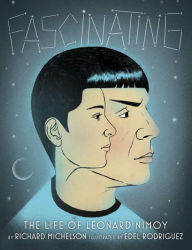
Fascinating: The Life of Leonard Nimoy. Richard Michelson. Illustrated by Edel Rodriguez. 2016. 40 pages. [Source: Review copy]
First sentence: Lenny took a deep breath and looked out at the playhouse stage.
Premise/plot: Richard Michelson has written a picture book biography of Leonard Nimoy. The book opens in 1939 with a young Lenny preparing to sing "God Bless America" at a talent show. He was the son of Russian immigrants--Jewish, and raised so. In fact, his inspiration for the Vulcan hand gesture--live long and prosper--came from a priestly blessing.
Readers learn about his interest in photography and acting. Both would be life-long pursuits and interests.
The book closes with Leonard Nimoy taking on the role of Spock and making it truly his own. The last illustrated spread depicts the first use of the "live long and prosper" from the episode Amok Time.
The next two pages fill out the rest of his life. He was an actor and a director. He was a photographer who displayed his photographs for the public, and, in fact published them as works of art. He was also an author.
The end brings a smile to my face. Before he left home, his mother encouraged him to learn to play the accordion. Acting jobs may come and go, she warned. But musicians can find a way to work. The book ends, "But he never did learn to play the accordion."
My thoughts: I LOVED this one so much. I thought it was very charming and well written. I did indeed find it fascinating. The author's note was great. I love that this book was written by one of Leonard Nimoy's close friends. I loved the personal touch--knowing that Nimoy read and approved of the project.
Text: 5 out of 5
Illustrations: 5 out of 5
Total: 10 out of 10
© 2016 Becky Laney of
Becky's Book Reviews

By:
vschneider46,
on 8/29/2016
Blog:
The Open Book
(
Login to Add to MyJacketFlap)
JacketFlap tags:
Native American,
book activities,
Track,
Jim Thorpe's Bright Path,
Jim Thorpe,
Educator Resources,
Football,
Uncategorized,
Sports,
biography,
Joseph Bruchac,
Olympics,
Add a tag
 LEE & LOW BOOKS celebrates its 25th anniversary this year and to recognize how far the company has come, we are featuring one title a week to see how it is being used in classrooms today as well, as hear from the authors and illustrators.
Today, we are celebrating Jim Thorpe’s Bright Path, an inspirational story for children of all backgrounds. A biography of the legendary Native American Jim Thorpe (1888–1953), voted the Greatest Football Player and Greatest Athlete of the Half-Century by two AP polls, focusing on his early childhood and how school and sports shaped his future.
Featured title: Jim Thorpe’s Bright Path
Author: Joseph Bruchac
Illustrator: S.D. Nelson
Synopsis: The biography of the legendary Native American, Jim Thorpe (1888–1953), focusing on his early childhood and how school and sports shaped his future.
From the day he was born, Jim Thorpe’s parents knew he was special. As the light shone on the road to the family’s cabin, his mother gave Jim another name — Wa-tho-huck — “Bright Path.”
Jim’s athletic skills were evident early on, as he played outdoors and hunted with his father and twin brother. When the boys were sent to Indian boarding school, Jim struggled in academics but excelled in sports. Jim moved from school to school over the years, overcoming family tragedies, until his athletic genius was recognized by Coach Pop Warner at the Carlisle Indian School.
Awards and Honors:
- Carter G. Woodson Book Award Honor, National Council for Social Studies
- Choices, Cooperative Children’s Book Center (CCBC)
- Teachers’ Choices, International Reading Association (IRA)
- Best of the Best List, Chicago Public Library, Children & YA Services
- Storytelling World Resource Award, Storytelling World magazine
Check out this interview with author, Joseph Bruchac, about Native American literature.
Resources for teaching with Jim Thorpe’s Bright Path:

Discover other books like Jim Thorpe’s Bright Path with the Joseph Bruchac Collection!
Book Activities:
- Draw attention to the use of similes in the book. For example: Jim took to it all like a catfish takes to a creek. It made him (Jim) feel like a fox caught in an iron trap. Epidemics of influenza swept through like prairie fires. Have students try to write their own similes for other events or actions in the story.
- Ask students to explore the National Track & Field Hall of Fame (www.usatf.org ) or the Pro Football Hall of Fame (www.profootballhof.com ) and plan an imaginary trip there or enjoy a visual visit on the Web.
Have you used Jim Thorpe’s Bright Path? Let us know!
Celebrate with us! Check out our 25 Years Anniversary Collection
 Veronica has a degree from Mount Saint Mary College and joined LEE & LOW in the fall of 2014. She has a background in education and holds a New York State childhood education (1-6) and students with disabilities (1-6) certification. When she’s not wandering around New York City, you can find her hiking with her dog Milo in her hometown in the Hudson Valley, NY.
Zap! Nikola Tesla Takes Charge
by Monica Kulling
illustrated by Bill Slavin
Tundra Books, 2016
Grades K-6
The reviewer received a copy of the book from the publisher.
Nikola Tesla is the latest subject in Monica Kulling's Great Idea Series featuring innovators and inventors. The story of Nikola Tesla is sure to intrigue readers. The picture book biography begins with Tesla departing from a
By: Rachel Brook,
on 8/12/2016
Blog:
OUPblog
(
Login to Add to MyJacketFlap)
JacketFlap tags:
jane austen,
British,
sir walter scott,
robert louis stevenson,
odnb,
robert burns,
edinburgh fringe,
Calton Hill,
*Featured,
Art & Architecture,
oxford dictionary of national biography,
Online products,
Arts & Humanities,
Clarinda's Tearoom,
National Library of Scotland,
scott monument,
Writer's Museum,
History,
Literature,
Biography,
edinburgh,
Add a tag
The Edinburgh Fringe is in full swing with over 3,000 arts events coming to the vibrant Scottish capital over the next few weeks. With the International Book Festival kicking off on the 13th, we’ve compiled our favourite bookish spots around the city for you to squeeze into your schedule.
The post 5 Edinburgh attractions for booklovers [slideshow] appeared first on OUPblog.
Nadia: The Girl Who Couldn't Sit Still
by Karlin Gray
illustrated by Christine Davener
Houghton Mifflin Harcourt, 2016
Grades K-5
As I watched the Olympics on television Sunday evening a familiar face was in the crowd for the women's gymnastics competition: Nadia Comaneci was in Rio to cheer on the 2016 gymnasts. A new picture book biography introduces young children to the Romanian gymnast and

By:
Becky Laney,
on 8/1/2016
Blog:
Becky's Book Reviews
(
Login to Add to MyJacketFlap)
JacketFlap tags:
Nonfiction,
review copy,
music,
biography,
j nonfiction,
Houghton Mifflin Harcourt,
mg nonfiction,
2016,
books reviewed in 2016,
Add a tag
Let Your Voice Be Heard: The Life and Times of Pete Seeger. Anita Silvey. 2016. HMH. 112 pages. [Source: Review copy]
First sentence: Pete Seeger became the most important folk singer of the twentieth and twenty-first centuries. But he might have chosen a very different path. Although his grandfather made a fortune from sugar refining in Mexico, Pete became an advocate for underpaid workers. Though he came from financial privilege, he identified with those who had to make a living. He fought for the oppressed and poor all his life.
Premise/plot: Let Your Voice Be Heard is a biography of Pete Seeger written for children. (I'd say eight to twelve, if I had to put a label on it.) The biography is great at putting Pete Seeger's life into context for better understanding. Perhaps the author wanting to keep this one short and accessible for her audience, did not fully cover his life and music. It is not an exhaustive book on the subject. But a good, basic introduction.
My thoughts: I definitely found this one to be fascinating. I knew next to nothing about Pete Seeger before picking this one up. (I'm certainly no expert in folk music. My only familiarity at all coming from the music of Peter, Paul, and Mary.) I thought it was very well-written.
© 2016 Becky Laney of
Becky's Book Reviews
Whoosh!: Lonnie Johnson's Super-Soaking Stream of Inventions
by Chris Barton
illustrated by Don Tate
Charlesbridge, 2016
Grades K-5
Chris Barton and Don Tate collaborated on last year's successful picture book biography, The Amazing Age of John Roy Lynch. I'm pleased that the duo is back with the engaging picture book about engineer, Lonnie Johnson. Johnson was a creative and inventive child who
Crossing Niagara: The Death-Defying Tightrope Adventures of the Great Blondin
by Matt Tavares
Candlewick, 2016
Grades K-5
In stunning watercolor, gouache and pencil illustrations, Tavares conveys the incredible story of the Great Blondin, a tightrope walker who set his sights on crossing Niagara Falls in 1859.
Crowds packed the area to see The Great Blondin walk across the falls. Gamblers
By:
Becky Laney,
on 5/9/2016
Blog:
Becky's Book Reviews
(
Login to Add to MyJacketFlap)
JacketFlap tags:
books reviewed in 2016,
biography,
picture books,
picture books for older readers,
j nonfiction,
Houghton Mifflin Harcourt,
review copy,
2016,
2016 Cybils-Eligible,
Add a tag
Nadia: The Girl Who Couldn't Sit Still. Karlin Gray. Illustrated by Christine Davenier. 2016. HMH. 40 pages. [Source: Review copy]
Premise/plot: A picture book biography of Nadia Comaneci.
My thoughts: First, I just want to say that I want--no, I NEED--more picture books about gymnastics. Or early readers. Or chapter books. Or, you know, novels. And while I'm at it, I'll put in a request for books about ice skating. A picture book about the 1996 U.S. Gymnastics team would be GREAT fun I think!
Second, I just have to say that I really enjoyed this picture book biography of Nadia Comaneci! It is a very age-appropriate biography I must say. It is set in Romania in the 1960s and 1970s. (But the focus is never on politics or hardships or possible reasons why she might have defected from her country.) Readers meet a young Nadia and her coaches Bela and Marta Karolyi. She began doing gymnastics at the age of 6. Over half the book focuses on the 1976 Olympic Games. The book ends with her returning home after winning at the Olympics. She was 14 years old, I believe. I want to say that these days you have to be at least sixteen in order to compete at the Olympics. A timeline will catch adults up on her life story.
One thing I did appreciate was the source notes provided at the end of the book. So often picture book biographies fail to show their research.
This one is easy to recommend.
Text: 5 out of 5
Illustrations: 3 out of 5
Total: 8 out of 10
© 2016 Becky Laney of
Becky's Book Reviews
By: Hannah Charters,
on 4/25/2016
Blog:
OUPblog
(
Login to Add to MyJacketFlap)
JacketFlap tags:
History,
Biography,
Quotes,
Language,
quotations,
New Zealand,
Anzac Day,
Oxford Reference,
who said it?,
OR,
australian history,
*Featured,
new zealand history,
Online products,
Quizzes & Polls,
trivia quiz,
famous quotations,
quotes quiz,
Australians,
Add a tag
"What a good thing Adam had. When he said a good thing he knew nobody had said it before." Mark Twain put his finger on one of the minor problems for a relatively new nation: making an impact in the world of famous quotations. All the good lines seem to have already been used somewhere else, by somebody else.
The post How well do you know your quotes from Down Under? appeared first on OUPblog.

By: JOANNA MARPLE,
on 4/15/2016
Blog:
Miss Marple's Musings
(
Login to Add to MyJacketFlap)
JacketFlap tags:
ecology,
San Diego,
tree planting,
biography picture book,
California history,
Perfect Picture Book Friday,
Kate Sessions,
The Tree Lady,
following one's dreams,
San Diego history,
biography,
Women's History Month,
trees,
Add a tag
I had another book scheduled for today, but as I am staying with one of my writing buddies and she introduced me to a delightful biography of a tree-loving woman here in San Diego, I couldn’t pass up the chance … Continue reading →
A Girl Called Vincent: The Life of Poet Edna St. Vincent Millay
by Krystyna Poray Goddu
Chicago Review Press, 2016
ISBN: 978-1-61373-172-7
Grades 5 and up
April is Poetry Month, so it's fitting that A Girl Called Vincent was released earlier this month. The biography provides middle grade and teen readers with an in-depth look at the life of Edna St. Vincent Millay, who was known to her friends
By: Hannah Paget,
on 4/8/2016
Blog:
OUPblog
(
Login to Add to MyJacketFlap)
JacketFlap tags:
British,
alan turing,
economic history,
*Featured,
Business & Economics,
London School of Economics,
monetary policy,
British economy,
economic models,
A Few Hares to Chase,
ACE computer,
alan bollard,
Bill Phillips,
economic stability,
fiscal policy,
LSE,
stabilisation policy,
the phillips curve,
Books,
Economics,
Biography,
money,
Add a tag
Austerity, uncertainty, instability … all problems we associate with Europe today as it cycles from pre-GFC exuberance to today’s austerity. But to put things in perspective, these are minor problems compared what our grandparents endured after World War Two. In Britain many people did not have enough to eat, the government had secret plans for national catastrophe, the Cold War was raging, the colonies erupting, and Sterling was in crisis. In those days there were few policy economists, and macroeconomics was caught in a battle between non-interventionist classical economics and the Keynesian revolution of demand management.
The post Who was Bill Philips? appeared first on OUPblog.
The Librarian Who Measured the Earth
Written by Kathryn Lasky; Illustrated by Kevin Hawkes
Little, Brown and Company. 1994
ISBN: 0316515264
I am on a crusade to get some really terrific and often overlooked informational picture books into the hands of teachers and parents. These books, read aloud to middle and high school students, could be a gateway for important conversations and growth.
By
Cynthia Leitich Smithfor
CynsationsCheck out the cover for Step Right Up: How Doc and Jim Key Taught the World about Kindness by
Donna Janell Bowman, illustrated by
Daniel Minter (Lee & Low, 2016). From the promotional copy:
A horse that can read, write, spell, and do math? Ridiculous! That's what people thought in the late 1800's - until they met Beautiful Jim Key.
Born a weak and wobbly colt in 1889, Jim was cared for by William "Doc" Key, a formerly enslaved man and self-taught veterinarian who believed in treating animals with kindness, patience, and his own homemade remedies. Under Doc's watchful eyes, Jim grew to be a healthy young stallion with a surprising talent - a knack for learning! For seven years, Doc and Jin worked together, perfecting Jim's skills. Then it was time for them to go on the road, traveling throughout the United States and impressing audiences with Jim's amazing performances. In the process, they broke racial barriers, and raised awareness for the humane treatment of animals.
Here's a true story of an extraordinary horse and the remarkable man who nurtured the horse's natural abilities. Together they asked the world to step right up and embrace their message of kindness toward animals.
View Next 25 Posts