Login or Register for free to create your own customized page of blog posts from your favorite blogs. You can also add blogs by clicking the "Add to MyJacketFlap" links next to the blog name in each post.
Blog Posts by Tag
In the past 7 days
Blog Posts by Date
Click days in this calendar to see posts by day or month
Viewing: Blog Posts Tagged with: science, Most Recent at Top [Help]
Results 1 - 25 of 1,250
How to use this Page
You are viewing the most recent posts tagged with the words: science in the JacketFlap blog reader. What is a tag? Think of a tag as a keyword or category label. Tags can both help you find posts on JacketFlap.com as well as provide an easy way for you to "remember" and classify posts for later recall. Try adding a tag yourself by clicking "Add a tag" below a post's header. Scroll down through the list of Recent Posts in the left column and click on a post title that sounds interesting. You can view all posts from a specific blog by clicking the Blog name in the right column, or you can click a 'More Posts from this Blog' link in any individual post.
From the publication of the Origin, Darwin enthusiasts have been building a kind of secular religion based on its ideas, particularly on the dark world without ultimate meaning implied by the central mechanism of natural selection.
Often when we look at biographies featuring people of color, they repeat the same themes: slavery & civil rights, music, sports. But people of color have contributed positively in every field, including the fields of science, technology, engineering, and math. These contributions should be celebrated all year long, not just during heritage months or when there’s a special focus on diversity!
Today on the blog, we feature 5 STEM innovators of color. Who else would you add to the list?
Founder of the Japanese car brand Honda, Soichiro Honda had an inventive mind and a passion for new ideas, and he never gave up on his dream. A legendary figure in the world of manufacturing, Honda is a dynamic symbol of lifelong determination, creativity, and the power of a dream.
Dr. Gordon Sato spent part of his childhood in the Manzanar Internment Camp during WWII, and later became a scientist. He created the Manzanar Project, which found a way to use mangrove trees to provide fuel and food for communities in Eritrea. With alternating verse and prose passages, The Mangrove Tree invites readers to discover how Dr. Gordon Sato’s mangrove tree-planting project transformed an impoverished village into a self-sufficient community.
Wangari Maathai was the first African woman and environmentalist to win a Nobel Peace Prize. Seeds of Change brings to life her empowering story, from her childhood in Kenya to her role leading a national movement.
Vivien Thomas was an African-American surgical technician who developed the procedures used to treat blue baby syndrome. Overcoming racism and resistance from his colleagues, Vivien ushered in a new era of medicine—children’s heart surgery. This book is the compelling story of this incredible pioneer in medicine.
Muhammad Yunus is an economist from Bangladesh who founded Grameen Bank and pioneered the concepts of microcredit and microfinance, for which he won a Nobel Peace Prize. Twenty-two Cents is an inspiring story of economic innovation and a celebration of how one person—like one small loan—can make a positive difference in the lives of many.
Diversify Your Nonfiction With These 5 STEM Innova said, on 9/28/2016 4:58:00 PM
[…] via Diversify Your Nonfiction With These 5 STEM Innovators of Color — Lee & Low Blog […]
Celebrating 25 Books Over 25 Years: Seeds of Chang said, on 10/17/2016 9:08:00 AM
[…] your nonfiction collection with books about STEM innovators of color including Wangari Maathai, Soichiro Honda, Vivien Thomas, Muhammad Yunus, and Gordon […]
On Tuesday I finally threw up my hands in frustration over the proliferation of "boys don't read" articles in the last few months. Here's an excerpt from the post entitled More Boy Bashing - Here We Go Again.
Can we please give boys and young men just a bit of credit for their reading habits? If we constantly push potty and other forms of low humor on them as something they'll read, aren't we just setting the bar a tad bit low?
I was thinking about this last night as my son and I were reading a portion of Jurassic Poop: What Dinosaurs (And Others) Left Behind, written by Jacob Berkowitz and illustrated by Steve Mack. Yes, this is a book ostensibly about poop (see that word in the title?), but it is SO MUCH MORE. The book discusses fossils, fossilization, carbon dating, history, archaeology, and the work of several different scientists. My son was drawn in more by the dinosaur connection than anything else, but since reading it he has been endlessly fascinated with the notion that you can learn about the past from things (artifacts) that are left behind, poop being one of them.
There are a number of books on low-brow topics that we hand to reluctant readers in an attempt to encourage them to read. However, the base nature of these topics and the quality of the work don't need to be mutually exclusive. (Oh, a book about poop? Must be crap!) So, in an effort to elevate some topics and/or titles perceived to be low-brow, here are some books (nonfiction all!) that will interest boys AND girls by the very nature of their FABULOUSLY INTERESTING content. ***** That list was filled with books on poop, toilets, underwear, and more. Why mention this in a book review? Because I've found a book (heck, a whole series!) that could easily be added to this list.
Gary D. Robson has written 20 books in the Who Pooped in the Park? series. Just take a look at this map to see some of the locations covered. I had no idea there was a book for Virginia! I'll be picking that one up for my outdoor education workshops soon.
The latest book in the series is WHO POOPED IN CENTRAL PARK? SCAT AND TRACKS FOR KIDS. Emma, Jackson, Lily and Tony spend a day walking through Central Park, beginning at the Central Park Zoo and ending at Farmer's Gate. At the beginning of their walk they meet a worker named Lawton who tells them he can identify animals by their scat and tracks. As the kids move through the park, they stop along the way to make observations, talk to people they meet, and look at poop and tracks. It's certainly an interesting way to spend the day, and the kids are fully engaged with their explorations. Back matter includes additional information (scat and tracks) on ten of the animals observed directly or indirectly through the signs they leave behind.
While I like the story and, I was even more enamored of the informational boxes on most double-page spreads titled "The Straight Poop." These boxes, added to the text, provide readers with a wealth of information. Here's an example of what you'll find in these boxes.
Groundhogs (also called woodchucks) build long, underground tunnels with special rooms just for pooping, so you won't find much groundhog poop above the ground.
Even though this book is set in Central Park, folks in the northeast, particularly in urban areas or close to state and local parks, will find this a useful guide. Even kids who don't live in and around NYC will learn something about the myriad of animals depicted. And really, who can resist a book about poop? Certainly not me.
0 Comments on The Straight Poop on Who Pooped in Central Park? as of 9/9/2016 12:22:00 AM
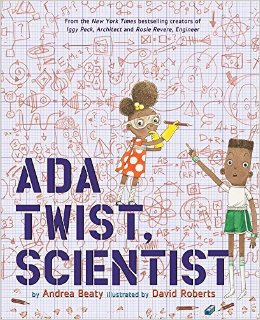
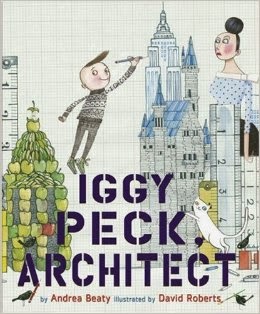
If you have read Iggy Peck, Architect and Rosie Revere, Engineer by Andrea Beaty and David Roberts, then you already know, even without having read it, how marvelous Ada Twist, Scientist is. If you haven't read what I have come to refer to as the STEM trilogy (seriously, these books have SO MUCH teaching potential...) read any or all, and in any order you like. Each book focuses on a creative, curious child driven by a passion, be it building, inventing or asking questions about the world around her and answering her own "whys." And, in each book, our hero faces a challenge, experiences failure, rejection and being misunderstood. This trilogy is almost as much about creativity and expression of creativity as it is accepting and appreciating this passion in a person, which I adore. And these layers are what make Beaty and Roberts's books so easily embraceable and universal. Even if we are not all architects, inventors and scientists, we all have a little bit of these qualities in us and we all value (and want our kids to experience and value) the joy of expression, creation and having a passion.
Oh yeah, and did I mention that Beaty writes the STEM trilogy in absolutely perfect rhyme? Beaty, who also writes novels for kids (Attack of the Fluffy Bunnies, Cicada Summer) is a master rhymer - there are never any bumps or head-shakes that happen as you read her books out loud. They FLOW... And, while I do love, love, love Iggy, it's hard not to be super excited about the girl power inherent in Rosie Revere, Engineer (yes, an elderly, pear shaped Rosie the Riveter is a character in the book) and Ada Twist, Scientist, which makes nods to Ada Lovelace and Marie Curie. These books must be read many times and very closely, as Roberts tucks all sorts of nods in his marvelous illustrations, from the titles of books to the furniture and fashions.
Ada Marie Twist doesn't talk until she is three, but once she figures how to break out of her crib, she is on a "fact finding spree." Her parents have a hard time keeping up with "their high-flying kid, whose questions and chaos both grew as she did." As she grows older, Ada comes to relish the moment when a question takes shape in her mind, this just happens to be the least messy and chaotic part of the process. Happily, her parents also come to terms with the messy and chaotic parts of the process.
I hope that you will purchase any and all of the books in this trilogy for the little people in your life. From the characters and their stories to the rhymes to the magnificent illustrations, these books are about joy - about joy and the qualities that make us human and make life worthwhile - creating, exploring and sharing.
Zap! Nikola Tesla Takes Charge
by Monica Kulling
illustrated by Bill Slavin
Tundra Books, 2016
Grades K-6
The reviewer received a copy of the book from the publisher.
Nikola Tesla is the latest subject in Monica Kulling's Great Idea Series featuring innovators and inventors. The story of Nikola Tesla is sure to intrigue readers. The picture book biography begins with Tesla departing from a
0 Comments on Zap! Nikola Tesla Takes Charge as of 1/1/1900
Zoo animals like lions and tigers may be exciting, but we have a native animal that’s just as big and exciting: the bison. A study of bison can liven up a study on Native Americans, pioneers, the West, or the Great Plains. They’re also a fun animal study subject.
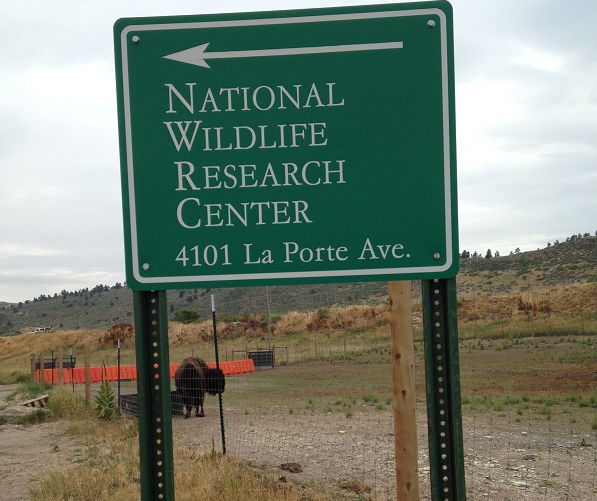
FreshPlans visited some bison at the National Wildlife Research Center in Ft. Collins, Colorado. Can you see the bison in the picture below? He doesn’t look very big, right? Up close, these are very big animals. They came up pretty close to get a good look at us, so we got a good look at them, too.
We saw bison standing around, eating grass, standing around, rolling in the dirt, and standing around. This is pretty much what we do, our guide explained. “They can run, and if they do, you want to get out of the way,” he told us. But they don’t go scampering around for fun.
These bison are part of a joint USDA and Colorado State University project to bring healthy bison back to Colorado. A disease called brucellosis has become a problem in the herds of buffalo in Yellowstone Park. The project is using new technology to breed healthy bison who are descendants of the Yellowstone Park herds, without the dangerous disease.
When we teach about animals, we like to focus on four things:
Morphology: the physical characteristics of animals, including body parts and adaptations.
Life cycles: how animals are born, live, and reproduce.
Habitats: the places where animals live.
Relationships with humans: how humans affect the animals and how they affect us.
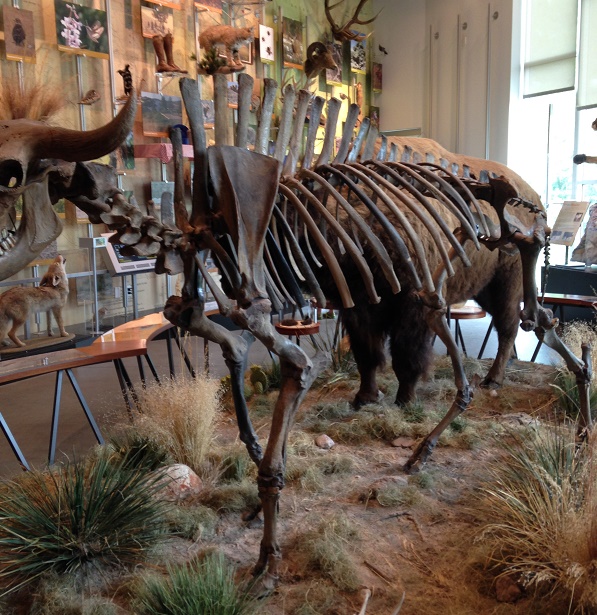
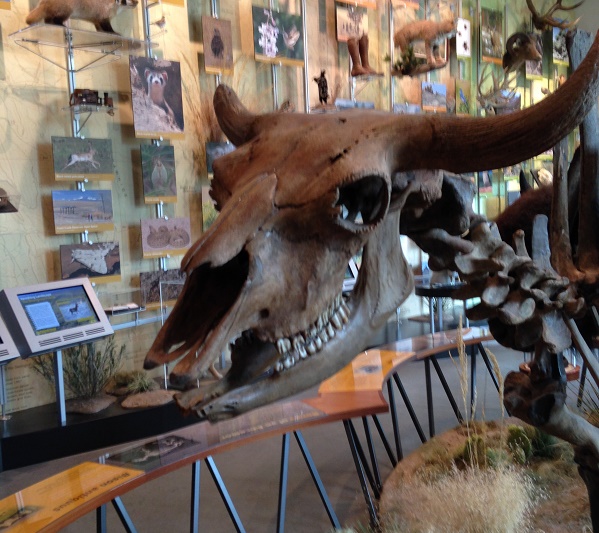
Even though we got a good look at the bison, we couldn’t touch them. We were curious about their unusual shape. So we went to the Discovery Museum in Ft. Collins to look at the skeleton of a bison. We saw that the big humps on their backs had bones inside. It reminded us of a stegoasaurus.
We learned that bison are mammals and ruminants, like cows. They have live babies, which grow up and have babies of their own, just as people do.
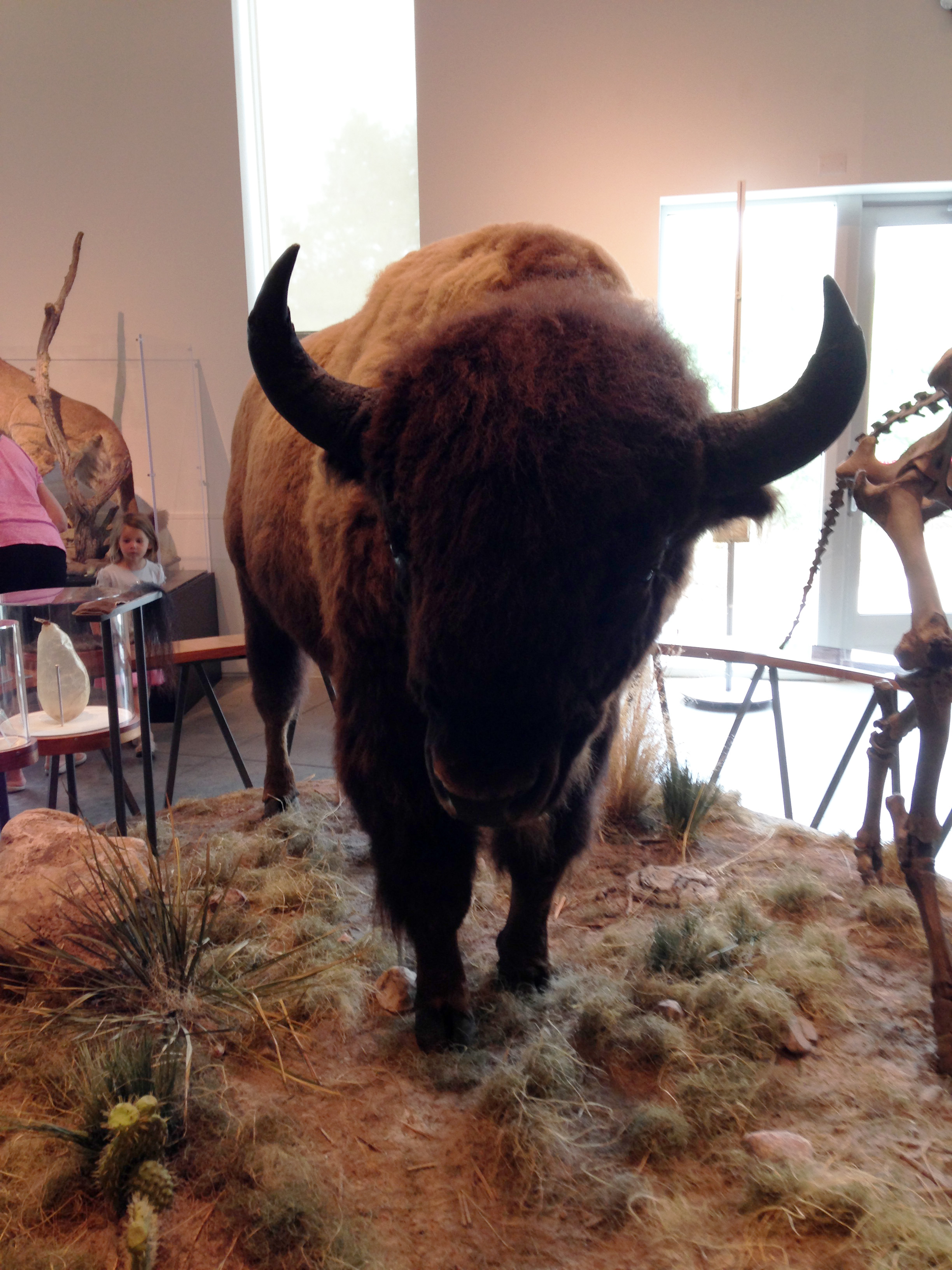
The museum has a taxidermy bison, which looked a lot like the live bison we saw — although it was a lot cleaner and neater. We got to feel bison fun, and we were surprised to find that it was very soft.
This bison is shown in a place made to look like its natural habitat: the prairie. The bison we visited at the USDA Wildlife Research Center live on the prairie, but they don’t get to roam like the buffalo in the song.
While some people eat bison meat today, we learned that most “buffalo meat” you can buy in a restaurant or a grocery comes from animals which have both bison and domestic cow heritage. We found bison wool yarn in Ft. Collins, but once again it included both bison wool and wool from sheep. Bison’s relationship with people today is less about human beings using bison for practical purposes and more about humans trying to care for the bison and make sure our grandchildren can still see this majestic animal on our prairies when they grow up.
Native Americans living on the plains and prairies, however, relied heavily on bison. Let younger students try out this interactive lesson on the relationship between Native Americans and bison. Older students will enjoy this more complex interactive web page from the Smithsonian.
Here are some more resources for teaching about bison:
Check out the Smithsonian’s Interactive Bison Exhibit for a little mouse practice and reading. Set it up as a station at your classroom computer and let students whet their appetite for learning about bison with a lot of intriguing facts.
Mr. Nussbaum has some fun activities about bison, both online and printable.
Texas Parks and Wildlife have a lesson on what bison eat. This page includes a number of different activities bringing up a lot of interesting points, and introducing the word “forbs,” which was a new one for us. There’s an interesting activity asking students to analyze a photograph, which we think could be a good part of critical reading and media literacy lessons. Feel free to use the photos on this page for your analysis!
The U.S. Mint has a lesson that helps students to recognize bison as natural resources. Both this lesson and the previous link include plant study.
Woolaroc Museum has a bison lesson plan pdf with reproducibles including information about bison and Plains Indians, as well as a retelling of a traditional folk tale.
The National Wildlife Federation has a science process lesson that gives students hands-on insight into why it’s so hard to get firm numbers for animal populations. They also have a great bison lesson plan with lots of background information which could be used alongside the first lesson.
Check out the LiveScience Bison News page. This could be part of your classroom morning news roundup, a great reading resource for your bison unit, or part of a student research project.
Zoo animals like lions and tigers may be exciting, but we have a native animal that’s just as big and exciting: the bison. A study of bison can liven up a study on Native Americans, pioneers, or the Great Plains. They’re also a fun animal study subject.
FreshPlans visited some bison at the National Wildlife Research Center in Ft. Collins, Colorado. Can you see the bison in the picture below? He doesn’t look very big, right? Up close, these are very big animals. They came up pretty close to get a good look at us, so we got a good look at them, too.
We saw bison standing around, eating grass, standing around, rolling in the dirt, and standing around. This is pretty much what we do, our guide explained. “They can run, and if they do, you want to get out of the way,” he told us. But they don’t go scampering around for fun.
These bison are part of a joint USDA and Colorado State University project to bring healthy bison back to Colorado. A disease called brucellosis has become a problem in the herds of buffalo in Yellowstone Park. The project is using new technology to breed healthy bison who are descendants of the Yellowstone Park herds, without the dangerous disease.
When we teach about animals, we like to focus on four things:
Morphology: the physical characteristics of animals, including body parts and adaptations.
Life cycles: how animals are born, live, and reproduce.
Habitats: the places where animals live.
Relationships with humans: how humans affect the animals and how they affect us.
Even though we got a good look at the bison, we couldn’t touch them. We were curious about their unusual shape. So we went to the Discovery Museum in Ft. Collins to look at the skeleton of a bison. We saw that the big humps on their backs had bones inside. It reminded us of a stegoasaurus.
We learned that bison are mammals and ruminants, like cows. They have live babies, which grow up and have babies of their own, just as people do.
The museum has a taxidermy bison, which looked a lot like the live bison we saw — although it was a lot cleaner and neater. We got to feel bison fun, and we were surprised to find that it was very soft.
This bison is shown in a place made to look like its natural habitat: the prairie. The bison we visited at the USDA Wildlife Research Center live on the prairie, but they don’t get to roam like the buffalo in the song.
While some people eat bison meat today, we learned that most “buffalo meat” you can buy in a restaurant or a grocery comes from animals which have both bison and domestic cow heritage. We found bison wool yarn in Ft. Collins, but once again it included both bison wool and wool from sheep. Bison’s relationship with people today is less about human beings using bison for practical purposes and more about humans trying to care for the bison and make sure our grandchildren can still see this majestic animal on our prairies when they grow up.
Native Americans living on the plains and prairies, however, relied heavily on bison. Let younger students try out this interactive lesson on the relationship between Native Americans and bison. Older students will enjoy this more complex interactive web page from the Smithsonian.
Here are some more resources for teaching about bison:
Check out the Smithsonian’s Interactive Bison Exhibit for a little mouse practice and reading. Set it up as a station at your classroom computer and let students whet their appetite for learning about bison with a lot of intriguing facts.
Mr. Nussbaum has some fun activities about bison, both online and printable.
Texas Parks and Wildlife have a lesson on what bison eat. This page includes a number of different activities bringing up a lot of interesting points, and introducing the word “forbs,” which was a new one for us. There’s an interesting activity asking students to analyze a photograph, which we think could be a good part of critical reading and media literacy lessons. Feel free to use the photos on this page for your analysis!
The U.S. Mint has a lesson that helps students to recognize bison as natural resources. Both this lesson and the previous link include plant study.
Woolaroc Museum has a bison lesson plan pdf with reproducibles including information about bison and Plains Indians, as well as a retelling of a traditional folk tale.
The National Wildlife Federation has a science process lesson that gives students hands-on insight into why it’s so hard to get firm numbers for animal populations. They also have a great bison lesson plan with lots of background information which could be used alongside the first lesson.
Check out the LiveScience Bison News page. This could be part of your classroom morning news roundup, a great reading resource for your bison unit, or part of a student research project.
We’re told that we can insert a gene to confer sterility and this trait would race like wildfire through Aedes aegypti. Why this species? Because it’s the vector of the Zika virus—along with the dengue and yellow fever viruses. The problem is that A. aegypti isn’t the only culprit. It’s just one of a dozen or more bloodsuckers that will also have to be wiped out. After we’ve driven these species to extinction, we’ll presumably move on to the Anopheles species that transmit malaria.
FreshPlans checked out Strataca, a museum at a working salt mine in Hutchinson, Kansas. We had the opportunity to go 650 feet down below the surface and see part of the mine. We learned a lot about salt!
There are still salt miners working in Hutchison, mining salt used on icy roads. This part of the mining industry, the nonmetallic mineral mining and quarrying industry, is not expected to grow in the future, but it’s essential work right now and an important part of the history of Hutchinson.
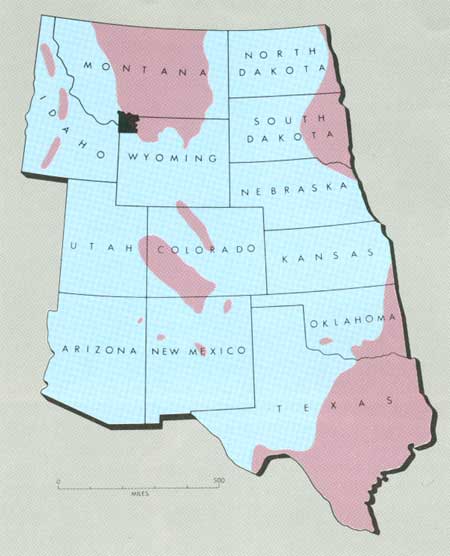
In fact, it’s an important part of the history of the Midwest, way back when it was under water. If your school is located in the middle of North America, chances are good that the land where it sits was once under the Permian Sea.
Is your school’s location on this map? Does it look as though the land where your school sits used to be under the sea?
If so, you might have salt somewhere in your neighborhood, too.
The salt mine in Hutchinson, Kansas, is part of the Permian Wellington Formation, formed about 275 million years ago when the Permian Sea dried up. At 27,000 square miles, this is one of the world’s largest salt deposits.
The deposit was discovered in 1887 by a prospector who was looking for oil. He didn’t find oil, but he did find salt. By 1923, the salt mine we visited was producing salt commercially. It still turns out about 500,000 tons of rock salt each year.
It’s called “rock salt” because the salt is in rocks.
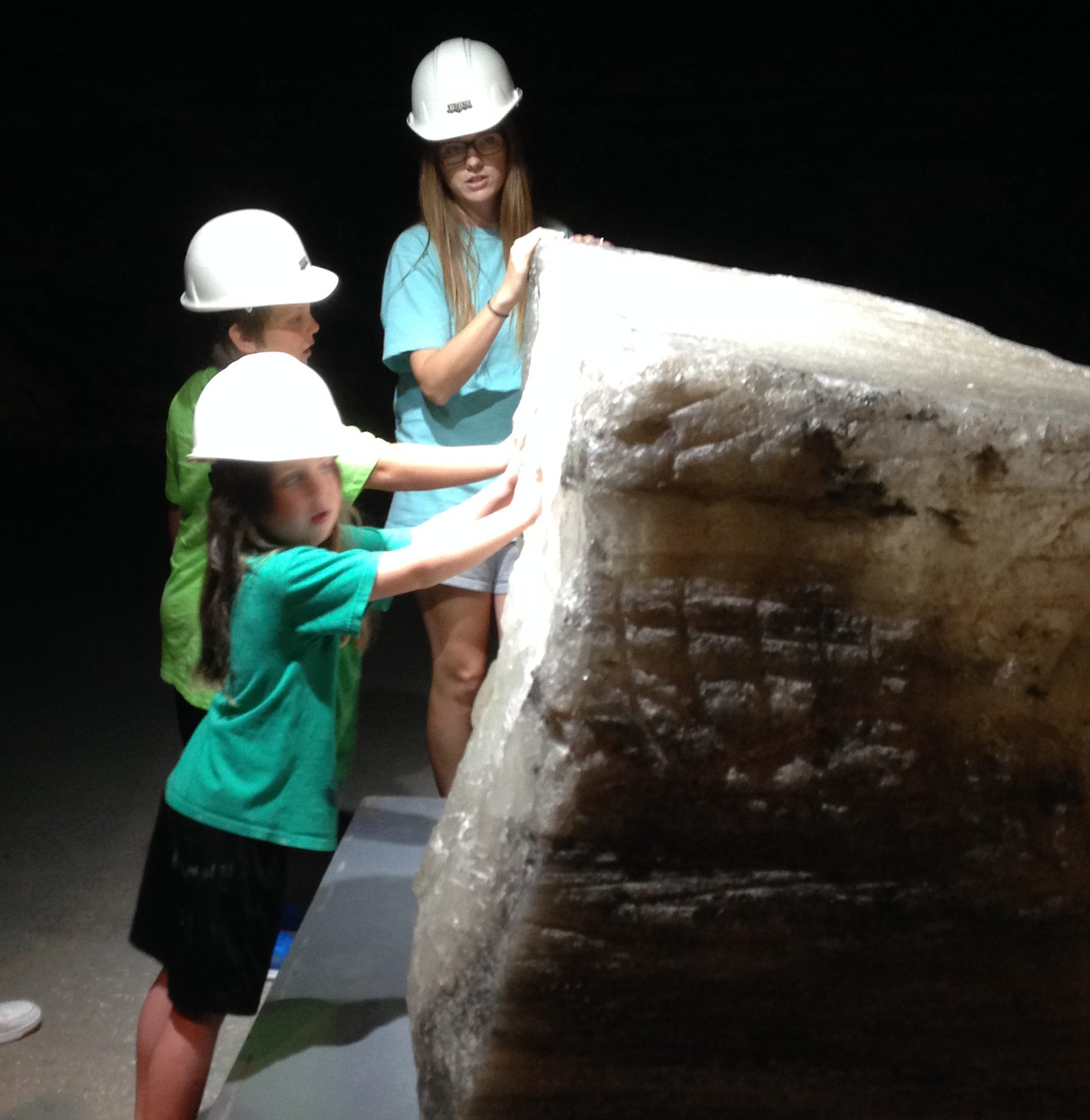
This giant piece of salt is fun to touch. The walls and ceilings in the salt mine are also made of salt. We got to ride in a little train through a part of the salt mine that is no longer in use. There we had a chance to see the places where the miners worked, the miners’ bathroom, and even a part of the mine where layers of salt had fallen from the ceiling to the floor. It was interesting to think about what it might have been like to work in a salt mine.
The Kansas Salt Museum at Strataca has some great resources for educators.
Here are some more online resources for a study of salt in the context of basic chemistry:
A lesson on dissolving salt in water from PBS provides hands-on experience with ideas about solvents, solutes, and solutions, with study materials for high school students.
ScienceNetLinks has a lesson that uses salt to work with magnification. If you’ve got magnifying glasses and microscopes on hand, this lesson gives you a simple way to put them to work.
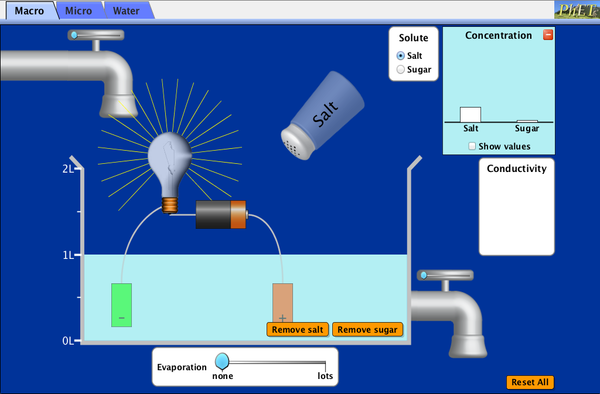
The University of Colorado offers a Java simulation with lots of resources on salt and sugar solutions.
Click to Run
If you have a chance to visit Strataca, you should. If not, think about our field trip and spend a little time exploring salt in your classroom. Lunch will never be the same!
I am not a gardener. I put plants in my yard with thought and care, then I had my third child and started working full time. I love plants, I love gardening, I just don't have time for it and thus haven't shared that love with my kids. However, I work at an elementary school with a project based learning curriculum where the second grade crew took on a year long project that involved a garden, milkweed and monarch butterflies. Using a micro-space, four big planter boxes and a compost pile, these kids became experts over the course of the year. And when, near the end of the school year their garden was vandalized, plants and chrysalises crushed, the spirits of our kids were not. There were tears, for sure, but they rallied. You can read about it here. I tell you about this by way of explaining my personal education on the power of the plant and the good of a garden and I am especially happy to be able to share Gardening Lab For Kids: 52 Fun Experiments to Learn, Grow, Harvest, Make, Play and Enjoy Your Garden by Renata Fossen Brown with the students at my school and my readers here.
Brown believes that gardening is the combination of art and science, and her book is a collection of activities that she has used professionally at the Cleveland Botanical Garden, where she has been vice president of education. Her introduction covers plant basics, from plant parts, hardiness and heat zones, annual versus perennial, watering, materials and even gardening with pets. Each lab takes up a two page spread, with the materials and instructions starting on the verso, and a "Dig Deeper!" box on the recto that gives scientist-gardeners the chance to go one step beyond. Units include getting started, theme gardening, green gardening, garden art and enjoying your garden and the variety and breadth that Brown brings to her book surprised and delighted me.
There are labs for soil percolation, making a rain gauge, making a sprinkler, using catalogs to create a garden design, and even making seed tape which I didn't know was a thing but is a brilliant idea. The entire unit on Theme Gardening is inspiring and I even found a project I think I can take on with my own kids - the Herb Spiral, using bricks like building blocks to build a very cool planter.
The labs featuring art projects, gifts and garden goodies are especially fun. From stepping stones, plant labels and wind chimes to fountains, bird baths, luminarias, Gardening Lab For Kids is packed with great ideas. My favorites? The Garden Journal, the colorful, portable cushions for sitting and enjoying the garden and the lab on Garden Poetry are right up there, but the Garden Fort has to be my absolute. How magical to create a garden, decorate it and then enjoy it from the privacy of your own, handmade fort?
Source: Review Copy
0 Comments on Gardening Lab: 52 Fun Experiments to Learn, Grow, Harvest, Make, Play & Enjoy Your Garden by Renata Fossen Brown as of 8/12/2016 5:16:00 AM
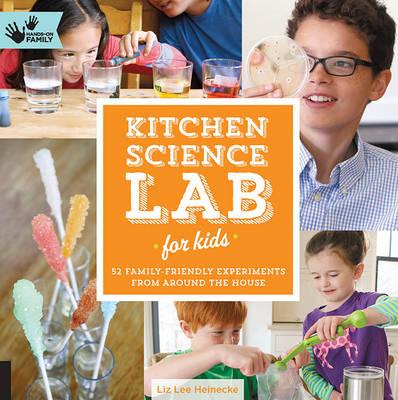
Liz Lee Heinecke clocked ten years of bench work in research labs before starting a new career - mom to three children. When her youngest was two, she started Science Wednesdays with her kids, but often encountered experiements that required specialized equipment, prompting Liz to begin customizing traditional science experiments and making up new ones. You can check out the brilliantly fun experiments she came up with at Kitchen Pantry Scientist, but I am sure that you will want to buy Kitchen Science Lab for Kids: 52 Family-Friendly Experiments from Around the House.
The format of Kitchen Science Lab for Kids is perfect! Each experiment unfolds over two pages, so you can prop open the book and see everything you will be doing, from beginning to end. The verso page contains a materials list and safety tips and hints and the start of the protocol (instructions). The recto finishes the protocol and ends with a "creative enrichment" block that encourages scientists to take experiments one step beyond. My favorite part of Heinecke's book, and one that she says are now treasured keepsakes in her house, is the Science Journal. Instructions are laid out for keeping a notebook to document and detail studies and experiments, which is a vital part of scientific exploration and a skill that is just plain useful across the board.
Kitchen Science Lab for Kids breaks the 52 experiments into 12 units. Chemical reactions, crystals, physics, life science, polymers, colloids and misbehaving materials are some of the units. Acids and bases, microbiology, botany and rocket science round out the 52 labs in the book. Children as young as five and as old as thirteen (or higher) will find these experiments engaging, exciting and fun. And even occasionally edible! Best of all, these experiments are all, 100% kid tested over a range of ages.
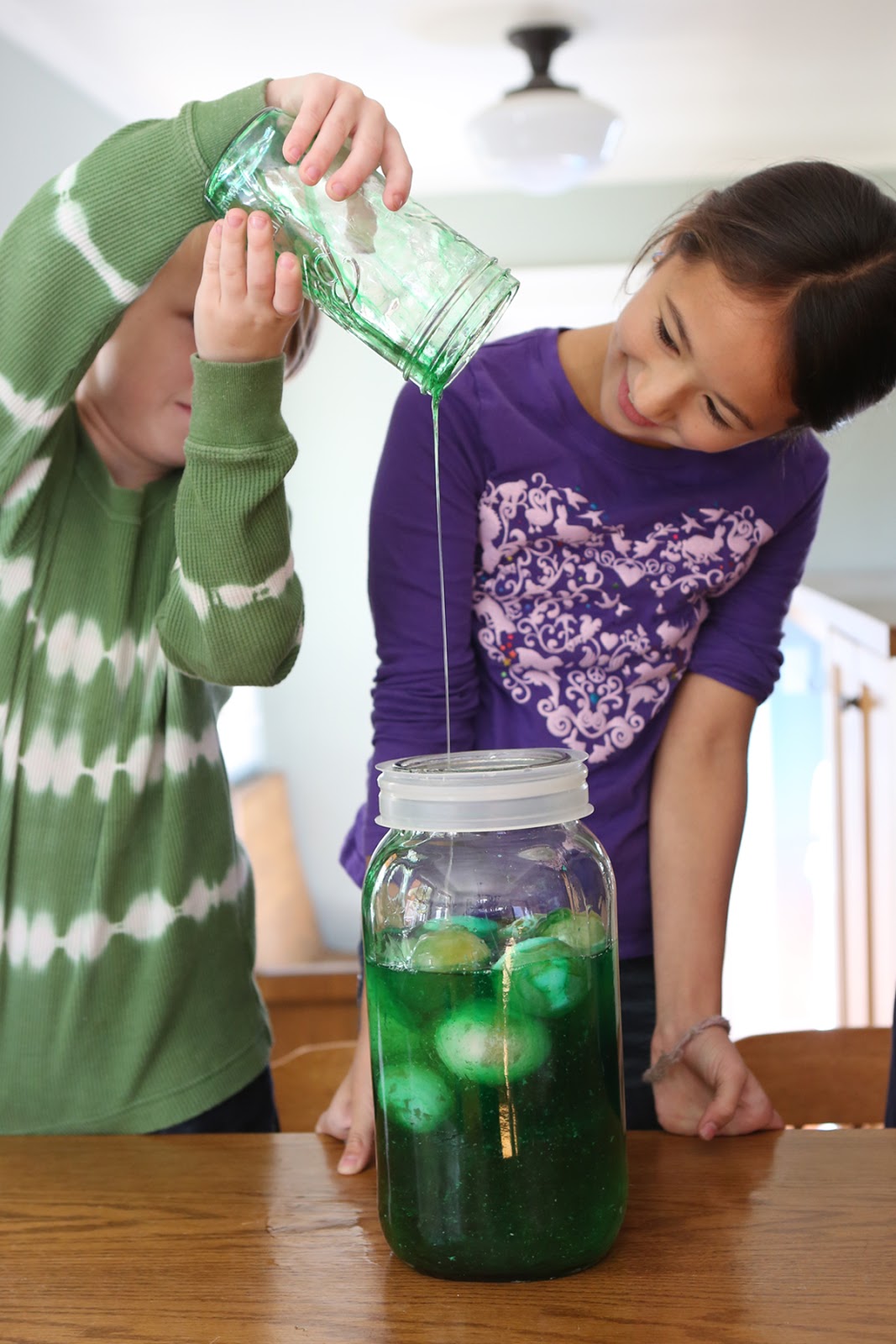
This is the experiment that I want to try with my kids - LAB 14: Standing on Eggs
Also by Liz Lee Heinecke:
Source: Review Copy
0 Comments on Kitchen Science Lab for Kids: 52 Family-Friendly Experiments from Around the House by Liz Lee Heinecke, 144 pp, RL 4 as of 1/1/1900
As a cook, I read Amazing (Mostly) Edible Science, and thought, this is a cookbook! Yum! However, having studied, researched and taught myself the hows and whys of cooking over the decades, I definitely understand that it IS a science. This is exactly why Amazing (Mostly) Edible Science by Andrew Schloss is such a fantastic book - it can hook people like me, who love food and cooking but not necessarily science, and teach me a thing or two. And have delicious, educational fun at the same time. Andrew Schloss is an industry expert, chef, consultant, author and the co-author of The Science of Good Food, a book that brings restaurant level chemistry and physics home with explanations of the physical and chemical transformations which govern all food preparation and cooking, making him perfectly poised to write this superb book for kids.
As I flipped through Amazing (Mostly) Edible Science, I came across many recipe experiments for things have long wanted to make. As the introduction says, "Each experiment is written directly to kids. Almost all can be completed with simple household ingredients. Most take less than an hour (some can be done in as little as 10 minutes), and each provides a snack or meal after you're finished experimenting." I can't think of a better way to spend time in the kitchen with your kids! Besides being filled with exciting experiments, the layout and presentation in Amazing (Mostly) Edible Science is MAGNIFICENT! Yes, it deserves that superlative in all caps. As you can see on the page below, each experiment has a rainbow-color-ranking on the right hand side of the page. Each color informs you as to the wow factor, the degree of edibleness, difficulty level, materials called for, time, cost and safety, making it SO EASY to flip through this book and choose something to do right then and there, or plan for another time.
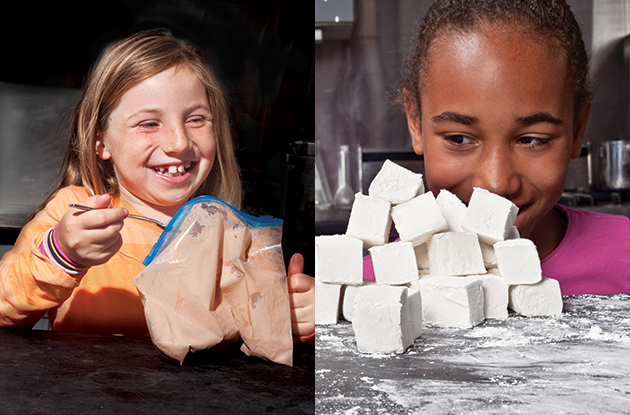
The table of contents is divided into six chapters: Wiggly, Jiggly Experiments, Sweet Crystal Experiments, Cookies, Cakes, and Other Baked Experiments, Fruitastic, Vegedacious Experiments, Eggcellent Eggsperiments, Sodalicious Experiments. You can make edible slime and glow-in-the-dark gelatin, cream-less ice cream and candy-cane origami. Or, you can make 40-second sponge cake, English muffins or molten chocolate cupcakes. As seen above, you can make glowy, bouncy eggs or solid soup. Then, top it off with little edible water bottles and milk rocks.
As a cookbook and a science in the home book, Amazing (Mostly) Edible Science hits all the right marks for me. As a book lover, the aesthetics of Schloss's book is deeply pleasing, from the easy to read, colorful experiments to the fantastic photographs to the matte paper. This is a gorgeous, great book!
Source: Review Copy
0 Comments on Amazing (Mostly) Edible Science: A Family Guide to Fun Experiments in the Kitchen by Andrew Schloss, 160 pp, RL: 4 as of 1/1/1900
It is probable that Shakespeare observed, or at least heard about, many natural phenomena that occurred during his time, which may have influenced the many references to nature and science that he makes in his work. Although he was very young at the time, he may have witnessed the blazing Stella Nova in 1572.
Coyote Moon
by Maria Gianferrari
illustrated by Bagram Ibatoulline
Roaring Brook Press, 2016
Grades K-5
Today I'm taking part in the Coyote Moon blog tour. The book officially hits shelves tomorrow. As part of the blog tour, I'm giving away one copy of Coyote Moon donated by the publisher. The details and entry form can be found at the bottom of this page.
The engaging narrative of Coyote
0 Comments on Coyote Moon- Blog Tour and Giveaway as of 7/18/2016 3:07:00 AM
Gorillas Up Close
by Christena Nippert-Eng
Photographs by John Dominski
and Miguel Martinez
Henry Holt and Company, 2016
Grades 3-6
The majority of the animal books in the 500s section of my school library focus on animals in the wild. Occasionally there are books about animals that were rescued and rehabilitated such as Winter's Tail: How One Dolphin Learned to Swim Again or Owen & Mzee: The
0 Comments on Gorillas Up Close as of 7/15/2016 1:45:00 PM
Whoosh!: Lonnie Johnson's Super-Soaking Stream of Inventions
by Chris Barton
illustrated by Don Tate
Charlesbridge, 2016
Grades K-5
Chris Barton and Don Tate collaborated on last year's successful picture book biography, The Amazing Age of John Roy Lynch. I'm pleased that the duo is back with the engaging picture book about engineer, Lonnie Johnson. Johnson was a creative and inventive child who
0 Comments on Whoosh!: Lonnie Johnson's Super-Soaking Stream of Inventions as of 7/10/2016 6:57:00 AM
The Great White Shark Scientist
by Sy Montgomery
photographs by Keith Ellenbogen
Houghton Mifflin Harcourt, 2016
Grades 5 and up
It's Shark Week on the Discovery Channel, and it's the perfect time to review the latest Scientists in the Field book, The Great White Shark Scientist. Author, Sy Montgomery, and photographer, Keith Ellenbogen, have teamed up on another exciting marine biology story
0 Comments on The Great White Shark Scientist as of 7/5/2016 5:49:00 PM
Independence Day is here; this weekend fireworks will light up the sky around the nation in celebration. But…how are fireworks made? And…who thought to send brightly colored explosions into the sky?
For Arbordale celebration and science go hand in hand, so here is a quick history chemistry and physics lesson in fireworks!
History
The Chinese were experimenting with exploding tubes of bamboo as early as 200 B.C., but it wasn’t until 900 A.D. that Chinese chemists found a mix that when stuffed in bamboo and thrown in a fire produced a loud bang. Over the next several hundred years experimentation lead to the first rockets, but as fire power began to fly in the air, celebrations also began to light up the sky.
Soon firework technology began to spread across Europe to Medieval England. The popularity of celebrating war victories and religious ceremonies with fireworks displays grew. The Italian pyrotechnic engineers are first credited with adding color to their fireworks in the 1830’s. The Europeans brought their knowledge of fireworks to America, and the first recorded display was in Jamestown in 1608.
John Adams predicted that fireworks would be part of the Fourth of July celebrations on July 3, 1776 with a letter to Abigail Adams where he said, “I am apt to believe that it will be celebrated by succeeding generations as the great anniversary festival. It ought to be commemorated, as the Day of Deliverance by solemn Acts of Devotion to God Almighty. It ought to be solemnized with Pomp and Parade, with Shews, Games, Sports, Guns, Bells, Bonfires and Illuminations from one End of this Continent to the other from this Time forward forever more.”
And so on the first anniversary of the country and each year we celebrate with Pomp and Parade, ending the day with Illuminations!
The Science
The Chinese put bamboo in the fire and the air pocket would make a bang when it was heated to a certain temperature. Today we have much better technology and fireworks are a little more complicated. The basic science has not changed, but the delivery methods have gotten much more accurate and high tech giving celebrators a bigger better show.
We know a tube is our vehicle, but how does it travel to the sky?
A mix of combustible solid chemicals is packed into the tube, along with neatly arranged metals. The metals determine the color (copper=blue/green, calcium=red), and the arrangement determines shape (circle, smiley faces, stars).
When the heat activates the chemicals, the excitement begins. The reaction is started by either fire or electricity through a fuse. As the heat begins to travel into the tube the chemicals become activated that reaction produces other chemicals such as smoke and gasses. The chemical reaction creates the release of energy; the energy is converted into the heat, light, sound and movement that we see up in the sky.
Physics takes over!
The Conservation of Energy Law says that the chemical energy packed inside that tube is equal to the energy of the released plus the energy left after the reaction. A professional firework in a large tube packed with chemicals creates a much bigger light show and bang than a tiny firecracker that jumps with a small bang.
The fireworks fly because of Newton’s Third Law. “For every action, there is an equal and opposite reaction” When the gasses are released from the chemical reaction they shoot down with force cause the firework to lift up into the air.
Finally, Why are fireworks always symmetrical?
Conservation of Momentum says that momentum must be the same before and after the explosion. In other words, when the explosion occurs the movement must be balanced.
Now that you have learned a little about the science behind fireworks enjoy watching them on this Independence Day. But remember, fireworks are dangerous and best left to the professionals!
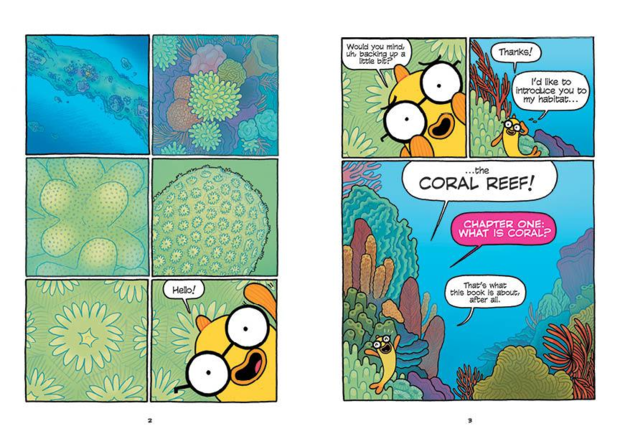
The fantastic publisher FirstSecond, whose motto is precisely and perfectly, "Great graphic novels for every reader," started a new non-fiction series for kids this year. Science Comics: Get to Know Your Universe debuts with superb creators and subjects, Coral Reef: Cities in the Ocean by Maris Wicks and Dinosaurs: Fossils and Feathers by MK Reed and Joe Flood.
Wicks, author of the excellent non-fiction graphic novel for kids, Human Body Theater, worked as a part-time program educator at the New England Aquarium and just spent two months doing scientific outreach for Woods Hole Oceanographic Institution on board the R/V Atlantis! Her passion and knowledge shine through in Coral Reefs: Cities of the Ocean and her introduction is definitely worth reading, especially when she tells readers that we, "make choices that impact the environment with every dollar you spend, every action you take, and every vote that you cast," and encourages us to plant a milkweed, listing all the benefits of giving Monarch butterflies a food source and breeding habitat that can trickle down and benefit the dying coral reefs. With humor and an understanding for her audience, Wicks starts big with a first chapter titled, "What is Coral?" describing the classification system. Chapter Two, "How and Where Coral Reefs are Formed," where I learned that, despite the fact that coral reefs occupy about 1% of the earth's surface, cora reefs are home to more than 25% of all the animals found in the ocean! Chapter Three, "The Coral Reef Ecosystem Explored" takes a closer look at the 25% of the sea life living there and Chapter Four, "How are Coral Reefs Connected to the Rest of the Planet?" is the longest and possibly most important chapter in the book. From start to finish, Wicks makes Coral Reefs: Cities of the Ocean as vibrantly bright and compelling as a healthy coral reef with her popping palette and engaging writing style. A glossary, bibliography and additional resources included in the back matter.
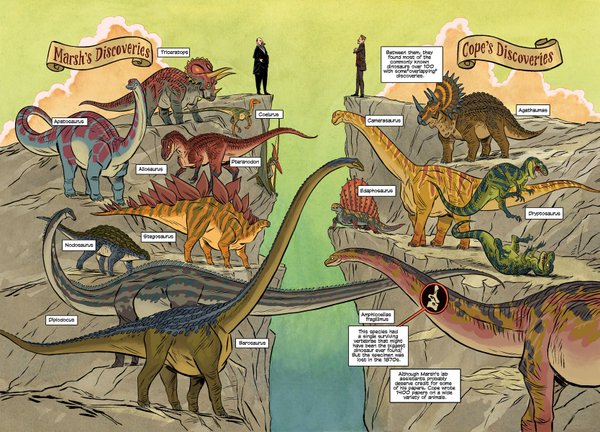
I have to, with great embarrassment, confess that, despite learning a fair bit about dinosaurs as each of my three children went through that phase of fascination, I tend to think of them as static. Dinosaurs: Fossils and Feathers, by MK Reed and Joe Flood, with an introduction by a dinosaur expert, changed my mind in a big way. In his introduction alone, Leonard Finkleman, Ph.D points out the many things that continue to be discovered about dinosaurs, as well as dinosaurs themselves, including the fact that once we didn't even know that dinosaurs lived on every continent. He goes on to write that Reed and Flood bring a "balance of science, philosophy, and history," to their book that is, "informative, funny, and, above all else, imaginative," noting that the lesson of Dinosaurs: Fossils and Feathers is that scientific discovery is very different from normal discovery. Finkleman writes, "Rather than limiting our imaginations, scientific discovery lets us imagine more about the world around us." With that in mind, Wicks and Flood follow paleontologists through history as they try to solve the greatest mystery of all, what happened to the dinosaurs?
Dinosaurs: Fossils and Feathers begins with a little time traveling, showing readers how ancient humans discovering dinosaur fossils thought they were anything from cyclopes to elephants to griffins. In the year 1800, these ideas changed radically when Mary Anning made remarkable finds on the Dorset coast, spending the next 35 years fossil hunting. They also detail the backhanded, sometimes dishonest machinations of the men who made these discoveries and pronouncements and delivered papers about these dinosaurs.
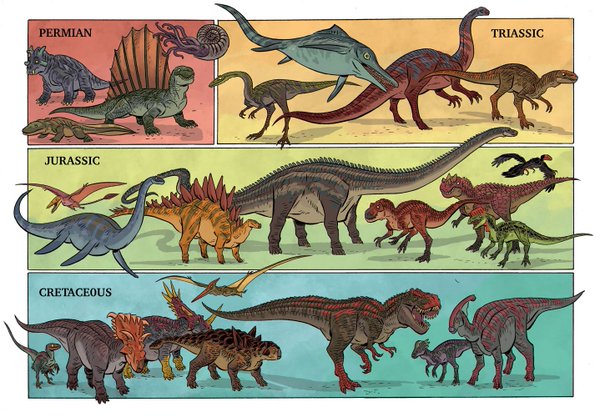
Joe Flood's illustrations are perfectly matched to the subject matter of Dinosaurs: Fossils and Feathers. While the illustrations of the dinosaurs are full of action and expression. The panels with humans present more of a challenge, because of the mostly Victorian time period and somewhat static nature of their roles int he story, yet Flood makes these compelling, especially through the expressions of the characters. There are notes, a glossary and further reading as well as two superb representations of the periods of the dinosaurs. Despite all this amazing information and illustrations, my favorite part of Dinosaurs: Fossils and Feathers comes at the end when the author and illustrator put themselves on the page an error in the text. There are 11 years between my oldest and youngest child. I learned that the big herbivore with the long neck was called the brontosaurus when my first child went through her dinosaur phase. By the time my youngest was going through his we learned that it was now reclassified as an Apatosaurus. On this page, Reed and Flood explain that, a few weeks before this book was due at the printer, researchers concluded that there was in fact enough difference between the two to make the Brontosaurus its own genus again, with a fact box noting that the Brontosaurus is now, "MK and Joe's least favorite dinosaur." With humor and knowledge, Dinosaurs: Fossils and Feathers proves that dinosaurs are anything but static.
Coming October, 2016 and February, 2017
Source: Review Copies
0 Comments on Science Comics: Coral Reefs - Cities of the Ocean by Maris Wicks AND Dinosaurs - Fossils and Feathers by MK Reed and Joe Flood, 120 pp, RL 3 as of 6/28/2016 12:26:00 AM
Prairie Dog Song: The Key to Saving North America's Grasslands
by Susan L. Roth and Cindy Trumbore
Lee and Low Books, 2016
Grades K-5
Susan L. Roth and Cindy Trombore have earned many honors and praises for their picture books including the 2014 Robert F. Sibert Medal for Parrots Over Puerto Rico. Their new nonfiction picture book highlights the role prairie dogs play in maintaining the balance
Aleksandra Mizielinska and Daniel Mizieliński (@hipopotam) started a revolution here in the UK, with the publication by Big Picture Press back in 2013 of their now famous Maps. With that beautifully produced book we started to see something of new departure for children’s non-fiction, with publishers realising that there was an appetite for gorgeously illustrated and finely produced information books which didn’t look or feel like school textbooks.
Since then we’ve seen several new non-fiction imprints established, dedicated to bringing us eye-catching, unusual and sumptuous non-fiction for children and young people, such as Wide Eyed Editions and 360 Degrees. This is great news, especially for younger children who report choosing to read non-fiction (42% of 7-11 year olds) almost as much as they do fiction (48.2% of 7-11 year olds, source), though you’d never guess this from the imbalance in titles published and reviewed.
It’s wonderful to see the return of the founders of the non-fiction revolution with a new title, Under Earth, Under Water, a substantial and wide-ranging exploration of what lies beneath the surface of the globe.
Split into two halves, allowing you to start from either end of the book by turning it around to explore either what lies beneath the earth, or under the oceans, this compendium of startling facts and quirky, fresh illustrations makes the most of its large format (a double page spread almost extends to A2), with great visual and verbal detail to pour over and a real sense of going down, down, down across the expanse of the pages.
The Earth pages cover everything from burrowing creatures to plant life in the soil, via extracting natural resources to industrial underground infrastructure. Tunnels, caves, digging up fossils and plate tectonics are all included in this rich and varied buffet brought together though a simple concept – simply exploring what is underneath our feet.
The Water pages explore aquatic life right from the surface down to the bottom of the Mariana Trench, ocean geography, human exploration with the aid of diving equipment, the history of submarines and even shipwrecks.
Lavishly produced, with gorgeously thick paper it is a delight to hold this book in your hands. Wonderful design, featuring lots of natural reds and browns in the Earth section and soothing shades of blues and green in the Water section, ensures exploring the diverse content is a visual treat as much as it is a spark for thinking about the world around us in new ways.
My only question mark over Under Earth, Under Water is the lack of an index. Maybe this makes it more like a box of treasures to rummage in and linger over, the sort of space where you can’t be sure what gems you’ll dig up. Although perhaps not a resource from which to clinically extract information, Under Earth, Under Water offers a great deal to explore and a very enjoyable journey to the centre of the earth.
There’s so much we could have “played” in Under Earth, Under Water. We toyed with making submarines, visiting caves, planting seeds to watch roots grow, but in the end the animal burrows won out, and we decided it was time to make our own. This began with papier mache and balloons…
…which when dry were set into a cardboard box frame, and surrounded by layers of “soil” i.e. different coloured felt, to recreate the layering of different soil and rock types.
Then the burrows needed filling! Sylvanian families came to the rescue, along with nature treasures gathered from the garden.
And soon we had a dollshouse with a difference! (Can you spot the bones and other archaeological finds waiting to be dug up from the soil??)
Whilst making our underground burrow we listened to:
Reading Above and Below by Patricia Hegarty and Hanako Clulow. This books explores similar territory to Under Earth, Under Water – but for slightly younger children – and makes great use of split pages.
Disclosure: I was sent a free review copy of this book by the publisher, Big Picture Press. The book was translated by Antonia Lloyd Jones although she is not credited in the book.
2 Comments on Under Earth, Under Water, last added: 5/26/2016
We've curated a list of some truly wonderful and entertaining bug books for kids ages 4 to 99. We've also included the game Bug Bingo, and it's the bees-knees.
The school year is coming to a close and it’s time to stock up for summer reading. We have five great books for you!
This month, our book list features a sweet story about an unconventional animal family, an adorable picture book that celebrates determination, a nonfiction guide to becoming a backyard scientist, and a book that teaches you how to stand up to their fears. For mature readers, the first-ever graphic novel to receive a Caldecott Honor will make for an engrossing read.
Get ready to say “Awww!” every time you turn the page! The real-life photos of a tiny little pig being raised by dachshunds is a heart-warming story that promotes acceptance and reminds us that everyone deserves love.
This adorable picture book is both a perfect read-aloud and an ideal graduation gift! It’s a joyful celebration of creativity, determination, and creative problem-solving. We can’t get enough of this one!
Anyone can be a scientist in this kid-friendly, non-fiction gem! Kids will learn how to observe, conduct research, collect data, and be part of four unique scientific discoveries that can happen anywhere — in a backyard, a field, or even a city park.
Warm, wonderful, and unforgettable, this is the terrific story of a boy whose best friend teaches him to stand up to his fears – from spiders to bullies and more. A perfect read for summer!
Both hopeful and heartbreaking, this beautiful book is the first graphic novel to be awarded a Caldecott Honor. Mature teens will find it captivating and will readily relate to its coming-of-age explorations of complex friendship and family relationships.


















.jpeg?picon=2456)

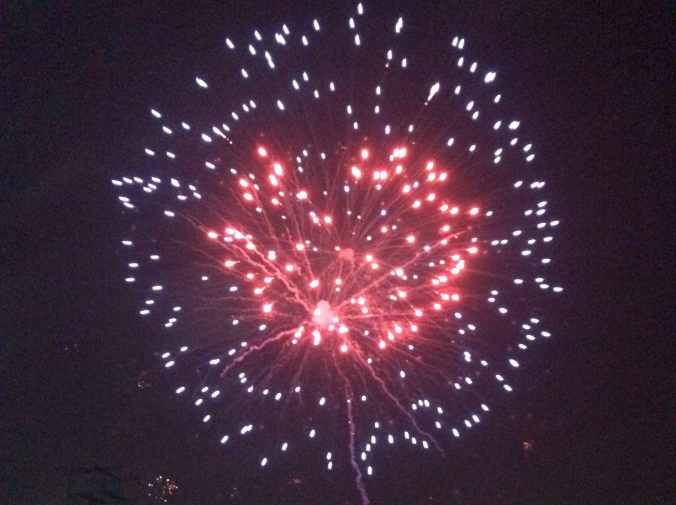
 John Adams predicted that fireworks would be part of the Fourth of July celebrations on July 3, 1776 with a letter to Abigail Adams where he said, “I am apt to believe that it will be celebrated by succeeding generations as the great anniversary festival. It ought to be commemorated, as the Day of Deliverance by solemn Acts of Devotion to God Almighty. It ought to be solemnized with Pomp and Parade, with Shews, Games, Sports, Guns, Bells, Bonfires and Illuminations from one End of this Continent to the other from this Time forward forever more.”
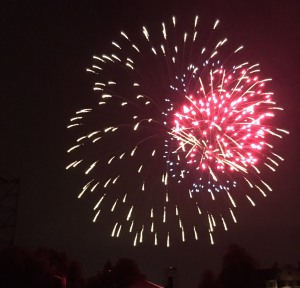 metals. The metals determine the color (copper=blue/green, calcium=red), and the arrangement determines shape (circle, smiley faces, stars).
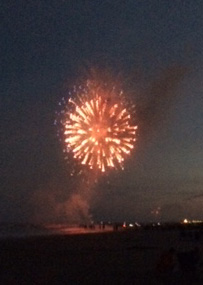 Conservation of Momentum says that momentum must be the same before and after the explosion. In other words, when the explosion occurs the movement must be balanced.








.jpeg?picon=3306)
 It’s wonderful to see the return of the founders of the non-fiction revolution with a new title,


Congratulations!
Thank you, Bigfoot! :-)
Big congratulations. Your illustrations look wonderful. Sure to become a very popular book with children and teachers.
Thank you so much for the kind words, June!