new posts in all blogs
Viewing: Blog Posts Tagged with: Caldecott, Most Recent at Top [Help]
Results 1 - 25 of 129
How to use this Page
You are viewing the most recent posts tagged with the words: Caldecott in the JacketFlap blog reader. What is a tag? Think of a tag as a keyword or category label. Tags can both help you find posts on JacketFlap.com as well as provide an easy way for you to "remember" and classify posts for later recall. Try adding a tag yourself by clicking "Add a tag" below a post's header. Scroll down through the list of Recent Posts in the left column and click on a post title that sounds interesting. You can view all posts from a specific blog by clicking the Blog name in the right column, or you can click a 'More Posts from this Blog' link in any individual post.
...has entered my classroom in the form 16 children who are, in three cases literally, angels. (I have an Angel, an Angela, and an Angelina!) This year, in addition to my old favorite
Roxaboxen, I began the year with the picture book poem
All the World by our friend Liz Garton Scanlon. This poem (even without the Caldecott Honor illustrations by Marla Frazee) touches the sacred for me, and the way I explained it to the shiny new second-graders children sitting on my shaggy spring green carpet is that it gathers up many small, ordinary things to make us feel one big true thing. Here's an excerpt.
All the World | Liz Garton Scanlon
Rock, stone, pebble, sand
Body, shoulder, arm, hand
A moat to dig, a shell to keep
All the world is wide and deep.
Hive, bee, wings, hum
Husk, cob, corn, yum!
Tomato blossom, fruit so red
All the world's a garden bed
Tree, branch, trunk, crown
Climbing up and sitting down
Morning sun becomes noon-blue
All the world is old and new
....
Everything you hear, smell, see
All the world is everything
Hope and peace and love and trust
All the world is all of us
**************************
After I read this, there was this long pause, and then Andy (yes, I have an Andy too), raised his hand to say, "That book almost made me cry." There was reverence in the room.
And that, my friends, is what they are ALL like this year: full of hope and peace and love and trust, open-hearted and ready. It's another miracle.
Just in case someone had thought to set this beauty to music, I searched a little and found my way to this, which plays with the end of the book to fit the music but comes out pretty wonderful.
Thanks to Liz, and thanks to Penny at
A Penny and Her Jots for hosting today, and thanks be to the ebb and flow of the world that every year is different!

By: Liz,
on 7/27/2016
Blog:
Liz's Book Snuggery
(
Login to Add to MyJacketFlap)
JacketFlap tags:
James Marshall,
Classics,
Picture Books,
Caldecott,
Goldilocks and the Three Bears,
3-5,
0-2,
Liz's Picks Videos,
Caldecott Illustrators,
Way Back Wednesday,
Way Back Wednesday Essential Classic,
Add a tag
[There is a video that cannot be displayed in this feed. Visit the blog entry to see the video.]
Currently, members of the Newbery and Caldecott committees serve with the understanding that they may never tell what happened during the deliberations.
However, there has been a recent conversation about whether there should be a statute of limitations on confidentiality. Should committee members be allowed to tell part or all of what happened in the discussions? Should there be a period of years after which the records can open? This month’s edition of School Library Journal has three wonderful articles about the issue.
I am fascinated by this conversation. Riveted. And here’s the crazy thing. I agree with all three points of view.
I agree with K.T. Horning that there is an amazing potential for researchers. I don’t want to know who said what, but I would love to know the larger issues. How did those brave committees who bucked trends do it? How did they come to consensus? What was the thought process in the room when The Invention of Hugo Cabret or A Visit to William Blake’s Innwon? And once and for all, wouldn’t it be wonderful to find out why Secret of the Andes beat Charlotte’s Web?
Forever is a long time not to know.
I agree with Ed Spicer that it would be freeing to tell everything. It would be marvelous to tell a creator that just because their book wasn’t honored doesn’t mean it wasn’t under consideration, that no one loved it or fought for it. It doesn’t mean it isn’t a great work of art. Former committee members can’t answer questions of why a particular book did or didn’t make the final cut for the rest of their lives. And when questions arise about unusual choices committees make, it is a long time not to be able to defend yourself.
Forever is a long time to keep a secret.
I agree with Dan Santat that it can be better not to know. The magic is preserved. Do we really want to know that a classic book barely squeaked by? Do we want to know all the reasons those fifteen people in that room rejected one book and anointed another? Do we want to know which book lost by a small margin? Do we want the creators to be concerned about all their decisions and choices when they create their next book?
Forever is a long time to doubt yourself.
There’s an additional issue for me. If we lifted the veil, what would we reveal, especially for the recent committees? The process is so secret that ballots are destroyed and official notes aren’t kept. If we opened the files for recent pivotal years, would we find the answers we’re looking for?
Ideally, I would love an oral history interview project or written accounts from each of the fifteen people in the room- in case the veil does lift sometime in the future. If there is a commitment to revealing information at some point, the sooner we start recording it, the better, before everyone who was in the room forgets the finer details.
The year I was on the Caldecott committee, one of our committee members gave us all lovely blue scarves, which we wore during the deliberations and announcement. I felt that every time I saw a blue-scarfed person that weekend, I was seeing a true friend. Each blue scarf represented one of the fourteen other people in the room. They were the fourteen safe places in tag, the fourteen people I could talk to about really happened- not what everyone on the outside thought happened. They still are- those fourteen special people who are forever keeping the same secrets I am.
I am on another award committee where part of the process shortly before the awards ceremony at the annual conference includes committee members telling why certain books lost. After the secrecy of an ALA committee- this openness feels strange to me. I find it really challenging to tell a room full of people what I think. I always feel paranoid that someone is audio recording the session and I’ll be thrown off the committee for revealing secrets.
Having being on several award committees, I can tell you that after a while what you say in the room, in the e-mail chat or on the conference call stops mattering. The committee voted and the committee as a group made a choice- and it is now your job to promote that book and that award.
I was one of the fifteen people in the room the year The Adventures of Beekle by Dan Santat won the Caldecott Medal. It’s my book. It doesn’t matter what was said in the room. It doesn’t matter what the vote tallies were. Seeing the Caldecott Medal on the cover will always make me smile. Reading it to a child who hasn’t heard it yet will always make me choke up. I will always get goose bumps when on the last line. It will always be my book.
Forever.
<!--[if gte mso 9]> Normal 0 false false false EN-US JA X-NONE <![endif]-->
What are your thoughts?

By: Samantha McGinnis,
on 5/17/2016
Blog:
First Book
(
Login to Add to MyJacketFlap)
JacketFlap tags:
graphic novels,
Book Lists,
science,
Caldecott,
The Liberation of Gabriel King,
Loree Griffin Burns,
summer reads,
Citizen Scientists,
Mariko Tamaki,
Deborah Underwood,
Johanna Kerby,
A Balloon for Isabel,
graduation gifts,
This One Summer,
Inside First Book,
Our Recommendations,
K.L.Going,
Little Pink Pup,
Add a tag
The school year is coming to a close and it’s time to stock up for summer reading. We have five great books for you!
This month, our book list features a sweet story about an unconventional animal family, an adorable picture book that celebrates determination, a nonfiction guide to becoming a backyard scientist, and a book that teaches you how to stand up to their fears. For mature readers, the first-ever graphic novel to receive a Caldecott Honor will make for an engrossing read.
For Pre-K –K (Ages 3-6):
 Little Pink Pup by Johanna Kerby
Get ready to say “Awww!” every time you turn the page! The real-life photos of a tiny little pig being raised by dachshunds is a heart-warming story that promotes acceptance and reminds us that everyone deserves love.
For 1st and 2nd Grade (Ages 6-8):
 A Balloon for Isabel by Deborah Underwood
This adorable picture book is both a perfect read-aloud and an ideal graduation gift! It’s a joyful celebration of creativity, determination, and creative problem-solving. We can’t get enough of this one!
For 3rd & 4th grade (Ages 8-10):
 Citizen Scientists by Loree Griffin Burns
Anyone can be a scientist in this kid-friendly, non-fiction gem! Kids will learn how to observe, conduct research, collect data, and be part of four unique scientific discoveries that can happen anywhere — in a backyard, a field, or even a city park.
For 5thand 6th Grade (Ages 10-12):
 The Liberation of Gabriel King by K.L. Going
Warm, wonderful, and unforgettable, this is the terrific story of a boy whose best friend teaches him to stand up to his fears – from spiders to bullies and more. A perfect read for summer!
Grades 7 & up (Ages 13+):
 This One Summer by Mariko Tamaki
Both hopeful and heartbreaking, this beautiful book is the first graphic novel to be awarded a Caldecott Honor. Mature teens will find it captivating and will readily relate to its coming-of-age explorations of complex friendship and family relationships.
The post Monthly Book List: Our Favorite Books For May appeared first on First Book Blog.

Today is the one year anniversary of the day the 2015 Caldecott committee announced our winner and honors.
Things I have learned in the last year:
-You can walk into a windowless hotel room with fourteen acquaintances and walk out two days later with fourteen lifelong friends.
 -The only people who truly understand what you went through are the ones who were in that room with you.
-Forever- which is the length of time that you will be keeping your mouth closed about exactly what happened during the deliberations- is a really long time.
-Getting to be on a phone call where you hear someone's life change is the most incredible experience.
-It is challenging to go from one of the most intense experiences of your life, and a crazy press conference full of celebration to driving a carpool the next day.
-Reading a New York Times article announcing the winner is enough to make you cry because you were in the room where it happened.
-You should never read the comments section of anything that discusses your winners.
-The generosity, graciousness and appreciation of the winners will overwhelm and humble you.
-Fifteen minutes during lunch is not enough time to tell a group of fifth graders about the experience of being on the committee.
-Having the ability to give away hundreds of books to a school that needs them is a wonderful feeling.
-Sitting in the front row at the banquet, seeing your name on the big screen and hearing your committee being thanked by the medal winner standing at the podium is a goose-bumpy and teary experience.
-Everyone in the children's book world is best friends with Dan Santat and was super happy that he won the Caldecott Medal. (Seriously. EVERYONE has told me that they are a close friend of Dan's. Is there anyone who only has a casual acquaintance with Dan?)
-The first Midwinter after you've been on the committee is hard. You know everything the committee is doing, and what time they are doing it, but you're not doing it too.
-If there are people left in the world who don't know you were on the Caldecott committee, your friends will make sure they find out.
-Being able to simply read and appreciate a beautiful picture book and not have to read it over and over and analyze it and tie yourself into knots writing a nomination for it is a nice thing.
-As overwhelming as it is to see your porch covered in boxes of submissions, you will miss them when they stop coming.
-Watching your winners have success in their careers is fantastically exciting.
-There is nothing like the thrill of seeing a Caldecott Medal on the cover of a book, and knowing exactly how it got there.
-Figuring out how to be vague in a blog post like this one is hard work.
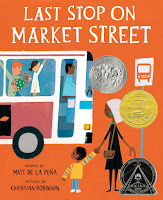 In 2008, librarians surprised everyone by choosing the 533-page, The Invention of Hugo Cabret as the winner of the Caldecott Medal honoring the "most distinguished American picture book for children." This year, the award committees surprised us again with the choice of a picture book, Last Stop on Market Street, as the winner of the Newbery Medal, given to "to the author of the most distinguished contribution to American literature for children."
The short video below featuring author, Matt de la Peña, reading from his book will convince you that this is a wonderful book.
My concern as a public librarian, however, is how best to share this book with kids. The book is a little lengthy for my usual storytime crowd, and school-aged kids can seldom be convinced to check out a picture book. It's in instances like these, that I envy school teachers and media specialists, who have such a wonderful opportunity to share great books with large numbers of kids. This is perfect book for reading aloud in school.
But, how to share it in a public library setting?
Last week, I had a last-minute inspiration and it was a rewarding experience. I have a small book club that meets every month. This month, I asked each of the kids to read Last Stop on Market Street - right then. In addition to positive comments about the book, I loved two of the observations that they reported:
- I never would have chosen this book if you didn't hand it to me.
- The people at the soup kitchen look like regular people.
We then discussed public transportation (none of the kids had ever been on a bus) and soup kitchens (none had ever been to one). Working in a suburban library with poor public transportation, I can understand this. However, as a suburban parent, I can tell you that I made sure that my own children volunteered at the local food pantry and experienced public transportation (I made all of them ride the public bus with me to the mall even though it was more expensive than driving my minivan and took twice as long). As a suburban librarian, I can't take kids on the public bus or to the soup kitchen, but at minimum, I've ensured that a few more children are now aware of the lives that others lead.This is one of the many things that makes my job worthwhile.
One of the missions of the
#WeNeedDiverseBooks (TM) campaign is to make sure that "all children can see themselves in the pages of a book." This is important, but also important is recognizing that all people are just "regular people." We always have more in common than we think.
Last Stop on Market Street by
Matt de la Peña, Illustrated by
Christian RobinsonRead it. Share it.
**Winner of the 2016 Newbery Medal
**A 2016 Caldecott Honor Book
**A 2016 Coretta Scott King Illustrator Honor Book
A New York Times Bestseller
Four Starred Reviews
Finalist for the 2014 E.B. White Read-aloud Book Award
A Junior Library Guild Selection

My young son loves Beekle: the Unimaginary Friend by Dan Santat.
And, for the first time, I'm going to be completely honest about why.
It's not the stunning artwork. It's not the incredible multi-layered story. It's not that I was a member of the committee that awarded it the Caldecott Medal. (WHY NOT??!! WHY ISN'T IT ANY OF THESE THINGS???!!)
It's the fact that you can see Beekle's butt.
Now, the casual reader probably only saw this Beekle butt, the main event.
But the true, careful observer can find a lot more than that with a little patience.
Here is a tiny Beekle climbing the tree.
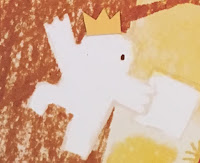
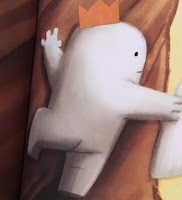
We also get a glimpse at Beekle's tuckus as he hands the paper to Alice, and in a later stylized version.
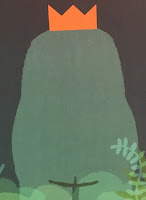
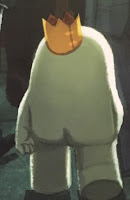
And it's the final image- on the back cover, as well as under the jacket.
Over the years, I have seen a number of posterior-related titles, starting with
Captain Underpants, and in recent years titles such as
Chicken Butt by Erica Perl and
Veggies with Wedgies by Todd Doodler have crossed my desk. My son thinks these are brilliant works of art. They make him laugh harder than any other books on our shelf. Seriously.
The 2015 Caldecott committee set several records. The most honor books. The first graphic novel. And also, if you were paying attention, the first Caldecott Medal book (that I know of) featuring a butt. My kids are the proudest of this record.
Caldebutt scholars may argue for the inclusion of
No, David! by David Shannon (featuring full nudity, no less!),
In the Night Kitchen by Maurice Sendak and
King Bidgood's in the Bathtub by Audrey Wood which certainly hints, if doesn't downright show anything. Those are honor books, and I'm talking about Medal books.
Now,
Travis Jonker has pointed out, that to some, there is now a second Caldecott Medal winner that features a butt. This one is on the cover, no less. (I see knees). Look at Travis' post for more.
Thank you to Travis, for his post, that freed me emotionally to write this one, and to Angela Reynolds, my fellow Caldecott committee member, for the truly awesome title.
And, whatever the reason, I'm glad my son loves Beekle; no ifs, ands, or butts.
The winners of the ALA Youth Media Awards were announced yesterday morning. (
Complete list of winners here.)
I'm still scratching my head a bit at the Newbery winner -- the picture book Last Stop On Market Street. I'll withhold judgement until I've had a chance to read it.
But which of the winners DID I read this year?
All three Newbery Honor books -- The War That Saved My Life (my pick for winner), Echo, and Roller Girl
Caldecott Winner -- Finding Winnie
Sibert Honor book -- Drowned City: Hurricane Katrina and New Orleans
Stonewall winner -- George
Both middle grade Schneider winners -- Fish in a Tree and The War That Saved My Life
I'm currently reading one of the Coretta Scott King Honor books -- All American Boys
Pura Belpré Author Award -- Enchanted Air by Margarita Engle
* * * * * * * *
All in all, it was a good reading year for me!
<!--[if gte mso 9]> Normal 0 false false false EN-US JA X-NONE <![endif]-->
Question: How do you spell the name of that big award that is given every year for the most distinguished contribution to American literature for children?
Answer: Newbery. Newbery. Newbery. NOT NewBERRY. It is named for eighteenth-century English bookseller John Newbery, and he only had one R in his last name.
Answer: Last Stop on Market Street, written by Matt de la Peña, illustrated by Christian Robinson. It is 32 pages and it is a picture book.
Question: Wait; how did a PICTURE BOOK win the Newbery Medal? I thought that award was for novels. Isn’t the Caldecott Medal for picture books?
Answer: Both the Newberyand the Caldecottcriteria define children as “persons of ages up to and including fourteen, and books for this entire age range are to be considered.”
Picture books were always eligible for the Newbery. This is just the first picture book to win. This also means that an illustrated book for older kids, up to age 14, is eligible for the Caldecott.
Question: So what won? The words, or the pictures?
For the Newbery Medal- the words won, and the Newbery Medal will be given to Matt de la Peña, the author.
However, the ALA Youth Media Awards were very good to Last Stop on Market Street. It also won a Caldecott Honor and a Coretta Scott King Illustrator Honor Award. Both of these awards are for the art and will be given to Christian Robinson, the illustrator. The book won three awards in all.
Answer: Finding Winnie: The True Story of the World’s Most Famous Bear, illustrated by Sophie Blackall, written by Lindsay Mattick.
Question: I thought Sophie Blackall is Australian and Lindsay Mattick is Canadian. Isn’t the Caldecott an American award? Wouldn’t that make Finding Winnie ineligible?
Answer: The Caldecott criteria states "the award is restricted to artists who are citizens or residents of the United States. "
Since the Caldecott Medal is only given to the artist, not the author- it is only the artist that needs to be eligible. So, it doesn’t matter where Lindsay Mattick lives.
Sophie Blackall is currently a resident of the United States, which makes Finding Winnie eligible.
Question: I’ve got more questions!
Answer: Ask them in the comments. I’ll try to answer them.
<!--[if gte mso 9]>
Normal 0 false false false EN-US JA X-NONE <![endif]-->
P.S. Newbery. One R.
Watch the Golden Globes last night? Well, it's award season for books, too!
The
big news today for librarians, parents, teachers, and fans of #kidlit, is the announcement of the
American Library Association's Youth Media Awards. I'll be driving to work as the live webcast begins, but I'll be checking in as soon as I get to work!
You can also follow the Twitter hashtag
#ALAyma for live updates.
I hope to see a few of my favorites!

How exciting to have Last Stop on Market Street be awarded the Newbery Medal as well as a Caldecott Honor. I remember this also happened with A Visit to William Blake’s Inn.
The post Youth Media Awards appeared first on ALSC Blog.

On December 1, 2015,
Publisher's Weekly ran an
article about Ingri and Edgar Parin d'Aulaire's
Abraham Lincoln, which won the Caldecott Award in 1940. The article states that the book will be reprinted to mark the 75th anniversary. Gross interviews Rea Berg of Beautiful Feet Books. It is her press that is reprinting the book.
I have not seen one of the original printings of the book. Apparently, the art in the book published in 1940 suffered in prints in the 1950s, when printing techniques changed. Berg's reprinting will restore the color and quality of the original.
I often discuss the book when I do workshops and lectures, but haven't written about it here on AICL. In my workshops, these pages are the ones I draw attention to.
First is this enlargement of the upper left part of the endpapers:
Look at the upper left corner, where you see what the d'Aulaire's intended to be a tipi and an Indian man, with one foot raised. Why, I wonder, is he shown that way? And his tipi is more like a toy than a real tipi.
The next image I show is this page:
The book is a life history. It includes that page of Lincoln as a child. The text, "solemn like a little papoose," plays on stereotypes of Native people as being stoic. And I wonder if the d'Aulaire's knew that papoose is not the Native word for baby. It is one peoples' word, but there's hundreds of Native languages and each one has its own word for baby.
Later, the d'Aulaire's tell us about Lincoln fighting Black Hawk. Here's an enlarged image from that page. Relative to the people drawn on other pages, this "Indian" is tiny --- but look at how cartoonish it is drawn!
And here's the text for that part:
[T]he men of New Salem were called to war, for an Indian chief, Black Hawk, had come back to Illinois with his warriors.
and
[T]he people of Illinois [...] went to war to chase the Indians out.
Here's more from that part of the book. At the end of that war is this image:
The text for that page is this:
One day a peaceful old Indian came walking into camp. The soldiers were angry and wanted to kill him, but Abe said, "Anyone who touches him must fight me first." Because Abe was the strongest, they had to obey."
I wonder if that "peaceful old Indian" was modeled on this portrait of Black Hawk?
Some of the content in the 75th anniversary edition is going to be changed. In the
Publisher's Weekly story is this:
Berg said they made minor modifications to the original art and text to reflect contemporary views about race politics and to reflect historical accuracy, citing two instances in the book, including one of a Native American cowering behind Lincoln, which they fixed to have him “standing erect.”
Here's that particular image, again, of the cowering man who will be standing erect in the new edition. What, I wonder, was the thinking behind the decision to change that man from cowering to standing erect? In the original, it fits with the white savior theme. Changing him from cowering to erect doesn't change that theme.
On the other hand, there are many accounts of an old Indian man walking into camp and Lincoln saying to his men that they should not hurt him. The sources don't have the "fight me first" line. The accounts are more specific to how Lincoln was viewed by those men. They didn't really respect him and somehow, his defending the old Indian is part of that account.
When the new book comes out, I'll definitely do some comparisons. Now--if I'd been asked to suggest changes, I'd add a bit about the word, papoose, and I'd revise the text about Black Hawk, too. And, I'd include a page about Lincoln signing the order for the largest mass execution in the US: the hangings of the
Dakota 38.
The other changes made are with regard to the depiction of slavery. Here's what the article says about that:
Another is when Lincoln is walking down the streets, with freed slaves bowing down to him. “The original text didn’t mention that he didn’t want them bowing down to him,” said Berg. “The original didn’t say that he actually shook hands with them. So we altered his face and made him shake hands with the former slaves and added in what he actually said in the historical record, which was, ‘Do not kneel to me.’ ”
It is a bit hard to make sense of what Berg is saying, but I think they're replacing the text in the book with text that matches the historical record. Here's the page in question (when I get a better image I'll use it instead):
I'll add a link to this post to the
set of links I'm compiling that document changes to children's books and I'll be back with a better image of that page when I get to the library.
I used make predications about which books would win the Newbery and Caldecott.
I even got pretty good at it.
But then, a crazy thing happened.
I got on the Caldecott committee.
To quote Into the Woods: “I know things now, many valuable things, that I hadn't known before.”
I know now that until….
-your porch has filled with boxes of books that all have to be read and evaluated carefully…
-you’ve spent a year reading during every ounce of time you have, during evenings, weekends, during time you would have spent with your family…
-you’ve read and analyzed every single book eligible for your award to the best of your ability…
-you’ve weighed and debated over and over which books should be nominated…
-you’ve carefully researched and written nominations with all the intensity of a graduate school thesis…
-you’ve sat in a room for hours and hours and hours and discussed books with people who knew them just as well as you did….
-you’ve taken a book off the table that you thought would be the winner…
-you’ve stared at a small piece of paper asking for your choice for the medal- and you knew that choice mattered….
-you’ve pushed aside all the stars, mock results and commentary and voted for the books you truly thought deserved to win…
-your committee has reached a consensus….
-you’ve been on a speakerphone call and heard the exact second when a person’s life changed completely….
-you’ve held the hands of the other committee members as your winners were announced and as the crowd literally gasped at your decisions…
…. there are a lot of things that are hard to know.
Now that I know what these things feel like, I find it hard to second-guess the work and decisions of someone else who knows too.
There are books I like, books I love, books I hope will win… but I haven’t done the work these committees have, and I haven’t read and studied the full field of eligible contenders.
I wish the members of all the America Library Association Youth Media award committees the best of luck as they prepare for their discussions and decisions this weekend. You’ve worked incredibly hard. Enjoy the phone calls and accolades!
And be sure to read this on Sunday. It says everything I want to tell you the night before the announcement.
I look forward to applauding your choices Monday morning. I will try not to gasp.

photo by the author
Last year I read over 500 picture books. I don’t think I’ve read quite that many this year, but I have kept up a steady pace. I certainly have changed the way I look at picture books. Spending a year on the Caldecott committee does that – I will never look at a picture book the same way again, and this is a good thing. For one, it has made it easier for me to share how to look at the art in these books. I have been working with our local school board to help teachers look more closely at picture books. I spent a week in early December with the Grade 1 teachers. I showed them what I saw in the books, and they shared what they saw. I was amazed that I was able to find something new in The Adventures of Beekle: The Unimaginary Friend. I consider all the books our committee chose as friends. I carry them in my car. They are lifelong companions. They are gifts.
Speaking of book gifts. This makes me so proud to be Canadian that I am shouting it from my virtual rooftops. IBBY Canada, Groundwood Books , Sydney Smith, and JonArno Lawson have banded together to give a gift to the Syrian refugees that are coming to our country. Along with a copy of Sidewalk Flowers, each book will contain a card inviting them to take a trip to their local public library. It makes my librarian heart melt, this does.
So whatever you are doing this day, be it celebrating with family, eating cookies, working, lounging by the fire, or just relaxing, enjoy a gift. Find a favourite picture book and read it aloud.
The post Picture books, the greatest gift appeared first on ALSC Blog.

 Love the ALSC awards? Sign up for two upcoming ALSC online courses taught by K.T. Horning! Learn about the history, terms, and definitions of these two great awards. Each of these six-week classes are open for registration. Hurry, registration is limited!
Winter 2016
The Sibert Medal: Evaluating Books of Information
January 4 – February 12, 2016
Spring 2016
The Caldecott Medal: Understanding Distinguished Art in Picture Books
April 4 – May 13, 2016
Detailed descriptions and registration information is available on the ALSC Online Learning section of the ALSC website.
Image courtesy of ALSC
The post Upcoming Awards Online Courses appeared first on ALSC Blog.

What distinguished 2015 picture book is going to join the ranks of Beekle, Amos McGee, Mirette, and those mosquitoes that buzz in peoples in ears and win the 2016 Caldecott Medal? The committee is just anxious to find out as you are! Did you know you can make the suggestions to the Caldecott Selection Committee? Yep, and we take your suggestions seriously. So if you opened a 2015 picture book and gasped at the breathtaking beauty on the page, let us know. If you marveled at the brilliant subversiveness when art plays against the expectations of the text, please share. If you have delighted in an illustrator’s exceptional technique in the service of storytelling or sharing information in a compelling way, do tell.
The 2016 Caldecott Award Committee is asking the ALSC membership to submit titles for consideration. The Caldecott Medal, along with Honors selected by the commitee, is presented annually to the to the artist of the most distinguished American picture book for children published in 2015.
You can read the complete terms, definitions, and criteria here, but please make sure the picture books you suggest demonstrate:
- Excellence of execution in the artistic technique employed;
- Excellence of pictorial interpretation of story, theme, or concept;
- Appropriateness of style of illustration to the story, theme or concept;
- Delineation of plot, theme, characters, setting, mood or information through the pictures;
- Excellence of presentation in recognition of a child audience.
Please remember only books illustrated by an American from the 2015 publishing year are under consideration for the award. Also please note that publishers, authors, illustrators, or editors may not suggest their own titles.
And on One Fine Day in January, likely a Snowy Day, All the World will find out which book will shine on for Many Moons.
Please send suggestions to Rachel Payne (Caldecott Committee Chair) at [email protected]
********************************************************
Today’s guest blogger is Rachel Payne, 2016 Caldecott Committee Chair.
The post Call for suggestions – 2016 Caldecott Award appeared first on ALSC Blog.


By: JOANNA MARPLE,
on 9/9/2015
Blog:
Miss Marple's Musings
(
Login to Add to MyJacketFlap)
JacketFlap tags:
librarian,
ALA,
Interview,
Bad Kitty,
Betsy Bird,
WILD THINGS,
Steve Light,
Julie Danielson,
Peter Sieruta,
Fuse Eight,
Liz Bicknell,
Benji Davis,
Newbery,
Caldecott,
NYPL,
youth,
Add a tag
I suspect that even if you have only been writing for children for a short while, if you live in the US (and maybe elsewhere) you will know the name Betsy Bird, who was the Youth Materials Selections Specialist of New … Continue reading →
The award acceptance videos from the 2015 Newbery-Caldecott-Wilder Banquet are now available. These speeches took place at the 2015 ALA Annual Conference in San Francisco. Below are the three videos from each of the winners. You can also watch the video of the full banquet (running time 1 hour 45 minutes 54 seconds). Enjoy!
Kwame Alexander – Newbery Speech
Dan Santat – Caldecott Speech
Donald Crews – Wilder Speech
The post Newbery-Caldecott-Wilder Banquet Videos appeared first on ALSC Blog.

.jpeg?picon=2287)
By: Jaime Temairik,
on 8/1/2015
Blog:
The Official SCBWI 10th Annual New York Conference Blog
(
Login to Add to MyJacketFlap)
JacketFlap tags:
Illustration,
picture books,
Inspiration,
Caldecott,
dan santat,
beekle,
#LA15SCBWI,
dan dan dan,
the hardest working man in children's books,
we love dan,
world's best dan,
Add a tag
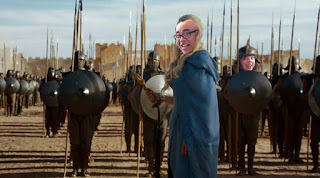 |
| Dan as Daenerys Targaryen, he is a fan of GoT |
Lin says it is a wonderfully satisfying and emotional moment to introduce Dan Santat and I agree, he's the super best.
Dan came here in 2001, this Summer Conference is the first SCBWI conference he ever attended. He worried it was too expensive, but that worry was soon put to rest when his portfolio got noticed by editor Arthur Levine, and because of attending the conference,Dan got his first book contract.
In the many years of attending SCBWI events and conferences, Dan's noticed success stories of authors and illustrators, and some stories of people who are still finding there way. Dan says:
Your time will come, it's not a race to the top of the mountain, everyone finds their time.
One way to ease your trek on the road to publication is to improve your taste: Do you know if you have good taste? Do you know if what you're writing is good? Dan reads us this Ira Glass quote:
Dan lists some of the stories and genres he likes, and thinks improving your work and taste is due to understanding why you like things, don't censor or bias yourself. Dan likes:
Batman and Akira comics. Movies and TV shows like Moneyball, Game of Thrones, Lost, and Breaking Bad. Podcasts like This American Life and Serial. From all of these he is learning story style and technique, observing different points of view. Immerse yourself in life and culture, take these references, says Dan, and come up with a unique spin on things.
You must do a critical review of your work. Dan reads us some 1 star and 5 star Goodreads reviews for
Where the Wild Things Are (which has an overall rating of 4.2, by the way). Compare your opinions with others, there are crazy reviewers and there are good reviewers, the good reviews are useful pieces of critical information that can make your work better.
Study the fundamentals, but don't be rigid.
Learn by imitation, but don't become a clone. In art school, Dan copied Wyeth paintings in class because when you paint the strokes a master painter painted, your hands learn what your head doesn't quite understand yet. But be sure to make your art your own, Dan says, try to make work that is original to yourself once you begin to trust your inner instincts.
The exploration comes by doing: You have to make a lot of lousy paintings before you find one you want to put in your portfolio. Dan was working a full-time job when he decided he wanted to be published, so he started working from 10 pm to 3 am on his illustration work and after weeks and weeks of working like this and honing his craft, he'd made himself an illustration portfolio he could be proud of.
Form follows function. Dan shows us how good stories have things happening for a reason, you see it in everything from
Back to the Future to his very own
Beekle.
A few of Dan's final thoughts: Do what you love, and the work will find you. Don't think about the money, think about the craft, and working on your craft is the only way to improve. And don't give up!
Thanks, Danders!!!

By: Dan Bostrom,
on 7/18/2015
Blog:
ALSC Blog
(
Login to Add to MyJacketFlap)
JacketFlap tags:
Newbery,
Caldecott,
Children's Literature (all forms),
Evaluation of Media,
Awards & Scholarships,
belpre,
Sibert,
ALA Annual 2015,
Blogger Dan Bostrom,
award books,
Add a tag

Winners of the 2015 Pura Belpre awards (image courtesy of ALSC)
The ALSC award acceptance speeches from the 2015 ALA Annual Conference are now available from the ALSC website. Speeches includes the winners of these 2015 awards:
Each of these is available as a downloadable PDF. For a full list of 2015 ALSC Book & Media Award winners please see the ALSC website.
The post 2015 ALSC Book & Media Speeches Now Online appeared first on ALSC Blog.

The place: San Francisco. The occasion: ALA Annual. The party: Caldecott. From January 2014 – January 2015, I studiously studied. I looked at over 500 picture books, and along with 14 other intrepid souls, decided which of those were the most distinguished. Our committee is incredibly proud of our list of books. And this year at ALA annual, we got to celebrate with the distinguished artists in the class of 2015.

At the banquet – photo by Angela Reynolds
Starting with a great street party for Melissa Sweet (which included yummy tacos & a baby shower), and then the next night a dinner with all 6 honor winners, followed the next evening by “Dinner with Dan”, and then Sunday the Caldecott-Newbery-Wilder awards banquet, it was a wild and fun ride!
But it wasn’t just fine dining. At each of these events our committee got to have some quality time with the illustrators that we honored. And we felt honored to do that. Each one of them thanked us profusely. I can speak for myself only (though I have a feeling many of my co-committee members will be shaking their heads yes), but I felt like I should be thanking them for their work, for their contribution to children’s literature. In Dan Santat’s award acceptance speech, he said the Caldecott changed his life. I must say, it changed ours, as well, Mr. Santat. 15 people became fast friends, confidantes, cohorts, colleagues. We bonded over art, over time spent together, and yes, even tattoos. This great party we called San Francisco created memories to last a lifetime.

Beekle tattoo – photo by Angela Reynolds
At the banquet, I was asked by Mac Barnett if serving on the Caldecott Committee was exciting as it sounds. I had to say a resounding yes to that. And you know what folks, only an ALSC member can do this. I’ve been a member for 21 years, and yes, I worked hard to get to a place where I could serve on this illustrious committee. But so can you. If it is your dream (as it was mine as a starry-eyed grad student), then work towards it. The rewards are immense, and they go far beyond a fancy cocktail dinner (though those are certainly nice, too). Thanks to all the publishers who wined and dined us, to all my committee members who opened my eyes to so many viewpoints, to the illustrators and authors who make amazing books, and to ALSC for being there to hold up children’s books as shining stars. Thank you all!
The post The party that was Caldecott appeared first on ALSC Blog.

Good morning. I can’t sleep. It may be that I am still on EST or that I just so excited to be here. My first conference and I’m entering my second day.
Yesterday I was lucky enough to attend the ALSC Preconference on celebrating the Honor Books. Wow. We all know KT Horning, but just hearing her speak and the wealth of information she had to share was amazing. I tried to take some old fashioned notes using a pen and paper. I could go on and on about what I learned. Here are just a few hightlights:
- Honors were called “Runners Up” until 1971
- The records are lost for who the Runners Up were in 1923, 1924 and 1927. What happened to them? KT Horning is determined to find out and I bet she will!
- Before 1958, an author could not win a second award. Would Robert McCloskey have won multiple awards before then if this rule had not been in place?
- Judy Freeman shared that we all must read Travis Jonker’s 6 Theories on “Sam and Dave Dig a Hole” on his 100 Scope Notes blog and to make sure to watch “The Best Book Trailer ever” there posted there as well.
http://100scopenotes.com/2014/10/02/6-theories-on-the-ending-of-sam-dave-dig-a-hole/
- Another idea Judy shared that I will definitely use with students is to have them write sequels to the book.
The afternoon was filled with inspiration from all the authors and illustrators. I spotted Lauren Castillo behind me and screamed. When I did that, I completely startled her. So sorry!
And then there were the opening remarks by Roberta Kaplan on this incredibly, historic day in San Francisco. Plus I got quite weepy when Tech Logic gave the wonderful librarians from The Pratt Library in Baltimore an award. When I ran into one in the Exhibit Hall that evening, I (surprise-surprise) screamed. The bravery and dedication to the community from those librarians and staff amazed me from the days it happened.
I don’t know what today will bring but I hope lots of jumping with old friends, new friends, authors and just fabulous people.
***************************************************
–I am a K-5 librarian from upstate NY who is just so excited to be attending her first ALA Conference!
The post #alaac15 Reviewing Friday and looking ahead appeared first on ALSC Blog.

In just over 20 days, I will be heading to San Francisco. I will be joining thousands of librarians making their way to the annual conference. This year is perhaps the most special conference ever for me. As a member of the 2015 Caldecott committee, I get to see the medal bestowed upon Dan Santat at the Caldecott-Newbery Banquet on Sunday, June 28 (ok I KNOW it is actually called the Newbery-Caldecott banquet, but hey, I’m calling it my way this year). Pretty exciting stuff!

Angela’s Caldecott memory book signed by fellow committee members (photo by A. Reynolds)
There are plenty of things I am looking forward to. Conference sessions, Guerrilla Storytime, the exhibits, running into librarian pals, spending time with old friends. But honestly, I am really looking forward to seeing those 14 special people that I share secrets with (aka the 2015 Caldecott Committee). Since February, our committee has been chatting via email. We’ve sent links to one another, and proudly read interviews with “our” illustrators. We’ve shared joys and ideas. We’ve shared thoughts about what to wear to the banquet. We’ve booked tattoo appointments & planned outings in San Francisco (we even have an official social -butterfly coordinator). I think we are all looking forward to a reunion in San Francisco. I know we are looking forward to meeting the illustrators of the amazing books we chose. We are gleefully anticipating celebrations with creators and publishers. And we can’t wait to honor the books that we are so delighted by. More memories will be created, I am certain of that.
It is going to be whirlwind of a time. Living in the woods, far away from my ALA colleagues, I always look forward to this time to refresh, get inspired by Big Ideas, and rejuvenate. This conference is going to charge my brain’s batteries for good long while. Yes, I get sentimental about this whole librarianship thing this time of year. I’ve never once regretted that push from a grad-school professor who insisted I join ALA and ALSC. Yes, I have served on maybe the best committees ever. But ALSC has served me well, too. Thanks, ALSC, for being the way to stay in touch. See you in San Francisco!
The post Annual Anticipation appeared first on ALSC Blog.


2015 ALA Annual Conference in San Francisco (image courtesy of ALA)
ALSC and the ALSC Awards Preconference Pilot Program Task Force want to remind Annual attendees that registration slots for the 2015 ALSC preconference program are still avaialable. This program takes place 11:30 a.m. – 4 p.m. Friday, June 26, 2015, at the 2015 ALA Annual Conference in San Francisco.
The program, entitled Distinguished and Diverse: Celebrate the 2015 ALSC Honor Books, will spotlight 2015 Honor Book recipients for the Newbery, Caldecott, Batchelder, Pura Belpré, Sibert and Geisel awards. The keynote speaker for the program is K.T. Horning, and there will be a panel facilitated by Judy Freeman.
The event will feature authors, illustrators and editors such as:
- Cece Bell
- Jacqueline Woodson
- Lauren Castillo
- Mary GrandPré
- Candace Fleming
- Yuyi Morales
- Jillian Tamaki
- Katherine Roy
- John Parra
- Patricia Hruby Powell
- Mark Siegel
- Christian Robinson,
- Jon Klassen
- Melissa Sweet
This is the first year that such a preconference will be held. The charge of the Awards Preconference Pilot Program Task Force is “to develop content and the program for a half-day preconference that will feature 2015 ALSC-only award honorees.” Based on the success of this year’s preconference, ALSC may or may not choose to hold similar events in connection with upcoming Annual Conferences. ALSC members receive a special discount (use code: ALSC2015) on registration.
The post Distinguished and Diverse: Celebrate the 2015 ALSC Honor Books appeared first on ALSC Blog.


By:
Roger Sutton,
on 5/8/2015
Blog:
Read Roger - The Horn Book editor's rants and raves
(
Login to Add to MyJacketFlap)
JacketFlap tags:
Awards,
Authors & Illustrators,
Caldecott,
Horn Book Magazine,
shadow,
1980s,
Marcia Brown,
classic HB,
hbmaug83,
Add a tag
by Janet A. Loranger
Thirty-seven years ago, Marcia Brown published her first picture book for children: The Little Carousel.* On June 28, 1983, she received her third Caldecott Medal for Shadow. Those years from 1946 to 1983 have encompassed one of the most distinguished careers in American children’s books. That her latest book has received such a signal honor and that she is the first illustrator to be awarded the medal three times are evidences of the undiminished vitality and richness of her contribution to the field. It is an uncommon achievement.
The nourishment of such a gift and such an achievement comes from many sources. Marcia grew up in several small towns in upstate New York, one of three daughters in a minister’s family. Everyone in the household loved music and reading, and her father also passed along to her, especially, his joy in using his hands. From childhood Marcia was allowed to use his tools and learned to respect and care for them. And from her own workbench and tools, in later years, have come the wood blocks and linoleum cuts that illustrate such handsome books as Once a Mouse… (1961), How, Hippo! (1969), All Butterflies (1974), and Backbone of the King (1966). Marcia feels that the most important legacy her parents gave her was a deep pleasure in using her eyes — for seeing, rather than merely for looking. Her keen delight in the details of nature and her acute observation of them are evident in all her books — most dramatically, perhaps, in the beautiful photographic nature books Walk with Your Eyes, Listen to a Shape, and Touch Will Tell (all Watts, 1979).
As a college student, Marcia was interested in botany, biology, art, and literature. During summer vacations she worked in Woodstock, New York, at a resort hotel and studied painting with Judson Smith, whose criticism and inspiration have remained an important influence in her life and art. After graduation she taught high school English, directed dramatic productions for a few years, and worked in summer stock. Some years later, she became a puppeteer in New York City and also taught puppetry for the extra-mural department of the University of the West Indies.
When Marcia moved to New York City, her interest in children’s book illustration drew her to work in the Central Children’s Room of The New York Public Library, where she gained invaluable experience in storytelling and an exposure to the library’s large international and historical collections. Here, too, she received encouragement from such outstanding children’s librarians as Anne Carroll Moore, Helen A. Masten, and Maria Cimino.
Marcia’s particular interest in folklore and fairy tales is apparent to anyone familiar with her books. Marcia believes strongly that the classic tales give children images and insights that will stay with them all their lives. To each of these stories she has brought her own special vision, her integrity, and a vitality that speaks powerfully and directly to children.
A very important influence in her life and in her books has been the stimulus of travel — that mind- and eye-stretching jolt out of the usual. Marcia has traveled widely in Europe, Great Britain, Russia, East Africa, the Middle East, and the Far East, including China. If she has a “home away from home,” it is Italy, the country with which she has felt most profoundly in tune. She lived in Italy, off and on, for four years, spending much of her time painting. Felice (1958) and Tamarindo! (1960) are books that grew out of her love for that country and her friendships with Italians. Marcia still writes to friends there, in Italian, and is able to converse with them in the language when she calls them on special occasions. France, too, has a special place in her life, and she spent over a year there; while living in Paris, she studied the flute with a member of the Paris Conservatory Orchestra. On a speaking trip to Hawaii she was so overwhelmed by the incredible beauty of the islands that she returned to spend many months and to do the research that was the basis for one of her most powerful books, Backbone of the King, a retelling of a great Hawaiian hero legend.
In the late 1960s Marcia gave up her long-time residence in New York City and moved to a small town in southeastern Connecticut. For the first time she was able to design and build a studio to fit her needs. It is a large room with a balcony at one end, a high ceiling with two skylights, and areas for doing painting, woodcuts, drawing, photography, sewing, and flute playing. The house is surrounded by hemlocks, and the woods nearby are filled with possums, raccoons, deer, squirrels, and birds. Not far from her property is the small river that provided the inspiration and the evocative winter photographs for her only filmstrip, The Crystal Cavern, published by Lyceum Productions in 1974. The plants, trees, wildflowers, and animals — and the changing seasons — are a constant source of stimulus and delight. Her greatest problem is finding time for all the interests she wants to pursue at home and also for going to New York to attend operas, ballets, concerts, and museums — and for traveling.
Most days, Marcia gets up early and spends some time reading while she has her breakfast. Just now, she is interested in the recently published book about a journey through the byways of America, Blue Highways, by William Least Heat Moon (Atlantic-Little). She finds many of the conversations the author had with residents of small, out-of-the-way villages the stuff of living folklore. Later, she might go to her studio and practice Chinese brush painting, a technique which first interested her in 1977 and which she began to study seriously, with a teacher, two years ago. Her paintings of lotuses, bamboo, plum blossoms, birds, and dramatic landscapes fill the walls of her living room and studio. She has begun to exhibit, along with other artists practicing the technique, and has sold several paintings.
If she has a sewing project, as she often does, Marcia will spend time on the studio balcony, where she has set up a sewing area. And each day, she faithfully practices her flute. She feels very fortunate to be studying with John Solum, a much-esteemed concert flutist, who lives in a nearby town. When she sews or paints, or works on illustrations, there is always music — as necessary to her as food. Her love of music and the dance and her deep understanding of them perhaps account, in part, for the grace, rhythm, and strength of her writing and illustration. Most certainly they are profound influences. Because her work requires solitude and long stretches of concentration, she often does not see as much of her friends as she would like to, but she accepts this fact as a price that must be paid.
Marcia Brown’s books have unquestionably stood the test of time. Nearly all of them are still in print — a certain proof of their enduring hold on generations of children. Never has Marcia been interested in passing fashions in children’s book illustration. She has worked in many media but not for the sake of variety; rather, she has always let the story and her feeling for it determine the medium and the style. Her particular vision and her uncompromising integrity have been rewarded in the past: two Caldecott Medals (for Cinderella in 1955 and for Once a Mouse… in 1962), six Caldecott Honor books, two nominations for the Hans Christian Andersen Award, the University of Southern Mississippi Medallion for Distinguished Service to Children’s Literature, and the Regina Medal. Now, after so many years of creating memorable children’s books, Marcia stands in a unique position — one abundantly deserved. It is gratifying that the children’s librarians of America, the dedicated people who bring children and books together, have honored her in so special a way.
*Except where another publisher is indicated, all books mentioned are published by Scribner.
From the August 1983 issue of The Horn Book Magazine.

The post Marcia Brown appeared first on The Horn Book.
View Next 25 Posts





