new posts in all blogs
Viewing Blog: Shelf-employed, Most Recent at Top
Results 1 - 25 of 655

a publics librarian's reviews, podcasts, booktalks and videos about literature for children and young adults
Statistics for Shelf-employed
Number of Readers that added this blog to their MyJacketFlap: 3
 Lowriders to the Center of the Earth
Written by Cathy Camper
Illustrated by Raúl the Third
They're back!
The impala - Lupe Impala, master mechanic
The mosquito - Elirio Malaria, the finest detail artist around
The octopus - El Chavo Flapjack Octopus, washcloth-wielding polisher of the Lowriders in Space Garage
If you think lowriders are impractical, think again. When the three amigos from the Lowriders in Space Garage go in search of their missing cat, their rocket-powered lowrider is just what they need. In this second book in the series, the three friends journey to the center of the earth and face off against a trickster coyote, an Aztec God, and other legendary Mexican and Aztec foes. As in the first book, they do it with humor, brains, and style—lowrider style—bajito and suavecito (low and slow).
Lowriders to the Center of the Earth is so visually cool, that it looks more like an older brother's indie comic book than a middle grade graphic novel. Raúl the Third uses red, black, and blue ink on sepia pages, and creates expressive faces, wild action, and hidden humor. The illustrations have a distinctly Mexican flair and invite the reader into the culture. His art is a perfect complement to Cathy Camper's hilarious wordplay. It's difficult to imagine that kids can learn Spanish, geology, ancient Aztec culture, Mexican culture, and the virtue of teamwork by reading a book that screams divertido (fun) but they can! Camper's dialogue is sharp and witty, and even features bilingual puns, as in this exchange between Lupe and the trickster coyote.
"Have you seen our cat?"
"Knock knock."
"Who's there?"
"Señor."
"Señor who?"
"Señor cat? I don't think so."
¡Ja, ja, ja!
This book may be even better than the first!
My copy of the book was provided by the publisher at my request when my LibraryThing copy went missing in the mail.

If you haven't heard it yet,
Horn Book has a new podcast. I made a small contribution to this podcast from June 20, 2016 (Hbook Podcast 1.17). You can hear me at the very end with my brief review of
Have You Seen Elephant? Creating a 30-second audio review is not as easy as it
sounds!
I'm so glad they allowed me to participate.


By: Shelf-employed,
on 7/14/2016
Blog:
Shelf-employed
(
Login to Add to MyJacketFlap)
JacketFlap tags:
digital audiobook,
spectrum disorders,
siblings,
book review,
summer,
series,
disabilities,
sisters,
J,
twins,
camp,
magical realism,
Add a tag
A Clatter of Jars by Lisa Graff
Read by Ellen Archer
2016, Listening Library
Quirky magical realism.
Read my full review at
AudioFile Magazine.
A Clatter of Jars is Lisa Graff's follow up to 2013's,
A Tangle of Knots.
I reviewed A Tangle of Knots in 2013, and declared, "If you read no other middle grade fiction book this year, you will have made a good choice." The magic doesn't wear off in
A Clatter of Jars, a deftly woven, magical realism story set in the same world as the preceding book, where many people possess Talents - from the mundane (ability to understand frogs) to the powerful (telekinesis). I particularly enjoyed this story because it features a boy who we may assume has some sort of spectrum disorder,
and it has a subtle
Lord of the Rings reference.
I often tell kids at the library that it's OK to start with a second book in a series if the first book is unavailable. (I don't like to see them go home empty-handed!) Most authors do a fine job of catching the reader up on prior events. However, because of the rich details of the world Lisa Graff has created,
A Clatter of Jars is best read after
A Tangle of Knots.
An audio excerpt from A Clatter of Jars and my review for AudioFile Magazine may be found here. [
http://www.audiofilemagazine.com/reviews/read/114587/a-clatter-of-jars-by-lisa-graff/]

By: Shelf-employed,
on 7/5/2016
Blog:
Shelf-employed
(
Login to Add to MyJacketFlap)
JacketFlap tags:
bullying,
friendship,
boys,
elementary school,
disabilities,
immigrants,
digital audiobook,
#weneeddiversebooks,
Indian Americans,
Add a tag
Save Me a Seatby Sarah Weeks and Gita Varadarajan
Read by Josh Hurley and Vikas Adam
This is a perfect middle grade novel for highlighting how easily one can mischaracterize another's words or actions. It's also an inside look at the immigrant and disability experience. Teachers, you should read this one and share it with your students!
I reviewed
Save Me a Seat for
AudioFile Magazine. The book spans only five days in fifth grade, the first week of school at Einstein Elementary School in Hamilton, NJ. Its sections are titled with the school lunch of the day —Chicken Fingers, Hamburgers, etc., and chapters alternate between Joe, a boy with auditory processing disorder (APD) and Ravi, a recent immigrant from India. Both boys are targets of the school bully—Joe, because of his disability, and Ravi because of his heavily accented English (which he himself cannot hear) and his family's style of food, dress, and manners.
Although Ravi was a favored, top-ranked student in his native Bangalore, India, his accent and lack of knowledge about his new country land him in the resource room at Einstein Elementary. Joe also visits the resource room to learn coping skills for his APD. Initially, Ravi views Joe with disdain —mistaking the outward signs of his disability for stupidity.
In each chapter, the boys recount the same scene, allowing the reader or listener to fully understand how our perception of an event is shaped by our cultural, family, and personal background. I'm sure that the printed book is wonderful as well, but the use of dual narrators in the audiobook really hammers home the differing perspectives.
Read my complete review of Save Me a Seat for AudioFile Magazine here. (An audio excerpt is also available at the same link, however, it only features the character Ravi, read by Vikas Adam.)
Read other reviews of Save Me a Seat and an interview with the authors at Sarah Weeks' website. I recently began working in a library with many new Indian-American families, and reading
Save Me a Seat was enlightening. The challenges involved in adapting to a new country are many and cannot be overlooked. I'm so glad I listened to this one!

I won't be posting here, but I'll be tweeting from
@shelfemployed, and I'll be live-blogging for the
ALSC Blog. If you're
#alaleftbehind, or interested in all things bookish and librarianish, follow along.

Here's a little fun for the day and two great dad books.
If you're on Twitter: In honor of Father's Day, Barnes and Noble
@bnbuzz is using the hashtag
#DadBooks to solicit groan-worthy puns and corny dad jokes based on well-known books. Be sure to check it out or join in the pun.
Here are a few (with links to their posts):
Oh, the Places You'll MowThe Girl Who's Certainly not Getting a Dragon TattooGone Grill 
If you're on Pinterest, check out my board, "
Comic strips featuring books." I've been collecting comic strips that feature books and libraries for the last several years. If you have a good comic strip that I've missed, please feel free to send it to me and I'll pin it.
And lastly, since Father's Day is tomorrow, I'll share two of my favorite "dad" picture books.
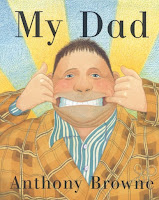
- My Dad by Anthony Browne (Macmillan, 2010) is a funny, homage to the classic jack-of-all-trades kind of dad. On each page, tribute is paid to the bathrobe-clad dad's many great qualities. The illustrations are wonderful - even as he is depicted as a fish or an owl, he retains his brown, plaid bathrobe. You can see them here [http://us.macmillan.com/mydad/AnthonyBrowne].
- Tell Me a Tattoo Story by Alison McGhee and illustrated by Eliza Wheeler (Chronicle, 2016) is lovingly written and illustrated. A young tattooed dad weaves a tale for his son using his tattoos. A sweet story that should appeal to many young families.

 I don't always write about books and libraries. I like to ponder things that I find curious or interesting, and sometimes I write about them as well.
BonBon Break, "an online magazine for modern moms," has purchased my article "If It Doesn’t Have a Face, Will They Eat It?" It began appearing on their site yesterday.
The article is a satirical commentary on the current marketing trend of anthropomorphizing common fruits and vegetables with comic representations and new names, e.g., Mighties, Halos. Sadly, it doesn't include my photos (I admit to being an amateur in photography), so I will include them here. The article has nothing to do with libraries, but you might get a chuckle from it, and I hope you read it.
If you missed my last article on BonBon Break, "Five Things You Didn't Know about Librarians," it's linked here and in the sidebar.
I'm over at the
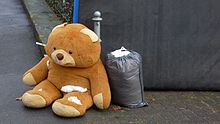
ALSC Blog today - complaining about stuffed animals.
 |
| Max Braun CC BY-SA 2.0 * |
Feel free to join me if you're so inclined.
In other news, I hope you've been downloading your free books from SYNC. Two free books are available each week beginning on Thursday. The books for that week are available for one week only. Books are yours - forever - no strings attached.
"SYNC is a free summer audiobook program for teens. Starting May 5th 2016, SYNC will give away two complete audiobook downloads a week - pairs of high interest titles, based on weekly themes. Sign up for email or text alerts and be first to know when new titles are available to download at
www.audiobooksync.com."
Today is the last day to get Zac & Mia by A.J. Betts, and I'll Give You the Sun by Jandy Nelson. Tomorrow, it's How it Went Down by Kekla Magoon (with a full cast narration!) and The Autobiography of an Ex-Colored Man by James Weldon Johnson.
Below are the titles for the next few weeks (there are more to come after these!):

Pea Storytime
 |
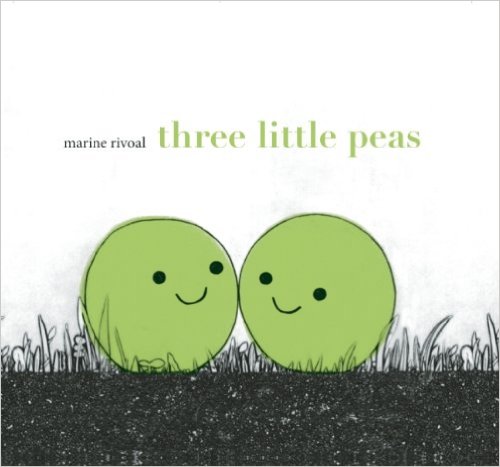
| Three Little Peas by Marine Rivoal, 2014, Enchanted Lion Books |
|
|
I don't usually (ever?) post about storytime, but I do a LOT of them. Yesterday, however, I had so much fun that I thought I'd share.
- The color of the day was green.
- The letter of the day was P, which led to the fun question of the day - "What letter does "pea" start with? (Sometimes I crack myself up.)
- My welcome sign read, "Welcome to storytime. I'm hap-pea to see you!"
These are the books and activities I shared:
Three Little Peas is a beautiful book that adds an opportunity to discuss (at a
very basic level) flora and fauna and the growing process.The illustrations are gentle and lovely and invite discovery - what else is underground with those two little peas? We followed this up with the song (complete with motions), "Oats, Peas, Beans, and Barley Grow." If you don't like to sing, Raffi can do it for you.
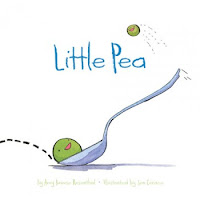 |
| Little Pea by Amy Krause Rosenthal, 2015, Chronicle Books |
| |
|
|
Amy Krause Rosenthal's books are so much fun. Rather than read
Little Pea, I showed the
TumbleBooks version instead. It was a great way to show off one of the library's online resources. Parents and kids enjoyed it. We followed it up with the fingerplay, "Five Fat Peas."
 |
| Pease Porridge Hot illustrated by Paige Billin-Frye, 2011, Child's World |
|
There are many book versions of "Pease Porridge Hot." This one, illustrated by Paige Billin-Frye is small for reading to a large group, but it worked fine because the illustrations are simple. We had a good laugh over whether or not one would eat soup that's "nine days old!" We followed it up with a simplified version of the classic clapping rhyme. If you don't know the clapping sequence, it's included in the book.
I had planned to bring in fresh peas to share with the kids, too, but I left my bag of snow peas at home. Good thing - there were more kids than I had peas.
Update: Shortly after I had finished storytime, a patron came to the desk and wanted a book, but couldn't remember the name of it. He described the story and I knew it. It was another wonderful pea book: The Pea Blossom by Amy Lowry Poole, Holiday House, 2005. Funny how that happens.
By: Shelf-employed,
on 5/31/2016
Blog:
Shelf-employed
(
Login to Add to MyJacketFlap)
JacketFlap tags:
Add a tag
Merrow by Ananda Braxton-Smith
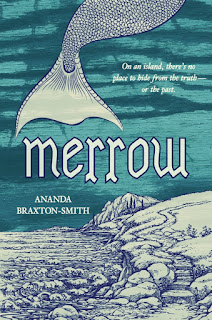 Candlewick Press, 2016
Everything turns into a story the moment it's done. The facts of things do not store well. They rot and fall apart. But the stories we tell last and even grow.
The Marrey family has long lived on a remote cove on a remote island in a Northern Sea. Twelve-year-old Neen Marrey has lived there all her life with her sour Auntie Ushag whose appetite for hard work and subsistence living leaves no room for the distant townsfolk's talk of the Others and the Otherwise. Besides, most of the talk centers on the Marreys anyway, especially since Neen's father drowned and her mam disappeared. Townsfolk say her mother was a merrow and returned to the sea. Even the Marreys only friends, Ma Slevin and her blind son, Scully, gifted with the Othersight, are filled with stories of the kraken, merrows, water horses, and the like. And what of Neen herself - afflicted with the Scales? Could her mother's merrow blood be running in her veins?
"All right?" asked Scully.
"I suppose so," I said. I wanted to be by myself. "Thank you."
I couldn't sleep that night. The sun going down made no difference. For a long while, there wasn't enough air to breathe. The weird blood swarmed in my chest, and I longed for morning. Not only that, the story stuck to every part of me: to my body with its scales, my mind with its waves and silver flashes, and my soul with its homesickness.
Scully Slevin is a true seer, and a honey-tongue with it. He has a word hoard bigger than any wrecker's haul, and he sees things nobody else does. That needs no proof. You only have to see him and hear him to know what he says is true.
Proof is for those with no eyes or ears in their heads.
Merrow is a coming-of-age story steeped in old world folklore and swimming in the atmosphere of a bygone time when Old Irish legends still held purchase in the hearts and minds of the island's people. The lines between truth and legend, dreams and reality, Catholicism and Celtic ways, are be blurred in this haunting, wistful story. Whether it is fanciful or realistic is for the reader to decide.
First published in Australia in 2010, as part of the
Secrets of Carrick series,
Merrow is coming to the U.S. this fall.
(Advance Reader Copy provided by the publisher at my request)

By: Shelf-employed,
on 5/30/2016
Blog:
Shelf-employed
(
Login to Add to MyJacketFlap)
JacketFlap tags:
Add a tag
If you are enjoying a respite from work on this Memorial Day, take time to reflect on the history of the holiday. The
Library of Congress is a good place to start. It may be called "Library of Congress," but it is
our Congress and
our library. It is the largest library in the world with a vast collection of digitized materials.
Soldier's memorial day Perkins, W. O. (William Oscar), 1831-1902, composer. Slade, Mary B. C., lyricist. Published: Boston Oliver Ditson & Co. 1870 Description: 5 pages

By: Shelf-employed,
on 5/25/2016
Blog:
Shelf-employed
(
Login to Add to MyJacketFlap)
JacketFlap tags:
Add a tag
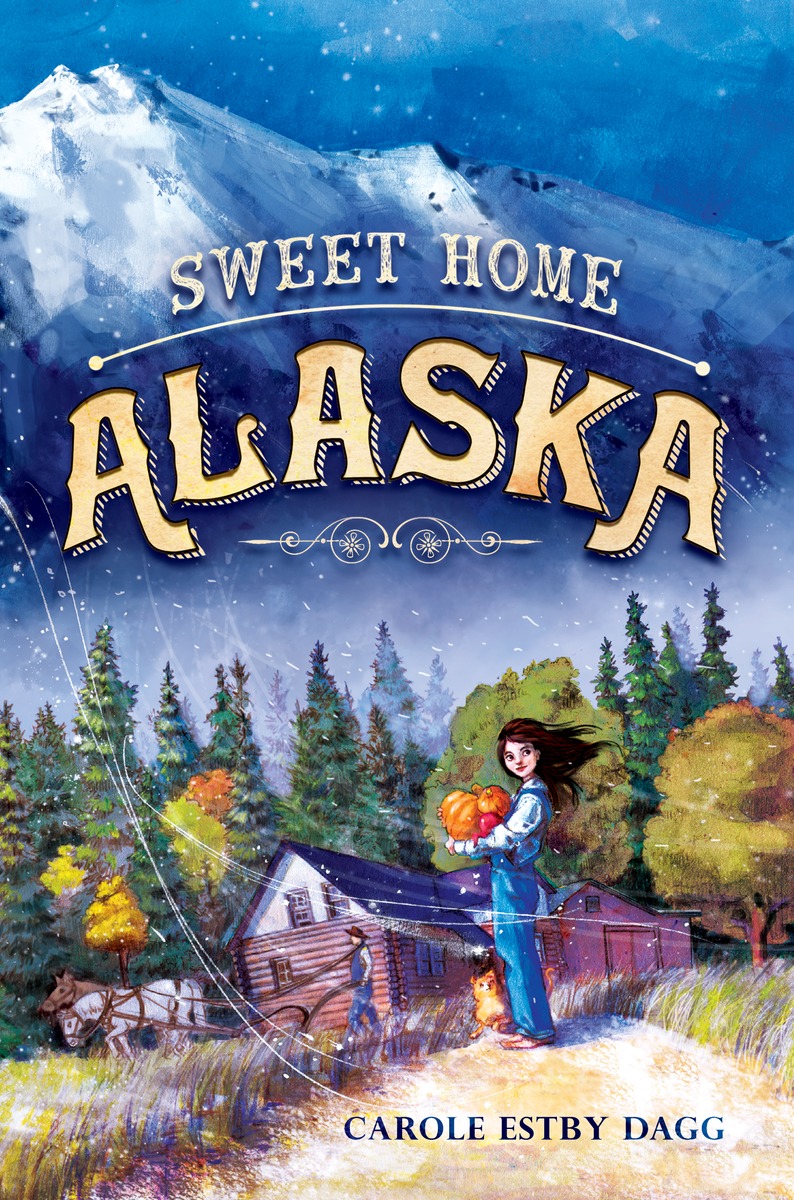
Sweet Home Alaskaby
Carole Estby DaggRead by Susan Denaker
I reviewed Sweet Home Alaska for AudioFile Magazine. It's historical fiction set during the Great Depression with particular interest to librarians. Though the main storyline is a family's struggles to homestead in Alaska, there is a library-related subplot. In an attempt to create a fledgling library for an impoverished population with scare resources, the protagonist (and later, the entire settlement), struggles with collection development and circulation issues. What should the library acquire and why? How will it be funded? Who will have access and how? Sound familiar? Of course, author Carole Estby Dagg is - you guessed it - a librarian!Read my AudioFile Magazine review of Sweet Home Alaska here.
Note:I had a very brief conversation with the author via Twitter here . Follow the conversation links if you're interested in commentary on Sweet Home Alaska from a Native American's perspective and the author's response.
By: Shelf-employed,
on 5/19/2016
Blog:
Shelf-employed
(
Login to Add to MyJacketFlap)
JacketFlap tags:
Add a tag
Big Dog and Little Dog: Making a Mistake
by Dav Pilkey
HMH Books for Young Readers
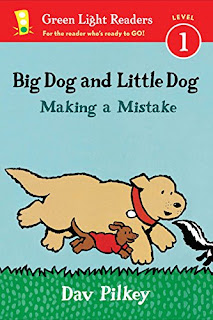
With two dogs and a skunk's tail on the cover, you know how this one is going to end! Still, Dav Pilkey knows exactly how to engage young readers, and despite the foregone conclusion of two dogs meeting a skunk,
Big Dog & Little Dog Making a Mistake is fresh and funny. I seldom enjoy early readers. I love this one. This is a great series.
With Mo Willems'
Elephant and Piggie celebrating a great decade with their final installment,
The Thank You Book, it's comforting to know that we've still got a great humorist to entertain our littlest readers.

The Wild Robot by Peter Brown
Read by Kate Atwater
Hachette Audio, 2016
AudioFile Magazine Earphones Award Winner
I recently reviewed The Wild Robot for
AudioFile Magazine. You can read my full review and hear an audio excerpt
here. [
http://www.audiofilemagazine.com/reviews/read/110681/the-wild-robot-by-peter-brown/]
The Wild Robot, a novel for ages 8 and up, is a departure from Peter Brown's usual offering of picture books (
Creepy Carrots,
Mr. Tiger Goes Wild,
My Teacher is a Monster - and more), but his customary excellence is just as apparent.
The link to my review is above, however, I'd like to highlight a few things.
The Wild Robot premise is unique and thought-provoking - a robot designed with AI and programmed for self-preservation and nonviolence, is marooned on an island with animals, but no humans from which to learn. The narrator, Kate Atwater, does a stellar job (
see review) and sounds a bit like Susan Sarandon. The audio book is unique in that the beginning and the closing chapters have sound effects including music and sounds of nature.
Overall, it's very well done! If you'd prefer to check out the print version,
Little Brown Books for Young Readers offers an excerpt of the print version of The Wild Robot here. [
http://openbook.hbgusa.com/openbook/9780316382014]

Just a reminder that it's Children's Book Week. #cbw16
There are plenty of resources available from the
Children's Book Week Digital Toolkit. I like to order the actual posters, but sadly, I forgot this year. The good news is that there are plenty of last-minute event kits and activity sheets available for download [
http://www.bookweekonline.com/activities].
Also, be sure to download this year's official CBW bookmark with art by Cece Bell. [
http://www.bookweekonline.com/bookmark]
 |
| [http://bookweekonline.com//system/files/189/original/CeceBell2016BookmarkFINAL.compressed.pdf] |
You can also add a Twibbon to your Twitter profile pic. (If you don't want it to completely obscure your profile pic, you will have an opportunity to shrink it.) [
http://twibbon.com/Support/Children39s-Book-Week]

A selection of darkly funny, mostly cautionary picture books.
Share these funny gems with slightly older listeners who have a sense of humor; but spare your very timid or gentle-hearted ones - happily-ever-after is not guaranteed in these tales of comeuppance, justice served, just desserts, and cautionary advice.
If you're unable to view the slide show, visit it on Riffle Books [ https://www.rifflebooks.com/list/206136] where I occasionally create themed slide shows.
Books included in the list:
- A Hungry Lion, Or a Dwindling Assortment of Animals by Lucy Ruth Cummins
- How to be Famous by Michal Shaley
- Everyone Love Bacon by Kelly DiPucchio
- Jim: Who Ran Away from his Nurse and Was Eaten by a Lion by HIlaire Belloc
- This is Not My Hat by Jon Klassen
- I Want My Hat Back by Jon Klassen
- The Book that Eats People by John Perry

Sticks and Stones by Abby Cooper
Farrar, Straus, & Giroux, 2016
(Advance Reader Copy provided by NetGalley) "Sticks and stones may break my bones, but words will never hurt me."
This adage has been told to innumerable children, but in Elyse's case, words
do hurt. Elyse has a rare condition called cognadjvisiblitis, or CAV. When she hears nouns or adjectives describing her, they appear as black words on her arms and legs.
In elementary school, Elyse could count on her best friend Jeg, the kindness of young children, and the assistance of teachers and school administrators to ensure that only positive words would appear on her skin, HAPPY, CUTE, SMART. These words were not only complimentary, they were non-irritating. Unkind words surfaced dark, large, and bold - causing extreme itching and discomfort.
Middle school behaviors cannot be controlled so easily. First, she is dumped by her boyfriend, and then she loses Jeg to the cool girls clique. No one can ensure that only positive adjectives find their way to Elyse's ears. It's no wonder that she takes to wearing long sleeves and pants, regardless of the season.
Things begin getting both better and worse as Elyse follows the advice she finds written on mysterious, but mostly encouraging, blue notes. The notes exhort her to compete for the school's coveted position of class trip Explorer Leader, but the contest exposes her to social situations that aggravate her CAV. Her nervous mother takes her, yet again, to the doctor renowned for, but mostly ineffective in treating CAV,
"People go to meetings, I said. "And take walks. It's not that crazy."
Dr. Patel scooted closer to get a better look at my words. DUMB was still there. So were IDIOT, LOSER, STUPID, UNLOVABLE, WORTHLESS, and FREAK, the whole crew. They were going in all different directions, and some were bigger than others, but they were all thick, dark, mean, and itchy, and felt like ridiculously scratchy clothes-the ones that also have ridiculously scratchy tags-I couldn't ever take off.
While the postulate of a school choosing a class trip leader in reality-TV-style, seems a bit far-fetched, the underlying middle school drama rings true, and the book's unique premise of CAV will give readers pause for thought.
Sticks and Stones offers more than just middle-school angst and coming-of-age experiences. Similar to the lives of real children who deal with name-calling everyday, Elyse's story is not one of overcoming this adversity, but of living with it. Elyse's story is a reminder that not all things can be made "right," but we should all take care that we do not contribute to making things "wrong."
(An added bonus: it's a mystery - who is writing those blue notes?)
This is a debut novel for former teacher and school librarian, Abby Cooper. She's off to a great start. Look for this one in July, or pre-order a copy.

 My daughter has been encouraging me to adopt a vegetarian diet. I do make an effort to eat meatless often, but a completely vegan or vegetarian diet takes a certain amount of commitment that I've never been willing to expend. Recently, this same daughter (she is both environmentally conscious and persuasive) talked me into watching the documentary, Cowspiracy. (I challenge you to watch this and not be affected.) In any case, The Forest Feast for Kids landed on my shelf in time to take advantage of my renewed interest in vegetarianism. Good timing, Forest Feast!
The Forest Feast for Kids: Colorful Vegetarian Recipes That Are Simple to Make
By Erin Gleeson
Abrams, 2016
From the whimsically painted watercolor endpapers and chapter title pages to the lusciously photographed finished recipes, The Forest Feast for Kids is a feast for the eyes as well as the stomach. These are recipes that are as beautiful to present as they are healthy to eat.
Contents in this generously sized book contain cookbook standards - table of contents, index, introduction, and pages of helpful hints and cooking techniques. The chapters run the gamut of gastronomic needs: Snacks, Drinks, Salads, Meals, Sweets, and Parties. Each chapter contains about six recipes, each one displayed on across two pages. The left page has a painted recipe title, simple instructions in a large typewriter font, handwritten notes offering serving hints, "cut into wedges and enjoy hot!" , and hand-drawn arrows pointing to the appropriate ingredient photo (not every child may recognize a cilantro leaf or bay leaf). Photos are not insets or bordered, they are part of a lovely integrated palette of ingredients and text. Beautiful photos of the finished dishes appear on the facing page.
Simplicity of ingredients (most recipes have only four) combined with attractive presentation make these recipes irresistible not only to young chefs, but also to harried caregivers who would love to put a healthy, attractive meal on the table, but have trouble finding the time. I know that I'll be making Strawberry-Cucumber Ribbon Salad soon!
Enjoy!
I've never seen the adult version of the same book. I'm willing to bet that it's equally wonderful!

By: Shelf-employed,
on 4/15/2016
Blog:
Shelf-employed
(
Login to Add to MyJacketFlap)
JacketFlap tags:
kindness,
storytime,
wordless,
E,
picture book roundup,
friendship,
cats,
art,
colors,
painting,
funny,
elephants,
Add a tag
It's been a while since I've done a picture book roundup. Here are three that struck my fancy:
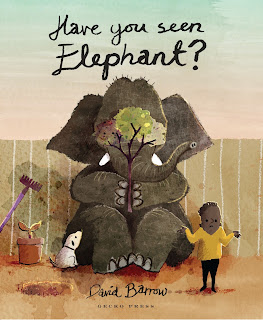 Kind. This boy is the best!
Have you seen Elephant?
Written and illustrated by David Barrow.
Gecko Press, 2016
A kind young boy plays hide-and-seek with his elephant friend and takes care to keep the game going, despite the fact that his friend is a very poor hider!
Have you seen Elephant? is bright and cheerful and funny, and above all - kind. This is the first book I've seen from Gecko Press and the first by David Barrow. I love it!
Confined? Can the colortamer catch them all?
Swatch: The Girl Who Loved Color
Written and illustrated by Julia Denos
Balzer Bray, 2016
Bright, bold, and expressive, Swatch is a color tamer - trapping and using colors in the most fantastic of ways. A bold and fearless artist, no color had escaped her artistic eye ... no color but one,
"Morning came, and there it was, fast fading and fierce, the King of All Yellows, blooming in the sidewalk crack in spite of the shadows. Swatch was ready .... At last, Yellowest Yellow would be hers."
Or would it?
This is the first book that Julia Denos has written as well as illustrated. I would love this book even if my favorite color were not the hero of the story!
Find. Where is that cat?

Spot, the Cat
Illustrated by Henry Cole
Little Simon, 2016
A beautifully detailed, wordless book - more than just a seek-and-find, it follows the path of an adventurous cat in the city and the boy who wants to find him. Join the young boy and search the city for Spot, the cat.

National Library Week begins today!
If you want to show your support of libraries this week, enter the American Library Association's contest, and help spread the word about all the great ways that your library helps people in your community. Contest details and other ways to show your love of libraries can be found at: [
http://www.ilovelibraries.org/national-library-week] 
By: Shelf-employed,
on 3/28/2016
Blog:
Shelf-employed
(
Login to Add to MyJacketFlap)
JacketFlap tags:
Add a tag
The
China Institute contacted me to see if I would be interested in seeing books from their
We All Live in the Forbidden City program. (The Forbidden City refers to the Imperial Palace in Beijing that housed the seat of Chinese government for about 500 years. It is now home to the
Palace Museum.) I reviewed their book for very young listeners or readers.
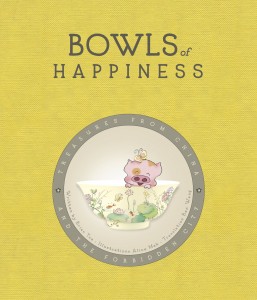
Bowls of Happiness: Treasures from China and the Forbidden City by Brian Tse. Illustrated by Alice Mak. Translated by Ben Wang.
China Institute, 2016
A mother creates a bowl and decides to paint it with a pig to represent her young daughter, nicknamed Piggy.
Mommy is good at making pottery. She has made a bowl, and on the bowl she painted a piggy.
Holding the bowl, Mommy smiles and says "At the sight of Piggy, my hearts leaps with joy!" Oh, silly Mommy.
To make Piggy happy, the mother paints a cloud. White Cloud, too, needs happiness, so she adds birds, and Flower, and Butterfly, and Tiny Goldfish. Fruits join the tableau as well, to "represent the joyful meeting of all living things." When finished, the bowl is lovely; and it is Piggy's; and it is a gift of happiness,
There are so many lovely things joined together on it, all gifts of happiness from Mommy to Piggy, which is me. Mommy smiles and says, "Oh, silly Piggy!"
The story is short and simple, yet steeped in Chinese culture and meaning. The illustrations are of mixed medium and feature simple ink drawings colored in cheery pastel colors with watercolor highlights. As each item is added to the painted bowl, the facing page features a facsimile of a pattern on one of the porcelain bowls in the Palace Museum collection.
A small (3 small-print pages) section titled "What Happiness!" follows the story and briefly explains Chinese customs pertaining to auspicious name selection and the creation of symbolic happiness that brings concrete blessings.
A final section contains beautiful photographs of the antique bowls represented in the story. The photos are presented on white space without text, so that young children can enjoy them. Descriptions are on accompanying pages.
Bowls of Happiness will provide a very small introduction to Chinese art and culture to the very young. Art teachers may find it useful for discussing painted pottery. The book is perfect for small hands and sharing one-on-one or with a very small group. The overall presentation is lovely.
Other books in the We All Live in the Forbidden City series are:
My copy of
Bowls of Happiness was provided by the China Institute.

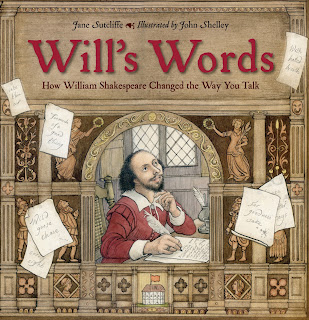 Will's Words: How William Shakespeare Changed the Way You Talk by Jane Sutcliffe. Illustrated by John Shelly. 2016, Charlesbridge.
According to author Jane Sutcliffe's note, she intended to write a book about the Globe Theater and its famous playwright, but found she was more interested in the way that William Shakespeare's words (even the invented ones!) have become so ingrained in our everyday speech.
The end result is somewhat of a hybrid. Two types of text boxes are placed upon each double-spread, full-bleed illustration. One contains an account of life in the time and milieu of William Shakespeare,
Good plays need good playwrights. And the most brilliant playwright in London was Mr. William Shakespeare. From butchers and bakers, to lords and ladies, everyone looked forward to the excitement of a Will Shakespeare play.
While the other explains one or more of Shakespeare's words,
WILL'S WORD: Excitement
WHAT IT MEANS: A feeling of "Bring it on!" This was a fairly new word in Will's time. He helped people get excited about "excitement."
WHERE IT COMES FROM: HAMLET, ACT 4, SCENE 4. There's a lot of excitement in Hamlet's family. And not the good kind.
The "Will's Word" text boxes are displayed on a facsimile of parchment paper - a nice touch. If John Shelley's illustrations don't necessarily capture the squalor of the time, they certainly capture the essence of living in a seething mass of humanity. The pen, ink, and watercolor illustrations are positively teeming with activity - providing opportunity for exploring hundreds of small details in each scene.
I chose to highlight one of the shorter passages. However, there are more than fifteen scenes packed with information presented in a lively, conversational tone that will keep readers' attention. Teachers should love this one.
The book goes on sale today. Look for it on a library shelf soon. If you choose to purchase it, you will receive the gift of more words from Shakespeare, your "
money's worth."
Author's Notes, Timeline, and Bibliography are included.
Note:
My copy of
Will's Words was provided by the publisher at my request.

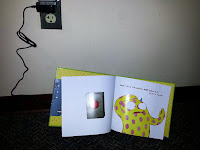 A book with a plug! Whaaat?
For car trips, young readers, struggling readers, and sheer entertainment, you can't beat a picture book/audio book combo for younger kids.
Though schools and libraries may still keep book/CD kits in their collections, the truth is, CD players are not that common anymore. Newer computers don't come with a standard CD/DVD drive, cars don't always have them, and the only people I know who still have "boom boxes" are children's librarians.
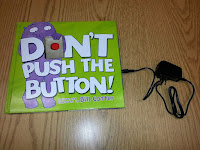 That's why I was happy to receive a copy of a new VOX (TM) "audio-enabled" book. In my photo, the book is plugged into the wall for charging, but I did that just for show because a book with a plug cracked me up! In truth, it arrived fully charged and ready to go - no plug required. (I didn't test it for battery performance.) The audio recording and speaker are built right into the book and operated by a simple control panel - power, play, pause, volume, forward, and back. There is also a standard headphone jack. The audio is of comparable quality to any conventional children's book. The book itself also seemed as sturdy as any, and was not overly heavy or burdensome.

Perhaps other companies have similar offerings, but this is the first book of its type that I've seen. I think it has possibilities, and that the days of the book/CD kit are numbered. I passed my copy along to a school superintendent who agreed that it might be a useful addition to his school's collection. I did not inquire as to the price. I was interested solely in the format.
If you can get your hands on one, it's worth checking out.
(I'm not going to review the book, Don't Push the Button!, but will merely note that it is in a vein very similar to the wonderful Press Here by Herve Tullet. Kids will likely enjoy it.)
My review copy was provided by
VOX Books.
Note:As always on my blog, I review books and materials for educational purposes only, and receive nothing of value other than the review copy, its associated marketing materials, and the occasional thanks or consternation of its author or publisher.
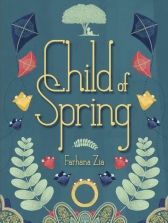 We receive news of current events from many sources: news outlets, Facebook, BuzzFeed, friends, family, etc. Some of it is accurate, some of it is false, much of it is biased. At best, each source reveals a glimpse of a larger picture.
I am in not suggesting that children's literature or cooking shows* can replace knowledge of current events, but it's easier to understand what's happening in a location if you understand what it's like to live there, play there, work there, learn there, and eat there.
I feel like learned more about the Iranian people from reading Persepolis or watching *Anthony Bourdain: Parts Unknown: "Iran" than I gleaned from "news." Similarly, I never truly grasped the standing of females in Saudi Arabia until I read The Green Bicycle, based on the award-winning documentary, Wadjda. In The Green Bicycle, Wadja opens readers' hearts to the everyday struggles of girls in Iran.
In Child of Spring, Basanta will open a door to the lives of children in a small Indian community. You will be glad you passed through.
Child of Spring by Farhana Zia.
March, 2016, Peachtree Publishers.
(Advance Reader Copy)
Basanta lives in a small hut in India. Though only 12-years-old, she, and most of her friends, work. Her best friend, Lali, takes care of siblings while her mother works. The handsome Bala is a jack-of-all-trades - begging, gambling, stealing, or performing. Beautiful and wily, Rukmani makes clay pots. Basanta works at the Big House with her mother - cooking, cleaning, and serving the whims of a wealthy family,
The station tower clock struck seven times. One by one, the residents of my busti ducked out of their huts. Bangles jangled on the women's wrists.. The men puffed on their cheroots and coiled head cloths around their heads.
The line at the water tap was already getting long and Rukmani was at the front of it, filling her pretty clay pots. I ducked my head and walked by quietly I didn't want to be peppered with questions about life at the Big House: "How many fluffy pillows on Little Bibi's bead, hanh? How many ribbons for Little Bibi's hair? How many eggs on Little Bibi's breakfast plate? Come, tell me, na?"
The life is hard, but the bonds of friendship and family within the impoverished
busti make life bearable, even enjoyable. Basanta is a good and generally obedient girl, but prone to clever scheming. When she becomes the unlikely possessor of an expensive ring, a plan forms in her mind. In practice, however, it turns out much differently than she expected! Spanning only a few weeks, the story ends on a hopeful note during
Divali, The Festival of Lights.
Child of Spring is a sometimes predictable story, but its strength lies in the rich cultural detail of life in Basanta's community, and in the joy the residents find in life's small pleasures.
A Glossary of Indian terms and expressions is included.
From the publisher:Read an excerpt of Child of Spring here.
By: Shelf-employed,
on 3/14/2016
Blog:
Shelf-employed
(
Login to Add to MyJacketFlap)
JacketFlap tags:
Add a tag
Hello, Florida!
Well, I've packed up a home of 15 years, and a job of a decade, and moved them both almost 1,000 miles away - while simultaneously working (with little more than a week's break), hosting two of my kids for back-to-back spring breaks (one helped load the moving van in the North, and the other one helped unload it in the South), and flying back and forth for new-hire screenings and orientation. (Have I mentioned that my husband and family are wonderful?)
Anyway, as of tomorrow, I will be "shelf-employed" in my new adopted state.
If you've been waiting for me to review a book you've sent me, I've got a backlog, but I'm getting through them.
Back in business! More soon ...
Images:


View Next 25 Posts


 Lowriders to the Center of the Earth