new posts in all blogs
Viewing: Blog Posts Tagged with: libraries, Most Recent at Top [Help]
Results 1 - 25 of 980
How to use this Page
You are viewing the most recent posts tagged with the words: libraries in the JacketFlap blog reader. What is a tag? Think of a tag as a keyword or category label. Tags can both help you find posts on JacketFlap.com as well as provide an easy way for you to "remember" and classify posts for later recall. Try adding a tag yourself by clicking "Add a tag" below a post's header. Scroll down through the list of Recent Posts in the left column and click on a post title that sounds interesting. You can view all posts from a specific blog by clicking the Blog name in the right column, or you can click a 'More Posts from this Blog' link in any individual post.

By: Benjamin Hoffman,
on 10/27/2016
Blog:
First Book
(
Login to Add to MyJacketFlap)
JacketFlap tags:
book fair,
experts,
logistics,
affordable,
Opportunities for You,
Make The Most of First Book,
Tips and Resources,
Using the First Book Marketplace,
How to Use First Book Resouces,
concierge services,
large order,
libraries,
events,
Books & Reading,
Add a tag
We know how hard our members work for the kids they serve, their schools or programs, and their communities. The First Book Network strives every day to put high-quality, diverse books into the hands of kids in need — books that might encourage a reluctant reader, reveal distant worlds, or open eager minds to new ideas. Books help reinforce students’ interests and celebrate their strengths.
 The Concierge Services team at First Book is here to help members who need a larger quantity of books. For events large and small, we provide the kind of high-touch, hands-on service that relieves you of the burden of logistics and allows every child you serve to find a book they love.
We are available to work with educators and program leaders to create a book list or collection that will fit your program’s needs and reflect the diversity of the population you serve. As experts in children’s books — with backgrounds in children’s literacy, education, and publishing — our team can guide you through the process.
If you are:
- Planning a book fair
- Building classroom libraries
- Sending home books as part of an after-school/summer program
- Creating a shared reading experience, or
- Distributing school supplies or basic needs items
We can provide you with a range of book choices for any age group, create an affordable package, and track the order right to your doorstep.
Over the next few months, the First Book blog will highlight some of the work Concierge Services has done to connect kids in need with stories and characters that they love. We are here to make things a little easier — to equip you with the resources you need to do the essential work of changing your students’ lives.
If you serve children in low-income communities and need a large quantity of books or resources at the best possible price, reach out to First Book’s Concierge Services at [email protected] or call the Member Services Team at 866.732.3669 and ask for Concierge Services.
The post First Book Concierge Services: A Helping Hand For Large Orders appeared first on First Book Blog.

Information about how libraries acquire and categorize their books.
http://thewritelife.com/new-authors-need-know-library-systems/

By: Alice Graves,
on 10/14/2016
Blog:
OUPblog
(
Login to Add to MyJacketFlap)
JacketFlap tags:
Library,
libraries,
Books,
Literature,
conference,
Media,
Anne Frank,
book fair,
Frankfurt,
Frankfurt Book Fair,
*Featured,
European Central Bank,
tour guides,
Frankfurt stock exchange,
Frankfurt Town Centre,
German National Library,
Old Opera House,
tourist sites in Frankfurt,
Add a tag
The world’s biggest book fair is opening its doors soon and, as a native “Frankfurter” working in the publishing industry, it's the time of year that my colleagues start asking me about my hometown. Sadly, the most common thing I hear is that there is little that they know beyond Frankfurt airport and the exhibition centre.
The post Beyond business and the book fair: exploring Frankfurt appeared first on OUPblog.
My first "real" job was working as a shelver (page) at the Bethlehem Area Public Library. I was almost 16. I worked in the Children's room.
It is 50 years later. I have worked in public libraries (and an academic library and a high school library but those were substitute positions) for 30+ years- and counting. I have always worked in Children's Departments. That's where I belong.
This video speaks to the importance of libraries - the importance of reading - the importance of books and most of all, the importance of making access to all three available to everyone.
Libraries save lives.
Gary Paulsen credits a public library for his education. Thomas Edison read his way through his public library after he left school.
Thanks to
Brain Pickings for sharing this story.
This week is Banned Book Week, a celebration of the freedom to read and an acknowledgement of the ongoing fight against censorship. There is much to talk about this year, including a fascinating survey by School Library Journal about librarian self-censorship and a PEN America report on challenged diverse children’s books, coupled with recent conversations sparked by author Lionel Shriver’s controversial comments about cultural appropriation and freedom of speech.
So, where are we when it comes to censorship? We asked authors, scholars, teachers, and librarians to share their thoughts with us in today’s roundtable. Participants:
- Guadalupe García McCall, author and teacher
- Jo Knowles, author
- Pat Scales, librarian
- Debbie Reese, scholar
Pat, as the former chair of the American Library Association’s Intellectual Freedom Committee, you’ve seen a number of book challenges over the years. What has changed since you first began looking at these issues? What has remained the same?
Pat Scales: Issues related to profanity, violence, and sex have always brought the censors calling. In the early 1970s and 1980s Judy Blume was being censored in school and public libraries coast to coast because she dealt with topics related to sex, bullying and other issues associated with coming of age. These were relatively new topics at the time. Now, her books aren’t challenged so much, but a host of others are. 21st century issues and concerns have ushered in a new wave of books that trouble censors. The Supreme Court decision that made gay marriage legal has caused some conservative groups to target books that deal with LGBTQ topics. As states wrestle with issues like North Carolina’s “Bathroom Bill,” the censors storm libraries looking for books about transgender youth like George by Alex Gino, Lily and Dunkin by Donna Gephart, and I Am J by Cris Beam. These books are the subject of Internet chatter on various listserves and blogs. Book Fair and Book Club companies refuse to offer these books in an effort to avoid controversy. And librarians, especially school librarians, sometimes avoid purchasing the books because they themselves are uncomfortable with the topic, or because they don’t want to “raise a red flg” to the censors.
The growing incidents of school violence in this country have caused censors to question whether violence has a place in children’s and young adult literature. Never mind that violence has always been present in children’s literature, and that children and young adults get a healthy exposure to street violence on the nightly news.
Conservative Christian groups have always raised concerns about topics that conflict with their religious beliefs. In the days when OIF and NCAC began tracking book censorship attempts, there were lists of “Inappropriate Literature” circulated among conservative organizations. Now these groups have websites and make such lists available by simply clicking a mouse. These websites come and go, but it remains alarming that a small number of groups want to control the narrative about what children should or shouldn’t read. There is some good news: Calling out censorship attempts to the public has caused the number of challenges to decline.
Book censorship does reflect trends. There is no way to predict what will be next. We must deal with them one at a time.
Jo, your novel Lessons from a Dead Girl appears on ALA’s list of frequently challenged books. How do you respond as an author when your book is challenged? Have you seen challenges change over time?
Jo Knowles: I can’t think of a single conference I’ve attended in the  past ten years in which at least one person has not said to me, “I love your books but could never have them in my library/classroom.” Often they say their community is too conservative for books with
“homosexual content.” Sadly, this hasn’t changed.
How do I respond? I share on social media in an attempt to start a thoughtful conversation. At a librarian dinner a year or so ago, one librarian noted she couldn’t have See You At Harry’s in her library (for the usual reason), and then another agreed. I asked them: “What would happen?” One said, “A parent would complain and I’d probably have to remove it.” “That’s it?” I asked. They both got quiet, then agreed they could handle that. I realize that in some communities, people fear losing their jobs. It’s a sad reality. But I still have to try to have the conversation, because sometimes people realize the risk isn’t that great. And if one kid gets to read the book and feel less alone or gain more compassion for others before it gets pulled from the shelves, it’s worth it.
As a teacher and a writer, how do you balance the need to tell the truth about history and parents’ desire to protect their children?
Guadalupe Garcia McCall: As a teacher, parent, and now grandparent, I do have to consider my audience carefully. Because I am in the classroom, I am sensitive to the concerns of parents and other teachers. I try to balance writing about controversial issues by writing with young people’s best interest in mind. That is, I always try to approach these topics honestly, but also respectfully and responsibly. Truth is, young people have information at their fingertips. Even as we are talking about a topic or time period, they reach for their phones and Google it. So there is no point in trying to pretend these things (e.g. the lynching of Mexicans by Texas Rangers in South Texas at the turn of the century) didn’t happen. . . . By discussing sensitive issues in a respectful manner, we are teaching young people not only to have respect for these topics but also to be sensitive to others.
Thinking about recent examples of books with problematic content (i.e., content that was not culturally accurate) being pulled prior to or just after publication, how do you feel about the publishers’ decisions to pull the book?
Debbie Reese: I hope that the recent decisions by publishers to withdraw a book, just before or after the book has been released, marks a turning point for us. We all care about the quality of representations of people. We’re not all in the same place in understanding what “quality” means, but I think social media is helping us reach a wider audience, and therefore, we’re in a substantially different moment.
Pat Scales: Books that reflect a culturally diverse society need to be in classrooms and in school and public libraries. But I’m uncomfortable with a “checklist” that leftist groups have developed to critique these books. I fear that publishers have become so sensitive to these groups that they have second thoughts about books they have committed to publication.
Jo Knowles: If I was a publisher and had a book recently released, or about to be, only to discover that we overlooked a very problematic aspect of the content, at the very least I would want to pull it back for revisions. I know if I were the author or illustrator of such a book I would want the same. If there’s a way to correct the problem, why wouldn’t you?
What, if anything, differentiates these examples from censorship?
Jo Knowles: Teachers and librarians weed books from collections when they discover they’ve become outdated or have incorrect information all the time. I don’t see that as censorship but as standard practice for collection development and management.
What differentiates these examples from censorship is that they are an issue of factual inaccuracy and cultural misrepresentation. That’s not the same as pulling a book because an individual found the content inappropriate for personal reasons, such as containing the presence of witchcraft, use of the word “scrotum,” or, as is often the case with my books, including an LGBT character.
Pat Scales: Publishers have an obligation to “fact-check” their books for “accurate portrayals” of diverse groups before the books are actually published. Companies are for profit, and make business decisions regarding the sales of books, but when a book is pulled prior to or immediately following publication it smacks of censorship. Is the concern that a reviewer may pan the book, and therefore affect sales? Or, is it about doing the right thing? Teachers and librarians are placed in the position to defend books when the censor calls, and publishers should defend the books they elect to publish. Librarians make mistakes, and so do publishers. But those mistakes die a natural death.
Debbie Reese: I don’t view publishers making decisions to hold or withdraw a book as engaging in censorship. These are business decisions made by business people who’ve reflected on concerns they heard. They responded to those concerns. We aren’t privy to the conversations, but my guess is that some of the conversation was about the public relations and reputation of the company, and that some of it was about the new information brought forth via social media.
I imagine the conversations were terse at times, with some arguing that the company should not “give in” to voices of dissent. I also imagine that such arguments were countered with an argument that the demographics in the US are shifting, and that it is a wise business decision to pay attention to that shift.
The ideal is to have more books with good representation, but problems do persist. How should we handle books with incorrect or culturally insensitive content?
Debbie Reese: Even very young children understand the concept of fairness. I think that concept is one avenue by which teachers can approach incorrect or culturally insensitive content. I firmly believe that the idea that young children are “too young” to be taught about bias and stereotyping is a problem. It lets ideas they absorb–simply by being a person moving through a society laden with stereotyping at every level–take root. It makes it harder for children to unlearn these stereotypes. Some resist, while others feel betrayed that their teachers gave them worksheets for years, of (for example), smiling Indians at Thanksgiving.
Teachers have a very important job: to educate. Parents trust that teachers won’t do wrong by their kids. There is an implicit trust in the teacher’s judgement. Teachers choose–every day–what they will, and will not, share with their students. . . . If a teacher gives children a book with inaccurate information in it, I believe they have a responsibility to point out those errors–or choose something else! If they choose to use it and point out the error, it teaches children a valuable lesson: you can’t trust every word in a book. That’s a powerful lesson!

Tribally enrolled at Nambe Pueblo, Debbie Reese founded American Indians in Children’s Literature in 2006. Her book chapters and articles are taught in Education, Library Science, and English courses in the US and Canada. A former schoolteacher and assistant professor in American Indian Studies, she conducts workshops for librarians and teachers and delivers papers and lectures at professional and academic conferences.

Guadalupe Garcia McCall was born in Mexico and moved to Texas as a young girl, keeping close ties with family on both sides of the border. Trained in Theater Arts and English, she now teaches English/Language Arts at a junior high school in San Antonio. McCall’s debut novel Under the Mesquite earned the Pura Belpré Award. Her newest novel is Shame the Stars.

Jo Knowles is the author of seven young adult novels, including Lessons from a Dead Girl and Still a Work in Progress. She lives in Vermont and teaches in the MFA program at Southern New Hampshire University. Find her online here.

Pat Scales is a retired middle and high school librarian from Greenville, SC. She has authored five books that deal with banned and challenged books, including Defending Young Adult Books: A Handbook for Librarians and Teachers, (Rowman and Littlefield, 2016). She also writes a column “Scales on Censorship” for School Library Journal and is a regular contributor to Book Links magazine.
By: Marissa Wasseluk,
on 9/15/2016
Blog:
First Book
(
Login to Add to MyJacketFlap)
JacketFlap tags:
libraries,
Book Relief,
Louisiana,
To Kill A Mockingbird,
For educators,
From Educators For Educators,
baton rouge flooding,
claire clickingbeard,
coach sarah batty,
flood relief,
louisiana flood books,
louisiana floods,
louisiana teachers,
tanglewood elementary,
Add a tag
All of us at First Book have been heartbroken to learn ways recent floods in Louisiana have destroyed public libraries, school libraries, and home libraries across Baton Rouge and the surrounding areas.

An aerial view of Baton Rouge, LA after 2016 flooding. Picture by U.S. Department of Agriculture.
Even before the flood waters started to recede in Baton Rouge, we knew what residents needed most urgently: clean water, a roof overhead, and the peace of mind that comes from knowing your next meal is not a gamble. But what comes afterwards? Where do we start to rebuild the foundation of a community?
“We lost everything in our library,” said Claire Clickingbeard, a teacher at Tanglewood Elementary in Baton Rouge. “As well as all teachers’ personal collections.”

Teachers from Baton Rouge and across the country wrote and told us where they needed to start.
“Our school lost its entire library, including all the books in individual classrooms, “said Sarah Batty, a teacher at Denham Springs High School in Livingston Parish. “As I was sorting through the books, I opened a copy of To Kill a Mockingbird. This particular book had been handed down through three teaching generations. I saw the ink from the handwritten notes running down the pages…and I lost what little bit of composure I still had left. It was my favorite teacher possession, and there it was dripping in the remains of the river that ran through my school.”
First Book is raising funds to help restock school libraries across the region for Claire, Sarah and many other educators and their students. Funds raised will help us cover the shipping and handling costs of donated books, as well as the purchase of additional books from the First Book Marketplace.
We invite anyone passionate about the power of books, education, and the importance of community to make a donation. If you are an individual that would like to help, please visit our fundraising page to make a donation. Each $1 donated will be MATCHED with a new book from our publishing partners, up to $30,000.
We are working with our friends at Houghton Mifflin Harcourt and other publishers who have generously donated a range of new books to this effort. If you are a publisher interested in contributing books to schools and programs affected by the floods, please email First Book at [email protected].
If your school or program was affected by the recent floods and would like to request new books to restock shelves or to share with the children you serve, please enter your contact information here. Please note that completing this form will not guarantee that you will receive books, but it will be the first step in the process. First Book will share books and resources with as many schools and programs as we are able.
Please join us in restoring the basic resources needed for a school.


The post Louisiana Book Relief: Help Restock Flooded Libraries appeared first on First Book Blog.

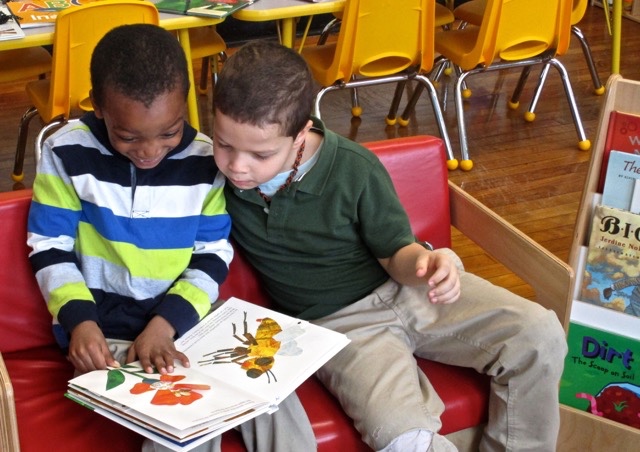
“Will they still be here tomorrow?” students often ask Morgan VanClief, the librarian at P.A. Shaw Elementary School in Dorchester, MA.
They’re asking about the brand new books that Morgan has been able to bring to the school’s library through generous grants and access to the First Book Marketplace. Many of her students simply aren’t used to having resources available to them on a consistent basis, so they get nervous that the fun and exciting books they see today might not be there tomorrow.
Thanks to Morgan and funding partners like KPMG, they can be confident that the books they love will be available to them day in, day out.
“I think it helps show them that they do deserve to have these resources at school, just like any other kid,” Morgan says.
In just two years as the school’s librarian, Morgan has turned the library into a vibrant and engaging place where students can explore their interests — but it hasn’t always been that way.
“It was literally just an empty room,” Morgan says of the library, “now we have shelves full of books, computers, and even a little theatre area.”
Students are becoming more comfortable using the library regularly and in turn, more comfortable at school. Just by coming to the library every day kids are opening up, advancing reading levels and most importantly, they’re happier.
“One student who was in kindergarten two years ago—he was very reserved, kind of withdrawn, almost sad at school,” Morgan says, “but after two years of constantly coming to the library, he enjoys school now and his family says he is happier at home too.”
For many students, questions about whether or not the books will be available have been replaced by other questions. Questions about a book’s characters, or the setting of their favorite story–questions that will help them learn and grow.
Morgan VanClief’s library was able to receive books through First Book’s partnership with KPMG. If you work with children in need, you can access books and resources for your classroom through the First Book Marketplace.
The post A Library Full of Books & Happiness appeared first on First Book Blog.

The week before school starts
And through the library,
We started getting ready
For the extraordinary.
Books were displayed
On the shelves here and there,
Waiting for readers
From here and elsewhere.
The students still had
A week to sleep late,
While librarians work hard
Not only the students
But also the teachers,
Were all given info
On things that were keepers.
Like sources and websites
And great info to know,
About books and collab’ing
Great things we can show.
Emails and posters
All ready to make,
To show off resources
For the campus to take.
And use for their projects
And digital work,
The library is here
Like Spock is to Kirk.
Not only does reading
Take place in here often,
But makerspace, gaming
And Lunches, and talkin’.
The library has changed
Through the years can’t you see,
From quiet hush zones
To chill places to be.
The collection has more
Than just books to check out,
But all sorts of things
For all users to scout.
From movies to audio
Kids books and much more,
All for the taking
On the fab library floor.

So with only five days
To get ready to open,
How bangin', how awesome
Time to bring lots of hope in!
By: Lizzie Furey,
on 7/27/2016
Blog:
OUPblog
(
Login to Add to MyJacketFlap)
JacketFlap tags:
libraries,
movies,
librarians,
ghostbusters,
New York Public Library,
nebraska,
The Breakfast Club,
*Featured,
TV & Film,
Monsters University,
Love’s Labour’s Lost ,
The Shawshank Redemption,
Add a tag
Paul Feig’s Ghostbuster’s remake has made waves on both sides of the Atlantic. As the original 1984 film set some significant action in the Stephen A. Schwarzman Building of the New York Public Library, we couldn’t help but indulge in a rifle through the archives of cinematic tributes to libraries.
The post From the archives: the top 5 movie scenes set in libraries appeared first on OUPblog.
By: Lizzie Furey,
on 7/25/2016
Blog:
OUPblog
(
Login to Add to MyJacketFlap)
JacketFlap tags:
Oxford,
England,
British,
*Featured,
international law,
travel guide,
Antonio Cassese,
Blackwell's bookshop,
International Association of Law Libraries,
Magdalene College,
Museum of the History of Science,
oxford university press museum,
libraries,
Law,
Add a tag
This week, the International Association of Law Libraries is holding its 35th Annual Course in Oxford, United Kingdom. Oxford University Press is delighted to host the conference’s opening reception in our own offices on Great Clarendon Street.
The post The perpetual Oxford tourist: what to see and do in the city of dreaming spires appeared first on OUPblog.
By: Lizzie Furey,
on 7/23/2016
Blog:
OUPblog
(
Login to Add to MyJacketFlap)
JacketFlap tags:
libraries,
librarians,
Technology,
e-books,
EIFL,
myanmar,
*Featured,
higher education,
e-library,
e-Library Myanmar Project,
Mandalay,
Myanmar Academic Library Consortium,
Yangon,
Add a tag
I have been a lifelong librarian in Myanmar since 1985. It is a great pleasure and honor to share the challenges and success of the e-Library Myanmar Project implemented by EIFL.
The post Transforming libraries in Myanmar: The e-Library Myanmar Project appeared first on OUPblog.
Every summer, thousands of librarians and other bibliophiles meet at the American Library Association’s Annual Conference. This year, it’s in Orlando (yeah…) and like years past, “ALA Annual” will host feature numerous creators, publishers, and panels relating to comics, gaming, and all the other geekery stuff that kids who hang out in libraries enjoy […]

By: Jessamyn West,
on 6/12/2016
Blog:
librarian.net
(
Login to Add to MyJacketFlap)
JacketFlap tags:
libraries,
Add a tag
I liked this so much I figured I’d do it again. Some of these are links emailed to me that I never did get around to writing a full post about.
- Every wanted something like Rotten Tomatoes that aggregated a bunch of reviews, only for books? The somewhat uninspiredly named Book Marks does that thing.
- We give people advice on how to find things, this meticulously detailed comparison between Apple Maps and Google maps can help us give people advice on how to find things.
- The Center for an Urban Future writes policy papers. This recent one about NYC libraries and their technology instruction is a very good read. NYC libraries provided tech training to more than 150,000 New Yorkers in 2015, up 81% from three years earlier.
- A story from the blogs: Sofya Onikienko and her rescuing of her books during the Patriotic War. Fascinating story at the Russian Landmarks blog. (thank you John)
- Wild Colorado is a library-created (and Kickstarter funded) app that helps people interact with and identify nature and is available to Coloradans statewide. (thanks Joseph)
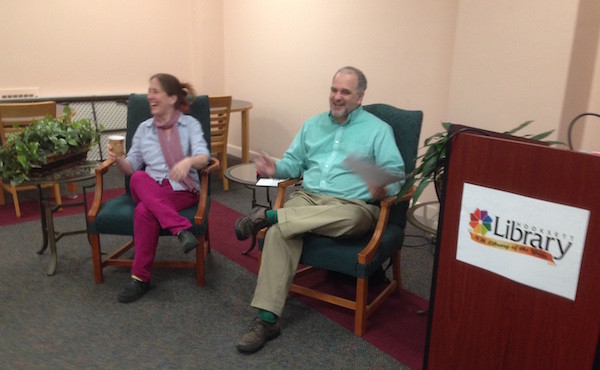
I had a great time at the Hooksett (NH) Library talking with the Merri-Hill-Rock Coop about library stuff on Wednesday. Cab Vinton from the Plaistow Library asked me what I’d like to do. I decided to break out of my normal “Here are some slides, let me talk about them…” routine and do something a little different. So I spoke for maybe 25 minutes about some Big Ideas I had for library services and then Cab and I spoke together and took questions about actual practical ways library workers could maybe work towards some of those ideals. It was a really constructive 90 minutes or so with a bunch of creative librarians who come from smaller libraries and are always doing more with less. We spoke specifically about trying to do things to make our buildings more available, lend and share more digital content, and getting outside our buildings somewhat. I stressed the point that sometimes you can’t change a thing immediately but you can advocate for that idea and support others who are able to make material changes. Having the library’s support for a thing is more useful and important than I think we sometimes appreciate. People trust us and care what we have to say.
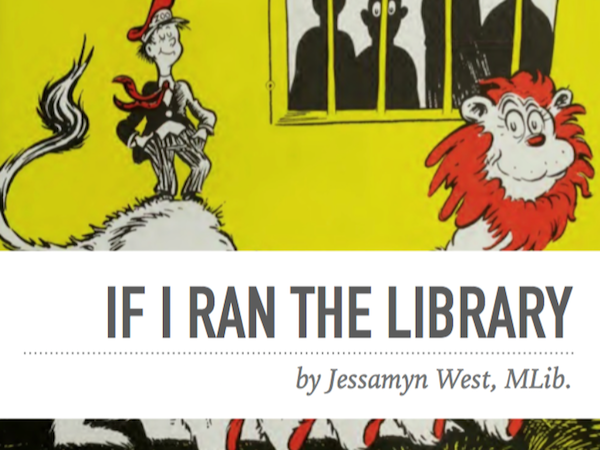
Here are my slides (with apologies to Dr. Seuss).
I'm over at the
ALSC Blog today - complaining about stuffed animals.
 |
| Max Braun CC BY-SA 2.0 * |
Feel free to join me if you're so inclined.
In other news, I hope you've been downloading your free books from SYNC. Two free books are available each week beginning on Thursday. The books for that week are available for one week only. Books are yours - forever - no strings attached.
"SYNC is a free summer audiobook program for teens. Starting May 5th 2016, SYNC will give away two complete audiobook downloads a week - pairs of high interest titles, based on weekly themes. Sign up for email or text alerts and be first to know when new titles are available to download at
www.audiobooksync.com."
Today is the last day to get Zac & Mia by A.J. Betts, and I'll Give You the Sun by Jandy Nelson. Tomorrow, it's How it Went Down by Kekla Magoon (with a full cast narration!) and The Autobiography of an Ex-Colored Man by James Weldon Johnson.
Below are the titles for the next few weeks (there are more to come after these!):

I need to close some tabs on my browser so they are here.
1. Are you someone from a “diverse” group who gets frequently asked for your opinions about how to help organizations “get diverse” enough so it seems like a part time job? Follow Diversity in Design’s lead and charge people for it. No shame in it. There is also Clarity.fm which doesn’t have a specific keyword for librarians but that didn’t stop me from signing up.
2. The Open Access Button “helps researchers, patients, students and the public get access to scholarly research and to report when they’re denied access.” Learn about it. Cool stuff.
3. Fair warning: the Department of Justice is starting to get serious about public entities having accessible websites and also “web content” What they mean about web content is not totally clear but libraries should pay attention. Good blog post by this law firm who has a good accessibility blog generally.
4. Live to Run Again is a not-for-profit public education campaign against drowsy driving for people who are traveling long distances to go to dog events. They sponsor ABLE an Audio Book and Library Exchange where volunteer librarians bring audiobook CDs to dog events so that people can listen to them and stay awake on the way home. Drop off the audiobook at the next library along the way. Great idea and they are always looking for donations if you are weeding CD audiobooks.
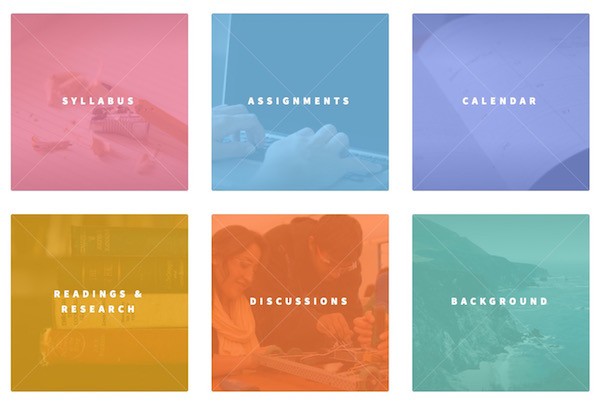
5. I don’t think I have mentioned this here but I am teaching a Tools for Community Advocacy class at the University of Hawaii, a short summer class with eleven really interesting students. I dislike course management software so I made my own website for the class from an available template. I am proud of it. You can view it here.
By: Samantha McGinnis,
on 5/31/2016
Blog:
First Book
(
Login to Add to MyJacketFlap)
JacketFlap tags:
Raymie Nightingale,
National Summer Reading Champion,
Authors & Illustrators,
author interviews,
Kate DiCamillo,
Beverly Cleary,
Because of Winn-Dixie,
CSLP,
Expert Voices,
Collaborative Summer Library Program,
imagination in books,
libraries,
Laura Ingalls Wilder,
summer reading,
The Tale of Despereaux,
Stuart Little,
summer library programs,
Add a tag
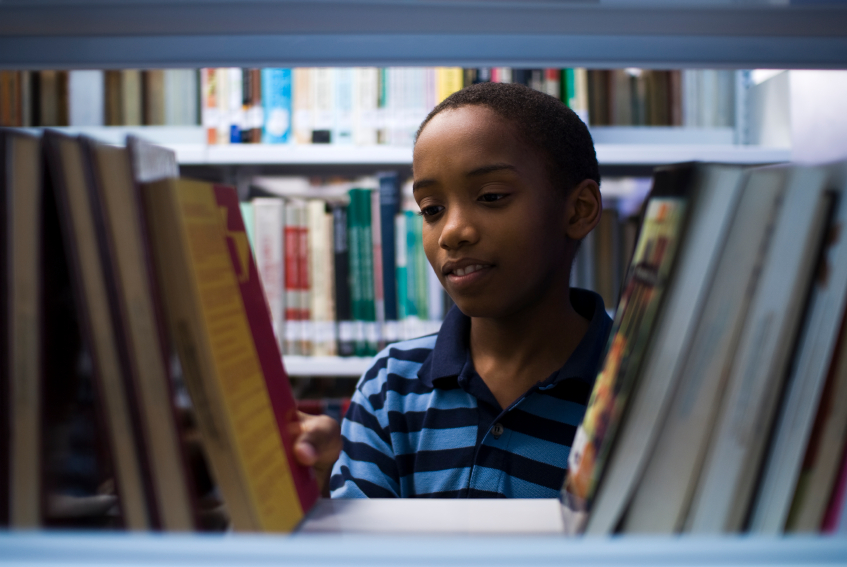
This summer, kids can access great books, go on adventures to faraway places and even win prizes – all at their local library.
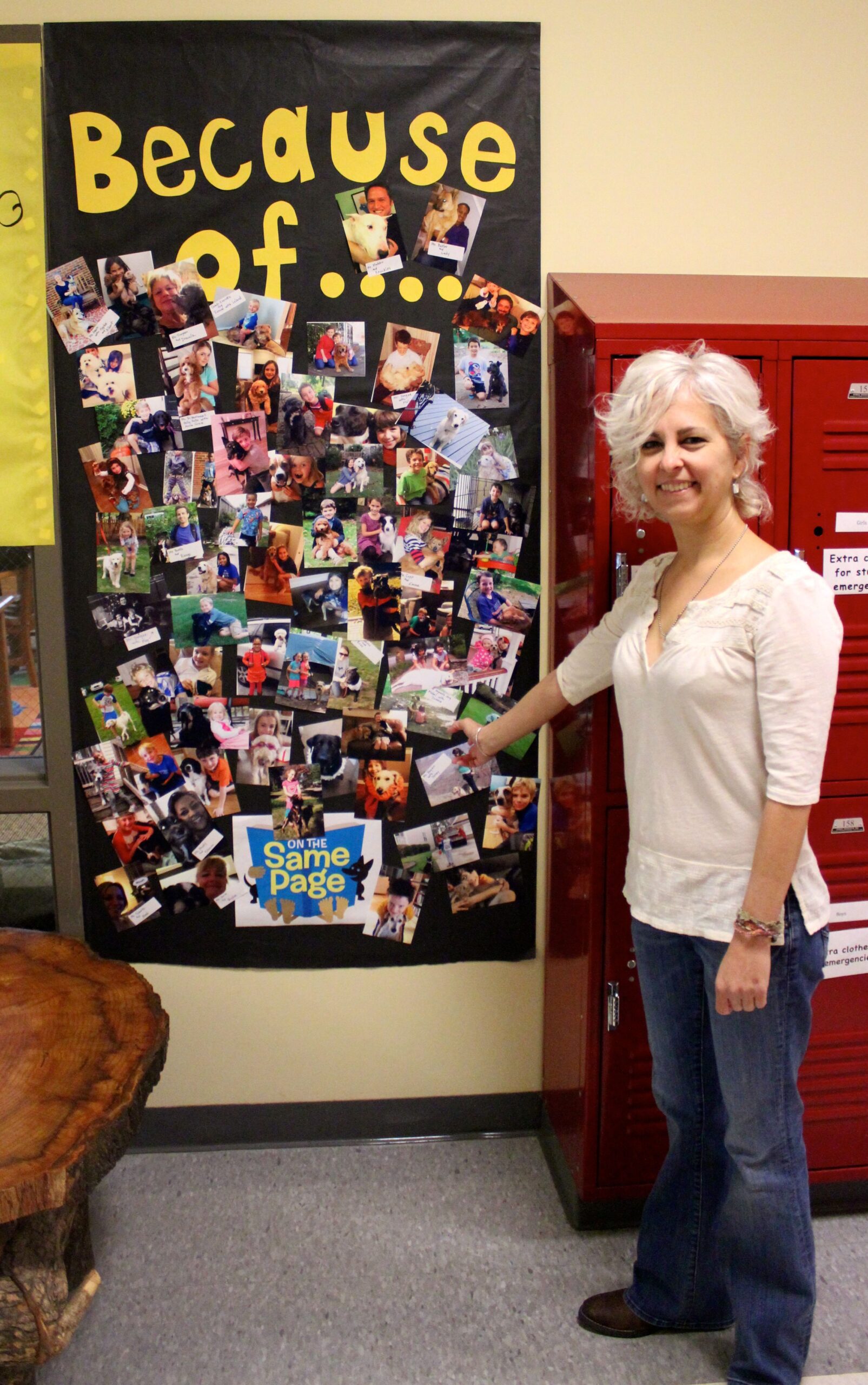
Kate DiCamillo, author of Because of Winn-Dixie, The Tale of Despereaux and the recently released Raymie Nightingale, appreciates the importance of reading – especially during the summer.
As she visits schools throughout the country, answering questions about her new character Raymie and her journey to conquer remarkable things, she’s also letting kids know that all summer long their local libraries offer great opportunities for summer fun as the 2016 Collaborative Summer Library Program (CSLP) National Summer Reading Champion.
We had the opportunity to talk to Kate about what inspired her to become a children’s author, the importance of books and imagination and which books she loved to read during summer break as a kid.
Your books are very imaginative. Why is important for kids to explore their imagination through books?
Because you find that anything is possible – and the feeling of possibility gets into your heart. That’s what books did for me.
As a kid, I was sick all the time and spent so much time alone. It was super beneficial to read because I was convinced that the things I didn’t think were possible actually were! That’s incredibly important for kids in need, but also for all of us.
 Your stories are very relatable for children. Why is it important for kids to see parts their lives in the books they read?
I feel this as an adult reader too. Books give me an understanding not only of the world and other people’s hearts, but my own heart. When you see yourself in a story, it helps you understand yourself.
During my school visits, so many kids tell me stories of how they connect with my characters – Despereaux and Edward Tulane and Raymie. It’s so humbling to see that connection.
And when you see other people, it introduces you to a whole new world. I think of a story I read as a kid, which was actually just reissued, called All of a Kind Family. It’s about a Jewish family in turn-of-the-century New York. That couldn’t have been more foreign to me growing up in Central Florida but I loved every word of it.
Did you like to read during the summer as a kid?
Yes! I loved reading. I could spend all day reading. I’d go up into my tree house with books and sometimes didn’t come down until dusk.
If you gave me a book as a kid, I loved it. I read without discretion. But I did have my favorites I’d come back to again and again: Beverly Cleary’s books, Stuart Little and Laura Ingalls Wilder’s books.
It’s so crazy to stand in front of groups of kids and tell them this. There’s always a murmur of “oh, yeah, yeah! I read that!” That’s the staying power of books.
How can kids access books and learning activities over the summer?
That is the beautiful thing about CSLP summer reading programs at public libraries: it makes it easy for parents, caretakers and kids themselves to access all kinds of materials and activities for free. The 2016 summer reading theme is “On your mark, get set, READ!” and I think that’s an open invitation to readers of all ages to take advantage of everything their library offers.
Want more Kate DiCamillo? Listen to her talk about the fantastic summer fun you can find at your local library!
The post Author Kate DiCamillo Finds Summer Fun at The Local Library appeared first on First Book Blog.

§ Blutch, Blutch, Blutch. French artist Christian Hincker, aka Blutch is a cartoon god in Europe, but known only to Euro comics experts here. The new New York Review of Books edition of PEPLUM is his first long work to be translated into English. It’s no easy reader; a mystical narrative that takes element from the […]
By: Lizzie Furey,
on 4/13/2016
Blog:
OUPblog
(
Login to Add to MyJacketFlap)
JacketFlap tags:
Library,
ala,
libraries,
Education,
National Library Week,
american library association,
day in the life,
*Featured,
East Carolina University,
Eleanor Cook,
National Library Week US 2016,
Add a tag
There is one week each year when it is completely acceptable to fawn over libraries and librarians and all that they do for communities, institutions, and the world in general. Of course, you may find yourself doing that every week of the year, anyway, but we have great news for library fans -- it’s National Library Week in the US.
The post Technology, project management, and coffee yogurt: a day in the life of a librarian appeared first on OUPblog.
So I've been arrested for outrageous library-saving behaviour and am writing this from Brixton jail... (no, not really). Today's #CarnegieOccupation protest march was very peaceful but there was NO DOUBT of people's passion for their libraries, the Carnegie (which had been occupied for over a week), Minet Library and other libraries under threat.

With a big ceremonial unlocking of the front gate, the occupiers came out to big cheers for the commitment they'd shown trying to rescue the library from the council's plan to turn it into a gym. The (Labour!) council's scheme seemed hair-brained: the library group had worked hard to come up with a reasonable business plan and the council had turned it down for lack of funds, but then suggested throwing millions at the building to turn it into a private gym with what appeared to be no organised business plan.

The council argued that they'd just push the books to the side, keeping it a library, but here's author Alan Gibbons arguing that a room with books in it is just a room, without a trained librarian, it's not a library. (Also there were questions about kids being allowed to hang out in a gym, who would look after the books, restock, etc.)

A group called 'Defend the Ten' have been arguing the case for all ten libraries in the London borough of Lambeth, and you can follow them on Twitter: @defendtheten.Quite a few writers and illustrators were able to come along, and it was great to see Francesca Simon, who had argued for libraries the previous evening on Channel Four:

Here's Francesca (author of the Horrid Henry books) with presenter Cathy Newman, and Kate Anderson who was arguing that libraries are passé. (Francesca said she thought Kate saw libraries only as a place to work on a research paper and probably hadn't been to one since university.)
Not everyone was able to make it, but they were present IN SPIRIT. (Yes, you, Ardagh.) Here's my studio mate Gary Northfield, author of the Julius Zebra books (in front of author Stella Duffy, who gave one of the speeches).

Sometimes I go to rallies and see people all with identical signs that the union or political party have given out, but this wasn't like that; a lot of people had put thought into creating their own unique signs, which was fabulous.

I loved the kids' signs, and there were SO MANY KIDS there! I do think the case for libraries is a no-brainer when we're talking about kids and books; there's no way even middle-class parents can keep up with the amount of books their kids go through. Some kids will read twenty or more books every week. And I've seen on my own royalty statements that a very, very small percentage of those books are e-books, they're almost all printed books. Books don't need batteries; if you throw one into the bath (as I did when I was two) it's not several hundred pounds worth of tech ruined.

Can I tell you HOW chuffed I was to see the signs I'd created? ...VERY CHUFFED. It almost felt like an Easter egg hunt, spotting them.

Oo, there's another one! :D

(You can download a range of them free if you click here.)

So I'm really curious what's going to happen to Carnegie Library now that the protestors have gone. Will Lambeth Council think twice about their screwball plan?

From what I hear, Carnegie Library was getting a lot of use and a real hub of organised community activities. We marched to Minet Library, also closed down and scheduled to become a 'healthy living centre'. I was talking with a fellow protester later in a cafe who said that the idea behind turning these libraries into gyms is that they're not allowed to take them down and rebuild them if they're libraries. (And Carnegie Library was a 'gift to the people', not to the council.) But if the council can get the designated usage changed, then they can do what they like. (I don't know if this is true but it sounds plausible.)

So many awesome signs!

I recognised this sign from @StudioTeaBreak online community's @MrsJTeaches!


We finished the rally in Brixton, by the Ritzy Cinema, in front of the Tate Central Free Library.

Here's an 11-year-old reading a surprisingly powerful piece of poetry she'd composed for the protest.

Still sign spotting...

Lovely author supporters! Amanda Lillywhite, Mo O'Hara (and can someone remind me of the name of the woman on the right? I'm so awful with names).

In front of Minet Library: bookseller Adriana at Pea Green Boat Books, Jo Franklin, Mo O'Hara and me.

Thanks so much to Stuart for coming with me! Well done to the Carnegie Library occupiers and everyone who's put time into the protests, and I hope the pressure to SAVE LIBRARIES continues!

By: Samantha McGinnis,
on 4/5/2016
Blog:
First Book
(
Login to Add to MyJacketFlap)
JacketFlap tags:
Judy Moody,
National School Library Month,
Expert Voices,
Association of School Librarians,
Judy Moody and Stink,
libraries,
librarians,
Authors & Illustrators,
Megan McDonald,
Add a tag
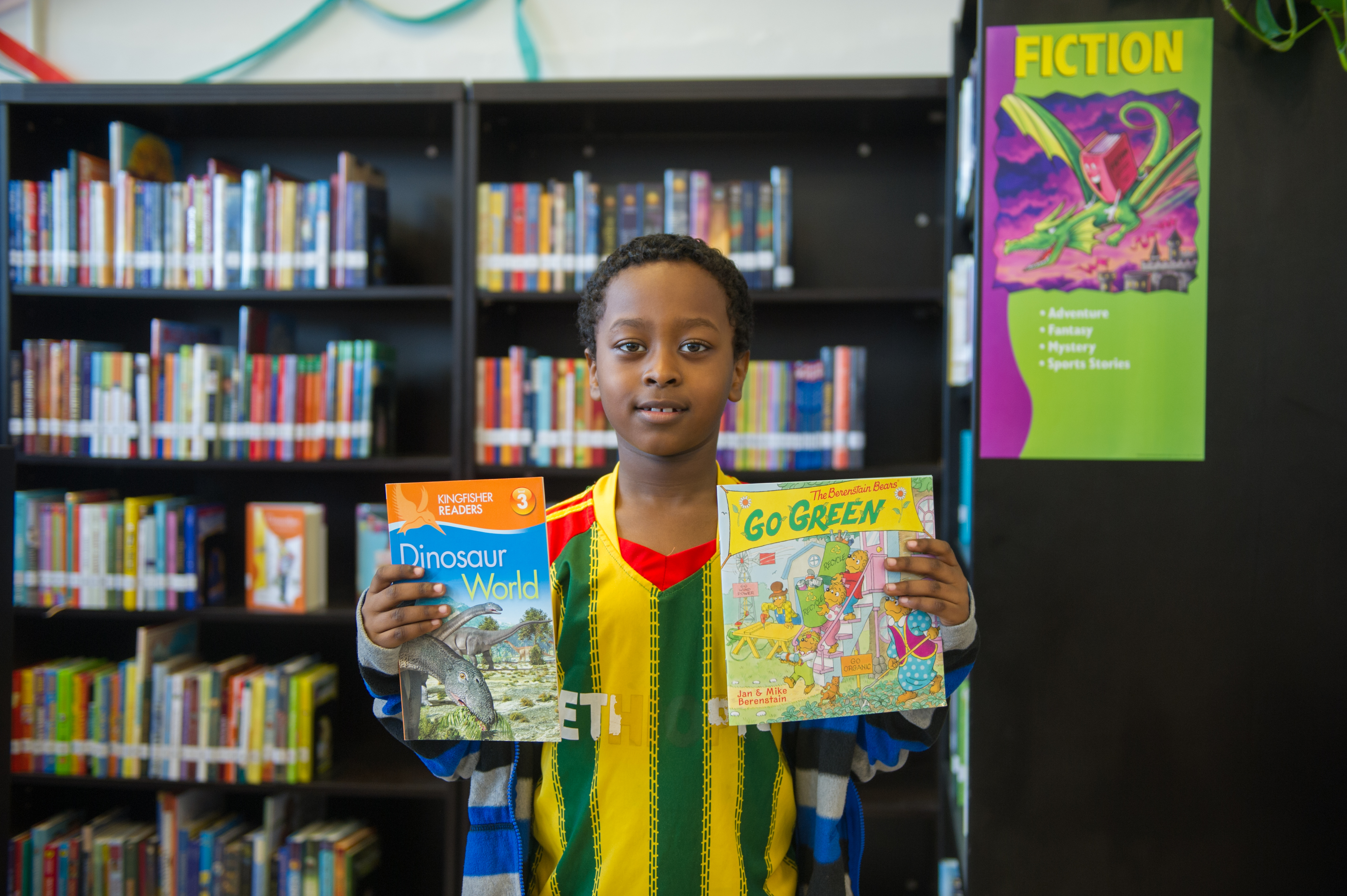
Today’s guest blog post is by bestselling children’s author Megan McDonald, 2016 Spokesperson for the American Association of School Librarians National School Library Month.
Imagine a school without a library.
A few years back, I was honored to be a visiting author in elementary schools in the state of Florida. After school one day, I was signing books at a table outdoors, because the school did not have a library.
A grandmother waited patiently in line, kids tugging at her. When she reached the table where I was sitting, she held out a well-worn, much-loved copy of my very first book, Is This a House for Hermit Crab?
With tears in her eyes, she told me about the many children, and now grandchildren, she’d taught to read using my book—because it was the one, the only, book they owned at their house.
The school library gave me my start as a reader, and as a writer. It was through my school librarian that I first met Ramona and Homer Price, Laura Ingalls Wilder and Stuart Little, the Melendys and the All-of-a-Kind Family.
Without them, my characters Judy Moody and Stink would not exist.
I want all kids to experience the magic of libraries. I want them to build log cabins out of Popsicle sticks and start their own Independent Saturday Afternoon Adventure Clubs and save the world ala Judy Moody. I want them to grow up to become readers and writers, artists, thinkers, inventors.
But for this to happen, we have to connect kids with books. We have to change lives with books.
First Book is doing just that!
First Book supports educators working in low-income communities with new books and educational resources. By signing up with First Book, school librarians can access affordable, relevant, best-in-class books for all readers, including reluctant readers.
School libraries are the heartbeat of the school. They serve as a resource to all students and support both required and independent reading. They shape lives. Join me in celebrating school libraries and highlighting the important work that school librarians do to transform kids’ learning.
Head for the school library. Seek out a book from First Book.
Anyone working in the lives of kids in need can sign up with First Book at www.firstbook.org/join.
The post Imagine A School Without A Library appeared first on First Book Blog.

You know the library closure situation is bad when people are actually locking themselves into doomed libraries and refusing to leave. That's exactly what's happening with the #CarnegieOccupation and these people have been in the Carnegie Library in Herne Hill, southeast London for five days and not planning to leave until it's saved from Lambeth Council-led ideas of turning it into a gym.

When I visited today, the protesters at the front gate explained to me that there are lots of gyms in the area, and this library was given to the people by Carnegie, not the council; they claim the council have no right to take it away from them. They said that the council thought they could leave some shelves with books, and still call that a library - 'a healthy living centre with a self-service neighbourhood library' are the words on the council library website - but the book area would be unstaffed. They were frustrated that the council was trying to call this book area a library, arguing that a space with books isn't a library unless there are librarians present. (Too right!)

I wasn't sure if the occupiers would have enough to eat after five days, but when I got there, I saw that the community have been great about keeping them stocked up with food and toiletries. What they need most is publicity for the cause, so the Carnegie Library and others don't quietly disappear. The council and the government need to realise libraries are a BIG DEAL in their communities, and they need MORE funds to stay up to date with modern times, not budget slashing and closures.

Here's a poster I drew for the protest, based on a poster I'd designed earlier (which you can download free here). Some people argue that the Internet makes libraries irrelevant; you can find information and buy books cheaply online. But if you plonk a kid in front of a computer to do their homework, they're not going to know how to find good information other than what Wikipedia and Google turn up. How can they know which sources are helpful and reliable, or do more than copy and paste? How will they even know what 'a reliable source' means?
This argument also assumes everyone has access to the Internet, computing equipment of some sort, and at least a little bit of money and a credit card to buy cheap books. But this isn't the case, library closures deeply affect the poorest and most vulnerable. Many of them need the library for a safe and warm place to study, free access to books and computers, the guidance of librarians, and a wide range of other services, depending on the local area and their needs.

The area closest to my heart is children's books: kids go through SO MANY books when they're young, more than even most well-off parents can be expected to buy. One quality picture book will cost well over a fiver, and a young child will easily read 20 in a week; a 10-year-old in a week might read five or more novels. Kids need a wide range of books coming at them constantly, not one book every year for their birthdays.
(When the kids in Carnegie Library found out I made books, they rushed back inside to see if the library had any and brandished them victoriously. We had a nice little chat about how I create the pictures in When Titus Took the Train.)

The #CarnegieOccupation are looking for support and it's great to see them getting it from other groups, such as this tweeted photo from the Lambeth Library staff. One of the protesters told me that none of the occupiers in the Carnegie are library staff; they said they wanted to protect its staff from losing their jobs, and it's non-employees who really need to speak up.

You can read more about library cuts in the recent BBC report on library closures, with exact figures, a grim read. (Go there first if you're going to follow any of the links here.)

I don't only want to focus on London libraries - so many more isolated communities need their libraries just as much if not more - but the #CarnegieOccupation seems to have hit a real nerve with people and the media coverage can lead a lot more people to consider their own libraries and decide how much they value them.

You can get updates on #CarnegieOccupation by following the Twitter hashtag, you can read a BBC article on it here, an Evening Standard article here, a BuzzFeed article here and an article in The Bookseller here.
You can sign a CILIP library services petition about library closures overall at the My Library By Right website.
The official demonstration Twitter account seems to be @DefendtheTen (here's the Defend the Ten website, and Carry On Carnegie - a blog run by young occupiers) and @SaveLambthLibs; I've seen tweets of support from the Society of Authors (@Soc_of_Authors) and CILIP library services (@CILIPinfo).

Best wishes, Carnegie Library, I hope you win this one.
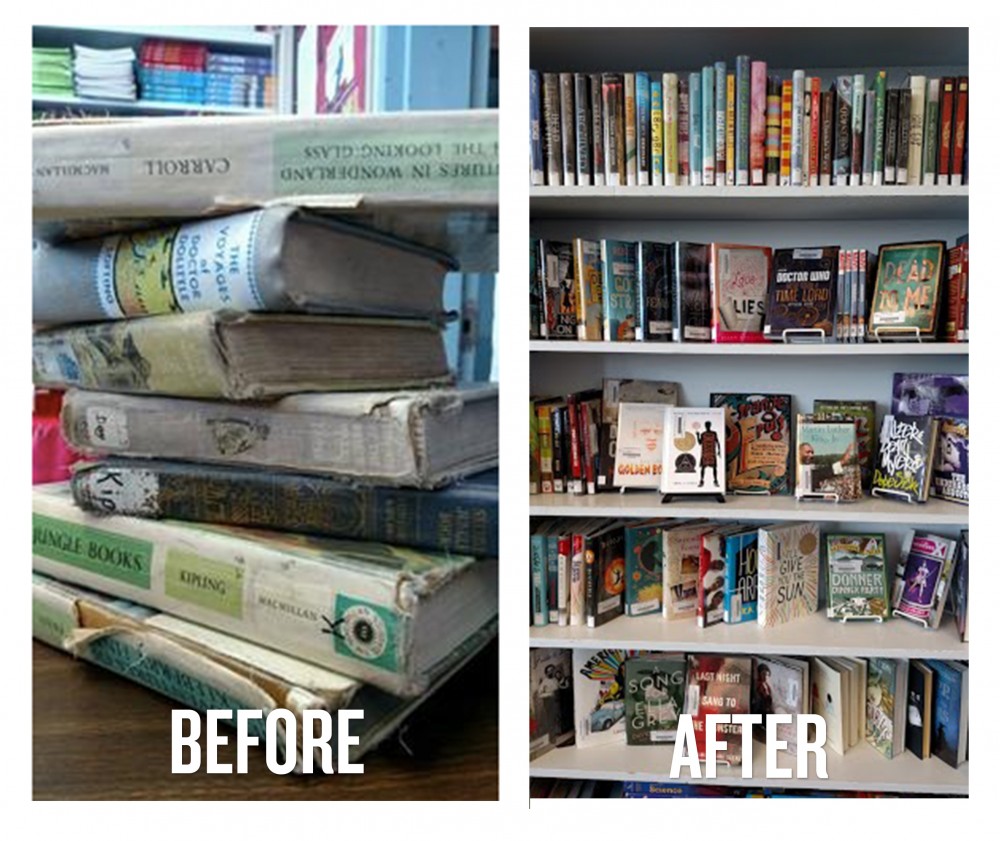
When Vanessa Cadena entered the library at Bret Harte Middle School this school year, she knew she had a big job ahead of her.
It was Vanessa’s first year at the school and the library had not been updated in almost twenty years. Full of damaged and outdated books, Vanessa saw the reluctance on the kids’ faces when they left the library with books they didn’t want to read.
“It was a space that was defined by a vast collection of outdated and tattered books, technology and furniture. It begged to be pumped with vitality again,” said Vanessa, the Library Media Specialist for the school.
To create the library her students needed, Vanessa needed some help. She started a First Book Fundly campaign with the goal to raise $1,000 to invigorate the shelves. She reached out to the PTA at both her school and the elementary schools whose students would be attending Bret Harte in the future. She spread the word via social media, faculty, friends, the local public library and the closest books hop. She even enlisted the help of an intern to pass out flyers promoting the campaign.
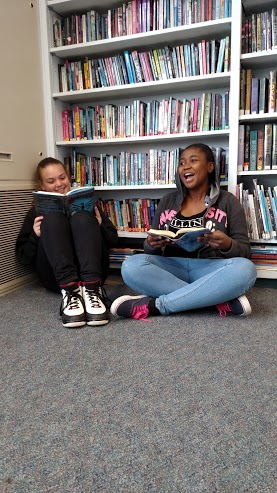 When she not only met, but exceeded her goal, Vanessa was ecstatic – and so were her 7th and 8th graders. With the money raised, Vanessa was able to add 350 books to her library. This year alone she has purchased 1,000 brand-new books from First Book to revitalize the collection.
It’s made an immense difference in the reading habits of her middle schoolers.
Now, Vanessa has “regulars.” She can’t keep fiction and graphic novels in stock and students race to library to see her new arrival section. When the kids take home a book, they usually finish it by the next day.
“Kids are excited to read,” Vanessa explains. “The teachers have told me this is the first year they could send their students to the library and every single student comes out with a book – and it’s a book they are reading and excited about.”
Want to bring books to your school or program, or one in your community? Visit www.firstbook.fundly.com to start a campaign.
The post An Educator’s Campaign to Revitalize Her Library appeared first on First Book Blog.

View Next 25 Posts



.jpeg?picon=2691)


.jpeg?picon=3015)

 Every summer, thousands of librarians and other bibliophiles meet at the American Library Association’s Annual Conference. This year, it’s in Orlando (yeah…) and like years past, “ALA Annual” will host feature numerous creators, publishers, and panels relating to comics, gaming, and all the other geekery stuff that kids who hang out in libraries enjoy […]


.jpg?picon=925)




Thank you for sharing such an insightful post. Do you think the intentional/unintentional lack of diversity among librarians choosing books to order/promote is censorship in itself? I ask because ALA is reporting 90% of school librarians and 86% of academic/public librarians as white (http://bit.ly/2dHyyqh)…which promotes a “biased, white-washed” stream of consciousness that dominates publishing companies and bookstores/shelves across America. In all honesty, that’s an “invisible censorship” that no one discusses on a public platform. I’m wondering of all the books censored, what’s the racial make-up of those censored? Food for thought…
School libraries are not an extension of the public libraries. Public schools stand in loco parentis, and their library collections exist to serve their educational mission. They are not to be a destination for free reading on par with public libraries that need to carry the widest possible assortment of books. Therefore, selection of books for school libraries is different from selection of books for the public library. If a book were to be blocked from both the school library and the local public library, well, then there’s a reason to scream bloody murder.
It also important to remember that fiction is not the same as non-fiction when it comes to issues of perceived inaccuracy. The main issue for fiction need to be plausibility, not generality. Pointing out cultural flubs in fiction is certainly part of the critique of a book, but oftentimes the pointing out of cultural flubs is colored by a political agenda, not by a flub being implausible. Or, because of a use of language by an author that a reader or reader just doesn’t like. Fact is, if we were to take out of circulation all fiction that gets something wrong or where an author’s choice of words pushes an emotional button, there will be precious few books on the shelves, movies in the theater, and plays on the stage.
[…] Banned Book Week roundtable: the evolution of censorship | Lee and Low Blog […]