new posts in all blogs
Viewing: Blog Posts Tagged with: E, Most Recent at Top [Help]
Results 1 - 25 of 93
How to use this Page
You are viewing the most recent posts tagged with the words: E in the JacketFlap blog reader. What is a tag? Think of a tag as a keyword or category label. Tags can both help you find posts on JacketFlap.com as well as provide an easy way for you to "remember" and classify posts for later recall. Try adding a tag yourself by clicking "Add a tag" below a post's header. Scroll down through the list of Recent Posts in the left column and click on a post title that sounds interesting. You can view all posts from a specific blog by clicking the Blog name in the right column, or you can click a 'More Posts from this Blog' link in any individual post.
Here's a little fun for the day and two great dad books.
If you're on Twitter: In honor of Father's Day, Barnes and Noble
@bnbuzz is using the hashtag
#DadBooks to solicit groan-worthy puns and corny dad jokes based on well-known books. Be sure to check it out or join in the pun.
Here are a few (with links to their posts):
Oh, the Places You'll MowThe Girl Who's Certainly not Getting a Dragon TattooGone Grill 
If you're on Pinterest, check out my board, "
Comic strips featuring books." I've been collecting comic strips that feature books and libraries for the last several years. If you have a good comic strip that I've missed, please feel free to send it to me and I'll pin it.
And lastly, since Father's Day is tomorrow, I'll share two of my favorite "dad" picture books.
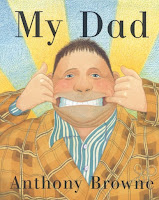
- My Dad by Anthony Browne (Macmillan, 2010) is a funny, homage to the classic jack-of-all-trades kind of dad. On each page, tribute is paid to the bathrobe-clad dad's many great qualities. The illustrations are wonderful - even as he is depicted as a fish or an owl, he retains his brown, plaid bathrobe. You can see them here [http://us.macmillan.com/mydad/AnthonyBrowne].
- Tell Me a Tattoo Story by Alison McGhee and illustrated by Eliza Wheeler (Chronicle, 2016) is lovingly written and illustrated. A young tattooed dad weaves a tale for his son using his tattoos. A sweet story that should appeal to many young families.

A selection of darkly funny, mostly cautionary picture books.
Share these funny gems with slightly older listeners who have a sense of humor; but spare your very timid or gentle-hearted ones - happily-ever-after is not guaranteed in these tales of comeuppance, justice served, just desserts, and cautionary advice.
If you're unable to view the slide show, visit it on Riffle Books [ https://www.rifflebooks.com/list/206136] where I occasionally create themed slide shows.
Books included in the list:
- A Hungry Lion, Or a Dwindling Assortment of Animals by Lucy Ruth Cummins
- How to be Famous by Michal Shaley
- Everyone Love Bacon by Kelly DiPucchio
- Jim: Who Ran Away from his Nurse and Was Eaten by a Lion by HIlaire Belloc
- This is Not My Hat by Jon Klassen
- I Want My Hat Back by Jon Klassen
- The Book that Eats People by John Perry


By: Shelf-employed,
on 4/15/2016
Blog:
Shelf-employed
(
Login to Add to MyJacketFlap)
JacketFlap tags:
kindness,
storytime,
wordless,
E,
picture book roundup,
friendship,
cats,
art,
colors,
painting,
funny,
elephants,
Add a tag
It's been a while since I've done a picture book roundup. Here are three that struck my fancy:
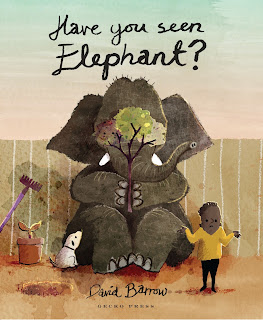 Kind. This boy is the best!
Have you seen Elephant?
Written and illustrated by David Barrow.
Gecko Press, 2016
A kind young boy plays hide-and-seek with his elephant friend and takes care to keep the game going, despite the fact that his friend is a very poor hider!
Have you seen Elephant? is bright and cheerful and funny, and above all - kind. This is the first book I've seen from Gecko Press and the first by David Barrow. I love it!
Confined? Can the colortamer catch them all?
Swatch: The Girl Who Loved Color
Written and illustrated by Julia Denos
Balzer Bray, 2016
Bright, bold, and expressive, Swatch is a color tamer - trapping and using colors in the most fantastic of ways. A bold and fearless artist, no color had escaped her artistic eye ... no color but one,
"Morning came, and there it was, fast fading and fierce, the King of All Yellows, blooming in the sidewalk crack in spite of the shadows. Swatch was ready .... At last, Yellowest Yellow would be hers."
Or would it?
This is the first book that Julia Denos has written as well as illustrated. I would love this book even if my favorite color were not the hero of the story!
Find. Where is that cat?

Spot, the Cat
Illustrated by Henry Cole
Little Simon, 2016
A beautifully detailed, wordless book - more than just a seek-and-find, it follows the path of an adventurous cat in the city and the boy who wants to find him. Join the young boy and search the city for Spot, the cat.

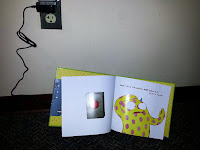 A book with a plug! Whaaat?
For car trips, young readers, struggling readers, and sheer entertainment, you can't beat a picture book/audio book combo for younger kids.
Though schools and libraries may still keep book/CD kits in their collections, the truth is, CD players are not that common anymore. Newer computers don't come with a standard CD/DVD drive, cars don't always have them, and the only people I know who still have "boom boxes" are children's librarians.
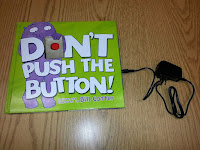 That's why I was happy to receive a copy of a new VOX (TM) "audio-enabled" book. In my photo, the book is plugged into the wall for charging, but I did that just for show because a book with a plug cracked me up! In truth, it arrived fully charged and ready to go - no plug required. (I didn't test it for battery performance.) The audio recording and speaker are built right into the book and operated by a simple control panel - power, play, pause, volume, forward, and back. There is also a standard headphone jack. The audio is of comparable quality to any conventional children's book. The book itself also seemed as sturdy as any, and was not overly heavy or burdensome.

Perhaps other companies have similar offerings, but this is the first book of its type that I've seen. I think it has possibilities, and that the days of the book/CD kit are numbered. I passed my copy along to a school superintendent who agreed that it might be a useful addition to his school's collection. I did not inquire as to the price. I was interested solely in the format.
If you can get your hands on one, it's worth checking out.
(I'm not going to review the book, Don't Push the Button!, but will merely note that it is in a vein very similar to the wonderful Press Here by Herve Tullet. Kids will likely enjoy it.)
My review copy was provided by
VOX Books.
Note:As always on my blog, I review books and materials for educational purposes only, and receive nothing of value other than the review copy, its associated marketing materials, and the occasional thanks or consternation of its author or publisher.
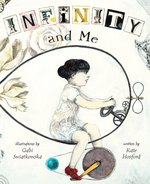 Although I reviewed a print version of Infinity and Me book several years ago (my original review is linked here), I recently had the opportunity to review the audio version for School Library Journal. My review as it appeared in the February, 2016, edition of SLJ is below.
HOSFORD, Kate. Infinity and Me. 1 CD w/tr book. 44 min. Live Oak Media. 2015. $29.95. ISBN 9781430120049.
K-Gr 3—A small girl, Uma, ponders infinity while gazing at stars, “How many stars were in the sky? A million? A billion? Maybe the number was as big as infinity.” Uma proceeds to ask friends and family how they conceive of infinity. They define it in quantities of numbers, time, music, ancestors—even spaghetti! Finally, she settles on her own measure of infinity, quantified in something that is personal and boundless. Narrator Nancy Wu is accompanied by a full cast of characters, music, and sound effects that complement the text and the book’s full-bleed, painted illustrations by Gabi Swiatkowska. Background sound effects include a bicycle bell, the “tinkling” of stars, chattering voices, and churning gears. A sense of wonder is embodied in Wu’s narration, the illustrations, and the overall production. The audiobook contains two tracks, one with page turn signals and one without. VERDICT This is an intriguing introduction to a mathematical concept, perfect for those seeking to inspire very young people to wonder about math and science. [“This quiet jewel is sure to spark contemplation and conversation": SLJ 10/12 review of the Carolrhoda book.]
##
Copyright © 2016 Library Journals, LLC, a wholly owned subsidiary of Media Source, Inc.
Reprinted with permission.

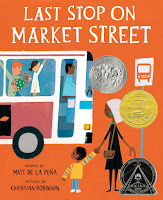 In 2008, librarians surprised everyone by choosing the 533-page, The Invention of Hugo Cabret as the winner of the Caldecott Medal honoring the "most distinguished American picture book for children." This year, the award committees surprised us again with the choice of a picture book, Last Stop on Market Street, as the winner of the Newbery Medal, given to "to the author of the most distinguished contribution to American literature for children."
The short video below featuring author, Matt de la Peña, reading from his book will convince you that this is a wonderful book.
My concern as a public librarian, however, is how best to share this book with kids. The book is a little lengthy for my usual storytime crowd, and school-aged kids can seldom be convinced to check out a picture book. It's in instances like these, that I envy school teachers and media specialists, who have such a wonderful opportunity to share great books with large numbers of kids. This is perfect book for reading aloud in school.
But, how to share it in a public library setting?
Last week, I had a last-minute inspiration and it was a rewarding experience. I have a small book club that meets every month. This month, I asked each of the kids to read Last Stop on Market Street - right then. In addition to positive comments about the book, I loved two of the observations that they reported:
- I never would have chosen this book if you didn't hand it to me.
- The people at the soup kitchen look like regular people.
We then discussed public transportation (none of the kids had ever been on a bus) and soup kitchens (none had ever been to one). Working in a suburban library with poor public transportation, I can understand this. However, as a suburban parent, I can tell you that I made sure that my own children volunteered at the local food pantry and experienced public transportation (I made all of them ride the public bus with me to the mall even though it was more expensive than driving my minivan and took twice as long). As a suburban librarian, I can't take kids on the public bus or to the soup kitchen, but at minimum, I've ensured that a few more children are now aware of the lives that others lead.This is one of the many things that makes my job worthwhile.
One of the missions of the
#WeNeedDiverseBooks (TM) campaign is to make sure that "all children can see themselves in the pages of a book." This is important, but also important is recognizing that all people are just "regular people." We always have more in common than we think.
Last Stop on Market Street by
Matt de la Peña, Illustrated by
Christian RobinsonRead it. Share it.
**Winner of the 2016 Newbery Medal
**A 2016 Caldecott Honor Book
**A 2016 Coretta Scott King Illustrator Honor Book
A New York Times Bestseller
Four Starred Reviews
Finalist for the 2014 E.B. White Read-aloud Book Award
A Junior Library Guild Selection

By: Shelf-employed,
on 12/23/2015
Blog:
Shelf-employed
(
Login to Add to MyJacketFlap)
JacketFlap tags:
YA,
adult,
favorites,
J,
E,
Add a tag
It's the end of the year and I had great plans of writing about all my favorite books of the year - there were so many! But there was also ALSC committee work, my fledgling freelance writing career, that five days a week thing they call work, and my family. As I write this, I'm waiting for the last of my children to arrive home for the holidays (one's flight was canceled, the other one's delayed).
So, for now, the best that I can do is this:
In middle grade fiction, I loved
Echo: A Novel by Pam Muñoz Ryan. Here's a link to my review:
http://shelf-employed.blogspot.com/2015/02/echo-novel-review.html In picture books,
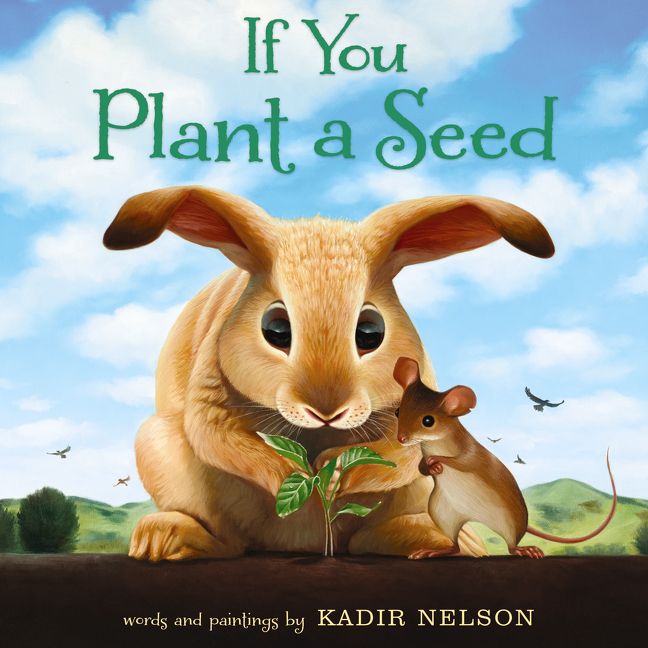
If You Plant a Seed by Kadir Nelson is simply perfect. My review is here:
http://shelf-employed.blogspot.com/2015/03/picture-book-roundup-new-or-coming-soon.htmlI listened to lots of great audiobooks, but I think
Me and Earl and the Dying Girl was tops. I reviewed it for
AudioFile Magazine. Here's the link:
http://www.audiofilemagazine.com/reviews/read/101740/ (
Diary of a Mad Brownie is a very close second!)
For the best in dealing with sad news, I was taken by Anastasia Higginbotham's,
Divorce is the Worst (for school-aged kids), and Todd Parr's,
The Goodbye Book for little ones dealing with loss.
In adult books, it was
Lafayette in the Somewhat United States by Sarah Vowell
. It's no surprise. I love everything she writes. I love my well-researched history with a humorous dose of irony and sarcasm.
Whether I review a book or not, if I've read it, I log it and star it in
LibraryThing. Yes, I know that Goodreads is more popular, but LibraryThing's aesthetic matches mine. I'm comfortable there. You can see my virtual library of over 1600 searchable books and 800 reviews on
LibraryThing.
I may take the next week off, perhaps not, but just in case - best wishes for a safe and happy holidays.

Each year, hundreds of new holiday books are printed. Many are trite, forced, or pedantic—but not these gems. Here are my five new favorites. Readjoice!
If you have trouble viewing the slideshow, visit it on
Riffle. Featured books:
- A Homemade Together Christmas
- Oskar and the Eight Blessings
- Me and My Dragon: Christmas Spirit
- Too Many Toys!
- Miracle on 133rd Street

By: Shelf-employed,
on 10/7/2015
Blog:
Shelf-employed
(
Login to Add to MyJacketFlap)
JacketFlap tags:
books,
book review,
dogs,
funny,
easy reader,
farm animals,
metafiction,
E,
Advance Reader Copy,
nocturnal animals,
picture book roundup,
Add a tag
This edition of the Picture Book Roundup features three funny books, a hilarious cautionary tale, and a sweet bookish story to melt your heart. Enjoy!
Review copies of
Night Animals by Gianna Marino (Viking, 2015) and
In! Over! and On! by Ethan Long (Penguin, 2015) were provided by the publishers at my request.
The Good Little Book by Kyo Maclear (Tundra, 2015),
Everyone Loves Bacon by Kelly DiPucchio (Farrar, Straus, & Giroux, 2015), and
Ragweed's Farm Dog Handbook by Anne Vittur Kennedy (Candlewick, 2015)
If you can't access the slide show with reviews below, you can see it on RiffleBooks at this link. [
https://read.rifflebooks.com/list/185319]

The Death Knell for Show-and-Tell
For
Library Card Sign-Up Month, I visit every Kindergarten class in town. I talk about all the great reasons to have a library card, drop off applications for each student, and read a book - preferably a funny one. Because I visit at least 12 different classrooms, I usually bring an assortment of books so I don't get bored reading the same one in each class.
If You Ever Want to Bring an Alligator to School, Don't (2015, Little, Brown) is a new book that I find hilarious. A little girl brings her alligator to school for show-and-tell, and all havoc breaks loose. I thought it would bring some giggles to Kindergarten kids. At my first visit, I asked the teacher if the kids had begun show-and-tell yet. I wanted to make sure they would get the joke. I was told that the new, more rigorous Kindergarten curriculum did not allow the time necessary for the rather lengthy process of show-and-tell. The teacher suggested that the book would be best shared with preschoolers as they are the only ones with time for show-and-tell. How sad.
This isn't an individual teacher's decision, it is a by-product of strict, standards-based education. I get it. I truly do, but I am glad that I am not a child today. Today's body of knowledge is so much greater than it was when I was in school, and the process of educating children has moved to a business-like model. These factors combine to remove much of the joy of early learning - free play, music, art, and show-and-tell.
If you're a parent or librarian or teacher with a few minutes of free time, spread some joy wherever you can. Life is hard - even in Kindergarten.

Each year, I try to do something new for Hispanic Heritage Month at the library.
This year, I fell in love with Susan Middleton Elya's, Little Roja Riding Hood (Putnam, 2014), so I based a program around that title. We had a fun time retelling the classic story as we knew it, recreating it with felt board pieces, reading Susan Middleton Elya's version, using the globe to find Spanish-speaking countries, playing a game of Color, Colorcito, and finally some free play with the felt board pieces and a rojo coloring page.
Below is a slide show with reviews of other bilingual favorites that I've used for storytime. I also have a list of fun preschool songs, music, and activities for Hispanic Heritage Month. Feel free to ask me about them. If you have trouble seeing the slideshow, you can access it on Riffle. [https://read.rifflebooks.com/list/181065]

 Bee Dance by Rick Chrustowski(Henry Holt, 2015)
Suitable for sharing with a story time group, Bee Dance is presented as a conversational entreaty to bees,
Waggle faster, honeybee! Buzz louder! Your dance points the way to the prairie."
Bee Dance is lyrical nonfiction with large, bright, cut-paper illustrations. An author's note contains additional facts and the author's source material.- You can watch an actual "waggle dance" below.
It's STEM Friday! (STEM is Science, Technology, Engineering, and Mathematics)

I think I am predisposed to like anything done by Gianna Marino, so I requested an Advance Reader Copy of Night Animals, which is on shelves now. I was not disappointed.
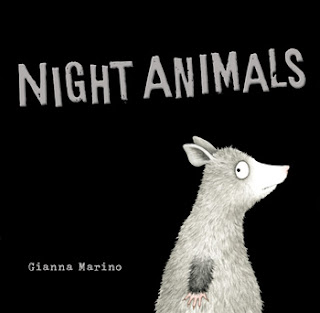
Marino, Gianna. 2015.
Night Animals. New York: Viking.
Full bleed illustrations let the night sky offer an expansive and inky stage for highlighting a comical group of nocturnal animals that are afraid of noises in the night. The large illustrations clearly detail the animals' antics, wide-eyed fear, and varying reactions to things that go "aaaarrrrooo!" in the night. The skunk is often depicted with a noxious greenish cloud behind him (much to the dismay of Possum), while the possum (appropriately) plays dead,
"I'm not here."
Minimal text is presented in cartoon-style word bubbles,
"What are we hiding from?" "Night animals! Now keep QUIET!"
Bear, Wolf, Skunk and Possum run from the "night animals." It takes a bat to tell them the
real danger in the nighttime forest.
Night Animals will tickle the funny bone of any young child. This is a perfect book for sharing with a group. Possum is hilarious!

School will be starting before you know it!
Here are some new books that feature the first day of school.
(if you cannot access the slide show, reviews are below)
- First Grade, Here I Come! by Tony Johnston
A playfully rambunctious boy plans his first day of first grade, "For show-and-tell, no teddy bears. I'll bring my snake - oh joy! My friends will hold my boa up. (I call him Huggy Boy.)" For this scene, the playful illustrations show the teacher standing atop her desk while the kids hoist Huggy Boy. Cheerful, silly fun!
- Bob and Flo by Rebecca Ashdown
It's Flo's first day at preschool. Not only does she find her missing bucket, she finds a friend. Cute.
- ABC School's for Me! by Susan B. Katz
"Eating snack around the rug, Friends who share a hello hug." A cute, rhyming, and encouraging ABC book. Dad's First Day Mike Wohnoutka Here's a twist on "first day of school" books - it's Oliver's dad who has the first day of school jitters! (Picture Oliver's teacher carrying Oliver's crying dad outside.) "The teacher walked Oliver's dad outside." "Bye, Daddy!" But don't worry ... it all turns out OK.
- Monkey: Not Ready for Kindergarten by Marc Brown
In crayon-inspired illustrations, Marc Brown tells the story of a monkey worried about his first day at school. "What if his teacher doesn't like him? What if he gets on the wrong bus? What if he can't find the bathroom? ..." With time and patient help from his parents and friends, Monkey slowly gets ready for Kindergarten.
- Rosie Goes to Preschool by Karen Katz
Rosie's not worried about her first day of preschool. In fact, she'll tell you all about it! Happy, simple, and multicultural - this is a classic Karen Katz book.
- Not This Bear: A First Day of School Story by Alyssa Satin Capucilli
In this story of a bear's first day at school, author Alyssa Satin Capucilli shows that going to school does not mean giving up one's individuality. Bear clings to some familiar things and habits from home, but still fits in and enjoys himself at school. An interesting and reassuring take on "first day at school" books.
- Ally-saurus & the First Day of School by Richard Torrey
Is there room for a dinosaur girl in a school filled with princess girls? Of course there is! "Taking off her favorite dinosaur pajamas, Ally-saurus dressed in her brand-new first-day-of-school outfit. "Your pants are on backward," said Father. "That's so my dinosaur tail can stick out," explained Ally-saurus. Let's wear our pants the right way," said Father. "ROAR!" said Ally-saurus."
- Eva and Sadie and the Best Classroom EVER! by Jeff Cohen
Big sister Sadie tries to help Eva get ready for Kindergarten - but teaching her math and reading may not be the best way to help!

Enjoy a slide show version of this month's picture book roundup - a sampling of my new favorites!
If the slide show doesn't work for you, I've listed the books below with links to my reviews on
LibraryThing.

Welcome to the final stop on the
Barbara Bottner blog tour for her latest book,
Fiona has spent the day at the beach and now it's time for bed.
"Time to say good night," said Mama.
"I'm not ready!" said Fiona.
"You've had a long day. You must be tired, from your head to your toes," said Mama.
"Maybe just a little tired...."
This may be a bedtime story, but Maggie Smith's bright illustrations are richly colored and full of life.
"Toes, go to sleep!" said Fiona.
Toes were for gripping flip-flops on the way to the beach.
Toes were easy. They went right to sleep."
The illustrations feature bright and bold depictions of Fiona's earlier daytime activities, while the pajama clad Fiona is contrasted in a smaller inset box, growing wearier with each page until she is finally and peacefully asleep against a backdrop of evening blue. Feet, Go to Sleep is an attractive combination of enjoyable and practical.
Although I was traveling, and did not have time to submit interview questions to author Barbara Bottner, she was kind enough to answer one question for me. As a Jersey Shore gal, I was curious if
Feet, Go to Sleep is based on any particular beach - perhaps one of Ms. Bottner's favorites. Bottner enjoyed frequenting Jones Beach on Long Island as a teenager, however, the location of Fiona's activities are not based on any specific beach, In fact, the book's location was added after the first draft. I have actually (succesfully) used the relaxation technique in
Feet, Go to Sleep many times
, although I've never needed it after a day at the beach. For me, a day at the beach is a relaxation technique in itself. Ah, that salt air!
Previous stops on the blog tour include:Feet, Go to Sleep by Barbara Bottner
Blog Tour Schedule
My copy of
Feet, Go to Sleep was provided by the publisher.

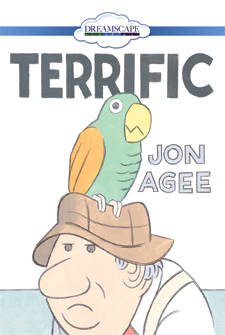
Below is my review of Jon Agee's Terrific as it appeared in the April 1, 2015 issue of School Library Journal. The review was slightly edited from my original. I didn't refer to Eugene as "the boy." Eugene is definitely not a boy, as you can see by the cover illustration. ;)
AGEE, JON. Terrific. 1 CD. 7 min. Dreamscape. 2014. $14.99. ISBN
9781633795112.
PreK-Gr 2--Eugene's life follows Murphy's Law--if something can go wrong, it will. And when inevitable misfortune falls, Eugene's favorite expression is a sarcastic, "Terrific." So, it's no surprise that when
the boy's Eugene's cruise ship sinks, all the passengers (except Eugene) are rescued, and he finds himself on a deserted island with a talking parrot. "Terrific," says Eugene. Narrator Kirby Heyborne plays the resigned, older, and long-suffering Eugene perfectly with a mix of sarcasm and fatigue, and creates a suitably squawking voice for the take-charge parrot who will change his attitude. Sound effects including boat horns, construction din, and ocean waves complement the story. Though listeners will miss Agee's humorous illustrations, the CD includes a fun musical version of "Terrific," sung by Heyborne with music by the Promise Makers. The lyrics are slightly modified from the text to fit the upbeat rhythm and rhyme scheme of the song, but stay true to the original story. VERDICT Purchase this one for sharing with school or storytime groups, one with a copy of the print book.--
Copyright © 2015 Library Journals, LLC, a wholly owned subsidiary of Media Source, Inc.
Reprinted with permission.
Listen to an excerpt from Terrific here.
By: Shelf-employed,
on 3/29/2015
Blog:
Shelf-employed
(
Login to Add to MyJacketFlap)
JacketFlap tags:
wolves,
E,
picture book roundup,
libraries,
books,
book review,
funny,
wordless,
rabbits,
Add a tag
Here are two new funny additions to add to my earlier post, Picture Book Roundup - new or coming soon!
We were reading these at work the other night. All you could hear were laughs, chuckles, and "awww"s.
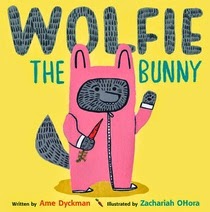
- Dyckman, Ame. 2015. Wolfie the Bunny. New York: Little Brown. Illustrated by Zacharia OHora.
This one had all the library staff laughing! Wolfie is the cutest little wolf in a bunny suit, but the star of this story is his sister, Dot. Doesn't
anyone else realize that a wolf does not make a good brother for a bunny? Every time I read it, I find something else amusing in the illustrations. See you at the Carrot Patch Co-op! (Bring your own shopping bag.)
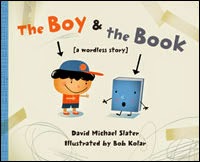
- Slater, David Michael. 2015. The Boy & the Book. Watertown, MA: Charlesbridge. Illustrated by Bob Kolar.
This wordless book about a book and a "rough-and-tumble" little boy will crack you up and then make you say "Awww!" It's sure to become a librarian favorite. You'll love the blue book (but "read" them all!)
Musing for the day: How does one become a wordless picture book author? ;)

By: Shelf-employed,
on 3/16/2015
Blog:
Shelf-employed
(
Login to Add to MyJacketFlap)
JacketFlap tags:
birds,
vampires,
dogs,
favorites,
funny,
toddlers,
kindness,
rabbits,
hamsters,
farms,
E,
space travel,
Advance Reader Copy,
Add a tag
This edition of the Picture Book Roundup features "jampires" (!), two Stanleys (one dog, one hamster), and a new Kadir Nelson book for which I can't find enough superlatives. Enjoy!
If you can't see the slideshow, I've included my reviews below.
If You Plant a Seed is a brilliantly written and exquisitely illustrated book about kindness. Sparse but meaningful text, combined with joyfully detailed illustrations of plants, birds, and animals. I love it!
- MacIntyre, Sarah and David O'Connell. 2015. Jampires. New York: David Fickling (Scholastic)
Who could be sucking all the jamminess out of the doughnuts? Jampires! Will Sam find jam? Will the Jampires find their nest? If you like funny, this is the best!
- Bee, William. 2015. Stanley the Farmer. New York: Peachtree.
Stanley is a hardworking hamster. Illustrations and text are bright and simple, making Stanley a perfect choice for very young listeners. Along the lines of Maisy, but with a crisper, cleaner interface. Nice size, sturdy construction.
The Wimbledons can't sleep. What IS all that noise? It's only Stanley, the dog. He's howling at the moon, fixing the oil tank, making catfish stew, ...? Hey, something's fishy here! Classic Jon Agee - droll humor at its best.
Review copies of
Jampires,
Stanley the Farmer, and
It's Only Stanley were provided by the publisher.

As I've mentioned before, I had the great honor and opportunity to serve again as a second round judge on the Elementary/Middle Grade Nonfiction book award panel for the Cybils Awards. If you're not familiar with the Cybils awards, they are the Children and Young Adult Bloggers' Literary Awards.
Our judging panel chose the following as the 2014 Cybils Award winner for best Elementary/Middle Grade Nonfiction book:
The judging panel's description:
Using child-friendly similes, Feathers shows that there is both beauty and purpose in nature and that, although we do not fly, we have many things in common with birds, such as the need to be safe, attractive, industrious, communicative, and well-fed. The simple, large text is suitable for reading to very young children, while the inset boxes contain more details for school-aged kids. The scrapbook-style watercolor illustrations show each feather at life size, and provide a nice jumping-off point for individual projects. Science, art, and prose work together to make this the perfect book to share with budding young artists, painters, naturalists, and scientists, and it will be appreciated by parents, teachers, and kids.
Melissa Stewart's website offers teaching resources and activities to go along with Feathers.

By: Shelf-employed,
on 2/13/2015
Blog:
Shelf-employed
(
Login to Add to MyJacketFlap)
JacketFlap tags:
space,
scientists,
astronomy,
picture books for older readers,
bio,
E,
STEM,
Carl Sagan,
STEM Friday,
book review,
science,
Add a tag
Sisson, Stephanie Roth. 2014. Star Stuff: Carl Sagan and the mysteries of the cosmos. New York: Roaring Brook.
In simple text augmented by word bubbles, thought bubbles, and sketches, Stephanie Roth Sisson gives us the highlights of Carl Sagan's life
—but more importantly, she offers a sense of his wondrous enthusiasm for the cosmos,
It gave Carl goose bumps to think about what he had learned about the stars, planets, and the beginnings of life. He wanted everyone to understand so that they could feel like a part of the stars as he did.
So he went on television.
This is the first book that Stephanie Roth Sisson has both written and illustrated. The fact that she is enthralled with her subject is apparent in the artwork. Painted cartoon images (often in panels with word bubbles), depict a happy Sagan, wide-eyed and curious. While some pages are like panel comics, others are full-bleed, double spreads depicting the vastness of the darkened skies, dotted by planets or stars. One foldout opens vertically, reminding us of our infinitesimal existence in the cosmos. We are so small, yet we are reminded,
The Earth and every living thing are made of star stuff.
Star Stuff is a 2015
NCTE Orbis Pictus Award Honor book for "outstanding nonfiction for children."
Substantial back matter includes Author's Note, Notes, Bibliography and Sources, Special Thanks, and Source Notes.
Preview the first eight pages of Star Stuff on the publisher's website.Note: Carl Sagan graduated from Rahway High School in Rahway, NJ. As far as I can tell, he's not mentioned anywhere on the school's website. Pity.
It's STEM Friday! (STEM is Science, Technology, Engineering, and Mathematics)

By: Shelf-employed,
on 1/26/2015
Blog:
Shelf-employed
(
Login to Add to MyJacketFlap)
JacketFlap tags:
inventions,
inventors,
E,
picture book roundup,
book reviews,
fairy tale,
nonfiction,
snow,
weather,
rain,
toddlers,
Add a tag
Some new picture book favorites! A fairytale, a toddler book, and poetic nonfiction. Enjoy!
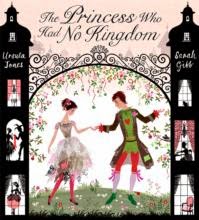
A beautiful princess, a pony, a red umbrella and red tights. This is the girls' empowerment fairytale that you've always wanted. Be who you are; love who you are. If the illustrations in this one do not enchant you, you have no magic in your soul. (So glad that this one made the leap across the pond!)
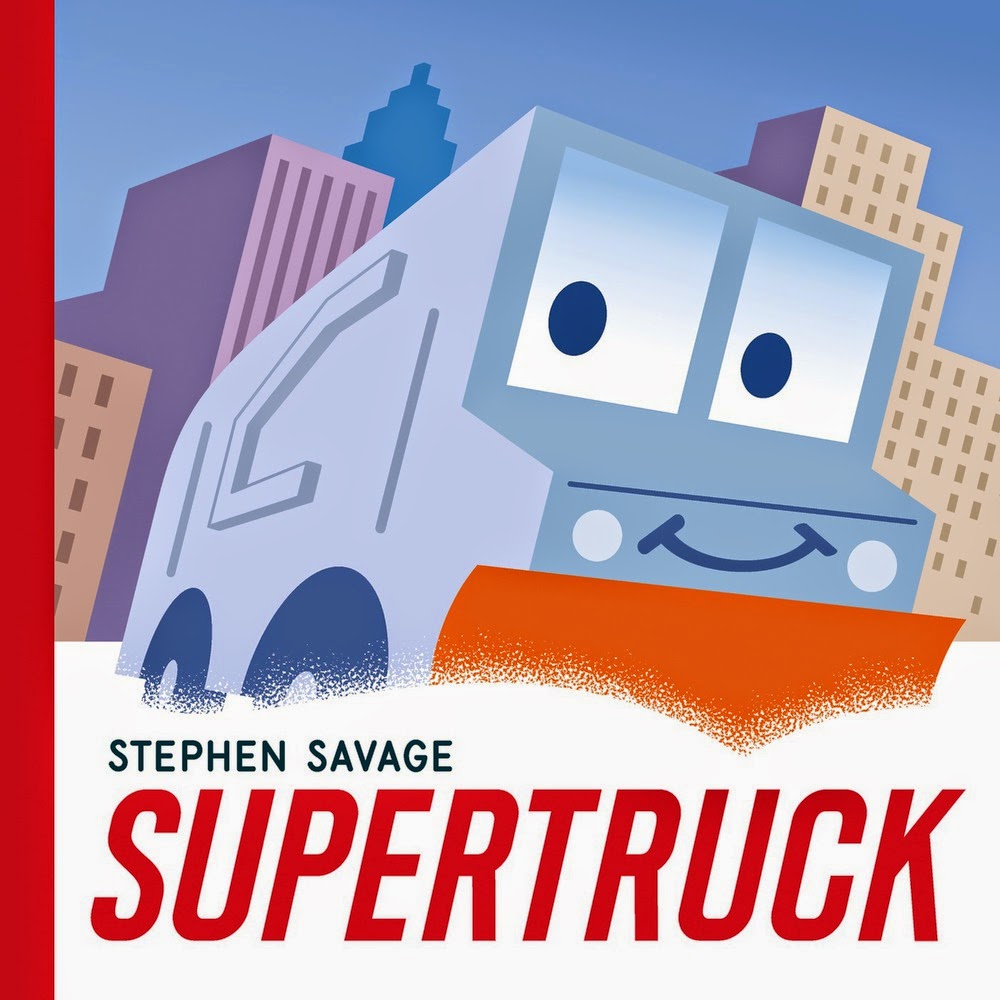
While tow truck and fire truck are out performing rescues, mild-mannered and bespectacled garbage truck "just collects the trash." It takes a snowstorm and an attachable snow plow to turn him into Supertruck! Simply told and simply illustrated for a young audience, this is a story of doing your job simply because it's the job that needs to be done. I like it!
Note: Despite its snowstorm theme, this one should be popular for the 2015, "Every Hero Tells a Story" summer reading theme.
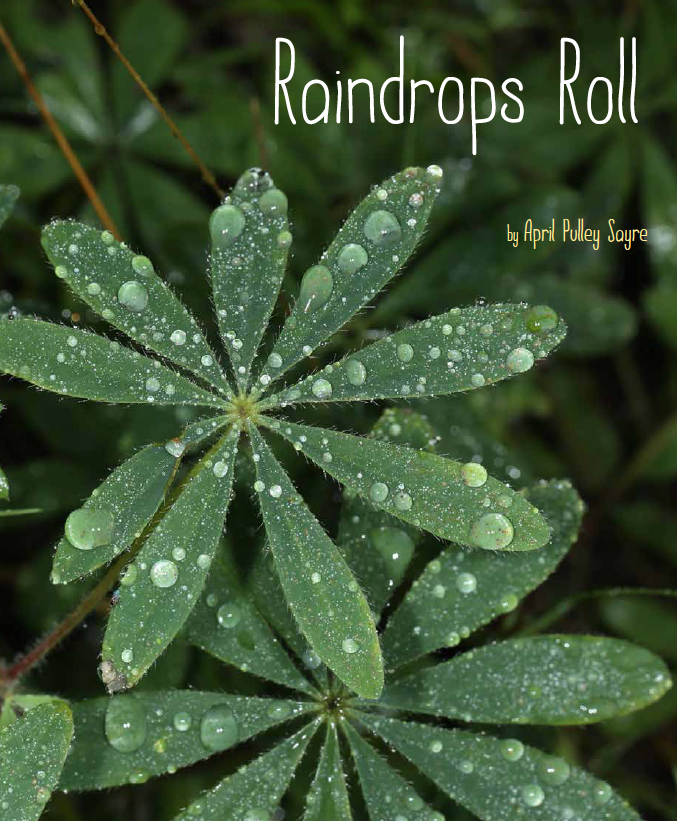
A beautifully photographed, poetic look at rain - what it does and where it lands and how we see it. Simple, gorgeous science,
It thuds.
Makes mud.
It fills.
It spills.

I've been goofing off for a few weeks, enjoying some family time while my oldest were home from college for the holidays. Now it's time to get back to business.
Roses are red.
Violets are blue.
Here is advice
I offer you:
Winter is dark;
Weather is drear.
But story time kids
always bring cheer.
Valentine's Day -
and books will delight.
One happy child
can banish the night.
© L Taylor
I tried something new today. I put my favorite, rhyming Valentine's Day books for story time in a
Riffle list that should allow for scrolling. I'll put my favorite Valentine's Day rhymes and songs below. Enjoy!
"A Kiss" (a fingerplay, prop story, felt board, or song)
There's something in my pocket,
Could it be a moose?
Could it be a train with a bell and a caboose?
Could it be a snake or some sticky glue?
Right here in my pocket is a KISS from me to you! (blow kiss)
I have a photo of a moose glued to a popsicle stick, a train whistle, a bell, a plastic, jointed snake, and glue. I pull them all out at the appropriate times.
Credit: King County Library SystemA Valentine fingerplay:
Show children how to put the "heels" of their palms together and then curve fingers around , meeting on top to form a heart. The rhyme goes like this:
"I put my hands together,
this is how I start;
I curve my fingers right around
and I can make a Heart!"
Credit: Everything Preschool"Skidamarink" or "Skinnamarink"You can find this favorite online if you don't already know it.

By: Shelf-employed,
on 11/24/2014
Blog:
Shelf-employed
(
Login to Add to MyJacketFlap)
JacketFlap tags:
music,
memoir,
nonfiction,
J,
musicians,
picture books for older readers,
E,
digital audiobook,
Keith Richards,
Add a tag
 Richards, Keith. 2014. Gus & Me: The Story of my Granddad and my First Guitar. Hachette Audio.
Keith Richards, the rough-edged, raspy-voiced, Rolling Stones guitarist, is hardly the man that comes to mind for a picture book writer and narrator, but then again, who better to tell the story of his first guitar?
Richards wins the listener over immediately with his folksy, working class Estuary English accent (think dropped h's and "intrusive" r's) and unmistakable fondness for his topics - his first guitar and his beloved Granddad, Gus. It was the musically talented Gus who introduced a young Keith Richards to the guitar, teaching him how to 'old it, and suggesting the classical Malagueña(r) as the pinnacle of guitar mastery.
I have yet to see the print version of this story, but I don't believe it could surpass the audio book. A story with music at its heart needs music to be understood. Richards plays bits from Malagueña in appropriate spots throughout the story, and during a visit to a music shop in London, we hear Steve Jordan on drums. Once, the listener even hears a little chuckle - not musical, but surprisingly sincere. Richards collaborated with other authors, but this is obviously his story, and he delights in telling it.
(Run time: about 7 minutes)
My review of Gus & Me for AudioFile Magazine appears here with a small excerpt. Take a listen!
 |
|

By: Shelf-employed,
on 10/17/2014
Blog:
Shelf-employed
(
Login to Add to MyJacketFlap)
JacketFlap tags:
E,
engineering,
STEM,
Ferris,
STEM Friday,
book review,
nonfiction,
Chicago,
J,
Add a tag
 Davis, Kathryn Gibbs. 2014. Mr. Ferris and his Wheel. New York: Houghton Mifflin Harcourt. Illustrated by Gilbert Ford.
Though written in a fully illustrated, engaging and narrative nonfiction style, Mr. Ferris and his Wheel is nevertheless, a well-sourced and researched picture book for older readers.
The story of the 1863, Chicago World's Fair debut of the world's first Ferris wheel (or Monster Wheel, as Mr. Ferris originally named it), is told in a flowing and entertaining style,
George arrived in Chicago and made his case to the construction chief of the fair.
The chief stared at George's drawings. No one had ever created a fair attraction that huge and complicated. The chief told George that his structure was "so flimsy it would collapse."
George had heard enough. He rolled up his drawings and said, "You are an architect, sir. I am an engineer."
George knew something the chief did not. His invention would be delicate-looking and strong. It would be both stronger and lighter than the Eiffel Tower because it would be built with an amazing new metal—steel.
and
it contains sidebars that impart more technical information that might otherwise interrupt the flow of the story,
George was a steel expert, and his structure would be made of a steel alloy. Alloys combine a super-strong mix of a hard metal with two or more chemical elements.
George Ferris' determination is a story in itself, but it is the engineering genius of his wheel that steals the show. A "must-have" for any school or public library.
Some facts about the original "Ferris" wheel:
- 834' in circumference
- 265' above the ground
- 3,000 electric lightbulbs (this itself was a marvel in 1893!)
- forty velvet seats per car
 |
Ferris wheel at the Chicago World's Fair c1893.
Rights Advisory: No known restrictions on publication.
Library of Congress Prints and Photographs Division[/caption] |
It's STEM Friday! (STEM is Science, Technology, Engineering, and Mathematics)

Copyright © 2014
L Taylor All Rights Reserved.

View Next 25 Posts



 If you're on Twitter: In honor of Father's Day, Barnes and Noble @bnbuzz is using the hashtag #DadBooks to solicit groan-worthy puns and corny dad jokes based on well-known books. Be sure to check it out or join in the pun.
  If you're on Pinterest, check out my board, "Comic strips featuring books." I've been collecting comic strips that feature books and libraries for the last several years. If you have a good comic strip that I've missed, please feel free to send it to me and I'll pin it.