JacketFlap connects you to the work of more than 200,000 authors, illustrators, publishers and other creators of books for Children and Young Adults. The site is updated daily with information about every book, author, illustrator, and publisher in the children's / young adult book industry. Members include published authors and illustrators, librarians, agents, editors, publicists, booksellers, publishers and fans. Join now (it's free).
Login or Register for free to create your own customized page of blog posts from your favorite blogs. You can also add blogs by clicking the "Add to MyJacketFlap" links next to the blog name in each post.
Blog Posts by Tag
In the past 7 days
Blog Posts by Date
Click days in this calendar to see posts by day or month
Viewing: Blog Posts Tagged with: YA, Most Recent at Top [Help]
Results 1 - 25 of 2,018
How to use this Page
You are viewing the most recent posts tagged with the words: YA in the JacketFlap blog reader. What is a tag? Think of a tag as a keyword or category label. Tags can both help you find posts on JacketFlap.com as well as provide an easy way for you to "remember" and classify posts for later recall. Try adding a tag yourself by clicking "Add a tag" below a post's header. Scroll down through the list of Recent Posts in the left column and click on a post title that sounds interesting. You can view all posts from a specific blog by clicking the Blog name in the right column, or you can click a 'More Posts from this Blog' link in any individual post.
4 sweet frosted sugar cookies. Cover Love: Darling! I don't think they needed to add the illustration at the bottom with the car and the road, but I like the photo of the guy and girl holding hands, I wish that was bigger, more of the focus. But I know it will be eye catching on display in my library.
Why I Wanted to Read This: This came in my first book order of the fall and I was looking for something light and fun. I started this right when I pulled it out of the box! Here's the synopsis:
June wants high school to end and real life to begin. Oliver is soaking up senior year’s glory days. They could have coasted through high school, knowing about—but not really knowing—each other.
Except that their moms have arranged for Oliver to drive June to school. Every. Single. Day.
Suddenly these two opposites are fighting about music, life . . . pretty much everything. But love is unpredictable. When promises—and hearts—get broken, Oliver and June must figure out what really matters. And then fight for it.
Romance?: Yes, of course.
My Thoughts: To be perfectly honest, I almost gave up on this book. June was so closed off and judgemental and righteous in the beginning that I had a very hard time liking her. She was just so right that Oliver and his group of friends were awful and she and her group of friends were right to dislike everything and everyone. I was afraid her attitude would last too long in the book and turn me off on it completely. However, I stuck with it and her attitude didn't last too long. She started to see that there was some value in most people and while some people are exactly what they appear to be, a lot of people aren't, including some of her "non-conformist" friends.
I LOVED OLIVER. Seriously, new book boyfriend. He's such a good guy. And I know he does give off a certain type of attitude with his appearance, he's just so much more than that. He is who I would totally have crushed on in high school, especially once I got to know him!
I would like to give this book to all the girls who judge people before they can be judged, that put up that wall to protect themselves. I work in a middle school and there are A LOT of girls like this who I want to read this book, but most of them wouldn't read a romance because it's not dark enough! To Sum It Up: Darling romance that could teach people a lot about judging others before getting to know them! Book from school library collection.
0 Comments on My Thoughts: Shuffle Repeat by Jen Klein as of 10/28/2016 11:53:00 AM
This weekend is a four day weekend for schools in our state so we are going to visit my oldest son in college! I will have to be driving, though, so I won't get a lot of reading done in the car. Hopefully I will have time to read while I am away. I am in the middle of reading Scary Out There and am loving it! I am also reading Shuffle Repeat because it just came in with our latest order at school. Fingers crossed that I come back having finished both!
0 Comments on Road Trip Reading #3 as of 10/21/2016 10:23:00 AM
I am going to try and write this without naming the book or the author, just talk about the issue. I am sure that other librarians have had this issue and am wondering what they do with it.
So, we have a series in the library that is pretty popular with our readers-young and old (we have a few teachers that love it as well). The author has started a second series, which the second book for recently came out. One of our teachers was very excited to read it so she took it home over the weekend before I had it cataloged for our collection. When she came in on Monday she told me she didn't think it was appropriate for a middle school library. I kind of rolled my eyes, knowing how conservative this teacher tends to be. But, I started reading on the page she told me to and holy cow! It was such a steamy sex scene. Like, WAY above what should be in a book for a middle school. I pointed it out to the high school librarians, just to get their opinion and they both agreed it was too steamy for their libraries too. I didn't feel too bad because this was only the second book in so we hadn't invested too much money.
Then the fifth book in her more popular series came out. And again, there was a pretty steamy sex series in this book. It's like this author is writing herself out of YA! We kind of use the barometer of "would a student see this on TV." And both times we had to say NO. Not broadcast TV anyway.
So, here's my concerns. I haven't seen anything on any blog reviews that talk about this. I realize mot blogs aren't written by librarians, but nobody even mentions the sex scenes. I read a lot of YA books and I haven't ever read anything in any YA book that matches this. I have in adult books, but not YA (honestly, not even in "new adult" book, it's that steamy). I don't shy away from putting books on our shelves that has swear words or talks about sex, but this is way more than talking about sex.
I feel like I am self-censoring and I hate that, but I also feel that school libraries have to have a different standard for what goes on their shelves, especially a middle school library. And it makes me so sad because it this is the way YA books are heading I will have less of them on my shelves. I love YA books, I think is great for kids to read about issues they will soon be facing or are already facing.
(It should be noted that I have not read any of the books in either of these series, but my partner librarian has as well as a few other teachers)
What are your feelings about sexual books on school library shelves?
0 Comments on School Library Issues as of 1/1/1900
Summary: Maggie is the spoilt princess of an organ-transplant mafia family, but her life is not completely sunshine and roses. She's still struggling with her grief over her secret boyfriend's violent death, and her father is actually supporting an act of Congress that would implode their whole business model. When she accidentally opens a suspicious email and infects her computer (and by extension all the computers in the house) with nasty spyware, the only person who can help is Alejandro - and the only way he'll do it is if she pulls a few strings and gets him the kidney he so desperately needs. She agrees, never planning to keep her promise, but finds out she's not getting off the hook so easily.
First Impressions: I found Maggie supremely unlikeable in the first quarter of the book or so, but after that it improved. The ending felt very abrupt though, with some sequelitis.
Later On: Somehow I missed that this book is based on "The Frog Prince" until partway through. I think if I'd known this going in, I would have been a lot more secure in the main character and where the story was going. Yes, Maggie has it very, very rough at the start. But she still makes a promise that she never intends to keep, seemingly because it's to someone who's gross to look at. And what can you say about a character who whines about her emotional pain not being respected by a boy who is terminally ill?
If you can get past the unpleasant start, Maggie improves a lot in the course of the book. She learns to be less self-centered and comes to see the bigger picture of her family's business and where it's headed after paid organ donation is legalized. She also learns to see the human impact of what they do as well as the economic one, and works through her grief and her feeling of being stuck in a realistic way.
I worried about the portrayal of Alex, who is Latino and definitely not of Maggie's social class. For awhile there it seemed like he was going to be the Inspirational Minority or the Inspirational Sick Person. In some ways he still was, unfortunately. We got a little exposition about his family but mainly he was a guest in Maggie's world, upending her notions of the world but ultimately remaining a static character himself.
This is the second book in a series, and some of the loose threads and rushed finish can be attributed to that.
Summary: With her hometown threatened by torrential rains and a failing dam, Keeley is determined to keep everybody's spirits up, to save her town, and to ride off into the sunset with her adorably perfect crush. And no matter how many people abandon her, she's going to have her happy ending.
First Impressions: Sniff! Everyone is so screwed up and flawed and messy. It felt so realistic.
Later On: Keeley's not an easy character to like at times, but she's so very real. She's the clown, the person who keeps everybody smiling. As things like her town, her school, her childhood friendships, and even her relationship with her parents are changing, she's having a difficult time realizing that a smile and a laugh are not the right expression in all circumstances. Her slow realization that sometimes you do need to be serious, you do need to accept change, and you do need to give in to the inevitability of loss (loss of home, loss of identity, loss of friendships) is wrenching, because you see people all around her at different stages of the same journey.
The interesting thing about the love triangle was that the "other boy" wasn't wrong for her - he was wrong for her at that time. While these two class clowns could have made it in another setting, they were too much alike, trying to ignore the end of their world and laugh away the sadness.
When Keeley wants to get serious, he pulls away. That's not to say he's a bubblehead - he has his own life issues. But Vivian doesn't use these to excuse him or to bring about a happy ending for them. Keeley learns to recognize that the relationship is going nowhere and walk away on her own, without the romantic intervention of her other possibility.
I haven't read all of Vivian's books, but if they're all this thoughtful, and all her characters are this beautifully drawn, I have some catch-up to do.
4 bittersweet chocolate chip cookies. Cover Love: Yes, the image of the bike and balloon combined with the tag line "Ethan went on a bike ride. Four years later, he came back," are very striking. Good stuff!
Why I Wanted to Read This: I was in the mood for something different and I needed a book I thought I could get done quickly. I have read Jennifer Mathieu before and knew I liked her writing so I gave this a try! Here's the synopsis from GoodReads:
When Caroline's little brother is kidnapped, his subsequent rescue leads to the discovery of Ethan, a teenager who has been living with the kidnapper since he was a young child himself. In the aftermath, Caroline can't help but wonder what Ethan knows about everything that happened to her brother, who is not readjusting well to life at home. And although Ethan is desperate for a friend, he can't see Caroline without experiencing a resurgence of traumatic memories. But after the media circus surrounding the kidnappings departs from their small Texas town, both Caroline and Ethan find that they need a friend--and their best option just might be each other
Romance?: Not really, but a pretty strong friendship develops.
My Thoughts: This was a powerful book. The author wrote it from the alternating points of view of Caroline and Ethan. She did a great job with each of their voices. I can't imagine the research she must have done to write Ethan so well! I'm sure that kids coming back from that kind of trauma display all types of behavior and the way she wrote Ethan seems so real and true. His chapters were particularly moving and engaging.
And Caroline was every bit as messed up because she blamed herself for Dylan's abduction. Although Dylan wasn't gone nearly as long as Ethan, because he was autistic his recovery was very stalled. That was one of the most interesting contrasts in the book: Ethan's parents had money to get him (and them) help, Caroline's family did not. However, Caroline's mom also kind of wanted to act like it didn't happened, which didn't help anyone in their family.
I liked how Ethan's flashbacks were handled. Even though the what happened to Ethan was totally disturbing, the author leaves it to our imaginations. She isn't graphic with his memories, what comes back to him truly is what he can handle in his recovery. However, it's very clear the kind of abuse and trauma he had to deal with during his four years. It was just so well done.
I loved how the book ended, there was hope for both Caroline and Ethan and their families. It was a good ending and really the best one for this story.
To Sum Up: This would be a powerful read for many ages. I am going to get it for my library because it gives students a glimpse into stuff that is very real, but rare. Just the kind of book I loved to read when I was a young teen!
Book requested and sent from Macmillan for review.
0 Comments on My Thoughts: Afterward by Jennifer Mathieu as of 10/4/2016 1:24:00 PM
Title:Nightstruck Author: Jenna Black Published: 2016 Source: Edelweiss
Summary: When Becket follows a baby's cry into a dark alley, she unwittingly looses demons on Philadelphia. Things get grimmer and grimmer for her and for her city until finally her own best friend is within their grasp. Is it possible Becket is the only one who can end this?
First Impressions: Why do I keep requesting horror books. Whyyyyyy. And the ending was a pointless cliffhanger.
Later On: This started very promisingly, but Beckett spent most of the book in a puddle of helplessness, punctuated by moments of horrific gore. And the pointless cliffhanger ending just made me furious, since we arrived at the cliff because Becket was so busy dithering. Still, if you love blood-splashing horror, you might as well give this a try.
Sara Sargent is an executive editor at HarperCollins Children's Books. She's published Deb Caletti, Jennifer Echols, Julie Cross, Aaron Karo and Martina Boone, and she acquires everything from picture books through young adult.
YA editors are wondering what's next when it comes to trends. Books that are hitting shelves today were acquired 12 to 24 months ago. It's true that you shouldn't write to trends. Today's trends will be over when your book comes out. Also, books that aren't written from the heart won't be as good.
"My list is only as good as the books you write."
Sara started at HC a year ago to develop books teens really want to read. She wanted to know what made teens tick, and what drives their purchasing habits. "What could I do to make sure the books I was publishing today reflected the teens of today?"
Publishers were publishing books for millennials and Gen Z—the one that follows millennials. Here's some marketing data:
First generation to be majority nonwhite
Average attention span is 8 seconds
They use on average five devices (phone, laptop, desktop, tv, table)
More tolerable of gender diversity than previous generations
It's good to research teens to understand what they want. There are a number of things to research: their music, their pop culture interests, their ideas about sex and identity, what they worry about, what their school lives are like (among many other things).
What makes her reject a manuscript?
One that feels like it's a book the authors are writing for the teens they were. You need to make it your business to know what would make a teen want to buy it.
Immerse yourself in teen culture. Watch a lot of YouTube. See what kids are watching. Read advertising industry articles. Subscribe to the AdWeek emails—they have lots of interesting articles on the topics. Download apps. Books are competing with other media for attention, and it's important to know your competition.
She creates separate social media accounts she uses to follow people. You can use it just for work to follow celebrities and such. See what they're talking about and how they're galvanizing their fans.
"We need to cozy up to our audience. We need to understand and know them, and—dare I say—love them."
What does cutting edge mean?
Among other things: Something that pushes the envelope as a taboo, something that experiments with form, something that makes adults uncomfortable, one that turns traditional relationships upside-down, one that portrays a broader set of experiences. "Innovative and pioneering. Those are great words."
Rethink storylines. Surprise her. "I know I'm reading something cutting edge when I can feel my brain carving a new path, rather than going on autopilot."
Something innovative builds on the pre-existing canon. "Read, read, and read some more."
You want to find a new way to express something universal.
5 yummy chocolate chip cookies. Cover Love: This one is ok. It's not my favorite, but I do love the colors.
Why I Wanted to Read This: I just loved the concept--descendants of Sherlock Holmes and John Watson in a modern day boarding school. I just couldn't wait to give it a try! Here's the synopsis from GoodReads:
The last thing Jamie Watson wants is a rugby scholarship to Sherringford, a Connecticut prep school just an hour away from his estranged father. But that’s not the only complication: Sherringford is also home to Charlotte Holmes, the famous detective’s great-great-great-granddaughter, who has inherited not only Sherlock’s genius but also his volatile temperament. From everything Jamie has heard about Charlotte, it seems safer to admire her from afar.
From the moment they meet, there’s a tense energy between them, and they seem more destined to be rivals than anything else. But when a Sherringford student dies under suspicious circumstances, ripped straight from the most terrifying of the Sherlock Holmes stories, Jamie can no longer afford to keep his distance. Jamie and Charlotte are being framed for murder, and only Charlotte can clear their names. But danger is mounting and nowhere is safe—and the only people they can trust are each other.
Romance?: A little.
My Thoughts: I love this world--one that actually had Watson and Holmes. One that has descendants of both of them. Jamie Watson had daydreams about meeting up with Charlotte from the time he was young and realized that there was a Holmes his age in the world. When they finally meet up at an American boarding school it's not a match made in heaven. A murder at the school brings them together especially when it looks like they are being framed. They start working together and the rest goes down in Holmes/Watson history!
This author nailed Holmes personality in Charlotte, but she also gave her a little vulnerability. This book is written from Watson's point of view, which the author also nails. She did her homework. The murders all have elements of cases from famous Sherlock Holmes/John Watson which is what brings Charlotte and Jamie together. They work on finding the culprit, but in true Holmes fashion, Charlotte only tells Jamie the barest minimum of what he needs to know. She makes him figure a lot out on his own.
While there isn't a romance, Jamie definitely has a crush on Charlotte, but it's born of respect, not lust. I just loved the dynamics between these two. The mystery is also strong, I didn't have it figured out at all. There were a lot of twists and turns.
To Sum Up: This was a really fun read and I look forward to the next two books in this trilogy. Because of some mature subject materials I will be book talking this one for my older readers this fall.
0 Comments on My Thoughts: A Study in Charlotte by Brittany Cavallaro as of 7/13/2016 4:59:00 AM
This weekend we are driving three hours away to watch our son play in a senior showcase soccer game. It will be a down and back in one day trip and my husband is driving, which means I am going to be reading!
What are you reading this weekend?
0 Comments on Road Trip Reading #2 & Weekend Reading #10 as of 7/13/2016 4:55:00 AM
Cover Love: Yes, I love this cover. I love that it looks like a summer camp and that each picture is a couple from the story. I love these short story collections!
Why I Wanted to Read This: I LOVED My True Love Gave to Me, which was a short story anthology of holiday romance stories. I was very excited when I saw that this one was coming out and super excited to read it. Here is the synopsis from GoodReads:
Maybe it's the long, lazy days, or maybe it's the heat making everyone a little bit crazy. Whatever the reason, summer is the perfect time for love to bloom. Summer Days & Summer Nights: Twelve Love Stories, written by twelve bestselling young adult writers and edited by the international bestselling author Stephanie Perkins, will have you dreaming of sunset strolls by the lake. So set out your beach chair and grab your sunglasses. You have twelve reasons this summer to soak up the sun and fall in love.
Romance?: Of course!
My Thoughts: I didn't love this book as well as My True Love Gave to Me. These stories weren't bad, but they didn't have the same feel to me as the holiday stories. I can't put my finger on it, but I just didn't love it. My favorite story was the one by Cassandra Clare, Brand New Attraction. I liked Leigh Bardugo also, Head, Scales, Tongue, Tail. Both of these had a supernatural element, which made them fun to read. (Actually, a lot of these stories had supernatural elements).
I read Souvenirs by Tim Ferdle around the same time my oldest son (who just graduated from high school) was deciding to break up with his long term girlfriend. There were a couple lines in that story I quoted to him because it was hard on both him and her when they broke up. I don't think the lines helped them, but I felt they were perfect for the situation.
I also liked that there were stories by authors I have never read yet. That's one thing I really like about these new anthologies.
This book just didn't give me quite the same feeling as the holiday stories book. I didn't get that feeling of being young and in love and in the summertime that I was hoping for. But, I know that these stories will be very popular with younger readers who will get that feeling.
To Sum Up: I will be buying this for my library and encouraging the girls looking for something a little different to give this one a try!
0 Comments on My Thoughts: Summer Days and Summer Nights edited by Stephanie Perkins as of 7/11/2016 7:27:00 AM
Title: The Memory of Light Author: Francisco X Stork Published: 2016 Source: Edelweiss
Summary: After a suicide attempt, Victoria lands in a mental hospital. As she reluctantly returns to life, and then starts to pursue it with more energy, she finds herself drawn to other teenage patients, all the with their own problems, and starts to accept that she's not weak, a failure, or oversensitive - she has a disease.
First Impressions: Lovely and quiet examination of recovery and mental illness. I would like to read some perspective on this book's attitude toward medication.
Later On: Somebody I follow on twitter will often post that depression is a liar, and the biggest lie it can tell you is that you're not depressed. The biggest lie that Victoria has to fight is that she has no right to be depressed. She spends a large part of the early book telling herself that she has a good life, a nice house, wealthy parents, and just because her mother died several years before, that's no reason to be depressed. But depression, as with all mental illness, needs no reason. It just is. Coming to that realization marks a turning point for Victoria, as does acknowledging that the pressures of her life pre-suicide attempt were exacerbating her illness.
As I mentioned above, the way medication is and isn't portrayed as part of treatment surprised me somewhat. (Full disclosure - while I know people who have been in treatment for depression, I've never had first-hand experience, so that's the limit of my knowledge.) Victoria doesn't go on medication as part of her treatment, which took me a little aback. Dr. Desai, her therapist, focuses more on analysis and identifying the spiraling negative thoughts that drag Vicky down. I know that medication isn't right for everyone, and therapy and analysis are as important as medication even for those who are on it.
However, I think that there's such a powerful public perception that "pills fix depression" that I would have liked to hear a little more discussion within the book or in an author's note as to why this wasn't part of Vicky's treatment, especially when medication is shown to help others within the story. But that's my personal question.
This review at Latin@s in Kidlit goes more in-depth, and also links to a great article on how mental illness is viewed in the Latino culture. Over at Disability in Kidlit, Kelly Jensen (the Twitter person I mentioned above) writes movingly about her experience of depression, starting as a teen.
0 Comments on Book Review: The Memory of Light by Francisco X Stork as of 7/10/2016 11:37:00 AM
Hi all! Stacey here with my buddy and fellow PubCrawler Stephanie Garber. There may come a time in your life where you will be asked to moderate a panel or facilitate a discussion. Here are our ten hot tips for moderating success.
1) Read the panelists’ books. The best panels in my opinion are the ones in which the moderator asks questions tailored to the author’s works. Obviously, this isn’t always possible, but at least be familiar with the book’s main ideas and stand out points. Don’t be afraid to ask your panelists’ publicists for books. It’s in the publishers’ interests for you to be informed about their author’s works. My secret weapon is to listen to the panelists’ audiobooks, when available. You can make your commute go by faster, and you can listen to them at 3x speed.
2) Send questions ahead of time. Some panelists can answer questions easily on the fly; others would rather visit the dentist than be unprepared. The more you can make your panelists comfortable, the easier time you will have facilitating a conversation.
3) Introduce your authors using the same tone and length. Often moderators will simply read an author’s bio for the introduction, but this invites problems. I recently participated in a panel where the moderator relied on our bios. My own is short and humorous, and doesn’t mention awards or distinctions, whereas the bio of the woman next to me mentioned every degree and award she had received. By contrast, I couldn’t help feeling like the village idiot. This might take a little work on your part to make your intros ‘match,’ but you’ll come across as more polished, and your authors will thank you.
(Note: I have encountered diva/divo panelists who want to be introduced a certain way. I tell them I will do my best, but make no promises. I firmly believe in treating every panelist with dignity and respect, and that means not putting one above the other).
I have spoken on panels where the moderator asks each author to introduce herself, which I find awkward and painful. Not everyone is comfortable talking about herself, and on the flip side, some authors can run at the mouth, viewing the intro as a way to self promote. You can avoid potential awkwardness by doing the honors.
4) Help your audience distinguish between panelists by presenting them as individuals. I have used labels such as, “a rising star,” “a thrilling new voice in contemporary fiction,” “a living legend,” “a NYT bestselling author.” Obviously, make sure your descriptions are complimentary.
5) Go with the flow. A recent panel I moderated featured two authors who were good friends and pros at public speaking. They had great chemistry, and meandered from topic to topic without much prompting from me. I had prepared questions in advance, but found myself needing to replace them with ones that were more natural to the conversation at hand. An additional challenge was to include the third panelist in the discussion as much as possible. This is where a good working knowledge of the authors and their books is essential, because sometimes you have to improvise, and the best way to improvise is to come prepared.
6) Resist letting authors read from their books. I personally find this a waste of time. The audience is there to learn something they can’t learn by merely picking up the book. Plus, not every author is good at, or comfortable with, reading out loud.
7) Remember, it’s not about you. As the moderator, your job is to guide conversations so that the panelists shine. However, this doesn’t mean you can’t bring yourself into the discussion by using examples from your own life to illustrate a particular question. And if you’re asking panelists individual questions, they love it when you’re able to sincerely mention how much something in their writing resonated with you.
8) The moderator sets the tone for the panel, so be personable and engaging. Think of yourself as the first sentence of a novel, the thing that pulls readers into the story. It’s the job of the moderator to engage the attention of every guest in the room.
9) Repeat questions asked by the audience. Just because you can hear a question doesn’t mean the entire room can hear it. Repeating the question also gives your panelists a little more time to think about their answers.
10) Try to have a little fun! Everyone appreciates humor, so if at all possible, weave some into your questions and your introductions—as long as your humor is respectful to the panelists.
Swati Avasthi does a brilliant job moderating a panel at the Multnomah Library that includes myself, Tess Sharpe and Isabel Quintero.
In the comments, let us know if you’ve seen a good moderator recently. Why was s/he good? What things could the moderator have improved upon?
Review by Andye
THE PASSION OF DOLSSAby Julie BerryAge Range: 12 - 17 yearsGrade Level: 7 and upHardcover: 496 pagesPublisher: Viking Books for Young Readers (April 12, 2016)Audible Audio EditionListening Length: 11 hours and 42 minutesProgram Type: AudiobookVersion: UnabridgedPublisher: Listening LibraryGoodreads | Amazon | Audible
I must write this account, and when I have finished, I will
0 Comments on THE PASSION OF DOLSSA by Julie Berry // Slow but Gooooood as of 4/14/2016 11:54:00 PM
By Becca...
WHEN WE COLLIDED
By Emery Lord
Hardcover: 352 Pages
Publisher: Bloomsbury (April 5, 2016)
Language: English
Age Range: 14 and Up
Goodreads | Amazon
Meet Vivi and Jonah: A girl and a boy whose love has the power save or destroy them.Vivi and Jonah couldn't be more different. Vivi craves anything joyful or beautiful that life can offer. Jonah has been burdened by responsibility
0 Comments on WHEN WE COLLIDED by Emery Lord // Heartbreakingly Beautiful, A Tornado At Sunset... as of 1/1/1900
Review by Natalie
FIRSTLIFEEverlife #1by Gena ShowalterSeries: An Everlife NovelHardcover: 480 pagesPublisher: Harlequin Teen (February 23, 2016)Language: EnglishGoodreads | Amazon
Tenley "Ten" Lockwood is an average seventeen-year-old girl…who has spent the past thirteen months locked inside the Prynne Asylum. The reason? Not her obsession with numbers, but her refusal to let her parents
0 Comments on FIRSTLIFE by Gena Showalter \\ Fun, Fast, and Full of Action as of 1/1/1900
According to the National Institute of Mental Health, Post-Traumatic Stress Disorder (PTSD) is a disorder that develops in some people after they’ve witnessed a shocking or traumatic event. People experience shock after traumatic events, but those who don’t recover from the initial shock are more likely to develop PTSD. After a distressing or upsetting event, it’s important to seek support.
While literature cannot take the place of a support group or therapy, it can help us process grief and trauma. Teens are not immune to PTSD, and several YA novels explore this disorder in different ways: through fantasy, dystopia, or realistic fiction. Some are from the perspective of the person suffering, while others explore what it’s like to be a family member or friend.
Here is a list of four young adult books that deal with PTSD:
Trail of the Deadby Joseph Bruchac – In the follow-up to Killer of Enemies, Apache teenager Lozen protects her family and friends as they travel in search of refuge in a post-apocalyptic world. Though Lozen has only taken the lives of others to protect herself and her family, the killings take a toll on her spirit and Lozen finds herself with what her people call “enemy sickness,” another name for PTSD. With the support of her friends and family, she is healed in a ceremony that reflects the traditional healing of her Apache ancestors.
The Impossible Knife of Memory by Laurie Halse Anderson – Hayley Kincaid and her father have moved around a lot in the past five years due to his job working on the road. They return to his hometown so that Hayley can have a shot at a normal life. However, after her father’s tours in Iraq, he developed PTSD. Hayley isn’t sure if being in her father’s hometown will help with his PTSD, or push him over the edge.
Melting Stones by Tamora Pierce – Evvy and
Rosethorn are sent to the island of Starns to help residents with a dormant volcano. While there, Evvy has flashes of a war from which she recently escaped.
Fallen Angelsby Walter Dean Myers – After his dreams of attending college fall through, Perry, a teenager from Harlem, decides to volunteer for the service and joins the Vietnam War. Perry and his platoon are sent to the front lines and come face-to-face with the horrors of war. Perry begins to questions why black troops are given the most dangerous assignments and why the U.S. is in Vietnam at all.
Review by Krista
Glass Sword (Red Queen #2) by Victoria Aveyard
Length: 14 hrs and 39 mins
Narrated By Amanda Dolan
Series: Red Queen, Book 2
Release Date: 02-09-16
If there’s one thing Mare Barrow knows, it’s that she’s different.Mare Barrow’s blood is red—the color of common folk—but her Silver ability, the power to control lightning, has turned her into a weapon that the royal
0 Comments on GLASS SWORD by Victoria Aveyard \\ Book & Audiobook Review as of 3/30/2016 12:43:00 AM
Review by Krista
STONE FIELDby Christy LenziInspired by Emily Bronte’s Wuthering Heights. Hardcover: 320 pagesPublisher: Roaring Brook Press (March 29, 2016)Language: English Goodreads | Amazon
A stunning debut novel that offers a new look at a classic love story about soul mates torn apart by the circumstances of their time.Catrina Dickinson is haunted by her past and
0 Comments on STONE FIELD by Christy Lenzi \\ A Wuthering Heights Retelling as of 1/1/1900
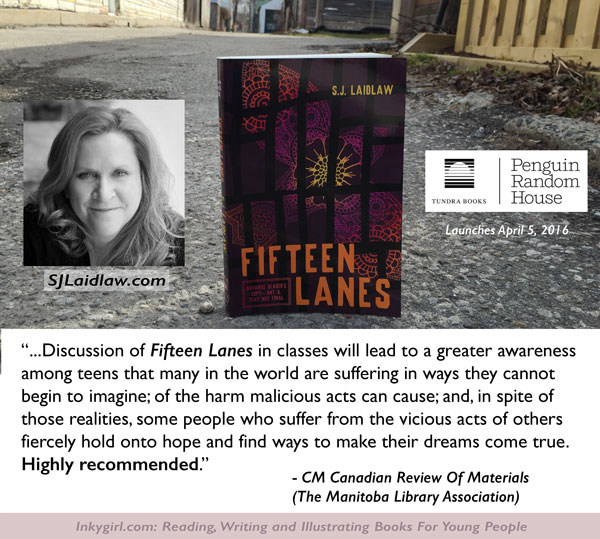
Just finished FIFTEEN LANES by S.J. Laidlaw (a.k.a. Susan Laidlaw), which comes out from Tundra Books/Penguin Random House on April 5th, 2016.
An intense and compelling read, FIFTEEN LANES follows the lives of two teenage girls from very different backgrounds. I found parts of the book difficult to get through because I felt so sad for the characters involved (one of the girls is the daughter of a sex worker in Mumbai, growing up in a brothel) but am so glad I kept reading. FIFTEEN addresses tough issues with honesty and hope.
It's no wonder the details and background are well-researched; the author herself works at an NGO facility in India, volunteering with sex workers' daughters in Kamathipura, the largest red-light district in Asia.
Synopsis of FIFTEEN LANES from Tundra Books:"Noor has lived all of her fourteen years in the fifteen lanes of Mumbai’s red light district. Born into a brothel, she is destined for the same fate as her mother: a desperate life trapped in the city’s sex trade. She must act soon to have any chance of escaping this grim future. Across the sprawling city, fifteen-year-old Grace enjoys a life of privilege. Her father, the CEO of one of India’s largest international banks, has brought his family to Mumbai where they live in unparalleled luxury. But Grace’s seemingly perfect life is shattered when she becomes a victim of a cruel online attack. When their paths intersect, Noor and Grace will be changed forever. Can two girls living in vastly different worlds find a common path?
"Award-winning author S.J. Laidlaw masterfully weaves together their stories in a way that resonates across class and culture. Fifteen Lanes boldly explores the ties that bind us to places and people, and shows us that the strongest of bonds can be forged when hope is all but lost."
0 Comments on FIFTEEN LANES by S.J. Laidlaw (Tundra Books, launching April/2016) as of 3/23/2016 1:01:00 PM
Review by Sara..
GIRL IN THE BLUE COAT
By Monica Hesse
Hardcover: 320 pages
Published by: Little, Brown (April 5, 2016)
Language: English
Grades: 9 Up
Goodreads | Amazon
An unforgettable story of bravery, grief, and love in impossible timesThe missing girl is Jewish. I need you to find her before the Nazis do. Amsterdam, 1943. Hanneke spends her days procuring and delivering
0 Comments on GIRL IN THE BLUE COAT by Monica Hesse // Good Historical Mystery With Beautifully Written, Complex Characters as of 1/1/1900
Review by Jennifer
THE SMELL OF OTHER PEOPLE'S HOUSESby Bonnie - Sue HitchcockGrade Level: 7 and upLexile Measure: 0960 (What's this?)Hardcover: 240 pagesPublisher: Wendy Lamb Books (February 23, 2016) Goodreads | Amazon
In Alaska, 1970, being a teenager here isn’t like being a teenager anywhere else. This deeply moving and authentic debut is for fans of Rainbow Rowell, Louise Erdrich,
0 Comments on THE SMELL OF OTHER PEOPLE'S HOUSES by Bonnie - Sue Hitchcock \\ Weird Title, Great Book as of 1/1/1900
Review by Sara
Flawed (Flawed #1)by Cecelia AhernAge Range: 12 - 18 yearsHardcover: 336 pagesPublisher: Feiwel & Friends (April 5, 2016)Goodreads | Amazon
Celestine North lives a perfect life. She's a model daughter and sister, she's well-liked by her classmates and teachers, and she's dating the impossibly charming Art Crevan.But then Celestine encounters a situation in which she makes an
0 Comments on FLAWED by Cecelia Ahern was Flawed, but Still a Good Dystopian Read as of 1/1/1900
by Andye
ZERO DAYby Jan GangseiHardcover: 368 pagesPublisher: Disney-Hyperion (January 12, 2016)Language: English Goodreads | Amazon
Eight years ago, Addie Webster was the victim of the most notorious kidnapping of the decade. Addie vanished-and her high-profile parents were forced to move on.
Mark Webster is now president of the United States, fighting to keep the oval office after a
0 Comments on Quick-Fire Review: ZERO DAY by Jan Gangsei \\ Mystery-Thriller! as of 2/25/2016 1:25:00 AM






.jpeg?picon=2287)


.jpg?picon=3847)


 The Impossible Knife of Memory
 Fallen Angels