new posts in all blogs
Viewing: Blog Posts Tagged with: macmillan, Most Recent at Top [Help]
Results 1 - 25 of 124
How to use this Page
You are viewing the most recent posts tagged with the words: macmillan in the JacketFlap blog reader. What is a tag? Think of a tag as a keyword or category label. Tags can both help you find posts on JacketFlap.com as well as provide an easy way for you to "remember" and classify posts for later recall. Try adding a tag yourself by clicking "Add a tag" below a post's header. Scroll down through the list of Recent Posts in the left column and click on a post title that sounds interesting. You can view all posts from a specific blog by clicking the Blog name in the right column, or you can click a 'More Posts from this Blog' link in any individual post.

By:
Betsy Bird,
on 10/27/2016
Blog:
A Fuse #8 Production
(
Login to Add to MyJacketFlap)
JacketFlap tags:
Reviews,
nonfiction picture books,
Feiwel and Friends,
macmillan,
2016 reviews,
Reviews 2016,
2016 nonfiction picture books,
Jonathan Tweet,
Karen Lewis,
Add a tag
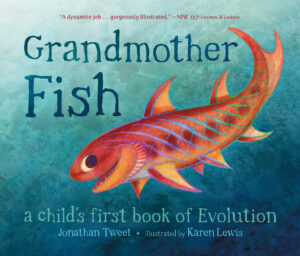 Grandmother Fish: A Child’s First Book of Evolution
By Jonathan Tweet
Illustrated by Karen Lewis
Feiwel and Friends (an imprint of Macmillan)
$17.99
ISBN: 978-1250113238
Ages 3-6
On shelves now
Travel back with me through the Earth’s history, back into the farthest reaches of time when the sand we walk today was still rock and the oceans of an entirely salination. Back back back we go to, oh about 13 years ago, I’d say. I was a library grad student, and had just come to the shocking realization that the children’s literature class I’d taken on a lark might actually yield a career of some sort. We were learning the finer points of book reviewing (hat tip to K.T. Horning’s From Cover to Cover there) and to hone our skills each of us was handed a brand new children’s book, ready for review. I was handed Our Family Tree: An Evolution Story by Lisa Westberg Peters, illustrated by Lauren Stringer. It was good, so I came up with some kind of a review. It was, now that I think about it, the very first children’s book review I ever wrote (talk about evolution). And I remember at the time thinking (A) How great it was to read a picture book on the topic and (B) That with my limited knowledge of the field there were probably loads and loads of books out there about evolution for small children. Fun Fact: There aren’t. Actually, in the thirteen years between then and now I’ve not seen a single evolution themed picture book come out since the Peters/Stringer collaboration. Until now. Because apparently two years before I ran across Our Family Tree author Jonathan Tweet was trying to figure out why there were so few books on the subject on the market. It took him a while, but he finally got his thoughts in order and wrote this book. Worth the wait and possibly the only book we may need on the subject. For a while, anyway.
Let’s start with a fish. We’ll call her Grandmother Fish and she lived “a long, long, long, long, long time ago.” She did familiar fishy things like “wiggle” and “chomp”. And then she had ancestors and they turned out to be everything from sharks to ray-finned fish to reptiles. That’s when you meet Grandmother Reptile, who lived “a long, long, long, long time ago.” From reptiles we get to mammals. From mammals to apes. And from apes to humans. And with each successive iteration, they carry with them the traits of their previous forms. Remember how Grandmother Fish could wiggle and chomp? Well, so can every subsequent ancestor, with some additional features as well. The final image in the book shows a wide range of humans and they can do the things mentioned in the book before. Backmatter includes a more complex evolutionary family tree, a note on how to use this book, a portion “Explaining Concepts of Evolution”, a guide “to the Grandmothers, Their Actions, and Their Grandchildren for your own information to help you explain evolution to your child”, and finally a portion on “Correcting Common Errors” (useful for both adults and kids).
 What are the forbidden topics of children’s literature? Which is to say, what are the topics that could be rendered appropriate for kids but for one reason or another never see the light of day? I can think of a couple off the top of my head, an evolution might be one of them. To say that it’s controversial in this, the 21st century, is a bit odd, but we live in odd times. No doubt the book’s creators have already received their own fair share of hate mail from folks who believe this content is inappropriate for their children. I wouldn’t be too surprised to hear that it ended up on ALA’s Most Challenged list of books in the future. Yet, as I mentioned before, finding ANY book on this subject, particularly on the young end of the scale, is near impossible. I am pleased that this book is filling such a huge gap in our library collections. Now if someone would just do something for the 7-12 year olds . . .
When you are simplifying a topic for children, one of the first things you need to figure out from the get-go is how young you want to go. Are you aiming your book at savvy 6-year-olds or bright-eyed and bushy-tailed 3-year-olds? In the case of Grandmother Fish the back-story to the book is that creator Jonathan Tweet was inspired to write it when he couldn’t find a book for his daughter on evolution. We will have to assume that his daughter was on the young end of things since the final product is very clearly geared towards the interactive picture book crowd. Readers are encouraged to wiggle, crawl, breathe, etc. and the words proved capable of interesting both my 2-year-old son and my 5-year-old daughter. One would not know from this book that the author hadn’t penned picture books for kids before. The gentle repetition and clincher of a conclusion suggest otherwise.
One problem with turning evolution into picture book fare is the danger of confusing the kids (of any age, really). If you play it that our ancestors were monkeys, then some folks might take you seriously. That’s where the branching of the tree becomes so interesting. Tweet and Lewis try hard to make it clear that though we might call a critter “grandmother” it’s not literally that kind of a thing. The problem is that because the text is so simple, it really does say that each creature had “many kinds of grandchildren.” Explaining to kids that this is a metaphor and not literal . . . well, good luck with that. You may find yourself leaning heavily on the “Correcting Common Errors” page at the end of the book, which aims to correct common misconceptions. There you will find gentle corrections to false statements like “We started as fish” or “Evolution progresses to the human form” or “We descended from one fish or pair of fish, or one early human or pair of early humans.” Of these Common Errors, my favorite was “Evolution only adds traits” since it was followed by the intriguing corrective, “Evolution also take traits away. Whales can’t crawl even though they’re descended from mammals that could.” Let’s talk about the bone structure of the dolphin’s flipper sometime, shall we? The accompanying “Explaining Concepts of Evolution” does a nice job of helping adults break down ideas like “Natural Selection” and “Artificial Selection” and “Descent with Modification” into concepts for young kids. Backmatter-wise, I’d give the book an A+. In terms of the story itself, however, I’m going with a B. After all, it’s not like every parent and educator that reads this book to kids is even going to get to the backmatter. I understand the decisions that led them to say that each “Grandmother” had “grandchildren” but surely there was another way of phrasing it.
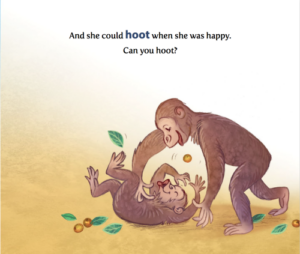 This isn’t the first crowd-sourced picture book I’ve ever seen, but it may be one of the most successful. The reason is partly because of the subject matter, partly because of the writing, and mostly because of the art. Bad art sinks even the most well-intentioned of picture books out there. Now I don’t know the back-story behind why Tweet paired with illustrator Karen Lewis on this book, but I hope he counts his lucky stars every day for her participation. First and foremost, he got an illustrator who had done books for children before (Arturo and the Navidad Birds probably being her best known). Second, her combination of watercolors and digital art really causes the pages to pop. The colors in particular are remarkably vibrant. It’s a pleasure to watch them, whether close up for one-on-one readings, or from a distance for groups. Whether on her own or with Tweet’s collaboration, her clear depictions of the evolutionary “tree” is nice and fun. Plus, it’s nice to see some early humans who aren’t your stereotypical white cavemen with clubs, for once.
I look at this book and I wonder what its future holds. Will a fair number of public school libraries purchase it? They should. Will parents like Mr. Tweet be able to find it when they wander aimlessly into bookstores and libraries? One can hope. And is it any good? It is. But you only have my word on that one. Still, if great grand numbers of perfect strangers can band together to bring a book to life on a topic crying out for representation on our children’s shelves, you’ve gotta figure the author and illustrator are doing something right. A book that meets and then exceeds expectations, tackling a tricky subject, in a divisive era of our history, to the betterment of all. Not too shabby for a fish.
On shelves now.
Source: Final copy sent from publisher for review.
Like This? Then Try:

4 bittersweet chocolate chip cookies.
Cover Love:Yes, the image of the bike and balloon combined with the tag line "Ethan went on a bike ride. Four years later, he came back," are very striking. Good stuff!
Why I Wanted to Read This:I was in the mood for something different and I needed a book I thought I could get done quickly. I have read Jennifer Mathieu before and knew I liked her writing so I gave this a try! Here's the synopsis from GoodReads:
When Caroline's little brother is kidnapped, his subsequent rescue leads to the discovery of Ethan, a teenager who has been living with the kidnapper since he was a young child himself. In the aftermath, Caroline can't help but wonder what Ethan knows about everything that happened to her brother, who is not readjusting well to life at home. And although Ethan is desperate for a friend, he can't see Caroline without experiencing a resurgence of traumatic memories. But after the media circus surrounding the kidnappings departs from their small Texas town, both Caroline and Ethan find that they need a friend--and their best option just might be each other
Romance?: Not really, but a pretty strong friendship develops.
My Thoughts:This was a powerful book. The author wrote it from the alternating points of view of Caroline and Ethan. She did a great job with each of their voices. I can't imagine the research she must have done to write Ethan so well! I'm sure that kids coming back from that kind of trauma display all types of behavior and the way she wrote Ethan seems so real and true. His chapters were particularly moving and engaging.
And Caroline was every bit as messed up because she blamed herself for Dylan's abduction. Although Dylan wasn't gone nearly as long as Ethan, because he was autistic his recovery was very stalled. That was one of the most interesting contrasts in the book: Ethan's parents had money to get him (and them) help, Caroline's family did not. However, Caroline's mom also kind of wanted to act like it didn't happened, which didn't help anyone in their family.
I liked how Ethan's flashbacks were handled. Even though the what happened to Ethan was totally disturbing, the author leaves it to our imaginations. She isn't graphic with his memories, what comes back to him truly is what he can handle in his recovery. However, it's very clear the kind of abuse and trauma he had to deal with during his four years. It was just so well done.
I loved how the book ended, there was hope for both Caroline and Ethan and their families. It was a good ending and really the best one for this story.
To Sum Up: This would be a powerful read for many ages. I am going to get it for my library because it gives students a glimpse into stuff that is very real, but rare. Just the kind of book I loved to read when I was a young teen!
Book requested and sent from Macmillan for review.
By:
Betsy Bird,
on 9/11/2016
Blog:
A Fuse #8 Production
(
Login to Add to MyJacketFlap)
JacketFlap tags:
2016 biographies,
Reviews,
biographies,
Roaring Brook,
Best Books,
middle grade nonfiction,
Candace Fleming,
macmillan,
Neal Porter Books,
middle grade biographies,
Best Books of 2016,
2016 reviews,
Reviews 2016,
2016 middle grade nonfiction,
Add a tag
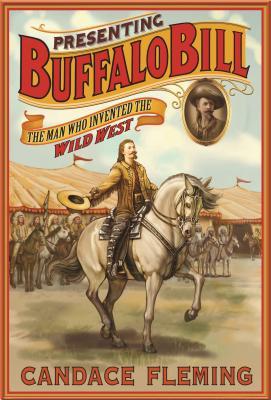 Presenting Buffalo Bill: The Man Who Invented the Wild West
By Candace Fleming
A Neal Porter Book, Roaring Book Press (a division of Macmillan)
$19.99
ISBN: 9781596437630
Ages 9-12
On shelves September 20th
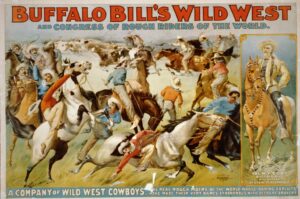
I’ve been thinking a lot lately about how we present history to our kids. Specifically I was thinking about picture book biographies and whether or not they’re capable of offering a nuanced perspective on a person’s complicated life. Will we ever see an honest picture book biography of Nixon, for example? In talking with a nonfiction author for children the other day, she asked me about middle grade books (books written for 9-12 year olds) and whether or not they are ever capable of featuring complicated subjects. I responded that often they’re capable of showing all kinds of sides to a person. Consider Laura Amy Schlitz’s delightful The Hero Schliemann or Candace Fleming’s The Great and Only Barnum. Great books about so-so people. And Candace Fleming… now there’s an author clearly drawn to historical characters with slippery slidey morals. Her latest book, Presenting Buffalo Bill is a splendid example of precisely that. Not quite a shyster, but by no means possessing a soul as pure as unblemished snow, had you asked me, prior to my reading this book, whether or not it was even possible to write a biography for children about him my answer would have been an unqualified nope. Somehow, Ms. Fleming has managed it. As tangled and thorny a life as ever you read, Fleming deftly shows how perceptions of the American West that persist to this day can all be traced to Buffalo Bill Cody. For good or for ill.
What do you think of when you think of the iconic American West? Cowboys and sage? American Indians and buffalo? Whatever is popping up in your head right now, if it’s a stereotypical scene, you’ve Buffalo Bill Cody to thank for it. An ornery son of a reluctant abolitionist, Bill grew up in a large family in pre-Civil War Kansas. Thanks to his father’s early death, Bill was expected to make money at a pretty young age. Before he knew it, he was trying his luck panning gold, learning the finer points of cowboy basics, and accompanying wagon trains. He served in the Civil War, met the love of his life, and gave tours to rich Easterners looking for adventure. It was in this way that Bill unwittingly found himself the subject of a popular paperback series, and from that he was able to parlay his fame into a stage show. That was just a hop, skip, and a jump to creating his Wild West Show. But was Bill a hero or a shyster? Did he exploit his Indian workers or offer them economic opportunities otherwise unavailable to them? Was he a caring man or a philanderer? The answer: Yes. And along the way he may have influenced how the world saw the United States of America itself.
 So let’s get back to that earlier question of whether or not you can feature a person with questionable ethics in a biography written for children. It really all just boils down to a question of what the point of children’s biographies is in the first place. Are they meant to inspire, or simply inform, or some kind of combination of both? In the case of unreliable Bill, the self-made man (I’m suddenly hearing Jerry Seinfeld’s voice saying to George Costanza, “You’re really made something of yourself”) Candace Fleming had to wade through loads of inaccurate data produced, in many cases, by Bill himself. To combat this problem, Ms. Fleming employs a regular interstitial segment in the book called “Panning for the Truth” in which she tries to pry some grain of truth out of the bombast. If a person loves making up the story of their own life, how do you ever know what the truth is? Yet in many ways, this is the crux of Bill’s story. He was a storyteller, and to prop himself up he had to, in a sense, prop up the country’s belief in its own mythology. As he was an embodiment of that mythology, he had a vested interest in hyping what he believed made the United States unique. Taking that same message to other countries in the world, he propagated a myth that many still believe in today. Therefore the story of Bill isn’t merely the story of one man, but of a way people think about our country. Bill was merely the vessel. The message has outlived him.
I’ve heard folks online say of the book that they can’t imagine the child who’d come in seeking a bio of Buffalo Bill. Since kids don’t like cowboys like they used to, the very existence of this book in the universe puzzles them. Well, putting aside the fact that enjoying a biography often has very little to do with the fact that you already were interested in the subject (or any nonfiction book, for that matter), let’s just pick apart precisely why a kid might get a lot out of reading about Bill. He was, as I have mentioned, a humbug. But he was also for more than that. He was a fascinating mix of good and evil. He took credit for terrible deeds but also participated in charitable acts (whether out of a sense of obligation or mere money is a question in and of itself). He no longer fits the mold of what we consider a hero to be. He also doesn’t fit the mold of a villain. So what does that leave us with? A very interesting human being and those, truth be told, make for the best biographies for kids.
 The fact that Bill is a subject of less than sterling personal qualities is not what makes this book as difficult as it is to write (though it doesn’t help). The real problem with Bill comes right down to his relationships with American Indians. How do we in the 21st century come to terms with Bill’s very white, very 19th century attitudes towards Native Americans? Fleming tackles this head on. First and foremost, she begins the book with “A Note From the Author” where she explains why she would use one term or another to describe the Native Americans in this book, ending with the sentence, “Always my intention when referring to people outside my own cultural heritage is to be respectful and accurate.” Next, she does her research. Primary sources are key, but so is work at the McCracken Research Library at the Buffalo Bill Center of the West in Cody, Wyoming. Her work was then vetted by Dr. Jeffrey Means (Enrolled Member of the Oglala Sioux Tribe), Associate Professor of History at the University of Wyoming in the field of Native American History, amongst others. I was also very taken with the parts of the book that quote Oglala scholar Vine Deloria Jr., explaining at length why Native performers worked for Buffalo Bill and what it meant for their communities.
What surprised me the most about the book was that I walked into it with the pretty clear perception that Bill was a “bad man”. A guy who hires American Indians to continually lose or be exploited as part of some traveling show meant to make white Americans feel superior? Yeah. Not on board with that. But as ever, the truth is far more complicated than that. Fleming delves deep not just into the inherently racist underpinnings of Bill’s life, but also its contradictions. Bill hated Custer when he knew the guy and said publicly that the defeat of Custer was no massacre, yet would reenact it as part of his show, 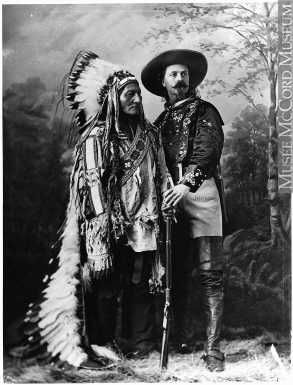 with Custer as the glorified dead hero. He would hire Native performers, pay them a living wage, and speak highly of them, yet at the same time he murdered a young Cheyenne named Yellow Hair and scalped him for his own glory. Fleming is at her best when she recounts the relationship of Bill and Sitting Bull. A photo of the two shows them standing together “as equals . . . but it is obvious that Bill is leading the way while Sitting Bull appears to be giving in. What was the subtext of the photo? That the ‘friendship’ offered in the photograph – and in Wild West performances – honored American Indian dignity only at the expense of surrender to white dominance and control.”
I’m writing this review in the year of 2016 – a year when Donald Trump is running for President of the United States of America. It’s given me a lot of food for thought about American humbuggery. Here in the States, we’ve created a kind of homegrown demagoguery that lauds the successful humbug. P.T. Barnum was a part of that. Huey Long had it down. And Buffalo Bill may have been a different version of these men, but I’d say he belongs to their club. There’s a thin line between “self-made man” and “making stuff up”. Thinner still when the man in question does as much good and as much evil as Buffalo Bill Cody. Fleming walks a tightrope here and I’d say it’s fair to say she doesn’t fall. The sheer difficulty of the subject matter and her aplomb at handling the topic puts her on a higher plane than your average middle grade biography. Will kids seek out Buffalo Bill’s story? I have no idea, but I can guarantee that for those they do they’ll encounter a life and a man that they will never forget.
On shelves September 20th.
Source: Galley sent from publisher for review.
Like This? Then Try:
Professional Reviews:
By:
Betsy Bird,
on 8/5/2016
Blog:
A Fuse #8 Production
(
Login to Add to MyJacketFlap)
JacketFlap tags:
Best Books of 2016,
2016 picture books,
2016 reviews,
Reviews 2016,
2016 funny books,
2016 funny picture books,
Reviews,
picture books,
knitting,
funny books,
Roaring Brook,
Best Books,
macmillan,
funny picture books,
Vera Brosgol,
Add a tag
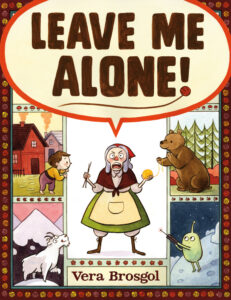 Leave Me Alone!
By Vera Brosgol
Roaring Brook Press (an imprint of Macmillan)
$17.99
ISBN: 9781626724419
Ages 4-7
On shelves September 13th
Knitting. It shouldn’t be so hard. I say this as the grown daughter of a chronic knitterer (not a word). I grew up neck deep in roving. I know the difference between a gossip wheel and a walking wheel (these are different spinning wheels). I know that if you want a permanent non-toxic dye for wool you use Kool-aid, that wool straight from the sheep is incredibly oily, and that out there are people who have turned the fur of their dogs and cats into sweaters. Yet the simplest act of knitting is lost on a good 50% of the children’s book illustrators out there that year after year can’t even be bothered to figure out which way the knitting needles are supposed to go. Down, people. The ends go down. In 2016 alone we’ve seen books like Maggie McGillicuddy’s Eye for Trouble get it wrong. Fortunately 2016 has also seen correctly positioned needles in Cat Knit, Ned the Knitting Pirate, and the greatest knitting related picture book I’ve seen to date Leave Me Alone! A superb readaloud of unparalleled visual humor, this is a knitting picture book par excellence and a pretty darn good original folktale too, come to think of it. Allowing for the occasional alien, of course.
“Once there was an old woman. She lived in a small village in a small house . . . with a very big family.” And by big family we mean big extended family. One gets the feeling that all her grown kids just sort of dump their own children on her, because there are thirty small grandchildren running amok in her home. Winter is coming soon and the old woman is keen on getting some knitting done for her extended brood. Trouble is, knitting and small children do NOT mix. So she picks up her stuff and goes into the deep, dark forest. That’s where the bear family finds her. So she goes to the mountains. Where the goats find her. Next it’s the moon. Where curious aliens find her. That leaves a wormhole where the void turns out to be her saving. Only problem is, it’s lonely in the void. Once her work is done, she heads back and when she sees her grandkids again, she doesn’t have to say a single word.
Here is the crazy thing about this book: It’s Vera Brosgol’s first picture book. I say that this is crazy because this does not read like a debut. This reads like Brosgol has been churning out picture books for decades, honing her skill, until finally at long last she’s produced a true diamond. But no. Some people get all the talent apparently. This is not, I should not, Ms. Brosgol’s first book in general. Her graphic novel Anya’s Ghost got a fair amount of attention a couple of years ago, and it was good. But nothing about that title prepared me for Leave Me Alone! Here we have a pitch perfect combination of text and image. If you were to read this book to someone without mentioning the creator, I don’t think there’s a soul alive who wouldn’t assume that the author and illustrator are one and the same. This is due largely to the timing. Just open the book to the first page. Examine the old woman on that page. Turn the page. Now look how that same woman has been transposed to a new setting and her expression has changed accordingly. Basically this sold the book to me right from the start.
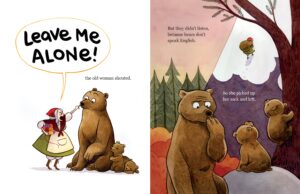 Funny picture books. For an author, creating a picture book that is funny means doing two things at once. You must appeal to both children and parents with your humor at the same time. Do you know how hard that is? Making something that a five-year-old thinks is funny that is also humorous to their parental unit is such a crazy balancing act that most picture book creators just fall on one side of the equation or the other. Make it funny only to adults and then you may as well just forget about the kids altogether (see: A Child’s First Book of Trump). Opt instead to only make it funny to kids and you doom the grown-ups to reading something they’d rather eat hot nails than read again (see: Walter the Farting Dog). But I honestly believe Brosgol has found the golden mean. Both adults and kids will find moments like the older sister stuffing a yarn ball in her brother’s mouth or the presence of the samovar (even in a wormhole) or the bear tentatively touching its nose after the old woman’s vigorous poke very funny indeed.
And let’s not downplay the writing here. There is serious readaloud potential with this book. I’ll level with you. In a given year you’ll see hundreds and hundreds of picture books published. Of these, a handful make for ideal readalouds. I’m not talking about books a parent can read to a child. I’m talking about books you can read to large groups, whether you’re a teacher, a librarian, or some poor parental schmuck who got roped into reading aloud to a group of fidgeting small fry. Few books are so good that anyone and everyone can enrapture an audience with them when read out loud. But Leave Me Alone! may be one of those rare few. Those beautiful butterflies. Those little jewels. The language mimics that of classic folktales, bandying about phrases like, “deep, dark forest”. And there are so many interactive possibilities. You could teach the kids how to yell out the phrase “Leave me alone!” all together at the same time, for example.
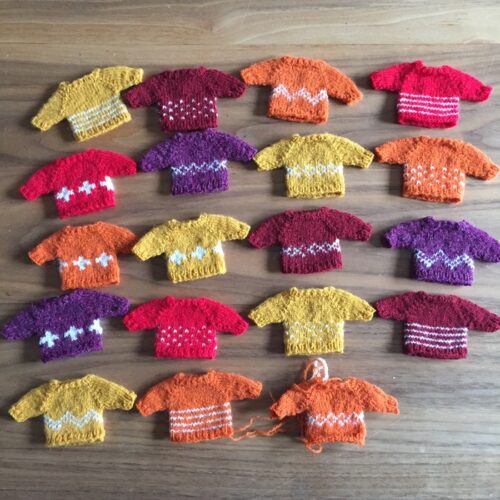
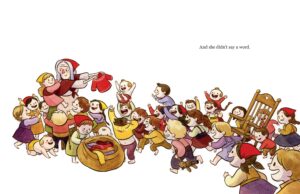 As for the art, it’s perfect. There’s a kind of Kate Beaton feel to it (particularly when babies or goats have full balls of yarn stuffed into their mouths). As I mentioned before, Brosgol knows which way knitting needles are supposed to lie, and better still she knows how to illustrate thirty different, and very realistically rendered sweaters, at the story’s end. There are also some clever moments that you’ll notice on a third or fourth read. For example, the very first time the woman yells, “Leave me alone!” she’s exiting the gates to her home and her children’s homes. The only people who hear her are her grown children, which means we don’t have to worry about small ears hearing such a caustic phrase from their grandma. Smart. And did you see that the twins get identical sweaters at the end of the book? Finally, there are the visual gags. The goats that surreptitiously followed the old woman to the moon, nibbling on a moon man’s scanner, for example.
I’ve seen a fair amount of hand wringing over the years over whether or not a children’s book can contain a protagonist that is not, in fact, a child, an animal, or an inanimate object rendered animate. Which is to say, are children capable of identifying with adults? More precisely, an adult who just wants to be alone for two seconds? The answer is swift and sure. Certainly they can. Particularly if the kid reading this book is an older sibling. The concept of being alone, of craving some time for one’s own self, is both familiar and foreign to a lot of kids. I’m reminded of the Frog & Toad story “Alone” from Days With Frog and Toad where Toad has a dark morning of the soul when he learns that Frog would like to have some alone time. Because of all of this, we see a lot of picture books where a character wants to be alone, has difficulty getting that “me time”, and eventually decides that companionship is the way to go (Octopus Alone, A Visitor for Bear, etc.). A few celebrate the idea (All Alone] by Kevin Henkes) but generally speaking parents use these books to convince their perhaps less than socially adept children that there are benefits to the concept of friendship. And there is a place in the world for such books. Fortunately there is also a place in the world for this book.
Folks sometimes talk to me about current trends in picture books. Sometimes they’re trying to figure out what the “next big thing” might be. But of course, the best picture books are the ones that at their core don’t really resemble anything but themselves. Leave Me Alone! isn’t typical. It reads aloud to big crowds of kids with great ease, lends itself to wonderful expressions, pops off the page, and will make anyone of any age laugh at some point. It’s a great book, and if I have to write another 500 words to convince you of it, I can do so. But why delay you from seeing it any longer? Go. Seek. Find. Read. Savor.
On shelves September 13th.
Like This? Then Try:
Source: Galley sent by publisher for review.
Misc: Cute promotion or THE CUTEST PROMOTION? As you can see from this Bustle interview, Ms. Brosgol knit twenty-five teeny tiny sweaters to promote this book. I steal the image for my own nefarious purposes and show it to you here:
By:
Betsy Bird,
on 6/16/2016
Blog:
A Fuse #8 Production
(
Login to Add to MyJacketFlap)
JacketFlap tags:
Maria Gianferrari,
Best Books of 2016,
Reviews 2016,
Reviews,
Roaring Brook,
Best Books,
picture book reviews,
Bagram Ibatoulline,
macmillan,
Add a tag
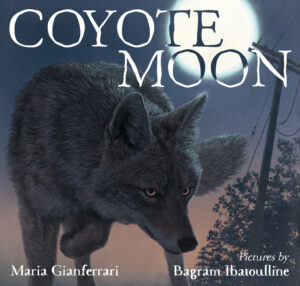 Coyote Moon
By Maria Gianferrari
Illustrated by Bagram Ibatoulline
Roaring Brook Press (an imprint of Macmillan)
$17.99
ISBN: 978-1-62672-041-1
Ages 4-7
On shelves July 19th
I feel as if there was less nature out there when I was a kid. Crazy, right? But seriously, as I grew to be an adult I was appalled at the discovery that other people in the United States had to deal with stuff like ticks and chiggers and painful jellyfish and worse. Me? The worst encounter I ever had with something stinging or biting were a couple of sweat bees on my knuckles. But the critter that seemed the most impossible in terms of everyday encounters has been, and continues to be to this day (until the moment we come face-to-face) the coyote. Coyotes were always the heroes of Wild West tales of Native American folklore. They didn’t just wander into your Michigan backyard or anything . . . did they? Now, thanks to books like the beautiful Coyote Moon I learn that coyotes live in every American state except Hawaii. Best that I get as much information as possible about them then. Thankfully, I’ve lots of help. Maria Gianferrari and Bagram Ibatoulline ratchet up the realism to eleven, making it hard to walk away from this book without considering the modern coyote’s plight.
The sun has set and the moon is on the rise. What better time for a coyote momma to leave her den and search for tasty morsels for her kin? Slipping in and out of the shadows of a suburban neighborhood, the coyote attempts to secure a mouse, a rabbit, and even the eggs of Canadian geese, all to no avail. As the sun begins to rise in the east, however, the coyote smells, seas, and hears a flock of turkeys. There is no hemming or hawing now. Without another thought she secures a big one for her family. Of course, before she returns home, she howls. A potentially dangerous act to perform so close to humans, but fortunately the one person who hears her is the one person who understands why she would howl in the first place. Backmatter consists of Coyote Facts, Further Reading, and Websites.
 The book is not written in verse or rhyme, but there’s something inherently rhythmic to Ms. Gianferrari’s text. Listen to how she begins the book: “Moon rises, as Coyote wakes in her den, a hollow-out pine in a cemetery. Coyote crawls between roots. She sniffs the air, arches her back, shakes her fur.” That’s beautiful, that is. Gianferrari’s text is like that from start to finish and it all gets particularly interesting near the end. What an interesting choice it was to switch into the second person near the story’s end. “You open your window… You watch as Coyote slips under the fence painted pink by the sun.” Interesting too that the coyote gets her name capitalized throughout the story. She’s the heroine, no bones about it, and refusing to give her a name keeps her appropriately wild. Capitalizing the word “coyote”, however, gives just the slightest personal bent to an otherwise impersonal descriptive name.
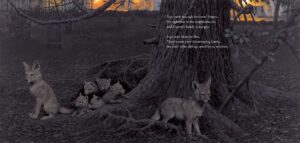
Which brings us to the art. I’ve been a big time fan of artist Bagram Ibatoulline for years. He’s one of those artists that are so good he’ll never ever win any American illustration awards. Such people exist all the time and this is particularly true of artists who truck with realism. Ibatoulline’s challenge here is twofold. On the one hand, he has to render the coyote and her environment in a nighttime setting without sacrificing detail. On the other hand, without giving his character any anthropomorphized tendencies, he also needs to make her sympathetic in her quest to provide food for her babies. The end result is fascinating to watch. With the aid of a full moon, Ibatoulline believably provides just enough light to justify seeing every single solitary hair on the coyote mama’s pelt. Often her eyes are the most colorful things on the page, aided in part by the streetlights as well. He even manages to give the sky that odd pink/grey color it sometimes takes on thanks to light pollution. I don’t know that I’ve ever seen it so perfectly rendered in a picture book before. Then there’s his ability to accurately render the light of an early dawn. We see the light striking the trees, the day beginning on the houses, and silhouetted against the lake the mama coyote. And even then, every single hair on her head is present and accounted for. How does he do that?
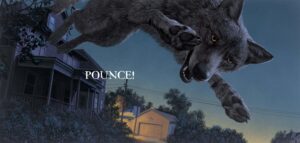 I read almost every picture book I review to my kids at some point or another, and I’m glad that I do. Even after all these years, they have the ability to surprise me. For example, if you’d asked me if this were a tense or scary book in any way I’d have initially said no. Yet clearly the book is capable of touching a nerve. My staid stoic five-year-old daughter, who recently informed me that The Walking Dead couldn’t possibly be all that scary a show, was positively petrified by the image of the coyote making her first pounce. No wolf attacking Little Red Riding Hood has ever made such an impression on her as that shot. Fortunately, it’s almost as if Mr. Ibatoulline and Ms. Gianferrari anticipated this. As a parent I was able to smoothly flip back three pages and show the baby coyote cubs near the den and explain that this was their mama. The explanation went a far ways towards alleviating her anxiety. Later, when the coyote gets a big mouth of turkey, Ibatoulline frames the shot in such a way as to display minimal carnage. All you get is, on one page coyote’s face ending just under her nose and on the other the tail, drifting feathers indicating the turkey’s dire fate.
Some folks might make the argument that this book is clearly nonfiction, and you could see their point. If we take the heroine of this story to be an average coyote and not a single one, thereby making this an average situation and not a specific one, then combined with the backmatter (the copious “Coyote Facts” as well as the bibliography for both further reading and websites) you almost find yourself in nonfiction territory. So out of curiosity I decided to see how my library’s distributor, Baker & Taylor, characterized the book. Lo and behold, they call it straight up nonfiction, no bones about it. Personally, I don’t agree. For whatever reason, for all that the book is informative and interesting, I still found the storyline just a tad too fictionalized to count as a purely informational text. Why is this? Compare the book to Hungry Coyote by Cheryl Blackford. In both cases you have average coyote storylines, and both very realistic indeed. Gianferrari has the leg up in this case since her book has nonfiction backmatter, but in both cases I felt like I was hearing a story more than I was learning factual information. Certainly authors can do both, but at the end of the day it’s the librarians who’ll decide where to shelve the puppy. And for me, any picture book collection should be honored to receive this book.
After finishing Coyote Moon I truly believe I have a better sense of coyotes now, and not a moment too soon. Just the other day I was told that the house I’m currently renting is on a little street, dubbed by the neighbors “Coyote Way”. I was told not to be surprised if I see those cheerful souls walking down the road to their destination. And while I have no desire to get up close and personal with the clan, it would be cool to watch from my windows. So thank you, Ms. Gianferrari and Mr. Ibatoulline for giving me the confidence, courage, and curiosity to see this through. I have little doubt that those qualities, to a certain extent the very benchmarks of childhood itself, will resonate with curious young readers everywhere. Lots of younger kids love wolves. These coyotes are about to give those wolves a real run for their money. Beautiful work. Beautiful stuff.
On shelves July 19th.
Source: Galley sent from publisher for review.
Like This? Then Try:
By:
Betsy Bird,
on 3/23/2016
Blog:
A Fuse #8 Production
(
Login to Add to MyJacketFlap)
JacketFlap tags:
Reviews,
poetry,
Roaring Brook,
Best Books,
macmillan,
Julie Morstad,
Neal Porter Books,
Julie Fogliano,
Best Books of 2016,
2016 reviews,
Reviews 2016,
2016 poetry,
2017 Newbery contenders,
Add a tag
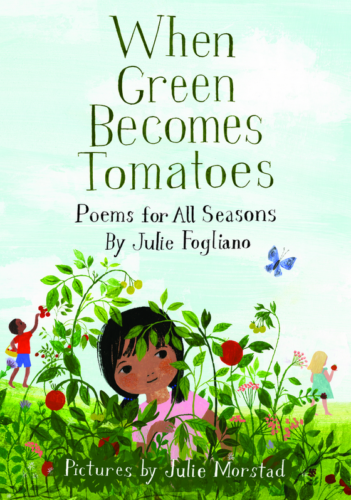 When Green Becomes Tomatoes: Poems for All Seasons
By Julie Fogliano
Illustrated by Julie Morstad
A Neal Porter Book / Roaring Brook Press (Macmillan)
$18.99
ISBN: 9781596438521
Ages 6 and up
On shelves now.
I don’t think I can adequately stress to you the degree to which I did not want to review this book. Not because it isn’t a magnificent title. And not because it isn’t pleasing to both eye and ear alike. No, it probably had more to do with the fact that it’s a work of poetry. I make a point of reviewing poetry regularly, though I’d be the first to say that it wasn’t my first language (if you know what I mean). I respect it but can occasionally find it tough going. I was determined to give this book its due, though. And the only way I could make myself physically sit down and review it was to read it cover to cover again. As I did so I was struck over and over, time and again, by just how melodious the language is here. Look, I’ll level with you. Seasonal poetry books are a dime a dozen. But what Fogliano and Morstad have created together is a lot more than just a book of poems for the changes of the year. This book manages to operate on a level that presents the very act of the seasonal cycle as positively philosophical, yet without distancing itself from its readership. It’s tricky territory, but together Fogliano and Morstad get the job done.
“from a snow-covered tree / one bird singing / each tweet poking / a tiny hole / through the edge of winter”. In the very first poem in When Green Becomes Tomatoes (a poem called “march 20”) the child reader is alerted to a change in the air. The snow is still present and the weather still gloomy, but there is hope on the horizon. Yet rather than turn the book into a paean to warmer weather, poet Julie Fogliano takes time to both celebrate and criticize the passing seasons. By the end of spring you look forward to summer and the end of summer leads to the relief of autumn, and so on and such. Accompanying these thoughts are small poems in lowercase and illustrations carrying the weight and expectations these seasons evoke in us. The end result can only be described in a single word: beautiful.
 Like I said, I’ve read a lot of poetry books for kids about the seasons in my day. The good ones have some kind of a hook. Like Joyce Sidman tackling it with colors in Red Sings from Treetops or Jon J. Muth writing the poems entirely as haikus as in Hi, Koo! A Year in Seasons. But Fogliano doesn’t really have a hook, and so I approached the title with trepidation. No hook? You mean it was just going to be . . . poems?! It takes the courage of your convictions to do a poetry book for kids straight these days. And it’s not true that Fogliano didn’t have one ace up her sleeve. A lot of works of poetry start in January (when the year itself technically begins). Using a technique of highlighting random dates, this poet begins the book on March 20th, the first day of spring. A small hook, sure, but at least it’s something.
As for the poems themselves, I was impressed not just with the writing, but with Ms. Fogliano’s grasp of what each season actually entails. There are a LOT of cloudy days, rainy days, and generally blah days in this book. They don’t weigh down the narrative or really make it all that gloomy. You just end up experiencing precisely the same feeling you have when you’re living those days. This is the rare book that acknowledges that spring doesn’t immediately mean sunshine and 55-degree temperatures. There’s a lot of snow and some mud and a whole ton of rain. Listen to how she puts it, though: “today / the sky was too busy sulking to rain / and the sun was exhausted from trying / and everyone / it seemed / had decided / to wear their sadness / on the outside / and even the birds / and all their singing / sounded brokenhearted / inside of all that gray.” It really isn’t until June that things even out, and I respect that. All the seasons are like that. It’s great to watch.
As you might have noted, the poetry found in this book straddles a line between being child-friendly and introspective (the two aren’t mutually exclusive, but neither are they always natural pairs). I found myself noting line after line after line that I wanted to quote. Here’s a small taste for each season.
On Spring: “shivering and huddled close / the forever rushing daffodils / wished they had waited.”
On Summer: “if you ever stopped / to taste a blueberry / you would know / that it’s not really about the blue, at all.”
On Fall: “october please / get back in bed / your hands are cold / your nose is red / october please / go back to bed / your sneezing woke december.”
On Winter: “a gust of wind / blew by my nose / i think i will be frozen soon / this living room / (all cozy chairs and fireplace) / has some real explaining to do.”
Some books of children’s poetry lean heavily on the works of other poets. I won’t presume to name her influences but if the July 12th poem is any indication then William Carlos Williams might have had some influence here. And maybe e.e. cummings too (with all that mudlicious mud).
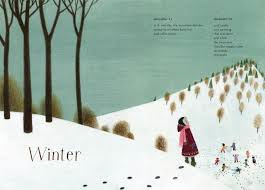 When she was much younger it’s clear that author Julie Fogliano made some kind of a blood sacrifice to the God of Perfect Illustrator Pairings. How else to explain how she has managed to work alongside such artists as Erin E. Stead and now Julie Morstad? Morstad is no newbie to the field, of course. I’ve been a big fan of her for years, starting with her art for The Swing by Robert Louis Stevenson. Morstad’s great talent lies not necessarily in her waiflike black-eyed children, but rather in how she creates tone. Though there are plenty of sequences in this book of kids playing together or sharing food and soup, for the most part her characters go it alone. These poems are the contemplations of a young person with time and space and nature in spades. I don’t know that if I read Ms. Fogliano’s poetry without the art I would have picked up on that myself. Note too how cyclical the book is. The first poem is the last, sure as shooting, but so too is the person seen at both the beginning and the end. It’s the same kid wearing the same clothes, which makes a subtle implication that though a whole year has gone by, time is simply doubling back on itself. Not sure what to make of that one, frankly.
With poetry, we have to play the game of answering what ages we think the poems are appropriate for. This book poses a bit of a challenge on that front. Some are younger, some definitely older. This mix will allow kids of all ages to take part in the fun, even as the book asks questions like whether or not there is a space between where things begin and things end “or just a slow and gentle fading”. Enticing to the eye but, more importantly almost, alluring to the brain as kids parse what Fogliano is trying to say, this is a book that has the potential (with the right teacher or parent) to convert the formerly unconvertible to the wonders of poetry itself. The truth of the matter is this: Fogliano and Morstad will make poets of us all.
On shelves now.
Source: Galley sent from publisher for review.
Like This? Then Try:
Professional Reviews:
Other Reviews:
By:
Betsy Bird,
on 1/24/2016
Blog:
A Fuse #8 Production
(
Login to Add to MyJacketFlap)
JacketFlap tags:
macmillan,
Lisa Brown,
Neal Porter Books,
Best Books of 2016,
2016 picture books,
2016 reviews,
Reviews 2016,
Reviews,
Roaring Brook,
Best Books,
picture book reviews,
Add a tag
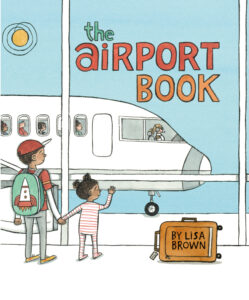 The Airport Book
By Lisa Brown
A Neal Porter Book, Roaring Brook, an imprint of Macmillan
$16.99
ISBN: 978-1-62672-091-6
Ages 4-7
On shelves May 10th.
Look, I don’t wanna brag but I’m what you might call a going-to-the-airport picture book connoisseur. I’ve seen them all. From out-of-date fare like Byron Barton’s Airport to the uniquely clever Flight 1-2-3 by Maria Van Lieshout to the odd but helpful Everything Goes: In the Air by Brian Biggs. Heck, I’ve even examined at length books about the vehicles that drive on the airport tarmac (see: Brian Floca’s Five Trucks). If it helps to give kids a better sense of what flying is like, I’ve seen it, baby. And I will tell you right here and now that not a single one of these books is quite as good at explaining every step of the journey as well as Lisa Brown’s brand new The Airport Book. I’d even go so far as to say that it’s more than just an instructional how-to. Packed with tiny details that make each rereading worthwhile, a plot that sweeps you along, and downright great information, this one here’s a keeper to its core.
“When you go to the airport, you can take a car, a van, a bus, or even a train. Sometimes we take a taxicab.” A family of four prepares for a big trip. Bags are packed with the haste that anyone with small children will recognize. Speed is of the essence. As they arrive at the airport we meet other people and families taking the same flight. There’s airport security to get through (the book mentions the many lines you sometimes have to stand in to get where you’re going), the awesome size of the airport itself, the gate, and then the plane. As we watch the younger sister in the family is having various mild freakouts over her missing (or is it?) stuffed monkey. The monkey in question is always in our view, packed in a suitcase, discovered by a dog during the flight, and finally reuniting with its owner on the luggage carousel. The family meets up with the grandparents and at last the vacation can begin. That is, until they all have to go home again.
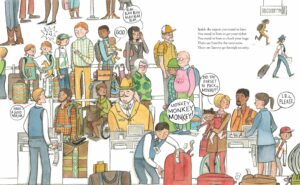 The problem with most airport-related picture books is something I like to call the Fly Away Home conundrum. Originally penned by Eve Bunting, Fly Away Home is one of those rare picture books out there that deal with homelessness in a realistic way. The story features a father and son living out of an airport. Since it touches on such an important, and too little covered, topic, the book continues to appear on required reading lists, in spite of the fact that the very premise is now woefully out-of-date. There are few areas of everyday American life that have changed quite so dramatically over such a short amount of time as the average airport experience. That’s why so many things about The Airport Book rang true for me. When Brown covers the facts surrounding departures and goodbyes to family and friends, she doesn’t set the scene inside the building but rather on the sidewalk outside of ticketing, as people are dropped off. Later you see people at their gate plugging in their cell phones willy-nilly (something I’ve never seen in a picture book before). It lends the book a kind of air of authenticity.
The story’s good and the art’s great but what I liked about the book was the language. Brown never tells you precisely what is going to happen, but she does mention the likelihoods. “Sometimes the plane is bouncy, but most of the time it is smooth.” “Sometimes the sidewalks and staircases move by themselves.” “Sometimes there are small beeping cars driving through . . .” As you read, you realize that in a way the narration of the book is being created for us from the perspective of the big brother. He’ll occasionally insert little notes that are probably of more use to him than us. Example: “You have to hold your little sister’s hands tight, or she could get lost.” Mind you, some of the sections have the ring of poetry to them, while staying squarely within a believable child’s voice. I was particularly fond the of the section that says, “Outside there are clouds and clouds and clouds.”
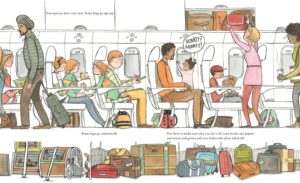 With all the calls for more diverse picture books to be published, it would be noticeable if Ms. Brown’s book didn’t have a variety of families, races, ages, genders, etc. What’s notable to me is that she isn’t just checking boxes here. Her diversity far surpasses those books where they’ll throw in the occasional non-white character in a group shot. Instead, the main family has a dark-skinned father and light-skinned, blond mother. Travels through the airport show adults in wheelchairs, twins, women in headscarves, Sikhs, pregnant ladies, and more. In other words, what you’d actually see in an airport these days.
And then the little details come up. Brown throws into the book a surprising array of tiny look-and-discover elements, suggesting that perhaps this book would be just as much fun in its way as a Where’s Waldo? game for older siblings as it is their younger brethren. Ask them if they can find The Wright Brothers, Hatchet (don’t think too hard about what happens to the plane in that book), the mom’s copy of Jack Kerouac’s On the Road, or the person looking for Amelia Earhart (who may not be as difficult to find as you think). There’s also a cast of characters that command your attention like the businesswoman who’s always on her cell phone and the short artist with the mysteriously shaped package.
There’s nothing to say that in five years airports will be just as different to us today as pre-9/11 airports are now. Yet even if our airports start requiring us to hula hoop and dance the Hurly Burly, Brown’s book is still going to end up being the go-to text desperate parents turn to when they need a book that explains to their children what an average airplane flight looks like. It pretty much gets everything right, exceeding expectations. Generally speaking, books that tell kids about what something is like (be it a trip to the dentist or a new babysitter) are pedantic, didactic, dull as dishwater fare. Brown’s book, in contrast, has flare. Has pep. Has a beat and you can dance to it. Like I said, this may be the best dang going-to-the-airport book I can name (though you should certainly check out the others I’m mentioned at the beginning of this review). A treat, it really is. A treat.
On shelves May 10th.
Source: Galley sent from publisher for review.
Like This? Then Try:
Interviews: Miss Marple’s Musings
And yet another surprise from Macmillan, this time from their Hill and Wang imprint: Hyman, Miles SHIRLEY JACKSON’S “THE LOTTERY” A GRAPHIC ADAPTATION Fiction , October 2016 (proposal available) Shirley Jackson’s short story THE LOTTERY is a classic of American literature that continues to thrill and unsettle readers nearly seven decades after it was first published. By turns puzzling and […]
By:
Betsy Bird,
on 12/8/2015
Blog:
A Fuse #8 Production
(
Login to Add to MyJacketFlap)
JacketFlap tags:
Best Books,
Feiwel and Friends,
macmillan,
early chapter books,
funny early chapter books,
Best Books of 2015,
Reviews 2015,
2015 early chapter books,
Sarah Courtauld,
Reviews,
Add a tag
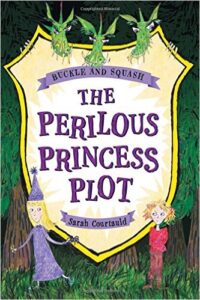 Buckle and Squash: The Perilous Princess Plot
By Sarah Courtauld
Feiwel and Friends (an imprint of Macmillan)
$14.99
ISBN: 978-1-250-05277-3
Ages 7-10
On shelves now.
Considering that I will never but EVER write an early chapter book or, for that matter, an easy book for new readers, it’s funny how often I sit around contemplating their difficulty. More precisely, I want to know which ones are more difficult to write. Easy books sounds like they’d be the hardest, particularly since it is remarkably hard to siphon a book down to its most essential parts while also making it interesting. Then again, those early chapter books are the devil. We see whole bunches of them published every year but how many are the type you’d like to read to your kids at bedtime over and over and over again? Nothing against Magic Treehouse, but would it kill Mary Pope Osborne to include just one tiny giant name Bonnet? Or have her characters fake The Black Death with the aid of turnip soup? I guess that’s what’s so great about Sarah Courtauld’s early chapter book import The Perilous Princess Plot. Not only is it sublime bedtime reading, it’s also perfect for transitioning kids to longer books, AND it’s knock your socks off funny. Goat and gruel, there’s something for everyone here. Unless you hate humor. Then you’re out of luck.
Meet Lavender. Interests include princesses, being a princess someday, handsome princes, and princesses (did I mention that one?). Meet her younger sister, Eliza. Interests include not hearing Lavender mention anything fairy tale related ever ever again (to say nothing of her singing). The two live in the Middle of Nowhere, in the Forgotten Corner of the Kingdom, in the realm of Squerb and their lives are pretty ordinary. Ordinary, that is, until Lavender gets herself kidnapped by the villain Mordmont who is hoping to ransom a pricey princess. Now it’s up to Eliza and her trusty steed/goat Gertrude to rescue Lavender (whether she wants to be rescued or not) and to generally save the day. There just might be a couple odd pit stops to attend to first.
It’s interesting. An author has a lot of ways of making a protagonist sympathetic to the her readership. Often in children’s books an instantaneous way is to make them the recipient of unfair treatment. Nothing captures hearts and minds more swiftly or efficiently than good old-fashioned outrage on behalf of your heroine and that’s certainly how Courtauld begins the book, with Eliza mucking out the goat pen as Lavender tra la las about. However, the real way in which you bond with Eliza is through your mutual annoyance with Lavender. Lavender is sort of what would happen if Fancy Nancy ever got so swallowed up in a princess obsession that she became unrecognizable to her family. Courtauld was quite clever to make Lavender the older sibling too. We’ve all seen the younger-princess-obsessed sibling motif in various books and while I’ve nothing against it, there’s something particularly grating when someone who, by dearth of age alone, should know better yet doesn’t.
In a given day you probably won’t read many early chapter books for kids that feel like the cast of Monty Python meandered out of retirement to write a book for children. Funny? Baby, you don’t know the half of it. Funny is hard. Funny is difficult. Funny is almost impossible to pin down because everyone’s sense of humor is different in some way from everyone else’s. But I simply refuse to believe that there’s a kid out there who could read this book and not crack a smile once. Here, I’ll give you an example. Early in the story the evil villain Mordmont is depressed. As he says, “I’m a man of simple pleasures . . . All I ever wanted was a castle, my own pride of lions, a jeweled crown, a choir of elves singing me awake each morning, sainthood, the power to make gold, the best mustache in Europe, a Jacuzzi, an elephant from the Indies, another one to be its friend, a singing giraffe, the power of invisibility, Magic Cheese Powers, a tiger with the feet of a lamb, the head of a lamb, and the body of a lamb – basically, a lamb – power over the sea, power over the letter C . . .” at which point we’re told that another 4,235 simple pleasures are to be skipped over so that we can fast forward to the final one, “a meringue that speaks Japanese.” It’s the lamb part that really got me. Love that lamb.
So let’s say you’re writing an early chapter book and you have the chance to illustrate it yourself. Do you do so? Particularly if it’s your debut novel? Yep. I’ve checked out her CV and from what I can tell Ms. Courtauld isn’t exactly a trained artist. In this respect she reminds me not a little of Abby Hanlon, another hilarious early chapter book author/self-taught illustrator whose Dory Fantasmagory is largely aided by her seemingly effortless pencilings. In this book too the art is deceptively simple. Just pencil sketches of silly tiny things, really. Yet I tell you right now that if some fancy pants illustrator walked up and said they’d redo the whole thing for free, I’d turn ‘em down flat. Courtauld has this perverse little style (in the best possible way, naturally) that just clicks with her storytelling. Some of it is obvious, like the view of a tearful rhino forced to watch Swan Lake, and some are visual gags so cheap that you just want to physically hug the book itself (like the image of people poking a girl after Mordmont talks about losing at poker). And how many early chapter book British imports can you name that contain images of Kanye West? I rest my case. Check and mate, babies.
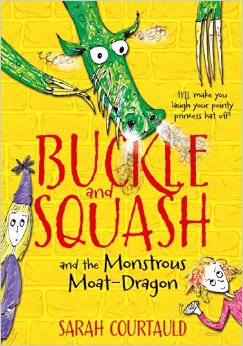
According to a number of reputable sources this book has, “won the Sainsbury’s Book Award, and has been shortlisted for the Sheffield Children’s Book Prize and Coventry Inspiration Book Award.” In the U.K. it was also originally released with the title Buckle and Squash and the Monstrous Moat-Dragon. I’m not entirely certain why the U.S. publisher chose to change that one. Perilous plots are nice and all but they can’t really hold a candle to freakin’ moat dragons, now can they? I mean, it’s a dragon! In a moat! Still, a title change is a small price to pay when you get a book as good as this one. Hand it to a boy, hand it to a girl, hand it to a goat, they’ll all enjoy it in their own ways (though the goat may need a bit of a floss afterwards). If there are more Buckle and Squash books on the horizon, let us hope they float our way. I, for one, will look forward to those adventures. After all, the Monty Python guys can’t live forever. Time for someone else to pick up the torch.
On shelves now.
Source: Galley sent from publisher for review.
Like This? Then Try:
Other Blog Reviews: Reading Rumpus
Professional Reviews:
Alternate Covers:
And here’s the book jacket whut wuz in Britain.
Misc: Read the first chapter here.
By:
Sue Morris @ KidLitReviews,
on 11/15/2015
Blog:
Kid Lit Reviews
(
Login to Add to MyJacketFlap)
JacketFlap tags:
Christmas,
Favorites,
Series,
Dan Hanna,
MacMillan,
Holiday Book,
Deborah Diesen,
gift-giving,
sea creatures,
5stars,
Contests-Giveaways,
Library Donated Books,
The Not Very Merry Pout-Pout Fish,
Farrar Straus Giroux BYR,
Children's Books,
holidays,
Picture Book,
Add a tag
THE NOT VERY MERRY POUT-POUT FISH VIRTUAL BOOK TOUR The Not Very Merry Pout-Pout Fish Written by Deborah Diesen Illustrations by Dan Hanna Farrar Straus Giroux BYR 9/08/2015 978-0-374-35549-4 32 pages Ages 2—6 “A gift should be BIG, And a gift should be BRIGHT, And a gift should be PERFECT— Guaranteed to …
By:
Betsy Bird,
on 10/19/2015
Blog:
A Fuse #8 Production
(
Login to Add to MyJacketFlap)
JacketFlap tags:
Reviews,
graphic novels,
First Second,
Roaring Brook,
Best Books,
macmillan,
middle grade graphic novels,
nonfiction graphic novels,
Best Books of 2015,
Reviews 2015,
2015 reviews,
2015 graphic novels,
funny graphic novels,
Maris Wicks,
Add a tag
 Human Body Theater
By Maris Wicks
First Second (a imprint of Roaring Brook and division of Macmillan)
$14.99
ISBN: 978-1-59643-929-0
Ages 9-12
On shelves now.
I gotta come clean with you. Skeletons? I’ve got a thing for them. Not a “thing” as in I find them attractive, but rather a “thing” as in I find them fascinating. I always have. Back in the 80s there was a science-related Canadian television show called “Owl TV” (a Canuck alternative to “3-2-1 Contact”) and one of the regular features was a skeleton by the name of Bonaparte who taught kids about various scientific matters. But aside from the odd viewing of “Jason and the Argonauts”, walking, talking (or, at the very least, stalking) skeletons don’t crop up all that often when you become grown. So maybe my attachment to Human Body Theater with its knobby narrator has its roots deep in my own personal history. Or maybe it has something more to do with the witty writing, untold gobs of nonfiction information, eye-catching art, and general sense of intelligence and care. Whatever the case, it turns out the human body puts on one heckuva good show!
When a human skeleton comes out and offers to right there, before your very eyes, become a fully formed human being with guts, skin, etc. who are you to refuse? Tonight the human body itself is putting on a show and everyone from the stagehands (the cells) to the players (whether they’re body parts or viruses) is fully engaged and involved. With our narrator’s help we dive deep beneath the skin and learn top to bottom about every possible system our bods have to offer. When all is said and done the readers aren’t just intrigued. They’re picking the book up to read it again and again. Backmatter includes a Glossary of terms and a Bibliography for further reading.
 I’ve been a big time Maris Wicks fan for years. It started long ago when I was tooling around a MOCCA (Museum of Comic and Cartoon Art) event and ran across just the cutest little paperback picture book. It couldn’t have been much bigger than a coaster and all it was was a story about a family taking a daytrip to the woods. Called Yes, Let’s it was written by Galen Goodwin and illustrated by a Maris Wicks. I didn’t know either of these people. I just knew the book was good, and when it was published officially a couple years later by Tanglewood Publishing I felt quite justified. But for all that I’d been a fan, I didn’t recognize Ms. Wicks’ work or name, at first, when she illustrated Jim Ottaviani’s Primates. When the connection was made I felt like I’d won a small lottery. Now she’s gone solo with Human Body Theater and the only question left in anybody’s mind is . . . why didn’t she do it sooner? She’s a natural!
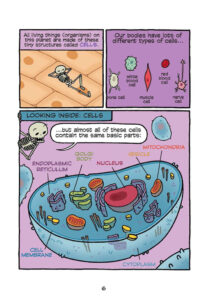
Now for whatever reason my four-year-old is currently entranced by this book. She’s naturally inclined to love graphic novels anyway (thank you, Cece Bell) and something in Human Body Theater struck a real chord with her. It’s not hard to figure out why. Visually it’s consistently arresting. Potentially dry material, like the method by which oxygen travels from the lungs to the blood, is presented in the most eclectic way possible (in this case, like a dance). Wicks keeps her panels vibrant and consistently interesting. One minute we might be peering into the inner workings of the capillaries and the next we’re zooming with the blood through the body delivering nutrients and oxygen. The colorful, clear lined style certainly bears a passing similarity to the work of author/artists like Raina Telgemeier, while the ability imbue everything, right down to the smallest atom, with personality is more along the lines of Dan Green’s “Basher Books” series.
For my part, I was impressed with the degree to which Wicks is capable of breaking complex ideas down into simple presentations. The chapters divide neatly into The Skeletal System, The Muscular System, The Respiratory System, The Cardiovascular System, The Digestive System, The Excretory System, The Endocrine System, The Reproductive System, The Immune System, The Nervous System, and the senses (not to mention an early section on cells, elements, and molecules). As impressive as her art is, it’s Wicks’ writing that I feel like we should really credit here. Consider the amount of judicious editing she had to do, to figure out what to keep and what to cut. How do you, as an author, transition neatly from talking about reproduction to the immune system? How do you even tackle a subject as vast as the senses? And most importantly, how gross do you get? Because the funny bones of 10-year-olds demand a certain level of gross out humor, while the stomachs of the gatekeepers buying the book demand that it not go too far. I am happy to report that Ms. Wicks walks that tightrope with infinite skill.
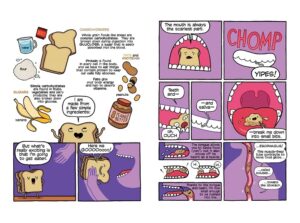 One of the parts of the book I was particularly curious about was the sex and reproduction section. I’ve seen what Robie H. Harris has gone through with her It’s Perfectly Normal series on changing adolescent bodies, and I wondered to what extent Wicks would tread similar ground. The answer? She doesn’t really. Sex is addressed but images of breasts and penises are kept simple to the point of near abstraction. As such, don’t be relying on this for your kid’s sex-ed. There are clear reasons for this limitation, of course. Books that show these body parts, particularly graphic novels, are restricted by some parents or school districts. Wicks even plays with this fact, displaying a sheet covering what looks like a possible penis, only to reveal a very tall sperm instead. And Wicks doesn’t skimp on the info. The chapter on The Reproductive Cycle, for example, contains the delightful phrase, “ATTENTION: Would some blood please report to the penis for a routine erection.” So I’ve no doubt that there will be a parent somewhere who is offended in some way. However, it’s done so succinctly that I wouldn’t be the least bit surprised if it causes almost no offense during its publication lifespan (but don’t quote me on that one).
If there is a problem with the book it may come right at the very beginning. Our skeleton hero introduces herself and from there you would expect her to jump right in to Human Body Theater with the bones. Instead, the storyline comes to a near screeching halt from the get go with a laborious explanation of cells, elements, and molecules. It’s not that these things aren’t important or interesting. Indeed, you can more than understand why they come at the beginning the way that they do. But as the book currently stands, this section feels like it was added in at the last minute. If it was going to preface the actual “show” then couldn’t it have been truly separate from the main event and act as a kind of pre-show entertainment?
What parent wouldn’t admit a bit of a thrill when their kid points to their own femur and declares proudly that it’s the longest bone in the human body? Or off-the-cuff speculates on the effects of the appendix on other body functions? We talk a lot about children’s books that (forgive the phrase) “make learning fun”, but how many actually do? When I wrack my brain for fun human body books, I come up surprisingly short. Here then is a title that can push against a certain kind of reader’s reluctance to engage with science on any level. It’s for the science lovers and graphic novel lovers alike (and lord knows the two don’t always overlap). More fun than it has any right to be. No bones about it.
On shelves now.
Like This? Then Try:
Source: Final copy sent from publisher for review.
Interviews: A great one conducted with Mara and The A.V. Club.
By:
Sue Morris @ KidLitReviews,
on 10/4/2015
Blog:
Kid Lit Reviews
(
Login to Add to MyJacketFlap)
JacketFlap tags:
The Westing Game,
puzzles,
Middle Grade,
mystery,
Favorites,
Series,
San Francisco,
Debut Author,
MacMillan,
Library Donated Books,
6 Stars TOP BOOK,
Book Scavenger,
Top 10 of 2015,
Jennifer Chambliss Bertman,
Christ Ottaviano Books,
ciphers and codes,
Henry Holtvand Company,
Sarah Watts,
Add a tag
Book Scavenger Written by Jennifer Chambliss Bertman Illustrations by Sarah Watts Christy Ottaviano Books 6/02/2015 . . …978-1-62779-115-1 . . . .354 pages Age 8—12 Junior Library Guild Selection “Twelve-year-old Emily is on the move again. Her …

by Bijou Le Tord (Four Winds Press, 1984)
Did you know I am a school librarian? I’m in my third year, at my second school, and have done it for about a decade with a break for graphics in between. Hashtag old.
And speaking of old, that’s what my current school is. That’s great for things like traditions and history, but it’s really great for things like stories. I’ve had a bit of a triage situation on my hands, and the thing that has taken the biggest chunk of time is massive weeding and collection development. (And undoing the work of the packiest rat that ever packed.)
I’ve been brutal in nonfiction and biographies because poor old Pluto has had better days and a 1970 biography of Peggy Fleming isn’t triple-lutz-ing off the shelves. But then there are picture books. And I haven’t tossed a single one. I need to, for reasons of both space and sanity. But when your library is old, there’s a lot that sparkles under all that dust. And I want to be careful because of things like early, early editions of the Nutshell Library.
Here’s one I found that I’d never heard of before, and wow. If you can get your hands on a copy, it would be a great pair with The Little Gardener.


This is the story of a rabbit, a gentle, shaky, line of a thing.
And it’s the story of his garden. He bids adieu to the snow and ice, and welcomes the warming sun.
These beginning spreads are so simple, so uncluttered, so spare. Those black lines on white, framed by spring’s pastels.
And the words! So unfussy. So beautiful.

When the day cools, he waters his seeds. The sun and the earth begin their work.

He patiently waits, and watches for a first ripple or a crack on the ground.

He patiently sits, until the first seedlings shoot up.
That last spread has a surprising detail, one that fits perfectly into the rabbit’s world but one that is unusual for this particular sequence of images: that star. The sun has been a small circle, hovering over the garden, doing its work. But while the rabbit waits, a star. It must be night. He’s taken his picnic basket and he’s patiently sat, and when the sun dropped, the star showed up.
The seasons take over, as they do, and soon it’s time to welcome back winter. The last time we see the rabbit, he is happy. His work is done.
This rabbit and his work are both sweet and slow and dear, and this book is a quiet little wonder.

By:
Betsy Bird,
on 8/6/2015
Blog:
A Fuse #8 Production
(
Login to Add to MyJacketFlap)
JacketFlap tags:
Reviews,
poetry,
Best Books,
Henry Holt and Company,
macmillan,
Calef Brown,
Christy Ottaviano Books,
funny poetry,
2010 poetry,
middle grade poetry,
Best Books of 2015,
Reviews 2015,
2015 poetry,
Add a tag
 Hypnotize a Tiger: Poems About Just About Everything
By Calef Brown
Christy Ottaviano Books, Henry Holt (an imprint of Macmillan)
$17.99
ISBN: 978-0-8050-9928-7
For ages 9-12
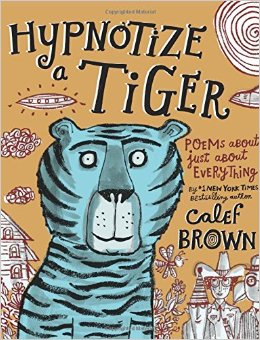
Why do I do this to myself? Let me tell you something about how I review. Board books? Pshaw. I can take one and write a nine-paragraph review parsing precisely why it is that Bizzy Bear’s preferred companions are dogs and bunnies. Nonfiction? Lay it on me. I’ll take infinite pleasure in discussing the difference between informational texts when I was a child (long story short, they sucked) and our current golden age. But there is one book genre that lays me flat. Stops me short. Makes it exceedingly difficult for me to get my head in order. Truly, children’s poetry books are the hardest to review. I don’t know exactly why this is. They are the most unloved of the books for kids. No American Library Association accredited awards are made specifically for them. They get checked out of libraries one month a year (April = National Poetry Month) and then lie forgotten. Yet so many of them are bite-sized wallops of greatness. Hypnotize a Tiger by Calef Brown is one of these chosen few. Not many poetry books for kids sport blurbs from Daniel Pinkwater (who found a soul mate in Brown’s art) to Jack Gantos to The Book of Life director Jorge R. Gutierrez. And few author/illustrators are allowed to go as positively wacky and wild as Brown does here. From tomato ultimatums and loofah tortes to velocipede odes and dodgebull (rather than dodgeball) you honestly never know where the book is going next. And you’re grateful for it.
So if it’s so great (and it is) why is reviewing a book of this sort the devil to do? There are any number of reasons. When reviewing a book with, say, a plot, it’s awfully easy for me to merely recap the plot, dish on the characters, bring up some single strange or scintillating point, then close it all down with a conclusion. Easy peasy. But poetry’s not really like that. There’s no plot to Hypnotize a Tiger. There’s not even a running gag that keeps cropping up throughout the pages. Each poem is its own little world. As a result, I’m stuck generalizing about the poems as a whole. And because we are dealing with 84-85 (depending on how you count) of them in total, I’m probably going to end up saying something about how some of the poems work and others don’t. This is kind of a cheat when you’re reviewing a collection of this sort because almost no children’s poetry book is absolutely perfect (Example A: The fact that Shel Silverstein wrote “Hug-a-War” . . . I rest my case). They will always consist of some verses that work and others that do not. In the end, the best I can hope for when reviewing poetry is to try to find something that makes it different from all the other poetry books published in a given year. Fortunately for me, Mr. Brown is consistently interesting. As Pinkwater said in his blurb, “He is a bulwark against mediocrity.”
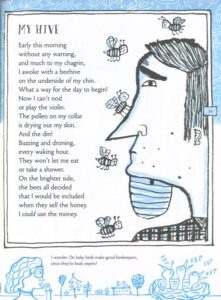 I’m very interested in the question of how to get kids around to reading poetry. My own daughter is four at this time and we’ve found that Shel Silverstein’s poetry books make for good bedtime reading (though she’s still thrown off by the occasional grotesquerie). For many children, Silverstein is the gateway drug. But Calef Brown, though he swims in Shel’s surrealism soaked seas, is a different breed entirely from his predecessor. Where Shel went for the easy silly ideas, Brown layers his ridiculousness with a bit of sophistication. Anyone could write a poem about waking up to find a beehive attached to the underside of their chin. It takes a Calef Brown to go one step further and have the unfortunate soul consider the monetary implications. Or to consider the verbal capabilities of Hoboken-based gnomes. So Hypnotize a Tiger becomes a book meant for the kid with a bit of prior poetry knowledge under their belt. You wouldn’t hand this title to a reluctant reader. You’d give it to the kid who’d already devoured all the Silverstein and Prelutsky and came to you asking, “What else you got?” That kid might be ready.
It is useful to note that you need to read this book aloud as well. There should be a warning sticker on the cover that says as much. Not that Brown makes it easy for you. Take the poem “Hugh”, for example. Short and simple it reads, “Meet my Belgian friend / He lives near Bruges, on a farm. / His name is Hugh Jarm.” Then at the bottom one of the tiny interstitial poems reads, “I once had a dream I was visiting Bruges – / snacking on chocolates while riding a luge.” Now the correct pronunciation of “Bruges” isn’t really necessary in the first poem, though it helps. The little tiny poem, however, is interesting because while it works especially well when you pronounce it correctly, you could probably mangle the wordplay easy peasy and still end up with a successful poem. SLJ probably said it best when they mentioned in their review of the book that, “Though there is more than one line that does not roll easily off the tongue and awkward rhymes abound, it is easy to see this clumsiness as part of the spirit of the collection.”
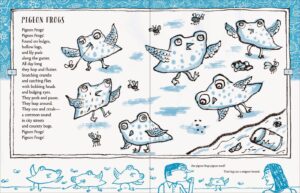 The subtitle of the collection is “Poems About Just About Everything” and that’s a fairly accurate representation. It does not mean, however, that there isn’t an internal logic to what’s being included here. There’s a chapter of animal poems, of people, insects, vehicles, schools, food, and then more esoteric descriptions like “Facts Poetic”, “Word Crashes”, and “Miscellaneous Silliness.” No poem directly applies to another, but they still manage to work together in tandem fairly well.
I don’t think it’s a serious criticism of a book to say that it’s not for all audiences. Calef Brown is an acquired taste. A taste best suited to the cleverest of the youngsters, absolutely, but acquired just the same. Not everyone is drawn to his style, and more fool they. To my mind, there is room enough in this world for any Calef Brown collection you can name. This book doesn’t have the widely popular feel of, say, a We Go Together but nor is the author writing poems simply to hear himself speak. Hypnotize a Tiger is a book built to please fans of creative curated silliness. Don’t know if you’ll like it? There’s only one way to find out. Pick this puppy up and read it to a kid. The book may surprise you (and so might the kid!).
On shelves now.
Source: Final copy sent from publisher for review.
Like This? Then Try:
Misc:
- I think this may honestly constitute the greatest class visit of all time.

By: Jerry Beck,
on 7/9/2015
Blog:
Cartoon Brew
(
Login to Add to MyJacketFlap)
JacketFlap tags:
Books,
nickelodeon,
Macmillan,
Avatar: The Last Airbender,
The Legend of Korra,
Bryan Konietzko,
Michael Dante DiMartino,
Comic-Con 2015,
Threadworlds,
Geniuses,
Add a tag
LIke his fellow 'Avatar' co-creator, Michael DiMartino is entering the world of publishing.
 Earlier this year, Macmillan established a partnership with Scribd. Initially, the publishing house agreed to allow subscribers to access more than 1,000 eBooks.
Today, the two companies have announced that an additional 1,000 Macmillan titles will be made available at the Scribd library. According to the blog post announcement, 300 of these new additions are children’s books.
The newly added books represent a wide range of genres such as fiction, nonfiction, and poetry. Readers can now enjoy works by Tom Wolfe, Hilary Mantel, and Madeline L’Engle through this eBook subscription service.
By: Jerry Beck,
on 7/6/2015
Blog:
Cartoon Brew
(
Login to Add to MyJacketFlap)
JacketFlap tags:
Comics,
nickelodeon,
Macmillan,
Mark Siegel,
Avatar: The Last Airbender,
The Legend of Korra,
Bryan Konietzko,
Michael Dante DiMartino,
First Second Books,
Threadworlds,
Add a tag
Hurry up and wait, benders! Bryan Konietzo's debut graphic novel series arrives in 2017.
I'm often asked by students which of my books is my favorite.
I used to say I don't have a favorite.
I love them all.
Well, I DO love them all.
But then I decided to 'fess up.
I DO have a favorite.
This one:
 |
| Greetings from Nowhere |
So that's why I LOVE this news:
Official on-sale date: 8/25/15.
So excited, y'all.
So excited to share this news (from Publishers Weekly Children's Bookshelf):
Janine O'Malley of Farrar, Straus & Giroux has acquired world rights for Wish, a novel by Barbara O'Connor. Eleven-year-old Charlie Reese has made the same wish since fourth grade, hoping that someday it will come true. When her irresponsible parents cause her to be sent to the Blue Ridge Mountains to live with family members she doesn't know, she needs that wish to come true more than ever. Publication is planned for fall 2016; Barbara Markowitz of Barbara Markowitz Literary Agency did the deal.
By:
Betsy Bird,
on 11/21/2014
Blog:
A Fuse #8 Production
(
Login to Add to MyJacketFlap)
JacketFlap tags:
David Macaulay Studio,
Reviews,
nonfiction,
nonfiction picture books,
Roaring Brook,
Best Books,
macmillan,
Katherine Roy,
Best Books of 2014,
Reviews 2014,
2014 reviews,
2014 nonfiction,
Add a tag
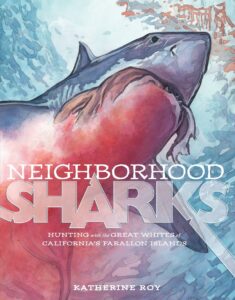 Neighborhood Sharks: Hunting with the Great Whites of California’s Farallon Islands
By Katherine Roy
David Macaulay Studio – Roaring Brook (Macmillan)
$17.99
ISBN: 9781596438743
Ages 7-12
On shelves now.
When you’re a librarian buying for your system, you come to understand that certain nonfiction topics are perennial favorites. You accept that no matter how many copies you buy, you will never have enough train or joke or magic books. And the king daddy topic to beat them all, the one that leaves a continual gaping hole in the Dewey Decimal area of 597.3 or so, is sharks. Kids can’t get enough of them. Heck, adults can’t get enough of them. Between Shark Week and movies like Sharknado, sharks haven’t been this pop culturally relevant since the good old days of JAWS. And sure, we’ve plenty of truly decent shark books on our shelves already. What we don’t really have are books that combine the blood and the facts with the beauty of full-color, wholly accurate paintings. We’ve never truly had a shark book that’s as accomplished and stunning as Katherine Roy’s Neighborhood Sharks. It’s crazy to contemplate that though shark books are never unpopular, only now did someone take the time and effort to give them a publication worthy of their terror and wonder.
A single great white shark cuts through the waters surrounding San Francisco’s Farallon Islands “just 30 miles from the city”. Prey comes in the form of a fine fat seal and before the mammal realizes what’s happening the shark attacks. What makes a shark the perfect killer? Consider its weapons. Note the body, covered in “skin teeth”, capable of acting like a warm-blooded fish. Observe its high-definition vision and five rows of teeth. Did you know that a shark’s jaws aren’t fused to the skull, so that they can actually be projected forward to bite something? Or the method by which you would go about actually tagging this kind of creature? With candor and cleverness, author/artist Katherine Roy brings these silent killers to breathtaking life. You may never desire to set foot into the ocean again.
It’s hard to imagine a book on sharks that has art that can compete with all those shark books laden with cool photographic images. Roy’s advantage here then is the freedom that comes with the art of illustration. She’s not beholden to a single real shark making a real kill. With her brush she can set up a typical situation in which a great white shark attacks a northern elephant seal. The looming threat of the inevitable attack and the almost Hitchcockian way she sets up her shots (so to speak) give the book a tension wholly missing from photo-based shark books. What’s more, it makes the book easy to booktalk (booktalk: a technique used by librarians to intrigue potential readers about titles – not dissimilar to movie trailers, only with books). There’s not a librarian alive who wouldn’t get a kick out of revealing that wordless two-page seal attack scene in all its horror and glory.
The remarkable thing? Even as she’s showing an eviscerated seal, Roy keeps the imagery fairly kid friendly. Plumes of red blood are far more esoteric and even (dare I say it) lovely than a creature bleeding out on land. You never see the shark’s teeth pierce the seal, since Roy obscures the most gory details in action and waves. There are even callbacks. Late in the book we see a shark attacking a faux seal, lured there by researchers that want to study the shark. Without having seen the previous attack this subsequent wordless image would lose much of its punch. And lest we forget, these images are downright lovely. Roy’s paintbrush contrasts the grey sea and grey shark with a whirling swirling red. You could lose yourself in these pictures.
Yet while Roy is capable of true beauty in her art, it’s the original ways in which she’s capable of conveying scientific information about sharks that truly won my heart. She’s the queen of the clever diagram. Early in the book we see an image of a shark’s torpedo-shaped body. Yet the image equates the shark with an airplane, overlaying its fins and tail with the wings and tail of a typical jet plane. Seeing this and the arrows that indicate airflow / how water flows, the picture does more to convey an idea than a thousand words ever could. I found myself poring over diagrams of how a shark can let in cold water and convert it in an internal heat exchange into something that can warm its blood. It’s magnificent. The close-up shot of how a shark’s five rows of teeth tilt and the shot that will haunt my dreams until I die of projectile jaws will easily satiate any bloodthirsty young shark lover hoping for a few new facts.
The projectile jaws, actually, are an excellent example of the tons of information Roy includes here that feels original and beautifully written. Roy is consistently child-friendly in this book, never drowning her text in jargon that would float over a kiddo’s head. Using the framing sequence of a shark attacking a seal, she’s able to work in facts about the creatures and their environment in such a way as to feel natural to the book. Neighborhood Sharks is one of the first books in the David Macaulay Studio imprint and like Mr. Macaulay, Ms. Roy is capable of artistic prowess and great grand factual writing all at once. The backmatter consisting of additional information, a word or two on why she decided not to do a spread on smell, Selected Sources, Further Reading, and a map of The Farallons is worth the price of admission alone.
The book is called “Neighborhood Sharks” for a reason. When we think of big predators we think of remote locations. We don’t think of them swimming along, so very close to places like the Golden Gate Bridge. Plenty of adults would be horrified by the notion that they might run into an unexpected shark somewhere. Kids, however, might see the prospect as exciting. Neighborhood Sharks has the potential to both satisfy those kids that have already read every single book on sharks in their local library and also convert those that haven’t already made sharks their favorite predator of all time. Remarkably beautiful even (or especially) in the face of straightforward shark attacks, this is a book that sets itself apart from the pack. If you read only one children’s shark book in all your livelong days, read this one. Disgusting. Delicious. Delightful.
On shelves now.
Source: Galley sent from publisher for review.
Like This? Then Try:
 Erin Stein will move from Little, Brown Books for Young Readers to the Macmillan Children’s Publishing Group (MCPG).
Stein will serve as publisher for a yet-to-be-named new imprint. She reports directly to MCPG president and publisher Jon Yaged.
In the past, Stein has worked on several licensed property projects that feature My Little Pony, Despicable Me, and The Muppets. With this new position, she will manage brand publishing ventures and oversee acquisitions for both commercial fiction and picture book manuscripts.
New Career Opportunities Daily: The best jobs in media.
 Three staff members at St. Martin’s Press have received promotions. All of them work within the art department.
Mike Storrings has been named vice president and creative director of the imprint. David Rotstein will tackle on the dual role of executive art director at St. Martin’s Press and creative art director of Minotaur. Olga Grlic has been appointed executive art director of the Griffin and mass market paperbacks teams.
New Career Opportunities Daily: The best jobs in media.
 And the hits just keep on coming! Ain’t no party like a Macmillan party, cause a Macmillan party has superior brownies. So there I was, HUGELY pregnant with some major back pain attending my penultimate librarian preview in a publisher’s home base (I actually have three more to write up after this, so no worries about me running out anytime soon). As you may know, Macmillan is based out of the Flatiron Building here in NYC and a nicer little ancient structure with teeny tiny elevators you will never meet.
Now a Macmillan Librarian Preview is a bit different from any other publisher’s preview. First off, superior desserts. So superior, in fact, that it takes an act of will not to eat large quantities of them. Second, they hold their previews in the afternoon, post-lunch, and end at the end of the work day (5ish or so). This allows you the chance to arrive on time, not particularly bleary-eyed, feeling guiltless when you go home afterwards. Third, they assign each attendee a group and then the groups go off into separate rooms.
I have been to (rough guess here) ten or so Macmillan previews over the years. I’ve seen them change and evolve over time into the clever current layout. And not once, NOT ONCE, had I ever been allowed to be a part of the group that stays in the first meeting room. Which is to say, the group that has access to those previously mentioned delicious snacks. But now I must credit the magical powers of my pregnant stomach. I got the first room! I got it!! Oh frabjous day, calloo, callay! Pardon me while I chortle in my joy.
And so it was that I sat in on the preview, finding that now I had to concentrate my willpower on NOT eating the delicious snacks, one after another. I tell ya, man. I ain’t never satisfied.
Onto the preview!
Farrar Straus Giroux
If You Were a Dog by Jamie A. Swenson, ill. Chris Raschka

It’s not as if Chris Raschka has to prove that he’s capable of drawing dogs or anything. I mean, he bloody won a Caldecott Award with one such book not too long ago. In the case of this particular title, we’re seeing a slightly squared off Raschka at work. The author is Jamie Swenson, whom I am delighted to report is a children’s librarian from Wisconsin. In the book a kiddo imagines being a dog, cat, fish, frog, and dinosaur. I particularly liked the line about being a “dino-eyed, perching-raptor sort of bird.” Extra Added Plus: In the vein of The Hello Goodbye Window (another Raschka award winner) the kid is mixed-race with a light mom and dark dad.
Rupert Can Dance by Jules Feiffer
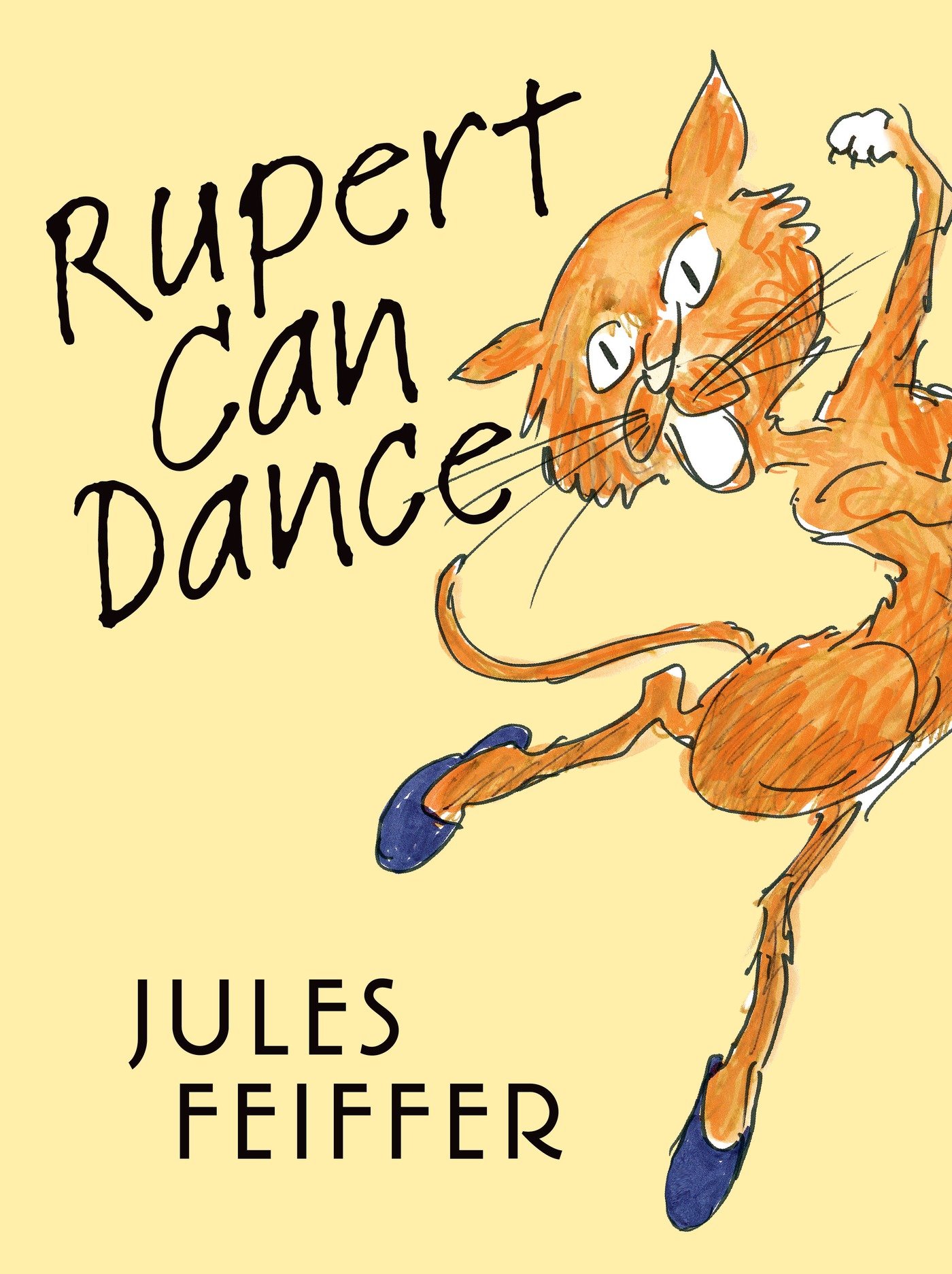
You can never predict a Feiffer. For a couple years now he’s been pairing his art to his daughter Kate’s writing, yielding such lovely titles as My Side of the Car (which I personally am really quite fond of). From time to time he’ll still strike out on his own, though. I consider some of his solo picture book efforts true classics (see: Bark, George and The Daddy Mountain as two examples). Now we meet Rupert, the dancing cat. Since Feiffer’s picture books often have interesting back stories, one can only hope the tale behind this tale will come out someday. In this book a cat that likes to dance en seul is discovered by his human owner. Unfortunately, her attempts to “help” result in him pulling away and quitting his high-stepping altogether. Things eventually reach a happy conclusion, and I couldn’t but think that the story was an excellent metaphor for when parental “help” offered to children is rebuffed in much the same way that Rupert rebuffs his mistress. Consider pairing this with Flora and the Flamingo or Penguin Cha-Cha.
And Two Boys Booed by Judith Viorst, ill. Sophie Blackall

I’m all about helping kids deal with disappointment and failure. Seems to me a healthy thing to do. Recently I reviewed The Most Magnificent Thing by Ashley Spires, which shows kids that getting things wrong over and over again can actually be a good thing. Along much the same lines comes the latest from the author that brought us Alexander and the Horrible, Terrible, No Good, Very Bad Day. So basically, we’re talking about a woman with some experience with disappointed boys. In this tale there is a small classroom talent show going on and our hero is going to sing. Trouble is, there are a LOT of kids before him and he really has to wait before his singing happens. Told with rhythmic text and some really nice little flaps that you lift, it doesn’t hurt matters any that the art is by Sophie Blackall, one of my favorite illustrators of regular everyday kids. When our hero does finally get his chance, most everyone applauds though two boys do boo him. Fortunately, it doesn’t hurt him one jot. And brother, if you can survive being booed as a kid then you are emotionally and mentally set for LIFE! What a cool idea for a book.
Little Humans by Brandon Stanton

So I’m walking down the street with my husband the other day and he says to me, “You know what the Humans of New York guy should do? He should make a book for kids.” I was mighty pleased to be able to say, “It’s out this October.” So there you go, folks.
The Key That Swallowed Joey Pigza by Jack Gantos
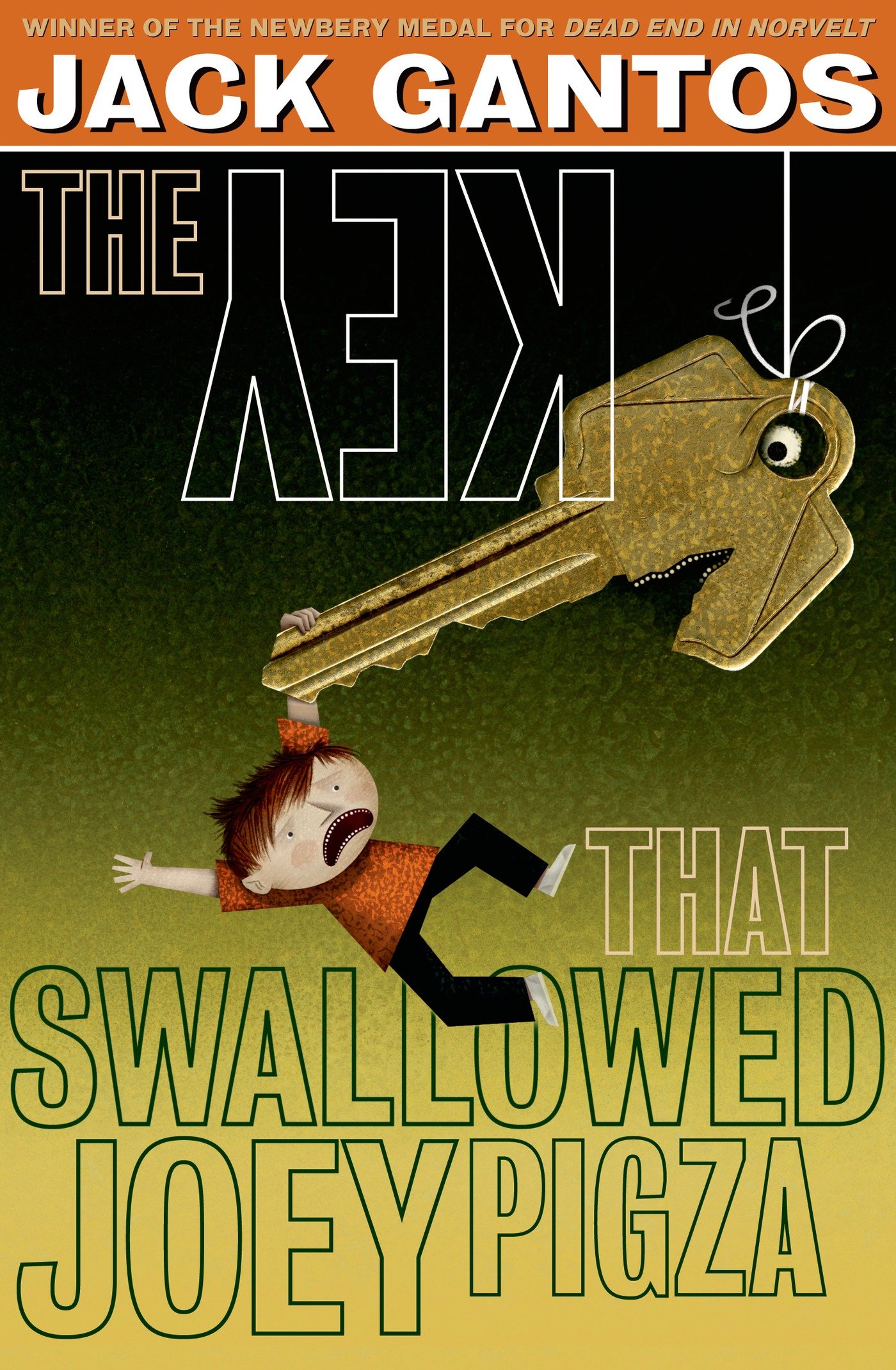
Sometimes a book jacket artist is so obvious you feel as if they’ve always been the artist on a series. Lane Smith’s covers of the Joey Pigza books? Yes, obviously. He did those years ago, right? Nope. And why no one thought to pair Smith and Gantos together before now is baffling. I mean, talk about a match made in heaven! These guys complete one another. As for the fact that there’s another Joey Pigza on the horizon, woohoo! Do you remember how angry some folks got when the last one came out? I remember some librarians complaining because at the end of #3 Joey really seemed like his life was coming together. Then it all fell apart in #4 (I Am Not Joey Pigza). In #5 he’s still dealing with some major problems and if I were a betting woman I’d say it’s likely that there are no easy answers. One thought about the title, it’s going to make keyword searches for the first book just the teensiest bit more difficult now.
Spirit’s Key by Edith Cohn
More keys. I have to remember how they were describing this one. If I’m remembering correctly then they said this was “Savvy meets Because of Winn-Dixie” (a “meets” I have certainly never seen before). I heard their description of this book but for some reason I just wasn’t able to get my fingers to write down the information correctly. Here’s the official summary then: “By now, twelve-year-old Spirit Holden should have inherited the family gift: the ability to see the future. But when she holds a house key in her hand like her dad does to read its owner’s destiny, she can’t see anything. Maybe it’s because she can’t get over the loss of her beloved dog, Sky, who died mysteriously. Sky was Spirit’s loyal companion, one of the wild dogs that the local islanders believe possess devil spirits. As more dogs start dying and people become sick, too, everyone blames the dogs–except for Spirit. Then Sky’s ghost appears. His help may be the key to unlocking her new power and finding the cause of the mysterious illness before it’s too late.”
Feiwel and Friends
Frankenstein’s Fright Before Christmas by Nathan Hale and Rick Walton
I never really noticed it before but Frankenstein sort of looks like a shorter, more undead version of Hale’s Hangman from the Nathan Hale’s Hazardous Tales series. See?
Sorry. That was random. I just love the Hazardous Tales series so much I’ll use any excuse to talk about ‘em. Anywho, here we have the sequel to Hale and Walton’s rather successful Frankenstein which, as you may recall, was a parody of Madeline. Looking at the book I was definitely reminded of The Nightmare Before Christmas. Not the worst thing to think of when looking at a new book, wouldn’t you say?
Rain Reign by Ann M. Martin
Right now this is the book I feel guiltiest for not having read yet. To give us a taste, five pages of this book were read aloud. And yup. That was pretty much all it took to get us all very very VERY interested. Yes, you could say that it looks rather familiar since it is yet again an Ann M. Martin dog book. But the individual voices of the characters, in particular the father and the daughter, are amazingly well delineated. With a heroine with Asperger’s who finds numbers and homonyms comforting, this was the take away line from the preview: “You may not like her, but you’ll love her.” Oooo. Well played, Feiwel and Friends.
Zorgoochi Intergalactic Pizza: Delivery of Doom by Dan Yaccarino
What does it say about a publisher when they have not one but TWO books for kids coming out the same year featuring outer space heroes that deliver pizzas? Over at the First Second imprint they’ve already published James Kochalka’s The Glorkian Warrior Delivers a Pizza. Now Feiwel and Friends are coming out with a middle grade novel about an independent space pizza company (never buy your space pizza from corporate sellouts, sweethearts). Copiously illustrated by Yaccarino and nicely designed, there is a moral to this tale: “Aliens aren’t good tippers.” It’s an interesting size for a middle grade, coming in at a slightly larger than usual 6″ X 9″. And since the story does, at some point, involve talking garlic, I officially approve. Insofar as I’m concerned, all books should involve talking garlic in some way. It just makes sense.
Coming Home by Greg Ruth
Okay. Fess up. How many of you have watched those YouTube videos of soldiers returning home, being greeted by their loved ones and haven’t teared up? Here, I’ll give you a challenge. Watch this and don’t cry.
Now admit that this is a great idea for a picture book. Greg Ruth was last seen creating the creepy as all get out graphic novel The Lost Boy. Switching gears entirely, he’s now penned a picture book that will be out just in time for Veteran’s Day. In this tale, a boy waits for his mom in an airport. As he does we see family after family greeting returning soldiers home.
Henry Holt
The Storm Whale by Benji Davies
I’m the kind of parent who always makes a big show of reading the author’s name when I read a book aloud to my kiddos. As a result, the name “Benji Davies” is VERY familiar to me. That’s because here in the States we primarily know him through his Nosy Crow imports like the Bizzy Bear series. Turns out, the man has loads of other books under his belt, and they do not all happen to involve wide-eyed board book bears. This book sort of looks like a combination of One Morning in Maine meets modern Japanese prints. With beautiful saturated color the story follows a boy, his fisherman father, and their cats. One day the boy finds a small whale on the beach and brings it home. Imagine this to be a companion to Lost and Found by Oliver Jeffers. Then head on over to the 100 Scope Notes post on the proliferation of whales in children’s books this year.
This Book Just Ate My Dog by Richard Byrne
I don’t know if you’ve noticed but after the publication of Herve Tullet’s Press Here, its overwhelming success led to a string of copycat picture books. And they all basically did the same darn thing, but with a mild twist here and there. *snore* If you’re going to make an interactive picture book where the format is key to the storytelling, at least put a little originality in there, people. Originality is the name of the game with Byrne’s latest. This is a book that uses the gutter (in layman’s terms, the middle of the book between the pages) as part of the plot. It’s funny and quirky and really rather clever. It would also make a GREAT readaloud picture book. Just sayin’.
Little Elliot, Big City by Mike Curato
I consider this one a love letter to New York City. It reminded me in equal turns of Gus Gordon’s Herman & Rosie and Dan Santat’s Beekle. In this story a small polka dotted elephant (the polka dots are awfully light) finds that he is just too small in this way too big city. Fortunately, he soon finds a friend who makes the experience of NYC a little more manageable.
Classic Comics: Pinocchio by Kate McMullan, ill. Pascal LeMaitre
Fun Fact: Did you know that in the original tale of Pinocchio it wasn’t a whale that swallowed everybody’s favorite wooden boy but a shark? You can thank Disney for mucking up your memories in that respect. McMulland and LeMaitre (who may sound familiar to you because he illustrated Andrea Beaty’s Ted books) have created an early chapter book hybrid graphic novel series in two-colors based on classics. First up (working off the original text) is Pinocchio. Next: Robin Hood.
Centaur Rising by Jane Yolen
In some ways, Jane Yolen is the queen of the hybrid humans. I can’t tell you how easy it has been over the years to hear the pleas of mermaid loving girls and then hand them Yolen’s Neptune Rising (check out the cover and you’ll see what I mean). Her latest is a bit of historical fiction with a title very similar to that old merman tale. Here’s the official publisher plot: “One night during the Perseid meteor shower, Arianne thinks she sees a shooting star land in the fields surrounding her family’s horse farm. About a year later, one of their horses gives birth to a baby centaur. The family has enough attention already as Arianne’s six-year-old brother was born with birth defects caused by an experimental drug—the last thing they need is more scrutiny. But their clients soon start growing suspicious. Just how long is it possible to keep a secret? And what will happen if the world finds out?”
Little Author in the Big Woods: A Biography of Laura Ingalls Wilder by Yona Zeldis McDonough,
ill. Jennifer Thermes
The most interesting thing about this is that the cover and interior illustrations evoke most clearly (and we have to assume, deliberately) the original illustrations of the Little House books by Helen Sewell. Knowing, as they do, that the Little House books are most accessible to slightly older children, this book makes Laura & Co. applicable to younger folks. Recipes and crafts are also included.
And Away We Go by Migy
Balloons are very big with Macmillan this year (as you will soon see with an upcoming Philip Stead book). In this cumulative story a fox gets a hot air balloon. As he travels, more and more animals join for a ride, bringing something with them. That’s when things get a little crazy. Think of a book like The Mitten only set in a hot air balloon and you’ll have the right notion. Plus, you’ve gotta love the retro look that one-namer Migy has cultivated here. Sweet.
Strongheart: The World’s First Movie Star Dog by Emily Arnold McCully
There is something deeply askew in the universe this year. I like dog books. Books. Plural. I keep bloody running into dog books that I enjoy and I am NOT a dog person. If it’s not Stubby the War Dog by Ann Bausum then it’s Tuesday Tucks Me In by Luis Carlos Montalvan or Kathi Appelt’s Mogie: The Heart of the House. Know what these all have in common? They’re all based on real dogs. McCully’s is no different. Before Lassie, before RinTinTin, there was Strongheart. A former soldier dog from Germany, Strongheart could march and obey orders but he didn’t know how to play. That meant he was an ideal actor (and don’t worry, the man who got him taught him to play as well). He became a real sensation of the 1920s, and his on-screen exploits even inspired the owners of RinTinTin. Pair this book with the aforementioned Stubby as well as Meghan McCarthy’s Balto for other books about dogs-turned-Vaudeville and onscreen stars.
Tales of Bunjitsu Bunny by John Himmelman
If I were to list my favorite picture books of all time, I would be ashamed not to mention Chickens to the Rescue and Katie Loves the Kittens, two of my favorite books. In the same vein as such series as Usagi Yojimbo comes an early chapter book series about a martial art that is entirely for bunnies. Short little stories and a single color (red), John himself has long studied martial arts so he knows from whence he writes when he includes such elements as bunchucks (they’re made of carrots).
Three Pickled Herrings by Sally Gardner, ill. David Roberts
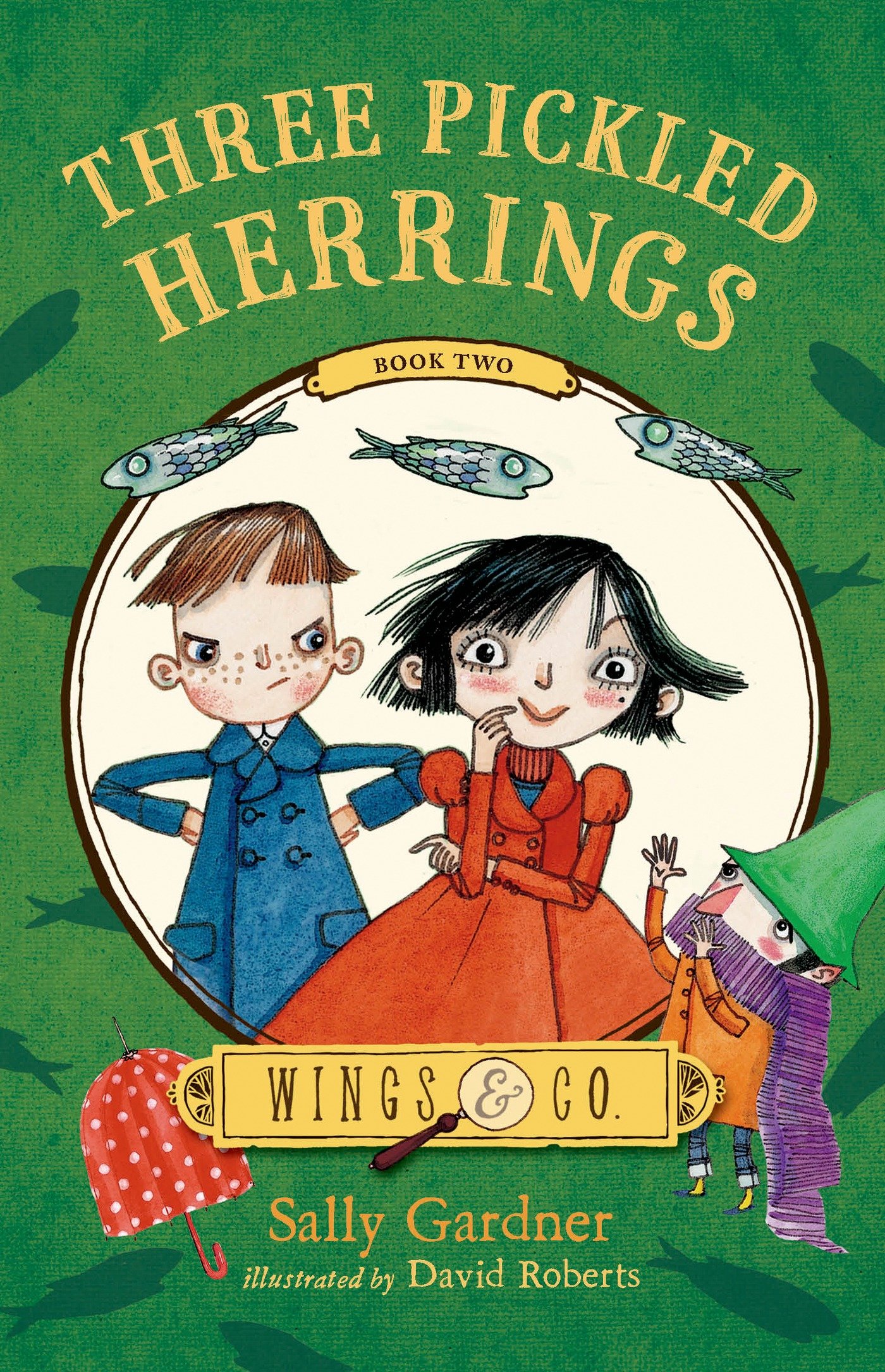
To a certain extent I’m including this because I enjoyed the first book in the series so very much. I’m sure I don’t have to tell you all how charming Operation Bunny: The Fairy Detective Agency’s First Case by Sally Gardner (which came out earlier this year) is. If you haven’t read it yet then tsk tsk tsk. It’s a pure delight. Very much in the Dahl vein, only slightly more refined. In any case, to know that there’s a second book coming out is just icing on the cake. I will be reading this.
How It Went Down by Kekla Magoon
As per usual I have a tendency to skip mentioning all the YA in a given preview and as per usual I make exceptions here and there. Kekla Magoon will always be such an exception as she is exceptional. What we have here is a kind of Trayvon Martin storyline. A black boy has been shot by a white man. Done in a Monster style (there are multiple voices and conflicting viewpoints) the crime has already happened. Lots of people feel conflicted about the crime. A politician who honestly feels this was a horrible thing to happen discovers that it does wonders for his poll numbers. A person who honestly didn’t like the victim now has to deal with his death. Great cover (love the hoodie). A must read.
The Book of Three (50th Anniversary Edition) by Lloyd Alexander
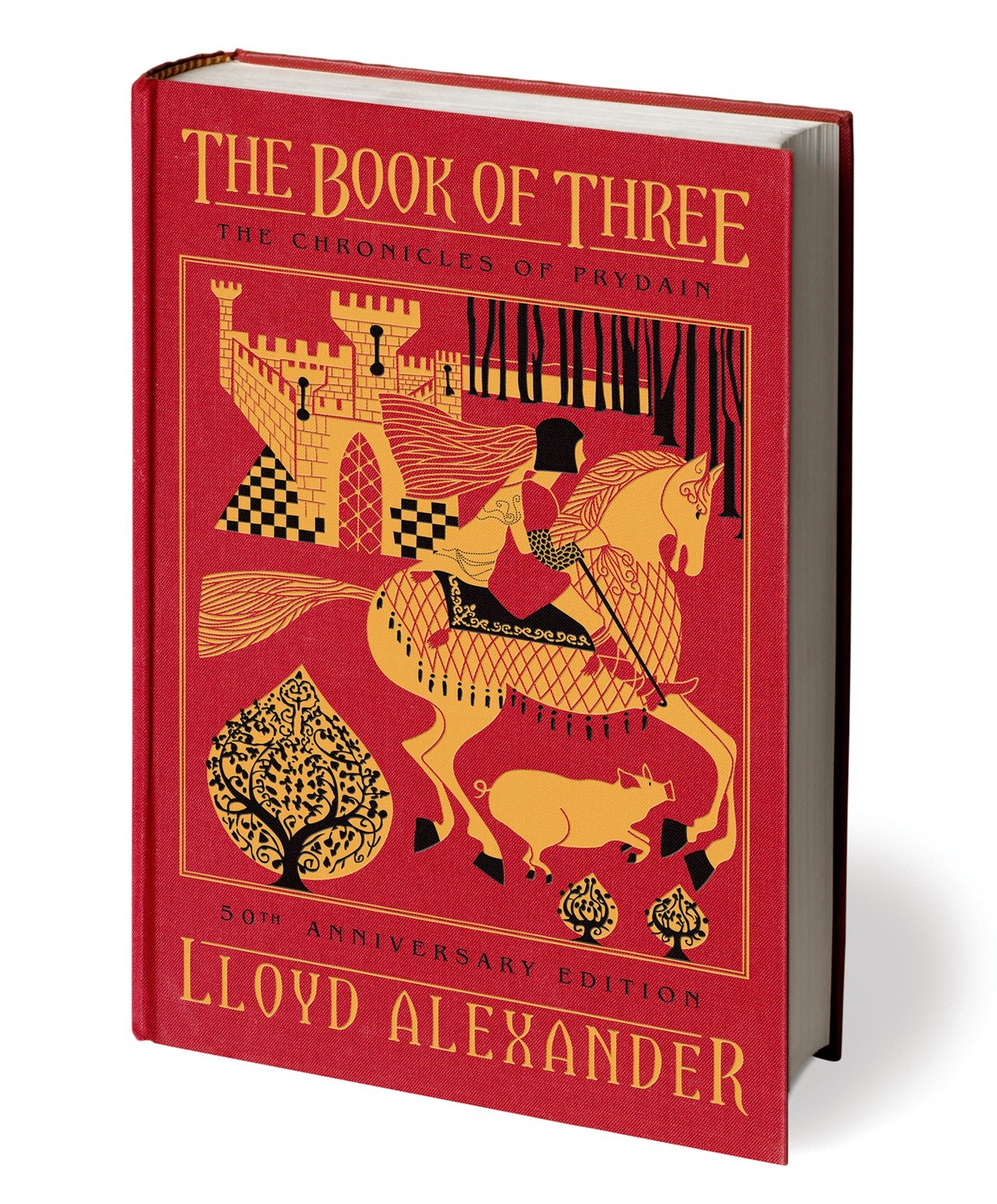
It’s been fifty years since Lloyd Alexander introduced the world to Prydain. That’s long enough for people to have forgotten the lamentable Disney film based on them and to remember only Alexander’s wit and wisdom. In this lovely new celebratory cloth-bound edition they’ve amped up the original cover and included an introduction from Shannon Hale. The foundling stories are now included in the back, which is a clever idea. Other books in the series will be coming soon too.
Roaring Brook Press
Viva Frida by Yuyi Morales

Are you excited? You should be. But you should also not rush to conclusions. If you’re looking for a straight picture book bio of Frida Kahlo then this is not the book for you. Written in both English and Spanish, Morales utilizes her impressive artistic skills to create this utterly beautiful mixture of illustration and models. With extremely simple text the book is less about Frida’s life and more about her inspiration as an artist. Biographical information is included at the end, but this is a book to hand to budding artists. It reminded me of Yuyi’s previous, fantastic, experiment with models with Tony Johnston’s My Abuelita. And speaking of Tony Johnston . . .
Sequoia by Tony Johnston, ill. Wendell Minor

Looks like we finally have a companion book for Jason Chin’s Redwoods. The difference is in the complete and utter absence of humans. In this book the tree is the true protagonist. Using poetic language, the book examines a single sequoia. Readers are encouraged to occasionally turn the book on its side from time to time to read it. Very cool stuff.
Neighborhood Sharks: Hunting the Great White Sharks of California’s Farallon Islands, by Katherine Roy
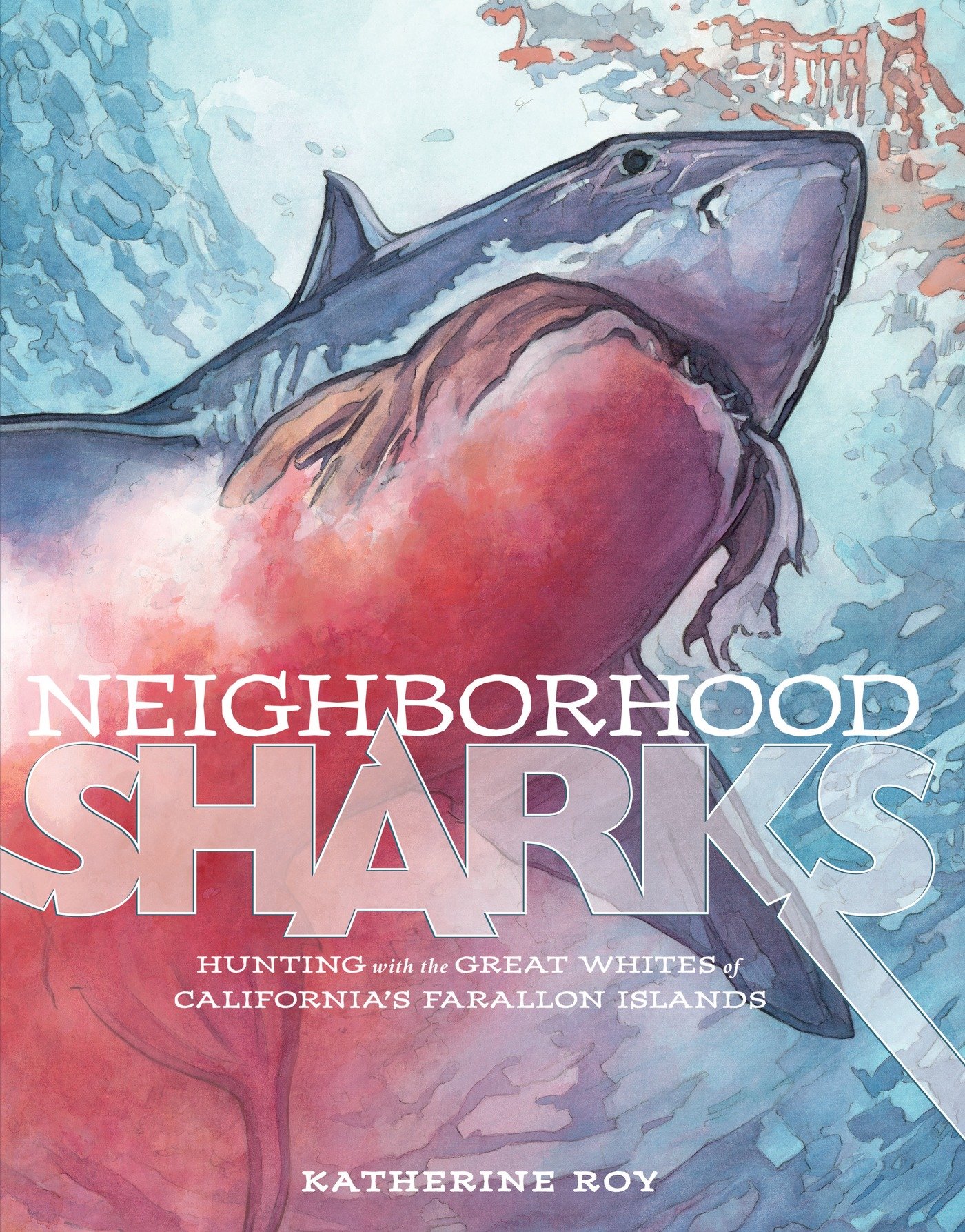
Great cover, right? There are a number of reasons to be excited about this particular book. I heard about it a year or so ago and have been anxiously awaiting its appearance ever since. This is the first book in the brand spanking new David Macaulay imprint at Macmillan. As the editors put it this is, “the most up-to-date book on sharks you will find.” Consider Ms. Roy a debut to watch. Gotta love that title too.
Sebastian and the Balloon by Philip C. Stead
The other balloon book of note. Here we have a new Stead, coming out at the same time as his interview site Number Five Bus Presents. To hear his editors speak of it, it’s a book about loneliness, friendship, quests, “and realizing your heart’s desire.” I found it to have a distinctly “classic” picture book feel to it. Plus, the man does a good bear. That’s important too, right?
Kid Sheriff and the Terrible Toads by Bob Shea, ill. Lane Smith

Look, I’ll level with you. I love Bob Shea and I have great fondness for the work of Lane Smith, but neither of them guarantee a slam dunk of a book every time. And yes, putting them together is fun but even that wasn’t enough to sway me. I had to read this puppy before I’d write it off as brilliant. And fortunately, it stood up to the test. Maybe that’s because it’s so bloody odd. Travis Jonker will tell you that the biggest trend in children’s books this year is whales, and he’s right. But if I were to pick a very strange sub-trend, I’d go with Westerns Featuring People Riding Tortoises. Don’t believe me? Well, we have this and we also have the new Anne Issacs title Meanwhile, Back at the Ranch. Sure, it’s only two but it’s two in the same year. That’s gotta mean something.
The Iridescence of Birds: A Book About Henri Matisse by Patricia MacLachlan, ill. Hadley Hooper
The way editor Neal Porter describes getting the pitch of this book, he was an event with Ms. MacLachlan and asked what she was working on. She told him it was a book that would never get published. Gotta watch yourself around Neal Porter though. Them’s fighting words. Challenge accepted! So basically what you have here is a book consisting entirely of two sentences. Two long run-on sentences, but still. Just two. Meant to be read aloud, this pairs well with the aforementioned Frida book because like Frida it has less to do with being a strict biography and more about what it means to be an artist. Illustrator Hadley Hooper may look somewhat familiar to you, by the way, since his last book was that cool bio Here Come the Girl Scouts.
Born in the Wild: Baby Mammals and Their Parents by Lita Judge

A new Lita Judge is always cause for celebration. Going a little bit more cuddly than her previous forays into birds and dinos, this book talks about the different things that babies need from their parents. The book follows the current trend of including a younger readaloud text alongside nonfiction background information for older readers. It’s a clever way of making a single book accessible to a range of ages. Clever, yes?
Edible Colors by Jennifer Vogel Bass

As a mother who attempts to break the cycle of picky eating with her own children (and the universe says, “Yeah. Good luck with aallllll that”) I instinctively gravitate towards any book that includes photographs of healthy food. The first thing I thought when I saw Jennifer Vogel Bass’s latest nonfiction picture book was of April Pulley Sayre’s Rah Rah Radishes and Go Go Grapes. In the same vein as Eating the Alphabet, the book consists of different colors and the fruits and veggies that are those colors. I’m very curious to see how Bass tackles blue. For the photos, Bass actually grew most of the foods here, going to her local markets for the rest.
Star Stuff: Carl Sagan and the Mysteries of the Cosmos by Stephanie Roth Sisson

With the new Cosmos television show I’ve been saying for quite some time that somebody needed to do a Neil deGrasse Tyson picture book bio. Well . . . this ain’t it. Ain’t it, but it’s the next best thing. Carl Sagan for the kiddos! Considering that in my own youth my sole understanding of who Sagan was consisted of a Bloom County cartoon (points to anyone who can name which one) this is a step in the right direction. This story tells how Carl got into science and ends with the Voyager project, golden records and all. So now at long last we’ve something to hand the Cosmos watchers! Woohoo!
The Graham Cracker Plot by Shelley Tougas
Huh. Is that a Jeff Newman cover I see? Hard to tell. I should have asked at the time, actually, but I was too distracted by (A) The cool title and (B) the fun sounding plot. In this tale by debut author Shelley Tougas, Daisy and Graham decide the time has come to bust her dad out of jail and escape to Canada. The entire book is told in the form of a letter to a judge about the events as they occurred. As you might be able to tell, not everything goes according to plan.
The Scandalous Sisterhood of Prickwillow Place by Julie Berry
Clearly somebody has been making blood sacrifices to the gods of good cover design. That somebody must be Julie Berry. In this Victorian farce seven girls in a boarding school make an unusual choice when their headmistress drops dead at tea. Rather than report the fact, they decide to pull a Summer of the Gypsy Moths and bury the body themselves, telling no one. Of course, that does still mean that her killer is out there. Now tell me you’re not intrigued.
First Second
Julia’s House for Lost Creatures by Ben Hatke
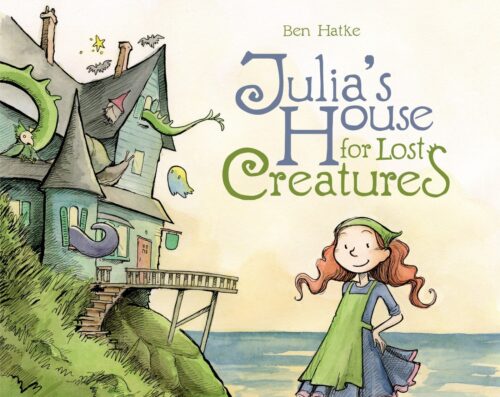
I know that you already love his Zita the Spacegirl graphic novels, but that series just wrapped up. So what’s the next step for Mr. Hatke? How about picture books? Because this book has been available through Netgalley, some of my librarians have already read it and they are BIG time fans. In this story Julia opens up her house to a range of odd creatures, and then must domesticate them (read: Get them to do their chores). For some reason, this felt like a good companion to this year’s The Midnight Library by Kazuno Kohara. And it definitely reminded me of that old Cartoon Network show Foster’s Home for Imaginary Friends.
Above the Dreamless Dead: World War I in Poetry and Comics, edited by Chris Duffy
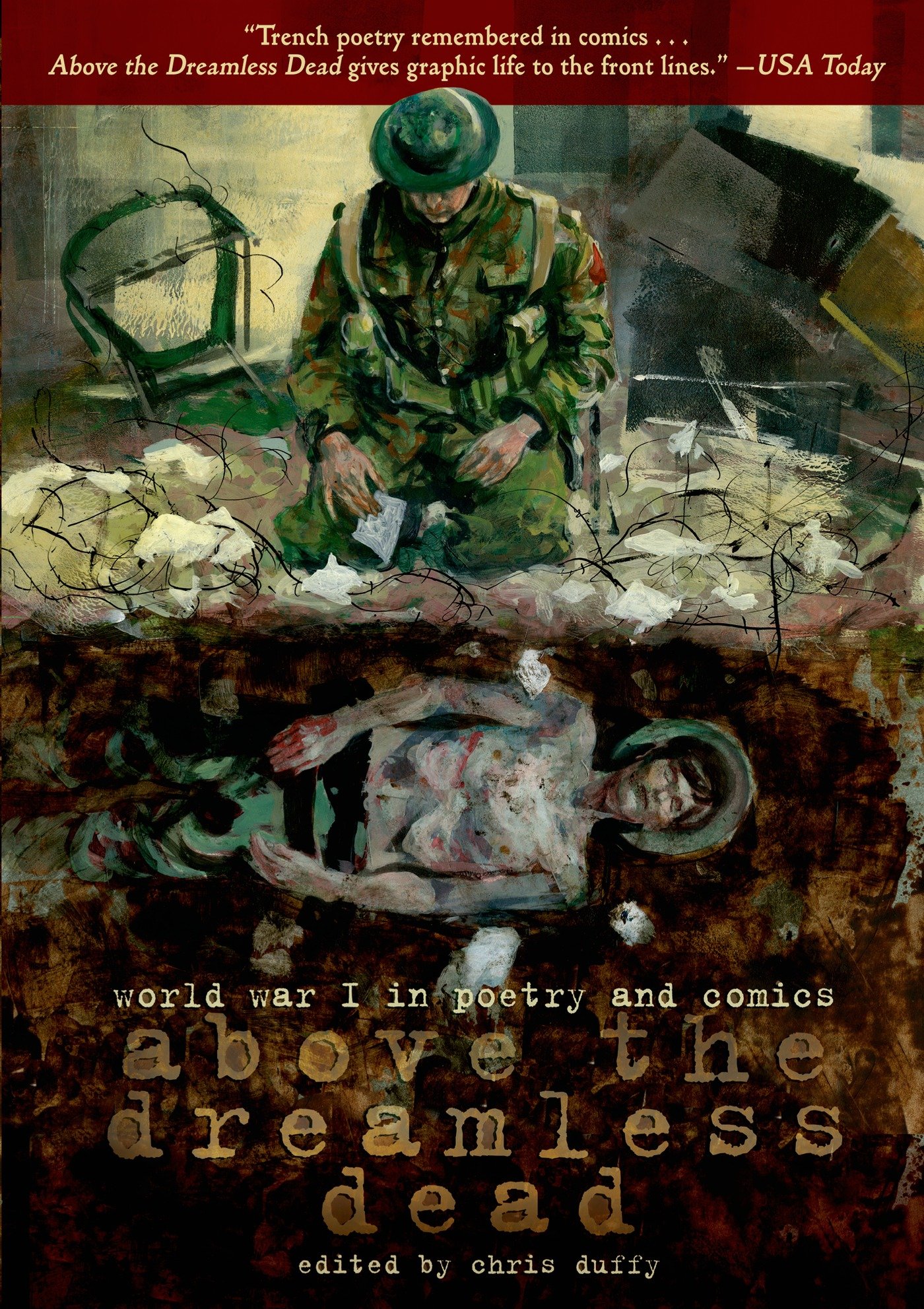
A far cry from Nursery Rhyme Comics, eh Duffy? So this would be the second YA title to grace my round-up. I wouldn’t necessarily mention it except that I love all the books that Duffy edits and this ties in so well with all the WWI units we’re hearing about this year. Taking real poetry written by WWI soldiers in the trenches (called “trench poetry”) each poem is accompanied by a different cartoonist’s work. A quick warning that this is being marketing for adults, but it has definite YA crossover potential. FYI.
And that is that! Many thanks to Macmillan for the lovely preview. And thanks to you all for reading.

By:
Debbie Reese,
on 5/27/2014
Blog:
American Indians in Children's Literature
(
Login to Add to MyJacketFlap)
JacketFlap tags:
middle grade,
middle school,
stereotypes,
not recommended,
Macmillan,
Copper Magic,
grave robbing,
Julia Mary Gibson,
Pub year: 2014,
Add a tag
In Copper Magic, twelve-year-old Violet Blake is digging by a stream near her house in Michigan and finds a "talisman" -- a copper hand that she comes to call "the Hand." Violet feels that this hand has some kind of power. She thinks she can use it to make wishes come true. Course, her first wish (for a new dress) does come true (actually she gets TWO new dresses), so she's thinking about how she'll use it to get her mom and little brother back home. Her mother is half Odawa.
Well, it turns out there was more than just that copper hand in the spot where Violet was digging. There's also a skeleton there that is dug up (another kid finds it), reassembled, and displayed as a curiosity in a local hotel.
Cue some fake Hollywood Indian music...
Can't be messing around in them Indian burial grounds, right?! We've seen THAT enough times in movies and TV shows to know that messing with bones and artifacts means bad things are gonna happen. And of course, bad things happen to the people in Copper Magic. Lots of bad things. A wicked storm. Lake water behaving in odd ways. Death. Before all that happens, Mercy (Violet's new friend) talks about how there might be a curse on the grave... Violet and her mother (remember--her mom is half Odawa) have special powers, too. They can see things other people can't.
"Cut!"
Cut that fake Hollywood Indian music, that is, and an emphatic "Cut it out!" as my parents would say when I was doing something wrong.
Cut it out, Julia Mary Gibson!
Cut it out, Susan Cooper!
Cut it out, Rosanne Parry!
"Cut what?" you may wonder... Quit writing about Native spirituality! You mean well, but you don't know what you're doing. From a place of ignorance, you're adding to an already-too-tall pile of garbage that gets circulated as information about Native people.
A good many writers have a moment in their life that touched them in such a way that they feel they must write about Native people. Gibson's moment is described in her Afterword. When she was eleven years old, she and her family found some bones near their summer cottage in Michigan. "[A]n expert" said they were "most likely American Indian but not old enough to be archeologically significant" (p. 329), so her grandfather "pieced together a skeleton and mounted it on plywood." Her "superstitious" grandma didn't like it and insisted the bones be reburied. This took place in the late 1960s or early 1970s (my guess, based on
Gibson's bio at Macmillan that says she was born "in the time of Freedom Rides and the Vietnam War").
Gibson goes on to say that her grandfather didn't know better.
In
Copper Magic, Violet is Gibson. The person who puts the skeleton on display is Mr. Dell, a hotel owner intent on increasing his business. The superstitious person who wants the bones reburied? Well, that is Mrs. Agosa, an Odawa woman who tells Violet to "Watch out for ghosts out by you" because "mad ghosts can throw out curses" (p. 134).
Gibson,
Cooper,
Parry and many other writers poke around a bit and pack their stories with bits of info that make it sound like they know a lot about American Indians. Gibson does that in
Copper Magic when she has some of her characters talk about grave robbing and why it is wrong. She also does that when she has Mrs. Agosa talk about the hotel owner burning her people's village and orchards because he wanted their land. In the Afterword, Gibson tells us that part of the story is true (p. 330):
"The real people of the Chaboiganing Band were yanked from their houses by a crooked land grabber and the local sheriff, who flung kerosene over homes and orchards and burned down the whole village, just as Mrs. Agosa tells it."
The burning of that village is important information. It is what major publishers like Macmillan (publisher of
Copper Magic) ought to make known. I wish Gibson had made it the heart of her story. Instead, she chose to tell a story about grave robbing, curses, and mystical Indians. There's more to the "mystical Indians" theme... Interspersed throughout
Copper Magic are pages about two ancient women: Crooked Woman and Greenstone. Those parts of Gibson's novel are presented in italics. They feed the mainstream monster of stereotypical expectations--where people love to read about "mystical Indians" and our tragic history.
In
Copper Magic, Violet's dad is a steady voice saying that Indian graves deserve respect and ought to be left alone. Violet parrots some of what he says but doesn't really understand. Ironically, Gibson is more like Violet than she realizes. Her understanding is superficial. Violet wants to use the hand to get what she wants. Gibson uses the childhood story to do what she wants.
As you may have guessed by now, I don't like what Gibson has done in
Copper Magic. And of course, I do not recommend it.
Copper Magic is another FAIL from a major publisher.
By:
Betsy Bird,
on 5/5/2014
Blog:
A Fuse #8 Production
(
Login to Add to MyJacketFlap)
JacketFlap tags:
nonfiction picture books,
Best Books,
Bryan Collier,
Henry Holt and Company,
macmillan,
Best Books of 2014,
Reviews 2014,
2014 reviews,
2014 nonfiction,
2015 Sibert contender,
Claire Rudolf Murphy,
Reviews,
nonfiction,
Add a tag
 My Country, ‘Tis of Thee: How One Song Reveals the History of Civil Rights
By Claire Rudolf Murphy
Illustrated by Bryan Collier
Henry Holt and Company (an imprint of Macmillan)
$17.99
ISBN: 978-0-8050-8226-5
Ages 7 and up
On shelves June 3rd
It doesn’t matter how long you’ve worked as a children’s librarian. It doesn’t matter how many books for kids you’ve read or how much of your life is dedicated to bringing them to the reading public. What I love so much about my profession is the fact that I can always be surprised. Take My Country, ‘Tis of Thee by Claire Rudolf Murphy as a prime example. I admit that when I glanced at the cover I wasn’t exactly enthralled. After all, this isn’t exactly the first book to give background information on a patriotic song or poem. We’ve seen a slate of books talking about “We Shall Overcome” over the years (one by Debby Levy and one by Stuart Stotts) as well as books on the Pledge of Allegiance or “The New Colossus”. So when I read the title of this book I admit suppressing a bit of an inward groan. Another one? Haven’t we seen enough of these? Well, no. Turns out we haven’t seen enough of them. Or, to be more precise, we haven’t seen enough good ones. What Murphy manages to do here is tie-in a seemingly familiar song to not just the history of America but to the embodiment of Civil Rights in this country itself. So expertly woven together it’ll make your eyes spin, Murphy brings us a meticulously researched, brilliant work of nonfiction elegance. Want to know how to write a picture book work of factual fascinating information for kids? Behold the blueprint right before your eyes.
The press for this book says, “More than any other, one song traces America’s history of patriotism and protest.” More than you ever knew. Originally penned in 1740 as “God Save the King”, the tune was sung by supporters of King George II. It soon proved, however, to be an infinitely flexible kind of song. Bonnie Prince Charlie’s followers sang it in Scotland to new verses and it traveled to America during the French and Indian War. There the colonists began to use it in different ways. The preacher George Whitefield rewrote it to celebrate equality amongst all, the revolutionary colonists to fight the power, the loyalists to celebrate their king, and even a woman in 1795 published a protest verse for women using the song. In each instance of the song’s use, author Claire Rudolf Murphy shows the context of that use and then writes out some of the new verses. Before our eyes it’s adapted to the Northern and Southern causes during The Civil War. It aids labor activists fighting for better pay. Women, Native Americans, and African-Americans adopt it, each to their own cause until, ultimately, we end with Barack Obama as president. Backmatter includes copious Source Notes documenting each instance of the song, as well as a Bibliography and Further Resources that are split between “If You Want to Learn More” and “Musical Links”. There is also sheet music for the song and the lyrics of the four stanzas as we know them today.
 There’s always a bit of a thrill in being an adult reading information about history for the first time in a work for kids. I confess readily that I learned a TON from this book. But beyond that, it was the scope of the book that really captured my heart. That it equates patriotism with protest in the same breath is a wonderful move in and of itself. However, part of what I like so much about the book is that it is clear that our work is nowhere close to done. Here is how the book ends: “Now it’s your turn. Write a new verse for a cause you believe in. Help freedom ring.” Right there Murphy is making it clear that for all that the Obama’s inauguration makes for a brilliant capper to her story, it’s not the END of the story. People are still fighting for their rights. There are still causes out there worth protesting. Smart teachers, I hope, will brainstorm with their students the problems still facing equal opportunities in America today and will use this book to give kids a chance to voice their own opinions.
There’s a trend in nonfiction for kids right now that you’ll usually find in science picture books. When it comes to selling books to children, it can be awfully frustrating for an author to have limit their work to a very precise age range or reading level since, inevitably, your readership ages out of your book fairly quickly. The solution? Two types of text in the same book. The author will write a simple sentence on a page and then pair that with a dense paragraph of facts on the other. The advantage of this is that now the book reads aloud well to younger ages while still carrying information for the older kids. Or, put another way, children studying a subject can now get more information out of a single book if they’re interested and can disregard that same information if they’re not. I mention this because the layout of this book looks at first like that’s what Murphy was going for. You’ll have the factual information, followed by the new verses of the song. Then, at the end, in larger type will be a simple sentence. Yet as I read the book it became clear that what Murphy’s actually doing is using the large type sentences to draw connections from one page to another. For example, on the page about women marching for the right to vote, the section ends with the large type sentence, “But the privilege to vote didn’t extend to Native Americans, male or female” (a fact that, I am ashamed to say, I did not know). Turn the page and now we’re reading about the Native American struggles for Civil Rights and after reading the factual information the bolded sentence reads, “Equality did not exist for everyone in America.” Turn the page and there’s Marion Anderson. And it is at this point that Murphy draws her most brilliant connections between the pages. Marion Anderson leads to Martin Luther King listening to her Lincoln Memorial performance on the radio when he is ten, then we turn the page to King proclaiming “My country, ‘tis of thee” in his “I have a dream” speech, which then naturally ties into Aretha Franklin singing the song at the inauguration of Barack Obama. Amazing.
 Now I’ve a funny relationship to the art of Bryan Collier. Sometimes I feel like he gives a book his all and comes out swinging as a result. If you’ve ever seen his work on Uptown or Knock Knock or Martin’s Big Words or Dave the Potter then you know what he’s capable of. By the same token, for every Uptown there’s a Lincoln and Douglass where it just doesn’t have that good old-fashioned Collier magic. I worried that maybe My Country, ‘Tis of Thee would fall into that category, particularly after seeing the anemic George Washington awkwardly placed on the book’s cover. As it turns out, that’s probably the weakest image in the book. Go into it and you’ll see that Collier is in fine fettle for the most part. For example, in a section discussing how both the North and the South adopted this song and sang their own verses to it, Collier brilliantly overlays a soldier’s tent against a plantation background. Inside the tent are shots of the battle raging, letters from the soldiers spilling out over the sides like a fabric of their own. Turn the page and now the fields are bare, the Emancipation Proclamation having been declared, and the papers you see floating across the earth and into the sky all begin with “A Proclamation”. This is the kind of attention to detail that gets completely ignored in a work of nonfiction, even when the artist has taken a great deal of care and attention. It took me about five or six reads before I would notice the photographs of kids interspersed with the drawn people. And sure there’s the occasional misstep (the tea dumped by the Bostonians looks a bit more like the wings of birds than something you’d like to consume, and while Collier nails Aretha Franklin better than anyone I’ve ever seen he just can NOT get George Washington quite right) on the whole the book hangs together as well as it does because Collier knows what he’s doing.
I can already tell you that this book will not get the attention it deserves. And what it deserves is a place in every single classroom, library, and bookstore shelf in the nation. Yet this isn’t a work of children’s nonfiction that slots neatly into a pre-made hole. There’s nothing else really like this book out there. That it works as a brilliant piece of nonfiction as well as a smart as all get out piece of history and classroom ideas for teachers is clear. What it has to say about our country and our people and how they’ve fought for their rights should not, under any circumstances, be missed. It’s hard to write patriotic American fare for kids that doesn’t just sound like boosterism. This book manages to pull it off and you feel pretty good after it does. Do not miss it. Don’t.
On shelves June 3rd.
Source: Galley sent from publisher for review.
Like This? Then Try:
- We Shall Overcome: The Story of a Song by Debby Levy – More of a picture book like this one and nowhere near as well researched, but fun and a good companion in the old history-of-a-song-in-America genre.
Professional Reviews:
Interviews:
- Bryan Collier talks about his work and discusses this book a little bit as well with SLJ.
Misc:
- How cool is this? Murphy has linked to a My Country Tis of Thee Music Project where “Choirs of all ages and abilities are invited to participate in the Music Project by singing and recording their own versions of My Country, Tis of Thee at school and in their communities.” Want to know more? Go here and then listen to some of the choirs that are already up for your listening pleasure.
- Murphy answers a couple questions about the book here.
View Next 25 Posts



 Grandmother Fish: A Child’s First Book of Evolution
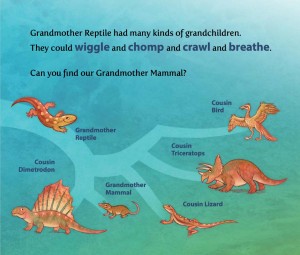 What are the forbidden topics of children’s literature? Which is to say, what are the topics that could be rendered appropriate for kids but for one reason or another never see the light of day? I can think of a couple off the top of my head, an evolution might be one of them. To say that it’s controversial in this, the 21st century, is a bit odd, but we live in odd times. No doubt the book’s creators have already received their own fair share of hate mail from folks who believe this content is inappropriate for their children. I wouldn’t be too surprised to hear that it ended up on ALA’s Most Challenged list of books in the future. Yet, as I mentioned before, finding ANY book on this subject, particularly on the young end of the scale, is near impossible. I am pleased that this book is filling such a huge gap in our library collections. Now if someone would just do something for the 7-12 year olds . . .
 This isn’t the first crowd-sourced picture book I’ve ever seen, but it may be one of the most successful. The reason is partly because of the subject matter, partly because of the writing, and mostly because of the art. Bad art sinks even the most well-intentioned of picture books out there. Now I don’t know the back-story behind why Tweet paired with illustrator Karen Lewis on this book, but I hope he counts his lucky stars every day for her participation. First and foremost, he got an illustrator who had done books for children before (Arturo and the Navidad Birds probably being her best known). Second, her combination of watercolors and digital art really causes the pages to pop. The colors in particular are remarkably vibrant. It’s a pleasure to watch them, whether close up for one-on-one readings, or from a distance for groups. Whether on her own or with Tweet’s collaboration, her clear depictions of the evolutionary “tree” is nice and fun. Plus, it’s nice to see some early humans who aren’t your stereotypical white cavemen with clubs, for once.

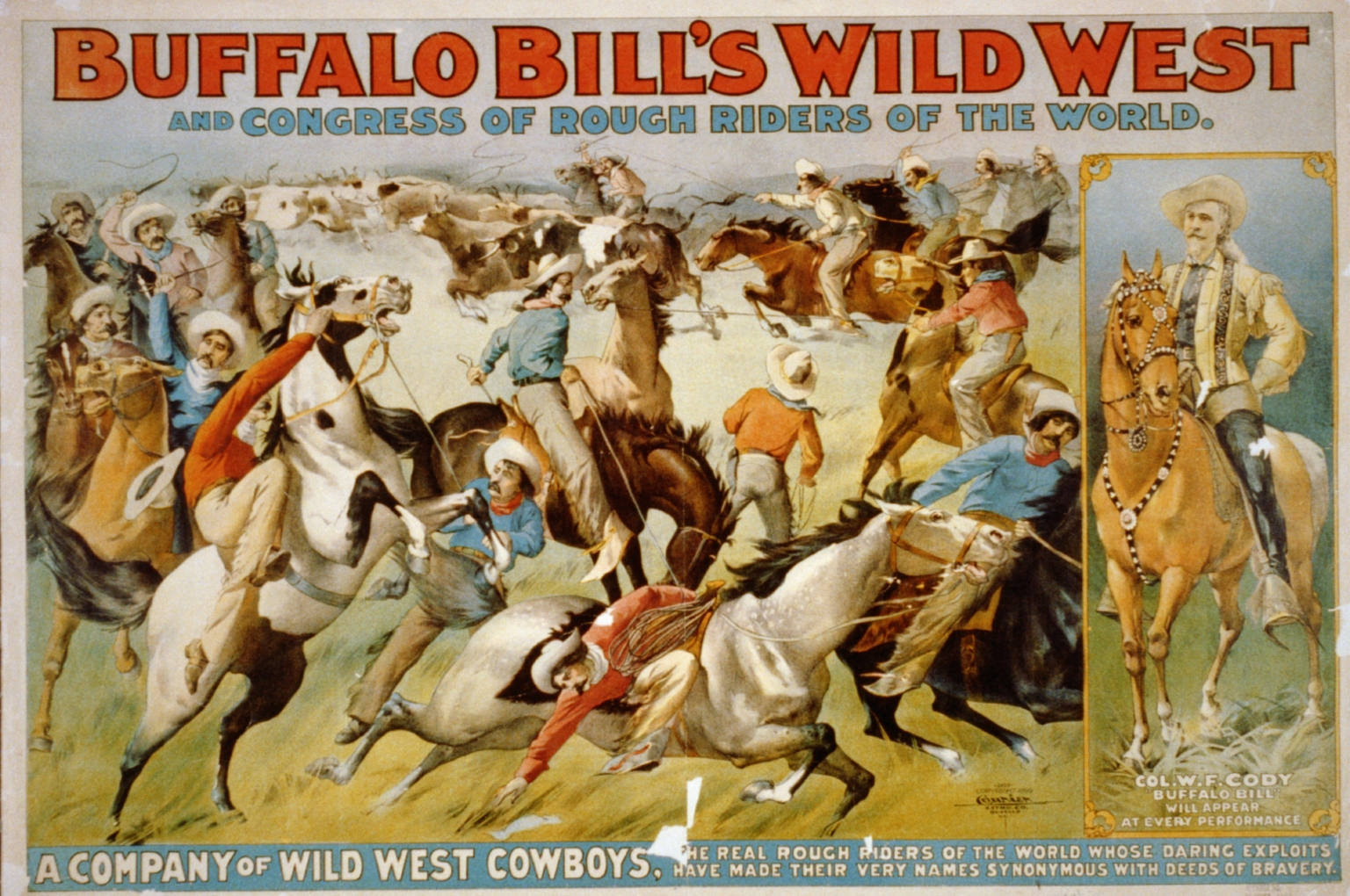
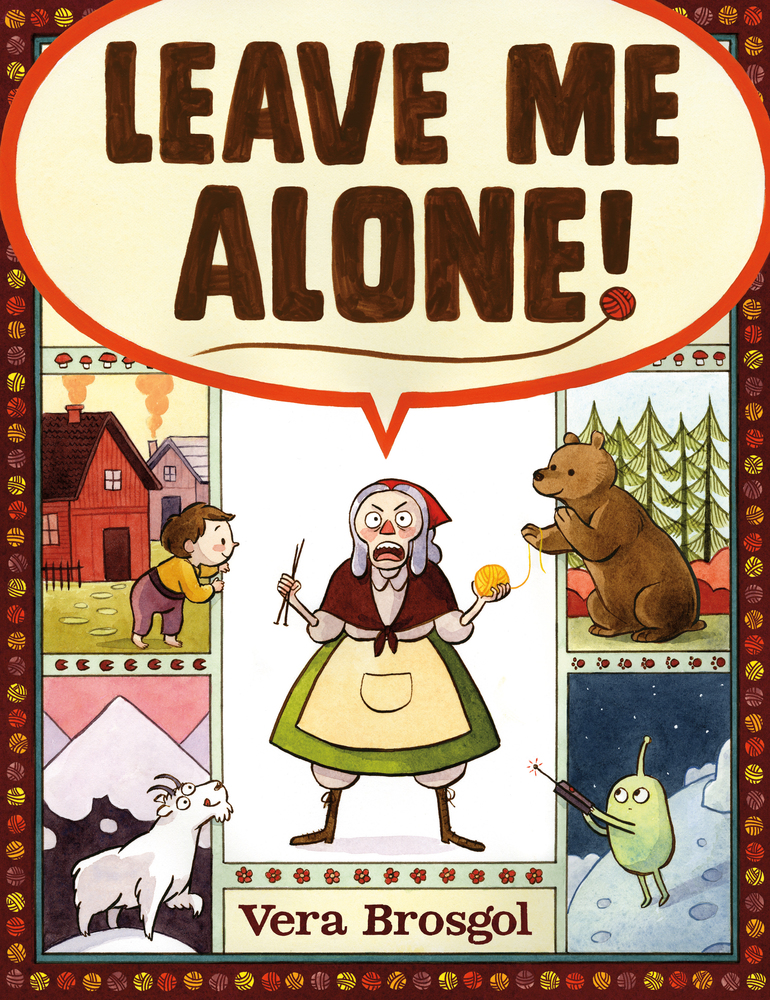
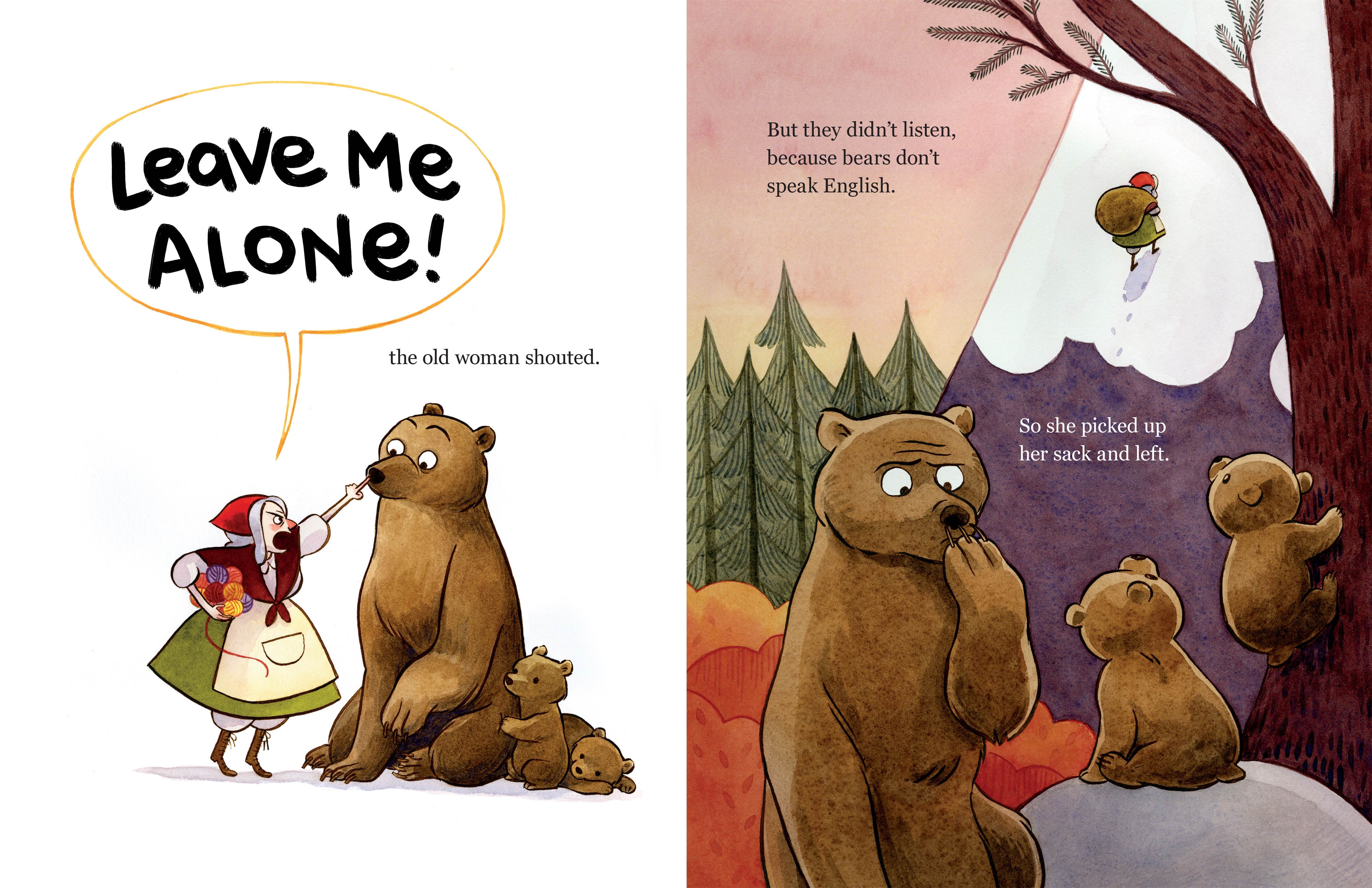
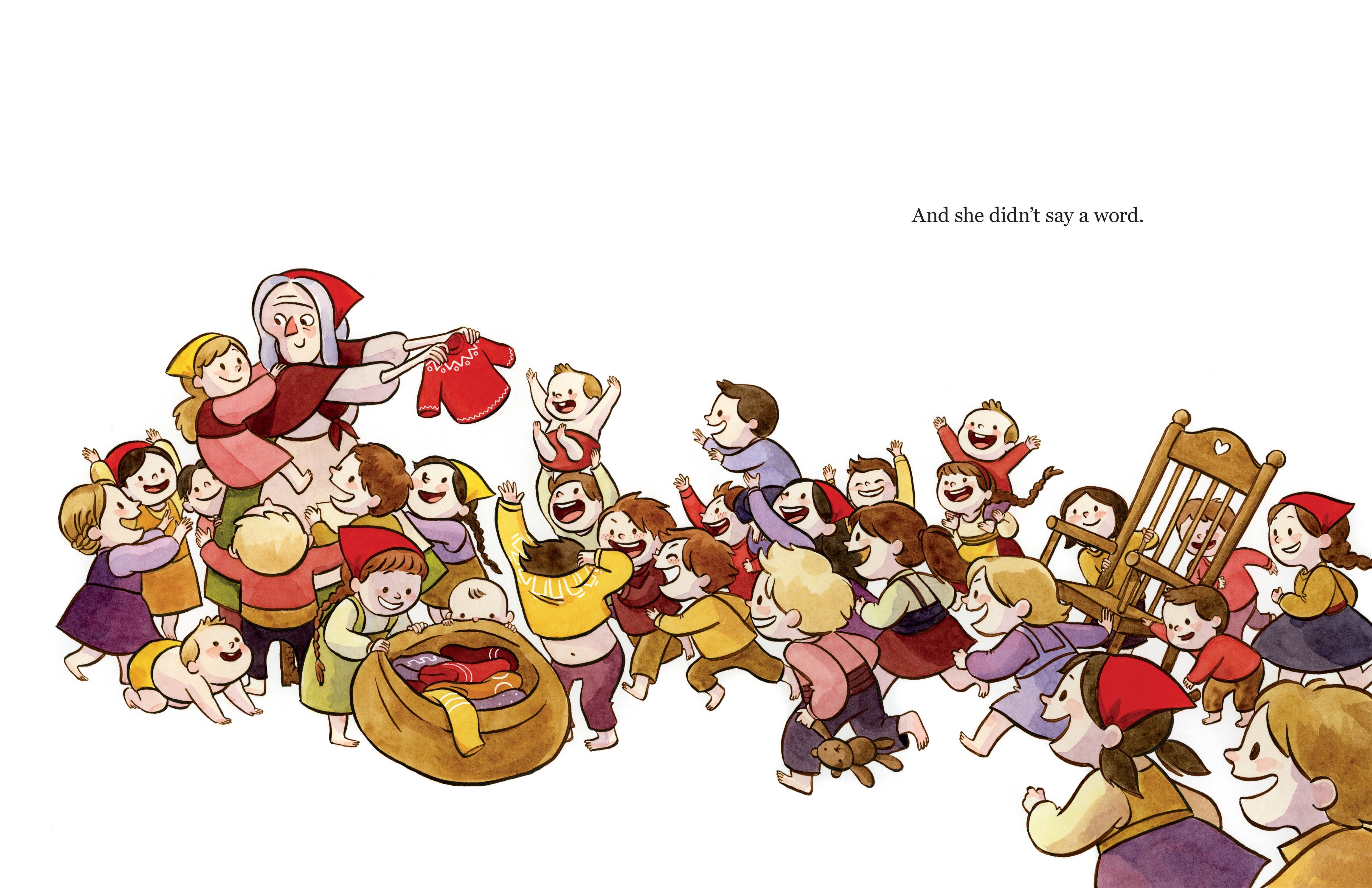
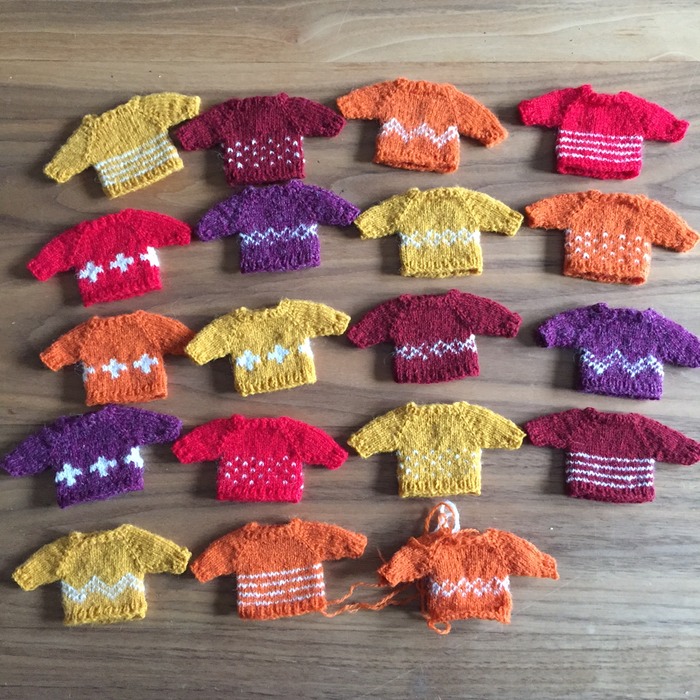


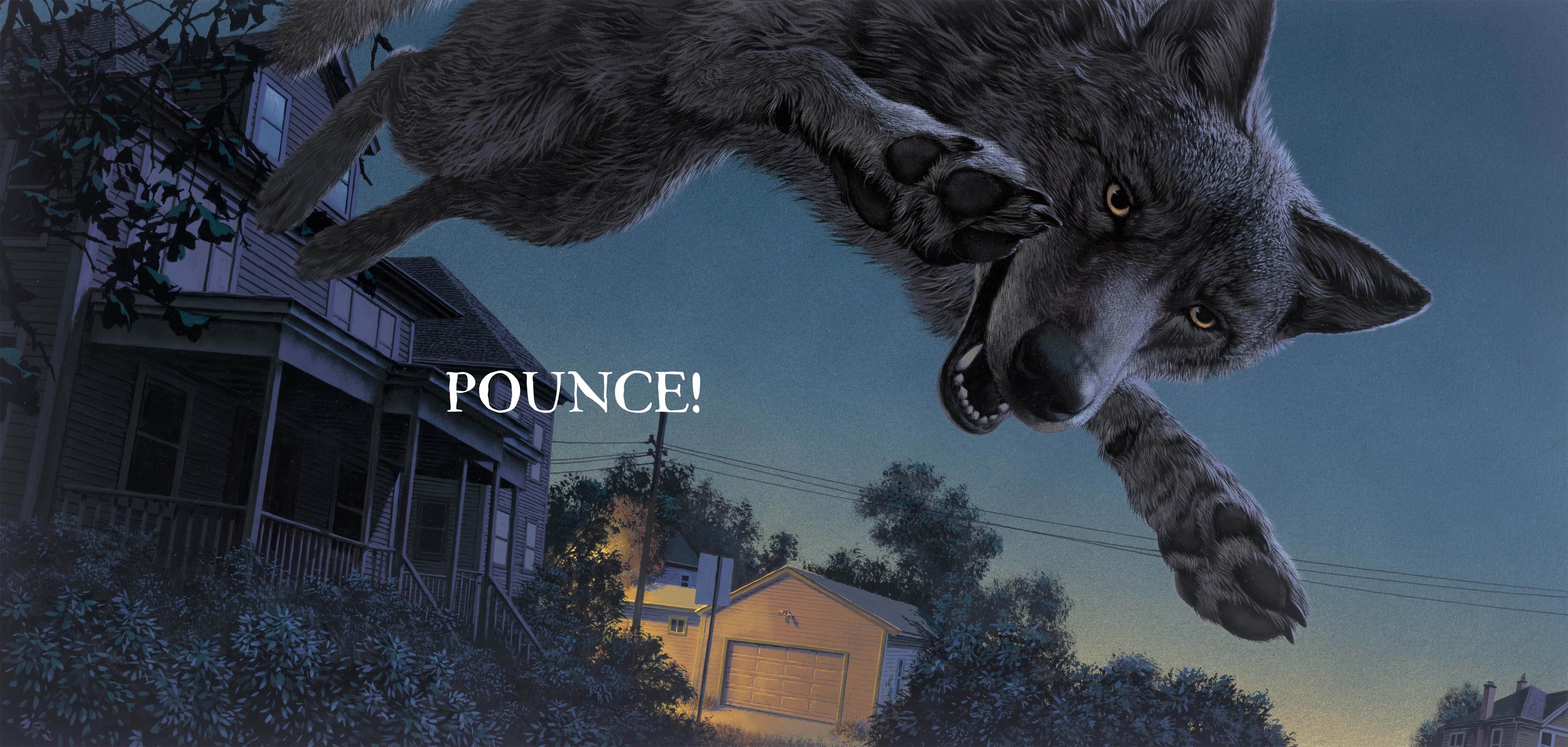
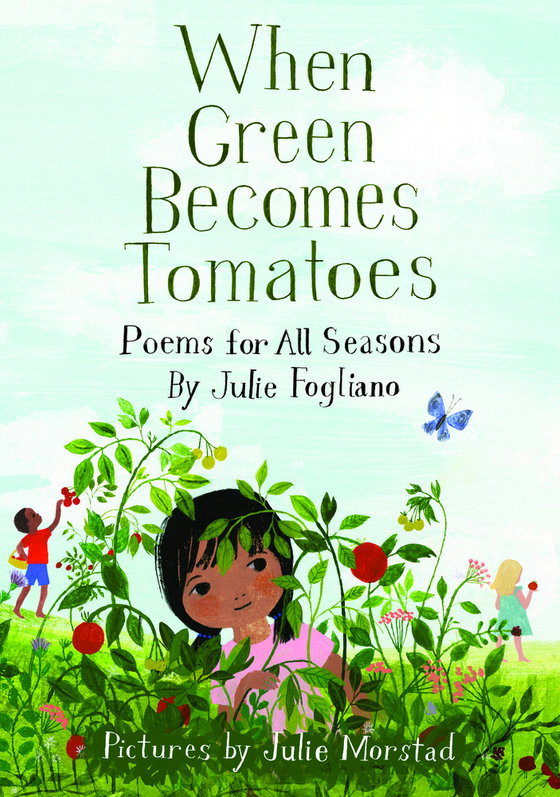
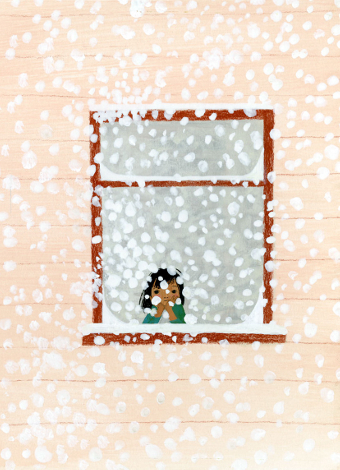

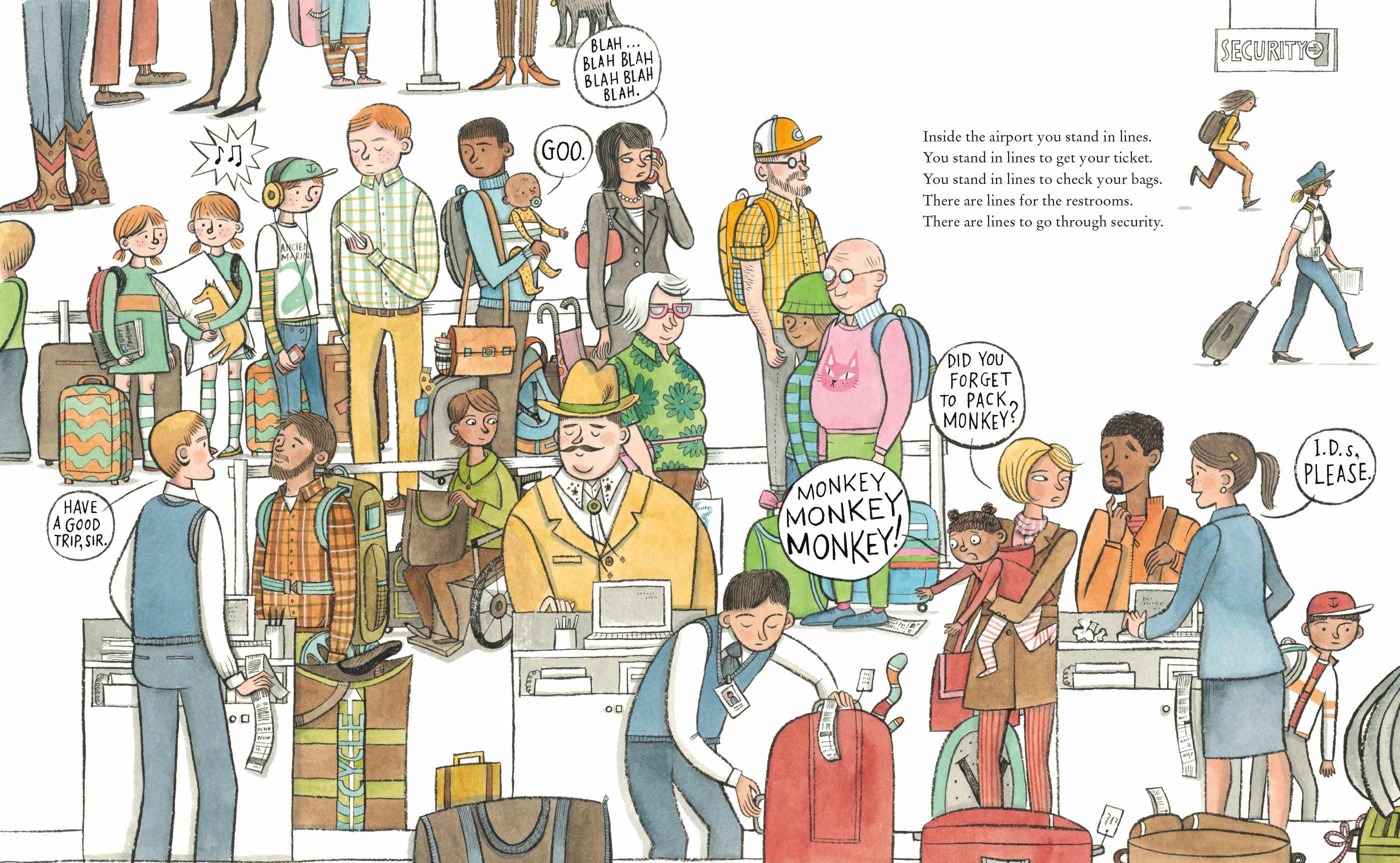
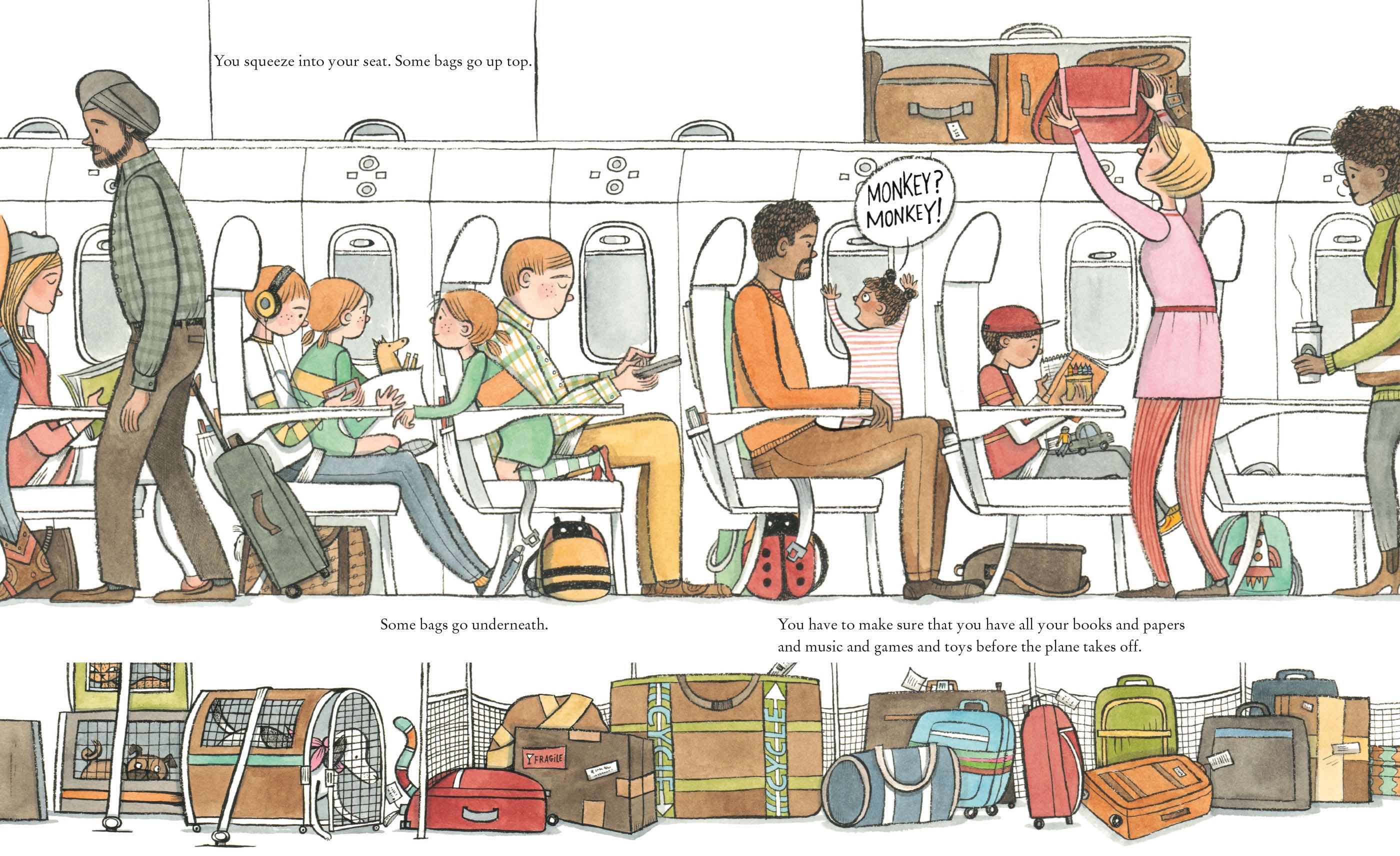

 And yet another surprise from Macmillan, this time from their Hill and Wang imprint: Hyman, Miles SHIRLEY JACKSON’S “THE LOTTERY” A GRAPHIC ADAPTATION Fiction , October 2016 (proposal available) Shirley Jackson’s short story THE LOTTERY is a classic of American literature that continues to thrill and unsettle readers nearly seven decades after it was first published. By turns puzzling and […]
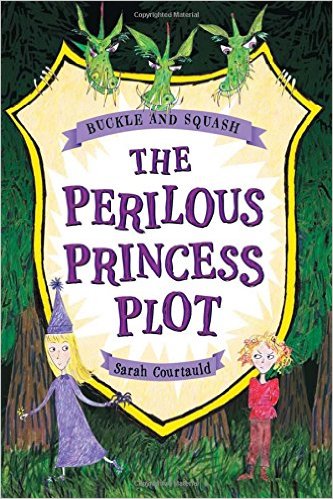
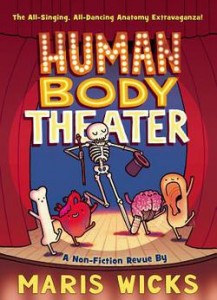


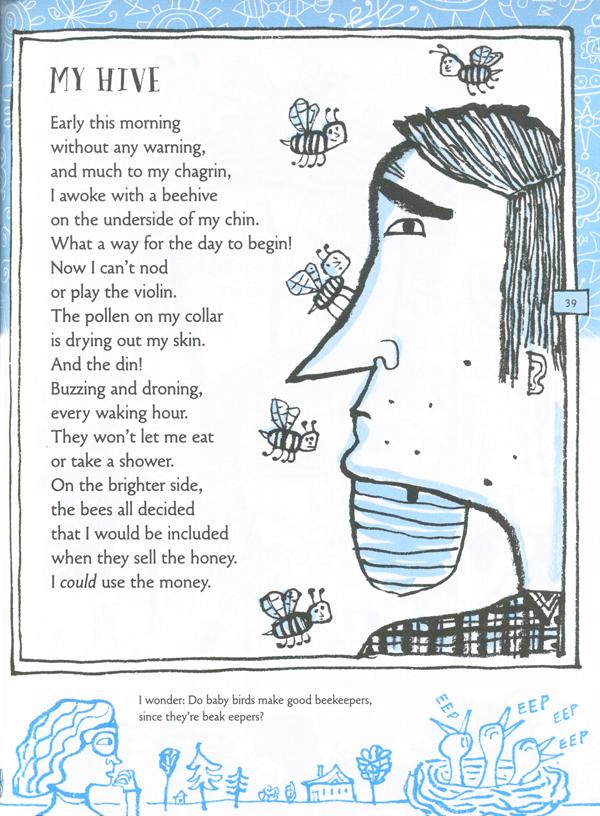


I’d also like to recommend Faith McNulty and Ted Rand’s book, HOW WHALES WALKED INTO THE SEA. It’s a beautiful book, and very good for grades three to five. It focuses just on whales–which can be an advantage: what I’ve found over the years is that children are natural Lamarckians–they believe that there were some plucky giraffes that stretched their necks longer so they could reach the leaves in the trees. The idea that animals evolved over generations–with the animals that better fitted a changing environment having more chances to bear more offspring and pass on their genes– that’s the biggest sticking point. Since WHALES focuses on one kind of animal, there’s more room for discussion. The text is poetic as well as precise.
MUST FIND!!