JacketFlap connects you to the work of more than 200,000 authors, illustrators, publishers and other creators of books for Children and Young Adults. The site is updated daily with information about every book, author, illustrator, and publisher in the children's / young adult book industry. Members include published authors and illustrators, librarians, agents, editors, publicists, booksellers, publishers and fans. Join now (it's free).
Login or Register for free to create your own customized page of blog posts from your favorite blogs. You can also add blogs by clicking the "Add to MyJacketFlap" links next to the blog name in each post.
Blog Posts by Tag
In the past 7 days
Blog Posts by Date
Click days in this calendar to see posts by day or month
Viewing: Blog Posts Tagged with: Nature, Most Recent at Top [Help]
Results 1 - 25 of 542
How to use this Page
You are viewing the most recent posts tagged with the words: Nature in the JacketFlap blog reader. What is a tag? Think of a tag as a keyword or category label. Tags can both help you find posts on JacketFlap.com as well as provide an easy way for you to "remember" and classify posts for later recall. Try adding a tag yourself by clicking "Add a tag" below a post's header. Scroll down through the list of Recent Posts in the left column and click on a post title that sounds interesting. You can view all posts from a specific blog by clicking the Blog name in the right column, or you can click a 'More Posts from this Blog' link in any individual post.
In a perfect world, I'd update my blog at least once a month. But the two projects I'm working on are technically too soon to show. So I'll show what I can and tell you more about them. Below is a book dummy I'm creating with a friend/author/colleague, Barb Ciletti. We're working as a team to submit to publishers and/or agents to get a book deal - fingers crossed. There's many revisions, but this is how it looks at the moment.
The second project is a book about mummies! The author is Rhonda Lucas Donald and it's our third book together. The publisher is Arbordale Publishing and it's our ninth book together. The Denver Museum of Nature and Science has a new traveling exhibit, Mummies: New Secrets from the Tombs so this is where my research began. The book is scheduled for Spring 2018. I'll be posting images from that project when I'm further along.
Cathy Morrison (1905 Schoolmarm), Jeff Stone (Antoine Janis) and Cindy Tunney (Auntie Stone)
Thank you Chris Winslow of FC Public Media for the photos.
Tantramar Heritage Trust
Ok, this photo is not really the students who visit the Upper Boxelder School. I found it online. But when I'm welcoming a school group to come inside and take a seat in the historic one room school house this is how I imagine they looked back in the day. We have a great time comparing and contrasting a day in the life of a student from 1905 and 2016.
Sea Otter - She hunts for food for both of them and never will give up.
Chimpanzee - At evening she will place it in a "sleeping" nest.
Here's two more sleeping animal spreads for November's theme, SLEEP. I feel like a lot of us Americans will need a long nap after this election season. Thanks for taking a look and please check out my Studio With A View Blog for more images from Baby on Board and other books.
0 Comments on And miles to go before I SLEEP as of 11/8/2016 10:28:00 AM
Here's my WIP or work in progress. It also fits the bill for October's theme word - Foliage. You can see more current projects at my Studio With A View.
Thanks for taking a look!
Cathy
In A Nutshell
0 Comments on Happy October! (better known in Colorado as fabulous fall foliage month). as of 10/2/2016 5:48:00 PM
We’re told that we can insert a gene to confer sterility and this trait would race like wildfire through Aedes aegypti. Why this species? Because it’s the vector of the Zika virus—along with the dengue and yellow fever viruses. The problem is that A. aegypti isn’t the only culprit. It’s just one of a dozen or more bloodsuckers that will also have to be wiped out. After we’ve driven these species to extinction, we’ll presumably move on to the Anopheles species that transmit malaria.
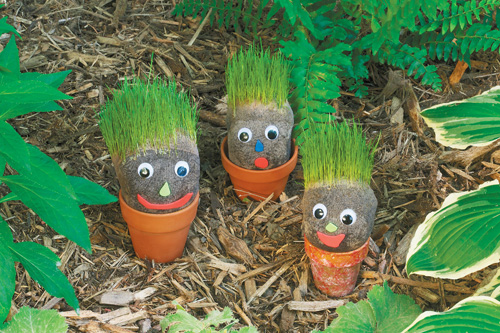
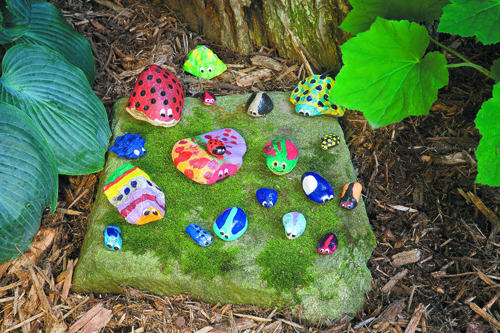
I am not a gardener. I put plants in my yard with thought and care, then I had my third child and started working full time. I love plants, I love gardening, I just don't have time for it and thus haven't shared that love with my kids. However, I work at an elementary school with a project based learning curriculum where the second grade crew took on a year long project that involved a garden, milkweed and monarch butterflies. Using a micro-space, four big planter boxes and a compost pile, these kids became experts over the course of the year. And when, near the end of the school year their garden was vandalized, plants and chrysalises crushed, the spirits of our kids were not. There were tears, for sure, but they rallied. You can read about it here. I tell you about this by way of explaining my personal education on the power of the plant and the good of a garden and I am especially happy to be able to share Gardening Lab For Kids: 52 Fun Experiments to Learn, Grow, Harvest, Make, Play and Enjoy Your Garden by Renata Fossen Brown with the students at my school and my readers here.
Brown believes that gardening is the combination of art and science, and her book is a collection of activities that she has used professionally at the Cleveland Botanical Garden, where she has been vice president of education. Her introduction covers plant basics, from plant parts, hardiness and heat zones, annual versus perennial, watering, materials and even gardening with pets. Each lab takes up a two page spread, with the materials and instructions starting on the verso, and a "Dig Deeper!" box on the recto that gives scientist-gardeners the chance to go one step beyond. Units include getting started, theme gardening, green gardening, garden art and enjoying your garden and the variety and breadth that Brown brings to her book surprised and delighted me.
There are labs for soil percolation, making a rain gauge, making a sprinkler, using catalogs to create a garden design, and even making seed tape which I didn't know was a thing but is a brilliant idea. The entire unit on Theme Gardening is inspiring and I even found a project I think I can take on with my own kids - the Herb Spiral, using bricks like building blocks to build a very cool planter.
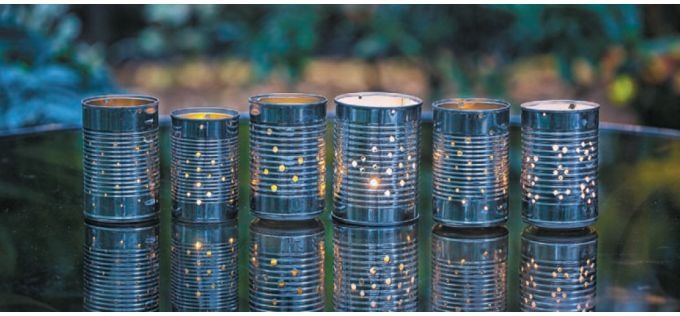
The labs featuring art projects, gifts and garden goodies are especially fun. From stepping stones, plant labels and wind chimes to fountains, bird baths, luminarias, Gardening Lab For Kids is packed with great ideas. My favorites? The Garden Journal, the colorful, portable cushions for sitting and enjoying the garden and the lab on Garden Poetry are right up there, but the Garden Fort has to be my absolute. How magical to create a garden, decorate it and then enjoy it from the privacy of your own, handmade fort?
Source: Review Copy
0 Comments on Gardening Lab: 52 Fun Experiments to Learn, Grow, Harvest, Make, Play & Enjoy Your Garden by Renata Fossen Brown as of 8/12/2016 5:16:00 AM
It's hard to believe it's already August. This year I've had my head buried in projects; four educational picture books, one trade book and several presentations. Yesterday I turned in final illustrations for Baby on Board which comes out in the spring. Now there's one more book and one more presentation to go. I have ideas I want to develop so I'm looking forward getting busy with new projects and open up some space to see what comes next.
In the Northern Colorado area we have Style Magazine. August's issue focuses on female entrepreneurs. I was fortunate to be interviewed by Elissa J. Tivona. Elissa is a journalist, she travels internationally to present her work in peace and conflict studies and teaches at CSU. She was wonderful to work with and I'm proud to be a part of this month's magazine.
Also I wanted to thank Elizabeth O. Dulemba for including Storytime in the Dome in her Friday Linky List! Elizabeth is a Visiting Associate Professor of the Picture Book Design class at Hollins University in Roanoke, Virginia in the summer. She currently lives in Edinburgh Scotland, pursuing her MFA in Illustration at the University of Edinburgh. Plus, she's an all around good person to know. We're both members of PictureBookArtists and I keep up her with her on her blog these days.
Last, but hopefully not least, here's a couple of illustrations from Baby on Board.
They paddle very slowly as they swim along the coast. But nestled under Mama's fin, this baby likes it most. Manatee
Tucked in pouches, gripped in teeth Propped on backs or underneath This is what some animals do. How did someone carry you?
As my family gazed down on the stratified color bands of geological history in the Grand Canyon, snow and ice lined each ridge, and made each step on the path going down a dangerous adventure, highlighting the glorious drama of the miles-deep gorge. It was dizzying and frightening and awe-inspiring.
It is probable that Shakespeare observed, or at least heard about, many natural phenomena that occurred during his time, which may have influenced the many references to nature and science that he makes in his work. Although he was very young at the time, he may have witnessed the blazing Stella Nova in 1572.
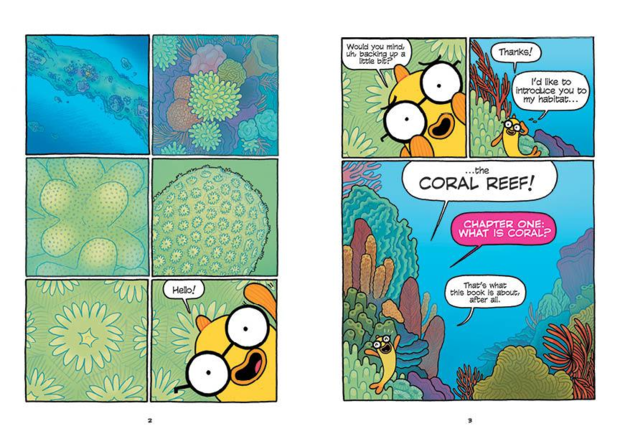
The fantastic publisher FirstSecond, whose motto is precisely and perfectly, "Great graphic novels for every reader," started a new non-fiction series for kids this year. Science Comics: Get to Know Your Universe debuts with superb creators and subjects, Coral Reef: Cities in the Ocean by Maris Wicks and Dinosaurs: Fossils and Feathers by MK Reed and Joe Flood.
Wicks, author of the excellent non-fiction graphic novel for kids, Human Body Theater, worked as a part-time program educator at the New England Aquarium and just spent two months doing scientific outreach for Woods Hole Oceanographic Institution on board the R/V Atlantis! Her passion and knowledge shine through in Coral Reefs: Cities of the Ocean and her introduction is definitely worth reading, especially when she tells readers that we, "make choices that impact the environment with every dollar you spend, every action you take, and every vote that you cast," and encourages us to plant a milkweed, listing all the benefits of giving Monarch butterflies a food source and breeding habitat that can trickle down and benefit the dying coral reefs. With humor and an understanding for her audience, Wicks starts big with a first chapter titled, "What is Coral?" describing the classification system. Chapter Two, "How and Where Coral Reefs are Formed," where I learned that, despite the fact that coral reefs occupy about 1% of the earth's surface, cora reefs are home to more than 25% of all the animals found in the ocean! Chapter Three, "The Coral Reef Ecosystem Explored" takes a closer look at the 25% of the sea life living there and Chapter Four, "How are Coral Reefs Connected to the Rest of the Planet?" is the longest and possibly most important chapter in the book. From start to finish, Wicks makes Coral Reefs: Cities of the Ocean as vibrantly bright and compelling as a healthy coral reef with her popping palette and engaging writing style. A glossary, bibliography and additional resources included in the back matter.
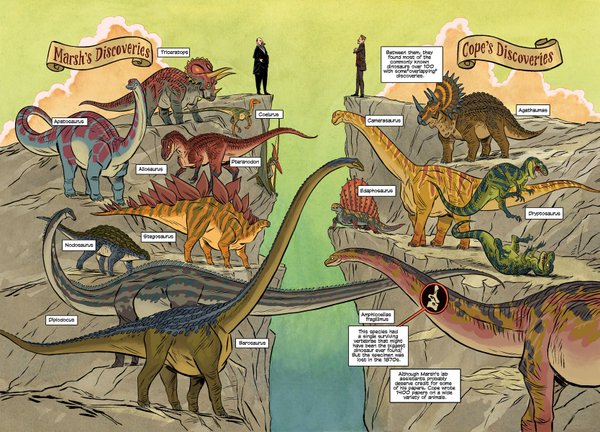
I have to, with great embarrassment, confess that, despite learning a fair bit about dinosaurs as each of my three children went through that phase of fascination, I tend to think of them as static. Dinosaurs: Fossils and Feathers, by MK Reed and Joe Flood, with an introduction by a dinosaur expert, changed my mind in a big way. In his introduction alone, Leonard Finkleman, Ph.D points out the many things that continue to be discovered about dinosaurs, as well as dinosaurs themselves, including the fact that once we didn't even know that dinosaurs lived on every continent. He goes on to write that Reed and Flood bring a "balance of science, philosophy, and history," to their book that is, "informative, funny, and, above all else, imaginative," noting that the lesson of Dinosaurs: Fossils and Feathers is that scientific discovery is very different from normal discovery. Finkleman writes, "Rather than limiting our imaginations, scientific discovery lets us imagine more about the world around us." With that in mind, Wicks and Flood follow paleontologists through history as they try to solve the greatest mystery of all, what happened to the dinosaurs?
Dinosaurs: Fossils and Feathers begins with a little time traveling, showing readers how ancient humans discovering dinosaur fossils thought they were anything from cyclopes to elephants to griffins. In the year 1800, these ideas changed radically when Mary Anning made remarkable finds on the Dorset coast, spending the next 35 years fossil hunting. They also detail the backhanded, sometimes dishonest machinations of the men who made these discoveries and pronouncements and delivered papers about these dinosaurs.
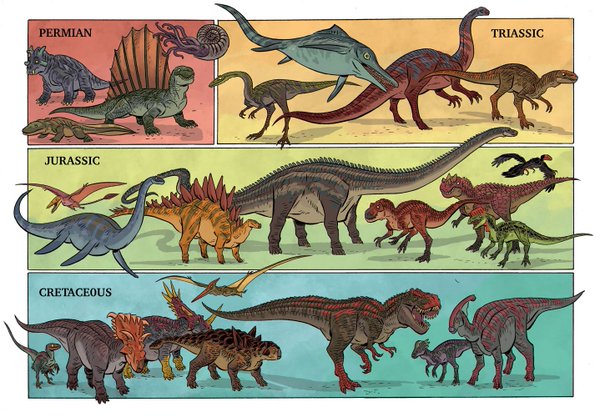
Joe Flood's illustrations are perfectly matched to the subject matter of Dinosaurs: Fossils and Feathers. While the illustrations of the dinosaurs are full of action and expression. The panels with humans present more of a challenge, because of the mostly Victorian time period and somewhat static nature of their roles int he story, yet Flood makes these compelling, especially through the expressions of the characters. There are notes, a glossary and further reading as well as two superb representations of the periods of the dinosaurs. Despite all this amazing information and illustrations, my favorite part of Dinosaurs: Fossils and Feathers comes at the end when the author and illustrator put themselves on the page an error in the text. There are 11 years between my oldest and youngest child. I learned that the big herbivore with the long neck was called the brontosaurus when my first child went through her dinosaur phase. By the time my youngest was going through his we learned that it was now reclassified as an Apatosaurus. On this page, Reed and Flood explain that, a few weeks before this book was due at the printer, researchers concluded that there was in fact enough difference between the two to make the Brontosaurus its own genus again, with a fact box noting that the Brontosaurus is now, "MK and Joe's least favorite dinosaur." With humor and knowledge, Dinosaurs: Fossils and Feathers proves that dinosaurs are anything but static.
Coming October, 2016 and February, 2017
Source: Review Copies
0 Comments on Science Comics: Coral Reefs - Cities of the Ocean by Maris Wicks AND Dinosaurs - Fossils and Feathers by MK Reed and Joe Flood, 120 pp, RL 3 as of 6/28/2016 12:26:00 AM
We've curated a list of some truly wonderful and entertaining bug books for kids ages 4 to 99. We've also included the game Bug Bingo, and it's the bees-knees.
The Wild Robot, a novel for ages 8 and up, is a departure from Peter Brown's usual offering of picture books (Creepy Carrots, Mr. Tiger Goes Wild, My Teacher is a Monster - and more), but his customary excellence is just as apparent.
The link to my review is above, however, I'd like to highlight a few things. The Wild Robot premise is unique and thought-provoking - a robot designed with AI and programmed for self-preservation and nonviolence, is marooned on an island with animals, but no humans from which to learn. The narrator, Kate Atwater, does a stellar job (see review) and sounds a bit like Susan Sarandon. The audio book is unique in that the beginning and the closing chapters have sound effects including music and sounds of nature.
A hopeful tale of friendship and flower power, Alison Jay‘s wonderful wordless picture book Bee & Me opens with a young girl startled by a buzzing bee.
No-one likes to be stung and it looks like the bee might be all over before the story’s even begun. Fortunately, a crack in the door of curiosity and bravery opens up the way for an joint adventure bringing plants and flowers across the grey city, delivering beauty and benefits to all city inhabitants, whether honey bees or humans.
Many layers of storytelling run parallel to the main plot. Repeat readings will lead you into the lives of several city inhabitants, when you peer through apartment windows, watching what happens as time passes and the plans of the girl and her bee blossom. It made me think of a recent discussion I had with author Phil Earle, in relation to his fabulous Storey Street series, where he talked about his firm belief that there is story worth hearing behind every door (or in Jay’s case, through every window). A further strand in Jay’s fabric of storytelling follows the growth of friendship between the girl and another young resident in her block of flats, as if distilling how nature can save us from loneliness and make us feel re-connected once more.
Worldwide, bees are in decline. Because of their role as pollinators, we need bees, and bees – facing the threat they now do – need us. This upbeat, optimistic, can-do example of how children are able to make a real and beneficial difference to their world will hopefully inspire a new generation prepared to make a difference.
Enthused by Bee & Me the girls and I set about creating lots of Bee Seed Tape to give away to all our fellow allotmenteers. Seed Tape is a strip of biodegradable material with seeds already imprinted in it, evenly spaced and super easy to use for speedy planting.
First we dyed (organic) toilet paper, spraying it with natural food colouring.
When the paper was dry, we stuck on seeds using a thick flour/water paste (as thick as possible, so that the moisture in it didn’t encourage the seeds to germinate). We chose to use seeds for sunflower and borage because bees love these plants and the seeds are large enough to handle easily.
Once our seed tape was dry we turned it into bees. Our bee body (which was designed to double up as a plant label) was made from a lollipop stick on which the seed types written on it.
The seed tape was wrapped around the lollipop and held in place with some black ribbon to create bee stripes. Ping-pong balls and pipecleaners were used to create bee heads, and instructions for planting the seed tape were stuck onto black cardboard wings (you can download the template here if you’d like to use ours) threaded on to the black ribbon.
Now it was time to share and plant our bee-friendly seeds so off to the allotment we went:
Here’s the seed tape rolled out before we covered it up with soil.
I don’t think I’ve ever seen such fun seed labels before!
Other activities which might work well alongside reading Bee & Me include:
Using out-of-date seeds to create mosaic artwork. Seeds and seed pods come in the most spectacular range of shapes and sizes and are great fun for using as an art material.
Going on an after-dark walk around the neighbourhood to look in windows. Can you spot, as in Bee & Me, someone reading a book? Someone painting a picture? Someone knitting, (extra points for these) tossing a pancake or writing a story on a typewriter? What tales could be behind these glimpses into the lives of others?
Adopting a small public space in your street (perhaps by a verge or under a tree) and planting some flowers or herbs to brighten up the lives, not just of bees, but also of your neighbours? Be inspired by Todmorden’s community herb gardens or London’s Guerilla Gardeners (with examples from around the world).
If you liked this post you might like these other posts by me:
Title: Little Bitty Friends
Author: Elizabeth McPike
Illustrator: Patrice Barton
Publisher: G.P. Putnam’s Sons Books for YOung Readers, February, 2016
Themes: spring, small animals, rhyme
Ages: 0-2
Genre: concept picture book
Opening: (first two spreads)
Little bitty steps
marching one, two, three,
Little furry caterpillar,
tickle, tickle, knee.
Synopsis:
Sharing strawberries with a wee mouse, stretching up skyward … Continue reading →
You may not know it since I don’t do a whole bunch of poetry reviews here, but I read poetry pretty regularly. My friend Cath in the Netherlands and I have a postal poetry exchange in which we choose a poem or two to send to the other every month or so. This year we decided to concentrate our poetry reading on poets we have never read before who are currently writing and who focus on nature in their poetry. I began the year with Wendell Berry and was a bit disappointed. His A Timbered Choir didn’t take flight for me. In the introduction to the book he claimed to be an amateur poet and, while there were a number of poems in the collection I did enjoy, he really isn’t the best of poets.
My next choice of poet, Joseph Massey, did not disappoint me. I don’t recall exactly how I came upon his work. I think I read about him in the Los Angeles Review of Books. He has a number of collections and since I had never read anything by him before it was difficult to choose. But when I came across a description of To Keep Time as being inspired by the landscape of Humboldt County, California, that is the one I decided to read.
What’s so special about Humboldt County? Well, when I graduated high school and decided to major in biology (I wanted to be a veterinarian) I decided to attend Humboldt State University in Arcata, California. You change a lot when you are eighteen and far away from home for the first time. Before my freshman year was out I had changed my major to English and decided I was going to teach. It meant going to a different university in Los Angeles my sophomore and following years. Nonetheless, my year at Humboldt was amazing and unforgettable.
HSU sits on a hill looking over the Pacific ocean. Stretching out behind the school are acres and acres of redwood forest. It is hands down one of the most beautiful places I have ever lived in my life. I would live there again if I could. So, poetry inspired by this landscape of ocean, redwoods, mountains, rain, fog and damp, yes please!
Massey’s poems have a haiku sensibility to them. Some are short and some are multi-parted. They are contemplative and surprising. It is the unexpectedness that I found so utterly marvelous; an image, a turn of phrase. I loved most when he would mix senses, for instance in “Microclimates”:
I squint
to hear the ocean
pierce an aperture
in sky
not wide enough
for words—
even a word—
to escape.
Also from “Microclimates”:
Bewilder-
ment persists
in this persistent
pressure gradient.
What I want to say
I can’t see to say
I can’t see to say it.
I also love the alliteration and the way he takes a word like “persists” and then changes it to “persistent.” Is there a word for that technique? I have come across it before in other poets and it is something that always gives me a little thrill.
Here is “Anchoritic”:
Listening to wind
dislodge objects
in the dark around
my room, I want
to think thinking
is enough to locate
a world, but it isn’t.
It isn’t this one.
It isn’t this world,
weather.
The word “anchoritic” is an adjective derived from the noun “anchorite.” An anchorite is a religious recluse, someone who has left the secular world to focus on their spiritual life. The poem itself is not particularly religious, but the title opens all sorts of suggestions and avenues of thought both secular and spiritual. It also suggests “anchor” as in anchored in place, but also a physical stability in the wind that is dislodging objects that contrasts beautifully with the thinking that is clearly unanchored. As you can see, the poems might be short but Massey packs in quite a lot!
I very much enjoyed To Keep Time and plan to read more of Massey’s work in the future. It is a happy occasion to discover a “new” poet.
Last weekend my charming assistant/husband helped me film this time-lapse video of yours truly painting a watercolor landscape. He also edited and produced it for me. Thanks, Jonathan! This is my first attempt at filming and isn’t my best landscape ever (the composition could be better) but it shows my painting technique and it’s (hopefully) interesting to watch it all come together. And without further ado, a painting from start to finish:
For the curious, pigments include:
Payne’s Gray, French Ultramarine, Prussian Blue, Sap Green, Quinacridone Gold, Yellow Ochre, Pyrrole Red Light, and a touch of Quinacridone Magenta, probably some other stuff.
Brushes:
Synthetic 1″ flat, Winsor & Newton sable flats in 1/2″ and 3/4,” Raphael Sable round #4, Winsor & Newton rigger
Manatee Rescue by Nicola Davies Candlewick, January 2016
I read aloud The Lion Who Stole My Arm by Nicola Davies earlier this year (see post here). In that book, an African boy who is maimed by a lion attack wants to get revenge on the lion that hurt him...until he learns about lion conservation and how much tourist money lions bring to his country.
I was thrilled to see that Nicola Davies is writing a series -- Heroes of the Wild. The newest in the series is Manatee Rescue. The manatees in this book live in the Amazon River, and the characters are indigenous people.
These are quick reads -- only about 95 pages, with an epilogue that gets them to 100. The books are illustrated with pen and ink drawings by Annabel Wright.
I can't wait for a kid reader to pick this up and give me their insights into the story!
0 Comments on Manatee Rescue by Nicola Davies as of 1/1/1900
Each day my inbox(es) fill with poems-a-day from various sources, and someday I should make a study of how I decide to click and read the comparatively few that I do. Here's one whose arguably not-very-poetic title caught my eye; I wanted to see where this would go. My instincts are pretty good, I guess--I loved it.
I have this, and this isn’t a mouth full of the names of odd flowers
I’ve grown in secret. I know none of these by name
but have this garden now, and pastel somethings bloom
near the others and others. I have this trowel, these overalls,
this ridiculous hat now. This isn’t a lung full of air.
Not a fist full of weeds that rise yellow then white then windswept.
This is little more than a way...
************************ Read the rest here, and listen to Jamaal read it himself here. This poem pleases me because of the tension between the everyday register and the imprecise words on the way to a very deliberate and precise capturing of everything the speaker claims not to know. (In fact I'm adding this to my collection of "no poems," poems which create their meaning by denying it.) Wouldn't the title and its stem, "I have this, and this isn't..." be a very interesting poetry prompt for kids?
I also like the feeling of effort in this poem, repeated effort, which must be reminding me of the repeated efforts we are having to make to keep driveway and sidewalks clear,* and "return as sprout" must be about the poor green tips of a daffodil, which in December thought it must be spring and time to spear up, but which now finds itself smack in the middle of the best path we could forge from the front porch to the sidewalk and is now trampled and muddied but still green.
Catherine is hosting today at Reading to the Core, with Irene Latham's new book in the spotlight--isn't it nice that you can just click to get there instead of digging your way through feet of snow? Let us be grateful for all that is!
*This morning at 4:15 I stood at the window and watched a noisy little Bobcat bulldozer work its way up our street, hoisting scoops of chunky, icy, frozen snow from the edges of the street and dumping it onto the finally clear, dry sidewalk. Oof. More shoveling, with a side of boulder-tossing.
0 Comments on "I know none of these by name" as of 1/1/1900
The soils surrounding the village where I live in the north west of England have abundant fertility. They mostly formed in well-drained, clay-rich debris left behind by glaciers that retreated from the area some ten thousand years ago, and they now support lush, productive pasture, semi-natural grassland and woodland. Although the pastures are managed more intensively than they were in the past, most of them are well drained, and receive regular dressings of manure along with moderate fertiliser, and are regularly limed, which keeps the land productive and the soil in good health.
Too Many Carrots Written & Illustrated by Katy Hudson Capstone 2/1/2016 978-1-62370-638-8 32 pages Ages 3—5 “Rabbit loves carrots. In fact, he loves them so much that they are crowing him out of his cozy burrow. When his friends offer help, Rabbit happily accepts. But will too many carrots cause too much trouble …
Bear Snores On is the first book in Karma Wilson’s series about Bear; a huggable and loyal friend, connoisseur of popcorn, and avid swimmer. It’s that time of the year and Bear has gone to sleep for a long time. What happens when several of his woodland friends happen upon his warm lair?
Bear Snores On is a great book you can use to teach young readers about seasons, hibernation, friendship, and sharing. There are so many big lessons in one small book!
Karma Wilson’s reading of Bear Snores On was filmed during Angie Karcher’sRhyming Picture Book Revolution Conference (RPBC). The purpose of the RPBC is to educate and support authors who write rhyming picture books.
KidLit TV’s Read Out Loud series is perfect for parents, teachers, and librarians. Use these readings for nap time, story time, bedtime … anytime!
Parents and Educators: Click here to download free Bear Snores On activities! Explore books written by Karma Wilson including more books about Bear!
ABOUT BEAR SNORES ON
Bear Snores On(Illustrated by Jane Chapman) – One by one, a whole host of different animals and birds find their way out of the cold and into Bear’s cave to warm up. But even after the tea has been brewed and the corn has been popped, Bear just snores on! See what happens when he finally wakes up and finds his cave full of uninvited guests — all of them having a party without him.
Karma Wilson grew up an only child of a single mother in the wilds of North Idaho. Way back then (just past the stone age and somewhat before the era of computers) there was no cable TV and if there would have been Karma could not have gotten it. TV reception was limited to 3 channels, of which one came in with some clarity. Karma did the only sensible thing a lonely little girl could do…she read or played outdoors.
Playing outdoors was fun, but reading was Karma’s “first love” and, by the age 11 she was devouring about a novel a day. She was even known to try to read while riding her bike down dirt roads, which she does not recommend as it is hazardous to the general well being of the bike, the rider, and more importantly the book. Her reading preference was fantasy (C.S. Lewis, Terry Brooks, etc…) and historical fiction (L.M. Montgomery, Laura Ingalls Wilder, etc…). Those preferences have not changed much.
Karma never considered writing as a profession because her mother was a professional writer which made it seem like boring and mundane work. At the age of 27 she realized that she still loved well written children’s books of all kinds, from picture books to young adult novels. By that time Karma was a wife and the mother of three young children. Trips to the library with her children were a combination of emotions…when they got a good book there was fun to be had by all, but so many of the books weren’t what her children wanted to listen to.
While looking for some themed art I came across this image I created some years ago for a book featuring Koko the lowland gorilla. This was part of the intro to her story.




 By: Cathy Morrison,
on 11/10/2016
By: Cathy Morrison,
on 11/10/2016


 By: DanP,
on 8/18/2016
By: DanP,
on 8/18/2016
 By: Tanya,
on 8/12/2016
By: Tanya,
on 8/12/2016

 I am not a gardener. I put plants in my yard with thought and care, then I had my third child and started working full time. I love plants, I love gardening, I just don't have time for it and thus haven't shared that love with my kids. However, I work at an elementary school with a project based learning curriculum where the second grade crew took on a year long project that involved a garden, milkweed and monarch butterflies. Using a micro-space, four big planter boxes and a compost pile, these kids became experts over the course of the year. And when, near the end of the school year their garden was vandalized, plants and chrysalises crushed, the spirits of our kids were not. There were tears, for sure, but they rallied. You can read about it here. I tell you about this by way of explaining my personal education on the power of the plant and the good of a garden and I am especially happy to be able to share Gardening Lab For Kids: 52 Fun Experiments to Learn, Grow, Harvest, Make, Play and Enjoy Your Garden by Renata Fossen Brown with the students at my school and my readers here.










 By: Mary Lee,
on 5/20/2016
By: Mary Lee,
on 5/20/2016


 By: Shelf-employed,
on 5/5/2016
By: Shelf-employed,
on 5/5/2016

.jpeg?picon=3306) By: Zoe,
on 4/24/2016
By: Zoe,
on 4/24/2016
 A hopeful tale of friendship and flower power, Alison Jay‘s wonderful wordless picture book Bee & Me opens with a young girl startled by a buzzing bee.


 By: JOANNA MARPLE,
on 4/1/2016
By: JOANNA MARPLE,
on 4/1/2016

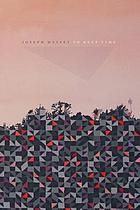 You may not know it since I don’t do a whole bunch of poetry reviews here, but I read poetry pretty regularly. My friend Cath in the Netherlands and I have a postal poetry exchange in which we choose a poem or two to send to the other every month or so. This year we decided to concentrate our poetry reading on poets we have never read before who are currently writing and who focus on nature in their poetry. I began the year with Wendell Berry and was a bit disappointed. His A Timbered Choir didn’t take flight for me. In the introduction to the book he claimed to be an amateur poet and, while there were a number of poems in the collection I did enjoy, he really isn’t the best of poets.
 Add a Comment

 By: Jessica Lanan,
on 3/3/2016
By: Jessica Lanan,
on 3/3/2016

 By: Heidi Mordhorst,
on 1/29/2016
By: Heidi Mordhorst,
on 1/29/2016


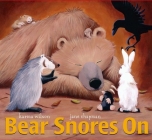 (Illustrated by Jane Chapman) – One by one, a whole host of different animals and birds find their way out of the cold and into Bear’s cave to warm up. But even after the tea has been brewed and the corn has been popped, Bear just snores on! See what happens when he finally wakes up and finds his cave full of uninvited guests — all of them having a party without him.

Zoe, this is a fabulous idea! Thank you for helping the bees