JacketFlap connects you to the work of more than 200,000 authors, illustrators, publishers and other creators of books for Children and Young Adults. The site is updated daily with information about every book, author, illustrator, and publisher in the children's / young adult book industry. Members include published authors and illustrators, librarians, agents, editors, publicists, booksellers, publishers and fans. Join now (it's free).
Login or Register for free to create your own customized page of blog posts from your favorite blogs. You can also add blogs by clicking the "Add to MyJacketFlap" links next to the blog name in each post.
Blog Posts by Tag
In the past 7 days
Blog Posts by Date
Click days in this calendar to see posts by day or month
Viewing: Blog Posts Tagged with: Sustainability, Most Recent at Top [Help]
Results 1 - 25 of 34
How to use this Page
You are viewing the most recent posts tagged with the words: Sustainability in the JacketFlap blog reader. What is a tag? Think of a tag as a keyword or category label. Tags can both help you find posts on JacketFlap.com as well as provide an easy way for you to "remember" and classify posts for later recall. Try adding a tag yourself by clicking "Add a tag" below a post's header. Scroll down through the list of Recent Posts in the left column and click on a post title that sounds interesting. You can view all posts from a specific blog by clicking the Blog name in the right column, or you can click a 'More Posts from this Blog' link in any individual post.
A hopeful tale of friendship and flower power, Alison Jay‘s wonderful wordless picture book Bee & Me opens with a young girl startled by a buzzing bee.
No-one likes to be stung and it looks like the bee might be all over before the story’s even begun. Fortunately, a crack in the door of curiosity and bravery opens up the way for an joint adventure bringing plants and flowers across the grey city, delivering beauty and benefits to all city inhabitants, whether honey bees or humans.
Many layers of storytelling run parallel to the main plot. Repeat readings will lead you into the lives of several city inhabitants, when you peer through apartment windows, watching what happens as time passes and the plans of the girl and her bee blossom. It made me think of a recent discussion I had with author Phil Earle, in relation to his fabulous Storey Street series, where he talked about his firm belief that there is story worth hearing behind every door (or in Jay’s case, through every window). A further strand in Jay’s fabric of storytelling follows the growth of friendship between the girl and another young resident in her block of flats, as if distilling how nature can save us from loneliness and make us feel re-connected once more.
Worldwide, bees are in decline. Because of their role as pollinators, we need bees, and bees – facing the threat they now do – need us. This upbeat, optimistic, can-do example of how children are able to make a real and beneficial difference to their world will hopefully inspire a new generation prepared to make a difference.
Enthused by Bee & Me the girls and I set about creating lots of Bee Seed Tape to give away to all our fellow allotmenteers. Seed Tape is a strip of biodegradable material with seeds already imprinted in it, evenly spaced and super easy to use for speedy planting.
First we dyed (organic) toilet paper, spraying it with natural food colouring.
When the paper was dry, we stuck on seeds using a thick flour/water paste (as thick as possible, so that the moisture in it didn’t encourage the seeds to germinate). We chose to use seeds for sunflower and borage because bees love these plants and the seeds are large enough to handle easily.
Once our seed tape was dry we turned it into bees. Our bee body (which was designed to double up as a plant label) was made from a lollipop stick on which the seed types written on it.
The seed tape was wrapped around the lollipop and held in place with some black ribbon to create bee stripes. Ping-pong balls and pipecleaners were used to create bee heads, and instructions for planting the seed tape were stuck onto black cardboard wings (you can download the template here if you’d like to use ours) threaded on to the black ribbon.
Now it was time to share and plant our bee-friendly seeds so off to the allotment we went:
Here’s the seed tape rolled out before we covered it up with soil.
I don’t think I’ve ever seen such fun seed labels before!
Other activities which might work well alongside reading Bee & Me include:
Using out-of-date seeds to create mosaic artwork. Seeds and seed pods come in the most spectacular range of shapes and sizes and are great fun for using as an art material.
Going on an after-dark walk around the neighbourhood to look in windows. Can you spot, as in Bee & Me, someone reading a book? Someone painting a picture? Someone knitting, (extra points for these) tossing a pancake or writing a story on a typewriter? What tales could be behind these glimpses into the lives of others?
Adopting a small public space in your street (perhaps by a verge or under a tree) and planting some flowers or herbs to brighten up the lives, not just of bees, but also of your neighbours? Be inspired by Todmorden’s community herb gardens or London’s Guerilla Gardeners (with examples from around the world).
If you liked this post you might like these other posts by me:
The global food system is estimated to contribute 30% of total Greenhouse gas (GHG) emissions. In this context, the EU has committed to reducing GHG emissions by 40% relative to 1990 levels by 2030 and by 80% by 2050. Apart from the necessary policies of citizen information and production regulation, could a consumer tax on the most Greenhouse gas-emitting foods be a relevant tool to improve diet sustainability? Could it combine greener and healthier diets with a limited social cost?
Why would agricultural producers engage in practices such as conservation, animal welfare, waste management, or organic farming? The literature hints that economic, social, and personal motivations are drivers of adoption. Sustainable practices are welcomed by farmers if there is a potential increase in profitability through more efficient processes, or as a source of differentiation (i.e. labelling). From a social perspective, sustainability has become a license to operate in food supply chains, where long-term viability depends on the fit between firm and society values.
Counting Lions written by Katie Cotton, illustrated by Stephen Walton is a book where things are not quite what they seem.
It features illustrations which look so incredibly lifelike that you think they must be photos. They are in fact hand drawn with charcoal – and lots of patience. It’s a counting book and is of course about numbers, but not only the first ten digits we learn. Rather it makes readers reflect on when numbers mean the difference between life and not just death, but extinction. It’s a remarkable book.
It’s a book to make you look, and think, and wonder in awe. Ten animals are introduced, each with a double page spread featuring Walton’s breathtaking and moving illustrations and a short poetic text giving the animals a context, introducing a few judiciously chosen facts about their lives. A tiger is described as “a flash of fire and night“. The elephants don’t just migrate, they “travel the dust paths of memory.”
Counting Lionscan be read as a learn-to-count book – one lion, two gorillas, three giraffes and so on. Young children will love the scale of the illustrations (this is an out-sized book), and I’m sure many a small hand will end up stroking the pictures, reaching out and feeling an emotional connection with the animals depicted. But don’t be fooled. This book will also capture the imagination of a ten year old who’s long past the 1,2,3 stage. The quiet, powerful language, the addition of fact files on each animal(including its status on the list of endangered animals) in an addendum, as well as links to further reading make this a springboard for anyone curious about and appreciative of the natural world.
Inspired by Walton’s remarkable use of charcoal we decided to explore this medium ourselves. I found this guide, this introduction and these tips very helpful background information.
We explored smudging, drawing fine lines, shading, removing charcoal with a rubber, “painting” with charcoal and a wet paint brush and more. Pretty soon we were quite dirty!
Charcoal is a very expressive medium to draw with – it makes such a satisfying mark even when pressing lightly. I’d definitely encourage you to use the largest possible sheets of paper if you try this out yourself as the ease with which such a juicy black line appears made us all want to make large movements whilst drawing.
We tried drawing in the dark, with just one light beaming on a “still life” (hence the lamp on the table in the picture above); this idea came from the rich darkness of the charcoal, and the sensory experience of drawing in the gloom was quite exciting! Here’s our final gallery:
Whilst we explored making art with charcoal we listened to:
The Lion by Benjamin Scheuer (do check out the video – it’s very lovely)
Other activities which might work well alongside reading Counting Lions include:
Reading Animal Rescue by PatrickGeorge – another book where things aren’t quite what the seem, and ideal for the crowd who are at the stage of learning their first numbers.
Doing a stock-take of your kids’ soft toys/plastic animals. Can they find out which ones (in real life) are endangered? What could they do to help? This resource from Wonderopolis might be useful.
Environmental sustainability includes an ‘if’. The ‘if’ is implied, but invariably left unstated. Sustainability means ‘ability to endure across time’. When used as a matter of physical limitation, no ‘if’ is implied or needed.
All the Wild Wonders – Poems of our Earth, edited by Wendy Cooling and illustrated by Piet Grobler is a collection of poetry which poses interesting questions about the world we live in. The poems encourage reflection on the wonders and beauty around us on our planet, and provoke thought about what the future holds given the impact humans have on the natural environment. There are poems in many different styles from Benjamin Zephaniah to William Blake, via Ogden Nash and John Milton, each juxtaposed in ways that draw out new and sometimes surprising comparisons.
Rich and colourful watercolour illustrations throughout make this look more like a picture book than many a poetry anthology whilst the embossed, textured cover and luxuriously thick paper that have been used for this new edition make this book simply delightful to hold in your hands as well as to read silently or aloud.
To celebrate publication of All the Wild Wonders in its new and exceptionally beautiful format earlier this spring I put some questions to Wendy Cooling, the editor of the anthology, about the way she works, the state of children’s poetry and what we could look for in the library or bookshop if we wanted to offer more great poems to the kids in our lives.
Playing by the book: When I look at the poetry books you’ve worked on sometimes they are described as being “written” by you, other times “edited” or “selected”. So what is a poetry editor? I see you almost more as a curator – you choose poems to present and juxtapose, rather than (I imagine) editing their actual words or structure?
Wendy Cooling: Yes, a poetry editor is really more like a curator than a book editor as he/she cannot change the words in a poem, or amend in any way without the poet’s consent. Sometimes an extract from a poem is agreed to but otherwise the poem is as the poet wrote it. The editor chooses and arranges the poems to present a theme or an idea in a coherent way.
An excerpt from All the Wild Wonders, illustrated by Piet Grobler
Playing by the book: Where and how do you start when you’ve a new anthology to curate? With lots of books on the table? Innumerable post-it notes?….
Wendy Cooling: The beginnings of an anthology are pure joy to me. I sit somewhere comfortable, often under a tree in the garden, surrounded by mountains of poetry collections and anthologies I just read and read and read… and use lots of post-it notes. I visit the Poetry Library in London’s Festival Hall and indulge in more poetry reading and lots of photocopying. I have of course far more poems that I can ever use.
An area specially for families and children in the Poetry Library.
The next bit is the hard bit, weeding out poems I love but don’t quite work for the age-group or within the overall developing theme. I look for a mixture of forms as I want to move children away from the idea that poems must rhyme. I look for writing from many cultures to give a sense of the universality of poetry.
I have a budget to consider too as of course poets are paid for the inclusion of a poem. There are always one or two very eminent poets we just can’t afford.
Playing by the book: So just with the words, there are plenty of different considerations. What about when an anthology is accompanied by illustrations, as many of yours are. When you are working on an anthology to what extent do you liaise with the illustrator?
Wendy Cooling: It is quite unusual for editor and illustrator to liaise, often the two never meet. Luckily I do get to see and comment on Piet Grobler‘s very earliest roughs. We don’t always quite agree on the meaning of a poem and can talk this through, quite a fascinating process. I think I’m very fortunate and do hope to work with Piet in the future.
Playing by the book: I’d love to be able to eavesdrop on those conversations where it turns out your two interpretations don’t quite match. I bet they are very rich and interesting!
What sort of anthology would you like to curate next if you could have an entirely free say in it? Is there a theme you’d especially like to explore which you haven’t yet?
Wendy Cooling: I have three ideas that I’m working on at the moment but won’t reveal them here!
Playing by the book: Fair enough – but I will be keeping my eyes peeled for future collections!
What about this then: Is there something that poetry does better or differently than other genres in your opinion?
Wendy Cooling: Poetry is very special as it helps children to really taste words and to experiment with their own writing. To children who struggle as readers, a poetry book is very liberating – poems are quite short and there’s no rule that says you must read them all. Poetry well-introduced can be perfect to get some children into reading – they all love the ‘no rules’ bit.
Poetry is wonderful at expressing a very deep thought in few words and with great immediacy. Children don’t become good readers until they are able to hear words sing in their heads, poetry helps them to experience this magic. Too often children are asked to find similes, metaphors, examples of alliteration, onomatopoeia, etc and they couldn’t care less what the poem is about. Let’s leave all the analysis for later on and introduce poems as pleasure, fun and excitement, things to make you laugh, feel and think.
An excerpt from All the Wild Wonders, illustrated by Piet Grobler
Playing by the book: What’s your opinion about the state of children’s poetry in the UK? Who are the up and coming children’s poets we should be looking out for?
Playing by the book: This seems like an opportune moment to congratulate Rachel Rooney on making this year’s CLPE Poetry Award shortlist which was recently announced. And what about you? Do you write poetry yourself?
Wendy Cooling: I write myself but not for publication! It’s a great pleasure perhaps a personal indulgence in my case.
Playing by the book: Apart from All the Wild Wonders, what three other children’s poetry anthologies would you encourage us to seek out if we were looking at starting a home poetry library?
Wendy Cooling: There are many terrific anthologies to look at, one of my favourites is Adrian Mitchell‘s A Poem a Day, it’s a delight to dip into and perfect for families to look at together. A Caribbean Dozen edited by John Agard and Grace Nichols is special too. If you can’t go to the Caribbean this is the next best thing as it invites you to experience the rhythms and atmosphere of another land.
There’s nothing like a live poet though, listening to them read, or perform their own poems can be a great experience. Children love to perform their poems too but should only be encouraged to learn by heart poems they really want to remember for ever.
Playing by the book: I couldn’t agree more with you Wendy. Thank you.
An excerpt from All the Wild Wonders, illustrated by Piet Grobler
3 Comments on All the Wild Wonders – an interview about poetry with Wendy Cooling, last added: 5/11/2015
I’m a great believer in kids’ magazines. For a start, they are a great way to support your child’s reading for pleasure:
They’re designed for dipping in and out of, making it easy to squeeze a bit of reading in at any point of the day. Brief articles, often highly illustrated also break down barriers reluctant readers might have; blocks of text tend to be relatively short, and the reader doesn’t feel s/he has to make a huge commitment to enjoy or learn something.
You can choose ones closely aligned to real interests your child has. Maybe your child is crazy about horses – there’s a magazine for that. Or cycling or gardening… you don’t have to stick to magazines aimed at children.
They’re reading material you can have very easily to hand. They can be stashed in bags for journeys out, they can be read at kitchen tables. Magazines (and newspapers) “hang around” making for easy serendipitous reading.
Their timely nature creates a buzz about reading – whether the magazine gets delivered once a week through your letterbox, or you know it comes out once a month and so make a special trip to the newsagents. The fact that magazines appear at certain times creates a frisson of excitement, and something that many kids will look forward to if you subscribe or get into the magazine habit.
Many magazines are highly illustrated, either with photos or artwork. Just because kids can read themselves, it doesn’t mean they don’t enjoy illustration of one sort or the other. Indeed, in today’s world with a highly visual focus, images are almost essential if you want to grab people’s attention.
Eco Kids Planet Magazine is a new nature and environment magazine aimed at children aged 7 to 11. The magazine uses narrative non-fiction, i.e. fun, fictional characters in a story format, to convey facts about nature and the environment, providing children with real world examples of how they can make a difference when it comes to looking after our planet.
It’s a brilliant success story: Eco Kids Planet Magazine was originally a Kickstarter project, but it is now stocked in one of the biggest newsagent/bookshop chains in the UK – WHSmiths. However, you can also get your hands on copies by entering a today’s brilliant international giveaway. First prize is a year’s subscription to Eco Kids Planet Magazine, and the Runners-Up Prize is a bundle of 6 past issues. Both prizes would be great for schools as well as families.
The nitty gritty of the giveaway
This giveaway is open WORLDWIDE
To enter, simply leave a comment on this blog post.
For extra entries you can:
(1) Tweet about this giveaway, perhaps using this text: Win a year’s subscription to @EcoKidsPlanet – a kids’ nature magazine – over on @playbythebook’s blog http://www.playingbythebook.net/?p=32552
(2) Share this giveaway on your Facebook page, Google Plus page or blog
You must leave a separate comment for each entry for them to count.
The winner and runner-up will be chosen at random using random.org.
The giveaway is open for two weeks and closes on Earth Day ie Wednesday April 22nd 5pm UK time. I will contact the winner and runner-up via email. If I do not hear back from the winner/runner-up within one week of emailing them, I will re-draw as appropriate.
I've been thinking alot about the pressure we put on ourselves in our youth library world. We want to be good at our job and for our community but there is also a whole world out there in the profession that sings a siren song of opportunity and over-commitment. Striking a work balance, a professional balance and a personal balance is hard because of All.The Things. that call and call and call.
Two recent blog posts brought this into particular focus. The first was this one atHouse at Katie's Corner. Katie talks about those many things that pulled at her and drove her to exhaustion. In the end, she reminds herself why she is a librarian : "It’s not to have the best blog or the latest gadget or the best-written article in Library Journal [although these things are fabulous]. I’m really doing my job to serve my people, my community, my kids. And if I focus so much on myself and how I stack up next to others, I’m not going to do the best job for them."
The second is the first of three posts that Mel is doing atMel's Desk about the nuances of no. Mel beautifully explores the difficulties and satisfactions of working towards balance and the power that "no" has in reaching towards that goal. She shares her journey of getting out of earshot of the siren song. I can hardly wait to read the next posts coming out on this.
One of my first library directors taught me something valuable as a young librarian that has helped me work through this struggle in my own practice. He pointed out that there was time for everything in my career. When I was asked to serve on an award committee early in my career, he said no. I was burning the candle at both ends with some amazing work projects and partnerships and he pointed out that the opportunity would come again. At the time, I was really angry with him. This was a once-in-a-lifetime opportunity! He was ruining everything! I could do it! I had the energy!
But time proved him right. The opportunity not only came again but came at a better time - a time when I could commit energy and thought to it without shorting my work at the library. And it came more than once. He helped me see that in the course of a career, we have many opportunities to do meaningful work professionally without jumping on the train early or taking time away from work or family.
I also learned as I went along that stress is not my favorite place to be. It helped me create balance and really pursue projects outside of work that made a difference without killing me with overwork. I say yes to very few outside professional commitments/projects at any one time (storytelling, consulting, professional association work, teaching, writing) since it has to mostly fit in my non-work time. If I take on too much, my blog goes quiet. I am out of balance.
How do I juggle all the things to get to balance? My first - and always - bond and commitment is to the people I serve and who pay my salary. My best energy, my best ideas and my time go here first. Next is my family. From there, I work to serve and advance our profession - taking on commitments that don't overwhelm me or crowd into my workday. If I don't serve my community and my job, everything else I do is really meaningless and false. This - this everyday and day-in-and-day-out work- is my center.
Because I am closing in fast on four decades as a children's librarian I have truly learned that a career is a marathon and not a sprint. The sweetness of those "extra" things that I have done in the past ten years is better than many things I did early on. And there is room and time for everyone to get to that sweet place. Time brings all the things our way. We just need to be patient and realize that the journey is just as good as the destination. Give yourself time and space to grow and balance. The rest of All.The.Things. will come in their own good time.
I have my first contender for the very best picture book I’ll read all 2015.
The Duck and the Darklings written by Glenda Millard, and illustrated by Stephen Michael King is a gentle and powerful heart salve. It is a tiny yet quenching oasis of love and hope. It is funny and quirky and lyrical and poignant and lovely in that way that makes your lips feel a little like singing when you read its words.
Grandpa and Peterboy live underground because the earth above has fallen into ruin. A quiet air of melancholy pervades their home whilst they remember happier, healthier and brighter times past. One day Peterboy finds a wounded duck which he brings home, even though they have little food to share. Compassion, thoughtfulness and generosity heal the duck, but once she is well enough she is drawn by instinct to leave and fly across the skies. The thought of losing his new friend makes Peterboy sad. Can he let that which he loves go?
Millard has written an exquisite story about hope and friendship. Rarely will you come across a picture book full with such glorious verbal imagery, where in almost every line words and sentences feel like they have been recast, hewn afresh from the language we use everyday. Melodic and evocative, I can’t remember the last time I read aloud a picture book and so enjoyed simply feeling and hearing the sentences blossom into the air as I shared the story.
With echoes of Leonni’s Frederick, The Duck and the Darklings explores the power of stories, real, remembered and imagined, to sustain us. For me it was also a metaphor for mourning and a way through, back to finding a sense of hope after experiencing depression, and how building relationships, even if they ultimately change and move on, is a that which brings us life.
M and J probably didn’t react the same way, I shall freely admit! As child readers of this book they adored its unconventionality, its playfulness, its whimsy. Grandpa in the book is highly inventive (there are many illustrations of his contraptions), Peterboy is brave, inquisitive and kind. He has freedom to roam and a valued role in the family and both these aspects also hugely appealed to my kids.
King’s illustrations are a perfect match for this very special story. With lots of black, dark blues and purples, mixing seemingly chaotic splashes and brushes with fine detail, humour and increasing use of colour as hope gradually fills the world between the book’s pages, King has created a beguiling landscape.
To paraphrase a line from The Duck and the Darklings, when I’m searching for books to share with my family and with you here on the blog, I wish “for more than crumbs and crusts”; I wish for “scrap[s] of wonderfulness.” And a piece of wonderfulness is truly what this book is.
A detail from the backcover of The Duck and the Darklings. This was the image which especially inspired our “playing by the book”.
Inspired by the darkness and the forest and flowers which grow as the earth heals, thanks to the blooming of hope and friendship between Peterboy, Idaduck and Grandpa, we created our own sculpture taking King’s illustrations as are starting point. To create the sculpture we used a large cardboard box, a piece of polystyrene (packaging from another box), jam jar and bottle lids, twigs, acrylic paint and tape.
First J painted the inside of the cardboard box and the twigs black, matching the black stemmed plants in King’s illustrations. She also painted the back of the lids black (where they weren’t already black), and the insides of the lids bright colours. For all of this it was important to use acrylic paint (rather than poster paint) as it adheres to almost any surface, including wood, metal and plastic.
Once the paint was dry we used the tape to stick the lids on the ends of the twigs to create “flowers”, which we embellished with paper leaves.
Then to bring light into our sculpture we used small batteries and LEDs to create pinpricks of magic.
I think you can just about see in the photo series below how J loved the “magic” of being able to turn the LED on by positioning it carefully on the battery. A simple but exciting introduction to electricity and circuits! We used small CR2032 3V lithium batteries and 5mm LEDs, and what J had to investigate is what difference it made as to which side of the battery the long leg of the LED (LEDs have one long leg, and one short) needed to be on, in order for the LED to light up. Once she’d cracked the magic-making we used electrical tape to fix the LEDs in position, taping around both legs of the LED and the battery to prevent any movement.
J stuck her LED lights through holes in the boxes once we’d assembled all our flowers inside the large cardboard box she’d painting black. To help the flowers stand upright, I “hid” a piece of polystyrene packaging under the base of the box. Thus, when J made a hole for her flower to stand in, the flower’s stem also went into the thick polystyrene base, helping it to stay vertical. You can just see the polystyrene in the picture – under the flap at the bottom of the box.
Finally we turned off all the lights in our room and entered into our own Darkness, gradually filling with light and hope and renewal.
Whilst making our garden in the darkness we listened to music I think could light up any darkness:
As steals the Morn by Handel, sung here by Mark Padmore and played by the English Consort. Exquisite, soothing, restorative.
Bless the glad earth also by Handel, the last piece in Act 2 of his opera Semele. You can see the production which moved me to tears the first time I saw it here, with ‘Bless the glad earth’ starting around the 45 minute mark. Yeah, I know it’s opera, but don’t think the kids won’t enjoy it; in my experience the “dressing up”, the theatricality, and the whole pomp of it can appeal to kids quite a lot! Just like many kids can fall in love with going to see a ballet, I’m convinced just as many could enjoy opera if given half a chance.
Reading the Kingdom of Silk series by the same author and illustrator pair. It’s actually thanks to this series of short novels for young children that I discovered The Duck and the Darklings. The series is remarkable and I will be reviewing this hopefully next month on the blog, but I can’t resist an extra opportunity to bring it to your attention as it is something rare and incredible.
Have you read anything yet this year which has simply taken your breath away?
Disclosure: I received a free review copy of The Duck and the Darklings from the UK distributors, Murdoch Books (YES! This Australian book is easily available here in the UK, your local bookshop should be able to order it without you having to resort to Amazon).
3 Comments on The Duck and The Darklings: Can my reading year get better than this?, last added: 1/19/2015
Thanks Claire, the LEDs are proving lots of fun with both the kids. I feel a bit ambivalent about using so many batteries, but the girls are excited and engaged by what they can do with the batteries and LEDs – we have another book linked project in the pipeline which uses them.
Zoe said, on 1/19/2015 4:29:00 AM
Thank you sara
linda sarah said, on 1/19/2015 4:51:00 AM
Ohhh, this is so beautiful – the review and the magical creations you made! I immediately ordered the book and am excited to read and drift into a new, enchanted space
In central Africa, the World Food Program is shifting from aid in kind to cash and vouchers in the refugee camps that it runs. The hope is to create benefits for the surrounding host-country economies as well as for the refugees, themselves.
In West Gonja, Ghana, the UN Food and Agricultural Organization is investing in cassava processing and marketing, in the hope of stimulating incomes, employment, and welfare in one of the country’s poorest regions.
In a small-scale fishery in the Philippines, the government hopes to introduce new regulations to ensure the fishery’s long-term sustainability. The long-term gains are clear, but in the short run, nobody knows what limiting access will mean for an economy in which most fisher households are poor, and income from fishing is vital to these as well as other poor households with whom they interact.
These are classic situations in which local economy-wide impact evaluation (LEWIE) methods can be incredibly useful. These methods model the way local economies function, and can be used to simulate how these economies might behave under shifting conditions. In cases such as those mentioned above, impacts depend critically on how local economies adjust. For example, if local supply responses around refugee camps or in the cassava-producing communities of West Gonja are low, policies that simulate demand could raise prices and harm people they intend to benefit, with collateral damage on other linked sectors and household groups.
For those designing or evaluating a policy or program, LEWIE methods can highlight impacts not only on those directly affected by the intervention, but also the spillover impacts around them. Policy makers and donors want to know what sorts of complementary interventions might be needed in order to make sure that their programs are successful. Often, answers are needed before programs and policies are put into place. LEWIE methods were designed to provide such answers. The stakes are high, and as always, time and resources are limited.
We find that LEWIE often has impacts far beyond what we anticipate when we begin an evaluation. Often, it reveals benefits missed by other approaches. Documenting likely impacts beyond those affected directly by an intervention ex-ante can tip the cost-benefit scale in favor of funding the intervention. More and more, governments and donors want to know that a development project not only benefits targeted households and sectors but also creates positive economic spillovers—and they want to know what can be done to enhance those spillovers. Documenting impacts beyond the treated can be critical in order to garner political and institutional support for projects and policies.
The natural tractor, by Marwa Morgan. CC BY-NC-ND 2.0 via flickr
Here’s a recent example: Our LEWIE of LEAP, Ghana’s flagship social cash-transfer program, found that each cedi transferred to a poor household increases local income by as many as 2.5 cedi. (A summary of this evaluation can be found at the UN-FAO’s From Protection to Production website.
Ghana’s President John Dramani Mahama, opening the Pan-African Conference on Inequalities last April, stated: “LEAP has had a positive impact on local economic growth. Beneficiaries spend about 80 percent of their income on the local economy. Every GH1 transferred to a beneficiary has the potential of increasing the local economy by GH2.50.” His goal was clear: to demonstrate that social protection and economic growth can be complements. It appears that LEAP accomplishes both. Read the President’s speech.
Understanding LEWIE is basic to designing rigorous and innovative RCTs. Development projects are likely to create spillovers within treated localities as well as with neighboring ones. LEWIE gives us a way of thinking about these spillovers so that RCTs capture them and avoid control-group contamination and other problems that often raise questions about the validity of experimental results.
Most practitioners and policy makers do not construct LEWIE models or carry out RCTs, but they often find themselves involved in designing interventions and coming up with strategies to evaluate their impacts. Insights from LEWIE studies, which have been carried out for a wide variety of interventions in diverse contexts, can inform their work, at a time when more and more donors include “local economy impacts” in their list of evaluation criteria. LEWIE changes the way we think about impacts, direct or indirect, on people who are so vulnerable that we cannot risk being wrong.
Headline image credit: Highway Fruit Stall, by flöschen. CC BY-NC-SA 2.0 via Flickr
In the Afterschool Program Facebook group, we were chatting recently about books as prizes for SLP and the question came up, "How do you afford books as prizes?" We shared some ideas on inexpensive sources: Half Price books; Scholastic Literacy Partnership, Scholastic Book Fair Warehouse sales; ARCs from conferences.
But that begs the question - where does the money come from? After all, books are our priciest prize.
One thing we did to find the money was change how we program.
We booked performers for years - singers, magicians, storytellers, performers of one kind and another. A very few could generate a crowd of 100-150 kids in our auditorium. Most would result in crowds of 25-45 kids and adults - and this in a city of 51,000 population!
The costs involved with performers were substantial - $200 if we were lucky; $300-$500 and up more likely. Add mileage, hotel and expenses and ouch! When we had 25 people in the audience, it meant we were paying anywhere from $10-30 per person in attendance for the program. That didn't seem like a sustainable use of money.
We were also developing some amazing in-house programs led by staff. It occurred to us that if we continued this strong staff programming and cut back on performers, we would have enough money to fund the hundreds of books that we want to give to kids as prizes.
So we made it so. We still book a performer or two for special events. The money we saved went directly to buying books as prizes for babies through teens. Parents and kids both love these books. Kids get to choose freely from a variety that we put out. We fill our program room for two weeks in August with books for kids to choose from who have completed their SLP in previous weeks.
Of course, we could also have written grants, looked for donors or sought money in other ways. But we chose to enfold books into existing programming money. By changing our priorities we made sure we could make a book in the hand of a child happen. Seems worth it!
(For more thoughts on sustainability and funding in Youth Services, see this series starting here that I wrote last fall).
“Once upon a time, Old MacDonald didn’t have a farm. He just had a yard—a yard he didn’t want to mow. But then, under the direction of the wise (and ecologically sensitive) Little Red Hen, Mac learns to look at the environment in a very different way, and whole new worlds start to bloom.”
Opening
“Old MacDonald had a house, E-I-E-I-O!”
The Story
Old MacDonald had a house with a big backyard he didn’t like to mow. In fact, he waited so long to mow it that Old MacDonald would sweat after just a short push of his power mower. There had to be a better way. So Old MacDonald got a goat. E-I-E-I-O! There were problems with the goat. MacDonald knew there had to be a better way, so he searched the Internet for help. He got that help from the Little Red Hen, the smartest hen in the world. But could she help Old MacDonald with his backyard lawn mowing aversion?
Review
A fun story that will have kids and adults laughing from the beginning, E-I-E-I-O puts Old MacDonald in the middle of suburbia. He has a house with a large backyard and Old MacDonald doesn’t like to mow. He gets a goat but the goat eats the hedges, putting a window between MacDonald and his neighbor. But MacDonald’s real trouble—and fame—doesn’t begin until he hires the Little Red Hen. I love bringing in a character from another story. It adds more flavor to the story and most kids will instantly recognize the Little Red Hen. Plus, this wise hen has an agricultural diploma—perfect for Old MacDonald.
First, Little Red Hen gets rid of the grass. At first, I didn’t get what she was doing—nor will most kids—but soon it became clear. Until that could happen, the neighbors join and form a protest, insisting, as one sign put it, “A LAWN in every YARD.” I love the signs. One says the neighbors formed a mud watch group. But the sign stating, “Change is BAD” pretty much sums up the problem: no one like change. Though there is one little guy who may like change. His sign says, “No More Mud,” but he put a line through one of those words. Not until Old MacDonald has a workable farm, producing organic veggies, does the neighborhood change their feelings toward the smell of Old MacDonald’s backyard farm.
The illustrations are fantastic. They tell the story as well as the text tells it. The details are terrific and sometimes surprising, but you must look carefully to appreciate all the effort that went into these spreads. Colorful, informative, and humorous are but three words that immediately come to mind when looking at E-I-E-I-O. I love the part when Little Red Hen has Old MacDonald throw his trash onto his backyard, well, actually, his back-mud. Old MacDonald looks like he has given up when he tosses his corncob out the window onto his back-mud.
Kids inherently think the word “poop” is funny. Well, Little Red Hen cannot make her compost without it, or worms, so kids will love these spreads. Of course, Little Red Hen stays out of the muck, calling directions out from atop her hen house. Yes, she is one wise hen. Eventually, Old MacDonald gains the neighbors’ favor and a new career in one of the most entertaining, yet informative, picture books this year.
A week or so ago I rubbed shoulders with some of Kids’ Lit most illuminating talents at the Book Links’ QLD (The Centre for Children’s Literature) third Romancing the Stars event. The objective of these evenings is to meet and listen to as many authors and illustrators wax lyrical about their latest publication as possible in a frenzy of succinct deliveries and rotations – rather like speed dating, but with books and ultimately more satisfying.
Amongst them was, rising star, Andrew King. I first met Andrew and Engibear, both instantly likeable fellows, last year when Andrew and I were amongst the ‘daters’. I confess the first time I laid eyes on his non-typical picture book, I baulked at the complexity of its design and presentation. Perhaps it is the poor mathematician in me, but there seemed too many labels and numbers and graph grids! The detail overwhelmed me and the thought, ‘too much’ flickered through my mind like an wavering light bulb.
But Andrew’s compelling fervour for his work convinced me to look more closely. So I did, and fell in love with what I saw. Engibear’s Dream is neither too busy nor over-detailed, but rather a masterfully thought out and delivered tale of simplicity and perseverance. Engibear’s life is too full to pursue both his dreams and work. He needs help and being a clever engineer like his creator, sets out to design a Bearbot to help him achieve more. But grand schemes are rarely realised first time round. It takes Engibear several attempts to ‘get it right’ but he never gives up on himself or his Bearbot.
More than just a cute rhyming counting book about the rigours of planning and design, Engibear’s Dream covers the themes of sustainable living, finding balance in a world of progress and change and being innovative and tenacious in the face of failure. Mighty issues for small minds, but ones they will assimilate as they follow Engibear’s attempts to succeed, all superbly illustrated both schematically and in explosive colour, by qualified architect Benjamin Johnston.
I needed to find out more about the man behind the bear, behind the robot. So this week I have a bona fide, qualified engineer behind the draft table. Here’s what he had to say…
Q Who is Dr Andrew King? How would you best describe present self?
A 48 year old mixed bag: self, husband, dad, son, brother, relative, friend, engineer, co-worker, band member, aspiring author, committee member, community member, etc…
Fortunately, from my perspective, I have been very lucky and the mix has been good to me – I am trying to be good back.
Q Describe your 10 year old self. Did you have any concept then of what you wanted to do or be when you grew up? If so, what?
A 10 year old mixed bag – just a bit less in the mix – son, brother, relative, friend, school student, footballer, etc…
Fortunately (again) I had a very pleasant and carefree childhood. So carefree that I don’t think I had any real idea of what I wanted to do when I grew up. Interestingly though, I remember that a friend and I were writing and illustrating small books of jokes back in grade 6 and trying to sell them (for about 2 cents each). It has been more than 30 years since I last tried but I am now trying to write and sell books again.
Q Writing for children is not your first chosen occupation. Why take up the challenge now?
Kelly and I have been writing and drawing with our kids for years. We ended up developing characters like Engibear and the Bearbot and writing about their adventures in Munnagong. A few years ago my daughter, Marie-Louise, suggested that we should write a book.
Q Engibear’s Dream is your first picture book for children. What are you trying to impart with this book and why choose the picture book format?
The book started as a way of making engineering more accessible to young children. However, we wanted to make the book something more than an instruction manual. Therefore, we included a storyline (in this case a story about perseverance) and tried to include humour. We have also added numbers so that it can be used as a counting book.
To me drawing is a very powerful communication tool. The combination of words and pictures used in engineering drawings is a particularly useful way to communicate design ideas. The opportunity to include these types of diagrams and images of Engibear and the Bearbot meant that the book had to include pictures.
Q What sets Engibear’s Dream apart from other picture books currently on the shelves?
Engineering – in two ways.
Firstly, having a character that is an engineer, there are very few engineers in children’s literature. To me this is surprising as children seem to be very interested in the things that engineers do. Engibear provides a “friendly face” of engineering and therefore a way to introduce engineering to young children at the right level.
Secondly, including detailed engineering drawings. Ben Johnston is an architect who is used to working with engineers. Ben has created loveable characters and has also been able to contrast them with fantastically detailed design drawings of Munnagong, Engibear’s house and workshop, the Bearbot and its working parts. I think this combination of drawing styles allows children to enjoy the characters and the story and then also spend time thinking about how things work and making things (engineering).
Q How long from conception to publication did it take to realise Engibear’s Dream?
Building Bearbot was an early family story that is about 10 years old and was the basis for Engibear’s Dream. It sat in the cupboard for a long time. However, once we decided to write a book and chose this story it took about three years to get to publication.
Q It takes Engibear up to 10 types from prototype to final version before he engineers the perfect Bearbot. Does it take engineer Andrew the same number of attempts to design something new before getting it right?
If it is a book, yes – easily!
Depending on the complexity of the project I think engineering design can also take a lot of work. However, engineers have developed systems such as standards, computer modelling and design reviews to help make the design process robust.
Q Engibear’s dream is to have a life less strenuous with more time for enjoying the simple pleasures. What’s the one thing on your non-writing wish-list you’d like to tick off /achieve / produce?
I would like to read more fiction.
Q Do you have other writing dreams you’d like to fulfil?
I have a series of Engibear books planned. Munnagong is a busy place; there is a lot of engineering going on and a lot to write about.
Q Engibear is written in quatrain rhyming verse. As a first time author, did you find this difficult to pull off? Why did you choose to tell the story in this way?
We wrote the book in quatrain rhyming verse because this is how we made up verses when my children were younger – it just seemed to be a natural way to rhyme. However, while this worked for family stories, it was very difficult to do it properly. As an engineer I have some technical writing skills but I had to learn a lot about writing verse. Therefore, I did a course with Dr Virginia Lowe at Create a Kids Book and Virginia then mentored me.
Q You chose to publish your book via a partnership publishing company (Little Steps Publishing). Why? What other publication avenues did you explore if any?
I did contact some traditional publishers and received very polite rejections. I thought that rather than keep going down that route it would be better just to get on with it – self publishing seemed to be the answer.
Q What is on the design board for Andrew? What’s your next ‘writing’ project?
We have been making models of the characters in Engibear’s Dream and we have created a rsk based engineering game. I am also working on the next planned Engibear book “Engibear’s Bridge”. This book is about construction of an iconic “green bridge” near Munnagong State School which will be opened as part of the Munnagong Festival.
Brilliant Andrew! You know I can’t wait to meet your new characters and see their designs.
Like the most enthralling kids’ movies, Engibear’s story doesn’t just end with a ‘happily ever after’ moment. Keep page turning and be fascinated by full page project drawings of BBT-10, the Final Version, resplendent with some side-splitting specifications. My young miss could not go past the line drawn end pages detailing Munnagong, home of Engibear either. A fascinating read.
Designed for 3 – 8 year olds. Also riveting for boys, those with inquisitive minds, budding designers and anyone who likes to dream big.
At a publisher’s event where I was meant to be being terribly professional, she handed me her new picture book, The Promise, illustrated by Laura Carlin, and I was floored.
Well, wouldn’t you be with a picture book which opens with a mugging?
I won’t say more about The Promise, other than that the tears were profoundly good tears, and if I had to sum it up, I’d describe the book as one part Melvin Burgess, one part Rachel Carson. Now that’s quite something for a picture book, don’t you think?
I recently asked Nicola about her new book, and – more broadly – about the issues that drive her to write, and here’s how our conversation flowed:
Nicola Davies: It’s a bit of a saga… My wonderful and best beloved editor at Walker, Caroline Royds (who is responsible for more wonderful books than any other editor of her generation) asked me if I’d be interested in writing a picture book version of The Man Who Planted Trees [by Jean Giono/PBTB]. I knew the book very well but hadn’t read it for years.
I re-read it and loved it all over again but knew that a) I didn’t want to retell someone else’s story, as it felt like a species of theft, and also I’m an author – so I have a fairly substantial ego – and I wanted something that was mine and b) I felt I wanted to write something for a modern world where most people live in urban or semi-urban situations.
For my research on Gaia Warriors [a book Nicola has written about climate change, with an afterword by James Lovelock/PBTB] I’d read about and talked to a lot of people involved in planting and preserving forest around the world so I knew I lot about the role of trees in regulating our atmosphere and also about the amazing transformation that they can bring about in local climate in urban and desert situations, bringing down temperatures and creating rainfall. So all of that was in my mind like soup.
But at the time I was also not well; I had a big and very horrible shoulder injury, and was up to my frontal lobes in hideous painkillers, so I went for a week’s holiday (something I don’t really do much) and just lay in the sun for a week. I wasn’t even consciously thinking of the book I would write. However, I got back, sat at my desk and knew this was The Day.
I didn’t make notes. I didn’t think. I just wrote and in about three hours I had The Promise. I rang Cas, read it to her and I realised the silence on the other end of the phone was her crying. Since then I think we’ve dropped one line, but everything else has remained unchanged.
One of the reasons I feel so unrestrained about singing the praises of my own book this time, is that it feels like it almost came from somewhere else and down my arm. I know in my SOUL that it has a really important and powerful message that can work across all age groups. When A First Book of Nature was published, I said in my speech at the launch that it had important work to do in the world, helping parents and children to reconnect with the simple profound joys of nature.
But I think The Promise has an even wider message, not just about our relationship with the environment but our relationship with ourselves, and that we can change; that a bad beginning doesn’t have to dictate a bad end. Something that I’ve seen the best teachers in the most deprived areas trying to convey to their pupils and a message that comes up again and again in my fiction.
Playing by the book: Yes, I couldn’t agree more.
Listening to your passion, would it be fair to describe you as a campaigner as well as an author?
Nicola Davies: I wouldn’t describe myself as a campaigner. I’m too much on the sidelines. I have been more involved politically and environmentally in the past. But I just get too upset and too angry and then I don’t help.
So telling stories that speak to ‘one heart at a time’ is the best way I can use what I am and what I can do with my life. I wish I’d seen that 20 years ago!
I hope The Promise is going to be the first of a line of picture books with big messages that work across ages. I’ve always said I would rather write one picture book that speaks to a generation than win the Booker, and that’s absolutely true; the problem with picture books is getting them out there, getting people to know about them.
So little children’s writing gets a serious review in the UK press. When the children’s entries for the Costa were reviewed on Radio 4 the presenters thought it was acceptable to say they hadn’t bothered to read them!
If we are supposed to value children and want them to read, then surely the most important writing is for children, and that writing should be valued?
Playing by the book: I couldn’t agree more with you Nicola! Perhaps we should campaign on this together?!
But actually, when I mentioned being a campaigner, I was thinking of your work for the World Land Trust. Can you tell us a little about your role as a World Land Trust Ambassador – what the charity does, and why you want to be involved with them.
Children getting ready to plant trees in the Garo Hills where Nicola Davies visited a WLT project, for ‘Elephant Road’.
Nicola Davies: I’ve been giving the WLT [World Land Trust] the lion’s share of my PLR [Public Lending Right - a fee which goes to authors, generated by their books being borrowed in UK/Eire public libraries/PBTB] for years. But I was incredibly flattered when they asked me to be an ambassador. This simply involves telling people about what they do. I wish I was truly famous then I could tell more people but I do what I can.
They’re such a simply ‘does what it says on the tin’ organisation. They work with the people who live with forests and wildlife to protect both. Sometimes that means buying the land, sometimes it means working carefully within existing and quite legally and culturally complex systems of indigenous land ownership, but it’s never top-down conservation, never the westerner telling the ‘natives’ what to do. And its incredibly successful. I think it’s very telling that WLT is the only conservation organisation that dear, lovely David Attenborough endorses.
I worked with WLT to research my book The Elephant Road, based very closely on their work in the Garo hills in NE India to safeguard elephant habitat and forest based livelihoods for local people.
Then I went to Borneo to see the amazing work WLT are doing with Borneo based organisation Hutan to make a continuous corridor of forest along the Kinabatangan river. It is really heartening to hear how committed the Bornean locals are to find ways to keep their forests, their wildlife and clean up their rivers. Of course the founders, Viv and John Burton, know all my old colleagues from the BBC Natural History Unit so it feels like going back to my roots sometimes too.
Wild Bornean Pygmy Elephant about to cross the Kinabatangan River. Photo: Nicola Davies
Nicola Davies: I think parents’ perception of danger is a big factor here. When I was a kid, I had scabs on my knees ALL the time. I was always bumping myself or cutting myself and nobody ever made a fuss. It was part of being a kid. I was allowed lots of unsupervised time, to just bum about in the garden or the fields and BE. Actually statistically not much has changed since the 60s; there is not a paedophile behind every bush and dealing with risk – for both adult and child – is an essential part of being human.
Richard Louv, an American author and campaigner (a real one), published a wonderful book called Last Child In the Woods all about the value of just BEING in wild or semi wild place, and what happens to kids who don’t get it. Its a must-read for anyone who cares about this stuff or who has children.
So my advice? Cut back on the activities and let a bit of your garden get messy and overgrown, so your kids can crawl about in the brambles and make a den out of a rusty old bit of tin roof – and just let them get on with it!
Playing by the book: Was there much time for books in your childhood or were you always outdoors?
Nicola on her first day at school
Nicola Davies: I was the youngest of 3 by a decade. My parents were old to have me and my mum was sick from the time I was 2. But we always had gardens – my dad and grandpa were great gardeners and countrymen so there were veg plots and flowers – and I was left to roam in them. I was also very bright and a bit weird, I suppose. I didn’t make friends easily (I still don’t) so I was very, very solitary (my mum made cakes and sandwiches for my 6th birthday party and nobody came…really NOBODY).
SO, when I learned to read I LIVED the books I read. And when I was outdoors I was trailing around talking to myself singing invented songs and making up some bonkers story. Really – perhaps it’s no wonder I didn’t have any friends!
As an adolescent (we’d moved to Suffolk by then) I got kind of obsessed with landscape, and I’d walk in the fields staring at the shape of them and how they fitted together. I wanted passionately to be able to paint landscapes. I remember reading The Lost Domain by Alain Fournier at 17 and wanting to paint that sense of mystery into the rolling West Suffolk hills around me.
My parents fostered my love of literature. They came from working class families in Wales where music and literature were very valued. My Dad taught me Keats poems, and whole sections of Longfellow’s Hiawatha, and my Mum bought me Thomas Hardy and DH Lawrence’s animal poems. My Dad played the Dies Ire from Verde’s Requiem at ear-bleeding volume every Sunday morning, and Kathleen Ferrier singing Blow the Wind Southerly. My parents both died when I was in my mid 20s and never lived to see me become human; I was pretty vile until I hit 40. But all that I am now – my writing, my love of painting of landscape and of music – comes from them. I’m the same inside as when I was 8.
Playing by the book: What nature writers/artists for adults or for children do you turn to nowadays for a dose of delight, excitement or understanding?
Nicola Davies: I return time and again to J. A Baker’s The Peregrine. I don’t very often get to the end because the writing makes me stop and think and re-read. It’s one of the few things that make me want to write apart from poetry – Ted Hughes, Seamus Heany, Kathleen Jaimie, John Heath Stubbs, Vernon Scannel, Les Murray… Its a long list!
I read a lot of nonfiction. Richard Holmes is a god, and my old friend Richard Mabey always tells me something new. Simon Barnes‘ work is wonderful too – full of insight and warmth and humour. But it’s actually visual art I find most inspiring – I’m a frustrated painter inside really. Landscapes are still my great love. The little water colours of the Yorkshire landscape that David Hockney did when he first came back from LA were just ravishing, I was physically enraptured, blown away, knocked out by those.
And Peter Doing – his visionary tropical landscapes are astounding. I went to Australia when my kids were small and got exposed to aboriginal art, not just the Northern Territories figurative stuff but the Western Desert dreaming pictures, and they opened my eyes to all manner of things. My favourite artist there is Pansy Napangardi, making pictures of astounding beauty, scale and vision, with deep meaning, just sitting in the desert in a flowery frock. The day I sell film rights or win the lottery, that’s one of the first calls: to the gallery in Sydney that sells her work.
Playing by the book: It’s fascinating to hear how important art is to you, as I’m particularly interested in the role of illustration in your works – a role which is perhaps extra important given their message about the beauty of nature. Your books have been illustrated by a panoply of stellar artists – Marc Boutavant, Salvatore Rubbino, Mark Heard, Brita Granstrom, Neal Layton, Michael Foreman, and Laura Carlin to name but a few. How do you work with your illustrators? What sort of (if any) collaboration is there?
Nicola Davies: I don’t draw any more. I regret not keeping it as part of my life and getting better, but it’s kind of too late to start the process of improving now, I think. And I am now rubbish at it. But I do have a passion for images and when I finish a book I have a really strong sense of the emotional and intellectual job that I want the illustration to do.
Luckily Walker Books let me have a big say in who we use and even more luckily I’ve worked with some brilliant people. The amount of contact varies. Sometimes I never even see the illustrator, but sometimes we chat and meet. Indeed, increasingly it’s the latter. Most of the people you mentioned, especially Mark, Brita, Neal and also Emily Sutton, I worked with and met and talked to about our vision of the book. Salvatore took pictures of my old house by the river in Tiverton and made them the illustrations for Just Ducks!, so he made that book like an autobiography, which was so lovely.
But it would be wrong to say I have any influence on their work and I wouldn’t want to. Illustrators have to let the text speak to them and have their own relationship with it.
Working with Laura has been wonderful. We had very little contact while she was working on The Promise, but I saw her work in progress via the designer of the book, Liz Wood. I saw Laura’s journey, and that was a great privilege. I remember when we were deciding who should illustrate it, well, seeing Laura’s work, I knew at once she was the one
The way she defines space is extraordinary and The Promise is all about how the small scale influences the big, and Laura understands that totally. We spoke at the same conference in January this year and I have to say hearing her speak about her work was so inspiring. I always say great art, certainly the art I like, has to come from a real place, rooted in the identity, the experience, the LIFE – and Laura’s work is entirely consistent with her as a human being. She wears her wisdom and her insight so lightly and her work comes from a deep sense of personal truth and outward looking. We’ve started talking about a new book, which I’m desperate to write.
Playing by the book: That sounds incredibly exciting, Nicola – I can’t wait to hear more about this!
But returning to you as a writer – I think you’re an unusual author, comfortable across a variety of genres, from poetry, to fiction, to non-fiction. What role does narrative play for you in writing, especially in writing non-fiction and poetry? For you, what is narrative, and how is it different (and similar) in your non fiction as opposed to your fiction?
Nicola Davies: Narrative is EVERYTHING. I’m always saying this but it’s the psychological carrier bag that humans have used to pass around truths, from information on how to skin a rabbit to the deep currents in our nature.
I think there’s a perception of narrative as plot, as the stuff that happens, but it isn’t. Narrative is a shape, a structure. It might be made of character, it might be made of plot, it might be made of a single vision. But narrative creates an emotional link with the reader, a channel down which information – fictional or non fictional- can be communicated.
Wordsworth’s poem Upon Westminster Bridge is a narrative. Nothing happens, no characters beyond the voice of the narrator, but it has a shape, a beginning a middle and and end, so you remember it AND the information it contains.
I went to the Children’s Media Conference this year and heard every TV executive say the word “narrative”. I’m not sure some of them had the first idea what that was, but there was a realisation that you can have all the techno wizzery in the universe but if you haven’t got a narrative that engages your viewers’ EMOTIONS, its all a waste of time.
I get very fed up of people talking about interactive media – when books are THE MOST interactive of all: reading isn’t passive. I can’t believe books have been beaten onto the back foot when we have the best, most sustainable and most intrinsically interactive medium of all.
But to get back to what you actually asked…
Narrative is the key. It’s an information delivery system, and whether the information you deliver is five made-up murders and the chase for the killer, or the life of a polar bear, it’s the same. There just isn’t a hard line between fiction and nonfiction, and as soon as you start to draw it you’re in trouble. What’s important is knowing what’s real and what isn’t – the provenance of the information, if you like.
Only grown-ups get their Y-fronts in a tangle over this. Kids get it. For instance, in my blue whale book there’s an illustration of two kids standing on a whale’s flipper. In what world can that happen? Air?? Water??? Where? Kids get that it’s story space, and in story space, stuff that’s real and stuff that’s not is mixed up. But they also get that the stuff you tell them whilst in that story space is true.
I remember running a session at the Tate Modern once and looking at an abstract painting by Lee Krasner. A little girl said “This picture is about [not "of" you notice, but "ABOUT"] what it feels like to be a bird landing in a tree, going fast, the going slow, and landing.”
So a 9 year old was quite at home with the fact that a flat abstract canvas can tell you something about time, space, speed and emotion all at once.
Oh how I love working with children!
Playing by the book: And talking of working with children, I’ve read that you’ve even written opera libretti as part of school workshops. What role does music play in your life? Can you tell me anything about the whisperings I’ve heard about musical adaptations of some of your picture books?
Nicola Davies: Music is huge. I sing with a little band now called Pangolin, although I’ve never had the belief or patience to learn an instrument. This means oddly that I listen to rather less music these days, as I’m always listening to a song over and over to learn it. But music has always had a huge role in my life – as a comfort, as a mood altering drug. And singing most days is becoming more and more important. Songs are another wonderful and very portable form of narrative. I’d LOVE to be able to write songs.
My next picture book – the ‘King Of The Sky’, which Mark Heard will illustrate – has theatrical potential. When I read it at a conference, the very strong reaction to the story made me think, “Ooo. I’ve got something here.” So I sent it to Karine Polwart, a fabulous singer-songwriter, to ask if she’d like to collaborate, and SHE SAID “YES!” – I couldn’t believe it. So now we’re looking into theatrical help from a director friend of mine and the plan is to make it into a musical, but using mainly voice (which Karine is brilliant at) to create something that children will be able to perform and make their own.
Playing by the book: Oh, Nicola, that sounds amazing – definitely something I’d travel to see (Festivals: Are you listening?!).
Thank you so much Nicola for such a lovely conversation today. I’ve gone away with a long reading/viewing list, and I didn’t need the hankies I brought with me this time!
Lovely how Salvatore Rubbino took pictures of Nicola’s old house and used them for the illustrations in Just Ducks! My daughter and I have both learnt a lot about ducks and their habits from this book. I think it’s fantastic to find informative, interesting, non fiction picture books.
Thank you Nicola and Zoe for a really interesting interview.
se7en said, on 9/16/2013 1:33:00 AM
How we wonderful to meet the author!!! We love her books… we just read Walking the Bear… Anyway I am so looking forward to your author interviews, just fabulous reading you certainly know how to ask interesting questions!!!
Mrs Brown said, on 9/17/2013 1:30:00 AM
Wow, I new nothing of her personal history until now and her endeavours outside of children’s books. I love her description of ‘story space’. It makes it sound like the very exciting and safe place that it is.
In this series of blog posts, sustainability is the watchword. We've looked at issues and thoughts about project costs and grant fails and triumphs. In this final post, let's consider the sustainability factor in our everyday programming work.
Programs are some of the bread and butter of our work with youth. The concept of sustainability becomes critical here.
Our patrons often want ALL THE THINGS. And many of us want to give them ALL THE THINGS. That's perfectly understandable. They pay us, they are the reason we are working at the library in the first place. However, ALL THE THINGS often leads to staff burn-out, stress, and an unsustainable pace and level of work for staffers. Work tasks leak into home life and extra unpaid hours. Nobody loves me. Everybody hates me. I hate you. I quit (literally or just check out emotionally and mentally).
Not sustainable. To create sustainability - and sanity - in programming, finding balance is an important factor.
Budget If we have a program budget, how can we best use it? Many of us are expected to and feel pressure to book outside performers (note: I work as a free-lance storyteller making the big bucks at schools and libraries so I know about this issue from the performer's perspective). If we spend all our money booking performers, does that leave us a budget for incentive prizes like books, bookbags or money to fund buses or another special project?
If we balance our planning and expectations, cut back on outside performers, it often frees programming money to allow us to fund special stealth programming projects or initiatives or try something entirely new. Our budget can then sustain a larger number of efforts.
Patron Expectations Teachers and parents have clear thoughts on what they need for kids in their care but often these fall into narrow personal concerns - we want to use the library without these crowds; the storytimes aren't convenient for my schedule; you should have more ________ (fill in the blank: baby/toddler/teen/K/school age/homeschool/single/continuous/Saturday/evening/Sunday/Monday morning -I could go on but you know what I'm talking about here) events; why can't you provide our group with a weekly storytime or monthly outreach visits?
Meeting all the expectations isn't possible to do in a sustainable way - especially if you want to balance services to all. The challenge in planning then becomes looking for ways - through active and passive programs; judicious deployment of staff for in-house and outreach efforts and critically looking at the arc of programs - to honor on some level most of your clientele's needs.
What might that look like? It all depends on what you can find sustainable - and what you feel you can fairly offer to all. Perhaps:
Storytimes being offered for 25-30 weeks of the year.
After school programs being offered once a month or in a three-four week series 2-3 times a year.
Storytime breaks of up to two months to allow time to book field trips or do outreach to daycares.
School age programs during school breaks and early release days including plenty of DIY activities.
Programs presented once a semester to classes that make weekly/monthly visits.
Outreach visits scheduled once a year to every day care or school classroom
Passive programs made available more frequently
There isn't a one-way, right answer but there are many paths to help create a program structure that can be sustained and serve many needs.
Balance and Sustainability The point is not to deny patrons, jealously guard time and resources or alternatively force staff into working at a mad pace. To sustain programs, finding the balance is key. Looking at what we do and how to create balance - whether through program breaks; decreasing the frequency of some programs; offering the same level of service to all school or daycare groups or making sure that we have a balance of active and passive programs - means that our program work can be sustained.
And in the End Last but not least, learning when to say when is critical. When a program has reached the end of it's useful life, even though it is your favorite, let it go and put staff time and resources elsewhere. It keeps what you offer fresh, frees time for new initiatives and services and keeps patrons interested in your offerings.
And that's what sustainability is really all about!
In this series, I am looking at sustainability in our work. The first post addressed some larger issues and thoughts about costs of ongoing projects followed by a post on grant fails Today, let's consider the sustainability factor of successful grant-funded projects.
So what are key components to create sustainability in grant-funded projects?
First don't write it if you can't see a way to sustain the project, keep it fresh or easily make changes to evolve it to meet changing community needs. Taking a pile of money, creating a thing and letting it languish seems to be wasteful. If, in your grant planning, you figure what you need to keep the initiative or service going beyond the grant, it means two things: the grant start-up money is well-used to kick things off and you actually need the service or initiative enough to justify putting future general budget funds into keeping it fresh.
Grant Wins Here are two examples of sustainability thinking weused in creating and thinking about projects we wanted to continue beyond their initial grant cycle.
2nd Grade Library Stars Based on meetings with our LMC colleagues who suggested we bring in one grade level for an introduction to the library, we decided to reach out to all second graders and offer a field trip adventure at our Main Library location. The biggest expense for this was going to be transportation - only one school is in walking distance of our Youth Services Department.
We wrote a Community Foundation grant for buses for $1000 and looked at our program budget for the future to fund the project in ensuing years. If we didn't book three outside performers, we would have that money.
The tours were a huge hit with the teachers, kids and staff. The worth of them was so apparent that the schools funded the buses the second year. Now we are looking at adding seventh grade and kindergarten field trips annually and the schools have agreed to split the bus costs. This makes these visits sustainable for both organizations. And because of the impact of the visits and the positives that have resulted, if we needed to fund raise to keep them going, I believe we would have no trouble in gaining support.
Baby Book Bees We offer our 1000 Books program to children ages 1-5 but really wanted to catch families with their children from birth. So we developed a pre-1000 BksB4K efforts asking parents to read 100 books to their baby before their first birthday. We decided that offering a little bib at sign-up with the library name and a book as a culminating incentive would be swell.
We wrote a Target grant to fund these two pieces and we received that grant - for twice the amount we asked for! This allowed us to fund the effort beyond a year and get better pricing on the bibs and books. And how will we maintain this effort beyond this grant funding? We plan to enfold this initiative into the funds for 1000 Books (that original $7000 raised). Once this money is expended, we'll look into using existing programming money to continue or do a special fundraising appeal.
I think, dear readers, you are starting to see how thread of funding for projects needs to be worked into the warp and weave of regular budgets for programs and collections if sustainability is a goal.
Next post, we'll leave special projects behind and look at the sustainability of our programs. See you then!
In this series of blog posts, I am looking at sustainability in our work. The first post addressed some larger issues and thoughts about costs of ongoing projects. Today, let's consider the pitfalls of grant-funded projects. It is exciting to plan, write and receive a grant - but the devil is in the details. What will you do once the funds are expended to maintain, evolve or change the grant-funded project. How will you keep it fresh? How do you build in sustainability?
I have noticed a tendency to create the project or service or kit or thing. And then when it is done, it is done. There is no money to add, enhance or change what has been created. The grant-funded initiative becomes static, dated and either reluctantly sunset long past it's usefulness or in place forever because it was...grant-funded!
Grant Fail Two examples of this grant-funded ennui in our library collection were a set of middle grade book discussion kits and "Treasure Boxes"- themed tubs full of preschool books and manipulatives to rotate to daycares. Both were outstanding original ideas, well-executed and did exactly what the grant was intended to do - for a time.
Book Discussion Kits The book discussion kits had ten books and a great discussion guide in special bags hung in a closet. As the years rolled on and the reading tastes of the target audience changed, the kits became less useful since no new ones were created or old ones withdrawn. Also compounding their decreased usefulness was difficulty in accessing them - both because they were out of browsing view in a closet and extremely tricky to find through the catalog.
The solution? Let the old kits go. Create new kits of five books each and house them near the fiction collection and accessible to the public. Buy enough bags to ensure we can develop 2-3 new kits each year for ten years and use the existing book budget to fund the purchase of the books. Be prepared to do great PR, withdraw kits that don't move and continuously add to keep content fresh.
Unsustainable was changed to sustainable. Treasure Boxes Created almost fifteen years ago, these tubs were stuffed full of goodness - fifteen-twenty books, puppets, cassettes, teacher material, hands-on manipulatives. They rotated in our outreach visits to the daycares we visited. Each daycare had a box for the month. All good you say?
The problem again was that the content of the boxes never changed. For years, our providers received the same books over and over again. To me, the message we were sending was that these are the only books we had on popular themes. It was as if we were caught in a Groundhog Day time warp that no one could ever escape. While we are spending ten of thousands of dollars a year on new materials for the general public in YS, the daycares were only provided with the same 100-150 titles.
The solution? Let the Treasure boxes go. Begin new service to the same daycares - Books2Go. Ten books per classroom are selected, bagged and delivered monthly to daycares. Each daycare then has 40-70 unique titles to share among the classrooms. We use our existing collection and a variety of titles pass through the hands of the providers to the kids. For teachers interested in particular themes, we encourage them to contact us and pick up a collection of five books matching their theme that we pull on their behalf.
Static morphed into dynamic and the service is sustainable as long as our department aide can drive and deliver and our collection of picture books exists.
Next post, let's look at grant triumphs in terms of sustainability.
This in the first in a series of blog posts addressing the concept of sustainability in our planning. As a management tool, it helps us build programs and initiatives in a way that points towards success.
I believe in sustainability - not just in my personal life but also in my work at the library.
When I think of projects and initiatives, a big question and discussion point as planning is done and over the course of the project is - can this be sustained? As a manager I like to see amazing efforts and accomplishments. I love to see big picture projects and ideas that push the envelope of our service to families and kids.
But I also like to see how the ideas and efforts can be maintained beyond the here and now. What are the implications - for the budget, for the staff, for continuation over the long-haul, for equitable access? Is the idea for a service or initiative one that will have longevity? Can it evolve and have a nimbleness factor that lets us adjust it for changing needs. Is this something that if we offer to one, we can offer to all?
To me questions like this that look into the future can inform our choices. They make planning deeper and result in a project or service that is more sustainable.
Let's look at an example.
1000 Books Before Kindergarten Many libraries are creating these programs for preschoolers in their community. The question is often asked, what are the costs of the program? I always like to say, it's what you can afford - and can realistically maintain. When we developed our program in Menasha, figuring in the cost for a binder for each child, CDs given out at every 100 level and a book at the end brought the cost per child to $14. I could see this would mean we would need to do continual fundraising to maintain this if the program proved popular.
It made me uncomfortable not to have a secure source of funds in place and to have such a high cost per child in terms of sustainability. The program has great worth and, philosophically, I wanted to offer it for as long as we could to involve kids for many years. The pressure of continual fundraising and grant-writing to maintain a project adds stress and uncertainty. I didn't want to repeat that feeling.
When we developed the program in here La Crosse, we had a goal of 1000 kids involved over the life of the program. We worked hard and raised $7000 dollars and figured the cost per child at $6 for stickers, book bag, finger puppet and book. We now have 750 kids in the program after two and a half years and still have a substantial cushion of funds to go well beyond our original projection (not all families who start will continue). I believe based on current and projected expenditures, our original funding remains secure for at least six years. By that time the program may naturally sunset or we can reach out again to generate donor-funding. This passes the sustainability test in my mind.
Our materials have also met that test. We have evolved our recording sheets and incentives to reflect participant feedback. It has helped us save money and still provide an amazing experience for families. We have not had to stay static and we look forward to more tweaks in the future.
In the next blog posts, I'll look at grant-funded projects and their pitfalls - or triumphs.
I’m not big on wind. Of all the meteorological marvels on offer, it’s the least appealing to me, perhaps because I endured a few too many tropical cyclones and missing roofs as a child.
So when The Windy Farm blew onto my shelves, I instinctively hunched my shoulders and wondered what on earth could be so appealing about the latest offering by well-liked picture book team, Doug MacLeod and Craig Smith. Turns out a whole Beaufort Scales worth.
Our plucky young narrator lives with her family on the windiest farm on Windy Hill because it’s all they can afford. Their home is buffeted and bullied by incessant katabatic winds. The kind of wind that permanently bends trees into weird angles; the kind powerful enough to blow away young pigs and little girls. No one is safe from its force, no one except Grandpa who, as the illustrations subtly suggest, is so immense and heavy that he will never budge just like his favourite pig, Big Betty.
The family survive undeterred and, as is often the case, necessity becomes the mother of invention. And indeed this is the case; Mum cannily invents heavy metal shoes to anchor them all to the ground. However, in spite of their best efforts, one day they lose half their home to nature’s tempest.
Rich Uncle Jeff is no help, pointedly refusing to lend them any of his oil-amassed fortune to help fix the house. They resort to good old fashioned ingenuity and Grandpa’s power tools instead but the ensuing crippling power bill plunges them into despair (who hasn’t felt like this after receiving their electricity bill?)
Not easily defeated, Mum comes up with a wily plan; to convert the farm into a sustainable wind farm. Pretty soon things are on the up and up. The farm road is paved in tarmac and truckloads of money from all the electricity they’ve enterprisingly ‘farmed’. Big Betty, the prized pig, returns to a wind-proof sty (she was sold to pay the electricity bills) and although the need to wear heavy metal boots remains, their money worries have been swept away, just like Uncle Jeff who ‘became poor’ after the ill winds of fate blew his way. ‘Never mind,’ Grandpa sanguinely observes; no one really liked him anyway.
Doug MacLeod’s contemporary message about the power of wind and its significance in environmental sustainability drifts delightfully zephyr-like throughout this picture book. Told in a concise, witty style, The Windy Farm exposes young readers to a range of fascinating topics including the harnessing of energy, inventions, problem-solving, sustainability and endurance.
No stranger to children’s book illustrating, Craig Smith’s flamboyant, comic-book style pictures and characters are hysterical; from the very top of Windy Hill all the way down to the chooks’ little metal boots. He uses heavier gauche paint to create a deeply detailed yet fluid almost dreamy visual effect that sweeps from page to page. Movement (of the omnipresent wind), is represented magnificently with the use of acrylics. One can see and feel the air swirling through each scene. I found it astounding even though I’m not that big on wind.
Smith and MacLeod include lots of witty references to the use of nuclear power and the need to adopt a clean energy philosophy if we are to enjoy a longer, better existence than poor old Uncle Jeff.
The Windy Farm is not however a heavy prescriptive lesson in world conservation. Rather, it is a light-hearted, fanciful look at ingenuity and tenacity in their purest and funniest forms. My Miss 7 just thinks it’s very cool. Well it would be with all that wind about wouldn’t it?
Breezy, good fun, imaginative with plenty of room for thought. Plus 5s will love it even if they are not big on wind (but most are).
After readingThe Year of the Flood by Margaret Atwood, (and its predecessor Oryx and Crake), I became increasingly interested in where my food comes from. Jenna over at Cold Antler Farm, posted this video. It's food for thought.
0 Comments on Sustainable Farming as of 10/28/2012 9:56:00 AM
Any idea when courgettes come into season? How about cucumbers? No? Don’t worry, you’re not alone. Research shows that most people aren’t sure when most British fruit and vegetables are in season which is a real shame as it means they’re missing out on when they’re at their absolute best.
While it’s easy to enjoy blueberries with your breakfast in winter, being accustomed to buying whatever we want, whenever we want it means we are increasingly becoming disconnected from our food and its relationship with nature. Eating with the seasons means getting back in touch with nature’s rhythms and eating the right thing at the right time. What could be more delicious than a crisp salad when it’s hot and sunny a wholesome stew when it’s cold? Ask any chef and they’ll tell you that fruit and veg are at their best when they’ve just been picked, so why settle for sickly looking strawberries in Winter or unappetising asparagus in Autumn?
Reasons to eat seasonably:
1. Fruit and veg are at their freshest and tastiest when they are first picked
2. Eating seasonably is a great way of eating more sustainably
Growing fruit and veg in season requires lower levels of artificial inputs like heating, lighting, pesticides and fertilisers than at other times of the year and so has a lower environmental impact.
3. Grocery bills are cheaper due in part by reduced transportation and production costs for growers. Everybody wins!
Get the whole family involved! Try cooking and eating seasonably to experience the joy of eating fruit and vegetables at their peak of perfection: fresher, tastier, better value and better for the environment. For more info check out our ‘Eat the Seasons’ page, and also our recipes page.
Our friends at Eat Seasonably also have a great interactive calendar that will keep you in the know all year through, click here to view.
Secret Seed Society, child-friendly recipes and tips for growing and cooking with kids for a healthier, happier future.
**Warning: I wear my heart on my sleeve. This post has things to say and opinions (backed by science) to share.**
What’s the Point of Being Green? by Jacqui Bailey is the most depressing, worrying book I’ve read this year. It’s also the nonfiction book this year I wish all my blog readers and their kids would read.
What’s the Point of Being Green? tackles head on how you and I are slowly destroying the thing we rely on – our planet, our home, the Earth. It pulls no punches as it lucidly discusses the causes and catastrophic consequences of climate change and environmental destruction. It’s a message lots of people don’t want to hear, it’s a message lots of people outright deny, but it’s a message we all need to take on board and respond to.
With chapters on fossil fuels and their alternatives, the degradation of the natural environment and the concomitant impact on biodiversity (and why this matters), population growth, over-consumption and waste this book looks at the damage we’re doing from every important aspect.
And whilst it doesn’t shy away from the problems and their enormity, the book is packed with ways we can all make a difference with tips on how we can change our behaviour and why we should change our values, open our eyes and accept what is happening.
Photo: NRDC Media
The book is brilliantly written for its target audience (fluent readers to 14, I’d say), with an urgency and liveliness that makes the book exciting and gives the reader a sense of empowerment; not only are the issues presented clearly, excitingly and thoughtfully, young readers will feel they can indeed make a difference.
M lapped the book up; she enjoyed retelling lots of facts she’d learned, and enjoyed even more “badgering” us to make changes suggested by the book, from collecting our shower water to reuse on houseplants to making sure we use lids on our pans when cooking.
The colourful illustrations, including lots of cartoons, are fun and although the book is jam-packed with information it is all presented in easy-to-enjoy chunks, great for both dipping in and out of, but also reading from cover to cover. There’s a glossary, well compiled index and a very useful list of organizations and websites to explore on the topics raised in this book.
This is a book with a powerful agenda. Some people won’t like that, but I love it. M loves it. It’s utterly depressing, compelling and essential reading.
In case you hadn’t guessed, the issues discussed in this book are ones very close to my heart. I’ve read the science, I understand what is happening, I’m frightened by the environmental changes that are taking place, but I’m trying my hardest to do what I can to keep the planet healthy for future generations.
That’s why we
3 Comments on The post in which I’m not impartial, but I am impassioned, last added: 11/28/2011
Great review, I will look it up! Handkerchiefs, there’s something we haven’t done. I love the holder!
I had a similar reaction to reading Bill McKibben’s Eaarth. It is scary and depressing, but the changes can be an enrichment of daily life, rather than a deprivation. I can’t say I envy the rabid shoppers after the news this weekend!
Stacey said, on 11/28/2011 5:58:00 PM
This post comes at such a great time for me. I agree with you strongly but lately some of my actions have not aligned at all with my values. My oldest daughter has been feeling silly that she brings reusable bottles to school when many of her friends bring plastic bottles each day. Tired of the fight, I have caved in lately and sent plastic water bottles with her to school while cringing the whole time. I am anxious to get this book and for us to read it as a family. We could all stand a little bit of reminding… Thanks for wearing your heart on your sleeve- it makes for the best posts
Zoe said, on 11/28/2011 10:44:00 PM
Hi Sara, Thanks for pointing me to Eaarth. I haven’t read it yet, but it looks very interesting. I’ve added it to my wishlist. Yes, I think that’s really a key thing – that changing our lifestyles can result in enrichment rather than deprivation.
Hi Stacey, ahh, just what we were talking about in our emails! Have you seen the video The Story of Stuff by Annie Leonard (it’s on youtube) – that might be good for your daughter to see if you want her to consider her use of immediately throwabale stuff. Here’s the main website: http://www.storyofstuff.org/
What’s the point of being green is available on amazon.com so I hope you can find a copy near you.
Both Sara and Stacey – can you think of any other books esp picture books, but also non fiction books that deal with climate change for children?
Sometimes I love the books I read with my daughters because of the delightful, uninhibited play they inspire. Other times I love the books we read together because they engage us with something bigger; they cause us to reflect upon our actions and the world around us and encourage thoughtfulness and care. Mama Miti: Wangari Maathai and the Trees of Kenya by Donna Jo Napoli and Kadir Nelson is a recent find that has done both these things for us.
Photo: Charmainezoe
Mama Miti is an enduring story with fable-like quality about a woman who loves trees. She knows which trees are good to harvest for firewood, which trees are best for building with, which tree leaves have medicinal properties as well as the trees which provide food for both people or animals and she happily shares this knowledge with the women she meets. In doing so, these women, armed with knowledge (and saplings!) are able to build better homes and communities, to provide more for their families and to build a more sustainable future – in fact all the things I try to do in my own small way.
It’s a fantastic book for stimulating discussion with your kids about plants and trees around you and what uses they have, what you can harvest from them, and why we might want to ensure that we continue to have plenty of trees and plants around us.
It’s a brilliant book for encouraging you to keep faith in the idea that small changes will eventually add up to something substantial that makes a difference.
It’s an inspirational book for anyone, but particularly girls wanting to read about amazing, strong women – it is actually a biography of Wangari Muta Maathai, the first African woman to win the Nobel Peace Prize. I left out this fact till now as Mama Miti is one of those non-fiction books which probably provide librarians with a puzzle – should it be shelved with literature, perhaps amongst picture books for slightly older children, or on the non fiction shelves (Moonshot: The Flight of Apollo 11 by Brian Floca which I reviewed here is another such dilemma posing book). Mama Miti is definitely a story that can be enjoyed for its writing and resonance first and foremost – the revelation that it is actually a true story about a real woman only further delighted M (and me!)
Kadir Nelson’s illustrations are amazing – yet another reason to love this book! He has created artwork primarily using scraps of African cloth, providing his illustrations with great visual texture which reward repeated, detailed observation. The use of African fabrics paradoxically really roots Napoli’s t
5 Comments on Trees, leaves and sandwich boards, last added: 8/12/2010
Those sandwich boards are awesome! What a great idea for nature walks with little ones! We have spent a lot of time this past year learning about the plants in our desert and trying to learn their names in Arabic (Egyptian and Bedouin), English, and of course their scientific names. My favorite post-flood desert plant is a “nim nam” and I just love saying it! I like your idea of experimenting with the burning wood. I’ve recently discovered that smoke from burning almond trees smells divine!
I’ve been wanting to read “Planting the Trees of Kenya: The story of Wangari Maathai”, which I’ll still look for, but the illustrations in “Mama Miti” look more engaging!
Zoe said, on 8/11/2010 11:16:00 PM
Hi Bernadette,
Oh yes, Nim Nam just trips of the tongue doesn’t it! How did you discover the scent of burning almond trees? I’m intrigued. Yes, I’m also after Planting the Trees of Kenya, but haven’t yet been able to get a copy through the library system.
Cathy @ NurtureStore said, on 8/12/2010 2:52:00 AM
Hi Zoe – what a super fun idea! My 2 love nature treasure hunting. B has just borrowed the Kingfisher Field Guide to the Trees of Britain and Europe from the library to help with her spotting. P.S. Would you come and share with the Play Academy link-up at mine tomorrow (Friday)?
Tweets that mention Trees, Leaves and Sandwich Boa said, on 8/12/2010 2:57:00 AM
[...] This post was mentioned on Twitter by Ready for Ten, Zoe Toft. Zoe Toft said: Trees, leaves and sandwich boards – a new post with a twist on going for a nature walk with your kids http://bit.ly/c1mTUG [...]
Zoe said, on 8/12/2010 6:28:00 AM
Hi Cathy, Do let me know if the Kingfisher guide is the business! I’ll try to remember to link up tomorrow If I don’t manage it, put it down to summer holiday madness
Joan Fitzgerald is Professor and Director of the Law, Policy and Society Program at Northeastern University. Her new book, Emerald Cities: Urban Sustainability and Economic Development, is a refreshing look at how American cities are leading the way toward greener, cleaner, and more sustainable forms of economic development. Emerald Cities is very readable and Marco Trbovich of the Huffington Post wrote, “Fitzgerald combines the academic discipline of an urban planner with the rigors of shoe-leather journalism in crafting a book that documents where real progress is being made….” In the original post below Fitzgerald shares how she found the fine balance between “academic discipline” and “shoe-leather journalism”.
Emerald Cities is my first true crossover book—a serious piece of scholarly research rendered as a journalistic narrative for a wider readership. In recent years, I have had plenty of practice on this front, writing several oped pieces for the Boston Globe and longer features for The American Prospect, a monthly magazine that often draws on academics to write many of its policy-oriented articles.
My journalist and editor husband, Bob Kuttner, has long urged me to discover the joys of the interview, both on the record and on background. And indeed, when you follow a formal research design or rely purely on data, you don’t get to ask impertinent questions. You are at risk of missing what is really going on.
When I first started writing more popular pieces, Bob would say, “Get some quotes” and “talk to people off-the-record.” So I did. Interviewing facilitates networking. One interview leads to another. I was intrigued at how much I learned—say about an industry such as solar or wind and the true state of play as opposed to the self-serving claims—in a few phone calls with industry insiders. If one is intellectually honest, this kind of interview is a legitimate scholarly technique as well as a tool of narrative journalism.
Journalistic reportage also helps bring prose alive. Reporting on data without bringing in a human element makes for dry reading. Another discipline of writing in a more journalistic style is that your ideas need to be compressed into a lot less space. The standard academic article is 25 pages. An oped piece is typically three typescript pages and a Prospect policy article between six and eight. It is amazing how many words some academic writers waste, telling you what they are going to tell you, then telling it, and then telling you what they told you.
The discipline of tight, lucid writing also clarifies one’s thinking process. In fact, I now require my policy students to write regular short assignments or op-ed-style pieces. At first, they hate them—they find it easier to write 10 pages than 2, which reminds me of the old saying, “I would have written it shorter but I didn’t have the time.” It does take time, and many drafts. Professor John Kenneth Galbraith, a scholar much admired for his incisive prose was once told by an admirer how “
0 Comments on Writing Emerald Cities as of 1/1/1900
Earth Day is a day designed to inspire awareness and appreciation for the Earth’s environment, and is held annually on April 22. Although it originated in the US, it’s now celebrated in many places across the globe. And to help you get involved with your kids, here’s Andi’s selection of exciting books and her reviews of them:
I consider this to be the classic environmental education fiction story and have read it to countless numbers of children of varying ages and all have found something that they like about it (would you expect anything else from Dr. Suess?) The story of the Lorax is told by the Once-ler, an unknown creature who lives in an old boarded-up house in the middle of a barren land. The story is about a beautiful landscape that is threatened when someone decides to use the tufts of the beautiful Truffula trees to make Thneeds (something that everyone needs) and the Lorax who “speaks for the trees” tries to stop the destruction of the forest and ponds and fields of his beautiful land. It is full of the rhyme typical of Suess books, and although the land is decimated at the hands of the Thneed creator, the last page is one of hope.
This story takes place in the rain forest, where the great Kapok trees rise high into the sky. The story is of a man who enters the forest with his axe, ready to cut down one of the giant trees. He soon grows tired, and is lulled to sleep by the heat of the forest. While he sleeps, the animals of the rainforest appear one by one and whisper in his ear, asking him to save their home. It is wonderfully illustrated with the bright plants and animals of the rainforest coming alive on each page.
Thanks for the suggestions Choxbox! I hope the typos meant you were doing something exciting at the same time as commenting… perhaps walking a high wire?



.jpeg?picon=3306)
 A hopeful tale of friendship and flower power, Alison Jay‘s wonderful wordless picture book Bee & Me opens with a young girl startled by a buzzing bee.


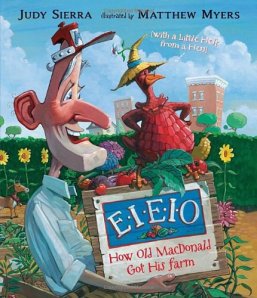

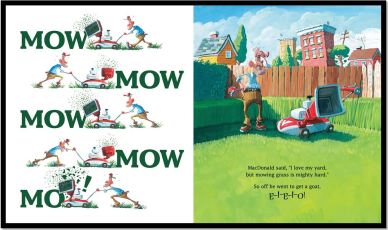
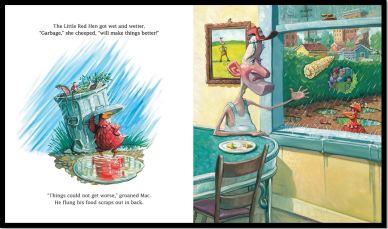


.jpeg?picon=3496)




 5 Comments on Fantastic Fiction for Kids – Earth Day, last added: 4/21/2010
Zoe, this is a fabulous idea! Thank you for helping the bees