JacketFlap connects you to the work of more than 200,000 authors, illustrators, publishers and other creators of books for Children and Young Adults. The site is updated daily with information about every book, author, illustrator, and publisher in the children's / young adult book industry. Members include published authors and illustrators, librarians, agents, editors, publicists, booksellers, publishers and fans. Join now (it's free).
Login or Register for free to create your own customized page of blog posts from your favorite blogs. You can also add blogs by clicking the "Add to MyJacketFlap" links next to the blog name in each post.
Blog Posts by Tag
In the past 7 days
Blog Posts by Date
Click days in this calendar to see posts by day or month
Viewing: Blog Posts Tagged with: animals, Most Recent at Top [Help]
Results 1 - 25 of 2,096
How to use this Page
You are viewing the most recent posts tagged with the words: animals in the JacketFlap blog reader. What is a tag? Think of a tag as a keyword or category label. Tags can both help you find posts on JacketFlap.com as well as provide an easy way for you to "remember" and classify posts for later recall. Try adding a tag yourself by clicking "Add a tag" below a post's header. Scroll down through the list of Recent Posts in the left column and click on a post title that sounds interesting. You can view all posts from a specific blog by clicking the Blog name in the right column, or you can click a 'More Posts from this Blog' link in any individual post.
between a cute little bird and a wide eyed baby bear...an "autumn serenade".
this is the second (but it sure won't be the last) piece i created this summer when i was trying my hand at mixed media. can i just tell you what a total blast it was creating this piece?! so much fun and a bit out of the box for me as i am a SUPER DUPER AWESOME planner. seriously. it's one of my finer traits....i think so, anyway. ;) this little creation was kind of spontaneous....kind of....
i knew i wanted to do a bear with an autumn color scheme. the rest just kind of happened the more i kept adding different layers, different supplies...and, being my absolute own worst critic well, i'm rather pleased with the way it turned out. i mean, c'mon..look at the face on the baby bear...you just gotta love him. :)
PRINTS available here. ORIGINAL PAINTING is FOR SALE. contact me here if interested.
also, here's a link to sweet ophelia...a colorful owl done in this same mixed media style.
perhaps 2017 will bring about some more of these little *experiments*....
0 Comments on a sweet little duet.... as of 12/14/2016 2:33:00 AM
Sea Otter - She hunts for food for both of them and never will give up.
Chimpanzee - At evening she will place it in a "sleeping" nest.
Here's two more sleeping animal spreads for November's theme, SLEEP. I feel like a lot of us Americans will need a long nap after this election season. Thanks for taking a look and please check out my Studio With A View Blog for more images from Baby on Board and other books.
0 Comments on And miles to go before I SLEEP as of 11/8/2016 10:28:00 AM
The US government recently announced that it was lifting its moratorium on funding certain experiments that use human stem cells to create animals that are partly human. At present scientists are only interested in creating entities with some human qualities, but which remain “mostly” animals. For example, some scientists want to create a chimeric pig with a human-enough heart to transplant into a human. Distinguishing between humans and other animals is common in most cultures.
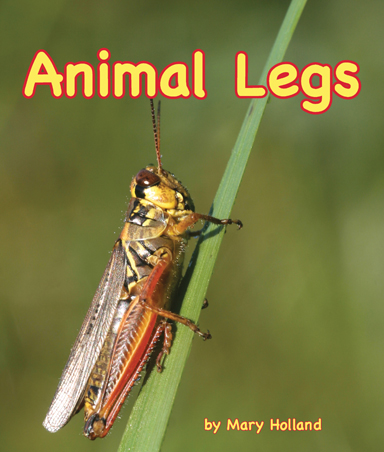
Bend your knees or jump up and down, how do you use your legs?
Compare how your legs work with the action of a frog’s legs or the webbing of an otter’s feet in Mary Holland’s new release Animal Legs. This is the third book in the Animal Anatomy & Adaptations series, and a perfect place for young readers to find amazing facts about the lives of animals found in their backyard.
We asked Mary Holland about her inspiration for Animal Legs and here is part of that interview.
A: Whose Animal Legs do you find most interesting?
MH: I’m afraid this is too hard a question to answer, as I find the many different ways that animals use their legs equally interesting. One of my favorites is a mole’s front paws. They look just like paddles to me, and the perfect tools to dig with. I also find the flap of skin that goes from a flying squirrel’s front legs to its back legs and allows it to glide through the air a remarkable adaptation. The fact that katydid ears are on their legs is pretty amazing, too!
A: Is there an animal/fact that you wish you could have included in the book or series but it just didn’t fit?
MH: There are so many animals that have such interesting feet and legs that I can’t even begin to count them, but one group that may have the most is insects. I could only fit a few of them in the book. Grasshoppers “sing” by rubbing their legs against their wings! Have you ever looked closely at a cicada’s front legs? They are pretty scary looking! Butterflies taste with their feet!
A: What is the most unusual predicament you have faced photographing an animal?
MH: I got very close to a young skunk in order to photograph it, and before I knew it, I was covered with skunk spray.
I once was trying to find a porcupine at night that was up in a tree, screaming its head off, and suddenly it fell to the ground about three feet from me. I almost had a head full of quills!
I was tracking a bobcat in late spring that had crossed a beaver pond, and the ice, which had started to melt, gave way (I weighed a lot more than the bobcat) and I fell through the ice into the cold water with snowshoes on. Fortunately, I could touch bottom with the tips of my snowshoes and managed to get out of the pond!
A: What would you like to share with young children about your love for nature?
MH: I feel so very lucky, as each day I get to discover something new. I never know what I’m going to find. I head outdoors, and go on what is to me very much like an Easter egg hunt – I look for animals and their signs and rarely do I come home without having found something new to observe and admire.
A: What do you have coming up next?
MH: I am working on two books. One is called Naturally Curious Day by Day. It describes two or three different animals or plants that you might see each day of the year. I am also writing a book called Otis the Owl, about a young barred owl.
Otis the Owl will fly onto bookshelves in the spring of 2017.
Throughout history and across cultures elephants have amazed and perplexed us, acquiring a plethora of meanings and purposes as our interactions have developed. They have been feared and hunted as wild animals, attacked and killed as dangerous pests, while also laboring for humans as vehicles, engineering devices, and weapons of war. Elephants have also been exploited for the luxury commodity of ivory.
Cats are among some of the most popular pets in the world, and they’ve been so for thousands of years. In fact, there are more than two million cat videos on YouTube. In appreciation of our feline friends for World Cat Day on 8 August, we’ve put together a list of 12 little-known cat facts.
It is probable that Shakespeare observed, or at least heard about, many natural phenomena that occurred during his time, which may have influenced the many references to nature and science that he makes in his work. Although he was very young at the time, he may have witnessed the blazing Stella Nova in 1572.
Did you escape to the beach for a little summer vacation? We did and brought home a few souvenirs from our walks on the beach. Now that our prize shells are sitting on a shelf collecting dust, it’s time to put them to use with a fun craft idea.
Shell Animals! This is a perfect activity for a rainy day or before a trip to the zoo. You can get as creative and detailed as you want while learning about different traits of the animal that you want to create.
We kept the supplies simple – of course, shells are the number one ingredient, although we would suggest some larger ones for young children, ours are a little smaller than we would have liked. To decorate your shells you will need, some construction paper, scissors, markers, paint or both. You can also add googly eyes and pipe cleaners for more detail. We made a peacock, a tiger, and our bear came in the perfect color straight from the ocean!
Share your favorite shell creatures with us; tag @arbordalekids on Facebook, Twitter, Pinterest or Tumblr! We will send a matching book to our top favorites!
Coyote Moon
by Maria Gianferrari
illustrated by Bagram Ibatoulline
Roaring Brook Press, 2016
Grades K-5
Today I'm taking part in the Coyote Moon blog tour. The book officially hits shelves tomorrow. As part of the blog tour, I'm giving away one copy of Coyote Moon donated by the publisher. The details and entry form can be found at the bottom of this page.
The engaging narrative of Coyote
0 Comments on Coyote Moon- Blog Tour and Giveaway as of 7/18/2016 3:07:00 AM
Gorillas Up Close
by Christena Nippert-Eng
Photographs by John Dominski
and Miguel Martinez
Henry Holt and Company, 2016
Grades 3-6
The majority of the animal books in the 500s section of my school library focus on animals in the wild. Occasionally there are books about animals that were rescued and rehabilitated such as Winter's Tail: How One Dolphin Learned to Swim Again or Owen & Mzee: The
0 Comments on Gorillas Up Close as of 7/15/2016 1:45:00 PM
GOODNIGHT GRIZZLE GRUMP! Published by HarperCollins(October 2015) My first picture book as author and illustrator!
- Grizzle Grump's page on the HarperCollins site FIVE STARS- San Francisco Book Review "This is a good choice for read-alouds and great fun, especially for those readers who can appreciate a good nap." - Kirkus Book Review "Goodnight, Grizzle Grump! is a great bedtime read. Warm and funny illustrations and the use of repetition are sure to connect with readers." - YA Books Central
0 Comments on Goodnight, Grizzle Grump! as of 7/11/2016 11:36:00 AM
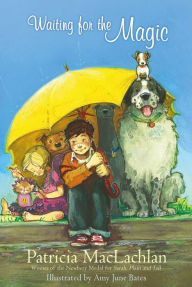
Waiting for the Magic. Patricia MacLachlan. 2011. 143 pages. [Source: Library]
Can a book about a father abandoning his family actually be good and funny and heartwarming? Apparently it can if it's written by Patricia MacLachlan.
The novel opens with Will, the narrator, discovering that his Dad has left them. He finds a note from his dad for him, and one for his sister. The mom, who is struggling to hold it together, decides to do something that many might consider drastic in its suddenness. The family needs a dog; that very day they will go to a shelter and get one. Will and Elinor can come along to help pick one out. Do they come home with a dog? Yes. They come home with FOUR dogs and ONE cat. The dogs are Bryn, Grace, Neo, and Bitty. The cat is Lula.
The way it's talked about in the novel--the way its perceived--is that 4 dogs and 1 cat can successfully replace the absent Dad. And that's a little true, at least on the surface, the dogs definitely take their minds off the problem, and prove lovable and entertaining as well. They all help take care of the animals. Everyone loves to play with all the dogs. And at night, the dogs are often in their beds. Bryn, I believe, "owns" the Mom, and takes over the bed.
The dogs are very joyful and fun. The novel has some 'magic' in it. The dogs (and cat) TALK. At first, it's just the four year old, Elinor, that hears them. The animals are all, OF COURSE SHE CAN HEAR US, SHE'S FOUR. YOU ALWAYS HEAR WHEN YOU'RE FOUR. But eventually Will hears them too....and he's not the only one.
I don't want to spoil the book. I don't. But the Dad is not out of the picture for good....and the family drama isn't nearly over. But it's drama in the best way under the circumstances. I wasn't expecting the book to be so delightful and heartwarming. I really wasn't.
Yesterday I was down at the barn painting a goat and a sheep. It wasn't a sketchbook page this time, but rather full size profiles painted in acrylic on plywood. Luckily I had Sofie to advise me.
The farmer, Lenny, asked me to help him with a farm-to-table display that he's setting up for the Country Living Fair starting today at the Rhinebeck Fairgrounds.
0 Comments on Yesterday at the Barn as of 1/1/1900
Prairie Dog Song: The Key to Saving North America's Grasslands
by Susan L. Roth and Cindy Trumbore
Lee and Low Books, 2016
Grades K-5
Susan L. Roth and Cindy Trombore have earned many honors and praises for their picture books including the 2014 Robert F. Sibert Medal for Parrots Over Puerto Rico. Their new nonfiction picture book highlights the role prairie dogs play in maintaining the balance
Aleksandra Mizielinska and Daniel Mizieliński (@hipopotam) started a revolution here in the UK, with the publication by Big Picture Press back in 2013 of their now famous Maps. With that beautifully produced book we started to see something of new departure for children’s non-fiction, with publishers realising that there was an appetite for gorgeously illustrated and finely produced information books which didn’t look or feel like school textbooks.
Since then we’ve seen several new non-fiction imprints established, dedicated to bringing us eye-catching, unusual and sumptuous non-fiction for children and young people, such as Wide Eyed Editions and 360 Degrees. This is great news, especially for younger children who report choosing to read non-fiction (42% of 7-11 year olds) almost as much as they do fiction (48.2% of 7-11 year olds, source), though you’d never guess this from the imbalance in titles published and reviewed.
It’s wonderful to see the return of the founders of the non-fiction revolution with a new title, Under Earth, Under Water, a substantial and wide-ranging exploration of what lies beneath the surface of the globe.
Split into two halves, allowing you to start from either end of the book by turning it around to explore either what lies beneath the earth, or under the oceans, this compendium of startling facts and quirky, fresh illustrations makes the most of its large format (a double page spread almost extends to A2), with great visual and verbal detail to pour over and a real sense of going down, down, down across the expanse of the pages.
The Earth pages cover everything from burrowing creatures to plant life in the soil, via extracting natural resources to industrial underground infrastructure. Tunnels, caves, digging up fossils and plate tectonics are all included in this rich and varied buffet brought together though a simple concept – simply exploring what is underneath our feet.
The Water pages explore aquatic life right from the surface down to the bottom of the Mariana Trench, ocean geography, human exploration with the aid of diving equipment, the history of submarines and even shipwrecks.
Lavishly produced, with gorgeously thick paper it is a delight to hold this book in your hands. Wonderful design, featuring lots of natural reds and browns in the Earth section and soothing shades of blues and green in the Water section, ensures exploring the diverse content is a visual treat as much as it is a spark for thinking about the world around us in new ways.
My only question mark over Under Earth, Under Water is the lack of an index. Maybe this makes it more like a box of treasures to rummage in and linger over, the sort of space where you can’t be sure what gems you’ll dig up. Although perhaps not a resource from which to clinically extract information, Under Earth, Under Water offers a great deal to explore and a very enjoyable journey to the centre of the earth.
There’s so much we could have “played” in Under Earth, Under Water. We toyed with making submarines, visiting caves, planting seeds to watch roots grow, but in the end the animal burrows won out, and we decided it was time to make our own. This began with papier mache and balloons…
…which when dry were set into a cardboard box frame, and surrounded by layers of “soil” i.e. different coloured felt, to recreate the layering of different soil and rock types.
Then the burrows needed filling! Sylvanian families came to the rescue, along with nature treasures gathered from the garden.
And soon we had a dollshouse with a difference! (Can you spot the bones and other archaeological finds waiting to be dug up from the soil??)
Whilst making our underground burrow we listened to:
Reading Above and Below by Patricia Hegarty and Hanako Clulow. This books explores similar territory to Under Earth, Under Water – but for slightly younger children – and makes great use of split pages.
Disclosure: I was sent a free review copy of this book by the publisher, Big Picture Press. The book was translated by Antonia Lloyd Jones although she is not credited in the book.
2 Comments on Under Earth, Under Water, last added: 5/26/2016
World Turtle Day is celebrated on 23 May every year since its inception in 2000. The American Tortoise Rescue sponsors this day of awareness to bring attention to one of the world’s oldest reptiles, and encourage humans to help in the conservation and protection of these grand animals. In honour of these grandiose creatures, we have compiled a reading list of biology titles and articles that have helped to further research into the conservation biology of all chelonians.
You can use you Facebook account, or create a Foreword Review account to leave your comment. It is very simple - and would mean the absolute World to Baby Bear and all his forest friends! Please also help spread the word and help me make this go viral. Voting ends May 20, 2016.
A HEARTFELT THANK YOU from: Baby Bear, Valerie Vole, Momma Bear, Sandy Spiderling, Zoe Zebra Butterfly, Honey Bee, Lili Ladybug, Sammy Snow Owl, and Shennen.
I just finished the artwork for an upcoming book, FOOTLOOSE by Kenny Loggins. The book is being published by Moondance Press/ Quarto Publishing Group. I'm really excited about this one and I think a lot of people are going to be putting on their dancin' shoes in October. The original song (FOOTLOOSE) has been re-written to become a fun story that takes place after hours, at the zoo. The art is full of animals, color, texture, fun and a whole lot of DANCIN'!
Plus, while painting these illustrations, I listened to Kenny's Return to Pooh Corner CD. Pure magic. I usually don't work directly with the author but I spoke to Kenny about his vision for the story. His input made the story telling more complete.
A big box of shiny new books landed on my doorstep. Memoirs of a Parrot is the fourth "memoir" book, written by the very talented Devin Scillian and published by Sleeping Bear Press.
"Yay, new books!"
When I read that a parrot would be the main character, I had to choose an African Grey parrot. I have fond childhood memories of my grandpa and his African Grey, named Chico. I chose a Hyacinth Macaw as the other parrot in the story. Mostly because of the color. I live in Ohio and Devin Scillian lives in Michigan, so it just made sense to use Ohio State (scarlet and grey) and Michigan colors (maze and blue). Plus, my wife's family is from the state up north (we're a "blended" family).
A drawing that I did in High School of my grandpa and his parrot, Chico.
Also, the main character (human) in the story plays a ukulele. I said, "hmmm, I need to get a ukulele (as reference) and begin my career as a ukulele rock star". Then I met Emily Arrow, a true ukulele rock star, so I bought one. Now I need to start practicing my ukulele licks.
"Hey, I think that I need a ukulele."
Anyway, you must take a look at Memoirs of a Parrot. It's got parrots, ukulele players and a very funny story.
End papers from Memoirs of a Parrot.
Thank you, Heather Hughes, Felicia Macheske and Sleeping Bear Press.
Now, back to the drawing board. -Tim
0 Comments on I Found a box of Parrots on my doorstep. as of 1/1/1900
April is National Poetry Month! All month long we’ll be celebrating by posting some of our favorite poems for Poetry Friday. To celebrate Earth Day, for today’s Poetry Friday, we chose a poem from Animal Poems of the Iguazú/Animalario del Iguazú, written by Francisco X. Alarcón and illustrated by Maya Christina Gonzalez.
Same Green Fate
let’s listen to
the green voice
of the rainforest
the colorful chorus
of so many flowers
trees and birds
let’s learn
the distinct
living alphabets
of so many species
so many insects
and butterflies
let’s be part
of the clamor and
song of this land:
you all belong
to us and we all
belong to you
protect all of us
for the Earth’s fate
for your own sake
let’s make the world
a true Ybirá Retá—
a Land of the Trees
Purchase Animal Poems of the Iguazú/Animalario del Iguazúhere.
Our Earth Day Poetry Collection is now 25% off! Purchase it here.
Ocean Animals (Animal Bites series)
by Laaren Brown
Liberty Street, an imprint of Time Inc. Books, 2016
Grades K-5
Polar Animals (Animal Bites series)
by Laaren Brown
Liberty Street, an imprint of Time Inc. Books, 2016
Grades K-5
Today is Earth Day, and it's the perfect time to highlight the new Animal Bites series by Animal Planet. Published by Time Inc., the series was released earlier this
0 Comments on Animal Bites- New Animal Planet Series as of 1/1/1900





 skin that goes from a flying squirrel’s front legs to its back legs and allows it to glide through the air a remarkable adaptation. The fact that katydid ears are on their legs is pretty amazing, too!




.jpeg?picon=3451)



.jpg?picon=1009)


.jpeg?picon=3306)
 It’s wonderful to see the return of the founders of the non-fiction revolution with a new title,


ZOE, PLEASE ADOPT ME!!
Seriously,
Simone.
Consider it done Simone