


The realization of this moment gave me chills and led me to share my writing backstory with Dana. Dana listened and encouraged me to open my presentation with this story. I was hesitant, the experience had halted my inner writer for years. What if sharing it again had the same result? 
new posts in all blogs
 By: Deb Frazier,
on 11/28/2016
By: Deb Frazier,
on 11/28/2016
Blog: TWO WRITING TEACHERS (Login to Add to MyJacketFlap)
JacketFlap tags: writing process, writing, writers, Write: It's good for you!, writing workshop, teacher of writing, young authors, Teachers who write, teacher writing, writer identity, community, Add a tag
.jpg?picon=160) By: Matthew Cheney,
on 10/28/2016
By: Matthew Cheney,
on 10/28/2016
Blog: The Mumpsimus (Login to Add to MyJacketFlap)
JacketFlap tags: Aickman, Electric Literature, horror, short stories, Writers, Add a tag
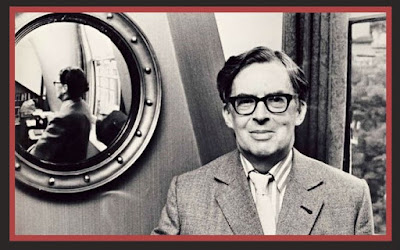
Electric Literature has published an essay I wrote about Robert Aickman, one of the greatest of the 20th century's short story writers:
For more of me on Aickman, see this post about my favorite of his stories, "The Stains".
By: Matthew Cheney,
on 10/19/2016
Blog: The Mumpsimus (Login to Add to MyJacketFlap)
JacketFlap tags: poetry, memoir, Writing, Writers, New Hampshire, Add a tag
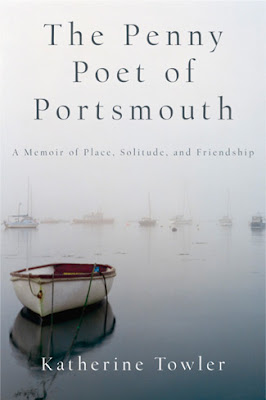
Katherine Towler's deeply affecting and thoughtful portrait of Robert Dunn is subtitled "A Memoir of Place, Solitude, and Friendship". It's an accurate label, but one of the things that makes the book such a rewarding reading experience is that it's a memoir of struggles with place, solitude, and friendship — struggles that do not lead to a simple Hallmark card conclusion, but rather something far more complex. This is a story that could have been told superficially, sentimentally, and with cheap "messages" strewn like sugarcubes through its pages. Instead, it is a book that honors mysteries.
You are probably not familiar with the poetry of Robert Dunn, nor even his name, unless you happen to live or have lived in or around Portsmouth, New Hampshire. Even then, you may not have noticed him. He was Portsmouth's second poet laureate, and an important figure within the Portsmouth poetry scene from the late 1970s to his death in 2008. But he only published a handful of poems in literary journals, and his chapbooks were printed and distributed only locally — and when he sold them himself, he charged 1 cent. (Towler tells a story of trying to pay him more, which proved impossible.) He was insistently local, insistently uncommercial.
Dunn was also about as devoted to his writing as a person could be. When Towler met him in the early '90s, he lived in a single room in an old house, owned almost nothing, and made what little money he made from working part-time at the Portsmouth Athenaeum. He seemed to live on cigarettes and coffee. When Towler first saw him around town, she, like probably many other people, thought he was homeless.
If a person could start a conversation with Dunn, which wasn't always easy, they would discover that he was very well read and eloquent. He was not, though, effusive, and he was deeply private. It was only late in his life, wracked with lung disease, that he opened up to anyone, and the person he seems to have opened up most to is Towler, though even then, she was able to learn very little about his past.
Towler got to know him because she was a neighbor, because she was intrigued by him, and because she was a writer on a different career track, with different ambitions. Dunn certainly wanted his poems to be read — he wouldn't have made chapbooks and sold them (even if only for a penny) if not — but he didn't want to subject himself to the quest-for-fame machine, he didn't want to do what everybody now says you must do if you want to have a successful writing career: become a "brand". He didn't bother with any sort of copyright, and Towler quotes a disclaimer from one of his books: "1983 and no nonsense about copyright. When I wrote these things they belonged to me. When you read them they belong to you. And perhaps one other." In 1999, he told a reporter from the Boston Globe, "It just feels kind of silly posting no trespassing signs on my poems."
His motto, written on slips of paper he occasionally gave to people, was "Minor poets have more fun."
When Towler met him, she was struggling with writing a novel. She had lived peripatetically for a while, but had recently gotten married. She wanted to be published far and wide, and in her most honest moments she probably would have admitted that she would have liked to sell millions of copies of her books, get a great movie deal or two, get interviewed by Terry Gross and Charlie Rose, win a Pulitzer and a National Book Award and, heck, maybe even a Nobel. Success.
Once her first novel was published, Towler discovered what many people do in their first experiences with publication: It doesn't fill the hole. It is never enough. There are always other books selling better, getting more or better reviews, always other writers with more money and fame, and in American book culture these days, once a book is a month or two old, it's past its expiration date and rarely of much interest to booksellers, reviewers, or the public, because there's always something new, new, new to grab attention. You might as well sell your poems for a penny in Market Square.
By the time Towler's first novel is published, Portsmouth is deep in the process of gentrification. Not only have the local market, five-and-dime store, and hardware store been put out of business by rising rents and big box stores, but all seven of the downtown bookstores have disappeared. (Downtown is no longer bookstoreless. Bookstores, at least, can appeal to the gentrifiers, though it's still tough to be profitable with the cost of the rent what it is.) Towler gives a reading at a Barnes & Noble out at the mall, a perfect symbol of pretty much everything Robert Dunn had lived his life against: a mall, a chain bookstore. He attends the reading, though, and seems happy for Towler's success. He stands in line to get his book signed, and then says something that cuts Towler to the bone: "I'll let you get to your public."
But at what cost? This question is always in the background as Dunn becomes ill and more dependent on other people. If he wants to stay alive, the sort of solitude he cultivated and cherished is no longer possible, leading to some difficult confrontations and tensions.
Towler does her best not to impose her own values on Dunn's life, but she can't help wondering what it would be like to live as Dunn does. Though she sympathizes with him, and shares some of his ideals, she's no ascetic. She can't help but think of Dunn as lonely, since she would be, especially in illness. She cherishes her husband, she likes the house they buy together, she enjoys (at least sometimes) traveling to readings and leading writing workshops.
Dunn's life, as Towler presents it at least, shows the inadequacy of the question, "Are you happy?" In illness, Dunn was obviously not comfortable, and when he couldn't be at home, he was often not content. But happiness is a fleeting thing, not a state of being. Even if you believe that happiness is something that can be captured for more than a moment, there's no reason to think that, except for illness, Robert Dunn was unhappy. He sculpted a life for himself that was, it seems, quite close to whatever life he might have desired having. I doubt having a life partner of some sort would have led to more moments of happiness for him, as Towler wonders at one point. The accommodations and annoyances of having another person around a lot of the time are insufferable for someone inclined toward solitude. Was this the case for Dunn? It's difficult to know, because he was difficult to know. Towler is remarkably restrained, I think, in not trying to impose her own pleasures on Dunn — she doesn't ever record saying to him what the partnered often say to the unpartnered, "Wouldn't you be happy with someone else in your life?" (I often think partnered people work a bit too hard to justify their own life choices, as if the presence of other types of lives are somehow an indictment of their own.) But even still, it does seem to be one of the more unbridgeable gulfs between types of people: the contentedly partnered seem as terrified of being unpartnered as the contentedly unpartnered are of being partnered, and so one looks on the other's life as a nightmare.
What The Penny Poet of Portsmouth shows is the necessity of community. Robert Dunn was, for many reasons, lucky that he lived in Portsmouth when he did, because there was a real community of writers and people interested in writing and reading, and these people looked out for each other. Before the rents went whacko, it was possible to live in Portsmouth if you weren't rich. This is why the word place in Towler's subtitle is so important. The book is not only a portrait of Robert Dunn, but a chronicle of the city that allowed him to be Robert Dunn. Towler is careful to chronicle the details of the place and community, both its people and its institutions. She shows the frustrations of dealing with bureaucracies of illness, and without being heavy-handed she depicts the ways that poverty is perceived in a place as ruggedly individualistic as New Hampshire — once she gets to know Robert Dunn, she also gets to see, feel, and struggle against the assumptions people who don't know him make. (In some of what she described him experiencing from nurses, doctors, and pharmacists, I couldn't help but think of my father, who did not have health insurance and who died of congestive heart failure. After he had a heart attack, he felt patronized and dismissed by hospitals that knew he couldn't pay his bills. Whether the hospital employees themselves actually felt this way, I don't know, but he perceived it deeply, and it contributed to his determination never to see another doctor or hospital. I'll forever remember the way his voice sounded when he told me, briefly, of this: the shattered pride, the humiliation, the rage all fraying his words.)
In its attention to the details of community — and a number of other ways — The Penny Poet of Portsmouth makes a perfect companion to Samuel Delany's Dark Reflections, another story of a poet, though in a very different environment. Arnold Hawley in Delany's novel is far less content than Robert Dunn in Towler's memoir, but their commitments are similar. Arnold is more seduced by the desire for fame and success than Dunn seems to have been, and so his personality is perhaps a bit more like Towler's, but without her relative success in everyday living. Having known Dunn, Towler is perhaps more capable of imagining Dunn as content in his life than Delany is quite able to imagine Arnold content — I've sometimes wondered whether Arnold is so tormented by his life because Delany himself would be tormented by that life, a life that is the opposite, in nearly every way, of his own. No matter. The books have much to say to (and with) each other.
There is much in Towler's memoir that is moving. She takes her time and doesn't rush the story. At first, I thought perhaps her pacing was unnecessarily slow, perhaps padding out what was a thin tale. I was wrong, though, because Towler is up to many things in the book, and needs her portrait of the place and person to be built carefully for her ideas and concerns to have resonance and real meaning. It's a tale of growing into knowledge and into something like intimacy, but also, at the same time, of coming to terms with unsolveable mysteries and uncrossable borders.
By the time I got to the fragmentary biography Towler offers as an appendix, those few pages were the most powerful of the book for me, because they show just how much we can't know. (I suppose the power was also one of some sort of personal recognition: Robert Dunn grew up only a dozen or so miles from where I grew up. The soil of his early years is as familiar to me as any other place on Earth. He was a graduate of the University of New Hampshire, where I finished my undergraduate degree and am now working on a Ph.D. I've only spent occasional time in Portsmouth, though enough over the decades to have seen some of the changes Towler writes about.) Primed by all the rest of Towler's story, it was this paragraph that most deeply affected me:
The book ends with a delightful collection of what we might call "Robert Dunn's wit and wisdom", taken from various interviews and profiles in local papers that Dunn had stuck in a folder labeled "Vanity". Of the civil rights movement, he told Clare Kittredge of the Boston Globe in 1999: "We had our hearts thoroughly broken."
Let's end these musings with what mattered most to Robert Dunn, though: the poetry. His poems remind me of Frank O'Hara (whom he discusses with Towler) and Samuel Menashe. They're colloquial and compressed, full of surprises. Thanks to Towler's book, I expect, Dunn's selected poems have finally been collected in One of Us Is Lost, and a few are reprinted in The Penny Poet. Here's one that seems particularly appropriate:
By: Matthew Cheney,
on 10/19/2016
Blog: The Mumpsimus (Login to Add to MyJacketFlap)
JacketFlap tags: poetry, memoir, Writing, Writers, New Hampshire, Add a tag
Katherine Towler's deeply affecting and thoughtful portrait of Robert Dunn is subtitled "A Memoir of Place, Solitude, and Friendship". It's an accurate label, but one of the things that makes the book such a rewarding reading experience is that it's a memoir of struggles with place, solitude, and friendship — struggles that do not lead to a simple Hallmark card conclusion, but rather something far more complex. This is a story that could have been told superficially, sentimentally, and with cheap "messages" strewn like sugarcubes through its pages. Instead, it is a book that honors mysteries.
You are probably not familiar with the poetry of Robert Dunn, nor even his name, unless you happen to live or have lived in or around Portsmouth, New Hampshire. Even then, you may not have noticed him. He was Portsmouth's second poet laureate, and an important figure within the Portsmouth poetry scene from the late 1970s to his death in 2008. But he only published a handful of poems in literary journals, and his chapbooks were printed and distributed only locally — and when he sold them himself, he charged 1 cent. (Towler tells a story of trying to pay him more, which proved impossible.) He was insistently local, insistently uncommercial.
Dunn was also about as devoted to his writing as a person could be. When Towler met him in the early '90s, he lived in a single room in an old house, owned almost nothing, and made what little money he made from working part-time at the Portsmouth Athenaeum. He seemed to live on cigarettes and coffee. When Towler first saw him around town, she, like probably many other people, thought he was homeless.
If a person could start a conversation with Dunn, which wasn't always easy, they would discover that he was very well read and eloquent. He was not, though, effusive, and he was deeply private. It was only late in his life, wracked with lung disease, that he opened up to anyone, and the person he seems to have opened up most to is Towler, though even then, she was able to learn very little about his past.
Towler got to know him because she was a neighbor, because she was intrigued by him, and because she was a writer on a different career track, with different ambitions. Dunn certainly wanted his poems to be read — he wouldn't have made chapbooks and sold them (even if only for a penny) if not — but he didn't want to subject himself to the quest-for-fame machine, he didn't want to do what everybody now says you must do if you want to have a successful writing career: become a "brand". He didn't bother with any sort of copyright, and Towler quotes a disclaimer from one of his books: "1983 and no nonsense about copyright. When I wrote these things they belonged to me. When you read them they belong to you. And perhaps one other." In 1999, he told a reporter from the Boston Globe, "It just feels kind of silly posting no trespassing signs on my poems."
His motto, written on slips of paper he occasionally gave to people, was "Minor poets have more fun."
When Towler met him, she was struggling with writing a novel. She had lived peripatetically for a while, but had recently gotten married. She wanted to be published far and wide, and in her most honest moments she probably would have admitted that she would have liked to sell millions of copies of her books, get a great movie deal or two, get interviewed by Terry Gross and Charlie Rose, win a Pulitzer and a National Book Award and, heck, maybe even a Nobel. Success.
Once her first novel was published, Towler discovered what many people do in their first experiences with publication: It doesn't fill the hole. It is never enough. There are always other books selling better, getting more or better reviews, always other writers with more money and fame, and in American book culture these days, once a book is a month or two old, it's past its expiration date and rarely of much interest to booksellers, reviewers, or the public, because there's always something new, new, new to grab attention. You might as well sell your poems for a penny in Market Square.
By the time Towler's first novel is published, Portsmouth is deep in the process of gentrification. Not only have the local market, five-and-dime store, and hardware store been put out of business by rising rents and big box stores, but all seven of the downtown bookstores have disappeared. (Downtown is no longer bookstoreless. Bookstores, at least, can appeal to the gentrifiers, though it's still tough to be profitable with the cost of the rent what it is.) Towler gives a reading at a Barnes & Noble out at the mall, a perfect symbol of pretty much everything Robert Dunn had lived his life against: a mall, a chain bookstore. He attends the reading, though, and seems happy for Towler's success. He stands in line to get his book signed, and then says something that cuts Towler to the bone: "I'll let you get to your public."
But at what cost? This question is always in the background as Dunn becomes ill and more dependent on other people. If he wants to stay alive, the sort of solitude he cultivated and cherished is no longer possible, leading to some difficult confrontations and tensions.
Towler does her best not to impose her own values on Dunn's life, but she can't help wondering what it would be like to live as Dunn does. Though she sympathizes with him, and shares some of his ideals, she's no ascetic. She can't help but think of Dunn as lonely, since she would be, especially in illness. She cherishes her husband, she likes the house they buy together, she enjoys (at least sometimes) traveling to readings and leading writing workshops.
Dunn's life, as Towler presents it at least, shows the inadequacy of the question, "Are you happy?" In illness, Dunn was obviously not comfortable, and when he couldn't be at home, he was often not content. But happiness is a fleeting thing, not a state of being. Even if you believe that happiness is something that can be captured for more than a moment, there's no reason to think that, except for illness, Robert Dunn was unhappy. He sculpted a life for himself that was, it seems, quite close to whatever life he might have desired having. I doubt having a life partner of some sort would have led to more moments of happiness for him, as Towler wonders at one point. The accommodations and annoyances of having another person around a lot of the time are insufferable for someone inclined toward solitude. Was this the case for Dunn? It's difficult to know, because he was difficult to know. Towler is remarkably restrained, I think, in not trying to impose her own pleasures on Dunn — she doesn't ever record saying to him what the partnered often say to the unpartnered, "Wouldn't you be happy with someone else in your life?" (I often think partnered people work a bit too hard to justify their own life choices, as if the presence of other types of lives are somehow an indictment of their own.) But even still, it does seem to be one of the more unbridgeable gulfs between types of people: the contentedly partnered seem as terrified of being unpartnered as the contentedly unpartnered are of being partnered, and so one looks on the other's life as a nightmare.
What The Penny Poet of Portsmouth shows is the necessity of community. Robert Dunn was, for many reasons, lucky that he lived in Portsmouth when he did, because there was a real community of writers and people interested in writing and reading, and these people looked out for each other. Before the rents went whacko, it was possible to live in Portsmouth if you weren't rich. This is why the word place in Towler's subtitle is so important. The book is not only a portrait of Robert Dunn, but a chronicle of the city that allowed him to be Robert Dunn. Towler is careful to chronicle the details of the place and community, both its people and its institutions. She shows the frustrations of dealing with bureaucracies of illness, and without being heavy-handed she depicts the ways that poverty is perceived in a place as ruggedly individualistic as New Hampshire — once she gets to know Robert Dunn, she also gets to see, feel, and struggle against the assumptions people who don't know him make. (In some of what she described him experiencing from nurses, doctors, and pharmacists, I couldn't help but think of my father, who did not have health insurance and who died of congestive heart failure. After he had a heart attack, he felt patronized and dismissed by hospitals that knew he couldn't pay his bills. Whether the hospital employees themselves actually felt this way, I don't know, but he perceived it deeply, and it contributed to his determination never to see another doctor or hospital. I'll forever remember the way his voice sounded when he told me, briefly, of this: the shattered pride, the humiliation, the rage all fraying his words.)
In its attention to the details of community — and a number of other ways — The Penny Poet of Portsmouth makes a perfect companion to Samuel Delany's Dark Reflections, another story of a poet, though in a very different environment. Arnold Hawley in Delany's novel is far less content than Robert Dunn in Towler's memoir, but their commitments are similar. Arnold is more seduced by the desire for fame and success than Dunn seems to have been, and so his personality is perhaps a bit more like Towler's, but without her relative success in everyday living. Having known Dunn, Towler is perhaps more capable of imagining Dunn as content in his life than Delany is quite able to imagine Arnold content — I've sometimes wondered whether Arnold is so tormented by his life because Delany himself would be tormented by that life, a life that is the opposite, in nearly every way, of his own. No matter. The books have much to say to (and with) each other.
There is much in Towler's memoir that is moving. She takes her time and doesn't rush the story. At first, I thought perhaps her pacing was unnecessarily slow, perhaps padding out what was a thin tale. I was wrong, though, because Towler is up to many things in the book, and needs her portrait of the place and person to be built carefully for her ideas and concerns to have resonance and real meaning. It's a tale of growing into knowledge and into something like intimacy, but also, at the same time, of coming to terms with unsolveable mysteries and uncrossable borders.
By the time I got to the fragmentary biography Towler offers as an appendix, those few pages were the most powerful of the book for me, because they show just how much we can't know. (I suppose the power was also one of some sort of personal recognition: Robert Dunn grew up only a dozen or so miles from where I grew up. The soil of his early years is as familiar to me as any other place on Earth. He was a graduate of the University of New Hampshire, where I finished my undergraduate degree and am now working on a Ph.D. I've only spent occasional time in Portsmouth, though enough over the decades to have seen some of the changes Towler writes about.) Primed by all the rest of Towler's story, it was this paragraph that most deeply affected me:
The book ends with a delightful collection of what we might call "Robert Dunn's wit and wisdom", taken from various interviews and profiles in local papers that Dunn had stuck in a folder labeled "Vanity". Of the civil rights movement, he told Clare Kittredge of the Boston Globe in 1999: "We had our hearts thoroughly broken."
Let's end these musings with what mattered most to Robert Dunn, though: the poetry. His poems remind me of Frank O'Hara (whom he discusses with Towler) and Samuel Menashe. They're colloquial and compressed, full of surprises. Thanks to Towler's book, I expect, Dunn's selected poems have finally been collected in One of Us Is Lost, and a few are reprinted in The Penny Poet. Here's one that seems particularly appropriate:
 By: Faith Pray,
on 9/23/2016
By: Faith Pray,
on 9/23/2016
Blog: SACRED DIRT (Login to Add to MyJacketFlap)
JacketFlap tags: #kidlitart, #backtoschool, #puddlejump, puddlejumpcollective, great books, writing, art, writers, artists, failure, good books, Add a tag




Then I'm set. I have a one-page cushion keeping me from a first-page flop.
 By: Lisa Keeler,
on 9/18/2016
By: Lisa Keeler,
on 9/18/2016
Blog: TWO WRITING TEACHERS (Login to Add to MyJacketFlap)
JacketFlap tags: authors, writing process, inspiration, writers, writing workshop, writer identity, Add a tag
By: Kathleen Neagle Sokolowski,
on 8/2/2016
Blog: TWO WRITING TEACHERS (Login to Add to MyJacketFlap)
JacketFlap tags: blogging, writing, writers, writing workshop, BLOG SERIES: Starting with What Matters Most in Writing Workshop, Add a tag
.jpeg?picon=2456) By: Christine Marie Larsen,
on 7/14/2016
By: Christine Marie Larsen,
on 7/14/2016
Blog: Christine Marie Larsen Sketchbook (Login to Add to MyJacketFlap)
JacketFlap tags: commissioned, SRoB, science, portraits, people, color, writers, editorial, faces, Add a tag
By: Faith Pray,
on 6/27/2016
Blog: SACRED DIRT (Login to Add to MyJacketFlap)
JacketFlap tags: great books, picture books, birthdays, writing, art, writers, parties, good books, time to write, teen writers, word therapy, Add a tag


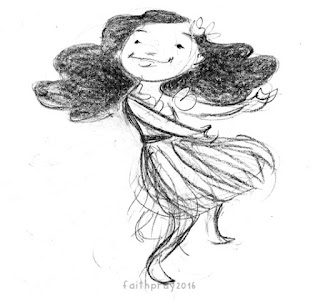

Wherever you find yourself this week,
I wish you peaceful breezes, sweet surprises, and
aloha.
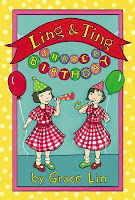
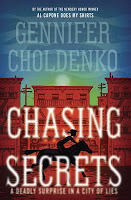
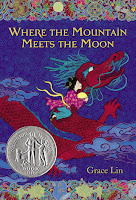

By: Dana Murphy,
on 6/20/2016
Blog: TWO WRITING TEACHERS (Login to Add to MyJacketFlap)
JacketFlap tags: authors, writers, Kate DiCamillo, Add a tag
.jpg?picon=980) By: Cheryl Rainfield,
on 6/17/2016
By: Cheryl Rainfield,
on 6/17/2016
Blog: Cheryl Rainfield: Avid Reader, Teen Fiction Writer, and Book-a-holic. Focus on Children & Teen Books (Login to Add to MyJacketFlap)
JacketFlap tags: Angela Ackerman, Becca Puglisi, setting thesaurus, rural setting thesaurus, urban setting thesaurus, writer resources, amwriting, writers, Add a tag
By: Christine Marie Larsen,
on 6/16/2016
Blog: Christine Marie Larsen Sketchbook (Login to Add to MyJacketFlap)
JacketFlap tags: SRoB, portraits, people, color, writers, editorial, commissioned, Add a tag
By: Matthew Cheney,
on 6/10/2016
Blog: The Mumpsimus (Login to Add to MyJacketFlap)
JacketFlap tags: Writers, Delany, Wesleyan UP, crowdfunding, Kenneth James, Add a tag
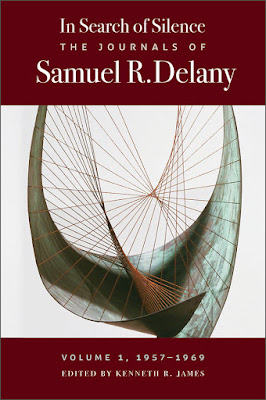
Kenneth James is editing the journals of Samuel Delany for publication. Volume 1 is coming out from Wesleyan University Press in December. For the future volumes, Ken needs help with funding.
If you already know how valuable this project is, don't read on. Just go donate.
But if you need some convincing, please read on...

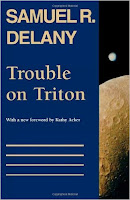

Volume 2 will be even more exciting, I expect. Ken plans for it to begin with Dhalgren material and then to continue through the 1970s, which would mean it includes material related to Trouble on Triton, Tales of Nevèrÿon, and, depending on how he edits it, Hogg, Neveryóna, Stars in My Pocket Like Grains of Sand, and others. It will also show how deeply connected Delany's nonfiction is to his fiction, and will show the development of his engagement with critical theory. Additionally, there's lots of material in the 1970s journals about his first experiences as a university teacher.
I'm just back from spending a few days at the Delany archive at Boston University, and I've looked through a few of the 1970s journals. They're truly thrilling for anybody interested not only in Delany the writer, but in the writing and thinking process in general. They're especially interesting for those of us who think that after 1969, Delany's work only got more brilliant. They are working journals, not really diaries as we generally think of them, and they clarify a lot of questions of when particular things were written, and why, and how. That makes them, if nothing else, of immense scholarly value. But they've also got material in them that just flat-out makes for good reading.
The work of editing them is ... daunting. This is why Kenneth James deserves your donations. (Wesleyan University Press is great, but they've got limited funding themselves. These books are not going to sell millions of copies, not because people don't love Delany's work, but because there's a small market for this sort of publication.) Ken probably knows Delany's work as well as anybody on the planet other than (perhaps) SRD himself. As a Cornell undergraduate, he interviewed Delany in 1986 — an interview deemed substantial enough to be included in Silent Interviews. Later, he wrote the introductions to Longer Views and 1984: Selected Letters. He organized the SUNY Buffalo conference on Delany, the first international conference on SRD's work, and guest-edited the volume of Annals of Scholarship that preserved some of the papers from that conference. He's written on various of Delany's books. He knows his stuff better than perhaps anybody else knows that stuff.
Ken is an independent scholar without a permanent university affiliation, which in this economic/academic structure means he has hardly any source of financial support for a project like this. He needs our support. Editing these journals is a full-time job if it's going to get done before the end of the century. The journals are handwritten, mostly in spiral ring notebooks. They're in various states of organization and disorganization. (The BU archivists are magnificent, and have done a great job of indexing and preserving the journals to the best of their ability, but these were working journals, not documents immediately designed for eternal preservation) And they are copious. In six hours of reading and notetaking yesterday, I made it through only a few months' worth of journals. Transcribing, editing, and annotating them will be a gargantuan task. Ken has already proved it is a task he is prepared for, a task he is capable of completing. I don't think I could do it. I know he can.
I could go on and on. Delany is one of the most important writers and thinkers of our time. The more I read, the more I delve into his archive, the more I believe this to be true. I've spent a decade studying his work and feel I'm only now beginning to move beyond a superficial appreciation of it.
We need these books, and we need Ken to be the one to put them together. There is nobody better for the job. Please help him do it.
By: Christine Marie Larsen,
on 6/9/2016
Blog: Christine Marie Larsen Sketchbook (Login to Add to MyJacketFlap)
JacketFlap tags: portraits, color, writers, exhibits, SRoB, Add a tag
By: Christine Marie Larsen,
on 6/9/2016
Blog: Christine Marie Larsen Sketchbook (Login to Add to MyJacketFlap)
JacketFlap tags: editorial, faces, commissioned, SRoB, portraits, people, color, writers, Add a tag
By: Christine Marie Larsen,
on 6/3/2016
Blog: Christine Marie Larsen Sketchbook (Login to Add to MyJacketFlap)
JacketFlap tags: portraits, people, color, writers, editorial, faces, commissioned, SRoB, Add a tag
By: Christine Marie Larsen,
on 5/18/2016
Blog: Christine Marie Larsen Sketchbook (Login to Add to MyJacketFlap)
JacketFlap tags: SRoB, portraits, people, color, writers, editorial, faces, commissioned, Add a tag
By: Christine Marie Larsen,
on 5/11/2016
Blog: Christine Marie Larsen Sketchbook (Login to Add to MyJacketFlap)
JacketFlap tags: portraits, people, writers, editorial, faces, commissioned, SRoB, Add a tag
By: Christine Marie Larsen,
on 4/27/2016
Blog: Christine Marie Larsen Sketchbook (Login to Add to MyJacketFlap)
JacketFlap tags: SRoB, portraits, people, color, writers, editorial, faces, commissioned, Add a tag
By: Christine Marie Larsen,
on 4/27/2016
Blog: Christine Marie Larsen Sketchbook (Login to Add to MyJacketFlap)
JacketFlap tags: portraits, people, color, writers, editorial, commissioned, SRoB, Add a tag
By: Faith Pray,
on 4/12/2016
Blog: SACRED DIRT (Login to Add to MyJacketFlap)
JacketFlap tags: great books, birthdays, writers, scribbles, good books, good, Add a tag



By: Matthew Cheney,
on 3/6/2016
Blog: The Mumpsimus (Login to Add to MyJacketFlap)
JacketFlap tags: teaching, Writing, Writers, academia, Hemingway, Modernism, Henry James, pedagogy, Add a tag
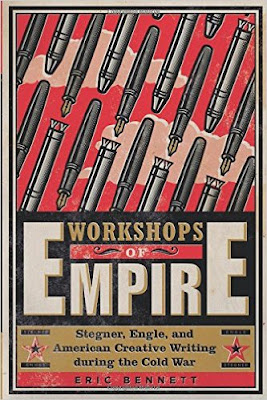
Eric Bennett has an MFA from Iowa, the MFA of MFAs. (He also has a Ph.D. in Lit from Harvard, so he is a man of fine and rare academic pedigree.) Bennett's recent book Workshops of Empire: Stegner, Engle, and American Creative Writing during the Cold War is largely about the Writers' Workshop at Iowa from roughly 1945 to the early 1980s or so. It melds, often explicitly, The Cultural Cold War with The Program Era, adding some archival research as well as Bennett's own feeling that the work of politically committed writers such as Dreiser, Dos Passos, and Steinbeck was marginalized and forgotten by the writing workshop hegemony in favor of individualistic, apolitical writing.
I don't share Bennett's apparent taste in fiction (he seems to consider Dreiser, Dos Passos, Steinbeck, Thomas Wolfe, etc. great writers; I don't), but I sympathize with his sense of some writing workshops' powerful, narrowing effect on American fiction and publishing for at least a few decades. He notes in his conclusion that the hegemonic effect of Iowa and other prominent programs seems to have declined over the last 15 years or so, that Iowa in recent years has certainly become more open to various types of writing, and that even when Iowa's influence was at an apex, there were always other sorts of programs and writers out there — John Barth at Johns Hopkins, Robert Coover at Brown, and Donald Barthelme at the University of Texas are three he mentions, but even that list shows how narrow in other ways the writing programs were for so long: three white hetero guys with significant access to the NY publishing world.
What Bennett most convincingly shows is how the discourse of creative writing within U.S. universities from the beginning of the Cold War through at least to the 1990s created a field of limited, narrow values not only for what constitutes "good writing", but also for what constitutes "a good writer". It's a tale of parallel, and sometimes converging, aesthetics, politics, and pedagogies. Plenty of individual writers and teachers rejected or rebelled against this discourse, but for a long time it did what hegemonies do: it constructed common sense. (That common sense was not only in the workshops — at least some of it made its way out through writing handbooks, and can be seen to this day in pretty much all of the popular handbooks on how to write, including Stephen King's On Writing.)
Some of the best material in Workshops of Empire is not its Cold War revelations (most of which are known from previous scholarship) but in its careful limning of the tight connections between particular, now often forgotten, ideas from before the Cold War era and what became acceptable as "good writing" later. The first chapter, on the "New Humanism", is revelatory, especially in how it draws a genealogy from Irving Babbitt to Norman Foerster to Paul Engle and Wallace Stegner. Bennett tells the story of New Humanism as it relates to New Criticism and subsequently not just the development of workshop aesthetics, but of university English departments in the second half of the 20th century generally, with New Humanism adding a concern for ethical propriety ("the question of the relation of the goodness of the writing to the goodness of the writer") to New Criticism's cold formalism:
For all of Bennett's gestures toward Marxism and anti-imperialism, he seems to share some basic assumptions about the power of literature with the men of the Cold War era he disdains as conservatives. In the book's conclusion, he writes:
As self-justifying delusions go, I suppose there are worse, and all of us who spend our lives amidst writing and reading believe to some extent or another that it's worthwhile, or else we wouldn't do it. But "worthwhile" is far from "world-changing". (Rx: Take a couple Wallace Shawn plays and call me in the morning.)
Despite this, Bennett's concluding chapter had me raising my fist in solidarity, because no matter what our personal tastes in fiction may be, no matter how much we may disagree about the extent to which writing can influence the world, we agree that writing pedagogy ought to be diverse and historically informed in its approach.
Bennett shows some of the forces that imposed a common shallowness:
Within the context of the book, Bennett's generalizations are mostly earned. What was for me the most exciting chapter shows exactly the process of simplification and erasure he's talking about. That chapter is the final one before the conclusion: "Canonical Bedfellows: Ernest Hemingway and Henry James". Bennett's claim here is straightforward: The consensus for what makes writing "good" that held at least from the late 1940s to the end of the 20th century in typical writing workshops and the most popular writing handbooks was based on teachers' knowledge of Henry James's writing practices and everyone's veneration of Hemingway's stories and novels.
For Bennett, Hemingway became central to early creative writing pedagogy and ideology for three basic reasons: "he fused together a rebellious existential posture with a disciplined relationship to language, helping to reconcile the avant-garde impulse with the classroom", "he offered in his own writing...a set of practices with the luster of high art but the simplicity of any good heuristic", and "he contributed a fictional vision whose philosophical dimensions suited the postwar imperative to purge abstractions from literature" (144). Hemingway popularized and made accessible many of the innovations of more difficult or esoteric writers: a bit of Pound from Pound's Imagist phase, some of Stein's rhythms and diction, Sherwood Anderson's tone, some of the early Joyce's approach to word patterns... ("He was possibly the most derivative sui generis author ever to write," Bennett says. Snap!) Hemingway's lifestyle was at least as alluring for post-WWII male writers and writing teachers as his writing style: he was macho, war-scarred, nature-besotted in a Romantic but also carnivorous way. He was no effete intellectual. If you go to school, man, go to school with Papa and you'll stay a man.
The effect was galvanizing and long-term:
Such a discussion of how Hemingway influenced creative writing programs made me think of other ways complex writing was made appealing to broad audiences — for instance, much of what Bennett writes parallels with some of the ideas in work such as Creating Faulkner's Reputation by Lawrence H. Schwartz and especially William Faulkner: The Making of a Modernist, where Daniel Singal proposes that Faulkner's alcoholism, and one alcohol-induced health crisis in November 1940 especially, turned the last 20 years of Faulkner's life and writing into not only a shadow of its former achievement, but a mirror of the (often conservative) critical consensus that built up around him through the 1940s. Faulkner became teachable, acceptable, "universal" in the eyes of even conservative critics, as well as in Faulkner's own pickled mind, which his famous Nobel Prize banquet speech so perfectly shows.
(Thus some of my hesitation around Bennett's too easy use of the word "modernist" throughout Workshop of Empire — the strain of Modernism he's talking about is a sanitized, domesticated, popularized, easy-listening Modernism. It's Hemingway, not Stein. It's late Faulkner, not Absalom, Absalom!. It's white, macho-male, heterosexual, apolitical. The influence seems clear, but it chafes against my love of a broader, weirder Modernism to see it labeled only as "modernism" generally.)
Then there's Henry James. Not for the students, but the teachers:
As Bennett makes clear, the idea of Henry James's writing practice more than any of James's actual texts is what held through the decades. "He did at least five things for the discipline," Bennett says (152-153):
There's much more to be investigated, as I'm sure Bennett knows. The role of the Bread Loaf Writers' Conference and similar institutions would add some more detail to the study; similarly, I think someone needs to write about the intersections of creative writing programs and composition/rhetoric programs in the second half of the twentieth century. (Much more needs to be written about CUNY during Mina Shaughnessy's time there, for instance, or about Teachers & Writers.) But the value of Bennett's book is that it shows us that many of the ideas about what makes writing (and writers) "good" can be — should be — historicized. Such ideas aren't timeless and universal, and they didn't come from nowhere. Bennett provides a map to some of the wheres from whence they came.
By: Stacey Shubitz,
on 2/12/2016
Blog: TWO WRITING TEACHERS (Login to Add to MyJacketFlap)
JacketFlap tags: Marlo Johnson, creativity, writing, writers, muse, Add a tag
By: Christine Marie Larsen,
on 2/11/2016
Blog: Christine Marie Larsen Sketchbook (Login to Add to MyJacketFlap)
JacketFlap tags: SRoB, portraits, people, color, writers, editorial, commissioned, Add a tag
View Next 25 Posts
Viewing: Blog Posts Tagged with: Writers, Most Recent at Top [Help]
Results 1 - 25 of 445
By: Deb Frazier,
on 11/28/2016
Blog: TWO WRITING TEACHERS (Login to Add to MyJacketFlap)
JacketFlap tags: writing process, writing, writers, Write: It's good for you!, writing workshop, teacher of writing, young authors, Teachers who write, teacher writing, writer identity, community, Add a tag
By: Matthew Cheney,
on 10/28/2016
Blog: The Mumpsimus (Login to Add to MyJacketFlap)
JacketFlap tags: Aickman, Electric Literature, horror, short stories, Writers, Add a tag
Electric Literature has published an essay I wrote about Robert Aickman, one of the greatest of the 20th century's short story writers:
Thirty-five years after his death, Robert Aickman is beginning to receive the attention he deserves as one of the great 20th century writers of short fiction. For the first time, new editions of his books are plentiful, making this a golden age for readers who appreciate the uniquely unsettling effect of his work.Continue reading at Electric Literature.
Unsettling is a key description for Aickman’s writing, not merely in the sense of creating anxiety, but in the sense of undoing what has been settled: his stories unsettle the ideas you bring to them about how fictional reality and consensus reality should fit together. The supernatural is never far from the surreal. He was drawn to ghost stories because they provided him with conventions for unmaking the conventional world, but he was about as much of a traditional ghost story writer as Salvador Dalí was a typical designer of pocket watches.
For more of me on Aickman, see this post about my favorite of his stories, "The Stains".
0 Comments on On Robert Aickman as of 10/28/2016 11:41:00 AM
Add a Comment
By: Matthew Cheney,
on 10/19/2016
Blog: The Mumpsimus (Login to Add to MyJacketFlap)
JacketFlap tags: poetry, memoir, Writing, Writers, New Hampshire, Add a tag

Dawn again,
and I switch off the light.
On the table a tattered moth
shrugs its wings.
I agree.
Nothing is ever quite
what we expect it to be.
—Robert Dunn
Katherine Towler's deeply affecting and thoughtful portrait of Robert Dunn is subtitled "A Memoir of Place, Solitude, and Friendship". It's an accurate label, but one of the things that makes the book such a rewarding reading experience is that it's a memoir of struggles with place, solitude, and friendship — struggles that do not lead to a simple Hallmark card conclusion, but rather something far more complex. This is a story that could have been told superficially, sentimentally, and with cheap "messages" strewn like sugarcubes through its pages. Instead, it is a book that honors mysteries.
You are probably not familiar with the poetry of Robert Dunn, nor even his name, unless you happen to live or have lived in or around Portsmouth, New Hampshire. Even then, you may not have noticed him. He was Portsmouth's second poet laureate, and an important figure within the Portsmouth poetry scene from the late 1970s to his death in 2008. But he only published a handful of poems in literary journals, and his chapbooks were printed and distributed only locally — and when he sold them himself, he charged 1 cent. (Towler tells a story of trying to pay him more, which proved impossible.) He was insistently local, insistently uncommercial.
 |
| Robert Dunn |
Dunn was also about as devoted to his writing as a person could be. When Towler met him in the early '90s, he lived in a single room in an old house, owned almost nothing, and made what little money he made from working part-time at the Portsmouth Athenaeum. He seemed to live on cigarettes and coffee. When Towler first saw him around town, she, like probably many other people, thought he was homeless.
If a person could start a conversation with Dunn, which wasn't always easy, they would discover that he was very well read and eloquent. He was not, though, effusive, and he was deeply private. It was only late in his life, wracked with lung disease, that he opened up to anyone, and the person he seems to have opened up most to is Towler, though even then, she was able to learn very little about his past.
Towler got to know him because she was a neighbor, because she was intrigued by him, and because she was a writer on a different career track, with different ambitions. Dunn certainly wanted his poems to be read — he wouldn't have made chapbooks and sold them (even if only for a penny) if not — but he didn't want to subject himself to the quest-for-fame machine, he didn't want to do what everybody now says you must do if you want to have a successful writing career: become a "brand". He didn't bother with any sort of copyright, and Towler quotes a disclaimer from one of his books: "1983 and no nonsense about copyright. When I wrote these things they belonged to me. When you read them they belong to you. And perhaps one other." In 1999, he told a reporter from the Boston Globe, "It just feels kind of silly posting no trespassing signs on my poems."
His motto, written on slips of paper he occasionally gave to people, was "Minor poets have more fun."
When Towler met him, she was struggling with writing a novel. She had lived peripatetically for a while, but had recently gotten married. She wanted to be published far and wide, and in her most honest moments she probably would have admitted that she would have liked to sell millions of copies of her books, get a great movie deal or two, get interviewed by Terry Gross and Charlie Rose, win a Pulitzer and a National Book Award and, heck, maybe even a Nobel. Success.
Once her first novel was published, Towler discovered what many people do in their first experiences with publication: It doesn't fill the hole. It is never enough. There are always other books selling better, getting more or better reviews, always other writers with more money and fame, and in American book culture these days, once a book is a month or two old, it's past its expiration date and rarely of much interest to booksellers, reviewers, or the public, because there's always something new, new, new to grab attention. You might as well sell your poems for a penny in Market Square.
By the time Towler's first novel is published, Portsmouth is deep in the process of gentrification. Not only have the local market, five-and-dime store, and hardware store been put out of business by rising rents and big box stores, but all seven of the downtown bookstores have disappeared. (Downtown is no longer bookstoreless. Bookstores, at least, can appeal to the gentrifiers, though it's still tough to be profitable with the cost of the rent what it is.) Towler gives a reading at a Barnes & Noble out at the mall, a perfect symbol of pretty much everything Robert Dunn had lived his life against: a mall, a chain bookstore. He attends the reading, though, and seems happy for Towler's success. He stands in line to get his book signed, and then says something that cuts Towler to the bone: "I'll let you get to your public."
As Robert turned away, leaving me to face a line of people waiting to have books signed, I felt that he had seen through me to the deep need for approval, the great strivings of ego, that lay at the heart of my desire to publish a book. Only by divorcing myself from the hunger for affirmation, his quip suggested, would I find what I truly desired. This is what he wanted for me, what he wanted for anyone who wrote.The Penny Poet of Portsmouth continues to think through these ideas, and to work through the contrast between Dunn's fierce localism and solitude and Towler's own conflicting desires, hopes, dreams, and fears. She begins in great admiration of Dunn, who seems to have sacrificed absolutely everything to his writing and has somehow overcome any yearning for fame or reward. In that sense, he seems saintly.
But at what cost? This question is always in the background as Dunn becomes ill and more dependent on other people. If he wants to stay alive, the sort of solitude he cultivated and cherished is no longer possible, leading to some difficult confrontations and tensions.
Towler does her best not to impose her own values on Dunn's life, but she can't help wondering what it would be like to live as Dunn does. Though she sympathizes with him, and shares some of his ideals, she's no ascetic. She can't help but think of Dunn as lonely, since she would be, especially in illness. She cherishes her husband, she likes the house they buy together, she enjoys (at least sometimes) traveling to readings and leading writing workshops.
Dunn's life, as Towler presents it at least, shows the inadequacy of the question, "Are you happy?" In illness, Dunn was obviously not comfortable, and when he couldn't be at home, he was often not content. But happiness is a fleeting thing, not a state of being. Even if you believe that happiness is something that can be captured for more than a moment, there's no reason to think that, except for illness, Robert Dunn was unhappy. He sculpted a life for himself that was, it seems, quite close to whatever life he might have desired having. I doubt having a life partner of some sort would have led to more moments of happiness for him, as Towler wonders at one point. The accommodations and annoyances of having another person around a lot of the time are insufferable for someone inclined toward solitude. Was this the case for Dunn? It's difficult to know, because he was difficult to know. Towler is remarkably restrained, I think, in not trying to impose her own pleasures on Dunn — she doesn't ever record saying to him what the partnered often say to the unpartnered, "Wouldn't you be happy with someone else in your life?" (I often think partnered people work a bit too hard to justify their own life choices, as if the presence of other types of lives are somehow an indictment of their own.) But even still, it does seem to be one of the more unbridgeable gulfs between types of people: the contentedly partnered seem as terrified of being unpartnered as the contentedly unpartnered are of being partnered, and so one looks on the other's life as a nightmare.
What The Penny Poet of Portsmouth shows is the necessity of community. Robert Dunn was, for many reasons, lucky that he lived in Portsmouth when he did, because there was a real community of writers and people interested in writing and reading, and these people looked out for each other. Before the rents went whacko, it was possible to live in Portsmouth if you weren't rich. This is why the word place in Towler's subtitle is so important. The book is not only a portrait of Robert Dunn, but a chronicle of the city that allowed him to be Robert Dunn. Towler is careful to chronicle the details of the place and community, both its people and its institutions. She shows the frustrations of dealing with bureaucracies of illness, and without being heavy-handed she depicts the ways that poverty is perceived in a place as ruggedly individualistic as New Hampshire — once she gets to know Robert Dunn, she also gets to see, feel, and struggle against the assumptions people who don't know him make. (In some of what she described him experiencing from nurses, doctors, and pharmacists, I couldn't help but think of my father, who did not have health insurance and who died of congestive heart failure. After he had a heart attack, he felt patronized and dismissed by hospitals that knew he couldn't pay his bills. Whether the hospital employees themselves actually felt this way, I don't know, but he perceived it deeply, and it contributed to his determination never to see another doctor or hospital. I'll forever remember the way his voice sounded when he told me, briefly, of this: the shattered pride, the humiliation, the rage all fraying his words.)
In its attention to the details of community — and a number of other ways — The Penny Poet of Portsmouth makes a perfect companion to Samuel Delany's Dark Reflections, another story of a poet, though in a very different environment. Arnold Hawley in Delany's novel is far less content than Robert Dunn in Towler's memoir, but their commitments are similar. Arnold is more seduced by the desire for fame and success than Dunn seems to have been, and so his personality is perhaps a bit more like Towler's, but without her relative success in everyday living. Having known Dunn, Towler is perhaps more capable of imagining Dunn as content in his life than Delany is quite able to imagine Arnold content — I've sometimes wondered whether Arnold is so tormented by his life because Delany himself would be tormented by that life, a life that is the opposite, in nearly every way, of his own. No matter. The books have much to say to (and with) each other.
There is much in Towler's memoir that is moving. She takes her time and doesn't rush the story. At first, I thought perhaps her pacing was unnecessarily slow, perhaps padding out what was a thin tale. I was wrong, though, because Towler is up to many things in the book, and needs her portrait of the place and person to be built carefully for her ideas and concerns to have resonance and real meaning. It's a tale of growing into knowledge and into something like intimacy, but also, at the same time, of coming to terms with unsolveable mysteries and uncrossable borders.
By the time I got to the fragmentary biography Towler offers as an appendix, those few pages were the most powerful of the book for me, because they show just how much we can't know. (I suppose the power was also one of some sort of personal recognition: Robert Dunn grew up only a dozen or so miles from where I grew up. The soil of his early years is as familiar to me as any other place on Earth. He was a graduate of the University of New Hampshire, where I finished my undergraduate degree and am now working on a Ph.D. I've only spent occasional time in Portsmouth, though enough over the decades to have seen some of the changes Towler writes about.) Primed by all the rest of Towler's story, it was this paragraph that most deeply affected me:
He went south in the summer of 1965 with the civil rights movement with a small group of Episcopalians from New Hampshire. Jonathan Daniels, who was shot and killed as he protected a young African-American woman attempting to enter a store in Hayneville, Alabama, had gone down ahead of the group. Robert would not talk about this experience, though others and I asked him about it directly. He did say once that he had known Daniels.Had Towler rushed her story more, the resonances and mysteries in that paragraph wouldn't have been nearly as affecting. (It helps if you already know the story of Daniels, I suppose.)
The book ends with a delightful collection of what we might call "Robert Dunn's wit and wisdom", taken from various interviews and profiles in local papers that Dunn had stuck in a folder labeled "Vanity". Of the civil rights movement, he told Clare Kittredge of the Boston Globe in 1999: "We had our hearts thoroughly broken."
Let's end these musings with what mattered most to Robert Dunn, though: the poetry. His poems remind me of Frank O'Hara (whom he discusses with Towler) and Samuel Menashe. They're colloquial and compressed, full of surprises. Thanks to Towler's book, I expect, Dunn's selected poems have finally been collected in One of Us Is Lost, and a few are reprinted in The Penny Poet. Here's one that seems particularly appropriate:
Public Notice
They've taken away the pigeon lady,
who used to scatter breadcrumbs from an old
brown hand and then do a little pigeon dance,
right there on the sidewalk, with a flashing
of purple socks. To the scandal of the
neighborhood. This is no world for pigeon
ladies.
There's a certain wild gentleness in
this world that holds it all together. And
there's a certain tame brutality that just
naturally tends to ruin and scatteration and
nothing left over. Between them it's a very
near thing. This is no world without pigeon
ladies.
Now world, I know you're almost
uglied out, but . . . just think! Try to
remember: What have you done with the
pigeon lady?
—Robert Dunn
0 Comments on The Penny Poet of Portsmouth by Katherine Towler as of 1/1/1900
Add a Comment
By: Matthew Cheney,
on 10/19/2016
Blog: The Mumpsimus (Login to Add to MyJacketFlap)
JacketFlap tags: poetry, memoir, Writing, Writers, New Hampshire, Add a tag
Dawn again,
and I switch off the light.
On the table a tattered moth
shrugs its wings.
I agree.
Nothing is ever quite
what we expect it to be.
—Robert Dunn
Katherine Towler's deeply affecting and thoughtful portrait of Robert Dunn is subtitled "A Memoir of Place, Solitude, and Friendship". It's an accurate label, but one of the things that makes the book such a rewarding reading experience is that it's a memoir of struggles with place, solitude, and friendship — struggles that do not lead to a simple Hallmark card conclusion, but rather something far more complex. This is a story that could have been told superficially, sentimentally, and with cheap "messages" strewn like sugarcubes through its pages. Instead, it is a book that honors mysteries.
You are probably not familiar with the poetry of Robert Dunn, nor even his name, unless you happen to live or have lived in or around Portsmouth, New Hampshire. Even then, you may not have noticed him. He was Portsmouth's second poet laureate, and an important figure within the Portsmouth poetry scene from the late 1970s to his death in 2008. But he only published a handful of poems in literary journals, and his chapbooks were printed and distributed only locally — and when he sold them himself, he charged 1 cent. (Towler tells a story of trying to pay him more, which proved impossible.) He was insistently local, insistently uncommercial.
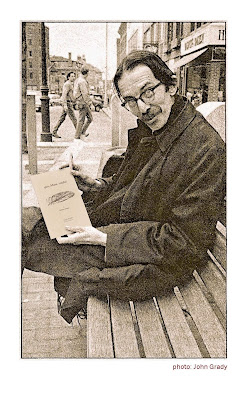 |
| Robert Dunn |
Dunn was also about as devoted to his writing as a person could be. When Towler met him in the early '90s, he lived in a single room in an old house, owned almost nothing, and made what little money he made from working part-time at the Portsmouth Athenaeum. He seemed to live on cigarettes and coffee. When Towler first saw him around town, she, like probably many other people, thought he was homeless.
If a person could start a conversation with Dunn, which wasn't always easy, they would discover that he was very well read and eloquent. He was not, though, effusive, and he was deeply private. It was only late in his life, wracked with lung disease, that he opened up to anyone, and the person he seems to have opened up most to is Towler, though even then, she was able to learn very little about his past.
Towler got to know him because she was a neighbor, because she was intrigued by him, and because she was a writer on a different career track, with different ambitions. Dunn certainly wanted his poems to be read — he wouldn't have made chapbooks and sold them (even if only for a penny) if not — but he didn't want to subject himself to the quest-for-fame machine, he didn't want to do what everybody now says you must do if you want to have a successful writing career: become a "brand". He didn't bother with any sort of copyright, and Towler quotes a disclaimer from one of his books: "1983 and no nonsense about copyright. When I wrote these things they belonged to me. When you read them they belong to you. And perhaps one other." In 1999, he told a reporter from the Boston Globe, "It just feels kind of silly posting no trespassing signs on my poems."
His motto, written on slips of paper he occasionally gave to people, was "Minor poets have more fun."
When Towler met him, she was struggling with writing a novel. She had lived peripatetically for a while, but had recently gotten married. She wanted to be published far and wide, and in her most honest moments she probably would have admitted that she would have liked to sell millions of copies of her books, get a great movie deal or two, get interviewed by Terry Gross and Charlie Rose, win a Pulitzer and a National Book Award and, heck, maybe even a Nobel. Success.
Once her first novel was published, Towler discovered what many people do in their first experiences with publication: It doesn't fill the hole. It is never enough. There are always other books selling better, getting more or better reviews, always other writers with more money and fame, and in American book culture these days, once a book is a month or two old, it's past its expiration date and rarely of much interest to booksellers, reviewers, or the public, because there's always something new, new, new to grab attention. You might as well sell your poems for a penny in Market Square.
By the time Towler's first novel is published, Portsmouth is deep in the process of gentrification. Not only have the local market, five-and-dime store, and hardware store been put out of business by rising rents and big box stores, but all seven of the downtown bookstores have disappeared. (Downtown is no longer bookstoreless. Bookstores, at least, can appeal to the gentrifiers, though it's still tough to be profitable with the cost of the rent what it is.) Towler gives a reading at a Barnes & Noble out at the mall, a perfect symbol of pretty much everything Robert Dunn had lived his life against: a mall, a chain bookstore. He attends the reading, though, and seems happy for Towler's success. He stands in line to get his book signed, and then says something that cuts Towler to the bone: "I'll let you get to your public."
As Robert turned away, leaving me to face a line of people waiting to have books signed, I felt that he had seen through me to the deep need for approval, the great strivings of ego, that lay at the heart of my desire to publish a book. Only by divorcing myself from the hunger for affirmation, his quip suggested, would I find what I truly desired. This is what he wanted for me, what he wanted for anyone who wrote.The Penny Poet of Portsmouth continues to think through these ideas, and to work through the contrast between Dunn's fierce localism and solitude and Towler's own conflicting desires, hopes, dreams, and fears. She begins in great admiration of Dunn, who seems to have sacrificed absolutely everything to his writing and has somehow overcome any yearning for fame or reward. In that sense, he seems saintly.
But at what cost? This question is always in the background as Dunn becomes ill and more dependent on other people. If he wants to stay alive, the sort of solitude he cultivated and cherished is no longer possible, leading to some difficult confrontations and tensions.
Towler does her best not to impose her own values on Dunn's life, but she can't help wondering what it would be like to live as Dunn does. Though she sympathizes with him, and shares some of his ideals, she's no ascetic. She can't help but think of Dunn as lonely, since she would be, especially in illness. She cherishes her husband, she likes the house they buy together, she enjoys (at least sometimes) traveling to readings and leading writing workshops.
Dunn's life, as Towler presents it at least, shows the inadequacy of the question, "Are you happy?" In illness, Dunn was obviously not comfortable, and when he couldn't be at home, he was often not content. But happiness is a fleeting thing, not a state of being. Even if you believe that happiness is something that can be captured for more than a moment, there's no reason to think that, except for illness, Robert Dunn was unhappy. He sculpted a life for himself that was, it seems, quite close to whatever life he might have desired having. I doubt having a life partner of some sort would have led to more moments of happiness for him, as Towler wonders at one point. The accommodations and annoyances of having another person around a lot of the time are insufferable for someone inclined toward solitude. Was this the case for Dunn? It's difficult to know, because he was difficult to know. Towler is remarkably restrained, I think, in not trying to impose her own pleasures on Dunn — she doesn't ever record saying to him what the partnered often say to the unpartnered, "Wouldn't you be happy with someone else in your life?" (I often think partnered people work a bit too hard to justify their own life choices, as if the presence of other types of lives are somehow an indictment of their own.) But even still, it does seem to be one of the more unbridgeable gulfs between types of people: the contentedly partnered seem as terrified of being unpartnered as the contentedly unpartnered are of being partnered, and so one looks on the other's life as a nightmare.
What The Penny Poet of Portsmouth shows is the necessity of community. Robert Dunn was, for many reasons, lucky that he lived in Portsmouth when he did, because there was a real community of writers and people interested in writing and reading, and these people looked out for each other. Before the rents went whacko, it was possible to live in Portsmouth if you weren't rich. This is why the word place in Towler's subtitle is so important. The book is not only a portrait of Robert Dunn, but a chronicle of the city that allowed him to be Robert Dunn. Towler is careful to chronicle the details of the place and community, both its people and its institutions. She shows the frustrations of dealing with bureaucracies of illness, and without being heavy-handed she depicts the ways that poverty is perceived in a place as ruggedly individualistic as New Hampshire — once she gets to know Robert Dunn, she also gets to see, feel, and struggle against the assumptions people who don't know him make. (In some of what she described him experiencing from nurses, doctors, and pharmacists, I couldn't help but think of my father, who did not have health insurance and who died of congestive heart failure. After he had a heart attack, he felt patronized and dismissed by hospitals that knew he couldn't pay his bills. Whether the hospital employees themselves actually felt this way, I don't know, but he perceived it deeply, and it contributed to his determination never to see another doctor or hospital. I'll forever remember the way his voice sounded when he told me, briefly, of this: the shattered pride, the humiliation, the rage all fraying his words.)
In its attention to the details of community — and a number of other ways — The Penny Poet of Portsmouth makes a perfect companion to Samuel Delany's Dark Reflections, another story of a poet, though in a very different environment. Arnold Hawley in Delany's novel is far less content than Robert Dunn in Towler's memoir, but their commitments are similar. Arnold is more seduced by the desire for fame and success than Dunn seems to have been, and so his personality is perhaps a bit more like Towler's, but without her relative success in everyday living. Having known Dunn, Towler is perhaps more capable of imagining Dunn as content in his life than Delany is quite able to imagine Arnold content — I've sometimes wondered whether Arnold is so tormented by his life because Delany himself would be tormented by that life, a life that is the opposite, in nearly every way, of his own. No matter. The books have much to say to (and with) each other.
There is much in Towler's memoir that is moving. She takes her time and doesn't rush the story. At first, I thought perhaps her pacing was unnecessarily slow, perhaps padding out what was a thin tale. I was wrong, though, because Towler is up to many things in the book, and needs her portrait of the place and person to be built carefully for her ideas and concerns to have resonance and real meaning. It's a tale of growing into knowledge and into something like intimacy, but also, at the same time, of coming to terms with unsolveable mysteries and uncrossable borders.
By the time I got to the fragmentary biography Towler offers as an appendix, those few pages were the most powerful of the book for me, because they show just how much we can't know. (I suppose the power was also one of some sort of personal recognition: Robert Dunn grew up only a dozen or so miles from where I grew up. The soil of his early years is as familiar to me as any other place on Earth. He was a graduate of the University of New Hampshire, where I finished my undergraduate degree and am now working on a Ph.D. I've only spent occasional time in Portsmouth, though enough over the decades to have seen some of the changes Towler writes about.) Primed by all the rest of Towler's story, it was this paragraph that most deeply affected me:
He went south in the summer of 1965 with the civil rights movement with a small group of Episcopalians from New Hampshire. Jonathan Daniels, who was shot and killed as he protected a young African-American woman attempting to enter a store in Hayneville, Alabama, had gone down ahead of the group. Robert would not talk about this experience, though others and I asked him about it directly. He did say once that he had known Daniels.Had Towler rushed her story more, the resonances and mysteries in that paragraph wouldn't have been nearly as affecting. (It helps if you already know the story of Daniels, I suppose.)
The book ends with a delightful collection of what we might call "Robert Dunn's wit and wisdom", taken from various interviews and profiles in local papers that Dunn had stuck in a folder labeled "Vanity". Of the civil rights movement, he told Clare Kittredge of the Boston Globe in 1999: "We had our hearts thoroughly broken."
Let's end these musings with what mattered most to Robert Dunn, though: the poetry. His poems remind me of Frank O'Hara (whom he discusses with Towler) and Samuel Menashe. They're colloquial and compressed, full of surprises. Thanks to Towler's book, I expect, Dunn's selected poems have finally been collected in One of Us Is Lost, and a few are reprinted in The Penny Poet. Here's one that seems particularly appropriate:
Public Notice
They've taken away the pigeon lady,
who used to scatter breadcrumbs from an old
brown hand and then do a little pigeon dance,
right there on the sidewalk, with a flashing
of purple socks. To the scandal of the
neighborhood. This is no world for pigeon
ladies.
There's a certain wild gentleness in
this world that holds it all together. And
there's a certain tame brutality that just
naturally tends to ruin and scatteration and
nothing left over. Between them it's a very
near thing. This is no world without pigeon
ladies.
Now world, I know you're almost
uglied out, but . . . just think! Try to
remember: What have you done with the
pigeon lady?
—Robert Dunn
0 Comments on The Penny Poet of Portsmouth by Katherine Towler as of 1/1/1900
Add a Comment
By: Faith Pray,
on 9/23/2016
Blog: SACRED DIRT (Login to Add to MyJacketFlap)
JacketFlap tags: #kidlitart, #backtoschool, #puddlejump, puddlejumpcollective, great books, writing, art, writers, artists, failure, good books, Add a tag

How do you feel about failure?

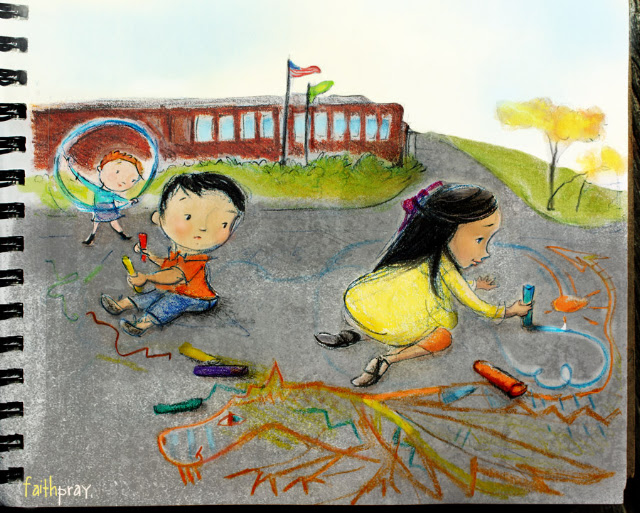
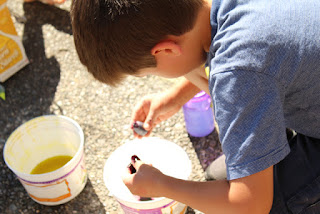
This summer, we made chalk paint with cornstarch, food coloring, and water.

Summery delight!
See our driveway canvas?

Little did we know that a thunderstorm brewed two hours away.

All our chalky wonders washed away overnight.
It's that resonance of art and failure that makes us strong, right?
It's that resonance of art and failure that makes us strong, right?
Do you ever wonder if we can learn as much from our flops
- our sloppy first drafts, our rejections, our imperfections -
as from our neat and tidy successes?
- our sloppy first drafts, our rejections, our imperfections -
as from our neat and tidy successes?
I have this thing. This fear of ruining a brand new notebook or sketchbook.
I figure if I'm constantly working at something, then naturally, I'll keep improving.
And when I look at my old notebooks stuffed with terrible first drafts and awkward brainstorms,
I get panicky. What if this first page represents who I am through that entire notebook or sketchbook? Can't it at least start out perfect?
Talk about writer's block, eh?
So, I solved it.
Talk about writer's block, eh?
So, I solved it.
It's my secret to hurdling the fear of failure. (in a notebook.)
I just skip the first page.
Then I'm set. I have a one-page cushion keeping me from a first-page flop.
(Really, it means that the second page becomes the first page, but shhh.)
But really, don't we gain something in being brave with each feeble offering of ourselves?
In truth, even if I jump right into the first page of a notebook and ink it up with a scratchy failure,
actually my "failure" teaches me something, and that becomes growth.

And if that's true, then maybe "failure" isn't so much of a failure.
Maybe the effort of trying something stretches and grows our skills.
And actually, that is beauty right there: being brave.


So, go out and be brave, my friends!
Ruin some second pages.
Scribble your heart out.
Make sloppy chalk paint that gets rained on overnight.
Scribble your heart out.
Make sloppy chalk paint that gets rained on overnight.
Get all muddy and splash around in those glorious flops.
Journey by Aaron Becker
Quest by Aaron BeckerChalk by Bill Thomson
Art & Max by David Wiesner
The Dot by Peter H. Reynolds
Harold's Purple Crayon by Crockett Johnson

Chalky books!


Quest by Aaron BeckerChalk by Bill Thomson
Art & Max by David Wiesner
The Dot by Peter H. Reynolds
Harold's Purple Crayon by Crockett Johnson
0 Comments on Chalk Lessons as of 9/23/2016 9:35:00 AM
Add a Comment
By: Lisa Keeler,
on 9/18/2016
Blog: TWO WRITING TEACHERS (Login to Add to MyJacketFlap)
JacketFlap tags: authors, writing process, inspiration, writers, writing workshop, writer identity, Add a tag
For writers to grow, they must develop writer identities. How do we help them do that?
By: Kathleen Neagle Sokolowski,
on 8/2/2016
Blog: TWO WRITING TEACHERS (Login to Add to MyJacketFlap)
JacketFlap tags: blogging, writing, writers, writing workshop, BLOG SERIES: Starting with What Matters Most in Writing Workshop, Add a tag
When I think about what I first want my students to know, what matters most to me as a teacher of writing, more than capital letters or topic sentences or punctuation, I want them to believe they have ideas worth sharing and stories worth telling. I want them to know their voice matters and their words can make a difference. I want them to believe they are writers, right now, whatever their reading proficiency, whatever their language background, whatever their home circumstances. WE ARE WRITERS HERE. We all matter, we all belong, we all can and should write.
By: Christine Marie Larsen,
on 7/14/2016
Blog: Christine Marie Larsen Sketchbook (Login to Add to MyJacketFlap)
JacketFlap tags: commissioned, SRoB, science, portraits, people, color, writers, editorial, faces, Add a tag
 By: Faith Pray,
on 6/27/2016
By: Faith Pray,
on 6/27/2016
Blog: SACRED DIRT (Login to Add to MyJacketFlap)
JacketFlap tags: great books, picture books, birthdays, writing, art, writers, parties, good books, time to write, teen writers, word therapy, Add a tag

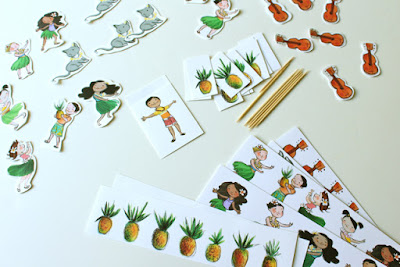
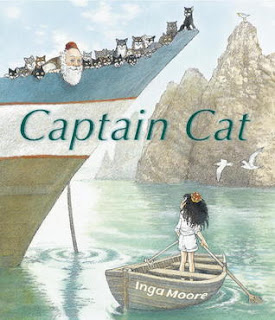
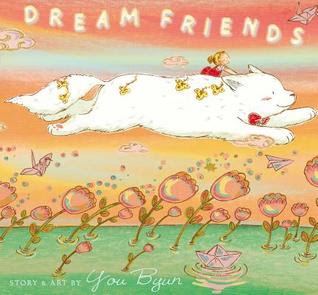
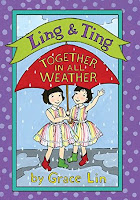
A small friend is turning 6 in two weeks.
She lives across the country,
and we can't make it to the luau party.
We can't come for cake and balloons and birthday hugs,
but we can send pineapples

and kitties

and fancy toothpicks.

They're like tiny, paper aloha hugs.
So, in shuttling wildebeests to soccer camp lately,
I have discovered a few good surprises
in being the carpool soccer mom.
Books on CD.
Car-goofy kids.
And sketchbook time
while all my soccer players
do their runs and drills.

Big chunks of sketchbook time
help when working out new ideas.
It's funny that I can sketch happy around a crowd,
but I can't write a drop.
My thoughts turn to stone and my stories sink.
But then, that's kind of a theme for me with words anytime lately.
I know some writers who scribble serious magic
in coffee shops and airplanes.
What about you?
When do you do your deep story work?
Can you create masterpieces with everyone there?
Do you thrive with hum and buzz?
Or do you like a hush when you create?


Wherever you find yourself this week,
I wish you peaceful breezes, sweet surprises, and
aloha.
Books {and CD books} we're enjoying this week:
Captain Cat by Inga Moore
Dream Friends by You Byun
Ling and Ting Share a Birthday by Grace Lin
Ling and Ting: Together in All Weather by Grace Lin
A Boy and a Jaguar by Alan Rabinowitz, ill. by Catia Chien
Where the Mountain Meets the Moon by Grace Lin
Chasing Secrets by Gennifer Choldenko


0 Comments on Aloha as of 7/1/2016 6:03:00 AM
Add a Comment
By: Dana Murphy,
on 6/20/2016
Blog: TWO WRITING TEACHERS (Login to Add to MyJacketFlap)
JacketFlap tags: authors, writers, Kate DiCamillo, Add a tag
 By: Cheryl Rainfield,
on 6/17/2016
By: Cheryl Rainfield,
on 6/17/2016
Blog: Cheryl Rainfield: Avid Reader, Teen Fiction Writer, and Book-a-holic. Focus on Children & Teen Books (Login to Add to MyJacketFlap)
JacketFlap tags: Angela Ackerman, Becca Puglisi, setting thesaurus, rural setting thesaurus, urban setting thesaurus, writer resources, amwriting, writers, Add a tag
I love Angela Ackerman and Becca Puglisi’s thesaurus books for writers. I think they help us when we’re stuck, remind us to use all our senses and find just the right descriptions, and prompt us to dig digger. So I was excited to hear that they have two new books out: The Urban Setting Thesaurus and The Rural Setting Thesaurus. And they’re celebrating with prizes! Read this guest post by Angela and Becca for more info. And if you haven’t already tried one of their books, I suggest you do. They are great tools for your writer’s toolkit.
There’s nothing better than becoming lost within the story world within minutes of starting a book. And as writers, this is what we’re striving to do: pull the reader in, pull them down deep into the words, make them feel like they are experiencing the story right alongside the hero or heroine.
A big part of achieving this is showing the character’s surroundings in a way that is textured and rich, delivering this description through a filter of emotion and mood. It means we have to be careful with each word we choose, and describe the setting in such a way that each sight, sound, taste, texture, and smell comes alive for readers. This is no easy task, especially since it is so easy to overdo it—killing the pace, slowing the action, and worst of all, boring the reader. So how can we create a true unique experience for readers and make them feel part of the action while avoiding descriptive missteps that will hurt the story?
 Well, there’s some good news on this front. Two new books have released this week that may change the description game for writers. The Urban Setting Thesaurus: A Writer’s Guide to City Spaces and The Rural Setting Thesaurus: A Writer’s Guide to Personal and Natural Spaces look at the sights, smells, tastes, textures, and sounds that a character might experience within 225 different contemporary settings. And this is only the start of what these books offer writers.
In fact, swing by and check out this hidden entry from the Urban Setting Thesaurus:Antiques Shop.
And there’s one more thing you might want to know more about….
 Becca and Angela, authors of The Emotion Thesaurus, are celebrating their double release with a fun event going on from June 13-20th called ROCK THE VAULT. At the heart of Writers Helping Writers is a tremendous vault, and these two ladies have been hoarding prizes of epic writerly proportions.
A safe full of prizes, ripe for the taking…if the writing community can work together to unlock it, of course.
Ready to do your part? Stop by Writers Helping Writers to find out more!
0 Comments on The Setting Thesaurus Books Are Here: Help Becca And Angela Celebrate With Rock The Vault! as of 6/17/2016 5:14:00 PM
Add a Comment
By: Christine Marie Larsen,
on 6/16/2016
Blog: Christine Marie Larsen Sketchbook (Login to Add to MyJacketFlap)
JacketFlap tags: SRoB, portraits, people, color, writers, editorial, commissioned, Add a tag
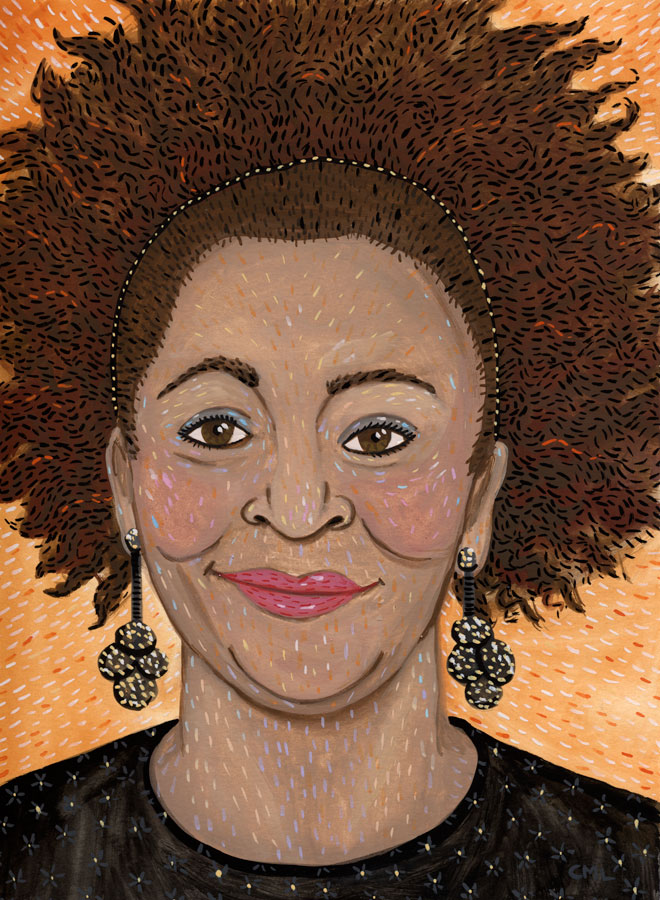 By: Matthew Cheney,
on 6/10/2016
By: Matthew Cheney,
on 6/10/2016
Blog: The Mumpsimus (Login to Add to MyJacketFlap)
JacketFlap tags: Writers, Delany, Wesleyan UP, crowdfunding, Kenneth James, Add a tag

Kenneth James is editing the journals of Samuel Delany for publication. Volume 1 is coming out from Wesleyan University Press in December. For the future volumes, Ken needs help with funding.
If you already know how valuable this project is, don't read on. Just go donate.
But if you need some convincing, please read on...


“Mesmerizing . . . a true portrait of an artist as a young Black man . . . already visible in these pages are the wit, sensitivity, penetration, playfulness and the incandescent intelligence that will characterize Delany and his extraordinary work.”As my blurb in the publicity materials shows, I've read volume 1, which covers the years 1957-1969. It's great. It shows us the very young Delany, it offers juvenilia and drafts that have never been public before, it shows his reading and writing and thinking during the period where he went from being a precocious kid to a professional writer. It's thoughtfully, sensitively edited, and is being published by the academic press that has been most devoted to Delany for a few decades now. It's a revelatory book.
—Junot Díaz, author of The Brief Wondrous Life of Oscar Wao
“This is a tremendously significant and vital addition to the oeuvre of Samuel Delany; it clarifies questions not only of the writer’s process, but also his development—to see, in his juvenilia, traces that take full form in his novels—is literally breathtaking.”
—Matthew Cheney, author of Blood: Stories
“These journals give us the very rare experience of being able to watch genius escaping from the chrysalis.”
—Jo Walton, author of Among Others
Volume 2 will be even more exciting, I expect. Ken plans for it to begin with Dhalgren material and then to continue through the 1970s, which would mean it includes material related to Trouble on Triton, Tales of Nevèrÿon, and, depending on how he edits it, Hogg, Neveryóna, Stars in My Pocket Like Grains of Sand, and others. It will also show how deeply connected Delany's nonfiction is to his fiction, and will show the development of his engagement with critical theory. Additionally, there's lots of material in the 1970s journals about his first experiences as a university teacher.
I'm just back from spending a few days at the Delany archive at Boston University, and I've looked through a few of the 1970s journals. They're truly thrilling for anybody interested not only in Delany the writer, but in the writing and thinking process in general. They're especially interesting for those of us who think that after 1969, Delany's work only got more brilliant. They are working journals, not really diaries as we generally think of them, and they clarify a lot of questions of when particular things were written, and why, and how. That makes them, if nothing else, of immense scholarly value. But they've also got material in them that just flat-out makes for good reading.
The work of editing them is ... daunting. This is why Kenneth James deserves your donations. (Wesleyan University Press is great, but they've got limited funding themselves. These books are not going to sell millions of copies, not because people don't love Delany's work, but because there's a small market for this sort of publication.) Ken probably knows Delany's work as well as anybody on the planet other than (perhaps) SRD himself. As a Cornell undergraduate, he interviewed Delany in 1986 — an interview deemed substantial enough to be included in Silent Interviews. Later, he wrote the introductions to Longer Views and 1984: Selected Letters. He organized the SUNY Buffalo conference on Delany, the first international conference on SRD's work, and guest-edited the volume of Annals of Scholarship that preserved some of the papers from that conference. He's written on various of Delany's books. He knows his stuff better than perhaps anybody else knows that stuff.
Ken is an independent scholar without a permanent university affiliation, which in this economic/academic structure means he has hardly any source of financial support for a project like this. He needs our support. Editing these journals is a full-time job if it's going to get done before the end of the century. The journals are handwritten, mostly in spiral ring notebooks. They're in various states of organization and disorganization. (The BU archivists are magnificent, and have done a great job of indexing and preserving the journals to the best of their ability, but these were working journals, not documents immediately designed for eternal preservation) And they are copious. In six hours of reading and notetaking yesterday, I made it through only a few months' worth of journals. Transcribing, editing, and annotating them will be a gargantuan task. Ken has already proved it is a task he is prepared for, a task he is capable of completing. I don't think I could do it. I know he can.
I could go on and on. Delany is one of the most important writers and thinkers of our time. The more I read, the more I delve into his archive, the more I believe this to be true. I've spent a decade studying his work and feel I'm only now beginning to move beyond a superficial appreciation of it.
We need these books, and we need Ken to be the one to put them together. There is nobody better for the job. Please help him do it.
0 Comments on The Journals of Samuel R. Delany as of 1/1/1900
Add a Comment
By: Christine Marie Larsen,
on 6/9/2016
Blog: Christine Marie Larsen Sketchbook (Login to Add to MyJacketFlap)
JacketFlap tags: portraits, color, writers, exhibits, SRoB, Add a tag

Come see this painting at the "Writers" show at Essentia in Belltown.
Opening Friday 6/10/16 6-9pm.
Join us for art, snacks, and readings by Sarah Galvin, Lesley Hazleton, and Maged Zaher
Push/Pull & Seattle Review of Books present
Writers:
A selection of portraits painted for the Seattle Review of Books of local and national authors, plus paintings of the objects of a writer's life.
Christine Marie Larsen is a Seattle illustrator. Her work has appeared in The New York Times, Travel & Leisure, The Stranger, and more. Her illustrations explore the serious and sill aspects of this life on earth.
Artist Reception will include readings from Lesley Hazleton, Maged Zaher, and Sarah Galvin.
Come join us for an evening of local authors and art. We also have a Little Free Library to browse and borrow from. Refreshements will be provided.
This show is made possible through The Betterhood at Essentia World's Only Natural Memory Foam.
Essentia Mattress Store - Seattle
2008 1st Ave, Seattle, Washington 98121
Add a Comment
By: Christine Marie Larsen,
on 6/9/2016
Blog: Christine Marie Larsen Sketchbook (Login to Add to MyJacketFlap)
JacketFlap tags: editorial, faces, commissioned, SRoB, portraits, people, color, writers, Add a tag

A SRoB portrait of TIME magazine correspondent Jay Newton-Small, author of Broad Influence: How Women Are Changing the Way America Works.
Add a Comment
By: Christine Marie Larsen,
on 6/3/2016
Blog: Christine Marie Larsen Sketchbook (Login to Add to MyJacketFlap)
JacketFlap tags: portraits, people, color, writers, editorial, faces, commissioned, SRoB, Add a tag
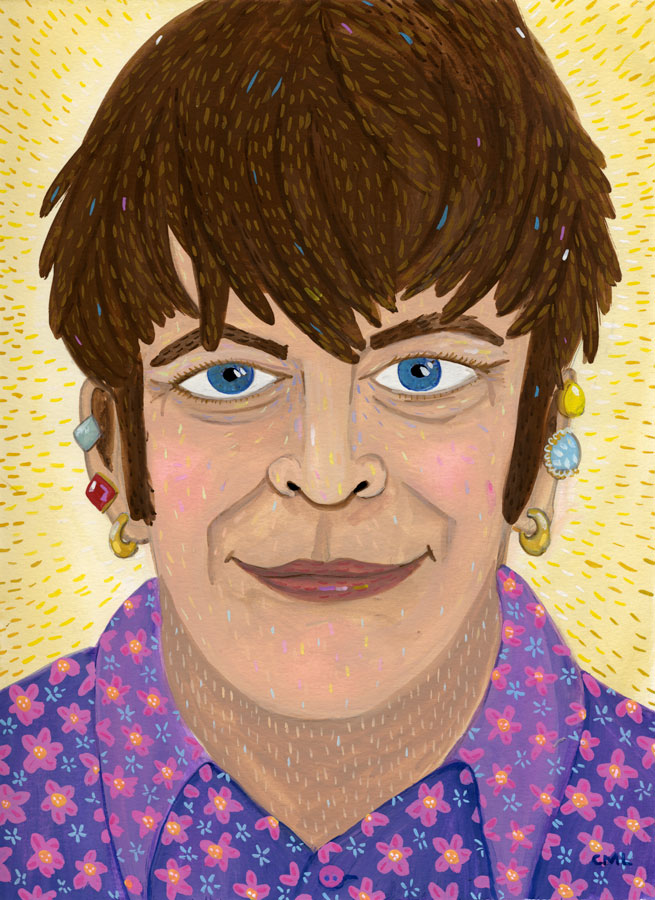
Author and activist Mattilda Bernstein Sycamore for the Seattle Review of Books Portrait Gallery
Add a Comment
By: Christine Marie Larsen,
on 5/18/2016
Blog: Christine Marie Larsen Sketchbook (Login to Add to MyJacketFlap)
JacketFlap tags: SRoB, portraits, people, color, writers, editorial, faces, commissioned, Add a tag
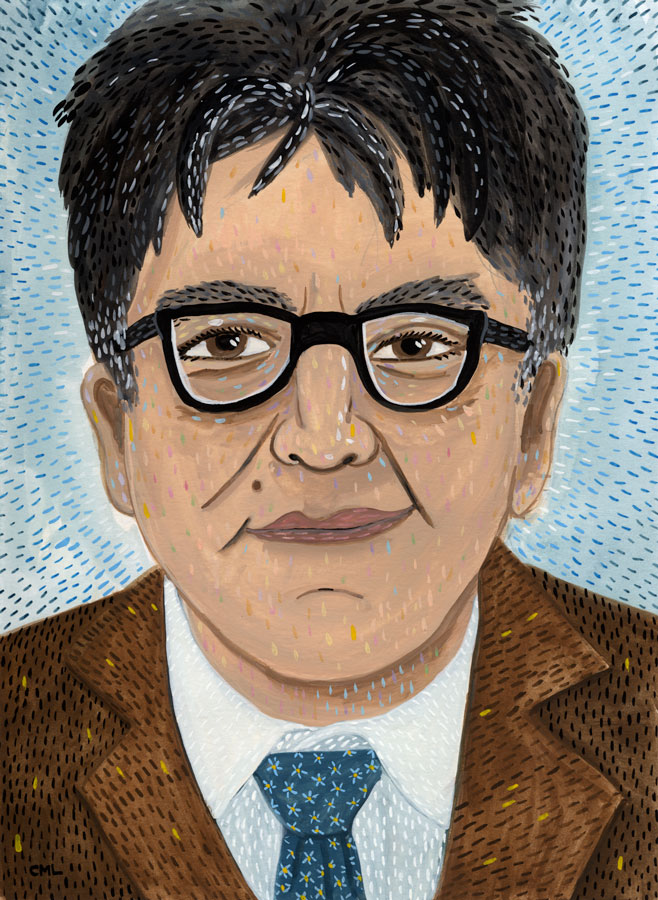
Here's a gouache on paper illustration of author and poet Sherman Alexie for the Seattle Review of Books Portrait Gallery
Add a Comment
By: Christine Marie Larsen,
on 5/11/2016
Blog: Christine Marie Larsen Sketchbook (Login to Add to MyJacketFlap)
JacketFlap tags: portraits, people, writers, editorial, faces, commissioned, SRoB, Add a tag
 By: Christine Marie Larsen,
on 4/27/2016
By: Christine Marie Larsen,
on 4/27/2016
Blog: Christine Marie Larsen Sketchbook (Login to Add to MyJacketFlap)
JacketFlap tags: SRoB, portraits, people, color, writers, editorial, faces, commissioned, Add a tag
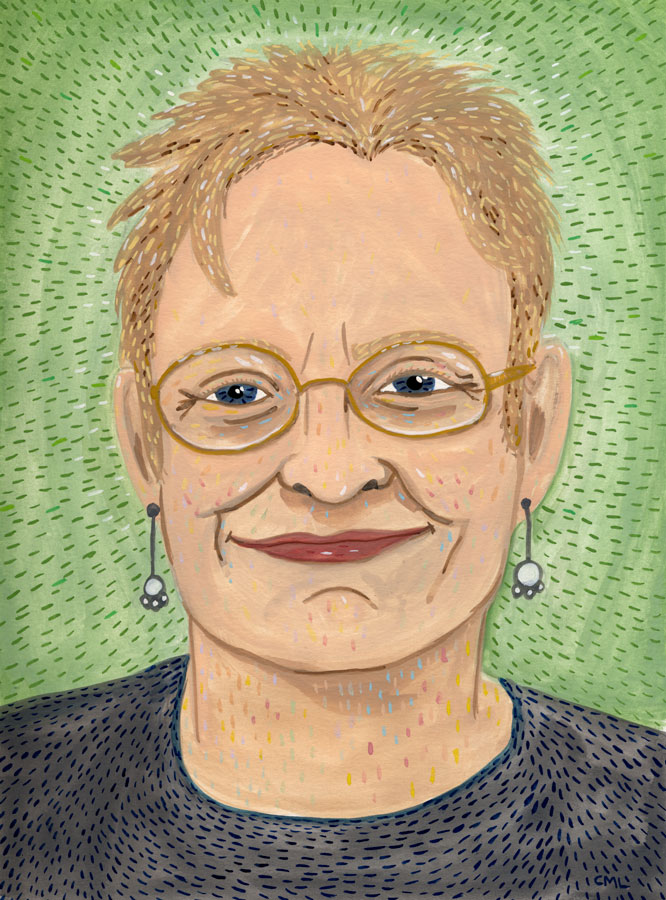 By: Christine Marie Larsen,
on 4/27/2016
By: Christine Marie Larsen,
on 4/27/2016
Blog: Christine Marie Larsen Sketchbook (Login to Add to MyJacketFlap)
JacketFlap tags: portraits, people, color, writers, editorial, commissioned, SRoB, Add a tag
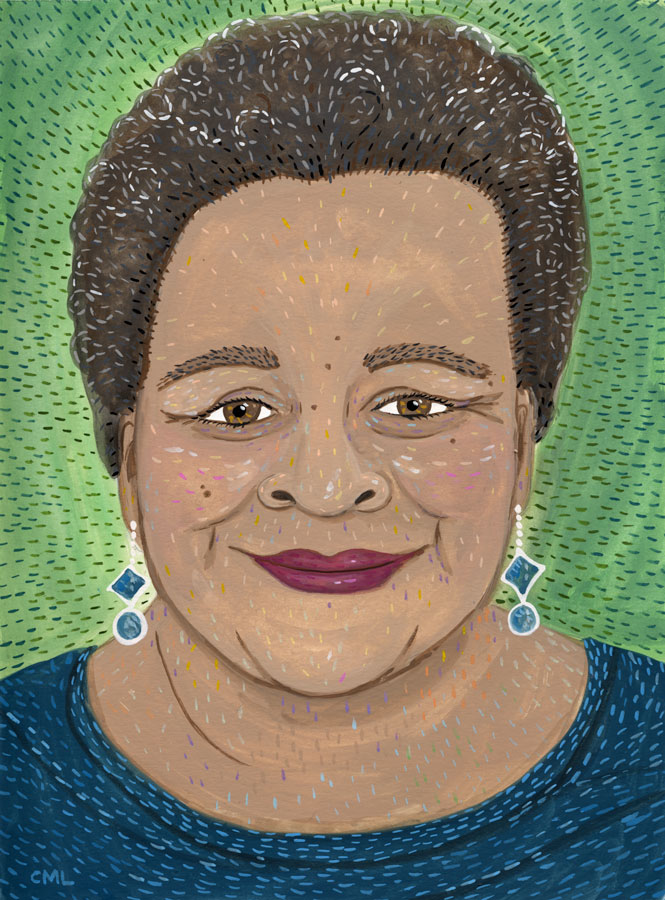 By: Faith Pray,
on 4/12/2016
By: Faith Pray,
on 4/12/2016
Blog: SACRED DIRT (Login to Add to MyJacketFlap)
JacketFlap tags: great books, birthdays, writers, scribbles, good books, good, Add a tag

Happy birthday, Beverly Cleary.
Thank you for Henry, Ramona, and Beezus.
Thank you for Klickitat Street.
Thank you for your books.


0 Comments on Happy birthday as of 1/1/1900
Add a Comment
By: Sharon Ledwith,
on 4/11/2016
Blog: Sharon Ledwith: I came. I saw. I wrote. (Login to Add to MyJacketFlap)
JacketFlap tags: The Last Timekeepers and the Arch of Atlantis, Tim Allen, Jugglers, Books, Writers, April Fool's Day, Jesters, Comedians, Ellen DeGeneres, Saturday Night Live, Robin Williams, Add a tag
Blog: Sharon Ledwith: I came. I saw. I wrote. (Login to Add to MyJacketFlap)
JacketFlap tags: The Last Timekeepers and the Arch of Atlantis, Tim Allen, Jugglers, Books, Writers, April Fool's Day, Jesters, Comedians, Ellen DeGeneres, Saturday Night Live, Robin Williams, Add a tag
Since April begins with April Fools’ Day, I thought I’d write about those who make us laugh and push our buttons. In the first book of my time travel series, I introduce you to Alan a Dale—Robin Hood’s famous minstrel and part of his band of merry teens. In my version, Alan is a teenage jongleur—a.k.a. juggler— and is instrumental in helping the Timekeepers with their mission in Nottingham. Jongleurs and juggles and jesters all fall into the same category: their purpose was to entertain royalty and commoners alike. In fact, the word ‘jester’ derives from the Anglo-Norman (French) words gestouror jestour meaning storyteller or minstrel.
Jesters (or fools as they were known) held a position of power and privilege within a royal or noble household. They could get away with saying or doing anything to the king or queen or nobles—literally anyone—without being punished. Compare the antics to our modern day comedians like Tim Allen, Robin Williams (still miss him), Ellen DeGeneres, or any past or present Saturday Night Livecomedians and you get what I mean. Comedians will say and do anything (most times for the shock value) and get away with it.
Now, if you think about it, books are a huge part of the entertainment industry. We writers are present day jesters and fools too. Words are power. And like comedians, we can pretty much say whatever we want in the written form, and publish it on Amazon or any other on-line publishing site. But there’s a fine line here. Back in the day, when jesters got a free pass for their behavior (with the exception of a few who did get reprimanded or whipped), they didn’t have the social media circus that we have now. Nowadays, if someone says something out of turn, you can bet it will be tweeted or shared! The jester’s main job was to entertain through stories or music or juggling. They poked fun at others, helped them to lighten up, and made them smile and laugh. Sometimes they even stopped wars from happening by detonating a situation between royals.

Imagine if writers had that kind of power? To write a book so powerful it could stop a war. Put down prose that would allow a reader to visualize walking in a character’s shoes. Or just create a story that will take readers away from their mundane existence. Keep in mind the intent of such power, and use intention as a foundation, and you’ve probably written a generational book that will continued to be talked about and read in the future. Think To Kill a Mockingbird or Les Miserables or The Catcher in the Rye, and you know what I’m talking about. Jesters, like authors, aren’t so far apart after all. We just have to remember to lighten-up, ourselves.
So, what makes you laugh-out-loud? Do you have a favorite modern day jester? How about a book that affected you so deeply that you’d recommend your kids and grandchildren should read it? Would love to read your comments! Cheers and thank you for reading my blog!
0 Comments on Surely, you Jest… as of 1/1/1900
Add a Comment
By: Matthew Cheney,
on 3/6/2016
Blog: The Mumpsimus (Login to Add to MyJacketFlap)
JacketFlap tags: teaching, Writing, Writers, academia, Hemingway, Modernism, Henry James, pedagogy, Add a tag

Eric Bennett has an MFA from Iowa, the MFA of MFAs. (He also has a Ph.D. in Lit from Harvard, so he is a man of fine and rare academic pedigree.) Bennett's recent book Workshops of Empire: Stegner, Engle, and American Creative Writing during the Cold War is largely about the Writers' Workshop at Iowa from roughly 1945 to the early 1980s or so. It melds, often explicitly, The Cultural Cold War with The Program Era, adding some archival research as well as Bennett's own feeling that the work of politically committed writers such as Dreiser, Dos Passos, and Steinbeck was marginalized and forgotten by the writing workshop hegemony in favor of individualistic, apolitical writing.
I don't share Bennett's apparent taste in fiction (he seems to consider Dreiser, Dos Passos, Steinbeck, Thomas Wolfe, etc. great writers; I don't), but I sympathize with his sense of some writing workshops' powerful, narrowing effect on American fiction and publishing for at least a few decades. He notes in his conclusion that the hegemonic effect of Iowa and other prominent programs seems to have declined over the last 15 years or so, that Iowa in recent years has certainly become more open to various types of writing, and that even when Iowa's influence was at an apex, there were always other sorts of programs and writers out there — John Barth at Johns Hopkins, Robert Coover at Brown, and Donald Barthelme at the University of Texas are three he mentions, but even that list shows how narrow in other ways the writing programs were for so long: three white hetero guys with significant access to the NY publishing world.
What Bennett most convincingly shows is how the discourse of creative writing within U.S. universities from the beginning of the Cold War through at least to the 1990s created a field of limited, narrow values not only for what constitutes "good writing", but also for what constitutes "a good writer". It's a tale of parallel, and sometimes converging, aesthetics, politics, and pedagogies. Plenty of individual writers and teachers rejected or rebelled against this discourse, but for a long time it did what hegemonies do: it constructed common sense. (That common sense was not only in the workshops — at least some of it made its way out through writing handbooks, and can be seen to this day in pretty much all of the popular handbooks on how to write, including Stephen King's On Writing.)
Some of the best material in Workshops of Empire is not its Cold War revelations (most of which are known from previous scholarship) but in its careful limning of the tight connections between particular, now often forgotten, ideas from before the Cold War era and what became acceptable as "good writing" later. The first chapter, on the "New Humanism", is revelatory, especially in how it draws a genealogy from Irving Babbitt to Norman Foerster to Paul Engle and Wallace Stegner. Bennett tells the story of New Humanism as it relates to New Criticism and subsequently not just the development of workshop aesthetics, but of university English departments in the second half of the 20th century generally, with New Humanism adding a concern for ethical propriety ("the question of the relation of the goodness of the writing to the goodness of the writer") to New Criticism's cold formalism:
Whereas the New Criticism insisted on the irreducible and indivisible integrity of the poem or story — every word counted — the New Humanism focused its attention on the irreducible and indivisible integrity of the humanistic subject. It did so not as a kind of progressive-educational indulgence but in deference to the wholeness of the human person and accompanied by a strict sense of good conduct. (29-30)This mix was especially appealing to the post-WWII world of anti-Communist liberalism, a world scarred by the horrors of Nazism and Stalinism, and a United States newly poised to inflict its empire of moral righteousness across the world.
For all of Bennett's gestures toward Marxism and anti-imperialism, he seems to share some basic assumptions about the power of literature with the men of the Cold War era he disdains as conservatives. In the book's conclusion, he writes:
It remains an open question just how much criticism some or all American MFA programs deserve for contributing to the impasse of neoliberalism — the collective American disinclination to think outside narrow ideological commitments that exacerbate — or at the very least preempt resistance to — the ugliest aspects of the global economy. Those narrow commitments center, above all, on an individualism, economic and otherwise, vastly more powerful in theory and public rhetoric than in fact. We encourage ourselves to believe that we matter more than we do and to go it alone more than we can. This unquestioned inflation of the personal begs, in my opinion, the kinds of questions that must be asked before any reform or solution to some seriously pressing problems looks likely to be found. (173)This is almost comically self-important in its idea that MFA programs might (he hopes?) have enough cultural effect that if only they had been more willing to teach students to write like Thomas Wolfe and John Steinbeck, then maybe we could conquer neoliberalism! One moderately popular movie has more cultural effect than piles and piles of books written by even the famous MFA people. If you want to fight neoliberalism, your MFA and your PhD (from Harvard!) aren't likely to do anything, sorry to say. If you want to fight neoliberalism ... well, I don't know. I'm not convinced neoliberalism can be fought, though we might be able to find an occasional escape in aesthetics. The idea that Books Do Big Things In The World is one that Bennett shares with his subjects; he'd just prefer they read different books.
As self-justifying delusions go, I suppose there are worse, and all of us who spend our lives amidst writing and reading believe to some extent or another that it's worthwhile, or else we wouldn't do it. But "worthwhile" is far from "world-changing". (Rx: Take a couple Wallace Shawn plays and call me in the morning.)
Despite this, Bennett's concluding chapter had me raising my fist in solidarity, because no matter what our personal tastes in fiction may be, no matter how much we may disagree about the extent to which writing can influence the world, we agree that writing pedagogy ought to be diverse and historically informed in its approach.
Bennett shows some of the forces that imposed a common shallowness:
There was, in the second wave of programs — the nearly fifty of them founded in the 1960s — little need to critique the canon and smash the icons. To the contrary, the new roster of writing programs could thrive in easy conscience. This was because each new seminar undertook to add to the canon by becoming the canon. The towering greats (Shakespeare, Milton, Whitman, Woolf, whoever) diminished in influence with each passing year, sharing ever more the icon's niche with contemporary writers. In 1945, in 1950, in 1955, prospective poets and novelists looked to the neverable pantheon as their competition. In 1980, in 1990, in 2015, they more often regarded their published teachers or peers as such. (132)That's polemical, and as such likely hyperbolic, but it suggests some of the ways that some writing programs may have capitalized on the culture of narcissism that has only accelerated via social media and is now ripe for economic exploitation. I don't think it's a crisis of the canon — moral panics over the Great Western Tradition are academic Trumpism — so much as a crisis of literary-historical knowledge. Aspiring writers who are uninterested in reading anything written before they were born are nincompoops. Understandably and forgiveably so, perhaps (U.S. culture is all about the current whizbang thing, and historical amnesia is central to the American project), but too much writing workshop pedagogy, at least of the recent past, has been geared toward encouraging nincompoopness. As Bennett suggests, this serves the interests of American empire while also serving the interests of the writing world. It domesticates writers and makes them good citizens of the nationalistic endeavor.
Within the context of the book, Bennett's generalizations are mostly earned. What was for me the most exciting chapter shows exactly the process of simplification and erasure he's talking about. That chapter is the final one before the conclusion: "Canonical Bedfellows: Ernest Hemingway and Henry James". Bennett's claim here is straightforward: The consensus for what makes writing "good" that held at least from the late 1940s to the end of the 20th century in typical writing workshops and the most popular writing handbooks was based on teachers' knowledge of Henry James's writing practices and everyone's veneration of Hemingway's stories and novels.
For Bennett, Hemingway became central to early creative writing pedagogy and ideology for three basic reasons: "he fused together a rebellious existential posture with a disciplined relationship to language, helping to reconcile the avant-garde impulse with the classroom", "he offered in his own writing...a set of practices with the luster of high art but the simplicity of any good heuristic", and "he contributed a fictional vision whose philosophical dimensions suited the postwar imperative to purge abstractions from literature" (144). Hemingway popularized and made accessible many of the innovations of more difficult or esoteric writers: a bit of Pound from Pound's Imagist phase, some of Stein's rhythms and diction, Sherwood Anderson's tone, some of the early Joyce's approach to word patterns... ("He was possibly the most derivative sui generis author ever to write," Bennett says. Snap!) Hemingway's lifestyle was at least as alluring for post-WWII male writers and writing teachers as his writing style: he was macho, war-scarred, nature-besotted in a Romantic but also carnivorous way. He was no effete intellectual. If you go to school, man, go to school with Papa and you'll stay a man.
The effect was galvanizing and long-term:
Stegner believed that no "course in creative writing, whether self administered or offered by a school, could propose a better set of exercises" than this method of Hemingway's. Aspirants through to the present day have adopted Hemingway's manner on the page and in life. One can stop writing mid-sentence in order to return with momentum the following morning; aim to make one's stories the tips of icebergs; and refrain from drinking while writing but aim to drink a lot when not writing and sometimes in fact drink while writing as one suspects with good reason that Hemingway himself did, despite saying he didn't. One can cultivate a world-class bullshit detector, as Hemingway urged. One can eschew adverbs at the drop of a hat. These remain workshop mantras in the twenty-first century. (148)Clinching the deal, the Hemingway aesthetic allowed writing to be gradeable, and thus helped workshops proliferate:
Hemingway's methods are readily hospitable to group application and communal judgment. A great challenge for the creative writing classroom is how to regulate an activity ... whose premise is the validity and importance of subjective accounts of experience. The notion of personal accuracy has to remain provisionally supreme. On what grounds does a teacher correct student choices? Hemingway offered an answer, taking prose style in a publicly comprehensible direction, one subject to analysis, judgment, and replication. ... One classmate can point to metaphors drawn from a reality too distant from the characters' worldview. Another can strike out those adverbs. (151)Bennett then points out that the predecessors of the New Critics, the conservative Southern Agrarians, thought they'd found in Hemingway almost their ideal novelist (alas, he wasn't Southern). "The reactionary view of Hemingway," Bennett writes, "became the consensus orthodoxy." Hemingway's concrete details don't offer clear messages, and thus they allowed his work to be "universal" — and universalism was the ultimate goal not only of the Southern Agrarians, but of so many conservatives and liberals after WWII, when art and literature were seen as a means of uniting the world and thus defeating Communism and U.S. enemies. "Universal" didn't mean actually universal in some equal exchange of ideas and beliefs — it meant imposing American ideals, expectations, and dreams across the globe. (And consequently opening up the world to American business.)
Such a discussion of how Hemingway influenced creative writing programs made me think of other ways complex writing was made appealing to broad audiences — for instance, much of what Bennett writes parallels with some of the ideas in work such as Creating Faulkner's Reputation by Lawrence H. Schwartz and especially William Faulkner: The Making of a Modernist, where Daniel Singal proposes that Faulkner's alcoholism, and one alcohol-induced health crisis in November 1940 especially, turned the last 20 years of Faulkner's life and writing into not only a shadow of its former achievement, but a mirror of the (often conservative) critical consensus that built up around him through the 1940s. Faulkner became teachable, acceptable, "universal" in the eyes of even conservative critics, as well as in Faulkner's own pickled mind, which his famous Nobel Prize banquet speech so perfectly shows.
(Thus some of my hesitation around Bennett's too easy use of the word "modernist" throughout Workshop of Empire — the strain of Modernism he's talking about is a sanitized, domesticated, popularized, easy-listening Modernism. It's Hemingway, not Stein. It's late Faulkner, not Absalom, Absalom!. It's white, macho-male, heterosexual, apolitical. The influence seems clear, but it chafes against my love of a broader, weirder Modernism to see it labeled only as "modernism" generally.)
Then there's Henry James. Not for the students, but the teachers:
As with Hemingway, James performed both an inner and an outer function for the discipline. In his prefaces and other essays, he established theories of modern fiction that legitimated its status as a discipline worthy of the university. Yet in his powers of parsing reality infinitesimally, James became an emblem similar to Hemingway, a practitioner of resolutely anti-Marxian fiction in an era starved for the same. (152)Reducing the influence and appeal here to simply the anti-Marxian is a tic produced by Bennett's yearning for the return of the Popular Front, because his own evidence shows that the immense influence of Hemingway and James served not only to veer teachers, students, writers, and critics away from any whiff of agit-prop, but that it created an aesthetic not only hostile to Upton Sinclair but to the 19th century Decadents and Symbolists, to much of the Harlem Rennaissance, to most forms of popular literature, and to any writers who might seem too difficult, abstruse, or weird (imagine Samuel Beckett in a typical writing workshop!).
As Bennett makes clear, the idea of Henry James's writing practice more than any of James's actual texts is what held through the decades. "He did at least five things for the discipline," Bennett says (152-153):
- His Prefaces assert the supremacy of the author, and "the early MFA programs depended above all on a faith that literary meaning could be stable and stabilized; that the author controlled the literary text, guaranteed its significance, and mastered the reader."
- James's approach was one of research and selection, which is highly appealing to research universities. Writing becomes a laboratory, the writer an experimenter who experiments succeed when the proper elements are selected and balanced. "He identified 'selection' as the major undertaking of the artist and perceived in the world a landscape without boundaries from which to do the selecting." Revision is key to the experiment, and revision should be limitless. Revision is virtue.
- James was anti-Romantic in a particular way: "James centered modern fiction on art rather than the artist, helping to shape the doctrines of impersonality so important to criticism from the 1920s through the 1950s. He insulated the aesthetic object from the deleterious encroachments of ego." Thus the object can be critiqued in the workshop, not the creator.
- "James nonetheless kept alive the romantic spirit of creative inspiration and drew a line between those who have it and those who don't." He often sounds mystical in his Prefaces (less so his Notebooks). The craft of writing can be taught, but the art of writing is the realm of genius.
- "James regarded writing as a profession and theorized it as one." The writer is someone who labors over material, and the integrity of the writer is equal to the integrity of the process, which leads to the integrity of the final text.
These ideas took hold and were replicated, passed down not only through workshops, but through numerous handbooks written for aspiring writers.
The effect, ultimately, Bennett asserts, was to stigmatize intellect. Writing must not be a process of thought, but a process of feeling. It must be sensory. "No ideas but in things!" A convenient ideology for times of political turmoil, certainly.
Semester after semester, handbook after handbook, professor after professor, the workshops were where, in the university, the senses were given pride of place, and this began as an ideological imperative. The emphasis on particularity, which remains ubiquitous today, inviolable as common sense, was a matter for debate as recently as 1935. The debate, in the 21st century, is largely over. (171)
I wonder. From writers and students I sense — and this is anecdotal, personal, sensory! — a desire for something more than the old Imagist ways. A desire for thought in fiction. For politics, but not a simple politics of vulgar Marxism. The ubiquity of dystopian fiction signals some of that, perhaps. Dystopian fiction is being written by both the hackiest of hacks and the highest of high lit folks. It shows a desire for imagination, but a particular sort of imagination: an imagination about society. Even at its most personal, navel-gazing, comforting, and self-justifying, it's still at least trying to wrestle with more than the concrete, more than the story-iceberg.
So, too, the efflorescence of different types of writing programs and different types of teachers throughout the U.S. today suggests that the era of the aesthetic Bennett describes may be, if not over, at least far less hegemonic. Bennett cites its apex as somewhere around 1985, and that seems right to me. (I might bump it to 1988: the last full year of Reagan's presidency and the publication of Raymond Carver's selected stories, Where I'm Calling From.) The people who graduated from the prestigious programs then went on to become the administrators later, but at this point most of them have retired or are close to retirement. There are still narrow aesthetics, but there's plenty else going on. Most importantly, writers with quite different backgrounds from the old guard are becoming not just the teachers, but the administrators. Bennett notes that some of the criticism he received for earlier versions of his ideas pointed to these changes:
I was especially convinced by the testimony of those who argued that the Iowa Writers' Workshop under Lan Samantha Chang's directorship has different from Frank Conroy's iteration of that program, which I attended in the late 1990s and whose atmosphere planted in my heart the suspicion that, for some reason, the field of artistic possibilities was being narrowed exactly where it should be broadest. In the twenty-first century, things have changed both at Iowa and at the many programs beyond Iowa, where few or none of my conclusions might have pertained in the first place. (163)That's an important caveat there. The present is not the past, but the past contributed to the present, and it's a past that we're only now starting to recover.
There's much more to be investigated, as I'm sure Bennett knows. The role of the Bread Loaf Writers' Conference and similar institutions would add some more detail to the study; similarly, I think someone needs to write about the intersections of creative writing programs and composition/rhetoric programs in the second half of the twentieth century. (Much more needs to be written about CUNY during Mina Shaughnessy's time there, for instance, or about Teachers & Writers.) But the value of Bennett's book is that it shows us that many of the ideas about what makes writing (and writers) "good" can be — should be — historicized. Such ideas aren't timeless and universal, and they didn't come from nowhere. Bennett provides a map to some of the wheres from whence they came.
0 Comments on Workshops of Empire by Eric Bennett as of 1/1/1900
Add a Comment
By: Stacey Shubitz,
on 2/12/2016
Blog: TWO WRITING TEACHERS (Login to Add to MyJacketFlap)
JacketFlap tags: Marlo Johnson, creativity, writing, writers, muse, Add a tag
Have you lost your muse? Create Now is the kind of book you need to help you transform your creative process and get you inspired to write.
By: Christine Marie Larsen,
on 2/11/2016
Blog: Christine Marie Larsen Sketchbook (Login to Add to MyJacketFlap)
JacketFlap tags: SRoB, portraits, people, color, writers, editorial, commissioned, Add a tag
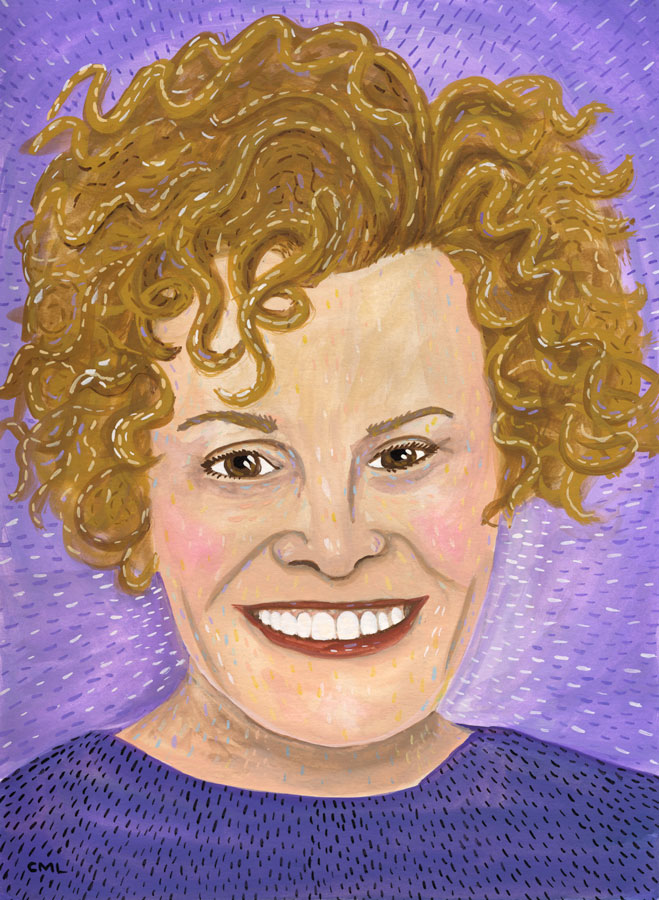


View Next 25 Posts