new posts in all blogs
Viewing: Blog Posts Tagged with: teaching, Most Recent at Top [Help]
Results 1 - 25 of 535
How to use this Page
You are viewing the most recent posts tagged with the words: teaching in the JacketFlap blog reader. What is a tag? Think of a tag as a keyword or category label. Tags can both help you find posts on JacketFlap.com as well as provide an easy way for you to "remember" and classify posts for later recall. Try adding a tag yourself by clicking "Add a tag" below a post's header. Scroll down through the list of Recent Posts in the left column and click on a post title that sounds interesting. You can view all posts from a specific blog by clicking the Blog name in the right column, or you can click a 'More Posts from this Blog' link in any individual post.
By
Cynthia Leitich Smithfor
CynsationsKatie Kennedy is the first-time author of
Learning to Swear in America (Bloomsbury, 2016). From the promotional copy:
An asteroid is hurtling toward Earth. A big, bad one. Maybe not kill-all-the-dinosaurs bad, but at least kill-everyone-in-California-and-wipe-out-Japan-with-a-tsunami bad. Yuri, a physicist prodigy from Russia, has been recruited to aid NASA as they calculate a plan to avoid disaster.
The good news is Yuri knows how to stop the asteroid--his research in antimatter will probably win him a Nobel prize if there's ever another Nobel prize awarded. But the trouble is, even though NASA asked for his help, no one there will listen to him. He's seventeen, and they've been studying physics longer than he's been alive.
Then he meets (pretty, wild, unpredictable) Dovie, who lives like a normal teenager, oblivious to the impending doom. Being with her, on the adventures she plans when he's not at NASA, Yuri catches a glimpse of what it means to save the world and live a life worth saving.
Prepare to laugh, cry, cringe, and have your mind burst open with the questions of the universe.How did you approach the research process for your story? What resources did you turn to? What roadblocks did you run into? How did you overcome them? What was your greatest coup, and how did it inform your manuscript?Research was a huge part of writing
Learning to Swear in America. The book is about an incoming asteroid, and the main character, Yuri, is a physics genius. I’m not.
I knew I didn’t want the book to be science-free. I mean, how could it be? It would be like a biography of a poet that doesn’t talk about the poetry—it would be missing a crucial element.
A physician friend told me about a Morbidity & Mortality meeting he attended as a young doctor. The physician in charge strode out onto the stage and wrote on the marker board:
- I didn’t know enough.
- Bad stuff happens.
- I was lazy.
The man turned to the assembled doctors and said, “The first two will happen. You will have patients die for both those reasons.”
Then he slammed the side of his fist against the board and roared, “But by God it better never be because you were too lazy to Do. Your. Job.”
That’s how I felt about approaching research for Learning to Swear. I didn’t know enough. I would make mistakes. But it wouldn’t be for lack of trying.
I read
Neil deGrasse Tyson,
Brian Greene,
Michio Kaku, and articles written by astrophysicists—for astrophysicists. You can find science simplified for the average educated reader—the basics on asteroids, for example. But if you want simplified information on spectral analysis? Forget it.
NASA’s website has all sorts of tables about asteroids, and it was a go-to source—until I discovered that the government shutdown also shuttered NASA. It was inconvenient not to be able to access information on which I was used to relying. It was chilling to realize that the people who usually stand sentry for Earth had been pulled in.
I should mention that a physicist who’s involved in security issues read for me—this is Dr. Robert August—and did me a world of good. Not only did he help me get the equipment right, but he corrected me on little cultural things. For example, he said that the computer programmers would have the name of their favorite pizza place written on their marker board. I included that.
Almost everything in the scenes with the programmers came from information Bob shared. He’s been in these kind of meetings, so that was incredibly helpful.
My biggest problem—outside of lack of background knowledge—was that I had envisioned exacerbating the problem mid-book by having the asteroid’s speed increase, so that it would arrive sooner than they expected.
Then I discovered this would violate the laws of nature.
Stupid laws of nature. By this point I had half the book written, and knew I had to find another way to make it harder for Yuri to stop the asteroid.
So I ate a lot of mint chocolate chip ice cream and did more reading—and somewhere in the tiny print I found my answer.
I did a little happy dance, and my husband asked why. “I found a way for an asteroid to smash the Earth, and we couldn’t do anything to stop it!”
He gave me a very strange look.
As a teacher-author, how do your two identities inform one another? What about being a teacher has been a blessing to your writing?Learning to Swear in America is based on an
Immanuel Kant quote:
"Do what is right, though the world should perish."
I teach college history, and we talk about Kant as part of the Enlightenment. That quote is one that hooked my imagination—I remember walking across the college parking lot thinking,
Yeah, but what if the world really would perish? What then?This book is the outgrowth of my conversation with Kant about that.
So I think being an instructor is helpful in several ways. First, history is narrative--essentially I tell stories to my students. Some of them are pretty good!
 |
| Charlemagne and Pope Adrian I. |
I look at the names in my lectures—the
Gracchi,
Charlemagne,
George Washington—and I’m so grateful that I get to share their stories with my students. What a privilege!
Also—what good practice in storytelling. I get to see immediately when the students’ attention flags.
Second, I come in contact with interesting material all the time, through reading in support of my day job, and even through my own lectures—like the Kant quote.
In fact, the main character of my next book was inspired by an historical figure—but I’m not saying who it is.

By: Cassandra Gill,
on 9/22/2016
Blog:
OUPblog
(
Login to Add to MyJacketFlap)
JacketFlap tags:
teaching methods,
behavioral development,
cognitive youth development,
Craig Winston LeCroy,
elementary teaching,
Jenny McCullough Cosgrove,
Books,
teaching,
learning,
Education,
Multimedia,
young children,
teaching strategies,
school children,
Infographics,
group work,
Social Work,
youth development,
Social Sciences,
*Featured,
Online products,
Add a tag
From student presentations, to lectures, to reading assignments, and so much more, teachers today have a wide variety of methods at their disposal to facilitate learning in the classroom. For elementary school children, group work has been shown to be one strategy that is particularly effective. The peer-to-peer intervention supports children in developing cognitively, emotionally, behaviorally, and socially. Group work encourages children to expand their perspectives on the world.
The post Group work with school-aged children [Infographic] appeared first on OUPblog.
I demonstrate hope.
Or the hope for hope. Or just more unanswerable holes.
—Mary Biddinger, "Beatitudes"
(I keep writing and rewriting this post.)
I thought I knew what I felt about the academic controversy du jour (a letter sent by a University of Chicago dean to incoming students, telling them not to expect trigger warnings, that academia is not a safe space, that open discussion requires them to listen to speakers they disagree with, etc.) — but I kept writing and rewriting, conversing and re-conversing with friends, and every time I didn't know more than I knew before.
Overall, I don't think this controversy is about trigger warnings, safe spaces, etc. Overall, I think it is about power and access to power. But then, overall I think most controversies are about power and access to power.
Overall—
The questions around trigger warnings, safe spaces, and campus speakers are complicated, and specific situations must be paid attention to, because universal, general statements are too distorting to be useful.
(I keep writing and rewriting this post.)
Perhaps headings will help:
Academic Freedom
I want academic freedom for everyone at educational institutions: faculty, students, staff. That said, as philosophers have shown for ages, defining what constitutes freedom requires argument, negotiation, even compromise, because one person's freedom may be another person's restriction.
Power
The University of Chicago dean's letter is primarily an expression of power and only secondarily about trigger warnings, safe spaces, and campus speakers. Though vastly more minor, it rhymes with the actions of the Long Island University Brooklyn administration, who locked out all members of the faculty union. Both are signs of things to come. The LIU action was union busting to consolidate administrative power; the UC dean's letter was the deployment of moral panic to consolidate administrative power.
Moral Panic
For the most part, the controversy over trigger warnings, safe spaces, etc. seems to me right now to be a moral panic, and much of the discourse around these things is highly charged not because of the specific policies and actual events — or not only because of the specific policies and actual events — but because of what they stand for in our minds.
Culture War
This moral panic plays into a larger culture war, one not limited to university campuses (indeed, the rise of Donald Trump as a political candidate also seems to me part of that larger war — and "war" is not too strong a word for it).
Tough Love and Hard Reality
Ever since I was in high school (at the latest) I have vehemently disliked the rhetoric of "tough love pedagogy" and "hard reality" that infuses current discussions of "coddled" students. I said on Twitter that such rhetoric seems to me arrogant, aggressive, and noxiously macho. I have not yet seen someone who advocates such policies and pedagogies do anything to get out of their own comfort zones, for instance by giving away their power and wealth and actively undermining whatever privilege they hold. I would take their position more seriously if they did so.
Comfort/Discomfort
That said, I think it's important to recognize that "comfort" and "discomfort" are broad terms with many meanings, and that students will, indeed, feel a kind of discomfort when encountering material that is new to them, that presents a worldview different from their own, etc. That seems healthy to me and entirely to be desired. (Perhaps we are trying to fit too much into the comfort/discomfort dichotomy. Or perhaps I am trying to restrict it too much.) There must be a way to value the challenging, critical pedagogy of, for instance, Women's Studies courses and Critical Race Theory courses without valorizing the sadism of the arrogant, aggressive, noxiously macho teacher whose primary desire from students is that they worship him as a guru, and whose primary pedagogy is to beat the wrongness out of everyone who steps foot in his classroom.
Perhaps other people's words will help. Here are some readings for homework:
The Ahmed and Nyong'o pieces are foundational; even if we end up disagreeing with them (do we? who "we"?), they help us focus on things that matter. The piece by Kevin Gannon is good at seeing how the "surface veneer of reasonableness" works in the dean's letter, and Gannon is also good at suggesting some of what this moral panic achieves — who benefits and why. Angus Johnston's post is useful for showing some of the complexities of the issues once we start talking about specific instances and policies. Henry Farrell highlights how this controversy is part of the institution of the university. Henry Giroux and the
undercommoners offer radical explosions.
(I keep writing and rewriting this post.
It is full of unanswerable holes.)
My sense of the concept of "moral panic" comes from
Policing the Crisis by Stuart Hall, et al.:
To put it crudely, the "moral panic" appears to us to be one of the principal forms of ideological consciousness by means of which a "silent majority" is won over to the support of increasingly coercive measures on the part of the state, and lends its legitimacy to a "more than usual" exercise of control. ... Their typical [early] form is that of a dramatic event which focuses and triggers a local response and public disquiet. Often as a result of local organising and moral entrepreneurship, the wider powers of the control culture are both alerted (the media play a crucial role here) and mobilised (the police, the courts). The issue is then seen as "symptomatic" of wider, more troubling but less concrete themes. It escalates up the hierarchy of responsibility and control, perhaps provoking an official enquiry or statement, which temporarily appeases the moral campaigners and dissipates the sense of panic. (221-222)
(Sociologists in particular have developed and challenged these ideas, but for my purposes here, this general approach to moral panics is accurate enough.)
There are a variety of fronts and a variety of causes being fought for in the wider culture war that includes (utilizes, benefits from) such panics as the current one (over the University of Chicago dean's letter). It is a war over the purpose and structure of higher education (and of education generally), it is a war over the meaning and implications of history, and it is a war over the meaning and implications of personal and group identities.
Kevin Gannon is onto something when he writes:
I don’t think it’s a coincidence that the backlash against so-called “political correctness” in higher education has intensified in direct variation with the diversification of the academy, areas of scholarship, and -- most significantly -- the student population. Underlying much of the hand-wringing about the state of the academy is a simple desire to have the gatekeepers remain in place.
Add to that: the challenge that
Black Lives Matter and other movements have made to the university status quo.
However, I think Gannon's argument soon falls into one of the traps this moral panic sets. Look where he goes next:
For every ginned-up hypothetical scenario of spoiled brats having a sit-in to protest too many white guys in the lit course, there are very real cases where trigger warnings or safe spaces aren’t absurdities, but pedagogical imperatives. If I’m teaching historical material that describes war crimes like mass rape, shouldn’t I disclose to my students what awaits them in these texts? If I have a student suffering from trauma due to a prior sexual assault, isn’t a timely caution the empathetic and humane thing for me to do? And what does it cost? A student may choose an alternate text I provide, but this material isn’t savagely ripped out of my course to satiate the PC police.
The trap here is the defense of "trigger warnings", because that's not
really what the letter and similar statements are about. People ought to be able to disagree about pedaogy while agreeing that the dean here overstepped his bounds. If a magic wand were waved and all the controversial issues that the letter is ostensibly about were made to disappear into unanimous agreement, the underlying questions of power would still remain.
What we need to look at are what the dean's statements are doing. If this is a moral panic, then it is trying to bring more people over "to the support of increasingly coercive measures on the part of the state" (or, in this case, university administration) and it "lends its legitimacy to a 'more than usual' exercise of control".
The letter is about control: who has it and who gets to assert it. Here, the increasingly coercive measures are not on the part of the state, but of the university administration. The letter is attempting to mandate against certain pedagogical practices and certain behaviors by student groups and individual students. The dean has asserted control. He has asserted the power to speak for the entire university.
I think it is an error to fall into the microargument over "trigger warnings", etc., because the meaningful argument is about who gets to mandate what, who gets to speak for whom, who dictates and who is dictated to. On the issue of this letter, that seems to me an argument for the University of Chicago's faculty, staff, and students to have together. But it points to a larger question of the neoliberal university.
The Neoliberal UniversityOver the last fifteen or twenty years in the United States, we've seen the triumph of a structural shift in universities, one that takes their medieval guild structure and alters it to a more corporate, neoliberal structure where all consequential decisions are the domain of the upper administration, where students become
consumers and teachers
deliver content, where one must
optimize processes and appeal to
external stakeholders and
achieve high performance to
enable success. (I think of it as the Triumph of Business School Logic.) In such a world, all value is numerical and everything can be measured with market reports. (For more on neoliberalism, I tend to refer to Philip Mirowski's
Never Let a Serious Crisis Go to Waste.)
This is not, of course, to say that individual groups, departments, or organizations within universities are themselves purveyors of neoliberal logic. Some are, some aren't. What I'm talking about when I talk about the
neoliberal university is its institutional structures and, especially, the priorities and actions of the administration, which under neoliberalism becomes (or wants to become) more powerful than in earlier structures where the faculty had more influence and control over the university as an institution. Such structures, priorities, and actions may be influenced by various groups outside the administration (the Economics Department, for instance, might have a particular influence on the administration's ideology and the College of Liberal Arts might have little to no influence. Or vice versa). But basically, the neoliberal university is the university not of colleagues and peers and truly shared governance, but of Boss Administrator.
 |
| Boss Administrator |
SolidarityThere are contradictions in all this, as a recent
Harvard Magazine article on
"Title IX and the Critique of the Neoliberal University" tries to show, saying: "An obvious response to the narrative critiquing the corporatizing university might then suggest that it’s invoked to protect the interests of the faculty over those of students and other university affiliates."
Such a frame, though, relies on the idea that
the faculty, the students, and
other university affiliates have inherently different interests, and that those interests are in conflict. It seems to me that things are more complicated than that. It seems to me that such a frame is already working within the assumptions of neoliberalism. The frame hides the many areas where the different groups that constitute a university can stand in solidarity — as I think they must if we are to have any hope of building a structure for the modern university that is not neoliberal.
While recent events have highlighted faculty vs. administration, we need to find better ways not only to undo as much of that dichotomy as possible, but to also increase solidarity with students and staff. Staff in particular can get lost in the arguments, and yet at every school I'm familiar with, the staff are the people most essential to the smooth functioning of everyday life. The staff must be included in any consideration of the work of the institution.
The neoliberalization of the university depends on, encourages, and exacerbates conflicts between the interests of
the faculty, the students, and
other university affiliates. They are different groups, yes, and different groups made up of different people, yes, and as such may always be coming at the goals of the institution from different points of view, with different values and different priorities, but that shouldn't destroy the idea of the university as a coalition, a union of differences. The neoliberal university destroys solidarity.
A Personal (and Utopian) Vision of the UniversityI keep writing and rewriting this post because I keep falling into the perhaps unavoidable and perhaps academic habit of pretending to perhaps know what I'm perhaps talking about.
No, that is not what I meant. That is not it at all.
Try this:
I cannot possibly pretend to have all the answers for how to escape the many binds that wrap universities in moral panics, culture wars, neoliberalism, etc. Not just because I am not omniscient. Not just because every institution has different systems and emphases, different quirks and qualms. But because—
(And yet of course injustice is structural and systemic. Of course.)
My own life has been deeply shaped by the binds I'm (perhaps) pretending not to be all bound up in. Institutions I have devoted myself to continue to be warped and bruised (and occasionally polished) by them.
There have been some pretty deep bruises over the last year.
I can't pretend I'm not writing from anger.
I can't pretend I'm not wounded in these culture wars.
And yet somehow I have some sort of hope.
Hope for what?
I'm not sure.
Here are some incomplete thoughts on my personal values and visions for academia, because I am an academic and thus must have a list of personal values and visions for academia, mustn't I? These mostly feel obvious to me, even (embarrassingly) banal, but perhaps articulating them is worthwhile:
I value a diversity of pedagogies and a diversity of course options for students. I think students will gain the most from having available to them teachers who are devoted to the pedagogy of the most traditional of lectures and teachers who are devoted to the pedagogy of the most radical of student liberation and teachers who fall everywhere in between. No teacher is great for all students, no pedagogy is great for all students. Had I the power, I would, for instance, eliminate all requirements for syllabi and simply require that teachers be thoughtful about their pedagogy and that they enter the classroom from a basic standpoint of respect for their students as human beings and as people capable of thought.
Public education should be free and open to the public. Society at large benefits significantly from open access to education. If we can fund trillion-dollar wars, we can fund public education. We simply choose not to. One of the engines driving the neoliberalization of higher ed is the lack of funding from the public. When there isn't enough money to go around, everything gets assessed first by cost. That will destroy all the best aspects of our universities.
Students, faculty, staff, and administration need to be able to find solidarity within mutual goals (and mutual aid). A diversity of disciplines, of epistemologies, of pedagogies, of life experience, etc. makes solidarity both challenging and imperative. The question I fall back on is: What can we do to strengthen our multiplicities?
I want academia to be a refuge for us all. This idea is inevitably solipsistic, because academia has been a refuge for me. How can I find values and visions beyond my own experience? (A university that was a true refuge might be able to show me the way. I think it has sometimes. Sometimes I've been oblivious, pig-headed, scared. But sometimes I've learned other ways. Yes, sometimes.)
Finally
, I yearn for a university where curiosity is celebrated as a kind of pleasure, where knowledge is a value unto itself, and where intellectual passion is perceived as essential to the good life.But What About Trigger Warnings, Etc.?(Oh gawd, I don't want to talk about this.)
What's the issue?
Is this the issue?
This is not
the issue.
It is
an issue. As such, it should be discussed, and it should continue to be discussed, and there should be nuance to the discussion.
(Assignment: Compare the rhetoric of "trigger warnings" and "spoiler warnings".)
(Assignment:
Discuss "entitlement".
What does it mean to be entitled?
Who gets to be entitled?
Explain.)
I don't think "trigger warnings" (or, better:
content notes) should be mandated or prohibited.
I don't think there is any practical way to mandate or prohibit such things without gross violations of academic freedom for everyone involved.
I could be wrong.
I am skeptical. I am wary.
What if, as has happened recently, such proposals come from students?
I think students should propose whatever they want.
Proposals are good. They get us talking about what we value and why.
Students have a big stake in this endeavor of education.
Institutions function through discussion, compromise, experiment.
Students should be encouraged to enter the discussion.
They should be aware that there is often compromise.
They should be encouraged to experiment.
Experiments often fail.
Experiment.
Try again.
Again.
I use content notes myself occasionally when presenting students with material that is particularly graphic or intense (in my judgment) in its sexual and violent content. That just seems polite. I spend a lot of time on the first day of class describing what we'll be doing, reading, and viewing; and later, I usually describe upcoming material to students so they'll have some sense of what they're getting themselves into. But I do that with most material, even the most ordinary and least controversial. It rarely seems pedagogically useful to me for students to go into upcoming work completely ignorant of its content and/or my reason for asking them to give that work their time and attention.
(In terms of whether students have a right to have alternative material if they are concerned about the material's difficulty for reasons of their own experiences or opinions, I generally think not, because they are usually not forced into a course. I say "generally" and "usually" because there are times when requirements, schedules, and such converge to effectively force a student into a particular course, and in that case, yes, more compromise may be necessary, but such situations are rare. I think. I hope.)
Beyond the sort of content notes I use when it feels necessary, my own feelings are (sometimes; often) along the lines of
the anonymous 7 Humanities Professors who wrote an essay a few years ago for Inside Higher Ed.
Yes, I have fears. I fear chilling effects. Yes. I think chilling effects happen. I think they come from all sorts of different directions. I think they are sometimes contradictory. Much depends on individual places, individual policies, even individual people.
A lot of the rhetoric around trigger warnings, safe spaces, etc. can be turned around and used for reactionary, regressive purposes. Jack Halberstam tries to show this in
"Trigger Happy: From Content Warning to Censorship". (I know a lot of people reject Halberstam's ideas. Rejection is fine, but I think dismissal is hasty. Show your work.)
Among the points made by the 7 Humanities Professors, two key ones are:
- "Faculty of color, queer faculty, and faculty teaching in gender/sexuality studies, critical race theory, and the visual/performing arts will likely be disproportionate targets of student complaints about triggering, as the material these faculty members teach is by its nature unsettling and often feels immediate.
- "Untenured and non-tenure-track faculty will feel the least freedom to include complex, potentially disturbing materials on their syllabuses even when these materials may well serve good pedagogical aims, and will be most vulnerable to institutional censure for doing so."
The 7 Humanities Professors go on to worry that the use of trigger warnings will lead to an expectation among students of such things for any material that is even remotely potentially offensive or disturbing, and a backlash against any professor who does not provide such a warning.
I wonder, though: Does that kind of effect need to be inevitable?
(The idea of safe spaces and safe zones was important to the LGBT movement for a while. I remember the sense of comfort — good comfort, necessary comfort — I felt when I saw "Safe Zone" stickers on faculty office doors. "Okay," I would think, "I can engage with this person. They're less likely to reject my humanity." That was comfort. That was refuge. It allowed thought, conversation, and learning to start. I see those stickers less often these days, I assume because there is an assumption that they are no longer necessary, especially as more and more universities have adopted institution-wide anti-discrimination policies. Still, I smile whenever I see one of those stickers, even if it's fading, even if it's on a door no-one uses anymore. There was comfort. There was refuge.)
If there is a synthesis of my ideas here, perhaps it could be this: We must be especially careful and deliberate in what we normalize.
Most faculty are not trained psychologists or psychiatrists, nor should they pretend to be. I think pretending to be a therapist when you have no training in therapy is unethical and potentially extremely dangerous both for the faculty member and their students.
(Don't give in to the guru temptation. Kill the guru in you.)
And yet a lot of teachers are drawn to the profession for reasons that seem to lead them toward wanting to be therapists, and while (perhaps?) on a general level this might not necessarily be a harmful tendency, when teachers perceive of themselves primarily as therapists, they tread into dangerous waters. (I've seen this especially among acting teachers and creative writing teachers, but perhaps it is a common tendency elsewhere, too.) As Nick Mamatas has said,
"Those who can't be a therapist, teach." This tendency should not be encouraged. Compassion, absolutely. Pretending to be a therapist, no.
I am not a therapist. I will not pretend to be a therapist. I am a quasi-expert on certain, very narrow, types of reading and writing. That is all.
There are resources on most campuses for students in crisis, and faculty should be familiar with those resources so they can direct students to them. (If a student's issues are too great for the resources of the university to help with, it makes no sense to me for the university or student to pretend otherwise, and in such cases a university should be able to compassionately and supportively say, "This is not the right place for you. We don't have the resources to help you here." Not doing so risks harming the student more. It is fatal for universities to try to be and do everything for everyone.)
Be Careful What You OssifyFrom the
Susanne Lohmann essay that Henry Farrell links to:
The problems to which the university is a response are hard problems, and there is no free lunch. Institutional solutions are generally second-best in the sense that they constitute the best solution that is feasible in the light of environmental constraints (in which case they are a defense), or they are less than second-best (in which case they are defective).
As a necessary by-product of fulfilling their productive functions, the structures of the university have a tendency to ossify. It is precisely because the powerful incentives and protections afforded by these structures are intertwined with their potential for ossification that it is hard to disentangle where the defects of the university end and its defenses begin.
Perhaps
ossification is a better way of thinking about the ideas I've been circling around here than
normalization, or perhaps they work together.
If ossification is unavoidable, even perhaps (occasionally?) desireable, then:
Be careful what you ossify.
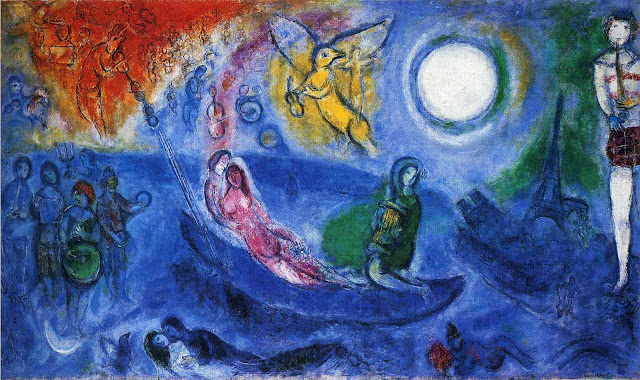 |
| Chagall, "The Concert" |
RefugeThe university must allow refuge.
Refuge must allow the university.
(I keep writing and rewriting this post.)
Freedom from. Freedom to.
Safety from. Safety to.
(Or just more unanswerable holes.)
All pedagogy allows some things and censures others. What does your pedagogy allow? What does it censure? How do you know?
Ripeness Is All
GLOUCESTER: No farther, sir; a man may rot even here.
EDGAR: What, in ill thoughts again? Men must endure
Their going hence, even as their coming hither;
Ripeness is all: come on.
GLOUCESTER: And that's true too.
Exeunt.
By: KatherineS,
on 9/2/2016
Blog:
OUPblog
(
Login to Add to MyJacketFlap)
JacketFlap tags:
Studying,
revision tips,
Very Short Introductions,
education psychology,
Social Sciences,
*Featured,
conditioning,
Educational Reform,
animal conditioning,
Learning: A Very Short Introduction,
Mark Haselgrove,
Pavlov’s Dog,
retrieval practise,
theory of conditioning,
Sociology,
teaching,
learning,
Education,
Add a tag
You are probably familiar with animal learning and conditioning. You probably know that certain behaviours in your pet can be encouraged by reward, for example. You may also know something of the science behind animal conditioning: you may have heard about Pavlov’s drooling dogs, Skinner’s peckish pigeons or Thorndike’s cunning cats. However, what you may not know is that the scientific study of animal conditioning has provided psychologists with an armoury of principles about how training can be most effective.
The post Conditioning in the classroom: 8 tips for teaching and learning appeared first on OUPblog.

By: Jonathan Auxier,
on 8/22/2016
Blog:
The Scop
(
Login to Add to MyJacketFlap)
JacketFlap tags:
Books,
Teaching,
Add a tag

Every fall I teach a class at Hogwarts Chatham University’s MFA program. It’s a great opportunity to spend time with young writers and talk about children’s literature! This year, I’m shaking up my standard reading list, and I thought I’d share it for those who want to play at home:
Harry Potter and the Sorcerer’s Stone by JK Rowling
A Little Princess by Frances Hodgson Burnett
Treasure Island by Robert Louis Stevenson
Peter & Wendy by JM Barrie
Magic Marks the Spot by Caroline Carlson
The Golden Compass by Phillip Pullman
Charlotte’s Web by EB White
The Crossover by Kwame Alexander
Tuck Everlasting by Natalie Babbitt
A Monster Calls by Patrick Ness
A Monster Calls (movie) dir. JA Bayona
Bud, Not Buddy by Christopher Paul Curtis
Crenshaw by Katherine Applegate
The Secrets of Story by Matt Bird
A lot of thought goes into the selection of a reading list. Even the best books can get stale over time, and it’s important to strike a balance between books that teach well (Peter Pan, Charlotte’s Web) and books that excite me (A Monster Calls, Crenshaw). This year, I decided to multitask and include a number of books that tie into my own current work in progress … which is to say that there are CLUES about my next novel buried in this list!

age range: 8-12
genre: contemporary fiction from a dog’s point of view
setting: the suburbs
Victoria J. Coe’s website
classroom guide
Readers will relate to Fenway’s impulsivity and delight in descriptions from his dog’s-eye view. Teachers and adults will appreciate generous sprinklings of rich vocabulary. –School Library Journal
Fenway may not understand Hattie’s behavior, but readers looking through his uncomprehending eyes will follow her ups and downs easily as she adjusts to the move. They’ll also wince in sympathy as she tries, with mixed success, to train, or even restrain, her barky, hyper, emotional pet. —Booklist
This perky, pet-centered tale takes readers inside the head of Fenway, an energetic and perpetually hopeful Jack Russell terrier with a deep love for food, intense hatred of squirrels, and undying adoration of his “small human,” Hattie. . . A fun, fresh frolic that animal-loving kids are sure to enjoy.—Publishers Weekly
Please tell us about your book.
Fenway and Hattie is about a dog named Fenway and his girl Hattie who move from an apartment in the city to a house in the suburbs, where they each struggle with big changes. But you only get Fenway’s side of the story, because the whole book is told from his point of view.
What inspired you to write this story?
I was inspired to write this story when my own family experienced a move and our dog was afraid we’d leave him behind. The move was hard on all of us, but I was especially tuned in to my dog’s fears and insecurities. As we took long walks together, I noticed how he checked everything out and I started to wonder what was going through his mind. That’s how the character of Fenway was born.
Could you share with readers a few interesting tidbits you learned while researching?
I’ve learned a lot about how dogs experience the world! Here are some interesting tidbits:
Dogs smell! But dogs don’t just smell scents; they use their noses to gather information. By smelling, dogs can tell:
- What’s new vs. what’s familiar
- If a person or another dog is a male or female
- What foods you’ve eaten
- What places you’ve been
- If a scent is faint or strong (that’s how dogs tell time)
- What you’ve touched and what’s touched you
- Dogs can even smell people’s feelings
Dogs make sounds, but they primarily communicate by body language. How dogs carry their ears or tails, whether they’re panting or baring their teeth, and what posture they assume can tell another dog all kinds of information. And dogs read our body language, too. They know from our bodies how we’re feeling and what our intentions are.
Dogs are always studying people. They know our routines – maybe better than we know ourselves! They also pick up on cues, like grabbing the leash comes before going for a walk. Dogs know all of our habits and when something changes, a dog is usually the first to notice!
What are some special challenges associated with writing from a dog’s point of view?
Ha! How long is this blog, Caroline? I like to say that writing from a dog’s point of view is just like regular writing only with both hands tied behind your back!
Seriously though, since dogs don’t understand most human language, I can only write actions, sounds, or observations that a dog would know – I can’t rely on human dialogue.
There are so many elements of the human world that dogs don’t know. Fenway doesn’t know how old Hattie is or what town they live in. And he certainly doesn’t know what she does when she’s not with him — unless he can see, hear, or smell clues, and he often comes to the wrong conclusion!
For instance, early on in the story, Hattie is packing. Fenway remembers that he’s seen her do this before – right before she disappeared and left him alone. And something really terrible must’ve happened to her because when she came back she smelled like burnt marshmallows and squirrels.
What topics does your book touch upon that would make it a perfect fit for the classroom?
Fenway and Hattie is a perfect mentor text for both point of view and inference. My classroom guide contains both POV activities and exercises as well as a discussion guide for the book – which as you can see from the packing example I just described is a lot of inference!
The post Classroom Connections: Fenway and Hattie by Victoria J. Coe originally appeared on Caroline Starr Rose


An invaluable resource for any and everyone who has children in their lives! Jamie Martin has scoured the best in children’s literature from around the globe and compiled in one volume, book recommendations sure to appeal to the reader in your life.
— LeVar Burton, Reading Rainbow
This is an especially joyous post for me today. My dear friend Jamie C. Martin, who has been steadily working on a book for five years, released it into the world earlier this month, and I want everyone to know about it!
Please tell us about your book.
Give Your Child the World: Raising Globally Minded Kids One Book at a Time is a global reading treasury for those “can’t-get-enough” book lovers, map collectors, adventure seekers, and wanderers-at-heart. It’s a resource for those who want their kids to grow up loving the neighbor next door as well as the one on the other side of the world. It’s for parents and educators who hope to raise world-lovers and world-changers.
The book includes more than 600 of the best children’s book recommendations from around the world, organized by region, country, and age range (ages 4-12). It also shares the story of how my own family became a multicultural one, with four nationalities represented under our roof.
Could you tell us about yourself?
My British husband Steve and I have been married for almost 18 years. We have three children. Jonathan, our biological son, joined our family first. Next came our son Elijah, who we adopted when he was still an infant from Liberia, West Africa. Both boys are now 11 years old. And our daughter Trishna joined our family from India at the age of 4—she just recently turned 13 (our first teenager, wow!).

I’ve been blogging for over seven years now, and my main online home is currently SimpleHomeschool.net, where I write alongside a fabulous group of contributors about intentional education, mindful parenting, and the joy found in a pile of books.
Where did the idea for Give Your Child the World first come from?
Back when I was a new mom, there was a book I adored. Actually I think you might have been the first to tell me about it, Caroline?!* Honey for a Child’s Heart by Gladys Hunt is all about using books in family life. In it the author has categorized the best classic children’s literature into a variety of lists that parents can easily use. I loved that she had done all the work so that I didn’t have to! I spent hours poring over that book as a young mom and starting our own home library.
But as our unique, multi-cultural family grew, I realized I needed a way to connect us more deeply to other cultures. We weren’t able to do much traveling at that time, but I found I could use books to add that new dimension to our family.
When I started looking for the best global books out there, I was more or less on my own to research and separate the good from the bad. That got me thinking about a reading treasury, like the one I had loved so much, but with an around-the-world focus. I thought about how much time it would have saved me save me, and eventually I thought I might as well create that resource for others!
How has children’s literature shaped your family’s everyday conversations?
Now that my kids are a little older, I can see many of the benefits that weren’t as obvious when they were still young. We have this rich book heritage, made up of all those pages we’ve read together, and I love that. So when things come up in the news, or even a personal challenge arises, often there will be a connection to a story that we can turn to for help and encouragement.
I like to think that in twenty years when the kids are grown, married, and have kids of their own, they might look back on their childhood through the lens of all the books we read. I hope these titles have taken root deep in their souls, building their characters page by page, strengthening them for when hard times inevitably come, and leading them to look not just for a career but a calling. A way to make a difference, big or small, in this world.
How has children’s literature played into your children’s understanding of the world around them?
You shared a quote with me years ago from Newbery medal-winning author Katherine Paterson that I have gone back to again and again. She said that “the books we read in childhood are a rehearsal for experiences later in life.”** And I couldn’t agree more.
Creating a family culture of books means our kids have the chance to live a thousand lives before leaving home. They can travel the world (and beyond!) all while safe within our four walls. They can feel the pain of a character’s flaws and learn from their mistakes, without having to experience the actual consequences. I don’t see reading as a way to escape reality, but as a way to prepare our kids for real life in a unique and beautiful way.
In recent years, organizations like We Need Diverse Books, Multicultural Children’s Book Day, and Lee and Low Books have brought a spotlight to diversity in children’s literature (and the lack thereof). What does Give Your Child the World add to the conversation?
It makes me so happy to see organizations highlighting this issue, and I’m thrilled to add my work to all that others have contributed. Give Your Child the World makes the process of finding multicultural books so much simpler for parents, families, and educators. Taking the time to research titles is something that busy mamas and papas often don’t have, and knowing that a trusted voice has done all that for them means they can get busy with the fun part: reading their way around the world with their kids!

And speaking of reading around the world, Jamie and Sarah Mackenzie of the Read Aloud Revival are pairing up to run an eight-week online book club which does just that. Click through to learn more. The adventure begins 27 June.
* It’s very possible! I have a memory of the two of us reading Gladys Hunt’s Honey for a Woman’s Heart: Growing Your World through Reading Great Books .
.
** I have to confess I’ve attributed this quote to both Katherine Paterson and Lois Lowry at various times and places! While I don’t know who originally said it, I do know I heard Katherine Paterson share these very words at an event in Washington DC in 2000 when talking about her Bridge to Terabithia .
.
The post Give Your Child the World: An Interview with Author Jamie C. Martin originally appeared on Caroline Starr Rose


age range: 10 and up
genre: contemporary fiction
setting: New York City
Melanie Conklin’s website
Preview the first three chapters
Please tell us about your book.
Counting Thyme is the story of Thyme Owens, an eleven-year-old girl whose family moves across the country for her little brother’s cancer treatment. It’s a story about family, friendship, and finding your place in the world when life throws you a curveball.
What inspired you to write this story?
The idea for this story came to me after I read a bunch of middle grade books with protagonists who were facing serious illnesses. I wondered what it would be like to be the sibling of a gravely ill child. I wondered how the conflicts at home would influence the conflicts at school. I thought it would be especially tough if you were just starting middle school, with all of the social pressures involved at that time in life. Thyme’s story grew from there!
Could you share with readers how you conducted your research or share a few interesting tidbits you learned while researching?
In my past life as a product designer, I did a ton of research at the outset of every new project. It’s no different for me with books. Once I have an idea, I conduct an audit—which is a fancy way of saying that I cast a wide net and gather research from all of the reputable sources in that subject area. With Counting Thyme, I gathered a tremendous amount of information online, because research hospitals are very interested in sharing knowledge. I also read countless blogs posted by parents of pediatric cancer patients to gain insight into their everyday lives and the ups and downs of treatment. When I had questions, I posted them on discussion forums and parents graciously answered, helping me understand the intricacies of their world.
What are some special challenges associated with writing middle grade?
My favorite thing about MG fiction is the way it explores tough topics in an honest way, while preserving a safe space for young readers. It’s tough to nail that balance. It took many passes of revision to balance the emotion and the information in Counting Thyme, so that readers can understand what’s happening without being bogged down by too much medical information. My favorite books are the ones that manage this balance effortlessly (although I now know that a lot of effort goes into that!).
What topics does your book touch upon that would make it a perfect fit for the classroom?
Because Counting Thyme is set in New York City, there’s a lot going on in the story. Thyme’s family moves into a multiple story apartment building, so she experiences living with close neighbors for the first time, which is a great touchstone for talking about the different ways that people live. There are also characters of many different backgrounds and ethnicities, which is what makes NYC so wonderful. This theme provides an opportunity to talk about different family traditions and cultures. Other themes touch on sibling relationships, honesty versus secrets, what it means to be a friend, and what it means to be counted (in your family, and in the world at large).
The post Classroom Connections: Counting Thyme by Melanie Conklin originally appeared on Caroline Starr Rose

By
Cynthia Leitich Smithfor
CynsationsKurt Dinan is the first-time author of
Don't Get Caught (Sourcebooks Fire, 2016). From the promotional copy:
10:00 tonight at the water tower. Tell no one. -Chaos Club
When Max receives a mysterious invite from the untraceable, epic prank-pulling Chaos Club, he has to ask: why him?
After all, he's Mr. 2.5 GPA, Mr. No Social Life. He's Just Max. And his favorite heist movies have taught him this situation calls for Rule #4: Be suspicious. But it's also his one shot to leave Just Max in the dust...
Yeah, not so much. Max and four fellow students-who also received invites-are standing on the newly defaced water tower when campus security "catches" them. Definitely a setup. And this time, Max has had enough. It's time for Rule #7: Always get payback.
Let the prank war begin.When and where do you write? Why does that time and space work for you?Having a full-time teaching job, papers to grade, and four children under the age of ten, let's just say that writing time (or any free time for that matter) is pretty sparse. So basically, I'm a anytime/anywhere possible type of writer.
I write in the mornings before my students arrive, on my lunch break, in the fifteen minutes before I head home to get the kids, during my kids' practices, or in the time after the kids go to bed if I'm not too tired and my brain is still functioning.
It can be a very piecemeal process, but I'm not too hard on myself and have a very realistic goal--500 words a day. When I get that finished, I don't stress out about my writing the rest of the day.
That's nice in that it allows me to focus my efforts and energy in other places they are needed.
As a teacher-author, how do your two identities inform one another? What about being a teacher has been a blessing to your writing?Other writers have good-naturedly ribbed me for having a secret "in" to the world of teenagers, and I suppose I do. I'm surrounded by them all day, and I hear their conversations, their worries, their humor, etc. I get to use all of that when I'm writing.
Being a writer has helped me immensely in the classroom though because kids love my honesty about how hard writing can be, about revision and brainstorming techniques I've learned, and about how you want to write something you're proud of, not just something you've finished.
Basically, I'm not just someone forcing them to write, I'm someone going through a lot of the same struggles they are, and a lot of them appreciate that.

age range: 9-12 years
genre: contemporary fiction
PB&J Society Rules
PB&J Society Bonus Chapter
Janet Sumner Johnson’s website
Please tell us about your book.
Some things are better together. Like peanut butter and jelly. Or Annie and Jason. So when her best friend’s house is threatened with foreclosure, Annie Jenkins is bursting with ideas to save Jason’s home. She could sell her appendix on eBay. (Why not?) Win the lottery. (It’s worth a shot!) Face the evil bankers herself. (She’s one tough cookie, after all.) Or hunt down an elusive (and questionably real) pirate treasure. Whatever the plan, it has to work, or this is undoubtedly The Last Great Adventure of the PB & J Society .
.
What inspired you to write this story?
I originally started writing this book based on memories from my own childhood. However, that version of the book was all over the place and not very good, so I shelved it. When I read through it many years later, Annie and Jason were so much fun, I couldn’t let them go.
Around that same time, the housing crisis was in full swing, and foreclosures were becoming all too common. I had some friends facing this, and I wondered how it affected their children. It was an easy connection to have Annie and Jason face this conflict, and the book grew out of that.
Could you share with readers how you conducted your research or share a few interesting tidbits you learned while researching?
My book, while not historical in and of itself, does have bits of history which required research here and there. Most of my research came after the first draft on an as-needed basis. For what I needed, simple internet-based searches worked fine, and I would usually fact check across various sites. However, I did use my Dr. Husband for some medical questions. Very useful to have an expert in the house!
One interesting thing I learned in my research is that Peanut Butter used to be called Peanut Paste. Sounds gross, right? John Harvey Kellogg (Yes, that Kellogg) patented a peanut-butter-making process in 1898. However, even though most information that I found credited Mr. Kellogg as the first patent-holder, a Canadian gentleman named Marcellus Gilmore Edson actually received a U.S. patent for his own peanut-butter making process in 1884. Maybe they ignore him because he’s Canadian? Maybe because his name isn’t as recognizable? I don’t know. But I thought that was interesting.
Another thing I learned is that peanut butter, apparently, wasn’t as tasty back then. It was invented for people with bad teeth who couldn’t chew. Who knew?
What are some special challenges associated with writing contemporary middle-grade fiction?
I love writing contemporary fiction because it is easy to identify with the characters and their circumstances. They face stuff we deal with in a very recognizable way. But one of the challenges is that time marches on and things change very quickly.
For example, in an earlier draft of my book, I made some references to Twinkies. And then BOOM! Hostess went bankrupt and Twinkies were gone. Just like that. I had to do an emergency edit and cut those references all out.
Of course, we all know that Twinkies are now back, but I decided it was better to keep them out.
Also in an earlier draft, I referenced iPods a lot. My editor rightly suggested that those are now out-dated, and kids have moved on to iPhones. Really, what I should be learning is not to use brand names in my writing!
But even then, you can’t always know what to avoid. In another book, I had one character telling another to “Let it go.” After a certain Disney movie was released, I couldn’t read the passage the same anymore, and had to change it.
In short, it can be tricky to keep a contemporary feel to a contemporary book when it takes years to write and publish it.
What topics does your book touch upon that would make it a perfect fit for the classroom?
There are quite a few discussion topics in my book, both serious and fun.
On the serious side:
-foreclosure
-moving
-making/being a friend
-parent’s job loss
-growing up
On the fun side:
-brain freeze
-pirates
-treasure maps
-ways to earn money
-soccer
Click through to sign up for my quarterly newsletter and you’ll receive a free printable from my novel, Blue Birds. Enjoy!
The post Classroom Connections: The Last Great Adventure of the PB&J Society by Janet Sumner Johnson originally appeared on Caroline Starr Rose


I few weeks ago I shared a link to a blog post by teacher Colby Sharp. In it he talked about picking up a middle grade book and feeling like he’d seen it all before. Then he read these words by author Linda Urban:
Colby went on to say “middle grade books are not about you and me” (in other words, the adults out there).
I’ve thought so much about Colby’s and Linda’s words these past few months. They’ve helped me solidify some of my ideas about children’s literature, actually. While I will always, always, always believe a good book is a good book for everyone, regardless of age (though not all books are for every reader, which is another discussion entirely), Linda has reminded me that children’s literature is first and foremost for children.
Of course I know this, but I think sometimes I bring an outside perspective (as both reader and writer) that doesn’t always serve the work best. Rather, this is where I’d like my focus to be:
- If this book is for a young reader, what is it they’ll discover that will be meaningful and ring true?
- What am I willing to say as an author that might feel trite or old news to the grow ups but could be new and important to young readers?
- Am I willing as a reader not to have my needs met first when I am reading middle grade?
I’m curious what readers here think.
Click through to sign up for my quarterly newsletter and you’ll receive a free printable from my novel, Blue Birds. Enjoy!
The post Middle Grade Books Are Not About You and Me (With a Nod to Colby Sharp and Linda Urban) originally appeared on Caroline Starr Rose


Fri-Sun — April 15th, 16th, 17th
Barnes & Noble, Coronado Mall (6600 Menaul Blvd)
From SCBWI-NM:
Nearly 20 local authors and illustrators will be giving talks, readings, and signings over this three day event. We will also have a table set up with as many local authors’ and illustrators’ books as we can get our hands on! Many autographed copies will be available.
*Bonus, the fair coincides with Barnes & Noble’s Educator Appreciation Week—meaning all educators (K-12) that have signed up for an education membership with Barnes & Noble, will get 25% off their purchases!
This is a huge event for New Mexico’s chapter of the Society of Children’s Book Writers and Illustrators — the first of its kind. I’ll be there Sunday, April 17 from noon to two and will read Over in the Wetlands and give a presentation about Roanoke’s Lost Colony. (If you’re an elementary teacher, be sure to pick up a copy of Blue Birds. It’s on the New Mexico Battle of the Books list next year).

Please spread the word. I’d love to see you there!
Click through to sign up for my quarterly newsletter and you’ll receive a free printable from my novel, Blue Birds. Enjoy!
The post Meet Local Authors, ABQ Readers and Teachers! originally appeared on Caroline Starr Rose

Maybe it's because I lead but one class during the one semester at Penn that teaching carries, for me, such weight. I begin planning for January in August, often earlier. Choosing the books we'll read, plotting our course, interacting with potential students. I pack as much into every class as our allotted hours allow. Pressing in with ideas, exhortations, readings. Bringing guests like George Hodgman (via Skype), Reiko Rizzuto, Margo Rabb, A.S. King, and Trey Popp into the fold. (Next year we'll be hosting Paul Lisicky, and focused on the art of time in memoir.) Using multiple media, stretching the idea of memoir, expecting much. Finding the good while searching, too, for all that is still possible.
And, this semester, leading two remarkable thesis candidates—Nina Friend and David Marchino—toward work so extraordinary that, I believe, it will represent their calling cards for years and years to come.
Teaching is standing before a class, then stepping aside. It's managing the ripples and waves while keeping the craft on course.
Three more weeks. And then these students will be off on their own, carrying our lessons forward, glancing back, I hope, not just as writers, but as people who value truth, empathy, conversation, and a greater knowing of themselves.

The Last Boy at St. Edith’s
age range: 8-12
genre: contemporary fiction
Lee Gjertsen Malone’s website
This is a funny, emotional book that will quickly become a favorite to many a reader, regardless of age. Sweet, funny, exciting—a spectacular debut. — Kirkus, starred review
Humor mixes with more serious issues in this clever debut. — Booklist
Malone’s debut is a sweet, candid novel about fitting in, messing up, and making amends. — Publisher’s Weekly
Please tell us about your book.
It’s the story of a boy named Jeremy who goes to an all girl’s school that tried to go coed but failed. He ends up being the very last boy left at the school, because his mother works there and won’t let him transfer, so he hatches a plan with his best friend to pull some epic pranks in an effort to get himself expelled.
What inspired you to write this story?
It began with a conversation with my husband. He went to an all-boy’s school that went coed a few years after he graduated, and we got a fundraising newsletter from his alma mater. As a graduate of public schools, I was fascinated with the whole idea – why a previously single gender school would decide to go coed, and, because this is where my mind goes, how would they know it would work? And what would happen if it didn’t work, and instead of there being more and more kids of your gender each year, there were fewer and fewer?
And the same time I was also thinking I wanted to write a book about a strong boy-girl friendship that was tested by growing up, and the combination of those two ideas got me started writing this book.
Could you share with readers how you conducted your research or share a few interesting tidbits you learned while researching?
I love doing research, even if it’s not obvious in the finished book. I love it almost too much. For this book I researched a lot of things – saint names, the economic development of western Massachusetts, and how doorknobs are put together. Oh, and pranks. Lots and lots of pranks.
What are some special challenges associated with writing middle grade?
First, I think that while it’s true that in any novel every scene has to have a purpose, in middle grade I think it’s even more important – because of the space constraints, every scene needs to do double and triple duty. There’s also the tricky issue of the middle grade voice. It’s not easy to find that balance where your kids sound like kids and the story feels like something they would be interested in without becoming a parody of the way kids talk.
What topics does your book touch upon that would make it a perfect fit for the classroom?
The book touches on a few topics I think would be great for classroom conversations. The first is gender – what does it mean to act like a boy? What does it mean to act like a girl? And why does it matter? Do you need to have friends and role models like yourself in order to know how you are supposed to be?
Secondly, Jeremy, the main character, is a lot of ways a cultural norm in our society. He’s white, male, middle class. He wouldn’t stand out at all in a lot of places. But he definitely does stand out at St. Edith’s. Which leads to the question, what makes something a norm anyway? How can you decide what’s normal without considering the context?
And finally, the main characters make some really bad decisions in the book that seem like good ideas at first. They never intend to hurt anyone with their pranks but they end up causing a lot more trouble than they expected. I think it’s interesting to think about what you should do when something you never intended to cause people trouble backfires.
What do you think of the blog? I’d love to hear from you.
Click through to sign up for my quarterly newsletter and you’ll receive a free printable from my novel, Blue Birds. Enjoy!
The post Classroom Connections: The Last Boy at St. Edith’s by Lee Gjertsen Malone originally appeared on Caroline Starr Rose


In 2009 I stopped teaching without any publishing prospects, but with the burning conviction it was time to put everything behind my efforts to finally sell a book. I did what every other aspiring author was doing then: I started a blog.
A few months later, I signed with my first agent. Four months after that, May B. was under contract. Through highs and lows this blog has been a constant, a place for me to think through ideas, share bits of encouragement, introduce readers to new books, and celebrate my own. Whether you’ve been here from the beginning or are entirely new, I thank you for the ways you’ve added to the conversation and become a key part of my writing life.
Over the next few months I plan to highlight key posts that have risen to the top. Today’s are the posts that are read most often (I wrote this before last week, when this post, now the top post of all time, went live). While my sense is most regular readers are aspiring writers, it’s interesting to note these posts almost exclusively speak to teachers, librarians, and parents looking to share books with their children.
Running a Book Club for Kids
The first post in a series based on my experience running after-school book clubs, this post has been number one around here for years. Included in the post are links to the rest of the series.

The Gift of Friendship
I love knowing that the second most-widely read post on the blog is essentially a love letter to my dear friend, Jamie C. Martin, whose own book comes out later this year. The post touches on the ways friends bolster and inspire us, in this case how Jamie pushed me to be brave when writing Blue Birds.
Third-Grade Book Club Reading Lists
Straight from my after-school book club days, this is the list I used with third-grade readers, plus a run down of everything I included in my Welcome to Book Club handout.
Classroom Connections: Fish in a Tree by Lynda Mullaly Hunt
Lynda’s had a pretty phenomenal year, hitting the NYT Bestseller’s List with her second middle-grade novel, Fish in a Tree , and going on to win the American Library Association’s Schneider Family Book Award, which “embodies an artistic expression of the disability experience for child and adolescent audiences.” This interview includes links to Lynda’s website and educator’s guide.
Fast Five: Novels About Teachers and Their Students
This one’s been a favorite for a long time, with a number of oldie but goodies sure to inspire.

Reading in the Wild: 5 Things Wild Readers Do
Teacher turned author turned Scholastic Press guru, Donalyn Miller, has written two glorious books about reading and teaching that I devoured. This post is one of several that grew out of her second book, Reading in the Wild: The Book Whisperer’s Keys to Cultivating Lifelong Reading Habits . Read our interview based on Donalyn’s first book, The Book Whisperer: Awakening the Inner Reader in Every Child
 , here.
Click through to sign up for my quarterly newsletter and you’ll receive a free printable from my novel, Blue Birds. Enjoy!
The post Top Posts of All Time originally appeared on Caroline Starr Rose

Eric Bennett has an MFA from
Iowa, the MFA of MFAs. (He also has a Ph.D. in Lit from Harvard, so he is a man of fine and rare academic pedigree.) Bennett's recent book
Workshops of Empire: Stegner, Engle, and American Creative Writing during the Cold War is largely about the Writers' Workshop at Iowa from roughly 1945 to the early 1980s or so. It melds, often explicitly,
The Cultural Cold War with
The Program Era, adding some archival research as well as Bennett's own feeling that the work of politically committed writers such as Dreiser, Dos Passos, and Steinbeck was marginalized and forgotten by the writing workshop hegemony in favor of individualistic, apolitical writing.
I don't share Bennett's apparent taste in fiction (he seems to consider Dreiser, Dos Passos, Steinbeck, Thomas Wolfe, etc. great writers; I don't), but I sympathize with his sense of some writing workshops' powerful, narrowing effect on American fiction and publishing for at least a few decades. He notes in his conclusion that the hegemonic effect of Iowa and other prominent programs seems to have declined over the last 15 years or so, that Iowa in recent years has certainly become more open to various types of writing, and that even when Iowa's influence was at an apex, there were always other sorts of programs and writers out there — John Barth at Johns Hopkins, Robert Coover at Brown, and Donald Barthelme at the University of Texas are three he mentions, but even that list shows how narrow in other ways the writing programs were for so long: three white hetero guys with significant access to the NY publishing world.
What Bennett most convincingly shows is how the discourse of creative writing within U.S. universities from the beginning of the Cold War through at least to the 1990s created a field of limited, narrow values not only for what constitutes "good writing", but also for what constitutes "a good writer". It's a tale of parallel, and sometimes converging, aesthetics, politics, and pedagogies. Plenty of individual writers and teachers rejected or rebelled against this discourse, but for a long time it did what hegemonies do: it constructed common sense. (That common sense was not only in the workshops — at least some of it made its way out through writing handbooks, and can be seen to this day in pretty much all of the popular handbooks on how to write, including Stephen King's
On Writing.)
Some of the best material in
Workshops of Empire is not its Cold War revelations (most of which are known from previous scholarship) but in its careful limning of the tight connections between particular, now often forgotten, ideas from before the Cold War era and what became acceptable as "good writing" later. The first chapter, on the
"New Humanism", is revelatory, especially in how it draws a genealogy from
Irving Babbitt to Norman Foerster to
Paul Engle and
Wallace Stegner. Bennett tells the story of New Humanism as it relates to New Criticism and subsequently not just the development of workshop aesthetics, but of university English departments in the second half of the 20th century generally, with New Humanism adding a concern for ethical propriety ("the question of the relation of the goodness of the writing to the goodness of the writer") to New Criticism's cold formalism:
Whereas the New Criticism insisted on the irreducible and indivisible integrity of the poem or story — every word counted — the New Humanism focused its attention on the irreducible and indivisible integrity of the humanistic subject. It did so not as a kind of progressive-educational indulgence but in deference to the wholeness of the human person and accompanied by a strict sense of good conduct. (29-30)
This mix was especially appealing to the post-WWII world of anti-Communist liberalism, a world scarred by the horrors of Nazism and Stalinism, and a United States newly poised to inflict its empire of moral righteousness across the world.
For all of Bennett's gestures toward Marxism and anti-imperialism, he seems to share some basic assumptions about the power of literature with the men of the Cold War era he disdains as conservatives. In the book's conclusion, he writes:
It remains an open question just how much criticism some or all American MFA programs deserve for contributing to the impasse of neoliberalism — the collective American disinclination to think outside narrow ideological commitments that exacerbate — or at the very least preempt resistance to — the ugliest aspects of the global economy. Those narrow commitments center, above all, on an individualism, economic and otherwise, vastly more powerful in theory and public rhetoric than in fact. We encourage ourselves to believe that we matter more than we do and to go it alone more than we can. This unquestioned inflation of the personal begs, in my opinion, the kinds of questions that must be asked before any reform or solution to some seriously pressing problems looks likely to be found. (173)
This is almost comically self-important in its idea that MFA programs might (he hopes?) have enough cultural effect that if only they had been more willing to teach students to write like Thomas Wolfe and John Steinbeck, then maybe we could conquer neoliberalism! One moderately popular movie has more cultural effect than piles and piles of books written by even the famous MFA people. If you want to fight neoliberalism, your MFA and your PhD (from Harvard!) aren't likely to do anything, sorry to say. If you want to fight neoliberalism ... well, I don't know. I'm not convinced neoliberalism
can be fought, though we might be able to find
an occasional escape in aesthetics. The idea that Books Do Big Things In The World is one that Bennett shares with his subjects; he'd just prefer they read different books.
As self-justifying delusions go, I suppose there are worse, and all of us who spend our lives amidst writing and reading believe to some extent or another that it's worthwhile, or else we wouldn't do it. But "worthwhile" is far from "world-changing". (Rx: Take a couple
Wallace Shawn plays and call me in the morning.)
Despite this, Bennett's concluding chapter had me raising my fist in solidarity, because no matter what our personal tastes in fiction may be, no matter how much we may disagree about the extent to which writing can influence the world, we agree that writing pedagogy ought to be diverse and historically informed in its approach.
Bennett shows some of the forces that imposed a common shallowness:
There was, in the second wave of programs — the nearly fifty of them founded in the 1960s — little need to critique the canon and smash the icons. To the contrary, the new roster of writing programs could thrive in easy conscience. This was because each new seminar undertook to add to the canon by becoming the canon. The towering greats (Shakespeare, Milton, Whitman, Woolf, whoever) diminished in influence with each passing year, sharing ever more the icon's niche with contemporary writers. In 1945, in 1950, in 1955, prospective poets and novelists looked to the neverable pantheon as their competition. In 1980, in 1990, in 2015, they more often regarded their published teachers or peers as such. (132)
That's polemical, and as such likely hyperbolic, but it suggests some of the ways that some writing programs may have capitalized on the culture of narcissism that has only accelerated via social media and
is now ripe for economic exploitation. I don't think it's a crisis of the canon — moral panics over the Great Western Tradition are academic Trumpism — so much as a crisis of literary-historical knowledge. Aspiring writers who are uninterested in reading anything written before they were born are nincompoops. Understandably and forgiveably so, perhaps (U.S. culture is all about the current whizbang thing, and historical amnesia is central to the American project), but too much writing workshop pedagogy, at least of the recent past, has been geared toward encouraging nincompoopness. As Bennett suggests, this serves the interests of American empire while also serving the interests of the writing world. It domesticates writers and makes them good citizens of the nationalistic endeavor.
Within the context of the book, Bennett's generalizations are mostly earned. What was for me the most exciting chapter shows exactly the process of simplification and erasure he's talking about. That chapter is the final one before the conclusion: "Canonical Bedfellows: Ernest Hemingway and Henry James". Bennett's claim here is straightforward: The consensus for what makes writing "good" that held at least from the late 1940s to the end of the 20th century in typical writing workshops and the most popular writing handbooks was based on teachers' knowledge of Henry James's writing practices and everyone's veneration of Hemingway's stories and novels.
For Bennett, Hemingway became central to early creative writing pedagogy and ideology for three basic reasons: "he fused together a rebellious existential posture with a disciplined relationship to language, helping to reconcile the avant-garde impulse with the classroom", "he offered in his own writing...a set of practices with the luster of high art but the simplicity of any good heuristic", and "he contributed a fictional vision whose philosophical dimensions suited the postwar imperative to purge abstractions from literature" (144). Hemingway popularized and made accessible many of the innovations of more difficult or esoteric writers: a bit of Pound from Pound's Imagist phase, some of Stein's rhythms and diction, Sherwood Anderson's tone, some of the early Joyce's approach to word patterns... ("He was possibly the most derivative
sui generis author ever to write," Bennett says. Snap!) Hemingway's lifestyle was at least as alluring for post-WWII male writers and writing teachers as his writing style: he was macho, war-scarred, nature-besotted in a Romantic but also carnivorous way. He was no effete intellectual. If you go to school, man, go to school with Papa and you'll stay a man.
The effect was galvanizing and long-term:
Stegner believed that no "course in creative writing, whether self administered or offered by a school, could propose a better set of exercises" than this method of Hemingway's. Aspirants through to the present day have adopted Hemingway's manner on the page and in life. One can stop writing mid-sentence in order to return with momentum the following morning; aim to make one's stories the tips of icebergs; and refrain from drinking while writing but aim to drink a lot when not writing and sometimes in fact drink while writing as one suspects with good reason that Hemingway himself did, despite saying he didn't. One can cultivate a world-class bullshit detector, as Hemingway urged. One can eschew adverbs at the drop of a hat. These remain workshop mantras in the twenty-first century. (148)
Clinching the deal, the Hemingway aesthetic allowed writing to be gradeable, and thus helped workshops proliferate:
Hemingway's methods are readily hospitable to group application and communal judgment. A great challenge for the creative writing classroom is how to regulate an activity ... whose premise is the validity and importance of subjective accounts of experience. The notion of personal accuracy has to remain provisionally supreme. On what grounds does a teacher correct student choices? Hemingway offered an answer, taking prose style in a publicly comprehensible direction, one subject to analysis, judgment, and replication. ... One classmate can point to metaphors drawn from a reality too distant from the characters' worldview. Another can strike out those adverbs. (151)
Bennett then points out that the predecessors of the New Critics, the conservative Southern Agrarians, thought they'd found in Hemingway almost their ideal novelist (alas, he wasn't Southern). "The reactionary view of Hemingway," Bennett writes, "became the consensus orthodoxy." Hemingway's concrete details don't offer clear messages, and thus they allowed his work to be "universal" — and universalism was the ultimate goal not only of the Southern Agrarians, but of so many conservatives and liberals after WWII, when art and literature were seen as a means of uniting the world and thus defeating Communism and U.S. enemies. "Universal" didn't mean
actually universal in some equal exchange of ideas and beliefs — it meant imposing American ideals, expectations, and dreams across the globe. (And consequently opening up the world to American business.)
Such a discussion of how Hemingway influenced creative writing programs made me think of other ways complex writing was made appealing to broad audiences — for instance, much of what Bennett writes parallels with some of the ideas in work such as
Creating Faulkner's Reputation by Lawrence H. Schwartz and especially
William Faulkner: The Making of a Modernist, where Daniel Singal
proposes that Faulkner's alcoholism, and one alcohol-induced health crisis in November 1940 especially, turned the last 20 years of Faulkner's life and writing into not only a shadow of its former achievement, but a mirror of the (often conservative) critical consensus that built up around him through the 1940s. Faulkner became teachable, acceptable, "universal" in the eyes of even conservative critics, as well as in Faulkner's own pickled mind, which his famous
Nobel Prize banquet speech so perfectly shows.
(Thus some of my hesitation around Bennett's too easy use of the word "modernist" throughout
Workshop of Empire — the strain of Modernism he's talking about is a sanitized, domesticated, popularized, easy-listening Modernism. It's Hemingway, not Stein. It's late Faulkner, not
Absalom, Absalom!. It's white, macho-male, heterosexual, apolitical. The influence seems clear, but it chafes against my love of a broader, weirder Modernism to see it labeled only as "modernism" generally.)
Then there's Henry James. Not for the students, but the teachers:
As with Hemingway, James performed both an inner and an outer function for the discipline. In his prefaces and other essays, he established theories of modern fiction that legitimated its status as a discipline worthy of the university. Yet in his powers of parsing reality infinitesimally, James became an emblem similar to Hemingway, a practitioner of resolutely anti-Marxian fiction in an era starved for the same. (152)
Reducing the influence and appeal here to simply the anti-Marxian is a tic produced by Bennett's yearning for the return of the Popular Front, because his own evidence shows that the immense influence of Hemingway and James served not only to veer teachers, students, writers, and critics away from any whiff of agit-prop, but that it created an aesthetic not only hostile to Upton Sinclair but to the 19th century Decadents and Symbolists, to much of the Harlem Rennaissance, to most forms of popular literature, and to any writers who might seem too difficult, abstruse, or weird (imagine Samuel Beckett in a typical writing workshop!).
As Bennett makes clear, the
idea of Henry James's writing practice more than any of James's actual texts is what held through the decades. "He did at least five things for the discipline," Bennett says (152-153):
- His Prefaces assert the supremacy of the author, and "the early MFA programs depended above all on a faith that literary meaning could be stable and stabilized; that the author controlled the literary text, guaranteed its significance, and mastered the reader."
- James's approach was one of research and selection, which is highly appealing to research universities. Writing becomes a laboratory, the writer an experimenter who experiments succeed when the proper elements are selected and balanced. "He identified 'selection' as the major undertaking of the artist and perceived in the world a landscape without boundaries from which to do the selecting." Revision is key to the experiment, and revision should be limitless. Revision is virtue.
- James was anti-Romantic in a particular way: "James centered modern fiction on art rather than the artist, helping to shape the doctrines of impersonality so important to criticism from the 1920s through the 1950s. He insulated the aesthetic object from the deleterious encroachments of ego." Thus the object can be critiqued in the workshop, not the creator.
- "James nonetheless kept alive the romantic spirit of creative inspiration and drew a line between those who have it and those who don't." He often sounds mystical in his Prefaces (less so his Notebooks). The craft of writing can be taught, but the art of writing is the realm of genius.
- "James regarded writing as a profession and theorized it as one." The writer is someone who labors over material, and the integrity of the writer is equal to the integrity of the process, which leads to the integrity of the final text.
These ideas took hold and were replicated, passed down not only through workshops, but through numerous handbooks written for aspiring writers.
The effect, ultimately, Bennett asserts, was to stigmatize intellect. Writing must not be a process of thought, but a process of feeling. It must be sensory. "No ideas but in things!" A convenient ideology for times of political turmoil, certainly.
Semester after semester, handbook after handbook, professor after professor, the workshops were where, in the university, the senses were given pride of place, and this began as an ideological imperative. The emphasis on particularity, which remains ubiquitous today, inviolable as common sense, was a matter for debate as recently as 1935. The debate, in the 21st century, is largely over. (171)
I wonder. From writers and students I sense — and this is anecdotal, personal, sensory! — a desire for something more than the old Imagist ways. A desire for thought in fiction. For politics, but not a simple politics of vulgar Marxism. The ubiquity of dystopian fiction signals some of that, perhaps. Dystopian fiction is being written by both the hackiest of hacks and the highest of high lit folks. It shows a desire for imagination, but a particular sort of imagination: an imagination about society. Even at its most
personal, navel-gazing, comforting, and self-justifying, it's still at least trying to wrestle with more than the concrete, more than the story-iceberg.
So, too, the efflorescence of different types of writing programs and different types of teachers throughout the U.S. today suggests that the era of the aesthetic Bennett describes may be, if not over, at least far less hegemonic. Bennett cites its apex as somewhere around 1985, and that seems right to me. (I might bump it to 1988: the last full year of Reagan's presidency and the publication of Raymond Carver's selected stories,
Where I'm Calling From.) The people who graduated from the prestigious programs then went on to become the administrators later, but at this point most of them have retired or are close to retirement. There are still
narrow aesthetics, but there's plenty else going on. Most importantly, writers with quite different backgrounds from the old guard are becoming not just the teachers, but the administrators. Bennett notes that some of the criticism he received for
earlier versions of his ideas pointed to these changes:
I was especially convinced by the testimony of those who argued that the Iowa Writers' Workshop under Lan Samantha Chang's directorship has different from Frank Conroy's iteration of that program, which I attended in the late 1990s and whose atmosphere planted in my heart the suspicion that, for some reason, the field of artistic possibilities was being narrowed exactly where it should be broadest. In the twenty-first century, things have changed both at Iowa and at the many programs beyond Iowa, where few or none of my conclusions might have pertained in the first place. (163)
That's an important caveat there. The present is not the past, but the past contributed to the present, and it's a past that we're only now starting to recover.
There's much more to be investigated, as I'm sure Bennett knows. The role of the
Bread Loaf Writers' Conference and similar institutions would add some more detail to the study; similarly, I think someone needs to write about the intersections of creative writing programs and composition/rhetoric programs in the second half of the twentieth century. (Much more needs to be written about CUNY during
Mina Shaughnessy's time there, for instance, or about
Teachers & Writers.) But the value of Bennett's book is that it shows us that many of the ideas about what makes writing (and writers) "good" can be — should be — historicized. Such ideas aren't timeless and universal, and they didn't come from nowhere. Bennett provides a map to some of the wheres from whence they came.

Yesterday I shared tips on finding authors who are interested in school visits. Today I’m going to bring up compensation, a topic that is never easy to discuss but is nevertheless necessary, especially if you’re interested in inviting an author to your school. Let’s look at some commonly-held assumptions about authors and visits and contrast them with a more realistic glimpse at things.
Assumption #1: Shouldn’t authors offer free school visits? After all, it’s great for publicity. Some authors do offer free visits, whether when first starting out (I did that) or by offering one or two free visits each year (I’ve done that, too) or in other situations when they choose to do so. But here’s the thing:
An author is a professional. Just as we wouldn’t expect a plumber to fix a leak in exchange for publicity, we shouldn’t expect the same from an author sharing her expertise with young readers.
There’s an unspoken assumption attached to this one, the idea that once an author sells a book she has it made. In truth, it’s safe to say many of us make less (in many cases far less) than your average teacher. All of my books have sold for less than what I received my first year teaching, and that was in the mid-nineties in New Mexico, one of the poorest states in the US. For an author, there’s no such thing as a steady income. Selling new books to a publisher can be sporadic, if it happens at all. I share this because I think it’s important to have a sense of how slow and precarious establishing oneself in the writing world can be.
Assumption #2: We’d like to have bookseller come when you’re at our school. Aren’t book sales enough to cover an author visit? Thank you to every school that considers book sales! To give a child the opportunity to own a book — any book — is a gift. And there is special meaning attached to a book written by an author the child has met. Unfortunately, though, book sales are not the same as compensation.
For example, for each book I sell, I earn around $1 for a hardback and $.50 for each paperback. So while selling books at a school visit is wonderful, it is primarily a benefit for young readers.

Assumption #3: I’ve just looked at your rates. You sure expect to make a lot of money an hour! If you click through to my author visits page, you’ll get sense at what I charge for visits in the Albuquerque area, within New Mexico, and out of state. While some authors choose not to list their prices online, I like having that information available to anyone who might consider inviting me to present at their school.
An author’s rates can’t be translated into hourly fees. When a school pays for an author visit, not only are they compensating the author for the work she does that day, but all the preparation that went into the presentations beforehand, the time spent traveling to and from the school, and the author’s time away from her writing desk. An author visit isn’t just an event, it’s an experience, one that takes time and preparation to get it just right.
Assumption #4: There’s no way my school can afford to bring an author in. Not true! Scholastic has produced a great document about preparing for an author visit, which includes ideas for fundraising. SCBWI offers the Amber Brown Grant, which annually gives one school “an all-expense-paid visit from a well-respected children’s author or illustrator.” Here’s another page with information on funding, another on grants. Perhaps money earmarked for field trips might be used for a school visit (think of it as a field trip coming to the school). Or maybe the PTA could help out. And don’t forget Skype visits, which cost significantly less.
Dan Gutman shares a wonderful quote from a student on his Perfect Author Visit page.
I am now reading more than any other part of my life thanks to Dan Gutman.
Isn’t this ultimately the wish of every author and teacher? An author visit is an opportunity to hook young readers, keep them reading, and serve their creativity, writing, and imaginations for years to come. It’s an investment, for sure, one I wholeheartedly believe is worth making.
Click through to sign up for my quarterly newsletter and you’ll receive a free printable from my novel, Blue Birds. Enjoy!
The post Why Pay Authors for School Visits Anyway? originally appeared on Caroline Starr Rose

.jpeg?picon=2982)
By: Caroline Starr Rose,
on 2/29/2016
Blog:
Caroline by line
(
Login to Add to MyJacketFlap)
JacketFlap tags:
authors,
teaching,
Add a tag

Perhaps you’ve considered inviting an author to talk to your students but are unsure what to do. Maybe a neighboring school has just brought in an author to great success and you’d like to do the same.
But how exactly do you proceed? How do you find an author who does presentations? Are these visits free (and if not, shouldn’t they be)?*
Finding authors
Probably the most comprehensive list of authors who do school visits can be found through the Society of Children’s Book Writers and Illustrators’ Speaker’s Bureau. Here you can find authors, illustrators, and children’s book translators by region or within a certain radius from where you are. Want someone who writes for a certain age range? You can do that, too.
For example, when I entered “All” (for authors, illustrators, or translators), “New Mexico,” and the age range 5-10, I was able to find six authors and illustrators who met that criteria. Because SCBWI is an international organization, you can find speakers from every corner of the globe and many who are willing to travel.

Another way to find authors is to visit publishing websites directly. Scholastic, for example, has an Invite an Author page, where you can search a list of authors available for school and Skype visits. Here’s a similar page from Random House Children’s Books, one from Penguin, another from HarperCollins.
Author Kim Norman also hosts a blog called School Author Visits by State, where you can quickly scan lists of authors, arranged alphabetically by state, who are ready and willing to present at schools.
One final way to find an author to visit your school is to simply Google a few of your favorites. Many authors include on their websites information about school visits as well as presentations prospective schools can choose from. Here are a few examples I think are especially great:
Alexis O’Neill
Lynda Mullaly Hunt
Kate Messner
Don Tate
Deborah Wiles
Gordon Korman
Kekla Magoon
Barbara O’Connor
Terry Lynn Johnson
Once you’ve booked that author, consider reading these articles filled with great advice on making your visit spectacular.
Ten Tips for a Perfect Author Visit :: Nerdy Book Club
The Authors Answer: What Made Your Best School Visits Great? :: Publisher’s Weekly Shelftalker
The Perfect Author Visit :: Dan Gutman
*More on this second question in tomorrow’s post
Click through to sign up for my quarterly newsletter and you’ll receive a free printable from my novel, Blue Birds. Enjoy!
The post Four Places to Find Authors Who Want to Vist Your School originally appeared on Caroline Starr Rose


The Remarkable Journey of Charlie Price
genre: contemporary with magical realism
age range: 8-12
setting: Cincinnati
Jennifer Maschari’s website
discussion guide
Jennifer Maschari’s debut novel is a work-out for the heart. Charlie Price has to make a terrible choice between what has been and what could be, and readers will stick with him every poignant, suspenseful step of the way. Charlie’s journey is more than remarkable. It’s unforgettable.
–Tricia Springstubb, author of Moonpenny Island
What a beautiful book Jen Maschari has written—a brave and big-hearted exploration of the sustaining power of friendship and the infinite treasure of memory our loved ones give us.
— Anne Ursu, author of Breadcrumbs and The Real Boy
Beautifully crafted sentences read almost as if they were poetry…Fans of both fantasy and realistic fiction will appreciate this painful but ultimately triumphant, multilayered novel.
— School Library Journal, starred review
A beautifully written meditation on grief … Reminiscent of Neil Gaiman’s Coraline”
— Booklist
Please tell us about your book.
My book is a middle grade novel about a boy named Charlie who thinks he is doing okay after the death of his mother. He has Mathletes, he has school, and he has his friends. But then his little sister, Imogen, finds a passageway under her bed to a world very much like their own, with one key difference: Mom is alive. But things are not as they seem. Charlie needs to find out the truth of this alternate world before he loses himself, the true memory of their mother and Imogen, forever.
My book has a little bit of everything: magic, math, hope, and a really great dog named Ruby.
What inspired you to write this story?
There are a lot of things that inspired the writing of Charlie’s story. My father passed away when I was younger so I think a lot of those feelings of loss and sadness and trying to find a new “okay” gave this story roots. I wrote the book that my younger self needed.
I also tutor students in math and used to teach fifth grade science. Charlie’s always been a mathematician to me. It was really interesting to contrast Charlie’s love of math (and its unchanging nature) with his constantly evolving feelings, hopes and understandings. Charlie wants there to be concrete answers, but life doesn’t always give them to you.
What are some interesting things you learned when researching for this book?
I did a lot of interesting research for this book. This research involved both using books and the internet to find answers.
Even though I grew up in Cincinnati where the book takes place, I made sure to look at maps of the area where Charlie lived. This added an extra layer of authenticity to his comings and goings (though I did take a few liberties). Google Maps was a great resource for this. Not only did I get to look at the street layouts but I also could look at pictures of the area. I researched the stars, constellation stories, different mathematical terms, and telescopes. An observatory in Cincinnati plays an interesting role in the story, and I e-mailed with the director to get the floor plans and discuss what could actually be seen by the telescopes. I love learning new things.
What are some special challenges associated with writing magical middle grade?
Defining the rules of magic was certainly a special challenge I had to face in writing this book. In an early draft, all kinds of magical things just happened at different times. I had to take a step back and actually write the rules down so I could refer to them as I was revising. It’s just like in real life. For example, take gravity. We know if we jump up, that we will come back down to earth. It’s what we expect. I had to build in that level of expectation with the magic. If this one thing happens, it causes this magical thing to happen, and I had to be consistent throughout.
What topics does your book touch upon that would make it a perfect fit for the classroom?
I truly believe that books act as mirrors (reflecting back our own experiences) and windows (allowing us to see into the lives of others). I hope that this book would reach kids who are facing difficult things in their lives – whether it be a death of a loved one or something else entirely – and let them see it’s possible to come out the other side. Books build empathy and allow safe spaces for kids to experience different emotions and situations. I hope that my book allows for that as well.
I think my book also has a lot of opportunities for cross-curricular connections:
-outer space (stars, orbits)
-math (variables, equations, Möbius strip)
-the constellations (stories and history behind them)
Click through to sign up for my quarterly newsletter and you’ll receive a free printable from my novel, Blue Birds. Enjoy!
The post Classroom Connections: The Remarkable Journey of Charlie Price by Jennifer Maschari originally appeared on Caroline Starr Rose

I had a bit of an adventure recently...
It began with me getting a plane to Scotland on a Sunday afternoon. Things got off to a dodgy start though - I nearly missed my flight. I had bags of time, right up to the point where, approaching the departure gate, I realised I'd left my watch in the tray at the security bit, so had to try and get back through. It's not so easy in the other direction. 'Last call for Lynne Chapman...' Luckily someone had handed my watch in. Thank goodness I noticed before I got on the plane.
I had been invited to spend 4 days at the International School of Aberdeen: the longest school visit I think I've ever done. I was put up in a rather nice hotel and had a big, if VERY taupe room: not a whisper of colour anywhere!
Bizarrely, on that Sunday night, I was the only person staying in the entire hotel. I could have run naked through the corridors at midnight. Instead I was very boring and went to bed. Well, I needed to be up bright and early for my first day at school.
The excitement was at a pretty high level before I even got there but, as the days went by, it got better and better. I moved around the school to a constant soundtrack of 'There she is!' and 'Look, it's Lynne Chapman!' with children waving and calling hello. I was nipping to the loo one lunchtime when I overheard an excited whisper: 'Look, she's going to the toilet!', as if it was a shock that I actually needed to.
I kicked off that first Monday morning with a lecture about how picture books are created. They had a totally gorgeous theatre. It was packed tight with all the kids and quite a few parents. I immediately felt very welcome. Everyone was obviously really keen and the talk went down extremely well. Good start!
I read stories and larked about with the younger ones as usual. I read Rocky and the Lamb for the first time in ages and we designed monsters. These are some of the children's monster drawings. Very inventive - I love how they often come up with elaborate stories about their invented creature:
At the end of the session, I got them all to hold them up and make a monster noise:
With the slightly older ones, I had time for 2 different workshops for each group, which is very unusual - normally it's a squeeze to see everyone once. This meant I could try a couple of new things. After passing on all my hot tips for creating characters (basically the 'best of' my Craftsy class), I tried demo sessions, showing them how to colour artwork. Some classes experimented with the Inktense watercolour pencils I love so much and others used pastels.
I did a big demo-drawing of Giddy Goat in pastels to show them specific techniques. I added to it over the days until it was finished and left it with the school as a present. These are a few of the pastel drawings the children created:
It was a bit scary doing something I've not tried before, but the children were great and absolutely loved the Inktense watercolour pencils. Both children and teachers were all so enthusiastic about everything I shared, I walked around in a warm glow all week.
I was looked after really well too. I was taken out a couple of times for meals in the evenings with the school librarian who had booked me (Thai and Lebanese - yum). I even got to try my hand at an after-school yoga class (oh dear: lots of creaky bits). Come Thursday afternoon, I was almost sad to be going home.
Luckily, the flight back home went without incident or recourse to stupidity.
Recently, I taught a class at my alma mater, the Rhode Island School of Design. It was a class on character design, focusing on THE CUTE ONES. Suffice it to say, this was right up my alley!
By
Cynthia Leitich Smithfor
CynsationsEsther, welcome back to Cynsations! What’s new in your writing-teacher life?I’m happy to report: the teaching part of my teaching-author life is taking off in all sorts of new directions this year, literally and figuratively. I continue to teach writing for children workshops at both
the University of Chicago’s Graham School’s Writer’s Studio and
Chicago’s Newberry Library, where I’ve taught since 2001 in alternating seasons.
However, this April and May I’ll be facilitating a Writers Group at the Writer’s Studio for middle grade and young adult novelists. This June I’m introducing a new hands-on workshop in which writers use common marketing tools to create a GPS to guide their final submission-worthy revisions.
Both institutions bring me stellar students from all walks of life, so committed to telling their stories to children they wring me out like a sponge.
I love it and remain “Jewish-Mama proud” as they fully immerse themselves in learning and honing their craft.
Come July, I’ll be flying northeast to Landgrove, Vermont, where I’m honored to continue
Barbara Seuling’s venerable Manuscript Workshop from July 10 to July 15 at the Landgrove Inn.

I’m back in Chicago July 23 through Aug. 3, again honored, this time to facilitate a writing for children workshop, along with
Joan Bauer and
Sara Holbrook, in Judson University’s Doctoral program.
We’ll spend time on campus grounding the soon-to-graduate
Doctorate in Literacy candidates in the Children’s Book World’s story-telling opportunities and possibilities; we’ll then retreat to a northern Michigan resort where we’ll work one-one-one with our writers to help each ready his or her manuscript.
How exciting that you’ll be leading the Manuscript Workshop at the Landgrove Inn in Landgrove, Vermont! Would you please tell us about the history of the program?The one-and-only Barbara Seuling - children’s book author of more than 60 titles, illustrator, former children’s book editor and esteemed children’s book writing teacher, founded The Manuscript Workshop in New York City in 1982, moving it to Vermont in 1992 and then to the Landgrove Inn these last few years.
That’s Barbara Seuling, the expert author, as in
How To Write A Children's Book and Get It Published (Wiley, 2004), Barbara Seuling, whose dedication to craft and children’s literature as well as to her students and fellow children’s book creators is known to all in the children’s book world.
I’m mindful I’m stepping into some mighty huge shoes.
An early brochure’s cover quote underscored Barbara’s heart and the workshop’s intent: “Spread your writer’s wings…and discover how high you can soar.”
Countless working writers who attended the workshop and retreat have indeed flown high, connecting with fellow writers, learning new skills and polishing their work.
The good news is: my heart lies with Barbara’s; the workshop’s intent remains the same.
The small (up to eight writers) week-long workshop continues its tradition of offering insightful, informative and inspiring one-to-one student-teacher connections.
Morning sessions include hands-on writing exercises and instruction on craft – story and its structure, format and genre considerations, the young reader’s needs.
Afternoons are set aside for individual writing and/or re-visioning of manuscripts, optional special interest sessions or free time.
Evening sessions focus on readings of the day’s work and guided critiques.
Throughout the week, focused food-for-thought conversations at meals highlight the writing process, paths to publications, writer’s tips and sustaining the creative spirit.
Appropriately enough, manuscript workshop founder Barbara Seuling ices the week’s cake with a guest speaker visit.
How about your personal philosophy of teaching? What should your students expect from you?As corny as it sounds, like Barbara I do things “the old-fashioned way” – up close and personal, eyeball to eyeball, heart to heart.
In my humble opinion: each of us has a story and the right to tell that story. It’s my job, as well as a privilege, to help the writer do just that if children are his or her audience. I do indeed invest in that story – in its construct, its telling, its place within the body of children’s literature.
But as important, I also invest in the writer. Knowing
what our characters want/need/wish for and
why isn’t enough; we need to know our own
what's and
why's. As
Marion Dane Bauer taught me, the writer needs to be somewhere in his story if it’s to re-sound in the reader’s heart.
This was a truth that came late to me in my own path to publication, a career that – proudly - earned me the title “The
Susan Lucci of Children’s Books.”
Again, it might sound corny, but I do my best to give my students and the writers I coach what I needed while out and about on my own writer’s plotline: I needed someone seeding me, feeding me, cheering me on, believing in my story, believing in me.
Like the earlier-mentioned Jewish Mama, I’m tough – because children deserve the very best, I nurture and I take enormous pride in the strides my students and coached writers – my “storied treasures” - continue to make.
One of the great lures of any workshop is the location. How would you describe it?I cannot tell a lie: I’ve yet to visit the Green Mountains in person!
However, I’m counting the days ‘til I arrive.
Paging through Vermont travel guides and scrolling down the pages of online Vermont websites, I know what awaits me: majestic mountain peaks, rolling hills, picturesque valleys and verdant forests, scenic roads, hiking trails and quaint charming towns. “Idyllic” is the word most travel writers choose to describe the Green Mountain State.
Tom and Maureen Checchia, proprietors of the historic
Landgrove Inn, known, incidentally, for its award-winning meals, describe their country inn and town as “authentically Vermont.”

The truth is: a whole lot of magic can happen when we leave our known and familiar writing rooms, when we take ourselves and our stories to new places and spaces and surround ourselves with like-minded, like-hearted folks who share our passion.
Tell us more what you’re doing in your writing life.Ah! The author part of teaching-author.
Alas, when I do claim writing time between my teaching and coaching, my work, like my teaching, has taken off in new directions, literally and figuratively. Now, when I do write, I’m usually writing nonfiction.
I found this funny at first, since I was somewhat reluctant to join my fellow
TeachingAuthors bloggers, certain the writing would not fulfill me as my fiction did. (How wrong I was!)
I also found my reluctance ironic. I minored in journalism at the
University of Pennsylvania’s Annenberg School of Communication and cut my writer’s teeth working for a local newspaper, then educational text book publishers.
Researching and writing
S is for Story, illustrated by
Zachary Pullen (Sleeping Bear, 2009) turned me around 360°. The writing itself, straightforward and concrete, came so naturally, lost as I was in that creative flow
Mihaly Csikszentmihalyi advocates.
Recently I began blogging for the
American Writer’s Museum, scheduled to open in Chicago in late 2016/early 2017.
Given my love of Chicago and All Things Children’s Book, my posts have featured
Shel Silverstein (“A Chicago Gift Named Shel”),
L. Frank Baum (“Somewhere, Over Lake Michigan!”) and
The Center for the Book’s Letters About Literature project (“Dear Author”). Future posts will feature
Gene Luen Yang (the new National Ambassador for Young People’s Literature), the Walter Dean Meyers Award and a favorite author’s upcoming 100th Birthday.
Currently, I’m working with a graphic designer to create a new alphabet book concept.
And that one middle grade fictional character whose story grabbed my heart a life-time ago?
Fortunately, she’s making herself known on a daily basis.
How would you say your journey has evolved over time?Leo the Late Bloomer and I have much in common.
For starters, like most beginning children’s book writers, I had no idea I was embarking on a journey, and a Hero’s Journey, to boot.
I was simply writing a picture book to be published in time for my son’s third birthday. It would be easy. It would be fun. And how nice that while doing so I could realize my childhood dream of seeing my name on the cover of a children’s book. I mean, I did teach fifth grade, right? I did write for newspapers, yes? I did write text books.
Fast forward
lots of years dotted with lots of rejections and “oh, no!” Moments, past
lots of twists and turns, not to mention
lots of mentors and allies. To my amazement, as story helps the reader discover/uncover/recover his story, writing – and revising - my never-published picture books and middle grade fiction helped me discover/uncover/recover my story. I’d finally found my voice. I could speak from the heart. Published picture books soon indeed followed.
But wait! Just as the hero surprisingly returns with something so much better than what he first sought, I did too.
Once published, I went on to become a teacher and coach of children’s book writers.
In
Elizabeth Strout’s new novel
My Name is Lucy Barton (Random House, 2016), the title character and narrator shares remembered advice from a famous author whose writing workshop she’d attended. “You will have only one story,” Sarah Payne told the class. “You’ll write your one story many ways. Don’t ever worry about story. You have only one.”
I agree.
I’ve come to see that all of my books, whether fiction or nonfiction, picture book or novel, and all of my characters from Lowell Piggott to the referenced and cited children’s book creators in S is for Story, tell the reader:
you matter!
Which is just what I tell my students and writers.
In so many inevitable yet surprising ways, I now understand my story may well be helping other writers tell their stories.
I look forward to doing just that July 10 to July 15 at the Landgrove Inn in Landgrove, Vermont.
Through February, The Inn offers a discount for accommodations. You can email Tom Chechhia at
[email protected].
Interested writers can also email me their questions at
[email protected].
Cheryl Blackford was born in Yorkshire, England but now lives in a house in the woods in Minnesota where she is entertained by a wide assortment of wildlife, including coyotes. Lizzie and the Lost Baby is Cheryl’s first middle-grade novel. She has written three non-fiction books for young readers, and her picture book Hungry Coyote
 (inspired by a coyote she saw one winter morning) won the 2015 Moonbeam Award in the category of picture books for ages 4-8.
What typically comes first for you?

Setting is often the first thing I think about with a new story. In LIZZIE AND THE LOST BABY I wanted to set a story in England and I modeled fictional Swainedale on Rosedale in the North York Moors, where my parents owned a cottage for many years. Rosedale is beautiful: wild in some places and pastoral in others. I love hiking across its purple-covered moorland on a sunny day and I worked hard to get the feel of the place into the story. I didn’t set out to write this book as historical fiction, but when Lizzie appeared she seemed to belong to a very specific time and place.

How do you conduct your research?
I usually begin on the web and then migrate to other resources such as the library or a primary source. In LIZZIE AND THE LOST BABY I needed information about English World War II evacuees and about the Gypsy/Traveller culture. I found fascinating BBC online archives of ordinary people’s wartime experiences and my primary source was my parents. My father was an evacuee whereas my mother stayed in her home in Hull and suffered through the bombing blitz. To learn about the Gypsy/Roma/Traveller culture, I began with memoirs, including Rabbit Stew and a Penny or Two: A Gypsy Family’s Hard and Happy Times on the Road in the 1950s  by Maggie Smith Bendell. Much of what is written about Gypsies was written by outsiders but this was information from a primary source. Maggie and I have since become friends and she was an early reader of my book. She gave it the thumbs up – which makes me very happy.
What is your favorite thing about research?
Everything! I love falling down the “research rabbit hole.” I always learn far more facts than I ever use! And actually, I shouldn’t have said “everything” because keeping accurate detailed records of my sources isn’t my favorite thing to do.
What’s one of the most interesting things you’ve learned while researching?
For LIZZIE AND THE LOST BABY, the most astonishing thing was that my father and uncle were evacuees — I had not known that before I began writing. The other fascinating things I discovered were all related to the Gypsy/Traveller culture in England . For example, I knew that Gypsies were avid horse traders but I didn’t know that they preferred a specific type of horse (grys in their language) that is sturdy and steady and has a beautiful long tail and feathery hair dangling over its hooves.
Why is historical fiction important?
Modern problems often have historical equivalents and we can all learn from the lessons of the past. Fiction can help readers develop empathy with people or problems they otherwise know little about, such as the Gypsies in LIZZIE AND THE LOST BABY. The prejudice towards the travelling people that Lizzie encountered is nothing new; it has existed for centuries and continues to this day. During World War II, Adolf Hitler and his Nazi regime murdered tens of thousands of Roma in an effort to exterminate a people they deemed inferior. Genocide is an ugly difficult subject and narrative fiction can help us find a way to discuss it with students.
More fabulous books about this time period:
The War that Saved My Life by Kimberly Brubaker Bradley, Dial Books, 2015
A Frost in the Night by Edith Baer, Farrar, Straus and Giroux, 1998.
Number the Stars by Lois Lowry, Houghton Mifflin Harcourt Books for Young Readers, reissued 2011.
The Klipfish Code by Mary Casanova, Houghton Mifflin Harcourt Books for Young Readers, 2007.
 Click here to download your own Blue Birds printable. Enjoy!
The post Straight from the Source: Cheryl Blackford on Writing Historical Fiction originally appeared on Caroline Starr Rose

Earlier this month, just back from a marvelous and productive
MLA Convention in Austin, Texas, I started to write a post in response to an Inside Higher Ed article on
"Selling the English Major", which discusses ways English departments are dealing with the national decline in enrollments in the major. I had ideas about the importance of senior faculty teaching intro courses (including First-Year Composition), the value of getting out of the department now and then, the pragmatic usefulness of making general education courses in the major more topical and appealing, etc.
After writing thousands of words, I realized none of my ideas, many of which are simply derived from things I've observed schools doing, would make much of a difference. There are deeper, systemic problems, problems of culture and history and administration, problems that simply can't be dealt with at the department level. Certainly, at the department level people can be experts at shooting themselves in the foot, but more commonly what I see are pretty good departments having their resources slashed and transferred to science and business departments, and then those pretty good departments are told to do better with less. (And often they do, which only increases the problem, because if they can do so well with half of what they had before, surely they could stand a few more cuts...) I got through thousands of words about all this and then just dissolved into despair.
Then I read a fascinating post from Roger Whitson:
"English as a Division Rather than a Department". It's not really about the idea of increasing enrollment in English programs, though I think some of the suggestions would help with that, but rather with more fundamental questions of what, exactly, this whole discipline even
is. Those are questions I find more exciting than dispiriting, so here are some thoughts on it all, offered with the proviso that these are quick reactions to Whitson's piece and likely have all sorts of holes in them...
The idea of creating a large division and separating it into departments is not one I support, because I think English departments ought to be more, not less, unified, but it nonetheless provides a template for thinking beyond where we are. (I don't think Whitson or Aaron Kashtan, whose proposal on Facebook Whitson built off of, desires a less unified discipline. But without clear mechanisms for encouraging, requiring, and funding interdisciplinarity, the divisions will divide, not multiply.)
The quoted Facebook post in Whitson's piece basically describes the English department at my university, and each of those pieces (literature, composition, linguistics, ESL, English education, creative writing) has some autonomy, more or less. I'm not actually convinced that that autonomy has been entirely healthy, because it's led to resource wars and has discouraged interdisciplinary work (with each little group stuck talking to each other and not talking enough beyond their own area because there's little administrative support for it and, indeed, quite the opposite: the balkanization has, if anything, increased the bureaucracy and given people more busy-work).
English departments need to seek out opportunities for unity and collaboration. I don't see how dividing things even more than they already are would achieve that, unless frequent collaboration were somehow mandated — for instance, one of the best things about
the program I attended for my master's degree at Dartmouth was that it required us to take some team-taught courses, which allowed fascinating interdisciplinary conversations and work. They could do that because they were Dartmouth and had the money to let lots of faculty collaborate. Few schools are willing to budget that way; indeed, at many places the movement is in the other direction: more students taught by fewer faculty.
Nonetheless, though I am skeptical of separating English departments more than they already are, I like some of Whitson's proposals for ways to reconfigure the idea of what we do and who we are and could be. Even the simple act of using these ideas as jumping-off points for (utopian) conversation is useful.
PlanetarityHere's a key point from Whitson: "I propose asking for more diverse hires by illustrating how important marginalized discourses are to the fields we study, while also investing heavily in opportunities for new interdisciplinary collectives and collaborations." (Utopian, but we're here for utopian discussion, not the practicalities of convincing the Powers That Be of the value of such an iconoclastic, and likely expensive, approach...)
This connects to a lot of conversations I observed or was part of at MLA, particularly among people in the Global Anglophone
Forum (where nobody seems to like the term "global anglophone"). Discussions of the
difficulties for scholars of work outside the US/Britosphere were common. At least on the evidence of job ads, it seems departments are, overall, consolidating away from such areas as postcolonial studies and toward broader, more general, and often more US/UK-centric curriculums. The center is reasserting itself curricularly, defining margins as extensions, roping them into its self-conception and nationalistic self-justification. The effect of austerity on humanities departments has been devasting for diversity of any sort.
I like the idea of "Reading and Writing Planetary Englishes" as a replacement for English Lit, ESL, and parts of Rhet/Comp. Heck, I like it as a replacement for English departments generally. It's not perfect, but nothing is, and "English" is such a boring, imposing term for our discipline...
(Where Comparative Literature — "Reading and Writing Planetary Not-Englishes" — fits within that, I don't know, and it's a question mostly unaddressed in Whitson's post and will remain unaddressed here because questions of literature in translation and literature in languages other than English are too big for what I'm up to at the moment. They are necessary questions, however.)
Spivak's idea of "planetarity" ("rather," as she says, "than continental, global, or worldly" [
Death of a Discipline 72]) is well worth debating, and may be especially appealing in these days of seemingly endless discussion of "the anthropocene" — but what exactly "planetarity" means to Spivak is not easy to pin down. (She can be an infuriatingly vague writer.) Here's one of the most concrete statements on it from
Death of a Discipline:
If we imagine ourselves as planetary subjects rather than global agents, planetary creatures rather than global entities, alterity remains underived from us; it is not our dialectical negation, it contains us as much as it flings us away. And thus to think of it is already to transgress, for, in spite of our forays into what we metaphorize, differently, as outer and inner space, what is above and beyond our own reach is not continuous with us as it is not, indeed, specifically discontinuous. We must persistently educate ourselves into this peculiar mindset. (73)
A more comprehensible statement on planetarity appears in Chapter 21 of
An Aesthetic Education in the Era of Globalization, "World Systems and the Creole":
The experimental musician Laurie Anderson, when asked why she chose to be artist-in-residence at the National Aeronautic and Space Administration, put it this way: "I like the scale of space. I like thinkng about human beings and what worms are. We are really worms and specks. I find a certain comfort in that."
She has put it rather aggressively. That is not my intellectual style, but my point is close to hers. You see how very different it is from a sense of being the custodians of our very own planet, for god or for nature, although I have no objection to such a sense of accountability, where our own home is our other, as in self and world. But that is not the planetarity I was talking about. (451)
On the next page, she makes a useful statement: "We cannot read if we do not make a serious linguistic effort to enter the epistemic structures presupposed by a text." (Technically, yes, we
can read [decode dictionary meanings of words] without such effort, but whatever understanding we come to will be narcissistic, solipsistic.)
And then on p.453: "...I have learned the hard way how dangerous it is to confuse the limits of one's knowledge with the limits of what can be known, a common problem in the academy."
Spivak (here and elsewhere) exhorts us to give up on totalizing ideas. She quotes Édouard Glissant on the infinite knowledge necessary to understand cultural histories and interactions: "No matter," Glissant says, "how many studies and references we accumulate (though it is our profession to carry out such things properly), we will never reach the end of such a volume; knowing this in advance makes it possible for us to dwell there. Not knowing the totality does not constitute a weakness."
That could be another motto for our new approach: "Not knowing the totality does not constitute a weakness."
What can be known, then, if not a totality, a thing to be mastered? Our limitations.
What I personally like about transnational, global, planetary, etc. approaches is that their impossibility is obvious and any pretense toward totalized knowledge is going to be laughed at, as it should be.
One point Whitson makes that I disagree with, or at least disagree with the phrasing of, is: "Most undergraduate students in English do not have a good grasp of rhetorical devices (
kairos, chaismus, prosopopoeia) and these would replace 'close reading' (a term that lacks the specificity of the more developed rhetorical tradition) in student learning outcomes and primary classes."
Reading is more than rhetorical analysis. "Close reading" may have a bad reputation, and in some of the ways it's used it deserves that bad reputation, but it remains a useful term for a necessary skill. Especially as we think about ways of communicating what we do to audiences skeptical of the humanities generally, a term like "close reading", which can be understood by people who aren't specialists, seems to me less alienating, and less likely to produce misunderstandings, than "rhetoric". But that may just be my own dislike of the word "rhetoric" and my general feeling that rhetorical analysis is, frankly, dull. (There's a reason I'm not a rhet/comp PhD, despite being at a great school for it.) I wouldn't pull a Whitson and say "We must have no rhetorical analysis and only close reading!" That's silly. There are plenty of reasons to teach rhetorical analysis in introductory and advanced forms. There are also many good reasons to teach and encourage close reading. Making it into an opposition and a zero sum game is counterproductive. After all, rhetorical analysis requires close reading and some close reading requires rhetorical analysis.
In any case, instead of debating rhetorical analysis vs. close reading vs. whatever, what I think we ought to be looking at first is the seemingly simple activity of making meaning from what we read. That unites a lot of approaches with productive questions. (John Ciardi's title
How Does a Poem Mean? has been a guiding, and fruitful, principle of my own reading for a long time.) From there, we can then begin to talk about
interpretive communities, systems of textual analysis, etc: ways of reading, and ways of making sense of texts. Certainly, that includes methods of argument and persuasion. But also much more.
There's much to learn from the field of rhetoric and composition on all that. (In fact, a term from rhet/comp,
discourse communities, can be quite useful here if applied both to the act of reading and the act of writing.) Reading should not — cannot — be the province only of literary scholars. A
recent issue of Pedagogy offers some fascinating articles on teaching reading from a comp/rhet point of view. Further, coming back to Spivak, it seems to me that her work, for all its interdisciplinarity, frequently demonstrates ways that readers have been led astray by not reading closely enough, and her own best work is often in her close readings of texts.
Whitson proceeds to a utopian idea of planetarity (one inherent in Spivak) as a way of broadening ideas of literature beyond the human. This would certainly make room for eco-critics, anthropocene-ists, animal studies folks, etc. This isn't my own interest, and I will admit to quite a lot of skepticism about broadening the idea of "literature" so much that it becomes meaningless, but it's clear that we need such a space within English departments, even for people who think plants write lit. Our departments ought to contain multitudes.
MediaI've taught media courses, and obviously have an interest in, particularly,
cinema. I don't think most such studies belong in English departments, so I am inclined to like the idea of it as a separate department within a general division. While there are plenty of English teachers who teach film and media well, and as an academic field it has some of its origins there, cinema especially seems to me to need people who have significant understanding of visual and dramatic arts. (Just as "new media" [now getting old] folks probably need some understanding of basic computer science.)
Media studies is inherently a site of interdisciplinary work, and that's a good thing. Working side-by-side, people who are trained in visual arts, theatre arts, technologies, etc. can produce new ways of knowing the world.
Something that media studies can do especially well is mix practitioners and analysts. Academia really likes to separate the "practical" people from the "theory" people. This is an unfortunate separation, one that has been detrimental to English departments especially, as literary scholars and writers are too often suspicious of each other. (I'll spare you my rant about how being both a literary scholar and a creative writer is unthinkable in conventional academic English department discourse. Another time.) You'll learn a lot about understanding cinema by taking a film editing class, just as you'll learn a lot about understanding literature by taking a creative writing class. Indeed, I often think the benefit of writing workshops (and their ilk) is not in how they produce better writers, but in how they may enable better readers.
On the other hand, and to argue in some ways against myself, writing and reading teachers ought to be well versed in media, because media mediates our lives and thoughts and reading and writing. To what extent should a department of reading and writing be focused on media, I don't know. Media tends to take over. It's flashy and attracts students. But one thing I fear losing is the
refuge of the English department — the one place where we can escape the flash and fizz of techno-everything, where we can sit and think about a sentence written on an old piece of paper for a while.
EducationI'm less convinced by Whitson's arguments about a division of "Composition Pedagogy and English Education". Why put Composition with English Education and not put some literary study there? Is literary study inherent in "English Education"? Why separate Composition, though? Why not call it "Teaching Reading and Writing"? Perhaps I just misunderstand the goals with this one.
It seems to me that English Education should be some sort of meta-discipline. It doesn't make much sense as a department unto itself in the scheme Whitson sets up, or most schemes, for that matter. Any sort of educational field is very difficult to set up well because it requires students not only to learn the material of their area, but to learn then how to teach that material effectively.
To me, it makes more sense to spread discussion of pedagogy throughout all departments, because one way to learn things is to try to teach them. Ideas about education, and practice at teaching, shouldn't be limited only to people who plan to become teachers, though they may need more intensive training in it.
If we want to be radical about how we restructure the discipline, integrating English Education more fully into the discipline as a whole, rather than separating it out, would be the way to go.
WritingWhitson proposes merging creative and professional writing as one department in the division. This is an interesting idea, but I'm not convinced. Again, my own prejudices are at play: in my heart of hearts, I don't think undergraduates should major in writing. I think there should be writing courses, and there should be lots of writers employed by English departments, but the separation of writing and reading is disastrous at the undergraduate level, leading to too many writers who haven't read nearly enough and don't know how to read anything outside of their narrow, personal comfort zone.
In the late '90s, Tony Kushner scandalized the Association of Theatre in Higher Education's annual conference with
a keynote speech in which he (modestly) proposed that all undergraduate arts majors be abolished. (It was published in the January 1998 issue of
American Theatre magazine.) It's one of my favorite things Kushner has ever written. The whole thing is worth reading, but here's a taste:
And even if your students can tell you what iambic pentameter is and can tell you why anyone who ever sets foot on any stage in the known universe should know the answer to that and should be able to scan a line of pentameter in their sleep, how many think that "materialism" means that you own too many clothes, and "idealism" means that you volunteer to work in a soup kitchen? And why should we care? When I first started teaching at NYU, I also did a class at Columbia College, and none of my students, graduate or undergraduate (and almost all the graduate students were undergraduate arts majors--and for the past 10 years Columbia has had undergraduate arts majors), none of them, at NYU or Columbia, knew what I might mean by the idealism/materialism split in Western thought. I was so alarmed that I called a philosophy teacher friend of mine to ask her if something had happened while I was off in rehearsal, if the idealism/materialism split had become passe. She responded that it had been deconstructed, of course, but it's still useful, especially for any sort of political philosophy. By not having even a nodding acquaintance with the tradition I refer to, I submit that my students are incapable of really understanding anything written for the stage in the West, and for that matter in much of the rest of the world, just as they are incapable of reading Plato, Aristotle, Hegel, Marx, Kristeva, Judith Butler, and a huge amount of literature and poetry. They have, in essence, been excluded from some of the best their civilization has produced, and are terribly susceptible, I would submit, to the worst it has to offer.
What I would hope you might consider doing is tricking your undergraduate arts major students. Let them think they've arrived for vocational training and then pull a switcheroo. Instead of doing improv rehearsals, make them read The Death of Ivan Illych and find some reason why this was necessary in learning improv. They're gullible and adoring; they'll believe you. And then at least you'll know that when you die and go to the judgment seat you can say "But I made 20 kids read Tolstoy!" and this, I believe, will count much to your credit. And if you are anything like me, you'll need all the credits you can cadge together.
Call it the pedagogy of pulling a switcheroo. A good pedagogy, at least sometimes. It doesn't have to be, indeed should not be, limited to Western classics, as Kushner (inadvertently?) implies, and the program he calls for would not be so limited, because the kinds of conversations that he wants students to be able to recognize and join are ones that inevitably became (if they weren't already) transnational, global, even maybe a bit planetary.
So yes, if
I were emperor of universities, I'd abolish undergraduate arts majors, but keep lots of artists as undergraduate teachers. I'd also let the artists teach whatever the heck they wanted. Plenty of writers would be better off teaching innovative classes that aren't the gazillionth writing workshop of their career. Boxing writers into teaching only writing classes is a pernicious practice, one that perpetuates the idea that the creation of literature and the study of literature are separate activities.
But let's come back to Whitson's first proposal: planetarity and the making of textual meaning.
My own inclination is not to separate so much, but to seek out more unities. What unites us? That we study and practice ways of reading and ways of writing. We should encourage more reading in writing classes and more varied types of writing in reading classes. We should toss out our inherited, traditional nationalisms and look at other ways that texts flow around us and around not-us. (Writers do. What good writer was only influenced by texts from one nation?) We should seek out the limits of our knowledge, admit them, challenge them, celebrate them.
Imagination Perhaps what we should think about is imagination. We need more imagination, and we need to educate and promote imagination. So many of the problems of our world stem from failures of imagination — from the
fear of imagination. If you want to be a radical educator, be an educator who inspires students to imagine in better, fuller, deeper ways. The conservative forces of culture and society promote exactly the opposite, because the desire of the status quo is to produce unimaginative (unquestioning, obedient) subjects.
English departments, like arts departments and philosophy departments, are marvelously positioned to encourage imagination. Any student who enters an English class should leave with an expanded imagination. Any student who studies to become an English teacher should be trained in the training of imaginations. We should all be advocates for imagination, activists for its value, its necessity.
One of the best classes I've ever taught was called Writing and the Creative Process. (You can find links to a couple of the syllabi on my
teaching page, though they can't really give a sense of what made the courses work well.) It was a continuously successful course in spite of me. The stakes were low, because it was an introductory course, and yet the learning we all did was sometimes life-changing. This was not my fault, but the fault of having stumbled into a pedagogy that gave itself over entirely to the practice of creativity, which is to say the practice of imagination. Because it was a pre-Creative Writing class, the focus wasn't even on
becoming better writers but rather on
becoming more creative (imaginative) people. That was the key to the success. Becoming a better writer is a nice goal, but becoming a more creative/imaginative person is a vital goal. Were I titling it, I'd have called that course Writing and Creative Process
es, because one of the things I seek to help the students understand is that there is no one process for either writing or for thinking creatively. But no matter. Just by having to think about, talk about, and practice creativity a couple times a week, we made our lives better. I say
we, because I learned as much by teaching that class as the students did; maybe more.
English departments should become departments of writing, reading, and thinking with creative processes.
I began with Spivak, so I'll come back to her, this time from her recent book
Readings:
And today I am insisting that all teachers, including literary criticism teachers, are activists of the imagination. It is not a question of just producing correct descriptions, which should of course be produced, but which can always be disproved; otherwise nobody can write dissertations. There must be, at the same time, the sense of how to train the imagination, so that it can become something other than Narcissus waiting to see his own powerful image in the eyes of the other. (54)
Training — encouraging, energizing — the imagination means a training in aesthetics, in techniques of structure, in ways of valuing form, in how we find and recognize and respond to the beautiful and sublime.
I'm persuaded by Steve Shaviro's arguments in
No Speed Limit about aesthetics as something at least unassimilable by neoliberalism (if not in direct resistance to it): "When I find something to be beautiful, I am 'indifferent' to any uses that thing might have; I am even indifferent to whether the thing in question actually exists or not. This is why aesthetic sensation is the one realm of existence that is not reducible to political economy." (That's just a little sample. See
"Accelerationist Aesthetics" for more elaboration, and the book for the full argument.)
Because the realm of the aesthetic has some ability to sit outside neoliberalism, it is in many ways the most radical realm we can submit ourselves to in the contemporary world, where neoliberalism assimilates so much else.
But training the imagination is not only an aesthetic education, it's also epistemological. Spivak again:
An epistemological performance is how you construct yourself, or anything, as an object of knowledge. I have been consistently asking you to rethink literature as an object of knowledge, as an instrument of imaginative activism. In Capital, Volume 1 (1867), for example, Marx was asking the worker to rethink him/herself, not as a victim of capitalism but as an "agent of production". That is training the imagination in epistemological performance. This is why Gramsci calls Marx's project "epistemological". It is not only epistemological, of course. Epistemological performance is something without which nothing will happen. That does not mean you stop there. Yet, without a training for this kind of shift, nothing survives. (Readings 79-80)
If we're seeking, as Whitson calls us to, to create more diverse (and imaginative) departments of English, then perhaps we can do so by thinking about ways of approaching aesthetics and epistemology. We can be agents of imagination. We don't need nationalisms for that, and we don't need to strengthen divisive organizational structures that have riven many an English department.
We can — we must — imagine better.

genre: historical fiction
setting: Manzanar, the Japanese internment camp, 1942
age range: 9-12
Lois Sepahban’s website
A superior story of survival and love.
— School Library Journal, starred review
This historical debut speaks volumes of love and longing.
— Kirkus, starred review
Engrossing and heartrending historical fiction.
— Publisher’s Weekly
Please tell us about your book.
Ten-year-old Manami did not realize how peaceful her family’s life on Bainbridge Island was until the day it all changed. It’s 1942, after the attack on Pearl Harbor, and Manami and her family are Japanese Americans at a prison camp in the desert. Manami is sad to go, but even worse is that they are going to have to give her dog, Yujiin, to a neighbor to take care of. Manami decides to sneak Yujiin under her coat, but she is caught and forced to abandon him. She is devastated but clings to the hope that somehow Yujiin will find his way to the camp and make her family whole again. It isn’t until she finds a way to let go of her guilt that Manami can accept all that has happened to her family.
What inspired you to write this story?
My book takes place at Manzanar in 1942. From 1942-1945, it was an internment camp for Japanese-Americans, most of whom were children. I grew up in central California, and I had two classmates whose grandparents were Manzanar internees. My classmates’ mom spoke to us a few times about her parents’ experiences at Manzanar. So, by the time I was seven or eight years old, I was aware of Manzanar. I was too young to understand it, but having something of a personal connection to the camp made me curious to learn more. My research led me to so many heartbreaking and poignant stories, as well as some very strange ones. One strange story was in an newspaper article. The old man being interviewed said that at some point, dogs started showing up at the camp. No one knew where they were coming from or how they got there. When I read that article, I got goosebumps. Suddenly, I knew what my story would be.
Could you share with readers how you conducted your research or share a few interesting tidbits you learned while researching?
Researching my book was a process that stretched over several years. It began, unintentionally, of course, in my childhood. Every time my parents drove past Manzanar on family trips or I listened to someone talk about Manzanar–these moments were layers of research that slowly built over time.
My curiosity really flamed to life in 2013 when I read Heather Lindquist’s book The Children of Manzanar. For the next few months, I devoured Manzanar true stories. I found an archive of oral history video interviews with former internees on Densho.org. My research at that time was deliberate. I knew that I wanted to write a story set at Manzanar. I knew I wanted it to have a love story between an internee and a camp worker. I knew I wanted the story to be from the perspective of a little sister. So I focused my research on the areas that were important to these storylines. I looked at old maps. I read supply lists and building reports from 1942. I drove along Highway 395 in California and tried to imagine how it must have looked to eyes that saw it for the first time. It is a landscape of scrub brush and red dirt. Very different from the lush rainforest of the Pacific Northwest. I continued to research as I wrote–looking for details and facts as I needed them for the story. And I was fortunate that a historian at the Manzanar National Historic Site was willing to read the manuscript to check for historical accuracy.
What are some special challenges associated with writing historical fiction?
The real challenge is that you can’t make certain things up in historical fiction. The characters, yes. The conversations, yes. Known historical events? Not so much. Writers do take liberties with history. I did. But I was careful to point out those liberties in the author’s note. When I speak to groups about my novel, it is not uncommon for me to hear from attendees that they had never before heard about the internment of Japanese Americans during World War II. So I feel a great responsibility to honestly portray this history.
What topics does your book touch upon that would make it a perfect fit for the classroom?
My book is a good fit for 4th grade social studies in California, Oregon, and Washington because these were the states affected by the Exclusion Zone rule. It is a good fit for 5th grade and 8th grade social studies because it discusses U.S. history. This history applies to Canada, too, which also had Japanese internment camps during World War II.
The post Classroom Connections: PAPER WISHES by Lois Sepahban appeared first on Caroline Starr Rose.

View Next 25 Posts




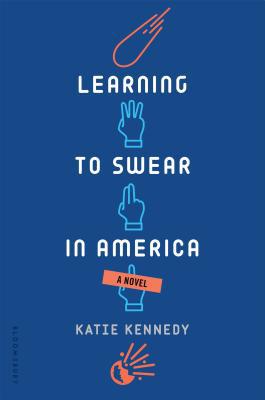


.jpg?picon=160)