new posts in all blogs
Viewing: Blog Posts Tagged with: historical fiction, Most Recent at Top [Help]
Results 1 - 25 of 1,170
How to use this Page
You are viewing the most recent posts tagged with the words: historical fiction in the JacketFlap blog reader. What is a tag? Think of a tag as a keyword or category label. Tags can both help you find posts on JacketFlap.com as well as provide an easy way for you to "remember" and classify posts for later recall. Try adding a tag yourself by clicking "Add a tag" below a post's header. Scroll down through the list of Recent Posts in the left column and click on a post title that sounds interesting. You can view all posts from a specific blog by clicking the Blog name in the right column, or you can click a 'More Posts from this Blog' link in any individual post.

By:
Cynthia Leitich Smith,
on 12/13/2016
Blog:
cynsations
(
Login to Add to MyJacketFlap)
JacketFlap tags:
picture book fiction,
board books,
Julie Flett,
Native American/First Nations,
David A..Robertson,
picture book,
diversity,
picture books,
historical fiction,
Add a tag
By
Cynthia Leitich Smithfor
CynsationsDavid A. Robertson is the first-time children's author of
When We Were Alone, illustrated by
Julie Flett (Portage & Main Press, Jan. 6, 2017)(
available for pre-order). From the promotional copy:
When a young girl helps tend to her grandmother’s garden, she begins to notice things about her grandmother that make her curious. Why does her grandmother have long braided hair and wear beautifully coloured clothing? Why does she speak another language and spend so much time with her family?
As she asks her grandmother about these things, she is told about life in a residential school a long time ago, where everything was taken away.
When We Were Alone is a story about a difficult time in history and, ultimately, a story of empowerment and strength.What first inspired you to write for young readers?So much of my writing is aimed at creating social change, especially in the area of relations between First Nations people and non-First Nations people.
I believe that change comes through education; what we learn from history, and its impact on contemporary society. In Canada, we have a long history of mistreatment concerning the First Nations people. As Canadians, we need to learn about this history. So, my work tries to educate in this way.
In terms of young readers, I believe that change comes from our youth. These are the people who shape our tomorrows, and they need to walk into tomorrow informed on the important issues and histories. If they do, we’ll be in a pretty good place.
What was your initial inspiration for writing this book? The Truth and Reconciliation Commission in Canada looked at the history of the residential school system, and its impact, and from that research, including residential school survivor testimony and documentation, it came up with a list of recommendations.
One of those recommendations was that the residential school system’s history needed to be taught in school as early as kindergarten.
When I saw this, I recognized that there weren’t many resources for teachers (i.e. books) that addressed the residential school system for younger learners.
So, I set out to write one, and that’s how When We Were Alone came about.
I wanted kids at that young age to learn about the system in a way that they could understand and engage with.
What were the challenges (literary, research, psychological, logistical) in bringing the text to life? For me the challenges mostly involved sensitivity and appropriateness. This is a difficult history to tell, especially to younger learners. So, I needed to tell the story in a good way.
It took a lot of research and consultation, it took finding the right rhythm in the passages to connect with readers, and we needed to find the right illustrator, too, which we did in Julie Flett.
Of course, writing these stories always has a psychological effect on you as the writer, too. Understanding that the kids you are writing about really went through these things is tough. But knowing that kids will be learning and growing and sharing makes it worth it.
What model books were most useful to you and how? |
| Also illustrated by Julie Flett |
I have the benefit of having five children. So, I’ve read my share of children’s books. This helped in terms of finding a good structure for When We Were Alone, and rhythm.
These two things are very important, and there are certainly some commonalities in books that really work in terms of how they are told, not just what is told in them.
What advice do you have for beginning children’s-YA writers? Read a lot of children’s books, or YA books. Figure out styles, structures, approaches from the best. Once you’ve done that, you’ll be ready to write a good story that really connects with your reader.
It always comes down to reading first, and then hard work and a bit of skill.
 Welcome to the 2016 Cybils Speculative Reader! As a first run reader for the Cybils, I'll be briefly introducing you to the books on the list, giving you a mostly unbiased look at some of the plot.Enjoy! NB: Author Cat Winters is a go-to for... Read the rest of this post
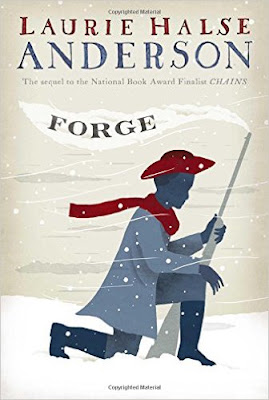 Synopsis: Forge and Ashes are the 2nd and 3rd books in the Seeds of America trilogy by Laurie Halse Anderson. Way, WAY back in 2009, I reviewed the first book, Chains, and was so glad to know there was a sequel in the works: it was an absorbing tale... Read the rest of this post
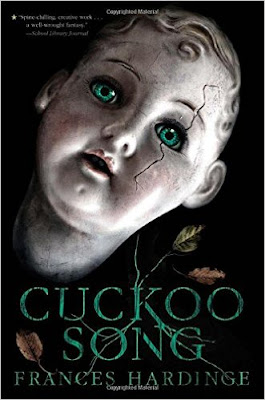 This scary cover almost made me not want to read it.Synopsis: I’m a huge fan of Frances Hardinge’s Fly By Night books, so I was eager to check out this one—another middle grade fantasy. It’s hard to talk about this one without giving away... Read the rest of this post
By
Gayleen Rabakukkfor
Cynthia Leitich Smith's
CynsationsMy current work in progress is a middle grade historical fantasy set in 1903.
Delving into the past has made me think about how history is presented in novels and the balance between real and imaginary.
For more insight on that topic, I turned to the authors of two of my favorite recently published books, focusing on process.
Kate Hannigan’s The Detective's Assistant (Little, Brown, 2015) is based on the extraordinary true story of Kate Warne, America’s first female detective. It won the SCBWI Golden Kite Award in 2016. Was there a particular item, fact or event that sparked the idea for The Detective's Assistant?KH: I was researching a story about camels in the American West in the 1850s when I came across a single nugget about Kate Warne. I read how she walked into Allan Pinkerton’s National Detective Agency in downtown Chicago, and he had assumed she was there for a secretary position. But she talked her way into a detective’s job, convincing Pinkerton she could “worm out” secrets from the wives and girlfriends of the city’s crooks and criminals.
Stumbling on this little gem, I was hooked! I dropped that camel story and ran with Kate Warne!
At what point did you start researching that? Did you start drafting a story first, or did you do research up front?  |
| Kate's model for her main character |
KH: I’m kind of a nutter about gathering facts. My background is newspaper journalism, so maybe that’s to blame. But I wanted to know all I could about Kate Warne, Allan Pinkerton, and Abraham Lincoln during this part of American history.
The biggest research was around understanding the Baltimore Plot, which is the pivotal part of the story — the plot to assassinate Lincoln before he could be sworn in for his first term.
So the whole process was immersive. I dove in deep before writing a single word. Once I felt like I had the facts, then I began my story.
Did you continue doing research as you were writing? KH: I’m still doing research! And the book published over a year ago! But I love this story so much, I can’t
not learn more about it. I do school visits all the time, and I talk to students about it. So it’s very much in the front of my mind.
As I was writing, I would come across a question — my characters are walking down the street in 1860 Chicago, so what were they walking on? How comfortable would a train ride be in 1860? Would we ride on upholstered seats or hard wood? — and drop down another rabbit hole.
Research is never ending with historical writing!
Were you surprised by what you learned doing research? Did any unexpected finds end up becoming significant parts of the story? KH: If you’re writing historical fiction, you’re probably a pretty huge history nerd. So digging up a juicy nugget can be a
thrill! And I dug up so many!
I enjoyed researching and writing this story to a ridiculous degree!
My characters live in a boardinghouse, so getting that setting right was foremost in my mind. I read
Uncle Tom’s Cabin by
Harriet Beecher Stowe (1852) and
Sister Carrie by Theodore Drieser (1900) (which was set a bit later but still illuminating nonetheless), just to get a sense of language of the times.
But I also plunged into nonfiction about the era, and I found a particular book about boardinghouses that was helpful. It described how incredibly cheap the managers — usually women — had to be to keep these places afloat. They were notorious for serving terrible food, which I thought could be played for a lot of humor in my book.
And this is what led to the chapter about Nell and the other residents eating a questionable meat for dinner, and Mrs. Wigginbottom getting shifty when there is talk about the orange tabby cat going missing.
Your book mixes well-known historical figures (Abraham Lincoln) with lesser-known, yet real individuals (Kate Warne) as well as completely fictional characters.
Tell us more about balancing the fact and the fiction – did you lean heavily on things the historical figures actually said? Were there some details you changed for the sake of the story? Were there some fixed points you felt couldn’t be altered? KH: Fact and fiction! This balance kept me up at night! I agonized over being true to the players and what was on record as having happened. I visited Kate Warne’s grave site here in Chicago more than a few times, and I deeply desired to do right by this woman.
But I also worried about the reader, and I wanted to make sure that the story I was telling would hold the interest of a 21st-century American kid. So it was agony!
Pinkerton had written about the cases that involved Kate Warne, so of course I wanted to nod to those. But I took artistic license and shuffled their order, so that the culminating case is the saving of Lincoln’s life. I needed to put them in a different order to serve my story, and I had to come to terms with that decision. It took me a bit though.
Do you feel authors writing for middle grade readers have a greater obligation to present an accurate picture of a historical time period, than those writing YA or adult fiction? KH: I very much believe authors for young readers have a greater responsibility to get historical fiction right. Because history is all new to this audience — this might be their first introduction to the Civil War, to Abraham Lincoln, to the Underground Railroad.
And if we make history engaging for them, we’re opening the doors to more exploration of our past, to creating more history lovers.
It’s a responsibility I take pretty seriously. Which is why I tend to research my books
to death!
Have you gotten any feedback from history or social studies teachers? Or any school visits or other presentations aimed specifically at the history aspect? KH: Yes! And it’s been so great! I’ve gotten tremendous feedback from teachers and librarians.
The Civil War hits with fifth-grade curriculum in many schools, so The Detective's Assistant has been on reading lists around the country. I’ve done Skype visits as well as in-person school visits, and the response from young readers has been mind-blowing!
The New York Historical Society included it in their family book club, the Global Reading Challenge in Chicago listed it among their 2016 books, an entire fifth-grade in Dallas read the book as part of their Civil War history unit. It’s been wonderful to share the story with so many kids!
Was there anything you found while doing research for The Detective's Assistant that will find it’s way into your next book? KH: Answer: I’ve been bitten by the research bug, and specifically, research into amazing women and people of color forgotten by history. So my next book is focused on World War II women beyond Rosie the Riveter. I can’t say there’s any overlap with the Civil War era, but the passion I feel for dusting off these remarkable players from the past and sharing them with a whole new audience, that definitely has carried over. It’s kind of become my mission!
The Detective's Assistant is realistic historical fiction, do things change when the story includes more fantasy elements? For that aspect, I asked Janet Fox, author of The Charmed Children of Rookskill Castle similar questions.Was there a particular item, fact or event that sparked the idea for The Charmed Children of Rookskill Castle? (what was it?)JF: Yes! I was mucking around on the internet when a friend posted a picture of an object the like of which I'd never noticed before. It was an 18th century German chatelaine. I thought it was peculiar, and I had to find out more about it, so I googled and discovered that this chatelaine was an offshoot of the more practical set of keys - to the chateau - worn at the waist.
I learned that chatelaines had evolved from keys to practical items, like scissors and coin purses, to charms. This chatelaine was all charms, and they were so odd that a story began forming in my mind almost right away.
At what point did you start researching that? (i.e. – did you start drafting a story first, or did you do research up front?) JF: Once I'd learned what a chatelaine was I began writing almost at once. Within a week of seeing the image, which is the same as the image that's in the novel, I'd completed the first 40 pages of what would become the novel. That's generally the way I work. I have to discover who my main character is and what her problem is before I can begin to flesh out the story, and research is part of that fleshing out.
Did you continue doing research as you were writing?JF: Yes - once I have a handle on my protagonist and what the story is generally about I tend to blend research with writing. For example, as soon as I decided to set the novel in Scotland, I took a pause and did a bunch of research on Scotland. That's almost always how I work - I write first to discover what I need to know more about. But it all starts with the character and her problem.
Were you surprised by what you learned doing research? Did any unexpected finds end up becoming significant parts of the story?JF: Not really - at least, not in this story. But read on - there's a relevant answer to this in your last question.
Your book mixes actual events and places completely fictional – and fantastical - events and characters. Tell us more about balancing the fact and the fiction? Were there any fixed points you felt couldn’t be altered? (why?)JF: I felt it was very important to be true to any factual details. For example, I had to learn what I could about enigma machines, about the inner workings of clocks, about movements and activities in the North Sea during that part of World War II, and so on.
That's where I really pay attention to accuracy - when I'm weaving facts into fantasy I want those facts to be right. In that way the reader more readily suspends disbelief for the fantasy elements.
Do the fantastical elements have a historical influence?JF: In a way. My grandparents were Irish and English, and I heard many stories growing up about the fantastical beliefs they carried with them from home, things like the stories my grandfather told me about "the little people." And Celtic and pagan practices have a basis in history and yet are mystical or fantastic in nature. To me, there's always a kernel of truth in a fairy tale.
Do you feel authors writing for middle grade readers have a greater obligation to present an accurate picture of a historical time period, than those writing YA or adult fiction?JF: I think any writer writing for any audience has an obligation to be accurate when it comes to historical detail. But I do think that the vulnerability of the younger reader requires a special adherence to accuracy. These are readers who will feel cheated if I give them information they later find to be false. They are also readers more likely to believe whatever you tell them, and I would hate to plant falsehoods in their minds.
Have you gotten any feedback from history or social studies teachers? (or any school visits or other presentations aimed specifically at the history aspect?)  |
| Dunrobin Castle, Janet's inspiration, located in Scotland |
JF: Not yet, although I would love to present something about the specific history aspects of the story.
I'm fascinated by World War II (and as we can see by the large number of middle grade novels out the past couple of years set during the war, so are others.)
The Blitz alone was a big deal, and I've given talks at bookstores at which adults have come forward after to tell me that they or their aunt or their father was sent out of London - and that's why they're in America today.
Was there anything you found while doing research for The Charmed Children of Rookskill Castle that will find it’s way into your next book?JF: Since Kat is clever with clocks, I did a bit of clock research and uncovered a rare old timepiece called a "Death's Head" watch. After further research I discovered that one of owners of one of the most bizarre of these was the doomed Mary, Queen of Scots. Well, that didn't feel accidental. As you can imagine, that watch is the centerpiece of my sequel.
 |
| chatelaine |
Cynsational NotesJanet Fox on Blending History with Fantasy from Cynsations. Peek: "Whether writing historical fiction or fantasy, the objective of suspension of disbelief can only be accomplished if the world-building is sound. In historical fiction, that means lots of research to get interesting tidbits right. In fantasy, it means crafting an environment in which those interesting tidbits feel right."
Gayleen Rabakukk holds a master of fine arts in writing for children and young adults from
Vermont College of Fine Arts. She co-moderates the middle grade book club for
Austin SCBWI and loves making discoveries – both on and off the page.
Always eager to track down a story, she has worked as a newspaper reporter, editor and freelance writer. Gayleen is married and has two caring and outspoken daughters. Their Austin, Texas home is filled with books and rescue dogs. You can find her online at or on Twitter
@gayleenrabakukkCongratulations to Gayleen on recently signing with
Andrea Cascardi at Transatlantic Agency!
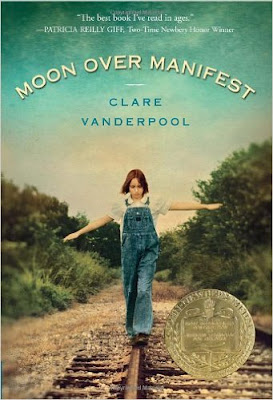 Synopsis: Yes, look, I'm participating in a Thing, and that thing is Middle Grade Monday! When am I ever organized enough to do that? Today, evidently. Anyway, I recently read Newbery Award winner Moon Over Manifest by Clare Vanderpool, who was one... Read the rest of this post
The saga of the Donner Party is fascinating to me, perhaps because I am a native Californian. More likely because, as an adult, I read Nathan Hale's excellent graphic novel recounting this story of survival, Donner Dinner Party. Despite the witty title, Hale handles the gruesome events with tact and respect for his young audience. He also shares so many facts that I had not known before, like the fact that George Donner murdered a man in anger during the journey and that one young member of the party actually died from overeating just after being rescued. While Hale's graphic novel is packed with facts, in To Stay Alive, Skila Brown masterfully uses the verse novel format to explore this story from the perspective of Mary Ann Graves, who was nineteen when the novels begins.
The second oldest child in a family of nine, Mary Ann and her family leave Lacon, Illinois with three horses, twenty head of cattle, eighteen oxen and three wagons. There are thirteen in the Graves party, including Jay Fosdick, oldest child Sarah's husband, and John Snyder, a hired hand who is stabbed to death by an irate George Donner before the snows even set in. While Hale, with an omniscient narrator, is able to share all aspects of the Donner Party, their struggles and outcomes, Brown's book gives us only Mary Ann's experience with an author's note at the end recounting the fates of the others. In doing this, Brown is able to have Mary Ann comment on the experience of being a woman in 1846. While expected to work as hard as the men, especially because she is not a child, her opinion means nothing, she has no say. In the poem, "In the Canyon," after the men have made the ill-fated choice to take Hasting's Cutoff, promised to be a well traveled shortcut, but really a forest, Mary Ann thinks,
Each time I push on a rock, I think
that these men in our camp
cannot admit when they're wrong.
Each time I snap off a limb, I think
that those men at the fort
did not know a shortcut, had us make one instead.
Each time I pick up a load of brush that scratches my face, I think
how much easier it will be for those who come
next year, now that we've made a path.
Divided by the four seasons with Winter being the longest section, To Stay Alive is completely gripping, but also hard to read if you are familiar with the history of the Donner Party. However, Mary Ann's strength of character and intelligence, as portrayed by Brown, kept me reading throughout the bleak and startling poems, many of which combine form and words in dynamic ways that allow you to feel the extreme jostling of riding in the wagon or the rush and flow of the Humboldt River or the intense pain of the cold and the blinding white of the snow. Fabric, sewing and specifically quilting was a theme in To Stay Alive that I felt was especially powerful. In fact, the first poem of the novel is, "New Dress" where Mary Ann describes her newly made travel dress,
thick and crisp and green,
white buttons in a line,
a bright stiff collar, perched high.
It's a dress for adventure,
a dress ready for
whatever it will face.
Strongly stitched, unspoiled, new,
well made.
It is meant to endure.
By the end of the novel, this enduring new dress is much like Mary Ann herself, stained from the blood of the Graves' last heads of cattle they slaughtered for food, stained from the blood of a deer she and William Eddy killed while trying to make their way over the mountain pass. Mary Ann notes that fabric of her green dress is, "stiff again - / not from newness, but from / something else, something that won't let it bend," as she tears strips of it off with her teeth, using it to bind and protect her feet, which are bleeding and aching after thirty-two days trying to make it to Sutter's Fort. She recoils "at the stench of her dress." Over the course of their journey, Mary Ann had been sewing a quilt. She leaves the finished quilt behind at Truckee Lake when she joins the party that will leave camp and ultimately find help. It is this same quilt that her youngest brother is wrapped in, buried in the mountains, in their Mother's arms. In Brown's version of Graves's story, Mary Ann spends her four months of recovery at Sutter's Fort sewing a new quilt, one made from the gray remnants of her clothing.
It is a field of gray,
a wall or worn-out worry,
patches and patches
of sewn-together sorrow.
But that is only the background.
on top of there is a rainbow of life,
a tapestry of creatures,
a forest of hope,
for I used brightly colored threads.
To Stay Alive is a powerfully told story of survival, made even more so by Brown's crafting of the poems that make up this novel. I look forward to the next subject that she chooses to turn her poetic sights to.
Source: Review Copy
The Royal Nanny. Karen Harper. 2016. 384 pages. [Source: Library]
First sentence: Of course I'd been out on the for-hire steam launch on the Thames my father captained, but in the railway carriage, I felt like I was flying.
Premise/plot: Charlotte Bill is a young woman hired to be an under-nurse (nanny) for the royal family. The book opens in 1898, and when she first meets David and Bertie, they rename her Lala. The York family keeps growing, and growing up. Little ones don't stay little forever. And tutors and governesses take charge as they do grow up. But these are the 'children' that she cares for as the royal nanny: David, Bertie, Mary, Harry, George, and John. Johnnie, the youngest, is practically HERS from birth to death. Johnnie is the strong-willed, naughty child beset with epilepsy. The royal family wants to keep him as hidden away as possible, once the fact that he's "not normal" is apparent. (That is THEIR perspective.)
Most of the book focuses on Lala's relationship with the children, with her relationship with their parents and grandparents which gives readers a behind-the-scenes glimpse into the lives of the rich and famous. The 'action' essentially covers 1898-1918. There is a brief epilogue that has Lala meeting David in the late 1950s after he's abdicated the throne.
But readers also catch glimpses of her private life. I imagine here is where the most speculation is taken. (Charlotte Bill was a real person; she really was the royal nanny). Her romance is complicated at best. It adds a couple of more layers to the book.
My thoughts: I really enjoyed this one. I find British history fascinating. Almost always have! And books about the royal family, draw me like few others. I would much prefer to read about this period of history than the 80th book about Henry VIII!!!
© 2016 Becky Laney of
Becky's Book Reviews
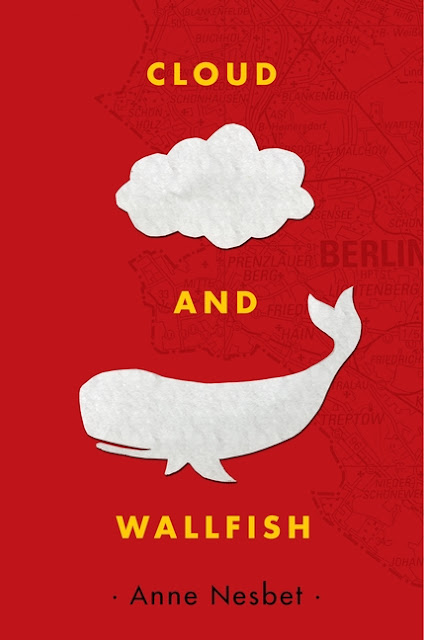
I reviewed and really enjoyed Anne Nesbet's debut novel, The Cabinet of Earth. It was exciting to read a middle grade fantasy novel set in Paris and I found the magic that Nesbet created for this story exciting and out of the ordinary. Nesbet followed with A Box of Gargoyles, a companion to her first book, then The Wrinkled Crown, another fantasy with the feel of a traditional fairy tale, albeit one with political undertones. It surprised me to find that Nesbet's new book, Cloud and Wallfish, is set in East Germany in 1989 and centers around the hard won friendship between an American boy with a paralyzing stutter and a curious girl who has been sent to live with her grandmother. Like what I imagine life in the German Democratic Republic prior to the fall of the Berlin Wall must have been like, Cloud and Wallfish is a quiet, secretive book that requests patience from readers. This patience will be rewarded, like the page turn that reveals the meaning to the title of this marvelous book, but some questions will never be answered.
Cloud and Wallfish begins in Oasis, Virginia in May of 1989. Noah Keller has almost finished fifth grade when his parents pick him up from school and completely turn his life upside down. Everything with his name on it is thrown into a trashcan at a rest stop on their way to the airport. They are headed to East Berlin, where Noah's mother has been given the opportunity to study the educational system in East Germany and finish her doctoral dissertation titled, "Differential Approaches to Elementary Education for Children with Special Speech-Production Impediments in East and West." This dissertation is especially personal for Noah and his mother because Noah stutters and has often been a guinea pig for his mother and her research. Noah also has a photographic memory, although he has not revealed this ability to his parents.
Noah's mother gives him a list of nine rules that he must adhere to strictly now that their "adventure" has begun, the first of which is, "They will always be listening and often be watching. Don't forget that." She also tells him that they are all changing their names, handing him a photo album filled with "memories" from a city they never lived in. Noah's dad also tells him that he was born in November and not March as he had always believed, sending him spiraling even further. Nesbet, by way of Noah's father, helps Noah cope with finding out that he isn't the person he thought he was, and that he is also being required to become a new person, in a humorously philosophical way that made me stop and think about identity,
Names change all the time. Some people change names when they get married, Some people write books under a pseudonym. Some people just always wanted to be called Rainbow Stormchaser, and one day they decide to make it so. Some people emerge from their wild teenage years and decide it's time to settle down to a quiet life in Oasis, Virginia, under different names entirely -
As an adult reading Cloud and Wallfish, there were so many moments that made me stop and think, and turn to Wikipedia, or my husband who is a history teacher and who also, like Nesbet, visited East Berlin as an exchange student (in fact, Nesbet, who is a professor at University of California Berkeley returned to the GDR in 1989 to work on her own dissertation). It was clear to me from the start that one or both of Noah's parents are spies (although Noah's stay-at-home dad insists that he is writing a novel about a mink farmer, he even puts locks his manuscript in the safe in their East German apartment every night), but I hope that young readers will come to this realization over the course of the novel along with Noah as he comes to suspect this himself.
Once in East Berlin, Noah's (now Jonah Brown) life comes to a grinding halt. Not only does he have to adhere to the nine rules, almost all of which include some form of not talking to anyone at any time, he is not allowed to go to school. Things do look up when he meets the girl living downstairs. Claudia, who is staying with her grandmother while her parents visit Hungary, is kept from talking to him, but she does get the chance to tell him that they are both changelings, strangers in this world and needing to get back to where they came from before they are forgotten. The two find their own coded ways to communicate, in the middle of country that is rife with codes and secret communications. One of my favorite, unforgettable things in Cloud and Wallfish is a communication the two share as they pass a map of Berlin back and forth. On this map, West Berlin is a blank, white blob amidst the streest of East Berlin and the two slowly begin drawing the intricate world of the changelings that they need to return to in this space.
The true climax of Cloud and Wallfish comes almost at the end of the novel, but "Secret Files" that Nesbet includes at the after each chapter (which are really non-fiction glimpses into this time in East Germany, with translations of newspaper articles and speeches and more, illuminating further the strange dystopian world that existed in Europe, in my lifetime) help to build the tension. I don't want to give too much away, but a tragedy with Claudia's parents and a secret revealed to Noah propels the two children into a dangerous situation just before the fall of the Berlin Wall. Nesbet's epilogue, which visits Claudia some years later, had me tearing up, in a good way.
Cloud and Wallfish is an amazing book that prompted me to learn more about the world that I live in. It is also a book that will require perseverance and dedication from readers, but also one that will reward this hard work. I hope that teachers and parents will embrace Cloud and Wallfish and read it out loud, a really great way to hook kids on a book they might not pick up or a book they might not stick with. My twelve-year-old son has heard me and my husband talking about this book and I think he is almost ready to give it a go, but of course I can't suggest that he read it...
Another fantastic book set in East Germany, 1961, beginning just as the wall goes up:
More books by Anne Nesbet
Source: Review Copy
To Stay Alive. Skila Brown. 2016. Candlewick. 304 pages. [Source: Review copy]
First sentence: It is finished.
Premise/plot: I've got two sets of 'two words' that will either compel you to pick this one up or to avoid it. For better or worse. First: DONNER PARTY. Second: VERSE NOVEL.
Mary Ann Graves is the narrator of this historical verse novel. She was nineteen at the start of the journey in the spring of 1846. This one is divided into seasons: spring, summer, fall, winter. Almost all of the poems involve the traveling west and surviving aspect of the pioneer spirit. The landscape and environment do feature in quite a bit. Especially the SNOW.
What this book is not is Little House On the Prairie. This isn't even THE LONG WINTER. People do have tendencies to group books together. That is why I think it is important that DONNER PARTY leap out at you first before you hear of wagon trains, prairies, pioneers, homesteaders, or going west.
My thoughts: There is a bareness to the poems that oddly enough works for me. The narrator does not wear her heart on her sleeve. She's not overly dramatic and sensitive. She doesn't speak of her dreams and feelings and there is absolutely no gushing. (She's no Ann-with-an-e Shirley.)
When I say the poems avoid gushing, I don't mean they are void of description and detail.
The men think they're/ following a trail, a road/ well marked by wheels/ and feet, like a street,/ pointing you/ in the direction you need/ to go. But I know./ We follow a trail of broken things/ tossed from wagons--family heirlooms/ so heavy with memories/ the oxen couldn't pull--/ quilts, spinning wheels, dishes (too much/ dust to see the pattern), wooden bits,/ once part of something rich,/ portraits of great-grandmothers/ who'll spend eternity in the desert,/ watching beasts pull treasures/ while dirty people trail behind.
Some poems are long, descriptive. Others are very short and bare.
this land/ has eaten/ my feet/ chewed them/ ripped them/ cut them/ they bleed/ into land/ that drinks/ them up/ but it is never full
I am so glad I did not read anything about the Donner party as a child when I was obsessed with Laura Ingalls!!!
© 2016 Becky Laney of
Becky's Book Reviews
 Welcome to another session of Turning Pages!Today my flying book-boat icon is especially apropos, as I'm talking about a time travel book, where the travel took place onboard a pirate ship. Now, I don't actually love time travel novels, because a.)... Read the rest of this post
In The Excutioner's Daughter by Jane Hardstaff, Moss is almost 12. She has lived her whole life in the Tower of London where her father is King Henry VIII's executioner. Moss's father told her that they must stay in the Tower as punishment for a crime he committed years ago.
Moss is the basket girl. She carries the newly chopped off heads from the block to the gates of the Tower where they will be on display. When she is pressed into service in the kitchen ,she makes friends with the King's latest enemy, an abbot. The day of the abbot's death, Moss runs away.
In her debut novel, Jane Hardstaff paints a realistic picture of the Tower and the river that flows by it during King Henry VIII's reign. The jacket blurb hints at a touch of fantasy in this otherwise historically accurate book. The touch of fantasy adds suspense and terror to the sotry of Moss's coming of age.
Moss learns about the flawed nature of people who must struggle to survive. She also learns about acceptance, love and forgiveness.
The Executioner's Daughter by Jane Hardstaff is a fine book.
Welcome to another session of Turning Pages!If we say we never judge a book by its cover, we'll sound like better people, sure, but we'll be total liars. I chose this book based on its beautiful cover, and that first snap judgment was enough to pick... Read the rest of this post
By: Stacy Dillon,
on 9/25/2016
Blog:
Welcome to my Tweendom
(
Login to Add to MyJacketFlap)
JacketFlap tags:
Friendship,
cats,
summer,
Historical Fiction,
neglect,
Candlewick,
elderly,
copy from publisher,
2016,
Add a tag
I was a kid running wild and free in the 1970s, and I find myself intrigued with the fiction written these days that takes place during that time period. It's a convenient time period, for sure. By this I mean that technology hadn't yet tethered us to our parents, and I'm assuming that most kids were like my sister and I -- running around the neighborhood and beyond with friends and coming home when we got hungry.
Raymie is a girl who isn't really noticed much by her parents. Her father has actually just up and left with a dental hygienist and Raymie's mom is spending her time staring into space. Raymie finds some comfort in neighbor Mrs. Borkowski who seems to know everything and always has time to talk to Raymie. She has also hatched a plan to get her father to come home.
Raymie has decided that she will enter and win the Little Miss Central Florida Tire 1975 pageant. This will result in her picture in the newspaper. Her dad will be so proud of her, he'll have to come home. When Raymie tells her dad's secretary her plan, Mrs. Sylvester says Ramie just has to learn to twirl the baton as her talent. This is how she ends up at Ida Nee's place for twirling lessons along with Beverly Tapinski and Louisiana Elefante -- two girls who couldn't be more different from one another.
Louisiana is a wheezy and delicate girl, prone to swooning, while Beverly is the tough talking daughter of a cop who swears that she's seen things. In between these two, Raymie Clarke is a steadfast girl just doing her best to understand others.
Over the next few days, Louisiana dubs their trio the Rancheros, and even though Beverly refuses to live by the moniker, it becomes clear that Louisiana often gets her way. As the girls search for Louisiana's beloved cat, perform good deeds, experience loss, and do a little breaking and entering along the way, they slowly reveal their worries to one another. They become tied together by the brokenness that surrounds them.
As always, DiCamillo leaves poetry on the page. But this book felt different to me. I was talking to a colleague about it and I noted that it felt like it had a big dose of Horvath in the pages. Some have said the girls are too quirky and almost derivative. I disagree. When you look closely, kids are weird. And if they allow themselves to be honest with who they are, Beverlys and Louisianas and Raymies are completely reasonable. Trying to mend neglect with toughness or fantasy is innately human. I really enjoyed this quiet and quirky summery read. I do wonder at today's kids sitting with the 1975 setting. I'm interested in their feedback.
By Cynthia Leitich Smith
for Cynsations
CSK Author Award Acceptance Speech by Rita Williams-Garcia from The Horn Book. Peek:
"...upon occasion, our histories are bound by peace and wonder as people of the planet Earth, looking up as we did on one night in the summer of 1969.
"In spite of some current rhetoric, very few of us on this soil can claim a separate and sole history. We are a joined people. Let’s keep looking up."
By Denis Markell
for Cynthia Leitich Smith's Cynsations
As an aspiring writer for children, one of the many dividends of marrying my beautiful and gifted wife Melissa Iwai...
 |
| (am I right or am I right?) |
was finding someone to collaborate with on picture books.
Seeing as I knew she was an extraordinary illustrator, this was to be expected.
What came as a surprise, however, was how deeply her personal experience as an Asian-American woman in America and the history of her family would affect me and my other work as well.
As a Caucasian, It was quite an education for me to see firsthand the tiny slights and assumptions that she would deal with on a daily basis on the streets of New York.
Because of this, I felt that when I finally wrote my first middle grade novel it would involve the Asian experience in our country in some way.
One of the family stories I learned from Melissa, was of her uncle, Takateru Nakabayashi, who had taken the American name of his favorite Jesuit teacher, brother Nicholas.
Uncle Nick, as he was always called, had been a member of
the famed 100th Infantry Battalion, the all Nisei army brigade who had fought in Europe in World War II.
I was dimly aware that such a unit existed, so I did some research and found that
there are some quite wonderful books which chronicle the story of these amazing men, who fought for their country so bravely while their fellow citizens, whose only "crime" was to be of Japanese ancestry, languished in internment camps.

But it was a story woefully untold for middle grade readers.
Now I had my subject, but how to tell their tale in such a way that it would reach the largest audience? Nonfiction?
There are gifted writers such as
Candace Fleming and
Steve Sheinkin who can bring history to life with the drama and craft that enthrall young readers, but that’s not really my strength. I’ve spent years as a comedy writer in other fields, and humor and fiction are more where I’m comfortable.
Historical fiction? While I could have set the story in the 1940s, I wanted to make the story as relatable as possible to kid readers today, so involving a young Asian-American boy in today’s world felt right. By now we’d had our son, and as he grew older, I observed his fascination with computer and video games. It occurred to me that perhaps this was a way in!
Maybe I could hook kids with an adventure, one involving computer games, puzzles and suspense. I could weave the story of Melissa’s uncle throughout, using him as a character and the clues could relate to the 100th Battalion.
If I could pull this off, my readers might get a history lesson without even realizing it! Of course, there would be enough there for teachers to expand on and amplify, if they wished to use my book in the classroom. But my goal was to tell the story with lots of humor and keep the kids laughing as they learned.
Finally, to honor my half-Asian son (who still faces many of the same micro-agressions his mother does), I decided to make the protagonist hapa, as half-Asians are called within the community. Note: for positive examples of hapa characters in Disney films please read
this excellent post.
So now I knew what the story I wanted to tell, and how I wanted to tell it. I rolled up my sleeves (okay, I pushed up my sleeves. I wear sweatshirts) and started to write. Click Here To Start was the result.

By:
Betsy Bird,
on 9/4/2016
Blog:
A Fuse #8 Production
(
Login to Add to MyJacketFlap)
JacketFlap tags:
Reviews,
historical fiction,
Louise Erdrich,
funny books,
Harper Collins,
Best Books,
middle grade historical fiction,
Best Books of 2016,
2016 reviews,
Reviews 2016,
2016 middle grade historical fiction,
2016 funny books,
Add a tag
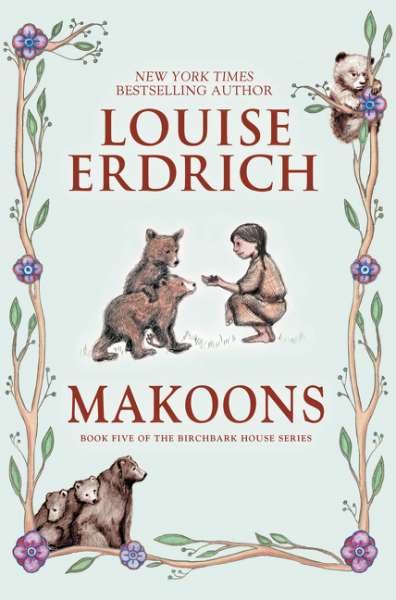
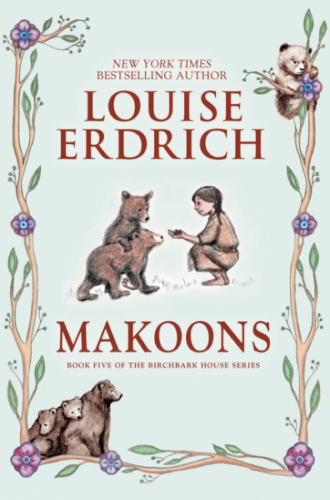 Makoons
By Louise Erdrich
Harper Collins
$16.99
ISBN: 9780060577933
Ages 7-12
On shelves now
They say these days you can’t sell a novel for kids anymore without the book having some kind of “sequel potential”. That’s not really true, but there are a heck of a lot of series titles out there for the 7 to 12-year-old set, that’s for sure. New series books for children are by their very definition sort of odd for kids, though. If you’re an adult and you discover a new series, waiting a year or two for the next book to come out is a drop in the bucket. Years fly by for grown-ups. The wait may be mildly painful but it’s not going to crush you. But series for kids? That’s another matter entirely. Two years go by and the child has suddenly become an entirely different person. They may have switched their loyalties from realistic historical fiction to fantasy or science fiction or (heaven help us) romance even! It almost makes more sense just to hand them series that have already completed their runs, so that they can speed through them without breaking the spell. Almost makes more sense . . . but not quite. Not so long as there are series like “The Birchbark House Series” by Louise Erdrich. It is quite possibly the only historical fiction series currently underway for kids that has lasted as long as seventeen years and showing no sign of slowing down until it reaches its conclusion four books from now, Erdrich proves time and time again that she’s capable of ensnaring new readers and engaging older ones without relying on magic, mysteries, or post-apocalyptic mayhem. And if she manages to grind under her heel a couple stereotypes about what a book about American Indians in the past is “supposed” to be (boring/serious/depressing) so much the better.
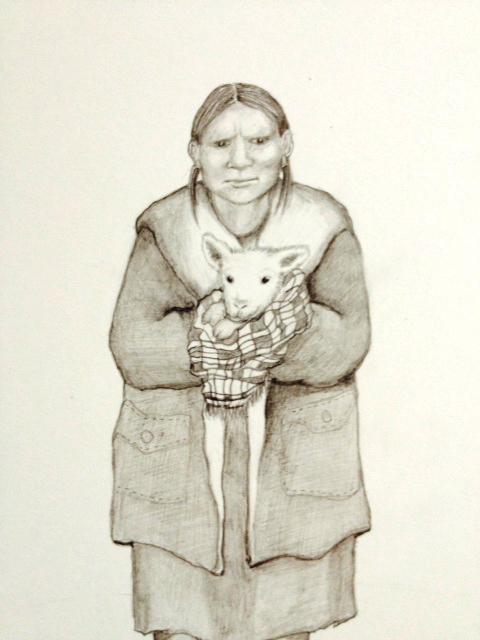
Chickadee is back, and not a second too soon. Had he been returned to his twin brother from his kidnapping any later, it’s possible that Makoons would have died of the fever that has taken hold of his body. As it is, Chickadee nurses his brother back to health, but not before Makoons acquires terrifying visions of what is to come. Still, there’s no time to dwell on that. The buffalo are on the move and his family and tribe are dedicated to sustaining themselves for the winter ahead. There are surprises along the way as well. A boasting braggart by the name of Gichi Noodin has joined the hunt, and his posturing and preening are as amusing to watch as his mistakes are vast. The tough as nails Two Strike has acquired a baby lamb and for reasons of her own is intent on raising it. And the twin brothers adopt a baby buffalo of their own, though they must protect it against continual harm. All the while the world is changing for Makoons and his family. Soon the buffalo will leave, more settlers will displace them, and three members of the family will leave, never to return. Fortunately, family sustains, and while the future may be bleak, the present has a lot of laughter and satisfaction waiting at the end of the day.
While I have read every single book in this series since it began (and I don’t tend to follow any other series out there, except possibly Lockwood & Co.) I don’t reread previous books when a new one comes out. I don’t have to. Neither, I would argue, would your kids. Each entry in this series stands on its own two feet. Erdrich doesn’t spend inordinate amounts of time catching the reader up, but you still understand what’s going on. And you just love these characters. The books are about family, but with Makoons I really felt the storyline was more about making your own family than the family you’re born into. At the beginning of this book Makoons offers the dire prediction that he and his brother will be able to save their family members, but not all of them. Yet by the story’s end, no matter what’s happened, the family has technically only decreased by two people, because of the addition of another.
Erdrich has never been afraid of filling her books with a goodly smattering of death, dismemberment, and blood. I say that, but these do not feel like bloody books in the least. They have a gentleness about them that is remarkable. Because we are dealing with a tribe of American Indians (Ojibwe, specifically) in 1866, you expect this book to be like all the other ones out there. Is there a way to tell this story without lingering on the harm caused by the American government to Makoons, his brother, and his people? Makoons and his family always seem to be outrunning the worst of the American government’s forces, but they can’t run forever. Still, I think it’s important that the books concentrate far more on their daily lives and loves and sorrows, only mentioning the bloodthirsty white settlers on occasion and when appropriate. It’s almost as if the reader is being treated in the same way as Makoons and his brother. We’re getting some of the picture but we’re being spared its full bloody horror. That is not to say that this is a whitewashed narrative. It isn’t at all. But it’s nice that every book about American Indians of the past isn’t exactly the same. They’re allowed to be silly and to have jokes and fun moments too.
That humor begs a question of course. Question: When is it okay to laugh at a character in a middle grade novel these days? It’s not a simple question. With a high concentration on books that promote kindness rather than bullying, laughing at any character, even a bad guy, is a tricky proposition. And that goes double if the person you’re laughing at is technically on your side. Thank goodness for self-delusion. As long as a character refuses to be honest with him or herself, the reader is invited to ridicule them alongside the other characters. It may not be nice, but in the world of children’s literature it’s allowed. So meet Gichi Noodin, a pompous jackass of a man. This is the kind of guy who could give Narcissus lessons in self-esteem. He’s utterly in love with his own good looks, skills, you name it. For this reason he’s the Falstaff of the book (without the melancholy). He serves a very specific purpose in the book as the reader watches his rise, his fall, and his redemption. It’s not very often that the butt of a book’s jokes is given a chance to redeem himself, but Gichi Noodin does precisely that. That storyline is a small part of the book, smaller even than the tale of Two Strike’s lamb, but I loved the larger repercussions. Even the butt of the joke can save the day, given the chance.
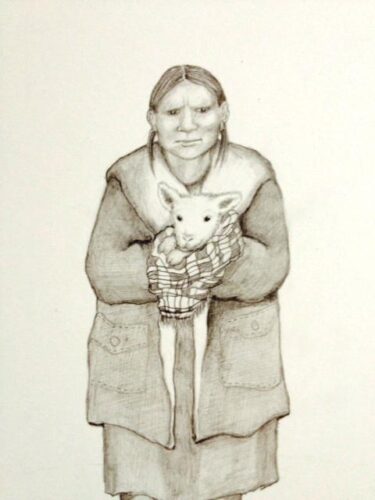 As with all her other books Erdrich does a E.L. Konigsburg and illustrates her own books (and she can even do horses – HORSES!). Her style is, as ever, reminiscent of Garth Williams’ with soft graphite pencil renderings of characters and scenes. These are spotted throughout the chapters regularly, and combined with the simplicity of the writing they make the book completely appropriate bedtime reading for younger ages. The map at the beginning is particularly keen since it not only highlights the locations in each part of the story but also hints at future storylines to come. Of these pictures the sole flaw is the book jacket. You see the cover of this book is a touch on the misleading side since at no point in this story does Makoons ever attempt to feed any baby bears (a terrible idea, namesake or no). Best to warn literal minded kids from the start that that scene is not happening. Then again, this appears to be a scene from the first book in the series, The Birchbark House, where Makoons’ mother Omakayas feeds baby bears as a girl. Not sure why they chose to put it on the cover this book but it at least explains where it came from.
It is interesting that the name of this book is Makoons since Chickadee shares as much of the spotlight, if not a little more so, than his sickly brother. That said, it is Makoons who has the vision of the future, Makoons who offers the haunting prediction at the story’s start, and Makoons who stares darkly into an unknown void at the end, alone in the misery he knows is certain to come. Makoons is the Cassandra of this story, his predictions never believed until they are too late. And yet, this isn’t a sad or depressing book. The hope that emanates off the pages survives the buffalos’ sad departure, the sickness that takes two beloved characters, and the knowledge that the only thing this family can count on in the future is change. But they have each other and they are bound together tightly. Even Pinch, that trickster of previous books, is acquiring an odd wisdom and knowledge of his own that may serve the family well into the future. Folks often recommend these books as progressive alternatives to Laura Ingalls Wilder’s Little House books, but that’s doing them a disservice. Each one of these titles stands entirely on its own, in a world of its own making. This isn’t some sad copy of Wilder’s style but a wholly original series of its own making. The kid who starts down the road with this family is going to want to go with them until the end. Even if it takes another seventeen years. Even if they end up reading the last few books to their own children. Whatever it takes, we’re all in this together, readers, characters, and author. Godspeed, Louise Erdrich.
For ages 7-12
Source: Final copy sent from publisher for review.
Professional Reviews:
Other Blog Reviews: BookPage

 I really like the cutout-look images on the cover, with the hidden animals...Synopsis: We don't necessarily review a ton of realistic MG fiction here (not as much Wonderland in the real world, I suppose) but it doesn't mean we aren't reading or... Read the rest of this post
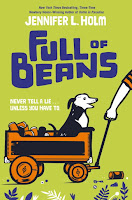
In
Full of Beans,
Jennifer Holm pulls me into her story from the very first page:
"Look here, Mac. I'm gonna to give it to you straight: grownups lie.
Sure, they like to say that kids make things up and that we don't tell the truth. But they're the lying liars."
Holm creates a character full of sass and resilience--he isn't afraid to tell it like it is. Grownups lie, life is hard, friends are key. I'm also really looking forward to talking with kids about how Beans grows and changes throughout the story.
I'm fascinated by the way that Holm pulls modern kids into a time and place so far away. Life wasn't easy for Beans--the Great Depression has the Florida Keys and all of America in its grip.
Jennifer Holm was kind enough to answer a few of my questions about
Full of Beans, her research and what struck her during the writing process.
Beans' voice rings so distinctive and true. How do you get into character as you write?Beans was always such a clear character to me. It sounds silly, but I could totally hear him in my head. I mostly try to get outside to get in the writing zone—away from my desk and computer. For some reason, if I’m taking a walk or jogging, the ideas come more easily.
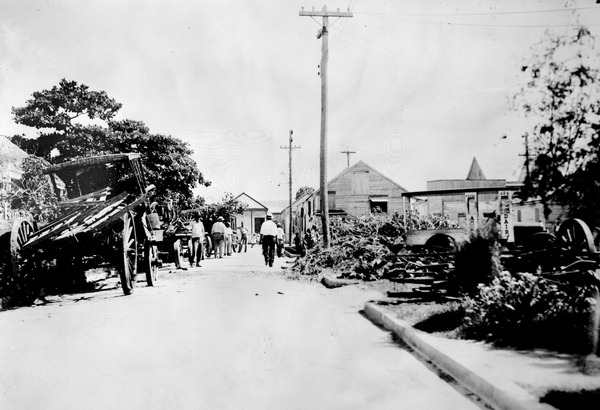
What are some images of Key West from the 1930s that show how hard life was during the Great Depression?The website Florida Memory from the state library archives has an incredible collection of historical photographs. At the height of the Great Depression, Key West was in dire straights. The majority of the inhabitants were unemployed and on public relief. This photo from 1935 shows garbage cleanup in a Key West neighborhood:
As part of President Roosevelt's New Deal, the Federal Emergency Relief Administration created a plan to revitalize Key West, renovate houses and hotels and turn it into a tourist destination. These before and after pictures of a school teacher's house are amazing. My great-grandmother grew up in a house like that.
What are a few of your favorite sayings from this time period? Did you make them up get them from your research?I love the phrase “mind your own potatoes.” That just says it all.
All of the sayings except for one were rooted in the time period. My daughter, Millie, made the lone modern contribution with her own personal phrase: “What in the history of cheese?” It’s become a household saying around here.
What was something astonishing you learned doing your research for this book?The whole leprosy storyline sucked me in pretty fast. It seemed quite far-fetched at first when I started to track down some of the rumors, but the more research I did, the more I discovered. In retrospect, the idea that people would hide family members who had leprosy (Hansen’s Disease) was very understandable. There was no treatment available at the time and quarantine was how the public health service managed the disease. People with leprosy were commonly “sent” (exiled is a better word in my opinion—there was not much choice involved) to leper hospitals, a notable one being in Carville, Louisiana. Even children were sent away. It was quite a heartbreaking situation all around.
Can you share one of the recollections of a family member that helped you bring this story to life?My favorite memory was shared with me by a distant cousin. She had grown up across from the cemetery—which is in the middle of an old part of the city. The houses in Key West are made of wood and built quite close together. She told me how when she was a child and there was a fire, all the neighbors near the burning house would take their belongings – from pots and pans to pianos – to the cemetery for safe keeping. They would just kind of camp out there because it was the only place that wouldn’t catch fire.
That's pretty amazing, and shows how fire was such a threat in this community. This photo from the Great Fire of 1923 shows just how vulnerable the wooden houses were:What connections do you make between the hard times Beans and his friends faced in the Great Depression and challenges kids might be experiencing today?Having a parent lose their job and the fear of having to move is something that kids of any era can relate to. In our own family, we have had a lot of up-and-down times. Kids always know what’s going on even if the parents aren’t discussing the problems with them.
Thank you so much for taking the time to share with us about Key West, your research and your wonderful story.The review copies were kindly sent by the publisher, Random House Books. If you make a purchase using the Amazon links on this site, a small portion goes to Great Kid Books. Thank you for your support.
©2016 Mary Ann Scheuer, Great Kid Books
Does building resilience in kids mean they have to be able to handle everything by themselves? Or that they can weather the hard times, with their sense of self intact? I adore Jennifer Holm's newest novel Full of Beans precisely for the way that Beans struggles through hard times, learning about the consequences of his decisions, yet never losing his sense of humor or his loyalty to his family and friends. It is both delightful to read and wonderful to reflect upon.
Full of Beans
by Jennifer L. Holm
Random House, 2016
Your local library
Amazon
ages 9-12
*best new book*
Beans Curry knows life is hard with the Great Depression--his dad is out of work, leaving home to look for work up north, and his mom takes in laundry, raising the family in their Key West home. Beans tries to help, sifting through the garbage looking for cans because a local con man has promised him twenty cents a can.
Life keeps throwing bum deals his way--the con man refuses to pay Beans what he promised--but Beans won't give up. He helps his mother babysit his crabby baby brother; he leads his gang of friends, challenging other kids to marbles; and he keeps his eye out new opportunities. So when a rumrunner makes him a proposition, it seems like things are finally turning up. Beans just doesn't predict how his actions might put others in harm's way. As the
starred Horn Book review wrote,
Beans’s earnest voice shows a young boy trying so hard to help out and to do the right thing, but getting caught up in dubious circumstances over which he has no control.
Readers may remember Beans from Jennifer Holm's popular
Turtle in Paradise (
my review here), but this new story stands on its own. I think that the setting Depression-era Key West becomes even more fully realized in
Full of Beans, as Holm seamlessly weaves historical details into the story. I especially like what librarian Tasha Saecker wrote over at
Waking Braincells:
Holm writes with a natural ease that is deceptively easy to read. Her writing allows readers to explore Key West in a time just as it is becoming a tourist destination due to the New Deal and its workers. Beans’ personal story is clearly tied to the story of Key West with his own despair and lack of money mirroring the city’s. His own journey through to honesty and truth follows that of the city as well. It’s a clever dynamic that makes both roads to change all the easier to relate to and believe.
This would make a terrific read-aloud, either as a family or in the classroom. Terrific sayings from the 30s infuse the dialog, and short chapters keep the pace moving quickly. Readers will root for Beans, whether it's as he's playing marbles against a rival gang or as he's struggling with hard decisions that will affect his neighbors and friends.
I'm especially looking forward to talking with my students in our Mock Newbery Book Club about how Beans responds to hard situations and how he changes. I wonder how they'll envision the setting of Key West, and themes they'll identify in the story.
Join me on Wednesday -- I'm looking forward to sharing an interview with Jenni Holm. I'm especially looking forward to sharing a slideshow of images of 1930s Key West. The review copies were kindly sent by the publisher, Random House Books. If you make a purchase using the Amazon links on this site, a small portion goes to Great Kid Books. Thank you for your support.
©2016 Mary Ann Scheuer, Great Kid Books
 Welcome to another session of Turning Pages!Many teens struggle with historical fiction which seems like a genre of "long ago and far away." The history of North Korea happened - and is still happening - right now. This book is a first-person... Read the rest of this post
Welcome to another session of Turning Pages! Mostly I'm not that big a fan of YA historical fiction that are set in modern history. Finding a novel set in the 70's or 80's feels weird, mainly because I've been alive during part of those years, and... Read the rest of this post
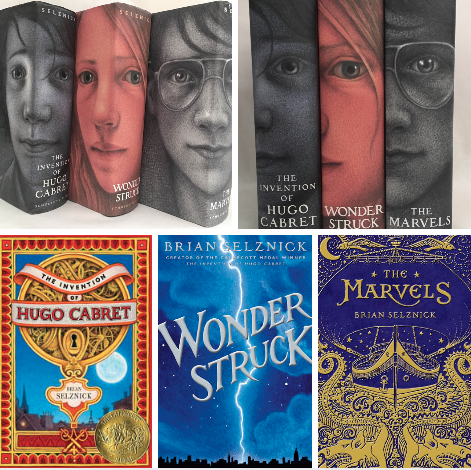
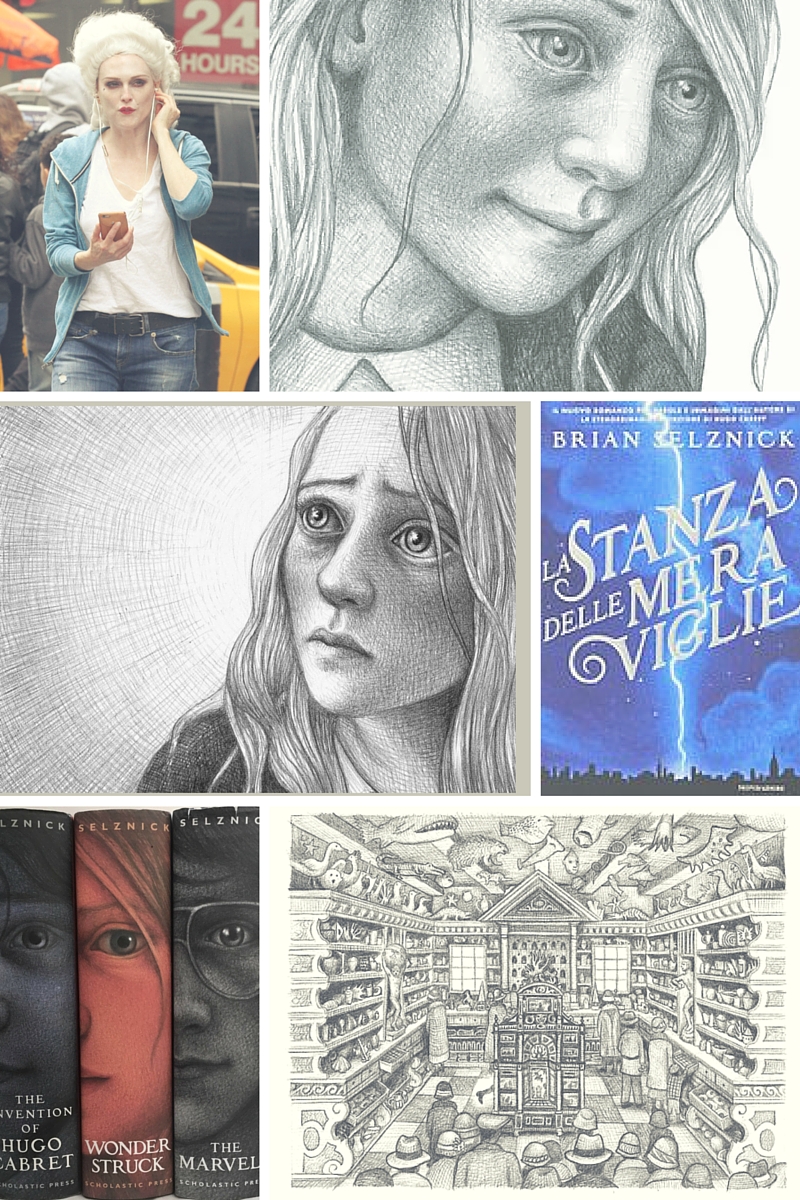
So, Wonderstruck by Brian Selznick has been sitting on my bookshelf for almost 5 years now, looking super cool (as seen above) as it sits between The Invention of Hugo Cabret, which was one of the first books I reviewed when I started this blog in 2008, and The Marvels, which I reviewed when it came out in September of last year. I have no idea why I never read it, but I finally got around to reading Wonderstruck for a handful of reasons. It's required summer reading for my son, who enters sixth grade in the fall. My brother read it out loud to his kids at dinner and, serendipitously, they encountered the film crew for the movie version of Wonderstruck, directed by Todd Haynes while on vacation in NYC this summer and one of the cast signed with my brother. Knowing that my son has to read this book, my brother and niece and nephew enjoyed it and that it is soon to be a movie directed by Todd Haynes (I wonder if the fact that Selznick has Hollywood heritage allows him to score prime directors for adaptations of his books?) was all the nudge that I needed to read it. And OF COURSE I loved it. 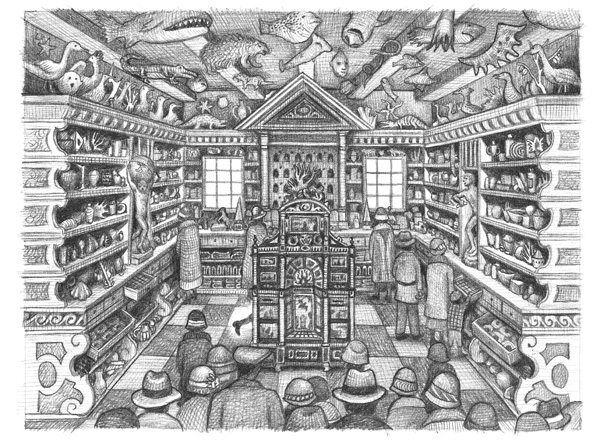
Seeing as how this is a very well known, well reviewed book, I don't feel like a traditional review is merited here so I'm going to do something a little different. Museums are a major part of Wonderstruck, which is also the name of a book within this book - a fictional book published by the American Museum Natural History about museums and curation. The main character Ben has a wooden box with a engraving of a wolf on the lid, which he comes to think of as his museum box. Inside the box, Ben has crafted cardboard dividers to house the small treasures he collected over the course of his life, which he has arranged with great care. Ben's story begins in 1977 and is told in text only for the first half of the book. In tandem with Ben's plot is the story of Rose, which begins in 1927 and unfolds in illustrations only for the first half of the book. At first, the only thing Ben and Rose seem to have in common is their deafness. But, like I said, museums have a big role in this book and when their stories collide you feel, well, wonderstruck. With that in mind, I have"curated" these collages filled with images, illustrations and other items that make up the exhibit that is the novel and film (coming in 2017) Wonderstruck.
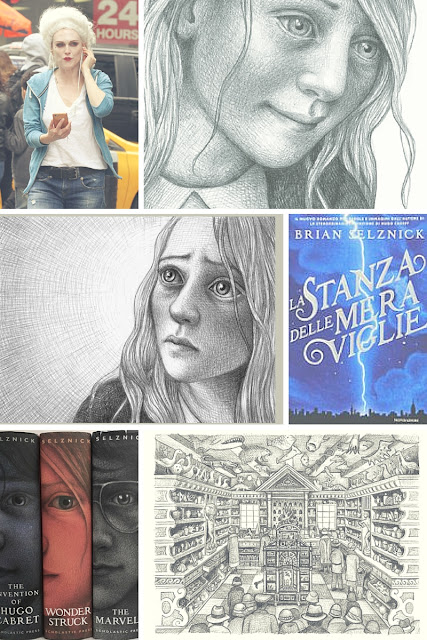
Ben remembered reading about curators in Wonderstruck, and thought about what it meant to curate your own life, as his dad had done here. What would it be like to pick and choose the objects and stories that would go into your own cabinet? How would Ben curate his own life? And then, thinking about his museum box, and his house and his books, and the secret room, he realized he'd already begun doing it. Maybe, thought Ben, we are all cabinets of wonders.
(Wonderstruck, page 574)
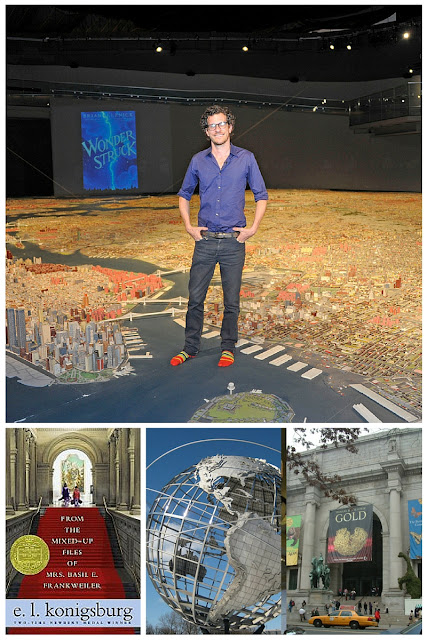
As with all Brian Selznick books, the acknowledgements and author's notes are almost a story unto themselves. Selznick is a curator, a researcher, an autodidact and a scholar of whatever subject he pursues, and it is always amazing to me to read the many areas that he studied, places he visited and people he interviewed while writing a book. Near the end of his acknowledgements, after listing all the people, places and things that influenced, informed and educated him, I was very pleased to find this nod from Selznick, as this was a book I thought of often while reading Wonderstruck, "Of course, any story about kids who run away to a museum owes a debt of gratitude to E. L. Konigsburg's From the Mixed-Up Files of Mrs. Basil E. Frankweiler. In order to pay back that debt, Wonderstruck is filled with references to Konigsburg and her book. How many can you spot?" I am going to have to go back and reread Wonderstruck, as I only found three nods. E. L. stands for Elaine Lobl, Konigsburg's maiden name. Selznick gives the main character's mother the name Elaine and his father the surname Lobel. A character in the book is named Jamie, which is also the name of one of the main characters in Konigsburg's Newbery winning book. If you find any, be sure to let me know! 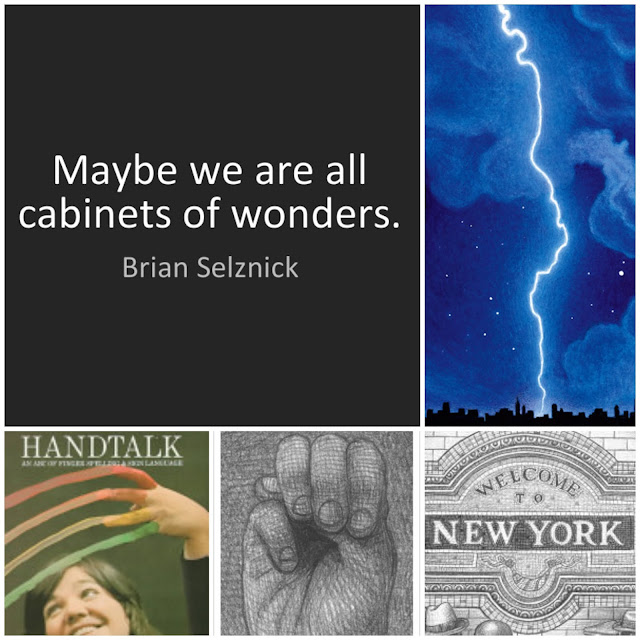
Source: Purchased
 Synopsis: The first book in this trilogy, The Falconer (reviewed here), was one of those surprise reads for me—as a combination of historical fantasy, faeries, and a dash of steampunk and romance, I wasn't sure I would like it. I've read a lot of... Read the rest of this post
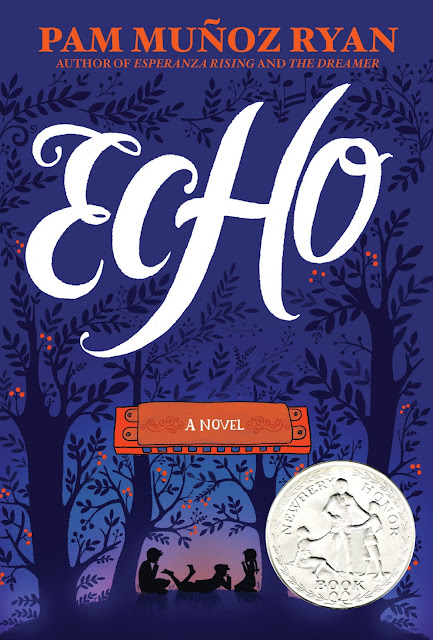
I missed Echo by Pam Muñoz Ryan when it came out in February of 2015. Scholastic is one of the few publishers I don't get review copies from and, working in a library instead of a bookstore now, I an not as up on what's new in the world of kid's books as I once was. I even missed the March, 2015 review of Echo in the New York Times Book Reivew, which I usually scour. Echo crossed my radar in January of this year when it won a Newbery Honor, along with two other superb books, The War that Saved My Life and Roller Girl. While I hate the fact that I didn't read Echo right when it came out, I am so, so glad that I knew absolutely NOTHING about it (save that it won an award) before I began listening/reading it. Having worked with and been an avid reader of children's literature for more than 20 years, I've kind of read it all. There aren't too many plots or characters that surprise me or feel really new and original. Echo surprised me - it's as if A. S. Byatt, an author of novels for adults that are magnificently crafted and often centered around a work of art - wrote a kid's book. If you want to be surprised by a story and you trust me and the librarians who hand out the Newbery awards, stop reading my review after the next sentence and go out and get your hands on a copy of Echo. Actually, I very, very strongly suggest LISTENING to the audio of this book (as well as buying it - you WILL want to own it) because - tiny spoiler alert - music is an integral part of Echo, and you get to hear it in the audio.
Stop reading HERE if you want to be surprised
****************************************
I was definitely surprised when I started listening to Echo and there were music credits before the story began. I was especially surprised when harmonica music kicked in. Like several minor characters in the book, I, too, did not take the harmonica seriously - nor did I notice the drawing (wonderful artwork by Dinara Mirtalipova) of one on the cover and spine of Echo! Echo is a work of historical fiction wrapped in the cloak of a fairy tale that is ultimately a story about the power of music to, "pass along . . . strength and vision and knowledge," and even overcome fear, intolerance and hatred. The story visits three very different children at three different times, starting in 1933 and ending in 1942. The common thread that connects these three children is their passion for music, embodied, at that time, in the harmonicas that they own. Surrounding these stories is the tale of a boy that begins just before the start of the 20th century. From a Gypsy, who presses a mouth harp on him for free, he buys a book titled, The Thirteenth Harmonica of Otto Messenger. The book tells the story of three abandoned princesses with beautiful singing voices. Trapped in the woods under the spell of a witch, they need a messenger to take something out into the world for them, something that will break the spell. Becoming lost in the woods, Otto meets the three princesses from the book. Desperate to know the end of their story, they enchant the harmonica that the Gypsy gave him and he agrees to send it into the world where, if it can "save a soul from Death's dark door," the spell will break and the princesses can return home.
The stories of the three central children in Echo would have been a satisfying book on their own, but linking them with the fairy tale of the three sisters imbues Ryan's novel with a quality of hopefulness and beauty, much like the sound of a well played harmonica. Part one begins in 1933, in Tossingen, Germany, with young Friedrich, a gifted musician. Part two begins in Pennsylvania, 1935. The third and final part begins in 1942, just after Pearl Harbor, in California, a harmonica at the heart of each story. Friedrich has a port wine birthmark on his face and suffers from seizures. Hitler's persecution of physically disabled forces Friedrich and his family to make difficult choices and his story ends without closure, his life in danger. Part two, features orphan brothers, the eldest of whom is a gifted musician, with his only hope for survival hinging on his ability to make it into a renowned harmonica band. Mike and Frankie are adopted by a painfully grieving heiress who needs to produce an heir to keep her fortune, their story also ending in a moment of danger and uncertainty. Finally, Ryan turns to Ivy Maria Lopez, shining a light on xenophobia and racism.
It is Fresno, 1942, and Ivy is the child of migrant farm workers. Her brother, Fernando, has just enlisted and her father has just accepted a job running a farm in Orange County. When they arrive at the farm, the Lopez's discover that it belongs to a Japanese-American family that has been sent to an interment camp. Their oldest child, a son in the Marines, is coming home on leave to sign the running of the property over to Mr. Lopez, if he approves of him. Ivy, and her parents, struggle to understand how the Yamamoto family, with a father who fought in WWI and a son fighting in WWII could be treated this way, while at the same time Ivy experiences racism and segregation when she learns that she is not allowed to attend her neighborhood school, but must go to one that will "Americanize" children like her. Living in California and working with the children of immigrants, many of whom are also the children of migrant workers, this part of the story resonated most with me.
The last two parts of the novel tie together all three stories in a marvelous, deeply satisfying way that had me weeping. Ryan returns to the fairy tale, bookending Echo with the conclusion to the story of the three princesses as well as the story of Otto, now the messenger, and the enchanted harmonica that he must send out into the world and how it gets there. Echo is a big book, but as many reviewers have said, and as was my experience, you will soar through it, drawn along by the beauty if Ryan's writing, the craft of her story and the humanity of her characters.
Source: Purchased Book & Audio Book
View Next 25 Posts











.jpeg?picon=2320)





Loved this title (reviewed it for Horn Book) — a Newbery contender for me. Re the cover, I think it indicates the multi-generational aspect of this series as well as signals that this particular title features the boys’ growing/learning from family members, getting in trouble, and having fun (in addition to the underlying difficulties you describe). It connects the twins’ mother’s experience with bears to her own cubs — the twins, especially Makoons as his name in Objibwe is Little Bear. The covers for Chickadee and Makoons both have borders featuring the animal each boy is named for. (The illustrations also make me think of those Sendak did for the Little Bear books.)