Login or Register for free to create your own customized page of blog posts from your favorite blogs. You can also add blogs by clicking the "Add to MyJacketFlap" links next to the blog name in each post.
Blog Posts by Tag
In the past 7 days
Blog Posts by Date
Click days in this calendar to see posts by day or month
Viewing: Blog Posts Tagged with: Government, Most Recent at Top [Help]
Results 1 - 25 of 54
How to use this Page
You are viewing the most recent posts tagged with the words: Government in the JacketFlap blog reader. What is a tag? Think of a tag as a keyword or category label. Tags can both help you find posts on JacketFlap.com as well as provide an easy way for you to "remember" and classify posts for later recall. Try adding a tag yourself by clicking "Add a tag" below a post's header. Scroll down through the list of Recent Posts in the left column and click on a post title that sounds interesting. You can view all posts from a specific blog by clicking the Blog name in the right column, or you can click a 'More Posts from this Blog' link in any individual post.
योग, मोदी सरकार और मन की बात Happiness is … योग, मोदी सरकार और जनता के मन की बात मन की बात नाम आते ही हमारे जहन में रेडियों पर मोदी जी के मन की बात का ख्याल आ जाता है …. अक्सर देखा गया है कि हम अपने मन की बात नही सुनते […]
The Freedom of Information (FOI) Act has been in the news again, when the controversial Independent Commission, much to the surprise of many, concluded the Act was ‘generally working well’, had ‘enhanced openness and transparency… there is no evidence that the Act needs to be radically altered’.
There are eleven diverse hill states in India which comprise the group of "Special Category States." They all suffer from the disadvantages that result from remoteness and geographical isolation, as well as historical and demographic circumstances. In addition to pathetic infrastructures, scant resources, unrealized human potential, and stymied economic growth, these states also represented various groups of marginalized minorities.
Reproductive Rights: Who Decides?
by Vicki Oransky Wittenstein
Twenty-First Century Books, 2016
ISBN: 978-1-4677-4187-3
Grades 9-12
In 2013 Louise reviewed For the Good of Mankind by Vicki Oransky Wittenstein. Today I am pleased to review Vicki's latest nonfiction book for teens, Reproductive Rights: Who Decides?
If you have viewed any of the recent Republican or Democratic debates,
0 Comments on Reproductive Rights: Who Decides? Blog Tour as of 2/19/2016 3:40:00 AM
Some writers have so confounded society with government, as to leave little or no distinction between them; whereas they are not only different, but have different origins. Society is produced by our wants, and government by our wickedness; the former promotes our happiness positively by uniting our affections, the latter negatively by restraining our vices. The one encourages intercourse, the other creates distinctions. The first a patron, the last a punisher.
What should we make of Chancellor George Osborne’s recent claim that we need a “comprehensive plan” to address the burgeoning Syrian refugee crisis, a plan that addresses the “root causes” of this tragic upheaval? The UK government’s way of framing the issue is not unique. Many other governments as well as political pundits of various ideological stripes have been urging us to see the issue in precisely these terms.
The French celebrate their National Day each year on July 14 by remembering the storming of the Bastille, the hated symbol of the old regime. According to the standard narrative, the united people took the law in its own hands and gave birth to modern France in a heroic revolution. But in the view of Immanuel Kant (1724-1804), the famous German philosopher, there was no real revolution, understood as an unlawful and violent toppling of the old regime.
सावधान .. अगर आप भी किसी विधायक के घर जा रहे हैं तो कृपया करके चाय वाय पी कर जाए अन्यथा … !!!! क्योकि विधायकों का कहना है कि खर्च की तुलना में वेतनमान बेहद कम मिलता है, इसके अलावा महंगाई बहुत ज्यादा है। दिनभर मेल-मुलाकातों के दौरान चाय-पानी पर काफी खर्च आ जाता है। ऐसे में हमें बेहद दिक्कत पेश आती है। हम इमानदारी से काम करने वाले लोग हैं, इसलिए वेतनमान में इजाफा होना चाहिए। सूत्रों का कहना है कि आप सरकार वेतन बढ़ाने की मांग पर कार्रवाई कर सकती है।
‘ ‘ !
नई दिल्लीः घर चलाने के लिए आम आदमी पार्टी (आप) के कई विधायकों ने वेतन बढ़ाए जाने की मांग की है। विधायकों का कहना है कि उनको जो भी वेतनमान मिलता है वह उनके दफ्तर और उससे संबंधित व्यवस्थाओं में ही खर्च हो जाता है, ऐसे में वह अपना घर खर्च कहां से चलाएं। वेतन बढ़ाने के लिए कुछ इसी तरह के तर्क देकर आम आदमी पार्टी के बीस से अधिक विधायकों ने मुख्यमंत्री अरविंद केजरीवाल को पत्र लिखे हैं। इन विधायकों का कहना है कि खर्च की तुलना में वेतनमान बेहद कम मिलता है, इसके अलावा महंगाई बहुत ज्यादा है। दिनभर मेल-मुलाकातों के दौरान चाय-पानी पर काफी खर्च आ जाता है। ऐसे में हमें बेहद दिक्कत पेश आती है। हम इमानदारी से काम करने वाले लोग हैं, इसलिए वेतनमान में इजाफा होना चाहिए। सूत्रों का कहना है कि आप सरकार वेतन बढ़ाने की मांग पर कार्रवाई कर सकती है See more…
AAP MLAs demand a hike in their salaries from Arvind Kejriwal | Latest News & Updates at Daily News & Analysis
A delegation of 20 Aam Aadmi Party legislators on Friday met Delhi Chief Minister Arvind Kejriwal demanding a hike in their salaries. Taking a clue from Parliamentarians in Lok Sabha and Rajya Sabha seeking 100 percent hike in their salaries, the AAP MLAs also decided to approach both Delhi CM and his deputy Manish Sisodia for a similar raise.
While speaking to dna AAP MLA Nitn Tyagi said that a team of 20 legislators had approached the CM, all the legislators unanimously agree that salaries must be raised.
“We get 53,500 in hand and it might sound a lot but we are not able to save a penny for ourselves. In fact I personally have on many occasions used money from my personal savings to work for the people of my constituency,” Tyagi said.
He added that not only him but other MLAs as well end up paying for the office, salaries of helpers, stationeries and so on, and that most of the previously lawmakers would also own business so had not much to rely on government salary.
“This is not the case with us. In a day, dozens of people from my constituency come to meet me with their problems. The people have to be served water, tea or snacks. This is basic courtesy but given the current salary even being courteous is turning out to be expensive for us.” dnaindia.com
तो इसमे गलत ही क्या है अभी नही कर सकते इतना खर्चा इसलिए तो अपने घर के बाहर बोर्ड लगा दिया है jee …
The general election of May 2015 brought an end to five years of coalition government in Britain. The Cameron-Clegg coalition, between 2010 and 2015, prompted much comment and speculation about the future of the British party system and the two party politics which had seemed to dominate the period since 1945. A long historical perspective, however, I think throws an interesting light on such questions.
The Amazing Age of John Roy Lynch
Written by Chris Barton; Illustrated by Don Tate
Eerdmans Books for Young Readers. 2015
ISBN: 9780802853790
Grades 4-8
I received a copy of this book from the publisher.
<!--[if gte mso 9]>
<![
0 Comments on The Amazing Age of John Roy Lynch written by Chris Barton; illustrated by Don Tate as of 1/1/1900
In the 1960s British comedy radio show, Beyond Our Ken, an old codger would, in answer to various questions wheel out his catchphrase—in a weary, tremulous groan—‘Thirty Five Years!’ I was reminded of this today when I realized that it is exactly 35 years ago that my first book on privacy was published. And how the world has changed since then!
Please email or phone your members of Congress and ask them to sign the "Dear Appropriator letter supporting library funding via these two programs: LSTA (Library Services Technology Act) and IAL (Innovative Approaches to Literacy)." Then, ask all other library supporters you know to do the same by no later than March 20th. Contact information for Congress members is here: http://cqrcengage.com/ala/home (just put in your zip code in the box on the lower right side).
Thank you for taking this step to ensure that our nation's teens continue to have access to library staff and services that will help them succeed in school and prepare for college and careers!
In his famous statement about the perils of presidentialism, Juan Linz argued that newly emerging democracies ought to avoid adopting a presidential form of government. One of Linz’s reasons had to do with the winner-take-all-nature of presidential elections. By definition, such elections are zero-sum games where the losing candidates have little to no prospect of sharing in executive power. By having a single indivisible and powerful executive office, presidential elections amplify the gap between winning and losing, and can contribute to creating and deepening political divisions, which is precisely what a new democracy ought to minimize.
At the same time, having the people elect the head of their state directly can strengthen the legitimacy of the democratic foundations of the new constitutional order. When conducted in a fair, free, and transparent manner observing the highest standards of electoral integrity, direct presidential elections can play an important role in aiding the development of civic and political values such as electoral participation, competitiveness, and accountability. If the population is not imbued by such values, the new democratic system may soon hollow out and become a procedural mechanism with no substantive values informing and guiding it.
An intermediate constitutional solution is the adoption of a semi-presidential system of government, which, according to scholars like Maurice Duverger and Robert Elgie, is characterized by a presidency that is elected directly by the people but that is also considerably weaker in power and authority than the chief executive of a presidential system of government. The relative weakness of the semi-presidential head of state is underscored by the fact that the office shares executive power with the prime minister who, as the head of government, is responsible to the legislature. Semi-presidentialism often becomes an attractive constitutional choice in new democracies precisely because it has the advantage of encouraging popular participation in the political system without concentrating too much power in a single executive office.
Budapest Parliament by Mike Gabelmann. CC BY-NC 2.0 via Flickr
The experience of the ten post-communist democracies in Eastern and Central Europe is an excellent case in point. At the time of their transition to democracy in the early 1990s, only half of the ten states had a semi-presidential executive: Bulgaria, Lithuania, Poland, Slovenia, and Romania. The remaining five states (the Czech Republic, Estonia, Hungary, Latvia, and Slovakia) remained parliamentary systems with both the prime minister and the president elected by the legislature. By 2015 Hungary, Estonia, and Latvia have remained the only three cases with indirectly elected heads of state. At first Slovakia, in 1998, and then the Czech Republic, in 2012, enacted constitutional changes to move from indirect to direct presidential elections. In both of these cases, the adoption of direct presidential elections was the result of repeated failures by parliament to ensure a smooth and efficient process. In Slovakia, the National Council was unable to elect a president after several unsuccessful rounds of balloting in 1998, whereas in the Czech Republic both the 2003 and the 2008 elections were characterized by legislative tumult leading to renewed calls for delegating the choice of president to the people.
What can constitutional designers and engineers learn from the history of presidential elections in the post-communist region? Insofar as political stability and legitimacy are concerned, there are three important lessons:
The semi-presidential model is a reliable and good constitutional choice as long as the formal powers of the head of state are kept modest. Some of the most serious constitutional battles between a directly elected president and the legislature took place in the three states where the head of state had the greatest formal powers (Lithuania, Poland, and Romania). However, while subsequent constitutional changes in these states modified the term or the powers of the president, none of them did away with the directly elective nature of the office.
Indirect presidential elections can be a major source of political instability, and loss of public trust in the legislature, unless the rules of the game are kept efficient. The examples of Slovakia and the Czech Republic showed that inclusive and consensus-oriented rules do not work in the long run. In both cases, the constitution required that the winning candidate obtain a highly qualified majority of votes, which proved to be extremely difficult, or even impossible, in an already fragmented multi-party parliament.
Efficient rules for indirect presidential elections ought to combine a simple majority threshold for winning with a fixed number of rounds in which the election must be completed. As the cases of Hungary and Estonia show, efficient rules will typically favor the candidate of the incumbent governing coalition and as such will further concentrate executive power in its hands. However, this may be a small price to pay relative to the instability that can be caused by the failure of consensus-oriented inclusive rules.
In short, the post-communist cases suggest that the ideal form of choosing the president of a new democracy may be either direct election by the people or indirect election by parliament using efficient, result-oriented rules and procedures. While presidentialism as a constitutional system may be perilous for the stability of a new democracy, as Juan Linz argued, there is also a great danger in adopting parliamentary processes of presidential election which can themselves become the source of political instability.
When the Senate of the Free City of Krakow oversaw the renovation of the main gate to the Royal Castle in 1827, it commemorated its action with an inscription: SENATUS POPULUSQUE CRACOVIENSIS RESTITUIT MDCCCXXVII. The phrase ‘Senatus Populusque Cracoviensis’ [the Senate and People of Krakow], and its abbreviation SPQC, clearly and consciously invoked comparison with ancient Rome and its structures of government: Senatus Populusque Romanus, the Senate and People of Rome. Why did a political entity created only in 1815 find itself looking back nearly two millennia to the institutional structures of Rome and to its Senate in particular?
The situation in Krakow can be seen as a much wider phenomenon current in Europe and North America from the late eighteenth century onwards, as revolutionary movements sought models and ideals to underpin new forms of political organisation. The city-states of classical antiquity offered examples of political communities which existed and succeeded without monarchs and in the case of the Roman Republic, had conquered an empire. The Senate was a particularly intriguing element within Rome’s institutional structures. To the men constructing the American Constitution, it offered a body which could act as a check on the popular will and contribute to political stability. During the French Revolution, the perceived virtue and courage of its members offered examples of civic behaviour. But the Roman Senate was not without its difficulties. Its members could be seen as an aristocracy; and for many historians, its weaknesses were directly responsible for the collapse of the Roman Republic and the establishment of the Empire.
In these modern receptions of the Roman Senate, the contrast between Republican Rome and the Roman Empire was key. The Republic could offer positive models for those engaged in reshaping and creating states, whilst the Roman Empire meant tyranny and loss of freedom. This Tacitean view was not, however, universal in the imperial period itself. Not only was the distinction we take for granted, between Republic and Empire, slow to emerge in the first century A.D.; senatorial writers of the period could celebrate the happy relationship between Senate and Emperor, as Pliny the Younger does in his Panegyricus and many of his letters. Indeed, by late antiquity senators could pride themselves on the improvement of their institution in comparison with its unruly Republican form.
The reception history of the Republican Senate of ancient Rome thus defies a simple summary. Neither purely positive nor purely negative, its use depended and continues to depend on a variety of contextual factors. But despite these caveats, the Roman Senate can still offer us a way of thinking about how we choose our politicians, what we ask them to do, and how we measure their achievements. This continuing vitality reflects too the paradoxes of the Republican institution itself. Its members owed their position to election, yet often behaved like a hereditary aristocracy; a body offering advice in a state where the citizen body was sovereign, it nonetheless controlled vast swathes of policy and action and asserted it could deprive citizens of their rights. These peculiarities contributed to making it an extraordinarily fruitful institution in subsequent political theory.
Headline image credit: Representation of a sitting of the Roman senate: “Cicero Denounces Catiline.” Public domain via Wikimedia Commons.
Thou shall not plagiarize. Warnings of this sort are delivered to students each fall, and by spring at least a few have violated this academic commandment. The recent scandal involving Senator John Walsh of Montana, who took his name off the ballot after evidence emerged that he had copied without attribution parts of his master’s thesis, shows how plagiarism can come back to haunt.
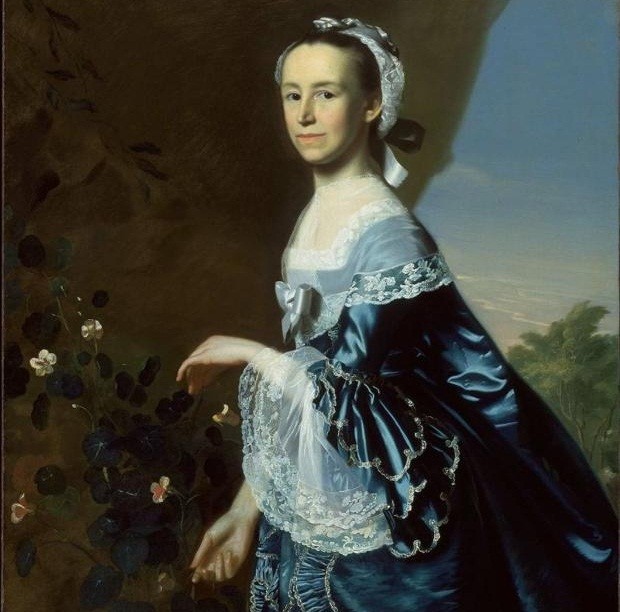
But back in the days of 1776, plagiarism did not appear as a sign of ethical weakness or questionable judgment. Indeed, as the example of Mercy Otis Warren suggests, plagiarism was a tactic for spreading Revolutionary sentiments.
An intimate of American propagandists such as Sam Adams, Warren used her rhetorical skill to pillory the corrupt administration of colonial Massachusetts. She excelled at producing newspaper dramas that savaged the governor, Thomas Hutchinson, and his cast of flunkies and bootlickers. Her friend John Adams helped arrange for the anonymous publication of satires so sharp that they might well have given readers paper cuts.
An expanded version soon followed, replete with new scenes in which patriot leaders inspired crowds to resist tyrants. Although the added material uses her characters and echoes her language, they were not written by Warren. As she tells the story, her original drama was “taken up and interlarded with the productions of an unknown hand. The plagiary swelled” her satirical sketch into a pamphlet.
Portrait of Mercy Otis Warren, American writer, by John Singleton Copley (1763). Public domain via Wikimedia Commons.
But Warren didn’t seem to mind the trespass all that much. Her goal was to disseminate the critique of colonial government. There’s evidence that she intentionally left gaps in her plays so that readers could turn author and add new scenes to the Revolutionary drama.
Original art was never the point; instead art suitable for copying formed the basis of her public aesthetic. In place of authenticity, imitation allowed others to join the cause and continue the propagation of Revolutionary messages.
Could it be that plagiarism was patriotic?
Thankfully, this justification is not likely to hold up in today’s classroom. There’s no compelling national interest that requires a student to buy and download a paper on Heart of Darkness.
Warren’s standards are woefully out of date. And yet, she does offer a lesson about political communication that still has relevance. Where today we see plagiarism, she saw a form of dissent had been made available to others.
Headline image credit: La balle a frappé son amante, gravé par L. Halbou. Library of Congress.
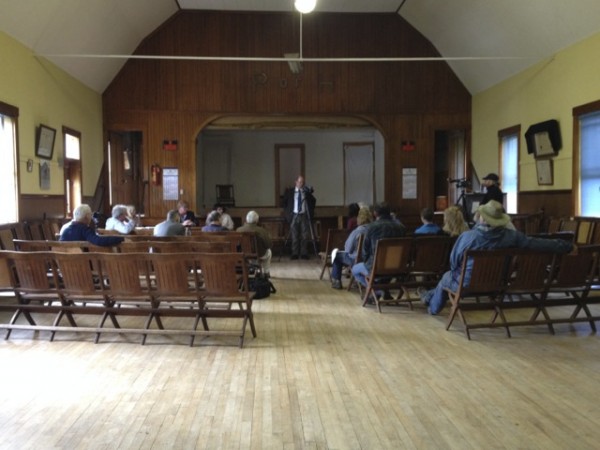
The Vermont Department of Public Service will hold public hearings to gather public input on the final draft of the 2014 Vermont Telecommunications Plan. The Plan addresses the major ongoing developments in the telecommunications industry, including broadband infrastructure development, regulatory policy and recommendations for future action. The Department will hold two public hearings in Orange County on the public comments draft of the Plan prior to adopting the final Plan. Middle Branch Grange, 78 Store Hill Road, East Bethel, Vermont, September 18, 2014, at 2:00 p.m.
I went to this meeting. There weren’t even going to be any meetings in Orange County, the county where I live, until someone showed up at one of the Barre meetings and suggested them. So there were two meetings in Orange County last week. One during the day in Bethel and one in the evening in Strafford. Unfortunately the weather didn’t totally cooperate so there was a local power outage for some reason and a forecast of a hard frost that evening. So a lot of the farmers who would have shown up at this even had to stay home and cover plants and do other things that farmers do when the weather starts getting cold.
I’ve been doing a lot of leisure-time stuff in keeping with my theme this month but today I went to work. I sat and listened to multiple stories of farmers and other neighbors struggling with digital disinclusion. I took some notes and I made a statement. This is the polished version of what I said.
My name is Jessamyn West, I’m a technology educator in Randolph Vermont and I wrote a book about the digital divide. I have three points I’d like to make
We’re interested in results, not projections. A lot of the data we hear talks about when we’re going to have everyone online, or points to the number of people who have this technology available. I’d like to know why people aren’t online and what we’re doing to work with those people. Saying that most Vermonters have access overlooks the chunk of people with no access who should be the focal point of future build-outs. This report talks about how Burlington Vermonters have a choice of ISPs and overlooks that most of us have almost no consumer choice at all.
And while we’re getting people access, let’s make sure they all have the same access. People talk about 3G and 4G as if they are the same as cable or DSL. They’re not. They come with bandwidth caps, overage charges, and a lot of concern about impending lack of net neutrality. Similar to how, back when people had dial-up, some people in more remote locations had to pay for the phone calls in addition to having to pay for the service. We’re seeing the same gap now with remote users only having satellite or cellular-based access. We should strive for everyone having equitable access.
Most important to me is what we call the empowerment or the usability divide. I heard a person earlier say she wanted to get access to the internet so that she could run a website for her small business. Just getting access isn’t going to give her a website. She’ll need resources and likely some human help in order to be able to do that. And where does that come from? It used to be that the digital divide was just “People don’t have access to computers” and then it was “People don’t have access to the internet” and now that most people have access, sometimes only through their public library, we are still seeing participation gaps. These gaps align along the same lines as other structural inequalities like poverty, educational attainment, age, race, and disability status. The people not participating are already facing multiple challenges. We know this. We need to find a way to support those people and not reinforce those inequalities.
The hardest to serve have always been the hardest to serve; the challenge of getting everyone online is going to necessarily mean having a plan for those people as well as everyone else. Thank you.
1 Comments on how the broadband sausage does or does not get made, last added: 9/25/2014
Excellent and right to the point, Jessamyn. Thanks for speaking up for those who are hardest to serve and who, whether because of farming or other concerns, were unable to attend that meeting.
Tuesday’s Cabinet reshuffle by David Cameron has been trailed for some time now, but until the last moment it was not expected to be of the scale it has assumed. As a result, it sets up the government to present a rather different complexion in the run-up to the general election.
The key factor in the scope of the reshuffle looks to have been William Hague’s decision to step down as Foreign Secretary. For some, this was the result of he’s being broken/bored by the work, but to have seen him last week pushing hard on ending sexual violence in conflict should give the lie to that. The reasons remain rather unclear for now, but the consequence is that the Foreign Office is losing one of its staunchest defenders of recent decades: Philip Hammond might be an operator, but he doesn’t have the same personal attachment to diplomacy that Hague has shown over the past four years.
If Hague walked, then Michael Gove certainly didn’t. His removal from Education to become Chief Whip isn’t a vote of confidence in either the man or his project for school reform: very little is coming through the legislative process in the next nine months that will require much arm-twisting. Cameron’s decision is very odd, given the extent to which he has backed Gove until now, when he could have cut his losses much earlier. Here the judgement might have been that things have moved far enough down the line that they can’t be reversed and that Gove is better moved out now to start building a profile in another area while Nicky Morgan picks up the metaphorical pieces.
Alongside these two big changes, a third individual was also pushed into the limelight: Lord Hill of Oareford. Jonathan Hill’s name is one which has been on the lips of almost no-one until today, when he was nominated as the British member of the European Commission. A Tory party insider, Hill has been Leader of the Lords since last year, providing with the skills of political management and coalition-building that Cameron argues will be essential in Brussels. His nomination also has the propitious consequence that there will be no need for the by-election that use of an MP would have entailed.
Beyond these three big changes, the rest of the reshuffle is mainly one of filling in the gaps created and rewarding allies (see the Institute of Government’s very useful blog for more). Thus several of the 2010 intake get into the Cabinet, such as Liz Truss, Stephen Crabb, and Priti Patel.
But what is the intent behind all of this?
There are two possible readings of this, one more optimistic than the other.
The positive interpretation is that this is part two of Cameron’s strategy, building on the radical phase needed to pull the UK up from the depths of the recession and forming a new team to create a positive shine to that work in anticipation for the general election. This is certainly Cameron’s own spin, trying to create a narrative that the worst is behind us and the strength of the economic recovery means we can afford not to think too hard about the difficulty that has passed.
Part of that strategy is to make a Cabinet that is more resistant to Labour attacks. One of the more-remarked-upon aspects has been the promotion/retention of women, an obvious rejoinder to the recent months of criticism from the Opposition. Likewise, Gove’s removal has at least some aspect of depriving Labour of one of their favourite whipping boys.
However, if we are feeling less generous, then we might look at things rather differently. Hague’s departure might seem less surprising if we consider that he might expect to be out of the Foreign Office next May in any case, on the back of a Tory defeat.
This is really the unspoken sub-text: that we give party loyalists some time in the political sun because it’s unlikely to last very long. Despite the tightening of the opinion polls in recent months (see the excellent Polling Observatory posts), the Conservatives still look like being out of power in May, even as a coalition partner. That puts a big disincentive on laying long-term plans and refocuses attention on making the most of the remainder of this Parliament.
It’s easy to forget in all of this that the Tories are still in a coalition with the Liberal Democrats and that whatever electoral nemesis they face next year, that still lies in the future. Hence Cameron still has to temper the desires and pressures of his party to fit the coalition agreement, not least in his allocation of government posts.
All of this has echoes of 1992, when John Major looked set to lose, only to scrap through for another five years. Back then, there was a distinct sense that the foot had come off the gas and that the long period of Tory government was coming to an end. It was to be the questions over the electability of Labour that finally proved more consequential in the vote.
Cameron might not have had the long period in power that Major did, but he does have an Opposition that has struggled to impress. Even with the more fractured arithmetic of a party political system with UKIP, Tory victory is not impossible. That raises the potential danger that Cameron might pull it all off next year and then have to follow through.
If that did happen, then Europe is going to be the big fight, which will take up almost all his energies until 2017. Whether Hammond in the Foreign Commonwealth Office and Hill in Brussels will still look like good choices then remains to be seen.
Simon Usherwood is Senior Lecturer in the School of Politics at the University of Surrey. He tweets from @Usherwood.
The Very Short Introductions (VSI) series combines a small format with authoritative analysis and big ideas for hundreds of topic areas. Written by our expert authors, these books can change the way you think about the things that interest you and are the perfect introduction to subjects you previously knew nothing about. Grow your knowledge with OUPblog and the VSI series every Friday, subscribe to Very Short Introductions articles on the OUPblog via email or RSS, and like Very Short Introductions on Facebook.
Subscribe to the OUPblog via email or RSS
Subscribe to only politics articles on the OUPblog via email or RSS.
Image credit: Prime Minister visits Russia, by Foreign and Commonwealth Office (Flickr). Open Government License v1.0 via Wikimedia Commons
Just in time for Independence Day, Doubleday Books for Young Readers (Random House Kids) has released two new titles by Caldecott Medalist, Peter Spier. He has taken the words of two of our nation's greatest symbols, the Constitution and "The Star-Spangled Banner," and created two sprightly illustrated, perusable picture books,
We the People: The Constitution of the United States and The Star-Spangled Banner.
In We the People, it is the preamble to the Constitution that creates the story. Short phrases ("We the people of the United States") appear on each double-spread page, accompanied by many small pen and watercolor vignettes relating to the phrase. On many pages, such as "promote the general Welfare," the small paintings contrast our past and future. One set of images shows a man with a three-cornered hat delivering the post on horseback. The facing image is that of a U.S. mail truck stopping at a line of rural mailboxes.We the People has a copy of the original document as its endpapers, and contains a brief history of the Constitution and its entire text in the back matter. Names and images of the Constitution's signers are also featured.
The Star-Spangled Banner features large, often double-spread paintings for each line in our national anthem. The illustrations depict the 1814 Battle of Baltimore which inspired the lyrics. The first two verses comprise the illustrated story, while the remaining two verses, along with the sheet music are included in the back matter. Also included is an image of the original hand-written poem, a receipt for the 30' x 40' flag that flew over Fort McHenry (made and sold by Mary Young Pickersgill for the sum $405.90), a photograph of the battered Fort McHenry flag when it arrived at the Smithsonian Museum in 1907, and of course, historical information regarding the flag and battle. The endpapers feature "A Collection of Flags of the American Revolution and Those of the United States of America, Its Government, and Its Armed Forces."
At 48 pages each, and a sizeable 12.5" x 9", these books offer young readers plenty of opportunity to peruse their many small characters and details. Both books should have a place in every school.
0 Comments on The Star-Spangled Banner and We the People for kids as of 6/23/2014 7:53:00 AM
If a week is a long time in politics then goodness knows what seven years represents in geopolitical terms. The publication of the second edition of the VSI to Geopolitics was a welcome opportunity to update and reflect on what has changed since its initial publication in 2007. Five issues loomed large for me in terms of the second edition.
First, the onset of a global financial crisis and the geopolitics of austerity deserved greater recognition. While much of the conversation focused on the failings of neoliberal globalisation and the banking/financial services sector, the financial crisis was also geographical and geopolitical in nature. Geographically, the impact and scope of crisis and austerity remains resolutely uneven with some communities and localities more exposed to debt, liability, loss and dispossession. The retrenchment of government spending and investment hit those communities highly dependent on public sector employment for example. Geopolitically, the financial crisis brought to the fore the manner in which some countries were represented and understood as financially reckless, political weak and incapable of reforming their economies. The so-called PIGS (Portugal, Ireland, Greece, and Spain) within the European Union context might be one such example of this geopolitical profiling but another might be the manner in which Cyprus was depicted as a source of ‘hot money’ from Russia and China, which was disrupting the capacity of the Cypriot government to make ‘necessary’ fiscal and political reforms to its economy and society.
Second, the ongoing legacies of the War on Terror needed further exposition. The recent rise of Sunni Islamic State of Iraq and Syria (ISIS) has generated a plethora of commentary much of which insists that the contemporary crises in Iraq and Syria are related to the deeply controversial invasion of Iraq in 2003 by a US-led coalition and a US-led strategy designed to use the invasion of Iraq as a way of introducing democratic transformation in the Middle East and Central Asia. What we now appear to face is a situation where the US and Iran might find they are able to collaborate with one another in a mutual goal of preserving the territorial integrity of Iraq (and perhaps also Syria). All of this seems far removed from the situation in January 2002 when President George W Bush described Iran as part of an ‘axis of evil’ with Iraq and North Korea. As critics noted at the time, this opportunistic labelling did not reflect the complex geopolitical circumstances surrounding those three states. And the refrain ‘states like these’ in the 2002 State of the Union Address by President Bush suggested that there might be even more to add to the list.
Third, the Edward Snowden revelations have highlighted the second edition had to talk more explicitly about an ‘invisible geopolitics’ or one perhaps barely visible to those of us not well connected to the intelligence community. While few would have been surprised by the rise of a surveillance culture post 9-11 in the US and UK (for example), it took these revelations to bring home quite how involved the communications sector was in enabling these mass surveillance cultures. Had popular culture, including films such as Enemy of the State (1998), offered us a pre-warning of the kind of surveillance capabilities that might be brought to bare on domestic citizens? What might the implications be for citizens to express geopolitical dissent in a world where telephone conversations and electronic conversation might be capable of being recorded, analysed and actioned?
Fourth, a new chapter on objects is introduced for the express purpose of focussing attention on the materiality of geopolitics. In other words, stuff. Whether it be either the CCTV camera on the high street or the flag being waved at an official ceremony, geopolitics is made possible by our relationship to objects. In the midst of the 2014 World Cup, it is difficult to avoid the sight of various national flags fluttering from buildings and cars, and being waved vigorously by supporters. In the contexts of mega events such as the Olympics and World Cups, the flag is an essential accomplice to host governments eager to capitalise on such global media exposure while at the same demanding ever more investment in security projects designed to safe-guard participants, spectators and the interests of government sponsors. But the flag can also matter in more mundane ways as well; the flag that might hang from someone’s house barely noticed but a powerful marker of geopolitical possibilities which extend far beyond national identification.
Fifth, and finally, the second edition was a welcome opportunity to remind readers that geopolitics is always embodied. It is not abstract. It is not something merely preoccupied with the global. It is a subject matter that is resolutely everyday. Geopolitics is about the various ways the geographies of politics are made to matter and the manner in which the local, national, regional and global co-constitute one another. Feminist geographers have been at the vanguard of this realisation and demonstrating how bodies, sites, objects and practices are inter-linked to one another and capable of producing very real consequences for people, communities and environments. The border and associated border regimes provide a rich source of material; linking border control/policing ideologies to the mobility and vulnerability of bodies. Sites and environments matter as anyone who has attempted to cross the US-Mexican border or the Mediterranean in a ramshackle boat would testify. For many of those migrants the journey itself will be one they won’t survive.
Professor Klaus Dodds is Professor of Geopolitics at Royal Holloway University of London. Since publication of Geopolitics: A Very Short Introduction, he has co-edited three books, Spaces of Security and Insecurity (2009), Observant States: Geopolitics and Visual Culture (2010), and The Ashgate Handbook on Critical Geopolitics (2012). He has also written The Antarctic: A Very Short Introduction. The new edition of Geopolitics: A Very Short Introduction
publishes this month.
The Very Short Introductions (VSI) series combines a small format with authoritative analysis and big ideas for hundreds of topic areas. Written by our expert authors, these books can change the way you think about the things that interest you and are the perfect introduction to subjects you previously knew nothing about. Grow your knowledge with OUPblog and the VSI series every Friday, subscribe to Very Short Introductions articles on the OUPblog via email or RSS, and like Very Short Introductions on Facebook.
Subscribe to the OUPblog via email or RSS
Subscribe to only politics articles on the OUPblog via email or RSS.
I think April 15th would be the worst birthday to have. There are two kinds of people as it relates to taxes – those who get a check and those who have to send a check. If you have to send a check (like me), you grudgingly hold onto it until the last minute and mail it on April 14th, leaving you broke and unable to buy a present for your friend with a birthday the following day. If you get a check, you filed in early February. Since you considered the return a sudden windfall, you blew it on something frivolous like a snowcone maker, leaving you no residual to buy a present for your friend with the worst birthday of the year.
Conversely, there would be something extremely cool about being a leap baby and having February 29th as your birthday.
That tidbit is irrelevant today since I just had to write a check to the United States Treasury! Oh, I understand that it costs to provide government services. I know it has to come from the citizens. I just hate filling that out on the check – and then they want me to Fed X it or pay extra for a return confirmation. I’m sorry, but aren’t I paying for the postal service to be sufficient to deliver your money to you? If you have any doubts whether the man in blue who just took my envelop can discharge his duty properly, shouldn’t you institute a better employee screening process instead of charging me another $4.50?
I’m not bitter, though. Not at all.
But while I’m on the subject, I remember when I took my first baby home from the hospital in mid-December. When I did my taxes, I felt like I had cheated the world since I got a deduction for the entire year and she only cost me for two weeks. That was eighteen years ago. So this year I lost the tax credit for her because she turned eighteen. I love her dearly, but like most children, she is complete financial dead weight – all cost, little contribution. And let me tell you Mr. United States Treasury, she costs considerably more now at eighteen than she did at one. I’d trade diapers and formula for cell phones, clothes, gas and car insurance any day.
I’m not bitter, though. Not at all.
I could go on, about paying into a social security system that I am assured will not exist when I am of age to need it. That’s why I had four kids, they are a kind of a retirement plan for me. I figure I can rotate a week a month at each of their houses and mooch off them just to pay them back. I’ll refuse to wear pants, make odd noises and smells, and sit on the front porch complaining about the government all day.
I’m not bitter, though. Not at all…
♦
Photo credit: Robert N. Dennis Collection of Stereoscopic Views
Artwork: The Taxes by Orlov
10 Comments on Tax Day – But I’m not Bitter, last added: 4/15/2014
Brilliant! Here in the UK income tax is taken from weekly/monthly income as we are paid throughout the year. 99% of the population never see/do a tax return.
We are not bitter the whole year – every year! Not at all!
Mark Myers said, on 4/15/2014 7:44:00 AM
Not at all! We get them taken out to, but it is never perfect and you either end up owing or getting a refund. Love that…but I’m not bitter.
sknicholls said, on 4/15/2014 8:54:00 AM
We LOST$200,000 on a property sale last year so we are actually getting money back this year. Just enough to pay the tax preparer LOL!
Levi Thetford said, on 4/15/2014 9:08:00 AM
Mark, brilliant piece. I had already “almost” forgotten the six figure check I also mailed yesterday. It doesn’t bother as much as it used to though. I guess getting older has it’s benefits. One thing that still gets to me though is the $5,000 it cost me to find out how much I owe. Ridiculous!!! Keep smiling my friend. Still praying for you and your family.
Mark Myers said, on 4/15/2014 9:11:00 AM
Thanks, we can not be bitter together.
Prayers appreciated! We are fighting.
Mark Myers said, on 4/15/2014 11:14:00 AM
Losing money on a land deal AND paying, wow…the double whammy. Sorry, don’t be bitter,
stacilys said, on 4/15/2014 11:29:00 AM
“I’ll refuse to wear pants, make odd noises and smells, and sit on the front porch complaining about the government all day.”
–Sooooo funny. I had to laugh out loud, once again.
But you’re not bitter though eh :-)
Mark Myers said, on 4/15/2014 11:31:00 AM
I’m not bitter at all… Not at all….
stacilys said, on 4/15/2014 11:32:00 AM
:-)
ksbeth said, on 4/15/2014 2:38:00 PM
glad you are not bitter and your retirement plan sounds very similar to mine. i have told each of my 3 daughters that i will live with each of them for 4 months a year, on a rotating basis and hopefully they each live in a warm climate. they told me that they’ve discussed it and it would be worth it for everyone to just pitch in for an apartment and a friendly nurse for me. ) hmmmm……..
The US military involvement in Iraq has more or less ended, and the war in Afghanistan is limping to a conclusion. Don’t the problems of torture really belong to the bad old days of an earlier administration? Why bring it up again? Why keep harping on something that is over and done with? Because it’s not over, and it’s not done with.
Torture is still happening. Shortly after his first inauguration in 2009, President Obama issued an executive order forbidding the CIA’s “enhanced interrogation techniques” and closing the CIA’s so-called “black sites.” But the order didn’t end “extraordinary rendition”—the practice of sending prisoners to other countries to be tortured. (This is actually forbidden under the UN Convention against Torture, which the United States signed in 1994.) The president’s order didn’t close the prison at Guantánamo, where to this day, prisoners are held in solitary confinement. Periodic hunger strikes are met with brutal force feeding. Samir Naji al Hasan Moqbel described the experience in a New York Times op-ed in April 2013:
I will never forget the first time they passed the feeding tube up my nose. I can’t describe how painful it is to be force-fed this way. As it was thrust in, it made me feel like throwing up. I wanted to vomit, but I couldn’t. There was agony in my chest, throat and stomach. I had never experienced such pain before.
Nor did Obama’s order address the abusive interrogation practices of the Joint Special Operations Command (JSOC) which operates with considerably less oversight than the CIA. Jeremy Scahill has ably documented JSOC’s reign of terror in Iraq in Dirty Wars: The World Is a Battlefield. At JSOC’s Battlefield Interrogation Facility at Camp NAMA (which reportedly stood for “Nasty-Ass Military Area”) the motto—prominently displayed on posters around the camp—was “No blood, no foul.”
Torture also continues daily, hidden in plain sight, in US prisons. It is no accident that the Army reservists responsible for the outrages at Abu Ghraib worked as prison guards in civilian life. As Spec. Charles A. Graner wrote in an email about his work at Abu Ghraib, “The Christian in me says it’s wrong, but the corrections officer in me says, ‘I love to make a grown man piss himself.’” Solitary confinement and the ever-present threat of rape are just two forms of institutionalized torture suffered by the people who make up the world’s largest prison population. In fact, the latter is so common that on TV police procedurals like Law & Order, it is the staple threat interrogators use to prevent a “perp” from “lawyering up.”
We still don’t have a full, official accounting. As yet we have no official government accounting of how the United States has used torture in the “war on terror.” This is partly because so many different agencies, clandestine and otherwise, have been involved in one way or another. The Senate Intelligence Committee has written a 6,000-page report just on the CIA’s involvement, which has never been made public, although recent days have seen moves in this direction. Nor has the Committee been able to shake loose the CIA’s own report on its interrogation program. Most of what we do know is the result of leaks, and the dogged work of dedicated journalists and human rights lawyers. But we have nothing official, on the level, say, of the 1975 Church Committee report on the CIA’s activities in the Vietnam War.
Frustrated because both Congress and the Obama administration seemed unwilling to demand a full accounting, the Constitution Project convened a blue-ribbon bipartisan committee, which produced its own damning report. Members included former DEA head Asa Hutchinson, former FBI chief William Sessions, and former US Ambassador to the United Nations Thomas Pickering. The report reached two important conclusions: (1) “[I]t is indisputable that the United States engaged in the practice of torture,” and (2) “[T]he nation’s highest officials bear some responsibility for allowing and contributing to the spread of torture.”
No high-level officials have been held accountable for US torture. Only enlisted soldiers like Charles Graner and Lynndie England have done jail time for prisoner abuse in the “war on terror.” None of the “highest officials” mentioned in the Detainee Task Force report (people like Donald Rumsfeld, Dick Cheney, and George W. Bush) have faced any consequences for their part in a program of institutionalized state torture. Early in his first administration, President Obama argued that “nothing will be gained by spending our time and energy laying blame for the past,” but this is not true. Laying blame for the past (and the present) is a precondition for preventing torture in the future, because it would represent a public repudiation of the practice. What “will be gained” is the possibility of developing a public consensus that the United States should not practice torture any longer. Such a consensus about torture does not exist today.
Tolerating torture corrupts the moral character of the nation. We tend to think of torture as a set of isolated actions—things desperate people do under desperate circumstances. But institutionalized state torture is not an action. It is an ongoing, socially-embedded practice. It requires an infrastructure and training. It has its own history, traditions, and rituals of initiation. And—importantly—it creates particular ethical habits in those who practice it, and in any democratic nation that allows it.
Since the brutal attacks of 9/11/2001, people in this country have been encouraged to be afraid. Knowing that our government has been forced to torture people in order to keep us safe confirms the belief that each of us must be in terrible danger—a danger from which only that same government can protect us. We have been encouraged to accept any cruelty done to others as the price of our personal survival. There is a word for the moral attitude that sets personal safety as its highest value: cowardice. If as a nation we do not act to end torture, if we do not demand a full accounting from and full accountability for those responsible, we ourselves are responsible. And we risk becoming a nation of cowards.
Rebecca Gordon received her B.A. from Reed College and her M.Div. and Ph.D. in Ethics and Social Theory from Graduate Theological Union. She teaches in the Department of Philosophy and for the Leo T. McCarthy Center for Public Service and the Common Good at the University of San Francisco. She is the author of Letters From Nicaragua, Cruel and Usual: How Welfare “Reform” Punishes Poor People, and Mainstreaming Torture: Ethical Approaches in the Post-9/11 United States.
Subscribe to the OUPblog via email or RSS.
Subscribe to only politics articles on the OUPblog via email or RSS.
A protestor holds a picture of a blood spattered Neda Agha-Soltan and another of a woman, Neda Soltani, who was widely misidentified as Neda Agha-Soltan.
It was agonizing, just a few weeks before publication of Martyrdom: A Very Short Introduction, to discover that there was a minor mistake in one of the captions. Especially frustrating, as it was too late to make the necessary correction to the first print run, though it will be repaired when the book is reprinted. New research had revealed the original mistake. The inaccuracy we had been given had circulated the web and had been published by numerous press agencies and journalists too. What precisely was wrong?
To answer this question it is necessary to go back to Iran. During one of the demonstrations in Tehran following the contested re-election of President Ahmadinejad in 2009, a young woman (Neda Agha-Soltan) stepped out of the car for some fresh air. A few moments later she was shot. As she lay on the ground dying her last moments were captured on film. These graphic pictures were then posted online. Within a few days these images had gone global. Soon demonstrators were using her blood-spattered face on posters protesting against the Iranian regime. Even though she had not intended to be a martyr, her death was turned into a martyrdom in Iran and around the world.
Many reports also placed another photo, purportedly of her looking healthy and flourishing, alongside the one of her bloodied face. It turns out that this was not actually her face but an image taken from the Facebook page of another Iranian with a similar name, Neda Soltani. This woman is still alive, but being incorrectly identified as the martyr has radically changed her life. She later described on BBC World Service (Outlook, 2 October 2012) and on BBC Radio 4 (Woman’s Hour, 22 October 2012)how she received hate mail and pressure from the Iranian Ministry of Intelligence to support the claim that the other Neda was never killed. The visual error made it almost impossible for Soltani to stay in her home country. She fled Iran and was recently granted asylum in Germany. Neda Soltani has even written a book, entitled My Stolen Face, about her experience of being mistaken for a martyr.
The caption should therefore read something like: ‘A protestor holds a picture of a blood spattered Neda Agha-Soltan and another of a woman, Neda Soltani, who was widely misidentified as Neda Agha-Soltan.’ This mistake underlines how significant the role is of those who are left behind after a death. Martyrs are made. They are rarely, if ever, born. Communities remember, preserve, and elaborate upon fatal stories, sometimes turning them into martyrdoms. Neda’s actual death was commonly contested. Some members of the Iranian government described it as the result of a foreign conspiracy, while many others saw her as an innocent martyr. For these protestors she represents the tip of an iceberg of individuals who have recently lost their lives, their freedom, or their relatives in Iran. As such her death became the symbol of a wider protest movement.
This was also the case in several North African countries during the so-called Arab Spring. In Tunisia, in Algeria, and in Egypt the death of an individual was put to use soon after their passing. This is by no means a new phenomenon. Ancient, medieval, and early modern martyrdom stories are still retold, even if they were not captured on film. Tales of martyrdom have been regularly reiterated and amplified through a wide range of media. Woodcuts of martyrdoms from the sixteenth century, gruesome paintings from the seventeenth or eighteenth centuries, photographs of executions from the nineteenth century, and fictional or documentary films from the twentieth century all contribute to the making of martyrs. Inevitably, martyrdom stories are elaborated upon. Like a shipwreck at the bottom of the ocean, they collect barnacles of additional detail. These details may be rooted in history,unintentional mistakes, or simply fictional leaps of the imagination. There is an ongoing debate, for example, around Neda’s life and death. Was she a protestor? How old was she when she died? Who killed her? Was she a martyr?
Martyrdoms commonly attract controversy. One person’s ‘martyr’ is another person’s ‘accidental death’ or ‘suicide bomber’ or ‘terrorist’. One community’s ‘heroic saint’ who died a martyr’s death is another’s ‘pseudo-martyr’ who wasted their life for a false set of beliefs. Martyrs can become the subject of political debate as well as religious devotion. The remains of a well-known martyr can be viewed as holy or in some way sacred. At least one Russian czar, two English kings, and a French monarch have all been described after their death as martyrs.
Neda was neither royalty nor politician. She had a relatively ordinary life, but an extraordinary death. Neda is like so many other individuals who are turned into martyrs: it is by their demise that they are often remembered. In this way even the most ordinary individual can become a martyr to the living after their deaths. Preserving their memory becomes a communal practice, taking place on canvas, in stone, and most recently online. Interpretations, elaborations, and mistakes commonly cluster around martyrdom narratives. These memories can be used both to incite violence and to promote peace. How martyrs are made, remembered, and then used remains the responsibility of the living.
Jolyon Mitchell is Professor of Communications, Arts and Religion, Director of the Centre for Theology and Public Issues (CTPI) and Deputy Director of the Institute for the Advanced Study in the Humanities (IASH) at the University of Edinburgh. He is author and editor of a wide range of books including most recently: Promoting Peace, Inciting Violence: The Role of Religion and Media (2012); and Martyrdom: A Very Short Introduction (2012).
The Very Short Introductions (VSI) series combines a small format with authoritative analysis and big ideas for hundreds of topic areas. Written by our expert authors, these books can change the way you think about the things that interest you and are the perfect introduction to subjects you previously knew nothing about. Grow your knowledge with OUPblog and the VSI series every Friday!
Subscribe to the OUPblog via email or RSS.
Subscribe to only VSI articles on the OUPblog via email or RSS.
Subscribe to only articles on law and politics on the OUPblog via email or RSS.
Image credit: A protestor holds a picture of a blood spattered Neda Agha-Soltan and another of a woman, Neda Soltani, who was widely misidentified as Neda Agha-Soltan, used in full page context of p.49, Martyrdom: A Very Short Introduction, by Jolyon Mitchell. Image courtesy of Getty Images.
Governance, governance everywhere – why has the word “governance” become so common? One reason is that many people believe that the state no longer matters, or at least the state matters far less than it used to. Even politicians often tell us that the state can’t do much. They say they have no choice about many policies. The global economy compels them to introduce austerity programs. The need for competitiveness requires them to contract-out public services, including some prisons in the US.
If the state isn’t ruling through government institutions, then presumably there is a more diffuse form of governance involving various actors. So, “governance” is a broader term than “state” or “government”. Governance refers to all processes of governing, whether undertaken by a government, market, or network, whether over a family, corporation, or territory, and whether by laws, norms, power, or language. Governance focuses not only on the state and its institutions but also on the creation of rule and order in social practices.
Martin Schulz, President of the European Parliament
The rise of the word “governance” as an alternative to “government” reflects some of the most important social and political trends of recent times. Social scientists sometimes talk of the hollowing-out of the state. The state has been weakened from above by the rise of regional blocs like the European Union and by the global economy. The state has been weakened from below by the use of contracts and partnerships that involve other organizations in the delivery of public services. Globalization and the transformation of the public sector mean that the state cannot dictate or coordinate public policy. The state depends in part on global, transnational, private, and voluntary sector organizations to implement many of its policies. Further, the state is rarely able to control or command these other actors. The state has to negotiate with them as best it can, and often it has little bargaining power.
But, although the role of the state has changed, these changes do not necessarily mean that the state is less important. An alternative perspective might suggest that the state has simply changed the way it acts. From this viewpoint, the state has adopted more indirect tools of governing but these are just as effective – perhaps even more so – than the ones they replaced. Whereas the state used to govern directly through bureaucratic agencies, today it governs indirectly through, for example, contracts, regulations, and targets. Perhaps, therefore, the state has not been hollowed-out so much as come to focus on meta-governance, that is, the governance of the other organizations in the markets and networks that now seem to govern us.
The hollow state and meta-governance appear to be competing descriptions of today’s politics. If we say the state has been hollowed out, we seem to imply it no longer matters. If we say the state is the key to meta-governance, we seem to imply it retains the central role in deciding public policy. Perhaps, however, the two descriptions are compatible with one another. The real lesson of the rise of the word “governance” might be that there is something wrong with our very concept of the state.
All too often people evoke the state as if it were some kind of monolithic entity. They say that “the state did something” or that “state power lay behind something”. However, the state is not a person capable of acting; rather, the state consists of various people who do not always not act in a manner consistent with one another. “The state” contains a vast range of different people in various agencies, with various relationships acting in various ways for various purposes and in accord with various beliefs. Far from being a monolithic entity that acts with one mind, the state contains within it all kinds of contests and misunderstandings.
Descriptions of a hollow state tell us that policymakers have actively tried to replace bureaucracies with markets and networks. They evoke complex policy environments in which central government departments are not necessarily the most important actors let alone the only ones. Descriptions of meta-governance tell us that policymakers introduced markets and networks as tools by which they hoped to get certain ends. They evoke the ways central government departments act in complex policy environments.
When we see the word “governance”, it should remind us that the state is an abstraction based on diverse and contested patterns of concrete activity. State action and state power do not fit one neat pattern – neither that of hollowing-out or meta-governance. Presidents, prime ministers, legislators, civil servants, and street level bureaucrats can all sometimes make a difference, but the state is stateless, for it has no essence.
Mark Bevir is a Professor of Political Science at the University of California, Berkeley. He is the author of several books including Governance: A Very Short Introduction (2012) and The State as Cultural Practice (2010). He is also the editor or co-editor of 10 books, including a two volume Encyclopaedia of Governance (2007). He founded the undergraduate course on ‘Theories of Governance’ at Berkeley and teaches a graduate course on ‘Strategies of Contemporary Governance’.
The Very Short Introductions (VSI) series combines a small format with authoritative analysis and big ideas for hundreds of topic areas. Written by our expert authors, these books can change the way you think about the things that interest you and are the perfect introduction to subjects you previously knew nothing about. Grow your knowledge with OUPblog and the VSI series every Friday!
Subscribe to the OUPblog via email or RSS.
Subscribe to only law and politics articles on the OUPblog via email or RSS.
Subscribe to only VSI articles on the OUPblog via email or RSS.
Image Credit: Martin Schulz during the election camapign in 2009. Creative Commons Licence – Mettmann. (via Wikimedia Commons)
I misfiled our tax extension. My husband, who is hilarious, wrote a letter to the IRS asking for clemency due to new-baby-induced Jello Brain. The IRS, who are apparently also hilarious, quoted him in their response.
I scanned the letter and he put it on Facebook. It went viral.
That afternoon during a lull in the daily baby-management, I hopped on Reddit to post the letter and discovered that someone had put it up hours earlier. Our funny IRS letter was now at the top of Reddit’s front page.
Over 1,800 people left comments and opinions. Everyone was pretty nice and we enjoyed the discussion. Some IRS employees even chimed in, talking about their jobs and lives.
This is the nature of the Internet. Something strikes a chord in our collective subconscious, and we share it with ourselves at the speed of thought.
I think we are all a little afraid of the IRS.
They seem to speak a slightly different language. They use phrases like: “A nonbusiness bad debt must be treated as a short-term capital loss” and look at us expectantly.
Every year they make us do math. They know our financial secrets, and they remind us that our money will be spent by people we probably didn’t elect, on things we might not like.
They could put us in jail. They took down Al Capone.
As a result, people yearn for a bit of humor from the IRS. I think any reminder that the government is made of people who are themselves parents and taxpayers is welcome news.
The Government emphasis on reading for pleasure could be behind an uplift in sales to school libraries, claims bookseller Marilyn Brocklehurst of the Norfolk Children's Book Centre.
She said: "The pronouncements by the government about reading for pleasure are having an impact; schools are asking us for support to develop their libraries. Teachers who care about reading now have a mandate to sort out the school library."








.jpg)





 That tidbit is irrelevant today since I just had to write a check to the United States Treasury! Oh, I understand that it costs to provide government services. I know it has to come from the citizens. I just hate filling that out on the check – and then they want me to Fed X it or pay extra for a return confirmation. I’m sorry, but aren’t I paying for the postal service to be sufficient to deliver your money to you? If you have any doubts whether the man in blue who just took my envelop can discharge his duty properly, shouldn’t you institute a better employee screening process instead of charging me another $4.50?



Excellent and right to the point, Jessamyn. Thanks for speaking up for those who are hardest to serve and who, whether because of farming or other concerns, were unable to attend that meeting.