new posts in all blogs
Viewing: Blog Posts Tagged with: Germany, Most Recent at Top [Help]
Results 1 - 25 of 179
How to use this Page
You are viewing the most recent posts tagged with the words: Germany in the JacketFlap blog reader. What is a tag? Think of a tag as a keyword or category label. Tags can both help you find posts on JacketFlap.com as well as provide an easy way for you to "remember" and classify posts for later recall. Try adding a tag yourself by clicking "Add a tag" below a post's header. Scroll down through the list of Recent Posts in the left column and click on a post title that sounds interesting. You can view all posts from a specific blog by clicking the Blog name in the right column, or you can click a 'More Posts from this Blog' link in any individual post.

By: Eleanor Jackson,
on 9/30/2016
Blog:
OUPblog
(
Login to Add to MyJacketFlap)
JacketFlap tags:
This Day in History,
Europe,
Second World War,
Nuremberg,
third reich,
*Featured,
nuremberg trials,
crimes against humanity,
Nazi war criminals,
Hermann Göring,
International Military Tribunal,
Kim Christian Priemel,
Sonderweg,
The Betrayal,
The Nuremberg Trials and German Divergence,
war crimes trials,
Books,
History,
Politics,
Germany,
allies,
Add a tag
Seventy years ago, on 30 September 1946, Lord Justice Lawrence, the presiding judge of the International Military Tribunal, began reading out the judgement in the trial of the so-called major German war criminals at Nuremberg. For nearly a year the remnants of the Third Reich’s top brass, led by Hermann Goering, had stood trial for crimes against peace, crimes against humanity, war crimes, and a conspiracy to commit the aforesaid crimes.
The post History in the courtroom: 70 years since the Nuremberg Trials appeared first on OUPblog.
By: Fiona Parker,
on 9/20/2016
Blog:
OUPblog
(
Login to Add to MyJacketFlap)
JacketFlap tags:
Books,
Law,
Germany,
lawyers,
*Featured,
ADR,
arbitration,
International Arbitration,
commercial arbitration,
arbitral tribunals,
Commercial Arbitration in Germany,
alternate dispute resolution,
domestic arbitration,
German law,
hourly rates,
Markus S. Rieder,
Munich Court of Appeals,
Add a tag
What has long been standard market practice in many jurisdictions is becoming more and more mainstream in Germany, too: compensating counsel in arbitration cases on an hourly basis, and being entitled to have the defeated party pay for it.
The post Hourly rates becoming more and more mainstream in German arbitration appeared first on OUPblog.
By: DanP,
on 7/28/2016
Blog:
OUPblog
(
Login to Add to MyJacketFlap)
JacketFlap tags:
Books,
France,
India,
Germany,
holiday,
reading list,
Thailand,
Summer Reading List,
reading guides,
suggested reading,
*Featured,
Life at Oxford,
#Cambodia,
holiday reading lits,
tour guides,
Add a tag
The sound of paddling pools, ice-cream vans, and sizzling barbecues means but one thing: summer is finally here. We caught up with four of Oxford University Press' most seasoned travelers to see which books they recommend for trips to Thailand, Cambodia, Germany, India, and France.
The post A summer reading list appeared first on OUPblog.

By: Jerry Beck,
on 4/27/2016
Blog:
Cartoon Brew
(
Login to Add to MyJacketFlap)
JacketFlap tags:
Tech,
CGI,
Germany,
Festivals,
FMX,
VR,
VFX,
Saschka Unseld,
Star Wars: The Force Awakens,
Oculus Story Studio,
Rob Legato,
Crytek,
Dear Angelica,
Film Engine,
Jason Hickey,
Sony Computer Entertainment,
Add a tag
Cartoon Brew reports from Germany's digital art conference FMX.
The post FMX Report #1: This Year Is All About VR appeared first on Cartoon Brew.
By: Michelle Mangione,
on 4/26/2016
Blog:
OUPblog
(
Login to Add to MyJacketFlap)
JacketFlap tags:
Books,
History,
Politics,
Germany,
America,
Jimmy Carter,
Europe,
nato,
American presidents,
US presidential election,
international relations,
Helmut Schmidt,
*Featured,
Kristina Spohr,
The Global Chancellor,
Schmidt-Carter non-relationship,
Add a tag
Helmut Schmidt and Jimmy Carter never got on. Theirs was, in fact, one of the most explosive relationships in postwar, transatlantic history and it strained to the limit the bond between West Germany and America. The problems all started before Carter became president, when the German chancellor unwisely chose to meddle in American electoral politics.
The post A prickly pair: Helmut Schmidt and Jimmy Carter appeared first on OUPblog.
"Wrapped" delves into the clash between civilization and nature.
The post ‘Wrapped’ by Roman Kaelin, Falko Paeper and Florian Wittmann appeared first on Cartoon Brew.
By: Eleanor Jackson,
on 3/17/2016
Blog:
OUPblog
(
Login to Add to MyJacketFlap)
JacketFlap tags:
Books,
History,
Politics,
Germany,
cold war,
Europe,
in memory,
Helmut Schmidt,
*Featured,
German politics,
west germany,
Die Zeit,
Elder Statesman,
Helmut Schmidt and the Reshaping of the International Order,
Kampfsport,
Kristina Spohr,
new cold war,
statesmen,
The Global Chancellor,
Add a tag
15 October 2015. Another cold, grey afternoon in Hamburg-Langenhorn. My last research visit to Helmut Schmidt’s private archive next to his home, a simple bungalow in the northern suburbs of the city. I was there to check some final references before sending my book off to press. But unexpectedly there was a chance to say hello to the former Chancellor, now ailing and housebound, before I took a taxi to the airport.
The post Meeting Helmut Schmidt: the man behind the statesman appeared first on OUPblog.
By:
Sue Morris @ KidLitReviews,
on 2/25/2016
Blog:
Kid Lit Reviews
(
Login to Add to MyJacketFlap)
JacketFlap tags:
magic,
Middle Grade,
mystery,
Germany,
witches,
Debut Author,
Library Donated Books,
J. L. McCreedy,
5-Stars,
Liberty Frye and the Witches of Hessen,
Penelope Pipp Publishing,
Add a tag
Liberty Frye and the Witches of Hessen Written by J. L. McCreedy Penelope Pipp Publishing 11/18/2012 978-0-9882369-1-2 256 pages Ages 8—12 . “The average ten-year-old girl seldom travels far from home. She doesn’t worry about being kidnapped by witches or imprisoned in medieval castles where children meet their unspeakable demise. She rarely …
Jake would rather spend his time playing videogames indoors until his mum decides to give him a present.
The post ‘The Present’ by Jacob Frey appeared first on Cartoon Brew.
Discover the art of Benedikt Luft, Cartoon Brew's Artist of the Day!
The post Artist of the Day: Benedikt Luft appeared first on Cartoon Brew.

By: JOANNA MARPLE,
on 12/2/2015
Blog:
Miss Marple's Musings
(
Login to Add to MyJacketFlap)
JacketFlap tags:
Interview,
picture book,
picture books,
Germany,
Illustrators,
Munich,
Illustrator interview,
Alexandra Boiger,
Marilyn Singer,
redwoods,
Max and Marla,
Tallulah's Tap Shoes,
Add a tag
I read MAX AND MARLA a few weeks ago after a friend reviewed it, and I immediately reached out to Alexandra for an interview. I think you’ll see why! It is also always a pleasure to have a fellow European on the … Continue reading →
By: Eleanor Jackson,
on 12/1/2015
Blog:
OUPblog
(
Login to Add to MyJacketFlap)
JacketFlap tags:
Books,
History,
Literature,
book publishing,
America,
allies,
British,
*Featured,
Arts & Humanities,
london,
Germany,
first world war,
White Fang,
The Call of the Wild,
Call of the Atlantic,
Charles Boon,
Charmain London,
Hughes Massie,
Jack London's Publishing Odyssey Overseas 1902-1916,
Joseph McAleer,
Marie Corelli,
Mills & Boon,
Stop the War League,
The Iron Heel,
Add a tag
What do America’s most famous novelist and the world’s largest purveyor of paperback romances have in common? More than you would think. Jack London (1876-1916), author of The Call of the Wild, White Fang, and other classics, was published in the UK and overseas by Mills & Boon, beginning in 1912.
The post Wartime bedfellows: Jack London and Mills & Boon appeared first on OUPblog.
This is history writing at it’s finest. Taking a small microcosm to tell the story of a country over the last 100 years. On a trip to Berlin in 2013 author Thomas Harding visited the summer lake house his great-grandfather built. Upon discovering the house in disrepair and scheduled for demolition Harding began researching the […]
By:
Sue Morris @ KidLitReviews,
on 11/10/2015
Blog:
Kid Lit Reviews
(
Login to Add to MyJacketFlap)
JacketFlap tags:
NonFiction,
Middle Grade,
Historical,
Favorites,
Series,
Germany,
Allies,
Russia,
fighting,
WWI,
Capstone,
wars,
5stars,
Library Donated Books,
Compass Point Books,
Rebecca Rissman,
WORLD WAR I: WHY THEY FOUGHT,
Add a tag
Today is Veteran’s Day, the perfect day to remember not only the brave men and women who fought for this country’s safety and freedom, but also a war that stunned many—the first World War. November 11th, 2015 marks the 96th anniversary of Armistice Day, the date Germany and the Allies signed an agreement to stop …
The Other Side of the Wall by Simon Schwartz
Translated from German by Laura Watkinson
Published by Graphic Universe, 2015
112 pages, best for grades 6 and up
Paperback
Simon Schwartz was born in East Berlin in the 1980s
.The Other Side of the Wall is his graphic memoir of growing up in the divided city, of his parent's three-year struggle to obtain an exit permit to leave East Berlin, and of his later forays between the two Berlins.
His parents met in college. His father came from a family of staunch Communist Party members. His mother's family was secretly more liberal, though any deviation from expected Party behavior was cause for examination and surveillance by the Stasi, or secret German police. It was dangerous to stray from party orthodoxy, particularly if you were a teacher, as Simon's father was. His parents became disillusioned with life in the restrictive East German city.
The Soviet Union had recently invaded Afghanistan. My dad worked on his speech, night after night.
"God, how can you describe a war as just? They want me to use fancy words to justify this invasion."
"Just write something you can square with your own conscience -- at least in part."
"I don't know if I can do that."
When his parents requested exit permits, their lives became fraught with poverty,ostracism, and physical danger.
The book's layout is as structured as Communist life - with few exceptions, four blocks per page - each bordered in black. The artwork is monochromatic, fitting for the stark reality of life behind the Wall. The story is told in speech bubbles, text blocks that set the scene or relay back story, and the occasional footnote explaining terms that may not be familiar to readers (well-known politicians or artists of the time, and uniquely German or Communist terms). Several panels are wordless - vague remembrances of the young Schwarz.
Back matter includes a glossary, a timeline of the Berlin Wall, and maps of Germany and Berlin 1961-1989.
I recently reviewed the historical fiction novel,
A Night Divided, that describes life in East Berlin in the immediate aftermath of the Berlin Wall's construction.
The Other Side of the Wall is a perfect companion book - a nonfiction, graphic novel account of the Wall's waning days. For younger readers not familiar with day-to-day life in the Cold War Era, this is a chilling introduction.

Conspiracy of Blood and Smoke is the sequel to a book I read and reviewed last year called
Prisoner of Night and Fog. I wasn't too crazy about that book, but I am pleased to say that I liked the sequel much more.
Prisoner of Night and Fog takes place in 1931 Munich, Germany. Gretchen Müller, part to the inner circle of young girls in the Hitler entourage, has discovered that her father, a strong Hitler supporter, had been deliberately killed in the 1923 Munich Beer Hall Putsch by a fellow Nazi. Gretchen is determined to solve mystery of who would have done such a thing with the help of Daniel Cohen, handsome reporter for the Munich Post. It also didn't take long for Aryan Gretchen and Jewish Daniel to find they were very attracted to each other despite their differences. And yes, they solve they mystery together.
Conspiracy of Blood and Smoke picks up their story in 1933 England. Forced to flee Germany after solving her father's murder, Gretchen is living in London with a loving family and going to school, and Daniel is working for the Oxford Mail, writing the society column. But when Daniel receives a telegram that his cousin Aaron has been attacked by Nazis and is in critical condition, he immediately returns to Germany to get justice to his cousin.
On January 30, 1933 Hitler is named Chancellor by President Hindenburg. One month later, February 27, there is a fire in the
Reichstag, the seat of government. Hitler blames the Communists for it, even though it has most likely been done by the Nazis for the purpose giving Hitler a strong reason for forcing the passage of the Enabling Act, a piece of legislation that would give him complete power, turning Germany into a Nazi dictatorship.
Then, when Gretchen receives a mysterious telegram telling her that Daniel is in trouble, that he is wanted for murder, and possibly dead, she decides to risk capture by the Nazis and returns to Germany to find him. There, an old newspaper friend of Daniel's tells Gretchen that the Nazis claim Daniel has killed a young women named Monika Junge and that he had also been beaten and robbed of his money and false identity papers a few days ago, but no one has seen Daniel since. Next, she calls her old friend Eva Braun and asks her to find out if Daniel has been arrested. Eva tells her no, but that Gretchen must get out of Munich, Hitler is still after her for what she uncovered about him while trying to find out who murdered her father. Ironically, the murder of Monika Junge leads Gretchen and Daniel right back to the
Reichstag fire in an unexpected way.
Gretchen gets on a train to Berlin, and (perhaps a little too conveniently) runs into Daniel. The two travel together to Berlin and what follows in a exciting journey through Berlin's underbelly and her higher echelons of government as Gretchen and Daniel try to clear his name of the murder charge the Nazis have leveled against him before the passage of the Enabling Act. Once the Enabling Act is passed, it will be impossible to solve the mystery surrounding Monika Junge's murder because anyone who could help would immediately be arrested (the Enabling Act passed on March 23, 1933).
Blankman used the
Reichstag fire and the Enabling Act to create a real nail-biting story. She also effectively mixes real people from that time with her fictional characters, though there is a fine line between what really may be and what she includes, case in point: what Monika Junge knows and why it is dangerous for a certain important Nazi is pure fabrication. But she does do a great job of showing why the events she includes are so important in understanding Germany at that time.
But as much as this is an historical fiction mystery utilizing time, place, people and events quite well , it is also a romance novel. Gretchen and Daniel are very much in love, and that's great. It doesn't overwhelm the overall story too much, but I have to be honest and say that this romance has gone on since 1931, Gretchen and Daniel have found themselves sleeping together many times when their lives have been in danger and nothing intimate has happened. It's even mentioned in Chapter 16. I had to ask myself if this is realistic and I don't think it is, not even for those times.
Blankman also brings in another interesting element of reality to the story - he organized crime syndicate, the
Ringvereine, which is something you don't hear about very often. I've heard of it, but don't know that much about it, only that they did exist and were very protective of their own - and Monika Junge was one of their own.
My only objection to the novel was the end, but I don't want to resort to spoilers, especially not at the end of a story, so you'll just have to read it know what I mean.
Do read the Author's Note at the end to fully appreciate all the history incorporated into this novel, and Blankman's Selected Bibliography for further information.
This book is recommended for readers age 14+
This book was borrowed from the NYPL

As a child, I remember the Olympics mainly as an opportunity to root against the Eastern Bloc countries. That may seem petty, but my family has/had relatives in the former Czechoslovakia, and that's what we did. In our family, a loss by an Eastern Bloc country was a win for democracy - as if beating East Germany in pole vaulting could somehow make things better. In reality, for the people of the Eastern Bloc, losing likely made their miserable lives worse - if they even knew about it at all.
There are many historical fiction books about wartime Germany.
A Night Divided deposits the reader in
post-WWII Germany — in Berlin, on the
wrong side of the wall.
A Night Divided by Jennifer A. Nielsen
(Scholastic, 2015)
In A Night Divided, 12-year-old Gerta, narrates the dangerously oppressive lifestyle into which she was unwilling thrust,
It was Sunday, August 13, 1961, a day I would remember for the rest of my life. When a prison had been built around us as we slept.
Erected without warning, the fence (and later, the wall) that separated East Germany from West Germany sprang up overnight - a night when Gerta's father and brother had been visiting the West. Gerta is trapped in the East with her resigned mother, and her rebellious older brother, Fritz. Rebellion in East Germany is costly, and the price can be your life.
"We will never be able to leave," Mama said. "The sooner you both accept that, the happier you will be."
I nodded back at her. But I new I could never again be happy here. And I refused to accept my life inside a prison."
This is a deeply affecting novel that does not gloss over the reality of living under the constant watchful eyes of the police, the
Grentztruppen or border police, and the brutal secret police, the
Stasi. In 1960s, East Germany, even a casual comment to a neighbor can be life-threatening.
Each chapter is introduced with a quote or German proverb that sets up the rationale for Gerta's continued, secretive resistance. "The only way to deal with an unfree world is to become so absolutely free that your very existence is an act of rebellion. — Albert Camus, French novelist"
Gerta Lowe is a character that the reader will cheer and remember.
A Night Divided is a chilling and riveting book, balanced by the hope of one family's love and courage.

By: Mohamed Sesay,
on 9/27/2015
Blog:
OUPblog
(
Login to Add to MyJacketFlap)
JacketFlap tags:
quiz,
Philosophy,
New York City,
Germany,
philosopher,
*Featured,
hannah arendt,
political philosophy,
POTM,
Quizzes & Polls,
Arendt,
Women in Philosophy,
OUPPhilosophy,
Philosopher of the Month,
philosopherotm,
female philosopher,
political theorist,
Add a tag
This September, the OUP Philosophy team have chosen Hannah Arendt as their Philosopher of the Month. Hannah Arendt was a German political theorist and philosopher best known for coining the term “the banality of evil.” She was also the author of various influential political philosophy books.
The post How much do you know about Hannah Arendt? [quiz] appeared first on OUPblog.
By: Mohamed Sesay,
on 9/5/2015
Blog:
OUPblog
(
Login to Add to MyJacketFlap)
JacketFlap tags:
Philosophy,
New York City,
Germany,
timeline,
Timelines,
*Featured,
political theory,
hannah arendt,
political philosophy,
Banality of Evil,
Philosopher of the Month,
philosopherotm,
philosophy timeline,
Eichmann in Jerusalem,
Jewish-German,
On Revolution,
On Violence,
The Origins of Totalitarianism,
politics,
Add a tag
The OUP Philosophy team have selected Hannah Arendt (4 October 1906- 4 December 1975) as their September Philosopher of the Month. Born into a Jewish German family, Arendt was widely known for her contributions to the field of political theory, writing on the nature of totalitarian states, as well as the resulting byproducts of violence and revolution.
The post Philosopher of the month: Hannah Arendt appeared first on OUPblog.
Illustrated map of a small part of Hamm, Germany.
By: Hannah Paget,
on 7/13/2015
Blog:
OUPblog
(
Login to Add to MyJacketFlap)
JacketFlap tags:
Books,
History,
Videos,
Politics,
Germany,
British,
Europe,
britain,
first world war,
European history,
*Featured,
UKpophistory,
international organizations,
the Guardians,
crisis of empire,
Eric Drummond,
mandate system,
post war period,
post war politics,
Secretary general,
Susan Pedersen,
The League of Nations,
Add a tag
The First World War threw the imperial order into crisis. New states emerged, while German and Ottoman territories fell to the allies who wanted to keep their acquisitions. In the following three videos Susan Pedersen, author of The Guardians, discusses the emegence of the League of Nations and its role in imperial politics.
The post Did the League of Nations ultimately fail? appeared first on OUPblog.

By:
Heidi MacDonald,
on 6/9/2015
Blog:
PW -The Beat
(
Login to Add to MyJacketFlap)
JacketFlap tags:
Comicfestival München,
Munich Comic Festival,
Peng! Awards,
ICOM,
Awards,
Conventions,
Germany,
Munich,
Top News,
German comics,
Add a tag
The Comicfestival München (Munich Comics Festival) was held last weekend, and numerous comics and graphic novels were honored with the Peng! Award, and the ICOM Independent Comics Award.
Tagesspiegel reports on the winners of the Peng!, and has incredible photos!
The nominees and winners ( ):
):
BESTER DEUTSCHSPRACHIGER COMIC [Best German Language Comic]:


…………………………………………………………………………………………………………………………………..
GHETTO BROTHER: EINE GESCHICHTE AUS DER BRONX von Julian Voloj & Claudia Ahlering (avant)
GUNG HO von Benjamin von Eckartsberg & Thomas von Kumman (Cross Cult)
IRMINA von Barbara Yelin (Reprodukt)
DER TRAUM VON OLYMPIA von Reinhard Kleist (Carlsen)
DAS UPGRADE von Ulf S. Graupner und Sascha Wüstefeld (Cross Cult)
BESTER EUROPÄISCHER COMIC [Best European Comic]:


 ………………………………………………………………………………………………………………………………………………………..
DER ARABER VON MORGEN von Riad Sattouf (Knaus)
DER ATTENTÄTER von Henrik Rehr (Jacoby & Steward)
AYA von Clément Oubrerie und Marguerite Abouet (Reprodukt)
BLACKSAD # 5: Amerillo von Juan Diaz Canales und Juanjo Guarnido (Carlsen)
DER SCHIELENDE HUND von Étienne Davodeau (Egmont)
BESTER NORDAMERIKANISCHER COMIC [Best North American Comic]:


………………………………………………………………………………………………………………………………………………………..
LOCKE & KEY # 6: ALPHA & OMEGA von Joe Hill und Gabriel Rodriquez (Panini)
PEANUTS – AUF ZU DEN STERNEN, CHARLIE BROWN von Vicky Scott u. a. (Cross Cult)
RACHEL RISING von Terry Moore (Schreiber & Leser)
SANDMAN: OUVERTÜRE # 1 von Neil Gaiman und J. H. Williams III (Panini)
HIER von Richard McGuire (Dumont)
BESTE COMIC-BERICHTERSTATTUNG [Best Comics Reporting]:


 .
.
………………………………………………………………………………………………………………………………………………………..
ALFONZ
COMIX
REDDITION
DIE SPRECHBLASE
TAGESSPIEGEL
BESTE COMIC-SEKUNDÄRLITERATUR [Best Book About Comics]:


……………………………………………………………………………………………………………………………………………………….
DER COMIC – GESCHICHTE, STILE, KÜNSTLER von Klaus Schikowski (Reclam)
DAS COMIC!-JAHRBUCH 2015 (ICOM)
DEUTSCHE COMICFORSCHUNG von Eckard Sackmann (auch Hg.)
GOING WEST – DER BLICK DES COMICS RICHTUNG WESTEN von Alexander Braun
75 JAHRE MARVEL. VON DEN ANFÄNGEN BIS INS 3. JAHRTAUSEND von Roy Thomas (Taschen)
BESTE NEUVERÖFFENTLICHUNG EINES KLASSIKERS [Best New Reprint of Classic Comics]:


 ………………………………………………………………………………………………………………………………………………………..
FLIEGENPAPIER von Hans Hillmann (avant)
DIE HAIE VON LAGOS von Matthias Schultheiss (Splitter)
LITTLE NEMO GESAMTAUSGABE von Winsor McCay (Taschen)
SPIROU-GESAMTAUSGABE von André Franquin (Carlsen)
TARZAN von Burne Hogarth (Bocola)
BESTE COMICVERFILMUNG [Best Film Adaptation from a comic]:


………………………………………………………………………………………………………………………………………………………..
BAYMAX – RIESIGES ROBOWABOHU
GEMMA BOVERY – EIN SOMMER MIT FLAUBERT
GUARDIANS OF THE GALAXY
KINGSMAN – THE SECRET SERVICE
X-MEN: ZUKUNFT IST VERGANGENHEIT
BESTER ONLINE-COMIC [Best Webcomic]:


 ………………………………………………………………………………………………………………………………………………………..
BEETLEBUM von Johannes Kretzschmar
A HOUSE DIVIDED von Haiko Hörnig und Marius Pawlitza
NiGuNeGu von Oliver Mielke und Hannes Radke
SCHISSLAWENG von Marvin Clifford
WORMWORLDSAGA von Daniel Lieske
BESTER ASIATISCHER MANGA [Best Asian Manga]:


………………………………………………………………………………………………………………………………………………………..
BILLY BAT von Naoki Urasawa und Takashi Nagasaki (Carlsen)
DER GOURMET von Jiro Taniguchi (Carlsen)
GUTE NACHT, PUNPUN von Inio Asano (Tokyopop)
MAGICAL GIRL OF THE END von Kentaro Sato (Tokyopop)
DIE MONSTER MÄDCHEN von Okayado (kaze)
BESTER DEUTSCHSPRACHIGER MANGA [Best German-language Manga]:


………………………………………………………………………………………………………………………………………………………..
78 TAGE AUF DER STRASSE DES HASSES von David Füleki (Tokyopop)
KIMI HE: WORTE AN DICH von Christina Plaka (Carlsen)
LOST CTRL von Evelyne Park (Carlsen)
MARTILLO’S MYSTERIOUS BOOKS von Luisa Velontrova (Tokyopop)
TEMPEST CURSE von Martina Peters (Carlsen)
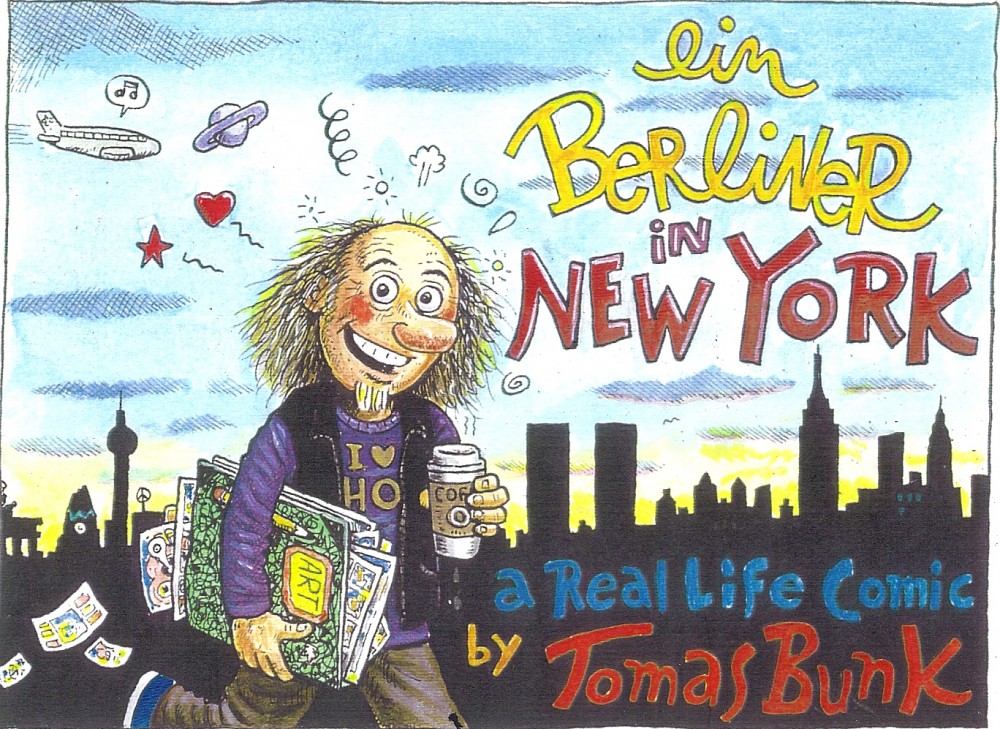
From Tom Bunk’s blog: http://bunkstuff.blogspot.com/
In addition, Tom Bunk received a Lifetime Achievement Award, and Eckart Schott of Salleck Publications was honored for special services for the Munich comics scene.
 On the same day, ICOM (Interessenverband Comic e.V., The Comic, Cartoon, Illustration and Cartoons Interest Group) announced their awards spotlighting independent comics. The link to the award winners is here, along with an index of past German comics award winners. (ICOM dates back to 1994.)
Bester Independent Comic [Best Independent Comic]
„Als ich mal auf hoher See verschollen war“ von Maximilian Hillerzeder (Edition Kwimbi)
Bester Kurzcomic [Best Short Comic]
„Insel Karkinos“ von Tim Gaedke
Herausragendes Szenario [Outstanding Scenario]
„The Right Here Right Now Thing“ von Paulina Stulin (Jaja Verlag)
Herausragendes Artwork [Outstanding Artwork]
„Die kleine blaue Melancholie“ von Yi „Yinfinity“ Luo
Sonderpreis der Jury für eine bemerkenswerte Comicpublikation
[Special Jury Prize for a remarkable comic publication]
„Ach so ist das?!“ von Martina Schradi (Zwerchfell Verlag)
Sonderpreis der Jury für eine besondere Leistung oder Publikation [Special Jury Prize for a special performance or publication]
Comic Solidarity (Eva Junker, Lukas Wilde, Sebastian Kempke)
Honorable Mentions
„Mister Origami“ von Bastian Baier und Robert Mühlich (Zwerchfell Verlag)
„Mondo 2“ Herausgeber: Tim Gaedke
„Oh 3“ (Zwerchfell Verlag)
„Penner“ von Christopher Burgholz (Jaja Verlag)
“Lebensfenster 2015″ Kurt-Schalker–Preis für graphisches Blogen [“Life Window (?!) 2015″ Kurt-Schalke – Prize for graphical blogs AKA biocomics on the web]
Hillerkiller von Maximilian Hillerzeder
By: Jerry Beck,
on 6/8/2015
Blog:
Cartoon Brew
(
Login to Add to MyJacketFlap)
JacketFlap tags:
Harald Siepermann,
Boris Aljinovic,
Der 7bte Zwerg,
Shout! Factory,
Daniel Welbat,
Douglas Welbat,
CGI,
Feature Film,
Germany,
Add a tag
The fairytale mashup will be distributed by Shout! Factory .
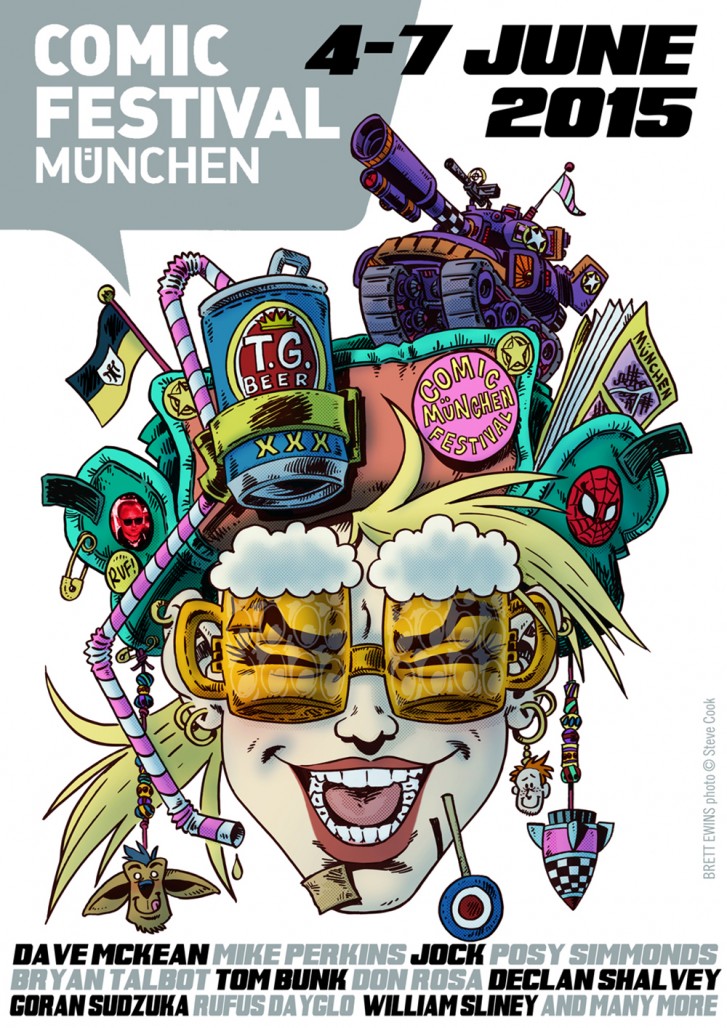 Every other year, Munich hosts the Munich Comic Festival (Comicfestival München), which, like other continental comics festivals, offers a diverse international guest list while still celebrating the local talent!
For those who kann nicht Deustsch sprechen, here’s the official greeting:
The Munich Comic Festival is the second largest comic event of its kind in Germany and is alternating every other year with the Comic Salon in Erlangen. In 2015 it takes place from June 4 to June 7 with some of the exhibitions starting earlier and continuing after the festival. From Mai 7 to June 9 the exhibition “The Beatles in Comics” will be shown in the Valentin-Karlstadt-Musäum. Other exhibitions to be shown deal with Will Eisner at the Jewish Museum, Paco Roca and Jordi Lafebre will present their artwork in person at the Instituto Cervantes, Tom Bunk, who will be get our Peng! Award for his life’s work , will show his artwork in the Amerikahaus. And finally, the quaint Beer and Octoberfest Museum in the oldest private house of Munich will be in on the Festival.
Main location of the Festival from June 4 to 7 is the Alte Kongresshalle (Old Congress Hall) neighboring on the Oktoberfest site. Here, among other things, one can find the book fair of all the comic publishers under one roof. Also there will be drawing workshops and prominent comic artist will be available for autographs. There will also be various presentations and lectures as well as exhibits, e.g. the exhibit of artwork from our guest country Great Britain. There will also be a cosplay contest. Many prominent artists like Don Rosa, Dave McKean, Posy Simmonds, Jock, François Walthéry, Bryan Talbot, Vicki Scott, Goran Sudžuka, Rufus Dayglo or Denis Kitchen will once again be guests of the Festival.
In 2013 the Munich Comic Festival had some 12,000 visitors, not counting the many people who visited exhibits that were shown at various locations for free.
Let’s condense that: the second largest comics festival in Germany, in Munich next to the Oktoberfest grounds. (BAR-CON!) The German equivalent of Angoulême. Lots of British cartoonists. Rosa, McKean, Kitchen.
So, what’s going on? Well… Click on the blue headlines below for more information!
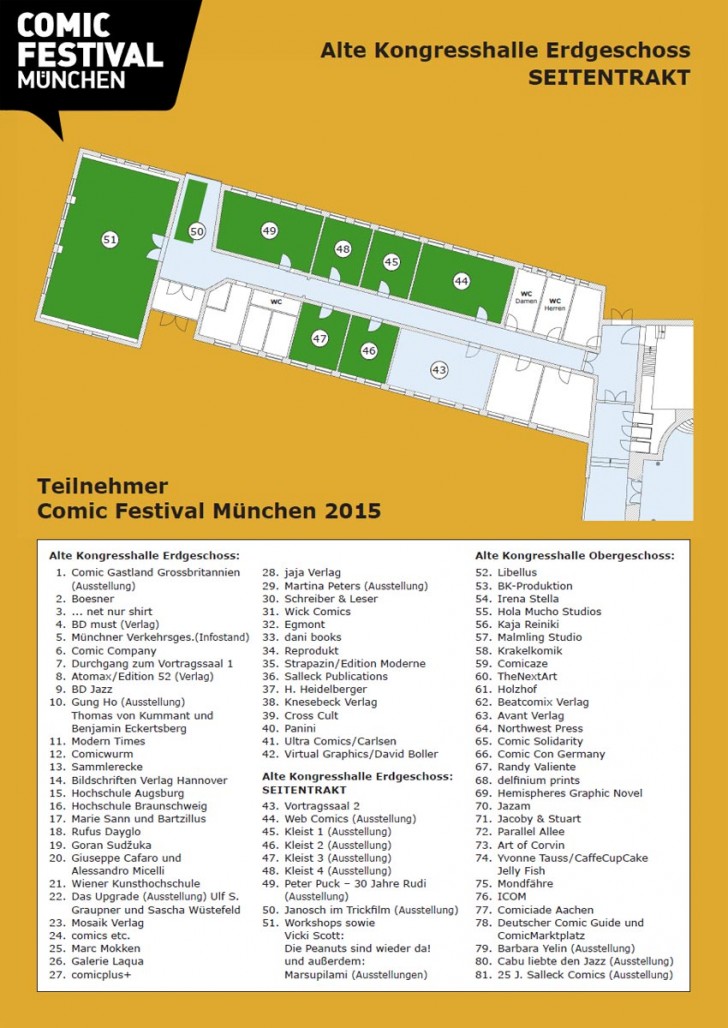
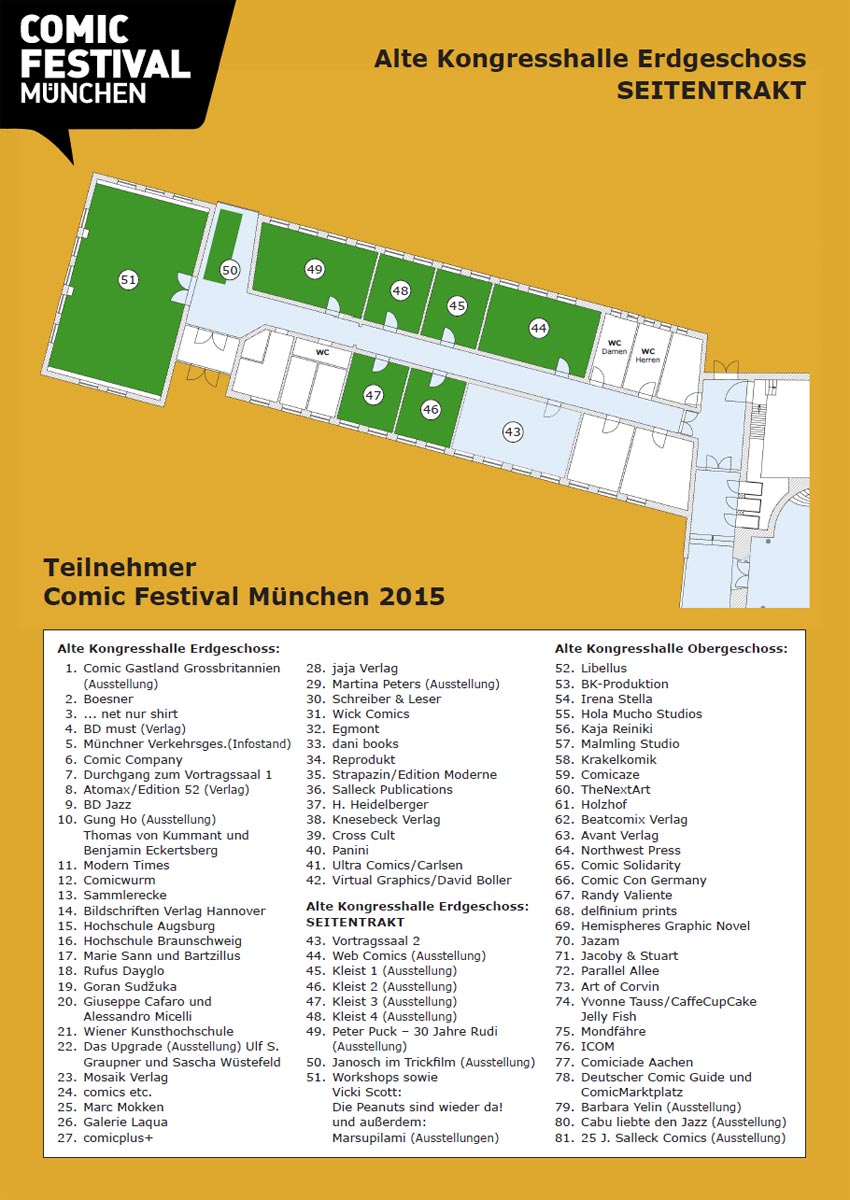
First, here’s the venue, built in the early 1950s:
Ground Floor
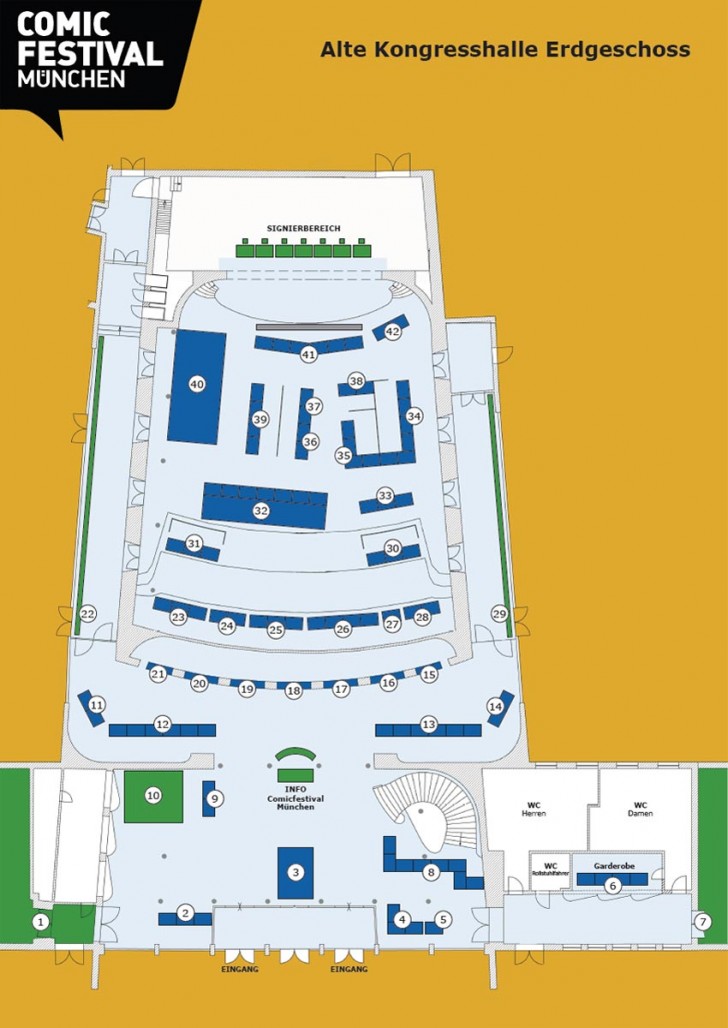 Upper Floor
(Yes, that is a bar. I suspect the pretzels are much better than those found in San Diego, especially if served with mustard!)
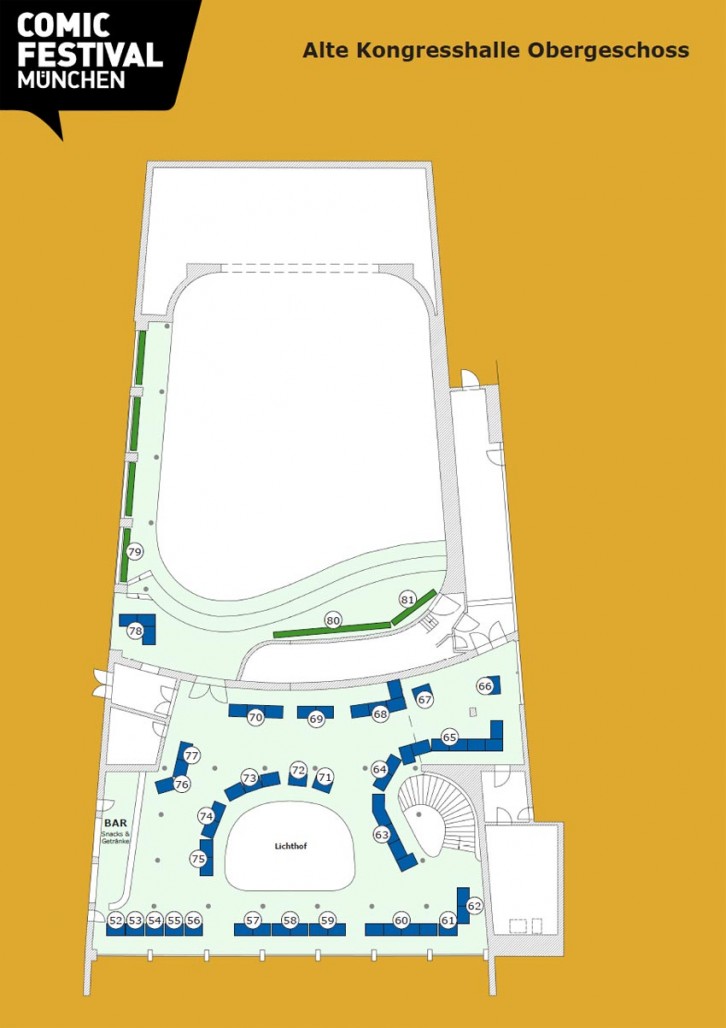 Panel rooms (and map key) (accessible to the left of the autographing stage)
Kids under 10 are free, teens 11-18 €15 for four days, adults €20 for four days! Thursday through Sunday.
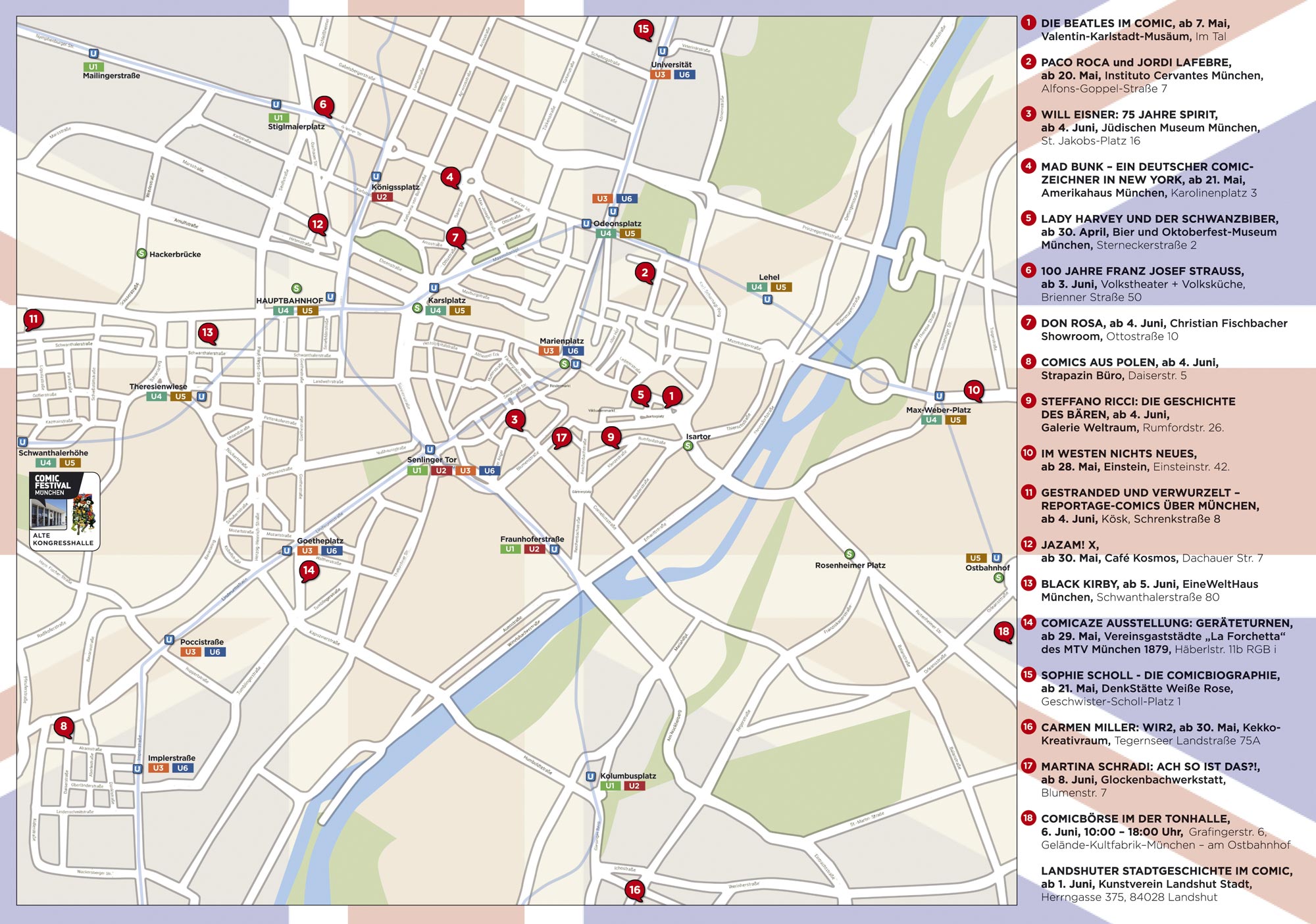
Yes, actual installations! Beatles! The Spirit! Uncle Scrooge! Tom Bunk at the Amerika Haus!
Here’s a local map!
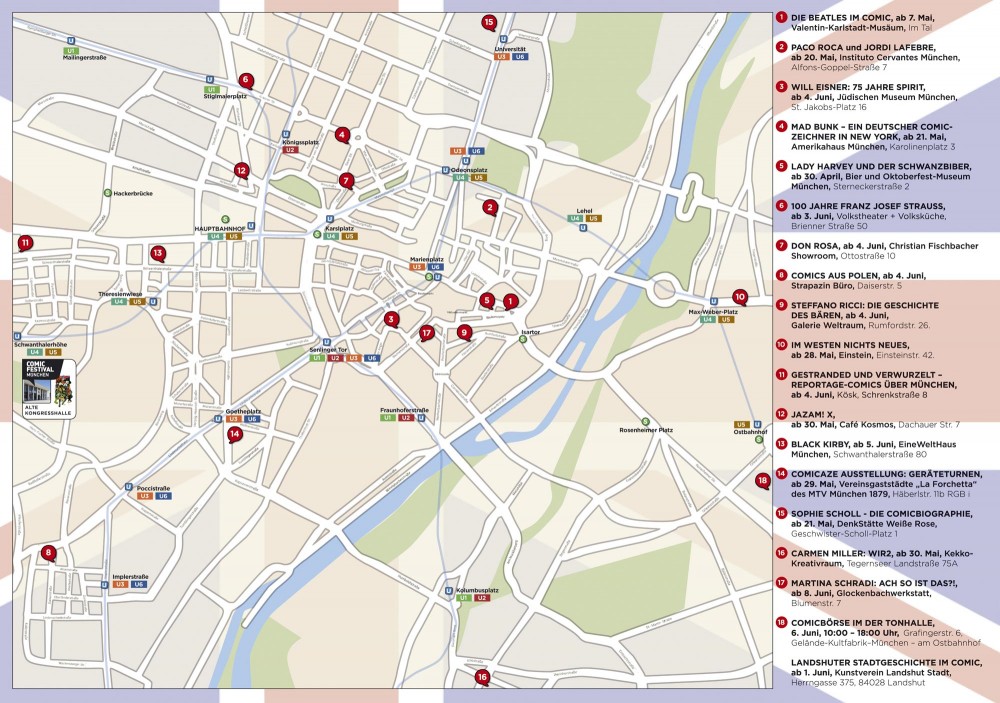
(Or you can download the guidebook!) (It’s got a welcome message from the Lord Mayor of Munich! Which makes sense, since funding comes from local cultural agencies.)
Okay… this one gets highlighted!
PREMIERE DER MUSIK-COMIC-SHOW STING ILLUSTRATED
Yup, that’s the German. And it pretty much describes what it is… Here’s the Google translation:
Together with the Palatinate cartoonist Dennis Hauck the Munich songwriter Alex Sebastian took the complete works of Sting before: The two sat among others lyrics hits like “King of Pain” or “Message in a Bottle” in amusing comic stories about, but also made before more obscure Album titles not just what can happen when it is cloudy, but do not want to rain? Why not move the better combating rivals from one day to the other? Why takes the Queen even a taxi to the train station? How do you make a woman’s right?
The result is a unique live show with comic projections that applies not only to die-hard fans Sting, but for every music and comic lovers a must. After several previews the official premiere will now take place as part of the Comic Festival.
(Which might also mean sketching!) Wow! Don Rosa will be autographing for 14 hours over 4 days, including one 4-hour block! Get there early!
Categories: Best German-Language Comic, Best European Comic, Best North American Comic, Best Comics Reporting, Best Books about Comics, Best Reprint, Best Film Adapation, Best Webcomic, Best Asian Manga, Best German Manga!
(FREE! But offsite. Saturday only.)
The MVG (the Munich transit agency) is sponsoring a comics competition. Just go to the show, and draw a comic under the theme “Simply Mobile”. The winner gets €200 and publication in MVGinfo, a magazine of 150,000 circulation.
This is kinda cool… each attendee gets a ticket, and uses that to vote for their favorite cosplayer! The ballots will then be used in a raffle! Oh, and if you come in costume on Saturday, your admission is half off!

Look! Seawigs have reached Germany! Here are some young rambling isles who we met last week at the European School in Bad Villbel, near Frankfurt.

Dressler, our German publisher, had asked us to go and visit some international schools to spread the word about Oliver and the Seawigs, or Schwupp und Weg as it’s known in those parts.

Our main host was Stephanie von Selchow who is the librarian at the European School in Frankfurt.
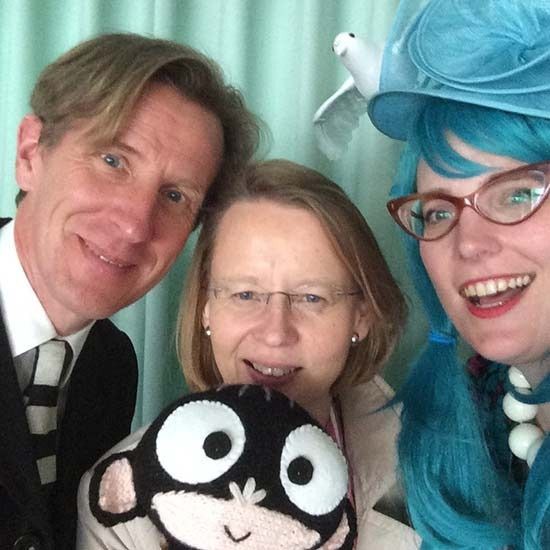
She’d arranged for us to do two sessions there, for her own students, and a visiting class from Textorschule, Sachsenhausen. A lot of the kids had already read Oliver and the Seawigs, so after we’d talked a bit about it we went on to Cakes in Space, which has just been published in Germany as Kekse im Kosmos. Most of the audience spoke good English, and it seemed to go down well... of course, some of the show needs no translation; the bit where I hit Philip over the head with a mandolin case goes down well in any language.

That afternoon we had a quick wander around Frankfurt, and tried to draw some of the odd but attractive nobbly linden trees which line the riverside.
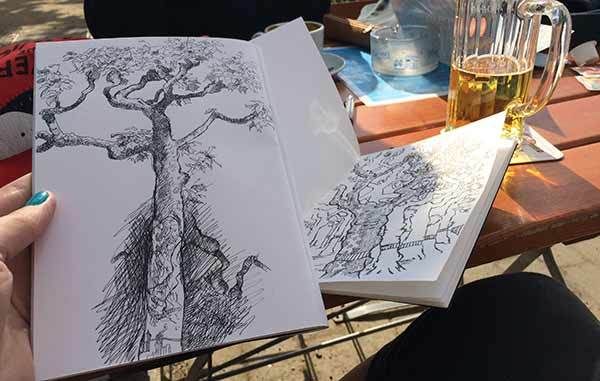
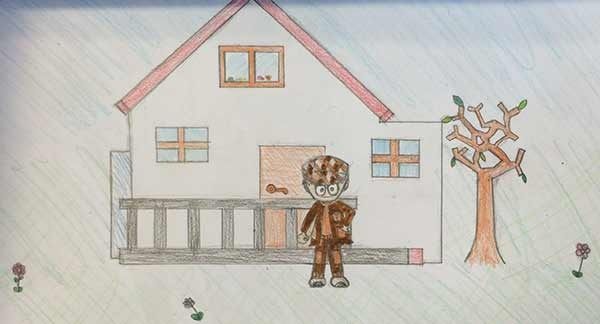
They're quite tricky trees to draw, and I'd love to have another try at them. One of the school kids had a picture of this kind of tree in his Oliver and the Seawigs artwork and he got the funny shape of it just right.
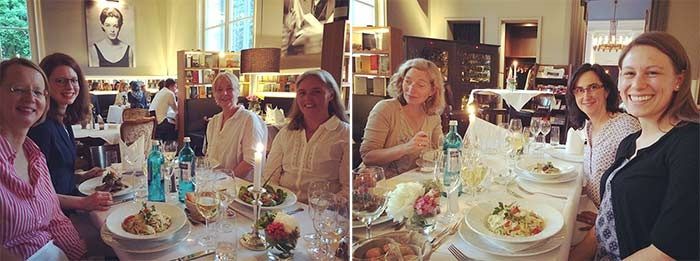
Then it was off to the Literaturhaus restaurant, where we had dinner with Stephanie and some of her colleagues from ESF and other schools.
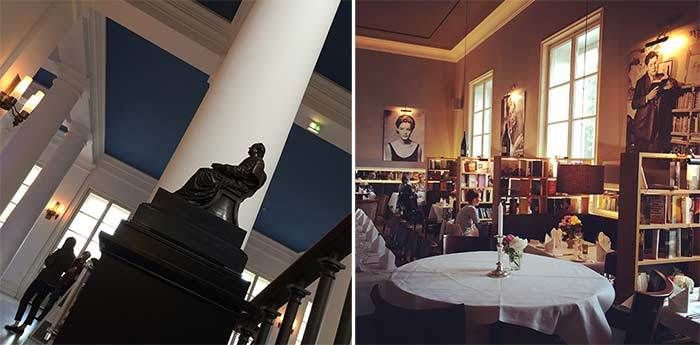
As you can see, it was very grand, and the food and company were first-rate.
The next morning we were picked up by Manuela Rossi, who whirled us down the Autobahn to Bad Villbel, where we talked Seawigs and Cakes to some of the students of the European School Rhine Main.
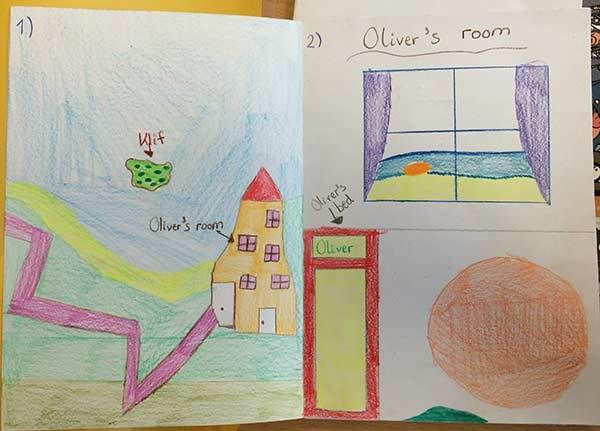
Utte, the librarian there, showed us some of the great artwork the children had produced, including this fantastic tower of houses. It looks a bit like a Traction City out of Philip’s Mortal Engines books.

Most amusing question of the day: Where did you get those GIGANTIC SHOES?

Then it was back on the Autobahn to yet another international school, Accadis in Bad Homburg.
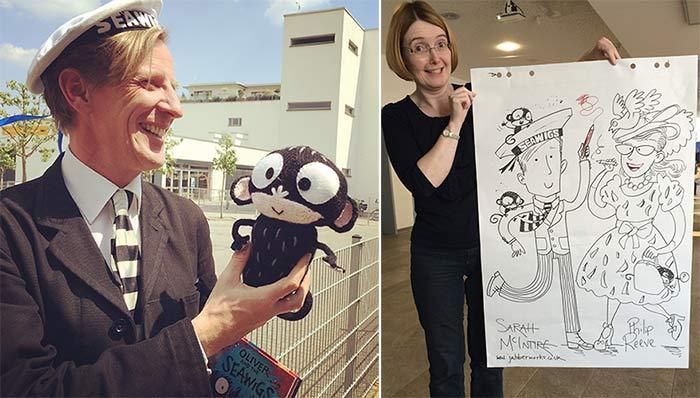
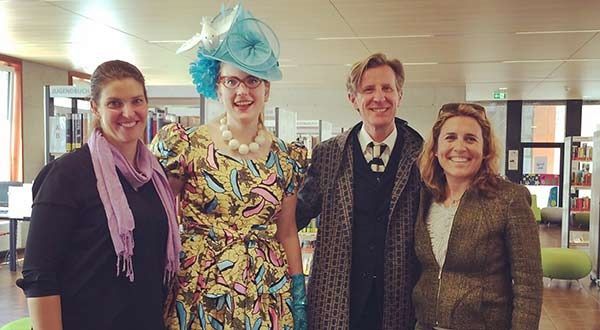
We’d met Samantha Malmberg and Caitlin Wetsch from the school at the previous night’s dinner, so it was good to see them in their natural surroundings, and meet their students, who were VERY EXCITED TO SEE US.
Some of the classes had done whole whole projects on Oliver the Seawigs, complete with some great drawings.
And after that we had a little bit more time to mooch around Frankfurt...
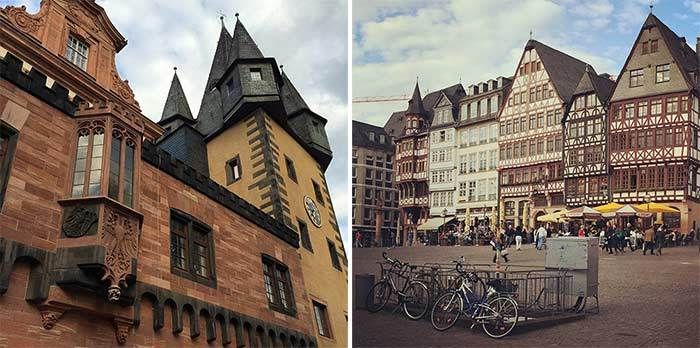
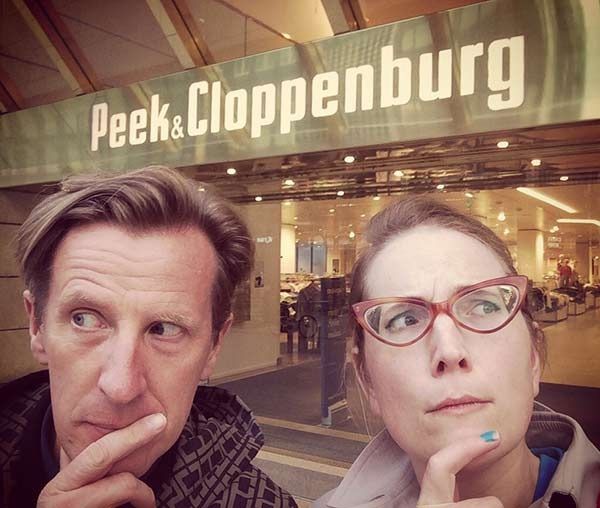
...in the guise of Mitteleuropean crime-fighting duo Peek & Cloppenburg.
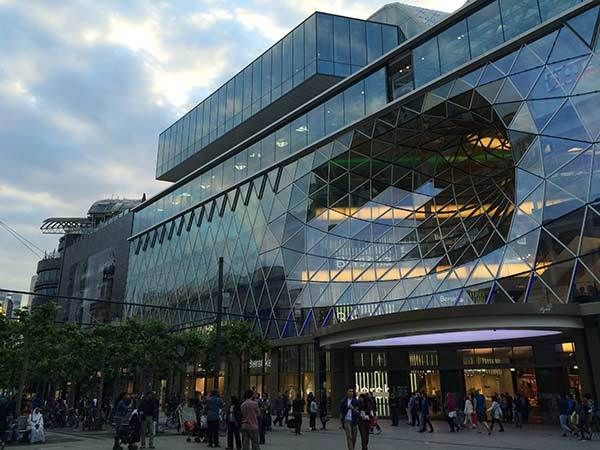
Strange things were going on in Frankfurt city centre. Nobody seemed to be bothered by the fact that the shopping mall was being devoured by a wormhole…
But we discovered a natty German-style TARDIS and were able to save the day.

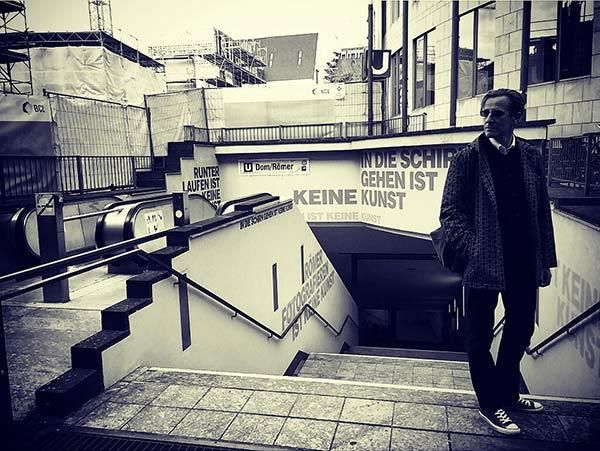
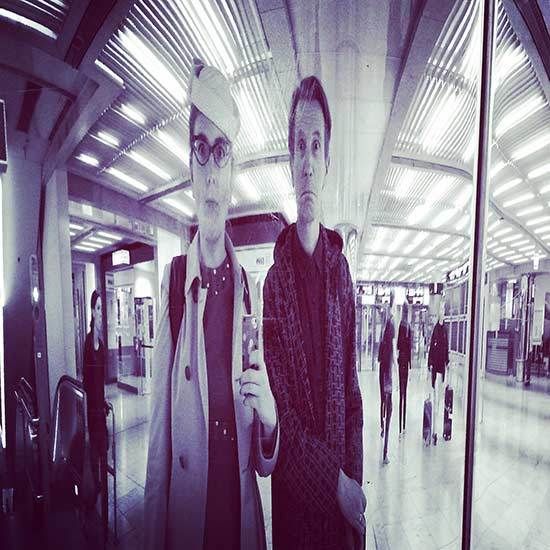
And we both found excellent covers for our pop albums, should we ever find time to write and record them. Here’s Philip, waiting for the Trans-Europe Express…
Heaven knows what mine is going to sound like.
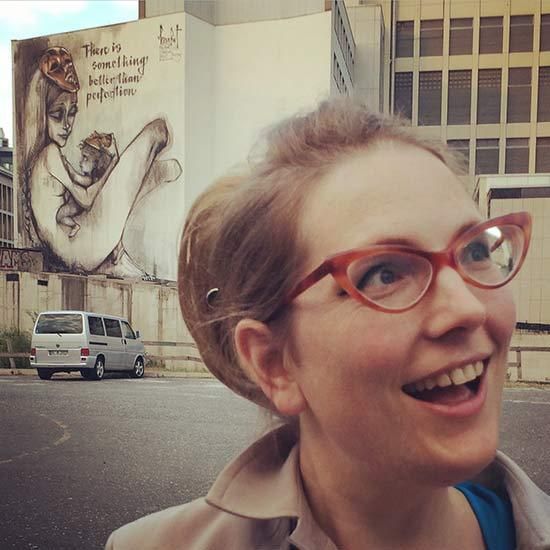
But whatever it is, it will be lovely: some things are Better Than Perfection.
Thanks to Stephanie, Utte, Sam and all the staff and volunteers who helped to make our visit to Frankfurt so enjoyable. We were very sad to leave!
View Next 25 Posts






.jpg?picon=925)