new posts in all blogs
Viewing Blog: The Mumpsimus, Most Recent at Top
Results 1 - 25 of 1,133

A blog about "displaced thoughts on misplaced literatures."
Matthew Cheney is a writer and teacher who lives in New Hampshire. His work has been published by English Journal, Strange Horizons, Failbetter.com, Ideomancer, Pindeldyboz, Rain Taxi, Locus, The Internet Review of Science Fiction and SF Site, among other places.
Statistics for The Mumpsimus
Number of Readers that added this blog to their MyJacketFlap: 4
Hopefully, someday my contribution to peace
Will help just a bit to turn the tide
And perhaps I can tell my children six
And later on their own children
That at least in the future they need not be silent
When they are asked, "Where was your mother, when?"
—Pete Seeger, "My Name Is Lisa Kalvelage"
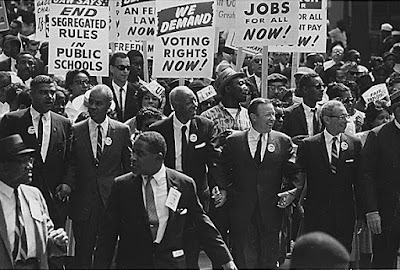
Faculty and grad students at my university are being targeted by right-wing groups who publicize their names and contact information because these faculty and students have criticized racist and sexist acts on campus. The Women's Studies department in particular has been attacked in the state newspaper for the crime of offering supplies to students who were participating in a protest against Donald Trump. The president of our university just sent out an email giving staff and students information about what to do if they are attacked. Numerous students have reported being harassed, spat upon, told they'd be deported, etc.
The right wing detests many segments of academia. The basic idea of women's studies programs, ethnic studies programs, queer studies programs, etc. are anathema to them, but right-wing vitriol is not limited to the humanities — ask
a climate scientist what life is like these days.
These trends are not new, but they are emboldened and concentrated by the success of Donald Trump and the
nazis,
klansmen, and various troglodytes associated with him.
Hate crimes are on the rise. The media, trapped in the ideology of false equivalence, terrified of losing access to people in power, besotted by celebrity, makes white supremacists look like
GQ models and ends up
running headlines questioning if Jews are people. Things will only get worse.
The chilling effect is already strong.
Within the last few days, I've heard from a number of academics (some with tenure) who say they are being very careful. They're changing their social media habits (in some cases, deleting their social media accounts altogether), making themselves less accessible, being careful not to show any political partiality around their students. They need their jobs, after all. They have bills to pay, kids to support, lives to live. Just yesterday, one of my friends was ordered to a meeting with a dean to justify a Tweet from her personal account, a Tweet I had to read three times before I could figure out what in it might ever be construed as "misrepresenting the university". She's got tenure, at least, so she might be safe for now. For now.
This is not to say that anti-Trump or left-leaning faculty ought to be celebrated as always correct and perfect. They're as capable of being incoherent, punitive, and authoritarian in their views as Trump is, and a few of the things some of my friends and colleagues said are things I completely disagree with. But they're human beings at a highly anxious moment expressing their views. They're not sending hate mail or harassing people, yet now they are targets of hate and harassment campaigns and many have pulled back, hidden, or deleted whatever they could of their public presence. These are wonderful people, teachers, and scholars. We need to hear their voices. We need them not to be strangled by fear. But they're scared.
Most teaching faculty in the U.S. don't have tenure, and tenure is often weak. The neoliberalization of academia has seen to that, and there's little reason to believe things will get better. The
Wisconsin model is one the Republicans hope to make national, and with control of all levels of federal government and a majority of state governments, that goal is within their reach.
The
series of moral panics that have been spreading through academia — and spreading even more in the discourse around and about academia — is effective in its work, and it is especially effective now in the Age of Trump.
"Political correctness" is a powerful term within the discourse, one that the right-wing uses skillfully to stifle dissent and to create a new common sense that is more favorable to the right's perspective. State universities like mine are especially vulnerable to the interference of politicians, even though at this point we get so little funding from the state that the term barely applies anymore. The triumph of the right wingers means institutions susceptible to political pressure will adapt to the new rulers.
Moves toward fascism may seem inimical to academia, but they're not at all.
Universities can adapt.
I don't have any original or even particularly insightful answers to this stuff. I've been reading lots of
Stuart Hall,
Audre Lorde, and
Victor Klemperer. I sent money to organizations committed to standing against Trump and fascism. I'm
matching my publisher's fundraiser for the ACLU. I'm adding
Parable of the Sower to the readings in my First-Year Composition course in the spring. I stuck a pink triangle pin on my backpack; I hadn't done so for many
years, but it feels important now to be visible.
I've got a lot less to lose than many of my friends and colleagues. (I'm a white male for one thing. White supremacist patriarchy lets us get away with more.) I'll protest, I'll speak out, I'll risk what I can see my way to risk.
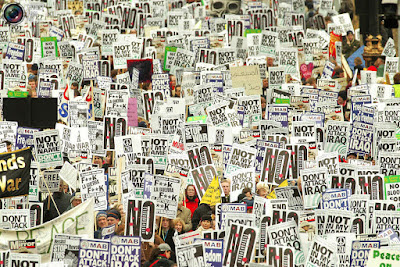
Back in the good olde days of George W. Bush, I was a columnist for a local newspaper. My assignment was to be the resident left-winger. My first column ran just before the attacks of September 11, 2001. In March of 2002, I began a column with the sentence, "If George W. Bush really wants to clean up politics in this country, the best thing he could do would be to resign." I was a young teacher at a private high school, and readers of the newspaper called the headmaster to try to get me fired. He liked me and had no desire to fire me. He encouraged people who called him to give me a call (my phone number was public), since, he told them, I'm a reasonable guy. "Not one of them would," he said to me a week or so later. "They're cowards. And good for you for speaking up. You and I don't agree about everything, but so what? Why would I ever want to have a teacher here who wasn't truthful to himself? Write what you need to write." A couple readers wrote relatively polite letters to the editor denouncing me for my lack of patriotism. (Now they'd just send an email in ALL CAPS and filled with abusive epithets and maybe a couple death threats for good measure. Those were simpler days...)
I kept at it for a while, and indeed eventually got a few phone calls, and now and then somebody wrote to the school to complain about a person with such unpatriotic and subversive ideas teaching the young and impressionable children, and once a deacon came to the school to speak with me between classes because he thought I needed God. I wasn't especially attached to writing those columns; it was just something that seemed like it needed doing, and I didn't have many other writing opportunities at the time. Eventually, I gave it up for blogging.
I don't think my words changed anybody's minds, I don't think I particularly helped anybody through writing those columns, and I am certain that I could have done more, risked more, donated more, written more. But I look back on it all now with some pride, because lots of people who later said they didn't support the catastrophic U.S. wars in Iraq and Afghanistan really did at the time. It's easy to forget now how much cultural pressure there was after 9/11 to toe the line, to keep your radical ideas to yourself, to not make waves, not buck the trends or upset the ship of state. People said we had to support the President even if we didn't agree with him. People said we needed to be united, even if it meant being united around murder, destruction, and hatred. Some of us disagreed, and the proof of my own stand remains in the pages of the
Record Enterprise of Plymouth, NH fifteen years ago.
There are many forces in my life right now saying it would be prudent for me not to associate my own name with seemingly radical beliefs or actions. I don't agree. I will not support Donald Trump or his minions. I will continue to compare them to Hitler and the Nazis as long as their actions and words continue to
evoke fascism. I will continue to advocate for an academia that seeks ways to shed the neoliberalism that has so corrupted the academic mission, and I will stand with students and faculty and staff who are marginalized, oppressed, precarious. Solidarity forever.
I will do my damnednest not to risk collaboration with oppression. As an American citizen, it's impossible not to have some complicity in the wars and weaponry our taxes pay for, or in the many ways our lifestyles destroy the biosphere, or — well, the list of atrocities we contribute to is long, and the whole country was founded on the sins of genocide and slavery, sins still repercussing at the present moment. I know this. I'm not seeking to hide the double/triple/infinite binds except to say there are some things we do not need to go along with, even as deep in the swamp of complicity as we may be.
It's important to pay attention to attacks and to chilling effects, important to make your own position known, to try hard not to collaborate with a regime of repression. We do what we can, and protect what we must. Some people can only resist quietly. Others will put their lives on the line. What matters is the resistance.
What matters is being able to stand tall and answer honorably when the future
asks, "Where were you, when...?"
My publisher, Black Lawrence Press,
has announced that for every book they sell through their website from now through the end of the year, they will donate $1 to the American Civil Liberties Union.
I will match this for my own book,
Blood: Stories, meaning that every copy sold through the BLP website will also send $2 to the ACLU.
I'm an ACLU member, and pleased with this choice of an organization to support because so many of BLP's authors are among the groups targeted by harassment, civil rights violations, and hate crimes — all of which are
on the rise and likely to continue rising.
In the archives of the
New York Times, materials about Germany and the rise of the Nazis to power are vast. It would take days to read through it all. Though it would be an informative experience, I don't have the time to do so at the moment, but I was curious to see the general progression of news and opinion as it all happened.
Here are a few items that stuck out to me as I skimmed around:
19327 February
10 March
29 May
12 June
1933
8 February
9 February
29 February
5 March
7 March
11 March
12 March
13 March
16 March
19 March
22 March
Electric Literature has published an essay I wrote about Robert Aickman, one of the greatest of the 20th century's short story writers:
Thirty-five years after his death, Robert Aickman is beginning to receive the attention he deserves as one of the great 20th century writers of short fiction. For the first time, new editions of his books are plentiful, making this a golden age for readers who appreciate the uniquely unsettling effect of his work.
Unsettling is a key description for Aickman’s writing, not merely in the sense of creating anxiety, but in the sense of undoing what has been settled: his stories unsettle the ideas you bring to them about how fictional reality and consensus reality should fit together. The supernatural is never far from the surreal. He was drawn to ghost stories because they provided him with conventions for unmaking the conventional world, but he was about as much of a traditional ghost story writer as Salvador Dalí was a typical designer of pocket watches.
Continue reading at Electric Literature.
For more of me on Aickman,
see this post about my favorite of his stories, "The Stains".
Dawn again,
and I switch off the light.
On the table a tattered moth
shrugs its wings.
I agree.
Nothing is ever quite
what we expect it to be.
—Robert Dunn
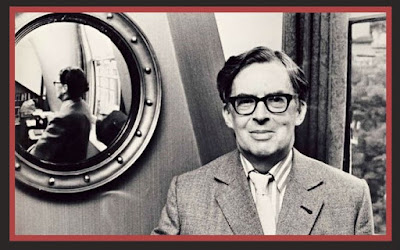
Katherine Towler's deeply affecting and thoughtful portrait of Robert Dunn is subtitled "A Memoir of Place, Solitude, and Friendship". It's an accurate label, but one of the things that makes the book such a rewarding reading experience is that it's a memoir of struggles with place, solitude, and friendship — struggles that do not lead to a simple Hallmark card conclusion, but rather something far more complex. This is a story that could have been told superficially, sentimentally, and with cheap "messages" strewn like sugarcubes through its pages. Instead, it is a book that honors mysteries.
You are probably not familiar with the poetry of
Robert Dunn, nor even his name, unless you happen to live or have lived in or around Portsmouth, New Hampshire. Even then, you may not have noticed him. He was Portsmouth's second
poet laureate, and an important figure within the Portsmouth poetry scene from the late 1970s to his death in
2008. But he only published a handful of poems in literary journals, and his chapbooks were printed and distributed only locally — and when he sold them himself, he charged 1 cent. (Towler tells a story of trying to pay him more, which proved impossible.) He was insistently local, insistently uncommercial.
 |
| Robert Dunn |
Dunn was also about as devoted to his writing as a person could be. When Towler met him in the early '90s, he lived in a single room in an old house, owned almost nothing, and made what little money he made from working part-time at the
Portsmouth Athenaeum. He seemed to live on cigarettes and coffee. When Towler first saw him around town, she, like probably many other people, thought he was homeless.
If a person could start a conversation with Dunn, which wasn't always easy, they would discover that he was very well read and eloquent. He was not, though, effusive, and he was deeply private. It was only late in his life, wracked with lung disease, that he opened up to anyone, and the person he seems to have opened up most to is Towler, though even then, she was able to learn very little about his past.
Towler got to know him because she was a neighbor, because she was intrigued by him, and because she was a writer on a different career track, with different ambitions. Dunn certainly wanted his poems to be read — he wouldn't have made chapbooks and sold them (even if only for a penny) if not — but he didn't want to subject himself to the quest-for-fame machine, he didn't want to do what everybody now says you must do if you want to have a successful writing career: become a "brand". He didn't bother with any sort of copyright, and Towler quotes a disclaimer from one of his books: "1983 and no nonsense about copyright. When I wrote these things they belonged to me. When you read them they belong to you. And perhaps one other." In 1999, he told a reporter from the
Boston Globe, "It just feels kind of silly posting no trespassing signs on my poems."
His motto, written on slips of paper he occasionally gave to people, was "Minor poets have more fun."
When Towler met him, she was struggling with writing a novel. She had lived peripatetically for a while, but had recently gotten married. She wanted to be published far and wide, and in her most honest moments she probably would have admitted that she would have liked to sell millions of copies of her books, get a great movie deal or two, get interviewed by Terry Gross and Charlie Rose, win a Pulitzer and a National Book Award and, heck, maybe even a Nobel. Success.
Once her first novel was published, Towler discovered what many people do in their first experiences with publication: It doesn't fill the hole. It is never enough. There are always other books selling better, getting more or better reviews, always other writers with more money and fame, and in American book culture these days, once a book is a month or two old, it's past its expiration date and rarely of much interest to booksellers, reviewers, or the public, because there's always something new, new, new to grab attention. You might as well sell your poems for a penny in Market Square.
By the time Towler's first novel is published, Portsmouth is deep in the process of gentrification. Not only have the local market, five-and-dime store, and hardware store been put out of business by rising rents and big box stores, but all seven of the downtown bookstores have disappeared. (Downtown is no longer bookstoreless. Bookstores, at least, can appeal to the gentrifiers, though it's still tough to be profitable with the cost of the rent what it is.) Towler gives a reading at a Barnes & Noble out at the mall, a perfect symbol of pretty much everything Robert Dunn had lived his life against: a mall, a chain bookstore. He attends the reading, though, and seems happy for Towler's success. He stands in line to get his book signed, and then says something that cuts Towler to the bone: "I'll let you get to your public."
As Robert turned away, leaving me to face a line of people waiting to have books signed, I felt that he had seen through me to the deep need for approval, the great strivings of ego, that lay at the heart of my desire to publish a book. Only by divorcing myself from the hunger for affirmation, his quip suggested, would I find what I truly desired. This is what he wanted for me, what he wanted for anyone who wrote.
The Penny Poet of Portsmouth continues to think through these ideas, and to work through the contrast between Dunn's fierce localism and solitude and Towler's own conflicting desires, hopes, dreams, and fears. She begins in great admiration of Dunn, who seems to have sacrificed absolutely everything to his writing and has somehow overcome any yearning for fame or reward. In that sense, he seems saintly.
But at what cost? This question is always in the background as Dunn becomes ill and more dependent on other people. If he wants to stay alive, the sort of solitude he cultivated and cherished is no longer possible, leading to some difficult confrontations and tensions.
Towler does her best not to impose her own values on Dunn's life, but she can't help wondering what it would be like to live as Dunn does. Though she sympathizes with him, and shares some of his ideals, she's no ascetic. She can't help but think of Dunn as lonely, since she would be, especially in illness. She cherishes her husband, she likes the house they buy together, she enjoys (at least sometimes) traveling to readings and leading writing workshops.
Dunn's life, as Towler presents it at least, shows the inadequacy of the question, "Are you happy?" In illness, Dunn was obviously not comfortable, and when he couldn't be at home, he was often not content. But happiness is a fleeting thing, not a state of being. Even if you believe that happiness is something that can be captured for more than a moment, there's no reason to think that, except for illness, Robert Dunn was
unhappy. He sculpted a life for himself that was, it seems, quite close to whatever life he might have desired having. I doubt having a life partner of some sort would have led to more moments of happiness for him, as Towler wonders at one point. The accommodations and annoyances of having another person around a lot of the time are insufferable for someone inclined toward solitude. Was this the case for Dunn? It's difficult to know, because he was difficult to know. Towler is remarkably restrained, I think, in not trying to impose her own pleasures on Dunn — she doesn't ever record saying to him what the partnered often say to the unpartnered, "Wouldn't you be happy with someone else in your life?" (I often think partnered people work a bit too hard to justify their own life choices, as if the presence of other types of lives are somehow an indictment of their own.) But even still, it does seem to be one of the more unbridgeable gulfs between types of people: the contentedly partnered seem as terrified of being unpartnered as the contentedly unpartnered are of being partnered, and so one looks on the other's life as a nightmare.
What
The Penny Poet of Portsmouth shows is the necessity of community. Robert Dunn was, for many reasons, lucky that he lived in Portsmouth when he did, because there was a real community of writers and people interested in writing and reading, and these people looked out for each other. Before the rents went whacko, it was possible to live in Portsmouth if you weren't rich. This is why the word
place in Towler's subtitle is so important. The book is not only a portrait of Robert Dunn, but a chronicle of the city that allowed him to be Robert Dunn. Towler is careful to chronicle the details of the place and community, both its people and its institutions. She shows the frustrations of dealing with bureaucracies of illness, and without being heavy-handed she depicts the ways that poverty is perceived in a place as ruggedly individualistic as New Hampshire — once she gets to know Robert Dunn, she also gets to see, feel, and struggle against the assumptions people who don't know him make. (In some of what she described him experiencing from nurses, doctors, and pharmacists, I couldn't help but think of my father, who did not have health insurance and who died of congestive heart failure. After he had a heart attack, he felt patronized and dismissed by hospitals that knew he couldn't pay his bills. Whether the hospital employees themselves actually felt this way, I don't know, but he perceived it deeply, and it contributed to his determination never to see another doctor or hospital. I'll forever remember the way his voice sounded when he told me, briefly, of this: the shattered pride, the humiliation, the rage all fraying his words.)
In its attention to the details of community — and a number of other ways —
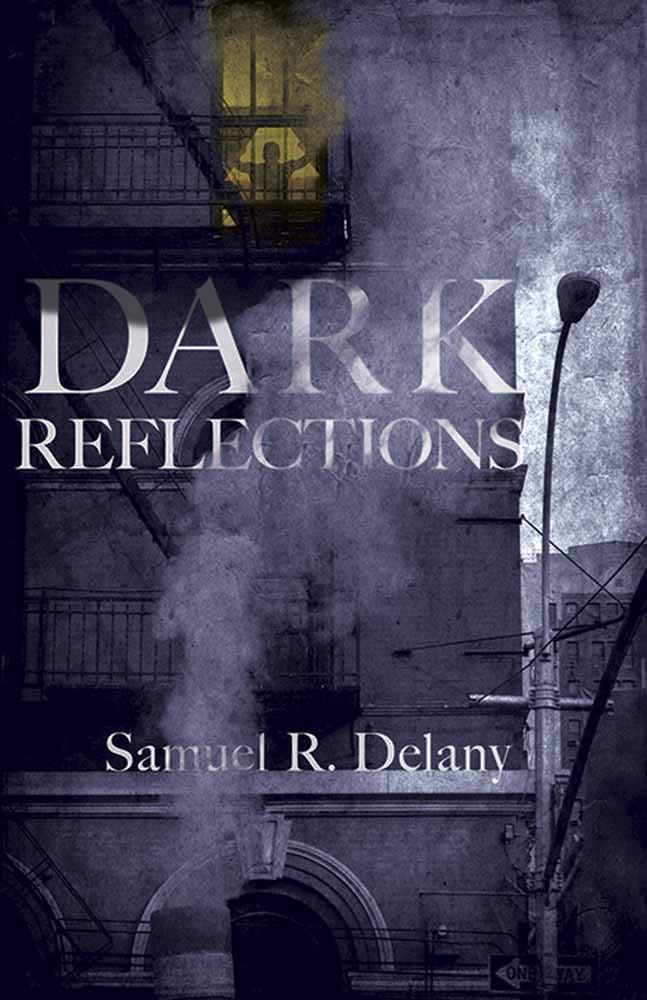
The Penny Poet of Portsmouth makes a perfect companion to Samuel Delany's
Dark Reflections, another story of a poet, though in a very different environment. Arnold Hawley in Delany's novel is far less content than Robert Dunn in Towler's memoir, but their commitments are similar. Arnold is more seduced by the desire for fame and success than Dunn seems to have been, and so his personality is perhaps a bit more like Towler's, but without her relative success in everyday living. Having known Dunn, Towler is perhaps more capable of imagining Dunn as content in his life than Delany is quite able to imagine Arnold content — I've sometimes wondered whether Arnold is so tormented by his life because Delany himself would be tormented by that life, a life that is the opposite, in nearly every way, of his own. No matter. The books have much to say to (and with) each other.
There is much in Towler's memoir that is moving. She takes her time and doesn't rush the story. At first, I thought perhaps her pacing was unnecessarily slow, perhaps padding out what was a thin tale. I was wrong, though, because Towler is up to many things in the book, and needs her portrait of the place and person to be built carefully for her ideas and concerns to have resonance and real meaning. It's a tale of growing into knowledge and into something like intimacy, but also, at the same time, of coming to terms with unsolveable mysteries and uncrossable borders.
By the time I got to the fragmentary biography Towler offers as an appendix, those few pages were the most powerful of the book for me, because they show just how much we can't know. (I suppose the power was also one of some sort of personal recognition: Robert Dunn grew up only a dozen or so miles from where I grew up. The soil of his early years is as familiar to me as any other place on Earth. He was a graduate of the University of New Hampshire, where I finished my undergraduate degree and am now working on a Ph.D. I've only spent occasional time in Portsmouth, though enough over the decades to have seen some of the changes Towler writes about.) Primed by all the rest of Towler's story, it was this paragraph that most deeply affected me:
He went south in the summer of 1965 with the civil rights movement with a small group of Episcopalians from New Hampshire. Jonathan Daniels, who was shot and killed as he protected a young African-American woman attempting to enter a store in Hayneville, Alabama, had gone down ahead of the group. Robert would not talk about this experience, though others and I asked him about it directly. He did say once that he had known Daniels.
Had Towler rushed her story more, the resonances and mysteries in that paragraph wouldn't have been nearly as affecting. (It helps if you already know the story of Daniels, I suppose.)
The book ends with a delightful collection of what we might call "Robert Dunn's wit and wisdom", taken from various interviews and profiles in local papers that Dunn had stuck in a folder labeled "Vanity". Of the civil rights movement, he told Clare Kittredge of the
Boston Globe in 1999: "We had our hearts thoroughly broken."
Let's end these musings with what mattered most to Robert Dunn, though: the poetry. His poems remind me of
Frank O'Hara (whom he discusses with Towler) and
Samuel Menashe. They're colloquial and compressed, full of surprises. Thanks to Towler's book, I expect, Dunn's selected poems have finally been collected in
One of Us Is Lost, and a few are reprinted in
The Penny Poet. Here's one that seems particularly appropriate:
Public Notice
They've taken away the pigeon lady,
who used to scatter breadcrumbs from an old
brown hand and then do a little pigeon dance,
right there on the sidewalk, with a flashing
of purple socks. To the scandal of the
neighborhood. This is no world for pigeon
ladies.
There's a certain wild gentleness in
this world that holds it all together. And
there's a certain tame brutality that just
naturally tends to ruin and scatteration and
nothing left over. Between them it's a very
near thing. This is no world without pigeon
ladies.
Now world, I know you're almost
uglied out, but . . . just think! Try to
remember: What have you done with the
pigeon lady?
—Robert Dunn
Dawn again,
and I switch off the light.
On the table a tattered moth
shrugs its wings.
I agree.
Nothing is ever quite
what we expect it to be.
—Robert Dunn
Katherine Towler's deeply affecting and thoughtful portrait of Robert Dunn is subtitled "A Memoir of Place, Solitude, and Friendship". It's an accurate label, but one of the things that makes the book such a rewarding reading experience is that it's a memoir of struggles with place, solitude, and friendship — struggles that do not lead to a simple Hallmark card conclusion, but rather something far more complex. This is a story that could have been told superficially, sentimentally, and with cheap "messages" strewn like sugarcubes through its pages. Instead, it is a book that honors mysteries.
You are probably not familiar with the poetry of
Robert Dunn, nor even his name, unless you happen to live or have lived in or around Portsmouth, New Hampshire. Even then, you may not have noticed him. He was Portsmouth's second
poet laureate, and an important figure within the Portsmouth poetry scene from the late 1970s to his death in
2008. But he only published a handful of poems in literary journals, and his chapbooks were printed and distributed only locally — and when he sold them himself, he charged 1 cent. (Towler tells a story of trying to pay him more, which proved impossible.) He was insistently local, insistently uncommercial.
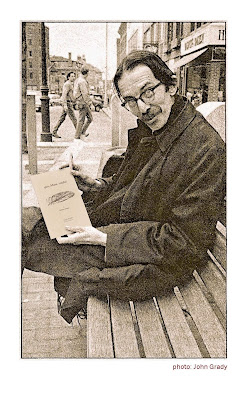 |
| Robert Dunn |
Dunn was also about as devoted to his writing as a person could be. When Towler met him in the early '90s, he lived in a single room in an old house, owned almost nothing, and made what little money he made from working part-time at the
Portsmouth Athenaeum. He seemed to live on cigarettes and coffee. When Towler first saw him around town, she, like probably many other people, thought he was homeless.
If a person could start a conversation with Dunn, which wasn't always easy, they would discover that he was very well read and eloquent. He was not, though, effusive, and he was deeply private. It was only late in his life, wracked with lung disease, that he opened up to anyone, and the person he seems to have opened up most to is Towler, though even then, she was able to learn very little about his past.
Towler got to know him because she was a neighbor, because she was intrigued by him, and because she was a writer on a different career track, with different ambitions. Dunn certainly wanted his poems to be read — he wouldn't have made chapbooks and sold them (even if only for a penny) if not — but he didn't want to subject himself to the quest-for-fame machine, he didn't want to do what everybody now says you must do if you want to have a successful writing career: become a "brand". He didn't bother with any sort of copyright, and Towler quotes a disclaimer from one of his books: "1983 and no nonsense about copyright. When I wrote these things they belonged to me. When you read them they belong to you. And perhaps one other." In 1999, he told a reporter from the
Boston Globe, "It just feels kind of silly posting no trespassing signs on my poems."
His motto, written on slips of paper he occasionally gave to people, was "Minor poets have more fun."
When Towler met him, she was struggling with writing a novel. She had lived peripatetically for a while, but had recently gotten married. She wanted to be published far and wide, and in her most honest moments she probably would have admitted that she would have liked to sell millions of copies of her books, get a great movie deal or two, get interviewed by Terry Gross and Charlie Rose, win a Pulitzer and a National Book Award and, heck, maybe even a Nobel. Success.
Once her first novel was published, Towler discovered what many people do in their first experiences with publication: It doesn't fill the hole. It is never enough. There are always other books selling better, getting more or better reviews, always other writers with more money and fame, and in American book culture these days, once a book is a month or two old, it's past its expiration date and rarely of much interest to booksellers, reviewers, or the public, because there's always something new, new, new to grab attention. You might as well sell your poems for a penny in Market Square.
By the time Towler's first novel is published, Portsmouth is deep in the process of gentrification. Not only have the local market, five-and-dime store, and hardware store been put out of business by rising rents and big box stores, but all seven of the downtown bookstores have disappeared. (Downtown is no longer bookstoreless. Bookstores, at least, can appeal to the gentrifiers, though it's still tough to be profitable with the cost of the rent what it is.) Towler gives a reading at a Barnes & Noble out at the mall, a perfect symbol of pretty much everything Robert Dunn had lived his life against: a mall, a chain bookstore. He attends the reading, though, and seems happy for Towler's success. He stands in line to get his book signed, and then says something that cuts Towler to the bone: "I'll let you get to your public."
As Robert turned away, leaving me to face a line of people waiting to have books signed, I felt that he had seen through me to the deep need for approval, the great strivings of ego, that lay at the heart of my desire to publish a book. Only by divorcing myself from the hunger for affirmation, his quip suggested, would I find what I truly desired. This is what he wanted for me, what he wanted for anyone who wrote.
The Penny Poet of Portsmouth continues to think through these ideas, and to work through the contrast between Dunn's fierce localism and solitude and Towler's own conflicting desires, hopes, dreams, and fears. She begins in great admiration of Dunn, who seems to have sacrificed absolutely everything to his writing and has somehow overcome any yearning for fame or reward. In that sense, he seems saintly.
But at what cost? This question is always in the background as Dunn becomes ill and more dependent on other people. If he wants to stay alive, the sort of solitude he cultivated and cherished is no longer possible, leading to some difficult confrontations and tensions.
Towler does her best not to impose her own values on Dunn's life, but she can't help wondering what it would be like to live as Dunn does. Though she sympathizes with him, and shares some of his ideals, she's no ascetic. She can't help but think of Dunn as lonely, since she would be, especially in illness. She cherishes her husband, she likes the house they buy together, she enjoys (at least sometimes) traveling to readings and leading writing workshops.
Dunn's life, as Towler presents it at least, shows the inadequacy of the question, "Are you happy?" In illness, Dunn was obviously not comfortable, and when he couldn't be at home, he was often not content. But happiness is a fleeting thing, not a state of being. Even if you believe that happiness is something that can be captured for more than a moment, there's no reason to think that, except for illness, Robert Dunn was
unhappy. He sculpted a life for himself that was, it seems, quite close to whatever life he might have desired having. I doubt having a life partner of some sort would have led to more moments of happiness for him, as Towler wonders at one point. The accommodations and annoyances of having another person around a lot of the time are insufferable for someone inclined toward solitude. Was this the case for Dunn? It's difficult to know, because he was difficult to know. Towler is remarkably restrained, I think, in not trying to impose her own pleasures on Dunn — she doesn't ever record saying to him what the partnered often say to the unpartnered, "Wouldn't you be happy with someone else in your life?" (I often think partnered people work a bit too hard to justify their own life choices, as if the presence of other types of lives are somehow an indictment of their own.) But even still, it does seem to be one of the more unbridgeable gulfs between types of people: the contentedly partnered seem as terrified of being unpartnered as the contentedly unpartnered are of being partnered, and so one looks on the other's life as a nightmare.
What
The Penny Poet of Portsmouth shows is the necessity of community. Robert Dunn was, for many reasons, lucky that he lived in Portsmouth when he did, because there was a real community of writers and people interested in writing and reading, and these people looked out for each other. Before the rents went whacko, it was possible to live in Portsmouth if you weren't rich. This is why the word
place in Towler's subtitle is so important. The book is not only a portrait of Robert Dunn, but a chronicle of the city that allowed him to be Robert Dunn. Towler is careful to chronicle the details of the place and community, both its people and its institutions. She shows the frustrations of dealing with bureaucracies of illness, and without being heavy-handed she depicts the ways that poverty is perceived in a place as ruggedly individualistic as New Hampshire — once she gets to know Robert Dunn, she also gets to see, feel, and struggle against the assumptions people who don't know him make. (In some of what she described him experiencing from nurses, doctors, and pharmacists, I couldn't help but think of my father, who did not have health insurance and who died of congestive heart failure. After he had a heart attack, he felt patronized and dismissed by hospitals that knew he couldn't pay his bills. Whether the hospital employees themselves actually felt this way, I don't know, but he perceived it deeply, and it contributed to his determination never to see another doctor or hospital. I'll forever remember the way his voice sounded when he told me, briefly, of this: the shattered pride, the humiliation, the rage all fraying his words.)
In its attention to the details of community — and a number of other ways —
The Penny Poet of Portsmouth makes a perfect companion to Samuel Delany's
Dark Reflections, another story of a poet, though in a very different environment. Arnold Hawley in Delany's novel is far less content than Robert Dunn in Towler's memoir, but their commitments are similar. Arnold is more seduced by the desire for fame and success than Dunn seems to have been, and so his personality is perhaps a bit more like Towler's, but without her relative success in everyday living. Having known Dunn, Towler is perhaps more capable of imagining Dunn as content in his life than Delany is quite able to imagine Arnold content — I've sometimes wondered whether Arnold is so tormented by his life because Delany himself would be tormented by that life, a life that is the opposite, in nearly every way, of his own. No matter. The books have much to say to (and with) each other.
There is much in Towler's memoir that is moving. She takes her time and doesn't rush the story. At first, I thought perhaps her pacing was unnecessarily slow, perhaps padding out what was a thin tale. I was wrong, though, because Towler is up to many things in the book, and needs her portrait of the place and person to be built carefully for her ideas and concerns to have resonance and real meaning. It's a tale of growing into knowledge and into something like intimacy, but also, at the same time, of coming to terms with unsolveable mysteries and uncrossable borders.
By the time I got to the fragmentary biography Towler offers as an appendix, those few pages were the most powerful of the book for me, because they show just how much we can't know. (I suppose the power was also one of some sort of personal recognition: Robert Dunn grew up only a dozen or so miles from where I grew up. The soil of his early years is as familiar to me as any other place on Earth. He was a graduate of the University of New Hampshire, where I finished my undergraduate degree and am now working on a Ph.D. I've only spent occasional time in Portsmouth, though enough over the decades to have seen some of the changes Towler writes about.) Primed by all the rest of Towler's story, it was this paragraph that most deeply affected me:
He went south in the summer of 1965 with the civil rights movement with a small group of Episcopalians from New Hampshire. Jonathan Daniels, who was shot and killed as he protected a young African-American woman attempting to enter a store in Hayneville, Alabama, had gone down ahead of the group. Robert would not talk about this experience, though others and I asked him about it directly. He did say once that he had known Daniels.
Had Towler rushed her story more, the resonances and mysteries in that paragraph wouldn't have been nearly as affecting. (It helps if you already know the story of Daniels, I suppose.)
The book ends with a delightful collection of what we might call "Robert Dunn's wit and wisdom", taken from various interviews and profiles in local papers that Dunn had stuck in a folder labeled "Vanity". Of the civil rights movement, he told Clare Kittredge of the
Boston Globe in 1999: "We had our hearts thoroughly broken."
Let's end these musings with what mattered most to Robert Dunn, though: the poetry. His poems remind me of
Frank O'Hara (whom he discusses with Towler) and
Samuel Menashe. They're colloquial and compressed, full of surprises. Thanks to Towler's book, I expect, Dunn's selected poems have finally been collected in
One of Us Is Lost, and a few are reprinted in
The Penny Poet. Here's one that seems particularly appropriate:
Public Notice
They've taken away the pigeon lady,
who used to scatter breadcrumbs from an old
brown hand and then do a little pigeon dance,
right there on the sidewalk, with a flashing
of purple socks. To the scandal of the
neighborhood. This is no world for pigeon
ladies.
There's a certain wild gentleness in
this world that holds it all together. And
there's a certain tame brutality that just
naturally tends to ruin and scatteration and
nothing left over. Between them it's a very
near thing. This is no world without pigeon
ladies.
Now world, I know you're almost
uglied out, but . . . just think! Try to
remember: What have you done with the
pigeon lady?
—Robert Dunn
And if my thought-dreams could be seen
They’d probably put my head in a guillotine
—"It’s Alright, Ma (I’m Only Bleeding)"
First, some axioms. Points. Nodes. Notes. (After which, a few fragments.)
From Alfred Nobel's will: "The said interest shall be divided into five equal parts, which shall be apportioned as follows: ...one part to the person who shall have produced in the field of literature the most outstanding work in an ideal direction..."
Even if every winner of the Nobel Prize in Literature were universally acclaimed as worthy, there would still be more worthy people who had not won the Prize than who had. Thus, the Nobel Prize in Literature will always be disappointing. The history of the Nobel Prize in Literature is a history of constant, repeated disappointment.
The Nobel Prize in Literature's purpose is not to recognize the unrecognized, nor to provide wealth to the unwealthy, nor to celebrate literary translation, nor to bring attention to small publishers. Occasionally, it does one or more of these things, and doing so is good. It would be nice if any or all of those were its purpose. I'm not sure what purpose it
does serve except as a sort of Hall of Fame thing, which reminds me of what Tom Waits
said at his induction to the Rocknroll Hall of Fame: "Thank you very much. This has been very encouraging."
As with many things,
Coetzee probably got it most right: "Why must our mothers be 99 and long in the grave before we can come running home with a prize that will make up for all the trouble we have been to them?"
My personal pick for a Nobel Literature laureate among the writers who seem like plausible candidates — that is, among the small group of writers whose names continue to be mentioned, year after year — is Ngugi wa Thiong'o. Among such American writers, I guess I'd pick Pynchon (not just for the early work —
Mason & Dixon is a wonder, and
Against the Day continues to seem to me to be the best science fiction novel of the 21st century), though I doubt they'd give it to him because he's pretty much guaranteed not to show up for the ceremonies. Among writers never/seldom spoken of for the Prize, I can hardly come up with a list without narrowing it somehow; for instance, U.S. writers I would like to see in contention include Ursula Le Guin and Samuel R. Delany, as well as countless poets, various nonfiction writers, a playwright or two (Wallace Shawn! Suzan-Lori Parks!), and maybe some unclassifiable weirdos. (I certainly feel no excitement for the idea of Philip Roth or Joyce Carol Oates winning, the two Americans typically mentioned.) We live in a very rich time for literature of all sorts, whether popular or elite.
But — brace yourself — hard as it is to believe, my personal desires are irrelevant to the Nobel Prize in Literature. I'm not even Swedish!
Anyway, I'm quite happy with
Bob Dylan winning the Nobel Prize in Literature because I like Bob Dylan's songs. Thus, the Prize as such seems to reflect well on my taste, and I want to defend it because my taste is mine and therefore I like it. If the Prize went, as it sometimes has, to a writer I don't especially care about, or whose work I don't especially like, I would feel annoyed, because isn't the job of prizes to flatter my taste?
I suppose this is how people who have passions for corporate sports teams feel when their favorite corporate sports team wins the corporate sports team tournament.
I adore Dylan and thus I agree with the Nobel Prize Committee. Their referees this year have made good calls, generally, though of course if I were one of the referees this year, the calls would have been even better.
No, I don't think Dylan is a poet in a strict, contemporary sense. He doesn't have to be. It's not the Nobel Prize in Poetry. (
"Literature" is always in the making.) Dylan is a songwriter and a performer. Separating his lyrics from performances of those lyrics can be clarifying, but it does violence to the work, leaves out an entire realm of communication. Nonetheless, his lyrics have proved portable, his music malleable, as he himself has often shown in performance (listen to "The Times They Are A-Changin'" on
MTV Unplugged or "A Hard Rain's A-Gonna Fall" from
Live 1975 for just a couple of the many examples) and countless musicians of various styles have proved (one of my favorites is
Chris Smithers' version of "Visions of Johanna"; also,
Antony & the Johnsons' "Knockin' on Heaven's Door").
The living U.S. Nobel Laureates in Literature are Toni Morrison and Bob Dylan. Obviously, American literature (what means "American"? what means "literature"?) is far more capacious than any two people, no matter how talented or accomplished, can represent, but nonetheless, look at the idea of American literature embodied in those two figures together: there's a perspective there on history, myth, and experience, on culture and creation. Both are popular artists, despite their obscurities and weirdnesses and highbrow allusions. They draw on and contribute to what can be called, for all such a term's inadequacies, an American vernacular. They are both obsessed, in their own unique ways, with the
old, weird America, its slave songs, murder ballads, hymns, blues, and jazz. There is something that feels very right to me about the pairing of their oeuvres, the way their poetries sing stories together.
I don't really care about the Nobel Prize, though. All prizes are awful. I won't defend the Nobel as a prize. Say what you want about it; I don't care. (Unless they give it to me. Then I'd care and I would accept the prize and I would do whatever they wanted me to do, because hey, why not? And the money would be nice.)
I care a lot about Bob Dylan, though — not the man, who I doubt I'd get along with very well, but his work, which awes me. The song
"Blind Willie McTell" alone would be enough to assure its writer of a place in the pantheon, and he's written dozens more of equal wonder.
To draw a bit of attention away from the ultimately useless questions of "Is it poetry?" or "Did he deserve to win?", here are some random, fragmentary thoughts on just a few corners of Dylan's body of work:
Everyone who has any liking for Dylan at all likes some Dylans more than others. I don't at all care for the current torchsong-singing Dylan. The last album I really adored was 2003's
"Love and Theft", though there are individual songs on the later albums, particularly
Tempest, that I enjoy. But there's a looseness to his later work, a tendency to let songs go on and on with the same rhythm, that doesn't do much for me. My favorite period is the 1970s, the period from roughly
Self-Portrait through
At Budokan, a period I often prefer in bootlegs and alternate versions of individual songs rather than the album versions, but which also includes my single favorite album,
Blood on the Tracks. Maybe it's because I was born the same year as
Blood on the Tracks, and maybe it's because I grew up listening to Dylan — but I didn't grow up listening to the '70s Dylan, since my father, the Dylan fan in the house, seemed to have given up on Dylan after he went electric. By the time I entered high school, I knew all the words to the first five albums, but had no idea there were later albums. Those later albums would be a revelation, first with
Highway 61 Revisited, then
Blood on the Tracks. A friend in college had the first official
Bootlegs album, and we listened to it like a secret hymnal. (I feel a bit sad that I heard "official bootlegs" before I ever heard the real boots, but the official ones are pretty great, and now that the
Basement Tapes have been released, there are only a handful of unofficial tracks I really love.)
Two somewhat unheralded albums are among my favorites:
Hard Rain and
World Gone Wrong.
Hard Rain is punk Dylan — live recordings in bad weather, with all the instruments going out of tune and the musicians furiously trying to get through their set. That album's versions of "Maggie's Farm" and "Stuck Inside of Mobile..." are especially fierce, but it's all great, wild, angry, dissonant.
World Gone Wrong is one of a pair of albums (with
Good as I Been to You) that brought Dylan back from the brink and rejuvenated him for some of his later
masterpieces.
Good as I Been to You is good, but
World Gone Wrong somehow goes beyond it, and sometimes vies for position as my favorite Dylan album: it's just Dylan and his guitar, singing old songs. Each track is wondrous, a reinvention that is also a summoning.
I love how much of a
magpie Dylan is, a thief and a scoundrel, a channeler of all he's ever heard. I
said a year ago, and still say: "Dylan's references, allusions, echoes, riffs, cut-ups, and copies expand his work and connect it to networks of meaning." Also: "Dylan is all poses, all artifice, and he always was. He's not, though, a postmodern ironizer; his earnestness is in the earnestness of his artifice. (His art is real for as long as he performs it.)"
Ahh well, enough of this. Go listen to some songs.
This is hard country to stay alive in
Blades are everywhere and they're breaking my skin
I'm armed to the hilt and I'm struggling hard
You won't get out of here unscarred
It's a long road, it's a long and narrow way
If I can't work up to you, you'll surely have to work down to me someday...
—"Narrow Way"
At the
Los Angeles Review of Books, I have
a new essay about Samuel R. Delany's 2007 novel Dark Reflections, which is about to be released in
a new and slightly revised edition by Dover Books. Here's a taste:
In many ways, Dark Reflections is a narrative companion to Delany’s 2006 collection of essays, letters, and interviews, About Writing. In the introduction to that book, Delany says that its varied texts share common ideas, primary among them ideas about the art of writing fiction, the structure of the writer’s socio-aesthetic world both in the present and past, and “the way literary reputations grow — and how, today, they don’t grow.” The book is mainly, though not exclusively, aimed at aspiring writers. It provides some advice on craft, but it circles back most insistently to questions of value, and especially to questions of the difference between good writing and talented writing — and what it means, practically and materially, for a writer to shape a life around an aspiration toward the highest levels of achievement. While About Writing poses and explores these questions, Dark Reflections dramatizes them.
Read more at LARB
.jpg?picon=160)
By: Matthew Cheney,
on 9/11/2016
Blog:
The Mumpsimus
(
Login to Add to MyJacketFlap)
JacketFlap tags:
novels,
Coetzee,
Add a tag
Whenever I write about a new Coetzee book, I am wary. I think back to
what I wrote in 2005 about
Slow Man when it was new, and I cringe. On the one hand, I'm glad to have this record of a first encounter; on the other, the inadequacies of a first encounter with a new Coetzee novel are immense. (With
Slow Man, I learned this vividly a few months later after the book wouldn't stop haunting me, and I reread it, and it was a different book, one I had learned to read only after reading it.) The first sentence of
my 2008 Diary of a Bad Year post is: "This is a book that will need to be reread. Until then, some notes." For the next book,
Summertime (2009), I didn't write anything until I could spend time thinking and re-thinking it, particularly as it was the final part of a trilogy of fictionalish autobiographies; I first wrote about it in
my Conversational Reading essay on Coetzee and autobiography. For
The Childhood of Jesus (2013), I returned to recording my initial impressions, but clearly labeled them as such. I will do the same here, with
Childhood's sequel, recently released in the UK and Australia (it's scheduled for release early next year in the US).
Some preliminary, inadequate notes on
The Schooldays of Jesus after a first reading:
There will be debate about whether it's possible to read
The Schooldays of Jesus without having read
The Childhood of Jesus. I think you could have a good, or at least adequate, experience of
Schooldays without
Childhood. They don't rely on each other for plot. What the novels together gain is resonance.
Reading
The Childhood of Jesus the first time through was for me a profoundly disorienting experience, because right through the last page I just didn't know what Coetzee was up to. (It was much like the experience of first reading
Elizabeth Costello.) Reading
Schooldays was far less disorienting because the territory felt at least a little bit familiar. I was ready for the enigmas. I had learned how to read.
There is no dedication.
Childhood was dedicated "For D.K.C." —
David Coetzee. In place of the dedication there is an epigraph from
Don Quixote, a book highly important to
Childhood but much less present in
Schooldays: "Algunos dicen: Nunca segundas partes fueron buenas." Here's the context of that sentence in Edith Grossman's
translation:
“And by any chance,” said Don Quixote, “does the author promise a second part?”
“Yes, he does,” responded Sansón, “but he says he hasn’t found it and doesn’t know who has it, and so we don’t know if it will be published or not; for this reason, and because some people say: ‘Second parts were never very good,’ and others say: ‘What’s been written about Don Quixote is enough,’ there is some doubt there will be a second part; but certain people who are more jovial than saturnine say: ‘Let’s have more quixoticies: let Don Quixote go charging and Sancho Panza keep talking, and whatever else happens, that will make us happy.’”
The first chapter of
Schooldays is a perfect short story. Coetzee almost never writes short stories, and the various segments of his novels typically rely on each other, but I had the feeling after reading this first chapter that even if the rest of the book were a dud, these twelve pages were rich enough to satisfy me.
Dogs are, once again, everywhere. Dogs as creatures wandering through the book, yes, but also dogs as metaphors and figures of speech. There will one day be entire Ph.D. dissertations devoted to Coetzee's dogs.
I will be curious to see if the US edition calls the child David or Davíd. He is the latter in the UK edition. I don't have the UK edition of
Childhood, but some of the UK reviews put the accent on the i, so I assume his name is spelled that way in it, unlike the US edition, where he is simply David. Both novels concern themselves with names and naming, and names are significant to most of Coetzee's work (in one of the best studies of that work,
J.M. Coetzee: Countervoices, Carrol Clarkson devotes
an entire chapter to names). Yet there is a sense through both books that names are not all
that important, that they are temporary, that there are "real names" beyond the everyday ones, and those ones matter, but the everyday names could be anything. Even Coetzee pronounces them differently: in December 2012, just before
Childhood was published,
he pronounced them in the Anglicized way:
Seye-mon and
Day-vid. By early 2013,
he was pronouncing David as Dah-
veed (one contextual difference: in the first, Coetzee is introducing the characters himself, and they aren't named in the passage he reads [most of the time in the book, David is "the boy" and Simon is "he"]. In the second, Simón is pronouncing Davíd's name. This might not matter except that the complexity of the linguistic situation in the book might make it that Simón is trying to speak Spanish, the dominant language in Novilla but not his native language. However, though I usually think Coetzee is going for the most subtle, complex, and multivalent possibilities, in this case I really do expect he just changed his mind.)
Simón's name is used much more in
Schooldays than it was in
Childhood. It's as if he's growing into it. Coetzee loves playing with pronouns and antecedents, and in
Schooldays, Simón's name is usually used in the narration via the construction "he, Simón". He's being named, pointed to,
hailed into identity (and ideology?). Perhaps one of the reasons for his constant tension with Davíd is the boy's resistence to such identity. (It's not that Davíd is without identity, but that he is more mysterious in his identity than Simón. Simón is simply unable to comprehend Davíd's identity, it seems. Certainly, Davíd believes that to be true.)
Though their titles lead us to think these novels are about the child, the main character is Simón. It's his consciousness that we have access to, his experiences that we see. One of the questions these books dramatize is: What is it to be responsible for the life and welfare of a child whom you can't understand, a child whose own view of the world is so clearly different from your own, a child who is alien to you. (A fascinating comparison: Doris Lessing's
The Fifth Child and
Ben, in the World.) Do we want Simón to give up on Davíd, to let him go? After all, Simón is, as Davíd repeatedly points out, not his "real father", just a caretaker, and he has fulfilled his duty as he originally perceived it. And yet there is responsibility for this young life, as difficult and confounding as that responsibility may be. Inés may have accepted the label of "Davíd's mother", but she doesn't seem much interested in the actual role. Simón is far more conscientious, recognizing that there is something beyond and outside of Davíd's behavior/personality/self/whatever that he must try to take care of.
One of the new characters in
Schooldays is Dmitri, a man who tends the local art museum, hangs around the dance academy that Davíd enrolls in, and more or less befriends Simón for a while. He's one of those familiar Coetzee characters who shows up, makes a mess of things, and refuses to go away. He returns us to names — it is no coincidence that there are two Russian names in the book: Dmitri and Alyosha. We can't help but think of
The Brothers Karamazov, and the personalities of Coetzee's Dmitri and Alyosha fit generally (or allegorically or stereotypically) with the personalities of Dostoevsky's. This makes me think of the end of
Coetzee's first correspondence with Arabella Kurtz (which would eventually lead to
The Good Story):
I think back to The Brothers Karamazov, where the storyteller distinguishes between those of us whose thinking is disordered and those whose minds work tidily and efficiently. He belongs (more or less) among the latter: he sees the Karamazovs as cautionary examples of where disordered thinking can land one. I hear what he says. Nevertheless, my sympathies are with the Karamazovs.
Order and disorder are ideas that run all through both books, and
Schooldays enriches some of the discussions of rationalism and mysticism in
Childhood via the academy of dance that Davíd enrolls in. The school's philosophy is utterly mystical. It carries forward some of the discussion of numbers and pedagogy from
Childhood, where, for instance, Simón says of David, "Most of the time ... I think the child simply doesn't understand numbers, the way a cat or a dog doesn't understand them. But now and then I have to ask myself: Is there anyone on earth to whom numbers are more real?" At the academy, the teacher says:
Uno-dos-tres: this this just a chant we learn at school, the mindless chant we call counting; or is there a way of seeing through the chant to what lies behind and beyond it, namely the realm of the numbers themselves — the noble numbers and their auxiliaries, too many to count, as many as the stars, numbers born out of the unions of noble numbers?...
To bring the numbers down from where they reside, to allow them to manifest themselves in our midst, to give them body, we rely on the dance. Yes, here in the Academy we dance, not in a graceless, carnal, or disorderly way, but body and soul together, so as to bring the numbers to life. As music enters us and move us in dance, so the numbers cease to be mere ideas, mere phantoms, and become real.
Davíd loves dancing the numbers, and has a particular talent for it. This is not, though, an uplifting movie-of-the-week in which a difficult/troubled child discovers a talent and becomes a great person and everyone lives happily ever after. Davíd's talent gives him some pleasure and sense of accomplishment, and it pleases some audiences, but that's about it. Other circumstances intervene, and Davíd ends the book more or less as he began. Simón, though, does not. The final pages are evocative and enigmatic, but within the enigma one thing becomes clear, and I found it remarkably moving: Simón has changed, his senses and perceptions are widening. For all the mysteries and frustrations he has endured throughout the two books, Simón has now, by the end of
Schooldays, found a moment of new possibility not for anyone else, but for, finally, himself.
There is much more to say and explore through this novel. (We still don't have any good answer to why these books are titled as they are. Is "Jesus" Davíd's "real name"? Does the biblical allusion allow Coetzee a comfort with allegory that he has never had access to before?) However, I have only read it once, and I know better than to trust any of my conclusions about Coetzee's writing after only one read. I will simply say: This second part is very, very good. Let’s have more quixoticies.
I demonstrate hope.
Or the hope for hope. Or just more unanswerable holes.
—Mary Biddinger, "Beatitudes"
(I keep writing and rewriting this post.)
I thought I knew what I felt about the academic controversy du jour (a letter sent by a University of Chicago dean to incoming students, telling them not to expect trigger warnings, that academia is not a safe space, that open discussion requires them to listen to speakers they disagree with, etc.) — but I kept writing and rewriting, conversing and re-conversing with friends, and every time I didn't know more than I knew before.
Overall, I don't think this controversy is about trigger warnings, safe spaces, etc. Overall, I think it is about power and access to power. But then, overall I think most controversies are about power and access to power.
Overall—
The questions around trigger warnings, safe spaces, and campus speakers are complicated, and specific situations must be paid attention to, because universal, general statements are too distorting to be useful.
(I keep writing and rewriting this post.)
Perhaps headings will help:
Academic Freedom
I want academic freedom for everyone at educational institutions: faculty, students, staff. That said, as philosophers have shown for ages, defining what constitutes freedom requires argument, negotiation, even compromise, because one person's freedom may be another person's restriction.
Power
The University of Chicago dean's letter is primarily an expression of power and only secondarily about trigger warnings, safe spaces, and campus speakers. Though vastly more minor, it rhymes with the actions of the Long Island University Brooklyn administration, who locked out all members of the faculty union. Both are signs of things to come. The LIU action was union busting to consolidate administrative power; the UC dean's letter was the deployment of moral panic to consolidate administrative power.
Moral Panic
For the most part, the controversy over trigger warnings, safe spaces, etc. seems to me right now to be a moral panic, and much of the discourse around these things is highly charged not because of the specific policies and actual events — or not only because of the specific policies and actual events — but because of what they stand for in our minds.
Culture War
This moral panic plays into a larger culture war, one not limited to university campuses (indeed, the rise of Donald Trump as a political candidate also seems to me part of that larger war — and "war" is not too strong a word for it).
Tough Love and Hard Reality
Ever since I was in high school (at the latest) I have vehemently disliked the rhetoric of "tough love pedagogy" and "hard reality" that infuses current discussions of "coddled" students. I said on Twitter that such rhetoric seems to me arrogant, aggressive, and noxiously macho. I have not yet seen someone who advocates such policies and pedagogies do anything to get out of their own comfort zones, for instance by giving away their power and wealth and actively undermining whatever privilege they hold. I would take their position more seriously if they did so.
Comfort/Discomfort
That said, I think it's important to recognize that "comfort" and "discomfort" are broad terms with many meanings, and that students will, indeed, feel a kind of discomfort when encountering material that is new to them, that presents a worldview different from their own, etc. That seems healthy to me and entirely to be desired. (Perhaps we are trying to fit too much into the comfort/discomfort dichotomy. Or perhaps I am trying to restrict it too much.) There must be a way to value the challenging, critical pedagogy of, for instance, Women's Studies courses and Critical Race Theory courses without valorizing the sadism of the arrogant, aggressive, noxiously macho teacher whose primary desire from students is that they worship him as a guru, and whose primary pedagogy is to beat the wrongness out of everyone who steps foot in his classroom.
Perhaps other people's words will help. Here are some readings for homework:
The Ahmed and Nyong'o pieces are foundational; even if we end up disagreeing with them (do we? who "we"?), they help us focus on things that matter. The piece by Kevin Gannon is good at seeing how the "surface veneer of reasonableness" works in the dean's letter, and Gannon is also good at suggesting some of what this moral panic achieves — who benefits and why. Angus Johnston's post is useful for showing some of the complexities of the issues once we start talking about specific instances and policies. Henry Farrell highlights how this controversy is part of the institution of the university. Henry Giroux and the
undercommoners offer radical explosions.
(I keep writing and rewriting this post.
It is full of unanswerable holes.)
My sense of the concept of "moral panic" comes from
Policing the Crisis by Stuart Hall, et al.:
To put it crudely, the "moral panic" appears to us to be one of the principal forms of ideological consciousness by means of which a "silent majority" is won over to the support of increasingly coercive measures on the part of the state, and lends its legitimacy to a "more than usual" exercise of control. ... Their typical [early] form is that of a dramatic event which focuses and triggers a local response and public disquiet. Often as a result of local organising and moral entrepreneurship, the wider powers of the control culture are both alerted (the media play a crucial role here) and mobilised (the police, the courts). The issue is then seen as "symptomatic" of wider, more troubling but less concrete themes. It escalates up the hierarchy of responsibility and control, perhaps provoking an official enquiry or statement, which temporarily appeases the moral campaigners and dissipates the sense of panic. (221-222)
(Sociologists in particular have developed and challenged these ideas, but for my purposes here, this general approach to moral panics is accurate enough.)
There are a variety of fronts and a variety of causes being fought for in the wider culture war that includes (utilizes, benefits from) such panics as the current one (over the University of Chicago dean's letter). It is a war over the purpose and structure of higher education (and of education generally), it is a war over the meaning and implications of history, and it is a war over the meaning and implications of personal and group identities.
Kevin Gannon is onto something when he writes:
I don’t think it’s a coincidence that the backlash against so-called “political correctness” in higher education has intensified in direct variation with the diversification of the academy, areas of scholarship, and -- most significantly -- the student population. Underlying much of the hand-wringing about the state of the academy is a simple desire to have the gatekeepers remain in place.
Add to that: the challenge that
Black Lives Matter and other movements have made to the university status quo.
However, I think Gannon's argument soon falls into one of the traps this moral panic sets. Look where he goes next:
For every ginned-up hypothetical scenario of spoiled brats having a sit-in to protest too many white guys in the lit course, there are very real cases where trigger warnings or safe spaces aren’t absurdities, but pedagogical imperatives. If I’m teaching historical material that describes war crimes like mass rape, shouldn’t I disclose to my students what awaits them in these texts? If I have a student suffering from trauma due to a prior sexual assault, isn’t a timely caution the empathetic and humane thing for me to do? And what does it cost? A student may choose an alternate text I provide, but this material isn’t savagely ripped out of my course to satiate the PC police.
The trap here is the defense of "trigger warnings", because that's not
really what the letter and similar statements are about. People ought to be able to disagree about pedaogy while agreeing that the dean here overstepped his bounds. If a magic wand were waved and all the controversial issues that the letter is ostensibly about were made to disappear into unanimous agreement, the underlying questions of power would still remain.
What we need to look at are what the dean's statements are doing. If this is a moral panic, then it is trying to bring more people over "to the support of increasingly coercive measures on the part of the state" (or, in this case, university administration) and it "lends its legitimacy to a 'more than usual' exercise of control".
The letter is about control: who has it and who gets to assert it. Here, the increasingly coercive measures are not on the part of the state, but of the university administration. The letter is attempting to mandate against certain pedagogical practices and certain behaviors by student groups and individual students. The dean has asserted control. He has asserted the power to speak for the entire university.
I think it is an error to fall into the microargument over "trigger warnings", etc., because the meaningful argument is about who gets to mandate what, who gets to speak for whom, who dictates and who is dictated to. On the issue of this letter, that seems to me an argument for the University of Chicago's faculty, staff, and students to have together. But it points to a larger question of the neoliberal university.
The Neoliberal UniversityOver the last fifteen or twenty years in the United States, we've seen the triumph of a structural shift in universities, one that takes their medieval guild structure and alters it to a more corporate, neoliberal structure where all consequential decisions are the domain of the upper administration, where students become
consumers and teachers
deliver content, where one must
optimize processes and appeal to
external stakeholders and
achieve high performance to
enable success. (I think of it as the Triumph of Business School Logic.) In such a world, all value is numerical and everything can be measured with market reports. (For more on neoliberalism, I tend to refer to Philip Mirowski's
Never Let a Serious Crisis Go to Waste.)
This is not, of course, to say that individual groups, departments, or organizations within universities are themselves purveyors of neoliberal logic. Some are, some aren't. What I'm talking about when I talk about the
neoliberal university is its institutional structures and, especially, the priorities and actions of the administration, which under neoliberalism becomes (or wants to become) more powerful than in earlier structures where the faculty had more influence and control over the university as an institution. Such structures, priorities, and actions may be influenced by various groups outside the administration (the Economics Department, for instance, might have a particular influence on the administration's ideology and the College of Liberal Arts might have little to no influence. Or vice versa). But basically, the neoliberal university is the university not of colleagues and peers and truly shared governance, but of Boss Administrator.
 |
| Boss Administrator |
SolidarityThere are contradictions in all this, as a recent
Harvard Magazine article on
"Title IX and the Critique of the Neoliberal University" tries to show, saying: "An obvious response to the narrative critiquing the corporatizing university might then suggest that it’s invoked to protect the interests of the faculty over those of students and other university affiliates."
Such a frame, though, relies on the idea that
the faculty, the students, and
other university affiliates have inherently different interests, and that those interests are in conflict. It seems to me that things are more complicated than that. It seems to me that such a frame is already working within the assumptions of neoliberalism. The frame hides the many areas where the different groups that constitute a university can stand in solidarity — as I think they must if we are to have any hope of building a structure for the modern university that is not neoliberal.
While recent events have highlighted faculty vs. administration, we need to find better ways not only to undo as much of that dichotomy as possible, but to also increase solidarity with students and staff. Staff in particular can get lost in the arguments, and yet at every school I'm familiar with, the staff are the people most essential to the smooth functioning of everyday life. The staff must be included in any consideration of the work of the institution.
The neoliberalization of the university depends on, encourages, and exacerbates conflicts between the interests of
the faculty, the students, and
other university affiliates. They are different groups, yes, and different groups made up of different people, yes, and as such may always be coming at the goals of the institution from different points of view, with different values and different priorities, but that shouldn't destroy the idea of the university as a coalition, a union of differences. The neoliberal university destroys solidarity.
A Personal (and Utopian) Vision of the UniversityI keep writing and rewriting this post because I keep falling into the perhaps unavoidable and perhaps academic habit of pretending to perhaps know what I'm perhaps talking about.
No, that is not what I meant. That is not it at all.
Try this:
I cannot possibly pretend to have all the answers for how to escape the many binds that wrap universities in moral panics, culture wars, neoliberalism, etc. Not just because I am not omniscient. Not just because every institution has different systems and emphases, different quirks and qualms. But because—
(And yet of course injustice is structural and systemic. Of course.)
My own life has been deeply shaped by the binds I'm (perhaps) pretending not to be all bound up in. Institutions I have devoted myself to continue to be warped and bruised (and occasionally polished) by them.
There have been some pretty deep bruises over the last year.
I can't pretend I'm not writing from anger.
I can't pretend I'm not wounded in these culture wars.
And yet somehow I have some sort of hope.
Hope for what?
I'm not sure.
Here are some incomplete thoughts on my personal values and visions for academia, because I am an academic and thus must have a list of personal values and visions for academia, mustn't I? These mostly feel obvious to me, even (embarrassingly) banal, but perhaps articulating them is worthwhile:
I value a diversity of pedagogies and a diversity of course options for students. I think students will gain the most from having available to them teachers who are devoted to the pedagogy of the most traditional of lectures and teachers who are devoted to the pedagogy of the most radical of student liberation and teachers who fall everywhere in between. No teacher is great for all students, no pedagogy is great for all students. Had I the power, I would, for instance, eliminate all requirements for syllabi and simply require that teachers be thoughtful about their pedagogy and that they enter the classroom from a basic standpoint of respect for their students as human beings and as people capable of thought.
Public education should be free and open to the public. Society at large benefits significantly from open access to education. If we can fund trillion-dollar wars, we can fund public education. We simply choose not to. One of the engines driving the neoliberalization of higher ed is the lack of funding from the public. When there isn't enough money to go around, everything gets assessed first by cost. That will destroy all the best aspects of our universities.
Students, faculty, staff, and administration need to be able to find solidarity within mutual goals (and mutual aid). A diversity of disciplines, of epistemologies, of pedagogies, of life experience, etc. makes solidarity both challenging and imperative. The question I fall back on is: What can we do to strengthen our multiplicities?
I want academia to be a refuge for us all. This idea is inevitably solipsistic, because academia has been a refuge for me. How can I find values and visions beyond my own experience? (A university that was a true refuge might be able to show me the way. I think it has sometimes. Sometimes I've been oblivious, pig-headed, scared. But sometimes I've learned other ways. Yes, sometimes.)
Finally
, I yearn for a university where curiosity is celebrated as a kind of pleasure, where knowledge is a value unto itself, and where intellectual passion is perceived as essential to the good life.But What About Trigger Warnings, Etc.?(Oh gawd, I don't want to talk about this.)
What's the issue?
Is this the issue?
This is not
the issue.
It is
an issue. As such, it should be discussed, and it should continue to be discussed, and there should be nuance to the discussion.
(Assignment: Compare the rhetoric of "trigger warnings" and "spoiler warnings".)
(Assignment:
Discuss "entitlement".
What does it mean to be entitled?
Who gets to be entitled?
Explain.)
I don't think "trigger warnings" (or, better:
content notes) should be mandated or prohibited.
I don't think there is any practical way to mandate or prohibit such things without gross violations of academic freedom for everyone involved.
I could be wrong.
I am skeptical. I am wary.
What if, as has happened recently, such proposals come from students?
I think students should propose whatever they want.
Proposals are good. They get us talking about what we value and why.
Students have a big stake in this endeavor of education.
Institutions function through discussion, compromise, experiment.
Students should be encouraged to enter the discussion.
They should be aware that there is often compromise.
They should be encouraged to experiment.
Experiments often fail.
Experiment.
Try again.
Again.
I use content notes myself occasionally when presenting students with material that is particularly graphic or intense (in my judgment) in its sexual and violent content. That just seems polite. I spend a lot of time on the first day of class describing what we'll be doing, reading, and viewing; and later, I usually describe upcoming material to students so they'll have some sense of what they're getting themselves into. But I do that with most material, even the most ordinary and least controversial. It rarely seems pedagogically useful to me for students to go into upcoming work completely ignorant of its content and/or my reason for asking them to give that work their time and attention.
(In terms of whether students have a right to have alternative material if they are concerned about the material's difficulty for reasons of their own experiences or opinions, I generally think not, because they are usually not forced into a course. I say "generally" and "usually" because there are times when requirements, schedules, and such converge to effectively force a student into a particular course, and in that case, yes, more compromise may be necessary, but such situations are rare. I think. I hope.)
Beyond the sort of content notes I use when it feels necessary, my own feelings are (sometimes; often) along the lines of
the anonymous 7 Humanities Professors who wrote an essay a few years ago for Inside Higher Ed.
Yes, I have fears. I fear chilling effects. Yes. I think chilling effects happen. I think they come from all sorts of different directions. I think they are sometimes contradictory. Much depends on individual places, individual policies, even individual people.
A lot of the rhetoric around trigger warnings, safe spaces, etc. can be turned around and used for reactionary, regressive purposes. Jack Halberstam tries to show this in
"Trigger Happy: From Content Warning to Censorship". (I know a lot of people reject Halberstam's ideas. Rejection is fine, but I think dismissal is hasty. Show your work.)
Among the points made by the 7 Humanities Professors, two key ones are:
- "Faculty of color, queer faculty, and faculty teaching in gender/sexuality studies, critical race theory, and the visual/performing arts will likely be disproportionate targets of student complaints about triggering, as the material these faculty members teach is by its nature unsettling and often feels immediate.
- "Untenured and non-tenure-track faculty will feel the least freedom to include complex, potentially disturbing materials on their syllabuses even when these materials may well serve good pedagogical aims, and will be most vulnerable to institutional censure for doing so."
The 7 Humanities Professors go on to worry that the use of trigger warnings will lead to an expectation among students of such things for any material that is even remotely potentially offensive or disturbing, and a backlash against any professor who does not provide such a warning.
I wonder, though: Does that kind of effect need to be inevitable?
(The idea of safe spaces and safe zones was important to the LGBT movement for a while. I remember the sense of comfort — good comfort, necessary comfort — I felt when I saw "Safe Zone" stickers on faculty office doors. "Okay," I would think, "I can engage with this person. They're less likely to reject my humanity." That was comfort. That was refuge. It allowed thought, conversation, and learning to start. I see those stickers less often these days, I assume because there is an assumption that they are no longer necessary, especially as more and more universities have adopted institution-wide anti-discrimination policies. Still, I smile whenever I see one of those stickers, even if it's fading, even if it's on a door no-one uses anymore. There was comfort. There was refuge.)
If there is a synthesis of my ideas here, perhaps it could be this: We must be especially careful and deliberate in what we normalize.
Most faculty are not trained psychologists or psychiatrists, nor should they pretend to be. I think pretending to be a therapist when you have no training in therapy is unethical and potentially extremely dangerous both for the faculty member and their students.
(Don't give in to the guru temptation. Kill the guru in you.)
And yet a lot of teachers are drawn to the profession for reasons that seem to lead them toward wanting to be therapists, and while (perhaps?) on a general level this might not necessarily be a harmful tendency, when teachers perceive of themselves primarily as therapists, they tread into dangerous waters. (I've seen this especially among acting teachers and creative writing teachers, but perhaps it is a common tendency elsewhere, too.) As Nick Mamatas has said,
"Those who can't be a therapist, teach." This tendency should not be encouraged. Compassion, absolutely. Pretending to be a therapist, no.
I am not a therapist. I will not pretend to be a therapist. I am a quasi-expert on certain, very narrow, types of reading and writing. That is all.
There are resources on most campuses for students in crisis, and faculty should be familiar with those resources so they can direct students to them. (If a student's issues are too great for the resources of the university to help with, it makes no sense to me for the university or student to pretend otherwise, and in such cases a university should be able to compassionately and supportively say, "This is not the right place for you. We don't have the resources to help you here." Not doing so risks harming the student more. It is fatal for universities to try to be and do everything for everyone.)
Be Careful What You OssifyFrom the
Susanne Lohmann essay that Henry Farrell links to:
The problems to which the university is a response are hard problems, and there is no free lunch. Institutional solutions are generally second-best in the sense that they constitute the best solution that is feasible in the light of environmental constraints (in which case they are a defense), or they are less than second-best (in which case they are defective).
As a necessary by-product of fulfilling their productive functions, the structures of the university have a tendency to ossify. It is precisely because the powerful incentives and protections afforded by these structures are intertwined with their potential for ossification that it is hard to disentangle where the defects of the university end and its defenses begin.
Perhaps
ossification is a better way of thinking about the ideas I've been circling around here than
normalization, or perhaps they work together.
If ossification is unavoidable, even perhaps (occasionally?) desireable, then:
Be careful what you ossify.
 |
| Chagall, "The Concert" |
RefugeThe university must allow refuge.
Refuge must allow the university.
(I keep writing and rewriting this post.)
Freedom from. Freedom to.
Safety from. Safety to.
(Or just more unanswerable holes.)
All pedagogy allows some things and censures others. What does your pedagogy allow? What does it censure? How do you know?
Ripeness Is All
GLOUCESTER: No farther, sir; a man may rot even here.
EDGAR: What, in ill thoughts again? Men must endure
Their going hence, even as their coming hither;
Ripeness is all: come on.
GLOUCESTER: And that's true too.
Exeunt.
I have a brief new essay up at The Story Prize Blog,
"Why I Am Not a Poet". Here's a taste:
I care about words, structures, rhythms, resonances, patterns, allusions, borrowings, sentences, images, emotions, voices, dreams, realities, fears, anxieties, failures, yearnings, and much more, but I don't really care about telling stories. The story is a kind of vehicle, or maybe an excuse, or maybe an alibi. The conventions of the story can be followed and forsaken in ways that get me to the other things, the things I care about.
All of those things I care about are things common to poetry — some more common to poetry than to prose, I'd bet — and that is why I read poetry, but even though I read poetry, I write prose because I just don't know how to do those things unless I'm writing prose.
(I think I would rather be a poet, but I am not.)
I returned to the WROTE Podcast recently for a 2-part
discussion of reading and writing queerly with Dena Hankins, SA "Baz" Collins, and moderator Vance Bastian. (Previously, I did
a solo conversation there.)
The strength of the discussion is also what makes it sometimes awkward and even contentious: we all have utterly different tastes, touchstones, and experiences. I'm not a natural fit for such a conversation, as I don't think of myself as a "consumer of queer content", but rather as a reader/writer who sometimes reads/writes queer stuff. I hardly ever seek out a book
only because it's about a queer topic or has queer characters, and I only ever set out to write such a thing if I'm writing for a specifically queer market, which rarely happens.
As I say in the program, if a book's not trying to do something new and different, and if it's not
aesthetically interesting to me, I'm unlikely to read it. Why bother? I've got more books than I have time to read already, and I'd rather read an innovative and thought-provoking hetero book than a familiar, conventional queer book.
Barthes gets at this in
The Pleasure of the Text, presenting a fairly familiar Modernist case, one that describes well my own textual pleasures and (very occasional) moments of bliss:
The New is not a fashion, it is a value, the basis of all criticism.... There is only one way left to escape the alienation of present-day society: to retreat ahead of it: every old language becomes old once it is repeated. Now, encratic language (the language produced and spread under the protection of power) is statutorily a language of repetition; all official institutions of language are repeating machines: school, sports, advertising, popular songs, news, all continually repeat the same structure, the same meaning, often the same words: the stereotype is a political fact, the major figure of ideology. Confronting it, the New is bliss (Freud: "In the adult, novelty always constitutes the condition for orgasm").
...The bastard form of mass culture is humiliated repetition: content, ideological schema, the blurring of contradictions — these are repeated, but the superficial forms are varied: always new books, new programs, new films, news items, but always the same meaning. [trans. by Richard Miller]
This is not, of course, what most readers want, and what is New to one is not New to another. My pleasure is your boredom, my bliss your pain. Nonetheless, I wish more queer writers today were more interested in finding new forms and shapes and styles. I mention in one of the episodes Dale Peck's new anthology,
The Soho Press Book of '80s Short Fiction, which is queer in that it is not heteronormative in its selections, putting Dorothy Allison, Robert Glück, and Essex Hemphill alongside Raymond Carver in a way no other anthology I'm aware of has done. What the anthology also does is show that many American queer writers were, once upon a time, interested in a truly wide range of aesthetics. Peck's anthology can only gesture toward those aesthetics, since it has to fit many different purposes between two covers, but it made me think about the ways that queer artists have for so long been the ones to embrace vanguards. (Queer Modernism is often the most interesting Modernism, for instance.) To be queer is to be outside the norm, and thus to be outside the norm's language and forms.
I ended the first episode with a point that right now seems to me the most important one: If we want to identify as a queer community (I'm not sure I do), and we really want to do something for the queer world generally, we should be advocating for queer writers from outside the U.S. and other relatively safe, progressive places. The two books I mentioned in the last moments as ones I'd be reading if I had time to read stuff other than things for my PhD are
Under the Udala Trees by
Chinelo Okparanta and
Guapa by
Saleem Haddad. There are likely many others I don't know about.
If there is a value in queer reading communities, then those communities must not replicate the
insularity of most American readers. If you want to be a politically and socially intentional reader, as describing yourself as a
queer reader (or
consumer of queer content) suggests you do, then your political and social intentions as a reader can't begin and end with you staring at a mirror.
Finally, I got into a bit of a disagreement with Baz Collins about Hanya Yanagihara's
A Little Life, and for my perspective on that book,
my initial post about it remains my most substantial declaration of love.
By: Matthew Cheney,
on 7/28/2016
Blog:
The Mumpsimus
(
Login to Add to MyJacketFlap)
JacketFlap tags:
poetry,
fiction,
essays,
Writing,
Theatre,
language,
aesthetics,
Bonnie Nadzam,
Stephen Burt,
LitHub,
Mac Wellman,
Add a tag
Bonnie Nadzam's recent essay at
Literary Hub,
"What Should Fiction Do?", is well worth reading, despite the title. (The only accurate answer to the question in the title [which may not be Nadzam's] is: "Lots of stuff, including what it hasn't done yet...") What resonates for me in the essay is Nadzam's attention to the ways reality effects intersect with questions of identity — indeed, with the ways that fictional texts produce ideas about identity and reality. I especially loved Nadzam's discussion of how she teaches writing with such ideas in mind.
Nadzam starts right off with a bang:
An artistic practice that perpetually reinforces my sense of self is not, in my mind, an artistic practice. I’m not talking about rejecting memoir or characters “based on me.” What I mean is I don’t have the stomach for art that purports to “hold up a mirror to nature,” or for what this implies, philosophically, about selfhood and the world in which we live.
This is a statement that avant-gardes have been making since at least the beginning of the 20th century — it is the anti-
mimetic school of art, a school at which I have long been a happy pupil. Ronald Sukenick, whose purposes are somewhat different to Nadzam's, wrote in
Narralogues that "fiction is a matter of argument rather than of dramatic representation" and "it is the mutability of consciousness through time rather than representation that is the essential element of fiction." Sukenick proposes that all fiction, whether opaquely innovative or blockbuster entertainment, "raises issues, examines situations, meditates solutions, reflects on outcomes" and so is a sort of reasoning and reflection. "The question," he writes, "is only whether a story reflects thoughtfully, or robotically reflects the status quo with no illuminating angle of vision of its own."
 |
| Magritte, "The Human Condition", 1933 |
Sukenick, too, disparages the "mirror to reality" or "mirror to nature" idea: "Once the 'mirror of reality' argument for fiction crumbles, possibilities long submerged in our tradition open up, and in fact a new rationale for fiction becomes necessary."
Nadzam's essay provides some possibilities for remembering what has been submerged in the tradition of fiction and for creating new rationales for fiction's necessity:
I want fiction to bend, for its structure not to mirror the reality I think I see, but for its form and structure to help me peel back and question the way reality seems. The way I seem. I love working with the English language precisely because it fails. Even the most perfect word or phrase or narrative can at best shadow and haunt the phenomena of the world. Words and stories offer a way of experiencing being that is in their most perfect articulation a beat removed from direct experience. And so have I long mistrusted those works in which representation and words function without a hiccup, creating a story that is meant to be utterly believed.
Again, not at all new, but necessary because these ideas so push against dominant assumptions about fiction (and reality) today.
An example of one strain of dominant assumptions: Some readers struggle to separate characters from writers. On Twitter recently, my friend Andrew Mitchell, a writer and editor, expressed frustration with this tendency,
saying: "EVERYTHING a character says/does in a story reflects EXACTLY what the writer believes, right? Based on the comments I just read: YES!" As I said to Andrew in reply, this way of thinking results from certain popular types of literary analysis and pedagogy, ones that seek Message from art, ones that want literature to be a paragon of Self Expression, with the Self either a fragile, wounded bird or an allegorical representative of All Such Selfs. It's "write what you know" taken to its logical conclusion: write
only what you know about what and who you are. (Good luck writing a story about a serial killer if you're not one.) Such assumptions are anti-imagination and, ultimately, anti-art.
These dominant assumptions aren't limited to classrooms and naive readers. Consider this, from Achy Obejas's foreword to
The Art of Friction (ed. Charles Blackstone & Jill Talbot):
When my first book, We Came All the Way from Cuba So You Could Dress Like This?, was released in 1994, my publishers were ecstatic at the starred review it received in Publishers Weekly.
But though I appreciated the applause, I was a bit dismayed. The review referred to the seven pieces that comprise the book as “autobiographical essays.” I found this particularly alarming, since six of the seven stories were first-person narrations, mostly Puerto Rican and Mexican voices, while I am Cuban, and one was from the point of view of a white gay man named Tommy who is dying of AIDS.
I’d have thought that the reviewer might have noticed that nationality, race, and gender seemed to shift from story to story—and that is what they were, stories, not essays; fiction, not memoir—but perhaps that reviewer, like many others who followed, felt more comforted in believing that the stories were not products of the imagination but lived experiences.
Imagination is incomprehensible and terrifying. In the classroom, I see this all the time when students read anything even slightly weird — at least one will insist the writer must have been on drugs. When a person reads a work of fiction and their first impulse is to either seek out the autobiographical elements or declare the writer to be a drug addict, then we know that that reader has no experience with or understanding of imagination. For such readers,
based on a true story are the five most comforting words to read.
I come back again and again to a brief passage from one of my favorites of Gayatri Spivak's books,
Readings:
I am insisting that all teachers, including literary criticism teachers, are activists of the imagination. It is not a question of just producing correct descriptions, which should of course be produced, but which can always be disproved; otherwise nobody can write dissertations. There must be, at the same time, the sense of how to train the imagination, so that it can become something other than Narcissus waiting to see his own powerful image in the eyes of the other. (54)
There must be the sense of how to train the imagination so that it can become something other than Narcissus waiting to see his own powerful image in the eyes of the other.
To return to Bonnie Nadzam's essay: Another dominant force that keeps fiction from becoming too interesting, keeps readers from reading carefully, and prevents the education of literary imagination is mass media (which these days basically means visual/cinematic media). I love mass media and visual media for all sorts of reasons, but if we ignore pernicious effects then we can't adjust for them. Nadzam writes:
...I’ve noticed that with much contemporary fiction, when we read, we’re often not asked to imagine we’re reading a history, biography, diary or anything at all. Often the text doesn’t even ask the reader to be aware of the text as text. With much fiction, we seem to pretend we are watching a movie. And it is supposed to be a good thing if a novel is “cinematic.”
Much fiction today, especially fiction that achieves any level of popularity, seems to me to draw not just structurally but emotionally from television. At its best, it's
The Wire (perhaps the great melodrama of our era -- and I mean that as high praise); more commonly, it's a Lifetime movie-of-the-week. TV, like pop songs, knows the emotional moves it needs to pull off to make its audience feel what the audience desires to feel -- make your audience feel something they
don't desire to feel, and most of them will turn on you with hate and scorn.
The giveaway, I think, is the narrowness of the prose aesthetic in all fiction that pulls its effects from common wells of emotion, because a complex, unfamiliar prose structure will get in the way of readers drinking up the emotions they desire. Such writing may not itself be inherently rich with emotion; all it needs to do is transmit signs that signal feelings already within the reader's repertoire. Keep the prose structure and style familiar, keep the emotions within the expected range, and the writer only needs to point toward those emotions for the reader to feel them. The reader becomes Pavlov's dog, salivating not over real food, but over the expectation of it. If an identity group exists, then that identity group can train its members toward particular structures of feeling. If the structures are even minimally in place, then members in good standing of an identity group will receive the emotional payoff they desire. Fiction then becomes a confirmation of identity and emotion, not a challenge to it.
(Tangentially: The radical potential of melodrama is to trick audiences into feeling emotions they would not otherwise feel and to complicate expected emotions. This was, for instance, the great achievement of
Uncle Tom's Cabin, a book that is terribly written in all sorts of ways, but which mobilized -- even weaponized -- sentiment to an extraordinary degree. The same could be said for
The Wire, though with significantly less social effect [
Linda Williams has some thoughts on this, if I'm remembering her book correctly].)
Anyone who's taught creative writing will tell you that lots of students don't aspire to write for the sake of writing so much as they aspire to write movies on paper. Which is fine, in and of itself, but if students want to write movies, they should take screenwriting and film production courses. And if I want to watch a movie, I'll watch a movie, not read a book.
Movies, TV, and video games are the dominant narrative forms of our time, so it should be no surprise that fiction often resembles those dominant forms. Even the most blockbustery of bestselling novels can't compete for dominance (and almost every bestselling novel these days is a movie-in-a-book, anyway, so they're just contributing to the dominance). Look how excited people get when they find out their favorite book will be turned into a movie. It's like Pinocchio being turned into a real boy!
What gets lost is
the literary. Not in some high-falutin' sense of the Great Books, but in the technical sense of what written texts can do that other media either can't or don't do as well. Conversely, other media have things they do that written texts don't do as well, or at all — this is what bugs me when people write about films as if they're novels, for instance, because it loses all sense of what is distinctly cinematic. But that's a topic for another time...
Nadzam discusses how she teaches fiction, and I hope at some point she writes a longer essay about this:
When I do “teach” creative writing, I point out that a work of formal realism (which I neither condemn nor condone) usually adheres to a particular formula: Exposition informs a person’s Psychology, from which arises their Character, out of which certain Motives emerge, based upon which the character takes Action, from which Plot results (EPiC MAP). And what formal realism achieved thereby was answering some of the metaphysical questions raised by Enlightenment thinkers about what the self, or character, might be—a person is a noun. A changing noun, perhaps, but a noun nonetheless—somehow separate from the flux of the world they inhabit. The students I’ve had who want to “be writers” hear about EPiC MAP and diligently set to work. The artists in the class, however—the kindred spirits with the mortal wound—they look at me skeptically. Something about that doesn’t feel right, they say. I don’t want to do it that way, they say. Can we break those rules? And each of their “stories” is a terrible, fascinating mess. Are the stories messes because these writers are breaking with habit, forcing readers to break with expectation, or is the EPiC MAP really an effective mirror? I grant that this is an impossible question to answer, but an essential question to raise. By my lights these students are trying, literally, to re-make the world.
This reminded me of Mac Wellman's longstanding practice of encouraging his playwrighting students to write "bad" plays.
The New York Times describes this amusingly:
He asks students to write bad plays, to write plays with their nondominant hands, to write a play that takes five hours to perform and covers a period of seven years. Ms. Satter recalled an exercise in which she had to write a play in a language she barely knew.
“I wrote mine in extremely limited Russian,” she wrote in an email. “Then we translated them back into English and read them aloud. The results were these oddly clarified, quiveringly bizarre mini-gems.”
Mr. Wellman explained: “I’m not trying to teach them how to write a play. I’m trying to teach them to think about what kind of play they want to write.”
Further,
from a 1992 interview:
Inevitably, if you start mismatching pronouns, getting your tenses wrong, writing sentences that are too long or too short, you will begin to say things that suggest a subversive political reality.
One of the most effective exercises I do with students (of all levels) is to have them make a list of "writing rules" — the things they have been told or believe to be key to "good writing". I present this to them seriously. I want them to write down what they really believe, which is often what teachers past have taught them. Then, for the next assignment, I tell them to write something in which they break all those rules. Every single one. Some students are thrilled (breaking rules is fun!), some are terrified (we're not supposed to break rules!), but again and again it leads to some fascinating insights for them. It can be liberating, because they discover the freedom of choice in writing, and do things with words that they would never have given themselves permission to do on their own. It's also educative, because they discover that some of the rules, at least for some situations, make sense to them. Then, though, they don't apply those rules ignorantly and unreflectively: when they follow those rules in the future, they do so because the rules make sense to them.
(I make them read Gertrude Stein, too. I make them try to write like Gertrude Stein, especially at her most abstract. [
Tender Buttons works well.] It's harder than it looks. They scoff at Stein at first, but once they try to imitate her, they struggle, usually, and discover how wedded their minds are to a particular way of writing and particular assumptions about sense and purpose.)
(I show them Carole Maso's book
Break Every Rule. I tell them it's a good motto for a writer.)
To learn new ways to write, to educate our imaginations, we need not only to think about new possibilities but to look at old models, especially the strange and somewhat forgotten ones. Writers who only read what is near at hand are starving themselves, starving their imaginations.
Nadzam returns to 18th century writers, a trove of possibilities:
Fielding thought a crucial and often overlooked aspect of the theatrum mundi metaphor was the emphasis the metaphor puts on the role of the audience, and the audience’s tendency to hastily judge the character of his fellow men. We are not supposed to assume, Fielding’s narrator tells us in Tom Jones, that just because the brilliant 18th-century actor David Garrick plays the fool, Garrick himself is a fool. Nor should we assume that the fool we meet in life is actually—or always—a fool. How then is Fielding’s audience to determine the character of Fielding’s contemporary who plays the part of an actor playing the part of a ghost puppet who represents a real-life individual whose eccentric and condemnable behavior Fielding satirizes? For Fielding, there is no such thing as an un-interpreted experience; an instance of mimetic simulation cannot be considered “truth” (a clear image in a well-polished mirror) because truth itself is the very act of mimetic simulation.
Seeking out writers from before fiction's conventions were conventional helps us see new possibilities. (This is one of the values of
Steven Moore's two-volume "alternative history" of the novel, which upends so many received ideas about what novels are and aren't, and when they were what they are or aren't. Also Margaret Anne Doody's
The True Story of the Novel. Also so much else.)
Finally, one of the central concerns of Nadzam's essay is the way that assumptions about fiction reproduce and reify assumptions about identity:
...what is now generally accepted as “fiction” emerged out of an essentialism that is oddly consoling in its reduction of each individual to a particular set of characteristics, and the reality they inhabit a background distinct from this self. At worst, behind this form are assumptions about identity and reality that may prevent us from really knowing or loving ourselves or each other, and certainly shield us from mystery.
So much fiction seems to see people as little more than roleplaying game character sheets written in stone. Great mysteries of motivation, great changes in conviction or belief, all these too often get relegated to the realms of the "unrealistic" — and yet the true realism is the one that knows our movement from one day to the next is mostly luck and magic.
Relevant here also is
a marvelous essay by Stephen Burt for Los Angeles Review of Books, partly a review of poetry by Andrew Maxwell and Kay Ryan, partly a meditation on how lyric poetry works. More fiction writers ought to learn from poetry. (More fiction reviewers ought to learn from the specificity and attention to language and form in Burt's essay, and in many essays on poetry.) Consider:
A clever resistance to semantic function, an insistence that we just don’t know, that words can turn opaque, pops up every few lines and yet never takes over a reader’s experience: that’s what you get when you try to merge aphorism (general truth) and lyric (personal truth) and Maxwell’s particular line of the North American and European avant-garde (what is truth?). It haunts, it teases, it invites me to return. By the end of the first chapbook, “Quotation or Paternity,” Maxwell has asked whether lyric identification is also escapism: “Trying to identify, it means / Trying to be mistaken / About something else.” Poetic language is, perhaps, the record of a mistake: in somebody else’s terms, we misrecognize ourselves.
And:
We can never be certain how much of our experience resembles other people’s, just as we can’t know if they see our “blue”.... Nor can we know how much of what we believe will fall apart on us next year. ... His poems understand how tough understanding yourself, or understanding anyone else, or predicting their behavior, or putting reflection into words can be, and then forgive us for doing it anyway...
We need more fiction like Stephen Burt's description of Andrew Maxwell's poems: More fiction that understands how tough understanding yourself, or understanding anyone else, or predicting their behavior, or putting reflection into words can be, and then forgives us for doing it anyway.
Literary Hub has published one of the most personal essays I've ever written, an essay about growing up as a reader and person during the AIDS crisis.The original title, which doesn't make a good headline and so wasn't used, is "A Long Gay Book, A Life". (I'm always happy for a Gertrude Stein allusion. And quotation, as you'll see in the piece.)
The piece is fragmentary, like memory. It roams across the page, probably an effect of my recently revisiting some of
Carole Maso's writings. (Also, reading Keguro Macharia's elegant
essays and
blog posts.)
Here's an excerpt:
When I was in the eighth grade I wrote a story about a vampire. He was young, roughly my age, entering puberty, entering vampirism. He ached to touch, to kiss, to drink in the loveliness of what he hungered for, but to do so was to admit his monstrosity and to kill what he loved. He feared himself and hated himself.
I don’t remember anything else about that story except how terrified I was to show it to anyone, lest they notice what I was saying about desire between the lines.
But I did show it to my English teacher. She had been sensitive and supportive of the stories I’d written, no matter how weird and violent. We talked about the story for a while. Now, more than 25 years later, all I remember is that she spoke—casually and not in any way judgmentally, without lingering—about the vampire’s desires being a powerful element of the story because they could also be read as sexual desires.
“No,” I replied quickly, lip trembling, “he’s just a vampire. Vampires have to drink blood or they die.”
She smiled and nodded. “Of course, of course,” she said.
Read more at The Literary Hub.
One of my favorite sites on the internet is Largehearted Boy, which brings music and literature together.
A core series at LB are the Book Notes: playlists of songs to accompany books.
Huge thanks to the Largehearted Boy proprietor, David Gutowski, for inviting me to participate and create
a Book Notes entry for Blood: Stories.
The The, David Byrne, Cowboy Junkies, Washington Phillips, Arvo Pärt, and many more...
Read the rest of this post
When Kelly J. Baker put out a call for essays about music albums and emotions, I knew immediately what I would propose: An essay about The The's
Soul Mining and what it meant to me as an adolescent.
Now, that essay, "Perfect Day", is available on Kelly's site, Cold Takes.Here's the opening:
That moment: album — book — car ride.
How long ago now? Twenty-five years? Something like that.
It was (roughly) sometime between 1988 and 1991, which means sometime between when I was (roughly) 12 years old and 16 years old. Most likely 1989 or 1990. Most likely 14 or 15 years old.
Interstate 93 North between Boston, Massachusetts and Plymouth, New Hampshire.
Blue Toyota Tercel wagon, my mother driving.
Mass market paperback of Do Androids Dream of Electric Sheep by Philip K. Dick (Blade Runner tie-in edition).
Black Sony Walkman cassette player.
Soul Mining by The The.
read more
I'm just back from
Readercon 27, the annual convention that I've been to more than any other, and for which (a while back) I served on the program committee for a few years. At this point, Readercon feels like a family reunion for me, and it's a delight.
Here, I simply want to riff on ideas from one of the panels I participated in.
Friday, I was on my first panel of the convention, "Nonfiction for Fiction Writers", with Jonathan Crowe, Keffy Kehrli, Tom Purdom, Rick Wilber. It was good fun. I'd taken lots of notes beforehand, because I wasn't really sure what direction the panel would go in and I wanted to be prepared and to not forget any particular favorites. Ultimately, and expectedly, I only got to mention a few of the items I was prepared to talk about.
However, since I still have my notes, I can expand on it all here...
First, I started thinking about useful reference books and tools. One of the things I talked about on the panel was the need I have to get some vocabulary before I begin to write anything involving history, professions I'm not highly familiar with, regions I don't know intimately, etc. I will make lists of words and phrases to have at hand. To create such a list, I spend lots of time with the Oxford English Dictionary, with specialized dictionaries (and old dictionaries —
Samuel Johnson's is invaluable, but I'm also fond of
the 1911 Concise Oxford Dictionary), with texts from the era or profession I'm trying to write about, and with a book I got years ago, the
Random House Word Menu, a highly useful book because it arranges words in a way reminiscent of the old
Roget's thesauruses (the ones not arranged alphabetically), but different enough to be uniquely useful. (For that matter, an old thesaurus is highly useful, too, as you'll find more archaic words in it. My preference is for one from the late 1940s.) Finally, I'm fond of
The People's Chronology by James Trager, which is a year-by-year chronology from the beginning of time to, in the most recent edition, the early 1990s. Being written by one person, it's obviously incomplete and biased toward what he thought was important, but what I find useful in it is the sense of scope that it provides. You can get something like it via Wikipedia's
year-specific entries, but it's nice to be able to flip through a book, and I find Trager's organization of material and summary of events interesting. Chronologies specific to particular people can be fascinating too, such as
The Poe Log.I'm also fond of old travel guides and atlases. I still have the
Rough Guide to New York City that I bought before I went to college there in 1994, and I treasure it, because it reminds me of a city now lost. I've got a couple editions of Kate Simon's
New York Places & Pleasures. (For London, I have a 1937 edition of
William Kent's Encyclopedia of London.) Similarly,
old atlases are a treasure trove; not only do they show lost places and borders long shifted, but they demonstrate the ways that people have thought about borders, geography, knowledge, and the world itself in the past. See Peter Turchi's
Maps of the Imagination for more on that.
That's it for the really useful reference stuff in general (individual projects often have their own specific needs for reference material). To see how I've put some of these things to use, check out the penultimate story in
Blood, "Lacuna". Now for some encounters with interesting nonfiction...
One of the greatest joys in nonfiction reading is to be reading something just for information and then to discover it's wonderfully written. On the panel, I said that when I was studying for my Ph.D. general exam, I decided to strengthen my knowledge of Victorian England by skimming some of
Peter Ackroyd's gigantic biography of Dickens. But once I started reading, I didn't want to skim. Ackroyd's sense of drama mixes perfectly with his passion for detail, and the book is unbelievably rich, eloquently written, and so compelling that it all but consumed my life for a couple of weeks.
Since Readercon is a science fiction, fantasy, and horror convention, I mostly thought about books to help such writers with their work. SF writers often obsess over "worldbuilding", which I put in quotation marks not only because I'm skeptical of the term, which I am, but more importantly because what such writers mean by "worldbuilding" varies. (For one quick overview, see
Rajan Khanna's 2012 piece for Lit Reactor.) My own feelings are at least in sympathy with statements from M. John Harrison, e.g. his controversial
2007 blog post on "worldbuilding" as a concept and his
brief note from 2012, wherein he writes: "Worldbuilt fantasy is over-engineered & under-designed. Whatever the term worldbuilding implies, it isn’t deftness or economy. A world can be built in a sentence, but epic fantasy doesn’t want that. At the same time, it isn’t really baggy or capacious, like Pynchon or Gunter Grass." The simplicities of SF are one of its great aesthetic and ethical limitations, even of the most celebrated and complex SF (see
my comments on Aurora for more on this; see Delany's
Stars in My Pocket Like Grains of Sand and Pynchon's
Against the Day for exemplary models of how to make complex settings in the baggy style; for short fiction, see
Chekhov). Too often, SF writing seems to seek to replace the complexities of the real world with the simplicities of an imagined world. This is one of my
complaints about apocalyptic fiction as well: when the history of the world we live in provides all sorts of examples of apocalypse and dystopia at least as awful as the ones SF writers imagine, what does that suggest about your made-up world?
Anyway, that all got me thinking about books that might be useful for someone who wanted to think about "worldbuilding" as something more than just escape from the complexities of reality. There are countless historical books useful for such an endeavor — even mediocre history books have more complexity to them than most SF, and analyzing why that is could lead a writer to construct their settings more effectively.
I said on the panel that if I could recommend only one history book to SF writers, it would be Charles Mann's
1491, which other people on the panel also recommended. While I'm sure there's academic writing that is richer than Mann's popular history, the virtue of his book is that it's engagingly written and thus a good introduction to a subject that can, in fact, be mind-blowing for a reader raised on all sorts of myths about the Americas before Columbus — some of which seem to have informed a lot of SF. (Really, Mann's book should be paired with John Reider's essential
Colonialism and the Emergence of Science Fiction.)
A very different approach to the complexities available in a single year is James Shapiro's
A Year in the Life of William Shakespeare: 1599, which I didn't get a chance to mention on the panel. It's one of my favorite books about Shakespeare for reasons well stated by Robert McCrum in an
Observer review when the book came out:
The story of 1599 ... is an enthralling one that includes the rebuilding of the Globe; the fall of Essex; the death of Spenser; a complicated publishing row about the Sonnets; the sensational opening of Julius Caesar; rumours of the Queen's death; the completion of a bestselling volume of poetry, The Passionate Pilgrim; and finally, the extraordinary imaginative shift represented by the first draft of Hamlet.
Partly, 1599 is a rediscovery of the worlds that shaped the poet's development and which, in his maturity, were becoming lost — the bloody Catholic past; the deforested landscape of Arden; a dying chivalric culture. Partly, it is a record of a writer reading, writing and revising to meet a succession of deadlines.
The writer and his world, as seen via the lens of a single year.
In my notes, I jotted down titles of a few other biographies that feel especially rich in the way they negotiate the connections between the individual consciousness and the wider world:
Virginia Woolf by Hermione Lee and
Other Powers: The Age of Suffrage, Spiritualism, and the Scandalous Victoria Woodhull by Barbara Goldsmith.
Then there is
Gotham: A History of New York City to 1898 by Edward G. Burroughs and Mike Wallace, which is unbelievably rich. There are countless books to read if you want to think about how to imagine cities and their histories; this is one that has long fed my imagination.
While I've got New York on my mind, I must recommend also George Chauncey's classic
Gay New York: Gender, Urban Culture, and the Making of the Gay Male World, 1890-1940. It's a marvelous portrait of a subculture and how that subculture interacts with the supraculture. Similarly, Graham Robb's
Strangers: Homosexual Love in the Nineteenth Century is a good challenge to a lot of assumptions about gay history.
Writers might find productive ways of working through the problems of history, subjectivity, and literary worlds by reading David Attwell's
J.M. Coetzee and the Life of Writing: Face to Face with Time, which is one of the best explorations of an individual writer's process and manuscripts that I know, and one that offers numerous techniques for thinking your way out of the traps of "worldbuilding".
On another day, if someone were to say to me, "I want to write an immersive SF story in an imagined world, so what should I read?" I would be as likely to start with Noël Mostert's
Frontiers as I would be with
1491 or another book. I first learned about
Frontiers from Brian Slattery, and though I have read around in it rather than read it front-to-back, its range and depth are utterly apparent. It tells of the history of the Xhosa people in South Africa. It is particularly valuable for anyone interested in writing some sort of first-contact story.
A caution, though: It's important to read people's own chronicles and analyses of their experiences, not just the work of outsiders or people distant in time from the events they write about. For instance, don't miss the
Women Writing Africa anthologies from the Feminist Press. Be skeptical of distant experts, even the thoughtful and eloquent ones.
Along those lines, a nonfiction book I would recommend to any writer is Edward Said's
Culture and Imperialism, which I much prefer to his more famous
Orientalism. Among the highly influential writers of the theory era, Said is, I think, hands down the best stylist and the least in need of a vociferous editor, so reading
Culture and Imperialism is often simply an aesthetic pleasure. But more than that, it brings to fruition ideas he had been developing for decades. This is not to say I think he's always
right (what fun would that be?) -- his reading of Forster's
Passage to India seems to me especially wrong, as if he'd only seen David Lean's awful movie -- but that he provides tools for rearranging how we think about imagination, literature, and politics. If you want to contribute to the culture around you, you ought to know what that culture does in the world, and think about how it does it. If you want to create imaginary cultures, then you ought to spend serious time thinking about how real cultures work. There are countless other writers who can help along the way, including ones who stand in opposition to Said, but as a starting point,
Culture and Imperialism works well.
For US writers especially, I must also add Mark Rifkin's
Settler Common Sense, a book I read earlier this year, and which made me want to go back to a lot of 19th century American lit that I don't have time at the moment to go back to. It's a kind of intellectual sequel to Toni Morrison's
Playing in the Dark (another must-read), but it expands the scope beyond the black/white binary, which, as Rifkin notes, "tends to foreground citizenship, rights, and belonging to the nation, miscasting Indigenous self-representations and political aims in ways that make them illegible."
Also well worth reading are two books by Sven Lindqvist,
Exterminate All the Brutes and
A History of Bombing, both interesting at a formal level, but also for what they discuss. These are short books, but accomplish more both aesthetically and intellectually than most SF.
It's important to consider the ways our assumptions are constructed, and if your a writer, that includes assumptions about writing, culture, and how certain styles and techniques are valued. For that, you could do worse than read
The Cultural Cold War: The CIA and the World of Arts and Letters by Frances Stonor Saunders,
The Program Era: Postwar Fiction and the Rise of Creative Writing by Mark McGurl, and
Workshops of Empire by Eric Bennett. The three books work well together, and draw on each other, creating a portrait of American literary institutions in the 20th century that are far from the objective tastemakers they sold themselves as being.
Most of the books I thought of and discussed on the panel were, in some way or another, about history, since the construction of history and memory is an obsession of mine. But I had one book about science on my list, though never got the chance to recommend it:
Sexing the Body by Anne Fausto-Sterling, a book that will challenge a lot of what you probably think you know about biology and gender. (On the other hand, the book has been influential enough that the common sense about gender and biology has shifted since it was published, so who knows.) Even if you are familiar with some of what
Sexing the Body argues about biology, it's valuable for the stories it tells about science and scientists. Indeed, this is something that makes it hugely useful to science fiction writers, even if they're not especially interested in gender: it demonstrates some ways that science is made.
Any writer could also benefit from thinking about the ways knowledge and writing disappear, and for that Nicholson Baker's
Double Fold: Libraries and the Assault on Paper is a good, if depressing, start.
Finally, I see in my notes a list of essayists I am always happy to read: Virginia Woolf, Samuel Johnson (for the construction of his sentences), Guy Davenport, Susan Sontag, James Baldwin, Carole Maso, Barry Lopez, William H. Gass, and Samuel Delany.
There are, of course, many others, and on another day I would make completely different lists and different recommendations, but these are the books and writers that come to mind now.
In the
Weird Fiction Review conversation I had with Eric Schaller, Eric asked me to talk a bit about designing the cover of
Blood: Stories, and in my recent
WROTE Podcast conversation, I mentioned an alternate version of the cover that starred Ronald Reagan (this was, in fact, the cover that my publisher originally thought we should use, until she couldn't get the image we ended up using out of her mind).
I thought it might be fun to share some of the mock-ups I did that we didn't use — the covers that might have been...
Front(click on images to see them larger)
 |
| 1a |
 |
| 1b |
1a & 1b. These two are variations on an early design I did, the first one that seemed to work well, after numerous attempts which all turned out to be ghastly (in a bad way). 1b for a while was a top contender for the cover.
 |
| 2 |
2. I always liked the idea of this cover ... and always hated the actual look of it.
 |
| 3 |
3. I made this one fairly early in the process, using the
Robert Cornelius portrait that is supposedly the first photographic portrait of a person ever made. It ended up being my 3rd choice for the final cover. I love the colors and the eeriness of it.
 |
| 4 |
4. This never had a chance of being the actual cover, but I love it for the advertisement alone. As far as I can tell, that was a real ad for revolvers.
 |
| 5 |
5. The inset picture is one I took in my own front yard. I like this cover quite a bit, but there's too much of a noir feel to it for the book, which isn't very noir.
 |
| 6 |
6. Here it is, the Cover That Almost Was. The image is a publicity photo from one of Ronald Reagan's movies.
 |
| 7a |
 |
| 7b |
 |
| 7c |
7a, 7b, 7c. Once I found
the Joseph Maclise image, I immediately thought I'd found the perfect illustration for the book. It took a long time and innumerable tries to figure out the final version, but it was worth the effort.
 |
| Actual cover |
Back
Though the book designer Amy Freels ultimately did the back cover herself, I gave it a stab. As you'll see, we went back and forth on whether to use all of the blurbs or just Chris Barzak's and put the other blurbs on an inside page.
 |
| 1 |
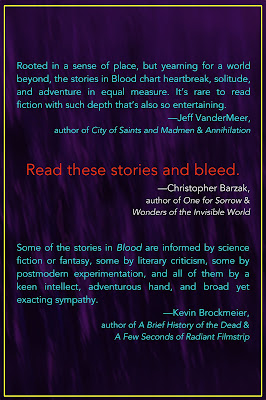 |
| 2 |
 |
| 3 |
 |
| 4 |
 |
| 5 |
 |
| 6 |
 |
| 7 |
1-7. These are a bunch of early attempts. None quite works (some
really don't work), and they would have all felt sharply separate from the front cover. We had lots of conversations about #4, though, as the publisher was quite attracted to the simplicity and boldness of it for a while.
 |
| 8 |
 |
| 9 |
 |
| 10 |
 |
| 11 |
 |
| 12 |
 |
| 13 |
 |
| 14 |
8-14. I love these, but they're all too complex for the back cover. As images, though, they still appeal to me deeply. I also like that they use
the Alejandro Canedo (or Cañedo) painting from Astounding (September 1947) that plays such an important role in the story "Where's the Rest of Me", though I also know we probably would have had to figure out how to get the rights to use it, and that could be a huge headache and a wild goose chase.
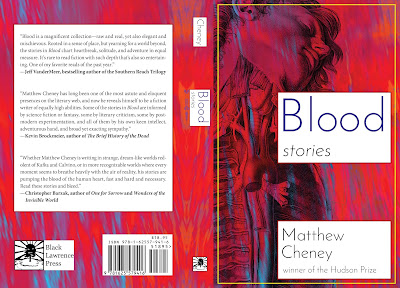 |
| Full, final cover |
The marvelous
Weird Fiction Review website has now posted
a conversation that Eric Schaller and I had about our books, our magazine
The Revelator, the weirdness of New Hampshire, and other topics.
Along with this,
WFR has posted Eric's story
"Voices Carry" (originally in
Shadows & Tall Trees) and my story
"The Lake" (originally in
Lady Churchill's Rosebud Wristlet).
So if you're curious about us or our writings (or just utterly bored),
Weird Fiction Review is a great place to start.
I'm thrilled that my
A Cappella Zoo story "Killing Fairies" has just been reprinted in
Best Gay Stories 2016 edited by Steve Berman for
Lethe Press.
The table of contents for
Best Gay Stories this year is quite strong, and it's an honor to be among this company. It's especially nice to have my story in a book with a story by Richard Bowes, since "Killing Fairies" is my attempt to write Bowesian tale: something that skirts the line between fiction and memoir. In this case, I wanted to preserve a few memories of my first year of college before those memories slip away (they grow dimmer and dimmer), and I thought a fun way to do that would be to give myself the challenge of trying to write like Rick.
It's harder than it looks. The problem for me was that my memories didn't add up to a story. There were a couple of really great characters (two of the strongest personalities I ever met in my life), but no story, just encounters that ultimately led nowhere because I quickly lost contact with those people as I developed a better network of friends. Then I thought: Who did I
hope to meet in college, but never did? And thus I created the strange, perhaps rakish character of Jack. Once he was added to the mix, the story began to cohere.
Here's a brief excerpt:
Killing Fairies
I met Jack at the end of my first year of college, a year that had begun in misery and ended in something else, though even now I'm not sure what to call it. Jack was two years ahead of me, and like me was one of the few people in our program who wanted to be a playwright and not a screenwriter. He was six-foot-four, scarecrow thin, with short sandy blonde hair and green eyes that won all staring contests. We had our first conversation during the height of a frigid winter. This was back in the mid-'90s, when you could still smoke inside buildings in New York City, and the smoking area for the Dramatic Writing Program at NYU was in a stairwell of the seventh floor of 721 Broadway, headquarters of all my shattered dreams. I regret I wasn't a smoker — it would have been easier to make friends, easier to have the casual conversations that led to connections, especially since the stairwell was an egalitarian place where the distinctions between faculty and students disappeared; the only distinction was between those who were fond of nicotine and those who were not.
I ended up in the stairwell with Jack because we were continuing a conversation we'd begun in class. It was a class called, simply, "Cabaret" — we all wrote and then performed two cabaret shows during the semester. Jack and I had somehow started talking about Arthur Miller, a playwright revered at DWP (he'd taught a course or two just before I enrolled). In class, I'd told Jack I thought Death of a Salesman was sentimental drivel, and he said he was thrilled to hear someone say that. Class ended, and we walked through the narrow DWP hallway to the stairwell, where a couple of other students nodded to Jack, though he paid no attention to them. As our evisceration of Miller's entire career wound down, and as I told Jack for the third time that no, I didn't need to bum a cigarette, he said, "So, tell me something about you I don't know."
"I'm left-handed," I said.
"I know that," he said.
"I'm from New Hampshire."
"Everybody here knows that."
"I used to read a lot of science fiction."
"How cute."
"What about you?" I said.
"Me?"
"It's only fair."
"Fine," he said, exhaling smoke. "I kill fairies."
I'm sure my face displayed exactly what he wanted: wide-eyed shock.
"People give them to me," Jack said. "Fairies. Plastic or glass. Dolls. Icons. And every one of them, I smash with a hammer, or I cut off their hair and wings, or I throw them in front of the subway, or I bite their fucking heads off and spit them to the ground."
Perhaps I chuckled nervously. More likely, I stood silent.
"You should come over sometime," he said. "It's fun. We can have a fairy-killing party."
--------------
Lethe is one of the few LGBT presses out there, and much deserves our support. (And they're currently celebrating their 15th anniversary!) The
Best Gay Stories series is consistently interesting and a valuable guide to queer writing today.
Here's the table of contents:
"A New Gay Fairy Tale" by Sandip Roy
"Repossession" by Jonathan Harper
"Gift-Wrapped" by Daniel M. Jaffe
"Wildlife" by Carter Sickels
"Fordham Court" by Richard Bowes
"What Do You Wear to a Nudist Colony?" by Michael Hess
"Marginalia" by Daniel Scott
"Monograph" by Mike Dressel
"Shoot-out" by Lou Dellaguzzo
"Killing Fairies" by Matthew Cheney
"Acres of Perhaps" by Will Ludwigsen
"Surfaces" by Peter Dubé
"Tea At Balmoral" by Paul Brownsey
"The Lesson" by Kelly Link
By: Matthew Cheney,
on 6/14/2016
Blog:
The Mumpsimus
(
Login to Add to MyJacketFlap)
JacketFlap tags:
interviews,
Movies,
horror,
Cheney publications,
aesthetics,
Electric Literature,
Michael Haneke,
neoliberalism,
Blood: Stories,
Adrian Van Young,
Texas Chainsaw Massacre,
Add a tag
The good folks at
Electric Literature invited me to converse with Adrian Van Young, perhaps not knowing that Adrian and I had recently discovered we are in many ways lost brothers, and so we could go on and on and on...
We talked about Texas Chainsaw Massacre, The Sublime, writing advice, writers we like, Michael Haneke, neoliberalism, The Witch, and all sorts of other things. It was a lot of fun and we could have gone on at twice the length, but eventually we had to return to our lives.
Many thanks to Electric Lit for being so welcoming.
I have been busy and have neglected this blog. I forgot to make a post here about some of the most exciting news of my year: I have a story in the current issue of my favorite literary magazine, Conjunctions. It's titled "Mass" and it is about, among other things, a mass shooting.
Early this morning, at least 50 people were killed and 53 wounded in a gay nightclub in Orlando, Florida. The New York Times is currently calling this the deadliest mass shooting in U.S. history.
I'm not going to write about the gun politics of this. For that, please read the work of Patrick Blanchfield, particularly "So There's Just Been a Mass Shooting", "God and Guns", and "The Gun Control We Deserve". (He's excellent on Twitter, as well, if you want his most recent thoughts.) I have sputtered on about the topic in the past, not always coherently. Patrick is better at it, and better informed, than I. Thinking through the complex, contradictory, vexing, and emotionally charged landscape of gun politics, I'm better (or at least more comfortable) in fiction. Thus, "Mass".
(Titles fascinate me. The title of this issue of Conjunctions is Affinity: The Friendship Issue. Affinity is something more than friendship. Friendship is useful, it feels good, it glues us socially, and sometimes it may be, yes, an issue. But affinity is more: its etymology [via Latin and French, a story told by the OED] is rich with ideas of relationship: relationship via marriage; any relationship other than marriage; a neighborhood; relationship between people based on common ground in their characters and tastes; spiritual connection; structural relationship; adjacency.)
A character in "Mass" has been reading theoretical physics:
“Not especially detailed theoretical physics, but introductory sorts of texts, popularizations, books for people who don’t really ever have a hope of truly understanding physics but nonetheless possess a certain curiosity. And its words are sometimes beautiful — a tachyonic field of imaginary mass — who couldn’t love such a phrase? I find it all strangely comforting, the more far-out ideas of quantum theory and such. It’s like religion, but without all the rigmarole and obeisance to a god. Or perhaps more like poetry, though really not, because it’s something somehow outside language, but nonetheless elegant, and of course constricted by language, since how else can we communicate about it? But it gestures, at least, toward whatever lies beyond logos, beyond our ability even to reason, though perhaps not to comprehend. At my age, and having spent a life devoted to language, there is comfort and excitement — even perhaps some inchoate feeling of hope — in glimpses beyond the realm of words. There is, I have come to believe, very much outside the text. What is it though? Call it God, call it Nature, call it the Universe, call it what it seems to me now to be — having read and I’m sure misunderstood my theoretical physics — call it: an asymptote.”
Mass. Affinity. Asymptotes.
The OED: b. Relationship by blood, consanguinity; common ancestry of individuals, races, etc.; an instance of this.
And then there is
"Blood". And
Blood: Stories.
"Why did you give it that title?" people ask. There are a lot of answers. (And that, in itself, is an answer.) Here's one: As a child of the early AIDS era, I always knew queer blood is politicized and scary. Scary, thus politicized. Politicized, thus scary.
Until recently, the FDA prohibited any man who had had sex with men since 1977 from donating blood. Now, if you've been celibate for a year, you can donate. The massacre in Orlando
brought this policy back into the news, with various outlets reporting that while queers were attacked, and blood was needed, any man who had had sex with a man in the last year could not, under FDA rules, donate blood.
Blood is a reality and blood is a potent metaphor: beautiful and terrifying, wonderful and evil.
Consanguinity.Blood is life and blood is death; blood is family and blood is genocide.
Is there an opposite to blood? What is
water in our metaphors? It washes blood away, but also sustains us as we live, for much of what we are is water. Tears are made of water, salt, enzymes, hormones. They taste like oceans and look like rain.
Water is what we weep.
I weep for my queer brethren. I weep, too, for the inevitable
homonationalism as queer shoulders are put to the wheel of US imperialism and US exceptionalism; as pride is wielded for Us against Them.
But I am not feeling political today.
Sometime looking backward
into this future, straining
neck and eyes I'll meet your shadow
with its enormous eyes
you who will want to know
what this was all about
—Adrienne Rich,
"A Long Conversation"
Yesterday, my aunt, after (as they say) a (short? long? relative to what?) illness, died.
We had never lived near each other, but she was a profound influence on my life. She and her daughter, my cousin, gave me Stephen King stories when I was much too young for them.
Night Shift, Skeleton Crew. The titles are still magic to me, the covers of the old paperbacks as powerful as any personal icon I have. So much of what I became as a writer is because of those stories. So much of what I became as a writer, then, is because of her.
She was a brilliant artist, a fun and funny person, so smart, so straightforward, saucy, even, and strong as the mightiest metal. She had a magnificent life with magnificent people in it, as well as hardship, oh yes, hardship, indeed, as we all do, yes, but still: she struggled, persevered, survived, didn't let the bastards get her down.
I will miss her forever and cherish her forever. Her husband, my uncle, provided me with my middle name, and I am always proud to have been named for him, one of the best people I know.
(The cover of my book called
Blood is a picture of a man with his heart removed.)
At the wedding of my youngest uncle some years ago, my oldest uncle, this great man now a widower, gave a toast in which he said ours is a motley family of steps and halfs, of once- and twice-removeds, of marriages and unions and affinities, but in the end those designations don't much matter, because family is family, and that's who we are, and what we are, and what we have, because we love each other.
Affinity. And even more so that most important of political cries: Solidarity.
I remember that Auden kept revising his poem
"September 1, 1939", because he couldn't decide between "We must love one another or die," "We must love one another and die," or nothing at all.
Here, then, my own tentative, inadequate revision:
We must love one another or nothing at all.I loved my aunt fiercely, and I love fiercely all you queer folk out there aching and screaming and scared and willing to fight, and all who dance against the gunfire, hands held together through the pain, lips together in solidarity, lives together as we live and live and live — even if separated by oceans, even if drowning in tears — always striving, even if never reaching, like asymptotes, like believers and holy fools — as we remember and honor the dead, as we go on, as we must, you, me, all — whether strangers or the oldest of lovers, we are — we must be — a mass of friends, family, water, blood.
And I dream of our coming together
encircled driven
not only by love
but by lust for a working tomorrow
the flights of this journey
mapless uncertain
and necessary as water.
—Audre Lorde
"On My Way Out I Passed Over You and the Verrazano Bridge"
Kenneth James is editing the journals of Samuel Delany for publication.
Volume 1 is coming out from Wesleyan University Press in December. For the future volumes, Ken needs help with funding.
If you already know how valuable this project is, don't read on. Just go donate.But if you need some convincing, please read on...
“Mesmerizing . . . a true portrait of an artist as a young Black man . . . already visible in these pages are the wit, sensitivity, penetration, playfulness and the incandescent intelligence that will characterize Delany and his extraordinary work.”
—Junot Díaz, author of The Brief Wondrous Life of Oscar Wao
“This is a tremendously significant and vital addition to the oeuvre of Samuel Delany; it clarifies questions not only of the writer’s process, but also his development—to see, in his juvenilia, traces that take full form in his novels—is literally breathtaking.”
—Matthew Cheney, author of Blood: Stories
“These journals give us the very rare experience of being able to watch genius escaping from the chrysalis.”
—Jo Walton, author of Among Others
As my blurb in the publicity materials shows, I've read volume 1, which covers the years 1957-1969. It's great. It shows us the very young Delany, it offers juvenilia and drafts that have never been public before, it shows his reading and writing and thinking during the period where he went from being a precocious kid to a professional writer. It's thoughtfully, sensitively edited, and is being published by the academic press that has been most devoted to Delany for a few decades now. It's a revelatory book.
Volume 2 will be even more exciting, I expect. Ken plans for it to begin with
Dhalgren material and then to continue through the 1970s, which would mean it includes material related to
Trouble on Triton, Tales of Nevèrÿon, and, depending on how he edits it,
Hogg, Neveryóna, Stars in My Pocket Like Grains of Sand, and others. It will also show how deeply connected Delany's nonfiction is to his fiction, and will show the development of his engagement with critical theory. Additionally, there's lots of material in the 1970s journals about his first experiences as a university teacher.
I'm just back from spending a few days at the
Delany archive at Boston University, and I've looked through a few of the 1970s journals. They're truly thrilling for anybody interested not only in Delany the writer, but in the writing and thinking process in general. They're especially interesting for those of us who think that after 1969, Delany's work only got more brilliant. They are working journals, not really diaries as we generally think of them, and they clarify a lot of questions of when particular things were written, and why, and how. That makes them, if nothing else, of immense scholarly value. But they've also got material in them that just flat-out makes for good reading.
The work of editing them is ... daunting. This is why Kenneth James deserves your donations. (Wesleyan University Press is great, but they've got limited funding themselves. These books are not going to sell millions of copies, not because people don't love Delany's work, but because there's a small market for this sort of publication.) Ken probably knows Delany's work as well as anybody on the planet other than (perhaps) SRD himself. As a Cornell undergraduate, he interviewed Delany in 1986 — an interview deemed substantial enough to be included in
Silent Interviews. Later, he wrote the introductions to
Longer Views and
1984: Selected Letters. He organized the SUNY Buffalo conference on Delany, the first international conference on SRD's work, and guest-edited the volume of
Annals of Scholarship that preserved some of the papers from that conference. He's written on various of Delany's books. He knows his stuff better than perhaps anybody else knows that stuff.
Ken is an independent scholar without a permanent university affiliation, which in this economic/academic structure means he has hardly any source of financial support for a project like this. He needs our support. Editing these journals is a full-time job if it's going to get done before the end of the century. The journals are handwritten, mostly in spiral ring notebooks. They're in various states of organization and disorganization. (The BU archivists are magnificent, and have done a great job of indexing and preserving the journals to the best of their ability, but these were working journals, not documents immediately designed for eternal preservation) And they are
copious. In six hours of reading and notetaking yesterday, I made it through only a few months' worth of journals. Transcribing, editing, and annotating them will be a gargantuan task. Ken has already proved it is a task he is prepared for, a task he is capable of completing. I don't think I could do it. I know he can.
I could go on and on. Delany is one of the most important writers and thinkers of our time. The more I read, the more I delve into his archive, the more I believe this to be true. I've spent a decade studying his work and feel I'm only now beginning to move beyond a superficial appreciation of it.
We need these books, and we need Ken to be the one to put them together. There is nobody better for the job.
Please help him do it.
A new interview with me — the first to come out since
Blood: Stories was released — is now up at
One Story's blog, part of the publicity leading up to the
One Story Literary Debutante Ball. Many thanks to Melissa Bean for conducting the interview, and for her very kind words about the book.
Here's a taste:
MB: On that note, what inspires your stories?
MC: Daydreams and nightmares created by anxieties, fears, and desires.
I don’t write fiction for the sake of therapy, per se, but I am prone to anxiety and I have an active imagination, so it’s often the case that a story starts from one of my weird anxiety fantasies.
Read more at One Story...
This afternoon, I will be flying to Los Angeles for the annual
Association of Writers & Writing Programs Conference. Here's my schedule of events, in case you're in the area and want to say hello...
- Thursday, 3/31: Black Lawrence Press reading and party at CB1 Gallery, 7pm
- Friday, 4/1: Signing at Black Lawrence Press booth (#1526), 1-2pm
- Saturday, 4/2: signing at the GLBTQ Caucus Hospitality Booth (#633), 12-12.30pm
And of course I'll be wandering around the conference and spending lots of time at the book fair.
View Next 25 Posts