


Add a Comment
new posts in all blogs
 By: Maryann Yin,
on 9/25/2015
By: Maryann Yin,
on 9/25/2015
Blog: Galley Cat (Mediabistro) (Login to Add to MyJacketFlap)
JacketFlap tags: Humble Bundle, Bookselling, Digital, Cory Doctorow, Jeff Smith, Alan Moore, Add a tag
By: Maryann Yin,
on 6/5/2015
Blog: Galley Cat (Mediabistro) (Login to Add to MyJacketFlap)
JacketFlap tags: Neil Gaiman, Authors, Videos, John Scalzi, Cory Doctorow, Margaret Atwood, Sir Terry Pratchett, Claire Armitstead, Add a tag
By: Maryann Yin,
on 12/11/2014
Blog: Galley Cat (Mediabistro) (Login to Add to MyJacketFlap)
JacketFlap tags: Celebrities, Neil Gaiman, Authors, Audiobooks, Cory Doctorow, Amanda Palmer, Wil Wheaton, Add a tag
 By: Neil Gaiman,
on 11/12/2014
By: Neil Gaiman,
on 11/12/2014
Blog: Neil Gaiman (Login to Add to MyJacketFlap)
JacketFlap tags: Hansel and Gretel, cory doctorow, Wits, The Sleeper and the Spindle, The art of asking, Add a tag
I came back to America and went to New York, where I talked at the New York Public Library about life, the universe and Hansel and Gretel, while dressed as dead Charles Dickens.
(You can watch or listen to the whole of that evening's interview with NYPL's own Paul Holdengraber at http://www.nypl.org/events/programs/2014/10/31/neil-gaiman-paul-holdengr%C3%A4ber).
They gave me a magical backstage library tour of creepy things, first. (It is chronicled here.)
Hansel and Gretel came out in the USA and is getting wonderful reviews. Here's the New York Times:


So two beautifully illustrated fairy tales came out on each side of the Atlantic.
I was honoured by the National Coalition Against Censorship at its 40th anniversary Gala dinner. (This is a video we made for them explaining why I love the First Amendment.)
But that wasn't the big book excitement in the household.
Nope. The big excitement was yesterday, when my wife, Amanda, became a published author with her first book.

She's also having to deal with the very real problem of Amazon in the US not stocking the book, due to their ongoing contract-battle with her publisher, Hachette. You can buy it from Barnes and Noble, with free shipping from Powells, or you could use Indiebound to find it or buy it from a local independent bookshop. But if you think you may want it, or if you know anyone who will want it for as a holiday gift... BUY IT THIS WEEK. Get it now. The bestseller rankings matter, and without the Amazon sales (they tend to be about half of a book's sales in the US) it's going to be much harder for her.
...
I was on WITS last week. I believe it will go out in podcast form on Friday Afternoon.
This is not to be confused with ASK ME ANOTHER, recorded many weeks ago, which also goes out in podcast form on Friday Afternoon.
For one week only, I will be semi-ubiquitous on public radio...
And finally... It was my birthday on Monday. I flew from Minneapolis to Boston, and gathered with Amanda in Harvard Square, to walk up to Porter Square Bookshop, with a crowd of late night bookbuyers, where she was going to do a midnight signing... And this happened:


 By: Maryann Yin,
on 10/14/2014
By: Maryann Yin,
on 10/14/2014
Blog: Galley Cat (Mediabistro) (Login to Add to MyJacketFlap)
JacketFlap tags: Authors, Comicbookland, Cory Doctorow, Bryan Lee O'Malley, New York Comic Con, Add a tag
By: Maryann Yin,
on 10/13/2014
Blog: Galley Cat (Mediabistro) (Login to Add to MyJacketFlap)
JacketFlap tags: Events, Oliver Jeffers, Cory Doctorow, Jodi Picoult, Blake Butler, Brandon Stanton, Cara Bertrand, Marcia Strykoski, Add a tag
By: Maryann Yin,
on 10/10/2014
Blog: Galley Cat (Mediabistro) (Login to Add to MyJacketFlap)
JacketFlap tags: Authors, Comicbookland, Illustrators, Cory Doctorow, Jen Wang, Add a tag
 By: Heidi MacDonald,
on 10/7/2014
By: Heidi MacDonald,
on 10/7/2014
Blog: PW -The Beat (Login to Add to MyJacketFlap)
JacketFlap tags: Interviews, Graphic Novels, Comics, Cartoonists, First Second, Cory Doctorow, Jen Wang, MMO Gaming, Add a tag
By: Dianna Dilworth,
on 7/22/2014
Blog: Galley Cat (Mediabistro) (Login to Add to MyJacketFlap)
JacketFlap tags: Copyright, Cory Doctorow, Add a tag
 By: Michelle,
on 7/16/2013
By: Michelle,
on 7/16/2013
Blog: Orca Book Publishers Blog (Login to Add to MyJacketFlap)
JacketFlap tags: graphic novels, Literacy, comics, comic, Educators, cory doctorow, reluctant reader, Add a tag


 Add a Comment
By: Jason Boog,
on 10/17/2012
Add a Comment
By: Jason Boog,
on 10/17/2012
Blog: Galley Cat (Mediabistro) (Login to Add to MyJacketFlap)
JacketFlap tags: eBooks, Cory Doctorow, Paolo Bacigalupi, Kelly Link, Lauren Beukes, Add a tag
.jpeg?picon=2765) By: Monica Zepeda,
on 7/1/2012
By: Monica Zepeda,
on 7/1/2012
Blog: The Librarian Writer (Login to Add to MyJacketFlap)
JacketFlap tags: Debut Author Challenge, bonus video, Reader's Corner, reading, Cory Doctorow, Little Brother, Add a tag
 By: Thao,
on 3/23/2012
By: Thao,
on 3/23/2012
Blog: B is for Books (Login to Add to MyJacketFlap)
JacketFlap tags: Lois Lowry, Linda Sue Park, Stephen King, Jules Feiffer, Lemony Snicket, Gregory Maguire, children's book, children's book reviews, Louis Sachar, Sherman Alexie, Houghton Mifflin, Jon Scieszka, Walter Dean Myers, M.T. Anderson, Artists I Love, Kate DiCamillo, Cory Doctorow, Chris Van Allsburg, Weird and Wonderful, Thao Lam, Young at Heart: Ages 8 and up, Tabitha King, The Chronicles of Harris Burdick, Add a tag
.jpg?picon=590) By: Lorie Ann Grover,
on 9/20/2011
By: Lorie Ann Grover,
on 9/20/2011
Blog: readergirlz (Login to Add to MyJacketFlap)
JacketFlap tags: libba bray, Garth Nix, steampunk, Holly Black, cassandra clare, Scott Westerfeld, Candlewick, M.T. Anderson, Cory Doctorow, Kelly Link, Add a tag
By: Lorie Ann Grover,
on 4/11/2011
Blog: readergirlz (Login to Add to MyJacketFlap)
JacketFlap tags: Rock the Drop, Cory Doctorow, Boing Boing, Emma Dryden, #rockthedrop, Add a tag
By: Micol Ostow,
on 3/7/2011
Blog: readergirlz (Login to Add to MyJacketFlap)
JacketFlap tags: Cory Doctorow, risk-taking, Add a tag
On Wednesday, we'll hear more from Cory about writing for young adult audiences, but in the meantime, let's talk - as a reader, do you think there's more risk involved in writing for a younger audience? How so? Do you think young adult readers are more open to riskier work?

 Add a Comment
.jpeg?picon=3626) By: Aaron Polson,
on 1/25/2011
By: Aaron Polson,
on 1/25/2011
Blog: The Other Aaron (Login to Add to MyJacketFlap)
JacketFlap tags: free stuff, Cory Doctorow, The House Eaters, The Bottom Feeders and Other Stories, Add a tag
By: Jason Boog,
on 11/14/2010
Blog: Galley Cat (Mediabistro) (Login to Add to MyJacketFlap)
JacketFlap tags: Uncategorized, Cory Doctorow, Add a tag
 By: Lauren,
on 9/13/2010
By: Lauren,
on 9/13/2010
Blog: OUPblog (Login to Add to MyJacketFlap)
JacketFlap tags: Film, Religion, apocalypse, A-Featured, A-Editor's Picks, cory doctorow, cherie priest, Apocalyptic AI, 2001: a space odyssey, death to humans, lord of the rings, warcraft, World of Warcraft, scientific american, the matrix, stanley kubrick, Manhattan College, apocalyptic, geraci, priest’s, Literature, Add a tag
 By: Aspiring Editor,
on 7/19/2010
By: Aspiring Editor,
on 7/19/2010
Blog: Aspiring Editor and Geek to the Core (Login to Add to MyJacketFlap)
JacketFlap tags: Cory Doctorow, Little Brother, paranoia, Marcus, paranoid, Xnet, Xnetter, M1k3y, Add a tag

.jpeg?picon=2058) By: Shelli,
on 6/1/2010
By: Shelli,
on 6/1/2010
Blog: Faeriality (Login to Add to MyJacketFlap)
JacketFlap tags: BEA bonanza, for the win, contest, giveaway, cory Doctorow, Add a tag
1) You must be a loyal follower to be eligible for any of the prizes. Why? Because I love meeting you guys and finding new bloggers/tweeters and can't unless you follower or comment. Also I think its only fair to reward those who come and listen to me rant :)
2) You must remember to enter for each prize. Remember each prize will ask you to take one action. So if you follower today and comment, it does not mean you are in the drawing for the whole month. You will be in the drawing today! Got it?
Bonus
Oh yeah, and when I hit 1,000 followers on my twitter and blog, I have a HUGE marketing prize you don't want to miss! So pass make sure your friends know about the Bonanza. Also if you sign up for my newsletter, at the end of the month, I will giveaway a secret package.
This month should be fun and I think you will love the giveaways I got for you so I hope you join me :)
Let's get to it!
Today's giveaway is:
A hardcover of Cory Doctorow's recently released of 26 Comments on BEA Bonanza - Day 1, last added: 6/2/2010
Display Comments
Add a Comment
 By: Anastasia Goodstein,
on 3/23/2010
By: Anastasia Goodstein,
on 3/23/2010
Blog: Ypulse (Login to Add to MyJacketFlap)
JacketFlap tags: reading rainbow, MTV, cory doctorow, little brother, Ypulse Essentials, perez hilton, Warner Bros., diesel, popeye, jersey shore, foursquare, miracle whip, be stupid, independent film channel, josh schwartz, MTV2, stephanie savage, the onion news network, Add a tag
By: Anastasia Goodstein,
on 12/1/2009
Blog: Ypulse (Login to Add to MyJacketFlap)
JacketFlap tags: breaking dawn, giant, cory doctorow, Ypulse Essentials, world aids day, current, beautiful creatures, LG, ford fiesta movement awards, give it a ponder, Heeb, Add a tag
 By: Melissa Wiley,
on 3/18/2009
By: Melissa Wiley,
on 3/18/2009
Blog: Here in the Bonny Glen (Login to Add to MyJacketFlap)
JacketFlap tags: Cynthia Lord, Cory Doctorow, Add a tag


 Add a Comment
 By: Eric Orchard,
on 11/24/2008
By: Eric Orchard,
on 11/24/2008
Blog: Eric Orchard (Login to Add to MyJacketFlap)
JacketFlap tags: cory doctorow, booties, henry, Add a tag
View Next 5 Posts
Viewing: Blog Posts Tagged with: cory doctorow, Most Recent at Top [Help]
Results 1 - 25 of 31
By: Maryann Yin,
on 9/25/2015
Blog: Galley Cat (Mediabistro) (Login to Add to MyJacketFlap)
JacketFlap tags: Humble Bundle, Bookselling, Digital, Cory Doctorow, Jeff Smith, Alan Moore, Add a tag
By: Maryann Yin,
on 6/5/2015
Blog: Galley Cat (Mediabistro) (Login to Add to MyJacketFlap)
JacketFlap tags: Neil Gaiman, Authors, Videos, John Scalzi, Cory Doctorow, Margaret Atwood, Sir Terry Pratchett, Claire Armitstead, Add a tag
 Trigger Warning author Neil Gaiman shared a beautiful friendship with the late Sir Terry Pratchett. During a conversation event with The Guardian books editor Claire Armitstead, he reminisced about one of his favorite memories with Pratchett. Click here to watch a video that features Gaiman recalling one of the last “out of the blue” conversations he had with Pratchett.
Since Pratchett’s passing, the world has been in mourning. Not too long ago, an anonymous graffiti artist painted a mural to honor Pratchett in London. Several authors have spoken out including The Handmaid’s Tale author Margaret Atwood, Old Man’s War series author John Scalzi, and Little Brother author Cory Doctorow.
Add a Comment
By: Maryann Yin,
on 12/11/2014
Blog: Galley Cat (Mediabistro) (Login to Add to MyJacketFlap)
JacketFlap tags: Celebrities, Neil Gaiman, Authors, Audiobooks, Cory Doctorow, Amanda Palmer, Wil Wheaton, Add a tag
 Writer Cory Doctorow has taken it upon himself to produce the audiobook edition of his book, Information Doesn’t Want to Be Free: Laws for the Internet Age.
According to Doctorow’s blog post, actor Wil Wheaton served as the narrator for this project. It also features “a mixdown by the wonderful John Taylor Williams, and bed-music from Amanda Palmer and Dresden Dolls.”
McSweeney’s released the hardcover version back in November 2014. Both Palmer and her husband Neil Gaiman wrote forewords for this project. (via Neil Gaiman’s Tumblr page)
New Career Opportunities Daily: The best jobs in media.
Add a Comment
By: Neil Gaiman,
on 11/12/2014
Blog: Neil Gaiman (Login to Add to MyJacketFlap)
JacketFlap tags: Hansel and Gretel, cory doctorow, Wits, The Sleeper and the Spindle, The art of asking, Add a tag
posted by Neil Gaiman
I went to Germany and Austria, and did book events and signings for Der Ozean am Ende der Straße.
I went to Paris and did book events and signings for L'océan au Bout du Chemin.I came back to America and went to New York, where I talked at the New York Public Library about life, the universe and Hansel and Gretel, while dressed as dead Charles Dickens.
(You can watch or listen to the whole of that evening's interview with NYPL's own Paul Holdengraber at http://www.nypl.org/events/programs/2014/10/31/neil-gaiman-paul-holdengr%C3%A4ber).
They gave me a magical backstage library tour of creepy things, first. (It is chronicled here.)
Hansel and Gretel came out in the USA and is getting wonderful reviews. Here's the New York Times:
Written with a devastating spareness by Neil Gaiman and fearsomely illustrated in shades of black by Lorenzo Mattotti, the newest version of “Hansel and Gretel” astonishes from start to finish. It doesn’t hurt that the book itself is a gorgeous and carefully made object, with a black floral motif on its pages’ decorated borders, along with abundant red drop caps and tall, round gray page numbers. ...All the well-chosen detail provides an ideal backdrop for what Gaiman and Mattotti have done with the Grimm Brothers’ familiar story of the two siblings who, after being abandoned by desperate parents, outwit their witchy captor. Their rendition brings a freshness and even a feeling of majesty to the little tale. Some great, roiling essence of the human condition — our fate of shuttling between the darkness and the light — seems to inhabit its pages.
Which is really rather wonderful.
The Sleeper and the Spindle came out in the UK, and is also getting great reviews. This Chris Riddell illustration raised some eyebrows:
When the picture was first seen we were criticised for writing a lesbian version of Snow White and Sleeping Beauty, and now people have read the story I've seen us criticised for not writing a lesbian version of Snow White and Sleeping Beauty.
What it is, I hope is a story about strong, smart women making their own stories. The Guardian's Amanda Craig said,
Neil Gaiman’s striking novella, The Sleeper and the Spindle, out this month, conflates and subverts Snow White and Sleeping Beauty into a tale of female courage and choice.and I'd take that.
So two beautifully illustrated fairy tales came out on each side of the Atlantic.
I was honoured by the National Coalition Against Censorship at its 40th anniversary Gala dinner. (This is a video we made for them explaining why I love the First Amendment.)
But that wasn't the big book excitement in the household.
Nope. The big excitement was yesterday, when my wife, Amanda, became a published author with her first book.
This is the cover. She spent the year writing it, following on from her TED talk of the same name, and it's just been published, on 11/11, by Grand Central. It's a remarkable book -- it's partly a memoir, partly a manifesto on crowdfunding and music and art, partly the story of our marriage and her friend Anthony's struggle with cancer and what that meant to Amanda's life and career. It's the story of how she did the most popular musical Kickstarter ever, and the weird and improbable shapes and twists her world has taken. It's about how we ask for things. It's about being vulnerable.
I think it's a fantastic book, but then, I'm biased, being in love with the author. (I'm also all through the book, not always flatteringly. It's a very honest book.)
Cory Doctorow writes a fantastic essay about Amanda, the book, asking and the shape of music and information in this decade over at the New Statesman:
First books are strange beasts. They are rougher than the books that follow (usually), but they are also full of literally everything that the author ever, over the course of her entire life, thought worthy of inclusion in a book. All subsequent books will be full of the things the writer came up with after she started publishing. The first one, that's got everything from the other side of the divide.
Palmer is a good writer, and in places she's great. She has a loose and at times meandering structure that usually works, except when it doesn't. As a literary work The Art of Asking is pretty good. But as a manifesto and a confessional of an artist uniquely suited to her time and place, it is without parallel.
What Palmer's story tells us is that asking, trusting, and giving are hard and terrifying, and you face real risk every time you do them.
Palmer receives death threats, is stalked and sexually assaulted by fans, is terrorised by fans who threaten suicide to command her attention.
Palmer doesn't make it look easy, this business of being public and naked. She makes it look hard. The Art of Asking is an inspiration because Palmer never tries to hide the scuffed duct-tape holding her life together. Instead, she takes us by the hand and insists that we look at this 21st century artistic business model with open eyes and realistic expectations.Which is the truth. It's also a very funny book. As Cory says, she's put everything in here.
She's also having to deal with the very real problem of Amazon in the US not stocking the book, due to their ongoing contract-battle with her publisher, Hachette. You can buy it from Barnes and Noble, with free shipping from Powells, or you could use Indiebound to find it or buy it from a local independent bookshop. But if you think you may want it, or if you know anyone who will want it for as a holiday gift... BUY IT THIS WEEK. Get it now. The bestseller rankings matter, and without the Amazon sales (they tend to be about half of a book's sales in the US) it's going to be much harder for her.
...
I was on WITS last week. I believe it will go out in podcast form on Friday Afternoon.
This is not to be confused with ASK ME ANOTHER, recorded many weeks ago, which also goes out in podcast form on Friday Afternoon.
For one week only, I will be semi-ubiquitous on public radio...
And finally... It was my birthday on Monday. I flew from Minneapolis to Boston, and gathered with Amanda in Harvard Square, to walk up to Porter Square Bookshop, with a crowd of late night bookbuyers, where she was going to do a midnight signing... And this happened:

0 Comments on The Most Important Publishing Event In Our House as of 11/13/2014 12:43:00 AM
Add a Comment
By: Maryann Yin,
on 10/14/2014
Blog: Galley Cat (Mediabistro) (Login to Add to MyJacketFlap)
JacketFlap tags: Authors, Comicbookland, Cory Doctorow, Bryan Lee O'Malley, New York Comic Con, Add a tag
 Over the weekend, Bryan Lee O’Malley appeared at New York Comic Con panel for a conversation with Cory Doctorow about his latest book, Seconds.
Following the great success he achieved with the Scott Pilgrim graphic novel series, he wanted to “do something super arty and weird.” For Seconds, O’Malley set out to write “a very external character…characters who just barge through life.” The star protagonist of this story, Katie, was partially inspired “by an obnoxious rock star.”
Regardless of the project, two parts of O’Malley’s creative process remain constant. First, he has to create the perfect mix tape because he will likely listen to it “thousands of times.” Second, he takes this approach: “every new book idea, I’m just going to tackle a problem and fix it.” What’s the initial step you take when you start a new project?
New Career Opportunities Daily: The best jobs in media.
Add a Comment
By: Maryann Yin,
on 10/13/2014
Blog: Galley Cat (Mediabistro) (Login to Add to MyJacketFlap)
JacketFlap tags: Events, Oliver Jeffers, Cory Doctorow, Jodi Picoult, Blake Butler, Brandon Stanton, Cara Bertrand, Marcia Strykoski, Add a tag
 Here are some literary events to pencil in your calendar this week.
To get your event posted on our calendar, visit our Facebook Your Literary Event page. Please post your event at least one week prior to its date.
Writer Cory Doctorow will talk about his new graphic novel, In Real Life. Hear him on Monday, October 13th at The Strand starting 7 p.m. (New York, NY)
New Career Opportunities Daily: The best jobs in media.
Add a Comment
By: Maryann Yin,
on 10/10/2014
Blog: Galley Cat (Mediabistro) (Login to Add to MyJacketFlap)
JacketFlap tags: Authors, Comicbookland, Illustrators, Cory Doctorow, Jen Wang, Add a tag
Cory Doctorow and Jen Wang have collaborated on a new graphic novel entitled In Real Life.
The book touches on several subjects including gaming, socializing over the internet, and more. This project marks the first time that Doctorow and Wang have come together as collaborators.
We spoke with both the writer and the illustrator to hear their thoughts on creativity, research, and editing. Here are the highlights…
New Career Opportunities Daily: The best jobs in media.
Add a Comment
By: Heidi MacDonald,
on 10/7/2014
Blog: PW -The Beat (Login to Add to MyJacketFlap)
JacketFlap tags: Interviews, Graphic Novels, Comics, Cartoonists, First Second, Cory Doctorow, Jen Wang, MMO Gaming, Add a tag
 By Kyle Pinion
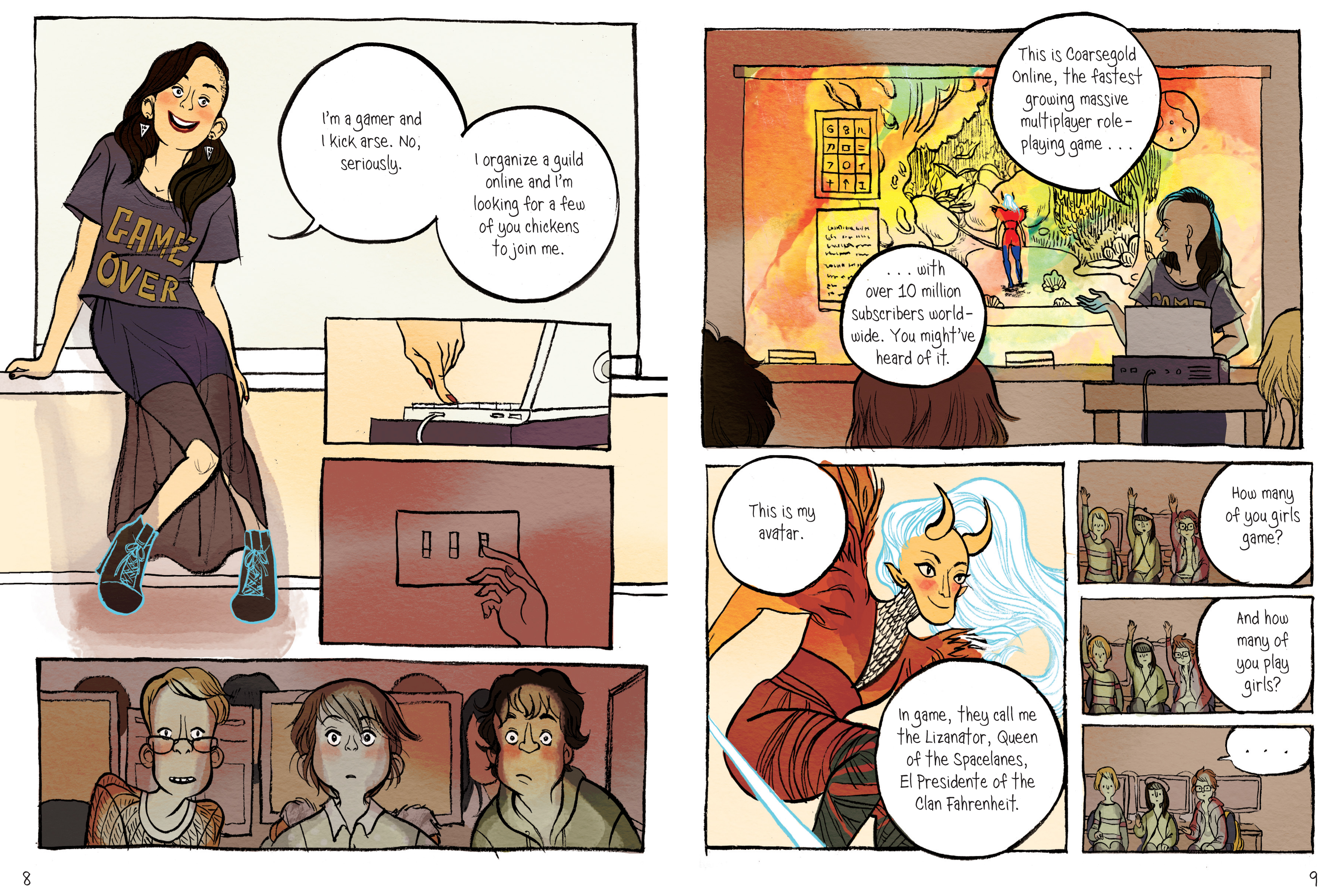
IN REAL LIFE, a graphic novel collaboration between journalist/author Cory Doctorow and comics creator Jen Wang, centers on a young gamer named Anda who becomes enraptured by an massively multiplayer online game (MMO) called “Coarsegold Online”. While logged-in, she makes new friends, including a gregarious fellow gamer named “Sarge” and a “gold-farmer” from China named Raymond. It’s the latter whose activities, which center on illegally collecting valuable objects in the game and selling them to other players from developed countries, begin to open up Anda’s perspectives on the concepts of right and wrong, and the power of action towards civil rights.
The book was a true eye-opener for me, as I’m not a gamer by any stretch of the imagination beyond the occasional dalliance on my console system at home. I was delighted when I received an opportunity to chat with Jen Wang about the origins of this project, its underlying themes, and how much of her own gaming experience played into the development of the narrative.
How did IN REAL LIFE (IRL) find its genesis? Did you know Cory Doctorow prior to working on this project?
Prior to IN REAL LIFE I was familiar with Cory Doctorow as a blogger and activist but I hadn’t read his fiction. ANDA’s GAME, the short story IRL is based on was actually the first piece I read. My publisher First Second sent me a link to the short and asked if I’d be interested. After reading that, it was hard to say no!
What is it about the subject matter that drew you in initially?
I like that it takes gaming, which many people see as frivolous entertainment, and gives it a real life context. The internet is inherently a social platform and it makes sense that it reflects our darker tendencies, such as exploiting people. I also like that it touches on the tension between China and the West. There’s just so much interesting material to explore and at the end of the day it’s still a simple story about two teenage gamers from different countries who become friends.
Your previous work, KOKO BE GOOD, also published through First Second, was solely written and illustrated by yourself. Do you find that there are inherent advantages in the collaborative process, and is there a method you prefer over the other?
It’s definitely a lot easier to illustrate your own work, that’s for sure. The collaborative process is more challenging, but you also get a second point a view and a direction to work towards. Sometimes in your personal work it takes a lot of soul searching to figure out what you’re trying to say but a collaborate project allows you to bounce off other people’s ideas and that’s really refreshing.
On the day to day work on the graphic novel, what was the working relationship between Cory and yourself? Were you in constant contact?
During the scripting phase of the book we were sending a lot of emails. I would write a draft, send it to Cory, and he would send some notes and bounce some ideas back. We went through maybe 8 or so drafts so it took a little while to nail down the final. I was pretty much left alone at the drawing stage, however.
How much of a specific vision did Cory have in the initial “Anda’s Game” script, and how much input did you have on character design before the development of IRL? Do you feel like Anda specifically has your “stamp” on her?
I had pretty much free reign as far as design went, so that part was fairly easy. When First Second approached me to do the project they wanted me to feel comfortable writing my own take, so mostly it was me pitching ideas to Cory and him giving me notes. I do feel like I have my stamp on Anda but then again I don’t know how it wouldn’t have happened naturally. She’s a nerdy teenage shut in and having been one myself I can relate to that a lot.
The gaming details throughout are very specific, do you have a significant gaming/MMO background as a user? If not, is that an area where Cory contributed significantly?
I don’t really have a background in MMOs but I played World of Warcraft for a couple weeks prior to starting the project. That plus a combination of sandbox games I’ve played were the inspiration for Coarsegold online. I mostly tried to create a game that felt familiar and yet tailored it to things I like in games. I’m very much into customization and resource management so it was fun to add things like to the book.
How do you sense that communication has changed for Generation Y and The Millennials? Do you find that you side more with Anda or her mother in what technology brings to social interaction?
I’m definitely on the Millennials side. I can’t imagine what my life would be like now if I didn’t have access to the internet as a teenager. I met so many other young artists online and they really motivated me to create and challenge myself. Without it, I would’ve had to seek these people out in college in person and I would’ve been a lot more lonely and isolated. There are risks to putting yourself online but there are risks to be alive in the real world as well. The best you can do is exercise caution and be smart about your privacy in the same way you would anywhere.
Is there anything from your own experience pulled into Anda’s story, at least from a characterization standpoint? Do you see Anda as a role model? Was that the intention all along?
I was a lot like Anda in high school. I was a teenage hermit who spent a lot of time connecting to peers online within my community of choice. Like Anda, I found my identity online because I was able to meet other people like myself. I see Anda less as a traditional role model and more as someone readers could relate to. Like Anda, most young people now are discovering the world through the internet and it can be a difficult place to navigate.
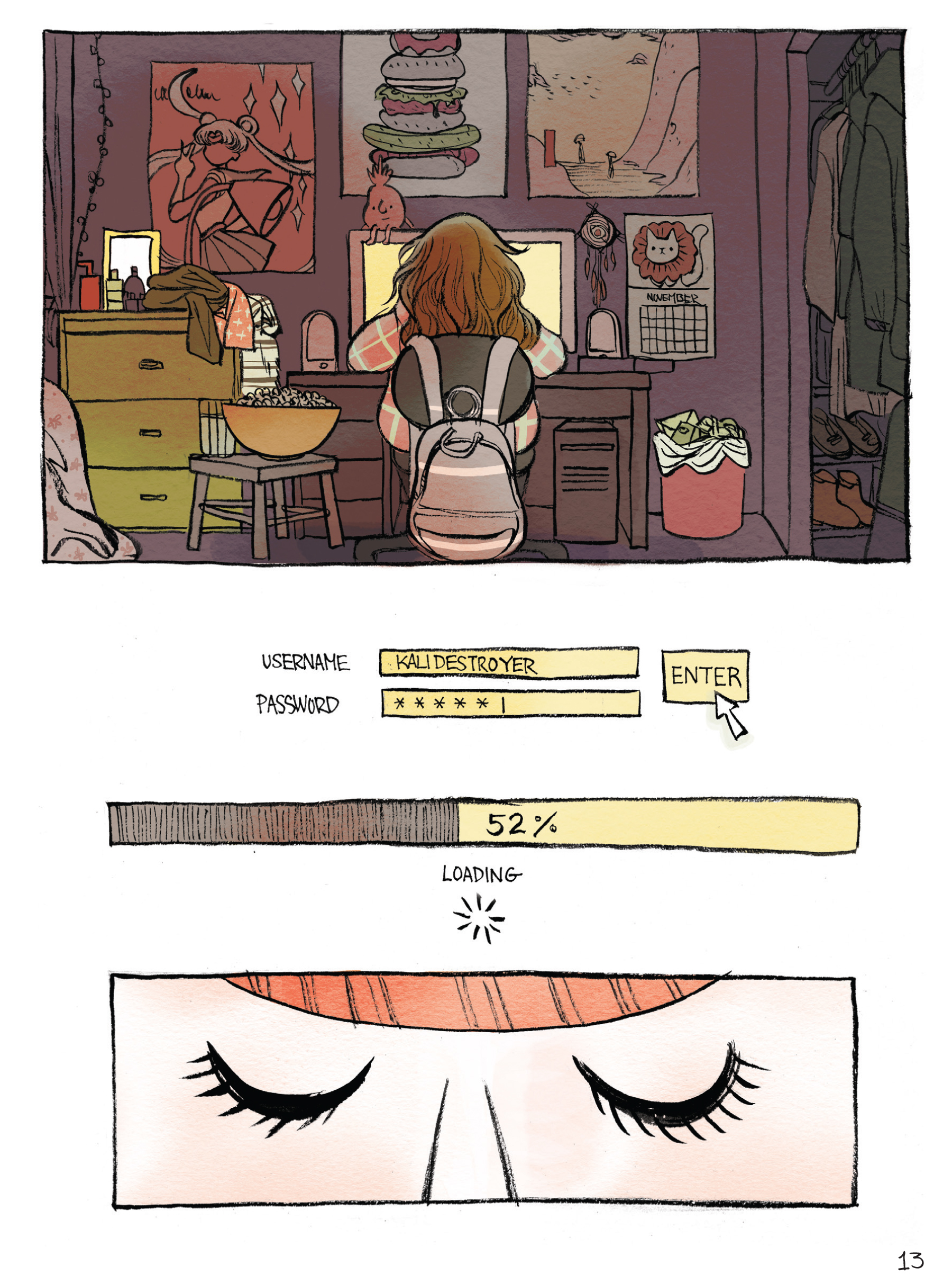
What drove the design of the world of Coarsegold? Any specific influences?
World of Warcraft is the main one, but I also looked at the Final Fantasy games, Skyrim, and more open world games like Animal Crossing, The Sims and Second Life.
What was the thought process on the color-design that differentiates Coarsegold from “the real world”?
I definitely wanted Coarsegold to be more bright and colorful by contrast as a reflection of Anda’s feelings toward both realities. I used different filters and colored textures so that real life was a little more tan and monochromatic while Coarsegold looked lively and exciting.
When Anda somewhat bridges the gap between the two by changing her hair color to match her avatar, what kind of sea-change does that indicate for her personally?
At that point in the story Anda has finally found purpose and confidence in her role as a Fahrenheit. Not only has she befriended Raymond and discovered this world of goldfarming, but she’s taken on the task of helping him. It’s a decision she’s been able to make for herself separate from what her peers have led her to believe, and changing her hair color is a symbol of this newfound confidence.
IN REAL LIFE defies expectations a bit in that it shifts a bit touching briefly on females in gaming (with the very succinct hand-raising scene in the classroom and some of the concerns of “Sarge”) and then moves into an area centering on economics and specifically civil rights. Do you sense a strong correlation between the two themes?
Oh, for sure. As in real life, the conflict within Coarsegold comes from who is considered an “other.” As a young girl in gaming, Anda is a minority, yet she’s in a position of power compared to Raymond who is not only a foreigner who doesn’t speak English, but also a goldfarmer. They’re able to connect as outsiders of this gaming establishment and both are fighting for the right to be themselves and be seen as equals.
I have to admit that the term “gold farming” is fairly new to me (as a non-gamer), and IRL paints a very morally grey picture around that activity, what do you feel as though readers should take from the book’s portrayal of that subject?
Gold farming was new to me too until I started researching for this book. There is a lot of grey area and it’s still evolving. What I do hope the readers takes away from IRL is the ability to keep an open mind about the people on the other side of the tracks and be empathetic to their struggles. On the surface the gold farming community appears to be taking advantage of game-makers and the “purity” of the game. On the other hand the gold farmers themselves are actually big fans who can only participate by being taken advantage of.
What inspired the creation of Raymond? Both in the look of his avatar and the character’s plight in China?
I wanted the goldfarmers to look small and vulnerable compared to everyone else. They haven’t been able to level up their characters and they’re not customized so Raymond doesn’t look any different from his peers. I also wanted them to not look human so as to “otherize” the goldfarmers in the eyes of Anda and Lucy at the beginning of the story. For Raymond’s human backstory I took a lot of inspiration from a book I read called FACTORY GIRLS: FROM VILLAGE TO CITY IN A CHANGING CHINA by Leslie T. Chang. It paints these very compassionate portraits of young female migrant workers and the everyday victories and struggles they face. Raymond comes from a very disadvantaged background but he’s also clever and ambitious enough to get what he wants (to play Coarsegold) with the means that he has.
Do you feel a sense of responsibility to educate as a creator publishing a book within the Young Adult literary genre? Does that affect the kinds of stories you hope to tell?
I don’t make it a point to be an educator, but I hope my stories reflect the world I’d like to see and the problems I’d like us to overcome.
If there was one-key take away or message from IN REAL LIFE that should highlighted, what would that be?
Be compassionate to others and be aware of how your role in the community may be inadvertently hurting others less privileged than you.
What’s next on the horizon for you post the release of IRL next month? Any new projects that you can share?
I have a couple new projects I can’t really talk about yet, but I’m excited to share I’m co-organizing a new comics festival in Los Angeles called Comics Arts LA. It’s a one day event that will take place on December 6th. We’ve got really great exhibitors lined up so it’s going to be fun. If any readers out there are in Southern California that weekend, I encourage you to come check it out! http://comicartsla.com
IN REAL LIFE will be available in a bookstore near you on October 14th through First Second
1 Comments on Jen Wang Aims To Give Gaming A Real World Context For ‘In Real Life’, last added: 10/8/2014
Display Comments
Add a Comment
By: Dianna Dilworth,
on 7/22/2014
Blog: Galley Cat (Mediabistro) (Login to Add to MyJacketFlap)
JacketFlap tags: Copyright, Cory Doctorow, Add a tag
Digital writing community Wattpad is making it easier for writers to make their work available to be the basis of fan fiction. The social network has expanded its Creative Commons licensing option to level 4.0, which essentially means that they are giving writers more options to rework and remix the work of other writers.
Writers can participate by tagging their stories with the CC 4.0 licensing option, making their stories searchable to site visitors looking for work to expand upon. Wattpad has more than 300,000 stories which include this distinction. Sci-fi author Cory Doctorow has shared five works on Wattpad under these licenses, including Homeland and Little Brother. To help promote the launch of CC 4.0, he has made his first novel Down and Out in the Magic Kingdom available for other writers to rework on Wattpad.
“The biggest question facing new writers today isn’t how to protect their work; it’s how to find a readership for it,” stated Doctorow. “It makes complete sense that so many Wattpad writers are gravitating toward Creative Commons licenses: by giving others permission to share your writing, you can open doors to new audiences and new creative opportunities.”
New Career Opportunities Daily: The best jobs in media.
Add a Comment
By: Michelle,
on 7/16/2013
Blog: Orca Book Publishers Blog (Login to Add to MyJacketFlap)
JacketFlap tags: graphic novels, Literacy, comics, comic, Educators, cory doctorow, reluctant reader, Add a tag
Raising a reader: how comics and graphic novels can help your kids love to read!
Great article by Cory Doctorow highlighting a new educational resource about comics’ role in literacy. Titled “Raising a Reader” and written by Dr. Meryl Jaffee, this resource is aimed at parents and educators and is available in PDF form for free download.
By: Jason Boog,
on 10/17/2012
Blog: Galley Cat (Mediabistro) (Login to Add to MyJacketFlap)
JacketFlap tags: eBooks, Cory Doctorow, Paolo Bacigalupi, Kelly Link, Lauren Beukes, Add a tag
Can the pay-what-you-want model work for the publishing industry? With six days left to purchase, the Humble eBook Bundle has already raised $855,755.
The Humble Bundle team has offered a collection of digital books from writers like Cory Doctorow, Paolo Bacigalupi, Lauren Beukes, Kelly Link and more, letting readers pay as much or as little as they want. As of this writing, they have already sold 63,441 copies of the bundle, with the average buyer paying $13.49 for the bundle.
Here’s more from the site: “Separately, this collection of fantastic novels and comics would cost around $157. But we’re letting you set the price! These eBooks are available in multiple formats including PDF, MOBI, and ePub so they work great on your computer, eBook readers, and a wide array of mobile devices … Choose how your purchase is divided: to the authors, the Electronic Frontier Foundation, the Child’s Play Charity, and/or the Science Fiction and Fantasy Writers of America.”
New Career Opportunities Daily: The best jobs in media.
Add a Comment
By: Monica Zepeda,
on 7/1/2012
Blog: The Librarian Writer (Login to Add to MyJacketFlap)
JacketFlap tags: Debut Author Challenge, bonus video, Reader's Corner, reading, Cory Doctorow, Little Brother, Add a tag
"I'm glad I'm off the grid." <!--[if gte mso 9]> Normal.dotm 0 0 1 111 637 Mouse, Mouse & Duque 5 1 782 12.0 <![endif]--><!--[if gte mso 9]> 0 false 18 pt 18 pt 0 0 false false false <![endif]--><!--[if gte mso 9]> <![endif]--> <!-- /* Font Definitions */ @font-face {font-family:Cambria;
0 Comments on Reader's Corner - June Update as of 1/1/1900
Add a Comment
By: Thao,
on 3/23/2012
Blog: B is for Books (Login to Add to MyJacketFlap)
JacketFlap tags: Lois Lowry, Linda Sue Park, Stephen King, Jules Feiffer, Lemony Snicket, Gregory Maguire, children's book, children's book reviews, Louis Sachar, Sherman Alexie, Houghton Mifflin, Jon Scieszka, Walter Dean Myers, M.T. Anderson, Artists I Love, Kate DiCamillo, Cory Doctorow, Chris Van Allsburg, Weird and Wonderful, Thao Lam, Young at Heart: Ages 8 and up, Tabitha King, The Chronicles of Harris Burdick, Add a tag
The Toronto Librarians are on strike. There is no need to panic… Ahhhhhhhh! Failing to reach a labour agreement over the weekend 2,400 librarians went on strike. All 98 library branches across Toronto are close as of Monday. The library is asking borrowers to hold on to all checked out books and materials. No overdue [...]
Add a Comment
By: Lorie Ann Grover,
on 9/20/2011
Blog: readergirlz (Login to Add to MyJacketFlap)
JacketFlap tags: libba bray, Garth Nix, steampunk, Holly Black, cassandra clare, Scott Westerfeld, Candlewick, M.T. Anderson, Cory Doctorow, Kelly Link, Add a tag
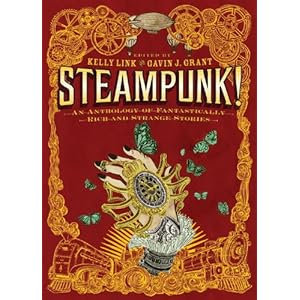
You know we love steampunk at readergirlz. We had a blast with Scott Westerfeld, right? Well, how about a collection of steampunk short stories by some more of our favorite, favorite YA authors? You'll recognize many from our rgz Circle of Stars, past guests and contributors. Grab your goggles, because this collection by Kelly Link and Gavin J. Grant delivers!
So, what will you find in Steampunk: An Anthology of Fantastically Rich and Strange Stories? How about mystery, murders, and machines? Worlds of gears and steam in amazing new locations from the minds of 14 writers: M. T. Anderson, Holly Black, Libba Bray, Shawn Cheng, Cassandra Clare, Cory Doctorow, Dylan Horrocks, Kathleen Jennings, Elizabeth Knox, Kelly Link, Garth Nix, Christopher Rowe, Delia Sherman, and Ysabeau S. Wilce.
How fun to find new authors I hadn't discovered before among old friends, all writing speculative fiction which often left me with chills. This quote from Cory's short story "Clockwork Fagin" really captures the collective atmosphere of Steampunk!:
"For machines may be balky and they may destroy us with their terrible appetite for oil, blood, and flesh, but they behave according to fixed rules and can be understood by anyone with the cunning to look upon them and winkle out their secrets. Children are ever so much more complicated."
Perfect, right? With three starred reviews already, look for this release October 11th!
Steampunk!: An Anthology of Fantastically Rich and Strange Stories
edited by Kelly Link and Gary J. Gavin
Candlewick Press, 2011 Add a Comment
By: Lorie Ann Grover,
on 4/11/2011
Blog: readergirlz (Login to Add to MyJacketFlap)
JacketFlap tags: Rock the Drop, Cory Doctorow, Boing Boing, Emma Dryden, #rockthedrop, Add a tag
As folks start spreading the word, emails are flying in about how YA lit lovers are going to ROCK THE DROP!
Beloved Emma Dryden is planning on dropping 8 YA novels around upper Manhattan, including Central Park!
Boing Boing is helping to spread the news. Thanks, Cory!
People are tweeting as the celebration gathers steam. Let's use #rockthed
By: Micol Ostow,
on 3/7/2011
Blog: readergirlz (Login to Add to MyJacketFlap)
JacketFlap tags: Cory Doctorow, risk-taking, Add a tag
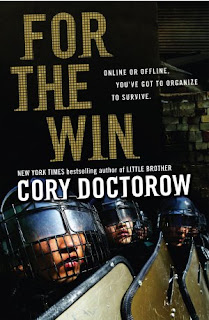
Hi, readergirlz, and welcome to March on the blog! Today kicks off our first feature for our theme of Risk-taking, but we're actually doing things a bit differently this week. Our featured author will be Cory Doctorow, who wrote the excellent For the Win, but we thought just this once, we'd kick the discussion off with you!
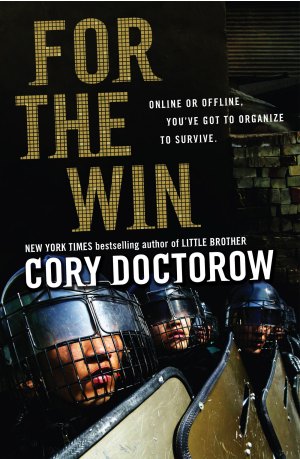
On Wednesday, we'll hear more from Cory about writing for young adult audiences, but in the meantime, let's talk - as a reader, do you think there's more risk involved in writing for a younger audience? How so? Do you think young adult readers are more open to riskier work?
By: Aaron Polson,
on 1/25/2011
Blog: The Other Aaron (Login to Add to MyJacketFlap)
JacketFlap tags: free stuff, Cory Doctorow, The House Eaters, The Bottom Feeders and Other Stories, Add a tag
Really, I don't mind. In fact, I encourage you to steal my book. The way I figure it--and I'm stealing the idea from Cory Doctorow, proving piracy of ideas is pretty common--anyone who steals my book wasn't going to pay for it in the first place.
What am I talking about? Well, I discovered (through the magic of Google Alerts...if you are an author and don't have one set to your name do it now) The Bottom Feeders is available through a file sharing site. Another site has it available for $1.99. Ha! Good luck selling it, folks. I'm not doing so hot at $.99. (5 sold in January so far...)
But I digress. Please, feel free to trade my book "illegally". Any of my books, actually. If it means more people read the books--awesome. The problem, see, is that most book pirates probably don't read all those files. Pirates pirate because they can--I'd say some are addicted to file downloading. I want to meet readers who are addicted to reading. So steal my book. Steal it all over the place. Just leave my name on it, okay, because not to do so would be the real theft.
Speaking of free things and reading, you can sign up for a free preview of The House Eaters. Just fill in the appropriate info off to the left. The book is coming. Soon.
In fact, it goes to print tonight...barring any major problems.
Excited?
Yes.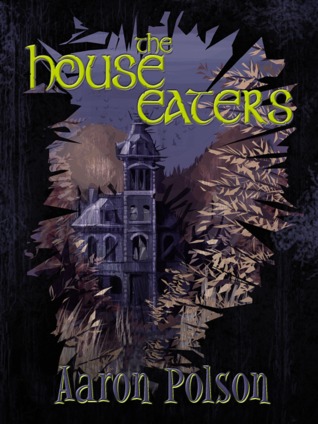
 Display Comments
By: Jason Boog,
on 11/14/2010
Display Comments
By: Jason Boog,
on 11/14/2010
Blog: Galley Cat (Mediabistro) (Login to Add to MyJacketFlap)
JacketFlap tags: Uncategorized, Cory Doctorow, Add a tag
 When working on your National Novel Writing Month manuscript, don’t let unknown facts slow down your writing. Instead of inventing facts or plagiarizing somebody work, just type TK and keep writing.
Novelist Cory Doctorow shared the simple and practical tip at Lifehacker: “[D]o what journalists do: type ‘TK’ where your fact should go, as in ‘The Brooklyn bridge, all TK feet of it, sailed into the air like a kite.’ ‘TK’ appears in very few English words (the one I get tripped up on is “Atkins”) so a quick search through your document for ‘TK’ will tell you whether you have any fact-checking to do afterwards. And your editor and copyeditor will recognize it if you miss it and bring it to your attention.”
This is our fourteenth NaNoWriMo Tip of the Day. As writers around the country join the writing marathon this month, we will share one piece of advice or writing tool to help you cope with this daunting project. For more writing advice, read our interview with Doctorow.
New Career Opportunities Daily: The best jobs in media.
Add a Comment
By: Lauren,
on 9/13/2010
Blog: OUPblog (Login to Add to MyJacketFlap)
JacketFlap tags: Film, Religion, apocalypse, A-Featured, A-Editor's Picks, cory doctorow, cherie priest, Apocalyptic AI, 2001: a space odyssey, death to humans, lord of the rings, warcraft, World of Warcraft, scientific american, the matrix, stanley kubrick, Manhattan College, apocalyptic, geraci, priest’s, Literature, Add a tag
Read his previous post, 10 Ways World of Warcraft Will Help You Survive the End of Humanity!
By Robert M. Geraci
Scientific American recently rocked the Internet with its editors’ piece “Death to Humans! Visions of the Apocalypse in Movies and Literature” but, in doing so, have missed half of the fun. In an article where the sublime (The Matrix) meets the atrocious (The Postman), the chief problem that SciAm’s editors suffer is that, to be honest, they do not know what an apocalypse is.
Threats to the world are not apocalyptic. In one of the apocalyptic texts par excellence, the Book of Revelation, the world isn’t just going to end…it’s going to transform in radical fashion (admittedly thanks to the seven seals that FBI and ATF members thought were marine mammals when David Koresh quoted them, the many-headed beast, and the whore of Babylon who will be drunk on the blood of the martyrs). Despite all the trials and tribulations, the end of the world is a good thing: it will end with the establishment of a wondrous new one.
So, how about some more apocalyptic films and books?
R.U.R. (1927; play) – Robots plan on killing us all. But after they’ve finished their noble work, they will explore an earth purged of, umm, us.
2001: A Space Odyssey (1968; film and novel) – In Kubrick’s and Clarke’s classic, David Bowman gets sucked into a galactic hotel and comes back a “Star Child” who can toss aside nuclear weapons as though they are paper airplanes. A new world shall dawn in the warm glow of the cosmic baby’s power.
Dark City (1998, film) – After John Murdoch psychokinetically conquers the aliens who have enslaved humankind, he remains stuck in a spaceship but uses its powers to provide himself with a West coast paradise where he will spend the future with a lovely woman whose memories have been tailored to match his own.
The Lord of the Rings (1954-1955 and 2001-2003; novels and films) – When two hobbits (one deranged and well past his prime, the other just twisted and tired after a noble quest) struggle at the flaming precipice of Mount Doom, they inaugurate a new world. In the end, lava purges the forces of evil and the friendly hobbits have a fighting chance to spend eternity blowing smoke rings and cheering for fireworks.
Down and Out in the Magic Kingdom (2004; novel) – Cory Doctorow paints us a future where we can spend an infinity in Disney Land, rejuvenating our bodies and, when necessary, restoring our minds to cloned bodies in the case of, well, an accident. And the line at the Pirates of the Caribbean ride won’t matter because you have an infinite amount of time to wait.
Accelerando (2006; novel) – After the machines take over the solar system, predicts Charles Stross, we can always ask a divine
0 Comments on Death to Humans! (The Apocalypse Remix) as of 1/1/1900
Add a Comment
By: Aspiring Editor,
on 7/19/2010
Blog: Aspiring Editor and Geek to the Core (Login to Add to MyJacketFlap)
JacketFlap tags: Cory Doctorow, Little Brother, paranoia, Marcus, paranoid, Xnet, Xnetter, M1k3y, Add a tag

A rush of emotions, action around every corner, suspision and paranoia to the max. This book had my gut wrenching and my head reeling.
This was another book I had no synopsis of before reading. I didn't even have a cover to go off of. All I had was a recommendation from a friend and his request that we read it "together". Meaning he had a copy on his phone, I had a copy on my Kindle and we would try to keep the same pace.
Last night he had the goal of finishing it by Tuesday. I said, ummm, no, we need to finish this tonight. And we did! (He actually finished it before I did.)
Cory Doctorow put a new twist on the old tale of 1984. I felt the same horror as I did when reading 1984 but could relate to it a little more because it was full of known technology and based in San Francisco, a place I've always wanted to visit. But it was more than that. The characters were brilliantly developed. You could picture each one of them and realize they'd probably be your friends if you knew them in real life. You too would be an "Xnetter", jamming with the best of them, if the government unjustly took over your city.
For a technologically savvy book, you don't have to be all that tech savvy yourself to understand it. I do know the power of code and the rush you get when a computer does what you tell it to do, but that's about as far as my technology knowledge goes. (I can't program a whole computer, just simple re-coding for websites. So, don't be impressed, please.)
Living with fear of a branch of the government that has gone rogue, hiding behind a movement with a code name M1k3y, unable to tell your parents you were jailed and tortured for 5 days, Marcus Yallow represents so many ideals and fears it's a wonder he doesn't implode.
Any high school and college age kid would get a lot out of this book. The controversy it brings up and the situations it thrusts the readers into creates a world we can all relate to in some form or other. We can all either be Marcuses or Charleses. Or maybe even Darryls or Vans. Or Anges. There's a character for everyone to put themselves into. What better way to read a story than to become part of it?
0 Comments on Little Brother as of 1/1/1900
Add a Comment
By: Shelli,
on 6/1/2010
Blog: Faeriality (Login to Add to MyJacketFlap)
JacketFlap tags: BEA bonanza, for the win, contest, giveaway, cory Doctorow, Add a tag
I'm alive!!!
I had the best time at BEA. Books books books! That's all it is for 3 days!
I shipped home 100 lbs of books! Yes I did! And most of them are for you! (Hate to admit it but I'm keeping some for myself!! Hey I didn't almost die twice for nothin'! :).
A little bit about BEA - its like playing the Hunger Games only in a bookstore instead of an outside arena. And Books are a hotter commodity than any food or weapons. In fact, books ARE your weapons! I'm not kidding when I saw I almost died twice - either by being trampled or killed with a new Hardback.
The slogan of the week with Jen Hayley and Shana Silver: "If we lose you, you are on your own!" ;) If you dont believe me, check this out!
Here's the deal - June is filled with stuff for you in celebration of all the books promoted at BEA. There will be:
- Signed books
- ebook ARCs
- paperback ARCs
- Book Swag
- Agent contests - Bree Ogden (Martin Literary), Mary Kole (Andrea Brown), and Suzie Townsend (Fineprint)
- Editor scoop - Daniel Ehrenhart (Harper), Regina Griffin (Egmont), Natashya Wilson (Harlequin Teen) and more!
- Author interviews - James Dashner, Holly Cupala, Jennifer Lynn Barnes, Kiersten Miller and more!
- and more.
- My Twitter
- My blog
- My newsletter
- daily stuff
- spontaneous stuff when I am inspired
- special follower giveaways
- prizes for new followers in June
- prizes for June commenters
- and a special newsletter giveaway at the end of the month
1) You must be a loyal follower to be eligible for any of the prizes. Why? Because I love meeting you guys and finding new bloggers/tweeters and can't unless you follower or comment. Also I think its only fair to reward those who come and listen to me rant :)
2) You must remember to enter for each prize. Remember each prize will ask you to take one action. So if you follower today and comment, it does not mean you are in the drawing for the whole month. You will be in the drawing today! Got it?
Bonus
Oh yeah, and when I hit 1,000 followers on my twitter and blog, I have a HUGE marketing prize you don't want to miss! So pass make sure your friends know about the Bonanza. Also if you sign up for my newsletter, at the end of the month, I will giveaway a secret package.
This month should be fun and I think you will love the giveaways I got for you so I hope you join me :)
Let's get to it!
Today's giveaway is:
A hardcover of Cory Doctorow's recently released of 26 Comments on BEA Bonanza - Day 1, last added: 6/2/2010
By: Anastasia Goodstein,
on 3/23/2010
Blog: Ypulse (Login to Add to MyJacketFlap)
JacketFlap tags: reading rainbow, MTV, cory doctorow, little brother, Ypulse Essentials, perez hilton, Warner Bros., diesel, popeye, jersey shore, foursquare, miracle whip, be stupid, independent film channel, josh schwartz, MTV2, stephanie savage, the onion news network, Add a tag
 Jersey Shore goes global (airing in more than 30 countries this week. Will the "Shore" lifestyle [aka "guido" stereotypes] translate? Also MTV and VH1 ink a deal with Foursquare encouraging fans to join and "friend" their favorite cast member, the... Read the rest of this post
By: Anastasia Goodstein,
on 12/1/2009
Blog: Ypulse (Login to Add to MyJacketFlap)
JacketFlap tags: breaking dawn, giant, cory doctorow, Ypulse Essentials, world aids day, current, beautiful creatures, LG, ford fiesta movement awards, give it a ponder, Heeb, Add a tag
 World AIDS Day on BET (music countdown show, 106 & PARK, dedicates a full episode to the growing HIV/AIDS epidemic, along with other weeklong programming events. Also Alicia Keyes performs live on YouTube as global ambassador for Keep a Child... Read the rest of this post
By: Melissa Wiley,
on 3/18/2009
Blog: Here in the Bonny Glen (Login to Add to MyJacketFlap)
JacketFlap tags: Cynthia Lord, Cory Doctorow, Add a tag
Thursday 3/12
—Not much reading time today. Shakespeare Club in the afternoon and somehow the morning just went to different activities. Did squeeze in time for about half a chapter of Lucky Girl. Love how she’s retelling the history of her birth parents, her adoptive parents, even the nun who facilitated the adoption.
—Beanie was glued to Usborne’s Living Long Ago all morning long. Wants to make fish pasties (the name made me LOL) and meat pie. Explained to me how to make a fake beauty mark. Showed me pictures of hoopskirts and farthingales, right before the Shakespeare kids arrived & “farthingale” was a word in one of our scenes.
Friday 3/13
—Baby had his two-month appointment today. Weighed in at 14 lbs! This has nothing to do with reading, of course, but it’s the reason I didn’t read much to speak of today. Schedule upturned. Guess I did read the med journal article refuting the notion of spacing out vaccinations.
Saturday 3/14
—A gardening day. Sorry, books. I’m a foul-weather friend.
Sunday 3/15
—Finished Down & Out in the Magic Kingdom. Doctorow spins an entertaining yarn. And makes me want to run and hide in the nearest neo-Luddite cave. And also, simultaneously and contradictorily, kind of makes me want to go to Disneyland. He paints a future in which scarcity is a thing of the past: scarcity of food, energy, shelter, access to transport, almost everything. The only kind of scarcity left is esteem-based: a good table in a restaurant, primo seats at a Disney attraction. What serves as currency in this kind of society is: esteem. The respect and good opinions of others. Fascinating concept. Doctorow calls it “Whuffie.” When others think well of you, your Whuffie goes up. Poverty amounts to ostracism, worse than ostracism actually, because it isn’t that people are choosing to look past you; they simply don’t notice you at all. Their mental internet uplinks tell them you have no Whuffie and their gazes just slide past you as if you aren’t their, which in a way you aren’t.
The more I think about Whuffie, and esteem as the measure of wealth, the more I wish we could apply a Whuffie system to, say, the AIG execs with their gigantic bonuses they’re sucking out of our bailout money. I have this gleefully nasty image of these people sitting on their millions but unable to find anyone willing to work for them or serve them in any capacity. No drivers, housekeepers, gardeners, nannies, accountants; all the dry cleaners, barristas, and restaurant staff in the country exercising a right to refuse service. Let them do their own taxes and plumb their own toilets. Ha.
Doctorow explores some of the complications and disadvantages of his Whuffie system: a kind of saccharineness overtakes public discourse, because in order for people to think well of you (increasing your Whuffie), they usually need to like you, which means people are careful to speak very pleasantly to each other all the time. Which sounds like a good thing, but if it’s not sincere it would be cloying. And even in a Whuffie economy, the rich tend to get richer and the poor poorer, because the more liked and respected you are, the better positioned you are to influence people and do things that make them admire you all the more. As I said, a really fascinating concept.
(Fair warning to my gentle readers—quite a bit of rough language and promiscuity in the book.)
Wednesday 3/18
Finished Rules by Cynthia Lord, a recent Newbery Honor book. 12-year-old Catherine has a brother, David, age 8, with autism. Catherine has great affection for her little brother and is quite protective of him, sensitive to the reactions of others around him, but she is frustrated, too, tired of the embarrassing situations David is constantly, unwittingly creating. At her friends’ houses, he’ll run through the house counting doors and slamming the cellar door if it’s open; a drop of water on his pants will cause him to undress right then and there. Catherine has created a whole set of rules to help David (who loves rules) learn accepted social behaviors; she is constantly adding to the list and reminding David of his rules.
My heart went out to Catherine. My Wonderboy is not on the autism spectrum, but he has some specific behaviors that are quite common in spectrum kids, and I could envision exactly the kind of situation Catherine kept encountering. That wet-clothes thing, Wonderboy totally does that. One drop of water is all it takes. And the fixating on an expected event, the difficulty in dealing with a wrinkle in the plans: oh yes, we’ve been there. But I’m the mom and helping ease my son through these challenges is part of my vocation. Watching Catherine battle frustration at David’s rigidity, seeing how helpless she sometimes felt, I felt some pangs over my older children, who, like Catherine, are extremely patient and loving with their brother, and who, like Catherine, probably feel in over their heads sometimes. Catherine’s parents are wincingly oblivious to her frustration. She longs for time alone with them, and seldom gets it. She longs for time alone with friends, without the complications that David’s presence can entail (as when, during the new girl next door’s first visit to Catherine’s house, David is bothered by the squeaking of Catherine’s guinea pigs and tries to drown them out by shouting), and seldom gets it. And even then, David seems to occupy most of her thoughts.
Catherine’s plight is handled with great sensitivity. Always, her deep love for David is apparent—and is, indeed, the cause of some of her hardest moments. It bothers her when people stare at him, but it bothers her even more when a stranger’s gaze slides past him, deliberately not seeing him. (Hmm, Whuffie again.) But Catherine’s unhappiness runs deep as well, and this is portrayed in an honest and utterly realistic manner.
The best parts of the book are the scenes in which an awkward friendship develops between Catherine and an older boy, wheelchair-bound, unable to speak, whom she sees every week in the waiting room of David’s OT clinic. Jason communicates by pointing at words written on index cards in a binder that is always with him. He’s rather a cantankerous person, clearly depressed, possibly suicidal. Catherine is shy and fumbling around him, not wanting to offend him but often doing so. And yet they become friends. Jason likes her a great deal. Unimpressed by the limited vocabulary his communication book affords him, she offers to make more word cards for him—and this is the heart of the book, because as Catherine searches for words that are important, vivid, useful, meaningful, to include in Jason’s book, she is also searching for words that communicate her own feelings. Her additions to the book range from the comical (”Whatever”—good for annoying your mother with, she tells Jason) to the poignant (”complicated,” “hidden,” “murky”). She’s groping for an understanding of who she is besides “David’s sister,” and she’s searching—though she doesn’t know it—for the courage to not care what people think, because what makes her unhappiest is her anxiety over the opinions of strangers, neighbors, the kids at school, the girl next door. Her friendship with Jason stretches her (and him too, it seems) in ways that are uncomfortable and good.
By: Eric Orchard,
on 11/24/2008
Blog: Eric Orchard (Login to Add to MyJacketFlap)
JacketFlap tags: cory doctorow, booties, henry, Add a tag
 You'll have to squint to see this one...Fantasy writer and wonderful person all around Paula Johanson sent me these wonderful booties for Henry which are made out of a magical, super soft material which I assume was made by elves. One really cool thing about these socks is that she also made a pair for writer Cory Doctorow's daughter Poesy. so, as Paula put it "Henry has a bootie pal (like a pen pal)"
14 Comments on Doctorow Booties, last added: 11/25/2008
Display Comments
Add a Comment
View Next 5 Posts
This is an interesting looking book, I really like the art especially. I always enjoy reading Kyle’s interviews, it’s cool to see somebody dig into a work beyond the surface level stuff.