JacketFlap connects you to the work of more than 200,000 authors, illustrators, publishers and other creators of books for Children and Young Adults. The site is updated daily with information about every book, author, illustrator, and publisher in the children's / young adult book industry. Members include published authors and illustrators, librarians, agents, editors, publicists, booksellers, publishers and fans. Join now (it's free).
Login or Register for free to create your own customized page of blog posts from your favorite blogs. You can also add blogs by clicking the "Add to MyJacketFlap" links next to the blog name in each post.
Blog Posts by Tag
In the past 7 days
Blog Posts by Date
Click days in this calendar to see posts by day or month
Viewing: Blog Posts Tagged with: action, Most Recent at Top [Help]
Results 1 - 25 of 90
How to use this Page
You are viewing the most recent posts tagged with the words: action in the JacketFlap blog reader. What is a tag? Think of a tag as a keyword or category label. Tags can both help you find posts on JacketFlap.com as well as provide an easy way for you to "remember" and classify posts for later recall. Try adding a tag yourself by clicking "Add a tag" below a post's header. Scroll down through the list of Recent Posts in the left column and click on a post title that sounds interesting. You can view all posts from a specific blog by clicking the Blog name in the right column, or you can click a 'More Posts from this Blog' link in any individual post.
Sky Jumpers depicts a post-apocalyptic world after World War III. Its spunky heroine, Hope Toriella, her best friend, Aaren, and their acquaintance, Brock, are risk-takers who like to climb the cliff at the town’s edge, hold their breaths, and jump through the Bomb’s Breath.
Robyn is a tinkerer. She loves building things with her dad, but since her dad's job has taken up most of his time lately, Robyn is on her own. One night after Robyn sneaks out as usual to head to the junkyard to find a voltage adapter for a project, things seem a bit off. Usually dodging the guards and scaling the fence are fun endeavors, but this night the guards are more soldier-esque than usual. And this time when she made it over the fence, there was a dog.
Luckily Robyn is a prepared girl, and has a pocket full of bacon to keep the dog at bay. True, the bacon was orignally for Robyn's friend Barclay who calls the junkyard his home, but Robyn is thankful she packed it.
It turns out that changes are afoot in a much more far ranging way than just upped security in the junkyard. This night comes to be called the Night of Shadows, and what it is is a coup. The standing government and all of the members of parliament are rounded up and/or killed. Robyn's father works for the government.
When she races home, she finds a horrifying sight. Her empty house is in shambles and her parents are gone. All that is left is a puddle of blood in the kitchen. Robyn is a wanted girl.
Now Robyn is forced to try to remember all of the warnings her father gave her that she only half listened to. The ones that started with "If anything ever happens to me and your mother...". Upon hearing strangers back in her house she takes the few items from her safe and takes off into the forest.
What comes next is an adventure that will keep readers up well into the night. Solitary Robyn must learn that sometimes it's okay (and necessary) to trust others. Her group of friends must learn to live by their wits and manage to help others who may not be so resourceful along the way.
Magoon has reimagined the world of Robin Hood in an alternate time period and has woven in technology and the idea of the big brother very well. Readers do not need to be familiar with the original tale to have a rip roaring time, but the ones who are familiar will likely be pleased with the reimagining of many of the main characters. Magoon has also woven in moon lore as an aspect of the world building that brings an air of fantasy to the whole story.
I cannot wait for the next installment of this exciting story!
0 Comments on The Shadows of Sherwood, by Kekla Magoon as of 1/17/2016 12:01:00 PM
The beauty of children’s books is that they lend themselves to so many further experiences beyond the reading of the words. These three books contain just the right mix of language and animation to have you and your little ones practicing a few moves of your own. Puddles are for Jumping, Kylie Dunstan (author, […]
Fans of Rachel Hartman’s breath-taking imagination and startling humane characters, dragons or otherwise, will marvel and mourn as Seraphina’s journey—at least on the page—comes to an end.
If you’re looking for a good fantasy book to transition from the young adult genre into the new adult genre, Michael Phillip Cash’s Witches Protection Program is your next read.
Over the past couple months I’ve looked at both of Satoshi Mizukami’s works that are available in English, Spirit Circle and Hoshi no Samidare: The Lucifer and the Biscuit Hammer, and my feelings on Biscuit Hammer were rather lukewarm. I felt like Spirit Circle improved on all of the problems I had with the story but that was expected, ... Read more
2 Comments on Moving Beyond Despair in The Lucifer and the Biscuit Hammer, last added: 5/24/2015
It has been a long time since I last read Biscut Hammer, but I remember the animal spirit things being very funny and yes I can agree the jokes do come off as LOOK WE MADE A JOKE which is true! That and the other supporting characters are quite interesting and some of the deaths were shocking at least to me…
I still have my fingers crossed for an anime adaptation of this series, I just hope it goes to a talented studio that can handle the source material without messing things up, but if I had to choose I might go with JC Staff, Shaft, TRIGGER or MAPPA.
Helen said, on 5/24/2015 5:17:00 PM
I didn’t find a way to work in a mention of the familiars but I liked how they weren’t all reflections of the characters or something simple like that, Loki’s words that no matter what his knight does he’ll follow him because it’s been too painful to watch them die over and over really summed it up nicely.
Paperback: 360 pages Publisher: Two Harbors Press Language: English ISBN-10: 937293645
Genre: fantasy, action and adventure
The Kingdom on the Edge of Reality
The Kingdom on the Edge of Reality takes the shape of a fantasy story full of action and adventure. There is a small kingdom set aside in time and space, saintly king, evil duke, prophecy and unlikely hero. The book is about a real kingdom set up in the present day by a wealthy eccentric in the Canadian wilderness; there is no magic, no bizarre weapons or fantastic creatures. Everything that takes place is the story is possible and plausible. Among other things it’s a serious book about the human predicament and lies across several genres, or maybe falls through the cracks between several genres, and that's what makes it unique.
When Gahan started writing The Kingdom on the Edge of Reality,it had a different title, certain characters, which were present in early project ideas, didn’t make it into the final work. Several scenes took place in locales that disappeared. Gahan was not afraid to just mess around and try all sorts of different approaches because that is the magic brew that what you are looking for will arise out of. He recommended that other authors work on paper with a ballpoint pen. Writing involves many changes, scratching out and writing between the lines before you ever try to type it out on the computer. Whatever you do have fun and be patient with your creation.
He had created living characters the same way he used to create characters as a ‘method’ actor in his previous career in the theatre. Through the characters own ingenuity and perseverance, chapter-by-chapter the new story unfolded. Some of them lost their lives solving the problem, and he regretted he was not being able to save them, but they made their own decisions. The only veto power he exercised was if they decided to sit down to eat and talk things over and the action began to drag, he would send in a messenger with some bad news to bring them to their feet again.
There was also a time during which he had to set the whole project aside. This made the story ten times better.
Teenagers and adults who enjoy King Arthur-like stories, castles, battles and life-threatening quests will enjoy this Arthurian saga. The Kingdom on the Edge of Reality is not only an escapist adventure but at times creates cultural controversy.
Gahan Hanmer's creativity and gift for storytelling came from his background in theatre. Creativity ran in the family, Gahan mother and uncle were well known actors. He developed his talent exclusively as a theater artist, working with many inspired teachers and directors
The result was the following:
What Readers are Saying... "The mark of a modern classic is a story line handled with such originality that it cannot be imitated. Like Lord of the Flies or The Last Unicorn, The Kingdom on the Edge of Reality is in a class by itself; it is one of a kind. --- Diane K. Stevenson, PhD "
About Gahan Hanmer
Gahan speaks French and Spanish and has a Master of Fine Arts degree from Columbia University. He unintentionally became a grown-up raising two beloved daughters and now lives in the high chaparral desert of California. The Kingdom on the Edge of Reality is available at: Amazon, and on his website. Ask Gahan Hanmer questions by visiting his website at http://thekingdomontheedgeofreality.com/contact.htm.
Book Excerpt
Sir Leo was glad to see me and shook my hand warmly. I had caught up with him in the field outside the walls where he was practicing with a bow and arrow. “Do you shoot?” he asked me.
“I haven’t since I was a boy.”
He handed me his bow and quiver and watched me put two arrows in the target and scatter five or six others in the grass beyond it.
“That was not too good,” he said, holding out his hand for the bow. In one fluid motion he nocked and drew and loosed and that arrow sprang into the bullseye like it couldn’t wait to do anything he wanted it to.
“That’s fantastic, Leo,” I said, and he grinned with pleasure. “How did you learn to do that?”
“Well, I taught myself. Or you could say I learned it from the birds. Have you ever wished you could fly?”
“Who hasn’t?”
“I made myself miserable with envy watching the birds when I was a boy. But when I discovered archery, I realized there was more than one way to ride the wind. If my body couldn’t do it, my spirit could. Here, take this arrow and throw it at the target.”
This Giveaway is open Internationally.
PRIZES 1 Winners will each receive a $25 Amazon Gift Card or PayPal Cash.
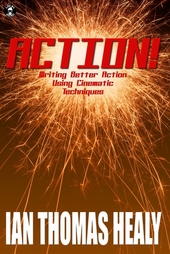
Darcy’s Note: In my question to understand action scenes better, I came across Ian’s book and was blown away by how practical it is. To make it even more practical I created an Action Scenes Checklist. To understand it and fully exploit it, you should buy his book and read it cover to cover. Yes, I’m that enthusiastic about it. If you plan ANY action in your story, you need this book. Stay tuned below for a chance to win a copy of this book and Healy’s latest novel.
Guest post by Ian Thomas Healy
Like many people, I love movies, and I have a special love for tight action sequences. I have always taken pride in my ability to translate that type of action into my books, and as a writer specializing in superhero fiction, action is an important component of my work. After years of being asked by my writer friends to help them with their own action sequences, it occurred to me that there might be a need for this sort of information across the industry, and so I sat down and analyzed what was it exactly that I did instinctively when I wrote action scenes, and how I might teach that to others. Thus, ACTION! WRITING BETTER ACTION USING CINEMATIC TECHNIQUES (http://www.amazon.com/dp/B0055LH0MU ) was born (naturally, during a running firefight with explosions and hair-breadth escapes).
A lot of writers dance around action, because writing it is daunting and uncomfortable. By its very nature, action is high-energy, full of motion and intense pacing, and for many writers, it’s a weird change from what they’re used to. At its very root, though, action is a means to resolve conflict, and conflict is the basis of all good storytelling, so it’s not something to run from (crashing through a window, sliding down a rooftop slope, and then dropping into a waiting convertible), but to embrace as an important part of your toolbox.
In ACTION, I break down what makes an action scene tick, from individual acts, called Stunts, up through Engagements (related series of stunts), to the all-encompassing Sequence, which contains more than one Engagement. Here’s an example of an action scene from my new book CASTLES, which released on April 1:
Sally rushed into the building. All she knew was in the space of a single breath, her entire squad had been taken out. Who were these guys, and how had they stayed under the radar so long? Parahuman criminals didn’t just appear out of the woodwork at random, especially when they were working as a team. There had to be records on these guys somewhere.
And then Sally ran across someone who could move nearly as fast as she could, and she was fortunate not to have been gutted like a fish by the barbed quills sprouting from the new combatant’s arms. He slashed at her and she twisted and dodged through the lobby of the building on full defense. Unlike the criminals two floors above, the guy attacking Sally wore less of a jumpsuit and more of a wrestling-style singlet. The quills seemed to grow all over his body and she thought of him as Porcupine Man.
Super-speed abilities were rare in the world, even more so than psionic powers, and yet this was the second speedster Sally had fought in as many weeks. “Is there a factory churning you guys out or something?”
Porcupine Man’s perceptions were apparently accelerated like hers, for he understood her despite her rapid speech. “The times, they are a-changin’.” He spread his arms wide and flexed his chest in a peculiar way.
Sally dropped to the floor as several quills whisked over her head to embed themselves in the reception desk, quivering like arrows. A sharp, burning pain shot down her back and she knew one of them had grazed her. She hoped like hell they weren’t tipped with poison. “That’s a Bob Dylan lyric. My husband loves that song.” She pulled her horseshoes from her belt.
“Maybe he can play it at your funeral.” Porcupine Man shot more quills at Sally and she threw herself backwards over the reception desk to put something solid between her and her opponent. With his speed, she only had a moment to decide on her next action, and she froze when she saw a terrified woman huddled beneath the desk, eyes wide, a quill poking out of her bloodstained blouse.
Sally had no time to check to see if the woman was severely hurt. She couldn’t stay hiding where she was and put the civilian in danger. Nor could she risk slowing herself down enough to offer any comfort. She heard the patter of Porcupine Man’s approaching footsteps and forced herself to move. She ran, leaning forward to make herself a smaller target. The slice on her back burned like a paper cut with lemon juice in it. He skidded to a stop and Sally knew she had an advantage over him, being able to stop and start instantly.
She glanced back and saw him fire another quill at her from his chest. It had gone from a veritable barbed forest to a sparse stand in just a few moments. His quills didn’t replace themselves very quickly. Maybe she could get him to use them up. She dove for the floor again, twisting herself around to land on her shoulder. The quill passed right over her face, close enough that she could see the wicked barbs on its tip. As she slid, she hurled one of her horseshoes at him. Normally, throwing away one’s melee weapons was a poor choice, but Sally had spent thousands of hours at the targeting range, learning how to throw things effectively. When accelerated by her super-speed arms, the most innocent objects could become deadly projectiles.
Her horseshoes were hardly innocent.
The iron ring caught Porcupine Man on his sternum, hitting him hard enough to send him flying back into a wall, which cracked with his impact. He fell amid a pile of broken drywall and didn’t move.
This scene represents a single Engagement in a larger Sequence, which is Mustang Sally’s team of superheroes versus a group of super-powered bad guys. There are several Stunts in this Engagement:
Sally dodges as Porcupine Man attacks her in melee combat.
Sally dodges again as Porcupine Man shoots spines at her in ranged combat.
Sally dodges yet again as he keeps shooting at her (she’s having a rough go of it).
Sally goes on the offensive and throws a horseshoe at Porcupine Man, taking him down.
In ACTION, I coach you on methods for writing these types of scenes on a step-by-step basis. When Darcy contacted me to say how helpful she’d found my book, it made my day, because any time I hear that I’ve helped someone to become a better writer, it makes the whole process worthwhile. If you find it a valuable tool for yourself, please don’t hesitate to post a review online and to let me know how it helped you!
Leave a comment and your name will be in a giveaway for a copy of one of Healy’s ebooks (Kindle, epub or pdf). There’s one copy each of ACTION! and CASTLE.
Today, Faber Academy and I are kicking off the blog tour for Kim Curran's DELETE! It's had a bit of trouble getting out, due to the closure of Strange Chemistry, but it's coming and it's having a blog tour!
Summary : The country is at war. Beset by enemies within and without. And all because of the decisions changed by one boy, Scott Tyler. In this ravaged alternative reality, Scott hardly recognises himself. He's a war hero, a leader of a unit of Shifters and maybe the only one who can prevent the country's frail defences from crumbling.
But all Scott wants to do is find a way back to the world he knew, without losing the girl he loves. With every Shift he makes, Scott edges closer towards oblivion. With no one to trust – not even himself – how much is he willing to risk to get home?
Review: This is the end of a trilogy, so this review will contain spoilers for the first two books (and you really do need to read Shift and Control before this one). Following the end of Control, Scott finds he has shifted to a world where Britain is at war, and Scott is apparently the Commandant of ARES, or at least its present form, and everything is completely different. However, unlike most Shifters whose realities change when they shift to accomodate for that shift and they accept that shift as being the one true reality, Scott remembers the more peaceful, less treacherous world, and he wants to get back.
I really enjoyed Shift and Control, and thus I was very excited to read this. When I did get to read Delete, I read it so quickly. I think if life didn’t get in my way, it would be a one-sit-read.
You know how I said Control put the plot on a larger scale to Shift? It’s happened again. Majorly. Again.
I loved the different sides of the characters we got to know. Frankie, Aubrey, and Katie were all changed but also still them, and Scott...woah. in this world, Scott’s personality is rather different to the one he remembers having, and I loved seeing him struggle with what he remembers, what he thinks he is, what what he has to do in this world. So much character development.
The plot progressed well. It’s fast, but there are also quieter moments. Especially between Aubrey and Scott as he tries to find the differences between the past Aubrey and the one now. .
I did have mixed feelings about the end. Initially I really disliked it, but after a little time, I realised how wonderful it was because Scott has learnt things and might be able to make things better and maybe it isn’t as bad an ending as I thought.
Overall: Strength 5 tea to a brilliant ending to an action packed series examining decisions and their consequences.
Title: Spirit Circle Genre: Adventure, Fantasy, Publisher: Shonen Gahosha (JP), Viz Media (US) Story/Artist: Satoshi Mizukami Serialized in: Young King Comics (33 out of 33 chapters reviewed) Fuuta Okeya lives a normal life and has gotten to his second year of middle school without incident, although he can see some spirits including the one following his new classmate, ... Read more
0 Comments on Spirit Circle Manga Review as of 3/17/2015 11:04:00 AM
Seven Wonders: Book 3: The Tomb of Shadows, by Peter Lerangis will appeal to tweens and teens who like lots of action and danger in their stories and who are curious about ancient history.
In the kingdom of Goredd, humans and dragons have lived and worked side by side for more than forty years, a treaty of peace signed, and the past war forgotten. But when a member of the royal family is brutally murdered and the finger of blame points to dragons, it appears that not all is forgotten, or forgiven.
Shadow Scale jumped out at me. It was more complex than it first appeared, I realized in that moment, because “scale” could mean several different things.
Enter to win a copy of Seraphina, written by Rachel Hartman, and the newest release, Shadow Scale (Seraphina: Book Two).
Giveaway begins March 9, 2015, at 12:01 A.M. PST and ends April 8, 2015, at 11:59 P.M. PST.
1) One Dog and His Boy- Written by Eva Ibbotson, Published by Scholastic Inc. New York, NY 2014. Hal is just an ordinary kid with a large dream of owning a dog. On his birthday Hal is allowed to choose a pet that is when Fleck becomes a part of his life and an adventure begins after Hal finds him gone on Monday. Together with a girl named Pippa Hal rescues Fleck and running away is his only option, made trickier when Pippa announces that she and the other dogs want to come along. It not only teaches your children about the power of friendship and love but it takes them on a journey through life. I highly recommend this book for your middle graders. Get out and pick up a copy today.
2) The Path of Names- Written by Ari Goelman, Published by Scholastic Inc. New York, NY 2013. Dahlia Sherman loves magic tricks, math and video games. She is not so found of campfire songs or lighting storms or mean girls her age. When she is placed in a sleeping camp strange things start happening like ghosts of little girls and an ancient maze guarded by a mysteries caretaker. This books take her on a journey through the past to discover what all this means. It is a mystery based on ancient Jewish scripture that is much better suited for your older middle grader. The book is a fun read and has a very strong connection to Jewish traditions and mystical culture.
0 Comments on Two Middle Grade Books 2014 as of 12/13/2014 3:02:00 PM
In order to spread some festive cheer, Blackstone’s Policing has compiled a watchlist of some of the best criminal Christmas films. From a child inadvertently left home alone to a cop with a vested interest, and from a vigilante superhero to a degenerate pair of blaggers, it seems that (in Hollywood at least) there’s something about this time of year that calls for a special kind of policing. So let’s take a look at some of Tinseltown’s most arresting Christmas films:
1. Die Hard, directed by John McTiernan, 1988
Considered by many to be one of the greatest action/Christmas films of all time, Die Hard remains the definitive cinematic alternative to the usual saccharine cookie-cut Christmas film offering. This is the infinitely watchable story of officer John McClane’s Christmas from hell. When a trip to win back his estranged wife goes awry and he unwittingly finds himself amidst an international terrorist plot, he must find a way to save the day armed only with a few guns, a walkie talkie, and a bloodied vest. With firefights and exploding fairy lights abundant, this Bruce Willis tour de force is the undisputed paragon of policing in Christmas films.
2. Home Alone, directed by Chris Columbus, 1990
In a parental blunder tantamount to criminal neglect, the McCallister family accidentally leave their youngest member, Kevin (played by precocious child star Macaulay Culkin), ‘home alone’ to fend for himself over Christmas as two omnishambolic burglars target the McCallister household. As the Chicago Police Department work through the confusion of the situation, Kevin traverses his way through a far from silent night. Cue copious booby traps and slapstick as the imagination of an eight-year-old boy ingeniously holds the line in this family-fun classic.
3. Batman Returns, directed by Tim Burton, 1992
Gotham is a city perennially infested with arch-criminals whose seemingly endless financial resources demand that they be tackled head-on by a force who can match them pound-for-pound (or dollar-for-dollar, if you prefer). Enter Gotham’s very own Christmas miracle: billionaire Bruce Wayne and his vigilante alter ego Batman (Michael Keaton), who provides a singular justice-hungry scourge against the criminal underworld. As the Penguin (Danny DeVito) hatches a nefarious plot which threatens the city, Batman’s wholly goodwill must prove resilient. Though director Tim Burton went on to make The Nightmare Before Christmas the following year, Batman Returns itself is hardly a Christmas classic.
4. Lethal Weapon, directed by Richard Donner, 1987
Ward Bond (1903-1960) as Bert the cop in It’s a Wonderful Life (1946) by Insomnia Cured Here. CC-BY-2.0 via Flickr.
With a blizzard of bullets and completely bereft of snow, LA-based Lethal Weapon lacks nearly all the usual trimmings of a Christmas film. Seasoned detective Roger Murtaugh (Danny Glover) is close to retirement when he’s paired with the young (and morose) Martin Riggs (Mel Gibson) to tackle a drug smuggling gang. As their stormy investigation progresses, Murtaugh and Riggs’ unlikely union flourishes into a double-act worthy of Donner and Blitzen (and, judging by the pair’s return in a subsequent three installments of the series, their entertaining policing partnership always leaves audiences wanting myrrh…).
5. National Lampoon’s Christmas Vacation, directed by Jeremiah Chechik, 1989
In this third installment of the Griswold family’s catastrophic holidays, Clark (Chevy Chase) navigates his way through the perils of yet another disastrous calamity, but at least this time he has his Christmas bonus to look forward to. Things take a bizarre turn for the criminal when the bonus isn’t forthcoming, resulting in a myriad of mishaps of Christmas paraphernalia and SWAT teams. As the tagline for the film attests, ‘Yule crack up!’
6. Kiss Kiss Bang Bang, directed by Shane Black, 2005
Petty thief Harry Lockhart (Robert Downey Jr.) finds himself embroiled in a series of increasingly byzantine cases of mistaken identity as both a method actor and criminal investigator. Reality cuts through when Harry is shepherded into a murder investigation involving the sister of his childhood crush, Harmony Lane (Michelle Monaghan). Perhaps one of the less christmassy films on this list, there are definitely still a few seasonal signs parceled in to this murder/mystery thriller.
“There’s something about this time of year that calls for a special kind of policing”
7. Miracle on 34th Street, directed by George Seaton, 1947
Arguably the ultimate Christmas film, Miracle on 34th Street is the classic tale of the legal battle around the sanity and freedom of a man who claims to be the real Santa Claus. This original film won three Academy Awards including Best Actor in a Supporting Role for Edmund Gwenn’s portrayal of Kris Kringle (‘the real Santa Claus’). Despite being remade in 1994 and adapted into various other forms, the 1947 version remains the quintessential Christmas film which no comprehensive watchlist could be without.
8. Bad Santa, directed by Terry Zwigoff, 2003
Dastardly duo Willie (Billy Bob Thornton) and Marcus (Tony Cox) make their criminal living by posing as Santa and his Little Helper for department stores, and then opportunistically stealing as much as they can. As the security team for their latest blag hunts them down, Willie meets a boy determined that he is the real Santa and the race is on for the degenerate pair to reform their lifestyles before they are stuffed.
What would would you add to this list? Tell us your favourite policing Christmas film in the comments section below or let us know directly on Twitter. Merry Christmas everyone!
Headline image credit: [365 Toy Project: 019/365] Batman: Scarlet Part 1. CC-BY-NC-SA-2.0 via Flickr.
I often wonder if people understand that love is an action word. No, I don't mean the act of fleshly love. I mean prove it.
Recently a person in my life has shown me that love was not in their vocabulary, let alone their heart. I dared them to prove to me they love me in ways that would conquer that disbelief. Give me a reason to stay in their lives. Because actions speak far louder than words and the only actions shown- were complacency and contempt. It had been that way for many, neglectful and abusive years.
That person is now taking baby steps to show me that my lifetime of love has not only been one-sided and pointless. They are allowing their heart to shine again. You see, it wasn't just non-love that was being communicated. It was hurt that was not being communicated. The poison had to stop.
If a man walked into his house and saw a stranger forcing his wife to do unspeakable things- would he not rush to her aid and save her?
And if a woman saw that same person robbing her husband and she just happened to have a strong weapon at her disposal, would she not rescue her husband and then think about calling for help?
It's the same in the spiritual sense; emotional & mental.
If a person is struggling with their faith, with their emotions, with their life- and you just happened to be with that person until death do you part- get in there and fight. Seriously. Who are you to leave them go this alone? How can you say you are in love when you don't even try?
Are you the person who is being neglected? I am praying. God knows the answers you need.
Don't leave people alone, my lovelies. Eventually you will lose them. In one way or another. Unless, of course, that is what you want. In that case, stop torturing them.
Step up and be the person your love needs.
Nobody should have to face the most horrifying of life's struggles alone. All humans need another human to hold their hand once in a while, to help them navigate through troubled waters.
This blog entry was not intended to be harmful or judgmental. I don't know who this is for. Maybe it is just for me. Whatever the case, we need each other. We can't go it alone. Let's purpose to be the hope and the salt and the Light in other people's lives. Hold them up when they cannot stand. Let's show them they are worth the fight and be there as long as it takes. Forgive. Forget. And love once again.
0 Comments on Love=Action as of 8/29/2014 4:27:00 PM
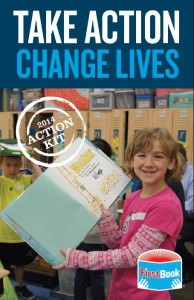
When Melissa Deneen Shipp surprised each of her students with a new book of their very own, their reaction surprised her. “Normally this is the part when they maul me with hugs,” she said. “But instead they just stared. They literally couldn’t believe their eyes!”
She told her students, “Yes, YOU are the owner of that book!” Jumping up and down, her students shouted in reply, “This is mine, this is mine!” It was one of the best days Melissa has ever had as a teacher.
For over 20 years, teachers like Melissa and supporters like you have joined First Book to bring moments of joy, comfort and learning to millions of kids in need.
But there’s so much more to be done. Over 32 million kids in the U.S. live in poverty. In their homes, schools and communities, books are rare.
As our kids return to school this month, we invite you to support them – now, throughout the year and into the future.
First Book will provide 15 million books to kids in need this year and we believe we can meet this goal because of supporters like you. Take action today!
In my current WIP, I want to up the action and make this a physically exciting story. So, I bought a great ebook, Action! Writing Better Action Using Cinematic Techniques by Ian Thomas Healy. It’s great, as I said, and breaks down the actions into easy components that can be easily mastered. Even for me, it’s easy.
Healy says that great action scenes put characters into motion and the “effective description of that motion is what makes the difference. . .”
I get that part. But here’s what stumps me: “At its most basic level, an action scene is an expression of plot or character development through violence.”
Violence. As in people hitting each other, shooting at each other, killing each other. Yep. That kind of physical violence.
It’s been a long, long time since I was in a knock-down drag-out fight. That was with my younger brother when I was about 15, and we were fighting about whether the overhead light was on or off while we watched TV. I never had the chance to play football, which is a pure Show-Don’t-Tell version of testosterone. When my daughters played soccer, I cringed when they played tea party on the field: Oh, you have the ball? Well, take your turn and when you are finished, I’ll take my turn. Teaching aggression (much less violence) to young ladies is hard.
Our society trains women to avoid violence. We teach our daughters aggression now on a soccer field, but step off the field and it’s tea party time again. Women writers are at a disadvantage in writing action scenes.
Because Healy says that a great action scene needs violence.
Heck, I can’t even work up a good case of Road Rage.
Motivation. The hardest thing for me is to motivate the characters. I can block out the action and get the characters fighting. I’ve seen enough action movies to be able to do it. (Go watch The Transformers latest movie if you want non-stop violence. Wow. It must take up 75% of that movie.)
But WHY are these characters resorting to violence? (See, even our language makes it hard to use violence: “resort” implies that violence is a last option and the choice to use it is not easy.) Why would the characters use fists, swords, guns or other weapons against someone else? Healy helps with blocking out the sequences of actions and building them into longer sequences. But he says little about the character motivations.
In one sense, this is an escalating of tensions. Almost any motivation would work: revenge, for example, could easily escalate into violence. Two rivals for a fortune in gold could escalate an argument into violence and death. For violence to take place, there’s a line that needs to be crossed. Polite society demands that people restrain themselves, and that self-control must break for your characters, shoving them into a no-holds-barred action. Violence. It’s an escalation and it’s a letting go of social restraints. It’s a willingness to take action and a determination to get something done—no matter what.
Sounds like a good way to increase the tension and stakes in a story. Yes, often action stories are physical stories, without much in the way of characterization. You’ve heard it said that you either write an action story or you write a character story. A cross-pollination though, could create an intriguing mix. This time, I’m shooting for a story with better balance between action and character.
Cinematic. In some ways, this mix will be more cinematic. The sights and sounds of the action are crucial to the success of the scene. And yes, as I am writing, I am trying to visualize the actions in my head; I’m trying to see it as if it is on the big screen. Healy’s title is right on, violence—action scenes—are cinematic.
Thanks to Healy’s advice, I am making lists of what he calls “stunts,” or isolated pieces of actions, that will build into “engagements,” or movement across a setting, which will ultimately build toward some climactic “resolution.” I am taking baby steps in building a chapter with interesting action, um, violence.
Look out. I’m strapping on my boxing gloves, er, getting ready to type the next chapter of this new action-adventure story.
Other info: Claire has also written Ferryman, which I reviewed here and won the Scottish Booktrust Award.
Summary : The English government have closed the borders with their Celtic neighbours. Any Celt found in England is branded with a tattoo, found twice they are executed. Scottish Lizzie is the 'property' of psychopathic London gang boss Alexander. Can Lizzie escape Alexander's deadly grip and at what price her betrayal?
Review: Following bad economic times, England closes the borders with Scotland and Wales and brings in a new policy: Celts found in England are branded. Branded Celts in England are killed. Lizzie is one such branded Celt, who is the "property" of Alexander, a gang boss in London, who keeps her around for her bombmaking skills. as time goes on, Lizzie realises she might like a life outside the gang. Which is something that Alexander does not like at all.
I read McFall's Ferryman last year and really enjoyed it. I was looking forwards to this, especially with everything going on about the Scottish Independence referendum. Extreme nationalist governments make good reading (not real life), and so do gangs. Add in promises of a clever awesome female character and I'm sold.
You very quickly get pulled into Lizzie's world, both the political climate and the gang life that she’s part of. It’s a world that is believable, if you imagine that a yes vote leads to extreme xenophobia on the English peoples’ part (ie just a huge ramp up of how it is now).
I love the fact that all the characters are well fleshed out really well. You really get close to them, even if that closeness is not something that you really want to be. Alexander’s creepiness seems to know no bounds. Lizzie, I liked a lot; she’s resourceful, and you want things to go right for her, even though they tend not to. I loved reading about them and how they got where they are and where they want to go.
It’s very very different to Ferryman. McFall writes well in both softer afterlife stories and gritty thrillers. I’m looking forwards to see what she does next.
Overall: Strength 4 tea to a fast paced relevant dystopia.
There are so many amazing quotes out there that focus in on what needs to be done and does it in a sentence or two.
The quote above from Anatole France, does just that.
It reminds me of the Bible quote: "Faith without works is dead."
No matter how much planning you do, if you don't take actionable steps, you won't get anywhere. And, if you can't dream it or believe you can accomplish it,
0 Comments on Content Marketing Success - You have to walk the walk as of 7/25/2014 6:42:00 AM



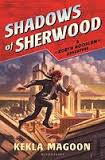 Robyn is a tinkerer. She loves building things with her dad, but since her dad's job has taken up most of his time lately, Robyn is on her own. One night after Robyn sneaks out as usual to head to the junkyard to find a voltage adapter for a project, things seem a bit off. Usually dodging the guards and scaling the fence are fun endeavors, but this night the guards are more soldier-esque than usual. And this time when she made it over the fence, there was a dog.
 By: [email protected],
on 10/14/2015
By: [email protected],
on 10/14/2015
 Paperback: 360 pages
 About Gahan Hanmer
  By: Darcy Pattison,
on 4/6/2015
By: Darcy Pattison,
on 4/6/2015


 Add a Comment
 By: Nina @ Death, Books, and Tea,
on 3/29/2015
By: Nina @ Death, Books, and Tea,
on 3/29/2015

 By: Daniel Hall,
on 12/10/2014
By: Daniel Hall,
on 12/10/2014


 I often wonder if people understand that love is an action word. No, I don't mean the act of fleshly love. I mean prove it.
 By: Julia Hornaday,
on 8/21/2014
By: Julia Hornaday,
on 8/21/2014
 Add a Comment

 Add a Comment

 By: Karen Cioffi,
on 7/25/2014
By: Karen Cioffi,
on 7/25/2014
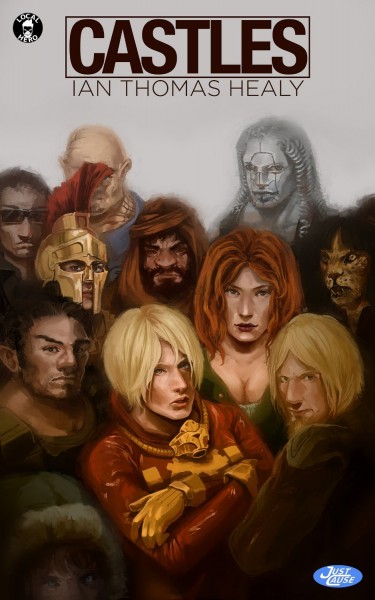 In ACTION, I break down what makes an action scene tick, from individual acts, called Stunts, up through Engagements (related series of stunts), to the all-encompassing Sequence, which contains more than one Engagement. Here’s an example of an action scene from my new book CASTLES, which released on April 1:

 When Melissa Deneen Shipp surprised each of her students with a new book of their very own, their reaction surprised her. “Normally this is the part when they maul me with hugs,” she said. “But instead they just stared. They literally couldn’t believe their eyes!”
 As our kids return to school this month, we invite you to support them – now, throughout the year and into the future.
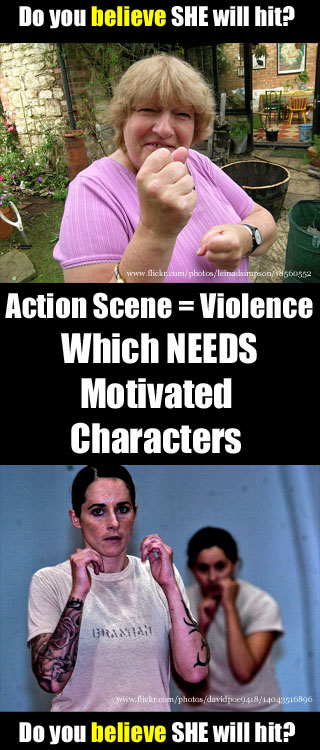 In my current WIP, I want to up the action and make this a physically exciting story. So, I bought a great ebook, Action! Writing Better Action Using Cinematic Techniques by Ian Thomas Healy. It’s great, as I said, and breaks down the actions into easy components that can be easily mastered. Even for me, it’s easy.
It has been a long time since I last read Biscut Hammer, but I remember the animal spirit things being very funny and yes I can agree the jokes do come off as LOOK WE MADE A JOKE which is true! That and the other supporting characters are quite interesting and some of the deaths were shocking at least to me…
I still have my fingers crossed for an anime adaptation of this series, I just hope it goes to a talented studio that can handle the source material without messing things up, but if I had to choose I might go with JC Staff, Shaft, TRIGGER or MAPPA.
I didn’t find a way to work in a mention of the familiars but I liked how they weren’t all reflections of the characters or something simple like that, Loki’s words that no matter what his knight does he’ll follow him because it’s been too painful to watch them die over and over really summed it up nicely.