new posts in all blogs
Viewing: Blog Posts Tagged with: shaun tan, Most Recent at Top [Help]
Results 1 - 25 of 80
How to use this Page
You are viewing the most recent posts tagged with the words: shaun tan in the JacketFlap blog reader. What is a tag? Think of a tag as a keyword or category label. Tags can both help you find posts on JacketFlap.com as well as provide an easy way for you to "remember" and classify posts for later recall. Try adding a tag yourself by clicking "Add a tag" below a post's header. Scroll down through the list of Recent Posts in the left column and click on a post title that sounds interesting. You can view all posts from a specific blog by clicking the Blog name in the right column, or you can click a 'More Posts from this Blog' link in any individual post.
By: Marjorie Coughlan,
on 5/23/2016
Blog:
(
Login to Add to MyJacketFlap)
JacketFlap tags:
Interviews,
Young Adult,
Toni Morrison,
Beatrix Potter,
Shaun Tan,
Middle-Grade,
Gabriel Garcia Marquez,
Jane Ray,
The Arrival,
Salman Rushdie,
Maya Angelou,
Alice Walker,
Walker Books,
Amnesty International,
Zadie Smith,
Barrington Stoke,
Artichoke Hearts,
Rohinton Mistry,
Sita Brahmachari,
Macmillan Children's Books,
Ben Okri,
Let Books Be Books,
Hannah Kent,
MWD interview,
Children's and YA books about disability,
MWD Theme - All About Balance (Disability & Special Needs),
disability in children's books,
A Kestrel for a Knave,
Anita Desai,
Anna and the Swallow Man,
Barry Hines,
Brace Mouth False Teeth,
Burial Rites,
Car Wash Wish,
Charmed Earth,
Circus Space,
Gavriel Savit,
Grace Manning,
Here I Stand,
I'll Be Home for Christmas,
Isabelle Allende,
Jasmine Skies,
Kite Spirit,
Kristine Landon-Smith,
Methuen Drama,
Mira in the Present tense,
Nirmal Brahmachari,
Red Leaves,
Tamasha Theatre Company,
Waterstone's Children's Book Award,
Wole Solinka,
Add a tag
 Author Sita Brahmachari‘s latest book is Car Wash Wish, her second novella for Barrington Stoke, a UK publisher who specialise in making books accessible to struggling readers, with a special emphasis on dyslexia. It’s an inter-generational story … Continue reading ... →
By: Marjorie Coughlan,
on 11/20/2015
Blog:
(
Login to Add to MyJacketFlap)
JacketFlap tags:
Shaun Tan,
Ziba Came on a Boat,
Eve Bunting,
Karen Lynn Williams,
Khadra Mohammed,
The Arrival,
Holiday House,
Catherine Stock,
Ted Lewin,
Robert Ingpen,
Liz Lofthouse,
Michelle Lord,
Shino Arihara,
Mary Hoffman,
Four Feet Two Sandals,
One Green Apple,
John Marsden,
R. Gregory Christie,
IBBY Congress,
Susan Guevara,
Tony Johnston,
Tilbury House,
Jude Daly,
Frances Lincoln,
Playing War,
Clarion Books,
Shen's Books,
Linda Gerdner,
Sarah Langford,
A Song for Cambodia,
Rukhsana Khan,
Matt Ottley,
Home and Away,
Karin Littlewood,
The Colour of Home,
Lea Lyon,
Jeremy Brooks,
Let There be Peace: Prayers from Around the World,
The Island,
Cinco Puntos Press,
Sarah Garland,
Armin Greder,
Doug Chayka,
Annemarie Young,
Anthony Robinson,
June Allan,
children's books about refugees,
Ronald Himmler,
Pegi Deitz Shea,
children's books about peace,
Stuart Loughridge,
Allen & Unwin,
Azzi In Between,
Tamarind Books,
MWD article,
Lee & Low (US),
Grandfather's Story Cloth / Yawg Daim Paj Ntaub Dab Neeg,
Eerdman's Publishing,
Mohammed’s Journey: A Refugee Diary,
Lothian Books,
children's books about war,
Voice from Afar: Poems of Peace,
The Roses in My Carpets,
Ben Morley,
Boyd's Mill Press,
Brothers in Hope: The Story of the Lost Boys of Sudan,
Carl Pearce,
Chue and Nhia Thao Cha,
Debra Reid Jenkins,
Dia Cha,
Dia's Story Cloth: The Hmong People's Journey to Freedom,
Frances Park & Ginger Park,
Gervalie's Journey: A Refugee Diary,
Joyce Herold,
Kathy Beckwith,
Mali Under the Night Sky: A Lao Story of Home,
Mary Williams,
Meltem's Journey: A Refugee Diary,
My Freedom Trip,
My Name is Sangoel,
The Silence Seeker,
The Whispering Cloth,
Viking (Australia),
You Yang,
Youmi,
Poetry,
Young Adult,
Anita Riggio,
Picture Books,
Articles,
Non-Fiction,
Middle-Grade,
Add a tag
A bibliography with links to relevant websites is listed by title can be … Continue reading ... →
By:
Bianca Schulze,
on 10/16/2015
Blog:
The Children's Book Review
(
Login to Add to MyJacketFlap)
JacketFlap tags:
Ages 9-12,
Classics,
Fairy Tales,
Shaun Tan,
Illustrator Interviews,
Maurice Sendak,
Hans Christian Andersen,
Chris Riddell,
Jackie Morris,
Brian Wildsmith,
James Mayhew,
Angela Barrett,
Illustration Inspiration,
Teens: Young Adults,
Errol Le Cain,
Angela Harding,
Books About Swans,
EH Shephard,
Eric Revilious,
Frances Lincoln Children's Books,
Hannah Firmin,
Robert MacFarlan,
Wicked Stepmother Books,
Add a tag
Jackie Morris lives in Pembrokeshire, Wales, with children, dogs and cats. Her latest book is the retelling of Hans Christian Andersen's The Wild Swans.

By:
Betsy Bird,
on 9/27/2015
Blog:
A Fuse #8 Production
(
Login to Add to MyJacketFlap)
JacketFlap tags:
Lois Lowry,
Shaun Tan,
National Book Award,
Eric Rohmann,
Jeanne Birdsall,
SCBWI-IL,
New Blog Alert,
Sy Montgomery,
Marc Tyler Nobleman,
literary tattoos,
Ingrid Sundberg,
Fusenews,
Philip Nel,
Roald Dahl Funny Prize,
Owl Moon,
Anastasia series,
The Center for Teaching Through Children's Books,
SCBWI,
Add a tag
The problem with this Fusenews feature is that if I don’t do them regularly then the news out there builds up, builds up, builds up, until there’s so much of it out there that I’m almost embarrassed to do anything with it. Such is the case today! And, as per usual, I’ll say that I’m just going to type these pieces up very fast, when in truth it’s pretty much going to be the same kind of thing I always do. Truth! Let’s do it.
- I highly recommend that each and every last one of you guys move to Illinois. The people here are so freakishly nice it’s amazing! Case in point, SCBWI-IL and The Center of Teaching Through Children’s Books are pairing up to have me talk to a whole bunch o’ folks on the evening of October 7th. Isn’t that kind of them? If you live in the area, please come by. I like to blather and while doing it in my own head is fine, it’s much nicer when there’s a healthy number of other people out there to absorb the blow.
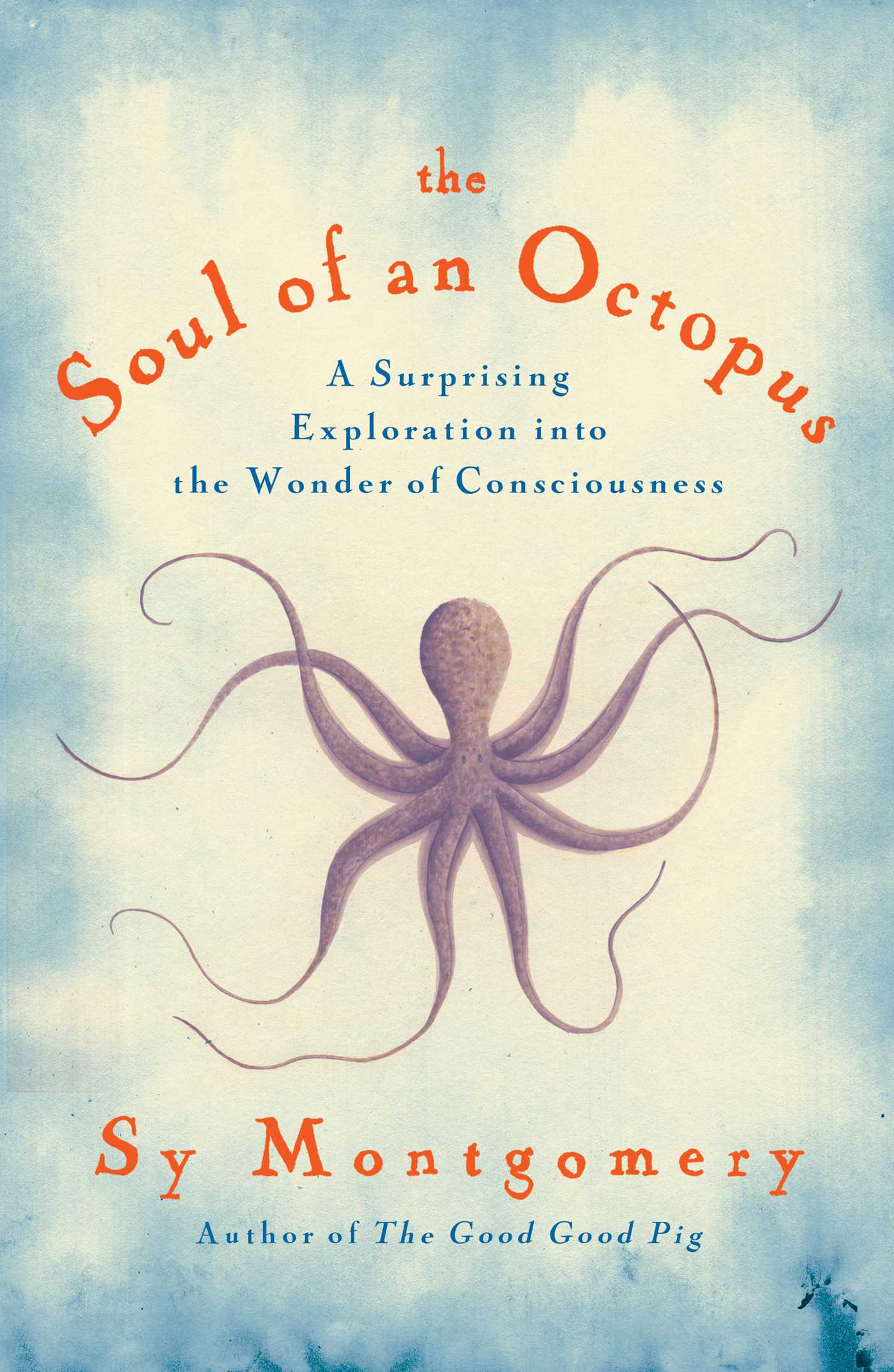
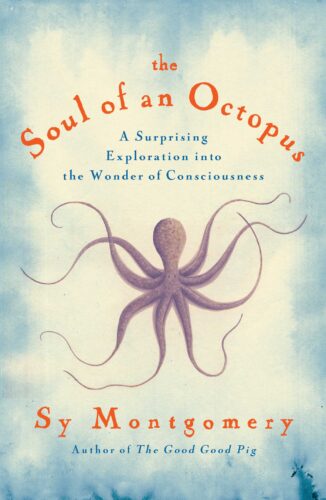 In case you missed it the National Book Awards Longlist for Young People’s Literature was released last week. A very YA-centric list indeed with only two clear cut books for kids. Yet look in other categories and you’ll find that children’s authors do not relegate themselves solely to the children’s category. For example, in the adult nonfiction section you’ll see that our beloved Sy Montgomery has been nominated for The Soul of an Octopus.
- New Blog Alert: Reading While White. You might argue that that is the unspoken title of most children’s literature blogs, but in this case they’re acknowledging the fact freely and commenting on what that means all the while. There are some fascinating pieces on there already, so if you’re anything like me you’re checking it daily. Ooo, I just love folks that aren’t afraid to touch on potentially controversial topics for the sake of making the conversation at large a richer experience.
- In a particularly unfunny move, The Roald Dahl Estate has closed down the beloved Roald Dahl Funny Prize that was the brainchild of Michael Rosen. Why? There are hems and haws to sort through here but I think the key lies in the part where they say that in conjunction with next year’s centenary celebration, “the estate would be focusing on a new children’s book prize to be launched in the US.” So clearly they didn’t want two Roald Dahl prizes out there. One wonders if this mysterious prize in the US will also be for humor. I suspect not, but I’d be awfully interested if any of you have further details on the mater.
- If you were once again faithfully checking your Iowa Review this season (ho ho) you might have seen three interesting things. #1 – It contains a “portfolio” all about children’s books this month. #2 – The cover is by Shaun Tan. #3 – Phil Nel’s piece A Manifesto of Children’s Literature; or Reading Harold as a Teenager is free for viewing online. I should note that the actual issue also has pieces by Jeanne Birdsall (yay!), Mr. Tan, and Kevin Brockmeier, so get thee to an academic library! Stat!
- I don’t do much in the way of Instagram myself, but even without knowing it I can acknowledge that this Buzzfeed piece on what would happen if Hogwarts characters had it was rather inspired. Thanks to Travis Jonker for the link.
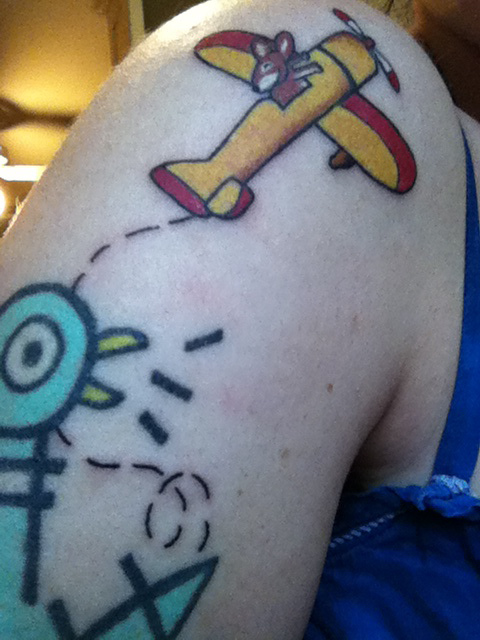
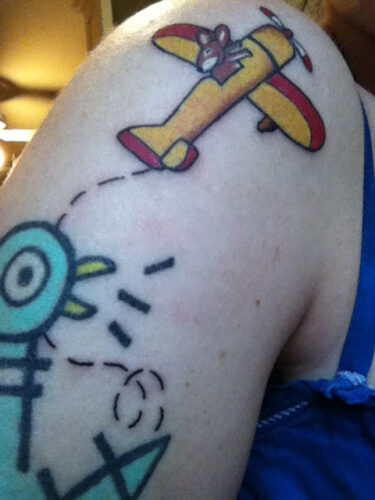 You ever hear the one about the bookseller who would get artists to draw their best beloved picture book characters on her arms and then she’d tattoo them there? Yes? Well, I hadn’t heard about her for a couple of years so I decided to check in. And lo and behold, one of my new neighbors here in the Chicago area, Eric Rohmann, was the creator of her latest tat.
- If someone asked you to suggest a children’s book that they hadn’t read but should, what would you choose? It helps if the person asking is British and wasn’t practically required by law, like those of us here in the States, to read certain books in the U.S. kidlit cannon. My suggestion was actually Half Magic by Edward Eager. See some of the others here.
- Wowzer. Children’s authors have power. Don’t believe me? See what Marc Tyler Nobleman pulled off with DC Entertainment. Well done, sir!
- Speaking of superheroes, two years ago Ingrid Sundberg drew a whole host of children’s and YA authors as spandex-wearing, high-flying, incredibles. It’s still fun to look at today here.
- Me Stuff (Part Deux): It’s a little old but I was interviewed by Joanna Marple not too long ago. There’s some good stuff there, like shots of the dream office I aspire towards (hat tip to Junko Yokota, though).
- I feel a bit sad that I never read Lois Lowry’s Anastasia books when I was a kid. I think I would have related to them (or at least to her glasses which originally rivaled mine in terms of width and girth). How I missed these books I’ll never know. Now I’m reading all about the changes being made to the newly re-released series. Some make sense but others (changing Anastasia, Ask Your Analyst to Anastasia Off Her Rocker) don’t make a lick of sense. I get that “analyst” is not a common term these days. I care not. The term “off your rocker” is, after all, no less dated.
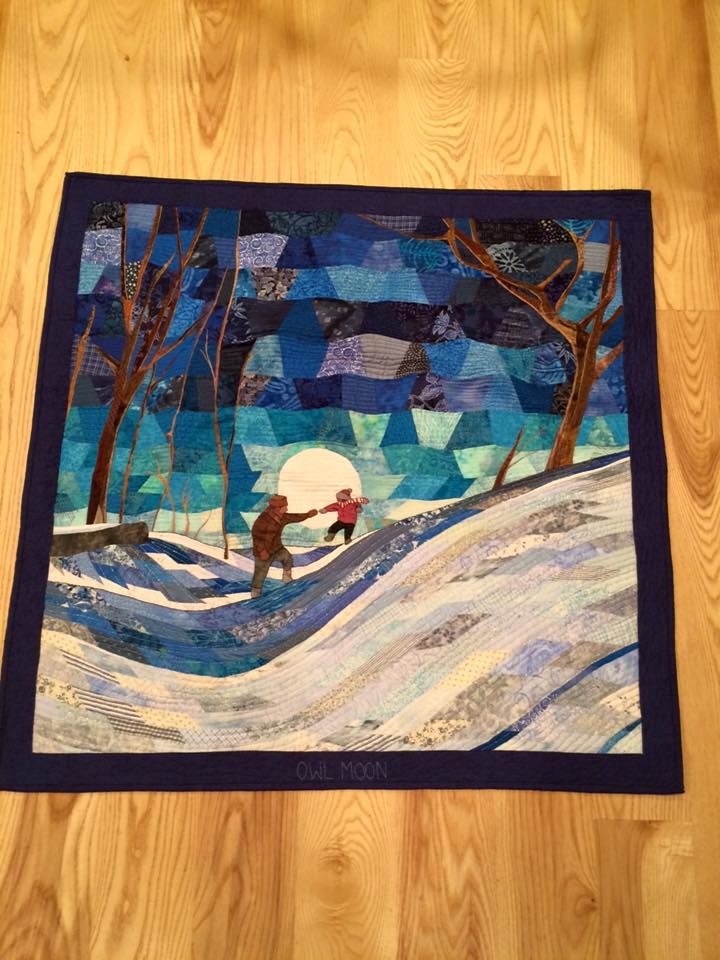
There are fans and then there are fans. And best beloved is the author or illustrator who meets a fan who knows, really knows, how to quilt. Ms. Sibby Elizabeth Falk showed this to Jane Yolen recently. It’s Owl Moon like you’ve never seen it before:


By:
[email protected],
on 9/16/2015
Blog:
Perpetually Adolescent
(
Login to Add to MyJacketFlap)
JacketFlap tags:
Book News,
shaun tan,
Gary Crew,
anthology,
Susanne Gervay,
Paul Collins,
Michael Gerard Bauer,
Judith Rossell,
Ford Street Publishing,
Justin D'ath,
Julie Fison,
Rich and Rare,
Add a tag
There really is something for everyone in Ford Street Publishing’s latest collection of Australian stories, poetry and artwork for teens – Rich and Rare. With pieces from almost 50 fab authors and illustrators, including Shaun Tan, Judith Rossell, Susanne Gervay, Gary Crew, Justin D’Ath and Michael Gerard Bauer (to mention a few), the anthology delivers […]

By: Edward Carey,
on 7/29/2015
Blog:
PowellsBooks.BLOG
(
Login to Add to MyJacketFlap)
JacketFlap tags:
Alasdair Gray,
William M Thackeray,
Lists,
Tove Jansson,
Beatrix Potter,
Rudyard Kipling,
Shaun Tan,
William Blake,
Beryl Bainbridge,
Heinrich Hoffmann,
Edward Carey,
Add a tag
As a child who loved books I was fascinated by the illustrations just as much as the text. The same is true for me today, and I'm happy to be among a group of writers who also illustrate their own works. There's a rich tradition of writer-illustrators spanning time. All 10 of these books are [...]
By:
[email protected],
on 7/9/2015
Blog:
Perpetually Adolescent
(
Login to Add to MyJacketFlap)
JacketFlap tags:
YA,
Book News,
shaun tan,
Sonya Hartnett,
margo lanagan,
Emily Rodda,
Morris Gleitzman,
Melina Marchetta,
Patrick Ness,
john flanagan,
Jaclyn Moriarty,
marcus zusak,
kirsty eagar,
lian hearn,
liane moriarty,
Isobelle Carmody,
Book Reviews - Childrens and Young Adult,
Anna Feinberg,
graeme simsion,
karen foxlee,
Joy Lawn,
Australian YA,
AJ Betts,
Add a tag
I’m just back from a tour of (mostly indie) London bookshops. My visit to the Tower of London was enhanced after seeing Sonya Hartnett’s Children of the King, which alludes to the missing princes held captive by their uncle Richard III in the Tower, in a Notting Hill bookshop. Australian YA, as well as children’s and […]
By:
Bianca Schulze,
on 6/16/2015
Blog:
The Children's Book Review
(
Login to Add to MyJacketFlap)
JacketFlap tags:
Ages 0-3,
Ages 4-8,
Picture Book,
Sports,
Picture Books,
Dr. Seuss,
Shaun Tan,
Illustrator Interviews,
featured,
Rabbits,
Knopf Books for Young Readers,
Carson Ellis,
Peggy Rathmann,
Animal Books,
Book Illustrator,
Jon Klassen,
Lisbeth Zwerger,
Illustration Inspiration,
Bunny Books,
Books About Ninjas,
Jennifer Gray Olson,
Pat Cantor,
Todd Kessler,
Add a tag
JENNIFER GRAY OLSON is a graduate of California State University, Fullerton, where she earned her bachelor of arts degree in art education. She is a glassblower and sculptor. In addition to writing and illustrating ...
Read the rest of this post

By: JOANNA MARPLE,
on 5/20/2015
Blog:
Miss Marple's Musings
(
Login to Add to MyJacketFlap)
JacketFlap tags:
Interview,
picture book,
picture books,
Shaun Tan,
Oliver Jeffers,
Illustrators,
Illustrator interview,
David Shannon,
NOBODY'S PERFECT,
Sam Zuppardi,
JACK'S WORRY,
Add a tag
Dear blog followers, I promised you that I was going to try and expand my interviews beyond the North American borders, so today we are back in the UK with one of their finest picture book illustrators, Sam Zuppardi (well, … Continue reading →
By:
Bianca Schulze,
on 3/14/2015
Blog:
The Children's Book Review
(
Login to Add to MyJacketFlap)
JacketFlap tags:
Illustrator,
Ages 0-3,
Ages 4-8,
Picture Book,
Peace,
Picture Books,
Art,
Shaun Tan,
Maurice Sendak,
Richard Scarry,
featured,
Ezra Jack Keats,
Barbara Cooney,
Lane Smith,
Picture Books For Children,
Edward Gorey,
Arnold Lobel,
Book Illustrator,
Beatrice Alemagna,
Illustration Inspiration,
Cultural Wisdom,
Social Graces,
Stephanie Graegin,
Annette LeBox,
Add a tag
Stephanie Graegin spent her childhood drawing and collecting fauna. These days, she lives in Brooklyn, is still drawing, and has managed to keep her animal collection down to one orange cat.

By: Jerry Beck,
on 2/4/2015
Blog:
Cartoon Brew
(
Login to Add to MyJacketFlap)
JacketFlap tags:
Oscars,
Shaun Tan,
John Lasseter,
Nick Park,
Pixar,
Ward Kimball,
John Weldon,
John Canemaker,
Chuck Jones,
Ralph Eggleston,
Richard Williams,
Brandon Oldenburg,
Kunio Kato,
Bob Godfrey,
Fred Quimby,
Joe Barbera,
Borge Ring,
Bill Joyce,
Torill Kove,
John Kahrs,
Michael Dudok de Wit,
Academy of Motion Pictures Arts and Sciences,
Bill Hanna,
Ernie Pintoff,
Will Vinton,
Award Season Focus,
Alexandre Espigares,
Andrew Ruhemann,
Bob Gardiner,
Co Hoedeman,
Dusan Vukotic,
Edward Selzer,
Eunice Macaulay,
Francois Alaux,
Herve de Crecy,
Laurent Witz,
Ludovic Houplain,
Thomas Stellmach,
Tyron Montgomery,
Zbigniew Rybczynski',
Add a tag
These rare videos document the presentation of the animated short Oscar from 1949 through 2013.
By:
[email protected],
on 1/12/2015
Blog:
Perpetually Adolescent
(
Login to Add to MyJacketFlap)
JacketFlap tags:
I don't wan't to go to school,
Julia Donalson,
Kate Miller-Heike,
Kate Mulvany,
lally katz,
Sieb Postuma,
The Scarecrows' Wedding,
The Snail and the Whale,
The Very Lonely Firefly,
Tiddler,
Where is Rusty?,
Book News,
school,
theatre,
shaun tan,
The Gruffalo,
Eric Carle,
Gecko Press,
Jane Godwin,
First Day,
John Marsden,
aaron blabey,
margaret wild,
Masquerade,
Axel Scheffler,
Very Hungry Caterpillar,
Starting School,
Kit Williams,
Anna Walker,
kim gamble,
Ahlberg,
Stephanie Blake,
Stick Man,
the rabbits,
The Artist Who Painted a Blue Horse,
Mister Seahorse,
Book Reviews - Childrens and Young Adult,
Joy Lawn,
Add a tag
It’s holiday time so some shows based on outstanding children’s books are currently being performed in Sydney and surrounds, as well as in other cities around Australia. A highlight is The Very Hungry Caterpillar (Penguin), a production created around four books by Eric Carle: The Very Hungry Caterpillar, of course, The Artist Who Painted a Blue Horse – […]
By:
[email protected],
on 1/6/2015
Blog:
Perpetually Adolescent
(
Login to Add to MyJacketFlap)
JacketFlap tags:
Book News,
friendship,
seasons,
beach,
shaun tan,
Claire Saxby,
recycling,
Alison Lester,
Walker Books,
Sue Whiting,
Random House Australia,
dianne wolfer,
Fremantle Press,
Lothian,
Allen & Unwin,
reassurance,
Karen Blair,
Book Reviews - Childrens and Young Adult,
Tom Jellett,
Granny Grommet and Me,
Seadog,
Rules of Summer,
Romi Sharp,
A Swim in the Sea,
Kyle Hughes-Odgers,
On a Small Island,
Meredith Thomas,
Noni the Pony Goes to the Beach,
Add a tag
In Australia we’re in the midst of Summer, although here in Melbourne we’ve already had all four seasons in one, sometimes even in one day! A great way to familiarise children with all that the season encompasses is through engaging language experiences. That means providing children opportunities to see, do, touch, listen, read and think […]
By:
[email protected],
on 12/2/2014
Blog:
Perpetually Adolescent
(
Login to Add to MyJacketFlap)
JacketFlap tags:
Book News,
shaun tan,
Claire Saxby,
Jackie French,
Refuge,
pamela rushby,
prime ministers literary awards,
Big Red Kangaroo,
Graham Byrne,
Smooch and Rose,
the accident,
Joy Lawn,
The NArrow Road to the Deep North,
Rules of Summer,
Qld Literary Awards,
Broken Nation,
Coal Creek,
Cracks in the Kingdom,
Forgotten Rebels of Rebels,
Only the Animals,
Ratcatcher's Daughter,
State Library of Qld,
The Incredible Here and Now,
Tigerish,
Zac & Mia,
Add a tag
The winners of the Qld Literary Awards and the PM Literary Awards are being announced on the same evening – Monday 8th December. You can follow the PM announcements live at #PMLitAwards or tune into @APAC_ch648 at 7:15pm http://on.fb.me/1pPELkt . It is fantastic that both these awards exist. They include outstanding Australian books and their shortlists promote these […]
.jpg?picon=1806)
By:
Maeve Friel,
on 10/22/2014
Blog:
An Awfully Big Blog Adventure
(
Login to Add to MyJacketFlap)
JacketFlap tags:
Guardian Teen Books,
Larry and Friends,
R:J: Palacio,
Shaun Tan,
Marjane Satrapi,
David Almond,
Benjamin Zephaniah,
Eileen Browne,
Jack Ezra Keats,
Maeve Friel,
#WeNeedDiverseBooksUK,
Add a tag
By diversity, they mean “books by and about all kinds of people… boys, girls, all different colours, all different races and religions, all different sexualities and all different disabilities and anything else you can think of – so our books don’t leave anyone out.”
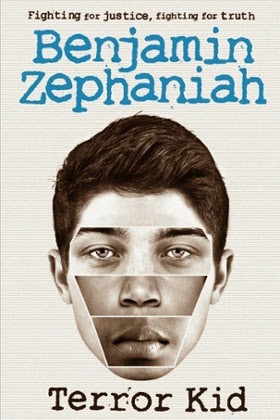
Benjamin Zephaniah whose Terror Kid is the Guardian Teen Book Club choice says:
“I love diversity. I love multiculturalism… It makes Britain´s music interesting. It makes our food interesting. It makes our literature interesting and it makes for a more interesting country … To me it’s not about black, white, Asian; it’s about literature for everybody.”
And there you have it: the criterion must be the quality of the literature. I see little value in writing or publishing books to satisfy some sort of quota to reflect the percentages of ethnic or racial populations or other minorities.
The Guardian published
a list of 50 books chosen to represent all manner of cultural diversity, from the amazing Amazing Grace by Mary Hoffman to Oranges in No Man´s Land by Elizabeth Laird.
Here are a few of my favourite books that are outstanding in every way and that also open windows on to different ways of seeing the world.
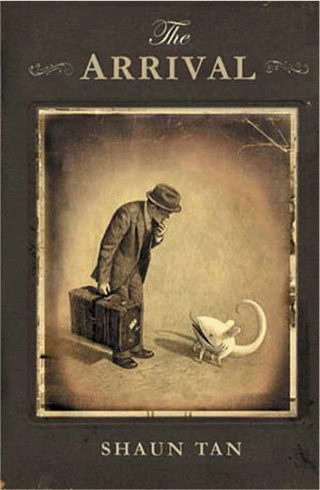
The Arrival, by Shaun Tan, is a wordless book about the experience of emigration/immigration, following the lonely journey of a man to a new country where everything is different and inexplicable. (He signed my copy when he spoke at a Children´s Books Ireland conference a few years ago and it is one of most treasured possessions.)
Persepolis by Marjane Satrapi, is a graphic novel based on her experiences during the cultural and political upheaval of the Iranian revolution after the overthrown of the Shah. This is a real eye-opener from the first pages showing tiny girls swathed in unfamiliar and unwanted veils in their school playground.
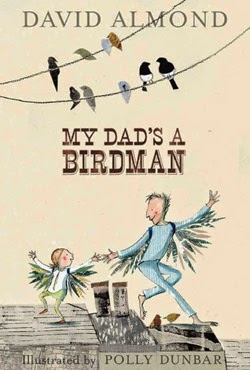
My Dad´s A Birdman, by David Almond, illustrated joyfully and colourfully by Polly Dunbar, is a terrific book about a young girl and her dad who is so overwhelmed with grief that he goes off the rails. It is suffused with love and tenderness and faith in the act of flying as Dad and daughter take part in a madcap and magical contest to sprout wings and fly across the river.
Wonder by R.J. Palacio is the story of Auggie, a boy with a shocking facial disfigurement who is
starting 5
th grade after years of home schooling: imagine how he is dreading it - “I won´t describe what I look like. Whatever you´re thinking, it´s probably worse.
I would like to add two more joyful books to the mix:
From Tangerine Books, a wonderful
picture book, Larry and Friends, by Ecuadorian illustrator Carla Torres in collaboration with Belgian/Venezuelan writer Nat Jasper celebrating the modern melting pot that is New York.
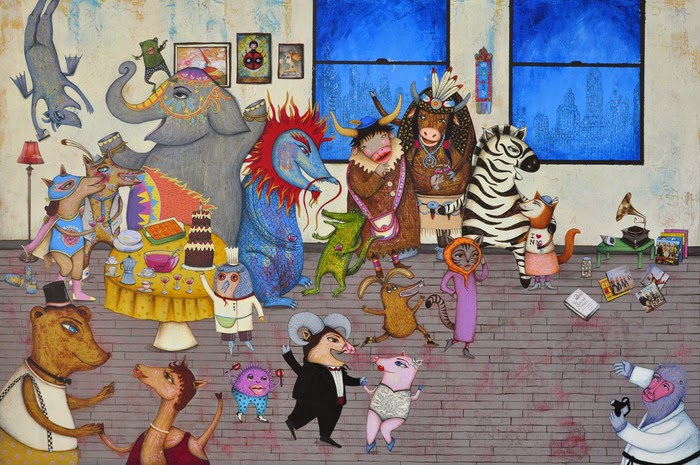
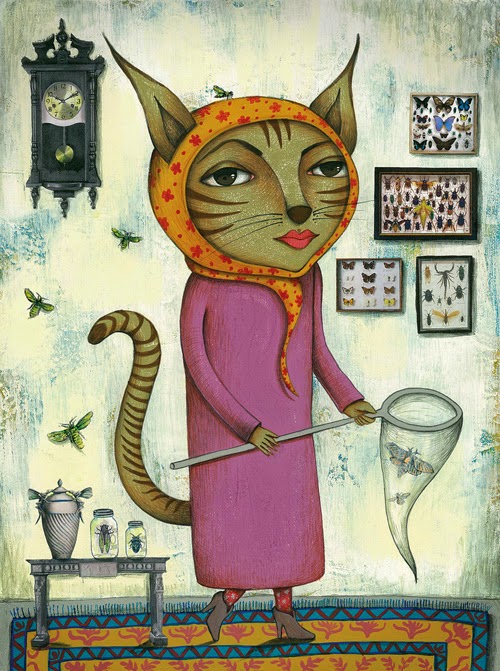
Larry, the New York dog, holds a party for all his amazing immigrant friends among them Magpa the pig from Poland who became a tightrope artist, Laila the Iranian entomologist, Edgar the Colombian alligator street musician, Ulises, the Greek cook and a host of other talented and tolerant newcomers to the city – all apparently based on real people and how they met up.
The book project was successfully funded by kickstarter – see more about it
here.
As you can see, the illustrations are divine - this is Layla, the Iranian entomologist who works at the museum.
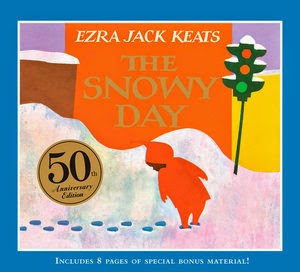
And finally, another great classic is The Snowy Day by Ezra Jack Keats (1963), possibly one of the earliest American picture books to feature a young African-American hero – although this is never mentioned in the text. It simply tells the story of a young four year old boy discovering snow in the city for the first time.
www,maevefriel.com
www.maevefriel.com/blog
You can also find me on Twitter @MaeveFriel
By:
[email protected],
on 10/20/2014
Blog:
Perpetually Adolescent
(
Login to Add to MyJacketFlap)
JacketFlap tags:
illustrator,
imagination,
shaun tan,
children's picture book,
wordless picture books,
Elise Hurst,
Scholastic Australia,
Omnibus Books,
Dimity Powell,
Book Reviews - Childrens and Young Adult,
carpet ride,
Imagine a City,
Add a tag
The sumptuous cloth cover and unfurling clouds swirling across the end pages indicate something special about Elise Hurst’s latest picture book, Imagine a City. You’ll recognise Hurst’s illustrations from her other picture books such as The Night Garden, Flood and The Midnight Club to name a few. Imagine a City is a glorious collection of […]
By:
[email protected],
on 7/7/2014
Blog:
Perpetually Adolescent
(
Login to Add to MyJacketFlap)
JacketFlap tags:
Sonya Hartnett,
catherine jinks,
John Marsden,
Gus Gordon,
Melina Marchetta,
Jaclyn Moriarty,
richard flanagan,
tim winton,
marcus zusak,
eleanor catton,
david mcrobbie,
Book Reviews - Childrens and Young Adult,
Book Reviews - Fiction,
graeme simsion,
karen foxlee,
hannah kent,
Joy Lawn,
evie wyld,
patrick holland,
Book News,
shaun tan,
Add a tag
I’ve just returned from visiting some major cities in the USA. It was illuminating to see which Australian literature is stocked in their (mostly) indie bookstores. This is anecdotal but shows which Australian books browsers are seeing, raising the profile of our literature.
Marcus Zusak’s The Book Thief was the most prominent Australian book. I didn’t go to one shop where it wasn’t stocked.

The ABIA (Australian Book Industry) 2014 overall award winner, The Rosie Project by Graeme Simsion was also popular. And a close third was Shaun Tan’s inimical Rules of Summer, which has recently won a prestigious Boston Globe-Horn Book picture book honour award. Some stores had copies in stacks.
http://www.hbook.com/2014/05/news/boston-globe-horn-book-awards/picture-book-reviews-2014-boston-globe-horn-book-award-winner-honor-books/#_
I noticed a few other Tans shelved in ‘graphic novels’, including his seminal work, The Arrival – which is newly available in paperback.

One large store had an Oceania section, where Eleanor Catton’s Man-Booker winner, The Luminaries rubbed shoulders with an up-to-date selection of Australian novels. These included hot-off-the-press Miles Franklin winner All the Birds, Singing by Evie Wyld and Hannah Kent’s Burial Rites, plus expected big-names – Tim Winton with Eyrie, Richard Flanagan’s The Narrow Road to the Deep North and works by Thomas Keneally and David Malouf. Less expected but very welcome was Patrick Holland.I chaired a session with Patrick at the Brisbane Writers’ Festival a few years ago and particularly like his short stories Riding the Trains in Japan.
Australian literary fiction I found in other stores included Kirsten Tranter’s A Common Loss, Patrick White’s The Hanging Garden and some Peter Carey.
One NY children’s/YA specialist was particularly enthusiastic about Australian writers. Her store had hosted Gus Gordon to promote his picture book, Herman and Rosie, a CBCA honour book, which is set in New York City. They also stocked Melina Marchetta’s Looking for Alibrandi and Saving Francesca, John Marsden, David McRobbie’s Wayne series (also a TV series), Catherine Jinks’ Genius Squad (How to Catch a Bogle was available elsewhere) and some of Jaclyn Moriarty’s YA. One of my three top YA books for 2013, The Midnight Dress by Karen Foxlee was available in HB with a stunning cover and Foxlee’s children’s novel Ophelia and the Marvellous Boy was promoted as part of the Summer Holidays Reading Guide.

Elsewhere I spied Margo Lanagan’s The Brides of Rollrock Island, published as Sea Hearts here (the Australian edition has the best cover); Lian Tanner’s Keepers trilogy; John Flanagan’s Ranger’s Apprentice and Sonya Hartnett’s The Children of the King. These are excellent books that we are proud to claim as Australian.
By:
Betsy Bird,
on 6/10/2014
Blog:
A Fuse #8 Production
(
Login to Add to MyJacketFlap)
JacketFlap tags:
Shaun Tan,
obits,
Frances Foster Books,
Mike Mulligan and His Steam Shovel,
apps,
Bill Watterson,
Fusenews,
Stephan Pastis,
Sxip Shirey,
literary food,
Random Penguin House,
Rita Meade,
Too YA for my blood,
Add a tag
- So the big news this week was that a writer at Slate decided that now was an ideal time to take a potshot at adults reading young adult books. And, as you might expect, everyone got quite hot under the collar about it. To arms! To arms! Considering that this sort of thing happens pretty much every time a new YA book hits the mainstream I wasn’t quite as upset as some. Honestly, I thought Roger Sutton’s piece Why Do We Even Call It YA Anymore? was much more along my own thinking. I could not help but enjoy Marjorie Ingall’s response as well.
 It’s one of those stories that’s just so crazy you don’t quite believe it at first. So about a year ago I attending a lovely dinner for Stephan Pastis, author of the book Timmy Failure: Mistakes Were Made (as well as the other Timmy books that would follow). Stephan was one of those fellows just filled to the brim with stories. And, as luck would have it, his stories were about syndicated cartoonists; one of my favorite things in the world to talk about! I heard him wax eloquent on the subject of Gary Trudeau, Berkeley Breathed, you name it. He even had ties to Charles Schulz (a fact that served me well when I interviewed Sparky’s wife Jean). But when I dared to ask if he’d ever met the elusive Gary Larson or Bill Watterson (of Far Side and Calvin & Hobbes fame respectively) he confessed he had not, though Watterson had once sent him a nice note about one of his comics. Well bust my buttons, but recently Pastis got a lot more out of Watterson than a mere note. He got three illustrated comic strips! Read this post to learn how he did it and why this is as extraordinary a fact as it is. Wowza!
- I was very sad to hear about the recent death of legendary children’s book editor Frances Foster. Read this remarkable interview with her from Horn Book, conducted by Leonard Marcus to get a sense of the woman we just lost. PW provided a very nice obituary for her here.
- Essentially, this is kind of a real world case of Mike Mulligan and His Steam Shovel, but with a dark dark twist.
- The voting may be over, but I can’t help but love the collection of different Penguin Random House logos that dared to combine the publishing behemoth. My personal favorite? Right here:
- I’ve oohed and cooed to you about the fact that Shaun Tan’s rather brilliant picture book Rules of Summer has an accompanying app with music by the amazing and fantastic Sxip Shirey. However, when I mentioned this fact before the app was not available for purchase. Now it is. Go get that thing then. You can even hear a selection of Sxip’s music for it here.
- Speaking of Rules of Summer, did you see Travis Jonker’s predictions of what he thinks will win the New York Times Best Illustrated Awards? Sort of a brilliant list to predict (and I think he’s completely and utterly dead on with his selection).
- Brain Pickings recently featured a selection of photographs of fictional meals from your favorite books. The photos are from the book Fictitious Dishes: An Album of Literature’s Most Memorable Meals. Though not strictly limited to children’s literature, it contains a handful of tasty treats worth noting. Be sure to check out the meals of Alice’s Adventures in Wonderland, The Secret Garden, Heidi, and a Chicken Soup With Rice that will knock your socks off.
- Just a quick shout out to my fellow metropolitan librarian Rita Meade who just sold her first children’s book. Go, Rita, go go go!
- One minute he’s winning a Tony. The next minute he’s turning The Dangerous Book for Boys into a television show. Wait . . . say what now?
- Did you guys happen to see Grace Lin’s rather remarkably good Cheat Sheet for Selling Diversity? Selling, heck. This should be disseminated into all the MLIS programs in the States. Future children’s librarians should be memorizing it by heart. THIS is how you handsell to a kiddo or a parent, guys. And Grace did all the work for you!
Daily Image:
Fairly brilliant!
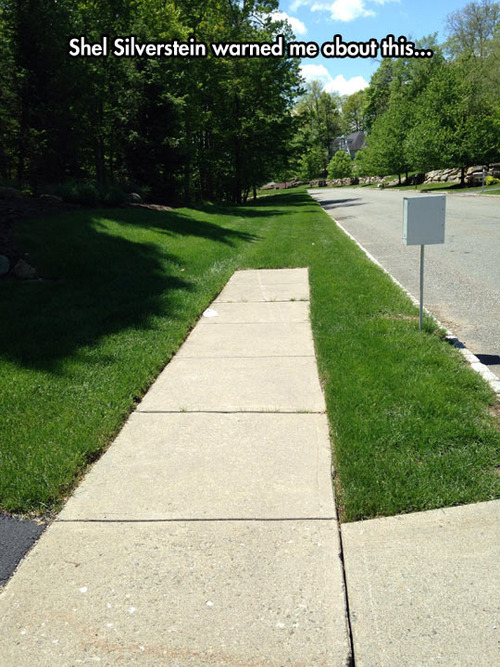
Thanks to Marci for the link.
By:
Betsy Bird,
on 4/10/2014
Blog:
A Fuse #8 Production
(
Login to Add to MyJacketFlap)
JacketFlap tags:
Scholastic,
Best Books,
picture books for older readers,
Arthur A. Levine,
Best Books of 2014,
Reviews 2014,
2014 picture books,
2014 reviews,
Reviews,
picture books,
Shaun Tan,
Add a tag
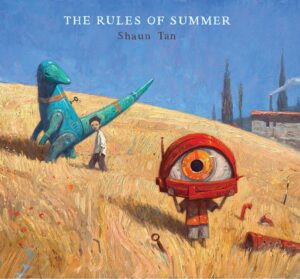 Rules of Summer
By Shaun Tan
Arthur A. Levine Books (an imprint of Scholastic)
$18.99
ISBN: 978-0-545-63912-5
Ages 4 and up
On shelves April 29th
When I was a young teen my favorite book was Ray Bradbury’s Dandelion Wine. Steeped in Bradbury’s nostalgia for his youth, I was in the throes of adolescence, probably on some level nostalgic for my own younger days. In this book I reveled in a childhood that was not my own but felt personal just the same. Summer seemed like the perfect time to set such a tale, what with its long days and capacity for equal parts mischief and magic. I loved my summers, even as I failed to know what exactly to do with them. I think of Bradbury’s novel from time to time, though its use for me has long since passed. I found myself going back to it after seeing Shaun Tan’s Rules of Summer. Encompassing a full summer season, Tan indulges his capacity for the odd and extreme while also managing to delve deeply into a relationship between two brothers. The family story is this book’s heart and soul meaning that when all is said and done this is a book for big siblings and little siblings. Miraculously both will see themselves reflected in the pages of the text. And both, if they approach it from the right direction, will find something to pore over in here for years and years to come.
“This is what I learned last summer,” says the book. It’s the kind of statement you might expect to find in an essay on How I Spent My Summer Vacation. Instead, what follows is a series of imaginative, wholly original extremes. Two brothers live in a world of fantastical creatures and gizmos. The younger continually breaks the rules as the elder either berates him or tries to save him from himself. A dinner party of well-dressed birds of prey contains the sentence, “Never eat the last olive at a party” as the older brother pulls his younger away from the potentially deadly entrée. “Never leave the back door open overnight” sees them both facing a living room awash in vegetation and giant lizards, the older boy clearly put out and the younger carrying a bucket and shovel. As the book continues you realize that the younger boy is often at odds with the rules his elder is trying to instill in him. The final straw comes after a massive pummeling, after which the elder brother sells his little bro off to a flock of black birds (“Never lose a fight”). Fortunately, a rescue is made and the book subtly shifts from admonitions to positive statements (“Always know the way home”). The final shot shows the two boys sitting on the couch watching TV, the walls of their living room wallpapered with drawings of the out-of-this-world creatures encountered in the rest of the book.
 As a general rule I try to avoid reading other reviews of the children’s book in my hand until I’ve read the stories myself and gotten a sense of my own perspective. In the same frame of mind I avoid reading the bookflaps of books since they’ve a nasty tendency to give away the plot. Usually I’ll even avoid looking at them after I’ve read the book in question, but there are exceptions to every rule. After reading Rules of Summer I idly turned the book over and read this one on the back cover: “Never break the rules. Especially if you don’t understand them.” Huh. Oddly insightful comment. Aw, heck. I couldn’t resist. I looked at the bookflap and there, lo and behold, the book started to make more sense. According to the flap the rules are those seemingly arbitrary ones that younger siblings have to face when older siblings come up with them. Slowly a book that before had seemed to have only the slightest semblance of a plot began to make a lot more sense. Had I not read the flap, maybe I would have come up with an entirely different interpretation of the pages. Not sure. Whatever the case, I like where the flap took me, even as I suspect that some kids will have entirely different takes.
Tan’s strength here lies partly in the fact that these brothers command your equal respect. When I read the book through the first time I thought that the younger brother was the hero. A couple more reads and suddenly the older one started to get more and more sympathetic. Consider, for example, that very first shot of the two after the endpapers. The text reads, “Never leave a red sock on the clothesline.” There, hunched against a fence, the two brothers huddle while a scarlet-hued red-eyed rabbit eyes the sock in question. The older brother has one arm protectively around the younger’s back and his other hand gently cupping his mouth. In later images the younger will mess something up and the older won’t bother to hide his frustrations. The lack of parents in this book is the only way to make it work. When kids deal with one another in the absence of adults, they make their own rules. Even when the elder sells his brother to a flock of birds for a dented crown (his least likable moment) you’re almost immediately back on his side when he rescues his little brother with a pair of bolt cutters a couple pages later. And honestly, what older brother and sister hasn’t fantasized at some point about selling off their annoying little brothers and sisters (see: The great Shel Silverstein poem “Brother for Sale”)? Tan is capable of seeing both sides of the sibling equation. Few picture books even dare.
Tan’s always had a bit of a fascination with the surreal world of middle class life. Suburbia is his Twilight Zone, and he hardly has to add any mechanical monsters or sentient birds to make it unusual. In Tales from Outer Suburbia it was language that primarily painted suburban Australia’s canvass. Here, words are secondary to the art. As I paged through I began to take note of some of the mechanics present on a lot of the pages. Water towers, oilrigs, and even the occasional nuclear power plant. Most beautiful and frightening were the extremely large structures holding the power lines. In one picture the younger brother plays a paddle-based game against a robot opponent while his older brother arbitrates. The sky is an overcast slate gray with these unnerving grids of line and metal towering over them in the background. Extra points if you can find the single black bird that makes an appearance on almost every spread until that climatic moment when it no longer appears.
 Even the endpapers of this book have the power to make you sit and stare for long periods of time. They inspire a feeling that is just impossible to put into words. The endpapers are also the place where Tan makes it clear that he’s going to be playing with light quite a lot in this book. For a fun time, try to figure out where the light source is coming from in each and every one of the book’s pictures. Sometimes it’s evident. Other times, the answer could well be its own little story.
The thickness to Tan’s paints also marks this as significantly different from some of his other books. Nowhere is this more evident than the cover. Look at the Picasso-like grassy field where the older brother scowls at his younger sibling. The midday sun, the paints so thick you feel like the cover would feel textured if you stroked it, and even the pure blue of the noonday sky has a different Tan tone than you’re used to.
I don’t know if Tan has sons of his own. I don’t particularly care. For all I know the inspiration behind this book came from a relationship with his own brother at an early age. Wherever it might have appeared, one cannot help but feel that Tan knows from whence he illustrates. Thanks to films like Frozen we’re seeing an uptick in interest in stories about siblings of the same gender. Brothers have a tendency to tricky to render on the page (see: the aforementioned Dandelion Wine) but it can be done. Tan has perfectly rendered one such relationship with all its frustrations, betrayals, fights, complaints and deep, enduring love. This book sympathizes with those kids, regardless of their birth order. The rules of childhood are built on shifting sands, causing children everywhere to look longingly at the seeming sanity of adulthood. It’s only when they cross over that these kids will find themselves nostalgic for a time of outsized rules and their overblown importance. Without a doubt, the best book about what summer means to child siblings I’ve ever read.
On shelves April 29th.
Source: Galley acquired at ALA Conference for review.
Like This? Then Try:
Other Blog Reviews:
Professional Reviews:
Other Reviews: Australian Comics Journal
Interviews: Gillo talks to Shaun Tan about the book here.
Misc:
- The book is available as an app, with music by the hugely talented Sxip Shirey.
- Download the Teacher’s Guide for the book here.
- If you don’t mind knowing as much as Tan himself knows about this book, you can read his commentary about each image here. And yes, he was quite close to his own older brother growing up. So that solves that mystery.
Video:
Seven videos about this book exist on Tan’s website. Check ‘em out if you’ve half a mind to.
And here’s a sneaky peek at the aforementioned app:
And here’s an interview with him about the book on ABC RN:
The SCBWI NY conference was incredible. There just is no other word for it. The staff was very helpful and I was impressed at how smoothly everything ran. They provided delicious breakfast breads and coffee (!!!!) each morning and the cocktail party was stunning and so yummy. I ate way too much of that sweet potato dish.Here's a picture of me with Kit Grindstaff and Ruth Setton at the social.I took tedious notes throughout the conference and if you followed the Twitter hashtag #NY13SCBWI you'll find my brief comments along with many others. Here's a picture of my MiG crit partners: Andrea Mack, Susan Laidlaw, Kate Fall and Carmella Van Vleet. So fun hanging out with them!I found the conference inspiring, and within it, many gems of wisdom that I can use in my own writing. Some brief thoughts thoughts of the weekend:Meg Rosoff had some great things to say about writing for children and to not get discouraged when others ask: "When are you going to write a real book? Like for adults?" She also encourages writers to: "Be flexible"For my breakout session, I went to Molly O'Neil- she's encourages writers to write with authenticity and heart. Here's the line of books that Molly has edited.Next I went to hear Francoise Bui because of her focus on characterization. Her three points were to build great characters you need voice, characterization and texture with in the story.
Shaun Tan, an illustrator, spoke about the importance to not fear failure. This helps us to be free to create and experiment. Knowing that you can throw out your work allows you to be uninhibited to create. I just loved that.Margaret Peterson Haddix reminded us that we must write a book for the kid that doesn't like to read. If we can do that, then the kids who do like to read will love it, too.Julie Andews spoke with her daughter, Emma Walton Hamilton. I was amazed by Andrew's presence, which seemed to fill the entire room. The two of them talked about brainstorming and then plotting since they need to work with each other to get the job done. They use a web cam for most of their writing sessions. Since they write multiple books in a series, they realized they needed to keep the books balanced between the inevitable and the element of surprise, which can be tricky.Finally, Mo Williams raced to the podium and then around the room. He was great and I laughed so hard hearing him speak. Williams urged us to go deeper, write what we don't know and understand so that we can explore new emotions within ourselves. He also said to not be afraid to ask the tough questions. Here's a link of great advice on Mo's 9 steps of writing.Oh, and I loved this line Williams said, "Writing is like a sale at the Gap. Take off 20%!"Such a great experience. I would highly recommend this conference!

By:
Susanne Gervay,
on 2/5/2013
Blog:
Susanne Gervay's Blog
(
Login to Add to MyJacketFlap)
JacketFlap tags:
News,
SCBWI,
Shaun Tan,
SCBWI Australia and New Zealand,
illustrator Frane Lessac,
Christopher Cheng author,
Kathleen Ahrens SCBWI,
Ellen Hopkins YA author,
Bruce Coveill author,
Jane Yolen author,
Jennifer Whistler SCBWI,
Julie Andrews from Sound of Music,
Lin Oliver and Theo Baker,
Meg Rostoff,
Add a tag
 Loved the SCBWI Conference – :
Brilliant Meg Rostoff who is witty and realistic and more
Shaun Tan who had the audience standing and cheering – a fabulous Australian and world illustrator!
Mo Williams who is definitely a stand up comic
Julie Andrew who had us all humming Sounds of Music
Best selling authors including Bruce Coville, Jane Yolen, Lin Oliver and Theo Baker, Ellen Hopkins …. and more.
 Frane Lessac, Chris Cheng and I were there representing the Aussie and New Zealand contingent.
Our fabulous international leader Kathleen Ahrens was there from Hong Kong
The speakers were wonderful, but loved the delegates even more – from all over the USA, Europe and Asia – friends through children’s books
 A privilege
.jpeg?picon=2287)
By: Martha Brockenbrough,
on 2/3/2013
Blog:
The Official SCBWI 10th Annual New York Conference Blog
(
Login to Add to MyJacketFlap)
JacketFlap tags:
Mo Willems,
Meg Rosoff,
Shaun Tan,
Jane Yolen,
Margaret Peterson Haddix,
mark teague,
Floyd Cooper,
David Ezra Stein,
Arthur A. Levine,
autograph party,
matthew kirby,
#NY13SCBWI,
Add a tag
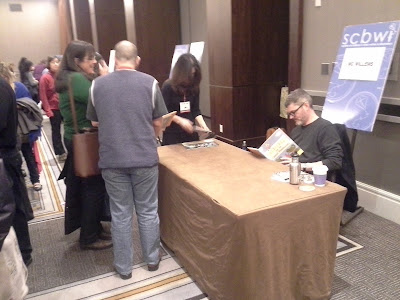
Almost the moment Mo Willems' keynote speech ended, people started lining up to get their books signed and we kid you not, the line ran the length of a football field (that's 100 yards, for those of you unfamiliar with the sport, or 91.44 meters if you're Canadian).
It's no wonder people are so excited to have their books inscribed, when you share the room with the likes of Julie Andrews, Mo Willems, Shaun Tan, Jane Yolen, Tomie dePaolo ...
We could and should go on, but we'll let the pictures speak for themselves.
 |
| Mo Willems |
 |
| Shaun Tan fans standing in a queue (do they say that in Australia?) |
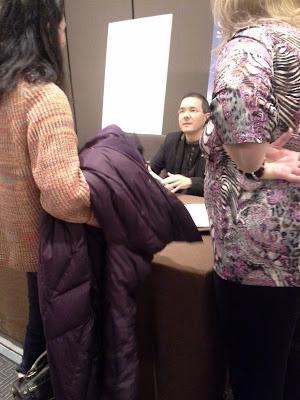 |
| Shaun Tan |
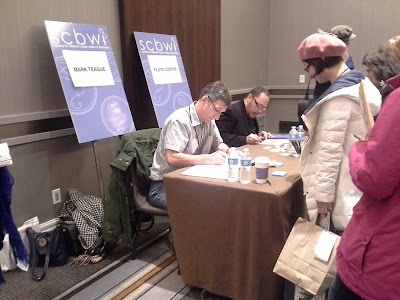 |
| Mark Teague and Floyd Cooper |
 |
| Meg Rosoff and David Ezra Stein |
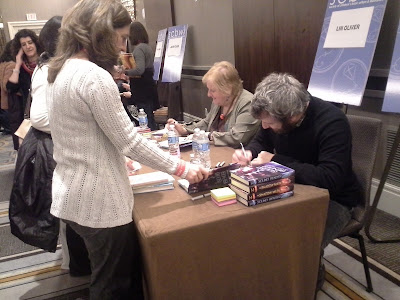 |
| Lin Oliver and Theo Baker |
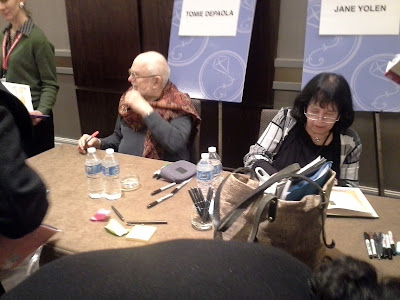 |
| Tomie DePaola and Jane Yolen |
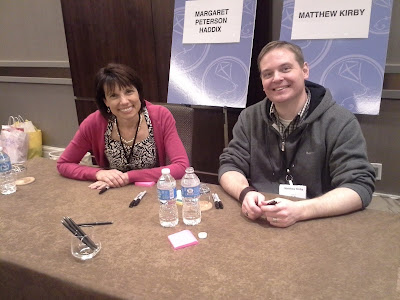 |
| Margaret Peterson Haddix and Matthew Kirby |
 |
Arthur Levine is a full-service editor. Here, he's opening
the book to the right page for an inscription. |
 |
| Our conference was the No. 1 trending subject on Twitter today... |
 |
| Until Shaun Tan spoke. No one's bigger! |
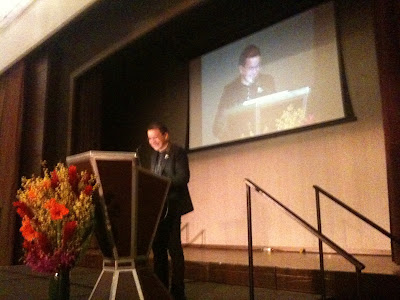 |
| Shaun Tan |
 |
| We, his audience, listening with a growing sense of wonder |
Shaun Tan grew up in the northern suburbs of Perth, Western Australia, and currently works as an artist, author and film-maker in Melbourne. Books such as The Rabbits, The Red Tree, Tales From Outer Suburbia and the acclaimed wordless novel The Arrival have been widely translated and enjoyed by readers of all ages. Shaun has also worked as a theatre designer, feature film concept artist, and wrote and directed the Academy Award winning animated short The Lost Thing. In 2011 he received the prestigious Astrid Lindgren Memorial Award in Sweden for his body of work. His most recent publication is The Bird King.
Shaun prefaces by saying that ultimately the truth of what he wants to say is in his actual work.
He shares flashes of insight...
the truths that I'm most interested in are the ones you can't speak about directly
we work in little bubbles, bumping into each other
he's interested in migration, crossing borders, transitions, the idea of a strange encounter, like in his amazing book, "The Arrival"
we forget our everyday world is really exotic, we see it so much we're sort of blind to it - the dark side of familiarity, where we stop appreciating the ordinary.
He reads us one of his stories, "Eric" (from "Tales From Outer Suburbia")
The room is captivated, and there's a huge AWWW... at the end.
Now he's discussing the themes of the story and how he followed the thread, saying
Again, some things can't be communicated directly.
He's talking (and showing slides) of other artists who captured seemingly unimportant things and found the beauty (and stories) in them, photos of his own studio that reveal much about his process, and images of close-to-his-home domestic scenes that inspire him. (We're seeing paintings and drawings, and even his sketchbooks!)
He's speaking now of exploring otherness and showing sketches he's done from museums of things foreign to him, saying:
"Drawing is the process of figuring out why I like things."
The most delicious part of his talk are his captioned illustrations that crack us up, explaining a 'typical' day. One drawing reads "stumble across my own consciousness in the kitchen - what time is it?"
It's whimsical, mystical and fascinating, just like Shaun!
There's so much more, and this moment still resonates from Shaun's keynote:
"I know a story is good when I can't entirely explain what it's about"
Want to hear more of Shaun's remarkable thoughts? You can check out
our pre-conference interview, and
his great website, and see some of his sketches yourself in his new "The Bird King and other sketches" but it was a delight to be able to hear him in person.
We're even getting a preview of his current work in progress...And we end with a standing ovation!

By: Candy Gourlay,
on 1/27/2013
Blog:
Notes from the Slushpile
(
Login to Add to MyJacketFlap)
JacketFlap tags:
Shaun Tan,
Writing For Children,
Children's authors,
James Scott Bell,
Working Partners,
Maureen Lynas,
inferring,
Show Not Tell,
Cornerstones Literary Consultancy,
Add a tag
By Maureen Lynas
Look, I'm cross. Can't you tell?
Do I have to actually spell it out for you!
Grrrrrrrrr
I once attended an excellent weekend course run by
Cornerstones Literary Consultancy. Each day was split into sessions based on
plot, character, settings etc. and all was well until we reached the session on
‘Show Not Tell’ Blank looks all round. Explanations were given. Examples
View Next 25 Posts








Glad to hear that the Anastasia books are being refreshed, but I agree that changing it to “off her rocker” is silly.
Thanks for the kind word, BB. It was, of course, a group effort. With Batman on your side, how can you lose?
I thought the exact same thing about changing “ask your analyst” to “off your rocker”! i bought new copies solely for the intro by the author to the first two in the series. They are HYSTERICAL. Also, I kind of like the new covers. It’s pretty clear to me that they are caricatures, not fetishizing anorexia or something.
“It helps if the person asking is British and wasn’t practically required by law, like those of us here in the States, to read certain books in the U.S. kidlit cannon.”
While admitting that commenting on spelling errors by a World Famous Librarian Person can lead to nothing but grief, I gotta say I love the image of a large cannon into which we can load kidlit books we’re not fond of and shooting them at our enemies.
He he! It always feels a bit like Christmas if I have a brush with Fuse News! Thanks Though I wish I had that quilt….
HA! I love the image of a large physical cannon. I think the only grief to be suffered here is on my part. I will, however, take my editor to task (my editor being my mother who usually catches these errors at 5 a.m., thereby sparing my readers).
I’m super pleased that Anastasia is getting a reprint but I was surprised…did they make her blonde? And I confess, as much as I loved Anastasia, I ADORED Sam.
Whoops. — Mom
The Owl Moon quilt is amazing in person. I happened to be there at the picture book boot camp where Sibby presented it to Jane. It was such a touching moment.