

Inspired by love, a misguided monkey believes he is destined for the moon.
The post ‘Monkey Love Experiments’ by Ainslie Henderson and Will Anderson appeared first on Cartoon Brew.
Add a Comment
 By: Jerry Beck,
on 12/17/2016
By: Jerry Beck,
on 12/17/2016
Inspired by love, a misguided monkey believes he is destined for the moon.
The post ‘Monkey Love Experiments’ by Ainslie Henderson and Will Anderson appeared first on Cartoon Brew.
Add a Comment By: Celine Aenlle-Rocha,
on 7/23/2016
By: Celine Aenlle-Rocha,
on 7/23/2016
This weekend, the 32nd International Society for Music Education World Conference will be hosted in Glasgow, Scotland. Researchers, practitioners, and performers will gather to present concerts, talks and discussions. We asked a few attendees for their pre-ISME thoughts and plans. What are you looking forward to at the conference?
The post Preparing for ISME Glasgow appeared first on OUPblog.
By: Kim Behrens,
on 7/21/2016
As the beginnings of large-scale travel and tourism through Scotland began within fifteen or twenty years of the battle of Culloden, it might have been expected that the conflict would become an early site of memory.
The post Culloden, tourism, and British memory appeared first on OUPblog.
 By: Jerry Beck,
on 6/22/2016
By: Jerry Beck,
on 6/22/2016
A boy fears for growing up and aging, and does odd things to avoid growing up.
The post ‘Gerascophobia’ by Shuangshuang Hao appeared first on Cartoon Brew.
Add a Comment
By: Jerry Beck,
on 6/14/2016
As much a surrealist art piece as a game promo, the trailer for Warhammer 40,000: Dawn of War III is a unique accomplishment. Cartoon Brew takes a look at how it was made.
The post ‘A Surreal Lucid Nightmare’: The Making Of ‘Warhammer 40,000: Dawn of War III’ Trailer appeared first on Cartoon Brew.
Add a Comment.jpg?picon=925) By: Sarah McIntyre,
on 5/13/2016
By: Sarah McIntyre,
on 5/13/2016
All this week I've been on an illustration book tour of the Scottish Highlands! At first I thought I was going to have to do it solo, but I asked Beth Bottery at Scottish Book Trust if I could bring Stuart along and she said yes. Then all my knitted book characters decided they wanted to come along, too. 
This is the first time I've ever gone on an extended tour with Stuart! And he wasn't just tagging along, he was WORKING. In fact, I thought I'd let him do the blogging. So... OVER TO STUART:
Hi, everyone! My first job was help Doug the Pug sharpen up his drawing skills in anticipation of all the pictures he was going to be making during the course of the week. He drew some pictures on the train. 
Here's one he did of me! 
And here's one he did of the First Minister Nicola Sturgeon. You can't get more Scottish than that. 
Our first port of call was GLASGOW, to see Sarah's auntie. 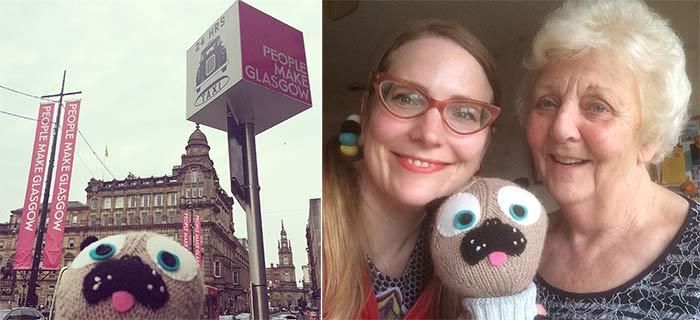
On Sunday, Beth Bottery and Thomas Jefferson from Scottish Book Trust came to pick us up and drove us all the way to Thurso, right in the north of Scotland. 
Here they are in the wilds of the Highlands.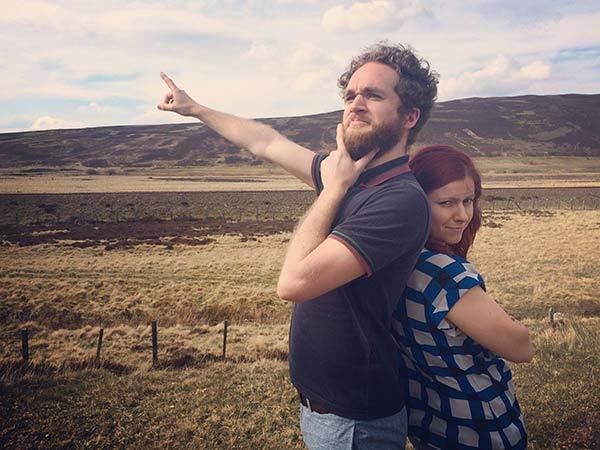
Here are a couple of snapshots of Thurso in late evening. 

MONDAY, 9 May:
My first stage appearance was at Mount Pleasant Primary School in Thurso (coordinated by Suzanne Urquhart) and Pennyland Primary came along, too. Here I am with Sarah in my new role as PROFESSOR SNOWSTORM! 
I'm supposed to know a lot about the different types of snow in Sarah and Philip Reeve's book Pugs of the Frozen North. Being on stage was exciting but also a bit nerve-racking. Luckily I didn't mess up too many of my lines.
Here are some books the children made in advance, which are pretty impressive. 

For the afternoon, Miller Academy Primary School (and Pat Ramsay) hosted us, along with visiting school Melvich Primary. At each visit we created a board game, featuring a race to the North Pole from the school. We wanted to give them ideas on creating a story, how (like a board game) it needs a beginning, an end, and perils in the middle. This group game up with some really unusual perils, culminating in the greatest peril: Donald Trump. 
We also met Reading Champion Alex Patience, who works with the kids on this reading scheme. 
On a beautiful evening - tropical for Thurso! - Sarah made a new friend named Kali. 
TUESDAY, 10 MAY:
We visited Castletown Primary School, just outside Thurso, with the visit coordinated by Rhona Moodie. Having a day's practice, I was beginning to get into my character a bit more. Things didn't seem to be quite so scary, particularly when the class was a bit smaller. 
Tom took us to a roadside cafe for lunch, just outside Wick, The Rumblin' Tum. It felt like something you might find in the Australian outback.
Sarah took this photo of Tom and me and mystery guest in the background.
In the afternoon, we were at Noss Primary School (which was only a few weeks old!), with Watten Primary visiting. Headmaster Ally Budge had really researched Sarah and Beth told us he'd filled out the application form for the visit in Russian! (Sarah and I both speak some Russian.) This was our largest event yet, with more than 200 children. The school gave Sarah a very thoughtful Russian-themed gift, Baggage by Marshak & Lebedev. 
We drove on to Tain and stayed in the Royal Hotel, which was very grand. 
Tain was lovely, with some very striking buildings. 
We had dinner at the restaurant at Tain railway station. Sarah shot this video because she thought Beth had a wonderful Hull accent.
During the week the four of us did some drawing challenges. Here's our #ShapeChallenge drawings. (Can you guess who drew which one?) Sarah sets daily Shape Challenges on Twitter which you can discover at @StudioTeaBreak. 

WEDNESDAY, 11 May:
In the morning we visited Knockbreck Primary School in Tain (coordinated by Mhairi Miller), with Dornoch Academy visiting. Sarah drew this picture of her and Doug the Pug but she forgot to take any more photos. 
After lunch, we headed to Strathpeffer Primary School (hosted by Carolyn Ritchie and Mr Spence), with visiting school Mulbuie St Clements.
The afternoon was so sunny that we sat out on the lawn of our hotel and did a Comic Jam together. Here are some teaching videos if you want to learn how to do a Comic Jam in your school.
Beth shot this video of the Comic Jam at different stages. 
THURSDAY, 12 May:
Our first stop was Teanassie Primary School (with Sharon Gallacher), with visiting school Beauly Primary, which was our most intimate event with just over 30 children. When we drove in, we saw the chickens and three pigs the school raise. 
Everyone on our tour loved knitted Doug the Pug, designed by Lauren O'Farrell (aka Deadly Knitshade). Here's the link if anyone wants to download the free pattern from Sarah's website. And here are some of the pugs the children drew at Teanassie:
In the afternoon we arrived in Inverness to visit Drakies Primary School (coordinated by Rebecca Fleming), with visiting school Bun-sgoil Ghàidhlig Inbhir Nis. Drakies were very excited about the visit and prepared some posters to advertise Sarah's event to the other children. Sarah was so pleased! 
Drakies even tweeted to Sarah before the event (@DrakiesPS). She loves it when teachers and pupils prepare things before the visit and this group made lots of great stuff. 


Even after the visit, this mum sent us a picture which made us all go 'Awww'. 
On Sarah's drawing challenge @StudioTeaBreak, Thursday is #PortraitChallenge day. Here's a family portrait of pop stars if they were animals. 

FRIDAY, 13 MAY
My costume for the week included wearing this pair of yellow trousers. Don't park on my double yellow lines! 
For our final day, we began at Crown Primary School in Inverness, organised by James Cook.
The school had a blog up by the same evening! We got some very encouraging feedback from the teachers, including one who said in twelve years of teaching, it was the best event she had seen and gave the teachers lots of ideas of things to do with the kids later. 
And finally, Hilton Primary School (with Amy Fraser) and visiting school Cradlehall Primary. We received a warm welcome from the dinner ladies! 
The dinner ladies even baked us banana flapjack! This was our biggest event. It will be funny telling my colleagues back at work what I've been doing all week. 
Here are cards Sarah drew for Tom and Beth, thanking them for all their hard work. Thank you very much, guys!! And to all the schools who hosted us, Scottish Book Trust, and our sponsors Scottish Friendly. 
This was a never-to-be-forgotten week! It gave me a whole new perspective of Sarah's work. I hope all the children we met go away and do a lot more drawing, writing and reading. I might try to do some more drawing, too! 
By: Sarah McIntyre,
on 4/19/2016
Uh... did you see Johnny Depp and his wife saying sorry for smuggling their pet dogs into Australia? It was a bit strange.
Well, I'm doing a Pugs of the Frozen North book tour of the Scottish Highlands in May, and Scottish Book Trust are already issuing their own apologies...
By: John Priest,
on 3/26/2016
This January, the OUP Philosophy team has chosen David Hume as their Philosopher of the Month. Born in Edinburgh, Hume is considered a founding figure of empiricism and the most significant philosopher of the Scottish Enlightenment. With its strong critique of contemporary metaphysics, Hume’s 'Treatise of Human Nature' (1739–40) cleared the way for a genuinely empirical account of human understanding.
The post How well do you know David Hume? [quiz] appeared first on OUPblog.
By: KatherineS,
on 1/25/2016
"�I may say, of myself and Copperfield, in words we have sung together before now, that
'We twa hae run about the braes
And pu’d the gowans fine'
'—in a figurative point of view—on several occasions. I am not exactly aware,' said Mr. Micawber, with the old roll in his voice, and the old indescribable air of saying something genteel, ‘what gowans may be, but I have no doubt that Copperfield and myself would have frequently taken a pull at them, if it had been feasible.'"
Over the years since it was written, many millions must have sung ‘Auld Lang Syne’ (roughly translated as ‘days long past’) while sharing Mr Micawber’s ignorance of what of its words actually mean.
The post The truth about “Auld Lang Syne” appeared first on OUPblog.
.png.jpg?picon=3640) By: Sara Burrier,
on 11/6/2015
By: Sara Burrier,
on 11/6/2015
 By: VictoriaD,
on 11/3/2015
By: VictoriaD,
on 11/3/2015
Depending on your tastes, bagpipes are primal and evocative, or crude and abrasive. Adore or despise them, they are ubiquitous across the city centers of Scotland (for tourists or locals?). In anticipation of St Andrews Day, and your Robert Burns poetry readings with a certain woodwind accompaniment, here are 10 facts you may not have known about the history of the bagpipes.
The post Ten fun facts about the bagpipes appeared first on OUPblog.
 By: Shelf-employed,
on 8/31/2015
By: Shelf-employed,
on 8/31/2015
I can't republish certain reviews that have already appeared in print or elsewhere online, but I can point you to where you might find them.
The Enchanted Files: Diary of a Mad Brownie by Bruce Coville. (Listening Library, 2015)
Suggested for ages 8-12. 298 minutes.
 |
| http://www.audiofilemagazine.com/reviews/read/102097/ |
By: KatherineS,
on 7/24/2015
Mary Stewart became Queen of Scots aged only 6 days old after her father James V died in 1542. Her family, whose name was anglicised to Stuart in the seventeenth century, had ruled Scotland since 1371 and were to do so until the death of Queen Anne in 1714. Raised in France from 1548, she married the heir to the French throne (1558) and did not come to Scotland until after he died in 1561.
The post A royal foxhunt: The abdication of Mary Queen of Scots appeared first on OUPblog.
By: Sarah McIntyre,
on 6/12/2015
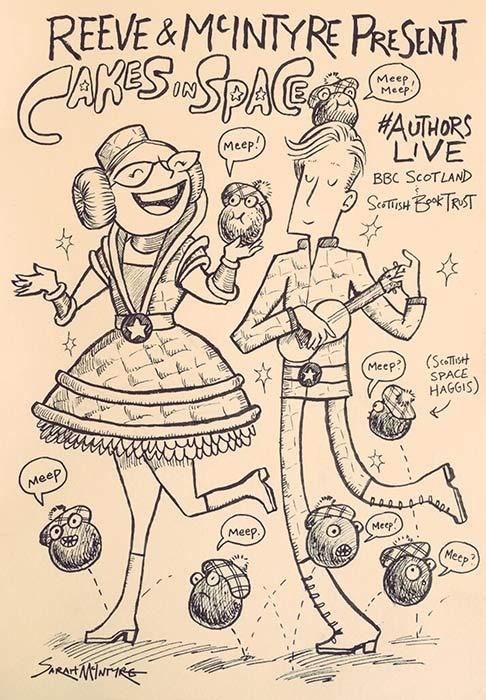
Blog written with my co-pilot Philip Reeve: So our shiny silver space shuttle set us down in sunny Glasgow, where we’d been invited by Scottish Book Trust to do one of their Authors Live events. 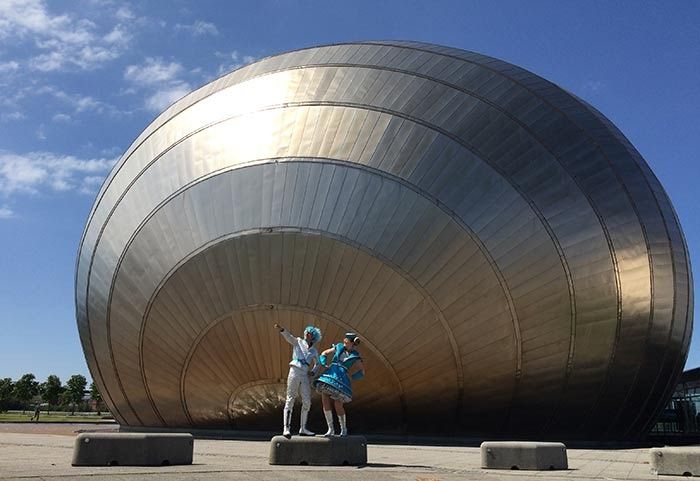
These events take place at the BBC’s Glasgow studios; there’s a small invited audience of children from local schools, but the show is also broadcast live online to any other schools who want to sign up for it.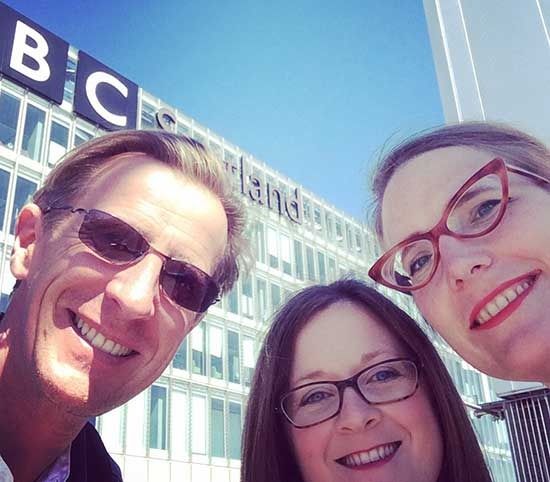
We arrived on Wednesday afternoon to meet Scottish Book Trust’s Heather Collins and some of the team who were going to be in charge of the broadcast. Part of the Cakes in Space show involves a video transmission from some spoon-crazy alien life-forms called the Poglites. At all the festivals we’ve done we’ve used a video which Philip and his wife Sarah Reeve shot on his phone, of two Poglite puppets in a spaceship set made out of old polystyrene packaging. 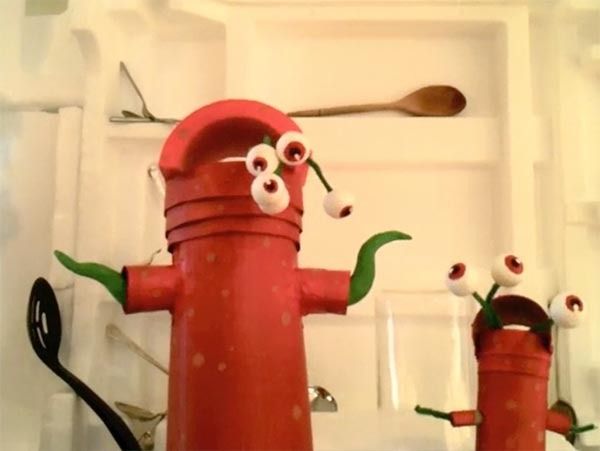
But to be shown by the BBC it needed to be ‘broadcast quality’, so we brought the puppets with us and re-shot the whole thing in one of the vaguely futuristic-looking stairwells at the BBC. 
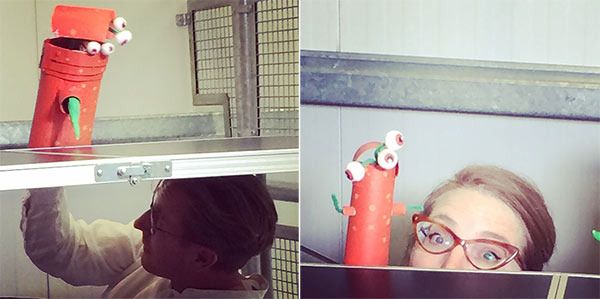
The actual show took place on Thursday morning. We suited up and waited nervously in the hotel lobby for the shuttle to take us to BBC HQ…

Filming was to take place in an open atrium area in the middle of the BBC building, which had been decorated for the purpose with stars and silver podia (grammar). It takes a LOT of people to arrange even a simple broadcast like this. Here are some of the team…
And here are some of the audience - a weird and wonderful collection of interstellar oddballs shipped in from a neighbouring star-cluster. 
Photo by Alan Peebles
They seemed friendly though. One of them, Abena, brought us this nice letter, so we knew they Came In Peace.
We’d never done a live broadcast before, so we were a bit nervous, but everything seemed to go well. 
Photo by Alan Peebles
Photo by Alan Peebles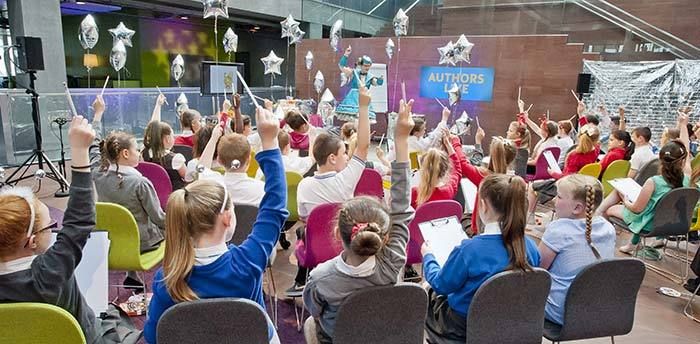
Photo by Alan Peebles
Photo by Alan Peebles
Photo by Alan Peebles
And you can see for yourself, because one of the great things about the Authors Live scheme is that recordings of the shows are kept on the Scottish Book Trust website, where anyone can watch them whenever they fancy. So we now have a lasting record of the Cakes In Space show, which future generations will be able to look at and say, ‘WHAT were you THINKING?’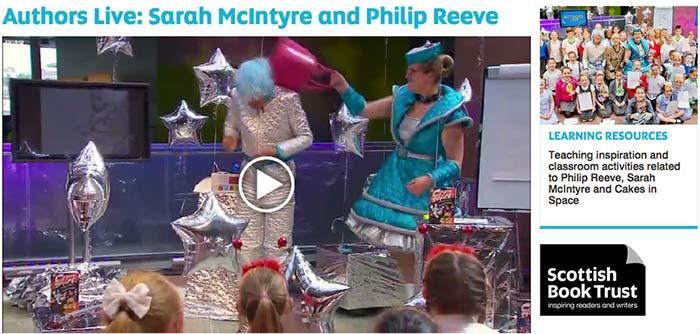
Click on the image to watch the video!
It’s especially nice to have this record because this was the last Cakes in Space show we’ll be doing (at least for a while). In the autumn we’ll be unveiling a whole new show based on Pugs of the Frozen North. Big thank yous to Heather and her team from Scottish Book Trust, teacher Jennifer Buchan (who created Author Live's Cakes in Space Learning Resource page), and Janice Forsyth, Donald, Irene, Neil, Liz, photographer Alan Peebles and everyone at BBC Scotland for making it all possible. 
While we were in Glasgow, we also managed to catch up with Sarah's Glasgow Auntie and our friends Adam Murphy (who draws the Corpse Talk strip for The Phoenix and his comics colourist partner Lisa Murphy. (Great to see you guys!)
By: Jerry Beck,
on 4/20/2015
By: Jerry Beck,
on 2/23/2015
"Spectators" is an observational animation that inverts the expected focus of a football match, turning attention to those on the periphery.
Add a Comment
By: Alex Guyver,
on 1/26/2015
One of Glasgow’s best-known tourist highlights is its Victorian Necropolis, a dramatic complex of Victorian funerary sculpture in all its grandeur and variety. Christian and pagan symbols, obelisks, urns, broken columns and overgrown mortuary chapels in classical, Gothic, and Byzantine styles convey the hope that those who are buried there—the great and the good of 19th century Glasgow—will not be forgotten.
But, of course, they are mostly forgotten and even the conspicuous consumption expressed in this extraordinary array of great and costly monuments has not been enough to keep their names alive. And, of course, we, the living, will soon enough go the same way: ‘As you are now, so once was I’, to recall a once-popular gravestone inscription.
Is this the last word on human life? Religion often claims to offer a different perspective on death since (it is said) the business of religion is not with time, but with eternity. But what, if anything, does this mean?
‘Eternal love’ and ‘eternal memory’ are phrases that spring to the lips of lovers and mourners. Even in secular France, some friends of the recently murdered journalists talked about the ‘immortality’ of their work. But surely that is just a way of talking, a way of expressing our especially high esteem for those described in these terms? And even when talk of eternity and immortality is meant seriously, what would a human life that had ‘put on immortality’ be like? Would it be recognizably human at all? As to God, can we really conceive of what it would be for God (or any other being) to somehow be above or outside of time? Isn’t time the condition for anything at all to be?

If we really take seriously the way in which time pervades all our experiences, all our thinking, and (for that matter) the basic structures of the physical universe, won’t it follow that the religious appeal to eternity is really just a primitive attempt to ward off the spectre of transience, whilst declarations of eternal love and eternal memory are little more than gestures of feeble defiance and that if, in the end, there is anything truly ‘eternal’ it is eternal oblivion—annihilation?
Human beings have a strong track record when it comes to denying reality.
One fashionable book of the post-war period was dramatically entitled The Denial of Death and it argued that our entire civilization was built on the inevitably futile attempt to deny the ineluctable reality of death. But if there is nothing we can do about death, must we always think of time in negative terms—the old man with the hour-glass and scythe, so like the figure of the grim reaper?
And instead of thinking of eternity as somehow beyond or above time, might not time itself offer clues as to the presence of eternity, as in the experiences that mystics and meditators say report as being momentary experiences of eternity in, with, and under the conditions of time? But such experiences, valuable as they are to those who have them, remain marginal unless they can be brought into fruitful connection with the weave of past and future.
From the beginnings of philosophy, recollection has been valued as an important clue to finding the tracks of eternity in time, as in Augustine’s search for God in the treasure-house of memory. But the past can only ever give us so much (or so little) eternity.
A recent French philosopher has proposed that time cannot undo our having-been and that the fact that the unknown slave of ancient times or the forgotten victim of the Nazi death-camps really existed means that the tyrants have failed in their attempt to make them non-human. But this is a meagre consolation if we have no hope for the future and for the flourishing of all that is good and true in time to come. Really affirming the enduring value of human lives and loves therefore presupposes the possibility of hope.
One Jewish sage taught that ‘In remembering lies redemption; in forgetfulness lies exile’ but perhaps what we it is most important to remember is the possibility of hope itself and of going on saying ‘Yes’ to the common, shared reality of human life and of reconciling the multiple broken relationships that mortality leaves unresolved.
Pindar, an ancient poet of hope, wrote that ‘modesty befits mortals’ and if we cannot escape time (which we probably cannot), it is maybe time we have to thank for the possibility of hope and for visions of a better and more blessed life. And perhaps this is also the message that a contemporary graffiti-artist has added to one of the Necropolis’s more ruined monuments. ‘Life goes on’, either extreme cynicism or, perhaps, real hope.
Featured image credit: ‘Life goes on.’ Photo by George Pattison. Used with permission.
The post Thoughts in the necropolis appeared first on OUPblog.
By: Julia Callaway,
on 12/21/2014
Scotland was selected as the Oxford Atlas Place of the Year 2014. We invited several experts to comment on the decision and Scotland’s phenomenal year.
Scotland has remained in the media spotlight throughout 2014 for one reason: the referendum on independence from the United Kingdom. This was the most significant event to have taken place in Scotland since the creation of the Union in 1707. But it hardly presented an edifying spectacle to the outside world. Nationalists constantly complained about England, describing every utterance by a Unionist politician as “cack-handed” or “an insult to the people of Scotland”. Celebrities such as Sir Paul McCartney, David Bowie, and J.K. Rowling who publicly backed the Union were subjected to appalling online abuse. Financial projections were produced which might politely be described as misleading. The proposals for an independent Scotland, in preparation since the foundation of the SNP in 1934, were marked by an astonishing lack of detail — voters were not even told what currency the new state was to have. The official Unionist campaign showed a crippling lack of passion; politicians argued for the status quo while pretending not to. Most Westminster MPs, aware of their unpopularity in Scotland, opted to say as little as possible. Three Scottish MPs from the Unionist camp stepped in to fill the vacuum: Jim Murphy, George Galloway, and, very much at the eleventh hour, Gordon Brown. Brown’s passionate speech, the finest of his career, delivered on the day before the vote, left everyone wondering why he had not become involved in the Unionist campaign sooner.
The campaign, indeed, had dragged on for three years. The SNP might have been expected to hold the referendum soon after their election to government in 2011. But the year 2014 appeared propitious: it was the year of the Glasgow Commonwealth Games, which could be expected to give a boost to nationalist sentiment, and of the 700th anniversary of the Battle of Bannockburn in 1314, at which the Scots had destroyed an English army of invasion, leaving the way clear for retaliatory Scottish raids on England. In the event, the Games were hailed as a triumph for Scotland, but had no effect on nationalism, while the Bannockburn anniversary was greeted with widespread indifference, with thousands of tickets at the commemorative event remaining unsold. The 100th anniversary of the outbreak of the First World War, in which Scots and English had fought and died side by side, carried a more meaningful resonance.
When the referendum was finally held, independence was decisively rejected. 1,617,989 Scottish residents voted for independence, out of a voting age population of 4,436,428: that is, 36.47%. The leader of the independence campaign, Alex Salmond, had declared immediately before the vote that the result would settle the matter for a generation; immediately after it, he challenged the result and called for a second referendum to be held as soon as possible. His colleagues in the SNP, meanwhile, floated the idea of a unilateral declaration of independence: the support of a majority of the people of Scotland, not having been forthcoming, was no longer deemed necessary. In the days which followed, the losers formed themselves into a group called “the 45” (44.65 per cent of those who voted had voted for independence). The name “the 45” recalls, of course, the doomed Jacobite rebellion of 1745, in which ordinary Scots were driven by their highland lords into an ill-advised invasion of England, and were roundly defeated, with catastrophic consequences for Scotland.

How does Scotland emerge from all this? The referendum exposed Scotland’s politicians to public view, caused old resentments to be stirred up, and led to the airing of attitudes that would have been better hidden. On the other hand, there was no serious violence and no bloodshed. It is enormously to the credit of the UK government that it permitted such a referendum to be held at all. The UK is now much stronger for having given the nationalists the opportunity to demonstrate that their supporters account for barely more than one in three of the Scottish voting age population.
But what of overseas visitors who may be contemplating a trip to Scotland next year? Do come. Scotland remains a country of unsurpassed natural beauty with a rich and visible history and a warm and welcoming people. By virtue of its membership of the UK, Scotland punches far above its weight in world affairs. Its language is English and its currency remains the pound sterling. The visitor to Scotland will find that there is one particular subject on which its people are united in not wanting to talk about: the 2014 independence referendum.
Headline image: The debating chamber of the Scottish Parliament Building by Colin. CC-BY-SA-4.0 via Wikimedia Commons.
The post Reflections on the 2014 Scottish independence referendum appeared first on OUPblog.


 By: Julia Callaway,
on 12/16/2014
By: Julia Callaway,
on 12/16/2014
The light in the Orkneys is so clear, so bright, so lucid, it feels like you are on top of the world looking though thin clouds into heaven.
It doesn’t even feel part of the UK: when you sail off the edge of Scotland by the Scrabster to Stromness ferry, you feel you are departing the real world to land in a magical realm.
Nowhere else on earth can you go to a place and see eight thousand years of continuous history in such a tiny space.
Skara Brae is what remains of a neolithic village, older than Stonehenge and the pyramids, kept secret underground until uncovered by a severe storm in 1850. You can walk in and sit down, look around at the stone walls, stone beds, stone cupboards, dressers, seats, and storage boxes. Recognizably human people lived here, seeing this same landscape and coast, feeling the same wind on their faces that you do, their eyes resting on the doors, hearths and toilets (one in each dwelling).
This is ‘stone age’ but talking about such ages is a misnomer in the Orkneys where they had no appreciable bronze age nor iron age so proceeded from the non-use of one metal to the non-use of another in what is now the best preserved neolithic site in Europe.

The Orkneys have been so fascinating for so long that even the vandalism needs to be preserved. In Maeshowe burial mound you can see where Viking tourists who came to the monument, already ancient by their time, wrote graffiti about their girlfriends on the walls. They wrote in Norse runes.
The Orkney islands were the headquarters of the Viking invasion fleets, and to this day the Orkneys are the only place in the world besides Norway where the Norwegian national day is celebrated.
The islands are filled with Tolkeinesque place names like the Ring of Brodgar, the Brough of Birsay, the Standing Stones of Stenness. Sagas were born here, like that of the peaceable 12th century Earl of Orkney, treacherously assassinated and now known as St Magnus, after whom the cathedral is named.
Sagas were created here in living memory. This is where the British home fleet was at anchor and the German fleet still lies. The battle fleet of the German Imperial Navy transferred in its entirety to Scapa Flow in 1919 to await a decision on its future. The German sailors could not bring themselves to give up their ships; they opened the seacocks and scuttled them all. At low tide you can still see the rusting hulks of Wilhelmine ambitions to dominate Europe.
If the Orkneys sound bleak and rocky, that would be the wrong impression to leave. They have rich and fertile farming land with green plains rolling on under a pearl sky. People tell folk tales around the peat fires, drinking ginger-flavoured whiskey; an orange cat pads around the grain heaps in the Highland Park distillery, and the islands shimmer under the ‘simmer dim’ of nightless summer days. I should be there now.
Headline image credit: Stromness, Orkney Islands by Geoff Wong. CC BY 2.0 via Wikimedia Commons.
The post Magical Scotland: the Orkneys appeared first on OUPblog.
 By: Julia Callaway,
on 12/15/2014
By: Julia Callaway,
on 12/15/2014
With the announcement of Scotland as Place of the Year 2014, we asked a few of our staff members who hail from Scotland to share their thoughts about home. They responded with heartfelt opinions, patriotism, nostalgia, poems, and a little homesickness. Here are their thoughts about Scotland being voted Place of the Year:
* * * * *
If I had been given a penny each time I was asked in 2014 about the Scottish referendum, I could quite possibly have written off the UK national debt. However, while there was no financial gain in these chats, I did sense that something much more valuable was happening; Scotland was finding its voice again. In the referendum, political debate was no longer a pursuit reserved for a privileged few, but open to everyone. There are some famous traditions in Scotland like haggis, tartan, and 12 year old Speyside whiskies (and I love all three), but I think the most lasting Scottish tradition is a readiness to stand at the vanguard of change. Whether this is manifest in new inventions, poetry, or indeed in changing the nature of political debate, Scotland’s voice is often worth listening to.
I’m glad that Scotland’s story is still being told as part of the United Kingdom but I remain grateful for the events of 2014 and the good they can bring. This year has allowed us to take stock, and hopefully, in the words of Rabbie Burns, ‘To see oursels as ithers see us’ and to change for the better again. I may be biased, but Scotland will always be my place of the year.
– Alistair Shand, Marketing Executive, Oxford Journals, from Markinch
* * * * *

I’m delighted that Scotland has been voted Oxford Atlas Place of the Year for 2014. If nothing else, I hope it means that people will think of something other than the stereotypical kilts, haggis, and bagpipes when they think of Scotland. It is a vibrant modern nation full of fantastic culture, rich history, and as we have seen this year, progressive politics. No matter which side of the referendum debate you were on, the level of engagement was really heartening, and spanned the generations; for the first time 16 and 17 year olds were allowed to vote. While 55% of voters decided against independence, the referendum has elevated Scotland in the world’s consciousness, and that makes me one tremendously proud Scot.
– Kirsty Doole, Publicity Manager, from Glasgow
* * * * *
It’s a great choice having Scotland as Oxford Atlas Place of the Year for 2014. Despite having lived away from Scotland for the best part of 20 years, I’m still a fiercely proud Scot (you can take the girl out of Scotland….). When people hear your accent for the first time, they always want to talk to you about Scotland. Where should they visit? (where do I start!) Is Glasgow scary (not in the least!), do you support Rangers or Celtic (neither, I’m a St Johnstone fan). It’s such a beautiful country, something of which I am reminded every time I take a trip across the border. The colours in autumn are spectacular, the natives are friendly, and its cities are vibrant, cosmopolitan places with plenty to explore. But if you asked me what I missed most about The Homeland, my answer might surprise you. It’s the drinking water. Crystal clear, straight out of the tap, and with no limescale — I’m homesick already.
– Fiona McPherson, Senior Editor, Oxford English Dictionary, from Grangemouth
* * * * *
I don’t think there are many other countries that provoke such a positive sense of belonging as Scotland. We may well have a reputation for being travellers, but no matter how far from ‘home’ or how long you’ve been away, that pride remains strong. When I think of home, it’s not the spectacular scenery that springs to mind (nor the much-maligned weather!), but the warm spirit, welcoming nature and humour of the people. We saw this in the summer of this year where Glasgow was the perfect host for the ‘Friendly Games’ and we see it annually in Edinburgh where the Fringe and Hogmanay are the focus of a global audience. However, my own favourite example of our welcoming, humorous people came in a football match against Italy in 2007 where the visiting Italians were treated to a rendition of ‘Deep fry your pizza. We’re gonna deep fry your pizza.’
— Paul Repper, Commissioning Editor, Primary Maths, Oxford Education, from Aberdeen
* * * * *
‘Ah dinna ken whit like your Scotland is. Here’s mines.
National flower: the thistle.
National pastime: nostalgia.’
— Liz Lochhead
In recent years, the whole world has caught a glimpse of my nostalgic Scotland. This is something we can all thank Alex Salmond for. As the referendum loomed, it seemed as though the drastic change in governance we were pursuing was based entirely on the first verse of ‘Flower of Scotland’. For those of you who may need a refresher in unofficial Scottish national anthems, this football fans’ favourite refers to Scots king Robert the Bruce sending Edward II of England ‘homewards, tae think again’.
Whichever way we voted in September, I’m pretty sure we Scots can all agree that our nation has been invented by nostalgics. We can wince all we like at Mel Gibson’s attempt at William Wallace, and shout down anyone who asks if we solely eat haggis and shortbread, but we’re just as guilty as the rest of you. I personally, having moved to England less than six months ago, have spun many a yarn about the mysterious land in the north, trying to appear exotic to my Oxford colleagues.
Scotland being chosen as the Oxford Atlas Place of the Year warms my nostalgic tartan heart; I always welcome an excuse to quote Rabbie Burns and raise a glass to Caledonia.
— Kathleen Sargeant, Marketing Assistant, Oxford Journals, from Falkirk, Stirlingshire
* * * * *
I may be somewhat biased but I thought it fitting that Scotland was announced as Place of the Year 2014. In a shortlist dominated by war and varying degrees of civil unrest, Scotland was a beacon of progress and positive political involvement. In the lead up to the independence referendum, held in September, the people of Scotland engaged with their future and their choices in a way rarely seen today, with 97% of people registering to vote. It was amazing to see my relatively small country become the focus of worldwide attention, especially for such a positive reason.
– CJ Cook, Marketing Executive, Law Marketing, from Livingston (but an adopted Glaswegian)
* * * * *
Scotland is my favourite place in the world and I’ve never found a bunch of friendlier people than those you find in Glasgow. Our sausage is square, our squash is called juice, and our pigeon holes are ‘dookits’. You’re guaranteed to make a friend if you travel any distance on public transport. My favourite bit about going home to Scotland is standing in the queue to board the plane. I never truly realise how much I miss the accent until I’m standing there, surrounded by people who over pronounce their ‘r’s’ in the same way I do. That’s when I know I’m nearly home.
– Jane Williams, Senior Marketing Executive, Medicine Marketing, from Inchinnan
Heading image: Heading image: Flag of Scotland by Cayetano. CC-BY-SA-2.0 via Wikimedia Commons.
The post Scottish OUP staff reflect on Scotland as Place of the Year 2014 appeared first on OUPblog.
 By: Molly Grote,
on 12/11/2014
By: Molly Grote,
on 12/11/2014
Here at Oxford University Press, we’re getting ready for the holiday season, and we were inspired by the new, twenty-first edition of the Atlas of the World to explore holiday traditions from around the world, including our 2014 Place of the Year, Scotland. Take a look at the map below to learn and see a little bit about the food, decorations, and other traditions of holiday celebrations taking place around the world at this time of year.
Image credit: Christmas lights on the tree in front of the Capitol Building, Washington, DC by Jonathan McIntosh. CC-BY-2.0 via Wikimedia Commons.
The post Holiday traditions from around the world appeared first on OUPblog.
 By: Connie Ngo,
on 12/6/2014
By: Connie Ngo,
on 12/6/2014
When one thinks of traditional Scottish music, one instrument usually comes to mind: the bagpipe. Although bagpipes are prominent in traditional music from Scotland, Scottish music branches far out beyond that. In light of Scotland receiving the title of Place of the Year for 2014, we’ve put together a brief playlist of music from Scotland, from chamber music to modern classical.
To learn more about Scotland and why it was voted Place of the Year for 2014, read our Place of the Year archive.
Headline image credit: Photo by PublicDomainArchive. CC0 Public Domain via Pixabay.
The post Music from Scotland: a playlist appeared first on OUPblog.
By: Molly Grote,
on 12/5/2014
This is an excerpt from Scotland: A Very Short Introduction by Rab Houston. Although the book was published in 2009, long before the Scottish independence referendum, the thoughts Houston expresses in the conclusion on the future of the country certainly proved relevant in the Scotland of 2014.
What are the implications of the past for Scotland’s future? First, Scots retain a deeply embedded sense of history, albeit a selective one. Like others in the Anglo-Saxon world, they understandably seek identity, empathy, and meaning for their private present by researching family or local history and they want to know about wars and history’s celebrities. They are less interested in the public past that creates the context for the social and political present, including for Scotland a separate national church, a distinctive legal code, and a very different experience of government. This detachment may be linked to any number of factors — a preoccupation with individual personal authority, disenchantment with politics, secularization, and electronic communications — but its effects are clear. Yet Scots still feel themselves touched by history and that awareness is a strong part of their identity. Modern Scotland is solidly grounded on historical foundations and the continuity this provides helps in dealing constructively with change.
One manifestation of the public past is a firm civic sense, which helps Scotland’s communities to score highly in polls of the most desirable places to live in Britain. Coupled with this is the enduring importance of locality and all the variety and the non-national solidarities it implies. An important reason Scottish devolution has worked so well is that historically Scotland had less centralized government than England and there was an effective civil society: precisely those forms of association below and outside the apparatus of the state, such as churches, communities, and families, mediating between public institutions and private lives, which now so concern the modern West. The notion of civil society empowering citizens has appeal both to the New Right and to left-leaning communitarian ideas of voluntary association, because it insists that people cannot have rights without responsibilities and that individualism has to be tempered by acknowledgement of a common good. Based on their historic experience of government, Scots felt that central authority could and should intervene for benign ends, but that most power should be diffused.
This appreciation of civil society is not rose-tinted. Scotland’s history has a dark side of greed, social inequality and injustice, the oppression of women, children, and other races, and bigotry towards different faiths, all repulsive to modern sensibilities. In the present too, there has been sleaze (notably in Labour’s ‘one-party states’ in west-central Scotland), there is a legacy of social conservatism that may encourage ignorance and intolerance, and there are problems of drug and alcohol abuse, anti-social behaviour, and crime, like anywhere in Britain. ‘The street’, once indicative of intimacy, has become a by-word for danger. Yet a vivid sense of the past, a firm national identity, and a strong civil society rooted in locality mark out both historic and modern Scotland.

History touches modern politics too, for as well as being Scottish, many Scots also feel British. The most important implication is that Scotland’s near-term future is unlikely to involve shunning community with the rest of Britain, because it has for hundreds of years been locked into a British paradigm. That does not mean Scots are always comfortable with their past or present relations with England, and they have never been slow to speak out when they perceive injustice. Less laudably, they have long played a ‘blame game’ against their neighbours. History shows they have a point, but to be a victim is to deny oneself agency. Better to accept how much has been gained from association with England, to recognize what is shared, to take justified pride in what is good about being different, and to change what is not.
The political implications of Union with England are still being played out three centuries on, albeit in a very different world. The component parts of Great Britain (and Ireland, both before and after independence in 1922) developed separately, but they also progressed together in ways that modified their experiences. In some regards, the parts have grown closer over time, but in important ways they remain different. All modern states are artifacts based on conquest and colonization, and laboriously created national solidarity (including Scottish, English, and British identity). Held together for centuries, the integrity of states everywhere is now maintained only precariously, their sovereignty and supposedly inviolable borders steadily eroded. Easy travel, immigration, trans-national crime, and global terrorism, capitalism, and environmental degradation are challenging and complicating our understandings of geography and politics. After 500 years of multi-national accretion, nation states, including Britain, are crumbling back into their component parts. Founded on centuries of uncertainty, experimentation, and compromise, the relations between Scotland and England remain open-ended.
During that time, Scotland has not been a backward version of England waiting to catch up, but something quite distinct. Politically, Scots have known what it is to be both independent and semi-detached in a way that is less true of Wales (whose institutions, if not its language, culture, and habits, were more completely assimilated) and wholly untrue of English regions since the early Middle Ages. Naturally the past should not determine the future, or we should never have shaken off the multiple oppressions of race, class, and gender. But history can liberate as well as limit and attempts to make a destiny that works with rather than against it are likely to be easier, more successful, and longer lasting. If one day Scotland did take the path of independence, it would be as much in tune with its history as would a future within the United Kingdom.
Image credit: Common Green, or ‘The Green’, Strathaven, South Lanarkshire, Scotland. Public domain via Wikimedia Commons.
The post An excerpt from Scotland: A Very Short Introduction appeared first on OUPblog.
 By: Catherine Fehre,
on 12/4/2014
By: Catherine Fehre,
on 12/4/2014
One of the ironies of the Scottish independence referendum is that Scotland is widely recognised to be a changed place despite the majority voting in favour of the union. It became clear during the course of 2014 that something significant was happening. Scotland witnessed levels of public engagement and debate never before seen. Hugh MacDiarmid’s ‘Glasgow 1960’ comes to mind. Returning to Glasgow ‘after long exile’, MacDiarmid’s narrator encounters packed trams heading for Ibrox, the home of Rangers football club, but discovers that the crowds are going to listen to a debate between ‘Professor MacFadyen and a Spainish pairty’ and that newspapers with headlines ‘Special! Turkish Poet’s Abstruse New Song’ were selling ‘like hot cakes’.
The Scottish Question may not have been debated on quite so elevated a level but debates were conducted the length and breadth of Scotland in a remarkably civil, engaging, and open manner. Those who sought to portray these debates as something sinister could do no better than refer to a professional politician who had an egg thrown at him while he addressed meetings on top of an Irn Bru crate. The dull, limited, predictable, binary debate of the conventional press contrasted with the expansive, lively, and engaging discussions that took place in often novel venues in every nook and cranny of Scotland. The Scottish Question, as debated by the public, was not restricted to a narrow constitutional question but became a genuine dialogue about what kind of place Scotland should seek to become. The referendum started a process that has not been halted by the outcome of a referendum on whether Scotland should become an independent country, the formal question that provoked this all-embracing national conversation.
The result of referendum and reaction to it has been in stark contrast to the referendum on devolution 35 years ago. In 1979, Scots had narrowly voted for a very limited form of devolution – 51.6% in favour on a turnout of 63.7% – but the measure on offer was not implemented as it failed to achieve the weighted majority demanded by Parliament at Westminster. The expectation in the run-up to that referendum had been that a decisive majority would vote for devolution. The slight numeric majority hid a defeat in expectations. Expectations were very different in the months leading up to September 18th this year. Early in 2014, opponents of independence thought that they might push support for independence below 30% and were still convinced that it would win less than 40% only a few weeks before Scots went to vote. In the event, 55.3% voted for the union on a record turnout of 84.6% but it has been the 45% that has been celebrated as victory. It has been the membership of the Yes parties, that has increased dramatically, with the membership of the Scottish National Party now dwarfing that of the other Scottish parties. With just under 100,000 members, the SNP can claim to be the only mass party in the UK today. Politics is an expectations game and supporters of independence knew that they had a ‘mountain to climb’, in the words of the chair of the official Yes campaign.
As opinion polls narrowed towards the end of the campaign, a ‘Vow’ was signed by the three main UK party leaders promising substantially more devolution while protecting Scotland’s share of public spending. This means that even the debate around the narrowed constitutionalist understanding of the Scottish Question will continue. More powers will be delivered with ramifications for the rest of the United Kingdom. Scotland is a changed place but an answer to the Scottish Question remains as elusive as ever.
Headline image credit: Glencoe, Scotland panorama by Gil Cavalcanti. CC BY-SA 3.0 via Wikimedia Commons.
The post Scotland is a different place now appeared first on OUPblog.

