new posts in all blogs
Viewing: Blog Posts Tagged with: boys reading, Most Recent at Top [Help]
Results 1 - 25 of 36
How to use this Page
You are viewing the most recent posts tagged with the words: boys reading in the JacketFlap blog reader. What is a tag? Think of a tag as a keyword or category label. Tags can both help you find posts on JacketFlap.com as well as provide an easy way for you to "remember" and classify posts for later recall. Try adding a tag yourself by clicking "Add a tag" below a post's header. Scroll down through the list of Recent Posts in the left column and click on a post title that sounds interesting. You can view all posts from a specific blog by clicking the Blog name in the right column, or you can click a 'More Posts from this Blog' link in any individual post.
 This coming Saturday evening, I’ll be interviewing Gary Schmidt about his new novel, Orbiting Jupiter, at the Peabody School in Cambridge, sponsored by Porter Square Books. It’s a very different kind of book from this author, and I am eager to talk with him. I hope you can join us!
The post Come fly with me appeared first on The Horn Book.
[As an experiment last fall, I invited self-publishers to submit their best new titles for review. About a dozen heeded the call, and I am reviewing their books in this space.]
 Bandits Peak; by Chris Eboch. Pig River Press, 2015. 173pp. ISBN 0-978-0692346006. Paper ed. $9.99
Jesse is out for a wander in the wilderness he loves near his small Washington State town when he comes across some strangers, two men and a pretty young woman. Fifteen-year-old Jesse’s insta-crush on the slightly-older Maria is believable and touching, and gives the subsequent boy-detective plot some emotional resonance. That the strangers are Up to No Good will be instantly apparent to readers, but an unrealistic degree of naivete on Jesse’s part, and the unrealistic lengths the story goes to in reinforcing that cluelessness, make the novel less credible than it needs to be. But what keeps it grounded–so to speak–are the wilderness-survival details (tracking, fire-making, fishing) that are Jesse’s best weapons for getting these varmints behind bars where they belong. R.S.
[This review may be distributed freely and excerpted fairly; credit to “Read Roger, The Horn Book Inc., www.hbook.com.]

The post Selfie Sweepstakes Reviews: Bandits Peak appeared first on The Horn Book.
 Don’t get me wrong. White guys working in children’s books have it good. In fact, it would be fair to say we have it pretty much made. But in the wake of host Daniel Handler’s remarks at Wednesday’s National Book Awards, I find myself thinking about the privileged but peculiar position white guys have in this field. (Some of what I have to say applies to the non-white guys, too, but I am not going to generalize that far.)
I wasn’t at the event and can’t bring myself to watch the video because I know it would have me writhing in empathetic embarrassment. So all of my information is from the transcript and subsequent internet outrage. And what I’m left with—even more than my happiness at Jackie Woodson’s win—is how sorry I feel for Handler, and how easily I could have fallen into the same trap. (I confess to some impatience with all the talk of him stealing Her Moment because Woodson is getting a way longer moment than any children’s National Book Award winner has ever gotten before. Quickly, who won last year?)
The main thing about being a white guy in children’s books is that you get a lot more attention—not to mention Caldecott Medals!—than you would otherwise, and than is really good for you. Award committees want you as a member. Conferences want you to speak. People look to you for a “male point of view”—especially when they are seeking to solve the perennial problem of The Boy Reader, attention to whose needs getting far more ink than the needs of his sister. If you’re good-looking—and here I speak from observation—you are really set. Molly Ivins would have said that you were born on third base, and, professionally speaking, she would have been right.
It’s a nice life that’s easy to get used to. But as Handler learned, it can bite you in the ass. There he was in the spotlight, doing what he’s been amply rewarded for doing for years, and he overreached. He was trying to show us that he was as cool as we’ve long been saying he was: I am so cool I can get away with a racist-not-racist watermelon joke. He couldn’t, and I’m sorry there was no one to tell him he wouldn’t. Or maybe he didn’t think to ask? It’s the least a guy can do.
The post Being a White Guy in Children’s Books appeared first on The Horn Book.
Teen boys go on journeys both physical (road trip!) and psychological in these affecting YA novels.
 Finn Easton, protagonist of Andrew Smith’s 100 Sideways Miles, has unusual scars on his back, products of the freak accident that also killed his mother when he was a kid. He has a pretty good life otherwise: his sci-fi novelist father loves him; his best friend Cade makes him laugh; and he has recently met Julia, the girl of his dreams. After Julia moves away, crestfallen Finn embarks on a college visit with Cade, a trip that turns the boys into heroes. Finn has a funny, fluid narrative voice, and his banter with Cade is excellent — and often hilariously vulgar. (Simon, 14 years and up)
 As Charlie Porter convalesces from a ruptured Achilles tendon, his past — years of being paraded around in a beetle costume by his opportunistic father as the child author of the Beetle Boy series — resurfaces in nightmares in which he’s tormented by a giant beetle. Charlie wrestles with anger regarding the exploitation and abandonment he suffered as a child, guilt for escaping that suffering while leaving his little brother behind, and gratitude toward the crotchety children’s book author who cared for him. In her relentlessly honest but hopeful novel Beetle Boy, author Margaret Willey crafts a delicate psychological landscape through carefully timed flashbacks. (Carolrhoda Lab, 14 years and up)
 Two years ago a family outing to the beach ended in trauma when fourteen-year-old Miles experienced a psychotic break. While recovering in the psych ward, Miles received a life-changing diagnosis of schizophrenia along with some devastating news: during the commotion of his episode, Miles’s little brother went missing and is presumed drowned. Miles begins a risky investigation into his brother’s disappearance shortly after ditching his cocktail of medications. Some readers will guess the twist ending of Nic Sheff’s Schizo, but will nevertheless hope for Miles to find peace with his life and with his illness. (Philomel, 12 years and up)
 As Carl Hiaasen’s farcical Skink — No Surrender opens, teen narrator Richard’s cousin, Malley, runs away from home, and Richard is certain that she’s with a chat-room acquaintance almost twice her age. He tells Clint Tyree, a.k.a. Skink (the unkempt and unwavering former Florida governor who stars in several of Hiaasen’s adult novels), and the pair immediately takes off on an event-filled road trip to rescue Malley. Hiaasen smoothly integrates Skink’s vulnerabilities with his larger-than-life behaviors — including eating roadkill and wrestling an alligator — and Richard’s naiveté plays nicely against Skink’s extremism. (Knopf, 12–15 years)
From the August 2014 issue of Notes from the Horn Book.
The post Go your own way appeared first on The Horn Book.
Far too many of our students enter as ninth graders reading woefully below level. Part of the problem, we believe, is due to the Matthew effect. The gist of this theory is that kids who struggle with reading for whatever reason avoid it all costs, causing them to fall even further behind. And of course, the farther behind they fall, the more they avoid reading.
As a result, our school’s English department has set out to create a culture of reading. We envision a school full of students who read for fun and engage in informal conversations with each other about books as readily as they do about last night’s basketball game. Students who would talk about the film version of a text and proclaim the book was way better. By focusing our efforts on creating such a culture (rather than on, say, scripted remedial curriculum), we hope that students will enjoy reading more and then read more.
One of the first things we changed to this end was our summer reading, as summer reading loss among inner-city students is well-documented. Previously, each grade level had an assigned text to read over the summer. Students would read the book and then write an essay or create a project that they would submit upon their return in the fall. As well-intentioned (and plagiarism-prone) as this was, it did not create the culture we wanted.
So last year we gave students more choice. We created a list of books with a few selections per genre. Students were given a packet that featured the cover, a brief synopsis of the premise, a simple approximation of difficulty, and page count for each book. After a week, they submitted their top three choices were then assigned one of those titles. Over the break, students completed a log in which they had to summarize and annotate each chapter and create a few discussion questions. In the fall they took part in discussion groups in their English classes with others who had read the same book.
Of course, things weren’t perfect. One thing we learned (i.e. were told by students) was that we needed more sports-related selections (we’re in all-boys school). We’re also going to encourage all faculty members to read at least one of the books from the list, and we’re considering creating cross-grade level reading groups.
But overall, I liked the results. Some students claimed it was the only book they had ever read all the way through outside of class. Others cited their summer reading book as their favorite book on my beginning of the year survey. And I had numerous old students stop by to talk about how great their book was and did I have the sequel for them to borrow. By these indications, I think we’re getting there one page at a time.
What does your school’s summer reading look like? Do you have any recommendations for books that should go on our list this for this summer?
The post Summer reading remixed appeared first on The Horn Book.
A heartrending and hilarious junior-high road-trip novel; a story about stepping up in dire straits; an exploration of grief, false exteriors, and hope; and a riveting depiction of a boy feigning manhood. These new novels featuring teenage boys offer coming-of-age drama with real heart.
 Two teens abandon their lackluster lives and hit the Autobahn in the audacious tragicomedy Why We Took the Car by Wolfgang Herrndorf. Unpopular Mike lives a life of quiet desperation at his Berlin junior high; new kid “Tschick” comes to class drunk and might be in the Russian mafia. When Tschick rolls up to Mike’s house in a hotwired car and proposes a road trip without a map, destination, or driver’s license, Mike says yes. Mike’s narration is an anxious stream of wry humor and linked anecdotes, but the moments when his façade slips are startling windows into the pain of social exclusion and the aching loneliness of being fourteen. (Levine/Scholastic, 12–15 years)
 Jake Cole’s father had been one of the best shell fishermen in Narragansett Bay until he injured his back and settled into running the Riptide Diner. When he goes missing, Jake and his mother lose their house, and now the diner is in danger of being repossessed. A mysterious character named Captain and the seasoned fisherman Gene Hassard help Jake earn money and learn the ways of the bay. With lushly detailed sense of place and character, Swim That Rock by John Rocco and Jay Primiano delineates the struggle of a boy coming to terms with his situation. (Candlewick, 12–15 years)
 In Matt Blackstone’s Sorry You’re Lost, seventh grader Denny “Donuts” Murphy has felt alone and small since his mother died. So he intentionally develops a big persona: clowning in the classroom, making everything into a joke. Gradually, with the help of friends and a budding romance, Donuts sheds his manic showman exterior and learns to appreciate the good of the world. The first-person narrative reveals Donuts’s inner self, and what might have been just a series of cliched middle-school antics turns out to be a story of substance and hope. (Farrar, 11–14 years)
 Thirteen-year-old Tyson figures he’ll make a fine outdoorsman: he’s been to a shooting range and owns all the Great American Hunter video games and Planet Earth DVDs. So when his grandfather (and, basically, best friend) invites him to go hunting in Wyoming’s Bridger-Teton National Forest, he sees it as his chance to prove himself a man. But the combination of an inexperienced boy, a sickly seventy-seven-year-old man, and a killer grizzly bear reported in the park is a dangerous one. Ryan Gebhart’s There Will Be Bears is a satisfyingly complicated realistic drama that deals with big issues; excellent pacing will hold readers in its grip. (Candlewick, 11–14 years)
From the March 2014 issue of Notes from the Horn Book.
The post Boys’ life appeared first on The Horn Book.
 May/June 2012 Horn Book
I want to thank you for publishing the piece by Hilary Rappaport (“On the Rights of Reading and Girls and Boys”). I really appreciated seeing some of my concerns about the gender divide in reading articulated so well. I have examined my biases related to literature and preferences, and have made adjustments in the way I think about them, as a result of the Guys Read movement. I’m glad for that. But I, too, am troubled by the push to further compartmentalize our young people by dividing the world of books into those for boys and those for girls.
I’m a huge fan of Jon Scieszka, but after hearing him speak at ALA in 2005, I was distressed to the point of writing him a letter, excerpted here:
I was troubled by your speech, especially considering that you spoke after a teenage boy who was gutsy enough to talk about how much he loves being in a book club and reading a huge variety of things. Not all boys (or girls, for that matter) fit the very specific gender roles you outlined. Not all boys like hockey, even if your son does. Not all boys are going to be satisfied with books that are pulled into a separate section for guys, and many girls will be less likely to pick up books if they are labeled as “guy” books.
It seems like there must be ways to validate and highlight a variety of reading while not pigeonholing people into behaving a certain way. Libraries have traditionally been a haven for boys who are not your typical “guy guys” (as James Howe puts it), and it makes me cringe to hear someone as charming and well-respected as you are implying that there is only one type of boy.
Please pass on my thanks to Hilary Rappaport for her column!
Leah Langby
Elk Mound, Wisconsin
I had mixed feelings when I read this blog post over at Jenn's Bookshelves. (Go read it if you haven't already.)
It's a huge honor for us to be known by kids as a tried-and-true publisher of books they actually want to read. That's the goal, after all. I'm so glad that John-John found his way to Capstone and the books we've created specifically for guys like him. And I'm glad he's no longer a reluctant reader.
But it really makes me sad that he says his friends don't like reading, and it makes me sad that even though he does, he's feeling let down by books that aren't accessible for some reason. And it makes me really sad that books are another place where guys who don't love sports or who are a bit "nerdy" can feel left out. Head over and leave some suggestions for John-John—if anyone can give him great recommendations, I feel pretty certain that the Capstone Connect readers can. And then let us know: what else could we be publishing? What other niches can we fill? What other readers could we create?
Have a good, book-filled weekend!
--Beth Brezenoff
Assistant Editorial Director
First, take a second and read the article over at New York Magazine's Vulture:
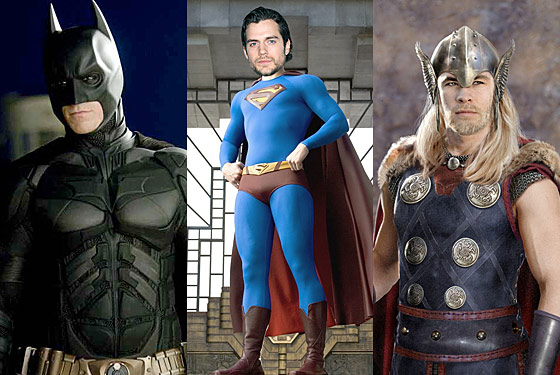
Why Aren't Americans Cast As Superheroes Anymore? Not Manly EnoughWell, that's exactly the kind of thing that's been bothering me about kid's literature, particularly what's aimed at boys. All I see anymore are weak, nerdy, down-trodden protagonists, from the poor orphan with broken glasses (I'm looking at you, Harry Potter) to the straight-up "wimpy kid."
I get it: many boys like to read about these archetypes because they identify with them. Almost every kid feels like an outcast, a put-upon pariah. And besides, the underdog character overcoming seemingly unsurmountable odds to defeat the bad guy
does make for good dramatic tension.
But the kidlit world has largely ignored the
other archetype that boys love:
the hero. As well as identifying with the boy they
are, they love to immerse themselves in the world of the man they'd like to
become.
Every other facet of boy's entertainment has figured this out: movies, cartoons, toys. From Transformers and GI Joe to classic superheros (Batman, Superman, Spider-Man), from Star Wars to Indiana Jones and on and on (you can tell where my childhood was spent).
But where are the heros in kidlit? Where are the Buzz Lightyear's, the Iron Man's? You don't even see adult protagonists of any kind, oddly enough.
I just don't get it...
.jpeg?picon=1637)
By:
Shutta Crum,
on 9/10/2010
Blog:
Shutta's Place
(
Login to Add to MyJacketFlap)
JacketFlap tags:
The Writing Life,
boys reading,
Random Thoughts,
books for boys,
Shutta Crum,
kids and books,
children reading,
Other Good Stuff!,
kids reading,
Thunder-Boomer!,
Thomas and the Dragon Queen,
dogs reading,
dos and books,
Add a tag
I LOVE that kids (and other readers) are picking up my new book, THOMAS AND THE DRAGON QUEEN (Knopf). Here are a couple of pics folks have sent me.

This is Aiden who read through a weekend visit to family and then on the way home in the car. Thanks, Hope for sending this to me!

This is Dillon Marx who, is not quite ready to read THOMAS yet, but who is trying to figure out why his older brother is so engrossed by this book. Thanks, Sueanne, for letting me post this picture!
Finally . . . a couple of favorite pics a friend sent of Bertie “reading” THUNDER-BOOMER! Thanks, Alice!


I wish he could tell me what he truly thought of it. THUNDER-BOOMER! does have a dog in it. At least he is not trying to bury it in the backyard!
Way to go, Bertie!!
See my contact page if you have photos you’d like to send me of your family members reading my books.
Hugs,
Shutta

I've been thinking about the subject of boys who don't read, and have been meaning to write a blog post or two about it. But, I'm quickly realizing that this crack-pot theory of mine is quite a bit larger than that.
So, knowing full well that the whole of the publishing and educational world is waiting with baited breath for what I have to say on the subject, I think I'm going to throw together a little online presentation.
I also know full well that my little theory could very well be completely off, but at the very least, it may get some of us thinking a little deeper about the matter. Because in order to solve a problem, one first has to understand it. And might I add, understand it intimately. Which has led me to believe, for starters, that the question "Why don't boys read?" is not quite the right question (not even "Why don't boys read as much as girls?") Anyway, hopefully, more will follow.
I think Dr. Seuss sums it up best . . .
"The more that you read, the more things you will know. The more you learn, the more places you'll go.
- Dr. Seuss, I Can Read With My Eyes Shut
Happy Children's Book Week!
"There are no secrets to success. It is the result of preparation, hard work and learning from failure." - Colin Powell
Do you agree? Do you have any secrets to success?
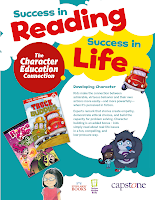
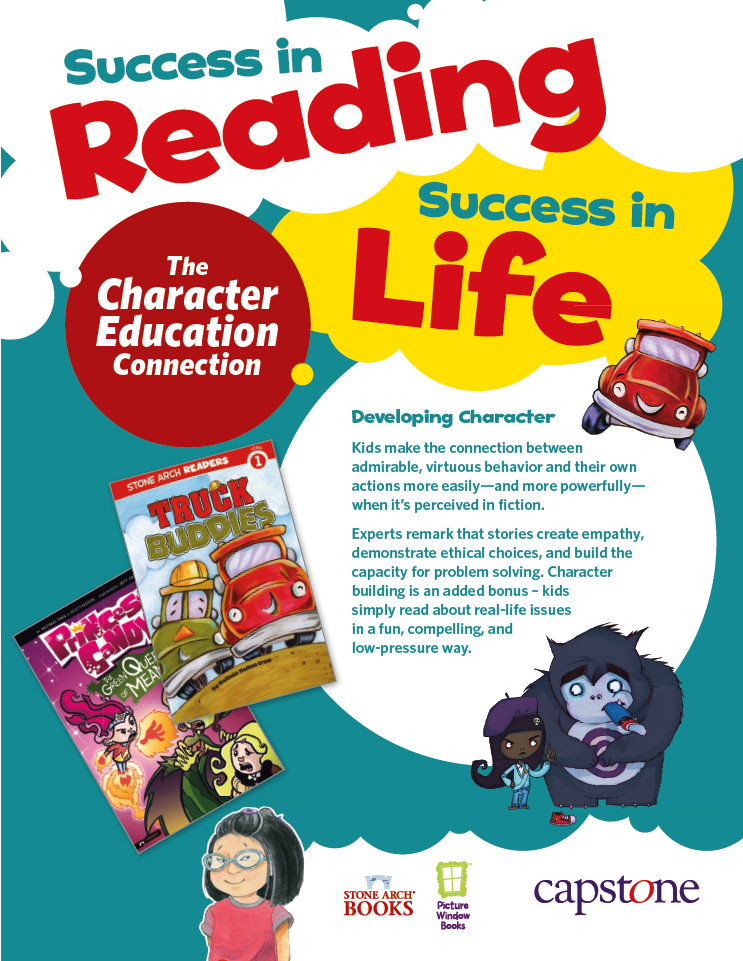
We've recently created a brochure on the importance of character education titled Success in Reading = Success in Life. By tying each of our books to one of the six pillars of character education, we are helping kids make the connection between admirable behavior and their own actions. This should help lead to success in their lives.
Send us your address if you'd like a copy.
Magazine reviewer Jonathan Hunt offers his picks for the five best YA works of fiction this year over at NPR. I will nitpick that one of the choices is not fiction and another not YA but all five are good books. Three of them appear on our Fanfare list, which will be whizzing its way to your inbox in just one week.
To link this morning's post with yesterday's, Jonathan and Debbie Reese are arguing over at Heavy Medal about Albert Marrin.
And apropos of nothing but still burned in my mind is this sentence from Amy Sohn's Prospect Park West, which I heard this morning on my iPod and which caused me to wonder if, when they came, they first came for the copyeditors: "Not once had Rebecca heard a mother infer even obliquely that she was hard up [for sexual gratification]." (I'm listening to this because PW gave it a starred review while over at Audible.com all the Prospect Park parents are leaving bitter comments about how bad it makes them look.)
The New York Times Best Illustrated Books list is out, along with my review of The Lion & the Mouse. What a great book--I wish they had given me twice the space. When I sat down with it and my two young neighbors, the two year old boy announced, looking uncertainly at the cover, "lions are scary." His more intrepid four-year-old sister took over the narration from there ("Look out for the bird!") until the end, whereupon the two-year-old said, "lions are NOT scary." Now it's his favorite book, so we gave him a copy for his birthday, along with a little plastic lion he can carry around in his hand. What's your talisman?
The most interesting statistic of this teen reading survey concerns who responded to it: "while we purposely marketed the survey to attract male readers, females are the vast majority (96%) of responders."
It would be really good to know if book reading breaks down in similarly dramatic proportions. We know that girls and women read more books than do boys and men, but how much more?
Zetta Elliott makes some great points re people of color in books and as authors.
Without in any way diminishing the very real problem of the white worldview of children's book publishing, I am struck by how often and widely charges of non-representation ("why aren't there more _____ in children's books?" "where are the books for ____ children?") are made of children's and YA literature. Books for and about boys. Books that show children in non-traditional families. Books that show children in traditional families, attending church. Middle-class black people. Girls who don't like pink.
The thinking goes that if there were more books about and for _____, more kids who are the same _____ would read. I wonder. Although I do believe that readers, at least in part, read for "the shock of recognition" Richard Peck talks about, I'm not sure that translates to wanting to read books "about people like me." It's more about being able to see yourself in circumstances unlike your own. To take the argument to its absurd conclusion, the belief that books should reflect their readers' circumstances means we could all give up reading and just look in the mirror.
But the concern here isn't so much with readers but with nonreaders. Do you remember the scandal of a few years ago with those Freakonomics guys, claiming that an enjoyment of reading was genetic? That kids didn't read because their parents read to them twenty minutes a day, they did so because their parents, as readers, were more likely to read to them twenty minutes a day? This is a little too mechanistic for me but I don't discount it completely. The pursuit of a more varied literary universe is an unalloyed wonderful thing--for readers. But I don't know that it will swell the ranks.
I'm about to leave for the day, and this cute story was just forwarded to me--
"Last night we were shopping at Costco and watched this little boy, probably 9 or 10, exit the store while reading a Stone Arch Book. From the glance we caught, we think it was a Jake Maddox title. It was so great...nose in the book and glued to the page. He was just following his mom's feet."
I love it! What a great way to end the day.
more soon!
--Beth

Or Batman and Robin, or maybe it's simply Twilight for little gay guys, but Tan Twan Eng's The Gift of Rain is quite the adolescent epic of doomed, yet eternal, love. Philip, the half-Chinese son of a wealthy colonialist, is sixteen when he meets Endo-san, an older Japanese man who has rented the small island owned by Philip's family, offshore their palatial home on the Malayan island of Penang. It's 1939, so you know this isn't going anywhere good, but the boy and man become inseparable, Philip introducing Endo-san to the nooks and crannies of Penang; Endo-san teaching Philip the martial arts and Zen philosophy of his homeland. On the page, there's nothing sexual between the two, and readers can decide for themselves just whether all the kisses and embraces and intense soul-searching gazes exchanged by the two constitute a romantic liaison or simply a very close friendship, one that, Endo claims, the two have had in previous lives and will go on to have in the future. The writing is just naive enough to make me wonder whether the author fully knew what he was implying but regardless, The Gift of Rain is a Boy Book writ large--tons of action, explosions, hand-to-hand combat, swordplay (heh), Eastern philosophy, spies, betrayals, secret caves, oaths, seppuku, and hardly a girl to be seen (except for Philip's plucky older sister and an old Japanese lady--also a martial artist--who encourages the now-elderly Philip to relate the story of his youth). I do hope boys can get past the flashback structure and the Oprah-looking cover for the grandly idealistic war story and safely sublimated romance.
Okay, handed an easy walk, I politely stepped around the bases, shaking hands with each player as I made my way home.
Goofus, on the other hand . . . .
From Work with Children in Public Libraries by Effie L. Power (ALA, 1943):
"Nationality and race influence mode and type of reading and therefore library selection. Jewish boys and girls are inclined to read serious books on mature subjects, and Italian children who live most naturally out-of-doors under sunny skies read reluctantly but enjoy picture books, poetry, and fairy tales. German American children make wide use of books on handicrafts which Jewish children largely ignore and from which Italian children choose few except those related to arts, such as wood carving, metal designing, and painting. The Czech children read history and biography. Probably the greatest readers of fiction are found among native American children."
I do like this:
"Girls, like boys, are seeking life, but in a different way. They need some so-called boys' books with moving plots and an adventurous hero to take them out of themselves and to keep them from becoming too introspective; for the opposite reason boys need some of the so-called girls' books, for their suggestions of self-analysis and wholesome sentiment."
The most arcane thing I've found thus far is a small LP from 1963 called "A Message from Lois Lenski: The Making of a Picture Book." Who's got a record player?
Publisher Lee & Low has put together a great set of answers from male authors and illustrators on what got them to make reading an important part of their lives; on what they’d like to say to boys who don’t read; and on what some of the biggest challenges are in getting boys to read. Some interesting reading, here. Check it out.
Thanks to Max Elliot Anderson for the link.
I review John Green's Paper Towns and Kevin Brooks's Black Rabbit Summer in the Times today. I had originally called the piece "Cherchez la Femme," as both books are mysteries about boys looking for missing girls, but the Times in their wisdom retitled it. I like mine better but titles have to be the editor's prerogative--witness my discussion years ago with the author who did not understand why I wouldn't let him call his article, "The Lead in My Pencil."
As quoted in the Wall Street Journal:
"There has been a real revolution" in books that "have more kid appeal," especially when it comes to boys, says Ellie Berger, who oversees Scholastic's trade division. "It's a shift away from the drier books we all grew up with."
And I would love to know whose ass this statistic was pulled out of:
Last year, U.S. publishers released 261 new works of juvenile fiction aimed at boys, more than twice the number put out in 2003, according to Bowker's Books in Print database. There were 20 nonfiction entries for boys, compared with just four in 2003.
I'm so happy when a picture book for adults is published as just that. Like this one.
View Next 10 Posts





.jpeg?picon=1852)




.jpg?picon=980)

Interesting. As an adult I want my male protagonists to be capable and proactive. Will not read a book that describes protagonist as needy, angst-y or searching.
Enjoy your blog.