new posts in all blogs
Viewing: Blog Posts Tagged with: publication, Most Recent at Top [Help]
Results 1 - 25 of 130
How to use this Page
You are viewing the most recent posts tagged with the words: publication in the JacketFlap blog reader. What is a tag? Think of a tag as a keyword or category label. Tags can both help you find posts on JacketFlap.com as well as provide an easy way for you to "remember" and classify posts for later recall. Try adding a tag yourself by clicking "Add a tag" below a post's header. Scroll down through the list of Recent Posts in the left column and click on a post title that sounds interesting. You can view all posts from a specific blog by clicking the Blog name in the right column, or you can click a 'More Posts from this Blog' link in any individual post.

a guest post by Shannon Hitchcock
A group marketing blitz during the month of August? My initial reaction was UGH! I’m a writer, not a marketer, but since I have a new book out, (RUBY LEE & ME, Scholastic, 2016), I accepted the challenge.
I see only one negative to group marketing, which is losing total control. On the other hand, there are lots of benefits. Benefits like:
- Better Results for Less Effort: A team can get more done than a single person. #MGGetsReal will be featured on at least ten blogs during the month of August, but I only had to write two posts.
- Better Ideas: Brainstorming often produced better ideas than I generated on my own. We held a brainstorming session and decided on a hashtag to tweet about our marketing plan. We settled on #MGGetsReal.
- Expertise: Joyce Moyer Hostetter, author of, (BLUE, COMFORT, & AIM, Boyds Mills Press), worked with her daughter and prepared a video that features all five of our books. I’ve never made a video before, and it would have taken me a long time to learn.
- Greater Marketing Reach: We all have different professional contacts, so the number of people we can reach as a group is greater than if I were going it alone.
- Motivation: Working as a group kept each of us motivated to do our part.

Any group of authors with a common theme could implement a plan like ours. Our plan:
- Read/write reviews for each book.
- Seek to engage teachers/librarians.
- Write for two blogs not our own, (seeking blogs with national exposure where possible).
- Develop “group ads” for social media.
- Develop a unique hashtag for the effort. We chose #MGGetsReal because our books tackle a tough topic in a way appropriate for Middle Grade readers.
- Post to social media 3x week for the month of August in a way that highlights all five books.
- Retweet using the hashtag #MGGetsReal.
- Feature other writers on our own blogs if applicable.
- Develop a video that highlights all five of the books featured below:
THE LAST CHERRY BLOSSOM by Kathleen Burkinshaw– Kathleen’s mother was a Hiroshima survivor. In this novel based on that experience, Kathleen shows the effect war has on children, and that sometimes the enemy is very much like us.
WHAT FLOWERS REMEMBER by Shannon Wiersbitzky– Shannon’s own grandfather suffered from Alzheimer’s, and in this novel she paints a realistic picture of a man losing his memory and of the young girl who loves him.
COMFORT by Joyce Moyer Hostetter– COMFORT tells the story of how Ann Fay’s dad is tormented by combat memories following WWII, and how his trauma hurts the whole family.
JUST A DROP OF WATER by Kerry O’Malley Cerra– This book takes place in the aftermath of 9/11. It shows how normally tolerant people developed prejudice toward their Muslim neighbors.
RUBY LEE & ME by Shannon Hitchcock—Following a tragic accident, two friends, one black, and one white, struggle with school integration. I lived through integration so this book is close to my heart.
A group marketing blitz during the month of August? I hope your initial reaction is YAY! Join #MGGetsReal on social media and give us a retweet, a Facebook share, and consider reviewing our books.
The post #MGGetsReal—A Joint Marketing Effort originally appeared on Caroline Starr Rose

I ran an earlier version of this post right after selling my first book. Because it’s one of my favorites, and because I so often need to hear these words myself, I’m sharing them again today.

It was 2004. While driving to meet my writing group, I happened to catch an interview on NPR with Adrienne Young, a folksinger just starting out. She talked about her first album, inspired by some advice she’d gotten while struggling to make it as a musician:
If you want to do this with your life, stay focused and see this through. You’ve got to plow to the end of the row, girl.
That simple phrase – plow to the end of the row – was enough to push Adrienne to continue. It became the title of both her album and lead song. I can’t quite explain what that interview meant to me, hearing an artist choose to create despite the struggle, to push against fear and sensibility and make it “to the end of the row.”
I’ve carried this image with me for years, the plant metaphor standing in for artistic endeavor, the plow the unglamorous slog needed to dig deep and make it to the end. Sometimes I find it funny I’d choose a profession so bent on forcing me to wait, so full of uncertainty and disappointment. An almost foolish optimism has kept me working, trusting that the next editor or the next agent or the next story would be the one to launch my career. I’ve haunted mailboxes and inboxes, waiting for something positive to come through. I’ve ceremoniously sent off manuscripts, chanting, “Don’t come back!” (entertaining postal workers, for sure). I’ve journaled again and again “this next editor is a perfect match!”, managing somehow to keep on plowing in midst of little validation.
After twelve years of writing and hundreds of rejections, I sold my first book, May B., a historical verse novel about a girl with her own challenging row to hoe. May’s determination carried me through a rocky publication experience: losing my first editor; the closing of my Random House imprint, Tricycle Press; the weeks when my book was orphaned, with no publishing house to claim it and its future uncertain; the swooping in of Radom House imprint, Schwartz and Wade; edit rounds seven, eight, and nine with editor number two; and finally, May B.’s birth into the world only three months behind its original release date.
I made it to the end of a very long, mostly lonely row, one that wasn’t very straight and was loaded with stones. But the soil got better as I worked it, and each little sprout was stronger than the last. The beauty of the writing life is I got to transplant the hardiest seedling and start again, this time working alongside others who nurtured it into something better than I could have ever created alone.
What is the dream of the artist-gardener? That our art will sprout and grow one day stand apart from us to thrive on its own.
But first we must reach the end of the row. Keep plowing, friends.
The post Plowing, Planting, Hoping, Dreaming originally appeared on Caroline Starr Rose

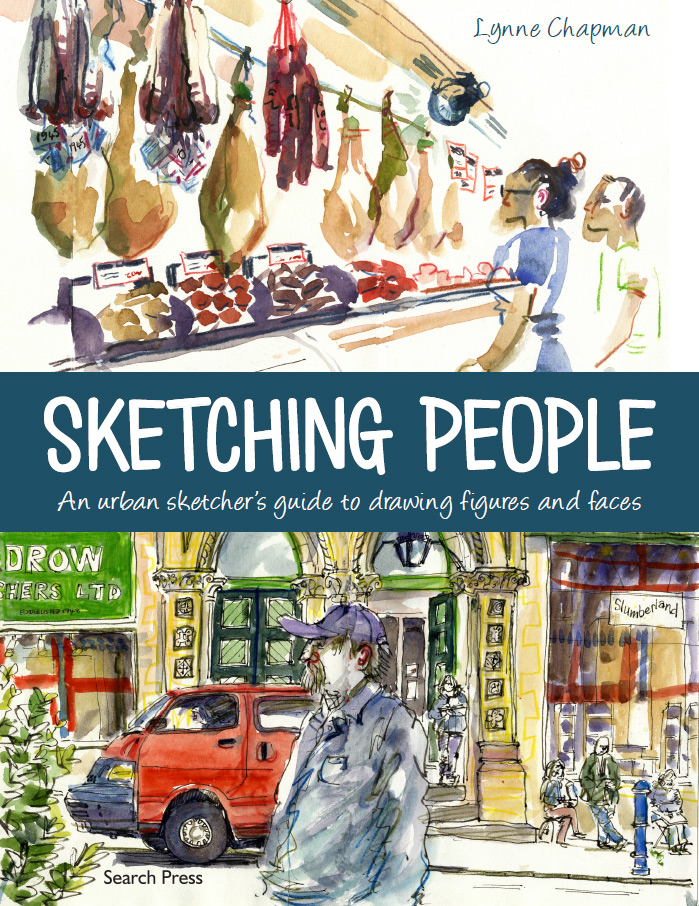
Yep, today is the official publication day for my new book Sketching People: an Urban Sketcher's Guide. Hurrah!
So, if you have pre-ordered a copy, it should be with you today or tomorrow. If this is the first you have heard about it (though that would be hard, the way I have been banging on about it...), you can read all about it and see lots of sample pages here.
If you are in the US, your co-edition isn't quite published yet, I'm afraid, but you only have to wait another 3 weeks. This is where you pre-order the American edition.
Happy sketching everyone! Don't forget to leave me some lovely reviews on Amazon :-)
The advance copies of my urban sketching book just arrived - hurrah! They should have been here a couple of weeks earlier it turns out, but they went astray in the mail and the publisher didn't realise I hadn't had them.
It's been a bit fraught with technical hitches to be honest because, when they resent my package this week, someone put in the American edition and one by a Singapore publisher (below), but left out the UK one (above). Never mind - they look gorgeous and glossy and I am very pleased. The contents on the inside of the different editions are more or less the same, it's just odd words and grammatical variations - it's mainly the covers which look different.
It's lovely to see how all the content looks, in it's proper form. I spent so long putting it all together and now here it is, looking like a real book!
I thought I'd take some snaps to give you a sneak preview, though you probably have a pretty good idea by now, since I've talked about it in progress often enough (hit the Sketching People label on the right, if you're interested).
There a section which looks at art materials, with a specific eye on how you choose tools which are appropriate to the problems of drawing people out on location:
I look at how you choose your subject, which is hugely important. There are some locations and activities which are virtually impossible, but plenty of others which make things a lot easier for you, especially if you are cutting your teeth:
Then there are the different possible angles to tackle. I would rarely advise drawing people front-on. It's much more interesting and far easier on the whole, to tackle them in profile or in three-quarter view, particularly when you are concentrating on faces:
I write a fair bit on techniques to deal with the fact that people move about a lot, which is of course one of the main things which makes them so tricky. I can't stress enough the benefits of trying contour drawing, both for warming up your arm and eye and for tackling your subject as swiftly as possible:
Plus another technique, handy particularly if you are drawing groups of people or people passing by, is using composites - sketches made up of a little of one person and a bit of another, with maybe the head of someone else again!
There is a lot more too, of course. I tried to think of everything I know. It's hard when you have been doing something for so very many years. It all becomes second-nature. Writing the book has been really interesting, because it has helped to make me analyse what I know. Which has actually really helped for when I am teaching workshops, like the ones I am doing at the moment for the Morgan Centre as part of my Artist-in-Residence year, and of course the work I do with Urban Sketchers.
As I write, sometimes an image for a book’s cover starts to form in my mind. Back in 2014, when my editor told me cover discussions for Blue Birds were underway, I took a moment to get on paper the idea I had in my head. It wasn’t meant as direction for illustrators Elena and Anna Balbusso, it was simply a chance for me to record what I had been picturing for months. I set the sketch aside, showing no one.

I love how closely the Balbusso sisters’ vision aligned with mine. And I especially love the way a portion of the original cover has been used for the paperback version that released yesterday, a true echo of that sketch I drew two years ago.
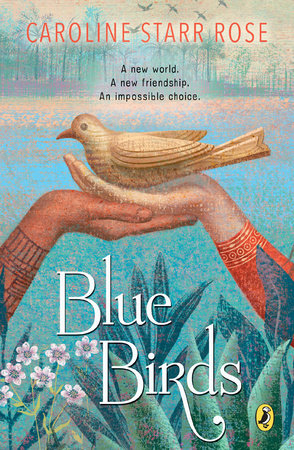
Don’t forget you have until Friday to win a Blue Birds prize pack — one for you, one for your friend. And you can always pick up a copy from your local bookstore or order one online.
The post A New Cover for Blue Birds appeared first on Caroline Starr Rose.

There’s this book I wrote a while back, something I started in 2001 and officially set aside three years ago. It’s called CAN’T BREAK US and is loosely based on my mother’s girlhood club. The manuscript is something I love to pieces, but after years and years of work just wasn’t coming together. It was my second attempt at a novel, the one that served its purpose in teaching me to write (of course, I still have a lot to learn). I figured we’d reached our end together (the manuscript and I. Book are friends, you know).

In the summer of 2013, author/editor/teacher Mike Winchell asked if I might be interested in contributing two pieces of writing — one non-fiction, one fiction — for an anthology proposal. The idea was to show students how authors can take ideas from real life and turn them into a story. My mind went immediately to CAN’T BREAK US, which initially grew from the stories my mother told me in my childhood. Using my author’s note as a starting place, I created my non-fiction piece. Then I pulled out a pivotal chapter, re-wrote it as verse, and sent it in.
The anthology sold to Penguin in a two-book deal:
“BEEN THERE, DONE THAT [is] a thematic anthology series with a kid-friendly Common Core tie in, in which a who’s who of award-winning and bestselling MG/YA authors will share a nonfiction narrative, and then write a related short story in order to show the “from-life-to-page” process of taking real-life experiences and transforming them into works of fiction.”

I’m honored a portion of this manuscript will live again in an entirely different form. I’m thrilled to be included alongside so many talented people. And I love that my mother’s club, The Little Nippers, will finally, finally be introduced to the world at large.
Because what young person hasn’t dreamed of a little pocket of the world where the kids are in charge?
Here’s a video about the background of my story “Lemon Squeeze.” You can click through to the Been There, Done That website and find similar items from the other authors in the “teaching materials” section.
Today across Twitter, Facebook, and Instagram, the Been There, Done That authors will use the hashtag #BeenThere to share one-line glimpses into the real-life event that inspired their work. We’d love if others might respond with their own #BeenThere moments!
The post BEEN THERE, DONE THAT Release Day! appeared first on Caroline Starr Rose.


Please tell us about your latest book, Enchanted Air.
Thank you for your interest! Enchanted Air, Two Cultures, Two Wings, is a verse memoir. In one sense it’s a travel book about the unusual experience of visiting relatives in Cuba during the Cold War. On another level, it’s simply about being bicultural, an experience shared by so many U.S. Latino children. I wrote this memoir as a plea for peace and family reconciliation, a process which quite amazingly began on December 17, 2014, during the same week when advanced review copies of Enchanted Air arrived on my doorstep! Of course, I rushed to revise the historical note to include President Obama’s announcement about the renewal of U.S.-Cuba diplomatic relations, changing my tone from a desperate plea to a song of gratitude.
There have been a number of verse memoirs published the last few years. Could you explain how you decided to use verse for your memoir? What does verse offer that prose doesn’t?
While I was writing Enchanted Air, I had no idea that Jacqueline Woodson and Marilyn Nelson were also working on their own verse memoirs! I was familiar with wonderful older verse memoirs by Lee Bennett Hopkins and a few others, but basically I expected Enchanted Air to languish alone on a librarian’s cart, with no one quite sure where to shelve it. Now, thanks to Brown Girl Dreaming’s National Book Award, I think verse memoirs will suddenly find their own place in the world. I chose poetry because free verse allowed me to transform memories into present tense, bringing childhood emotions back to life.
Already, Enchanted Air has garnered enormous praise. It’s a Junior Library Guild title and has earned three starred reviews. Your other books have won such prestigious awards as the Pura Belpré Medal, the Claudia Lewis Award, the Newbery Honor, the International Reading Association’s Children’s Book Award, the Américas Award, the Jane Addams Award, and the Lee Bennett Hopkins Honor, just to name a few.
How have you learned to deal with such acclaim? How do you set the possible pressure of such praise aside when working on something new?
Acclaim is wonderful when it happens, but life keeps me humble. I still receive plenty of manuscript rejections, especially for my biographical picture books about great Latino scientists who have been forgotten by history. As far as pressure, there’s nothing I can do to influence grownup reviewers and award committee members. All I can do is write from the heart, picturing my readers as children.
This is your fourth book to release this year. How do you handle the juggle while continuing to work on new projects?
Three picture books—Drum Dream Girl, Orangutanka, and The Sky Painter—were released within weeks of each other by sheer coincidence. I wrote them all in different years, but publication coincided simply because the illustration and book design process is so much slower and less predictable than the writing. Now I’m back to working on historical verse novels, with only an occasional burst of inspiration leading to another picture book idea.
Learn more about Margarita and her books at www.margaritaengle.com.
The post Enchanted Air: Two Cultures, Two Wings by Margarita Engle appeared first on Caroline Starr Rose.

Instead of a launch party for Over in the Wetlands, I lead story time at the Albuquerque/Bernalillo County Library‘s Cherry Hills branch. Think stories, games, coloring pages, and gator cookies.

Reading Wetlands by Cathryn Sill.


Explaining the three things we needed to “make” a hurricane: wind, waves, and rain. Look at that handsome boy of mine on the right!


And the other handsome one! (Incidentally, this is what happens when the Rose boys take over the camera).
The post A Wetlands Story Time in Pictures appeared first on Caroline Starr Rose.

Oh my goodness, this book.

I wrote it in 2008 (which, looking back, was a very good year for me. I finished my first draft of May B., wrote Wetlands, and had my first inkling of an idea for Blue Birds).
Over in the Wetlands didn’t sell until early 2012. And finally, three and a half years later, I can proudly say this special picture book releases tomorrow!
On Friday I’m giving away three copies and three Wetlands posters through my newsletter. The poster is a two-for-one treasure — the back has discussion questions and activity pages for teachers and librarians to photocopy and share with young readers. If you’d like a chance to win a book and poster, simply sign up for my newsletter here. It’s an e-publication that comes directly to your inbox just three to four times a year and is an easy, low-key way to keep up with my books, events, and the like.
Here’s to a book that’s been a long time in the making. Happy Book Birthday, Wetlands!
The post It’s Been a Long Time Coming… appeared first on Caroline Starr Rose.


If you’ve been around here for any length of time, you know my friend J. Anderson Coats says a lot of things that resonate with me. She’s the one who gave me my favorite piece of writing advice and came up with that great cow-through-a-colander writing metaphor.
During a recent email exchange with my Class of 2k12 friends, Jillian shared this:
A writing career is not a sprint. It’s a marathon. You’re not on a schedule. There is no schedule.
That first part, I’ve probably heard it a thousand times. But the second part? It felt like a revelation. It’s true that when you’re on deadline you most certainly have a schedule, but otherwise, the writing life is wide open.
So you know what?
- If there’s no schedule, someone else isn’t going to beat you to the punch. What you’re working on now will not somehow be replaced by someone else’s (faster) efforts.
- The market isn’t in charge of your story. You are.
- For you published folks, you will not be forgotten if you somehow don’t get to keep some “regular” publishing schedule. Yes, your readers might age out, as they say, but there are always new readers to take their place and earlier books to introduce readers to the new ones, whenever they happen to be published.
- Unless you’re contractually committed, you can write whatever you want whenever you want.
- And there’s what author/illustrator Ruth McNally Barshaw (my niece’s former Girl Scout leader!) posted on Facebook a few days ago:
Repeated themes I heard at the writer-illustrator conference in LA: Slow down. Take time to do your best work. When you think it’s done, set it aside to assess again later. Build on what you borrow. Be courageous — do work you find important, no matter what others say. LIVE so you’ll have a rich portfolio of experiences to draw and write from. What gets your next book published isn’t luck, desperation, a magic shortcut, or networking with stars; it’s your hard work, your being ready to jump at sudden opportunities, and your connections with friends. #SCBWI14
Here’s to approaching your writing with freedom in the days ahead!
The post There is No Schedule appeared first on Caroline Starr Rose.


As much as I love blogging, I’m not always sure other people are listening in. A few weeks ago I got an incredible email from blog reader Linda Jackson that reminded me what I do here does indeed connect with readers, sometimes in very big ways.
Hi Caroline,
Since that day I received an email from Amazon stating that May B. was a book of the month then saw your WOW Wednesday post on Adventures in Children’s Publishing, I have been totally inspired and motivated by your story. I don’t know if you know this, but I have a list of authors on my website under a tab titled Inspiration, and you are at the top of the list. What has inspired me most was your post Plow to the End of the Row. And today I want to share with you that I have plowed to the end of the row, which is quite fitting seeing that the main character in the manuscript that finally landed me an agent actually has to work in a cotton field.
After six years of working hard and believing, 200+ queries, 4 manuscripts (one of them rewritten multiple times, once from scratch), 4 R&R’s from agents, 7 pitch contest wins, I finally got “The Call” today.
So, that’s my story, and I wanted you to know how you influenced it…which is why I will ALWAYS BUY YOUR BOOKS! Interestingly, after reading your post on Working Hard and Believing, I remember thinking, Lord, please don’t let that happen to me. I could never survive 200 queries. When I read about Kathryn Stockett and her five years of querying, I said I could never do that. And when I read that Becca Fitzpatrick re-wrote the same manuscript for five years and even trashed it and rewrote it from scratch, I said I could never do that. I have done ALL that and more. The manuscript that I queried forever and rewrote forever is still NOT the one that got an editor/agent’s attention. I had to write something new. We never know what we can survive until we have to survive it.
Thanks for being an inspiration,
Linda
***
I’ve been sitting on this email for weeks, waiting to hear where Linda’s book landed. Here’s the official news from Publisher’s Marketplace:
Mississippi-native Linda Jackson’s BECOMING ROSA, a coming-of-age tale set in Mississippi in 1955, about a young African-American girl who dreams of a life beyond the cotton fields, to Elizabeth Bewley at Houghton Mifflin Harcourt Children’s, at auction, in a two-book deal, for publication in Fall 2016, by Victoria Marini at Gelfman Schneider/ICM (World English).
Congratulations, Linda! Your story has thrilled me down to my toes and has inspired me to keep plowing. Now, readers, go out and congratulate the remarkable Linda Jackson.
The post Six Years of Working Hard and Believing appeared first on Caroline Starr Rose.

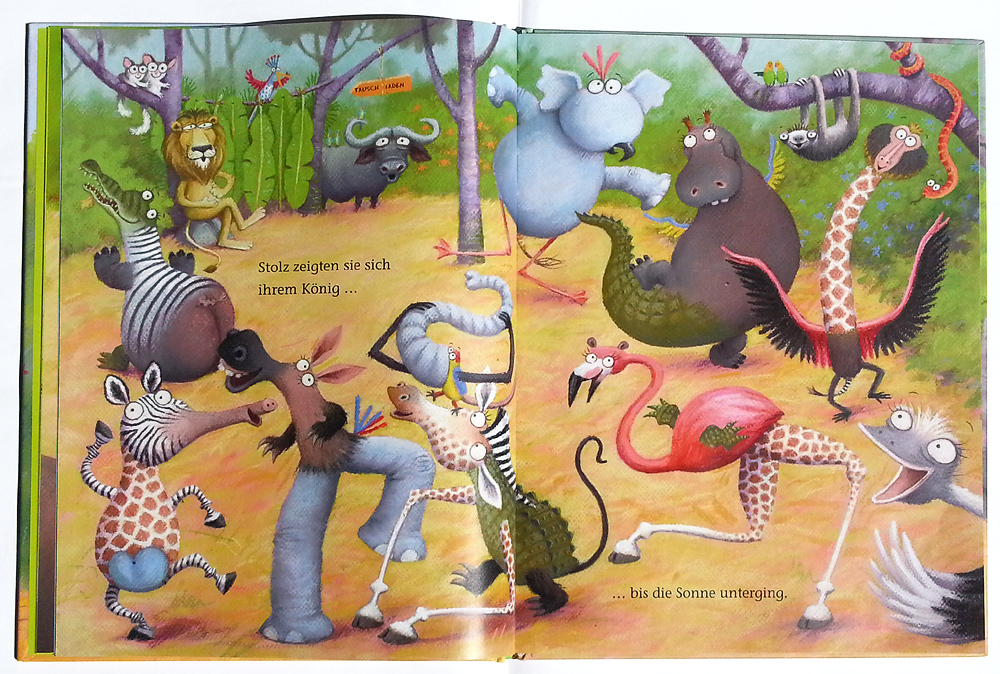
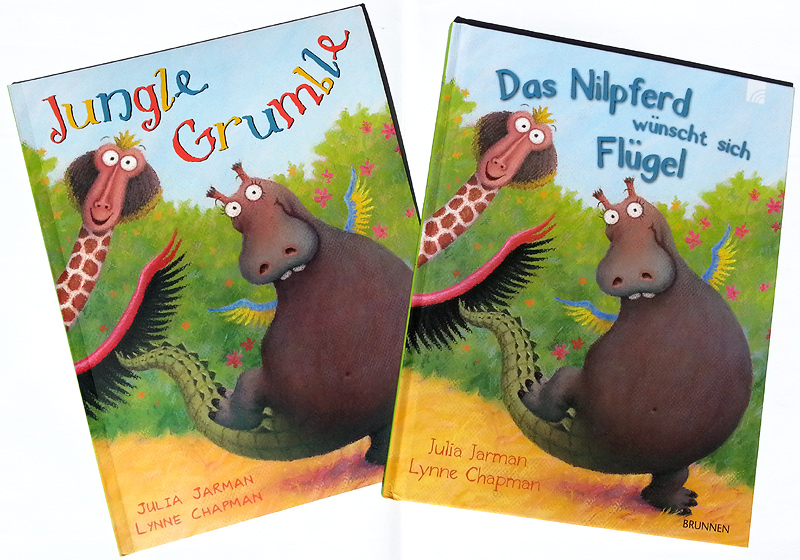
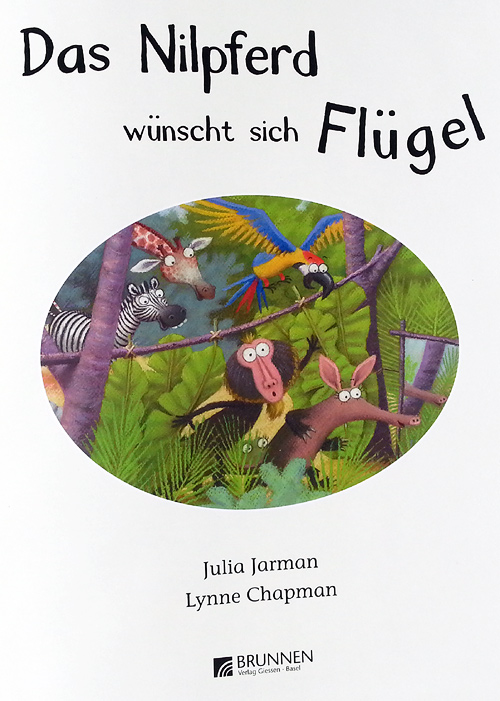
The postman delivered another parcel this week. It's the German co-edition of Jungle Grumble:
It's always fun to get copies of foreign co-editions of my picture books. I especially enjoy it when I get German ones, as I did German A level at school, many, many moons ago.
It got very rusty of course so, in the days when I used to torture myself at the gym, I used to work my way, painfully slowly, through German translations of trashy novels, while I was puffing away on the exercise bike - much easier vocabulary than more worthy literature. People used to laugh at me, because I had to hold the book in one hand and a pocket dictionary in the other!
After that, I decided to re-do a German GCSE, just for fun, as an evening class, because I was OK reading off the page, but absolutely rubbish at any kind of conversation - which is after all, the point of a language. I really enjoyed myself and was a real swot. A little group of us used to get together in-between classes and test each other. I got an A* and was very pleased with myself.
Anyway, enough of this rambling and back to Jungle Grumble. The fact that I can read the text (more or less) is interesting, because things are not always direct translations. The title for instance is no longer Jungle Grumble but 'The Hippo Wishes He was a Bird'.
It's great news that the 2014 German edition of 5000 copies has already sold out: the copy my publisher has just sent me is from a 2015 reprint - they have done another 4000. Hurrah!
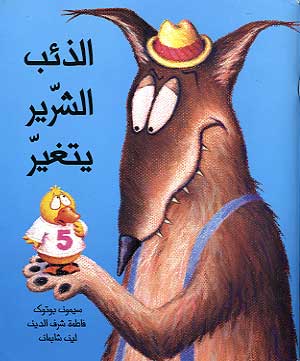 I also just found out that Jungle Grumble has now got a Chinese co-edition. I had Chinese editions of Stinky! and Lark in the Ark too. I love the ones with different alphabetic styles. I've had lots of Korean ones and Big Bad Wolf is Good was published in Arabic, which is great for taking into schools, because it runs in the opposite direction to a UK book, something I didn't know until I got my copy.
The conversation started one late night (or very early morning) in the summer of 1994. I was unemployed, between my freshmen and sophomore year at Kansas State, stuck between art and English education. My best friend and I spent those long summer nights driving aimlessly through our small, sleepy hometown. We played amatuer philosopher during those drives, questioning God, the universe, everything.
"I don't want to live forever," I said.
"Neither do I. Not on Earth, anyway."
"No," I said, "I don't want to go to heaven either. I mean, that's just nuts. Forever is a long time."
My friend laughed. "It's not like heaven's just clouds and harps and shit. I don't think you understand what it would be like."
No, it's not like that at all. I've seen death in my life--death and a lot of change. I remember every one of my grandparents' funerals, my father's, my first wife's. I remember standing in the basement of the Warren-McElwain mortuary in Lawrence, KS deciding on a casket for my wife at age 37.
The funeral director, a relatively young woman herself, stopped in mid sales pitch/product description, and said, "You're too young for this."
Yes, and no. And maybe.
Death is a part of life. Our mortality is what binds us together, and to rob anyone of death is to steal the very essence of what it means to be human. Death is not the worst thing to come for us. Death is our oldest friend. Death reminds us to live, to enjoy, to laugh and have fun, and to love well. Death taught me well from a young age. This is what is the end to which we all must go. This is what gives value and rarity to your life.
I've carried those lessons with me. I have no desire to live forever--and I fear immortality in world not built for it much more than my own death. Maybe heaven isn't harps and clouds and "shit." Maybe I can't comphrended immortality. I do know this: on Earth, I'm happy my time is limited.
It's much more valuable this way.
Yesterday we celebrated Blue Birds at Page One.


I got to give a little Over in the Wetlands: A Hurricane-on-the-Bayou Story preview. Also, it seems I took a nap.


Look! There’s my student teaching partner, Eva!

Thank you, friends, for all your kindness these last few days. It’s been a wonderful privilege giving my book over to you.
The post An Afternoon in Pictures appeared first on Caroline Starr Rose.

I first ran this series five months after May B. hit the shelves. With Blue Birds releasing next week (!), it feels like the right time for me to revisit my Writer’s Manifesto — a list of things I’d like to focus on in my public, private, and writing life.
This is not in any way meant to be preachy or condemning (please notice I’m directing all of this to myself). I have yet to figure everything out and am in many ways a pro at doing the exact opposite of what I know is best. Yet these are ideas I’ve circled back to again and again, things I know will ultimately benefit my career, my friendships, my writing and my life. I’d love to hear your thoughts below.
In my writing life I will…
- Write the stories that speak to me: I will continue to write what nourishes and interests me first and worry about the market second.
- Seek guidance, support, and direction when needed: I will ask questions of my agent and editor when I’m unsure or need help. I will go to other writers in the same life phase or those older and wiser when I need assistance.
In my writing life I will not…
- Lose my love for story, kids, or words: Once you’re published, art becomes commodity. It’s not right or wrong, it just is. I want my motivation and passion to remain firmly in the place it always has been. While there are no guarantees of success in writing this way, their is much joy, and this, in the end, is more important to me.
- Compare one book against another: I choose not to be paralyzed by comparing my titles to previous books I’ve written. Each deserves to stand alone and has its own merit. The rest of the publishing world has the freedom to compare if they choose. For me to do so is unfair to new stories beginning to form.
- Despair: If you know me well, you know panic is a part of my writing when I’m drafting something new. I fret that I don’t know how to write or have nothing new to say. But I can’t let that panic lead to despair. Reminding myself that things always start this way keeps things in perspective. Allowing myself to play with language and ideas is much more doable than telling myself I’m writing an entire book. Choosing to nurture rather than berate gives me permission to try.
It’s my hope that holding to what I’ve processed these last few months will keep me grounded, help me grasp the deep satisfaction writing brings, and hold at bay the things that only lead to disappointment.
What about you? What things do you want to uphold in your public, private, and writing lives?
The post Navigating a Debut Year: Writing Life appeared first on Caroline Starr Rose.


I first ran this series five months after May B. hit the shelves. With Blue Birds releasing next week (!), it feels like the right time for me to revisit my Writer’s Manifesto — a list of things I’d like to focus on in my public, private, and writing life.
This is not in any way meant to be preachy or condemning (please notice I’m directing all of this to myself). I have yet to figure everything out and am in many ways a pro at doing the exact opposite of what I know is best. Yet these are ideas I’ve circled back to again and again, things I know will ultimately benefit my career, my friendships, my writing and my life. I’d love to hear your thoughts below.
In my private life I will…
- Err on the side of love: I got this beautiful quote from author Irene Latham, who first heard it from her mama. It’s a good way to think about the world in general and is especially important in our small community. Assume the best of others, their intentions, their actions. It will make you happier and kinder, too.
- Let go of what I can’t control: This is pretty much everything from how my work is received by professional reviewers, bloggers, readers, and friends to sales, publicity, and marketing efforts outside my hands. I can do what I can, and that is all. It isn’t right or fair to try to own things that aren’t mine and never will be.
- Be real with other authors in a safe, closed community: I’ve talked a lot about the Class of 2k12 and The Apocalypsies around here. Though both function as promotional groups for debut authors, they are first and foremost a place I can go for support. The debut year is full of new experiences only other debuts can truly appreciate and understand. Knowing I can go to these stellar people with anything has helped bolster and encourage me.
In my private life I won’t…
- Hold my colleagues to unspoken expectations: This one is easy to do without even realizing it — trusting a colleague will read my book as I have read hers, assuming someone else will talk up my titles as I have for him, believing another should comment on my blog as much as I do on hers and on and on. Insisting others are beholden to me because of what I’ve done for them is a sure formula for heartache, especially when those friends have no idea of my expectations. Maybe they haven’t read my book yet but still plan to. Maybe they have, and out of an attempt to be courteous haven’t mentioned it because it wasn’t their thing. Maybe they’re not interested in it at all. Ultimately, it’s none of my business and becomes another opportunity to err on the side of love.
- Compare or begrudge the successes, sales, or careers of others: About six months ago, there were a number of posts in the blogosphere about envy and contentment. There was tremendous response from readers confessing similar feelings. The drive to compare is such a gut-level thing it’s sometimes hard to avoid. Some people are able to use comparison as a sort of motivation for their own work. Not so with me. Comparison leads to frustration and feelings of inadequacy…or feelings of superiority, neither of which benefits me. My friends’ successes don’t somehow negatively reflect on my own efforts. There is room for all of us. Just because my career will unfold differently from someone else’s doesn’t make it wrong and doesn’t give me the right to be bitter with others’ success.
The post Navigating a Debut Year: Private Life appeared first on Caroline Starr Rose.

I first ran this series five months after May B. hit the shelves. With Blue Birds releasing next week (!), it feels like the right time for me to revisit my Writer’s Manifesto — a list of things I’d like to focus on in my public, private, and writing life.
This is not in any way meant to be preachy or condemning (please notice I’m directing all of this to myself). I have yet to figure everything out and am in many ways a pro at doing the exact opposite of what I know is best. Yet these are ideas I’ve circled back to again and again, things I know will ultimately benefit my career, my friendships, my writing and my life. I’d love to hear your thoughts below.
In my public life I will…
- Be generous: In my interactions with others and in the way I conduct myself, I’d love to be known as generous. This doesn’t mean committing to every opportunity or request that comes. It means being warm, friendly, and supportive of the writing community and the publishers, teachers, librarians, booksellers and readers who make it all happen.
- Speak well of fellow writers: Whether I know them personally or not. Whether I like their work or not. These people are my people. This is enough of a reason to speak kindly or not at all.
- Conduct myself in a becoming way: While I can’t control what others think of me (more on that below), I can choose to present myself in a way I’m proud of, whether that be in person or through social media. I am in no way perfect, believe me, but I strive not to embarrass myself, the children I write for, or the people who publish my writing.
In my public life I won’t…
- Add to or perpetuate gossip: In just these few months as a debut, I’ve already heard things about fellow authors that have broken my heart. Whether shared maliciously, as some sort of cautionary tale, or just for fun, it’s been more than I need to know. I refuse to participate in keeping the stories going, and I will ask you not share whatever it is you’ve heard about others with me.
- Disparage others’ books, genres, or talents but will find value in what they create: For much of my life, I’ve been a self-proclaimed book snob. Many writers talk of becoming more and more critical as readers the longer they write. For me, some sort of weird opposite has happened. Because I know first hand of the hard work the writing life demands, I’m learning to appreciate books, topics, and styles I would have ignored years ago. The books I don’t connect with aren’t really my concern: they weren’t written for me. There is an audience for them somewhere.
The post Navigating a Debut Year: Public Life appeared first on Caroline Starr Rose.


Blue Birds makes its way into the world two months from now. I am beyond excited to introduce you to my girls, Alis and Kimi, and hope they will come to mean to you what they do me.

During the next week over a dozen bloggers will celebrate Blue Birds. Some will post about friendship or cross-cultural experiences. Others will run interviews with me or will share a Blue Birds review. I’ll include all links on the blog, so that you might read along.

As part of the celebration, I’m giving away a downloadable PDF of this beautiful Blue Birds quote (created by Annie Barnett of Be Small Studios) for anyone who pre-orders the book. If you’d like to participate, here’s all you need to do:
I will send out the PDF on Tuesday, January 20. This is yours to use as you choose. My copy is going on my bookshelf, and I’ve also had notecards made. I do ask that you not give away the PDF itself. This is an honor system sort of thing, and I’d like it to remain as a gift for those who pre-order. But feel free to print as many copies as you’d like. Imagine what a lovely gift the book and quote might be together!
Before getting published, I had no idea how much power pre-sales can have. Early numbers help a publisher decide how many books to print (what’s known as a print run), influence bookstores whether or not to carry a book, and can indicate how successful a book will be overall.
I would be honored if you spread the word about Blue Birds. Thank you, friends, for your support. A book needs readers, and I am so grateful for readers like you.
The post Celebrating BLUE BIRDS: A Week-Long Giveaway appeared first on Caroline Starr Rose.

This post is an oldie but goodie worth re-running. In case you’re wondering, I continue to apply for grants and fellowships — three in the last eighteen months, to be exact.

My high-tech list of submissions (contests included) before signing with my agent. Something kind of fun — #71 on the white page? A portion of that book will publish in an anthology in 2016. And Stacey Barney just happens to be my beloved editor of BLUE BIRDS as well as my next novel, coming in 2016.
I’ve entered/applied for roughly a dozen writing contests/grants over the years. One I finished first. One I got an honorable mention. The others I didn’t place at all. Still, every contest was worth experiencing for a number of reasons:
1. Working with a deadline: Those of us who haven’t yet sold a manuscript write without any sort of formal deadline. This works well for some, not so well for others. By signing up for a contest, you have committed to finishing and submitting your writing by a certain time, great practice for future deadlines once your work is sold.
2. Reviewing your writing: Whether applying for a grant or entering a contest, you’ll need to carefully study your work, looking for ways to strengthen it but also examining why your writing deserves to win (early pracitice on determining why your title would be successful in the marketplace). Filling out an application and following the contest’s guidelines will bolster your ability to write a strong, concise query.
3. Getting read: Some contests/grants offer feedback for those who place. It is so beneficial to see what others outside of your writing community have to say about your work. Authors, editors, and agents often judge these contests, putting your work front and center. Sometimes for me, just knowing someone I admire has read my work is enough. I entered Hunger Mountain’s Katherine Paterson Award so that she might read my writing. I got no feedback. I didn’t place, but the gracious, two-time Newbery winner read my words! I’m satisfied.
4. Publishing opportunities: Winning contests/grants means a portion of your work is often published, allowing for other readers, agents, and editors to learn of your writing. In winning first place for a novel excerpt at the Jambalaya Writers’ Conference, my work will be featured in an anthology put out by Nicholls University. At the same conference, I happened to be critiqued by a poetry professor from Southeastern Louisiana University. He asked for a few poems from my free-verse novel to publish in Louisiana Literature magazine, which he edits. These publications don’t have wide circulation, but my work is out there. People are reading it.
5. Beefing up your query: Winning a contest is great query fodder. I think a large part of my agent requests these last few months have come from winning this small, local contest and the publication that has come about as a result.
Those of you who are members of the Society of Children’s Book Writers and Illustrators need to take advantage of their grant programs, if you haven’t already. There are a half-dozen or so to choose from. You may enter one per calendar year. In the three I’ve entered, there have been only 200-400 other entrants. Think about it. There are thousands of member in this organization, but only a handful applying for grants. Your work will be read by industry professionals. You might even get some money out of the experience. What have you got to lose?
Have you entered contests or applied for grants? Any you could recommend? What has your expereince been?
The post Writing Contests and Grants: Why You Should Enter appeared first on Caroline Starr Rose.


Today I’m feeling grateful for the people in my life who make the books happen. My agent, who believes in me and is the enthusiastic, in-the-know one who shows my work to others, the one who looks out for me and cheers me on.
My editors, who push me to find my best work, whose faith in my writing I can borrow when I’m not believing it myself.
The copyeditors, art directors, book designers, publicists, book sales reps, and marketing department who add their expertise and love.
I’ve got one small role in the process. If what I write is worth reading, its because of the hard work everyone else puts in behind the scenes.
The post For Those Who Work Behind the Scenes appeared first on Caroline Starr Rose.


By: Kathy Temean,
on 12/6/2014
Blog:
Writing and Illustrating
(
Login to Add to MyJacketFlap)
JacketFlap tags:
Lidia Gurling-Mielcarek,
Nightlight Reading,
Short Story Writing Contest,
Contests,
writing,
Publication,
opportunity,
Win,
Places to Submit,
Add a tag

The snowy illustration above was sent in by Lidia Gurling-Mielcarek to help us celebrate this time of year that brings in the cold. Brrr!
Lidia is an freelance illustrator from Poland. She works in traditional and digital medias and loves to create children’s illustrations.
Call for:
Kudos for Friday post
Holiday Illustrations (at least 500 pixels wide)
Christmas Poems
Hanukkah Poems
New Year Poems
Send to Kathy.temean(at)gmail.com Put December Illustration or December Poem in subject area. Thanks!
Last week I pointed out that the 7 Point Story Structure System could work even with short Stories. Here is an opportunity to try it out with this no fee short story contest. Here are the details:
2014 NIGHTLIGHT READING WRITERS CONTEST
Nightlight Reading is requesting submissions for our 2014 Nightlight Readings Short Story Writers Contest that is geared to at-risk boys in the 10-12 year age group who often stop reading for pleasure. Nightlight Reading’s goal is to fund and promote literature that appeals to boys and keeps them engaged and reading.
- The 2014 CONTEST THEME is ADVENTURE.
- The written piece should be considered a SHORT STORY with a MAXIMUM COUNT of 5,000 WORDS.
JUDGING
The 2014 contest entries will be pre-screened and read by a jury panel who may be scholars, librarians, teachers, and special guests who will decide on 10 semi-finalists. Then, a jury of young readers selected from our target readers will read all 10 entries and vote on the winners.
PRIZES
Prizes will be awarded for First, Second, and Third Place as follows:
- First Prize: $1,000 award plus certificate and publication of the story.
- Second Prize: $500 award plus certificate and publication of the story.
- Third Prize: $300 award plus certificate and publication of the story.
All award winners will be publicized nationally by Nightlight Reading.
OWNERSHIP
The authors will retain ownership of the stories, but Nightlight Reading will have the right to publish and distribute the story without compensation and in ways consistent with its mission for up to 2 years from the date of the awards are announced.
RULES
The Nightlight Reading Writers Contest is open to anyone who loves to write stories for boys, and may be a professional writer, student or budding writer.
Submissions must not have been previously published or won any other writing contest. However, simultaneous submissions to other contests are acceptable.
DEADLINE
Deadline for submission for the 2014 contest is December 31, 2014.
Use this link to enter: http://www.nightlightreading.org/contest-entry-form/ Good luck!
Talk tomorrow,
Kathy
Filed under:
Contests,
opportunity,
Places to Submit,
Win,
writing Tagged:
Lidia Gurling-Mielcarek,
Nightlight Reading,
Publication,
Short Story Writing Contest 

One of the most exciting things about being an author is connecting with readers. It’s incredible to me to realize there are people out there waiting for my next book. And it’s especially dear to know some of you come here regularly to listen in on the things I have to say.

As you probably know, the best way to launch a book into the world is to send it out with lots of love. What’s the best sort of love a reader can offer? Word of mouth, hands down. Word of mouth comes in the form of casual conversations, recommendations, blog posts, and reviews on sites like Amazon or Goodreads. It’s simply one reader talking to another.
Want to have a hand in a word of mouth campaign? I have ten advance reader copies of BLUE BIRDS to give away. I’d love if you’d consider writing a blog post to run the second week of January about one of the following things:
- Friendship: how your friend(s) have influenced you, the role childhood friendships have played in your life, or any other friendship-related idea
- Pivotal Moments: An instance when you experienced a world completely different from anything you’d ever known before, a time you stepped outside your own culture, or any other life-changing idea
- Review: an honest look at what you think of BLUE BIRDS (Just because you read here doesn’t mean you have to like it! Every opinion is a valid one.)
To participate, leave a comment below. While I’ll only have ARCs for the first ten commenters, if you’d still like to participate, I have a lovely little thank you I’ll send along to all who choose to blog.
Thanks, friends! I’ll be in touch with more specific details soon.
The post Are You A Blogger? Let’s Talk about BLUE BIRDS! appeared first on Caroline Starr Rose.


It was so, so lovely to talk a few weeks ago with Sarah and Beth Anne of Brilliant Business Moms. They sought me out after reading this guest post at Modern Mrs. Darcy. Here are a few of the things you can expect in the podcast:
01:15 – Roald Dahl, the Oregon Trail, and My Journey
04:24 – The Most Honest Thing I’ve Ever Written
07:48 – What about Mr. Chapman?
09:59 – The Apprentice Stage
13:34 – Maniacal Optimism
16:54 – Why a Traditional Publisher?
19:29 – How to Get Published
22:50 – Finding an Agent
24:59 – Advice for Apprentice Authors
29:31 – Does a Web Presence Matter?
31:02 – A Day in the Life
34:34 – How Much Does an Author Make?
38:56 – Resources for Aspiring Authors
44:30 – What My Boys Think About Having an Author for a Mom
The podcast is live! Click through to have a listen.
The post A Podcast with Brilliant Business Moms appeared first on Caroline Starr Rose.

A nice surprise package arrived this afternoon. I was trying to work out what it could be, as I wasn't expecting anything big and flat. I had completely forgotten about the American editorial commission I took on at the beginning of the summer, via my US agent:
I haven't worked in editorial for years, though it was where I learnt my trade, back in the late '80s. On publication day, they always send you at least one copy of the magazine, for your portfolio. So here it is!
The spread was for Spider - a subscription magazine for children, mainly full of stories and poetry, with some activities to try. This fabulous front cover illustration was done by Dom Mansell:
If you are interested to see how the artwork was created, I blogged the process in three different stages and you can see them all here.
View Next 25 Posts



.jpeg?picon=2982)




.jpeg?picon=3626)


Love Lidia’s illustration :)