new posts in all blogs
Viewing: Blog Posts Tagged with: Lewis Carroll, Most Recent at Top [Help]
Results 1 - 25 of 59
How to use this Page
You are viewing the most recent posts tagged with the words: Lewis Carroll in the JacketFlap blog reader. What is a tag? Think of a tag as a keyword or category label. Tags can both help you find posts on JacketFlap.com as well as provide an easy way for you to "remember" and classify posts for later recall. Try adding a tag yourself by clicking "Add a tag" below a post's header. Scroll down through the list of Recent Posts in the left column and click on a post title that sounds interesting. You can view all posts from a specific blog by clicking the Blog name in the right column, or you can click a 'More Posts from this Blog' link in any individual post.

By: Catherine,
on 3/31/2016
Blog:
OUPblog
(
Login to Add to MyJacketFlap)
JacketFlap tags:
digital technologies,
J.R.R. Tolkien,
Books,
Philip Pullman,
Literature,
Videos,
fantasy,
Oxford,
lewis carroll,
His Dark Materials,
stories,
Alice in Wonderland,
Media,
lord of the rings,
*Featured,
TV & Film,
Add a tag
Lewis Carroll, J.R.R. Tolkein, and Philip Pullman are three of the many great writers to come out of Oxford, whose stories are continually reimagined and enjoyed through the use of media and digital technologies. The most obvious example for Carroll's Alice in Wonderland are the many adaptations in [...]
The post A reimagined Wonderland, Middle-earth, and material world appeared first on OUPblog.

By: Maryann Yin,
on 2/11/2016
Blog:
Galley Cat (Mediabistro)
(
Login to Add to MyJacketFlap)
JacketFlap tags:
Robert Jordan,
George R. R. Martin,
Sir Arthur Conan Doyle,
Quentin Tarantino,
Humble Bundle,
Neil Gaiman+,
Bookselling,
Lewis Carroll,
Digital,
Dean Koontz,
Tom Clancy,
Charlaine Harris,
Alan Moore,
Kevin Smith,
Add a tag
 Dynamite Entertainment has established a new partnership with Humble Bundle. The two collaborators will offer a deal called the “Best-Selling Authors Bundle.”
Customers can choose between the publisher or a non-profit as the recipient of their money. They will have three charity options: the Comic Book Legal Defense Fund, Doctors Without Borders (a.k.a. Médecins Sans Frontières), and the Make-A-Wish Foundation.
Here’s more from the press release: “The ‘pay what you want’ model offers readers the chance to unlock over 120 comics, and over 3,500 pages of content. This will give graphic lit fans access to: Charlaine Harris’ Grave Sight Part 1 by Charlaine Harris, The Shadow Vol 1: Fire of Creation by Garth Ennis and Aaron Campbell, Patricia Briggs’ Mercy Thomson: Hopcross Jilly by Patricia Briggs, The Complete Alice in Wonderland by Lewis Carroll, Leah Moore, and John Reppion, Sherlock Holmes: Year One by Sir Arthur Conan Doyle and Scott Beatty, The Spider Vol. 1: Terror of the Zombie Queen by David Liss and Francesco Francavilla, and Tom Clancy’s Splinter Cell: Echoes by Tom Clancy. As the bundle progresses, there will be a running average.”
By: Maryann Yin,
on 2/2/2016
Blog:
Galley Cat (Mediabistro)
(
Login to Add to MyJacketFlap)
JacketFlap tags:
Mia Wasikowska,
Alan Rickman,
Videos,
Lewis Carroll,
Adaptation,
Johnny Depp,
Anne Hathaway,
Tim Burton,
Sacha Baron Cohen,
Helena Bonham-Carter,
Add a tag
Disney has unveiled a new teaser for Alice Through the Looking Glass. The video embedded above offers glimpses of Mia Wasikowska as Alice Kingsleigh, Johnny Depp as The Mad Hatter, and Alan Rickman as the Blue Caterpillar.
TIME reports that other members of the cast include Helena Bonham Carter as The Red Queen, Anne Hathaway as the White Queen, and Sacha Baron Cohen as Time. This film adaptation, a sequel to Tim Burton’s Alice in Wonderland, comes out May 27, 2016.
Follow these links to watch the previously released teaser videos and the first full trailer. Click here to download a free digital copy of Lewis Carroll’s Through the Looking-Glass. (via E! Online)

The cover has been unveiled for Marissa Meyer’s forthcoming young adult book, Heartless. According to Meyer’s blog post, the story for this standalone novel will be a prequel to Lewis Carroll’s Alice in Wonderland.
We’ve embedded the full image for the jacket design above—what do you think? Entertainment Weekly reports that Feiwel and Friends, an imprint of the Macmillan Children’s Publishing Group, has scheduled the release date for Nov. 08.
 The British Library, an institution based in London, England, has been hosting an Alice in Wonderland exhibit. The curators organized this program to celebrate the 150 year anniversary of the publication of Lewis Carroll’s beloved novel.
Some of the items on display include manuscripts, reviews, and a variety of illustrated editions of the book. The closing date for has been scheduled on Apr. 17, 2016.
Here’s more information from the organization’s website: “Although the story has been adapted, appropriated, re-imagined and re-illustrated since its conception, we are still enchanted by Carroll’s original, much loved story, which continues to inspire new generations of writers and illustrators. Come and see Lewis Carroll’s original manuscript with hand-drawn illustrations, alongside stunning editions by Mervyn Peake, Ralph Steadman, Leonard Weisgard, Arthur Rackham, Salvador Dalí, and others.”
 Here are some literary events to pencil in your calendar this week.
To get your event posted on our calendar, visit our Facebook Your Literary Event page. Please post your event at least one week prior to its date.
YouTube stars Dan Howell and Phil Lester will headline an event to discuss their new book, The Amazing Book is Not on Fire. Meet them at Barnes & Noble (Union Square branch) on Tuesday, Nov. 17 starting at 5 p.m. (New York, N.Y.)
The next session of the Selected Shorts events series will focus on Lewis Carroll’s Alice in Wonderland. Join in at Symphony Space’s Peter Jay Sharp Theatre on Wednesday, Nov. 18 starting at 7:30 p.m. (New York, N.Y.)
Eight children’s books creators will participate in the November Picture Book Bonanza. Check it out at Books of Wonder on Saturday, Nov. 21 from 1 p.m. to 3 p.m. (New York, N.Y.)
 Disney has unleashed three new teasers for the Alice Through the Looking-Glass movie. The clips embedded below offer glimpses of Mia Wasikowska in the role of Alice Kingsleigh and Helena Bonham Carter in the role of The Red Queen.
This movie, a sequel to Tim Burton’s Alice in Wonderland, for May 27, 2016. Click here to download a free digital copy of Lewis Carroll Through the Looking-Glass. (via Entertainment Weekly)
Disney has unveiled a teaser trailer for Alice Through the Looking-Glass. The story of this film adaptation comes from Lewis Carroll’s beloved novel. A release date has been scheduled for March 13, 2015.
The video embedded above features Mia Wasikowska reprising the role of Alice Kingsleigh. According to The Hollywood Reporter, other cast members from the 2010 Alice in Wonderland movie who have returned for this project include Johnny Depp as The Mad Hatter, Helena Bonham Carter as The Red Queen, Anne Hathaway as The White Queen, Alan Rickman as the voice of the Blue Caterpillar, and Michael Sheen as the voice of the White Rabbit.
The theatrical release date has been set for May 27, 2016. Click here to download a free digital copy of Through the Looking-Glass. (via Vulture)

By: Salman Rushdie,
on 9/3/2015
Blog:
PowellsBooks.BLOG
(
Login to Add to MyJacketFlap)
JacketFlap tags:
Literature,
Lewis Carroll,
Q&A,
Gabriel Garcia Marquez,
Juan Rulfo,
Salman Rushdie,
James Joyce,
Franz Kafka,
Kurt Vonnegut,
Science Fiction and Fantasy,
Mikhail Bulgakov,
Italo Calvino,
Add a tag
Describe your latest book. Two Years Eight Months and Twenty-Eight Nights is a fairy-tale of New York (well, mostly New York). New York with added genies (jinn). It's about a jinnia princess, Dunia, who acquires a large number of human offspring, and uses them to help her battle an invasion of our world by the [...]
By: Miranda Dobson,
on 7/4/2015
Blog:
OUPblog
(
Login to Add to MyJacketFlap)
JacketFlap tags:
Arts & Humanities,
georgian children's literature,
OUP history,
OUP museum,
Books,
History,
Literature,
children's literature,
lewis carroll,
Alice in Wonderland,
children's book,
Multimedia,
Oxford University Press,
*Featured,
alice liddell,
charles dodgson,
Images & Slideshows,
Alice’s Adventures in Wonderland,
Add a tag
Alice's Adventures in Wonderland is a children's story that has captivated the world since its publication in the 1860s. The book is celebrated each year on 4th July, which is also known as "Alice's Day", because this is the date that Charles Dodgson (known under the pen name of Lewis Carroll) took 10-year-old Alice Liddell and her sisters on a boating trip in Oxford, and told the story that later evolved into the book that is much-loved across the world.
The post Alice’s Adventures in Wonderland artifacts: [slideshow] appeared first on OUPblog.
By: Hannah Paget,
on 7/3/2015
Blog:
OUPblog
(
Login to Add to MyJacketFlap)
JacketFlap tags:
Alice in Wonderland,
wonderland,
*Featured,
The Story Museum,
charles dodgson,
alice's day,
Science & Medicine,
scientific,
UKpophistory,
victorian britain,
Arts & Humanities,
Melanie Keene,
Science in Wonderland,
Books,
Literature,
Oxford,
lewis carroll,
Alice,
Add a tag
Tomorrow Oxford will celebrate Alice’s Day, with mass lobster quadrilles, artwork and performances, croquet, talks, and teapot cocktails, and exhibitions of photographic and scientific equipment. The diverse ways in which Alice and her wonderland are remembered and recast reveal how both heroine and story continue to speak to many different kinds of audience, 150 years since Lewis Carroll’s book was first published.
The post Alice down the microscope appeared first on OUPblog.

An artist named Adamova Marina (also known as Talamaska) created paper-cut art pieces inspired by Lewis Carroll’s famous novel.
Talamaska’s artwork showcases the Cheshire Cat, the White Rabbit, and the Queen of Hearts. What’s your favorite character from the Wonderland cast?
According to boredpanda.com, five of Talamaska’s pieces were showcased at a personal exhibition in Moscow. Follow these links to download free digital copies of both Alice’s Adventures in Wonderland and Through the Looking Glass.
 “What’s in a name?” The Electric Lit team has explores this question with a new infographic on “A History of Pen Names.”
The image features several literary icons including Alice in Wonderland author Lewis Carroll, The Adventures of Tom Sawyer author Mark Twain, and Jane Eyre author Charlotte Brontë. We’ve embedded the full piece below for you to explore further—what do you think?

By: Maryann Yin,
on 4/6/2015
Blog:
Galley Cat (Mediabistro)
(
Login to Add to MyJacketFlap)
JacketFlap tags:
J.K. Rowling,
Bookselling,
Trends,
Lewis Carroll,
John Green,
Jane Austen,
Markus Zusak,
Charlotte Bronte,
Harper Lee,
J. R. R. Tolkien,
Raymond Feist,
Add a tag
 What’s the most popular book in Australia?
According to the results of Dymocks Bookstore’s booklover’s 101 survey, that honor belongs to Markus Zusak’s The Book Thief. More than 15,000 bibliophiles participated in this survey.
Here’s more from The New Daily: “This year 17 Australian books made the list, including AB Facey’s A Fortunate Life and Anh Do’s The Happiest Refugee…Ms Higgins said 35 books on the list have been made into successful films – including the recent Hollywood hit Fifty Shades of Grey.” We’ve linked to free samples of the top ten books below.
Free Samples of Australia’s Top 10 Favorite Books
01. The Book Thief by Markus Zusak
02. Pride & Prejudice by Jane Austen
03. To Kill a Mockingbird by Harper Lee
04. Magician by Raymond Feist
05. The Lord of the Rings trilogy by J.R.R. Tolkien
06. The Fault in Our Stars by John Green
07. The Hobbit by J. R. R. Tolkien
08. Jane Eyre by Charlotte Brontë
09. Alice’s Adventures in Wonderland by Lewis Carroll
10. The Harry Potter series by J.K Rowling
How has Lewis Carroll’s Alice’s Adventures in Wonderland stood the test of time? The Morgan Library & Museum is hosting an exhibit called “Alice: 150 Years of Wonderland.”
The curators plan to bring over the original manuscript for Carroll’s beloved children’s book “across the pond” from the London’s British Library to New York City. Other items that will be displayed include drawings, letters, rare editions of the book, and vintage photos. The opening date has been scheduled for June 26, 2015 and the closing date has been set for October 11, 2015.
Here’s more about the exhibit: “The enchanting tale of Wonderland was first told ‘one golden afternoon’ to Alice Liddell and her two sisters. Delighted by the fantastic world of logic and nonsense inhabited by rabbits in waistcoats and playing card gardeners, Alice begged for a written copy of her namesake’s adventures under ground. Charles Lutwidge Dodgson (better known by his pen name Lewis Carroll) painstakingly wrote out the story, illustrating the original manuscript with his own pen and ink drawings.” Follow this link to download a free digital edition of the novel.
By: Maryann Yin,
on 12/12/2014
Blog:
Galley Cat (Mediabistro)
(
Login to Add to MyJacketFlap)
JacketFlap tags:
Maurice Sendak,
Margaret Wise Brown,
Clement Hurd,
Children's Books,
Neil Gaiman,
Poetry,
Authors,
Dr. Seuss,
Lewis Carroll,
Add a tag
Once again, Neil Gaiman agreed to perform a reading of a beloved children’s story for a Worldbuilders fundraising venture. The choices included Where the Wild Things Are by Maurice Sendak, ‘Jabberwocky’ by Lewis Carroll, Fox in Socks by Dr. Seuss, and Goodnight Moon written by Margaret Wise Brown and illustrated by Clement Hurd.
‘Jabberwocky’ received the most votes and the organization has raised more than $639,000.00. The video embedded above features Gaiman in the woods delivering a dramatic recitation of Carroll’s famous nonsense poem from memory—what do you think?
New Career Opportunities Daily: The best jobs in media.
Fairy tale is a country of the mind where there are many inhabitants stretching back into deep time, and we're like people before Babel, we speak a common tongue: fairy tales exist in a symbolic Esperanto, with familiar motifs and images and characters and plots taking on new shapes and colors and sounds. One of [...]
I am just back from participating in FILIJ, Mexico’s International Fair of Children and Youth Book and I am just floored by the experience. Run by Conaculta, Mexico’s governmental agency for the arts, it is BEA, ALA, NCTE, and the National Book Festival all in one glorious ten day event with over 300,000 people attending. You can get a taste in this photo gallery. They (this is translated by google so is probably not too great) wish:
to encourage the habit of reading among children and young people of Mexico; and bring together publishers, booksellers, distributors, librarians, teachers and specialists, in order to raise the quality and quantity of publications circulating in the Mexican market. Also aims to compare experiences, promote exchange with other countries and bring the public to national and international issues.
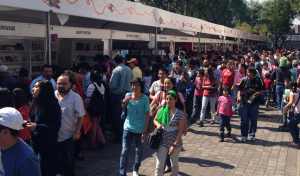
The festival was a vibrant place of tents full of books to see and buy, entertainments such as rock concerts and puppet shows, and tons of children and people eagerly enjoying books and stories. Among the events for professionals are a National Meeting for Booksellers (and, yes, the photo is of Laura Vaccaro Seeger and Neal Porter who participated last year), a National Conference of Librarians, an International Seminar (for 600 participants:) on the Promotion of Reading, and 5 hour Master Classes on Writing and Illustration. There were also school visits, all sorts of performances (just wandering around I saw a puppet show and a rock concert), and a huge area of workshops for children. You can get a taste of the magnitude of the festival by looking at this brochure that includes a map of the festival as well as a listing of all the publishers and a schedule of events.
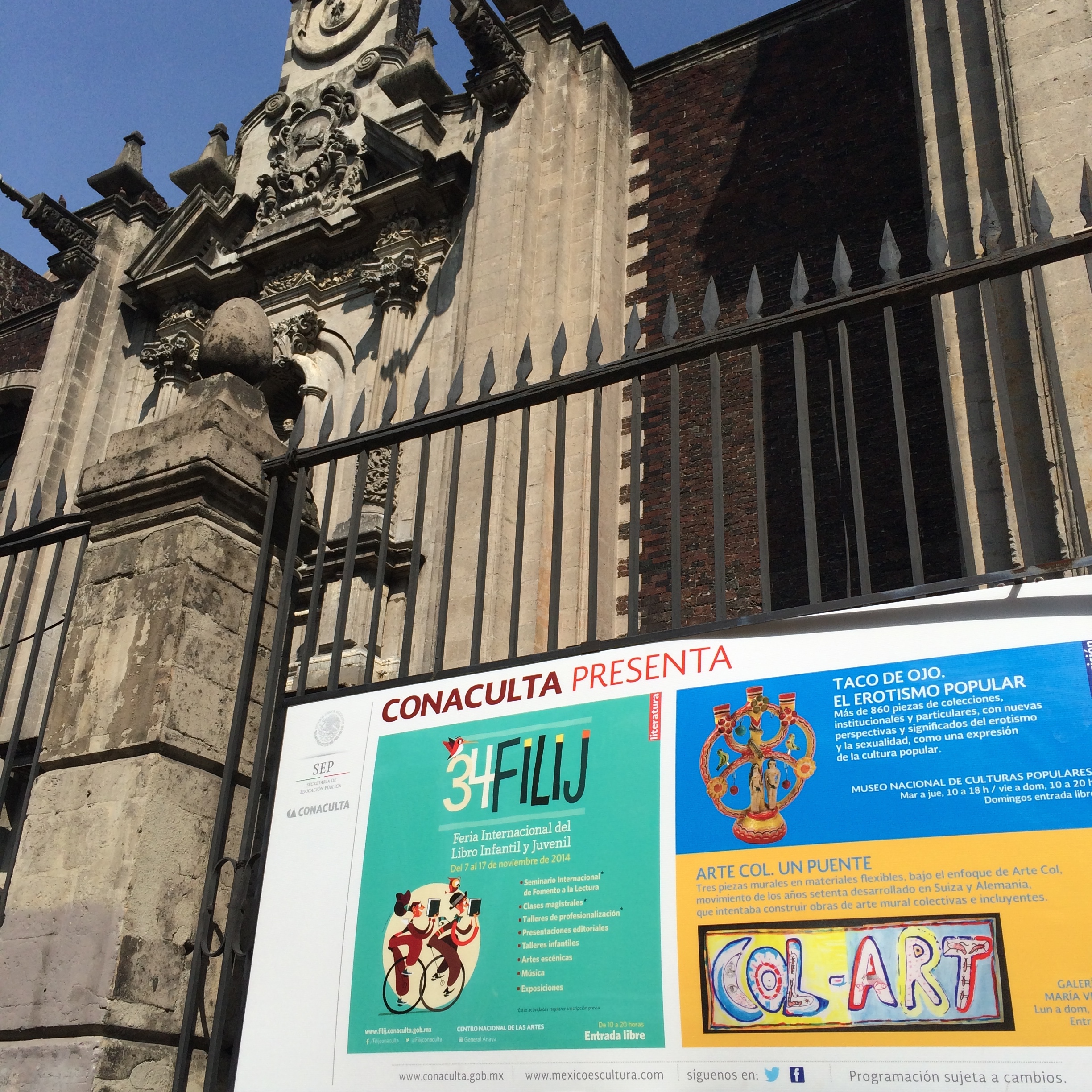
Even before I got to the festival grounds I had an inkling that this was a big event for all, seeing this poster for it in the city center:
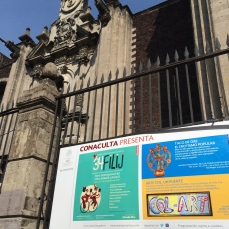
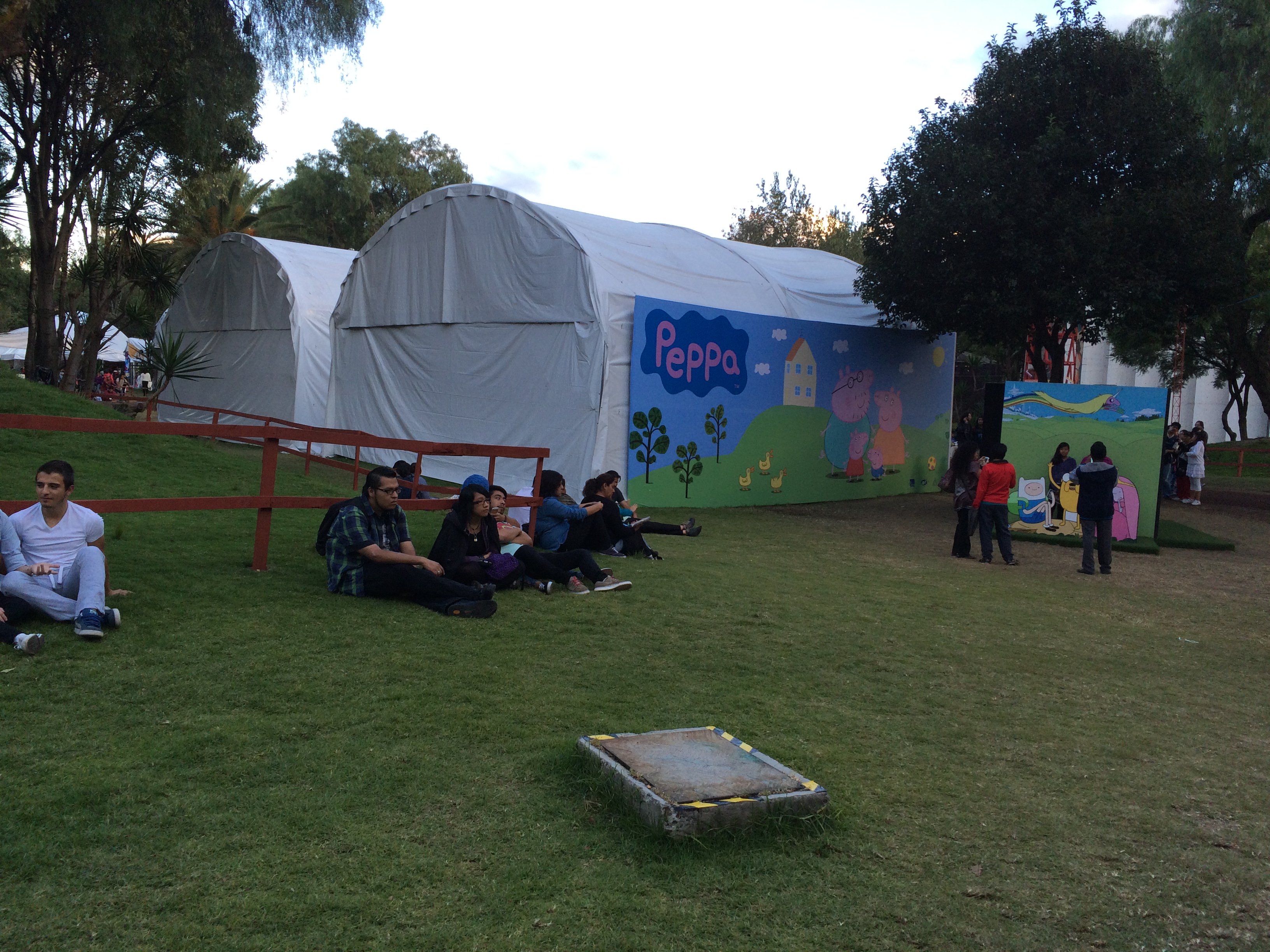
And once at the fair grounds I just enjoyed the energy. I was there only on weekdays, but am told you can barely move on the weekends.
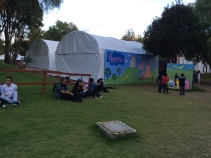 (There were so many tents full of books! This may look empty, but it is not. Just liked the Peppa painting on this particular tent.)
 (This was a rock concert.)
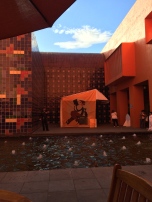
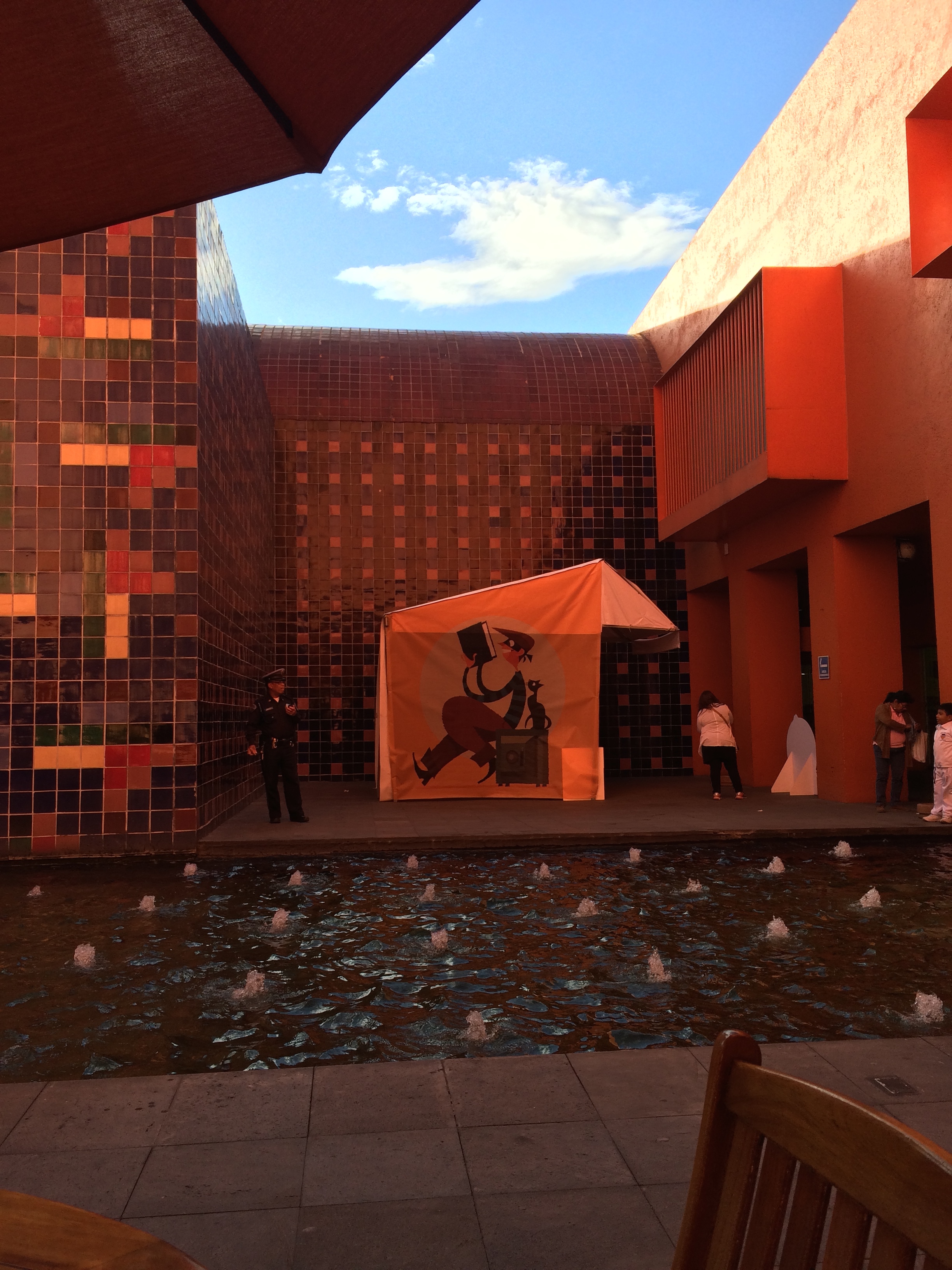
(This was a lovely cafe, but I’m afraid the warm orange of the walls came out rather dark in this photo of mine. In the back you can see one of the delightful posters that were all around the place. I believe there was a contest to get the commission to do these posters.)
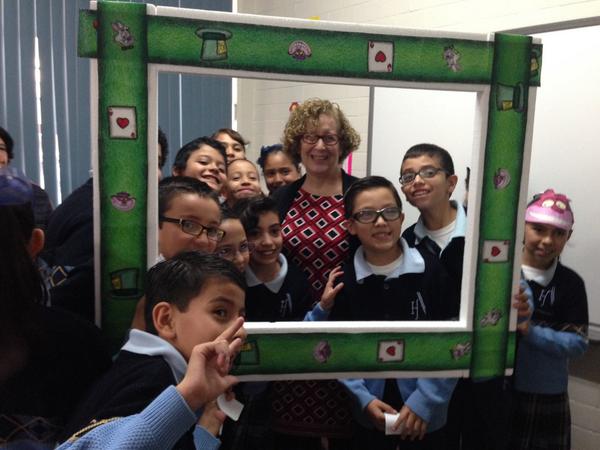
Outside the festival, I did a presentation on Alice’s Adventures in Wonderland to an attentive group of fourth graders at the Colegio Heraldos de México. They had prepared for my visit by watching both the Disney and Tim Burton’s movies, prepared questions, and created drawings and other decorations for my visit. The children’s English was fabulous — they seemed to follow my presentation with easy and asked thoughtful and carefully constructed questions. At the end I was surprised when they all wanted me to sign copies of Alice in Wonderland, personal autograph books, and paper. So I did so as Lewis Carroll’s proxy! And then they gave me gifts — mostly chocolate, but also a book, and an amazing folk art clay statue of the Virgin Mary. They had never had an author visit before so it was a very big deal. For me too! My thanks especially to the Mexican Macmillan folk (among them Renato Aranda and Mariana Mendia – a fellow Alice fan ) who took care of everything beautifully.
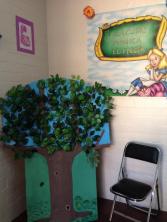
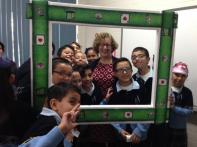
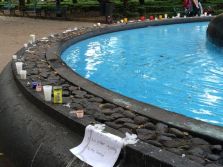
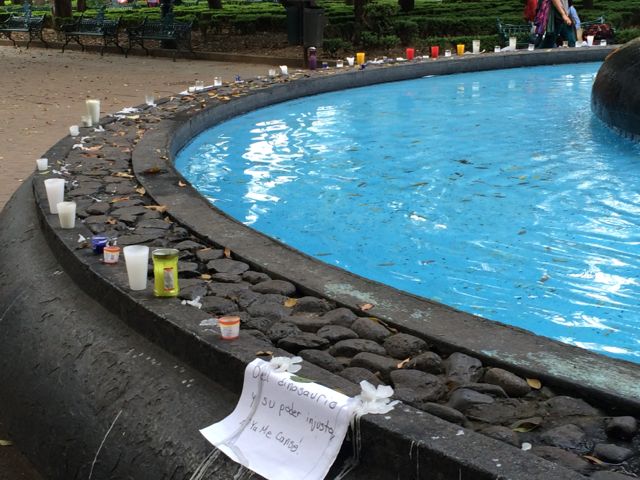
Afterwards we went to the Museo Frida Kahlo (La Casa Azul where I’d first been years ago) and then to a fabulous lunch on the Coyoacan Zocalo. I was moved by the candles for the 43 slain students, one of the many observations and demonstrations I saw while in Mexico City.
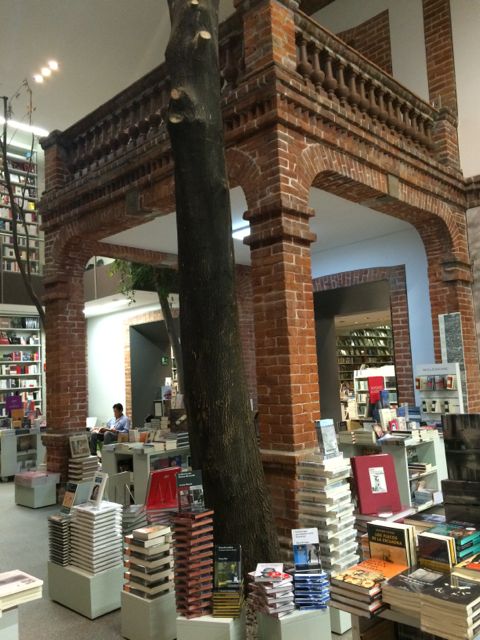
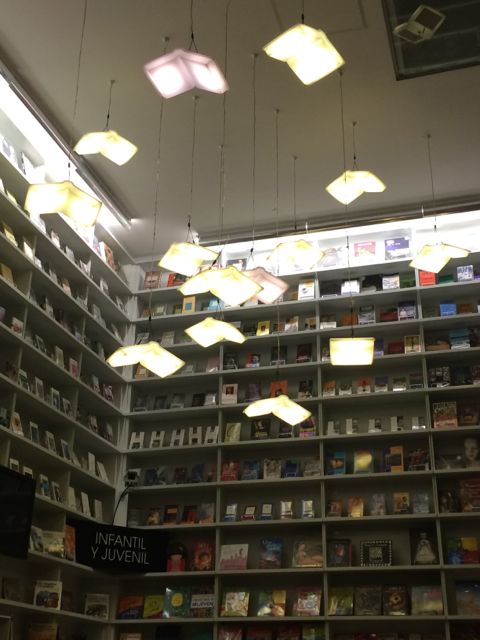
We were also in Coyoacan one of the nights for a lovely dinner with local authors and publishing folk. While walking about we stopped at the Centro Cultural Eleno Garro, a fabulous bookstore in an historic building with trees inside and flying lit books in the children’s section.
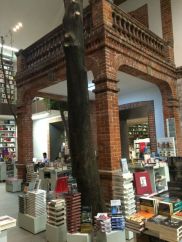
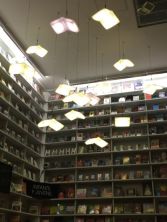
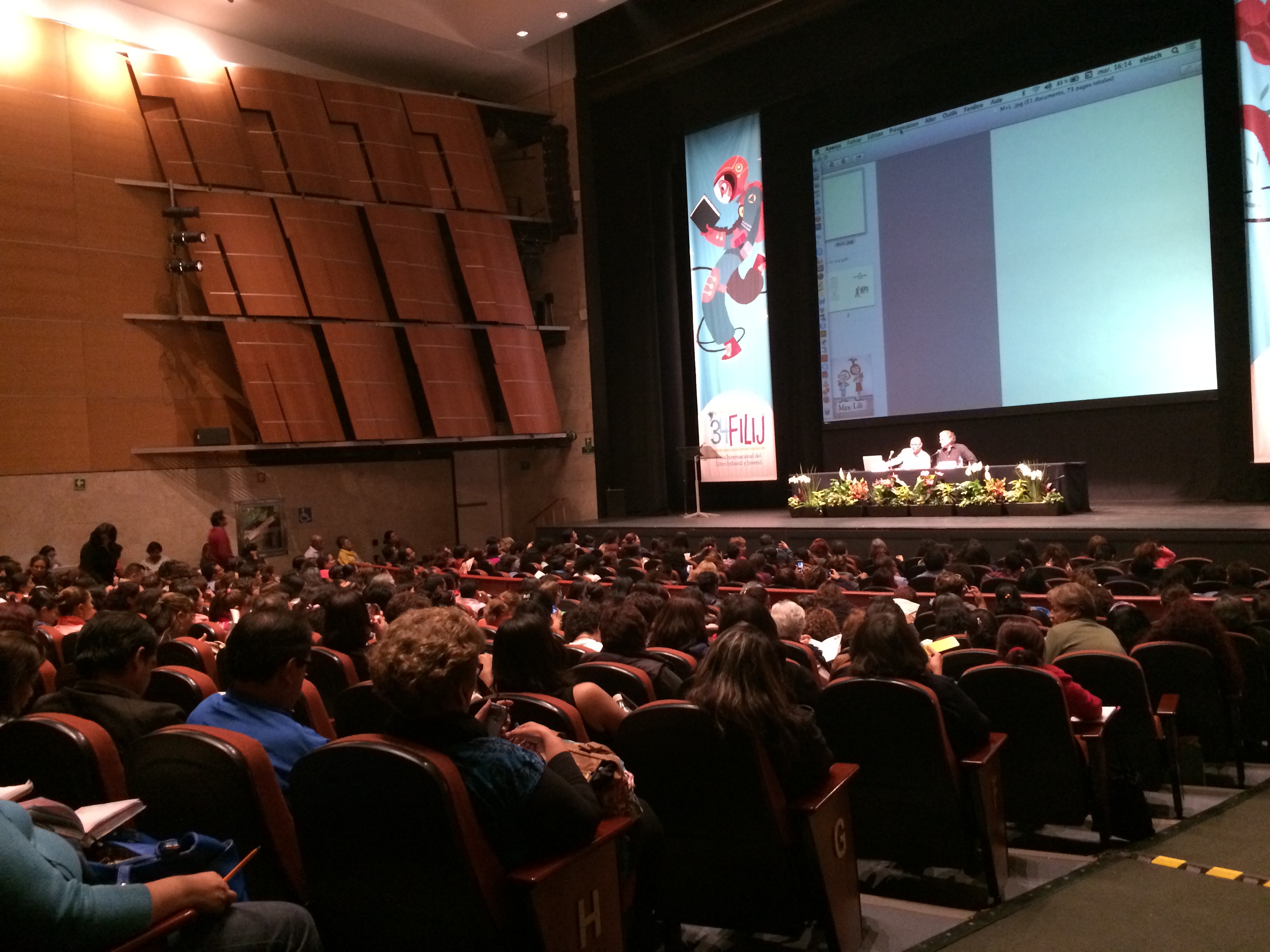
My talk for the symposium, also on Alice, went very well. The 600 listeners were generous, attentive, and had some excellent questions. I had observed one of my fellow presenters, illustrator Serge Bloch, a few days before so was prepared for the experience of simultaneous translation, especially when the audience reacted a few beats late to anything amusing. This is a shot from the auditorium during Serge’s presentation which will give a taste of what mine looked like.

Over the week I was there I met so many interesting people (a complete list of speakers is here) and especially enjoyed chatting with Bart Moeyaert, Serge Bloch, and Gonzola Frasca. And then there were my follow-English speakers, the Australian writer John Marsden with his wife Chris, and the UK Chicken House publisher (and Harry Potter editor) Barry Cunningham. We spent our final day together visiting Teotihuacan and then enjoying a lovely leisurely lunch that included ant eggs and crickets. Quite tasty, I should say though I admit found it hard to put aside my cultural squeamishness.
My great thanks to Conculta for inviting me. Most of all my great, great thanks to Karen Coeman who put the whole thing together — she even showed up at 6 AM yesterday at our hotel to be sure we all made it off to the airport without difficulty. Her team included the fabulous Diego Sanchez Moreno and Orly Rosales as well as a committed and helpful group of volunteers who took care of everything for us.


 The Penguin Random House Audio team has developed a new discovery app called “Volumes.”
With this free app, readers can listen to clips from works by Jodi Picoult, Sophie Kinsella, and Jim Gaffigan. Sometimes, full-length audiobooks will be made available at no charge. At the moment, users can download a free digital copy of Lewis Carroll’s Alice’s Adventures in Wonderland which features the voice acting talents of Jim Dale.
Her’s more from the press release: “As part of the app’s launch, and to encourage users to give listening a try, Penguin Random House Audio is working with Literacy Partners to donate one audiobook (up to 25,000 audiobooks) for every person that downloads the app and pledges to listen. Listeners can take the pledge on Random House Audio’s Facebook page.” What are your favorite audiobooks?
New Career Opportunities Daily: The best jobs in media.
I admit to a particular fondness for subversive books and so Betsy Bird, Julie Danielson, Peter Sieruta’s Wild Things! Acts of Mischief in Children’s Literature would have been right up my alley even if I hadn’t known the three authors long before the book came into being. And so I was pleased as punch when Betsy and Jules invited me to answer a few questions about someone who created my favorite subversive book, Lewis Carroll.
We know that you’ve done a fair amount of research on Alice in Wonderland in your spare time so let’s find out some stories folks might not know very well. In fact, let’s start at the very beginning. Lewis Carroll. We know that name was a pen name and that he had a penchant for early photography. What don’t we tend to know about him?
The mythology around the creation of Alice’s Adventures in Wonderland centers on Carroll’s friendship with the real Alice Liddell and her two sisters. What has been completely overlooked is that the girls had an older brother, Harry, who was also one of Carroll’s good friends. The children of the head of the Oxford college where Carroll was a mathematics instructor, it was the nine-year-old Harry who Carroll befriended originally. He took Harry boating, tutored him in math, to chapel, and so on. The friendship was reciprocated in spades; Harry was known to follow the young man around like an eager puppy. However, he soon went off to boarding school as was typical for boys of his time and class leaving behind his three sisters who were educated at home by a governess. And so it was that Alice and her two sisters became the most famous of Carroll’s many child friends with Harry quite forgotten.
The relationship between Alice and Carroll has been the source of much speculation. Few people pause to wonder what happened to her when she grew up, though. What did she do with her life?
It seems to have been typical of her time and class. At age twenty-eight she married Reginald Hargreaves in Westminster Abbey and had three sons, one of whom she named Caryl. While she always denied it you have to wonder if she was being subversive and was indeed naming him after Carroll. In 1932 for the centenary of Carroll’s birth she traveled to New York City where Columbia University gave her an honorary doctorate. A delightful and completely fictional imagining of this event is Dennis Potter’s movie Dreamchild.
It’s hard to picture the book without also picturing the original illustrations. Are there any stories there?
The first edition of the book came out in July 1865, but was recalled when Tenniel informed Carroll that he was unhappy with the print quality of the illustrations. So the books were recalled and all who had received presentation copies were asked to return them. The rejected copies were sent to hospitals and other institutions. The handful that exist today are the most desired by collectors and the most expensive. After illustrating Looking-Glass Tenniel declined to illustrated any more of Carroll’s work leading many to suspect the relationship between the two had been a difficult one, but who knows?
Various adaptations of the Alice books have made their way into television shows and feature films. What’s your favorite Alice adaptation?
I’m still waiting for a completely successful one. So far I’ve liked parts of different ones, but I don’t think any work completely. One that I think actually does a lot quite well is Disney. I dislike his framing story — especially the end with the frightened Alice running back home as the book Alice is not fearful at all. However, many scenes are just wonderful, say the Walrus and the Carpenter.
I get a kick out of Betty Boop in Blunderland.
And I also quite like Alice at the Palace perhaps because Alice is played and sung by Meryl Streep!
But I’m still waiting for a great one.
Is there anything else about the book that you think folks are generally unaware of?
Just that it is a really fun and whimsical book and has an unfortunate reputation as being unduly dark. What it is is deeply subversive, especially for the original Victorian child readers. He makes great fun of so many aspects of their lives, say the didactic poetry they had to recite — the poems in the books are mostly parodies of dreadfully instructive ones Victorian children had to memorize and recite — as well as what they had to learn and how they had to behave. He respected children enormously and it comes through in the books. I urge people who have been dubious about the appeal of the book for children today to give it another look. Kids who go for other subversive books (Lemony Snicket’s come to mine) and/or those that play with language are really going to like these given the chance.


 When we last spoke with author Gregory Maguire, he told us he planned to sit in a “big long white noise period” to coax out his muse. He recently revealed that he has been working on an adult book with “an Alice in Wonderland connection.”
In an interview with School Library Journal, Maguire (pictured, via) mostly talks about fairy tales and his recently released young adult title, Egg and Spoon. At the very end, he offers a teasing snippet about his new project.
In the past, Maguire has written novels inspired by ”Cinderella,” “Snow White,” The Wonderful Wizard of Oz, and A Christmas Carol. How do you predict he will remix Lewis Carroll’s beloved fantasy story?
New Career Opportunities Daily: The best jobs in media.
I started out wanting to be a children’s book illustrator. As a child I was celebrated for my art work, starting in high school I began creating my own illustrations for some of my favorite books and stories, and in college I was an art major, focusing on printmaking. At that time the most scathing criticism was that your work looked “illustrationy.” And so I did beautiful minimalist engravings and etchings in class and did my illustrations at home, careful to not let anyone in my printmaking world know about them, especially not the instructors — renowned artists themselves — whom I admired tremendously.
From college I went right to Sierra Leone as a Peace Corps Volunteer. There I taught for a year and then worked as an illustrator for NGOs, creating various educational materials. My biggest project was to create illustrations for a multi-media presentation on bridge and road repair. I learned how to deal with cement, how to fix a hanging bridge, and so much more. I did posters on scabies, on breast feeding, on malaria prevention. And at home I worked on illustrations for Kipling’s “The Elephant’s Child”, inspired by the gorgeous flora and fauna all around me.
When I returned to the US I considered an MFA in printmaking, but the lack of personal encouragement from my former instructors decided me — I’d stop feeling guilty about my illustration work and focus on that. And so I put together a portfolio and made the rounds (while also working full time as a teacher — I wasn’t brave enough to go free-lance full-time and, besides, I loved teaching). I taught the legendary editor Janet Schulman’s daughter and she kindly looked at my portfolio, but we both agreed my work was too austere for her books. At Harpers they held on to my portfolio for a while, but then suggested I do some things to make my art a little too cute for my taste. There were a couple of agents too, but nothing came of it.
Perhaps because of greater recognition for my teaching, work in early educational computing, and critical writing, I lost interest in illustrating. My final work is from 1998 when I had the idea of creating an edition of Alice’s Adventures in Wonderland that would be visually annotated for children. That is, it would have loads of small Richard-Scarry-like-drawings that would help young readers understand the text, even the more antiquated passages. And then Roxanne Feldman (aka fairrosa) whom I’d met online came to my school. A savvy web designer, when I asked her if we could put a few of the kids’ drawings of Alice online she said “sure” and ended up putting the whole book online – the first two and a half chapters illustrated by me and the rest by my 4th grade students. Sadly, a couple of years ago the school reorganized their servers and it is no longer online.
It is rare these days that anyone sees my work (or even knows about it) other than my “Elephant’s Child” illustrations as they are framed and sit over my couch right next to Robert Byrd’s original cover art for Africa is My Home. Then last night thinking about my current book project which involves making Alice accessible to young readers today, I remembered those Alice illustrations of mine. And while I have no wish to continue that project (my focus is on writing now), I thought it might be fun to put them back online for others to see. Perhaps I will, at some point, put up some of my other old illustrations — I did some for Tolkien, L’Engle, and a whole bunch of folk and fairy tales. Meanwhile, if you want to see my efforts at Alice please go here.


How to Train Your Dragon by Cressida Cowell and Through the Looking Glass by Lewis Carroll are among books that have been given a new life in London this summer. The National Literacy Trust in Britain has developed a public art project that commemorates 50 books in an new and innovative way: as public benches.
The project is called Books about Town. Artists have been asked to adapt famous books into benches which have been placed throughout the city. The “BookBenches” project is designed to encourage reading. Readers can find four different literary maps of these sculptures online and use them to guide their literary treasure hunts. The routes include: Greenwich Trail, Bloomsbury Trail, City Trail and Riverside Trail.
The exhibition is up through September 15th.
New Career Opportunities Daily: The best jobs in media.
View Next 25 Posts







That’s so cool, Monica! Looks like a great time and great experience. And I would love to go to Museo Frida Kahlo some day…