JacketFlap connects you to the work of more than 200,000 authors, illustrators, publishers and other creators of books for Children and Young Adults. The site is updated daily with information about every book, author, illustrator, and publisher in the children's / young adult book industry. Members include published authors and illustrators, librarians, agents, editors, publicists, booksellers, publishers and fans. Join now (it's free).
Login or Register for free to create your own customized page of blog posts from your favorite blogs. You can also add blogs by clicking the "Add to MyJacketFlap" links next to the blog name in each post.
Viewing: Blog Posts Tagged with: copyright, Most Recent at Top [Help]
Results 1 - 25 of 119
How to use this Page
You are viewing the most recent posts tagged with the words: copyright in the JacketFlap blog reader. What is a tag? Think of a tag as a keyword or category label. Tags can both help you find posts on JacketFlap.com as well as provide an easy way for you to "remember" and classify posts for later recall. Try adding a tag yourself by clicking "Add a tag" below a post's header. Scroll down through the list of Recent Posts in the left column and click on a post title that sounds interesting. You can view all posts from a specific blog by clicking the Blog name in the right column, or you can click a 'More Posts from this Blog' link in any individual post.
I'm not one to dwell on something, to pine and to wallow. I am a positive person and I like to move forward and upward from difficult situations. But, I am a completist, I like to finish what I start, and I like to be thorough. I like to help others through my own experience, and to share information that may benefit others. We artists (and friends!) need to stick together... and speaking of which, I so greatly appreciate all of the support that's been shown to me over the past couple days!
Here is my letter to S6, their response, and my reply to it. If it helps someone, I'm happy.
-----------------------
My email to S6 (email #1)
February 25, 7:27pm
Dear Society 6,
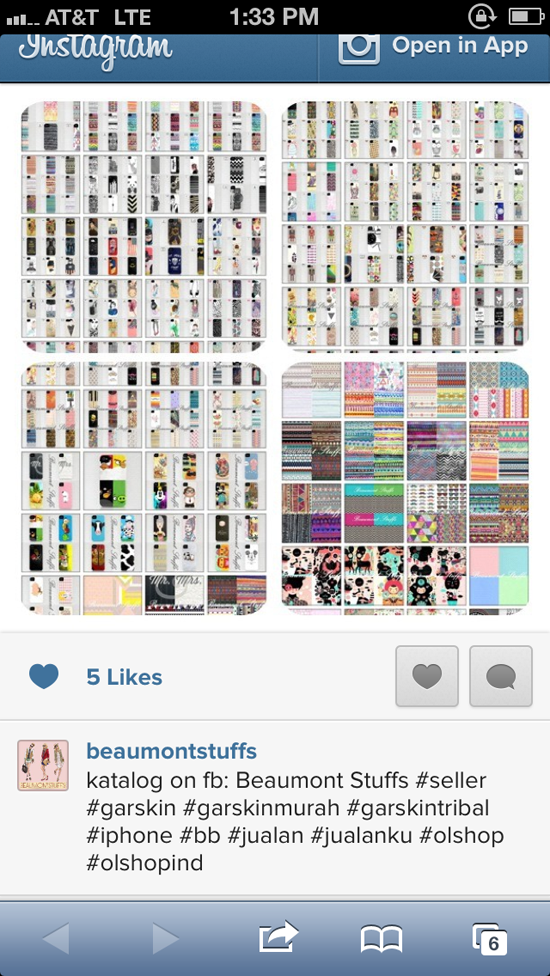
I recently discovered an Instagram "shop" selling my Society 6 art as well as MANY designs from MANY other Society 6 artists. When first I discovered the post (yesterday), it was 22 weeks old. I am 100% certain that the stolen art was art that I specifically designed and prepared exclusively for products in my S6 shop. I just wanted to let you know that those designs have been stolen and are now floating around Indonesia on products I never approved and will never receive any income from. And the "seller" has now disappeared from social media, at least under their former name.
My own case of infringement is not the first that I've heard about from former S6 shopkeepers, and sadly, it probably won't be the last. I don't know how the international illegal art market is obtaining the art— whether you have a hole in your servers, or a bad apple in your bunch. That's for you to know and handle. But, however you deal with it, please deal with it. This IS happening. Ignoring the problem is not going to make it go away. And there will only be more and more people like me that voice our own stories about copyright infringement of the work that we prepared and posted exclusively to our S6 shops.
When we join S6, we understand and acknowledge that you take no responsibility for copyright infringement. But (and I think I can speak for everyone on S6 here) we go in with a certain expectation that S6 will take, at the very least, reasonable measures to protect our work from getting ripped off. Moreover, S6 is more than just a shopping site. It is also a community. In order to keep your community healthy, thriving and undivided long-term, there has to be a certain level of goodwill coming from you toward the individuals within the community whose art is taken from S6 and infringed.
A healthy community helps it's members out as best it can within it's own set of guidelines, though limited they may be. There is a humanity and helpfulness there built in the system. After reading comments and stories of other former S6 artists being shut out (and shut off from their accounts) after voicing the international infringement of their intellectual property which they directly connected to their involvement on S6, I see that there is a serious, fundamental problem. If you are part-shop/part-community, you need to step up to the plate a little. Not asking for a lot here. Acknowledgement and some support, in a seemingly small way, would go a long way in the goodwill department. (How about a community forum for users, with this issue as one of the discussion boards where people can share, unite, and call out infringers?)
Anyway, I am a fan of your site, and I truly hope you will make this issue a top priority to fix.
Best Regards,
Kathy Weller
WellerWishes
(attached to message: screenshot from Instagram providing infringing sellers' name)
-----------------------
REPLY from S6 (email #2)
February 25, 7:37pm
Hi Kathy,
Thank you for contacting Society6 Support.
We don't know what "shop" you are referring to, but we'd sure like to see it if you can report it?
(Note: the following portion of the email, in grey, is content lifted directly from Society6's Copyright page)
Please allow us to share some very important information regarding your Copyrights.
First, please be aware that when you post your work to the Internet, no matter the size or resolution of your images, no website (and we mean NO website, not a one) can make it impossible to prevent it from being copied.
It is also incredibly important to us that you understand that while we do everything in our power to maintain your trust as an artist, we are not charged with enforcing the laws that we are required to follow.
Copyright infringement is generally a civil matter, which only the copyright owner can pursue - this means it is your responsibility to make sure that you are upholding your legal interests in your work, we are not authorized to do it for you. We are prohibited from giving specific legal advice on your rights, whether in connection with particular uses of copyrighted works, cases of alleged domestic or foreign copyright infringement, or other matters of a similar nature. You may wish to seek professional legal advice from a copyright attorney and to discuss your legal options.
Please remember, finding your artwork on another site is usually a good thing! In fact we encourage and support the sharing of your artwork as long as it is done correctly and with respect to you as the artist. So if you find your work on another website, please make sure the website is actually unlawfully infringing your copyright and not making "fair use" of your content, or reselling your products (buying them from you and reselling them for a profit). You won't make any friends if you're issuing unwarranted DMCA takedown notices to someone trying to give your work more exposure because they admire it!
If you're still not comfortable with your work showing-up on another site, always start by simply asking the website owner to remove the infringing content. Our experience shows that a polite email to the website admin requesting the image be removed is usually all it takes to resolve the situation.
In cases where your works appear for sale or where someone is claiming the work as their own, contact the individual asking that the works be removed immediately. The next step is to contact the company hosting the site containing the infringing work and ask them to disable the content or the account. When Society6 members have contacted sites like Etsy or Facebook in the past, these companies have typically responded in a reasonable time frame and suspended the content or the user. Please remember that most sites have systems, or specific processes (i.e. DMCA requirements) in place that you must follow in order to handle these matters.
If your desire is to sell your products, please know that we take every action to both protect your images, but also make them compelling for customers to purchase as products, and easy to promote thru social media, blogs, and other websites on the Internet.
Society6 secures your hi-resolution files and only ever provides a low resolution preview of your work on our site. Our product previews are presented at 600px, even though a larger 800px image is now the industry acceptable standard for product previews. It has been determined that at this size (and at screen resolution) there is no way to reproduce a printed product fit for sale.
We do not enable watermarks over your images as research shows it deters people from purchasing your products. There is no other successful online retailer that uses watermarking technology. You may find another site that offers watermarks, but you will quickly discover that all you’ll end up with is watermarked images and dismal sales.
We enable right clicks because this is a great way to allow members and other people to link to your work and give you additional exposure. We believe that disabling right clicks is not a true protection and does more harm than good - anyone that is stealing images understands how you can still copy right click disabled images. Furthermore, even if you disable the click, you can always take a screenshot.
We recommend that you research the relevant copyright laws and their application to your work on the Internet (links below), or consult legal counsel if you are unsure about copyright law.
We also suggest that you review Society6's Terms of Service http://society6.com/help/terms with respect to our Content & Copyright Policy to ensure that you are in compliance at all times.
We really appreciate your understanding and appreciate your continued support.
Sincerely,
(Name of S6 support person)
----------------------------
My Reply (email #3)
February 25, 7:52pm
Hi (Name of S6 support person),
Thanks for the reply. The shop that infringed S6 artists' work, including mine, has disappeared (I mentioned that in the 1st paragraph of my previous email).
It was really not a shop at all, but an Indonesian seller who has a bunch of S6 stolen art for sale on iphones via Instagram, Facebook and Twitter. They sold under the name Beaumont Stuffs.
The seller left all three social media sites after being exposed by the online community. (Though I'm sure they will pop back up with another name.)
I attached a screenshot in my original message to you of the Instagram post where I first discovered my work on their phones. I put it in my original message to you, but here is it again.
Thanks for the rest of the copyright info in the email. I already read it on your site.
Good luck and I hope you can fix what is broken over there.
I'm going to go remove my account now.
Best,
Kathy
7 Comments on Letter to Society6, last added: 3/1/2013
Society 6 is just the WORST! I follow another artist on Facebook (Christopher Uminga) who just had the same issue with another seller stealing his (and plenty of other artists') work. Although I readily support artists' ability to sell their work in an easy format, I can no longer support or recommend the purchase of Society 6 products because I simply can't be sure that I'm rewarding the proper artist whose work I admire. Society 6 needs to tighten the ranks and make it a little more difficult to sell just any old thing. If a seller has more than two wildly different styles it's a sure bet that the art in question isn't theirs.
Hi Anon, Thank you for your support and for chiming in! I greatly appreciate you adding new info to the conversation. It's difficult for me to understand how S6 prioritizes the importance or severity of infringement. There is the type you mentioned -artists on S6 stealing other artists' work (something I was not aware of til now on S6). There is my issue of infringement by other parties (mine overseas) selling products which, it is crystal clear to me, were created using designs I specifically templated for my S6 products and they were the only other servers besides my own that had access to those art files. Then there is the infringement of artists on S6 using trademarks and trademarked characters in their work. This is rampant on S6 and has been for a long time. I am not sure what steps they take to address that type of infringement but whatever they do, it does not seem to be working. There is this perception that it is ok to rip off a larger, more popular intellectual property like Batman, Barbie or Hello Kitty. In my book IP is IP and IP crime is IP crime no matter how big or indie your property is. And it amazes me how rampant this one is because I don't understand where some of these peope draw the line at creative integrity and originality. I guess there is parody of public figures and that can fall under Fair Use but who writes that script? Eek... I apologize for getting off track here from the original subject. It's just that there are several IP issues. Such a slippery slope.
Wow, their response is completely unacceptable and looks as if your note was disregarded. I was lead to your site by a large art group on FB, many contemplating selling on S6. After your experience and S6's truly disheartening lack of caring about their artist community I don't think any of them will be using their site. Plus many who were there will be shutting own their shops. Thanks for your open communication. All of us do need to stick together to make sure this stops. Sincerely, Susan
Seconding Susan's comment above... Totally unacceptable response from Society 6. Dismissive and even a little condescending when you have supplied them all the details already.
I'm so sorry you had to go through this. You can be sure word of this will spread around like wildfire.
I wish you the best of luck with legal correspondence to the offending party {vultures, as you called them - wonderful description for these thieves who can't or won't make their own art}
I think we've all learnt something from this. I certainly have.
Jeez, Kathy- That is scary! I've had my artwork on Society 6 for less than a year and this definitely makes me question my decision to upload product there. I guess I always had a nagging doubt with these sites as they pretty much admit they can't protect our art any way. Thank you for sharing and good luck!
Susan, Thanks for chiming in. Yes I agree, my massage was blatantly disregarded. It's perplexing to me, the S6 model of part shop/part community with really a hands-off, ignorant, hear no evil/see no evil/speak no evil approach to situations like this. It's completely backwards to treat individual cases like this as so unimportant as to not even warrant a complete reading of my message, when their community consists completely of individual artists coming together under their roof. It's very scary, the more scary the more I think about it. And when I think about the research I did (or tried to do) before joining... I did email back and forth with them trying to get a handle on their process, looking for more transparency. I never got it. but I went ahead with my shop anyway. I learned a really important lesson there. Just another case of my gut fully knowing what my intellect didn't have the words to communicate, at the time. My gut comes FIRST these days.Just sometimes, it's hard to tell. But the more I listen, the better I get at hearing it.
Nicole / Joe - Thanks for chiming in! I am so glad to have a blog where I can share great, awesome positive stuff but also stuff that affects ALL of us and may not be so pretty such as this infringement issue. The more I read and learn, the more I'm seeing a scarlet letter G for Guilty on Society6.
Maddening, disappointing, unsettling, frustrating news this morning: I discovered my art has been infringed upon.
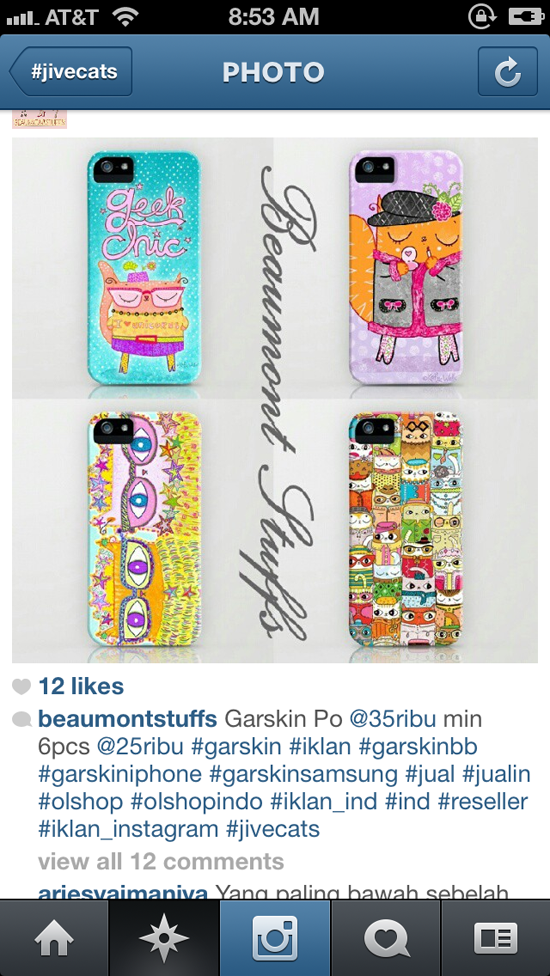
At first, I thought this was a fan-based post. But then I quickly realized that I'd come across a social media vulture-stealer-infringer-seller who is selling my designs and many, many others, through their social media outlets.
Of course once they got called out by me, most of their accounts are suddenly private... Guilty!!!
(As of this writing, their Twitter is still public - so feel free to tweet them...
Beaumont Stuffs Facebook account - Now Private!
The ONLY place that had access to these exact same designs other than myself is Society 6, so I'm going to be contacting them as well. Really, REALLY disappointing. I joined S6 last summer and actively had a shop/presence there for about a month or so, until I decided to go indie with Case-Mate Aug./Sept. 2012.. Of course, I *trusted* Society 6.. But my designs leaked out into the underground illegal art trade. So, nice. Now that's a sad state of affairs. When you join Society 6 and sell through there, you are in business with them and entrusting them with your work. It's such a violating discovery to find that the designs I made specifically for my Society 6 shop were leaked. I do not think Society 6 is *directly* to blame for this. But I *DO* think they need to take some responsibility. It is clear that they have a security leak (or more than one?) and they need to get to the bottom of how this happened and figure something out so that it does not happen again. They have GOT to treat this SERIOUSLY. I have read about this happening in the past with Society 6 and I have heard that they were unresponsive to infringement claims such as this. Well, now I am about to find out for myself.
I'll be contacting every social media outlet and every avenue I can to stop this. Please comment if you know of any resources that might help me, if you can spare any advice, or if you just want to offer support!! I truly appreciate it ALL.
Oh... and also: feel free to "friend" them and screenshot any pages you gain access to, and send them along to me. THAT would REALLY help a lot!!
23 Comments on Copyright infringement by Beaumont Stuffs, last added: 3/1/2013
so sad. I'm really sorry that this is happening to you. On the plus side, my friend posted this to Facebook (Maurie Manning) and because of this incident I have discovered your beautiful work! I love it all!
Thanks so mucb Ashley! That's so awesome ! I am so happy you discovered my work through this awful incident! Silver lining :) :D
Anonymous said, on 2/24/2013 2:34:00 PM
I click on your "My name is Kathy..." link above and I see your first mistake: a huge, high-resolution image of your artwork loads. It would be a simple matter for anyone to capture that image and use it on anything to produce a high-quality product! Keep all of your online images relatively *small* to prevent theft/reuse.
Next option: hire an attorney. Even if it's just to send out cease and desists. It sounds like an open and shut case.
Your name is even in the drag and drop photograph on the cases! Very clear in the top two...Anger doesn't even begin to cover it! I hope this is resolved soon, girl!!
yes you are right - that one image is very large. My home page template supports dynamic views so they really shouldn't show up as LARGE as they do, but they do and it's been an issue that I need to fix.
However that is only one image and actually the stolen images are directly lifted from the art I was selling on products on Society 6.
I already contacted an IP attorney. I don't agree that it is open and shut. U.S. copyright registration is very often blatantly and brazenly ignored by countries particularly in Asia and South America. Though they are OUR laws they are not necessarily followed and complied with by some dubious sellers that are not in the U.S.A.
Thank you for your comments! I wish I knew your name so I could put a comment to a name!
I *just* opened an S6 page yesterday and just took the leap today and started adding my newest work. When I shared my big news on IG, a follower/fellow artist clued me in to your troubles. What a mess! I took down my artwork from there and read the "copyrights" section of there "help", which basically says that they are not in the business of protecting our copyrights from anyone else, they don't prevent right clicks and don't intend to, they don't allow watermarks and don't intend to, good luck and have a nice day. :(
Although the pillows looked adorable on the screen, I'm going back to etsy. Your website is beautiful. I'm glad you are no longer there and you caught them and at least slowed them down. And thank you very much for announcing this and perhaps protecting others from virtual pickpockets.
Kathy, awful news! I'm really sorry. These seem to be the often bad news from designers who decide to sell their lovely work through society6, and they still take no action to protect who really keeps them on business... just very frustrating! This is the reason I opened and then almost immediately closed my shop there. I really hope there's something you can do. Good you caught the bastards! I'll spread the news...
This makes me so angry for you. I adore your style and have seen you via instagram. Having had my work copied, my images lifted, people selling my art and even taking pictures !!!can really understand how awful this is. Your creativity, hard work, talent being Stolen by this company...i can't find them now so maybe they have removed themselves. People say when i am copied it flattery !! how is theft flattery. It's disheartening too to learn that your images where taken from society 6. I can only hope you can get some resolution to this.
Hi Kathy This Facebook group I belong to could be a good place to post - Copyright Infringement Cases - or if you like I could post a link to your blog. I can imagine how upset you must be. I only have to think of someone stealing my work and feel sick to my stomach. Hope you get it sorted. :) Carla
Their Twitter page is gone now and it says that their FB page doesn't exist. I hope that the fact that they were caught shamed them into pulling everything!!!
I'm so sorry this happened to you. You're art is wonderful! It should remain yours!
Sorry for the report--I wanted to included the name of the WA company. Here's the revised comment:
This is so scary! You know, I created an account at Society 6 last summer from the recommendation of a well-known male artist. I guess for once I can be grateful to my procrastination, because I never did log anything onto it. I am so, so sorry this has happened to you. )-: There's a small, but prominent, Seattle Design shop--MODERN DOG--that's been fighting Disney and Target for almost 2 years for copyright infringement. They said they may never win, but they're fighting on principle. They took donations on their website for a small amount of time to help fight legal costs. Already your actions of principle have affected them to remove social media sites and helped spread the word to so many others. Thank you for being an art crusader! Also, I will add that this issue led me to your art as well--which is adorable!
Here's the link to that story--I hope it helps you: http://www.king5.com/news/cities/seattle/Seattle-designers-sue-Disney-claims-copyright-infringement-179754381.html
Juju - THANKS for the link to the Modern Dog case (I'm a fan of theirs & I have a Modern Dog book of their design work :D ) Love the fighing on principle, though it is such a hard way to go... the stress... takes a steely will and an iron gut! ;) I'll check that link out, thanks!
Elizabeth - Thanks! Yes I noticed that... and POOF they are gone...
Vita - THANK YOU!! XO
Carla-Thanks for the name of the FB group! I'll visit there, but please feel free to post my blog link there if you like! :D Absolutely :)
Heidi/Little Nore - thanks so much! We will see what happens. They have disappeared into thin air but the one thing I can say is that they know I'm watching and that you all have rallied too! For my part, next time... oh there is many things I would do differently... I will be a silent ninja and I will be able to contact the other infringed-upon artists (things happened so fast I saw art I recognized but I did not get adequate-enough screen grabs..) NOT that I'm looking forward to a "next time"... just that I'll be better prepared. That's for sure. ;)
MaJo BV - THANK YOU for your support!! (And for your compliments of my work!! :D ) I greatly apreciate your nod to other artists, formerly with S6, who have had similar experience. That is really on my mind right now. (I'm about to post the letter I sent to S6. Please stay tuned for that one!)
Lori, Good for you for making an informed decision. I believe in making a decision based on information that is available, no matter what. What is important is that people share honest info from experience and that can factor in (or not, as the case may be) to another person's individual decision! :D Sharing is caring (and is good karma too!)
Juju - THANKS for the link to the Modern Dog case (I'm a fan of theirs & I have a Modern Dog book of their design work :D ) Love the fighing on principle, though it is such a hard way to go... the stress... takes a steely will and an iron gut! ;) I'll check that link out, thanks!
Elizabeth - Thanks! Yes I noticed that... and POOF they are gone...
Vita - THANK YOU!! XO
Carla-Thanks for the name of the FB group! I'll visit there, but please feel free to post my blog link there if you like! :D Absolutely :)
Heidi/Little Nore - thanks so much! We will see what happens. They have disappeared into thin air but the one thing I can say is that they know I'm watching and that you all have rallied too! For my part, next time... oh there is many things I would do differently... I will be a silent ninja and I will be able to contact the other infringed-upon artists (things happened so fast I saw art I recognized but I did not get adequate-enough screen grabs..) NOT that I'm looking forward to a "next time"... just that I'll be better prepared. That's for sure. ;)
MaJo BV - THANK YOU for your support!! (And for your compliments of my work!! :D ) I greatly apreciate your nod to other artists, formerly with S6, who have had similar experience. That is really on my mind right now. (I'm about to post the letter I sent to S6. Please stay tuned for that one!)
Lori, Good for you for making an informed decision. I believe in making a decision based on information that is available, no matter what. What is important is that people share honest info from experience and that can factor in (or not, as the case may be) to another person's individual decision! :D Sharing is caring (and is good karma too!)
So sorry to see & hear about this and I hope Society 6 can do something helpful towards resolving this issue for you. They really need to step up their game!
I am a textile designer and have thought about putting some designs up with them. Been dragging my feet about it as I was focusing on other projects. Now I think I may pass altogether on them.
Hi Modern! Gee, I wrote a very detailed message to you a few hours ago on my iphone, and I lost it. So here is a new one...
Thanks for your support and comments! I know that S6 will do nothing for me but I really hope they make the decision to reinvestigate the model they have built on the intersection of business and community, and how they need to support each other, genuinely, literally.
Another issue is available information. They seem to keep cards so close to their vest when it comes to process. There is so painfully little on their web site about how things are actually made.
We are all artists, we understand printing process, dpi, color processes and the like.
Before I joined S6, I emailed them to find out further technical information regarding their process. They never really gave me a straight answer to that question. (actual email exchange follows)
------------------------ Me:
Hi there! I have a couple seller questions: 1) I have a detail of the larger image used for the iphone. That same image is used for the greeting card. Is it possible to instead choose the full image for the greeting card, and not the iphone-specific detail from the print? 2) My original art is 27.5" x 20.5", 300 dpi. The larger prints are larger than that size (22 x 28 and 36 x 28, with no option to remove the larger prints from sale). How can you get a good hi-res print that is larger than the original art without the quality suffering? Please let me know the answers to the above. Thanks! Best regards, Kathy
------------
Society 6:
Thank you for contacting Society6 Support.
We use the asset you uploaded for the iPhone Cases/Skins to create the Stationery. If you need to EDIT these, just click "Add T-Shirts and More" at the top of any post to easily edit/delete other products that accompany your Art Print.
Our system automatically determines your available sizes based on industry standards and the amount of pixels in your file. These sizes created by our system can not be edited or changed. You are able to EDIT and replace the file at any time.
I hope this helps!
(name of Society 6 Support person here)
----------
They are simply not transparent about their process. I should have seen this as a red flag. And I guess, on some level, I did, after all.
I really hate that this happened to you, Kathy. I wish more people would realize that taking someone's art without permission to make a profit is THEFT not flattery. I'm so glad I did not upload any work to my S6 shop yet, especially after reading this part of their stance on copyright protection that you posted:
"Please remember, finding your artwork on another site is usually a good thing!...You won't make any friends if you're issuing unwarranted DMCA takedown notices to someone trying to give your work more exposure because they admire it!"
Yes, exposure is great, but finding your work on a site that is making money off of your designs without your knowledge or consent is horrendous (I know, it happened to me for the first time this Summer and it was a TERRIBLE feeling)...
Well...keep on truckin', Girl! Your artwork rocks- here's to lots of awesome *legitimate* deals coming your way soon!!!
Genevieve, THANKS SO MUCH for your support!! :D XO Seriously that sentence gives me shivers, too. Again, they are so vague. If pressed they will surely say that what they mean is that if people are promoting your work on their blog, who are you to argue with the exposure. Of course, two wrong things with that. 1) People need to get in the habit of asking permission before posting work that is not their own regardless of the situation. This is just a given. 2) That sentence itself is so dubious, shady, and opaque and it is clear that it's that way on purpose. It was probably written by their lawyers.
In 2010, Aaron Swartz, a 26-year-old computer programmer and founder of Reddit, downloaded thousands of scholarly articles from the online journal archive JSTOR. He had legal access to the database through his research fellowship at Harvard University; he also, however, had a history of dramatic activism against pay-for-content online services, having previously downloaded and released roughly 100,000,000 documents from the PACER (Public Access to Court Electronic Records) database, which charges eight cents per page to access public files. Given his status as a prominent “hacktivist” and the sheer quantity of files involved, law enforcement agents concluded that Swartz planned to distribute the cache of articles and indicted him on multiple felony counts carrying a possible sentence of $1 million in fines and 35 years in prison.
Swartz was slated to go to trial this year but committed suicide in early January, prompting a public outcry against the prosecution in his case. Swartz was a prominent voice in the heated debate surrounding modern copyright law and public access and use (see his 2008 “Guerrilla Open Access Manifesto”). New York’s current issue contains a great feature from Wesley Yang discussing Swartz’s activism, his life, and the controversy in which he was embroiled.
In the ongoing debate over Swartz’s prosecution, we’ve pulled together a brief reading list on the issues surrounding American copyright in the digital age from OUP’s stable:
A Senior Copyright Counsel at Google takes a look at the changing economic realities of the globalizing, digitizing world and concludes that our government must “remake our copyright laws to fit our times.”
An overview of music piracy stretching back to the advent of recorded sound. The RIAA made headlines throughout the last decade by litigating against users who shared music online, but musicians, record companies, songwriters, and fans were navigating this territory for nearly a century before the Internet became a factor.
The story of one early 20th century musician who spent decades conducting high-profile lawsuits against the leading pop icons of the day. Though he never won a single case, Ira Arnstein managed to have a significant impact on the shape of music copyright through the decisions in his numerous cases.
Spoo homes in on the contested publication of Ulysses to reveal the impact on copyright of literary modernism (and vice versa). Characters such as Ezra Pound, the infamous publisher Samuel Roth, and of course James Joyce flesh out a revealing story about artists grappling with free speech and authorship.
Oxford University Press is committed to developing outstanding resources to support students, scholars, and practitioners in all areas of the law. Our practitioner programme continues to grow, with key texts in commercial law, arbitration and private international law, plus the innovative new ebook version of Blackstone’s Criminal Practice. We are also delighted to announce the new edition of the Max Planck Encyclopedia of Public International Law, one of the most trusted reference resources in international law. In addition to the books you can find on this page, OUP publishes a wide range of law journals and online products.
Subscribe to the OUPblog via email or RSS.
Subscribe to only law and politics articles on the OUPblog via email or RSS.
Tweet Yesterday’s summary judgment filings confirm that settlement talks have been ongoing–and the Siegel side is in disarray.The motion filed yesterday was as expected as a player trotting to first base after ball 4. When an appeals court sends a case back down saying that the case is all but over but the filing, the [...]
4 Comments on DC moves to end Superman, Superboy lawsuits, last added: 2/9/2013
If I were asked to express in a single sentence what has happened mentally to many American children during the last decade I would know no better formula than to say that they were conquered by Superman. And if I were further asked what is the real moral of the Superman story, I would know no better answer than the fate of the creator of Superman himself.
@mgh The following are a few references to the initiation of settlement talks.
Toberoff’s argument against the summary judgment is that DC violated procedural rules re a mandatory pre-filing notice period. DC finds the you-said-judgment-but-not-summary-judgment argument to be transparent jockeying for tactical advantage. Specifically, DC alleges that Toberoff was delaying so he could prepare and file the 2/7 Pacific Pictures motion, which, reading between the lines, is an attempt at showing that the recent string of losses has not left Toberoff powerless.
Thing is–and here I’m speaking more about the negotiating role of an attorney than the legal–the PacPic filing doesn’t achieve that goal. If anything, it has the opposite effect.
The same goes for the objection to DC’s motion on 2/7. Could Toberoff win on the you-said-judgment-not-summary-judgment technicality? Sure. District court judges have to be sensitive to this sort of stuff, since you don’t want a picayune matter of procedure to undo more substantive decisions. But as I noted yesterday, it doesn’t foster fear or respect.
Settlement talk references – the process started in January
p.17 – email
p. 18 – email
p. 78 “In reality, Mr. Petrocelli had stated in a largely unrelated telephone
conversation with Mr. Toberoff about organizing settlement talks that DC would file a “motion for entry of judgment””
p. 78 “On January 31, Mr. Petrocelli had a telephone conversation with Mr. Kendall (who does not represent any party in these two cases) about coordinating a settlement meeting.”
p. 79 “Obviously, DC cannot use casual references in settlement conversations to evade its meet-and-confer obligations under Local Rule 7-3, especially when DC was openly vague about the sort of motion it intended to file”
Jeff Trexler said, on 2/9/2013 7:31:00 AM
A quick update – one procedural, another more interesting.
Procedural: Judge Wright replied pretty much as one might expect. He says that while DC gave Toberoff plenty of notice, Toberoff IDed a technical inconsistency with the procedural rules.
You can almost hear the judge sigh.
The upshot: he grants the continuance and cancels the March 11 dates for the Siegel and Pacific Pictures cases. In Pacific Pictures, he takes this one step further and says that he’ll make his decision based on the record.
What’s more interesting is that DC’s latest document dump includes an interesting piece of info re the Shuster case. DC includes material indicating that it has sought a new court-ordered mediation with Mark Peary now that the court has shown him that he really can lose everything except the micro-settlement with his mother. Previously, Peary had said he had only considered the possibility of a loss “like I would an asteroid hitting us and wiping out life on earth.”
In other words, DC is likely prepared to reach a new agreement in excess of the old 25K/year settlement.
Tweet News reports are circulating that the Siegel and Shuster heirs have asked the lower court to dismiss DC’s copyright lawsuits. What actually happened is rather different. The Siegel and Shuster heirs’ attorney, Marc Toberoff, appears to have conceded that the Superman copyright dispute is over and the heirs have lost. Here’s what happened in [...]
15 Comments on Siegel and Shuster attorney to court: It’s over, last added: 2/7/2013
Oh Jeff, Jeff, Jeff….
What will you get to write about now?
Mitchell Berger said, on 2/7/2013 8:38:00 AM
You don’t have to be a procedural wonk to understand the importance of the admittedly complex issue of civil procedure. That’s because, as far as I understand it, there is still some bargaining to be done. And every DC claim that can be dismissed improves the Siegel’s bargaining position. I think the 9th Circuit’s decision is horrible. It chills the bargaining process by putting in land mines, it also seems to directly contradict one of the cardinal rules of evidence in civil matters – statements made in conjunction with an offer of settlement are not admissible as evidence. And if a term sheet doesn’t fit that description, I don’t know what does. Maybe that’s why the 9th Circuit didn’t want the case to establish a precedent.
Jeff Trexler said, on 2/7/2013 9:04:00 AM
@Jonboy Just you wait. Been holding back. Always open to questions too.
@Mitchell Berger The state of the law regarding term sheets would surprise a lot of people who agree to them. It’s in many ways counterintuitive. My take on the 9th Circuit’s use of a memo dispo is that the legal principles for finding a term sheet binding have already been established. This was just an application of established law to a particular fact pattern – no need to offer additional guidance in binding precedent.
Re bargaining to be done: yep, that’s how these things often get wound up after one side wins a huge victory. Thing is, though, DC is now in the stronger position, a reversal of the situation in 2008 and the subsequent expansion of the Siegels’ ownership stake. The filing described in this post is primarily about Toberoff not getting hit with owing damages & attorney fees to DC.
MG said, on 2/7/2013 9:19:00 AM
Now can we get Superman back in his original costume instead of Jim Lee’s nightmare?
Jesse Post said, on 2/7/2013 10:39:00 AM
Jeff, I can’t wait for the book you write on this. You know — the book that I decided in my head will be on sale around this time next year.
Seriously, these as-we-go-along posts are stirring and wrenching and eye-opening. Putting it all in one place in the proper context (and in the right narrative order) would be a must-read.
The human “point” that stands out to me here is the aggressive attempt to strip an author of his right to be considered an author while we here in the 21st century are enjoying a renaissance of author recognition; even corporate authors! “Monsters, Inc.” isn’t just a Pixar film, but a Pete Doctor film, and it’s marketed that way. Kevin Feige, Jon Favreau, and Joss Whedon are given more credit for the Marvel film explosion than the corporation itself is. Today, corporate art producers promote their employed or freelance individual humans as the secret to their success, yet we just have a block preventing us from affording the same recognition to those who built the foundations. It’s because the working relationships then were so fuzzy and disputed that any “give” in those relationships today becomes dangerous to the financial health of the companies. Understood. But it doesn’t make it any less outrageous.
Brad Ricca said, on 2/7/2013 11:33:00 AM
I second Jeff’s book — he is literally the only person who is getting the analysis of this right. Otherwise, facts like these get buried behind single news leads and small paragraphs. No one is simply willing to do the homework anymore.
Something new that struck me was the use of “Jack Kirby’s Fourth World” in a few places in the settlement. I don’t know the exact reason they were putting it in (help?) but just the way it is worded — as his, but emphatically theirs — very ironic and sad.
Jeff Trexler said, on 2/7/2013 12:41:00 PM
@Jesse Many lawyers today are domo arigato Mr. Roberto when it comes to preventing future harm to a corporate client. It doesn’t occur to them that treating folks as less than human is offensive in ways that can lead to much more substantial harm down the line.
For instance, the Siegel case has cost Time Warner millions in legal fees–probably more than they would have paid the Siegels under the settlement during the same period of time. The likelihood that Time Warner would have taken the same financial hit if Joanne Siegel had gone off the reservation after transferring DC all the rights in the settlement falls somewhere on the spectrum from slim to none. But all the lawyer can think is control, control, control without any sense of nuance or a strategy informed by human nature.
@Brad Based on the context, my initial sense is that Kirby’s Fourth World + related material are there to forestall on claim to revenue from post-termination versions of Kirby’s Jimmy Olsen/Fourth World/Kamandi material with an arguable or actual Superman connection. (Definition 9, “Superman Property,” is key here.) At the time profits from Darkseid material may have been the main concern, but who knows? Perhaps the original plan for the New 52 was to build it around Goody Rickles.
On a broader level, yes, the phrase “Jack Kirby’s Fourth World” has branding value in the comics community, but in a document designed to deny an original creator the possibility of any credit or financial interest it takes on a wholly different valence.
jonboy said, on 2/7/2013 1:07:00 PM
Jeff,
Aren’t the royalties retroactive? Meaning, isn’t DC paying the royalties from the date the agreement was signed to today, as well as going forward? DC didn’t pursue this case to stop those royalties, or even reduce them, they reacted to Toberoff’s claims.
So saying “the Siegel case has cost Time Warner millions in legal fees–probably more than they would have paid the Siegels under the settlement during the same period of time” isn’t really accurate, is it?
Did the lawsuit cost TW money? Yes. But they were willing to pay the Siegel heirs significant money, and had an agreement to do so. It was the Siegels and Toberoff who decided to try to void that agreement.
What was TW to do? Renegotiate for more? Siegel didn’t want more. Apparently she wanted to stick it to the man. So TW had to defend their property.
Jeff Trexler said, on 2/7/2013 1:46:00 PM
@jonboy There was a way to write certain clauses – particularly anything pertinent to non-defamation and other stuff beyond finances – that likely could have kept the settlement process from breaking down into the long-ongoing lawsuit.
When you’re negotiating a settlement, particularly a one involving a situation w/ decades of hard feelings, you don’t stop with cash if you want the settlement to get the folks on the opposite side of the table to sign on the final dotted line. Many disputes aren’t really just about money–and if you pretend they are, you could end up losing more of it than is necessary.
In the Siegel deal, when the dollars were more or less set would have been a great to time to think about how to get the Siegels to see this a good thing, as a form of vindication for Jerry and a means of securing his legacy. Without that, there was always a serious chance it could revert to the mean–a fractious, costly legal dispute.
Now DC is on the hook for the past royalties *and* the decade or so of lost time, extra staff, $ spent massaging it for SEC filings and fees for outside counsel. A bit of strategic humanity in 2002 could have saved all that extra cash for creative projects to further corporation growth–or, more likely, tripling bonuses for C-level executives.
Silly but True said, on 2/7/2013 2:02:00 PM
This deserves a book all to its own. But I’d also be interested in an indepth detailed history of the larger universe of notable comic/ fandom trademark and copyright disputes including Superman (Siegel/Shuster), Natl vs Fawcett / Marvel vs DC (Shazam/Capt Marvel), DC vs Bruns, Gerber/ Wolfman/ Friedrich vs Marvel, Warren vs Harris, Gaiman vs McFarlane (Medieval Spawn, Angella, Cogliostro, and Miracleman/Man-of-Miracles), Miracle(Marvel)man, Stan Lee vs Marvel (2002 not Stan Lee Media), Jack Kirby vs Marvel, and hell, let’s even toss in Lucasfilm vs Battlestar Galactica.
My overall understanding of things is that the (admittedly different) courts have been schizophrenic at best over the nearly century of time they’ve been looking at the sausage-making of my beloved hobbies.
jonboy said, on 2/7/2013 2:07:00 PM
Jeff,
So are you thinking that if DC/TW had been “nicer” to the Siegels in 2002, all the subsequent legal wranglings wouldn’t have occurred?
That, I can understand.
BUT, if the Siegels had made up their minds to fight prior to the 2002 settlement regardless of the $ offered (in which case why would they have agreed to it), then no amount of nicety would have fixed it.
All in all, yes, I agree being ‘nice’ solves a heckuva lot more problems than it creates, but at the same time, sometimes you just gotta be a dick in order to get what you want.
Horatio Weisfeld said, on 2/7/2013 2:47:00 PM
JT:
Thanks for your detailed reporting/analysis + I look forward to a book.
Jamie Coville said, on 2/7/2013 4:28:00 PM
JT: I do as well, hopefully it’s not just on this case, but all previous legal cases. Preferably written from the Siegel family POV and explains what they were going through and why they came to that POV, if possible. That’s a book I really want to read.
Brad Ricca said, on 2/7/2013 7:09:00 PM
Yeah, just shocked by how much DC insisted on controlling the narrative of the actual story. It’s the ultimate version of Editorial — making the Siegel life story itself part of approved DC canon. How do you make something work? Fit it in continuity. Really surreal.
More Last(?) Words | Brad Ricca said, on 2/7/2013 7:19:00 PM
[...] More last words on the lawsuit by Jeff Trexler at The Beat. [...]
From the 1920s to the 1950s, Ira B. Arnstein was the unrivaled king of music copyright litigants. He spent the better part of those 30 years trying to prove that many of the biggest hits of the Golden Age of American Popular Song were plagiarized from his turn-of-the-century parlor piano pieces and Yiddish songs. “I suppose we have to take the bad with the good in our system which gives everyone their day in court,” Irving Berlin once said, but “Arnstein is stretching his day into a lifetime.”
Arnstein never won a case, but he left an enduring imprint on copyright law merely by getting his days in court and establishing precedents that later led to copyright infringement judgments against such notables as George Harrison and Michael Bolton. Though his claims often strained judicial credulity, Arnstein had a gift for posing conundrums that engaged some of the finest legal minds of his era, forcing them to refine and sharpen their doctrines.
Over the years, Arnstein laid claim to more than a hundred standards of the Great American Songbook. This playlist of 15 songs — from Irving Berlin’s “A Russian Lullaby” of 1927 to Cole Porter’s “I Love Paris” of 1952 — is representative, and we have selected recordings that illustrate performance styles from the 20s to today. “No one,” as one lawyer wrote and you will agree, “can accuse Arnstein of courting feeble opposition.”
Gary A. Rosen is the author of Unfair to Genius: The Strange and Litigious Career of Ira B. Arnstein. He has practiced intellectual property law for more than 25 years. Before entering private practice, he served as a law clerk to federal appellate judge and award-winning legal historian A. Leon Higginbotham, Jr.
Subscribe to the OUPblog via email or RSS.
Subscribe to only music articles on the OUPblog via email or RSS.
Subscribe to only law and politics articles on the OUPblog via email or RSS.
There has been a lot of great writing about copyright and access to our cultural and intellectual history in the weeks since Aaron Swartz’s death. I have been retreading some of my old favorite haunts to see if there was stuff I didn’t know about the status of access to online information especially in the public domain (pre-1923 in the US) era.
I talk like a broken record about how I think the best thing that libraries can do, academic libraries in particular, is to make sure that their public domain content is as freely accessible as possible. This is an affirmative decision that Cornell University made in 2009 and I think it was the right decision at the right time and that more libraries should do this. Some backstory on this.
So, if I wanted to share an image from a book that Cornell has made available, I have to check the guidelines link above and then I can link to the image, you can go see it and then you can link to the image and do whatever you want with it, including sell it. This is public domain. The time and money that went into making a digital copy of this image have been borne by the Internet Archive and Cornell University. The rights page on the item itself (which I can download in a variety of formats) is clear and easy to understand.
Compare and contrast JSTOR. Now let me be clear, I am aware that JSTOR is a (non-profit) business and Cornell is a university and I am not saying that JSTOR should just make all of their public domain things free for everyone (though that would be nice), I am just outlining the differences as I see them in accessing content there. I had heard that there were a lot of journals on JSTOR that were freely available even to unaffiliated people like myself. I decided to go looking for them. I found two different programs, the Register and Read program (where registered users can access a certain number of JSTOR documents for free) and the Early Journal Content program. There’s no front door, that I saw, to the EJC program you have to search JSTOR first and then limit your search to “only content I can access” Not super-intuitive, but okay. And I’m not trying to be a pill, but doing a search on the about.jstor.org site for “public domain” gets you zero results though the same is true when searching for “early journal content” and also for “librarian.” Actually, I get the same results when I search their site for JSTOR. Something is broken, I have written them an email.
So I go to JSTOR and do a similar search, looking for only “content I can access” and pick up the first thing that’s pre-1923 which is an article about Aboriginal fire making from American Anthropologist in 1890. I click through and agree to the Terms of Service which is almost 9000 words long. Only the last 260 words really apply to EJC. Basically I’ve agreed to use it non-commercially (librarian.net accepts no advertising, I an in the clear) and not scrape their content with bots or other devices. I’ve also seemingly acquiesced to credit them and to use the stable URL, though that doesn’t let me deep-link to the page with the image on it, so I’ve crossed my fingers and deep-linked anyhow. I’m still not sure what I would do, contact JSTOR I guess, if I wanted to use this document in a for-profit project. Being curious, I poked around to see if I could find this public domain document elsewhere and sure enough, I could.
Google Books has it both available and not-available depending how you look for it. Readable online, downloadable if you really fish around for it. Google has nearly identical language to JSTOR: use this non-commercially, don’t scrape content or use bots, leave Google’s watermark intact. Hathi Trust has a discovery layer for this material as well and they provide this concise explanation of how “public domain, Google digitized” is different from the public domain. Seventeen different types of rights, whoo-wee!
The Internet Archive has a copy, though it was a little tough to find, and it’s an OCRed version of the Google Books document that’s been ported to their interface, though this one says NO_KNOWN_COPYRIGHT (all caps not mine).
At that point, I quit looking. I found a copy that was free to use. This, however, meant that I had to be good at searching, quite persistent and not willing to take “Maybe” as an answer to “Can I use this content?” I know that when I was writing my book my publishers would not have taken maybe for an answer, they were not even that thrilled to take Wikimedia Commons’ public domain assertions.
As librarians, I feel we have to be prepared to find content that is freely usable for our patrons, not just content that is mostly freely usable or content where people are unlikely to come after you. As much as I’m personally okay being a test case for some sort of “Yeah I didn’t read all 9000 words on the JSTOR terms and conditions, please feel free to take me to jail” case, realistically that will not happen. Realistically the real threat of jail is scary and terrible and expensive. Realistically people bend and decide it’s not so bad because they think it’s the best they can do. I think we can probably do better than that.
2 Comments on on public domain and “public domain”, last added: 1/28/2013
Hi Jessamyn. I’m so glad you’re a broken record on this issue. I am too, and still feel that the message still hasn’t been repeated often enough.
For my longest piece on this topic, see “Open access for digitization projects,” first published in my newsletter for July 2, 2009 [ http://goo.gl/NPQF ], and reprinted with some revisions in Karl Grandin (ed.), _Going Digital: Evolutionary and Revolutionary Aspects of Digitization_, Nobel Foundation, Royal Swedish Academy of Sciences, April 2011 [ http://goo.gl/bVnSl ].
Janice van de Velde said, on 1/22/2013 6:36:00 PM
I’m currently co-convening the National and State Libraries of Australasia (NSLA) Copyright Working Group and read this article with great interest. NSLA has made a commitment to ensure that “public domain works are, to the greatest extent possible, accessible and available for unrestricted re-use by the public.” At the moment we are considering how to make this an easy process, so we are looking at options to: standardise the way we identify our public domain collections in a way that is easy to understand and eliminates complex registration or permission barriers while still maintaining appropriate acknowledgments (for creators and library collections). Here’s the NSLA Position Statement on Public Domain – http://www.nsla.org.au/sites/default/files/publications/NSLA.Public_Domain_Statement.pdf Janice van de Velde
“It was brand new, it was relatively unregulated, and it posed a mortal threat to the music business as it existed at that time, because it was making the product available for free to the public.” That sounds like a discussion of digital music, but it’s a comment on the introduction of radio in the early 20th century.
In this video, Gary A. Rosen, an intellectual property lawyer, explains that the radio industry made the same arguments as digital music providers in their similar battles with the music industry, nearly 100 years apart. The long and tortured career of Ira B. Arnstein, “the unrivaled king of copyright infringement plaintiffs,” opens a curious window into the evolution of copyright law in the United States and the balance of power in Tin Pan Alley. Although Arnstein never won a case, author Gary A. Rosen shows that the decisions rendered ultimately defined some of the basic parameters of copyright law. Arnstein’s most consequential case, against a dumbfounded Cole Porter, established precedents that have provided the foundation for successful suits against George Harrison, Michael Bolton, and many others.
The music industry, radio in the 1920s, and the Internet today
Gary A. Rosen is the author of Unfair to Genius: The Strange and Litigious Career of Ira B. Arnstein. He has practiced intellectual property law for more than 25 years. Before entering private practice, he served as a law clerk to federal appellate judge and award-winning legal historian A. Leon Higginbotham, Jr.
Subscribe to the OUPblog via email or RSS.
Subscribe to only law and politics articles on the OUPblog via email or RSS.
Way back in March, I wrote a post about Pinterest. At that time, I had been contemplating using it to save images to use in my research. Given potential copyright issues, I decided it just wasn’t worth the bother.
That was then. This is now.
I still don’t use Pinterest to save images found while researching various writing projects. Instead, I use it to pick new topics. After these projects are published, I use Pinterest to attract new readers.
Research
If you aren’t familiar with Pinterest, members visit this site to do image searches on anything that interests them. There are categories for Animals, History and Science and Nature. You can also do keyword searches.
When I am researching new topics, I click on “Popular.” Granted, this isn’t as focused as a search on Photography or Weddings, but it does tell me what people are Pinning (this is the Pinterest term for copying an image to your own page, called a Board).
One of my primary writing gigs is for Education.com. If I click on Popular and see numerous pins that involve initials or various words or blocks of text used in craft activities, I brainstorm something along these lines for grader school students. The same goes for string art, polymer clay and food served in ice cream cones.
Pinning Down New Readers
Once Education.com publishes my activities, I Pin the images back to my own boards. I have a board for Activities and Crafts and another for Science Projects. Because I took the photos and link back to Education.com, with their permission, there aren’t any issues with who owns what and thus no copyright hang ups. And, if someone repins an image to their own board, that’s more traffic driven our way.
I don’t stop there. I’ve been taking a lot of nature photos to use in my blog posts about writing. A board labeled, obviously enough, Nature Photos links back to my personal blog. Another board, What I’ve Been Reading, links back to either my book review blog or my personal writing blog. On days someone repins one of my photos, I see a bump up in traffic.
What if you don’t write book reviews or crafts? Then think about what you do write. If you write fiction, where is your novel set? If it is a real place, and it is someplace that you visited and took research photos, then put up a board.
Maybe you took scads of photos of clothing and furniture so that you’d be certain to get period details right. Create a board.
Food. Animals. Health and Fitness. Geek. All of these and more are categories on Pinterest. Not that this has to limit you in any way. After all, people can find you with a keyword search.
Get out your camera. Brainstorm about your book and start promoting yourself.
SueBE--I'm in complete agreement with Kirstie. I hate finding yet another reason to get onto Pinterest. It's addicting. And dangerous. But I will try. I'm finishing a piece set in the swamp. Perhaps I'll see if I can go for a visit...via Pinterest.
I used to hang out in Pin a lot but I didn't like the "thing-lust" factor it created in me or others. I also am wary of the copyright issues. But I think you outlined some very practical ways to use it I hadn't thought of. I appreciate that and may recreate my profile.
Julie, I'm with you on the 'thing lust' issue. But I also found that now that I've found set ways to use Pinterest, I can look at some of the other things and think "not for me."
Sioux and Kirstie, I dodge the time factor by getting on Pinterest when I only have so much time. Dinner's in the oven (and there's a timer on) or we are about to go some place. Instant cut off!
I've been experimenting with Pinterest, too. I've been using it mostly in two ways as a writer--one: pinning BOOKS WORTH READING--things we promote here on WOW! that I reviewed/enjoyed AND on my own blog, too as well as what I see others recommend. Then the other way I've been using it is creating a board for my book: Finding My Place. I'm not as good at finding things to pin here since it is set in the Civil War, but so far, I've found a few and managed to pin them to hopefully helpful posts. Personally, I love the recipes and funny sayings on there. But I admit, I haven't made ONE recipe from Pinterest yet. :)
Another useful idea I've seen writers do is use Pinterest as a portfolio for their clips. WOW columnist Allena Tapia has a great one ("My Writing Work"), and she pins her monthly articles we create on WOW because of the awesome header artwork (if I do say so myself, lol). :)
Great post, Sue! It has me thinking about things I can do with the platform. Charlene Oldham wrote an article that has some fantastic advice as well: How to Promote with Pinterest
A while ago, I was tidying up after a school event. The librarian had already started her next class, which, I quickly surmised, was the annual “tell them about copyright and plagiarism” lesson for new senior school pupils. Hooray! So, I listened in.
After explaining something about copyright and plagiarism, she gave the reasons why they shouldn’t break the laws. Well, she gave two reasons.
You might get caught plagiarizing in an exam or coursework and then you could be disqualified.
You are committing a crime and if you get caught you could get a criminal record and/or pay other penalties.
These reasons, though true, are neither the whole truth, nor the most important truths, nor the arguments most likely to convince. We (people in general) are not very good at risk analysis. These risks seem far off and unlikely and once we observe that in fact it’s very possible to break copyright over and over again and not get caught, the argument loses all power.
Here are some better reasons (which she may have given after I'd left):
If you break copyright laws, you are stealing; in doing so you are directly hurting individual, real people, most often people who really can’t afford to be victims of your theft. (When people hear specific stories of hardship, this is powerful, and most young people care deeply about such things. In fact, it’s my belief that most people of any age care, and those who don’t are perhaps unreachable anyway. Some people will steal and hurt whatever we do or say.)
If you download illegally, you are also putting money into the rapacious pockets of large corporations. (Most people don’t particularly like the thought of benefiting huge companies while harming individuals.)
If you wrote something and discovered that, although you were making no money from it, someone else was, how would you feel? How would you feel if that happened over and over again, and you remained poor while the people stealing it grew richer and lazier? (The “imagine if it were you” argument is a strong one.)
I’ve been thinking (and talking!) about copyright and its effects recently, and I’d like to draw your attention to some things.
1. ALCS have produced some wonderful classroom resources for primary and secondary pupils, which outline the issues in useful and clear ways. Consider pointing teachers in their direction?
2. The Universal Declaration of Human Rights, Article 27, para 2: “Everyone has the right to the protection of the moral and material interests resulting from any scientific, literary or artistic production of which he is the author." Just in case anyone thinks we don't have any moral authority to protect our work.
3. You might be interested in the story in Der Spiegel of what happened when Julia Schramm, of Germany's Pirate Party, which campaigns on an anti-copyright platform, discovered that her book was available on an illegal download site. When she sold publishing rights to Random House, what did she think that meant, if she doesn't agree with copyright anyway and allegedly regards Intellectual Property as "disgusting"? Surely a better course of action for her would have been to self-publish or crowd-fund the project, then assigning a Creative Commons Licence?
4. What about TrafficPaymaster, the "scraping" software sold by HowToCorp? Do read this Guardian article. It makes the point that HowToCorp was founded by Grant Shapps, now chairman of the Tory party. He handed the company over to his wife, but I'm guessing there's one member of the Government who just may not be on our side in the copyright argument. I do hope I'm wrong.
5. And companies that profit from illegal download sites? Danuta Kean explains it brilliantly here. Please read her full piece but these were some points that stuck out for me:
That the illegal filesharing sites iFile.it and Library.nu are alleged to have made $11m from ebook downloads.
That "BitTorrent –the technology of choice for illegal filesharing – is estimated to account for 18% of global Internet traffic."
That when the FBI indicted seven executives of the file-sharing site Megaupload, those executives, including Kim Dotcom (!), had allegedly earned $175m from the site. In 2010 Dotcom took home $42m.
(Quoted with Danuta's permission...)
6. Here is another online article, the Trichordist’s Letter to Emily White, including a personal story of the negative effect on a writer. As Danuta and the Trichordist both argue, it’s not just the file-sharing sites but the companies that sell the hardware to both parties in the transaction; the sites that profit from advertising (Google, ebay, Facebook etc); and the finance companies that provide the money-handling facilities when people sign up for premium subscriptions, for example. It seems as if everyone benefits except the creator.
That’s the point: I don’t believe I have a right to earn a living from my writing. What I do believe is that if anyone is going to earn anything from my writing, that person should be me. Not only me, but me foremost, me in control. That's what copyright means. It doesn't mean greedy, rapacious miserliness. It means being able to share in the results of our own creativity, talent and hard work.
And this is important for young people to realise because they, too, are creators. One day, many of them will try to make a career in a creative industry, not only to pay their bills but to contribute to the culture of their time. What will that be like if in the meantime they and we have allowed the Cult of Free to hold sway so that paying the bills is not only difficult but impossible? Creative people must eat, too.
Some people disagree with the whole idea of copyright protection. Fine. Disagree away. I'm telling you why I support it. And why I want young people to know the score. Then they can decide.
19 Comments on Copyright education - by Nicola Morgan, last added: 10/3/2012
Catherine - it's a classic, isn't it?! I'd love to hear Julia Schramm's side of the story. Perhaps she's changed her mind about copyright :) In which case, hooray!
Isn't it depressing that we need posts like this. It seems so obvious that stealing someone else's work is just wrong - appealing to self-interest, or pointing out the rapacious nature of businesses that profit, that's all a side-issue. It's part of respecting each other - I just wish it were 'taught' as part of being in a family, rather than schools teaching it in special lessons. (Sorry, I sound like an old person!)
And another reason it is important to respect copyright is because not all countries in the world do and we have to be able to set an example in the English speaking world where it does matter! If we breach our own laws we can hardly campaign for copyright for writers in other countries who often earn even less than our writers do - if they earn anything at all.
Well said. In addition to the above, as an Illustrator one of my concerns is that my work may be downloaded and used to support issues or ideas that I disagree with. I am careful to retain copyright on all my artwork and to explain to clients what this means. Very few people have a full understanding of the rights of creative people. There was a recent discussion online about using found photos or drawings in blogs and I was surprised at how many thought that they did not need to ask permission from the copyright holder to do this. I don't think this is their fault - they genuinely hadn't thought it through and meant no harm - so it is great to have copyright explained as clearly as you have done in your post. I will keep this link for future reference!
Couldn't agree more, Nicola. Thanks for setting it out so coherently! A lot of kids do still think it's okay to download music illegally, but not so much books. When I lived in the Middle East, everyone bought illegal film DVDs because it was the only way to watch a film (no cinemas, censored TV etc), that is also changing with the new copyright laws.
I'd also like to point out that it doesn't just apply to writing. I've seen blog posts by writers, who would never steal another person's writing, which are illustrated with photographs downloaded and used without permission. Remember that whatever it is, if you didn't create it, buy it or ask permission, you don't have the right to use it.
I think another attitude which is very common is that copyright only exists if making money is involved. People think it is fine to use somebody else's work if they're not benefiting financially from it.
yes, Mark's point is indeed a good one. And the moral rights are as important as the economic ones.
I also completely agree that we should make sure education about artists' rights very much comes into this, alongside and equal to writers' rights. As I say in the article, it's about creativity and creative industries, in all their forms.
Fab post. The problem is many people don't see it as stealing. They can't see the person or people they are harming. And great point made by Patsy regarding the use of other creative works such as photography.
It would be nice if this kind of education *also* included the ability to exercise one's right to Fair Use and that they only have those choices if they choose to use them.
Just as this thread includes people who don't understand the rights of creative people, many creative people don't seem to understand the rights of others when it comes to Fair Use of their works, which isn't something that any creator can deny.
Chris - I agree. I don't think any of us would seek to deny it. One of the problems with the law as it stands is that Fair Use (the US term) is so difficult to define. But Fair Use is about quoting extracts, not about copying. There is a grey area that demands a decision, which is where Fair Use comes in, but we're talking about moral and legal rights to have a say in how a piece of work is used, within the law. We are not seeking to curb creativity - far from it.
(PS I wasn't quite sure who "they" refers to in your opening sentence?)
The fact that the Internet is so hard to police — and that no single authority is in a position to dictate what it should and should not contain — should be cause for celebration for anyone with an interest in the freedom of speech, expression, and the sharing of ideas. But the Internet has two faces. For every positive exercise of those and other freedoms, there’s an act of fraud, counterfeiting, and copyright infringement. How is the law — in particular the English legal system — attempting to stem the tide of the last problem (online infringement) and take pirates down?
Attacks are being made on two main fronts in the UK. The first is via section 97A of the Copyright, Designs and Patents Act 1988. This permits a court to order a service provider — which could be an ISP, a search engine, or a social networking website — to block its users from accessing infringing material. To take ISPs as an example: when there are perhaps millions of infringing users in the UK using the internet access services of only six major ISPs, it’s going to be much easier to pursue those intermediaries than it is the individuals.
Although section 97A has been around since 2003, the first real attempt to use it wasn’t until 2011. The film industry brought a test case against the UK’s largest ISP, BT, seeking a court-ordered block of an infringing service called NewzBin2. BT heavily resisted the attempt, but every ground it raised was dismissed by the High Court and a block was ordered. This year it was the turn of the music industry, which sought blocks from BT and the remaining five major UK ISPs against the celebrity poster-boy of internet piracy: The Pirate Bay (TPB). With none of the ISPs willing to defend such an obviously dubious service, the High Court easily found TPB to be infringing copyright in February of this year. With little to distinguish TPB from NewzBin2, the ISPs then largely gave up the fight and dropped any opposition to a block. This was then ordered in May.
While section 97A has been making waves since its first appearance last year, the second front has been bobbing along in calm waters. Key provisions of the Digital Economy Act 2010 impose obligations upon ISPs to notify their subscribers, once those ISPs have been informed by copyright owners that those subscribers are suspected of infringing copyright, mostly likely via peer-to-peer file sharing (via sites such as TPB). Repeat offenders are put on what is effectively a “naughty list” and copyright owners can use those lists to pick juicy targets for taking further action. Two major ISPs tried to knock the Act out by launching judicial review proceedings, complaining that it offended European and human rights laws. They failed overall, but their actions have delayed the introduction of the Act’s notification regime. A final draft of the Initial Obligations Code (the Code), which sets out the details of the regime’s operation, has now been prepared by Ofcom (the UK’s communications regulator) and was put out for a consultation which ended in July. But there is a lot of work to be done before the regime begins. For example, an independent appeals body is to be created to deal with subscribers who wish to appeal an allegation of infringement. Accordingly, the Government does not expect the first notification letter to be sent until 2014. In the immediate term the Code will not provide for any real sanctions against subscribers beyond receipt of the letter, and accordingly can be criticised as lacking teeth.
While introducing the Digital Economy Act is probably better than doing nothing, the Newzbin2 and TPB cases suggest that section 97A is the far more effective weapon against piracy. Service providers may now be more motivated to assist copyright owners to police their services, if the alternative is to face the cost and bother of a section 97A application that the odds are they’ll lose. There is no direct connection, but in response to industry pressure Google (which may be the next target for a section 97A application) has recently agreed to demote websites from its search results where it has repeatedly received reports of those sites hosting infringing material. It’s a start, but it won’t remove them from its listings altogether.
The UK can’t, of course, solve this problem alone. A number of jurisdictions now have bespoke anti-file-sharing laws in place. These include France (HADOPI); Spain (Ley Sinde); South Korea and New Zealand. Others are in development. As well as being legally challenging, these sorts of measures are also proving politically controversial. Proposed legislation in the USA — SOPA (Stop Online Piracy Act) and PIPA (PROTECT IP Act) — met with huge public opposition earlier this year and are being reconsidered, but may still come to pass in some form. Before leaving power, President Sarkozy of France hailed HADOPI as hugely successful. The new government in France is reported to be less enthusiastic about the law and its multi-million Euro yearly cost.
It’s worth finishing with a note on circumvention. Very few, if any, of the measures discussed above are foolproof. Many (website blocks for example) are fairly straightforward to get around. Although a large proportion of casually infringing Internet users may not know how, a Google search for “How do I get around The Pirate Bay block?” reveals plenty of results, including several videos on Google’s own YouTube. Ironically, when I clicked on the first video in the list, I was presented with an advert for one of 20th Century Fox’s soon to be released (and no doubt, pirated) movies. Evidently, there’s still a lot of work to be done.
Darren Meale is a Senior Associate and Solicitor-Advocate at SNR Denton, specialising in intellectual property litigation and advice. He has particular expertise and interest in digital rights issues, including the way in which the Internet and new digital technologies interact with and potentially infringe intellectual property rights. His recent paper, ‘Avast, ye file sharers! The Pirate Bay is sunk’, has been made freely available for a limited time by the Journal of Intellectual Property Law and Practice.
JIPLP is a peer-reviewed monthly journal. It is specifically designed for IP lawyers, patent attorneys and trade mark attorneys both in private practice and working in industry. It is also an essential source of reference for academics specialising in IP, members of the judiciary, officials in IP registries and regulatory bodies, and institutional libraries. Subject-matter covered is of global interest, with a particular focus upon IP law and practice in Europe and the US.
Subscribe to the OUPblog via email or RSS.
Subscribe to only law and politics articles on the OUPblog via email or RSS.
A group of independent font designers have teamed up to create a service which will track the unauthorized use and distribution of font files online. They’re trying to raise $4,000 to make this happen:
TypeSnitch is a community-funded service that helps you keep tabs on where your font files are being publicly shared online. It will monitor popular sources and help you request file takedowns and other tedium related to inappropriate sharing of your files.
Recently, the Guardian reported the story of author Terry Goodkind, who "turned to Facebook to name and shame a fan who pirated a digital version of his latest novel". As usual when a case of theft is revealed, there were arguments on both sides, regarding whether words should be free or authors should be entitled to protect their work and earn from it. Paulo Coelho is quoted as calling on "pirates of the world" to "unite and pirate everything I've ever written". Coelho has every right to say this of his own work - he is exercising the degree of control (or lack of) that he chooses. However, I do not recall him calling on pirates of the world to pirate steal everything that anyone else has ever written.
And this is what the proponents of the "words should be free" argument so often forget. Surely the choice should be made by the creator of the content? Otherwise it's theft.
Whether or not illegal downloading increases sales is utterly beside the point. It may well do so. All my self-published ebooks are DRM-free, not because I want them to be stolen but because I want my readers to be able to read them on any device in as many places as they wish, and if the price I must pay is that some people will steal, that's a price I'll pay. That does not mean that I am happy with anyone stealing it, or that I can afford to be stolen from. But frankly, even that misses the point: theft is still theft however much the victim can absorb the loss.
Taking something without the owner's permission is theft and theft is wrong. I grant that if you'd die without the stolen item, it's forgivable. But it's still theft. And last thing I heard, books may be important but you don't generally die for the lack of one.
It really is that simple.
Recently, I downloaded the remarkably wonderful Adblock program, a piece of free software which instantly removes all adverts from my internet experience, including those dreaded "belly-fat" ads on Facebook. After I'd downloaded, I was given the option of paying a contribution, if I wished. I paid $5.
A few days later, I received this email (my bold):
Hi Nicola I wanted to say thanks for paying for AdBlock at http://chromeadblock.com/pay. I wrote AdBlock hoping to make people's lives better, and you just told me that I managed to do it :) Thank you very, very much! &nbs
10 Comments on Caught read-handed... by Nicola Morgan, last added: 7/24/2012
Just because it is relatively easy to steal written material is no excuse for doing it. And I think the same goes for photographs - someone has gone out with camera, done clever twiddly things with it, then played with digital whatnots to make it as wonderful as he/she can, before offering it for us all to enjoy. We don't have the right to appropriate these images any more than we do to steal the written word.
Well, I reserve the right NOT to pirate Paulo Coelho's work, or for that matter buy, borrow or otherwise read it by accident.
'Words should be free?' What a disingenuous thing to say. Of course WORDS are free, but that's not what we as writers are selling, any more than musicians are selling vibrating air molecules. What we are selling are the stories and ideas represented via the medium of words in a chosen combination. That is artistry, that takes vast amounts of time and effort, and that (unless the author says otherwise) should never be free. It's WORK.
I'm coming round to thinking that people are quite primitive creatures in this regard, and don't truly deeply regard something as theft unless it involves a physical object. This applies to piracy, but also to tax evasion. Many people who evade tax would probably jib at stealing fivers directly from the purses of pensioners, even though that's effectively what they're doing. Without the physical object, it lacks the moral heft to pull on your guilt strings.
The other aspect is replicability. If you have 12 apples and I take one, you've only got 11 left. Whereas, if I download your book, you're "no worse off than before".
In a world where more and more possessions are in non-physical form, this is an area where people are going to have to catch up fast.
The problem is the internet / digital. When things are physical, no one seems to have a problem with the concept of theft but once online, a lot of people seem to create a ‘moral’ differentiation / justification to take / use work and use as they see fit. I did a National Crime Survey recently with an interviewer. We spent 30 mins talking about crime in the neighbourhood but there were no specific questions about on line theft and I had to type a mini essay into her computer about my credit card being phished and my photos taken without my permission online. If the Government doesn’t recognise fully recognise it as crime, it’s no wonder people think it’s ok.
It's very much a conscience thing - that's why 1% of people who find free software useful pay a donation. Sadly, it's this 1% who will agree with what is written in this blog post, while the other 99% won't even read it. They'll be too busy reading their illicitly-gained copy of 50 Shades - not that the 50 Shades franchise is losing out.....
The issue of illegal downloading has affected the music industry arguably much longer than literature and we should look to see how sites such as bandcamp allow bands to distribute their material often on a "pay what you think it's worth" basis.
Of course, this method (the Radiohead method as it's often known as) means you have to rely a lot on self-promotion to even reach those who are willing to pay.
There is now an entire generation online who do not see illegal downloads as theft and it will be difficult to ever change their minds.
In the meantime, the only people making a fortune are those who run those 'Facebook fat' ads which these illegal download sites are plastered in.
Hear, hear, Nicola. My impression is that those who defend pirating - 'everything should be free' - are thieves and know themselves to be thieves, just as pickpockets, shoplilfters and burgulars do. But the downloaders like to hide behind this nice, shiny defence. 'It's about freedom!' I'll believe them on the day they defend their bosses' right to get a long year's work out of them for nothing - and a book often takes longer than a year to write.
Susan - "My impression is that those who defend pirating - 'everything should be free' - are thieves and know themselves to be thieves, just as pickpockets, shoplilfters and burgulars do." Absolutely.
Richie - "the only people making a fortune are those who run those 'Facebook fat' ads which these illegal download sites are plastered in." Yes, indeed. That was the powerful aspect i took away from the very long article I linked to. It's very interesting that people are happy to knock big business at the same time as stealing from small people in a way that only helps big business.
Catherine - yes, this is the really hard bit to explain, isn't it? It doesn't look as though it hurts us, especially when people don't realise that this is not a hobby but the way we feed ourselves. So, one theft is a deduction from my income.
The only issue I have with this whole debate - this specific one with Terry Goodkind, that is - is that there has been too little discussion of the actin he chose to take. Authors - as your post attests - are desperate for piracy to be taken seriously as what it is - a crime. Which means the correct response is to report instances to the authorities. By not doing so (with any other crime, if someone decides to act on their own initiative we call them a vigilante), Goodkind is weakening authors' claims that this is a crime to be taken as seriously as other crimes so the way he has been championed (not here, I should add) really does no favours.
Dan - when I started writing the post, I was going to go into that but a) I decided that the post was going to be too long and b) I decided that the important parts to me were not the rights and wrongs of retaliation but the wrongs of the thief and the rights of authors. If I disagree with TG's actions, I do so very mildly and on a theoretical level that doesn't really grip me. I don't blame him even if i don't agree with his action; I do blame the thief, and I don't want to detract from that.
A legal case ruling that an internet service provider (ISP) must block access to a copyright-infringing website has been hailed by the Publishers Association as setting a legal precent to protect copyright.
If you’re out to make a great app or better hammer, there will be copy cats galore. As for nice artists looking to do something with your own characters… what I really must warn you about are crafters who rip IP. Boy do I hate them. I’ll take giant corporate entities ripping on us over crafters any day.
See, when it’s the giant companies, it’s always some young new in-house designer getting lazy and throwing existing IP into the mix, figuring nobody will know. It’s an easy fix, they pay your legal fees and remove the product, done deal.
But crafters? They don’t have the $ to pay legal fees. But you will always have to pay yours, and you will always always have to stop every single one of them.
It makes tremendous sense, but it’s not something most of us would think about until we were in that position. The image here are a crafter’s copies of his work. Copying is not always the “highest form of flattery” you can pay someone.
0 Comments on "If you’re out to make a great app or better hammer, there will be copy cats galore. As for..." as of 1/1/1900
The Publishers Association has told MPs that economic analysis contained in the Hargreaves Review was "fundamentally flawed" and that the review's proposals to weaken copyright with new exceptions are not supported by strong economic analysis.
The trade body has submitted written evidence to the House of Commons Business, Innovation and Skills Select Committee, which is taking evidence from a range of bodies affected by the intellectual property review.
I think one of the many many things that is exacerbated by the digital divide is the gap in understanding about digital content. That is, the difference between what digital content is innately, what it becomes when it becomes a transactional item (i.e. with checkoutability), and what aspects of both of these “states of being” are created by whom.
So, it’s one thing to say “We have ebooks!” and quite another to represent the “ecosystem” of ebooks (to quote a recent talk I heard from a representative of the American Publishers’ Association) as being analogous to the one that paper books inhabit. This is just a long lead-up to linking to this article about bittorenting and using it to access copyrighted works and what you might find there. The author, Jeff Duntemann, is a friend of a friend and wrote a piece looking at which Dummies books are actually available on The Pirate Bay in the light of Wiley filing a copyright lawsuit against people pirating their books using Bittorent. For people familiar with the world of underground ebooking, this will be nothing new. For people who aren’t quite sure exactly how people get and/or redistribute digital content, this post should be helpful for you. Duntemann notes that the bulk of ebook swapping likely isn’t even taking place on big public torrent tracking sites like The Pirate Bay because ebook files are smaller and can be distributed in any number of different ways. He notes:
Video rules the torrent world because video is big, and the BitTorrent protocol is the most effective way to get video downloaded quickly. Small files like ebooks are elsewhere, unless they’re gathered into massive collections the size of Blu-Ray rips. Ebook piracy seems to be a minor issue today because ebook piracy is mostly invisible. It’s out there, and for all that I’ve pondered the problem, I return to the conclusion that the problem has no solution other than to sell the goods easily and cheaply, and to stop teaching people to be pirates by making the media experience complicated with DRM.
In the meantime, I’m considering purchasing this book for my local library. I think we as librarians need to understand these systems if we’re going to be working within and around them.
1 Comments on Pirating for Dummies – torrenting easy-ish to block, but does it solve any real problem?, last added: 11/24/2011
You have probably noticed that Pinterest is getting a lot of attention from teen librarians lately. If you have not seen this site for yourself, Pinterest is a social network/curation site based on the concept of a pinboard. Users share images by “pinning” them. Followers can see each other’s boards and “repin” images they like. It’s a great way to share programming ideas, with a clean, pleasant look and an easy-to-use interface. YALSA recently used Pinterest to share ideas for Teen Tech Week.
There has been plenty of chatter on the ya-yaac listserv about Pinterest as well, mostly singing its praises, but a thread titled ”Pinterest is awesome, but are we risking a lawsuit” gave me pause. In this thread, people linked to a couple of blog posts that expressed serious concerns with the copyright implications of “repinning” content and some conflicting messages between Pinterest’s terms of service and suggested use of the site.
The concerns stem in particular from a blog post by Kirsten Kowalski: a photographer and lawyer, who deleted content she had repinned from other websites after determining that doing so was violating copyright. The interesting thing about her post is that Kowalski loves Pinterest. Instead of saying we should avoid the site because of it’s potential for copyright violations she’s started a conversation and Pinterest is listening.
Other blogs and news sources have also expressed concerns with Pinterest and copyright. And still others have written to say that we shouldn’t worry so much, pinning images may in many cases fall under fair use, and the current copyright worries have more to do with the need for copyright laws to change.
Two posts that stood out in my mind as providing sane advice for navigating copyright concerns while continuing to love Pinterest were Amy Lynn Andrews of Blogging With Amy’s post “Pinterest and Copyright: What I’m Doing,” which suggests thinking before we pin, and Nancy Sims post “Pinterest, copyright and Terms of Service“ on her blog Copyright Librarian which reminds us to regard fair use as a tool we can use rather than something to fear.
The bottom line is, there is copyright confusion when it comes to Pinterest, but that shouldn’t stop us from using the site. What can we do? We can pin smart and pin safe. Here are my suggestions:
6 tips for smarter, safer, pinning:
Pin your own content with the intent to share. Sharing our ideas is one of the strengths of the YALSA community. We can confidently repin each other’s images if we post them with sharing in mind.
Pin images when creators have attached a “Pin Me” button. They are inviting you to share as well.
Pin original posts and include links with your pins. Pinterest suggests doing so on their etiquette page. Attribution does not necessarily make copies legal under fair use, but it is always a good idea to give credit to creators. And it can help you find the s
Add a Comment
Interesting backstory about the timing of the National Library of Ireland’s decision to publish rare James Joyce manuscripts online. Controversial Joyce scholar, Danis Rose is claiming that EU copyright gives one “economic rights” if they are the first to publish public domain materials and is publishing these manuscripts via a US publishing house called House of Breathings. And maybe all libraries with digitized online manuscripts have these sort of warnings, but this collection seems more heavily warned than most, see below.
0 Comments on James Joyce in Ireland: Is for the librarians the same as by the librarians? as of 1/1/1900
Have you had your copyright violated, your work reprinted without your permission? Writer/blogger Duane Lester did–a Missouri newspaper reprinted one of his blog posts from All American Blogger without his permission. Watch the video below to see what he did about it.
I love that Duane Lester stood up for his rights as a writer. What do you think?
The issue of copyright has risen again in a controversy from The New Yorker blogger, Jonah Lehrer. The basic story is that Lehrer, who just moved his blogging to The New Yorker’s site, has been copying sentences, paragraphs and passages from previously published work and using them in new posts. Is this plagiarism?
Copyright and Rights
This accusation sent me to my dictionary. Plagiarism is “the unauthorized use or close imitation of the language and thoughts of another author and the representation of them as one’s own original work.” (Random House Unabridged Dictionary, 2nd edition. New York: Random House, 1983. P. 1479.)
How can this be plagiarism, when he is quoting himself and not another author? Let’s get our terms right. Lehrer misrepresented the rights available for his work. By definition (see above), he can’t plagiarize himself.
That is incorrect. Instead, the victim was The New Yorker, who thought they were buying an original article, and instead got a partial reprint.
Copyright is the legal protection of a creative work. The rights to use a creative work can legally be licensed, sold or assigned, and can be sub-divided in many ways. Some traditional rights are First North American serial rights (first time an article/story appears in a magazine), or book rights (often the territory for the rights may be restricted). In other words, the venue for the publication, the geographic location for the publication and almost anything else is negotiable. If both parties agree, it's a deal. If Jonah Lehrer told The New Yorker that his blog posts were part reprint and part original, there would have been no problem. Instead, he misrepresented his material and sold rights that he no longer had. But he did not plagiarize himself.
The General Conversation about Who Owns What
Photo copyright Darcy Pattison, 2012. All rights reserved. Lake Ouachita, Arkansas. 2012.
This situation with Lehrer has sparked other conversations about copyrights. Kids and teachers freely copy music and text online. The addition of Creative Commons licenses makes it trickier.
But let’s be clear: the intent of the copyright laws are to protect the material created by authors, musicians, videographers, artists, etc.
This is necessary because without the ability to sell their work and make money, the level of creativity dies. Why should I work for three years on a novel that I just give away free? It makes no sense. Compensation for creative works is essential so we can live and eat and pay bills. The intent of copyright isn’t to deprive others of using something, it is to protect the possibility of creative people making a living from their creativity.
Depending on the source, researchers say that 1-5% of people actually create content online and the rest consume it. Those of us who create, spend our lives trying to be original, to entertain, to
2 Comments on Can You Plagiarize Yourself? Conversations about Copyright, last added: 6/27/2012
Interesting post, Darcy--I hadn't heard about the NTY controversy, but I bet that guy never even thought about the whole "rights" issue, which is a whole other can of worms.
For everyone who has copyright questions, I am currently editing an issue for WOW! all about copyright laws/issues, and it will be in the July issue!
It's funny that you mentioned this because we had a similar experience a while back. One of our blog tour hosts was upset because she found out the touring author had posted the same guest post elsewhere. She said, "She's an author who doesn't create original content for her blog tour stops and self-plagiarizes her own post word for word . . ." And I said, "Huh?" It was the first time I'd ever heard anyone use the term plagiarize about a person using her own work! Yes, that goes against the definition!
Anyway, the whole double post was something we don't allow on tours and an honest mistake from the author, but it blew my mind that this blogger was so dramatic about it. And it sounds like the people who called Lehrer a plagiarist are a bit over dramatic, too.
New writers tell me all the time that they are afraid that someone might steal their writing. How much of a worry is it really? A writer takes a realistic look.
No poem this week. Sorry. I've got other issues on my mind. Please read this post as a PSA, not a rant or a finger-pointing accusation.
Earlier this week, I received this email from J. Patrick Lewis (used here with his permission):
Dear Mary Lee, Could you please answer a question for me? Suppose you wanted to post a poem on your blog that was written by say, Philip Larkin or Elizabeth Bishop (or any famous poet not in the public domain). Could you do so without securing permission and paying for rights? I see such poems all over the internet, and I always wonder if the poet's permission to post was secured.
Here's my answer (not exactly as I wrote it -- I edited it a bit for this post):
The short answer to that question is that no, a person should never publish a poem on one's own blog/site that's not in the public domain unless permission has been secured (and is included in the post).
The true answer is the one you've discovered for yourself -- people do it all the time.
The grey space between the short answer and the true answer is the digital citizenship that many Poetry Friday bloggers try to teach by example. If we can't get permission for the poem, we post part of it and link to the site where we found it. Or we link to the book it is from, so that our reproduction of the poem is a form of advertising for the author. The same is true for the images we use on our blog. I mostly use my own photos, but when either of us use a picture that's not our own, we take it from Flickr Creative Commons and cite attribution. We do use book cover images without asking for permission, but always in the context of a positive review of the book and a link for purchase as our form of attribution.
Thank you for your question. It pulled my mission as a teacher into sharper focus than ever: it is so essential, so necessary, so mandatory that at school, children are given the opportunity to live the creative life -- reading, writing, making stuff (actual and digital) and sharing their own creations. If they never live on the creative side (even just playing at it, practicing it at school), they will never understand the importance of securing permissions. Because they will fail to see why it matters until they have THEIR stuff out there and they want others not to steal/misuse THEIR creation.
Kate Messner wrote on this topic yesterday in a post that's a little closer to home -- how to share content from other blogs: "About Copyright and Sharing Content". Her bottom line is a good one to keep in mind:
"When in doubt, don’t copy and paste. Link to the original content on the site where it was originally published."
Thank you for your patience with this departure from the usual light fare of Poetry Friday. Go check out the other offerings on the Poetry Friday Roundup at A Teaching Life.
9 Comments on Poetry Friday -- Digital Citizenship, last added: 7/23/2012
Thank you, Mary Lee, for this post. I came to it right after reading Kate's words. Such reminders are important. I hope that your summer and writing life are treating you well!
Good stuff, Mary Lee. Perhaps students may *wish* that someone they didn't know would want to post their stuff, and not really get that someone else wouldn't feel the same way. So they may understand that other artists wouldn't want their work changed, but not understand that they wouldn't want it shared.
I would love to hear J.Patrick Lewis'response. Sometimes when I review a poetry book, I'm tempted to include one poem so that people can get the flavor for the book. Wonder how poets feel about that?
Hi Mary Lee. Interesting exchange. I've taken the cue from other Poetry Friday participants on the "How much to share?" issue, but when I made my debut at The Hardball Times, I really wanted to share a poem by Marianne Moore in its entirety, so I searched around and found this:
A swashbuckler of a bow to you, Mary Lee, for taking the time to respond so thoughtfully. My query had to do with famous poets and poetry. For those of us who aren't famous, I would want to see our poems get the widest possible exposure. Gratis, of course, on blogs. Adoption in textbooks, anthologies, and the like are an iguana of a different hue.
Re-posted with permission from original blog post here.
Sara, our lawyer,and I all helped Roni through the situation but here is the whole story below. You can no longer say that you haven't been warned!
Guest Blogger: RONI LOREN
So today I'm forgoing the usual Fill-Me-In Friday post to talk about something that I've been wanting to blog about for a while but couldn't until the situation was wrapped up.
For those of you who are super observant, you may have noticed some changes on my blog over the last few months. Tumblr posts went away. Fiction Groupie disappeared. I deleted most of my Pinterest boards. The Boyfriend of the Week has changed format. And all my previous posts from the past three years--all 700 of them--now have new photos on them. Why is that? What happened?
Well, you've probably figured it out from the title, but it's because I've been involved in a case regarding a photo I used on my blog. Like most of you, I'm a casual blogger and learned my way into blogging by watching others. And one of the things I learned early on was that a post with a photo always looked nicer than one with just text. So I looked at what other people were doing for pictures. And mostly it seemed that everyone was grabbing pics from Google Images and pasting them on their sites. Sometimes with attribution, most of the time without. And when I asked others (or looked at disclaimers on websites and Tumblrs), it seemed that everyone agreed using pics that way was okay under Fair Use standards.
Here is an example of a disclaimer I found on a bigger site (name of blog removed):
THIS BLOG claims no credit for any images posted on this site unless otherwise noted. Images on this blog are copyright to its respectful owners. If there is an image appearing on this blog that belongs to you and do not wish for it appear on this site, please E-mail with a link to said image and it will be promptly removed.
And site after site had the same kind of thing. Just look on Tumblr, that same type of disclaimer is on a ton of them. And I'm thinking--well, that must mean it's okay because if that weren't true, sites like Tumblr and Pinterest couldn't even exist because reposting pics is the whole POINT of those sites. So off I went doing what everyone else does--using pics from Google Images, putting a disclaimer on my site, etc.
Well on one random post, I grabbed one random picture off of google and then a few weeks later I got contacted by the photographer who owned that photo. He sent me a takedown notice, which I responded to immediately because I felt awful that I had unknowingly used a copyrighted pic. The pic was down within minutes. But that wasn't going to cut it. He wanted compensation for the pic. A significant chunk of money that I couldn't afford. I'm not going to go into the details but know that it was a lot of stress, lawyers had to get involved, and I had to pay money that I didn't have for a use of a photo I didn't need.
It wasn't fun. But the fact of the matter is, I was in the wrong. Unknowingly. But that doesn't matter. And my guess is that many, many of you are doing the same thing I was doing without realizing it's a copyright violation. So I wanted to share my experience so that you can learn from my mistake. Here's what I learned about Fair Use:
It DOESN'T MATTER...
if you link back to the source and list the photographer's name if the picture is not full-sized (only thumbnail size is okay) if you did it innocently if your site is non-commercial and you made no money from the use of the photo if you didn't claim the photo was yours if you've added commentary in addition to having the pic in the post if the
42 Comments on Blogging Authors Beware! You Can Get Sued. Roni Loren Guest Blogs, last added: 7/24/2012
A friend from twitter posted your blog. Thanks for the information. I have to go through my blog now. I don't know how long it'll take, but I appreciate the information.
Wondering if this applies to including quotes on your blog. Last night on my I quoted Ted Geisel. Listed it as his quote and all, but should I take it down? Anyone know?
Which is why P&E requires authors to provide their own banners or cover scans for use on P&E in the new books section. We do try to always respect copyright even though others have used some of the editor's written work elsewhere and some of those should have known better, especially when it's a newspaper. So please take the guest blogger's advice and akways respect copyright.
Anonymous said, on 7/20/2012 7:21:00 PM
This has worried me ever since I started blogging some even years ago so I have never used an image - and that includes videos -without the agreement of the creator. The one photo on I have used came from a friend and I have her agreement in writing.
alex said, on 7/20/2012 7:25:00 PM
Would popular .gifs widespread on tumblr from TV shows and films need to be taken down? I've seen that stuff duplicated and recreated all over tumblr, and people don't seem to care much, but I wonder how safe it is if you were to post one on your blog...
I think book covers on review blogs would be okay though.
It's really sad that an innocent blogger can get into so much trouble over a picture. But I understand where the owner of those photos are coming from :P
Great points here about copyright, and I'm sorry to hear that you had to learn the hard way. Just wanted to bring to your attention that (ironically) you've miscredited that quote to Oprah, when credit is due to Maya Angelou.
Roni, I'm sorry you had to go through all of that! Thank you for spreading the word to the rest of us.
Anonymous said, on 7/20/2012 9:34:00 PM
I'm sorry this happened to you.
While the photographer was legally in the right to ask for a huge sum of money because you used his photograph, I think he is an absolute jerk to do what he did.
Anonymous said, on 7/21/2012 12:45:00 AM
Well, Anonymous, I supposed I'll be anonymous as well and tell you that the photographer was asking for payment for the use of his services. We don't go to the gas station and use their gas then call them jerks when they ask us to pay for it. If we unknowingly pump gas, we still have to pay for it. It is sad that the blogger had to pay money that she didn't have, but as she says, she was in the wrong. My work gets stolen and used, and whenever I can track down who is stealing my images, I also ask for compensation. It is fair to be paid for my work and my time creating my work. I am glad that she is spreading the word so that others don't make the same mistake and break the laws.
Roni, thanks so much for sharing this. I'm so sorry for what you've had to go through. As an attorney, I can imagine how stressful and expensive it's been. It's making me glad I don't use Pinterest though I wanted to sign up.
This article is really worth reading, it has too much details in it and yet it is so simple to understand, Thanks for sharing the picture it has great detail in it and i really appreciate your true artistic work!
Yikes!!! Thanks so much for posting this. I had no idea either. I should tell my daughters about this. They're constantly posting pics to their Tumblr's. I'm afraid their allowance will not cover legal fees.
Thanks again!
Anonymous said, on 7/21/2012 11:50:00 AM
Does anyone know if reblogging on Tumblr counts as infringement? I have only been on it a few months but read that reblogging is fine since it links to the original blogger. If that is not the case, I don't want to reblog ever again! Thoughts or knowledge on the subject?
Thanks for the great post! I'm going back through my blog now! And sorry you had to learn the hard way. I'll take your advice and learn from you.
Anonymous said, on 7/21/2012 1:30:00 PM
I agree with Anon 1:45am. You use their work, you should pay compensation for it. The only thing jerkish about this situation is infringing on another artists work.
I'm sorry this happened to you, Roni Loren, and that you had to learn the hard way. This is something I learned during my first semester of college when we learned how to use the Internet and find credible sources. We also learned a little about copyright and what we can and can't use without permission, so I've known this since my first days of college and have never forgotten that information. I use images that are explicitly free from free image sites or I take my own photos, photoshop them, and use them (which I love to do).
I've seen many writers ask these types of questions about pictures and song lyrics and quotes from other books, etc. My answer to them is to ALWAYS consult a lawyer. NEVER get your legal advice from some random stranger on the Internet or from someone who's not an Intellectual Properties attorney. If the layman giving you advise is wrong then YOU'RE going to be the one being sued, not them. But alas, most people ignore my advice, mostly because they probably can't afford to consult a lawyer or don't want to put in the effort to do so. I can't say I care, because I won't be the one getting sued, if it ever happens to them.
Alas, lesson learned in Roni Loren's case. Unfortunately, it's the hard way. I'm wondering if it cost more to pay for the use of the photos (and lawyer to solve it) than it would have been to consult a lawyer beforehand.
I have to agree with the "absolute jerk" comment above, although I would substitute "colossal" for "absolute," and possibly follow it up with something about his petti- and greediness. At any rate you're welcome to use any of my photos from my Flickr page for your blog posts, if that helps.
As an artist AND a writer, I've had my illustrators used and posted without my permission, well, constantly. There's one on tumblr with tens of thousands of reblogs. Is there any credit to me on it? No. People have tried to fix it by adding notes to the bottom or links to my site, but the reblogs come from the journals who don't give credit. Worst of all, the image was altered (severely cropped), so it's not even an entirely complete piece! I've yet to report it (I've done that with other heavily reblogged pieces with no credit to me), but it bothers me so, so much when I think about it. Because when I post my own work, I get a dozen or two reblogs at most. That's it. Imagine if credit was on the picture getting circulated in front of THOUSANDS of pairs of eyes. Frustrating doesn't even begin to cover it.
Unless someone's benefiting monetarily from illegally using my illustration, or they've used it in promotional materials or invitations or something else much greater than a blog post, I would never, ever demand compensation. I've known professional designers who were also in a situation where their work was used without permission, but they usually warn first, and only sue if the person does not cooperate or has used it and made money.
Still, in an age of Pinterest (which I despise because, again, I get a lot of pins without credit) and Tumblr, it's good to make people aware that credit goes a long way. And better still does permission. (I do hold most of my art within creative commons licensing so people are free to use it for non-monetary gain but, again, for every generous, thoughtful person are ten people who take my work and do whatever they want with it.)
Tumblr is not simply a free stock photo site, and neither is Pinterest.
Great that you've shared this. It's a minefield out there knowing what's free to use and what's not. I take thousands of my own photographs and usually use those, but it is too easy to grab a google image. Strangely I've found some of my images on google images. How did that happen?
Anyway, I've been contacted by google a couple of times - once when I'd had a picture up a year ago. So there are a couple of scary groups whose job it is to scour the blogs etc for copyright infringement. So it's a great idea to take down even old blogpost pictures as you've done.
Oh I see the dreaded Captcha Codes, grr.
Denise
Anonymous said, on 7/21/2012 6:03:00 PM
Im sorry it was wrong to post a copyrighted photo...but it was taken down and no harm was done. He wanted an obscene amount of money and got exactly what he wanted. Its called greed. You dont want your photos being displayed by others properly display that they are copyrighted oh and maybe keep them off the internet. Just saying. You dont want it shared then dont put it out there to be shared. Theses opinions are mine and solely mine. Sorry I think it is a bunch of bs. Going after someone for money when they put themself in the place to have their stuff displayed via internet.
What always bugs me about this type of story is that it makes no sense for most owners of a photo to get upset that someone used it in a non-profit blog, because it basically serves as free advertising for the owner. I myself have discovered artists that I have gone on to buy prints from due to first stumbling across one of their pics on a blog. If that pic hadn't been there, I may not have ever discovered the artist.
Would I want someone taking my entire novel and posting it somewhere? Right now I don't mind (I have it posted myself on Authonomy) but when I'm a published author I wouldn't be as happy. BUT, I would be thrilled if anyone excerpted my novel in their blog posts, as I would see that as free advertising, not as ripping me off.
This question has always worried me as it's so difficult to get the definitive answer on what you can and can't use and there is no question, blog posts do look more inviting with some illustration. So, I really appreciate the post and am off to work out what is, and isn't, safe to leave up.
It would be so much easier if search engines had some simple device to show what was free to use and what wasn't. I've been working off the theory that I could use it if it wasn't water-marked but I realise, now, that this was a little naive.
Many thanks to Roni and all concerned for the post.
Anonymous said, on 7/22/2012 7:55:00 AM
Anonymous 7:03 PM,
you said: "You dont want it shared then dont put it out there to be shared." What makes you think that the photographer was the one who put it out there? Just the fact the the photo is available on the internet doesn't mean that the owner put it there; on the contrary, comments above show that photos are often copied without the owner's permission or knowledge.
Also, may I ask how you reached the conclusion that: "He wanted an obscene amount of money and got exactly what he wanted."
Ms.Loren wrote only that "He wanted compensation for the pic. A significant chunk of money that I couldn't afford." The fact that she couldn't afford this sum of money doesn't necessarily mean that the photographer was asking an unreasonable amount for the use of one insignifcant photo; he may well have been asking for his usual fee for allowing his work to be used, many sucessful professionals can and do charge significant amounts for their work.
Since Ms.Loren does not deny her liability, I am assuming that the legal debate was to settle on a fair and reasonable amount of compensation. Perhaps the photographer was asking for too much, perhaps he was too angry about the unauthorised use of his work to see Ms.Loren's side of the argument, perhaps he even wanted to make an example out of this, so that it wouldn't happen again.
If the last is true, it certainly worked. If the whole thing had stopped with Ms.Loren's taking the picture down, if she hadn't gone through this worrisome and expensive process, would she be making such a point of warning others?
Fabulous post. Personally, I've never posted anything other than personal photos, book covers of guests (and mine, of course), and photos taken and provided by guests illustrating their blogs. I'm not tech savvy but even if I was, I wouldn't use any other images for these very reasons.
I find this whole thing completely ridiculous. I just deleted thousands of pictures from my blog because of this BS. What about all those sites that do nothing but post pictures found on the internet..why are the photographers going after them?
If you post a picture online you should EXPECT it to be copied and posted at other places. A blogger should not be able to be sued for thousands of dollars for posting a picture they found online.
I loved the thought of everyone posting free pictures that they have taken with their cameras for their own use. Or even free pictures they have used from different sites. Ones that won't get us into trouble if we reuse them. I can see a page on Pintrest with "all these pictures that are here can be used by the permission of the creator."
Aah, if only someone would start the share page.
Moi? I'm an absolute computer illiterate and still trying to figure out how Pintrest and Good Reads work.
Any volunteers? We can spread the word and ask for free pins on FB.
Or maybe this is a stupid thought.
Anonymous said, on 7/22/2012 6:51:00 PM
I think the photographer was greedy and should have been satisfied when Ms. Loren took down the photo. Personally, I think copyright laws are the terrible combination of way too strict and sporadically enforced--the online equivalent of a speed trap.
The photographer needs to find a better way to make revenue, rather than hunting down bloggers and suing them. How petty. Or get a different job. Or realize times are a-changing and the internet is a place where ideas are freely shared. The blogger wasn't stealing your work--she was promoting it. And her intentions were good. To the photographer: be a better human being and have some understanding for fellow artists who are also not rich and trying to share their vision with the world.
I admit that I'm a little perplexed that so many advocate copyright infringement on pictures/photos/illustrations. Just because it's on the Internet does not mean it's free to use.
As an author, I would be upset if someone was posting my novels, in part beyond fair use or in whole, without my permission. I would NOT look at it as someone promoting my work--especially if they also failed to attribute it properly.
So many authors get upset by literary pirates, why shouldn't artists get upset when people pirate their work?
One of my goals in writing is to be able to earn enough to support myself. Why on earth should I get a different job or feel complimented (or promoted) if someone steals my work? What's good for the artist is good for the author. Shouldn't the creator have a say in how and where their work is displayed?
I know a couple of fellow writers who were seriously concerned about posting pics on their websites because of not being able to properly credit the photog in question, and they took it upon themselves to replace the photos with ones from a royalty free photo service.
For me, I basically use photos that I've taken in the past three years, and recycle when I can.
Anonymous said, on 7/23/2012 6:55:00 AM
I'm an author. I'd hate it if someone posted my fiction online without compensating me... after all, I make my living off my fiction.
Even if someone posts something and takes it down, I know from experience it will still be up. Bots or who-knows-what will have copied it and it will still be available online. Content spreads exponentially. Once on the internet, always on the internet.
Seems like we writers ought to be sensitive to this issue if anyone is.
Anonymous said, on 7/23/2012 9:07:00 AM
Thank you so much, Roni, for sharing the details of your unfortunate experience...AND for the very good advice. I'm just launching a new blog and I'd been blithely (and foolishly) picking out photos from Google Images and thought "Oh, if I crop it, change it, just use this corner of it, it's OK to use, b/c it's not the same as the original, entire image." Well, DOH! Back to the drawing board, and to Flickr and Creative Commons!
THANK YOU for posting this! I've been wondering what to do, and had even started attributing pics.
Time to start finding CC replacements...
I did have a law firm show up in my stat counter re: a photo I'd used. Nervous perspiration ensued.
Anonymous said, on 7/23/2012 3:13:00 PM
I have to be honest I'm quite surprised by how many authors seem to think that this is unfair and the photographer is being outrageous. As if the guy doesn't have the right to deserve a living. It's only free advertising if the poster links back to the photographers website. I have never seen this in all the author websites I've visited. I'll bet that these are the same authors who screech so loudly about ebook piracy. Seems like it's ok to infringe someone else's copyright but how dare anyone infringe their copyright. nonny99
This is all so confusing. Do I understand it is okay to use CC license and royalty free pics? I use my own photos a lot on my blog, so I imagine some of them have been copied to other blogs. If I were a professional photographer, I would definitely want compensation for a photo or at least attribution. I think we also have to keep in mind music on trailers should not be used without permission and/or attribution.
If you have a bit of drawing or graphic design experience, I suggest just making your own graphics.
Whenever I post something on my blog, I just make a quick sketch/doodle and give it a dash of color in Photoshop with a brush set to look like a watercolor. Takes about 15 minutes and has a loose style I like - and avoids any copyright unpleasantness.
Whatever the merits of the latest summary judgment motion in the dispute over the Superman copyright, its supporting exhibits bring together a number of important documents in two accessible filings.
The first set brings collects key contracts and court filings in chronological order, from the sale of Superman to the current termination dispute. We’ve seen much of this before, but not in one place. Especially worth noting are full copies of the complaint, court opinions & settlement in the 1947 Siegel & Shuster lawsuit.
The other set of documents, focusing on the Shuster heirs, contains material pertaining to Shuster’s estate and the 1992 pension arrangement, including an unproduced screenplay for a Siegel and Shuster biopic.
2 Comments on The Legal View: Historic Documents in the Siegel & Shuster Lawsuits, last added: 7/25/2012
Mike Mitchell Online said, on 7/24/2012 2:24:00 PM
This is interesting stuff. I’m bookmarking it to read later.
BobH said, on 7/25/2012 9:46:00 PM
Interesting stuff. Thanks for making it available in such an accessible format.
Levitz: “I was disappointed when I learned when I learned that the Shuster family filed their termination claim.”
I’m kind of disappointed in Levitz. He comes across as playing a sort of corporate “good cop”, convincing the heirs he’s genuinely interested in Shuster’s contribution to comics history and that the pittance DC’s paying is the best deal he can get them. I don’t know if his interest is genuine, but I can see that by filing the termination, the heirs were able to get an offer, that they rejected, which would have paid a guaranteed $4 million dollars from 2005 to 2033 (and probably considerably more, unless DC was planning on playing accounting games with the profits. Just the 1% cover price royalty on comics should cover the guaranteed amount with just direct market sales), more than five times that deal Levitz got them, even assuming DC was willing to modify that deal to cover Shuster’s nephew and niece after his sister passes away.
Society 6 is just the WORST! I follow another artist on Facebook (Christopher Uminga) who just had the same issue with another seller stealing his (and plenty of other artists') work.
Although I readily support artists' ability to sell their work in an easy format, I can no longer support or recommend the purchase of Society 6 products because I simply can't be sure that I'm rewarding the proper artist whose work I admire.
Society 6 needs to tighten the ranks and make it a little more difficult to sell just any old thing. If a seller has more than two wildly different styles it's a sure bet that the art in question isn't theirs.
Hi Anon, Thank you for your support and for chiming in! I greatly appreciate you adding new info to the conversation. It's difficult for me to understand how S6 prioritizes the importance or severity of infringement. There is the type you mentioned -artists on S6 stealing other artists' work (something I was not aware of til now on S6). There is my issue of infringement by other parties (mine overseas) selling products which, it is crystal clear to me, were created using designs I specifically templated for my S6 products and they were the only other servers besides my own that had access to those art files. Then there is the infringement of artists on S6 using trademarks and trademarked characters in their work. This is rampant on S6 and has been for a long time. I am not sure what steps they take to address that type of infringement but whatever they do, it does not seem to be working. There is this perception that it is ok to rip off a larger, more popular intellectual property like Batman, Barbie or Hello Kitty. In my book IP is IP and IP crime is IP crime no matter how big or indie your property is. And it amazes me how rampant this one is because I don't understand where some of these peope draw the line at creative integrity and originality. I guess there is parody of public figures and that can fall under Fair Use but who writes that script? Eek... I apologize for getting off track here from the original subject. It's just that there are several IP issues. Such a slippery slope.
Wow, their response is completely unacceptable and looks as if your note was disregarded. I was lead to your site by a large art group on FB, many contemplating selling on S6. After your experience and S6's truly disheartening lack of caring about their artist community I don't think any of them will be using their site. Plus many who were there will be shutting own their shops. Thanks for your open communication. All of us do need to stick together to make sure this stops.
Sincerely,
Susan
Seconding Susan's comment above... Totally unacceptable response from Society 6. Dismissive and even a little condescending when you have supplied them all the details already.
I'm so sorry you had to go through this.
You can be sure word of this will spread around like wildfire.
I wish you the best of luck with legal correspondence to the offending party {vultures, as you called them - wonderful description for these thieves who can't or won't make their own art}
I think we've all learnt something from this. I certainly have.
Best wishes,
Cat
Jeez, Kathy- That is scary! I've had my artwork on Society 6 for less than a year and this definitely makes me question my decision to upload product there. I guess I always had a nagging doubt with these sites as they pretty much admit they can't protect our art any way. Thank you for sharing and good luck!
-Joe
Susan, Thanks for chiming in. Yes I agree, my massage was blatantly disregarded. It's perplexing to me, the S6 model of part shop/part community with really a hands-off, ignorant, hear no evil/see no evil/speak no evil approach to situations like this. It's completely backwards to treat individual cases like this as so unimportant as to not even warrant a complete reading of my message, when their community consists completely of individual artists coming together under their roof. It's very scary, the more scary the more I think about it. And when I think about the research I did (or tried to do) before joining... I did email back and forth with them trying to get a handle on their process, looking for more transparency. I never got it. but I went ahead with my shop anyway. I learned a really important lesson there. Just another case of my gut fully knowing what my intellect didn't have the words to communicate, at the time. My gut comes FIRST these days.Just sometimes, it's hard to tell. But the more I listen, the better I get at hearing it.
Nicole / Joe - Thanks for chiming in! I am so glad to have a blog where I can share great, awesome positive stuff but also stuff that affects ALL of us and may not be so pretty such as this infringement issue. The more I read and learn, the more I'm seeing a scarlet letter G for Guilty on Society6.