


Sometimes the most effective way to help writers leap ahead, is to slow things down and take a step back.
new posts in all blogs
 By: Lisa Keeler,
on 10/6/2016
By: Lisa Keeler,
on 10/6/2016
Blog: TWO WRITING TEACHERS (Login to Add to MyJacketFlap)
JacketFlap tags: storytelling, writing process, drawing, sketching, writing workshop, minilesson, kindergarten, Talking, Add a tag
 By: Gavin McGuire,
on 10/4/2016
By: Gavin McGuire,
on 10/4/2016
Blog: First Book (Login to Add to MyJacketFlap)
JacketFlap tags: Inspiring Stories, Impact Stories, Your Stories, kate b. reynolds charitable trust, pathway to k, vanessa osbourne, Diversity, Kindergarten, early education, Family Engagement, Add a tag
 Add a Comment
.jpeg?picon=2320) By: Mary Ann Scheuer,
on 8/22/2016
By: Mary Ann Scheuer,
on 8/22/2016
Blog: Great Kid Books (Login to Add to MyJacketFlap)
JacketFlap tags: picture books, preschool, kindergarten, ages 5-8, ages 2 - 4, Add a tag
Kids new to kindergarten will be reassured that they'll quickly get used to kindergarten, just like monkey in Monkey: Not Ready for Kindergarten. Other new kindergarteners will love the out-of-this-world energy of Planet Kindergarten. My teenagers still smile at the classic ABC story of Miss Bindergarten Gets Ready for Kindergarten.
If your little one is anxious, they might like the upbeat reassurance in Little Lola, or they might like the way Hyewon Yum turns the tables in Mom, It's My First Day of Kindergarten! showing how nervous parents are, even if the kids have everything under control.
Do you have any favorite books to share as your kids start the school year? I love adding to my collection!
The review copies were kindly sent by the publishers, Macmillan, Harper Collins, Chronicle, Penguin, Random House, Simon & Schuster and Boyds Mills. If you make a purchase using the Amazon links on this site, a small portion goes to Great Kid Books. Thank you for your support.
©2016 Mary Ann Scheuer, Great Kid Books


 By: Mary Ann Scheuer,
on 6/1/2016
By: Mary Ann Scheuer,
on 6/1/2016
Blog: Great Kid Books (Login to Add to MyJacketFlap)
JacketFlap tags: parenting, summer reading, preschool, kindergarten, ages 8-12, ages 5-8, ages 2 - 4, Add a tag
As summer approaches, kids get excited for freedom from the routines and structures of school. But parents often worry how they will encourage their children to keep reading. Kids have put a lot of effort into developing their reading abilities throughout the school year--what's going to happen to all those hard-earned skills over the summer?
Parents and children know that it’s important for children to develop strong reading skills--the question I hear so many parents asking is, “How can I get my child to enjoy reading more?” They’re absolutely right. Enjoying reading is key--we want our kids to get lost in books, totally absorbed in whatever they're reading.
We do what we enjoy doing--that’s basic human nature, isn’t it? Reading develops only with practice -- the more you read, the better you get; the better you get, the more you read. So how do we help children enjoy reading and choose to read more often?
Research has shown that two elements are key: children's access to interesting books and choice of books that they can read. It makes sense, doesn't it? I love the way Dav Pilkey, author of the Captain Underpants series, put it in What Kids Are Reading:
The second step is to get a sense of your child's approximate reading levels--not to prescribe what your child can read, but to help her find books that are easy enough to read independently. Children will find the most success reading books in that they can read easily and fluently, especially during the summer.
The final step is to recognize that learning is social -- kids will get engaged more if you value their ideas, ask for their recommendations, talk with them. Do they resist talking with you? Figure out another way for them to engage with others--maybe it's high-tech and setting up a blog, maybe it's old-school and having a reading recommendation journal that you each put entries into, maybe it involves ice cream and friends who like to talk about books and hobbies.
Are you looking for summer reading ideas? Check out my recommendations, created for Berkeley Unified School District families.
Please feel free to download these, print them and share with your friends. Most of all, try to make summer reading time a fun, relaxing part of your summer!
©2016 Mary Ann Scheuer, Great Kid Books2016, Mary Ann Scheuer
Great Kid Books & Berkeley Unified School District
 By: Mary Ann Scheuer,
on 5/26/2016
By: Mary Ann Scheuer,
on 5/26/2016
Blog: Great Kid Books (Login to Add to MyJacketFlap)
JacketFlap tags: preschool, kindergarten, ages 8-12, ages 5-8, ages 2 - 4, picture books, Add a tag
 Wordless books can be a delight and a challenge to read with children -- here are a few of my tips:
1. Encourage children to make up the story. There is no "right" or "wrong" way to read these books.
2. Spend time looking at the cover and talking about the book's title. What do you think this story is going to be about? What do you notice?
3. Take a "picture walk" through the pages, looking at the pictures and talking together about what you see.
4. Slow down and notice the details together. Talk about the characters' expressions, the setting, the use of color. What does the illustrator want us to notice?
5. Encourage your child to use different voices, add sound effects and use interesting words as they tell the story. Have fun!
These conversations will enrich your child's storytelling, bringing joy and meaning to the experience.
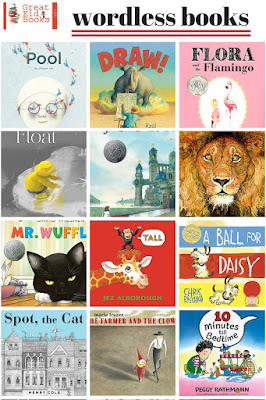 Here is a collection of my favorite wordless books, new and old, with a brief description (based on the publisher's description).
©2016 Mary Ann Scheuer, Great Kid Books
 By: Mary Ann Scheuer,
on 5/18/2016
By: Mary Ann Scheuer,
on 5/18/2016
Blog: Great Kid Books (Login to Add to MyJacketFlap)
JacketFlap tags: picture books, preschool, kindergarten, ages 5-8, ages 2 - 4, Add a tag
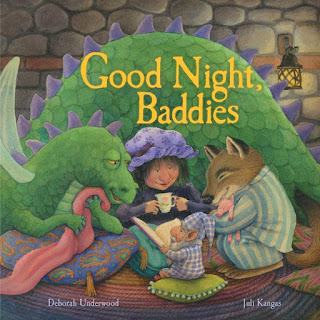
Children will enjoy recognizing favorite tales and spotting details from each in the illustrations. I absolutely agree with the BookDragon's review: "Deborah Underwood and Juli Kangas are a delightfully subversive team, proving even the meanest baddies need time to relax and recharge."
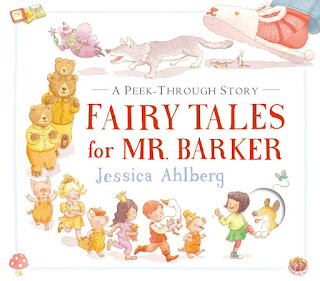
Just as the villain enters the scene, Lucy knows that it's time to leave and invites her new friends to join her. Soon she's followed by Goldilocks, the three little pigs and Jack, with the three bears, the wolf and the giant all chasing them. Ahlberg uses the cutouts very effectively, engaging young readers and prompting them to wonder what's on the other side.
In each new scene, she provides just enough clues for readers to guess which tale Lucy has entered. This encourages young readers to take part in the story, actively engaging with the text. Jessica Ahlberg is the daughter of Allan and Janet Ahlberg, whose classic The Jolly Postman is one of my all-time favorite fairytale mashups. Jessica told Publisher Weekly,
The review copies were kindly sent by the publishers, Time, Inc. (via BlueSlip Media) and Capstone Books. If you make a purchase using the Amazon links on this site, a small portion goes to Great Kid Books. Thank you for your support.
©2016 Mary Ann Scheuer, Great Kid Books
 By: Mary Ann Scheuer,
on 5/10/2016
By: Mary Ann Scheuer,
on 5/10/2016
Blog: Great Kid Books (Login to Add to MyJacketFlap)
JacketFlap tags: preschool, kindergarten, ages 5-8, ages 2 - 4, best new book, picture books, Add a tag

Young readers will start by following the toddler's cry for her beloved monkey. With an adult or older reader, they will then read the cool, composed voice explaining the experience. I like to think of this as the big brother coaching the little sister through the experience.
Brown captures the busy nature of airplane travel without leaving the reader overwhelmed. Part of this is the reassuring, matter-of-fact tone of the main narrator and of the parents on the journey. Partly it's the satisfying story arc, both for the main character and the smaller stories. She balances detailed illustrations with a few large, open spreads of the airplane flying in blue sky.
I especially love how diverse Brown's airplane travelers are--in so many ways. The main family is multiracial, with a black dad, white mom, two brown kids. There are people of different ethnic and racial groups. There is a working mom, constantly on her cell phone. A dad is traveling alone with a little baby. A woman is traveling independently in a wheelchair. And yet none of this diversity draws attention to itself--it seems effortless and natural, and yet Brown carefully, thoughtfully includes in so many ways.
Check out these stellar reviews:
©2016 Mary Ann Scheuer, Great Kid Books
 By: Mary Ann Scheuer,
on 4/4/2016
By: Mary Ann Scheuer,
on 4/4/2016
Blog: Great Kid Books (Login to Add to MyJacketFlap)
JacketFlap tags: ages 5-8, ages 2 - 4, poetry, picture books, nonfiction, science, preschool, kindergarten, Add a tag
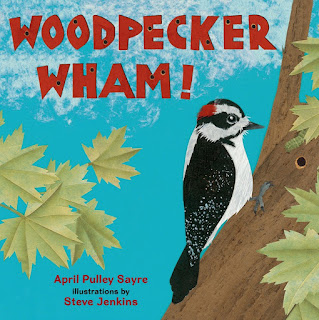
The bouncing, rhythmic verse and the bold illustrations make this a great read-aloud. As you read, ask kids which words they think have real pizzaz--notice Sayre's word choices. Whether she's showing how the birds fly or how their tapping sounds, Sayre chooses dramatic words. Encourage your kids to try using words like this on your next walk outside.
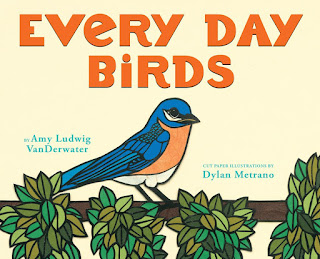
The bold illustrations focus young readers on each bird, setting each bird against a simple background helps highlight the species and the poetry. I especially like how VanDerwater focuses on one key feature of each bird, highlighting it with strong language. The endnotes provide more detail on each species for adults to share, as kids as more quesitons.
Together, the cumulative effect leads to a rhythm and rhyming scheme that makes for a lovely read-aloud for preschoolers. "Heron fishes with his bill./ Sparrow hops in brown./ Mockingbird has many voices./ Pigeon lives in town." Perfect for budding naturalists.
Illustrations from Woodpecker Wham copyright ©2015 Steve Jenkins, used with permission of the publisher. Text from Every Day Birds written by Amy Ludwig Vanderwater. Illustrations copyright 2016 by Dylan Metrano. Used with permission from Orchard Books/Scholastic. The review copies were kindly sent by the publishers, Macmillan and Scholastic. If you make a purchase using the Amazon links on this site, a small portion goes to Great Kid Books. Thank you for your support.
©2016 Mary Ann Scheuer, Great Kid Books
 By: Mary Ann Scheuer,
on 4/2/2016
By: Mary Ann Scheuer,
on 4/2/2016
Blog: Great Kid Books (Login to Add to MyJacketFlap)
JacketFlap tags: poetry, picture books, kindergarten, ages 5-8, Add a tag
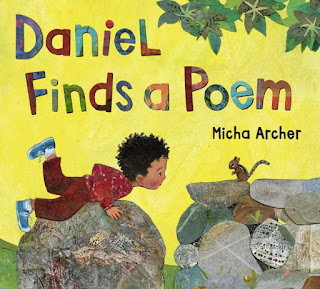
As he wanders through his local park and neighborhood, Daniel watches and asks different animals for their views on what poetry is. With his dark curly hair and eyes full of wonder, Daniel soaks each detail. Notice how Archer keeps the child part of each moment, even though the story is really about poetry and nature. This helps keep the child reader part of the story each step of the way.
Archer's illustrations are so lush, pulling readers into each scene, inviting them to linger and soak up the beauty just as Daniel does. I especially like the ending, as Daniel takes the small details each of the animals shares and creates his own found poem--and then performs it for a small audience in the park.
Share this delightful story and stop to notice the small details all around us. A wonderful introduction for poetry in the classroom or at home--best suited for kindergarten through 3rd graders as they start writing their own poems.
Illustrations ©2016 Micha Archer, used with permission of the publisher. The review copies were kindly sent by the publisher, Nancy Paulsen Books, and we have also purchased additional copies for our school library. If you make a purchase using the Amazon links on this site, a small portion goes to Great Kid Books. Thank you for your support.
©2016 Mary Ann Scheuer, Great Kid Books
 By: Mary Ann Scheuer,
on 12/24/2015
By: Mary Ann Scheuer,
on 12/24/2015
Blog: Great Kid Books (Login to Add to MyJacketFlap)
JacketFlap tags: picture books, kindergarten, ages 5-8, Reading Around the World, ages 2 - 4, Add a tag
Throughout, Bob Graham varies the perspective--taking readers close up to some children's lives and looking down from up high at others. The story ends by gradually pulling back on the view of Coco playing outside on a winter's day with her friends, helping readers see her small, immediate world in a larger context of her factory town.
French artist and author Clotilde Perrin follows one point in time across different time zones across the globe, in the striking picture book At the Same Moment, Around the World.

Perrin's artwork is full of small details and drama, including some darker moments--lending complexity to the simple prose. A foldout world map in the end helps readers locate each place and names all these children.
The review copies were kindly sent by the publishers, Candlewick and Chronicle. If you make a purchase using the Amazon links on this site, a small portion goes to Great Kid Books. Thank you for your support.
©2015 Mary Ann Scheuer, Great Kid Books

 By: Donna McDine,
on 12/8/2015
By: Donna McDine,
on 12/8/2015
Blog: Write What Inspires You (Login to Add to MyJacketFlap)
JacketFlap tags: picture book, children's book review, Donna McDine, kindergarten, #KidLit, Dee and Deb Off They Go Kindergarten First Day Jitters, kindergarten children's book, #PB, Add a tag
For Kindergarteners they sure do get around!
Dee and Deb have been busy traveling from the east coast to the west coast. Where do they get their energy?
Their latest stop is Amazon and feedback of their adventures are available for your review.
Be sure to stop back in the coming days and weeks to see where their adventures take them!
~~~~~~~~~~~~~~~~~~~~~~~~~
Best wishes,
Donna M. McDine
Multi Award-winning Children's Author
Ignite curiosity in your child through reading!
Connect with Donna McDine on Google+
Dee and Deb Off They Go Kindergarten First Day Jitters ~ December 2015 ~ Guardian Angel Publishing, Inc.
A Sandy Grave ~ January 2014 ~ Guardian Angel Publishing, Inc. ~ 2014 Purple Dragonfly 1st Place Picture Books 6+, Story Monster Approved, Beach Book Festival Honorable Mention 2014, Reader's Favorite Five Star Review
Powder Monkey ~ May 2013 ~ Guardian Angel Publishing, Inc. ~ 2015 Purple Dragonfly Book Award Historical Fiction 1st Place, Story Monster Approved and Reader's Favorite Five Star Review
Hockey Agony ~ January 2013 ~ Guardian Angel Publishing, Inc. ~ 2015 Purple Dragonfly Book Award Honorable Mention Picture Books 6+, New England Book Festival Honorable Mention 2014, Story Monster Approved and Reader's Favorite Five Star Review
The Golden Pathway ~ August 2010 ~ Guardian Angel Publishing, Inc. ~ Literary Classics Silver Award and Seal of Approval, Readers Favorite 2012 International Book Awards Honorable Mention and Dan Poynter's Global e-Book Awards Finalist By: Mary Ann Scheuer,
on 12/2/2015
By: Mary Ann Scheuer,
on 12/2/2015
Blog: Great Kid Books (Login to Add to MyJacketFlap)
JacketFlap tags: best new book, picture books, preschool, kindergarten, ages 5-8, ages 2 - 4, Add a tag
 A young child dreams of flying to Saturn, and so it all begins with a plan. A plane, a map of the solar system, her trusty dog. Soaring up to the planets. By the third page in (maybe I'm slower than your typical kid?), I realized that each word just changes by one letter: plan becomes plane, then plane becomes planet. Here are the first two spreads:
You can't read the story without spending time investigating the pictures. What is happening? What is the girl thinking about? Whose plane is outside? Why is a plane sitting outside at a farm? But the words help move the story along, too. The word game adds intrigue and humor, as readers try to figure out the rules of the game.
What's magical is how the story has depth and feeling far beyond the words. As the young girl discovers a key to a photo album, we realize that her mother used to fly the plane but that she is no longer here. As the story unfolds, the father and daughter together plan to launch the plane--honoring the girl's mother.
I've been wondering about the age range for this book. While I think it sings particularly well for new readers in kindergarten or 1st grade, I think the story will resonate with older and younger children. Pre-readers will love being able to read the story developing through the pictures. And the story will resonate with older children who will understand the emotional depth, as well as have fun with the very clever word play. In my ideal world, I'd love to have 2nd and 3rd graders create new stories that change word by word, one letter at a time--and see where it takes them!
Illustrations ©2015 Barbara Lehman, used with permission of the publisher. The review copy was kindly sent by the publisher, Houghton Mifflin Harcourt. If you make a purchase using the Amazon links on this site, a small portion goes to Great Kid Books. Thank you for your support.
©2015 Mary Ann Scheuer, Great Kid Books
 By: Mary Ann Scheuer,
on 11/15/2015
By: Mary Ann Scheuer,
on 11/15/2015
Blog: Great Kid Books (Login to Add to MyJacketFlap)
JacketFlap tags: picture books, preschool, kindergarten, ages 5-8, ages 2 - 4, Add a tag


My students love this holiday story. They can relate to how Maria's anxious worry and laugh at the thought of eating all those tamales. I love the family warmth and love that shines through each page.

Probe a little deeper, and it's a book that can lead to many conversations with children. Some families will want to talk about who is making the food and serving it--the role of women and slaves. Others will notice the way preparing and storing food has changed. There has been much debate about the depiction of the 19th century slave family this book (see this NY Times article), but each reader will need to judge for herself. As Emily Jenkins wrote in her author's note,

The review copies came from our school library, as well as from the publishers. If you make a purchase using the Amazon links on this site, a small portion goes to Great Kid Books. Thank you for your support.
©2015 Mary Ann Scheuer, Great Kid Books
 By: Donna McDine,
on 11/13/2015
By: Donna McDine,
on 11/13/2015
Blog: Write What Inspires You (Login to Add to MyJacketFlap)
JacketFlap tags: picture book, Donna McDine, Guardian Angel Publishing, Susan Berger, kindergarten, children's picture book, Earthquake, #pblitreview, Add a tag

Wishing you daily inspiration!
~~~~~~~~~~~~~~~~~~~~~~~~~
Best wishes,
Donna M. McDine
Multi Award-winning Children's Author
Ignite curiosity in your child through reading!
Connect with Donna McDine on Google+
Dee and Deb Off They Go Kindergarten First Day Jitters ~ December 2015 ~ Guardian Angel Publishing, Inc.
A Sandy Grave ~ January 2014 ~ Guardian Angel Publishing, Inc. ~ 2014 Purple Dragonfly 1st Place Picture Books 6+, Story Monster Approved, Beach Book Festival Honorable Mention 2014, Reader's Favorite Five Star Review
Powder Monkey ~ May 2013 ~ Guardian Angel Publishing, Inc. ~ 2015 Purple Dragonfly Book Award Historical Fiction 1st Place, Story Monster Approved and Reader's Favorite Five Star Review
Hockey Agony ~ January 2013 ~ Guardian Angel Publishing, Inc. ~ 2015 Purple Dragonfly Book Award Honorable Mention Picture Books 6+, New England Book Festival Honorable Mention 2014, Story Monster Approved and Reader's Favorite Five Star Review
The Golden Pathway ~ August 2010 ~ Guardian Angel Publishing, Inc. ~ Literary Classics Silver Award and Seal of Approval, Readers Favorite 2012 International Book Awards Honorable Mention and Dan Poynter's Global e-Book Awards Finalist By: Mary Ann Scheuer,
on 10/25/2015
By: Mary Ann Scheuer,
on 10/25/2015
Blog: Great Kid Books (Login to Add to MyJacketFlap)
JacketFlap tags: holidays, picture books, funny books, preschool, kindergarten, ages 5-8, ages 2 - 4, Add a tag
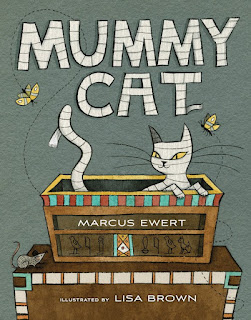


You might also enjoy seeing these other Halloween recommendations:
©2015 Mary Ann Scheuer, Great Kid Books
 By: Mary Ann Scheuer,
on 10/7/2015
By: Mary Ann Scheuer,
on 10/7/2015
Blog: Great Kid Books (Login to Add to MyJacketFlap)
JacketFlap tags: friendship, funny books, preschool, kindergarten, ages 5-8, ages 2 - 4, best new book, Add a tag
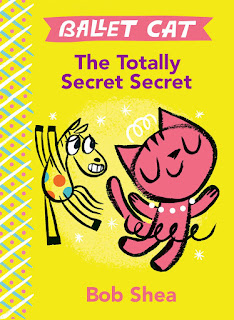
New readers (and little siblings) will delight in how Bob Shea builds this story, with expressive illustrations and large speech bubbles. They can laugh at the exaggeration, but also relate to how Sparkle Pony feels. I love this climax:
This would make a great book to act out as readers' theater, but it would also make a great one to talk about at home. I can even see bringing it up in the car the next day:
Illustrations ©2015 Bob Shea. The review copy was kindly sent by the publisher, Disney Hyperion. If you make a purchase using the Amazon links on this site, a small portion goes to Great Kid Books. Thank you for your support.
©2015 Mary Ann Scheuer, Great Kid Books
 By: Mary Ann Scheuer,
on 10/5/2015
By: Mary Ann Scheuer,
on 10/5/2015
Blog: Great Kid Books (Login to Add to MyJacketFlap)
JacketFlap tags: friendship, picture books, preschool, kindergarten, read-alouds, ages 5-8, ages 2 - 4, Add a tag

The review was kindly sent by the publisher, Scholastic. If you make a purchase using the Amazon links on this site, a small portion goes to Great Kid Books. Thank you for your support.
©2015 Mary Ann Scheuer, Great Kid Books
 By: Mary Ann Scheuer,
on 8/28/2015
By: Mary Ann Scheuer,
on 8/28/2015
Blog: Great Kid Books (Login to Add to MyJacketFlap)
JacketFlap tags: picture books, preschool, kindergarten, ages 5-8, ages 2 - 4, Add a tag
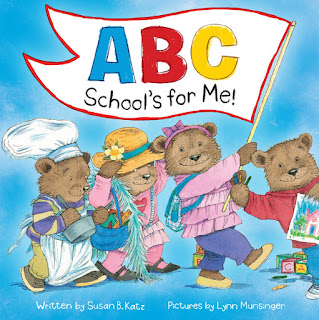
Children will love looking at the pictures, noticing the details in each scene. Munsinger not only captures the bears' expressions but also their busy activity throughout the day. Katz moves easily from dump trucks to jumping rope, building letter block towers, playing with paper puppets and waiting in line. Her rhymes have grace and rhythm that are lovely to read aloud and never overwhelm the pictures. The best description of this book came from my 11 year old:

Illustrations ©2015 Lynn Munsinger; used with permission from the publisher. The review copy was kindly sent by the publisher, Scholastic. If you make a purchase using the Amazon links on this site, a small portion goes to Great Kid Books. Thank you for your support.
©2015 Mary Ann Scheuer, Great Kid Books
 By: Mary Ann Scheuer,
on 8/27/2015
By: Mary Ann Scheuer,
on 8/27/2015
Blog: Great Kid Books (Login to Add to MyJacketFlap)
JacketFlap tags: picture books, preschool, kindergarten, ages 5-8, ages 2 - 4, Add a tag
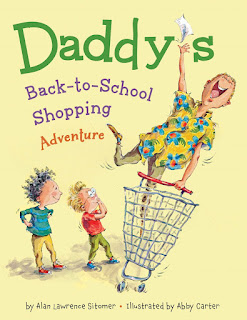
When Daddy finds a lunchbox that's just like the one he had when he was a boy, he just has to have it. In a humorous role reversal, now it's the kids' turn to say, "Uh daddy... Is it on the list?" I loved how the dad then turned to a softie, trying to negotiate and wheedle his way to get his coveted lunchbox. Sitomer balances the humor with a heartwarming ending.
Want more back-to-school books? This week I'm reviewing these new favorites:
Illustrations ©2015 Abby Carter; used with permission from the publisher. The review copy was kindly sent by the publisher, Disney Hyperion. If you make a purchase using the Amazon links on this site, a small portion goes to Great Kid Books. Thank you for your support.
©2015 Mary Ann Scheuer, Great Kid Books
 By: Mary Ann Scheuer,
on 8/26/2015
By: Mary Ann Scheuer,
on 8/26/2015
Blog: Great Kid Books (Login to Add to MyJacketFlap)
JacketFlap tags: friendship, picture books, preschool, kindergarten, ages 5-8, ages 2 - 4, best new book, Add a tag

I especially love how Nichols uses her delightful illustrations to develop the story, keeping the language spare. Each picture focuses on the children and their world, but there's enough space to let the reader imagine themselves as being there too.
Nichols develops the relationship between Maple and Willow in perfect balance, moving back and forth from each sister's perspective, helping children empathize with both sister. You can see just how excited Maple is to start school, but also how much she misses her sister. And the ending still has me smiling, as the sisters come up with just the right solution.
Want more back-to-school books? This week I'm reviewing these new favorites:
Illustrations ©2015 Lori Nichols; used with permission from the publisher. The review copy was kindly sent by the publisher, Nancy Paulsen Books / Penguin. If you make a purchase using the Amazon links on this site, a small portion goes to Great Kid Books. Thank you for your support.
©2015 Mary Ann Scheuer, Great Kid Books
 By: Mary Ann Scheuer,
on 8/25/2015
By: Mary Ann Scheuer,
on 8/25/2015
Blog: Great Kid Books (Login to Add to MyJacketFlap)
JacketFlap tags: preschool, kindergarten, ages 5-8, ages 2 - 4, Add a tag
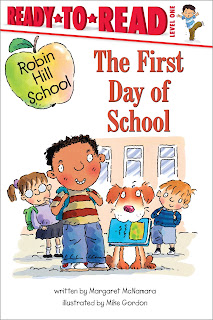
Want more back-to-school books? This week I'm reviewing these new favorites:
The review copy came from our home library. If you make a purchase using the Amazon links on this site, a small portion goes to Great Kid Books. Thank you for your support.
©2015 Mary Ann Scheuer, Great Kid Books
 By: Mary Ann Scheuer,
on 8/23/2015
By: Mary Ann Scheuer,
on 8/23/2015
Blog: Great Kid Books (Login to Add to MyJacketFlap)
JacketFlap tags: picture books, preschool, kindergarten, ages 5-8, ages 2 - 4, Add a tag
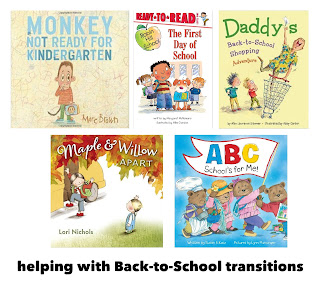 Are you getting nervous about the beginning of the school year? Who gets more nervous, kids or parents?? Will your child be able to make the transition to a new school, new teacher, new friends? There's nothing like the nervous excitement of the first day of school. Some kids are raring to go, while others are tentatively clinging to their parents.
This week, I'll share five of my favorite back-to-school picture books, starting with Monkey Not Ready for Kindergarten by Marc Brown, creator of the Arthur books and TV show.
Marc Brown's illustrations are both funny and reassuring. The handwritten text adds a colorful, child-friendly feel to the story. This is a lovely story to read to ease back-to-school worries. My favorite page? The night before kindergarten, when Monkey helps get everything ready: making his lunch, putting his favorite book all about bugs inside his backpack so he has "something to remind him of home."
Enjoy this book either before the first day, or a few weeks into school, and talk about how your own family is coping with the transition of going back to school. And hope that Monkey comes back for more!
The review copy was kindly sent by the publisher, Alfred A. Knopf/Random House. If you make a purchase using the Amazon links on this site, a small portion goes to Great Kid Books. Thank you for your support.
©2015 Mary Ann Scheuer, Great Kid Books

 By: Franki,
on 7/20/2015
By: Franki,
on 7/20/2015
Blog: A Year of Reading (Login to Add to MyJacketFlap)
JacketFlap tags: picture book, Kindergarten, Louise Borden, Add a tag
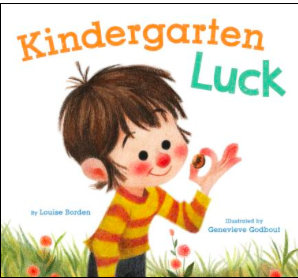
I have been looking forward to the release of Kindergarten Luck by Louise Borden for a long time. I received a review copy in the mail from the publisher last week.I love all of Louise's books and we love that she is an Ohio author.
Kindergarten Luck is about a boy named Theodore and his lucky day. On a gloomy day, Theodore finds a shiny new penny face up and his day goes from gloomy to lucky. The book follows Theodore through his day in Kindergarten where lucky things happen! From having great pancakes for breakfast to being line leader at school, Theodore has a great day! At the end of the book, Theodore pays his luck forward so that his friend can have a lucky day too.
This is a happy book with lots for readers to talk and think about. It seems like a book that should be in every Kindergarten classroom. It is also great for older kids too when talking about paying things forward and finding those positive things throughout the day. The illustrations are fun and happy and the end pages are an added piece of fun!
This would be a great gift for any kids in your life who are getting ready to start Kindergarten!
 By: Heidi Mordhorst,
on 6/19/2015
By: Heidi Mordhorst,
on 6/19/2015
Blog: my juicy little universe (Login to Add to MyJacketFlap)
JacketFlap tags: school, nature, kindergarten, my own work, teacher poems, Add a tag
 Due to a curious solution to the problem of too many snow days, our school year ended at 12:30 on Monday. We finished everything important on Friday, and I had hoped just a little that maybe no one would come on Monday--but they did, and we found lots of nice ways to fill that last few hours (including giving everyone one last chance to count to 100, an assessment I had forgotten to squeeze in--just as well they all came!).
And then they were gone.
Sometimes a meager harvest
The last half day--
walls stripped, treasure bags packed,
Jim Joe jumped one last time;
gifts given and received,
farewell hugs ceremoniously
hugged, fast and earnest,
because we'd run out of time again
one last time.
Now the room is hollow, dead--
nothing living but the teacher and
a single valiant sugar snap vine,
three feet high and climbing
a string up the Weather Window.
On the one vine, at the top, hangs
a single beautifully formed,
pleasingly plump green pod.
Teacher steps out of her sandals
onto a low chair and up onto
the radiator, plucks the fat pod
full of peas she forgot to share
and eats it, all by herself--
one last sweet crunchy mouthful
swallowed alone in the classroom
on the last half day.
HM 2015
all rights reserved
***********************
Mary Lee herself is rounding up remotely at A Year of Reading today. Go get yourself some farmyard fun and lots of poetry goodness from around the Kidlitosphere!
By: Mary Ann Scheuer,
on 5/28/2015
Blog: Great Kid Books (Login to Add to MyJacketFlap)
JacketFlap tags: friendship, picture books, funny books, preschool, kindergarten, ages 5-8, ages 2 - 4, Add a tag
Kind little Mouse has made a birthday cake for his friend Little Bird. He sets off to deliver the cake, but meets other friends who ask for a piece. Pham sets up readers to expect that Mouse will gather the expected ingredients along the way: eggs, milk, honey. But with each page turn, Mouse's friends offer something completely unexpected in return.
A Piece of Cake was honored as a finalist in the Northern California Book Awards this year. I was honored to be part of the children's award committee. Here is part of their description of this delightful story:
The review copy was kindly sent by the publisher, HarperCollins. If you make a purchase using the Amazon links on this site, a small portion goes to Great Kid Books. Thank you for your support.
©2015 Mary Ann Scheuer, Great Kid Books

View Next 25 Posts
Viewing: Blog Posts Tagged with: kindergarten, Most Recent at Top [Help]
Results 1 - 25 of 152
By: Lisa Keeler,
on 10/6/2016
Blog: TWO WRITING TEACHERS (Login to Add to MyJacketFlap)
JacketFlap tags: storytelling, writing process, drawing, sketching, writing workshop, minilesson, kindergarten, Talking, Add a tag
By: Gavin McGuire,
on 10/4/2016
Blog: First Book (Login to Add to MyJacketFlap)
JacketFlap tags: Inspiring Stories, Impact Stories, Your Stories, kate b. reynolds charitable trust, pathway to k, vanessa osbourne, Diversity, Kindergarten, early education, Family Engagement, Add a tag
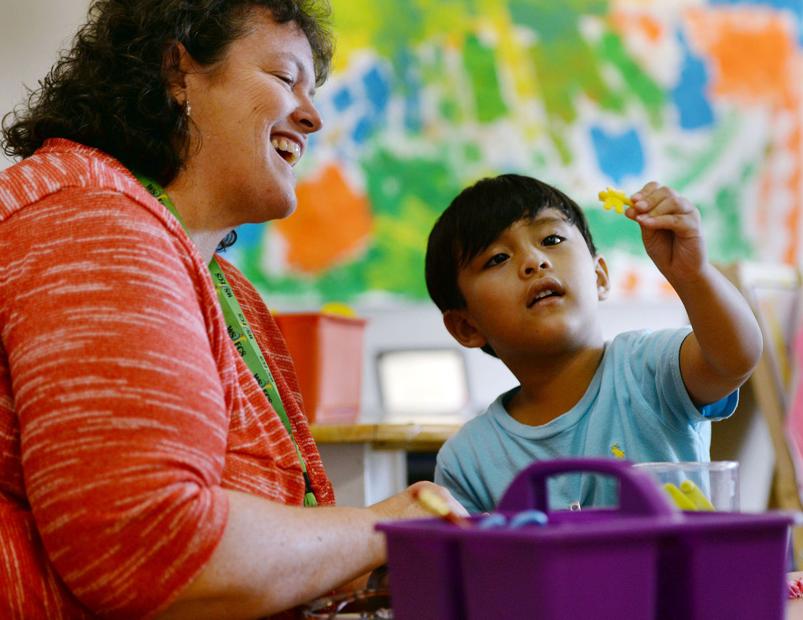
With a waiting list of more than 400 students, Vanessa Osbourne knew she needed to offer another option for the kids who weren’t going to be able to participate in the pre-kindergarten program.
Daniel Dominguez-Carmona shows the actions of a dragonfly to WSFCS Ready Schools Coordinator Eva Phillips in his “Pathway to K” classroom. Image via Winston-Salem Journal.
“We wanted to make sure that if those kids didn’t get a Pre-K experience that we offer something for them before school started,” said Osbourne, program coordinator for Winston-Salem, Forsyth County Schools.
Osbourne developed Pathway to K, a three-week course at the end of the summer designed to prepare kids who wouldn’t otherwise participate in Pre-K for kindergarten and introduce them to the kinds of activities they’ll be doing in school.
Thanks to a generous grant from the Kate B. Reynolds Charitable Trust, Pathway to K is able to access the First Book Marketplace and all that it has to offer. Each classroom has multiple sets of diverse books that aim to reach each and every child. When the program has parent engagement nights, kids and their guardians receive a brand new, high-quality book to take home.
Some of the parents or guardians participating in Pathway to K work multiple jobs and are striving every day to provide opportunities for their children, and it’s not always easy. The opportunity to participate in a kindergarten readiness program is huge for many families.
“We had a grandmother who was so excited when her grandson got in to Pathway to K,” Vanessa said. “She acted like it was a college application. When we told her, ‘Of course he got in,’ she ran around shouting, ‘He got in! He got in!’”
A program like Pathway to K is worth getting excited about. Vanessa uses her 30 years of experience in education to make sure each child is getting a well-rounded experience. During the three-week program children are introduced to books, practice counting and sorting and learn social and emotional skills.
But there is one thing that Vanessa hopes Pathway to K can instill in its tiny participants.
“Building that love of reading.”
Pathway to K was able to receive books through First Book’s partnership with Kate B. Reynolds Charitable Trust. If you work with children in need, you can access books and resources for your organization through the First Book Marketplace.
The post All Roads Lead to Learning with Pathway to K appeared first on First Book Blog.
By: Mary Ann Scheuer,
on 8/22/2016
Blog: Great Kid Books (Login to Add to MyJacketFlap)
JacketFlap tags: picture books, preschool, kindergarten, ages 5-8, ages 2 - 4, Add a tag
Starting school is a big deal in a little person's life. I love sharing these ten picture books with kids throughout the fall. In part, it's creating a shared experience--letting kids know they aren't the only ones going through these experiences. It's also a time to notice all the changes and talk about what's happening.
 |
| 10 picture books for the beginning of school |
- ABC, School’s for Me, by Susan B. Katz, illustrated by Lynn Munsinger
- Little Lola, by Julie Staab, illustrated by David Gothard
- Maple and Willow Apart, by Lori Nichols
- Miss Bindergarten Gets Ready for Kindergarten, by Joseph Slate, illustrated by Ashley Wolff
- Mom, It’s My First Day of Kindergarten!, by Hyewon Yum
- Monkey: Not Ready for Kindergarten, by Marc Brown
- The New Girl… and Me, by Jacqui Robbins, illustrated by Matt Phelan
- Planet Kindergarten, by Sue Ganz-Schmitt, illustrated by Shane Prigmore
- Pete the Cat: Rocking in My School Shoes, by Eric Litwin, illustrated by James Dean
- School’s First Day of School, by Adam Rex, illustrated by Christian Robinson
- A Tiger Tail (Or What Happened to Anya on Her First Day of School), by Mike Boldt
- Time for (Earth) School, Dewey Dew, by Leslie Staub, illustrated by Jeff Mack
Kids new to kindergarten will be reassured that they'll quickly get used to kindergarten, just like monkey in Monkey: Not Ready for Kindergarten. Other new kindergarteners will love the out-of-this-world energy of Planet Kindergarten. My teenagers still smile at the classic ABC story of Miss Bindergarten Gets Ready for Kindergarten.
If your little one is anxious, they might like the upbeat reassurance in Little Lola, or they might like the way Hyewon Yum turns the tables in Mom, It's My First Day of Kindergarten! showing how nervous parents are, even if the kids have everything under control.
Do you have any favorite books to share as your kids start the school year? I love adding to my collection!
The review copies were kindly sent by the publishers, Macmillan, Harper Collins, Chronicle, Penguin, Random House, Simon & Schuster and Boyds Mills. If you make a purchase using the Amazon links on this site, a small portion goes to Great Kid Books. Thank you for your support.
©2016 Mary Ann Scheuer, Great Kid Books
0 Comments on Starting School: 10 favorite picture books (ages 3-6) as of 1/1/1900
Add a Comment
By: Mary Ann Scheuer,
on 6/1/2016
Blog: Great Kid Books (Login to Add to MyJacketFlap)
JacketFlap tags: parenting, summer reading, preschool, kindergarten, ages 8-12, ages 5-8, ages 2 - 4, Add a tag
 |
| from Flikr, by Enokson |
Parents and children know that it’s important for children to develop strong reading skills--the question I hear so many parents asking is, “How can I get my child to enjoy reading more?” They’re absolutely right. Enjoying reading is key--we want our kids to get lost in books, totally absorbed in whatever they're reading.
 |
| from Flickr, by Piulet |
Research has shown that two elements are key: children's access to interesting books and choice of books that they can read. It makes sense, doesn't it? I love the way Dav Pilkey, author of the Captain Underpants series, put it in What Kids Are Reading:
"What if all of your reading material was selected by, or restricted by people who believed that they know what was best for you? Wouldn’t that be awful? Wouldn’t you resent it? And isn’t it possible that you might begin to associate books with bad things like drudgery and subjugation?"The first step to supporting your child is to encourage them to pick what interests them. During the summer, encourage them to seize the power and declare their own passions or interests. Baseball fan? Read biographies, baseball mysteries or sports magazines. Dolphin lover? Dive in deep, learning all about types of dolphins, threats on their habitats and scientists who study them.
The second step is to get a sense of your child's approximate reading levels--not to prescribe what your child can read, but to help her find books that are easy enough to read independently. Children will find the most success reading books in that they can read easily and fluently, especially during the summer.
The final step is to recognize that learning is social -- kids will get engaged more if you value their ideas, ask for their recommendations, talk with them. Do they resist talking with you? Figure out another way for them to engage with others--maybe it's high-tech and setting up a blog, maybe it's old-school and having a reading recommendation journal that you each put entries into, maybe it involves ice cream and friends who like to talk about books and hobbies.
Are you looking for summer reading ideas? Check out my recommendations, created for Berkeley Unified School District families.
 |
| 2016 Summer Reading Suggestions |
©2016 Mary Ann Scheuer, Great Kid Books2016, Mary Ann Scheuer
Great Kid Books & Berkeley Unified School District
0 Comments on Summer reading: Encouraging children to enjoy reading more as of 1/1/1900
Add a Comment
By: Mary Ann Scheuer,
on 5/26/2016
Blog: Great Kid Books (Login to Add to MyJacketFlap)
JacketFlap tags: preschool, kindergarten, ages 8-12, ages 5-8, ages 2 - 4, picture books, Add a tag
Do you enjoy reading wordless books with your child? Do you like the freedom to make up your words and stories, or does it leave you a little lost? Wordless picture books tell the stories only through the illustrations, and they put much more of the storytelling role onto the reader.
1. Encourage children to make up the story. There is no "right" or "wrong" way to read these books.
2. Spend time looking at the cover and talking about the book's title. What do you think this story is going to be about? What do you notice?
3. Take a "picture walk" through the pages, looking at the pictures and talking together about what you see.
4. Slow down and notice the details together. Talk about the characters' expressions, the setting, the use of color. What does the illustrator want us to notice?
5. Encourage your child to use different voices, add sound effects and use interesting words as they tell the story. Have fun!
These conversations will enrich your child's storytelling, bringing joy and meaning to the experience.
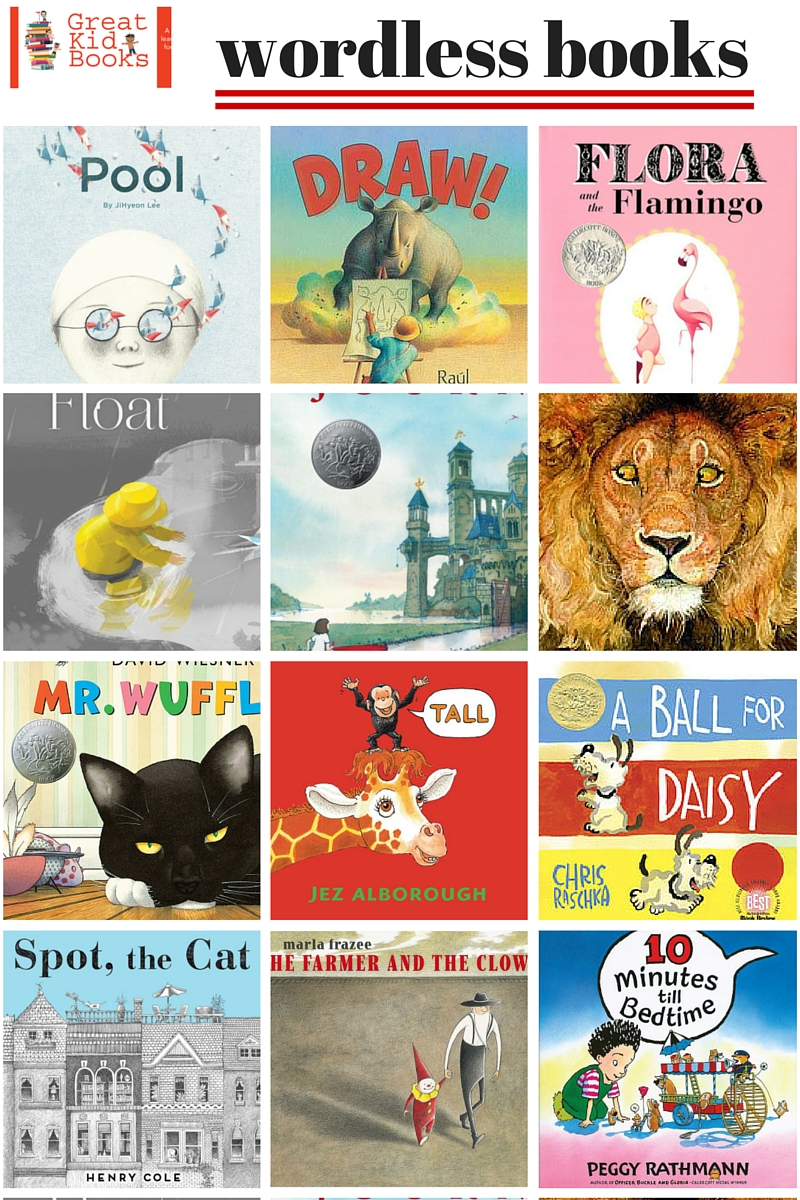
- 10 Minutes till Bedtime, by Peggy Rathmann -- A boy's hamster leads an increasingly large group of hamsters on a tour of the boy's house, while his father counts down the minutes to bedtime.
- A Ball for Daisy, by Chris Raschka -- A dog has fun with her ball, until it is lost. This story is about what it is like to lose something special, and find a friend.
- Draw!, by Raúl Colón -- A boy who is confined to his room fills his sketch pad with lions and elephants, then imagines himself on a safari.
- The Farmer and the Clown, by Marla Frazee -- A farmer rescues a baby clown who has bounced off the circus train, and takes very good care of him until he can reunite the tot with his clown family.
- Flora and the Flamingo, by Molly Idle -- In this wordless book with interactive flaps, a friendship develops between a girl named Flora and a graceful flamingo, as they learn to dance together.
- Float, by Daniel Miyares -- A boy loses his paper boat in the rain, and goes on an adventure to retrieve it.
- Good Night, Gorilla, by Peggy Rathmann -- An unobservant zookeeper is followed home by all the animals he thinks he has left behind in the zoo.
- Journey, by Aaron Becker -- A lonely girl draws a magic door on her bedroom wall and through it escapes into a world where she creates a boat, a balloon, and a flying carpet that carry her on a spectacular journey.
- The Lion and the Mouse, by Jerry Pinkney -- In this wordless retelling of an Aesop fable set in the African Serengeti, an adventuresome mouse proves that even small creatures are capable of great deeds when she rescues the King of the Jungle.
- Mr. Wuffles!, by David Wiesner -- Mr. Wuffles ignores all his cat toys but one, which turns out to be a spaceship piloted by small green aliens.
- Pool, by JiHyeon Lee -- Two shy children meet at a noisy pool and dive beneath the crowd into a magical undersea land, where they explore a fantastical landscape and meet various creatures.
- Spot the Cat, by Henry Cole -- A cat named Spot ventures out an open window and through a city on a journey, while his owner (and the reader!) try to find him.
- Tall, by Jez Alborough -- All the jungle animals help a very little monkey to feel that he is tall.
- The Typewriter, by Bill Thomson -- Three children find a typewriter on a carousel, and begin an adventure that helps them discover the wonder of words.
©2016 Mary Ann Scheuer, Great Kid Books
0 Comments on Sharing wordless books with children: tips & favorite books (all ages) as of 5/26/2016 4:13:00 AM
Add a Comment
By: Mary Ann Scheuer,
on 5/18/2016
Blog: Great Kid Books (Login to Add to MyJacketFlap)
JacketFlap tags: picture books, preschool, kindergarten, ages 5-8, ages 2 - 4, Add a tag
My students love sharing fairy tales and they have so much fun reading new twists on old favorites. Two new favorites emphasize humor and downplay the traditional tales' darker sides, making them perfect for preschoolers and kindergartners.
Good Night, Baddies
by Deborah Underwood
illustrated by Juli Kangas
Beach Lane / Simon & Schuster, 2016
Your local library
Amazon
ages 4-7
With charming rhymes, Underwood creates a scene where fairytale villains come together at the end of a long day to share dinner and bedtime stories. The baddies really shine when given a chance.
Baddies sit politely dining,The evil queen puts on pajamas, while the wolves brush their teeth (well, their fangs). The sweet rhymes and soft illustrations contrast perfectly with baddies' reputation--who would think that the troll enjoys a bubble bath after a hard day waiting for the three billy goats gruff?
no one throwing food or whining.
All day long they must be vile;
now, at night, they chat and smile.
 |
| "Evil queen, take off your crown; trade pajamas for your gown. Tuck your poisoned fruit away. Find Snow White another day." |
Fairy Tales for Mr. Barker: A Peek-Through StoryYoung Lucy chases her dog through fairy tale lands, dodging bad guys along the way. Even before you get to the title page, young Lucy asks her dog, "Do you want to hear a story, Mr. Barker?" But the pup is distracted by a butterfly, and takes off out of the open window. When Lucy follows him, she enters one new fairytale world after another -- and readers must guess (along with Lucy) where she is.
by Jessica Ahlberg
Candlewick, 2016
Your local library
Amazon
ages 4-7
 |
| "Where are we?" asked Lucy. She saw a broken chair, three bowls of porridge, and a little golden-haired girl." |
In each new scene, she provides just enough clues for readers to guess which tale Lucy has entered. This encourages young readers to take part in the story, actively engaging with the text. Jessica Ahlberg is the daughter of Allan and Janet Ahlberg, whose classic The Jolly Postman is one of my all-time favorite fairytale mashups. Jessica told Publisher Weekly,
“I think fairy tales are a great shared knowledge, and so if you assume prior knowledge you can play with expectations or make it into a guessing game, as I did in Mr. Barker. I think the fact that the tales are ‘universal’ gives the child reader power. I think it can be fun for them to spot changes, or mistakes, or to know what’s going to happen next. It gives them a bit of control, perhaps. Similarly, my protagonist is able to help the fairy tale people she meets, because she knows their stories and knows what’s going to happen before they do.”It is interesting that both books draw only from European folktales and fairytales. The illustrations show mainly white characters, although Ahlberg draws both Lucy and Sleeping Beauty with brown hair and slightly darker skin tones.
The review copies were kindly sent by the publishers, Time, Inc. (via BlueSlip Media) and Capstone Books. If you make a purchase using the Amazon links on this site, a small portion goes to Great Kid Books. Thank you for your support.
©2016 Mary Ann Scheuer, Great Kid Books
0 Comments on Good Night Baddies & Fairy Tales for Mr. Barker: Two new delightful twists on fairytale favorites (ages 4-7) as of 1/1/1900
Add a Comment
By: Mary Ann Scheuer,
on 5/10/2016
Blog: Great Kid Books (Login to Add to MyJacketFlap)
JacketFlap tags: preschool, kindergarten, ages 5-8, ages 2 - 4, best new book, picture books, Add a tag
I love traveling, going to see new places and experience new things. But traveling with kids, well that takes a special sort of patience, humor and--above all else--preparation. I adore, adore, adore Lisa Brown's newest picture book, The Airport Book, precisely because she celebrates the adventure of traveling by airplane with kids, full of so many things to look at and so many stories within the main story.
The Airport Book"Don't forget monkey!" a mom reminds her family, as they are finishing their packing. "Of course I won't forget monkey!" the dad replies, and kids will smile as the little girl announces proudly, "I pack monkey!" Right from the beginning, Brown engages readers with the story, encouraging readers to predict just what's going to happen when monkey goes missing.
by Lisa Brown
Roaring Brook / Macmillan, 2016
Your local library
Amazon
ages 2-8
*best new book*
 |
| "Monkey monkey monkey!" "Did you forget to pack monkey?" |
"Inside the airport you stand in lines. You stand in lines to get your ticket. you stand in lines to check your bags. There are lines for the restrooms. There are lines to go through security."Linger on the page for a while, and you'll notice that there are all sorts of little stories within the central story. Readers will have a great time choosing a character and seeing what's happening to them in the next scene.
 |
| "You squeeze into your seat. Some bags go up top. Some bags go underneath." |
I especially love how diverse Brown's airplane travelers are--in so many ways. The main family is multiracial, with a black dad, white mom, two brown kids. There are people of different ethnic and racial groups. There is a working mom, constantly on her cell phone. A dad is traveling alone with a little baby. A woman is traveling independently in a wheelchair. And yet none of this diversity draws attention to itself--it seems effortless and natural, and yet Brown carefully, thoughtfully includes in so many ways.
Check out these stellar reviews:
- School Library Journal, starred: "A must-buy for most libraries."
- The Horn Book, starred: "Sky-high in concept, execution, and kid appeal; the only airport book you’ll ever need."
- Kirkus Reviews, starred: "It eases readers through these experiences, reassuring them with clarity, candor, and repeated words...this travelogue delivers at many altitudes."
©2016 Mary Ann Scheuer, Great Kid Books
0 Comments on The Airport Book, by Lisa Brown: Full of things to see and talk about! (ages 2-8) as of 1/1/1900
Add a Comment
By: Mary Ann Scheuer,
on 4/4/2016
Blog: Great Kid Books (Login to Add to MyJacketFlap)
JacketFlap tags: ages 5-8, ages 2 - 4, poetry, picture books, nonfiction, science, preschool, kindergarten, Add a tag
Poetry can be a terrific way to explore different topics kids might want to learn more about. In particular, poetry and science make a great pair. Above all else, poets and scientists ask us to stop and notice the world around us. I love these two picture books that celebrate our fine feathered friends, and do it with terrific word play and illustrations.
Woodpecker WhamSayre’s dynamic verse brings alive the sound and movement of six different woodpecker species as they chop, bonk, tap, and slam, doing serious work.
by April Pulley Sayre
illustrated by Steve Jenkins
Henry Holt / Macmillan, 2015
Your local library
Amazon
ages 4-8
 |
| "Swoop and land. Hitch and hop. Shred a tree stump. Chop, chip, chop!" |
Every Day BirdsShort simple verses and cut-paper collage illustrations introduce young readers to common North American birds. Choosing birds that preschoolers like to notice, VanDerwater displays one bird on each page, highlighting a memorable characteristic for each.
by Amy Ludwig VanDerwater
illustrated by Dylan Metrano
Orchard/Scholastic, 2016
Your local library
Amazon
ages 3-6
 |
| "Chickadee wears a wee black cap." |
 |
| "Owl swoops soundlessly late at night." |
Together, the cumulative effect leads to a rhythm and rhyming scheme that makes for a lovely read-aloud for preschoolers. "Heron fishes with his bill./ Sparrow hops in brown./ Mockingbird has many voices./ Pigeon lives in town." Perfect for budding naturalists.
Illustrations from Woodpecker Wham copyright ©2015 Steve Jenkins, used with permission of the publisher. Text from Every Day Birds written by Amy Ludwig Vanderwater. Illustrations copyright 2016 by Dylan Metrano. Used with permission from Orchard Books/Scholastic. The review copies were kindly sent by the publishers, Macmillan and Scholastic. If you make a purchase using the Amazon links on this site, a small portion goes to Great Kid Books. Thank you for your support.
©2016 Mary Ann Scheuer, Great Kid Books
0 Comments on Poetry for the Birds: Woodpecker Wham and Every Day Birds (ages 3-8) as of 4/4/2016 12:36:00 PM
Add a Comment
By: Mary Ann Scheuer,
on 4/2/2016
Blog: Great Kid Books (Login to Add to MyJacketFlap)
JacketFlap tags: poetry, picture books, kindergarten, ages 5-8, Add a tag
As we launch into National Poetry Month, I want to start by sharing Daniel Finds a Poem--an absolutely beautiful new picture book that celebrates finding poetry all around us. I adore watching spring burst forth--and this book inspires me to stop, pause and take note of all the wonder around me.
Daniel Finds a Poem"What is poetry?" Daniel wonders as he sees a sign announcing a poetry performance in his local park. In this picture book, Micha Archer helps children see that poetry can be a moment of stopping to notice what's around you--just catching that moment in time, that spot in a place you know.
by Micha Archer
Nancy Paulsen Books / Penguin, 2016
Preview on Google Books
Your local library
Amazon
ages 5-9
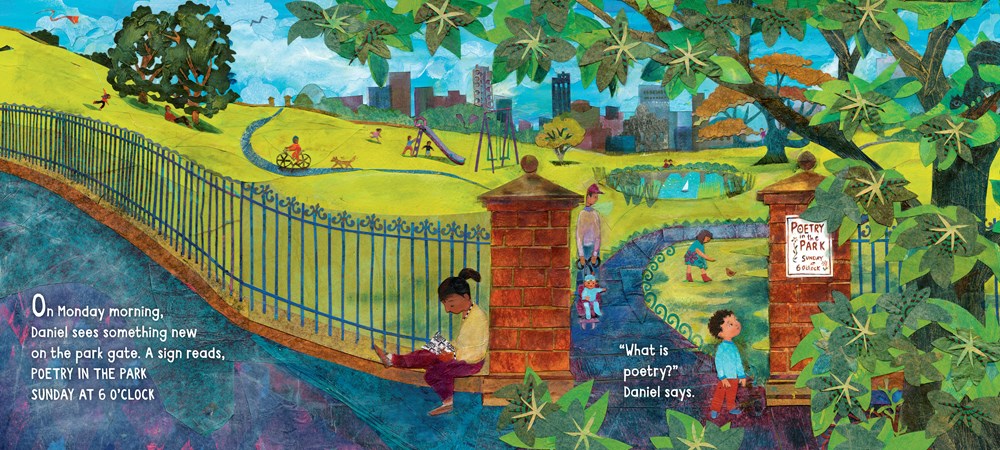 |
| "On Monday morning, Daniel sees something new on the park gate: POETRY IN THE PARK... 'What is poetry?' Daniel says." |
 |
| "He looks up in surprise when he hears Spider say, 'To me, poetry is when morning dew glistens.'" |
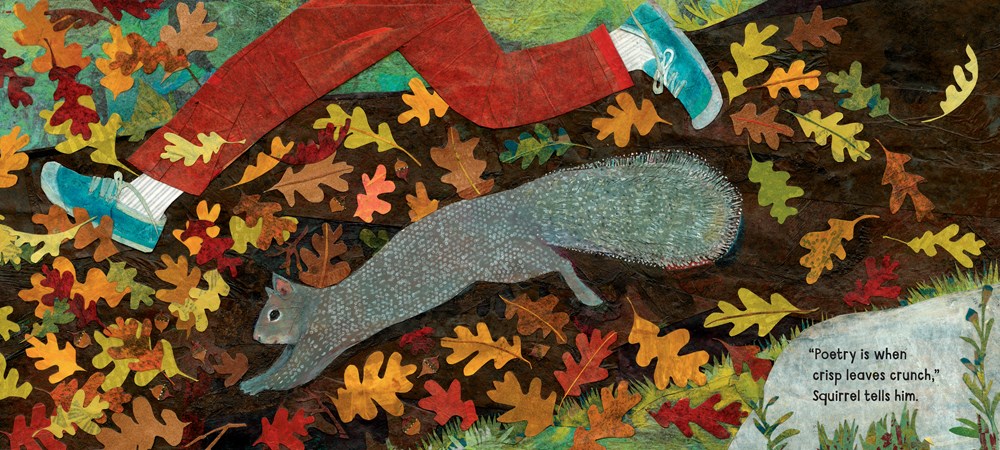 |
| "'Poetry is when crisp leaves crunch,' Squirrel tells him." |
Share this delightful story and stop to notice the small details all around us. A wonderful introduction for poetry in the classroom or at home--best suited for kindergarten through 3rd graders as they start writing their own poems.
Illustrations ©2016 Micha Archer, used with permission of the publisher. The review copies were kindly sent by the publisher, Nancy Paulsen Books, and we have also purchased additional copies for our school library. If you make a purchase using the Amazon links on this site, a small portion goes to Great Kid Books. Thank you for your support.
©2016 Mary Ann Scheuer, Great Kid Books
0 Comments on Daniel Finds a Poem, by Micha Archer -- exploring nature, finding wonder everywhere (ages 5-9) as of 4/2/2016 7:55:00 AM
Add a Comment
By: Mary Ann Scheuer,
on 12/24/2015
Blog: Great Kid Books (Login to Add to MyJacketFlap)
JacketFlap tags: picture books, kindergarten, ages 5-8, Reading Around the World, ages 2 - 4, Add a tag
As our news is filled with global and local conflict, I wonder about how to share a sense of our global community with our young children. Their experiences are rooted in their immediate surroundings. So how do we share a sense that things are similar for children in other parts of the world?
Two beautiful picture books help young children think about how our experiences are similar but different, without being didactic. Instead, they draw children into observing and reflecting other family's moments in the same day.

How the Sun Got to Coco's House
by Bob Graham
Candlewick, 2015
Your local library
Amazon
ages 4-8
The moon peeks in through Coco's window as her parents tuck her into bed, but on the other side of the world the sun is rising over a polar bear family. The sun is busy already, lighting the way for a fishing boat, catching the eye of a great whale, "making shadows on the snow and in Jung Su's footsteps."
 |
| "It balanced out on the wing--just for young Lovejoy, off to visit his grandma." |
Readers follow the sun from one brief moment to another, watching the rising sun crest over a yurt and bounce off the tip of an airplane. As readers wonder what has happened to Coco, they turn the page and "the winter sun barged straight through Coco's window!"
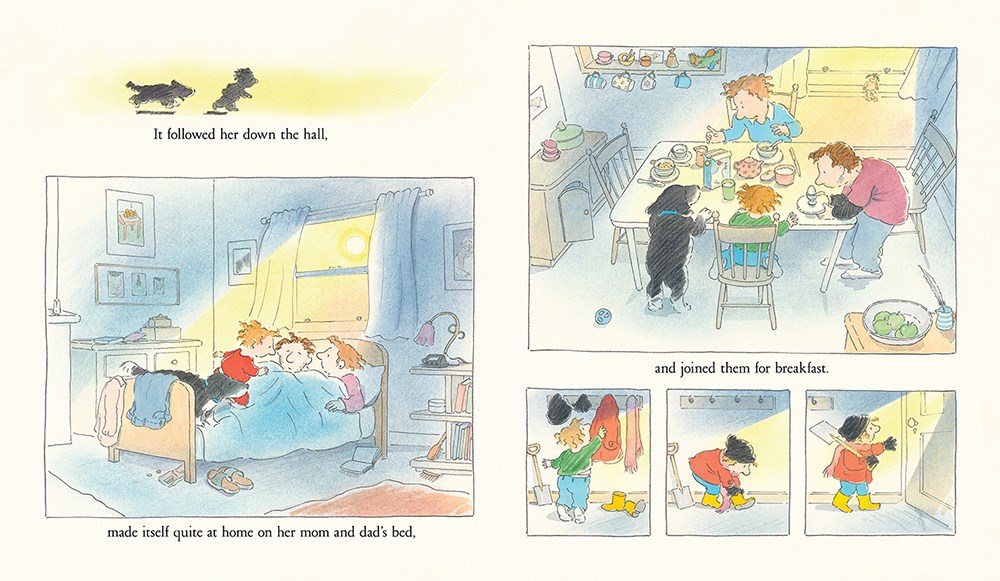 |
| "It followed her down the hall, made itself quite at home on her mom and dad's bed, and joined them for breakfast." |
French artist and author Clotilde Perrin follows one point in time across different time zones across the globe, in the striking picture book At the Same Moment, Around the World.
At the Same Moment, Around the WorldThis story begins in Dakar, Senegal at six o'clock in the morning, as Keita helps his father count the fish caught during night. Following eastward, Perrin moves around the globe. “At the same moment,” it is 7 a.m. in Paris and Benedict is drinking his hot chocolate before school--while it is 8 a.m. in Bulgaria and Mitko is chasing the school bus. Each spread shows two time zones, emphasizing the point that these are happening at the same moment.
by Clotilde Perrin
Chronicle, 2014
Your local library
Amazon
ages 5-9
 |
| "At the same moment, in Hanoi, Vietnam, it is one o'clock in the afternoon, and Khahn takes a nap despite the noise outside. At the same moment, in Shanghai, China, it is two o'clock in the afternoon, and Chen practices for the Lunar New Year parade." |
The review copies were kindly sent by the publishers, Candlewick and Chronicle. If you make a purchase using the Amazon links on this site, a small portion goes to Great Kid Books. Thank you for your support.
©2015 Mary Ann Scheuer, Great Kid Books
0 Comments on Around the world--sharing with children a sense of global community (ages 4-9) as of 12/24/2015 4:33:00 PM
Add a Comment
By: Donna McDine,
on 12/8/2015
Blog: Write What Inspires You (Login to Add to MyJacketFlap)
JacketFlap tags: picture book, children's book review, Donna McDine, kindergarten, #KidLit, Dee and Deb Off They Go Kindergarten First Day Jitters, kindergarten children's book, #PB, Add a tag
For Kindergarteners they sure do get around!
Dee and Deb have been busy traveling from the east coast to the west coast. Where do they get their energy?
Their latest stop is Amazon and feedback of their adventures are available for your review.
Be sure to stop back in the coming days and weeks to see where their adventures take them!
~~~~~~~~~~~~~~~~~~~~~~~~~
Best wishes,
Donna M. McDine
Multi Award-winning Children's Author
Ignite curiosity in your child through reading!
Connect with Donna McDine on Google+
Dee and Deb Off They Go Kindergarten First Day Jitters ~ December 2015 ~ Guardian Angel Publishing, Inc.
A Sandy Grave ~ January 2014 ~ Guardian Angel Publishing, Inc. ~ 2014 Purple Dragonfly 1st Place Picture Books 6+, Story Monster Approved, Beach Book Festival Honorable Mention 2014, Reader's Favorite Five Star Review
Powder Monkey ~ May 2013 ~ Guardian Angel Publishing, Inc. ~ 2015 Purple Dragonfly Book Award Historical Fiction 1st Place, Story Monster Approved and Reader's Favorite Five Star Review
Hockey Agony ~ January 2013 ~ Guardian Angel Publishing, Inc. ~ 2015 Purple Dragonfly Book Award Honorable Mention Picture Books 6+, New England Book Festival Honorable Mention 2014, Story Monster Approved and Reader's Favorite Five Star Review
The Golden Pathway ~ August 2010 ~ Guardian Angel Publishing, Inc. ~ Literary Classics Silver Award and Seal of Approval, Readers Favorite 2012 International Book Awards Honorable Mention and Dan Poynter's Global e-Book Awards Finalist
0 Comments on #PB Dee and Deb Off They Go Kindergarten First Day Jitters has arrived at Amazon as of 12/8/2015 6:47:00 AM
Add a Comment
By: Mary Ann Scheuer,
on 12/2/2015
Blog: Great Kid Books (Login to Add to MyJacketFlap)
JacketFlap tags: best new book, picture books, preschool, kindergarten, ages 5-8, ages 2 - 4, Add a tag
New readers and pre-readers are so often frustrated that their imaginations take flight far ahead of their reading skills. They want complex, interesting stories -- and they'll be delighted with The Plan. With just one or two words on each page, Alison Paul & Barbara Lehman tell a story full of imagination through the interplay between pictures, characters and words.
The Plan
by Alison Paul
illustrated by Barbara Lehman
Houghton Mifflin Harcourt, 2016
Google Books preview
Your local library
Amazon
ages 3-8
*best new book*
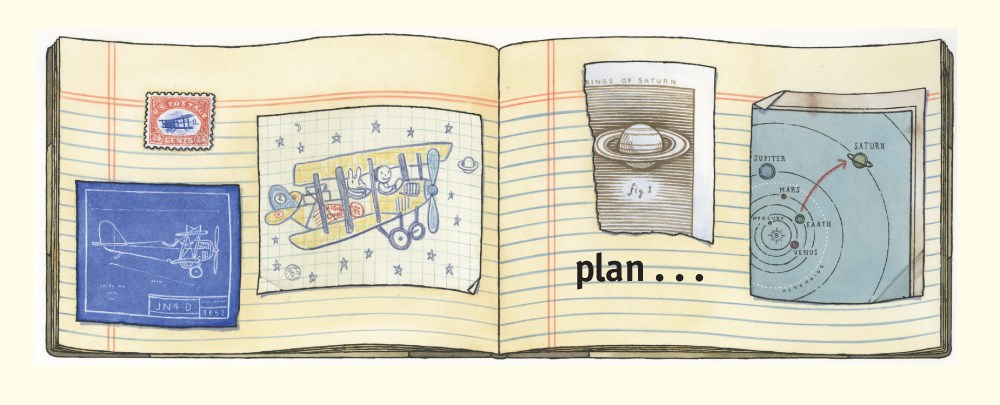 |
| It all begins with a "plan" |
 |
| Look outside to see the "plane" |
What's magical is how the story has depth and feeling far beyond the words. As the young girl discovers a key to a photo album, we realize that her mother used to fly the plane but that she is no longer here. As the story unfolds, the father and daughter together plan to launch the plane--honoring the girl's mother.
I've been wondering about the age range for this book. While I think it sings particularly well for new readers in kindergarten or 1st grade, I think the story will resonate with older and younger children. Pre-readers will love being able to read the story developing through the pictures. And the story will resonate with older children who will understand the emotional depth, as well as have fun with the very clever word play. In my ideal world, I'd love to have 2nd and 3rd graders create new stories that change word by word, one letter at a time--and see where it takes them!
Illustrations ©2015 Barbara Lehman, used with permission of the publisher. The review copy was kindly sent by the publisher, Houghton Mifflin Harcourt. If you make a purchase using the Amazon links on this site, a small portion goes to Great Kid Books. Thank you for your support.
©2015 Mary Ann Scheuer, Great Kid Books
0 Comments on The Plan, by Alison Paul & Barbara Lehman -- story taking flight with just a few words (ages 3-8) as of 1/1/1900
Add a Comment
By: Mary Ann Scheuer,
on 11/15/2015
Blog: Great Kid Books (Login to Add to MyJacketFlap)
JacketFlap tags: picture books, preschool, kindergarten, ages 5-8, ages 2 - 4, Add a tag
As the world is rocked again by horrific events, Americans are getting ready to celebrate Thanksgiving--a holiday marked in my mind by spending time together as a family in the kitchen. Here are four picture books to share that celebrate cooking together. My goal in pulling together this set is to share books that show different perspectives from different ages. Snuggle up and enjoy!
Sharing the Bread:With gentle rhymes and old-fashioned pictures, this book celebrates a family coming together to prepare a Thanksgiving meal. "Sister, knead the rising dough. / Punch it down, then watch it grow. / Line your loaves up in a row. / Sister, knead the dough." I love how each family member contributes and kids will like all the ways they're involved. As the kitchen fills with family members sharing the cooking tasks and anticipating the feast, readers see the dinner coming together—and may be surprised at how familiar it feels. The old-fashioned illustrations don't appeal to me as much as they might to others, but I suspect that's because I don't connect to the Victoriana setting.
An Old-Fashioned Thanksgiving Story
by Pat Zietlow Miller
illustrated by Jill McElmurry
Schwartz & Wade / Penguin Random House, 2015
Your local library
Amazon
ages 4-8

Too Many TamalesMaria is so excited to help her mother make tamales for their family Christmas celebration. Maria feels so grown-up helping. When she sees her mother's diamond ring sparkling on the counter, she just has to try it on. A few hours later, when she realizes that the ring is no longer on her finger, Maria panics--convinced that the diamond got lost in the tamales. So she does what any worried kid would do: persuade her cousins that they have to eat ALL the tamales, looking carefully for the ring.
by Gary Soto
illustrated by Ed Martinez
Puffin / Putnam, 1996
Your local library
Amazon
ages 4-8
My students love this holiday story. They can relate to how Maria's anxious worry and laugh at the thought of eating all those tamales. I love the family warmth and love that shines through each page.
A Fine DessertThis is a warm and sweet book about how parents and children have made blackberry fool together throughout the ages. Jenkins and Blackall take readers to 1710 Lyme, England, as a mother and daughter pick wild blackberries; 1810 Charleston, South Carolina, where an enslaved mother and daughter gather them from the plantation garden; 1910 Boston, where a mother and daughter go to the market and then prepare a Sunday dinner; and finally 2010 San Diego, where a boy and his father use store-bought berries to make a feast for family and friends.
Four Centuries, Four Families, One Delicious Treat
by Emily Jenkins
illustrated by Sophie Blackall
Schwartz & Wade / Penguin Random House, 2015
Your local library
Amazon
ages 5-8
Probe a little deeper, and it's a book that can lead to many conversations with children. Some families will want to talk about who is making the food and serving it--the role of women and slaves. Others will notice the way preparing and storing food has changed. There has been much debate about the depiction of the 19th century slave family this book (see this NY Times article), but each reader will need to judge for herself. As Emily Jenkins wrote in her author's note,
"The story includes characters who are slaves, even though there is by no means space to explore the topic of slavery fully. I wanted to represent American life in 1810 without ignoring that part of our history. I wrote about people finding joy in craftsmanship and dessert within lives of great hardship and injustice--because finding that joy shows something powerful about the human spirit."As we come together as families, I believe we must find ways to talk about the hard subjects while still acknowledging our community and support for one another. I accept Jenkin's decision, especially since she and Blackall explain their thinking in endnotes, although my strongest belief is that we must share a wide range of views of the past with children. No one book can present all views.
Feast for 10This counting book follows an African-American family going to the grocery story and then home to make dinner together. Simple rhymes are easy to read aloud: "Two pumpkins for pie / Three chickens to fry." The illustrations celebrate the children's role throughout and are full of warm family love. A delightful, modern story that rounds out this set nicely.
by Cathryn Falwell
Clarion / Houghton Mifflin Harcourt, 1993
Your local library
Amazon
ages 3-6
The review copies came from our school library, as well as from the publishers. If you make a purchase using the Amazon links on this site, a small portion goes to Great Kid Books. Thank you for your support.
©2015 Mary Ann Scheuer, Great Kid Books
0 Comments on Sharing family time this Thanksgiving: four picture books to share (ages 3-8) as of 11/15/2015 11:52:00 PM
Add a Comment
By: Donna McDine,
on 11/13/2015
Blog: Write What Inspires You (Login to Add to MyJacketFlap)
JacketFlap tags: picture book, Donna McDine, Guardian Angel Publishing, Susan Berger, kindergarten, children's picture book, Earthquake, #pblitreview, Add a tag

I'm delighted to share an early #pblitreview...
Picture Book Review by Susan J. Berger
“What a delightful book! The first sentence, Dee and Deb, twin sisters, were always together – Crib mates to playmates is great! The exploration of the awful "I'm alone in Kindergarten" feeling makes this a great book for pre-schoolers and about-to-be kindergarten kids.
<!--[if gte mso 9]> Normal 0 false false false EN-US JA X-NONE <![endif]-->
Jack Foster's colorful illustrations are a perfect compliment to the text.” Susan J. Berger, children’s author of Earthquake
Visit Susan at:
Susan J. Berger or Susan B. James
Thanks a bunch Susan for your heartfelt review of my latest children's book, Dee and Deb Off They Go Kindergarten First Day Jitters!!!!!
~~~~~~~~~~~~~~~~~~~~~~~~~
Best wishes,
Donna M. McDine
Multi Award-winning Children's Author
Ignite curiosity in your child through reading!
Connect with Donna McDine on Google+
Dee and Deb Off They Go Kindergarten First Day Jitters ~ December 2015 ~ Guardian Angel Publishing, Inc.
A Sandy Grave ~ January 2014 ~ Guardian Angel Publishing, Inc. ~ 2014 Purple Dragonfly 1st Place Picture Books 6+, Story Monster Approved, Beach Book Festival Honorable Mention 2014, Reader's Favorite Five Star Review
Powder Monkey ~ May 2013 ~ Guardian Angel Publishing, Inc. ~ 2015 Purple Dragonfly Book Award Historical Fiction 1st Place, Story Monster Approved and Reader's Favorite Five Star Review
Hockey Agony ~ January 2013 ~ Guardian Angel Publishing, Inc. ~ 2015 Purple Dragonfly Book Award Honorable Mention Picture Books 6+, New England Book Festival Honorable Mention 2014, Story Monster Approved and Reader's Favorite Five Star Review
The Golden Pathway ~ August 2010 ~ Guardian Angel Publishing, Inc. ~ Literary Classics Silver Award and Seal of Approval, Readers Favorite 2012 International Book Awards Honorable Mention and Dan Poynter's Global e-Book Awards Finalist
0 Comments on #pblitreview - Dee and Deb Off They Go Kindegarten First Day Jitters as of 11/13/2015 6:56:00 AM
Add a Comment
By: Mary Ann Scheuer,
on 10/25/2015
Blog: Great Kid Books (Login to Add to MyJacketFlap)
JacketFlap tags: holidays, picture books, funny books, preschool, kindergarten, ages 5-8, ages 2 - 4, Add a tag
Do your little ones love scary stories, or are you looking for gentle tales with silly ghosts? Here are five new favorite picture books with plenty of ghosts, mummies and monsters to satisfy all sorts of little beasts.
Mummy CatAs the graceful mummy cat emerges from his tomb, he searches for “his loving friend,” the girl-queen Hat-shup-set. Bay Area team Ewert and Brown create a tender friendship story, deftly weaving together a creepy murder-mystery, hieroglyph clues, and Ancient Egyptian practices. My students are loving this story, especially the detailed illustrations and the hidden clues. Enchanting.
by Marcus Ewert
illustrated by Lisa Brown
Clarion, 2015
Your local library
Amazon
ages 5-9
Fright ClubOnly the truly scary can be members of the Fright Club. But when a cute little bunny tries to join their fun, he's outraged when they tell him he can't join. Returning with his lawyer and friends, he launches a protest: “HISS, MOAN, BOO! WE CAN SCARE TOO!” chant a butterfly, ladybug, turtle, and squirrel. I love the way Ethan Long turns kids' (and monsters') expectations upside down, showing how things are not always the way you assume they'll be. Plus, this story is a lot of fun to read aloud, and isn't actually too scary for new readers.
by Ethan Long
Bloomsbury, 2015
Your local library
Amazon
ages 4-8
The Fun Book of Scary StuffA young boy makes a list of all the things that scare him. Monsters top his list (“Mom says they eat anyone who doesn’t stay in his own bed”) but his dog calmly refuses to admit that he’s afraid of anything. The pair’s hilarious back-and-forth dialog continues, until the tables turn. Jenkins and Yum perfectly capture the pair’s worry and false bravado.
by Emily Jenkins
illustrated by Hyewon Yum
Farrar, Straus and Giroux, 2015
Your local library
Amazon
ages 4-8
Leo: A Ghost StoryLeo has a hard time making friends: no one can see him. But when he meet Jane, she invites him to play, thinking he’s one of her imaginary friends. Leo is delighted but nervous that she will be scared when she finds out he’s a ghost. I love how accepting Jane is, how open she is not only to Leo but also to her own imagination. This gentle ghost story is more about finding friendship and acceptance than a Halloween story, but it’s utterly delightful. For more, see my full review here.
by Mac Barnett
illustrated by Christian Robinson
Chronicle, 2015
Your local library
Amazon
ages 3-7
*best new book*
The Little Shop of MonstersBlending creepy descriptions with goofy illustrations, this picture book strikes just the right balance for a mock-horror picture book. “Pssssst…HEY, YOU! Are you afraid of MONSTERS? Do they make you SHIVER and SHAKE?” As the text amps up the fright, the illustrations put the emphasis on the laughs, making this right for those who like to giggle and squirm at the same time.
by R.L. Stine
illustrated by Marc Brown
Little, Brown, 2015
Your local library
Amazon
ages 4-8
You might also enjoy seeing these other Halloween recommendations:
- New York Times bookshelf: Halloween
- Horn BOO! 2015, via The Horn Book
- The 9 best Halloween costumes based on children's books, via Book Riot
©2015 Mary Ann Scheuer, Great Kid Books
0 Comments on Halloween picture books: 5 new favorites (ages 4-9) as of 10/26/2015 12:57:00 AM
Add a Comment
By: Mary Ann Scheuer,
on 10/7/2015
Blog: Great Kid Books (Login to Add to MyJacketFlap)
JacketFlap tags: friendship, funny books, preschool, kindergarten, ages 5-8, ages 2 - 4, best new book, Add a tag
If you have kids who love Elephant and Piggie or Frog and Toad, laughing at the way these friends play together, bicker and work through their conflicts, then you're going to love Ballet Cat: The Totally Secret Secret. It sparkles with humor, but underlying it is a real understanding of friendship.
Ballet Cat: The Totally Secret SecretBallet Cat’s best friend Sparkle Pony is getting a bit tired of always playing ballet -- but what’s a BFF supposed to do? Sparkle Pony tries to suggest other things. He tries to go along and dance. But then he realizes that he's holding onto a big secret.
by Bob Shea
Disney Hyperion, 2015
Your local library
Amazon
ages 4-8
*best new book*
 |
| "I will always be your friend, Sparkle Pony! No secret can ever change that." |
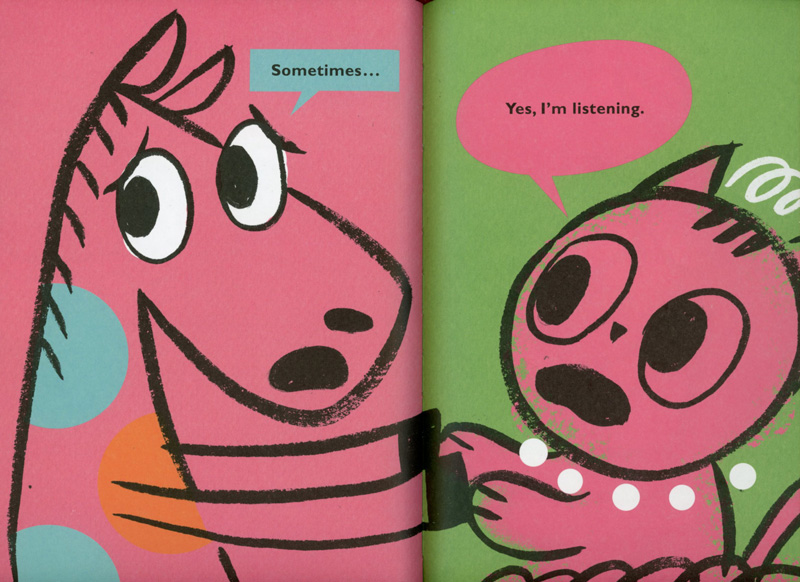 |
| "Sometimes..." "Yes, I'm listening." |
 |
| "SOMETIMES I DON'T WANT TO PLAY BALLET!" |
"You know, I was thinking about Ballet Cat and her friend. I wonder why it was hard for Sparkle Pony to tell her that he didn't like ballet?"Friends need to accept differences--adults know that, but often it's hard to put into practice. This is a great story about just that: loving each other even more than we love our individual interests.
Illustrations ©2015 Bob Shea. The review copy was kindly sent by the publisher, Disney Hyperion. If you make a purchase using the Amazon links on this site, a small portion goes to Great Kid Books. Thank you for your support.
©2015 Mary Ann Scheuer, Great Kid Books
0 Comments on Ballet Cat: The Totally Secret Secret, by Bob Shea -- a favorite new friend for beginning readers (ages 4-8) as of 1/1/1900
Add a Comment
By: Mary Ann Scheuer,
on 10/5/2015
Blog: Great Kid Books (Login to Add to MyJacketFlap)
JacketFlap tags: friendship, picture books, preschool, kindergarten, read-alouds, ages 5-8, ages 2 - 4, Add a tag
With plenty of visual puns and word play, this upbeat and funny picture book is a great place to start a conversation about friendship. Rosenthal and Lichtenheld are two of my favorite picture book creators--I adore sharing their Duck! Rabbit! with kids. Their newest creation is full of their trademark humor and definitely worth seeking out.
Friendshape
by Amy Krouse Rosenthal
illustrated by Tom Lichtenheld
Scholastic, 2015
Your local library
Amazon
ages 4-8
As the Kirkus Review points out, you almost hope that the titles is what inspired the creators from the beginning. What shape does friendship take? Can people who are as different as a circle and a square still be friends?
Although there is no real plot, there is plenty of humor and thoughtful messages in this picture book. I really like how they show the characters as shapes. For me, this helps young children see some of the metaphors but it also helps them see themselves in the book. By having just basic outlines of the shapes, with funny cartoonish expressions, Lichtenheld invites readers to seem themselves as characters in the book.
 |
| "Friends welcome others to join in." |
The puns keep rolling along, inviting kids to figure them out and invent their own. "Friends are always there to lean on," as the shapes all lean in together. "Friends play fair and [insert the yellow square]."
Friendship isn't always easy. When conflict happens, friends never "stay bent out of shape for long." Kids would enjoy coming up with some of their own observations about friendship, adding on to the book as they go.
The review was kindly sent by the publisher, Scholastic. If you make a purchase using the Amazon links on this site, a small portion goes to Great Kid Books. Thank you for your support.
©2015 Mary Ann Scheuer, Great Kid Books
0 Comments on Friendshape, by Amy Krouse Rosenthal and Tom Lichtenheld -- upbeat and funny, but with a thoughtful message (ages 4-8) as of 10/5/2015 8:15:00 AM
Add a Comment
By: Mary Ann Scheuer,
on 8/28/2015
Blog: Great Kid Books (Login to Add to MyJacketFlap)
JacketFlap tags: picture books, preschool, kindergarten, ages 5-8, ages 2 - 4, Add a tag
As your little ones come home from their first few days of school, do they talk much about it? Or do you have to poke and prod to find out about their school day? In either case, Susan Katz's newest picture book is a delightful way to celebrate and talk about the school day for preschoolers and kindergartners.
ABC School's For Me!by Susan B. Katzillustrated by Lynn MunsingerWith delightful rhyming couplets, Katz celebrates playful school activities from a typical preschool or kindergarten day. She uses the alphabet to guide the story, starting each line with a different letter which is highlighted in bold block print. But the real delight comes from the adorable bears parading through their day.
Scholastic, 2015
Your local libraryAmazonages 3-6
 |
| "Books that are just right for me. Crayons for coloring, in my hand, Dump trucks, playing in the sand.” |
"It's a first-day-of-school stress reliever."I couldn't have said it better myself. Enjoy and delight in seeing what your little one talks about or notices. Want more back-to-school books? This week I've reviewed these new favorites:
Illustrations ©2015 Lynn Munsinger; used with permission from the publisher. The review copy was kindly sent by the publisher, Scholastic. If you make a purchase using the Amazon links on this site, a small portion goes to Great Kid Books. Thank you for your support.
©2015 Mary Ann Scheuer, Great Kid Books
0 Comments on ABC School's For Me!, by Susan B. Katz: delightful celebration of school (ages 3-6) as of 8/28/2015 9:04:00 AM
Add a Comment
By: Mary Ann Scheuer,
on 8/27/2015
Blog: Great Kid Books (Login to Add to MyJacketFlap)
JacketFlap tags: picture books, preschool, kindergarten, ages 5-8, ages 2 - 4, Add a tag
I have to be honest: I feel torn about back-to-school shopping. I love getting my kids organized, but I hate the pleading for useless knick-knacks or trendy decorations. But one thing's for sure: it's all part of getting ready for school. Alan Lawrence Sitomer, California's Teacher of the Year in 2007, celebrates this tradition with a silly, heart-warming story: Daddy's Back-to-School Shopping Adventure.
Daddy's Back-to-School Shopping AdventureIt's time for back-to-school shopping, and siblings Jenny and Jake know that the number-one rule is "We only buy what's on the list." But that doesn't mean shopping can't be a little fun. This family knows how to be goofy. The illustrations are giggle-inducing, full of exaggerated movement and lots of details for kids to enjoy.
by Alan Lawrence Sitomer
illustrated by Abby Carter
Disney Hyperion, 2015
Your local library
Amazon
ages 4-7
 |
| "Look at us," Jenny called out. |
Want more back-to-school books? This week I'm reviewing these new favorites:
©2015 Mary Ann Scheuer, Great Kid Books
0 Comments on Daddy's Back-to-School Shopping Adventure, by Alan Lawrence Sitomer (ages 4-7) as of 8/27/2015 10:58:00 AM
Add a Comment
By: Mary Ann Scheuer,
on 8/26/2015
Blog: Great Kid Books (Login to Add to MyJacketFlap)
JacketFlap tags: friendship, picture books, preschool, kindergarten, ages 5-8, ages 2 - 4, best new book, Add a tag
Back-to-school stories usually focus on what it's like to start school, but what happens to sibling's relationships when kids head off to the classroom? Lori Nichols' newest book provides a tender and charming look at how two sisters cope with the transitions when one of them heads off to school.
Maple & Willow ApartMaple and Willow have loved playing together all summer, but when it's time for big sister Maple to start school the transition is especially hard for Willow. "Home wasn't the same without Maple." And when she came home, Maple couldn't stop talking about her new friends. I adore how Nichols shows Willow's perspective, how she tells about her new friend Pip -- an acorn-topped sprite she finds under a tree -- how she explores and finds things to do when Maple is away.
by Lori Nichols
Nancy Paulsen Books / Penguin, 2015
Your local library
Amazon
ages 2-6
*best new book*
 |
| "I had fun too," said Willow. "I played with Pip." |
 |
| "And we have loud horns!" |
 |
| The next morning, Willow had a surprise for Maple. "Maple, Pip wants to go to school with you today." |
©2015 Mary Ann Scheuer, Great Kid Books
0 Comments on Maple & Willow Apart, by Lori Nichols -- back-to-school transitions for two sisters (ages 2-6) as of 8/26/2015 8:54:00 AM
Add a Comment
By: Mary Ann Scheuer,
on 8/25/2015
Blog: Great Kid Books (Login to Add to MyJacketFlap)
JacketFlap tags: preschool, kindergarten, ages 5-8, ages 2 - 4, Add a tag
Transitions are not easy, especially going back to school. This beginning reader captures these transitions in a very relatable way. I was especially looking for a book with a character of color, and love how Gordon creates this diverse classroom.
The First Day of SchoolMichael is excited for the first day of first grade. But what's he going to do when he realizes that his puppy Cookie can't join him? He's spent all summer playing with Cookie -- they're best friends. When his teacher says that she'd love for Cookie to come, but that she would belong to everyone in the class. Michael realizes that if Cookie stays at home, he'll be there waiting just for him when he gets home.As the Booklist review states,
Robin Hill School early readers series
by Margaret McNamara
illustrated by Mike Gordon
Aladdin / Simon & Schuster, 2005
Your local library
Amazon
ages 4-7
"Kids starting school will recognize the truth about how big the change will be--how hard it is to let go of old routines as well as the joy of returning home to a loving welcome."This beginning reader works well, both as a read aloud for kids entering kindergarten and as a level 1 beginning reader for children who can read simple sentences with short words. I was especially looking for a back-to-school book featuring a character of color, and the illustrations are perfect--both funny and full of feeling.
Want more back-to-school books? This week I'm reviewing these new favorites:
©2015 Mary Ann Scheuer, Great Kid Books
0 Comments on The First Day of School: a beginning reader in the Robin Hill School series (ages 4-7) as of 8/25/2015 8:28:00 AM
Add a Comment
By: Mary Ann Scheuer,
on 8/23/2015
Blog: Great Kid Books (Login to Add to MyJacketFlap)
JacketFlap tags: picture books, preschool, kindergarten, ages 5-8, ages 2 - 4, Add a tag
This week, I'll share five of my favorite back-to-school picture books, starting with Monkey Not Ready for Kindergarten by Marc Brown, creator of the Arthur books and TV show.
As the start of kindergarten gets closer and closer, Monkey's worries grow. "What if his teacher doesn't like him? What if he gets on the wrong bus?...What if he doesn't make new friends?" His parents try to help ease his worry, and kids will relate to the back-to-school rituals: getting a lunchbox, playing school at home, having a playdate to meet new friends.Monkey Not Ready for Kindergarten
by Marc Brown
Alfred A. Knopf / Random House, 2015
Your local library
Amazon
ages 3-6

 |
| "It's almost time for kindergarten!" |
 |
| "What if his teacher doesn't like him? What if he gets on the wrong bus?" |
Enjoy this book either before the first day, or a few weeks into school, and talk about how your own family is coping with the transition of going back to school. And hope that Monkey comes back for more!
The review copy was kindly sent by the publisher, Alfred A. Knopf/Random House. If you make a purchase using the Amazon links on this site, a small portion goes to Great Kid Books. Thank you for your support.
©2015 Mary Ann Scheuer, Great Kid Books
0 Comments on Monkey Not Ready for Kindergarten: easing transitions (ages 3-6) as of 8/24/2015 2:54:00 AM
Add a Comment
By: Franki,
on 7/20/2015
Blog: A Year of Reading (Login to Add to MyJacketFlap)
JacketFlap tags: picture book, Kindergarten, Louise Borden, Add a tag
I have been looking forward to the release of Kindergarten Luck by Louise Borden for a long time. I received a review copy in the mail from the publisher last week.I love all of Louise's books and we love that she is an Ohio author.
Kindergarten Luck is about a boy named Theodore and his lucky day. On a gloomy day, Theodore finds a shiny new penny face up and his day goes from gloomy to lucky. The book follows Theodore through his day in Kindergarten where lucky things happen! From having great pancakes for breakfast to being line leader at school, Theodore has a great day! At the end of the book, Theodore pays his luck forward so that his friend can have a lucky day too.
This is a happy book with lots for readers to talk and think about. It seems like a book that should be in every Kindergarten classroom. It is also great for older kids too when talking about paying things forward and finding those positive things throughout the day. The illustrations are fun and happy and the end pages are an added piece of fun!
This would be a great gift for any kids in your life who are getting ready to start Kindergarten!
0 Comments on Kindergarten Luck by Louise Borden as of 7/20/2015 6:41:00 AM
Add a Comment
By: Heidi Mordhorst,
on 6/19/2015
Blog: my juicy little universe (Login to Add to MyJacketFlap)
JacketFlap tags: school, nature, kindergarten, my own work, teacher poems, Add a tag

And then they were gone.
Sometimes a meager harvest
The last half day--
walls stripped, treasure bags packed,
Jim Joe jumped one last time;
gifts given and received,
farewell hugs ceremoniously
hugged, fast and earnest,
because we'd run out of time again
one last time.
Now the room is hollow, dead--
nothing living but the teacher and
a single valiant sugar snap vine,
three feet high and climbing
a string up the Weather Window.
On the one vine, at the top, hangs
a single beautifully formed,
pleasingly plump green pod.
Teacher steps out of her sandals
onto a low chair and up onto
the radiator, plucks the fat pod
full of peas she forgot to share
and eats it, all by herself--
one last sweet crunchy mouthful
swallowed alone in the classroom
on the last half day.
HM 2015
all rights reserved
***********************
Mary Lee herself is rounding up remotely at A Year of Reading today. Go get yourself some farmyard fun and lots of poetry goodness from around the Kidlitosphere!
0 Comments on the last half day as of 6/19/2015 8:15:00 AM
Add a Comment
By: Mary Ann Scheuer,
on 5/28/2015
Blog: Great Kid Books (Login to Add to MyJacketFlap)
JacketFlap tags: friendship, picture books, funny books, preschool, kindergarten, ages 5-8, ages 2 - 4, Add a tag
Hooray! Today is my birthday, and I want to share a slice of cake with every one of my friends. This cake below, from 1976, should be large enough for everyone to have a slice!
 |
| 4th of July 1976 stars & stripes cake |
A trip down memory lane! I can still remember the feeling of growing tall enough to look at the oven knobs straight on, instead of having to stand on tip toe.

For a birthday treat, I'd like to share a favorite book: A Piece of Cake, by LeUyen Pham. It will bring lots of smiles, as kids laugh at the unexpected twists at each page turn.
A Piece of Cake
by LeUyen Pham
Balzer + Bray / HarperCollins, 2014
Your local library
Amazon
ages 3-8
A Piece of Cake was honored as a finalist in the Northern California Book Awards this year. I was honored to be part of the children's award committee. Here is part of their description of this delightful story:
Piece by piece, Mouse trades away the cake until he has none left, arriving at Little Bird’s house only with an odd assortment of things... As they walk back to Mouse’s house to make another cake, they find each friend surrounded by trouble. Once again, Pham expertly manages page turns to surprise readers with the solutions that Little Bird cleverly suggests.I adore the retro feel of Pham's artwork and the story is so much fun to read aloud. Little kids will love the patterned surprises, and older kids will have fun with the clever twists and enjoy the message about teamwork and creative thinking. I hope this web sampler from HarperCollins lets you glimpse part of this story--make sure to turn the pages to see how the story starts off:
The review copy was kindly sent by the publisher, HarperCollins. If you make a purchase using the Amazon links on this site, a small portion goes to Great Kid Books. Thank you for your support.
©2015 Mary Ann Scheuer, Great Kid Books
0 Comments on A Piece of Cake, by LeUyen Pham -- Birthday fun with friends (ages 3-8) as of 5/29/2015 2:23:00 AM
Add a Comment
View Next 25 Posts