JacketFlap connects you to the work of more than 200,000 authors, illustrators, publishers and other creators of books for Children and Young Adults. The site is updated daily with information about every book, author, illustrator, and publisher in the children's / young adult book industry. Members include published authors and illustrators, librarians, agents, editors, publicists, booksellers, publishers and fans. Join now (it's free).
Login or Register for free to create your own customized page of blog posts from your favorite blogs. You can also add blogs by clicking the "Add to MyJacketFlap" links next to the blog name in each post.
Blog Posts by Tag
In the past 7 days
Blog Posts by Date
Click days in this calendar to see posts by day or month
Viewing: Blog Posts Tagged with: Networking, Most Recent at Top [Help]
Results 1 - 25 of 106
How to use this Page
You are viewing the most recent posts tagged with the words: Networking in the JacketFlap blog reader. What is a tag? Think of a tag as a keyword or category label. Tags can both help you find posts on JacketFlap.com as well as provide an easy way for you to "remember" and classify posts for later recall. Try adding a tag yourself by clicking "Add a tag" below a post's header. Scroll down through the list of Recent Posts in the left column and click on a post title that sounds interesting. You can view all posts from a specific blog by clicking the Blog name in the right column, or you can click a 'More Posts from this Blog' link in any individual post.
#BabyLove: My Social Life Written & Illustrated by Corine Dehghanpisheh My Art to Inspire 7/09/2015 978-0-9851930-4 18 pages Ages 1—3 “’Click.’ ‘Tap.’ Tag and post. An adorable baby tells a modern tale about life in today’s digital world. #BabyLife: My Social Life highlights the social phenomena of sharing daily activities using technology and …
I’ve been blogging for YALSA for almost year. Crazy to think I’m starting my second year of graduate school. Those job descriptions that come into my email box seem a little more real, and a little more attainable.
What makes me so excited about heading into the professional world of librarianship is when I get the chance to interact with other librarians, librarians that have experience and insight, insight that I hope to one day have. While I know they, technically, are my colleagues, I still feel a little out of their league. However, that doesn’t stop me from soaking up as much knowledge from them as I can.
I got an opportunity to meet a handful of other librarians (and YALSA) bloggers last week. Crystle, our blog manager, had arranged some Google Hangouts as a way for us bloggers to meet each other. I logged on Monday night, not quite sure what to expect.
Our hangout also had another purpose than simply seeing each other on our screens — we were discussing The Future of Library Services for and with Teens: A Call to Action. It was a report that resonated with me; many of the ideas proposed are ones that are in line with the readings I had done for my community engagement class this spring, along with the work I did with elementary students last year. I have found that if you let the interests and passion of the people you’re working with guide action, then we are setting ourselves up for success.
As we walked through the first few sections of the report, I was content to just listen to the librarians, who spoke about previous experiences with teens. I felt lucky to be a part of a conversation where I heard about the reality of things in library land; while we want to always think that reports and theory are accurate, we know that at the end of the day, real life isn’t as set in stone or black and white. It felt like I was getting a peak into what my job might be like in a year and frankly, it was incredibly inspiring and exciting. I wished we were all sitting around a table at a coffeeshop, where we had more time to share experiences and talk through new ideas.
This hangout reminded me the power of networking. While I didn’t speak much, I was still a part of this conversation. I was learning and processing and thinking about the ways in which these ideas could be put into place in my own practice as a librarian. I look forward to another year of YALSA blogging and navigating my way through teen librarianship.
This is a guest post by Kristine Macalalad, a member of the Local Arrangements Committee for Annual 2015 in San Francisco.
Why do we attend conferences? Getting ourselves there - from making the case, finding the funding, pinning down all the details of travel and accommodations, leaving work in the middle of summer reading...all the way down to schlepping all those cardigans with us across a great distance - can be no small feat. So, why do we do it? Is it all that great swag? Is it the marvelous learning opportunities? Some might argue it’s all about the networking!
Some things are just done best in person, and one of those things is networking. For newbies and seasoned professionals alike, networking affords a chance to make beneficial connections. Imagine: hundreds of like-minded folks, many passionate about the same things, many friendly and wanting to help, and all under the same roof. Magic happens! Ideas are bounced around, brains are picked, burning questions are answered, and connections are made that can have lasting effects long after we return home.
How to do it?
First off, orient yourself. Annual is a huge event and can be overwhelming, especially to first-timers. Alleviate the stress by doing some prep work. Peruse the Annual site. Figure out which sessions, meetings, and socials sound interesting to you. The conference’s Resources for First-Timers page gives a helpful breakdown of things to consider, and YALSA’s conference wiki is a great resource for YALSA conference activities.
Take time to think about who you are as a professional. Leigh Milligan of the website I Need a Library Job recommends preparing a short 30-second speech about yourself. Having something prepared can make introducing yourself go more smoothly. This reflection will also help you home in on the issues and events you really care about, and give you more to discuss with the like-minded people you’ll find there.
Come prepared with business cards and clothes that make you feel both comfortable and confident. 'Nuff said.
Consider staying near the conference, sharing a room with other conference-goers, and/or volunteering. Instant networking!
Ask questions! One of the easiest ways to get a conversation started and to keep it going is to ask questions. This is your chance to do lots and lots of mini-informational interviews.
Relax, be yourself, and have fun. For many of us, Annual really only comes around once in a great while.
For more on the art of networking, check out Ava Iuliano’s recap of NMRT’s 2012 online panel, "Professional Networking for New Librarians." The recap/panel discussion brings up excellent points such as the idea that networking is more like farming than hunting in the sense that, bit by bit, we are cultivating relationships in the long run.
For a chance to meet and chat about career opportunities with media company recruiters, head to Mediabistro’s networking party tomorrow, Dec. 16 at Harlot (46 Minna Street). From 6:30 to 8:30 p.m. PT, you can discuss openings with recruiters from organizations such as Scribd. The subscription-based audio and eBook provider seeks developers and editorial assistants to join its team.
Are you worried about catching the flu, or perhaps even Ebola? Just how worried should you be? Well, that depends on how fast a disease will spread over social and transportation networks, so it’s obviously important to obtain good estimates of the speed of disease transmission and to figure out good containment strategies to combat disease spread.
Diseases, rumors, memes, and other information all spread over networks. A lot of research has explored the effects of network structure on such spreading. Unfortunately, most of this research has a major issue: it considers networks that are not realistic enough, and this can lead to incorrect predictions of transmission speeds, which people are most important in a network, and so on. So how does one address this problem?
Traditionally, most studies of propagation on networks assume a very simple network structure that is static and only includes one type of connection between people. By contrast, real networks change in time — one contacts different people during weekdays and on weekends, one (hopefully) stays home when one is sick, new University students arrive from all parts of the world every autumn to settle into new cities. They also include multiple types of social ties (Facebook, Twitter, and – gasp – even face-to-face friendships), multiple modes of transportation, and so on. That is, we consume and communicate information through all sorts of channels. To consider a network with only one type of social tie ignores these facts and can potentially lead to incorrect predictions of which memes go viral and how fast information spreads. It also fails to allow differentiation between people who are important in one medium from people who are important in a different medium (or across multiple media). In fact, most real networks include a far richer “multilayer” structure. Collapsing such structures to obtain and then study a simpler network representation can yield incorrect answers for how fast diseases or ideas spread, the robustness level of infrastructures, how long it takes for interaction oscillators to synchronize, and more.
Image credit: Mobile Phone, by geralt. Public domain via Pixabay.
Recently, an increasingly large number of researchers are studying mathematical objects called “multilayer networks”. These generalize ordinary networks and allow one to incorporate time-dependence, multiple modes of connection, and other complexities. Work on multilayer networks dates back many decades in fields like sociology and engineering, and of course it is well-known that networks don’t exist in isolation but rather are coupled to other networks. The last few years have seen a rapid explosion of new theoretical tools to study multilayer networks.
And what types of things do researchers need to figure out? For one thing, it is known that multilayer structures induce correlations that are invisible if one collapses multilayer networks into simpler representations, so it is essential to figure out when and by how much such correlations increase or decrease the propagation of diseases and information, how they change the ability of oscillators to synchronize, and so on. From the standpoint of theory, it is necessary to develop better methods to measure multilayer structures, as a large majority of the tools that have been used thus far to study multilayer networks are mostly just more complicated versions of existing diagnostic and models. We need to do better. It is also necessary to systematically examine the effects of multilayer structures, such as correlations between different layers (e.g., perhaps a person who is important for the social network that is encapsulated in one layer also tends to be important in other layers?), on different types of dynamical processes. In these efforts, it is crucial to consider not only simplistic (“toy”) models — as in most of the work on multilayer networks thus far — but to move the field towards the examination of ever more realistic and diverse models and to estimate the parameters of these models from empirical data. As our review article illustrates, multilayer networks are both exciting and important to study, but the increasingly large community that is studying them still has a long way to go. We hope that our article will help steer these efforts, which promise to be very fruitful.
Date: 2 December 2014 Time: 10:30 Cost: None (Participants to bring a plate of eats to share for lunch) Venue: Pretoria (Address will be given to respondents) RSVP: By 28 November to Jenny at [email protected] Let’s get together for the end of the year and relax among friends and colleagues.
0 Comments on End of year function as of 9/5/2014 11:34:00 AM
Venue: Emmarentia (Address will be sent to respondents)
Date: 22 August 2014
Time: 12:00 - 15:00
Cost: None (Attendees to bring a plate of eats)
RSVP: By 21 July to Jenny at [email protected]
Please join us for an informal gathering / smooze / lekgotla / indaba to network and catch up. All are welcome, members and non-members. There won’t be a formal topic for discussion; we’ll just
0 Comments on Lunch Indaba as of 9/5/2014 11:34:00 AM
Only a couple of weeks until the SCBWI Summer Conference in Los Angeles! If you haven't yet registered, you're out of luck....they just announced that the conference is now sold out. However, you can follow along virtually via the #LA14SCBWI hashtag on Twitter as well as the SCBWI conference blog.
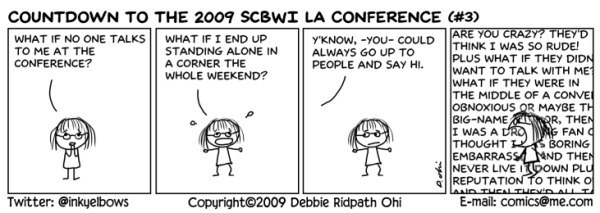
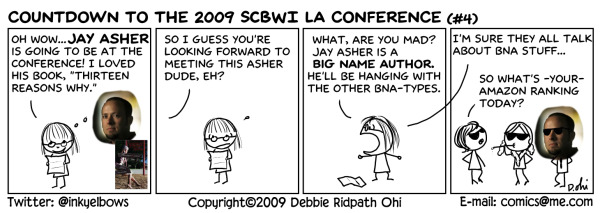
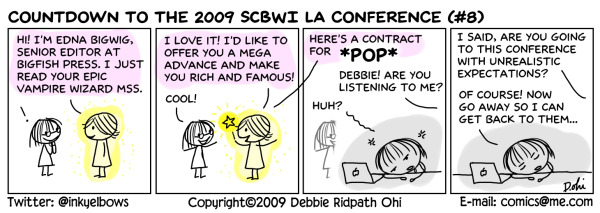
If you're a conference newbie who is nervous, I encourage you to browse my SCBWI Conference Newbie comics. I created these when I was a nervous newbie as well! So many people think I'm an extrovert, but I'm actually very much an introvert and was terrified (to the point of sweating palms, pounding heart, hating the idea of having go up and introduce myself over and over) about attending my first regular SCBWI conference back in 2009.
(Edit re: above comic: I did end up meeting Jay at the conference and he was really nice! And he didn't mention his Amazon ranking EVEN ONCE! Heh.)
I've posted advice for first-timers before and will post it again at the end of this piece, but now that I've attended other SCBWI annual conferences (and had my career jumpstarted because of the 2010 SCBWI-LA Conference), here is some additional advice I have for those who have attended more than once:
Don't get offended or disheartened if people you've met before don't remember you.
This is something I've learned from both sides. As a 2nd- and 3rd-timer (and so on), I've sometimes gone up to a person or group I've met and had my confidence deflated when it becomes clear they don't remember me at ALL from the previous year. My inner reactions ranged from embarrassment, humiliation, irritation, frustration and even brief anger ("I guess I'm just NOT IMPORTANT enough for xxx to remember!! Hmph.").
Now heading into my sixth year in a row attending SCBWI-LA, I've learned the following:
- I'm terrible at remembering people unless I've had multiple conversations or interactions with the same person.
- Even then, especially if I'm tired or am in a noisy crowd (remember what I said earlier about being an introvert?) or have met many new people in a row just before, I may still forget having met someone before.
I still accidentally re-introduce myself to people whom I've met before, sometimes whom I've met EARLIER IN THE CONVENTION. I'm always horribly embarrassed when this happens.
When I approach someone whom I've met before but with whom I don't have constant contact, I usually try saying something that will help remind them of our mutual context, or remind them of having met at xxx. Until I'm sure they actually do remember me, I try very hard NOT to put them on the spot (e.g. I don't say, "So, what did you think of my most recent post?" etc.).
When someone does this to me (subtly or unsubtly :-) setting the context and helping me remember), I immediately feel more at ease with them and am more likely to want to chat with them in the future.
Another tip: if someone DOES remember you, never assume that they're up-to-date on all your exciting news. I've had the occasional person react badly when they realize I'm not aware of their new book ("?? But I posted it all over Facebook!") I never assume anyone reads all my posts or keeps up with all my news. People have busy lives and different priorities.
Something else I've learned: even so-called Big Name authors and illustrators can be insecure. I am faaaar from being a Big Name, but having had a bit more experience at conference-going now, I also realize how some of the Big Name types who seemed standoffish to me actually weren't.
Be gracious, be forgiving and try very hard to assume the best about a person rather than the worst.
And I apologize ahead of time if I don't remember your name or re-introduce myself. :-\
And here some tips for first-timers who feel nervous about attending for the first time, or are normally very shy or introverted and dread the idea of having to meet a lot of new people:
1. Be brave and make the first move. You'd be surprised at how many other attendees feel exactly the same way as you do. Introduce yourself to people you sit beside, stand in line with, notice standing alone.
2. TAKE BUSINESS CARDS. Yes, even if you aren't published yet. We're all going to meet a lot of people over the weekend, and taking away a business card from an encounter or introduction will help the people you meet remember you. If you're an illustrator, take postcards or make sure a sample of illustration style is on your business card.
3. Have realistic expectations. Don't expect to be "discovered" at the conference.
4. In my experience, you're much more likely to meet new people if you're alone. If you're always chatting and hanging out with the same person or people, you're not as approachable. I'm not saying that you SHOULDN'T hang out with people you like, of course! Just keep in mind that as a group, you're probably not going to meet as many new people as someone who is by themselves.
5. If you're on Twitter, write your Twitter handle on your name badge somewhere.
But most of all: TRY TO HAVE FUN.
***** A CHALLENGE TO THE "MANY-TIMERS" OUT THERE ****
Try to remember what it was like when you attended your very first event, or how insecure you felt in the beginning. Then make it a personal challenge to find at least one lost-looking or nervous conference newbie who is sitting or standing alone. Introduce yourself, chat with them, find out what they're working on, perhaps (if appropriate) offer some advice.
Give good karma and it WILL come back to you.
0 Comments on Tips for SCBWI conference newbies, second-timers, plus a CHALLENGE for the many-timers as of 1/1/1900
Let someone you invite to your network know how you came to find them or be referred to them. It can be as simple as, “I’m long time friends with so and so and I found your contact through her and think our connection here may be mutually beneficial.” Anything less than that is just creepy like the stock messages I’ve been getting on LinkedIn, “Please join my network.” My knee-jerk thinking is, “What do you think this is? Twitter or something? I don’t know you! I only talk to complete strangers on that social network.
0 Comments on LinkedIn Pro Tip from a Social Butterfly as of 5/29/2014 4:40:00 AM
With ALA slamming up at breakneck speed, I feel the need to make sure I connect to each and every one of you who come to Chicago. Logistics tell me I'm nuts. But then again, it's worth the try.
Although there are some great social events in the offing, I think another youth services blogger and readers of blogs and twitter -peeps gathering would be fun to do especially if you're thinking of being at the Newbery/Caldecott awards banquet on Sunday June 30 at the Sheraton or the speeches after! It struck me that lots of us would be hanging around this premier youth services celebration, so...
....if you plan attend the banquet or just drop by the speeches after the dinner (there are chairs set up and you can listen to the speeches free and gaze upon the glitterati in the audience!), we can do a meet-up!
Traditionally, at the conclusion of the banquet, a receiving line with the honorees takes place right after the speeches outside the hall. There is always a cash bar. It's a great spot to gather and chat late night (caffeinate early to be up late!).
So consider this for your schedule and say hi!
Post N/C Youth Blogger/Blog Reader/Tweep Meet-up Sunday June 30 Sheraton Chicago banquet area 10:30-11pm-ishstart (or whenever N/C speeches end)
8 Comments on ALA - Let's Get Together Yeah Yeah Yeah, last added: 6/20/2013
I attended the SLJ Think Tank in NYC last week. It was a transformative day for me - not just because of the outstanding and thought-provoking speakers but also for the chance to be with colleagues I have met in a whole new way.
In the past, if I wanted to bounce ideas off people or get my collegial-jolt, attendance at state and national conferences was the main way I interacted to get my youth librarian-idea fix. The networks of colleagues who mentored me, friended me and supported me (and back at all of them with the same from me) especially at ALA was grounded in real time and in real places. The gabbing, blue-skying, laughing, eating and drinking that brought us together helped me become the children's librarian I am.
But something changed in the last year that broadened and opened my horizons so far I feel that I can almost see to the end of the universe. Although I've been communicating in new ways through this blog and Facebook, my time on Twitter and in Facebook groups brought a new immediacy and connectivity to my work. For those who find this journey of discovery ho-hum, bear with me.
I was a late Twitter adapter, partly because, as a yakker of legendary repute, how could I harness that into 140 characters? But once I jumped in, I realized that the immediacy of the conversations and links led me to deep connections with and respect for people I had never met IRL. Ideas hatched, work flowed, tempers flared, sympathy was extended and support and wicked humor was always there.
Professional Facebook and Google groups (ALA Think Tank, Code Named Awesome, Flannel Friday), all discovered through Twitter, added to the fun and gestalt. The overlap among them all in terms of interacting with colleagues across many social media platforms only increased the connectivity.
So when I came to New York (you knew I'd get back here, right?), I got a chance to meet, IRL, so many people who are friends in social media: @amyeileenk, @mmlibrarian; @libraryvoice, @MissReneeDomain @melissaZD, @sophiebiblio. I realized that despite the fact we were meeting for the first time, I felt we had been friends forever.
And I felt free - and connected - in a way that is deeper than my professional association connections - perhaps because there are no expectations of work for me when I am involved with social media friends and colleagues (well, unless we hatch something!). These connections and chats sustain me and spark my imagination. It is really connecting with people's minds directly and I learn at the feet of these colleagues (take note Twitter and FB, lurkers, engage and show your stuff!!).
So a big shout-out to all my creative partners on social media whether I've met you IRL or not. Our connection is what fuels me!
I know exactly what you mean! I meet people online and when we meet in person it's like we've been friends forever and that connection continues in real life. It does make me a bit sad that I don't get to hang out with these people all the time and only at conferences, but it makes those conferences all that much sweeter and more fun. And I love that we can continue that connection throughout the year.
I'm sort of nervous for ALA Chicago for this very reason--I know so many amazing people that I haven't met yet--how will I possibly have time to hang out with everyone?! I'm so thankful every day for my amazing network.
I totally know what you mean...how can we find that time. I wonder if we should plan to find each other after, like Caldecott Newbery banquet. Skip the receiving lines and go for the drinks! I'm gonna be listening to speeches for free and now that I'm not on ALSC board I am free of obligations. Might be fun but requires being up at night!!!
Kary Henry @MissKaryReads said, on 4/24/2013 8:45:00 AM
Marge, I am indeed one of those (semi-)Twitter lurkers...mostly because I don't yet know exactly what I'm doing! But the more I put out there, the more confident I feel, and I just had to say that I take such strength and energy from all of you!
Flannel Friday is fast approaching it's second anniversary. As the auspicious day approaches, participants in Flannel Friday are sharing what this movement has meant to them. Sharon over at her blog Rain Makes Applesauce is gathering the posts of participants. All are worth reading.
I myself am not a flannelist anymore. Or a prop-meister. Or a storytime provider. I once was and enjoyed that part of my work more than I can say. But even as a manager, I love and appreciate the efforts in the field of storytime and early literacy and the great places people are taking them. So, though I am not an active participant and really just an observer, let me still share with you what these intrepid folks and their blogs have meant to me and my professional life.
The blogs that participants are encouraged to start have often blossomed well beyond sharing flannel stories and patterns. Many of these new bloggers have expanded their content with thoughts about their work, programs, children's services and issues swirling around youth librarianship. When I celebrated the linkiness of my life a few weeks ago, it was also a homage to FF folks who have jumped into the blogosphere with both feet and enriched my thinking and work life so profoundly.
The FF community also led me fully into the world of Twitter. Many of these bloggers were the first tweeps I followed and chatted with. They have become a community of friends that I rely on and learn from.
I am in awe of the founders of (thank you, thank you) as well as the participants in this amazing grassroots effort. You have affected a sea change in youth librarianship and connectivity.
We have a favorite partnership in our community. It's with our La Crosse Storyelling Festival. As part of my job, I represent the library on the planning committee for this annual festival, held the first weekend after Labor Day for over 800 avid storytelling fans. The festival features tellers from our local guild, from the state and national tellers.
The library began as a partner years ago by sponsoring children's crafts during breaks in the children's tent storytelling. When I started work at the library four years ago, the fest steering committee asked me to serve on their board - they are all storytelling colleagues that I had known for years in my storytelling circles. Our library wants library staff to serve, on library time, on local organizations and boards (Rotary, Jaycees, Optimists, Earth Day planning committee) so this fit right in with the library goals. And it was storytelling. As a free lance storyteller, it was a great fit!
As a board member, I've been able to work on behalf of the festival - but also on the library's behalf. I look for ways to make our contribution meaningful and to highlight the library beyond having our logo displayed. The library now co-sponsors the Friday night spooky tales. I host the evening as the "Wizard of Reading" and get to plug the library and reading. Anyone who shows their library card gets $3 off their admission. The library, pays the difference - we consider it part of our programming.
The Saturday craft area that we sponsor has mellowed into an activity area with one or two book-related activities (bookmark making, writing or drawing activities) and a space for reading and books. I also do storytelling in the children's tent off and on during the afternoon. It's also a great chance to spend time with folks who are regular library users, chatting about their thoughts on the library; promote our services to non- and new- users and be there for support of literacy through storytelling.
So the twelve and fourteen hour days I work at the festival are about as fun as they can be for work hours. And the partnership between storytelling and the library...well, it's perfect.
0 Comments on I Want to Tell You a Story as of 9/9/2012 12:08:00 PM
Recently, I discovered freelance writing marketing tactic that many professional freelance writers have been using for years:
I went to my local Chamber of Commerce to meet my potential clients face to face.
In this setting I had no competition. The marketing was far less frustrating than the scattershot approach, because I knew what my clients needed, and I was prepared to offer it to them.
That’s how I landed ten new clients in a month. My first client paid me $800 up front for two hours of consulting. I didn’t even write anything. I just pointed him in the right direction.
What I did wasn’t special. In fact, anyone can do it. All it takes is a little common sense and courage. Here’s the step-by-step process I used to land ten new clients in thirty days.
Step 1: Research
I Googled my local Chamber of Commerce by typing in the name of my town and state, followed by “Chamber of Commerce.” My local Chamber popped up on the first page. As soon as I was on the website, I did a little browsing around. I wasn’t just mindlessly looking though. I had an agenda:
I dug up information about the Chamber of Commerce.
I needed to answer these specific questions: How does it operate? How old is it? How many members are there? What are the fees to join? How often do you pay?
By being informed about the Commerce itself, I knew what to expect out of its members as well as the Board of Directors. It would also help me tailor my marketing.
I thoroughly searched through the list of members.
I needed to know which local businesses had joined the Chamber. The owners of these businesses know how important it is to market and get new customers, so they’d be more willing to hire a writer. Those are the people I wanted to talk to.
I went through the list carefully from A to Z. I took note of which businesses had websites, and which businesses offered discounts to other Chamber of Commerce members. I also researched the types of businesses on the list. There were dentists, gourmet popcorn shops, even movie theaters. I wanted to find out what these businesses offered to the community, how they stood out from their competition, and what I could do for them. Then I wrote down questions that I wanted to ask each owner that I met.
I had 98 businesses to research. It took me two days to go through them all.
But my local Chamber has a small members list compared to other places. If your Chamber has a really big list, here’s a tip: Narrow down who you want to talk to by searching through each category of businesses and picking out ones that can afford to pay you what you’re worth. For example, if you charge $100 for a one-page ad, you want to look at companies that make enough money so that $100 a page doesn’t seem like a big deal. You may not land them as a client, but you could get a referral to another business in the same earnings bracket – or even higher.
I found out out if non-members can attend events as guests of the Chamber.
My local Chamber of Commerce allows non-members to attend three events a year, but there’s a $10 fee to get in. To me that fee was worth it. It’s nominal compared to how much money new clients could potentially bring in.
Find out if your Chamber does something similar. If they don’t, search the schedule to see if any of the events are open house. Those types of events let potential members mingle with current members, making it a great way to network.
I looked at the list of scheduled events.
I took note of which ones are more likely to draw a bigger crowd. Those are the events I want to attend.
I chose three events, two on the weekend and one charity event. I reasoned that business owners would set aside time on a weekend to go to a Chamber of Commerce event, even if it was just for an hour or so. Of course, everyone loves supporting a charity, and in supporting a cause I would show that I’m willing to use part of what I earned as a writer to give back to the community. Everyone loves hiring a humanitarian.
Step 2: Preparation
Once I had done my research it was time for me to prepare for the events I was going to attend. The first thing I did was make a list of what I needed in order to market myself effectively. It read something like this:
Website
Business cards
Letter of introduction
Writing samples
Reply cards
Postage stamps
Envelopes
Clothes
I had a website, but was – and still is – currently under construction. I didn’t want that fact to deter anyone from requesting information from me. So I put up a contact form on my landing page so that they could request an information packet from me, either through snail mail or email, and ask me questions.
Once I had my business cards made, I put together my letter of introduction and writing samples. My samples had to be diverse. I made sure to include a mock-up of a one-page ad, a newsletter, some informational articles, and a few other pieces of marketing material.
The reply cards I had were simply postcards with postage affixed to them. These are easy to use as reply cards because the person can simply fill in their information and drop it in the mail. It eliminates delayed reactions for mailing; if the postage is already there, the person doesn’t have to set aside mailing it due to a lack of postage.
The envelopes I bought were large manila envelopes. I fixed together five information packets to start out with; I wasn’t expecting a huge response. I put a letter of introduction, copies of my samples, a business card and a reply card in each envelope. I wrote my return address in the corner in the neatest, most legible handwriting I could muster. This was one of those moments I wished I had return address labels, but I made do with what I had.
The last thing I did was pick out my clothes for each event. You may think this is silly, but I wanted to dress for the job I wanted, not the job I had. I was very careful and meticulous when picking out my clothes. I made sure that I was modestly dressed: no cleavage showing, no short skirts, no tight pants, and no extremely high heels. I wanted to leave a positive impression. I wanted people to remember me, not my shoes or what I was wearing. I also made sure my accessories, makeup and hair weren’t flashy, gaudy or inappropriate.
I ran the outfits by my mother. She’s a legal secretary and office manager for a non-profit law firm. They have a set of rules at her job for clothing. She’s in charge of telling people whether their clothing is inappropriate in the workplace. By running the outfits by her, I knew that I’d be dressed to impress.
If you’ve got someone that works in an office environment, you can do the same thing. That became my rule of thumb for these events: If you can’t wear it in a law office, you can’t wear it to a client meeting.
Step 3: Take Action
I’m a natural wallflower. I don’t like to mingle at gatherings, even if the place is full of people that I’ve known for years. But I had to break out of that routine if I wanted to get some clients. For each event, I arrived ten to fifteen minutes early. As soon as I stepped into the door I took the initiative to talk to the first person I saw. I just said “Hi, my name is Kinya.” It never failed to start a conversation.
When people asked me what I did for a living, I told them, “I help businesses communicate with their current and future customers and clients.” They were always eager to learn how.
I didn’t keep the conversation focused on me; I always switched the topic back to their business. This is where the research came in handy. I was already prepared for all the members there, so I asked them questions pertaining to their individual businesses. They were impressed that I knew so much. Many of my conversations lasted ten minutes or more.
At the end of the conversations, I always asked if we could exchange information. Usually we would swap business cards, but if the other person didn’t have a business card I put their name, business name and telephone number in my cell phone.
Step 4: Follow Through
I waited a minimum of three days before I followed up with those I met. If I had their business cards, I went into their place of business to see if they were working. If they were, I told them that it was nice meeting them at the event, and I looked forward to seeing them at the next one. I also told them if they needed anything – anything at all – to just call me.
One person actually called me and asked me if I had “an epic brownie recipe” they could have for a family reunion. I passed along something spectacular with a caramel center and an ice cream topping. She was ever so grateful, and promised to pass my information along to other business owners.
If no one was there, I left a message with the manager on staff. For the ones who hadn’t given me their business cards, I followed up with them on the phone. If they didn’t answer, I left them a brief message.
The results were overwhelming to me: I’ve sent out over forty information packets and gained ten new clients. Two of these clients were referrals.
And I didn’t have to lowball my pricing for anyone. Everyone immediately thought my fees were reasonable, because they recognized how valuable my services were. And, perhaps best of all, I’m the only copywriter they know in the area. By taking these simple steps, I’ve set myself up to not only get new clients, but expand my business.
How about you — have you landed any gigs from attending Chamber events or other networking events? Do you have additional tips on how to make the most of these events? Share your insights in the Comments!
Kinya is a freelance copywriter and public speaker. She enjoys baking, writing fantasy novels , watching cartoons and brushing up on her Latin. Her blog, Nom de Plume Ink, talks about things she’s learning and discovering on the journey to reaching her career goals.
According to an article in Writer’s Digest three summers ago (“The Must-Have Online Marketing Plan” by M.J. Rose), “Ultimately, no matter what you do, careers are made on the book, not on the marketing.”
That’s very true. Just as true is this statement from the same article: “Someone–either you or your publisher–is going to have to get the word out about the book.”
More and more often, that “someone” is the author. That article was written three years ago…but the dilemma of “how much marketing is enough?” has still not been resolved.
Today’s Publishing Reality
More and more, today’s author is expected to do his part in the marketing. Marketing plans must be part of your query or proposal now–no matter how much you’ve been published.
It can include (but not be limited to) creating a website, writing a blog, making video trailers, doing blog tours, getting your book reviewed online, writing a newsletter…AND being active on Facebook and Pinterest and Goodreads.
Why Social Networking?
Until I heard several speakers at a leadership conference a few years ago, I’d avoided most social networking because of the time it took. I was very “hit and miss” with Twitter and Facebook and LinkedIn until I discovered SocialOomph.com, which let me schedule posts and tweets for a week at a time.
According to those market gurus, a high percentage of people check Facebook accounts four times more often than their email. (I’m sure it’s much, much more often now.) Social networking appears to be the new way to connect with people–including your readers (now called your “tribe,” a term I heartily dislike.)
I have a private family Facebook account, although I have my doubts anymore about just how private anything is online. And I have a writer’s Facebook account and what they used to call a “fan page.” I finally set up my LinkedIn account, my Amazon author page, and Pinterest account. I tried Goodreads three times and got kicked off each time…more rejection to deal with! Ha ha.
The Times, They Are a-Changin’…Again!
We writers feel the pressure to learn and use all the marketing and networking opportunities, but is there no limit? How much time do YOU devote to marketing (daily or weekly)? How do you decide which sites to try, and which ones to leave until later?
If you have time, leave a comment below about your own social networking and marketing experiences. Which avenues have worked best for you? Which ones do you actually enjoy? How do you keep from using more time than you intended? (I literally missed a meal the first time I got on Pinterest! My eyes were nearly bloodshot when I logged off.)
What are the pluses and minuses you’ve encountered? Looking forward to your ideas!
The freelance daydream has been permeating the minds of closet word nerds in corporate America since the invention of the cubicle.
It’s my theory that the first person to be locked inside the three-sided Eradicator of Creativity immediately sat down and started typing query letters—the literary equivalent of digging an escape tunnel with a spoon. There’s just something about vanilla colored walls, industrial carpeting, and annual “Biggest Loser” competitions that has a certain group of us questioning the meaning of our lives.
From inside the cubicle, freelancing looks a lot like Canaan—the land of milk and honey and setting your own schedule. And although there are parts of freelancing that are indeed akin to the promise land, it’s not all manna and miracles. In fact, if the jump from corporate America’s private jet isn’t thought through, the landing can be pretty darn violent.
But, as I’ve learned over the course of the last six months, it doesn’t have to be. And since clichés around taking chances are abundant—and leaving the corporate world to freelance is akin to skydiving—here are three things to think about when taking the ultimate plunge.
1. Check your equipment
I spent ten years in the insurance industry. That’s ten years of making connections, writing emails, saving phone numbers, going to conventions, and putting up those stupid folding booths at trade shows. And while most of the people I met I’ll probably never talk to again, there are a select few people that I stay in touch with.
Prior to leaving the cushy job, take a look around and ask yourself a few of these questions.
Who can help you once you leave? Mention your plan to a few close colleagues and do everything you can to exploit every connection you have. Assignments can come from anywhere, even the places you’d least expect. You’re last job before you leave is to prime the pump and make it a little easier to land that elusive first job.
What other businesses do you work with that are potential markets for your writing? In my case, the insurance industry is filled with brokers, appraisers, reinsurance markets, accounting firms, industry periodicals, and a vast array of other businesses and associations. Each one of these is a potential client or market. I’ve got insider industry knowledge that the average writer might not have. Plus, certain people at these companies know me, which means I’m sitting on warm leads, rather than shivering my rear end off on cold ones.
Can you sweet-talk your media relations (or marketing) specialist into allowing you to write copy once you’ve left? It might seem like a tough sell, but most corporate marketing departments are one-size-fits-all operations. Just because someone holds a position in the marketing department doesn’t mean they know how to write compelling copy. (This is especially true in the insurance industry.) Before you leave, show them what you can do by rewriting a product description or sales one sheet. There’s nothing better than leaving a job and still finding a way to have them pay you.
2. Jump and free-fall
Once you’ve actually made the jump, the fun begins, right? Well, not always. Most people find that freefalling is tough. The structure that you’ve become accustomed to is suddenly gone. You’re now totally self-reliant. Oh, and that nice paycheck you used to get every other Friday? Yeah, that’s gone, too.
Some people panic, but I can assure you, panicking doesn’t help. So, what do you do? Simple: You organize. Remember all thos
Dreaming of your big break? Waiting to see your byline in The New York Tmes or Washington Post? Maybe seeing your name grace the pages of Cosmo or Ladies’ Home Journal or Sports Illustrated keeps you motivated.
Until you break into those national markets, smart writers localize and cash in.
Think regional publications, local websites, area newspapers.
I was lucky. When I began freelancing full-time, I broke into a national sports and fitness magazine. Within two months of my initial conversation with the editor-in-chief, I received contracts for three feature pieces.
And, I received payment up front.
At the same time, I knew if I wanted my writing career to grow, I would have to work hard and find other publications to supplement my income.
Besides, it never hurts to have a steady income stream.
How did localizing help?
I landed a steady gig at a regional newspaper, a state-wide magazine publishes a couple of my articles each year, and I launched a newspaper column geared to small weekly newspapers.
Don’t overlook the neighborhood newspaper or budding website promoting a local business. You can snag local writing gigs by keeping these points in mind.
Develop your expertise. I’m a history nut and I enjoy current events. I’ve parlayed my interests into multiple magazine and newspaper articles, photo layouts, blogging gigs, and website writing.
Establish relationships. So, you don’t know the editor of the local press? Go introduce yourself! Network!I didn’t know the editor or staff of a regional magazine, but once I pitched a story and spoke with him on the phone, I made a point to learn the hierarchy of their editorial staff. Now I know not to send a query to the assistant editor. I would not have know that if I hadn’t taken a vested interest.
Fine-tune your pitch. Don’t count out any ideas. A friend who is an avid reader landed a book column in a local newspaper! One trick that helped land a steady assignment was analyzing what was covered in-house and what work was farmed out to freelancers. Once you see what needs a publication has, you can adapt your platform to fit their needs.
I still haven’t ended up in The New York Times or the Washington Post, but I will eventually. Each article I investigate for a local market builds my resume and adds exemplary clips to my portfolio.
What local markets have you pitched?
0 Comments on Localize Writing and Cash In as of 5/3/2012 6:18:00 AM
For the last three years we have held dinners during June, July and August with the editors, agents, and art directors in the children’s publishing industry at various nice restaurants in New York City. These dinners are open to any SCBWI member. Since writers visit NYC to meet with their publishers and also visit the city with their families, we have had members from Australia, Canada, and from all over the US, join us.
Over the years I have made friends with many editors and agents and enjoy their company so much that I was inviting them out to dinner, just for fun. That’s when I thought I should open this up to writers and illustrators to help them get to know the wonderful people in our industry.
The dinners run around $130 - nice restuarants with private rooms cost a good amount of money in NYC. I’d like to say we make money on these dinner, but our goal is to break even at the end of the night.
So what do we do at these dinners? Is there a workshop or program before or after the dinners?
The dinners are just a way to make friends and network with the editors and agents invited. They are set up to provide some time before dinner for everyone to mingle and socialize, then once we sat down and have orders, we go around the table and introduce ourselves. Each person talks a few minutes about what they are working on and their industry goals. The rest of dinner is getting to know the editors and/or agents seated next to you. We switch the editors/agents around when it is time for dessert, to maximize your interaction with them.
No one brings a manuscript or book dummy to the dinner. Illustrators can bring a postcard to give to the editors or agents and they can bring a small portfolio, but they can only show it after dinner if they are asked by and editor or agent to see it.
Already this year, members are asking me if we are going to do the dinners again this summer. So with the New York City SCBWI’s approval, we are going to have a few Networking Dinners again this year. I have not set up the restaurants, so the prices are also not set up. I have sent out the dates to the editors and agents, so I have listed the dates below, in case you want to mark your calendars.
Space is limited, since only two people can attend for each industry professional. Plus, we are also having less dinners this year.
Here are the dates and the editors/agents, so far, who have committed to a date:
June 26th – Agent Melissa Sarver – Elizabeth Kaplan Literary Agency
July 24th – Agent John Cusick – Scott Treimel Literary Agency
July 25th – Agent Sean McCarthy – Sheldon Folgeman Literary Agency
Aug. 14th – Editor Heather Alexander from Dial BFYR
If you know you want to attend a dinner on a certain date, you can e-mail me to get on the list, now.
hey Kathy…if ever looking for an ARTIST AGENT to take to dinner, I’m game. I travel to NYC several times a year…can in June July or Aug too, and love meeting artists and talking about industry. Always looking for talent too..:)
kathytemean said, on 4/3/2012 8:43:00 AM
Chris,
We would LOVE you to join us. What date works for yiou?
Kathy
:Donna Marie said, on 4/3/2012 4:08:00 PM
I’m so glad we can still have these WONderful dinners! I had the pleasure of attending one last year, and they’re worth every penny
I spent my whole weekend writing letters to the editors and agents, giving them the information they need for the conference and asking for critique donations for our Scholarship Fund. I normally do not repost an article, but I thought this one was worth repeating. Plus, it would help give me a few hours to get some other things on my list done. I did add a few new things if you read this last year.
At this year’s conference attendees can sign up to attend a Mix and Mingle on Friday night with the faculty. This is a great opportunity for people to meet and network with agents, editors and published authors.
You never know where getting to talk with industry professional in a social setting will lead, so I think it is important to discuss some of the things that will help you put your best foot forward. Remember, you are making an impression when you meet another person and you want that impression to be a good one. Nobody wants to do business with someone they think is rude, so tamp down the aggressive behavior.
Here are some conference etiquette do’s and don’ts:
Don’t:
1. Don’t stalk an editor or agent. There are numerous stories about authors who have followed an editor/agent into the bathroom and slipped a manuscript under the door. This is never a good idea. 2. Don’t push your manuscript on an editor /agent and never sneak it into their briefcase, or folder. In fact don’t whip out your manuscript at the conference, unless the editor or agent asks you to physically hand it over. If an editor/agent is interested, ask them how they would like you to submit it. 3. Don’t cut into another member’s conversation with an editor or agent. They will notice and you’ll make enemies of your co-attendees. And don’t hog the conversation at the Mix and Mingle or the lunches. Be considerate to your fellow writers and give them a chance. 4. Don’t get tongue tied. There will be plenty of opportunity to talk with the faculty during the conference, so if you do not get to talk to them at the Mix and Mingle you’ll have time later. Prepare and rehearse a pitch, so you can spout off a few coherent sentences, when you are asked what are you working on. 5. Don’t bring gifts, booze, or line cards with glittery sprinkles or stars. 6. Don’t brag or compare your writing to a Newbery award winning author or book. 7. Don’t argue with the editor /agent if they say something you don’t agree with during your manuscript critique your manuscript. Don’t cry or get mad. Not everyone likes every book they read and even if they truely act like they hate it, so what? That doesn’t mean someone else will feel the same way. Listen, ask questions and get as much out of the critique as you possibly can. They might spark an idea that breathes life into your story. Even if someone says you should give up writing, don’t let it bother you. They are wrong. Please don’t expect that, because it won’t happen and if it does, please let me know. Editors are wrong all the time. Most famous authors have been rejected over and over again. 8. Don’t forget to be respectful and friendly. 9. Don’t forget to bring your business cards and postcards of your illustrations. Don’t make the mistake of trying to whip out your portfolio at lunch or other social events. That is not the time or place for this. It is very difficult for someone to focus on a portfolio, but it is easy to handle a postcard. 10. Don’t forget to laugh. Bring your sense of humor
10 Comments on Conference Do’s and Don’ts, last added: 4/3/2012
I remember this post from before — some things really stuck with me — but I’m glad you decided to post it again. It bears repeating. Let’s hope those who most need to read this, do! Thanks.
ekbalesteri said, on 4/2/2012 9:00:00 AM
Thank you for reposting this, Kathy. It’s easy to get flustered at such a big event, so keeping these tips in mind is extremely helpful!
I’ve also discovered that in addition to purchasing signed copies of books from attending authors for myself, they make awesome end-of-school-year thank you gifts for my children’s teachers! They LOVE them!!
Writerlious said, on 4/2/2012 12:31:00 PM
Thanks for posting this Kathy! I’ve been following your blog for a week or two now and have found it to be so helpful. I’m attending my first writing conference this May. Your posts on pitch and conference etiquette couldn’t have been more perfectly timed.
Kirsten Larson said, on 4/2/2012 1:08:00 PM
Hi Kathy, I’m going to LA Writers’ Days this month — my first conference. This post was timely and VERY helpful. Good luck with your conference!
:Donna Marie said, on 4/2/2012 1:09:00 PM
Every word of this rings true To me, you SHOULD re-post this (and all the conference reminders) every year. It’s good for the “veterans” to refresh as the time inches closer, and it’s invaluable for all those who are “First Timers!”
Thanks, Kathy
kathytemean said, on 4/2/2012 10:06:00 PM
Kristen,
Enjoy your first conference and let me know how you make out. In the future you should think about joining us on the East Coast. We have a lot of people fly in from CA every year to attend out conference in June.
Good luck,
Kathy
kathytemean said, on 4/2/2012 10:09:00 PM
Eileen,
Thanks for sharing that idea with us. I never thought about giving them to school teachers. Probably, because my son is grown. We should mention that at the conference – good idea. I’ll be in touch soon.
Kathy
kathytemean said, on 4/2/2012 10:23:00 PM
Rosi,
People have to be more aware of hw they are being viewed. It seems every year, I have an editor mention someone who forced themselves on them. Instead of making an ally, all they did was make the editor want to run away. So I hope they do read this and it sinks in.
Talk soon,
Kathy
Kirsten Larson said, on 4/3/2012 6:18:00 AM
Thanks Kathy! Or maybe I’ll see you at SCWBI in LA?
kathytemean said, on 4/3/2012 3:27:00 PM
Kirsten,
I probably will not make it out to LA this year. I love LA, but I attended last year and this year I had my knee replaced. It probably would be okay by the summer, but it isn’t ready for travel yet. Don’t want to put out the money if there is a chance I would not be able to go.
The New York Metro SCBWI meets once a month on Tuesday evenings from September to June for their Professional Series.
It is a really good deal. You get to meet important people in the publishing industry and it only costs $15 if you are a member.
On March 13th, you can meet Laurent Linn, Art Director at Simon & Schuster Books for Young Readers along with Scott M. Fischer, Illustrator of Jump! and Lottie Paris Lives Here and hear them talk about how they worked together on the book.
If you are in the city, don’t miss this oportunity. You can never go wrong when Laurent is involved in something. Besides adding to your industry knowledge, remember that going to these things helps fill your goal of maintaining a good mix of learning and networking.
SUBJECT: It Takes Two To Tango: How Art Directors and Illustrators Really Work Together
Location: The Anthroposophical Society, New York Branch, 138 West 15th Street (between 6th Avenue & 7th Avenue).
Time:7:30pm-9:30pm. Doors open at 7:15pm.
Cost: $15 for SCBWI members, $20 for nonmembers Seating is limited to the first 80 people.
A mentoring client recently told me she was going on vacation and was wondering if being unavailable for a month would hurt her career.
Au contraire — I think a vacation is a great excuse to keep in touch with your editors. Whenever I go away, I e-mail all my editors beforehand — even ones I haven’t worked with in a while, or editors who I’ve built a relationship with but haven’t written for yet — to tell them I’ll be away and unavailable for assignments between dates X and Y.
Then, when I get back, I e-mail them all again to let them know I’m back and ready for more work if they need someone.
When I do this, I often get replies from my editors that they’ll have work for me soon.
Editors and clients typically have a stable of writers, and if you want to be the one who garners assignments, you need to be top of mind when those assignments come up so it’s you they think of.
Here are some “excuses” you may have to stay in touch with your editors and clients:
1. You’ve moved. Of course you’ll want to send all your editors your new address!
2. You have a new phone number or e-mail address. Ditto.
3. You’ll be unavailable for new work for a while. For example, if you’re going on vacation, moving, on maternity leave, or booked up with work.
4. You scored a writing coup you want to share. For instance, you broke into an impressive market or won an award.
5. You have an opening in your schedule. I like to let my editors know when I’ve finished a batch of deadlines and am open for new assignments.
6. You have a new website you want to share. Send editors and clients there to get a look at your clips, client list, and more.
7. You’ve just added a bunch of clips to your writer site. This shows that you’re a successful freelance writer who gets lots of work — and shows your editors and clients what you can do!
I typically write to my editors every month or two — not every single week. Just enough to remind them I still exist without coming off as a stalker.
What excuses do you use to stay in touch with your editors and clients? Share your insights in the Comments below! [lf]
How did you feel the last time someone sent you a personalized thank you note out of the blue? It made your day, right?
But here’s the kicker. The next time you were in a position to help the person who made you feel great, you did so willingly. That’s the funny thing about a thank you. It has a habit of bringing good things back to the few people who still send them out.
Thank you notes are the simplest, cheapest, yet most powerful tool freelancers have at their disposal. Here are a few reasons to start sending more of them.
Send a thank you; win a client
When an editor rejected one of my ideas last year, I did what I always do—I sent my potential sources an email thanking them for the interesting quotes but unfortunately, the editor had rejected the story. One person responded. She told me how much she appreciated being kept in the loop because no other reporter ever did. By the way, she worked for a mid-sized, PR company looking for a part time freelancer. She’d checked out my website samples and wondered if I’d be interested in writing some press releases for her?
Um, yes?
By the end of 2011, that simple thank you note earned me $2,300. If her final project hadn’t clashed with my other year end deadlines I would have grossed even more.
Send a thank you; build a bridge
Thank you notes are also terrific bridge builders and I ought to know since I demolished quite a few in my callow youth. Here’s one every freelancer should build.
Who’s your least favorite person in your freelancing world? How about the surly clerk in Big Company X responsible for cutting your 1099 checks? Yup, definitely someone in desperate need of a few bridges and let me tell you why.
No one ever thanks the payroll clerk.
Payroll clerks are grunt workers. They are paid crappy salaries to run reports, open and close the monthly books, process company payroll and research all sorts of mind-numbing things like that one missing invoice from 2003 that’s somewhere in a haystack of dusty filing cabinets. The unluckier ones cannot take vacation at month end, quarter end or year-end, let alone between January 1 and April 15. Toss in a bunch of whiny freelancers to this thankless pressure cooker and even saint would snap.
So here’s what you do. The next time you (finally) get your check from Company X, give that clerk a call. Let her know how much you appreciate her help when she’s so busy. Make that personal connection even if it’s just a voice mail. Then follow up with a real, honest-to-God thank you note (like the old timers used to write back in the early 1990s)–card, envelope, stamps–the whole works. Not only will you make her day (maybe even her month) but chances are you’ll start getting those 1099 checks a lot faster.
Send a thank you; exit gracefully
A thank note also provides a graceful exit strategy—especially with tough clients. I know, I know, but when firing a particularly difficult client do not give in to the temptation to say how you really feel.
Instead, take the high road with a thank you note. Let the client know that while you are sorry that perhaps things didn’t quite work out the way you’d both hoped, you appreciated the opportunity to work together and wish him the best for his future endeavors.
There are three very good reasons to do this.
It’s a small world (three cheers for LinkedIn!) and you never know who this client is talking to.
Do you really want someone’s last memory of you to be a wild-eyed rant?
This is another article we had planned for Sprouts Magazine. I thought it would show you how getting out there, talking to people, and doing school visits can lead to more buzz about you and your books. Melissa is the co-chair of the PTO’s Visiting Authors Committee in Long Hill Township.
Last March, she hosted a visit to the Gillette School from Mike Rex. He received rave reviews, including one from a child who said, “He is SO awesome.” Melissa agreed, and thought it would be SO awesome to interview Mike and find out more about his creative journey.
So, if you network and get a school visit, make sure you are awsome. Always be prepared to inspire, entertain, and provide the children a valuable experience. If you do, you will find yourself in articles that other people will read. Some of those people maybe teachers or on the PTO Visiting Authors Committee and contact you; helping you keep the buzz going.
Melissa Eisen Azarian is a freelance writer and co-chair of her PTO’s Visiting Authors Committee. Her first children’s book, The Amistad Mutiny: From the Court Case to the Movie, was released by Enslow Publishers in 2009. [email protected]
Michael Rex is the author/illustrator of Goodnight Goon, which reached #1 on the New York Times Best Sellers List. He has written and illustrated over twenty books. He grew up in Chatham, New Jersey and is a graduate of the School of Visual Arts. Recently, he moved to Leonia, New Jersey, where he is busy working on Fangbone! Third Grade Barbarian! In January, Putnam released the first two books in this new graphic novel series for elementary readers. Here is the Interview:
Your mom is the Administrative Director at a library. How much did her working at a library influence your career choice?
I was there often as a kid and she brought home lots of books for me. However, I remember more art books than novels. Collections of cartoons, “How To” books and books on movie making.
She could buy books at a good discount, so she bought me “How To Draw Comics The Marvel Way” when it first came out. I was never a big superhero guy, but I did learn many basic drawing techniques from that book.
What other factors influenced your decision to become an author/illustrator for children?
After graduating from SVA, I was interested in cartooning, and I was working as a video editor and I was always drawing. My work was getting silly, and kind of cute. It dawned on me that children’s illustration might work for me. I began to spend time at libraries in Manhattan and in bookstores. What grabbed me was that there was no one style that was popular. Every book looked different. Each book had its own feel. It seemed to be a genre, or format, that let an artist use their visual style to support, and add to a story.
What were your biggest obstacles, either academically or professionally?
Biggest hurdle academically? That’s easy. I hated school. Hated it every day from fifth grade to eleventh. In twelfth grade I went to Morris County Vo-Tech half a day to study commercial art. I loved it.
I hated school because I was very unorganized a
0 Comments on PTO’s – School Visits and Mike Rex as of 1/1/1900




 By: Beth,
on 8/27/2015
By: Beth,
on 8/27/2015


 Add a Comment


 Add a Comment
 By: Corinne Grinapol,
on 12/15/2014
By: Corinne Grinapol,
on 12/15/2014
 By: Charley,
on 11/2/2014
By: Charley,
on 11/2/2014


 By: Jenny,
on 9/5/2014
By: Jenny,
on 9/5/2014
 By: Debbie Ridpath Ohi,
on 7/17/2014
By: Debbie Ridpath Ohi,
on 7/17/2014
 By: Tonia Allen Gould,
on 5/28/2014
By: Tonia Allen Gould,
on 5/28/2014


.jpeg?picon=2691) By: LAURIE WALLMARK,
on 5/13/2014
By: LAURIE WALLMARK,
on 5/13/2014
 By: Marge Loch-Wouters,
on 6/13/2013
By: Marge Loch-Wouters,
on 6/13/2013




 We have a favorite partnership in our community. It's with our La Crosse Storyelling Festival. As part of my job, I represent the library on the planning committee for this annual festival, held the first weekend after Labor Day for over 800 avid storytelling fans. The festival features tellers from our local guild, from the state and national tellers.
 The Saturday craft area that we sponsor has mellowed into an activity area with one or two book-related activities (bookmark making, writing or drawing activities) and a space for reading and books. I also do storytelling in the children's tent off and on during the afternoon. It's also a great chance to spend time with folks who are regular library users, chatting about their thoughts on the library; promote our services to non- and new- users and be there for support of literacy through storytelling.
 By: Linda Formichelli,
on 8/20/2012
By: Linda Formichelli,
on 8/20/2012
.jpeg?picon=2850) By: Kristi Holl,
on 7/24/2012
By: Kristi Holl,
on 7/24/2012
.jpeg?picon=893) By: LuAnn Schindler,
on 5/3/2012
By: LuAnn Schindler,
on 5/3/2012
 Dreaming of your big break? Waiting to see your byline in The New York Tmes or Washington Post? Maybe seeing your name grace the pages of Cosmo or Ladies’ Home Journal or Sports Illustrated keeps you motivated.
 By: Kathy Temean,
on 4/2/2012
By: Kathy Temean,
on 4/2/2012


 2 Comments on Metro SCBWI NYC Professional Series, last added: 3/4/2012
Display Comments
Add a Comment
2 Comments on Metro SCBWI NYC Professional Series, last added: 3/4/2012
Display Comments
Add a Comment




 By Kinya Shelley.
 According to an article in Writer’s Digest three summers ago (“The Must-Have Online Marketing Plan” by M.J. Rose), “Ultimately, no matter what you do, careers are made on the book, not on the marketing.”
  By Tim Hillegonds.
 For the last three years we have held dinners during June, July and August with the editors, agents, and art directors in the children’s publishing industry at various nice restaurants in New York City. These dinners are open to any SCBWI member. Since writers visit NYC to meet with their publishers and also visit the city with their families, we have had members from Australia, Canada, and from all over the US, join us.
 I spent my whole weekend writing letters to the editors and agents, giving them the information they need for the conference and asking for critique donations for our Scholarship Fund. I normally do not repost an article, but I thought this one was worth repeating. Plus, it would help give me a few hours to get some other things on my list done. I did add a few new things if you read this last year.
 The New York Metro SCBWI meets once a month on Tuesday evenings from September to June for their Professional Series.
  If you are in the city, don’t miss this oportunity. You can never go wrong when Laurent is involved in something. Besides adding to your industry knowledge, remember that going to these things helps fill your goal of maintaining a good mix of learning and networking.
 A mentoring client recently told me she was going on vacation and was wondering if being unavailable for a month would hurt her career.
 This is a guest post by Gwynneth Anderson.
 This is another article we had planned for Sprouts Magazine. I thought it would show you how getting out there, talking to people, and doing school visits can lead to more buzz about you and your books. Melissa is the co-chair of the PTO’s Visiting Authors Committee in Long Hill Township.
 Biggest hurdle academically? That’s easy. I hated school. Hated it every day from fifth grade to eleventh. In twelfth grade I went to Morris County Vo-Tech half a day to study commercial art. I loved it.
Yayayayay! I will be there!! :D
See you there!
Might I also suggest this lovely party? https://www.facebook.com/events/507061362689235/?fref=ts
I'M SO IN
Can't wait! I'll be there in fancy-pants dress. :--)
And I hope you will be walking that red carpet young woman!!!
Absolutely, the more opportunities to meet-up, the better!!
I will try my best to make it! I would love to be there! :)