new posts in all blogs
Viewing: Blog Posts Tagged with: authors and illustrators, Most Recent at Top [Help]
Results 1 - 25 of 460
How to use this Page
You are viewing the most recent posts tagged with the words: authors and illustrators in the JacketFlap blog reader. What is a tag? Think of a tag as a keyword or category label. Tags can both help you find posts on JacketFlap.com as well as provide an easy way for you to "remember" and classify posts for later recall. Try adding a tag yourself by clicking "Add a tag" below a post's header. Scroll down through the list of Recent Posts in the left column and click on a post title that sounds interesting. You can view all posts from a specific blog by clicking the Blog name in the right column, or you can click a 'More Posts from this Blog' link in any individual post.

By: Kathy Temean,
on 1/7/2015
Blog:
Writing and Illustrating
(
Login to Add to MyJacketFlap)
JacketFlap tags:
picture books,
inspiration,
publishers,
submission guidelines,
authors and illustrators,
opportunity,
Flashlight Press,
Picture book publisher,
need to know,
Places to Submit,
Add a tag
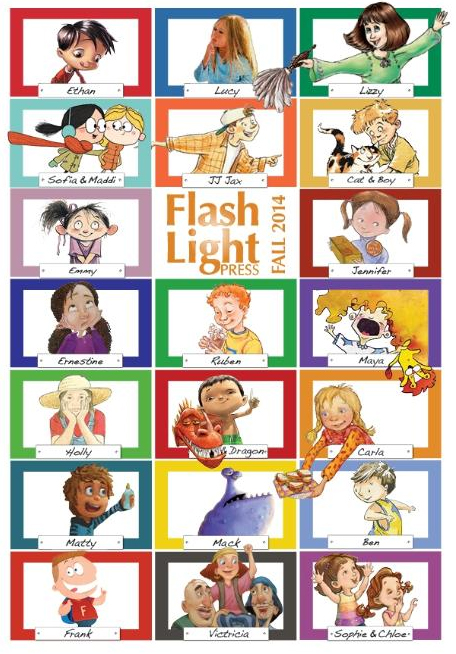
FlashLight Press is celebrating their 10 year in the publishing business. They are a small publisher and only publish a few books each year, but they specialize in picture books. Check out their awards pages. I was impressed with what they have accomplished. You may even recognize some of the artwork on their covers, since many of their illustrators have been featured on Illustrator Saturday. Click on the illustration that shows off some of the character in their books to look over their book catalog.
SUBMISSION GUIDELINES:
If you have a story you want FLASHLIGHT PRESS to consider:
First, make sure your manuscript fits the following criteria:
- is a fiction picture book (NOT a concept book, non-
fiction, an early reader, a chapter book, or a YA novel)
- has a universal theme (but no holiday themes, and no
talking inanimate objects)
- deals with family or social situations
- targets 4-8 year olds
- is between 500-1,000 words
- feels like a Flashlight book (Please read about our
books to determine whether your story really feels like a
fit.)
If your manuscript meets their criteria:
- send a query email describing your story (plot, word
count, target audience, what makes this story unique) and
a bit about yourself, to Shari Dash Greenspan at
[email protected]
- do not send snail mail queries. We disregard and
recycle all snail mail submissions.
- do not send attachments (instead, type your query
into the body of the email.)
- do not send your full manuscript (neither attached nor
pasted into the email).
Then:
- you will receive an automated reply within a week or so
that we received your email query.
- if we wish to see your full manuscript, we’ll let you know
by email within a month or so. If you do not receive an
email requesting your full manuscript, please realize that
your story was not considered a fit for our line.
Manuscripts, when requested, will be evaluated within three to
four months.
Important tip: unless you are also an artist, do not include
illustrations with a requested manuscript.
If you create artwork that you want them to consider:
- Explore our site to be sure that your style could be a fit.
- Please do not send any samples by snail mail – we are going
paperless and will recycle all paper samples we receive.
- Do not send attachments. Instead, please paste a few sample
jpegs into an email. Then we don’t have to open any files and
can easily view your artwork.
- Do include links to your online portfolio in your email.
- Send the email to [email protected].
- We‘ll keep your information on file for future reference, and will
be in touch if we have any projects to offer.
Make this the year you revise and submit. Gook Luck!
Talk tomorrow,
Kathy
Filed under:
authors and illustrators,
inspiration,
need to know,
opportunity,
picture books,
Places to Submit,
publishers Tagged:
Flashlight Press,
Picture book publisher,
submission guidelines 

By: Kathy Temean,
on 1/5/2015
Blog:
Writing and Illustrating
(
Login to Add to MyJacketFlap)
JacketFlap tags:
Agent,
picture books,
Young Adult Novel,
Middle Grade Novels,
authors and illustrators,
opportunity,
children writing,
Editor & Agent Info,
Places to Submit,
Capital Talent Agency,
Cynthia Kane,
Add a tag
Capital Talent Agency located in Washington, DC has added a new literary division to their agency services. They say they want to provide a wonderful home for authors who are looking for a supportive and hands-on agency. “We want nothing more than to see our authors achieve their dreams, and we do everything we can to make that happen.”
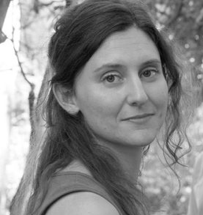 Agent Cynthia Kane has been involved in the publishing industry for more than ten years. She has seen over 100 titles to market and has edited for UN Women (The United Nations Entity for Gender Equality and the Empowerment of Women). She has worked with Michael Gross, New York Times best-selling author, on “740 Park: The Story of the World’s Richest Apartment Building” and “Rogues Gallery: The Secret History of the Moguls and the Money That Made the Metropolitan Museum.” Cynthia has also written for national and international publications and has served as a writing instructor at the Writopia Lab in Washington, DC, and has run several writing workshops. Cynthia received her B.A. in Literature from Bard College and her M.F.A. in Creative Nonfiction from Sarah Lawrence College.
She is looking for: young adult, children’s, nonfiction, memoir, commercial fiction (but no science fiction or fantasy).
How to contact: “Submissions should be sent to literary.submissions [at] capitaltalentagency.com. We accept submissions only by e-mail. We do not accept queries via postal mail or fax. For fiction and nonfiction submissions, send a query letter in the body of your e-mail. Attachments will not be opened. Please note that while we consider each query seriously, we are unable to respond to all of them. We endeavor to respond within six weeks to projects that interest us.”
Talk tomorrow,
Kathy
Filed under:
Agent,
authors and illustrators,
children writing,
Editor & Agent Info,
Middle Grade Novels,
opportunity,
picture books,
Places to Submit,
Young Adult Novel Tagged:
Capital Talent Agency,
Cynthia Kane 

By: Kathy Temean,
on 1/2/2015
Blog:
Writing and Illustrating
(
Login to Add to MyJacketFlap)
JacketFlap tags:
Interview,
inspiration,
Advice,
Process,
Digital Art,
illustrating,
authors and illustrators,
University of California,
demystify,
Illustrator Sites,
Illustrator's Saturday,
Diana Kizlauskas,
Ray College of Design,
Add a tag
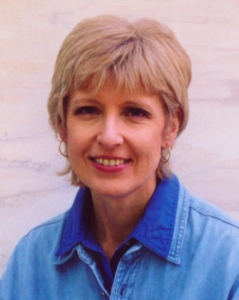 Diana Kizlauskas says she knew she was in trouble early on. Drawing Barbie was more fun than playing with her. Drawing a poster of the Beatles was more appealing than buying one. A high school mural project meant more than ACT scores. By senior year, I made peace with my art addiction and chose it as my professional path…
With help from above and a little caffeine, I earned B.A. degrees in Art Education (UIC, 1974) and Illustration (Ray College of Design/ Illinois Institute of Art, 1991), supplementing those with drawing workshops at the School of the Art Institute of Chicago. My portfolio landed me in the freelance world of advertising and editorial illustration. Then with a new millennium, came a new direction: greeting cards and children’s educational publishing. Throughout this time, I exhibited work in the Chicago area, including at Gallery 400/UIC, Hyde Park Art Center, North Lakeside Cultural Center, and had a solo show at the Beverly Arts Center. In Indiana, my work was displayed at the Anderson Fine Arts Center, the John G. Blank Center for the Arts and Purdue University.
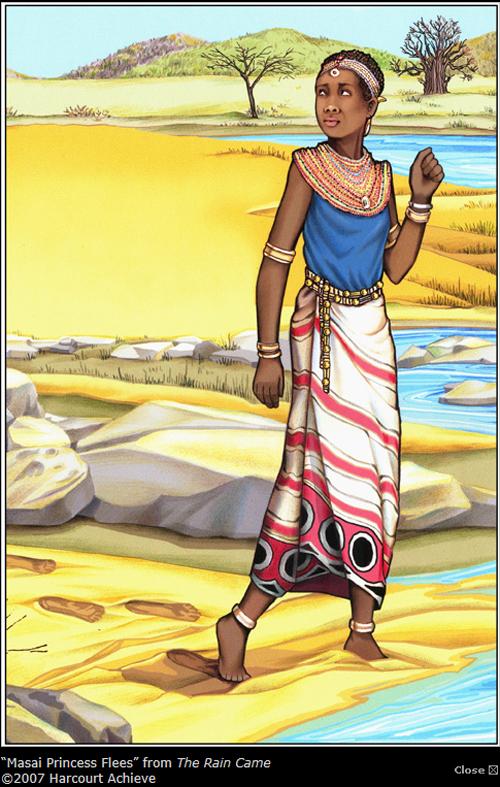
My work, family and faith community make up my rather simple universe. A native Chicagoan, my heart is anchored to the Midwest. However, I often go beyond the familiar to work with ethnic and historical themes. Through books, various other media and travel, I enjoy learning about different eras and cultures. I’ve amassed a wealth of visual reference materials which help me render physical characteristics, geographic features and design elements of various places and times. My background in education helps me translate those images to young readers in ways they can best understand.
TECHNIQUES
The illustrations presented here are created digitally or are hybrids of traditional acrylic on canvas or colored pencil on board combined with digital media.
Here is Diana talking about her process:

When I start an illustration I first break down the image to its most essential components. In the case of “The Climb” from my The Twelve Ravens book project, these are: the mountain, the stormy sky, girl protagonist and the injured eagle.

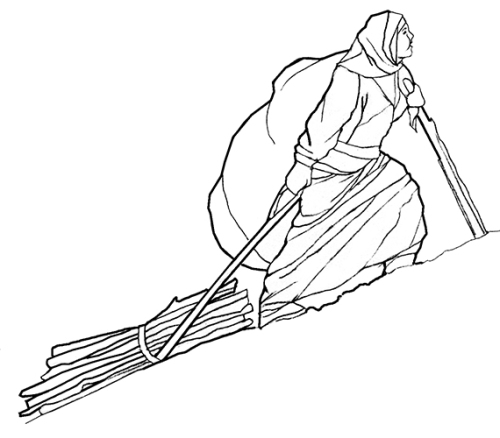
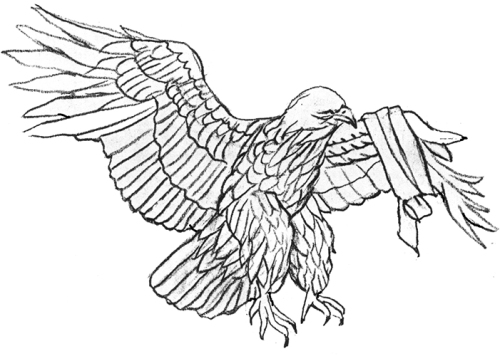
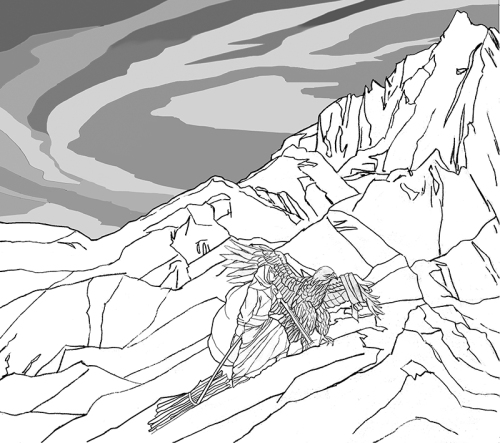
I then scan the images into Photoshop, placing each on a separate layer so that I can manipulate them independently. I play with size, cropping, etc., until I’m satisfied with the arrangement.
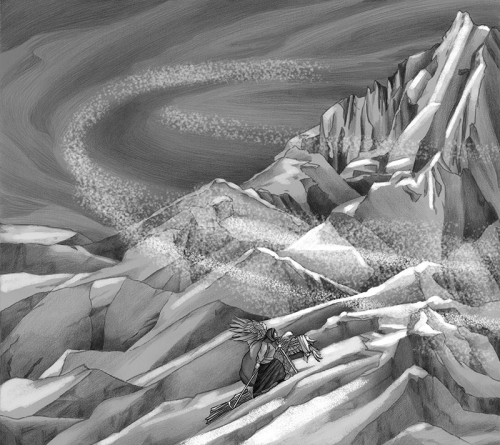
Since an odd number of objects make for a more interesting composition, I’ll eventually add in a fifth element, the “swoosh” of a blizzard.
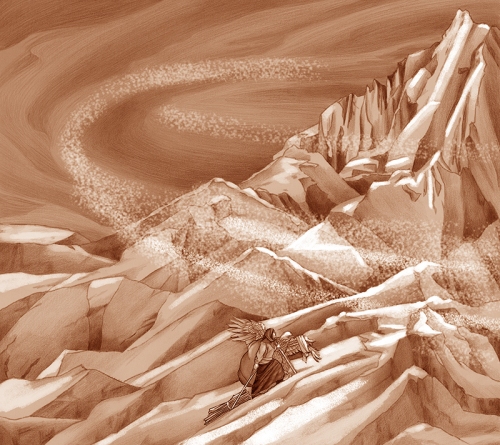
Next, I add tones to the drawing. I do this digitally or by printing out the line art and adding shading by hand and rescanning. The prior picture is an example where I have done both to achieve the result.
I start “painting” by duplicating my black and white tonal image and adjusting its color to umber (Figure 7). This layer lies atop the original tonal art.

I again replicate the image to create a blue layer, which lies atop the umber. Then, using various percentages of opacity in my eraser tool, I remove sections of blue to expose umber and umber to expose black and greys. This results in a balanced warm-cool color underlayment.
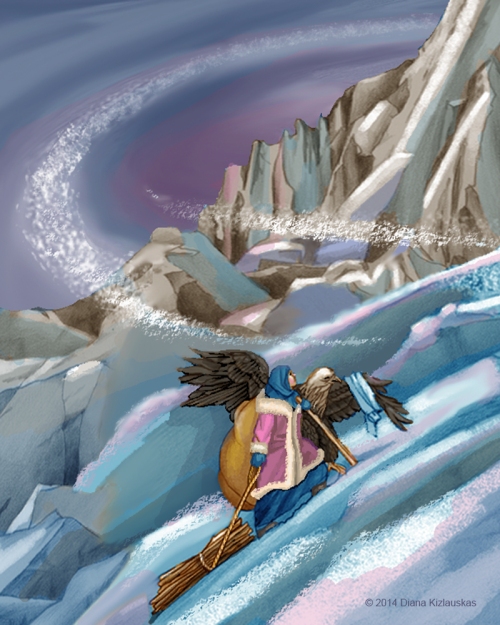
I go to finish by brushing on an entire spectrum of colors, working out details, depth, drama, texture. I give myself creative license to cut, crop, chop and drop, until—voila, it’s done!
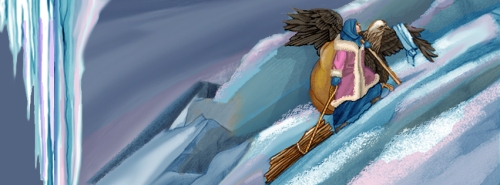
Even as I’m working on the final art, I like to keep each key component of the piece in a separate layer so that I can continue to scale it, move it or manipulate its brightness and color. This is particularly helpful when the format of the illustration needs to be changed from print edition to eBook or if you need to “repurpose” images for a promotional spot. For example, I adapted the scene from “The Climb” to use as my Facebook masthead last winter.
How long have you been illustrating?
I’ve been drawing since I could clutch a crayon in my chubby little hands; I’ve been paid for it since 1991.
How did you end up going to University of California, Irvine?
I received a BA degree in Art Education from the College of Art and Architecture, University of Illinois at Chicago, known around these parts as UIC. (I have never studied in California; perhaps your question is based on a typo in one of my bio pages.)
Since you received a BA in Art Education, did you teach after you graduated?
After completing my student teaching, I opted to stay home with my two children until they started grammar school. However, I do have about a decade of experience teaching part-time extracurricular classes to 3-7 year olds, including crafts, science and religious education.
What types of classes did you take that really helped you to develop as an illustrator?
Because a successful illustration is the result of craft, composition and creative communication, I think that Life drawing, Basic Design and Illustration Concepts courses were all indispensable.
When did you get involved in Freelance Art?
I began getting professional free-lance projects immediately upon graduating from Ray College of Design. Their job placement services were quite helpful in getting me those initial interviews and portfolio showings.
What was the first thing you created where someone paid you for your work?
As a kid, I sold poster-size portraits of the Beatles to classmates. My first job as a “bone fide” illustrator was an editorial piece for the Chicago Daily Southtown newspaper.
What made you decide to study illustration at Ray College of Design/ Illinois Institute of Art in 1991?
Ray College was a small vocational school providing a lot of individual attention to its students and geared toward getting them into the working world. At this point in my life, I felt I had had enough theoretical background and needed to jump into action.
How long did you take drawing workshops at the School of the Art Institute of Chicago?
I attended Advanced Drawing Workshop for about a year.
Do you think taking those workshops helped improve your drawing skills?
They certainly did. But more importantly, they impressed upon me the importance of surrender to the mystery of creative process, experimentation with images, as well as pushing techniques and materials to their limits. Oddly enough, I also came away from my experience at SAIC with a personal resolve to avoid conformity to non-conformity.
When did you go digital?
I was dragged into the Digital Age in the late 2000’s by clients and agents who wanted a project done quicker, cleaner, and cheaper. I went kicking and screaming, but it was one of the best things that ever happened to me professionally.
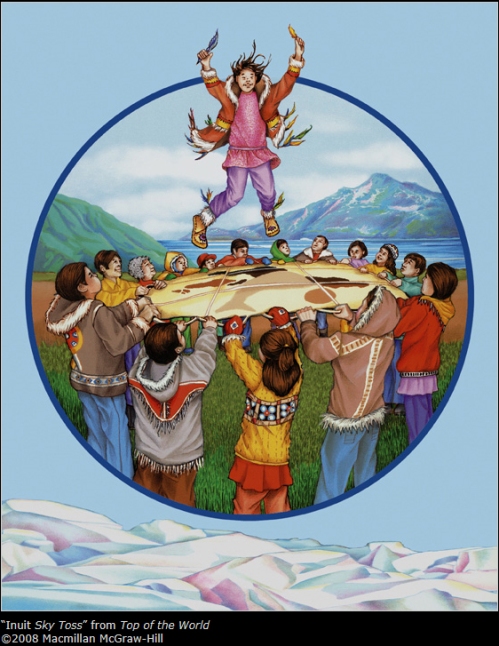
How many children’s books have you illustrated?
If we count leveled readers, I have illustrated 14 books in traditional print and 4 eBooks.
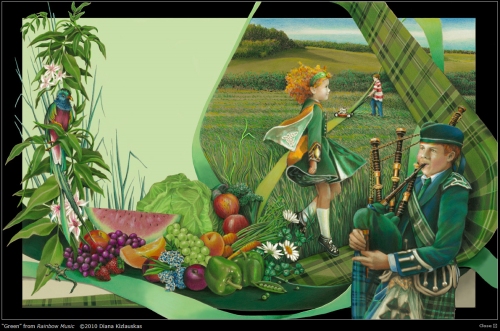
Do you still do freelance art?
All my work is done on a free-lance basis.
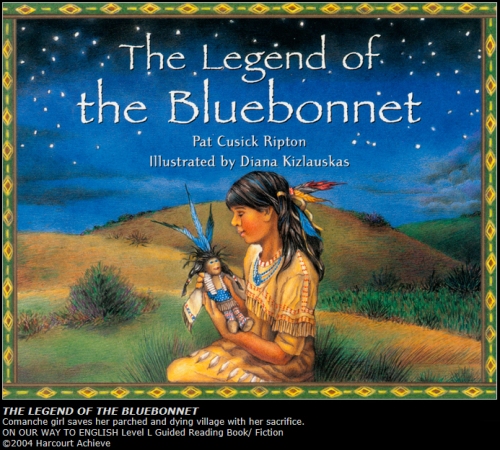
What was the first picture book that you illustrated? When did that happen?
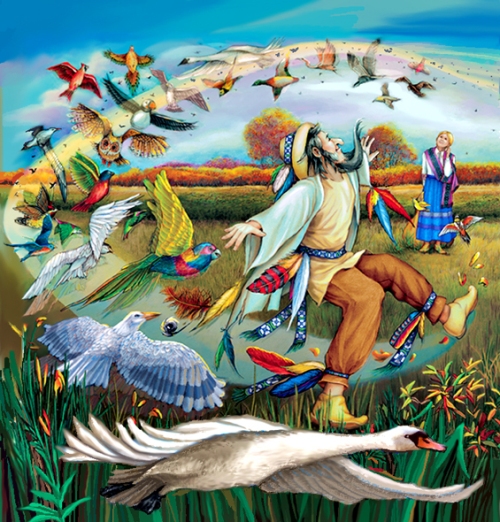
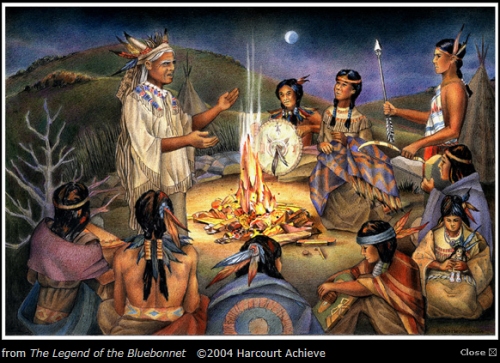
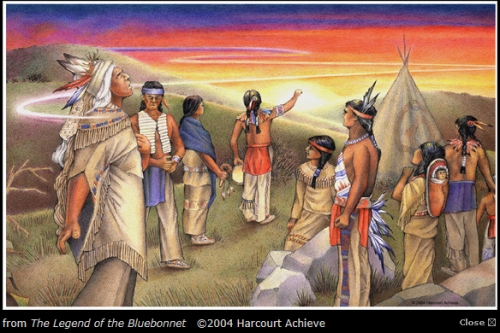
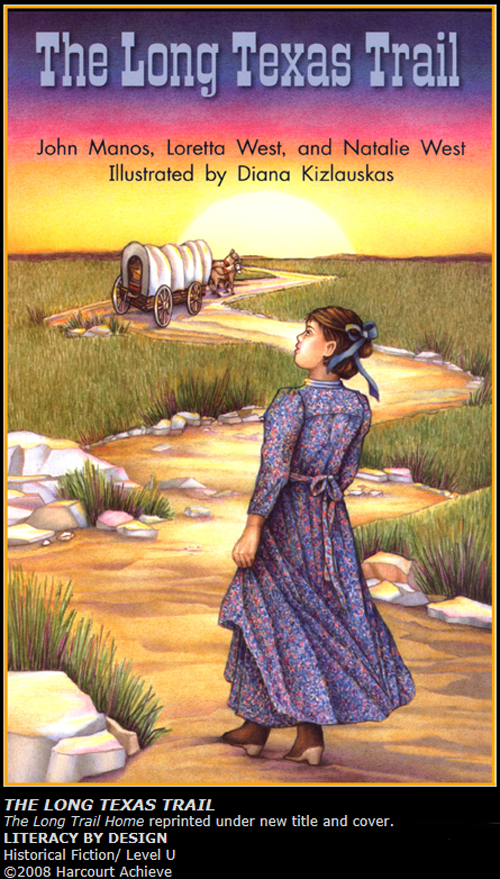
I illustrated The Legend of the Bluebonnet in 2004.
How did that contract come about?
I was approached by Steven Edsey Sons artists’ reps to do the project. They had seen a piece in my samples portfolio which matched the needs of the client very closely—a Plains’ Indian family preparing a meal. The rest was, as they say, history.
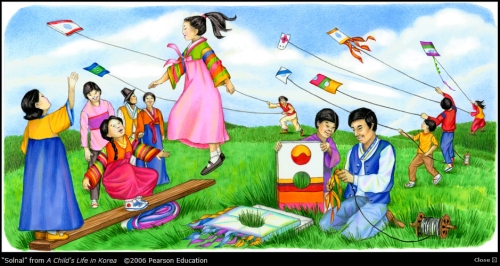
Was the Legend of the Bluebonnet the first book you did with Houghton Mifflin Harcourt?
The publisher of the Legend of the Bluebonnet was Rigby/ Harcourt Achieve. I’m unclear as to what its relation to Houghton Mifflin Harcourt was at that time.
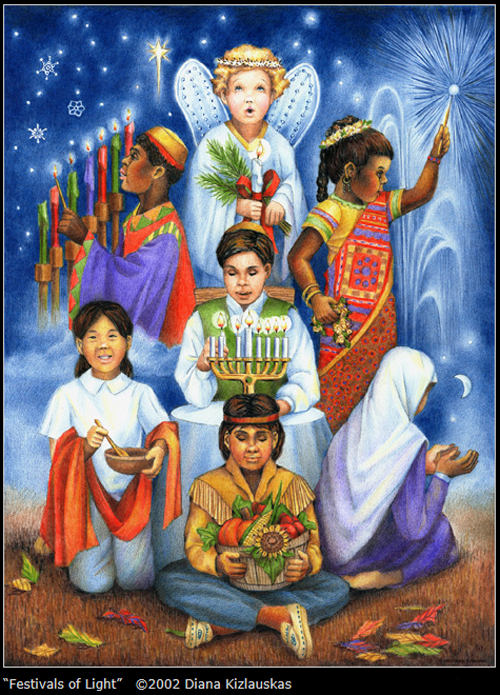
How many books have you done with Harcourt?
I have illustrated four leveled readers for Rigby/ Harcourt Achieve and one for Harcourt School Publishers.
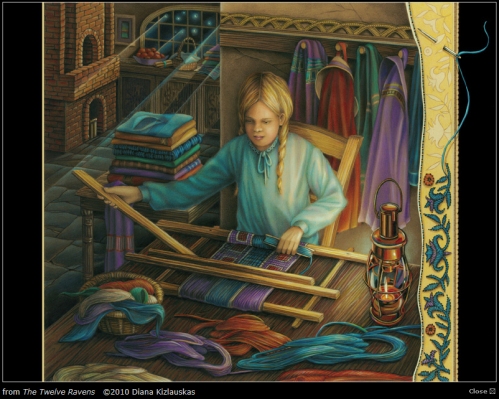
Would you consider working with an author who wants to self publish?
I would base my decision on the strength of the author’s credentials and the quality of the material.
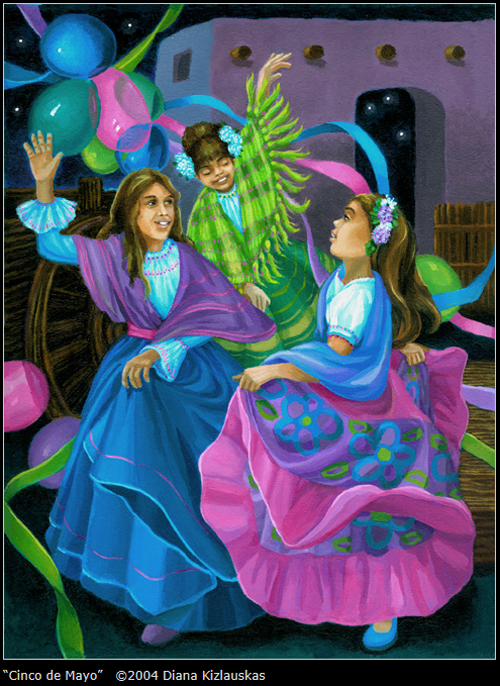
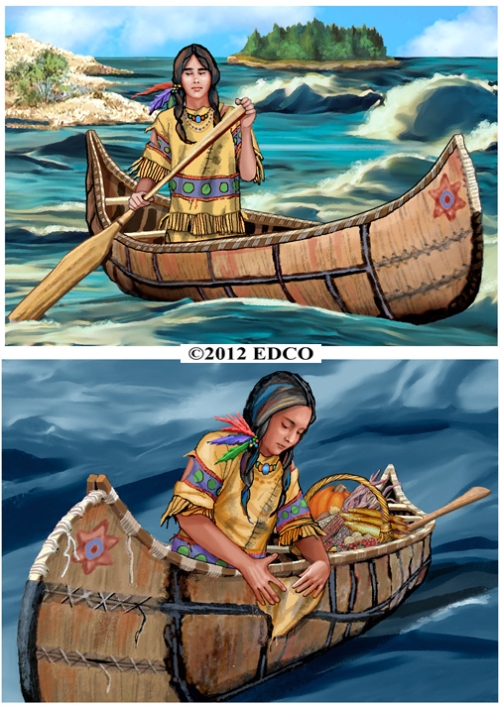
Can you tell us a little bit about EDCO/Ireland? How did they find you and what type of work did they have you do?
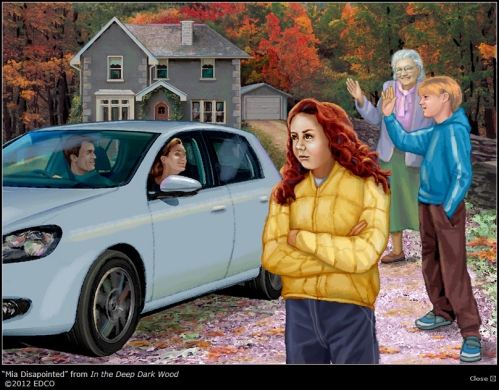
EDCO is an educational publisher in Ireland. I believe their art directors saw my work on childrensillustrators.com and then contacted my current artist reps. I illustrated several stories (“In the Deep Dark Wood,” and “The Island of the Blue Dolphins”) and a poem (“The North Wind”) for them. One of these illustrations was then adapted as a cover for By The North Star, a book in their Big Box Library series.
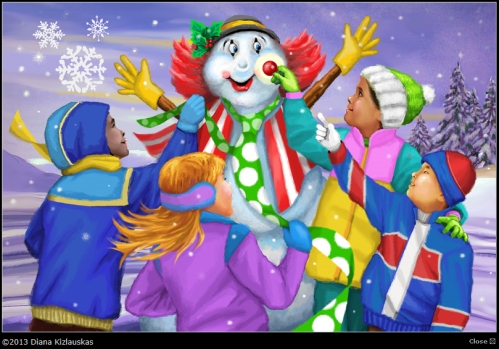
Have you worked with educational publishers? Which one’s?
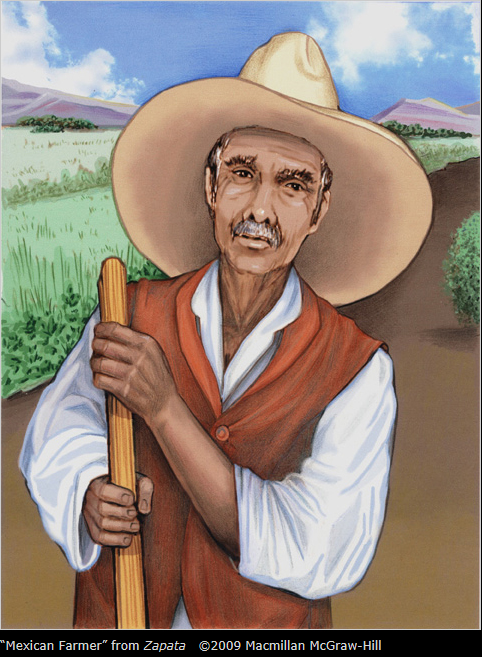
Besides the aforementioned Rigby/Harcourt Achieve, Harcourt School Publishers and EDCO/Ireland, I have worked with Macmillan/McGrawHill, Pearson/Scott Foresman, Pearson Education, Compass Publishing and Quarasan, Inc. Though they might also be considered a trade or religious publisher, Pauline Books and Media contracted me to illustrate Jorge of Argentina: The Story of Pope Francis for Children (2014).
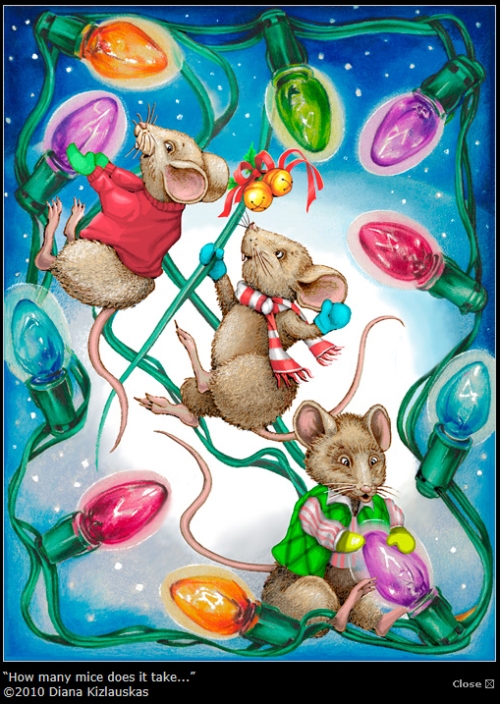
How did those books come your way?
Nearly all of them came through artists’ reps with whom I was associated at the time of the project’s inception.
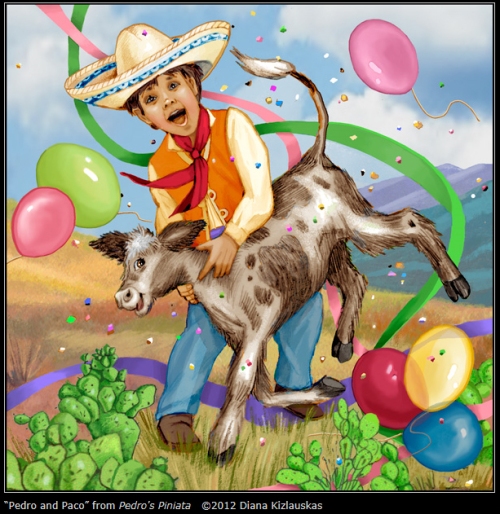
Have you ever tried to write and illustrate a children’s book?
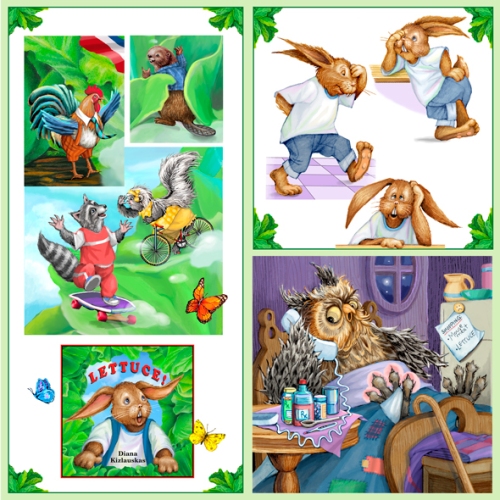
Yes, I have. LETTUCE! , my tall tale about a rabbit and his rampant good fortune, is on the eBook market right now. Parents and teachers of preschoolers have given it a 5-star rating and I’m very excited about making it available in a traditional print version this spring.
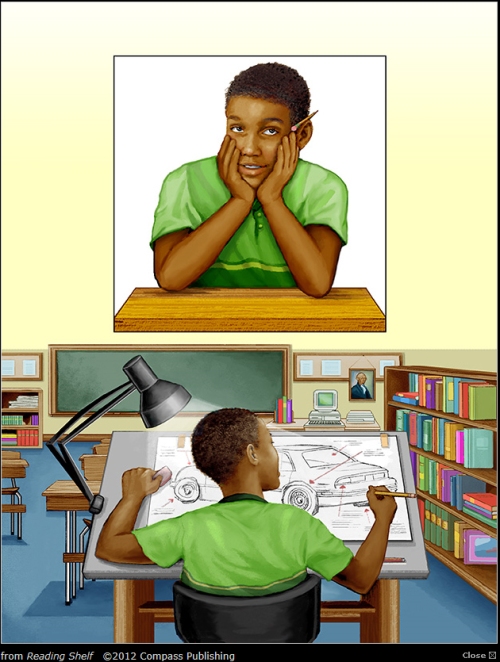
Do you have an agent? If so, who and how long have the represented you? If not, would you like one?
Over the years I have been represented by several agencies, but since 2010 by WendyLynn&Co.
What types of things do you do to get your work seen by publishing professionals?
I supply my artist reps with promotional material and advertise on childrensillustrators.com (http://www.childrensillustrators.com/illustrator-details/DKizlauskas/id=2110/). I maintain gallery and bookstore spaces on the Society of Children’s Book Writers and Illustrators website (http://www.scbwi.org/members-public/diana-kizlauskas) and I maintain an author/illustrator page on amazon.com. Also, I post regularly to my business Facebook page (www.facebook.com/DKIllustration). Most importantly, I keep my DKI Children’s Illustration website (www.dianakizlauskas.com ) updated and functioning.
Have you seen your style change since you first started illustrating?
Absolutely. My work is increasingly softer edged, more painterly, and close to 100% digital.
Have you gotten any work through networking or the Internet?
Almost exclusively so. As I described above, nearly all my marketing revolves around websites and on-line portfolio displays.
Do you use software for painting besides Photoshop?
So far, only Photoshop.

Do you own a graphic tablet? If so, how do you use it?
Yes, indeed. To reduce a complicated explanation to bare basics: I scan hand-drawn and photo-reference images into Photoshop, then use both a mouse and stylus to create layers, lines, colors, textures and draw additional images directly onto the tablet—whatever it takes to bring the illustration to finish.
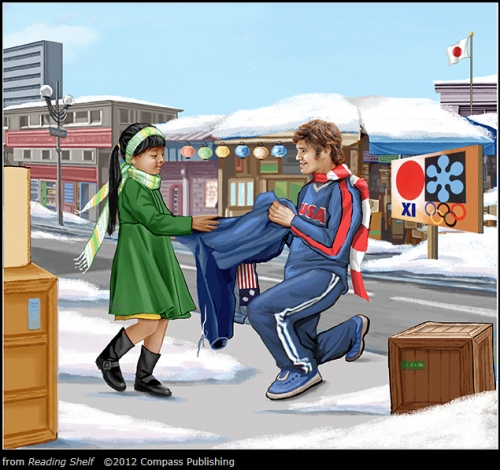
How much time do you spend illustrating?
When working on a client project, I keep a very strict 10-hour, 6 day per week schedule. When creating promotional samples or working on my own books, I loosen it up to 6-hours per 5 days weekly. (This fall a family medical crisis put my work on temporary “hold,” but I’m slowly getting back on track.)
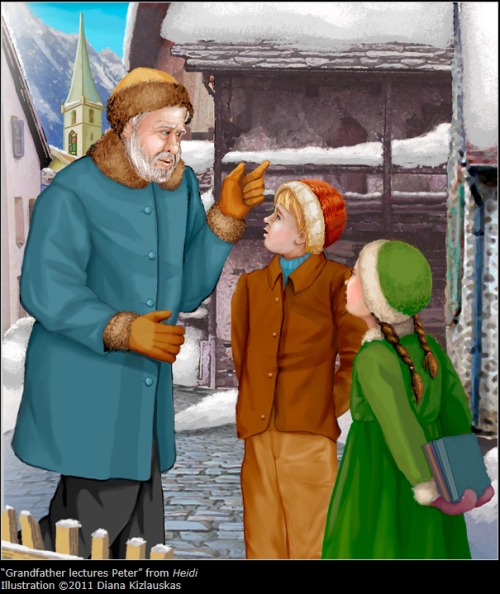
Do you have a studio set up in your house?
Yes, I do. I’m very fortunate to have a large room and loft area that accommodate a drawing table,easel, computer, printer, scanner, copier, a 8’x3.5’ work counter with horizontal storage, and 3 file cabinets full of reference clippings (some dating back to grammar school). Scads of shelves house more reference, paints, brushes , pencils and pens—not to mention a potpourri of chachkies. The closet full of dusty portfolio cases and canvases bears witness to a time before computers took over.
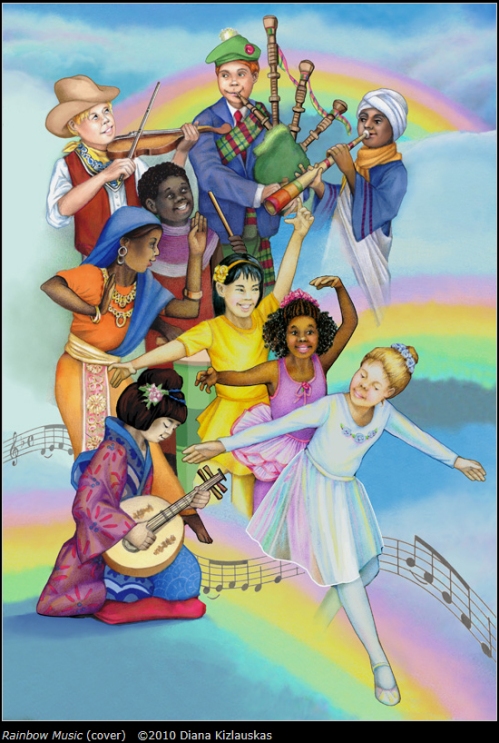
Any picture books on the horizon?
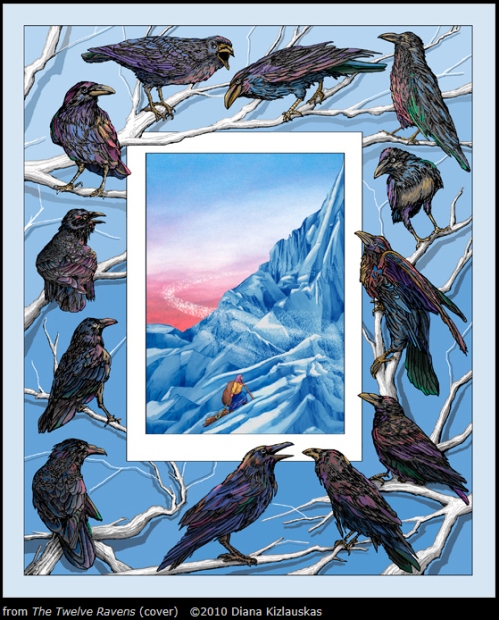
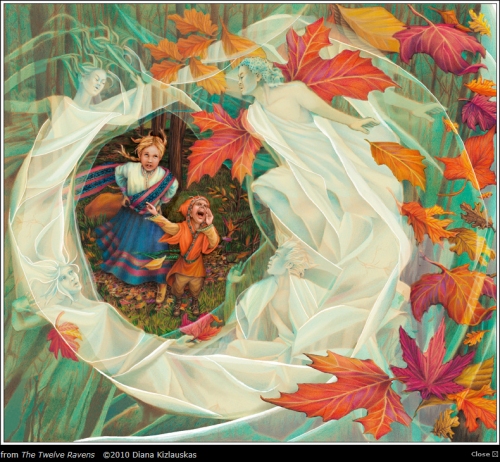
The Twelve Ravens , a Lithuanuian folktale which I have adapted, retold and illustrated, is a project I hope to have out by Fall, 2015. The eBook version is almost done, the print format awaits revision.
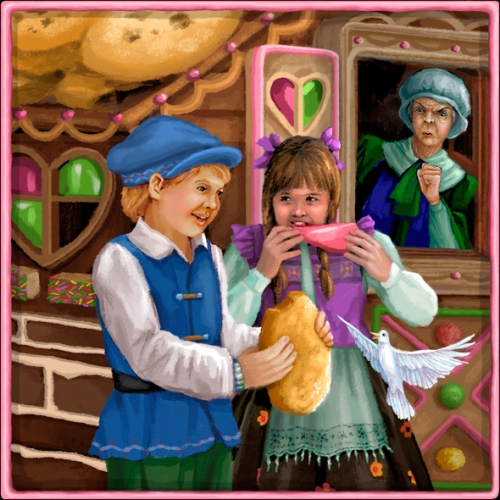
What are your career goals?
Beautiful books for beautiful children! I want to continue communicating to children of all colors and backgrounds through positive, bright and inspiring images. Whether my illustrations attain the stature of being published by the top trade publishers in the country or are independently made and distributed, my goal is to make each one better than the one before. I believe that concentrating on the work itself and not the fame or fortune it may bring is the only way an artist can maintain sanity in an ever-changing business world and culture.
What are you working on now?
As I mentioned, LETTUCE! and The Twelve Ravens are on my mind, but they may have to simmer on a back burner if my agent drafts me for a McGraw-Hill Education project for which I’ve recently been approved.
Are there any painting tips (materials, paper, etc.) you can share that work well for you? Technique tips?
Since I do all my “painting “ in Photoshop these days, there’s not much in the way of materials that I need to think about. But when working with colored pencils on paper or creating a “hybrid” piece where I draw onto a printed digital image, I like to use a wonderfully smooth paper called Mohawk Superfine. It is a 100 lb. “ultra white” cover stock used by the printing industry. It is receptive to the toner inks in my printer and is a perfect surface for multiple layers of Prismacolor pencils.
Any words of wisdom you can share with the illustrators who are trying to develop their career?
Like a man walking a tight rope, look straight ahead, never down. In creative, competitive fields, people who remain positive, patient, and intrinsically motivated—eventually prevail. Or as a colleague once remarked, “I can’t NOT do this…” Really, what other choice does a true artist have? So, KEEP AT IT!
Thank you Diana for sharing your journey and process with us and helping us kick off 2015. You can visit Diana at her website: http://www.dianakizlauskas.com to see more of her work.
If you have a moment I am sure Leeza would love to read your comments. I enjoy them too. Thanks!
Talk tomorrow,
Kathy
Filed under:
Advice,
authors and illustrators,
demystify,
illustrating,
Illustrator Sites,
Illustrator's Saturday,
inspiration,
Interview,
Process Tagged:
Diana Kizlauskas,
Digital Art,
Ray College of Design,
University of California 

By: Kathy Temean,
on 12/28/2014
Blog:
Writing and Illustrating
(
Login to Add to MyJacketFlap)
JacketFlap tags:
Tips,
list,
reference,
inspiration,
Advice,
Process,
authors and illustrators,
demystify,
Kendra Shedenhelm,
Best of Writing and Illustrating 2014,
Add a tag
Kendra Shedenhelm sent this illustration in for us to enjoy. It makes me think of the song that was out a year ago titled, “What does the Fox say.” Must be Tee Hee Hee. The fourth book she has illustrated, “You, the Magician,” was released in November 2014, and can be viewed at http://www.youthemagician.com. http://www.kendrashedenhelm.com/
HERE ARE THE LINKS TO HELPFUL ARTICLES POSTED IN 2014
WORLD BUILDING TIPS
TIPS ON WRITING ENDINGS
THE MANUSCRIPT IN THE DRAWER
SELF PUBLIHING – GETTING YOUR BOOK READY
REVISIONS
TRACKING SUBMISSIONS
PRICING STRATEGIES FOR ILLUSTRATING
MORE SHOWING LESS TELLING
AGENT/AUTHOR REVISION TIPS
RESEARCHING AGENTS
PUTTING WORDS ON PAPER
CREATING SYMPATHIC CHARACTERS
AMAZON RANKING vs. DAILY BOOK SALES
WORKING OUT THE DETAILS
TEN DREADED MANUSCRIPT ERRORS
PITCH IS CONCEPT
STATE OF THE CHILDREN’S PUBLISHING MARKET
STATE OF THE MARKET PART TWO
STATE OF THE MARKET PART THREE
ATTACKING A CONFERENCE
WHEN DO WRITERS STOPW WRITING
MATCHMAKING FOR WRITERS CRITIQUE PARTNERS
SEVEN WAYS TO MAKE YOURSELF AN EASY AUTHORS TO WORK WITH
AMAZON SALES STRATEGIES
AMAZON STATEGIES – LOOK INSIDE
AMAZON STRATEGIES – SALES PAGE
LITERARY vs. COMMERCIAL FICTION
RIGHT TO WRITEPICTURE BOOK CHARACTER DEVELOPMENT
90 THINGS TO KNOW ABOUT YOUR CHARACTER
HOW TO SPOT A GREAT PICTURE BOOK
RESEARCHING FICTION
BEFORE STARTING A THRILLER NOVEL
ROMANTIC BODY LANGUAGE
NEVER SAY HE THOUGHT/SHE THOUGHT
CRITIQUING SECRETS
MASTERING KID SPEAK
LETS TALK POV
RIGHT TO WRITE
GRAMMAR NAZI
FIVE WAYS TO FOLLOW UP WITH AN EDITOR OR AGENTS
OUTLINING YOUR NOVEL
BEFORE THE SALE – BOOK APPEAL
FORMAT YOUR BOOK FOR CREATESPACE
THREE TRICKS FOR SHOWING RATHER THAN TELLING
DEALING WITH REJECTION
CRITIQUING SECRETS
WRITING WORKSHEETS
7 POINT STOR STRUCTURE SYSTEM
Talk tomorrow,
Kathy
Filed under:
Advice,
authors and illustrators,
demystify,
inspiration,
list,
Process,
reference,
Tips Tagged:
Best of Writing and Illustrating 2014,
Kendra Shedenhelm 

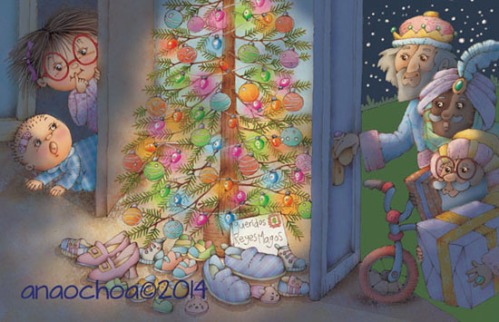
This Christmas illustration was sent in by Ana Ocho to help us celebrate the day. Ana has worked with most publishers in Mexico (both private and government), doing picture books as well as school text books. She was featured at the beginning of the year on Illustrator Saturday. http://kathytemean.wordpress.com/2014/01/11/illustrator-saturday-ana-ochoa/
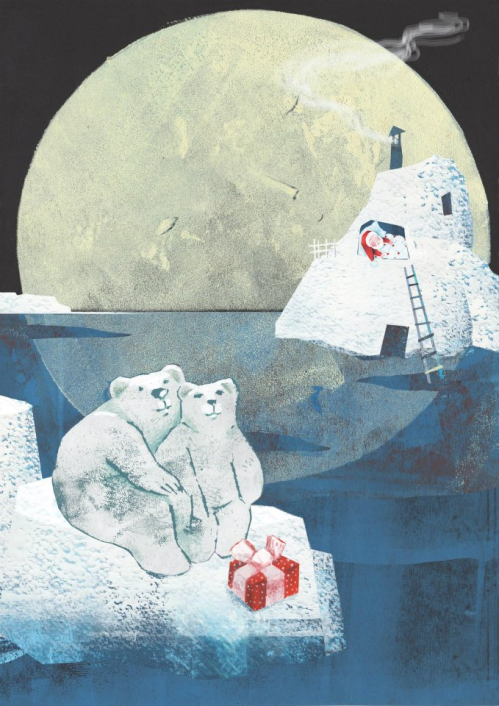
This happy North Pole Illustration was sent in by Andreha Peklar. She was featured earlier this year on Illustrator Saturday. http://kathytemean.wordpress.com/2014/07/12/illustrator-saturday-andreja-peklar/
DECEMBER’S LIGHT by Eileen Spinelli
It’s the slanted light of a silver star,
soft candlelight in a quiet room.
It’s lantern light from house to barn
swaying bright against the gloom.
It’s the light of home across the miles.
It’s the puddled light of moon-on snow.
It’s the light in eyes…in smiles…in hearts.
It’s the sweetest light of all I know.

Thank you Eileen and Carol for the Christmas cheer. Hope everyone is having a wonderful day. Merry Christmas!
Talk tomorrow,
Kathy
Filed under:
authors and illustrators,
Holiday,
inspiration,
Poems Tagged:
Ana Ochoa,
Andreja Peklar,
Carol Murray,
Eileen Spinelli 

By: Kathy Temean,
on 12/23/2014
Blog:
Writing and Illustrating
(
Login to Add to MyJacketFlap)
JacketFlap tags:
Hally Franz,
Lauren Gallegos,
Robin Jordan,
inspiration,
Poems,
Holiday,
authors and illustrators,
Christmas Poems,
Mark Meyers,
Add a tag

Lauren Gallegos sent in this cute illustration that rings so true. She is a Children’s Book Illustrator who was featured on Illustrator Saturday: http://kathytemean.wordpress.com/2012/11/03/illustrator-saturday-lauren-gallegos/ www.Laurengallegos.com Twitter: @laurengallegos
Here are two holiday poems. More tomorrow and Christmas Day. Voting will start on Friday.
The Tasting Tree
By: Robin Jordan
Busy hands stained juicy, red.
Berries strung. Needle ‘n thread.
Draped around a fragrant pine
Over, under branches fine.
Popcorn seeds shake, shake, shake, then
Burst into a snowy flake.
Loosely sewn all in a row
On the festive tree they go.
Vanilla scents thrill the nose.
Cookies tied with shiny bows
Sprinkles shimmer, precious gems
Dot the sweeping verdant stems.
Shepherd crooks, a sweet delight
Twisted stripes. Some red, some white.
Candy canes hung by their hook
Help create a gleeful look.
My tasting tree’s now complete.
Leaving Santa lots to eat.
Working hard all through the night
Must stir up his appetite!
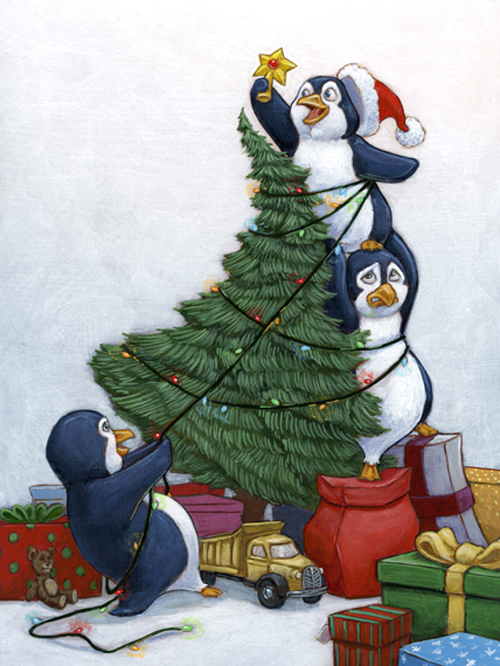
The above illustration was done by Mark Meyers. He was featured on Illustrator Saturday in 2012. Here’s the link. http://kathytemean.wordpress.com/2013/10/05/illustrator-saturday-mark-meyers/
Christmas Movies and Meaning
By Hally Franz –
On the Twelve days of Christmas I hoped I could see,
The classic holiday movies I’d missed on TV.
So many favorites make me smile, laugh, and cry,
But the days left for watching are flying right by.
Day one, I will start with some time spent with Clark,
Though his house was lit well, he was left in the dark,
‘Bout what grand or glum bonus would come his way,
And what crazy cousin Eddie would do that last day.
Day two, it’s time for a freckle-faced kid,
And the tale of what the two robbers did.
Left all alone, but helpless he’s not,
For few have the tricks clever Kevin has got!
Day three, I must visit a lodge in Pine Tree,
For Vermont is a lovely white place one should be,
On lyrical holidays with Danny and Bing,
Engagements and soldiers, all the songs they will sing.
Day four is saved for a swelling single dad,
Who put on the suit and left the life he once had.
Shaving and gaining, graying and growing,
He flew to the North Pole where elves he’s employing.
On day five, I’ll enjoy a sugary treat,
A Caan-Ferrell combo is one hard to beat.
Jovie leads carols, gets Santa’s sleigh off the ground,
In a place folks think no Christmas cheer can be found.
From sweet to a sneak on day six, I will go,
When I watch the green guy with the heart yet to grow.
He seemed determined to ruin Christmas for young Cindy Lou,
Until Dr. Seuss taught him a lesson compliments of the Whos.
By seven I travel across the pond to hear,
Tales of Mark and Daniel and Bridget dear.
Their accents are lovely, their troubles quite mad,
The kiss in the snow leaves me a Colin Firth fan.
Now when on day eight, loves turns to divorce,
It’s time for “delousing babies in Burma,” of course.
Though they try to avoid crazy families, they find,
Even spray cheese and spending limits are better than “lies.”
Though Peter B. helped produce my selection above,
He’s rabbit-costume-hating Ralphie in one we all love.
On day nine it’s Red Ryder BB guns and lady-leg lamps,
Frozen tongues, broken glasses, and little guy scamps.
My nostalgic mood continues on ten,
When I’ll watch my old black-and-white friend.
George questions himself and thinks his life’s been a waste,
Clarence reveals he’s made Bedford Falls a fine place.
Dickens’s story, reincarnated has been,
But, any version works fine on day eleven.
Visions and dreams appear as in our story above,
Unlike good-guy George, Scrooge must learn how to love.
Day twelve is reserved for one from way back,
A short film of a child and the love he did lack.
A poor boy he has only his drum he can play,
For the newborn king on that most glorious day.
Thank you, Hollywood, for movies we enjoy year after year,
For stories of love, life, and lessons held perennially dear.
But, if one studies the list, I think you will find,
Few of the flicks bring the true meaning to mind.
The most known films are sweet and funny, it’s true,
But fail to bring Mary, the manger, and Jesus in view.
Tinsel Town, try addressing man’s internal crave,
And, give us more to see about the son that He gave.
It’s a story that’s true, compelling, and brave,
Of One born to die, our sinning souls to be saved.
Consider my list, along with my request,
While I reveal answers to the above test.
“Christmas Vacation” should not be spent “Home Alone,”
Unless it’s a “White Christmas” and you’re talking by phone.
But, then “The Santa Clause” and his “Elf” won’t find you around,
If in spite of “The Grinch that Stole Christmas” down the chimney they bound.
If left stranded deep in snow read “Bridget Jones’ Diary” for fun,
Are remember “Four Christmases” are rarely better than one.
Tell “The Christmas Story” for one or all who are near,
Be thankful “It’s a Wonderful Life” whether you’re there or you’re here.
Sing “A Christmas Carol” or two with joy in your heart,
And, one called “Little Drummer Boy” is a great way to start.
Blessings to all at this Christmastime,
And, thank you for reading my ramble-ing rhyme.
In summary, I say watch those movies we love,
But save time for the Savior sent from above.
*~*~*~*~*~*~*~*~*~*~*~*~*~*~*~*~*~*~ *~*~*~*~*~*~*~*~*~*~*~*~*~*~*~*~*~*~
This was sent in by Margo Sorenson. She doesn’t know who wrote it, but it is a very well-known in Hawaii.
“Da Night Bafo Christmas” Was da night bafo’ Christmas, and all ova’ da place,
Not even da geckos was showin’ their face.
Da stockings was hangin’ on top da TV
(‘Cause no mo’ fireplace in Hawai’i )
Da kids stay all crashed, my old man too.
They leave all da work for you-know-who.
So me, I stay pickin’ up alla dea toys,
When – boom! – outside get only big noise!
I run to da window, I open ‘em up,
I stick out my head and I yell, “Eh! Whassup?!”
And then, I no can ba-lieve what I seen!
Was so unreal, you know what I mean?
This fat haole guy get his reindeers in my yard!
And reindeers not housebroken,
you know, as’ why hard!
But nemmind, this Christmas,
so I cut ‘em some slack.
Plus, had uku pile presents pokin’ outta his sack!
So I wait ’till he pau tie up his reindeer,
Then I yell out da window,
“Huui! Brah, ova hea!”
An’ I tell ‘em first thing,
when I open da door,
“Eh, Hemo your shoes! You going dirty my floor!”
He take off his boots, he tell, “You know who I am?”
I go, “Ho! From the smell, must be Mr. Toe Jam!”
He make mempachi eyes and he go, “Ho, ho, ho!”
By now, I stay thinking this guy kinda slow!
He look like my Tutu, but little less weight,
And his beard stay so white, mo’ white than shark bait!
He stay all in red, specially his nose,
And get reindeer spit on top his nice clothes!
But him, he no care; he just smile at me,
And he start fo’ put presents unda-neath da tree.
I tell ‘em, “Eh, brah, no need make li’dat,
And watch where you step! You going ma-ke da cat!”
Then, out from his bag, he pull one brand new computah,
Choke video games, and one motorized scootah!
He try for fill up da Christmas socks too, But had so much pukas,
all da stuff went fall troo.
When he pau, I tell ‘em, “Eh Santa, try wait!
I get plenty leftovahs, I go make you one plate!”
But he nevah like hang, he had so much fo’ do;
Gotta make all them small kids’ wishes come true.
So I wave ‘em goodbye, and I flash ‘em da shaka,
And I tell ‘em, “Mele Kalikimaka!”
When he hear that, he stop…and I telling you true,
He go, “Garans ball-barans! Merry Christmas to you!”
*~*~*~*~*~*~*~*~*~*~*~*~*~*~*~*~*~*~*~*~*~*~*~*~*~*~*~*~*~*~*~*~*~*~*~*~
Thank you Hally and Robin for sending in your December poems. I will post a couple more tomorrow and a few on Christmas, then you can vote on Friday. Please stop back an vote for your favorite Holiday poem. Have a Merry Christmas.
Talk tomorrow,
Kathy
Filed under:
authors and illustrators,
Holiday,
inspiration,
Poems Tagged:
Christmas Poems,
Hally Franz,
Lauren Gallegos,
Mark Meyers,
Robin Jordan 

By: Kathy Temean,
on 12/22/2014
Blog:
Writing and Illustrating
(
Login to Add to MyJacketFlap)
JacketFlap tags:
Agent,
Book,
inspiration,
success,
illustrating,
authors and illustrators,
Sarah LaPolla,
Bradford Literary Agency,
Dow Phumiruk,
Avalon Writer's Retreat,
Kelly Calebrese,
Add a tag
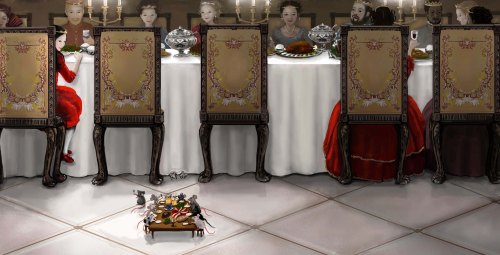
Dow Phumiruk is an aspiring children’s book illustrator. She won the 2013 SCBWI On-the-Verge Emerging Voices Award that promotes diversity in children’s books. This feast illustration is from a book idea called Arissa and the Queen’s Mice. Please visit her portfolio site at http://www.artbydow.blogspot.com or her blog at http://www.happydow.blogspot.com to see more of her work.
 I’m thrilled to share that… drum roll please… Kelly Calabrese has accepted representation with Sarah LaPolla of Bradford Literary Agency!
Kelly says, “Sarah LaPolla is a super sharp, smart, and witty agent who really *gets* the types of books that I like to write – which I believe is the most important factor in an agent/writer relationship.”
Kelly first met Sarah at the annual NJ SCBWI June Conference, and then again at the Full Manuscript Avalon Writres’ Retreat at the end of September. Sarah critiqued her full manuscript of her YA Thriller-Horror, BEAUTIFUL BLOODY DUCKLING, and gave her editorial notes that were dead-on insightful.
I asked Kelly what happened post the Avalon Writers’ Retreat, here is what she said:
I had the amazing fortune of being accepted into Brenda Drake’s Pitch Wars. As a chosen mentee in this contest, I won the editorial aid of two published mentors – Trisha Leaver and Lindsay Currie – who helped to shape my story into a much stronger version. I can’t shout loud enough from the rooftops about how life-changing Pitch Wars can be. After working day and night on revisions (Sleep? What sleep?!), I completed my manuscript a mere two days before Thanksgiving.
Sarah received my full manuscript on the 25th of November, and offered me representation within two weeks. Crazy. I know. And so very encouraging!!! It’s all very *dream come true* – WHOOT!
I truly believe that Sarah is an ideal agent for me, and that we are going to KICK ASS together. So, watch out world.
Of course, I could not have done it on my own. I am beyond grateful for Dee Falvo (my über talented CP), for the constant encouragement provided by my fellow NJ SCBWI members, and for the empowering mentorship offered through Pitch Wars.
The writing community ROCKS. And I am so thrilled to be a part of it…. #AmWriting #AmReading #Forevermore :)
— @kellycalabrese & @sarahlapolla —-
PS: I started a new BLOG called We Hear YA! It connects YA writers with their teen audience and can be found here: http://wehearya.blogspot.com/ (@WeHear_YA)
LINKS…
Sarah LaPolla: http://www.bradfordlit.com/about/sarah-lapolla-agent/
Pitch Wars: http://www.brenda-drake.com/pitch-wars/
Trisha & Lindsay’s book:
http://www.fluxnow.com/product.php?ean=9780738740805
CONGRATULATIONS KELLY AND SARAH!
FYI: If you have a Kindle, here are two books that have had their prices temporarily reduced. Can’t ever go wrong buying a Lauren Oliver book. I personally read and enjoyed. I just bought RED RISING, but have not read it yet. It has gotten a lot of buzz and awards.

Panic
By Lauren Oliver
A New York Times bestselling author delivers a “fast-paced and captivating book” (School Library Journal). In the small town of Carp, teenagers have invented a dangerous game, and newly graduated Heather and Dodge find themselves competing for thousands of dollars — putting their very lives at risk.
$1.99
Deal ends: January 5
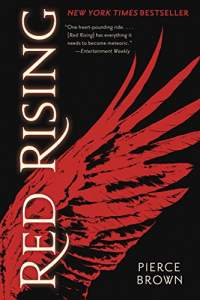 Red Rising
By Pierce Brown
For fans of The Hunger Games comes a New York Times bestseller that’s a “heart-pounding ride” (Entertainment Weekly). Darrow is a Red — part of the lowest level in his color-coded dystopia. Can he infiltrate the ruling Gold caste and bring justice to his people? “Fast-paced, gripping, well-written” (Terry Brooks).
$1.99
http://www.amazon.com/s/ref=nb_sb_noss_1?url=search-alias%3Ddigital-text&field-keywords=RED%20RISING
Deal ends: December 27
Talk tomorrow,
Kathy
Filed under:
Agent,
authors and illustrators,
Book,
illustrating,
inspiration,
success Tagged:
Avalon Writer's Retreat,
Bradford Literary Agency,
Dow Phumiruk,
Kelly Calebrese,
Sarah LaPolla 

By: Kathy Temean,
on 12/20/2014
Blog:
Writing and Illustrating
(
Login to Add to MyJacketFlap)
JacketFlap tags:
Process,
submissions,
revisions,
article,
authors and illustrators,
bio,
Melissa Iwai,
Bebe Willoughy,
inspiration,
Advice,
Add a tag
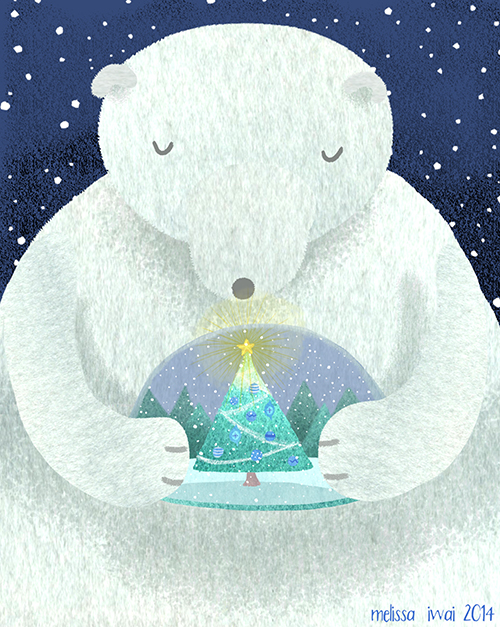
This sweet illustration was sent in my Melissa Iwai. Melissa was featured on Illustrator Saturday.
When I meet a new writer and they ask me for advice, I always point out not to rush to submit what they have written. That advice comes from personal experience and many years of observation. When you are new you think everything you write is wonderful and it isn’t until a few years late and many rejections that you realize you better get into a critique group and learn to revise. The trouble is a writer can go on too long with revisions and setting things aside, so when Bebe sent me this short article I thought it might provide the inspiration you can use going into 2015.
Here’s Bebe:
 Listening Too much or Self Doubt
By Bebe Willoughby
While people who worked in publishing above us hurried off to the Hamptons on Friday’s early summer dismissal, a co-worker and I stayed in the air conditioned office to write a book on dreams. Our lack of self-confidence prevented us from sending it out.
We tucked the manuscript safely in a drawer , where it stayed for four years. We joined a writing group and brought along the manuscript. The leader, a well-known writer/ illustrator, said it was publishable and encouraged us to send it out. So we did and got a quick call from an editor who wanted to publish it.
I have another tale to tell that involves doubting myself and listening to far too many people. I wrote a short story entitled “Nothing Lasts Forever.” None of my writer friends showed much enthusiasm, and a top editor told me I did not write well enough for major magazines. I lived with that declaration for quite some time. Then a friend who did not work in publishing advised: “send it out. You have nothing to lose.” She, of course, was right, but I had not seen it that way. My tale has a happy ending. The story was published in Seventeen magazine.
I encourage writers to have others read their work, but be careful about listening too hard. In the end, you must trust yourself.
Bebe Willoughby earned a M.F.A.in creative writing at Columbia University and is the author of five works of fiction–four children and one novel for adults. She served for ten years as an editor at Random House.
Bebe, thank you for sharing your experiences with all of us. I hope it inspires everyone to get their revisions done and submit more of their writing and illustrating this year. Remember, it doesn’t always have to be a book contract to be successful. Wishing everyone a very successful 2015. Now’s the time to start think laying out a plan.
Talk tomorrow,
Kathy
Filed under:
Advice,
article,
authors and illustrators,
bio,
inspiration,
Process,
revisions,
submissions Tagged:
Bebe Willoughy,
Melissa Iwai 

I thought this Saturday I’d bring you some of the Santa’s from past Illustrator Saturdays. Remember that not every illustrator has done an illustration of Santa. I am sure I missed some Santa’s, so if you were featured on Illustrator Saturday and have a Santa that you would like me to add, please email me with the illustration and I will add it to the celebration of Santa.
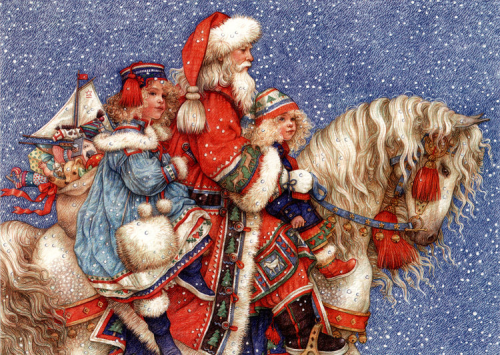
Yvonne Gilbert http://kathytemean.wordpress.com/2013/11/09/illustrator-saturday-yvonne-gilbert/
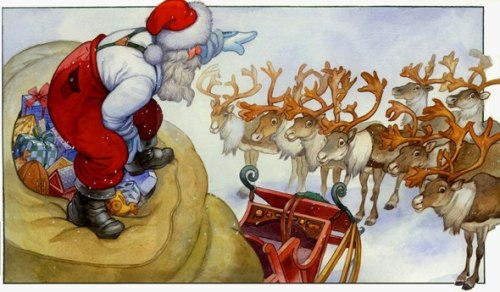
David Thorn Wenzel – http://kathytemean.wordpress.com/2013/08/24/illustrator-saturday-david-thorn-wenzel/
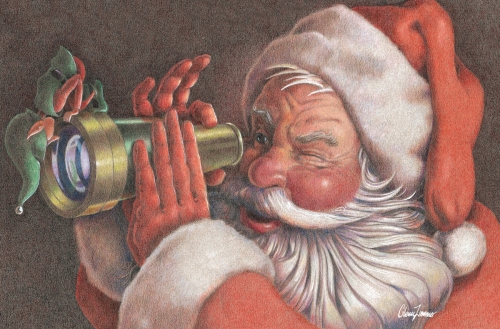
Glenn Zimmer – http://kathytemean.wordpress.com/2013/10/19/illustrator-saturday-glenn-zimmer/
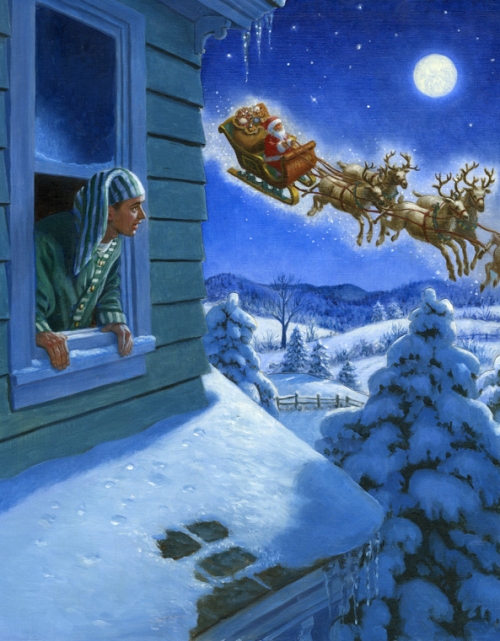
Ruth Sanderson – http://kathytemean.wordpress.com/2012/03/17/illustrator-saturday-ruth-sanderson/
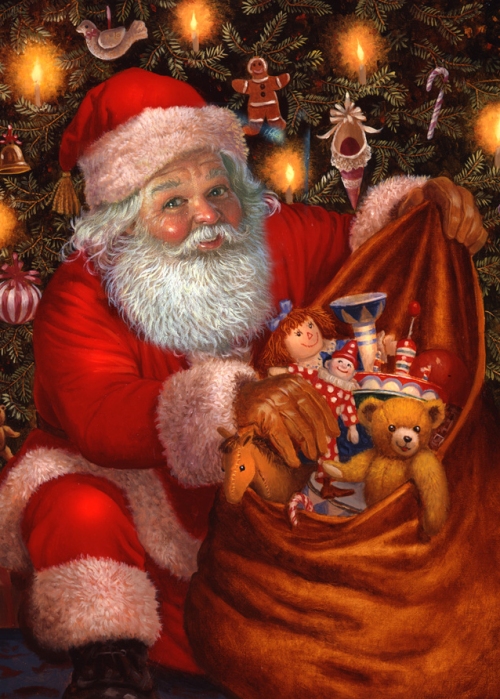
Ruth Sanderson – http://kathytemean.wordpress.com/2012/03/17/illustrator-saturday-ruth-sanderson/
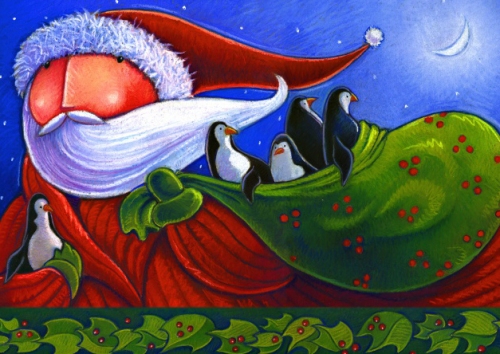
Michele Noiset – http://kathytemean.wordpress.com/2012/09/22/illustrator-saturday-michele-noiset/
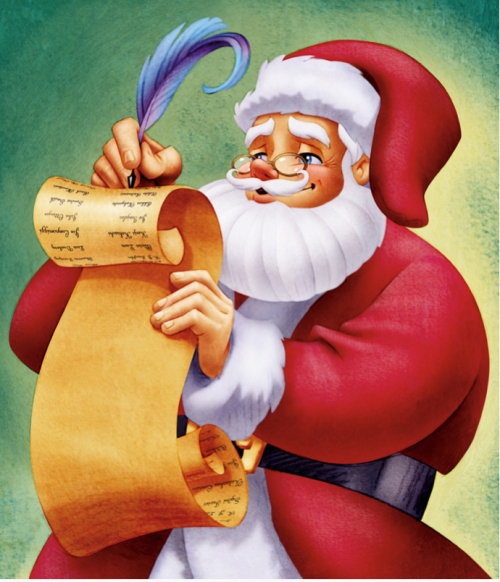
David Harrington – http://kathytemean.wordpress.com/2014/10/18/illustrator-saturday-david-harrington/

Micheal Garland – http://kathytemean.wordpress.com/2013/08/31/illustrator-saturday-michael-garland/
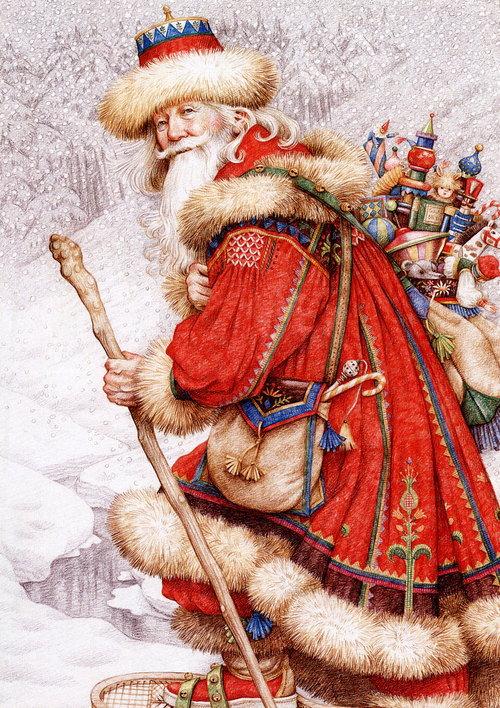
Yvonne Gilbert http://kathytemean.wordpress.com/2013/11/09/illustrator-saturday-yvonne-gilbert/

Carlyn Beccia – http://kathytemean.wordpress.com/2011/03/12/illustrator-saturday-carlyn-beccia/
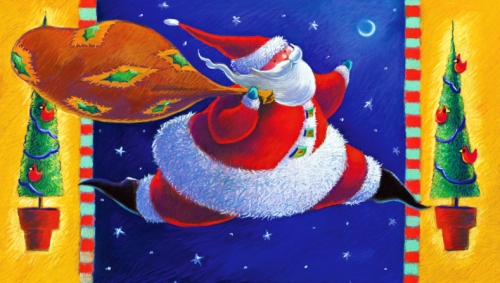
Michele Noiset – http://kathytemean.wordpress.com/2012/09/22/illustrator-saturday-michele-noiset/
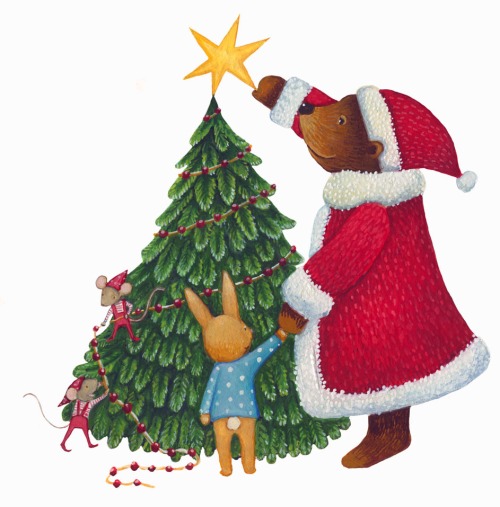
Sarah Dillard – http://kathytemean.wordpress.com/2012/08/19/illustrator-saturday-sarah-dillard/

Michael Garland – http://kathytemean.wordpress.com/2013/08/31/illustrator-saturday-michael-garland/
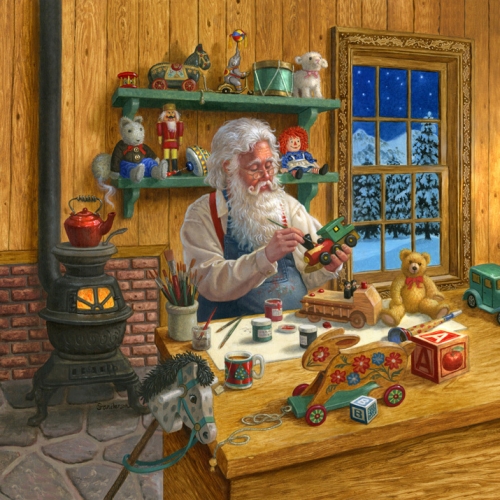
Ruth Sanderson – http://kathytemean.wordpress.com/2012/03/17/illustrator-saturday-ruth-sanderson/

Karen Romagna – http://kathytemean.wordpress.com/2011/05/14/illustrator-saturday-karen-romanga/
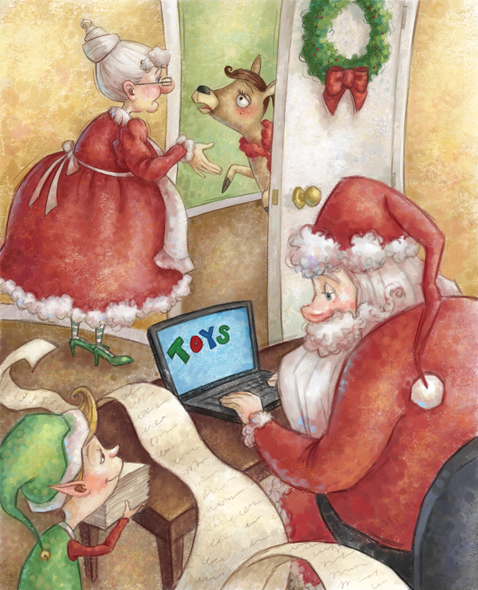
Shawna JC Tenney – http://kathytemean.wordpress.com/2013/04/20/illustrator-saturday-shawna-jc-tenney/
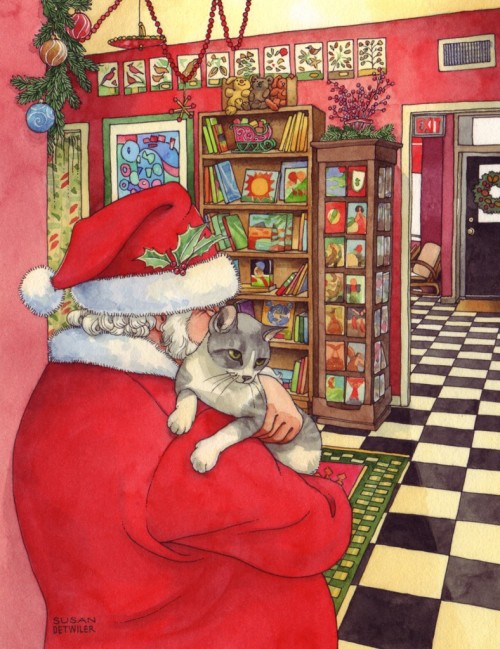
Susan Detwiler – http://kathytemean.wordpress.com/2013/03/09/illustrator-saturday-susan-detwiler/
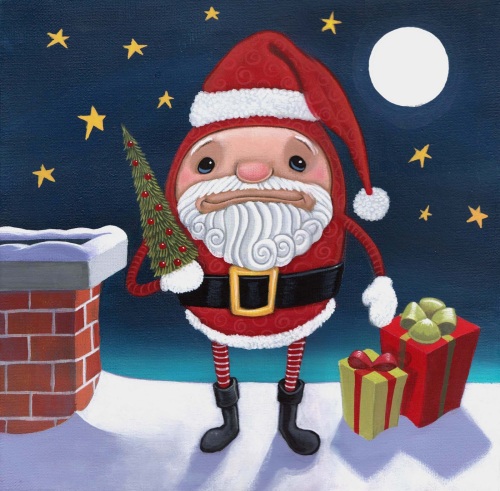
This Santa was done by Robert Eberz. Robert will be featured on Illustrator Saturday in January, so check back for more. www.roberteberz.com
Merry Christmas! Remember that I will be posting Christmas poems on Christmas Day, so if you have a Christmas poem, please email it to me.
Talk tomorrow,
Kathy
Filed under:
authors and illustrators,
Holiday,
Illustrator's Saturday,
inspiration,
Poems Tagged:
Christmas,
Santa Claus,
Santa illustrations from Illustrator Saturday 

By: Kathy Temean,
on 12/17/2014
Blog:
Writing and Illustrating
(
Login to Add to MyJacketFlap)
JacketFlap tags:
Editor & Agent Info,
need to know,
Places to Submit,
Kendra Shedenhelm,
Kimberly Brower,
Rachel Marks,
RF Literary,
Agent,
reference,
authors and illustrators,
opportunity,
Add a tag
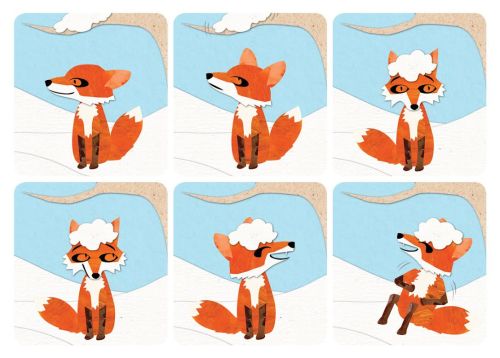
Kendra Shedenhelm sent this illustration in for us to enjoy. It makes me think of the song that was out a year ago titled, “What does the Fox say.” Must be Tee Hee Hee. The fourth book she has illustrated, “You, the Magician,” was released in November 2014, and can be viewed at http://www.youthemagician.com. http://www.kendrashedenhelm.com/

Kimberly Brower, Agent
Kimberly fell in love with reading when she picked up her first Babysitter’s Club book at the age of seven and hasn’t been able to get her nose out of a book since. Reading has always been her passion, even while pursuing her business degree at California State University, Northridge and law degree at Loyola Law School, Los Angeles. By joining the Rebecca Friedman Literary Agency in 2014, she has been able to merge her legal background with her love of books. Although she loves all things romance, she is also searching for books that are different and will surprise her, with empathetic characters and compelling stories.
Kimberly is interested in both commercial and literary fiction, with an emphasis in women’s fiction, contemporary romance, mysteries/thrillers, new adult and young adult, as well as certain areas of non-fiction, including business, diet and fitness.
Follow her on Twitter at @kimberlybrower
 Rachel Marks, Agent
Rachel began her career in the entertainment industry. Starting out as a production assistant, she has worked on popular shows like So You Think You Can Dance, The Biggest Loser, and The Golden Globe Awards Show. In 2011 her focus shifted to publicity and marketing where she worked for Sony Computer Entertainment, assisting in the launches of several video game titles. She is a graduate of University of Miami and lives in Los Angeles.
Rachel is interested in young adult, science fiction, fantasy, new adult and romance.
Follow her on Twitter at
How to submit: Email a query to Kimberly at kimberly [at] rfliterary.com or Rachel [at] rfliterary.com. Submit a brief query letter and your first chapter (pasted into the email, not to exceed fifteen double-spaced pages) and for security purposes, do not include any attachments unless specifically requested.
Talk tomorrow,
Kathy
Filed under:
Agent,
authors and illustrators,
Editor & Agent Info,
need to know,
opportunity,
Places to Submit,
reference Tagged:
Kendra Shedenhelm,
Kimberly Brower,
Rachel Marks,
RF Literary 

By: Kathy Temean,
on 12/15/2014
Blog:
Writing and Illustrating
(
Login to Add to MyJacketFlap)
JacketFlap tags:
Illustrator's Saturday,
Amalia Hoffman,
Michelle Kogan,
Marie Wagner,
inspiration,
Poems,
Holiday,
Chanukah,
illustrating,
authors and illustrators,
Add a tag
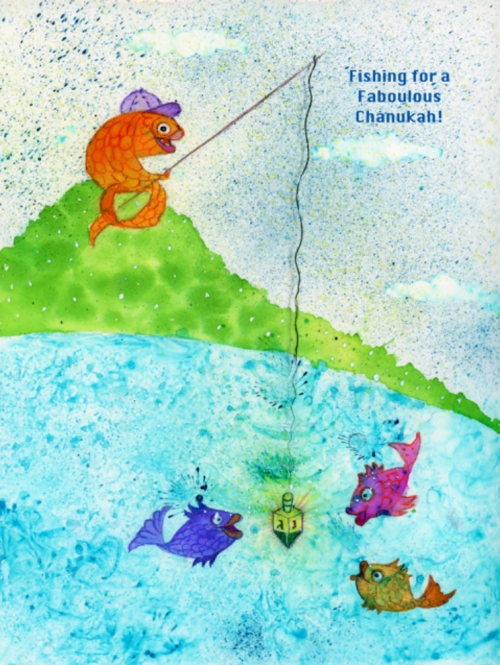
Amalia Hoffman sent this in to help us celebrate Chanukah. Amalia was featured on Illustrator Saturday: http://kathytemean.wordpress.com/2010/09/18/illustrator-saturday-amalia-hoffman/
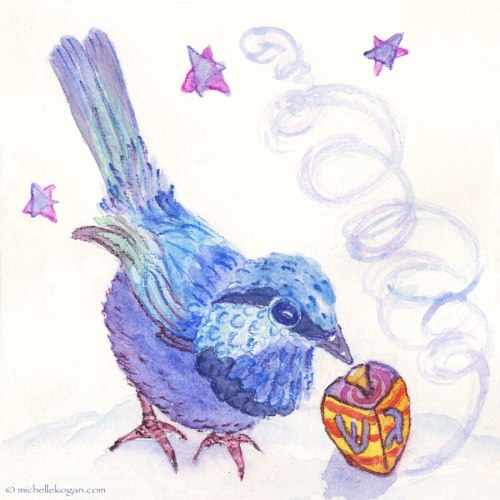
Michelle Kogan not only sent in the illustration above, but also the poem below to celebrate Hanukkah.
Hustle of Hanukkah
Michelle Kogan © 2014
Hustle of Hanukkah
somehow squeezing it in
In between holidays
falling often mid week
In between school and work
and numerous car trips
In between tradition
and finding your own way
In between Maccabees
the temples destruction
In between stolen oil
a miracle appears
In between night’s darkness
inner warmth radiates
In between lights glowing
throughout cold winter days
In between your mom’s arms
and between dad’s embrace
Making Hanukkah fit
in between for eight days
The poem below was sent in by Marie Wagner. Marie is an Artist, Author, Publisher, and Web designer. http://fineartamerica.com/profiles/marie-wagner.html?tab=artworkgalleries
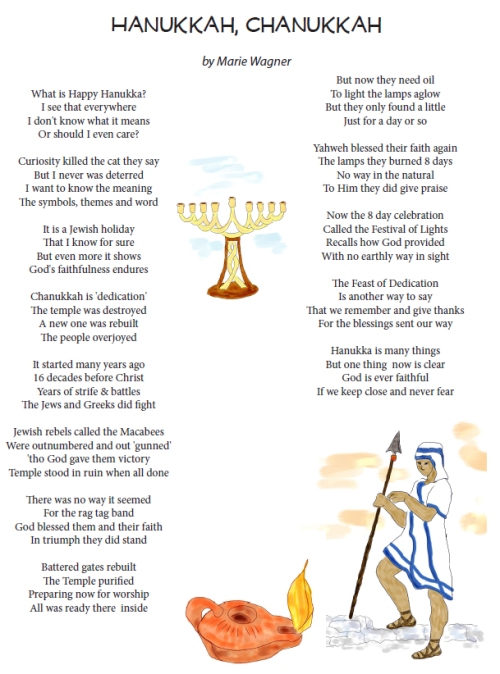
Thank you Amalia, Michelle, and Marie for sharing your work with us.
Hope all my Jewish friends around the world have a wonderful holiday!
Talk tomorrow,
Kathy
Filed under:
authors and illustrators,
Holiday,
illustrating,
Illustrator's Saturday,
inspiration,
Poems Tagged:
Amalia Hoffman,
Chanukah,
Marie Wagner,
Michelle Kogan 

By: Kathy Temean,
on 12/14/2014
Blog:
Writing and Illustrating
(
Login to Add to MyJacketFlap)
JacketFlap tags:
picture books,
chapter books,
publishers,
submissions,
Middle Grade Novels,
authors and illustrators,
opportunity,
need to know,
Artist opportunity,
Places to Submit,
Scarletta Press,
Add a tag
 SCARLETTA PRESS accept submissions ONLY during their reading period (September 1 to June 1).
SUBMISSIONS ARE CURRENTLY OPEN.
They use Submittable.
While they seek to publish new voices missing from the literary world, they also want to make sure your manuscript will fit their genre community. The books they choose to publish are intellectually stimulating, adding relevant knowledge to readers’ minds. Their Junior Readers and Kids imprints focus on literature and picture books with educational twists, exciting illustrations, and engaging plots.
Genres they focus on include:
- Children’s Fiction
- Middle-grade Fiction
- Educational Fiction/Nonfiction
- Picture Books
They do not publish plays, screenplays, short story collections, or poetry.
With your cover letter, please submit a synopsis of your book and one or two chapters, no more than 30 pages. They accept both agented and unagented manuscripts.
Illustrators: Don’t forget that picture book publishers need you, too.
You may submit electronic submissions through Submittable. If you are including images–no more than one total file–please make sure to save and upload them in a .pdf format.
You may send your hard copy submission to:
Editor
Scarletta
1201 Currie Avenue
Minneapolis, MN 55403
Please include a self-addressed stamped envelope (SASE) with any hard copy submissions to receive our response.
Special Instructions from Scarletta Publishers
*Please do not send submissions directly to any of our staff members.
**Note that due to the number of submissions we receive, we do not have the ability to notify authors of having received their submissions. While we understand that you may be anxiously awaiting a response to your submission, we ask that you do not send your manuscript more than once or send multiple inquiries about your submission’s status.
Talk tomorrow,
Kathy
Filed under:
Artist opportunity,
authors and illustrators,
chapter books,
Middle Grade Novels,
need to know,
opportunity,
picture books,
Places to Submit,
publishers,
submissions Tagged:
Scarletta Press 

By: Kathy Temean,
on 12/5/2014
Blog:
Writing and Illustrating
(
Login to Add to MyJacketFlap)
JacketFlap tags:
Illoustrator Saturday Favorites,
Which is your favorite?,
inspiration,
submissions,
illustrating,
authors and illustrators,
opportunity,
Illustrator Sites,
Illustrator's Saturday,
Add a tag
By: Kathy Temean,
on 12/5/2014
Blog:
Writing and Illustrating
(
Login to Add to MyJacketFlap)
JacketFlap tags:
Illoustrator Saturday Favorites,
Which is your favorite?,
inspiration,
submissions,
illustrating,
authors and illustrators,
opportunity,
Illustrator Sites,
Illustrator's Saturday,
Add a tag
By: Kathy Temean,
on 12/4/2014
Blog:
Writing and Illustrating
(
Login to Add to MyJacketFlap)
JacketFlap tags:
Call for Poems,
Joan Charles,
Submitting your article,
inspiration,
authors and illustrators,
opportunity,
need to know,
Marketing a book,
Places to sumit,
Pendred Noyce,
Call for Illustrations,
Add a tag
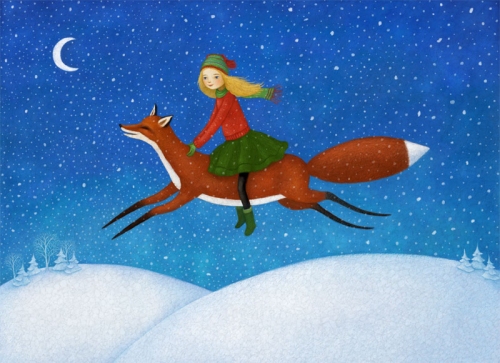
This wonderful holiday inspired illustration was sent in by Joan Charles. She is an illustrator, writer, graphic designer. Her work can be found in gallery exhibitions, magazines, and books. She illustrated the award-winning middle grade adventures Lost in Lexicon and The Ice Castle, written by Pendred Noyce. http://www.joancharles.com
In the last few months I have been asked how someone gets on Writing and Illustrating to show off their work, get an interview, and market a book. Here are the things I consider:
1. Do I know you? Have I met you?
2. Do you follow my blog?
3. Do you leave comments?
4. Do you promote Writing and Illustrating on your website, facebook, or blog?
5. Have you tweeted, reblogged, facebooked or shared information posted on Writing and illustrating?
6. Have you ever been featured on Writing and Illustrating?
7. Have you ever written or shared any information on Writing and Illustrating that would help other writers or illustrators?
8. If you haven’t done any of the above, do you have something to share that the readers who be interested in hearing about?
9. Have you published a book? Is there anything interested in how it got published or something you did that would interest readers?
10. Are you willing to do a book give-a-way?
I can’t know everyone by meeting them in person, but I can get to know you by leaving a comments or following my blog. I have many friends that I hope to meet someday. If you are writing or illustrating a book, you should be looking for people like me who have a large amount of followers and start working to make a connection.
I’m happy for everyone who gets something published, wins a contest, gets an agent, or wins an award and will be happy to include you in a Kudos post. But if you fit into the first seven on the list, you are considered family and will always get your successes promoted on Writing and Illustrating.
Tips: You shouldn’t wait until your book is about to come out to start building connections. Start doing that right now. Think about what type of things you could share that would help other writers. Maybe you don’t feel like you have anything to share, but I bet you do if you think about it. Have you attended a workshop or conference? Have you read a book on how to write or illustrate? You may be revising a story and have an epiphany. Did you learn anything useful during a critique? Maybe you run into an agent or editor who shared knowledge that could be shared? The substance of all these things could be used to write an interesting article. It would be a great way to get your name out there and be noticed.
Just remember when you want to promote yourself, you can’t look like that is all you are interested in doing.
Submissions: Send to Kathy.temean (at) gmail (dot) com. In subject area write, SUBMISSION ARTICLE FOR WRITING AND ILLUSTRATING. Introduce yourself, bio, and send me your article or express you interest in writing an article on…(subject and your idea).
I love when people have a topic they would like to write about that will help other writers and illustrators. If there is not enough meat to the article, I will give you some ideas or suggestions to pump it up. So write something interesting, helpful and start submitting your article to build your list of places and people who will help spread the words when success jumps in your path.
I am sure you have gone to blogs or signed up for newsletters that end up just talking about their book or books. If you haven’t you are lucky. I know I have and it is very disappointing. In fact that tactic could turn someone off and cause them not to buy anything with your name on it. So be careful.
Don’t get buried in only thinking about writing only for your own blog. If you get your article on another blog, you are getting access to a whole new group of people who might end up following your blog. Be smart. Even if you have ten published books, do not turn down someone with a large following saying things like, “I want people to come to my blog, not yours.” This is a statement from someone who doesn’t understand the importance of marketing and someone not savvy enough to see how getting exposure to thousands of new people could be a huge win.
Remember: I am not the only blog with a large following. There are many that could provide opportunities for you.
I am looking to do a Kudos post next week. Any good things happening out there? Let me know.
Call for Christmas Poems or Hanukkah Poems and or illustrations. Will be posting them later this month. Send to Kathy.temean(at)gmail.com Put December Illustration or December Poem in subject area. Thanks!
Talk tomorrow,
Kathy
Filed under:
authors and illustrators,
inspiration,
Marketing a book,
need to know,
opportunity,
Places to sumit Tagged:
Call for Illustrations,
Call for Poems,
Joan Charles,
Pendred Noyce,
Submitting your article 

By: Kathy Temean,
on 12/4/2014
Blog:
Writing and Illustrating
(
Login to Add to MyJacketFlap)
JacketFlap tags:
Call for Poems,
Joan Charles,
Submitting your article,
inspiration,
authors and illustrators,
opportunity,
need to know,
Marketing a book,
Places to sumit,
Pendred Noyce,
Call for Illustrations,
Add a tag
This wonderful holiday inspired illustration was sent in by Joan Charles. She is an illustrator, writer, graphic designer. Her work can be found in gallery exhibitions, magazines, and books. She illustrated the award-winning middle grade adventures Lost in Lexicon and The Ice Castle, written by Pendred Noyce. http://www.joancharles.com
In the last few months I have been asked how someone gets on Writing and Illustrating to show off their work, get an interview, and market a book. Here are the things I consider:
1. Do I know you? Have I met you?
2. Do you follow my blog?
3. Do you leave comments?
4. Do you promote Writing and Illustrating on your website, facebook, or blog?
5. Have you tweeted, reblogged, facebooked or shared information posted on Writing and illustrating?
6. Have you ever been featured on Writing and Illustrating?
7. Have you ever written or shared any information on Writing and Illustrating that would help other writers or illustrators?
8. If you haven’t done any of the above, do you have something to share that the readers who be interested in hearing about?
9. Have you published a book? Is there anything interested in how it got published or something you did that would interest readers?
10. Are you willing to do a book give-a-way?
I can’t know everyone by meeting them in person, but I can get to know you by leaving a comments or following my blog. I have many friends that I hope to meet someday. If you are writing or illustrating a book, you should be looking for people like me who have a large amount of followers and start working to make a connection.
I’m happy for everyone who gets something published, wins a contest, gets an agent, or wins an award and will be happy to include you in a Kudos post. But if you fit into the first seven on the list, you are considered family and will always get your successes promoted on Writing and Illustrating.
Tips: You shouldn’t wait until your book is about to come out to start building connections. Start doing that right now. Think about what type of things you could share that would help other writers. Maybe you don’t feel like you have anything to share, but I bet you do if you think about it. Have you attended a workshop or conference? Have you read a book on how to write or illustrate? You may be revising a story and have an epiphany. Did you learn anything useful during a critique? Maybe you run into an agent or editor who shared knowledge that could be shared? The substance of all these things could be used to write an interesting article. It would be a great way to get your name out there and be noticed.
Just remember when you want to promote yourself, you can’t look like that is all you are interested in doing.
Submissions: Send to Kathy.temean (at) gmail (dot) com. In subject area write, SUBMISSION ARTICLE FOR WRITING AND ILLUSTRATING. Introduce yourself, bio, and send me your article or express you interest in writing an article on…(subject and your idea).
I love when people have a topic they would like to write about that will help other writers and illustrators. If there is not enough meat to the article, I will give you some ideas or suggestions to pump it up. So write something interesting, helpful and start submitting your article to build your list of places and people who will help spread the words when success jumps in your path.
I am sure you have gone to blogs or signed up for newsletters that end up just talking about their book or books. If you haven’t you are lucky. I know I have and it is very disappointing. In fact that tactic could turn someone off and cause them not to buy anything with your name on it. So be careful.
Don’t get buried in only thinking about writing only for your own blog. If you get your article on another blog, you are getting access to a whole new group of people who might end up following your blog. Be smart. Even if you have ten published books, do not turn down someone with a large following saying things like, “I want people to come to my blog, not yours.” This is a statement from someone who doesn’t understand the importance of marketing and someone not savvy enough to see how getting exposure to thousands of new people could be a huge win.
Remember: I am not the only blog with a large following. There are many that could provide opportunities for you.
I am looking to do a Kudos post next week. Any good things happening out there? Let me know.
Call for Christmas Poems or Hanukkah Poems and or illustrations. Will be posting them later this month. Send to Kathy.temean(at)gmail.com Put December Illustration or December Poem in subject area. Thanks!
Talk tomorrow,
Kathy
Filed under:
authors and illustrators,
inspiration,
Marketing a book,
need to know,
opportunity,
Places to sumit Tagged:
Call for Illustrations,
Call for Poems,
Joan Charles,
Pendred Noyce,
Submitting your article 
By: Kathy Temean,
on 12/3/2014
Blog:
Writing and Illustrating
(
Login to Add to MyJacketFlap)
JacketFlap tags:
list,
Book,
picture books,
inspiration,
YA Books for Adults,
Goodreads,
Young Adult Novel,
Middle Grade Novels,
authors and illustrators,
2014 Goodreads Best Books,
Adult Book for YA Lovers,
Add a tag
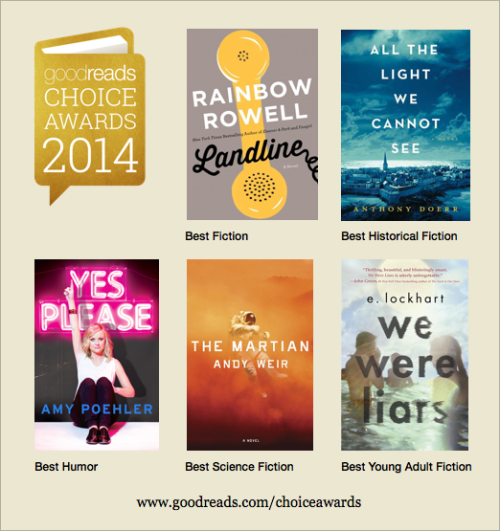
As writers and illustrators the holiday season provides an opportunity to support the publishing industry by buying a few books as gifts for friends and family.
Goodreads announced their 2014 Readers Choice Awards. Click the picture below to review the nominees and the winners in all categories.
Here are 25 YA books that Epic Reads suggests for Adults. How many have you read?
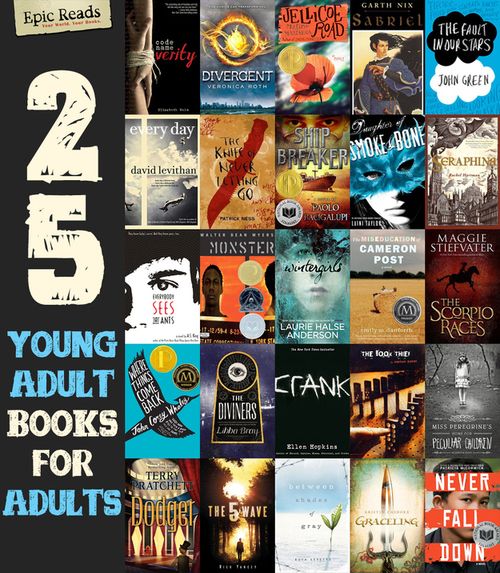
Out of the books pictured above I have read 7 and have 4 bought and ready to be read.
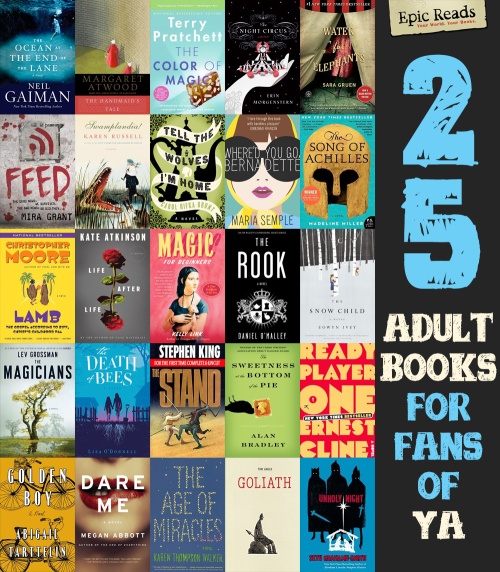
Out of the 25 Adult Books for Fans of YA I have read 4 and 3 are waiting to be read.

From the books pictured above, I have read 23 and 12 are bought and waiting.
There are so many more wonderful books I have read this year. How many of these books did you read? Did you have a book that was your favorite? It doesn’t have to be pictured. I’d love you to share.
Oh, don’t forget the picture books: Each time you buy a picture book you support an illustrator and a writer with your purchase and the book you buy might be the book that puts a child on the path to enjoying books for the rest of their life.
Talk tomorrow,
Kathy
Filed under:
authors and illustrators,
Book,
inspiration,
list,
Middle Grade Novels,
picture books,
Young Adult Novel Tagged:
2014 Goodreads Best Books,
Adult Book for YA Lovers,
Goodreads,
YA Books for Adults 

By: Kathy Temean,
on 11/26/2014
Blog:
Writing and Illustrating
(
Login to Add to MyJacketFlap)
JacketFlap tags:
Contest,
inspiration,
Poems,
Holiday,
authors and illustrators,
Eileen Spinelli,
Happy Thanksgiving,
Carol Murray,
Spaghetti Smiles,
Better Than Gold,
Thanksgiving Poem Contest,
Add a tag
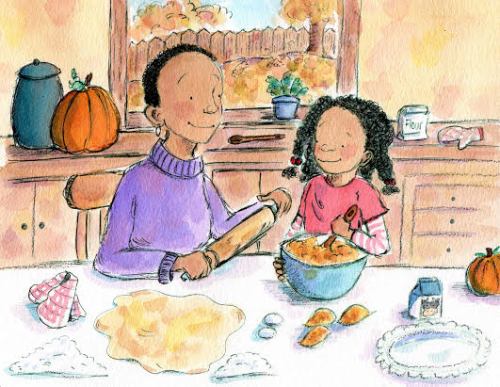
Michelle Henninger sent this illustration in to help us celebrate Thanksgiving. Michelle prefers a traditional approach of pen/ink, and watercolor: with a touch of digital thrown in for good measure. She is a member of the Society for Children’s Book Writers and Illustrators, she was a New England SCBWI Ann Barrows Illustration Scholarship recipient. She was the first 2014 featured illustrator on Illustrator Saturday. She is represented by Christina Tugeau at CATugeau.
THANKSGIVING PRAYER
by Eileen Spinelli
Thank you for the world–still sweet.
Thank you for the food we eat.
Thank you for the honeyed sun
that spoons its light on everyone.
Thank you for the leaves that fall
in glowing piles near the wall,
for kindness in a stranger’s face
and every unexpected grace.
Thank you for the starry dark,
for children laughing in the park,
for cozy towns and sleepy farms,
for dreamers, dancers, babes in arms.
Than you for all hearts that sing
of hope in spite of everything.
Fall Favorites
by Carol Murray
Pumpkins, round, upon the ground,
and children playing ball,
Scarecrow tips his tattered hat,
and waves to one and all.
Sleek black cats on fuzzy mats,
reclining, large and small,
and every size has starlit eyes,
like diamonds at The Mall.
Wine is chilled, and home is filled
with friends, both short and tall.
Hooray! Hooray! Thanksgiving Day.
Favorite things of Fall.
by Carol Murray
A Thanksgiving Toast
Here’s to years of happiness
and months of sunny skies,
To weeks of reaching mountain peaks,
and days of caring eyes,
To hours of hope and tenderness,
and minutes of delight,
On second thought, we wish you love,
We’re giving thanks tonight.
Thank you to Michelle, Eileen, and Carol for sharing their work to help us celebrate Thanksgiving. Hope everyone enjoys the day.
Winners:
Darlene Beck-Jacobson won Gayle Aanensen’s book BETTER THAN GOLD.
Joanne Roberts won SPAGHETTI SMILES by Margo Sorenson.
Congratulations! Winner please send me your addresses so they can be sent out.
You may wonder why I did not post the poems for the Thanksgiving Poem Contest yesterday. That is because Carol Murray was the only one to send in a poem for the contest and the default winner. Thank you Carol.
Talk tomorrow,
Kathy
Filed under:
authors and illustrators,
Contest,
Holiday,
inspiration,
Poems Tagged:
Better Than Gold,
Carol Murray,
Eileen Spinelli,
Happy Thanksgiving,
Spaghetti Smiles,
Thanksgiving Poem Contest 

By: Kathy Temean,
on 11/21/2014
Blog:
Writing and Illustrating
(
Login to Add to MyJacketFlap)
JacketFlap tags:
Interview,
picture books,
inspiration,
Advice,
Process,
illustrating,
authors and illustrators,
John Lithgow,
How to,
Leeza Hernandez,
Illustrator's Saturday,
Never Play Music Right Next to the Zoo,
Add a tag
Leeza Hernandez is an award-winning illustrator and children’s book author, hails from the south of England, but has been living in New Jersey since 1999. In 2004 she switched from newspaper and magazine design to children’s books, and hasn’t looked back. With a few books now under her belt, she’s currently working on three new projects: a follow up to Dog Gone! called Cat Napped; a sequel to Eat Your Math Homework called Eat Your Science Homework, other released this year. In 2013 she illustrated a picture book written by acclaimed actor and author John Lithgow. Follow Leeza on Twitter @leezaworks. She also took over my place as the Regional Advisor for the New Jersey SCBWI chapter and is doing a great job.
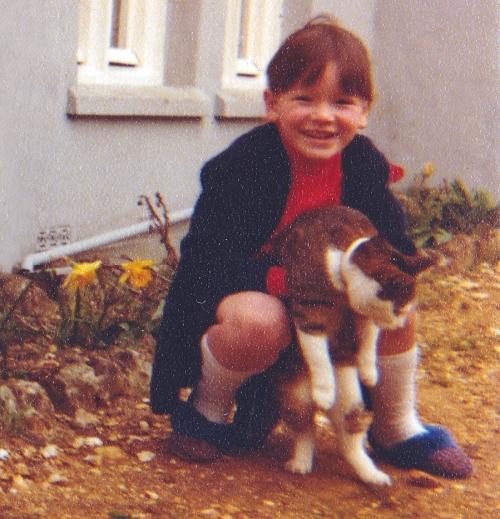
Below is Leeza at six years old with her cat Minnie Weasle!
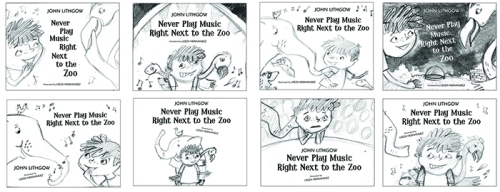
Here is Leeza explaining her process:
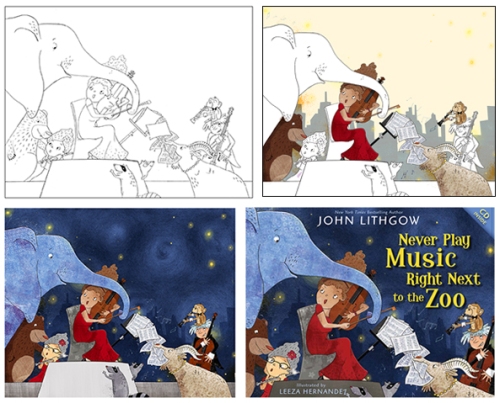
The cover of Never Play Music Right Next to the Zoo took a fair amount of working out—between not giving too much away and showing to little that it looked too vague. The images show a handful of the different covers that were sketched up, then the progression of the final color cover.
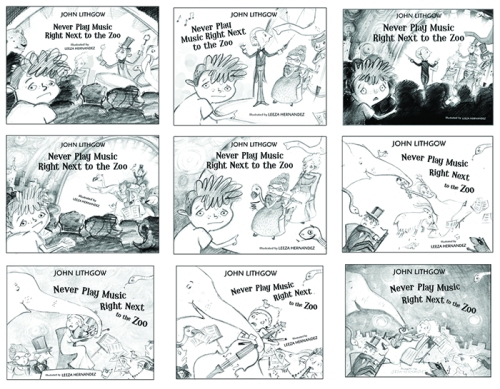
These are the thumbnail sketches for the book layout.
Because there were so many animals in Never Play Music Right Next to the Zoo, I kept all my research pictures organized in a jumbo ring binder.

But, no matter how hard I looked, I just couldn’t find an image of a yak playing a sax so had to use some creative license!

Below you can see the process of the cover art.
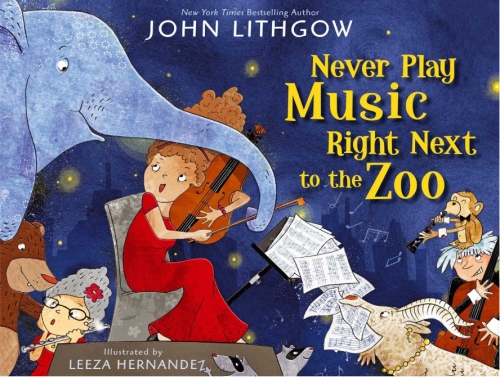
Below is an up close look at the final cover.
What caused you to move from the UK to the US?
Work. I took an art director position at a newspaper in the late 90s which was the field I worked in back then.
When did you decide you wanted to illustrate for children?
It wasn’t a conscious decision really, but in the early 2000s I discovered Illustration Friday (www.illustrationfriday.com)—a great source of inspiration but also a way to help you create illustrations for yourself based upon a weekly word prompt. Browsing through the site, one link led to another and I eventually landed at SCBWI (www.scbwi.org) and that was that!

This image was created for the Illustration Friday prompt “Wisdom” and received an American Illustration selection back in the early 2000s. I added it to my portfolio among a handful of painted images and it was what art directors responded to the most. I was encouraged to create more!
What was the first picture book that you illustrated? And how did that contract come your way?
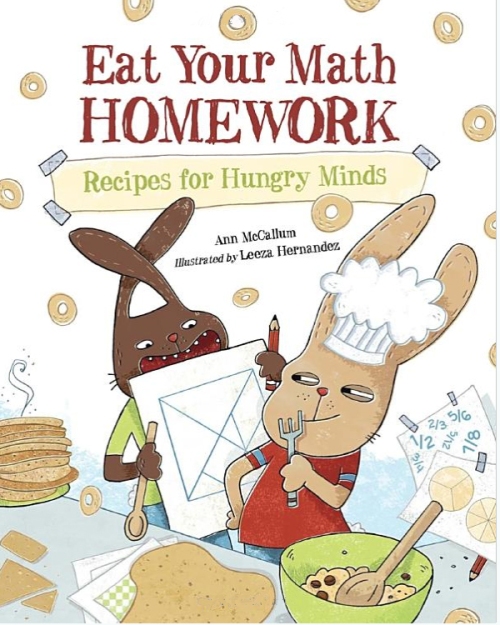
Eat Your Math Homework was the first trade picture book I was hired to illustrate, which came about after attending a Rutgers One-on-One Plus conference (ruccl.org). I met an editor at the luncheon who took my promo postcard away with her and about six months later the designer reached out to my agent asking if I was available-yay!
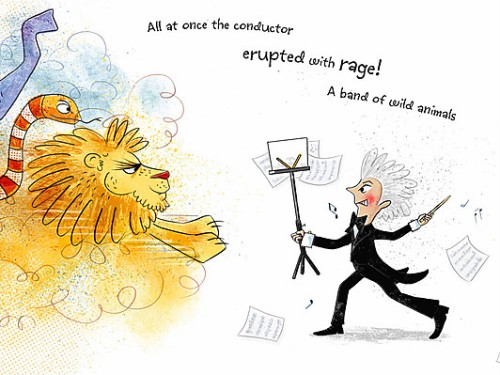
How did you connect with John Lithgow to illustrate his book, Never Play Music Right Next to the Zoo ?
I was asked to do some samples (along with some other illustrators) for a book written by a ‘high-profile’ author but I didn’t know who it was until I found out I was picked for the project. It was all very mysterious and exciting!
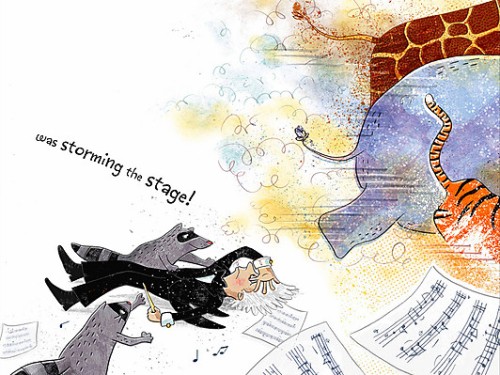
Have you met John Lithgow?
Yes, he’s lovely. We launched the book together in New York, it was so much fun. He sang his songs. I spared the audience and did not sing!
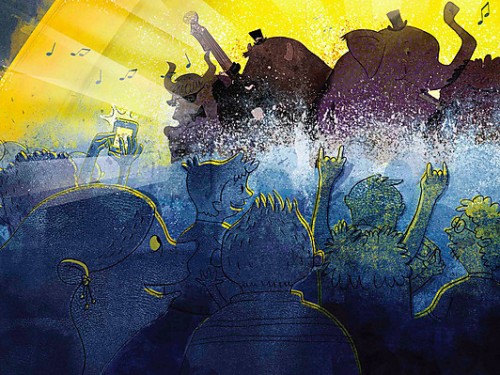
How long did you have to illustrate Never Play Music Right Next to the Zoo?
This was one of the quickest turnaround books I have worked on and it was 40 pages. From initial sketches, through revisions and to final art was a little less than eight months total.
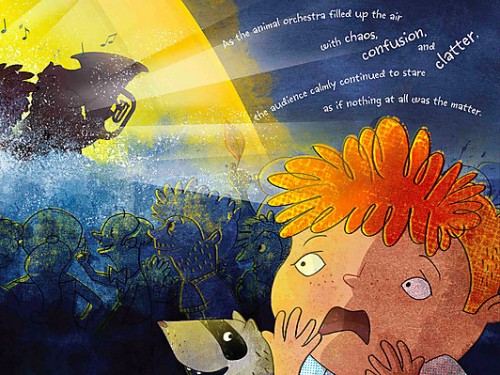
I see you illustrated a second book with Ann McCallum this year, titled Eat Your Science Homework. Did you sign a two-book deal when you illustrated Eat Your Math Homework in 2011?
No two-book deal. It was simply an organic progression. Ann had an idea and submitted her proposal for the science book and a few months after they acquired the manuscript, Charlesbridge asked if I’d
illustrate it.
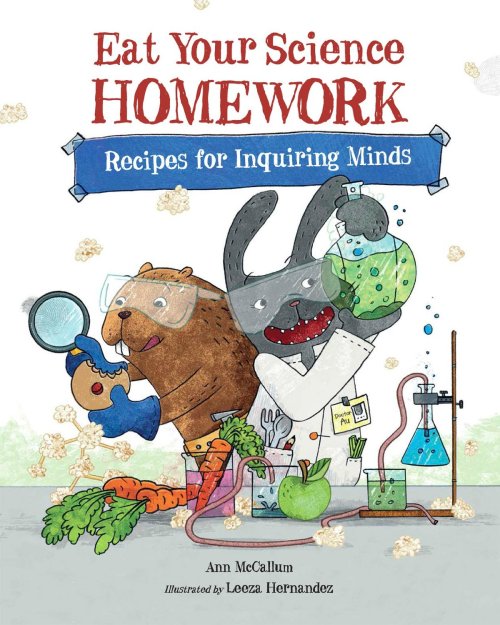
Will there be a third book with Ann?
Yes! Eat Your U.S. History Homework is due to release in late 2015.
I am assuming that Cat Napped! published by G. P. Putnam’s Sons came about due to the previous book you wrote and illustrated titled, Dog Gone! Can you tell us the story behind these two books?
Back in 2009 I won the Tomie de Paola portfolio award at the New York SCBWI conference—which was amazing. As a result, I was invited in to the Penguin offices to meet with an editor, publisher and art director and they looked at my work as well as a sample and manuscript for Dog Gone! and they took it. I was beyond thrilled and so, so grateful for the opportunity.
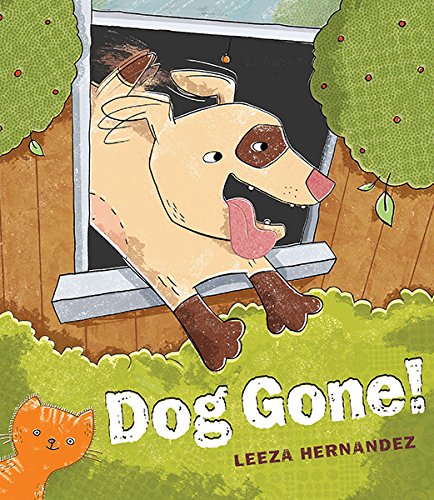
During the time I worked on Dog Gone! I had this idea that I wanted to create a cat book in the same vein and I already had the title Cat Napped! noodling around in my head, but it took a while to flesh out the story. I remember having submitted the story along with a couple of other ideas to the editor and right after Dog Gone! released they took it.
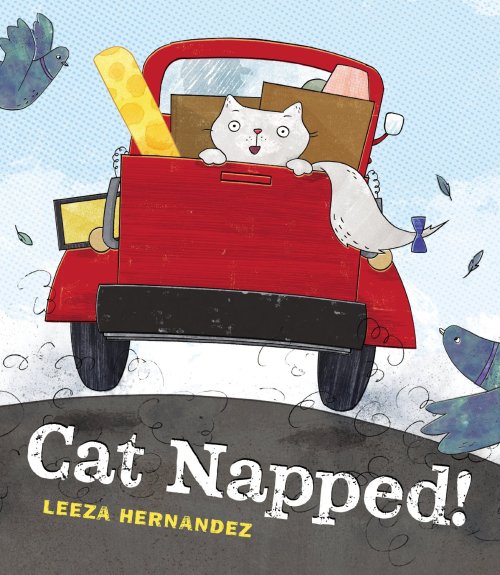
Have any of the books you worked on won any awards?
Eat Your Science Homework was awarded a 2014 Junior Library Guild selection—awesomesauce!
Do you have plans to write and illustrate another book?
Hahaha, yes of course! I hope I never stop.

What do you consider your first big success?
Wow, that’s a tough question. I’m not sure I can measure one big success that easily. Having a book published is amazing, but I also consider the ever-evolving process as a series of successful stepping-
stones and I do a little happy dance each time I move to the next one—because they all teach me something about myself and/or my work. Creative folks are such sensitive creatures and it can be
intimidating to put our work out there in front of people, so each time we are brave and face our fears head on, that’s a success. Actually, when I attended a SCBWI conference for the first time, I was so overwhelmed I almost didn’t go back the next day—so I’d say not giving up right off the bat was my first big success!
For pencil work, I use 2H, HB, 2B and 5 or 6B pencils on Arches hotpress 140lb paper.
 What is on the drawing board now?
My schedule has been a little nuts lately so I am taking a rest-of-the-year break and finally getting around to updating my website, which has been somewhat neglected.
Do you ever use Corel Painter or Photoshop when illustrating?
I ‘collage’ in Photoshop. I take all the pieces that I create by hand, scan them in, then slice ‘n’ dice them into a final illustration. I think of Photoshop as my digital scissors and glue, but I don’t actually illustrate with Photoshop if that makes sense, like, I’m not drawing or painting digitally using brushes and filters.
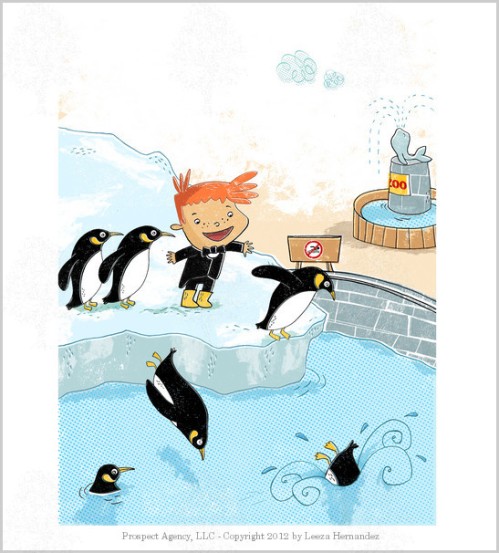
Do you own a graphic tablet?
No. If you mean a Cintiq or Wacom, that is. I’ve seen them in action though, wow!
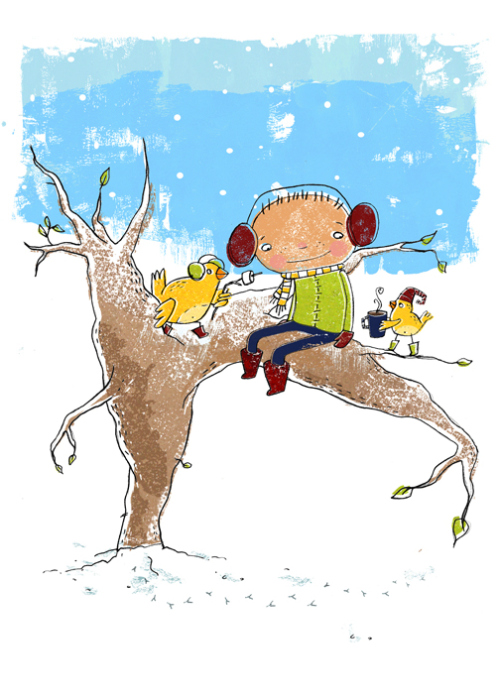
Is there one thing that you did or happened that you feel really pushed your career to the next level?
I joined SCBWI. So far, this has been an amazing journey of education, connections, opportunities, projects and rewards, but it all started with this incredible organization that continues to play a role—LOVE SCBWI!

Do you take pictures or other research before you start a project?
Before and during—yes. Having reference material gives me a much better understanding of what I am drawing than simply imagining. I like to begin by drawing realistically before I think about characterizing for a book because it gives me an accurate sense of anatomy, behavior, body language, etc., even though they’re very loose drawings. There were a number of animals in Never Play Music Right Next to the Zoo that I hadn’t drawn before, so I filled a ring binder with reference just for that project.
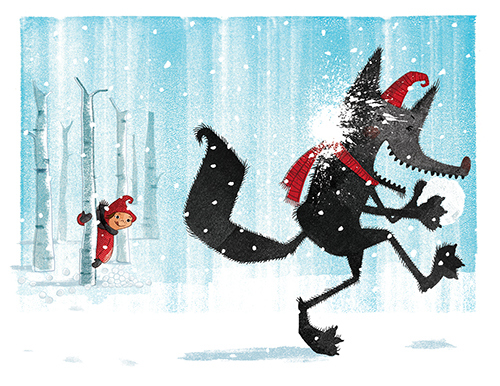
The original pick-up truck for Cat Napped! was a struggle, but after sharing with my editor, we realized it was too square and modern, so I went back and researched vintage trucks from the 40s and 50s. The end result was a bit of a hybrid but its softer, curvier edges suited the tone of the book far better than the angular truck I had originally drawn.
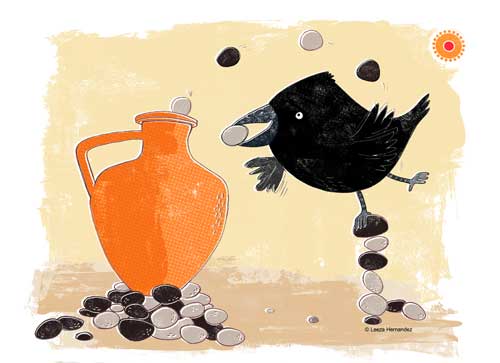
The internet is a powerful tool—National Geographic (nationalgeographic.com), Nat Geo Kids (kids.nationalgeographic.com), NASA (nasa.gov), and Pinterest (pinterest.com) are some of my favorites but discipline is key. The amount of research I do depends upon the project but I have to be careful with the amount of time I spend researching versus creating the art.
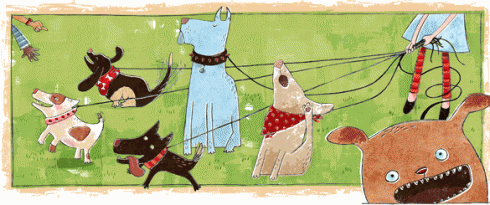
I use a timer to stay on top of it. And even if I am not researching for a particular project, I carry a sketchbook with me and either have my phone or camera for taking any pictures. Inspiration strikes when I least expect it so I like to be as prepared as possible.
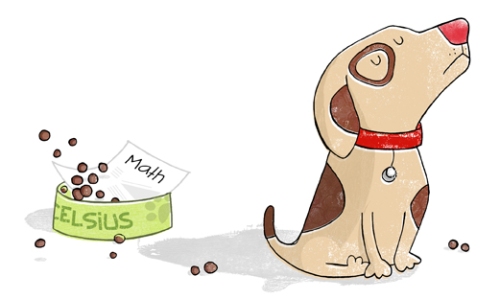
Have you found most art directors and editors give you a lot of freedom when illustrating a book? Do they want to be involved all the way through the process?
Once, I was given very specific art notes for an educational book but the turnaround time was tight, so the notes were helpful for me to jump right in. I’ve received minimal notes for nonfiction projects if there was a point that needed to be demonstrated visually for some specific text. For example: the Homework books sometimes have charts.
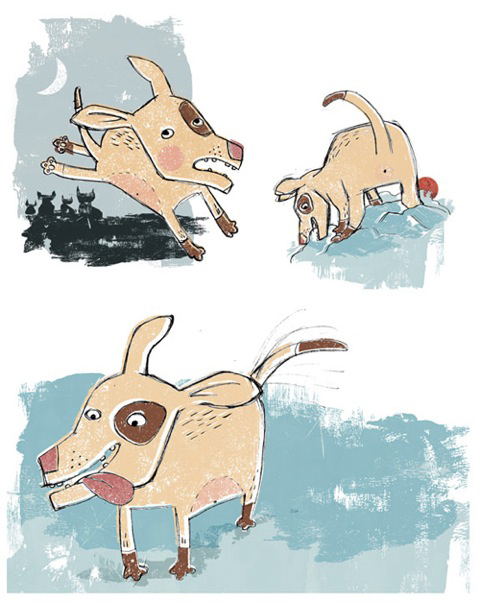
For the fictional projects, I’m pretty much left to it for the first round of sketches, then the art director and/or editor and I discuss together. Sometimes, I’ll offer up additional sketch options for a handful of spreads if I have lots of ideas and can’t decide which direction to go. There can be a lot of back and forth on the cover, though.
What is the one thing in your studio that you could not live without?
My art materials—pencils, brushes, paper, inks, sketchbooks—I’d be kinda lost without them!
Do you try to spend a specific amount of time working on your craft?
Yes, even if it’s only for ten minutes, that’s my rule.
Do you have any career dreams that you want to fulfill?
To travel, keep making art, and continue creating books for young readers—that would be lovely!
Thank you Leeza haring your journey and process with us. Can’t wait to see your career go forward. You can visit Leeza at her website: http://www.leezaworks.com to see more of her work.
If you have a moment I am sure Leeza would love to read your comments. I enjoy them too. Thanks!
Talk tomorrow,
Kathy
Filed under:
Advice,
authors and illustrators,
How to,
illustrating,
Illustrator's Saturday,
inspiration,
Interview,
picture books,
Process Tagged:
John Lithgow,
Leeza Hernandez,
Never Play Music Right Next to the Zoo 

By: Kathy Temean,
on 11/15/2014
Blog:
Writing and Illustrating
(
Login to Add to MyJacketFlap)
JacketFlap tags:
2014 Highlights Fiction Contest Winners,
Contest,
writing,
publishers,
authors and illustrators,
opportunity,
children writing,
Highlights Fiction Contest,
Places to sumit,
Add a tag
Highlights Fiction Contest

HIGHLIGHTS 2015 FICTION CONTEST GUIDELINES
CATEGORY:
Mystery stories
PRIZES:
Three prizes of $1,000 or tuition for any Highlights Foundation Founders Workshop. (For a complete list of workshops, visit http://www.highlightsfoundation.org)
ENTRY DATES:
All entries must be postmarked between January 1 and January 31, 2015.
RULES:
No entry form or fee is required.
Entrants must be at least 16 years old at the time of submission.
We welcome work from both published and unpublished authors. All submissions must be previously unpublished and not found online.
Stories may be any length up to 750 words. Indicate the word count in the upper right-hand corner of the first page of your manuscript.
No crime, violence, or derogatory humor.
Entries not accompanied by a self-addressed, stamped envelope will not be returned.
Manuscripts or envelopes should be clearly marked FICTION CONTEST. Those not marked in this way will be considered as regular submissions to Highlights.
SEND ENTRIES TO:
FICTION CONTEST
Highlights for Children
803 Church Street
Honesdale, PA 18431
WINNERS:
The three winning entries will be purchased by Highlights and announced on Highlights.com in June 2015. All other entries will be considered for purchase by Highlights. For details about our purchase policies, please see our contributor guidelines: https://www.highlights.com/contributor-guidelines
Highlights for Children Fiction Contest Winners for 2014:
“Harold’s Hat” by Mike Allegra
“Easter with Baba Lena” by Vila Gingerich
“Heart Surprises” by Clare Mishica
Talk tomorrow,
Kathy
Filed under:
authors and illustrators,
children writing,
Contest,
opportunity,
Places to sumit,
publishers,
writing Tagged:
2014 Highlights Fiction Contest Winners,
Highlights Fiction Contest 

By: Kathy Temean,
on 11/14/2014
Blog:
Writing and Illustrating
(
Login to Add to MyJacketFlap)
JacketFlap tags:
Interview,
picture books,
inspiration,
Process,
illustrating,
authors and illustrators,
Illustrator's Saturday,
Maja Sereda,
Illustrator Journey,
University of Pretoria,
Add a tag
 Maja Sereda has illustrated number of picture books published in English, Afrikaans and other African languages. She has received 3 ATKV awards for best illustration (category ages 3–6) in 2008, 2009, 2011. And her book A kite’s flight written by W. Gumede won the Crystal Kite member’s choice award for the Africa region, 2011. Her latest book La Grande Fleur, written by Yves Pinguilly, was published in France (2013).
Maja tackles each project with great passion and enthusiasm, which she best communicates through her fun and quirky illustrations. Maja works in soft pastels as well as digital media. She loves drawing all creatures great and small, including little children!
Here is Maja explaining her process:

I create a sketch for my illustration using a colour pencil on 60gsm paper.

The sketch is scanned and rough colour dropped in.
I trace image onto final pastel paper and start pasteling.

I always work from left to right or from the center outwards in order not to smudge the pastel. It is a very delicate medium.
To create details I use pastel pencils, whereas for the fine outlines I once again bring in a colour pencil. Most often a brown.
Background is drawn last.
Final Illustration

Below: Snow Games written by Joanna Marple (www.utales.com) 2012
LA GRANDE FLEUR COVER
La Grande Fleur was published in France by Oscar Editeur in 2013.
The book was part of the French/South African season.
La Grande Fleur interior art.
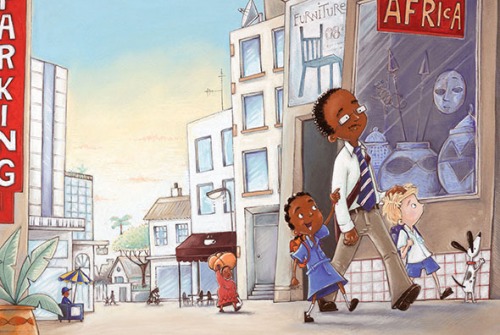
How long have you been illustrating?
I’ve been illustrating books since 2007.
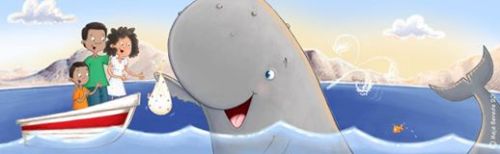
What made your family move from Poland to South Africa when you were young?
My dad received a work contract and decided to take it. It was supposed to be a temporary move, but I fell in love with South Africa and persuaded my family to stay.
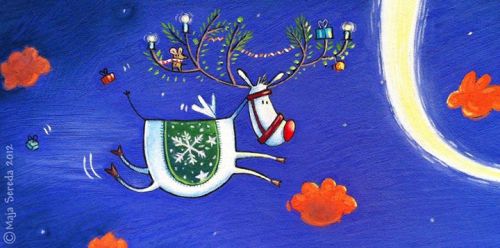
Have you ever gone back to Poland?
I like to visit from time to time. I still have family and primary school friends living in Poland.
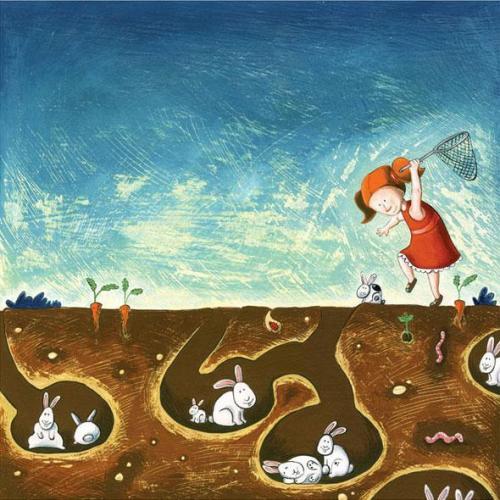
What University did you attend and what did you study?
I studied BA (Information Design) aka graphic design at University of Pretoria.
What was the first painting or illustration that you did where someone paid you for your artwork?
I did a number of illustration jobs while working in the design/advertising industry, such as story boarding or product drawings. I believe the very first paid illustration job was my first book.
What type of job did you do right after you graduated?
I moved to Dublin, Ireland for a year where I worked for a marketing company as a junior art director.
When did you decide you wanted to illustrate for children?
It was in my final year of studies. I realized that I’ve chosen the wrong field. Design was simply not for me. It took me a few years before I could start freelancing and working as a full time illustrator.

How many picture books have you illustrated?
Approximately 17 picture books, however I’m not counting illustration work done for educational books.
Were any of them published by a US Publisher?
Unfortunately not, however I’m hoping it will happen one day soon. I’m always dreaming and wishing.
What was the first picture book that you illustrated? And how did that contract come your way?
My sister put me in touch with a client who wanted to illustrate a story that her father wrote. It was small private project. Out of that book, an illustration of mine title ‘catching rabbits’ was born, which I sent to a local South African publisher. They replied immediately and asked me to pitch for a book. I had my first real book contract within in a week. I was over the moon.
How do you connect with art directors and editors and find illustration work?
So far I’ve been very lucky. Work finds me. Nevertheless, from time to time I do like to contact a publisher via email and send them my updated portfolio.
Are you represented by artist agency? If so, who? If not would you like to find one?
I’m not represented by anyone at the moment and I am currently looking for US representation. In South Africa, the market is very small and a freelance illustrator can easily approach publishers directly.
It looks like you have illustrated books in many different languages. How do publishers help you work with a book that is written in another language?
Even though my Afrikaans isn’t very good, I do understand it and therefore am able to read a manuscript without translation. Many of the other African languages are sent to me with the English translation. I’m currently studying French. One of my latest books LA GRANDE FLEUR written by Yves Pinguilly, was also translated for me into English.
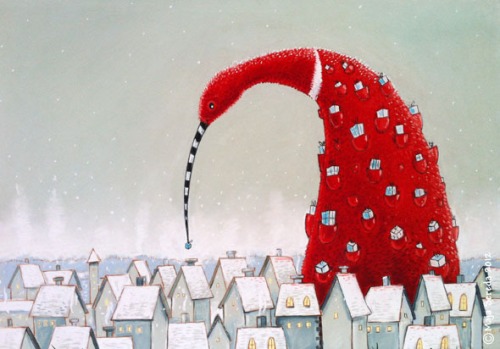
Have you done any illustrating for children’s magazines?
I do regular work for a local magazine Hoezit! It is also an Afrikaans publication.
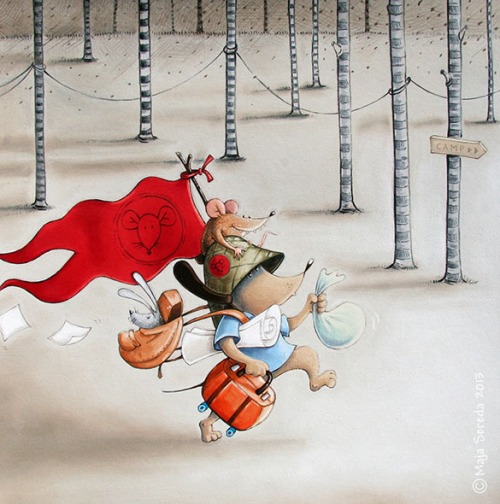
Have you done any work for educational publishers?
I work for educational publishers on a regular basis. This work however doesn’t inspire me and therefore doesn’t feature in my portfolio. I prefer to work on picture books for young children.
What is your favorite medium to use to do your illustrations?
At the moment, it’s soft pastels. I simply love the medium – the intensity and variety of colour is incredible. Most of my recent work has been done in pastels. In the past, I’ve worked with gouache, acrylic, ink, oil and Photoshop.
Has that changed over time?
I have grown a lot as an illustrator, I don’t think one ever stops growing and learning. When I started illustrating my focus was simply on creating sweet, quirky illustrations, but now I’m leaning more and more towards fantasy and also more personal work.

What do you consider is your first big success?
My first book received an award for best illustration, it definitely inspired me to keep going.
Do you ever want to write and illustrate a picture book?
Yes, mostly definitely. I write and sketch ideas often – my big aim is to set aside some time and only focus on doing my own book. Perhaps this coming year! Recent trip to Reunion Island was very inspiring and I would like to use some of the incredible imagery in my book.
Would you be open to working with an author who wants to self-publish a picture book?
Yes, and I have in the past although these projects are often tricky. There is the issue of budget, quality of the writing, etc.
Do you take pictures or do any types of research before you start a project?
I take photographs, I search the web, look through books. Research is vital for any project.
Do you think your Polish roots or the South African culture is reflected in your art?
Little bit of both, however I do feel a stronger connection with my polish roots.
n
What is the one thing in your studio that you could not live without?
I have so many things, it’s difficult to choose! Pastels of course, but also colouring pencils. I find them fantastic to sketch with, much better than the graphite pencil.

Do you try to spend a specific amount of time working on your craft?
As much as I can, but I don’t have a specific number of hours in mind. I also believe it’s good to take breaks from drawing and creating. I love spending time behind the camera lens as well, especially photographing birds and insects.
Do you think the Internet has opened doors for you?
Absolutely. Hasn’t it for everyone? It is incredible how we are all connected, we share our work and meet fantastic people online.
Do you use Photoshop or Corel Painter with your illustrations?
I use Photoshop for my digital artwork. I also use to help me plan layouts.
Do you own or have you used a Graphic Drawing Tablet in your illustrating?
Yes, I use a Wacom tablet.
Do you have any career dreams that you want to fulfill?
I have many dreams, it’s hard to summarize them all here. Ideally I want to have the freedom to write and illustrate my own books. Also create a product line using my art.
What are you working on now?
I have one or two potential books to create. I’m still deciding which one to take on.
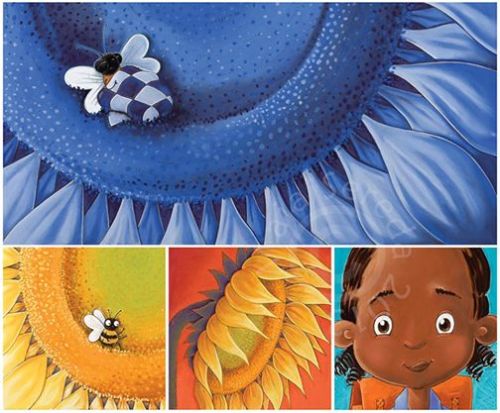
Do you have any material type tips you can share with us? Example: Paint or paper that you love – the best place to buy – a new product that you’ve tried – A how to tip, etc.
I love using 60gsm layout paper for sketching because it’s slightly transparent. I can always overlay my sketches and work over them.
Any words of wisdom on how to become a successful writer or illustrator?
Work hard, believe in your dream, make sure that the work you produce is of high quality and then be brave. Not everyone is going to be a fan of your work, but sometimes you simply have to look for the right audience.
Thank you Maja for sharing your journey and process with us. Please let us know all your future successes. We’d love to hear about them and cheer you on. You can see more of Maja’s work on www.childrensillustrators.com/majasereda and see more of her portfolio on: http://www.facebook.com/MajaSeredaIllustration
If you have a moment I am sure Maja would like to read your comments. I enjoy reading them, too, even if I don’t always have time to reply. Thanks!
Talk tomorrow,
Kathy
Filed under:
authors and illustrators,
illustrating,
Illustrator's Saturday,
inspiration,
Interview,
picture books,
Process Tagged:
Illustrator Journey,
Maja Sereda,
University of Pretoria 

By: Kathy Temean,
on 11/11/2014
Blog:
Writing and Illustrating
(
Login to Add to MyJacketFlap)
JacketFlap tags:
Agent,
Young Adult Novel,
Middle Grade Novels,
authors and illustrators,
opportunity,
Editor & Agent Info,
Publishers and Agencies,
Places to sumit,
Fiction and Non-fiction,
Agent Looking for Clients,
Alex Shane,
Add a tag
 Alec Shane has been promoted to agent at Writers House, which is one of the largest literary agencies in the world. It prides itself on providing an extraordinary amount of individual client attention combined with the full service benefits of foreign and sub rights departments, as well as a full accounting and royalty staff.
Alex began his career at Writers House as an intern in September of 2008 and simply refused to leave, so he was given the wonderful job of Assistant to Jodi Reamer. And while he continues to work under Jodi’s careful tutelage, he is now also in the process of actively building his own list and currently represent a fairly eclectic mix of Children’s and Adult fiction and nonfiction. He is eagerly looking for both.
On the fiction side, he loves mysteries, thrillers, bad-ass protagonists with a chip on their shoulders, beautifully told historical fiction (The Vietnam War, the Maccabees, and The American Revolution fascinate him in particular),well-researched adventure stories, and great horror. He says, “I haven’t been scared to turn off the light in far too long and something needs to be done about it.”
In terms of children’s books, getting boys to read again is especially important to him, and thus he’s particularly on the lookout for a fun middle-grade adventure series, ghost story, or anything else geared toward younger male readers.
On the nonfiction side, he’s attracted to odd, quirky histories, biographies of people he didn’t even know existed (but definitely should have), “guy” reads, humor, narrative nonfiction that sheds light on under-the-radar events and lifestyles, and all things sports. He is also currently up in the air as to whether or not he believes in ghosts, hauntings, and the supernatural, so if you have something that can convince me one way or the other, I’d love to see it.
Alex majored in English at Brown University, a degree he put to immediate use by moving to Los Angeles after graduation to become a professional stunt man. Realizing that he prefers books to breakaway glass, he moved to New York City in 2008 to pursue a career in publishing. Alec quickly found a home at Writers House Literary Agency, where he worked under Jodi Reamer and Amy Berkower on a large number of YA and Adult titles.
Twitter handle: @alecdshane.
He is looking for: Alec is now aggressively building his own list. “What I’m looking for in fiction: mystery, thriller, suspense, horror, historical fiction, literary fiction, and books geared toward young male readers (both YA and MG).
What he’s not looking for: Romance (paranormal or otherwise), straight sci-fi, high fantasy, picture books, self-help, women’s fiction, food, travel memoir.”
PROJECTS/SALES/BOOKS:
SHARK WARS, EJ Altbacker
THE BOOK OF BLOOD, HP Newquist
MONKEY TOWN, Ronald Kidd
HOW THE STATES GOT THEIR SHAPES, Mark Stein
SHARK WARS 6: THE LAST EMPREX, EJ Altbacker (Razorbill)
YOU MIGHT REMEMBER ME: THE LIFE AND TIMES OF PHIL HARTMAN, Mike Thomas (St. Martins)
SEEING AMERICA, Nancy Crocker (Medallion Press)
Submission guidelines: He accepts e-mail and snail-mail queries (although email is preferable), and will usually respond within 4-5 weeks. Please send the first 10 pages of your manuscript, along with your query letter, to ashane [at] writershouse.com with “Query for Alec Shane: TITLE” as your subject heading – no attachments please! If sending via regular mail, please include a SASE with proper postage.
Writers House
21 West 26th Street
New York, NY 10010
phone 212-685-2400
Talk tomorrow,
Kathy
Filed under:
Agent,
authors and illustrators,
Editor & Agent Info,
Middle Grade Novels,
opportunity,
Places to sumit,
Publishers and Agencies,
Young Adult Novel Tagged:
Agent Looking for Clients,
Alex Shane,
Fiction and Non-fiction 

By: Kathy Temean,
on 11/8/2014
Blog:
Writing and Illustrating
(
Login to Add to MyJacketFlap)
JacketFlap tags:
Editors,
authors and illustrators,
Publishing Industry,
opportunity,
children writing,
Matt de la Pena,
need to know,
Agent and Editor Critiques,
Private Dinner in NYC Jacqueline Woodson,
SCBWI Discounted Registrations,
We Nee Diverse Books,
Agent,
Events,
Add a tag
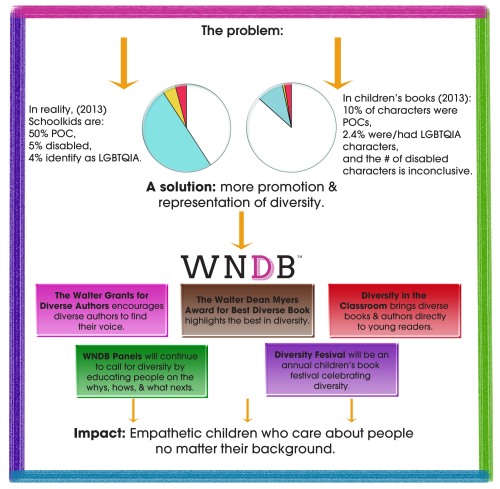
You can help make a difference by making a donation.
There are lots of things you can receive by contributing to the cause. Example: AGENT critiques and EDITOR critiques from editors at Big 5 publishing houses.
An unforgettable opportunity to have a private dinner in NYC with incredible bestselling & award-winning authors Jacqueline Woodson AND Matt de la Peña
Coming soon – a limited number of discounted registrations for Fans of SCBWI – including a VIP critique at their annual LA conference in 2015! Many thanks to Lin Oliver, Sara Rutenberg and Kim Turrisi for offering this. Can’t wait to see how quickly they go!
Here’s the link to the WNDB campaign: http://igg.me/at/diversebooks Maybe even find something you could give as a holiday gift with your donation.
Talk tomorrow,
Kathy
Filed under:
Agent,
authors and illustrators,
children writing,
Editors,
Events,
need to know,
opportunity,
Publishing Industry Tagged:
Agent and Editor Critiques,
Matt de la Pena,
Private Dinner in NYC Jacqueline Woodson,
SCBWI Discounted Registrations,
We Nee Diverse Books 

View Next 25 Posts








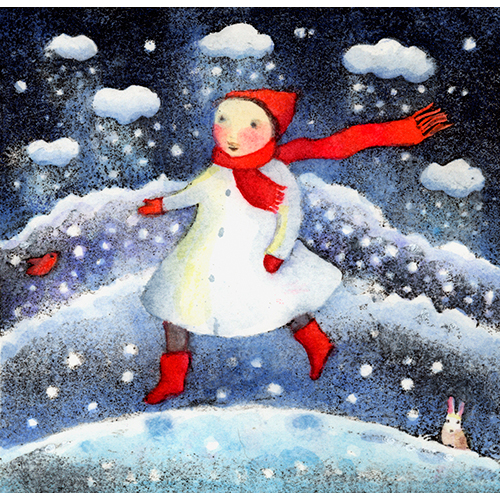


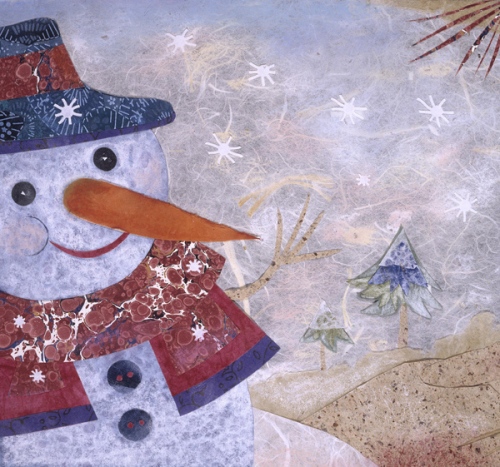

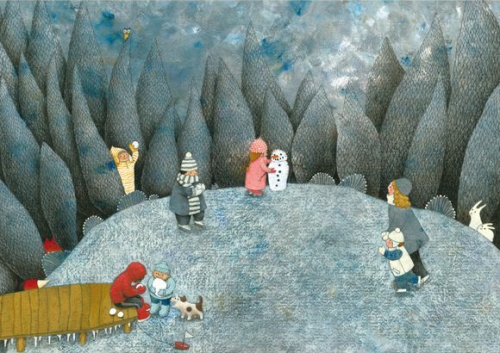
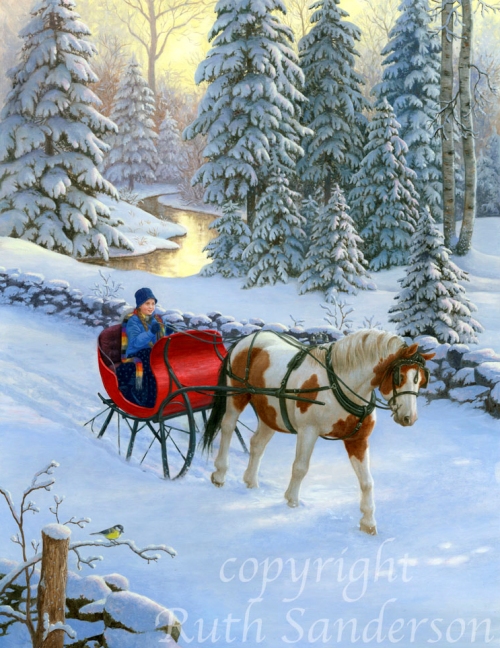

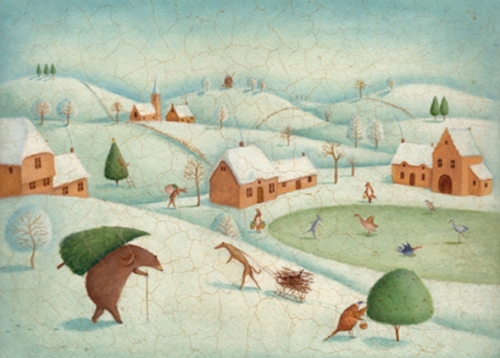
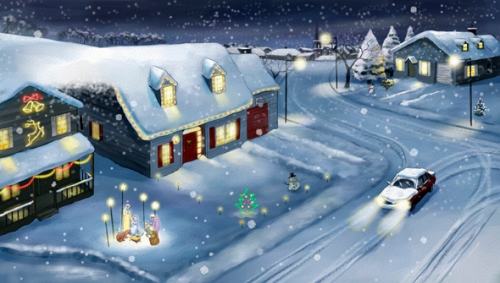
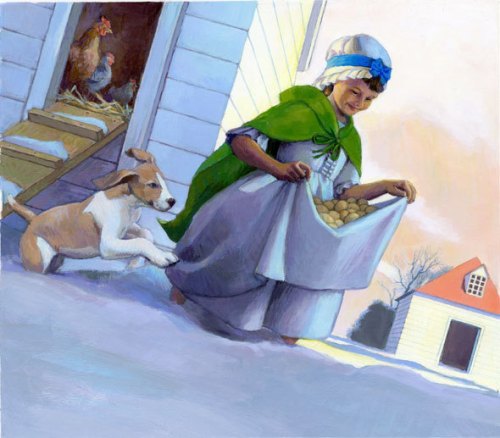
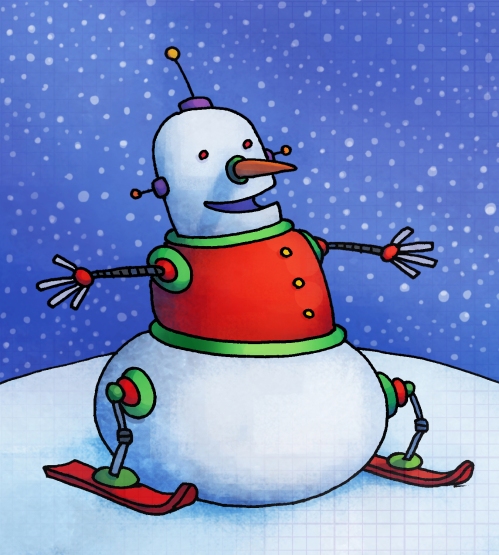
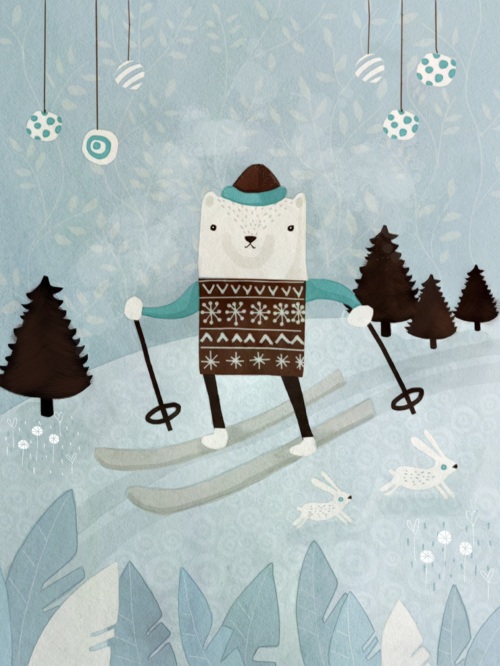
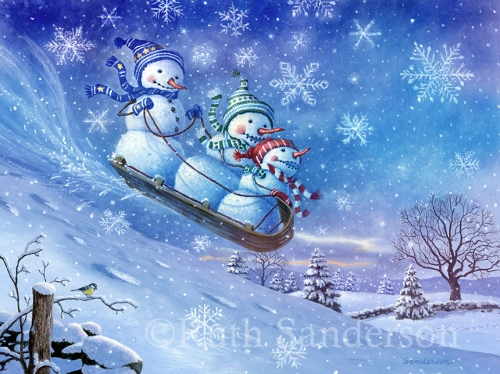
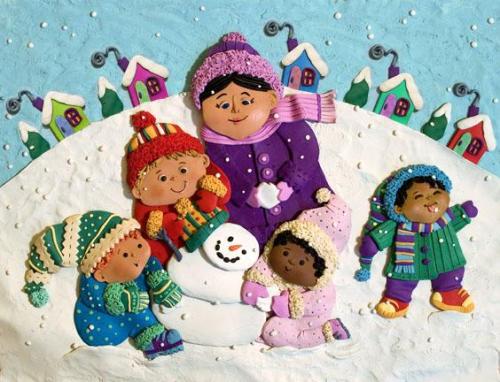
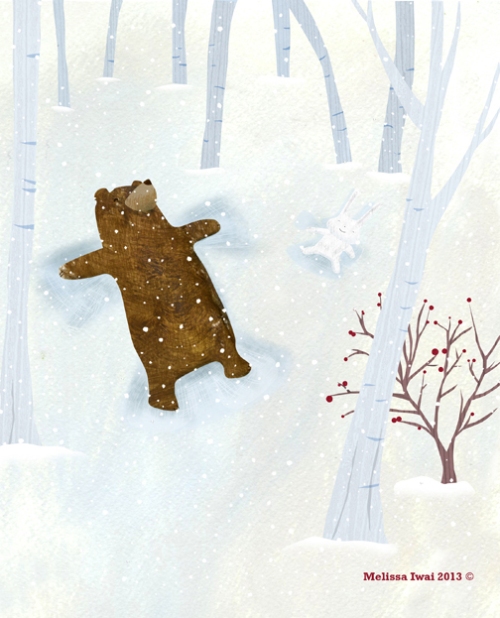

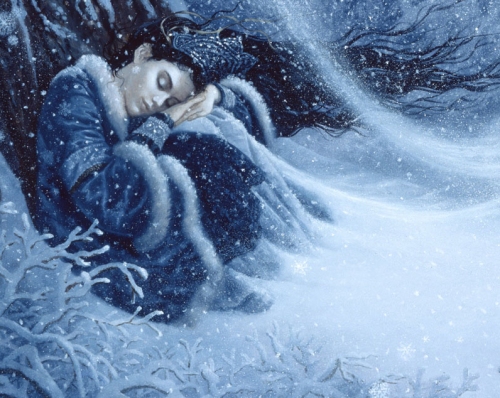
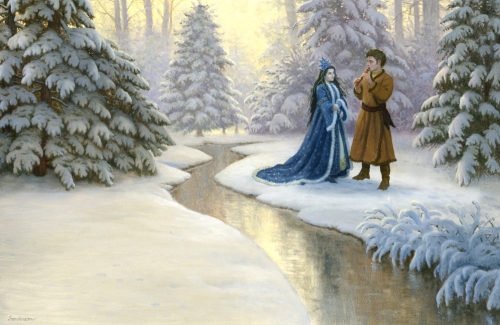
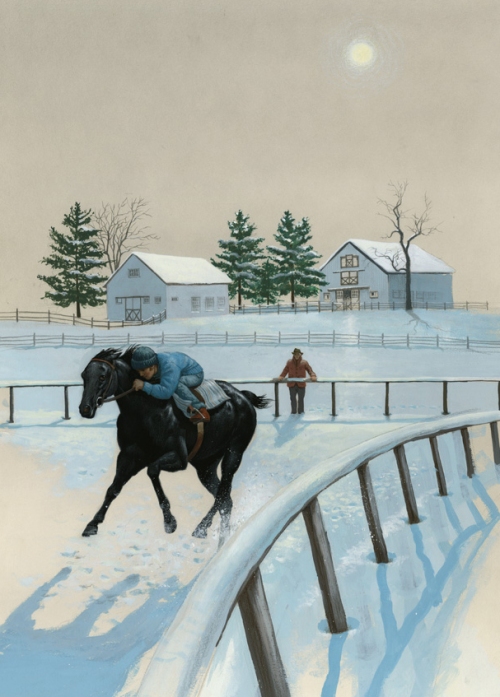
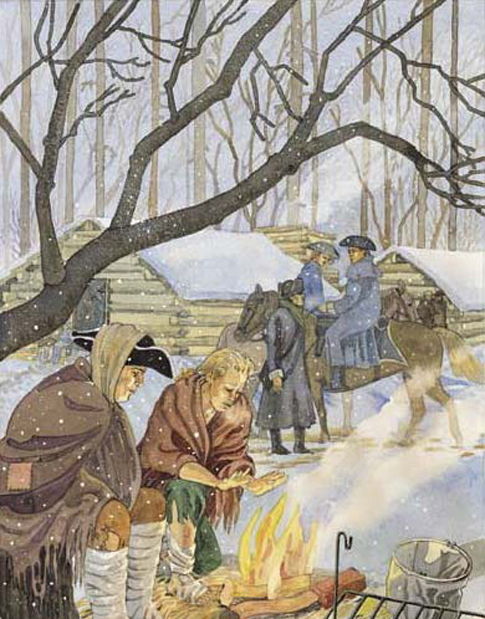
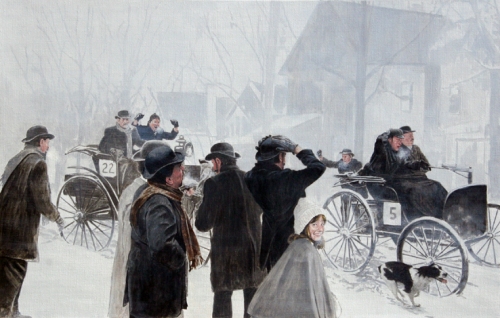
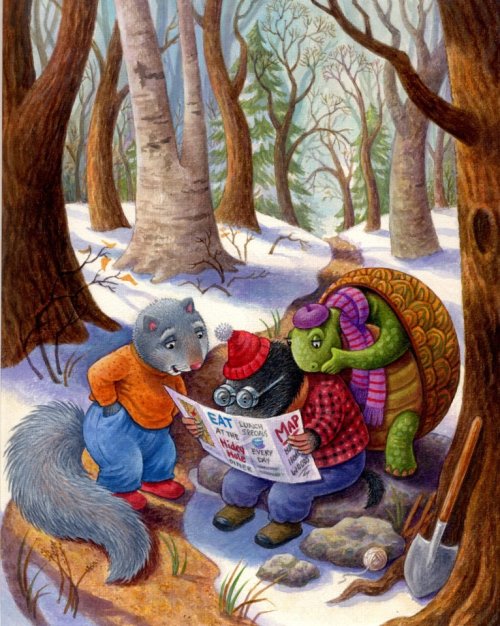

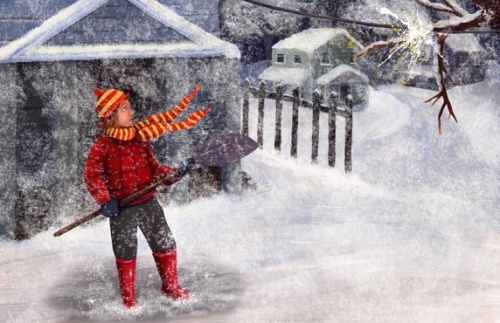
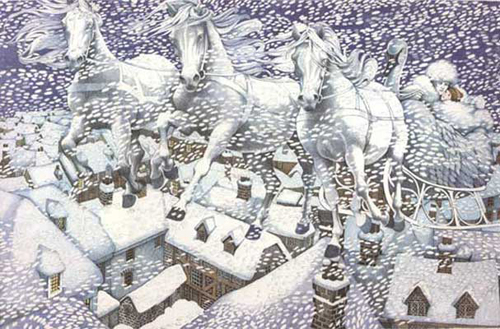


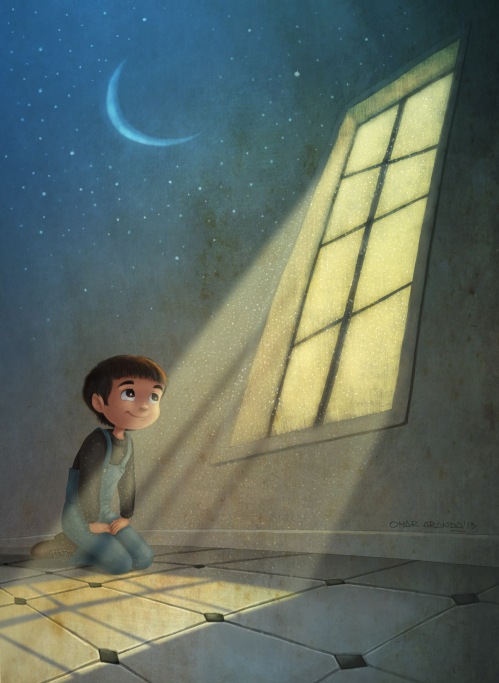
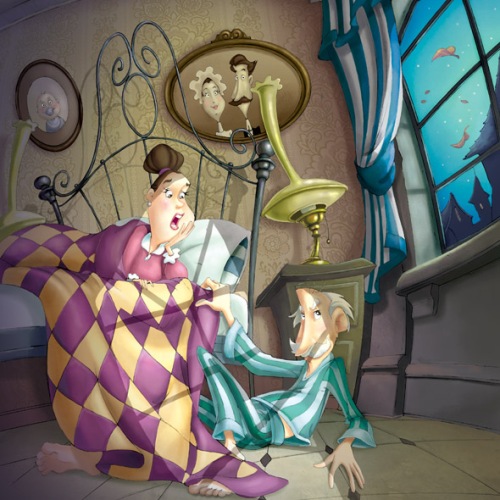
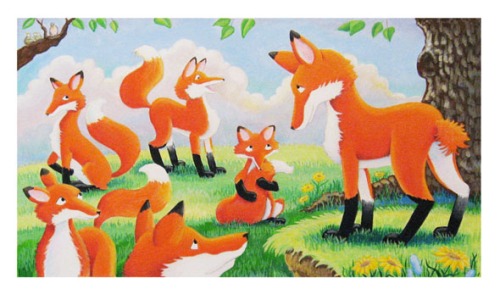
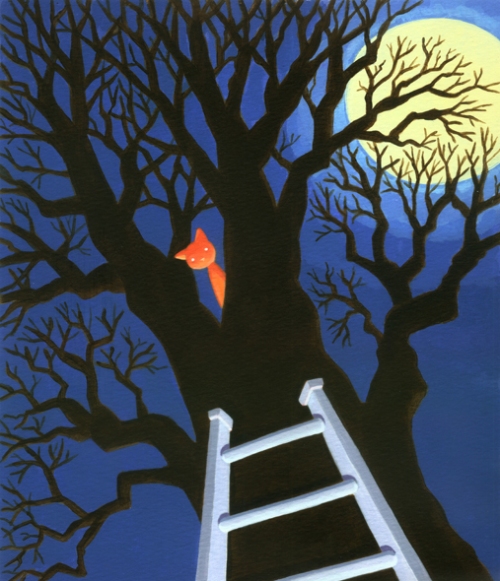

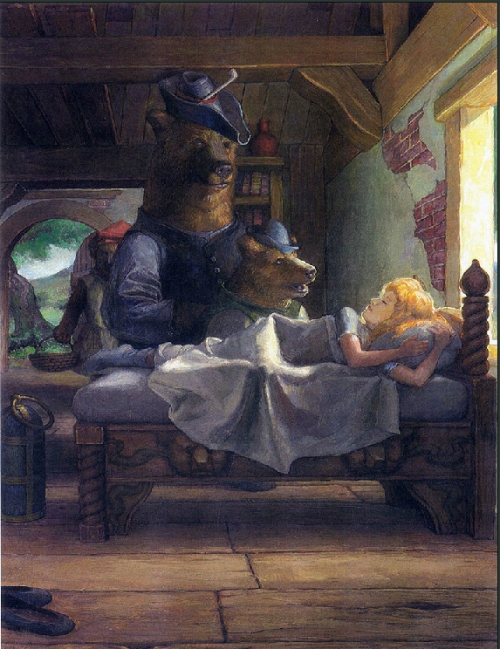

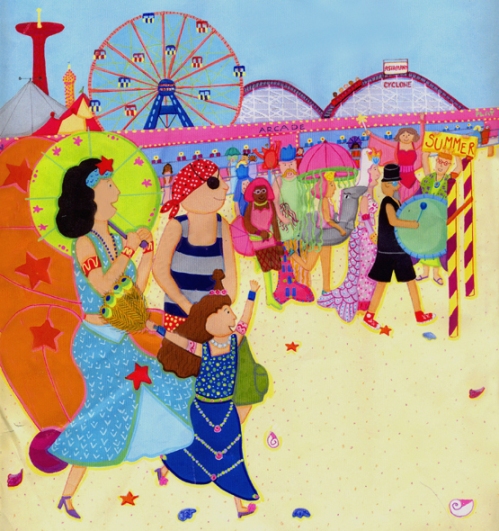
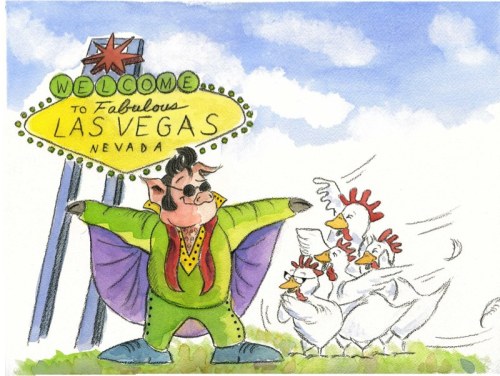
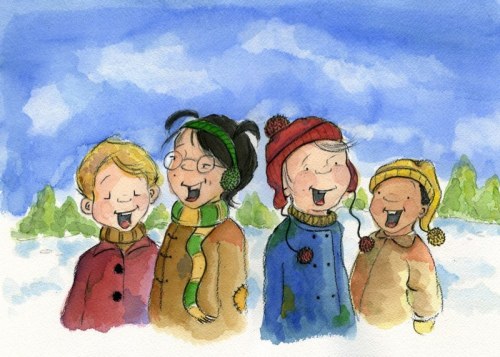
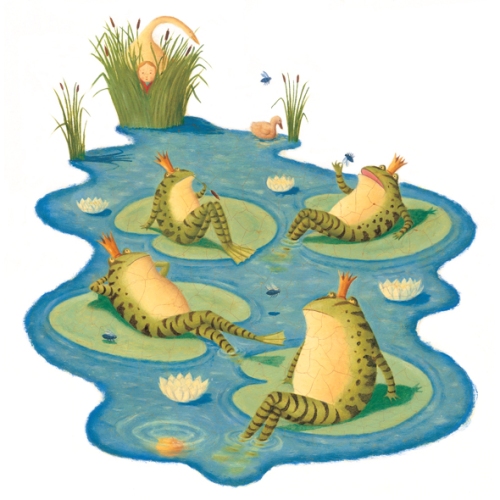
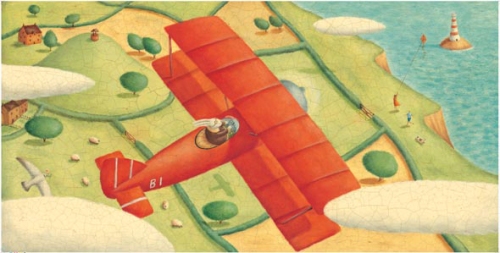


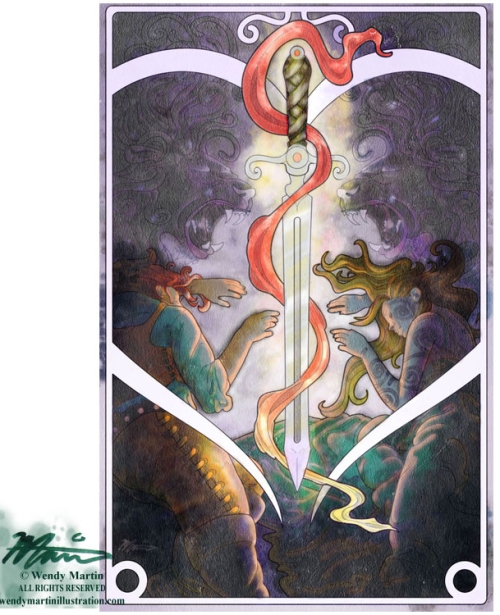
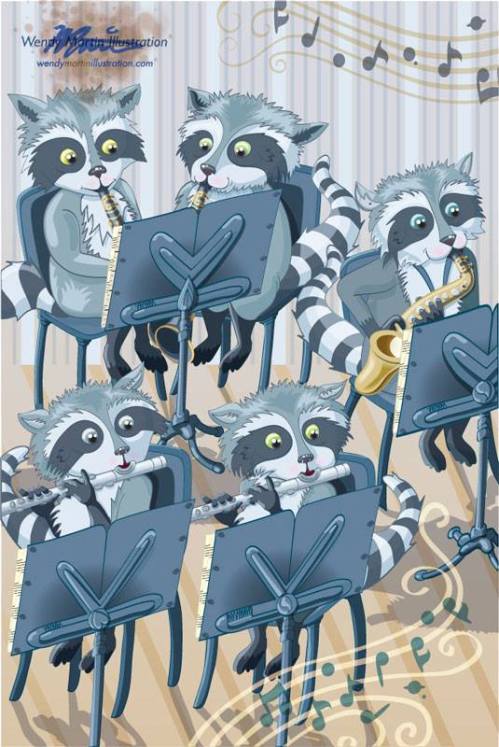
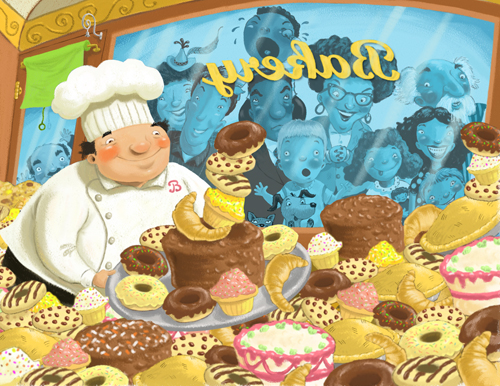

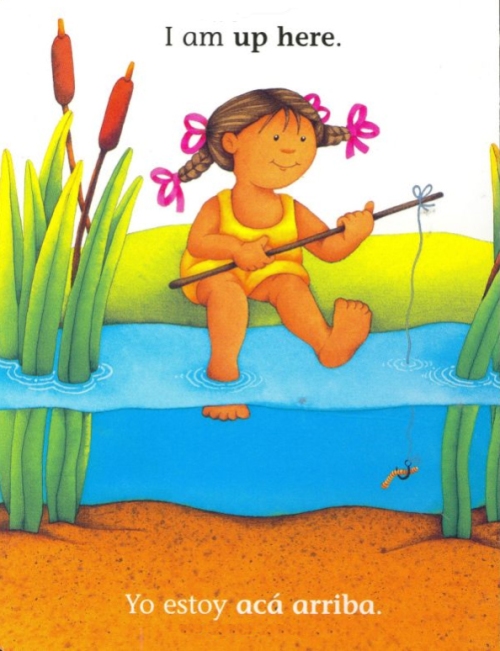



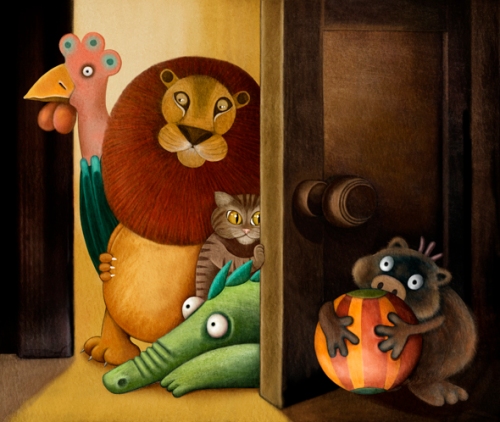

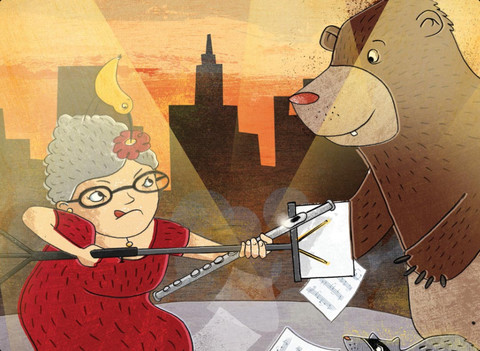

 Mike Moran:
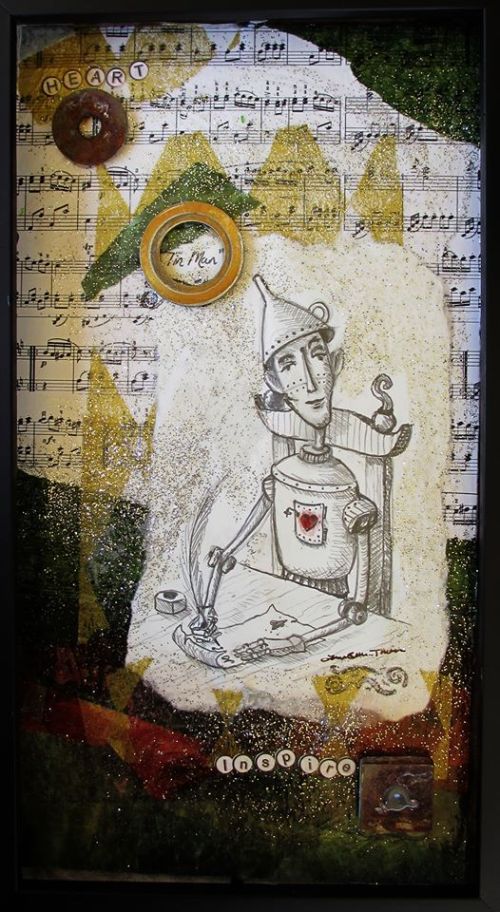
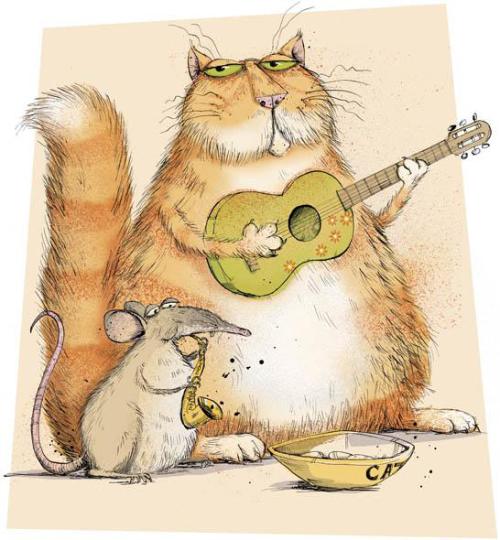
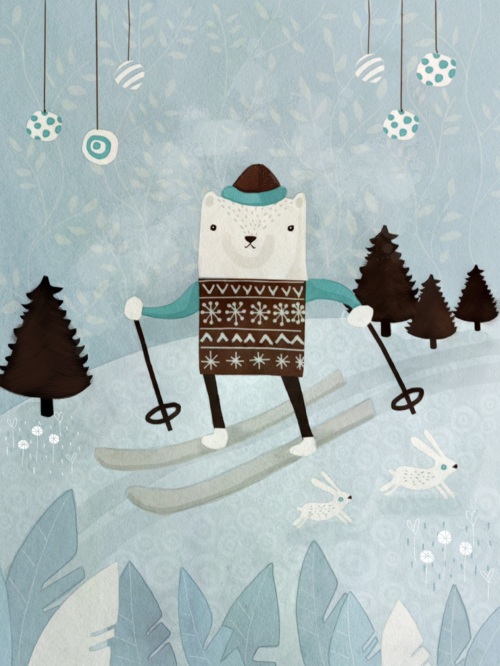


Thank you for this, Kathy :D