new posts in all blogs
Viewing: Blog Posts Tagged with: illustrating, Most Recent at Top [Help]
Results 1 - 25 of 160
How to use this Page
You are viewing the most recent posts tagged with the words: illustrating in the JacketFlap blog reader. What is a tag? Think of a tag as a keyword or category label. Tags can both help you find posts on JacketFlap.com as well as provide an easy way for you to "remember" and classify posts for later recall. Try adding a tag yourself by clicking "Add a tag" below a post's header. Scroll down through the list of Recent Posts in the left column and click on a post title that sounds interesting. You can view all posts from a specific blog by clicking the Blog name in the right column, or you can click a 'More Posts from this Blog' link in any individual post.
The SABF is being held from 31 July to 2 August in Johannesburg this year. They are offering illustrators the opportunity to demonstrate at an illustration easel. Every hour on the hour, there will be a different illustrator at the easel for children to watch. There are 18 slots over the three days that can be filled on a roster basis. Please contact Jenny at [email protected] by 17

By: Kathy Temean,
on 1/2/2015
Blog:
Writing and Illustrating
(
Login to Add to MyJacketFlap)
JacketFlap tags:
Interview,
inspiration,
Advice,
Process,
Digital Art,
illustrating,
authors and illustrators,
University of California,
demystify,
Illustrator Sites,
Illustrator's Saturday,
Diana Kizlauskas,
Ray College of Design,
Add a tag
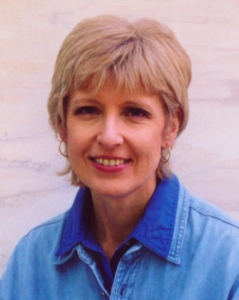 Diana Kizlauskas says she knew she was in trouble early on. Drawing Barbie was more fun than playing with her. Drawing a poster of the Beatles was more appealing than buying one. A high school mural project meant more than ACT scores. By senior year, I made peace with my art addiction and chose it as my professional path…
With help from above and a little caffeine, I earned B.A. degrees in Art Education (UIC, 1974) and Illustration (Ray College of Design/ Illinois Institute of Art, 1991), supplementing those with drawing workshops at the School of the Art Institute of Chicago. My portfolio landed me in the freelance world of advertising and editorial illustration. Then with a new millennium, came a new direction: greeting cards and children’s educational publishing. Throughout this time, I exhibited work in the Chicago area, including at Gallery 400/UIC, Hyde Park Art Center, North Lakeside Cultural Center, and had a solo show at the Beverly Arts Center. In Indiana, my work was displayed at the Anderson Fine Arts Center, the John G. Blank Center for the Arts and Purdue University.
My work, family and faith community make up my rather simple universe. A native Chicagoan, my heart is anchored to the Midwest. However, I often go beyond the familiar to work with ethnic and historical themes. Through books, various other media and travel, I enjoy learning about different eras and cultures. I’ve amassed a wealth of visual reference materials which help me render physical characteristics, geographic features and design elements of various places and times. My background in education helps me translate those images to young readers in ways they can best understand.
TECHNIQUES
The illustrations presented here are created digitally or are hybrids of traditional acrylic on canvas or colored pencil on board combined with digital media.
Here is Diana talking about her process:
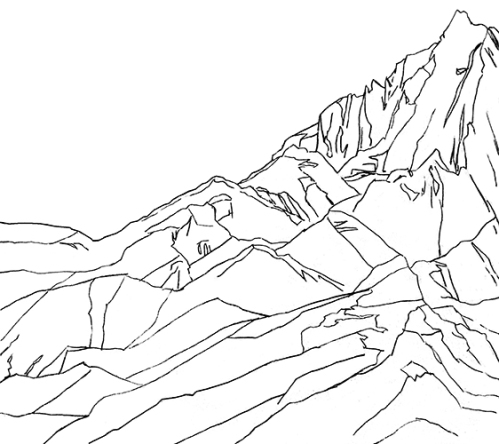
When I start an illustration I first break down the image to its most essential components. In the case of “The Climb” from my The Twelve Ravens book project, these are: the mountain, the stormy sky, girl protagonist and the injured eagle.
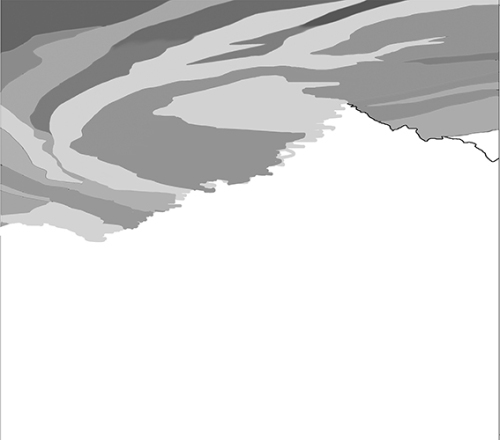
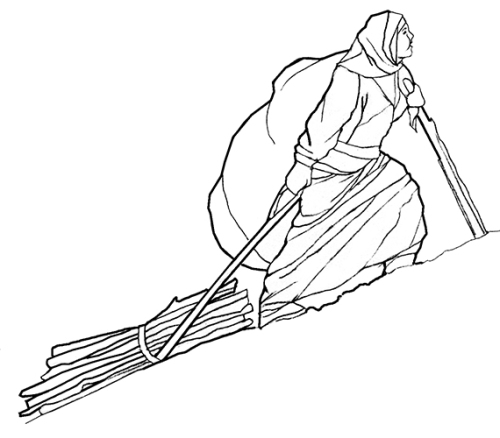
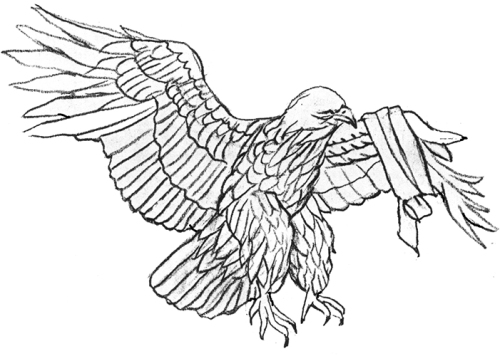
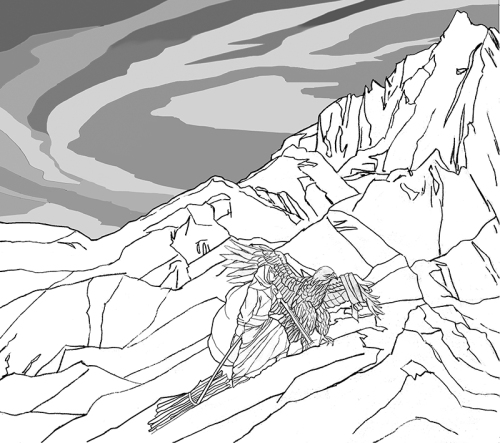
I then scan the images into Photoshop, placing each on a separate layer so that I can manipulate them independently. I play with size, cropping, etc., until I’m satisfied with the arrangement.
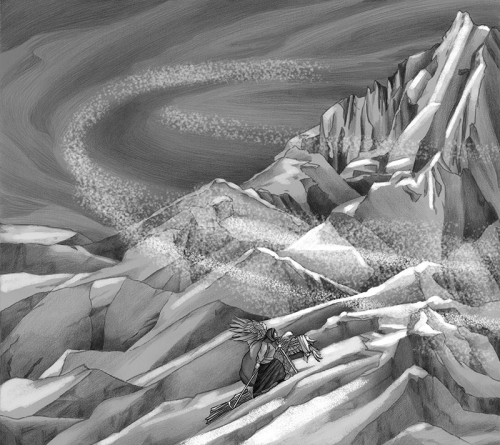
Since an odd number of objects make for a more interesting composition, I’ll eventually add in a fifth element, the “swoosh” of a blizzard.
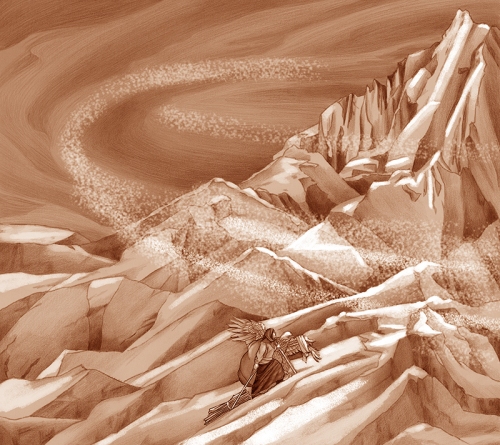
Next, I add tones to the drawing. I do this digitally or by printing out the line art and adding shading by hand and rescanning. The prior picture is an example where I have done both to achieve the result.
I start “painting” by duplicating my black and white tonal image and adjusting its color to umber (Figure 7). This layer lies atop the original tonal art.

I again replicate the image to create a blue layer, which lies atop the umber. Then, using various percentages of opacity in my eraser tool, I remove sections of blue to expose umber and umber to expose black and greys. This results in a balanced warm-cool color underlayment.
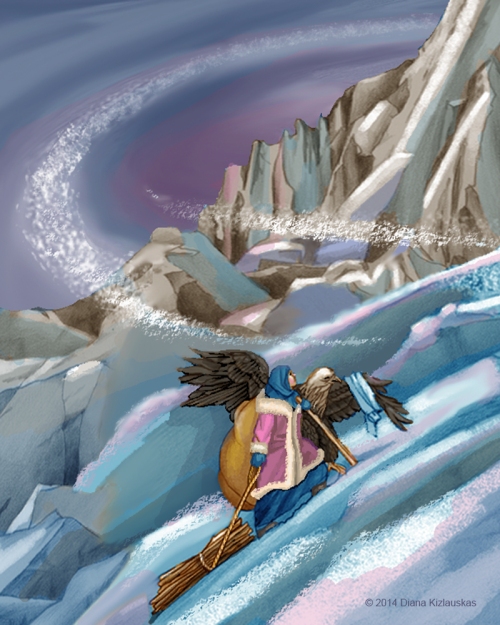
I go to finish by brushing on an entire spectrum of colors, working out details, depth, drama, texture. I give myself creative license to cut, crop, chop and drop, until—voila, it’s done!
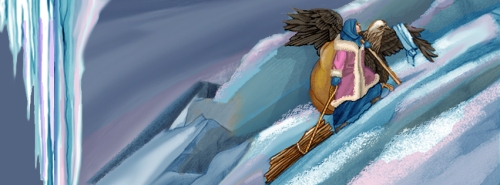
Even as I’m working on the final art, I like to keep each key component of the piece in a separate layer so that I can continue to scale it, move it or manipulate its brightness and color. This is particularly helpful when the format of the illustration needs to be changed from print edition to eBook or if you need to “repurpose” images for a promotional spot. For example, I adapted the scene from “The Climb” to use as my Facebook masthead last winter.
How long have you been illustrating?
I’ve been drawing since I could clutch a crayon in my chubby little hands; I’ve been paid for it since 1991.
How did you end up going to University of California, Irvine?
I received a BA degree in Art Education from the College of Art and Architecture, University of Illinois at Chicago, known around these parts as UIC. (I have never studied in California; perhaps your question is based on a typo in one of my bio pages.)
Since you received a BA in Art Education, did you teach after you graduated?
After completing my student teaching, I opted to stay home with my two children until they started grammar school. However, I do have about a decade of experience teaching part-time extracurricular classes to 3-7 year olds, including crafts, science and religious education.
What types of classes did you take that really helped you to develop as an illustrator?
Because a successful illustration is the result of craft, composition and creative communication, I think that Life drawing, Basic Design and Illustration Concepts courses were all indispensable.
When did you get involved in Freelance Art?
I began getting professional free-lance projects immediately upon graduating from Ray College of Design. Their job placement services were quite helpful in getting me those initial interviews and portfolio showings.
What was the first thing you created where someone paid you for your work?
As a kid, I sold poster-size portraits of the Beatles to classmates. My first job as a “bone fide” illustrator was an editorial piece for the Chicago Daily Southtown newspaper.
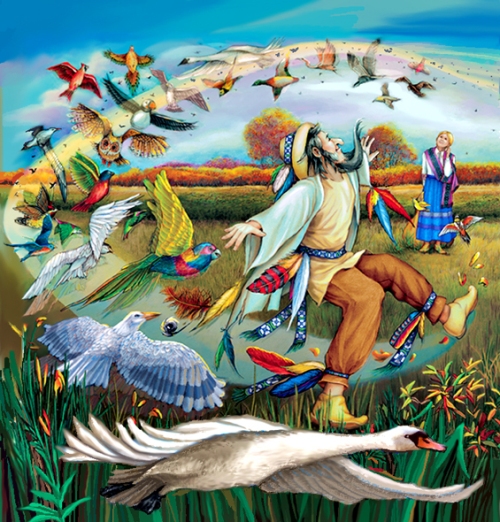
What made you decide to study illustration at Ray College of Design/ Illinois Institute of Art in 1991?
Ray College was a small vocational school providing a lot of individual attention to its students and geared toward getting them into the working world. At this point in my life, I felt I had had enough theoretical background and needed to jump into action.
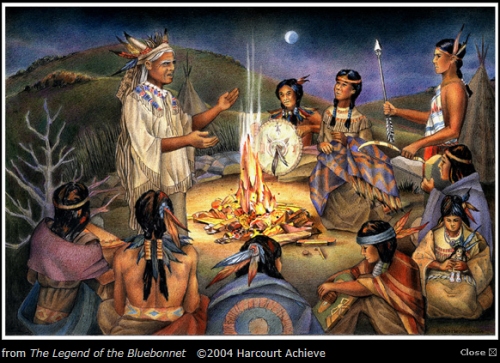
How long did you take drawing workshops at the School of the Art Institute of Chicago?
I attended Advanced Drawing Workshop for about a year.
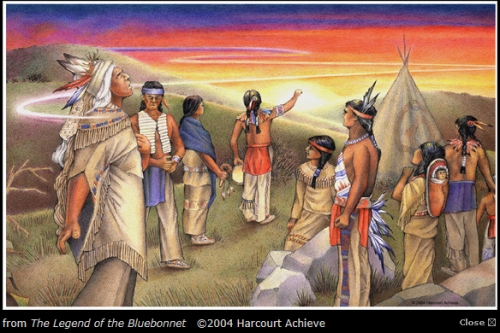
Do you think taking those workshops helped improve your drawing skills?
They certainly did. But more importantly, they impressed upon me the importance of surrender to the mystery of creative process, experimentation with images, as well as pushing techniques and materials to their limits. Oddly enough, I also came away from my experience at SAIC with a personal resolve to avoid conformity to non-conformity.
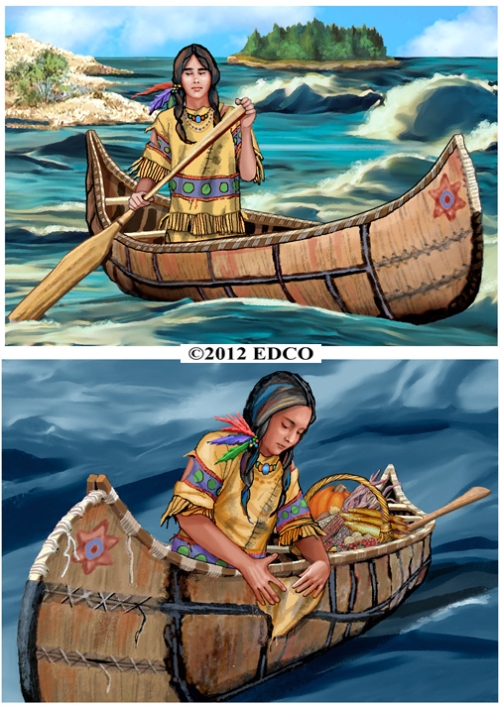
When did you go digital?
I was dragged into the Digital Age in the late 2000’s by clients and agents who wanted a project done quicker, cleaner, and cheaper. I went kicking and screaming, but it was one of the best things that ever happened to me professionally.
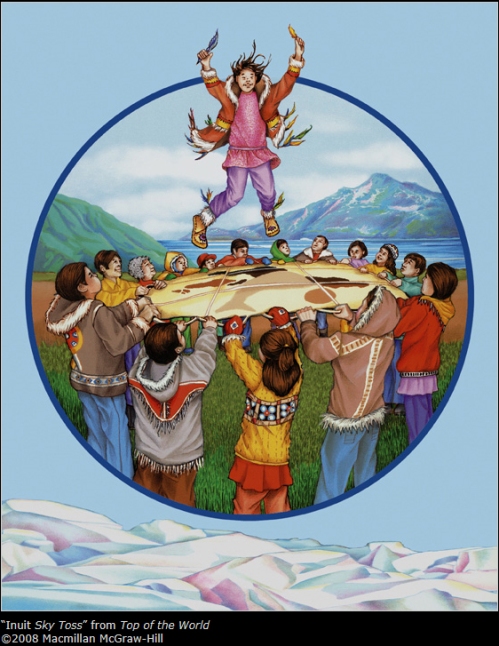
How many children’s books have you illustrated?
If we count leveled readers, I have illustrated 14 books in traditional print and 4 eBooks.
Do you still do freelance art?
All my work is done on a free-lance basis.
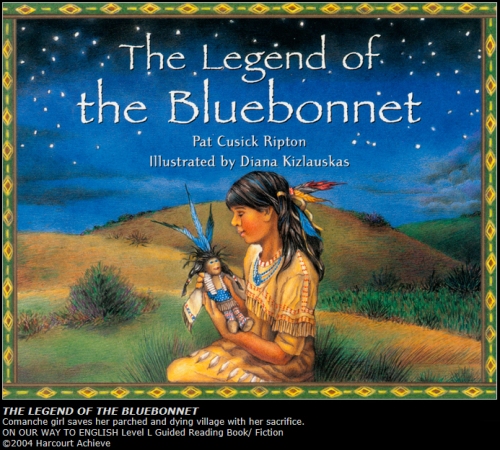
What was the first picture book that you illustrated? When did that happen?
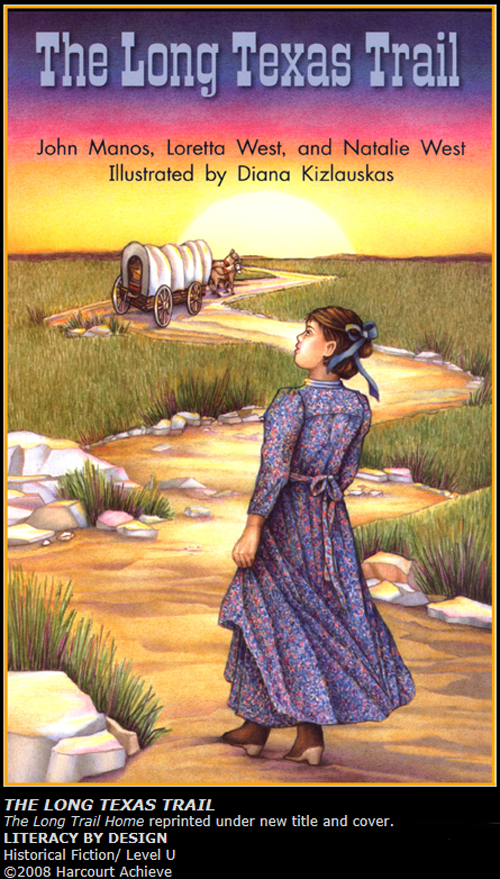
I illustrated The Legend of the Bluebonnet in 2004.
How did that contract come about?
I was approached by Steven Edsey Sons artists’ reps to do the project. They had seen a piece in my samples portfolio which matched the needs of the client very closely—a Plains’ Indian family preparing a meal. The rest was, as they say, history.
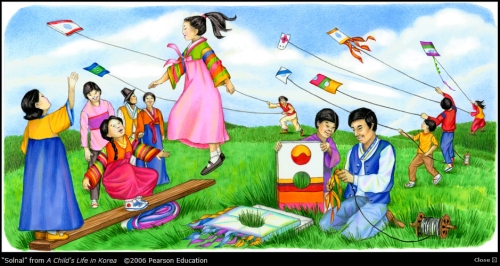
Was the Legend of the Bluebonnet the first book you did with Houghton Mifflin Harcourt?
The publisher of the Legend of the Bluebonnet was Rigby/ Harcourt Achieve. I’m unclear as to what its relation to Houghton Mifflin Harcourt was at that time.
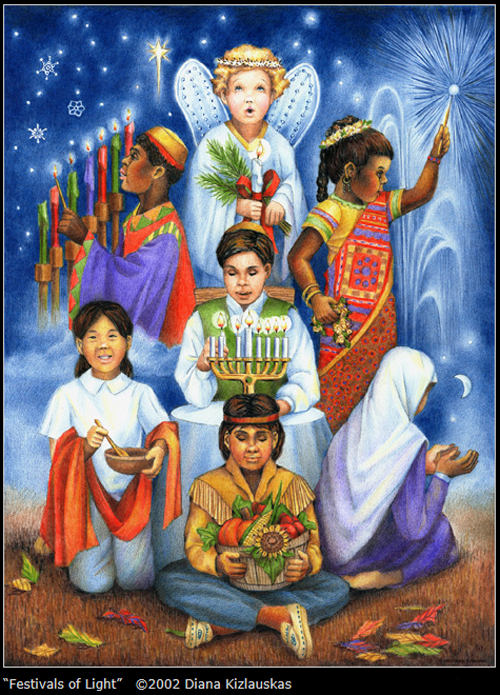
How many books have you done with Harcourt?
I have illustrated four leveled readers for Rigby/ Harcourt Achieve and one for Harcourt School Publishers.
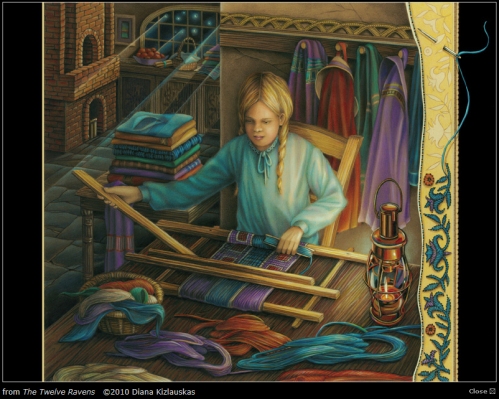
Would you consider working with an author who wants to self publish?
I would base my decision on the strength of the author’s credentials and the quality of the material.
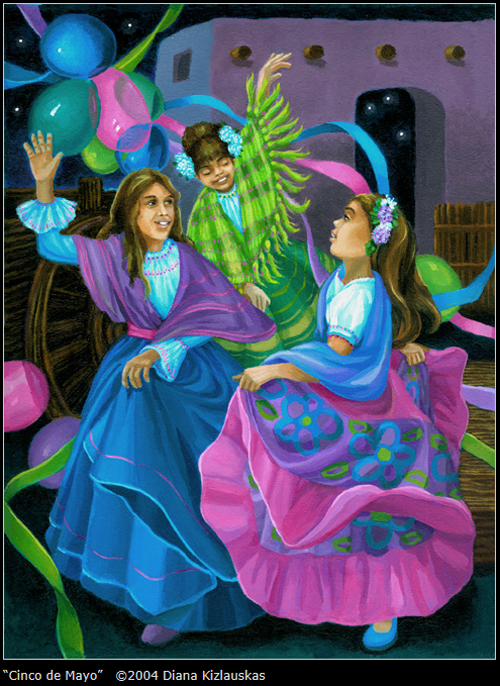
Can you tell us a little bit about EDCO/Ireland? How did they find you and what type of work did they have you do?
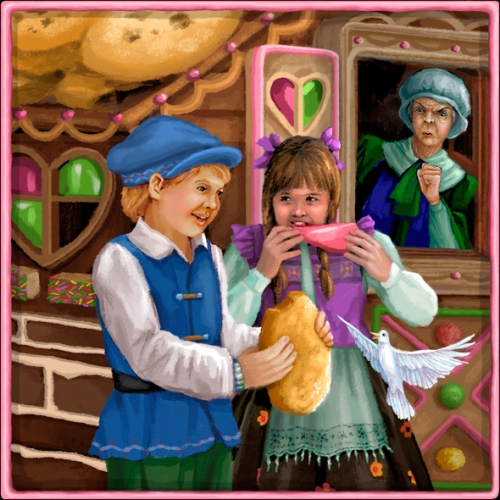
EDCO is an educational publisher in Ireland. I believe their art directors saw my work on childrensillustrators.com and then contacted my current artist reps. I illustrated several stories (“In the Deep Dark Wood,” and “The Island of the Blue Dolphins”) and a poem (“The North Wind”) for them. One of these illustrations was then adapted as a cover for By The North Star, a book in their Big Box Library series.
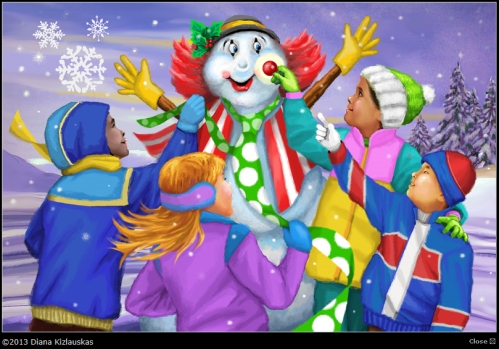
Have you worked with educational publishers? Which one’s?
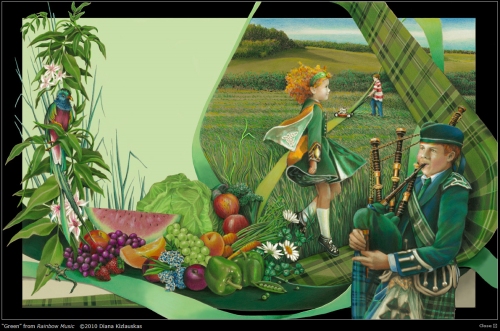
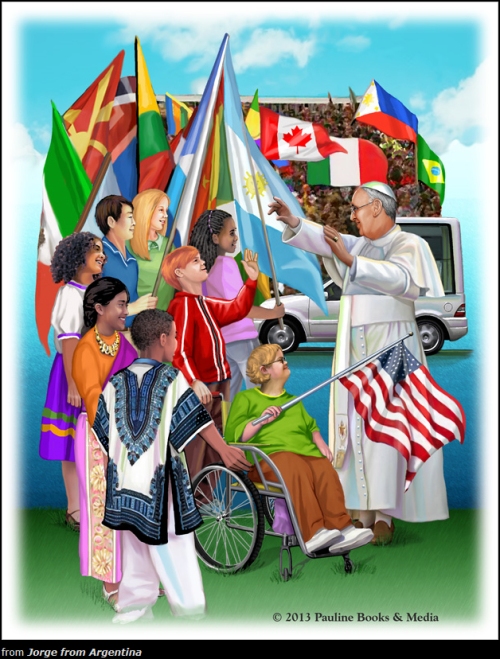
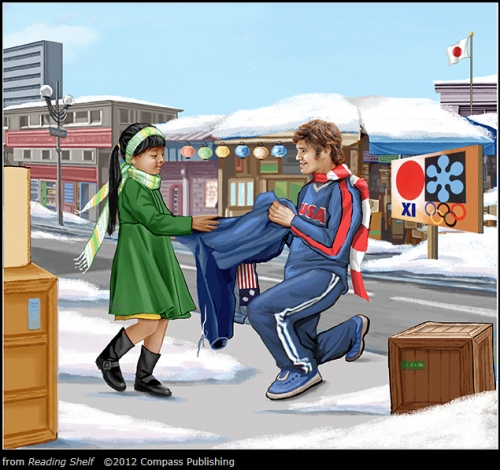
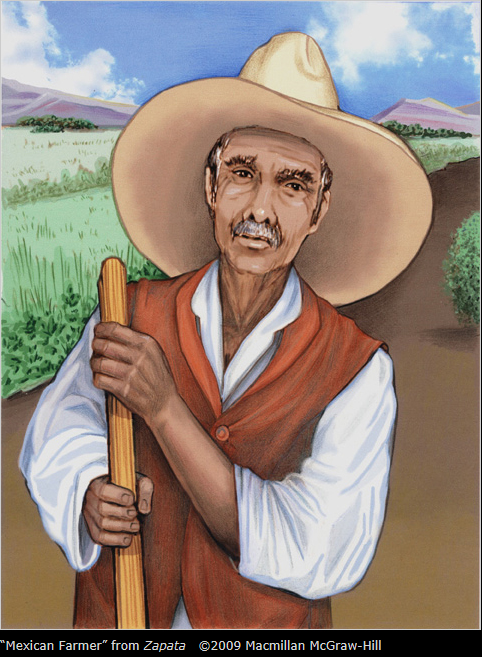
Besides the aforementioned Rigby/Harcourt Achieve, Harcourt School Publishers and EDCO/Ireland, I have worked with Macmillan/McGrawHill, Pearson/Scott Foresman, Pearson Education, Compass Publishing and Quarasan, Inc. Though they might also be considered a trade or religious publisher, Pauline Books and Media contracted me to illustrate Jorge of Argentina: The Story of Pope Francis for Children (2014).
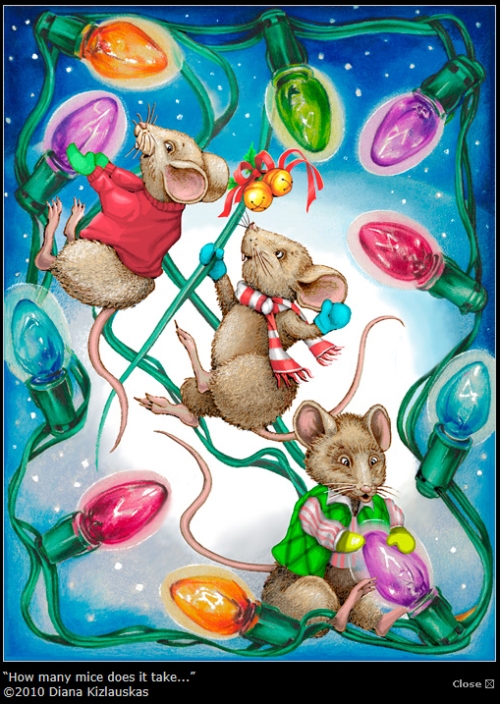
How did those books come your way?
Nearly all of them came through artists’ reps with whom I was associated at the time of the project’s inception.
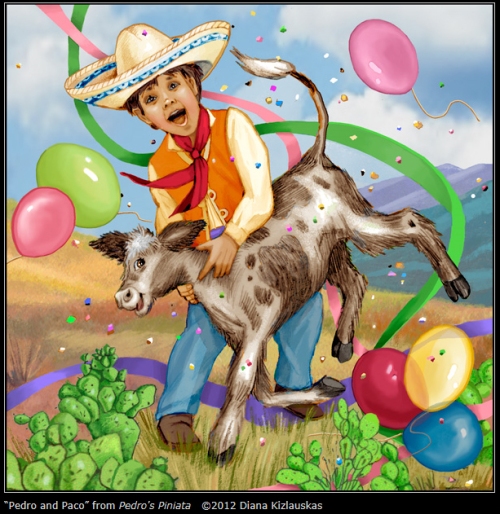
Have you ever tried to write and illustrate a children’s book?
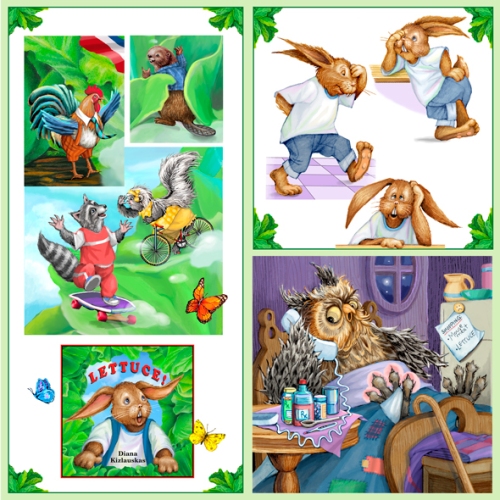
Yes, I have. LETTUCE! , my tall tale about a rabbit and his rampant good fortune, is on the eBook market right now. Parents and teachers of preschoolers have given it a 5-star rating and I’m very excited about making it available in a traditional print version this spring.
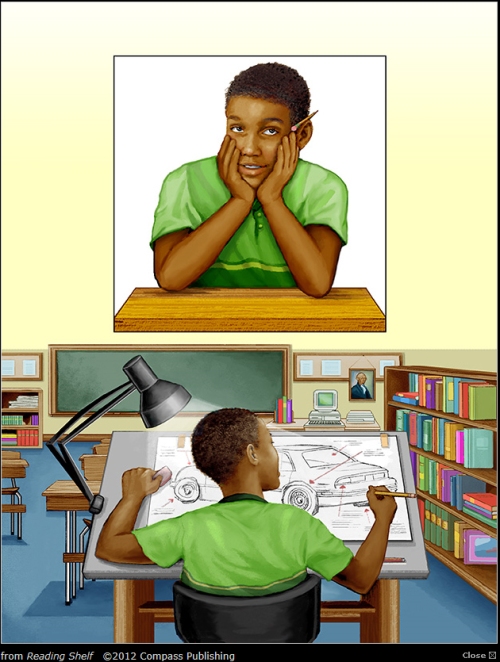
Do you have an agent? If so, who and how long have the represented you? If not, would you like one?
Over the years I have been represented by several agencies, but since 2010 by WendyLynn&Co.
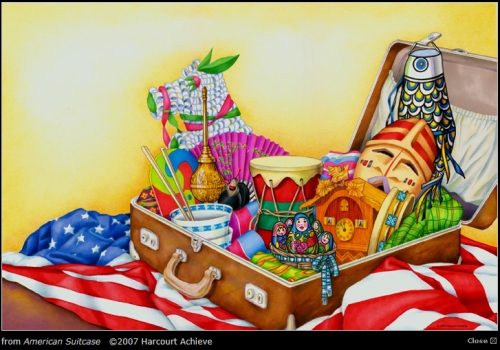
What types of things do you do to get your work seen by publishing professionals?
I supply my artist reps with promotional material and advertise on childrensillustrators.com (http://www.childrensillustrators.com/illustrator-details/DKizlauskas/id=2110/). I maintain gallery and bookstore spaces on the Society of Children’s Book Writers and Illustrators website (http://www.scbwi.org/members-public/diana-kizlauskas) and I maintain an author/illustrator page on amazon.com. Also, I post regularly to my business Facebook page (www.facebook.com/DKIllustration). Most importantly, I keep my DKI Children’s Illustration website (www.dianakizlauskas.com ) updated and functioning.
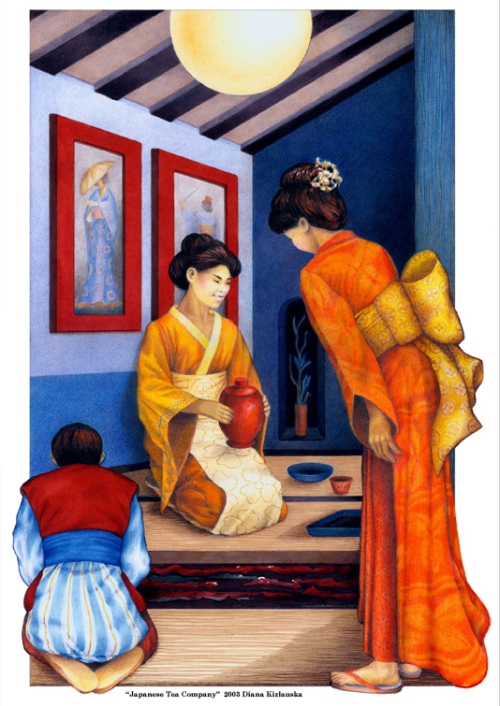
Have you seen your style change since you first started illustrating?
Absolutely. My work is increasingly softer edged, more painterly, and close to 100% digital.
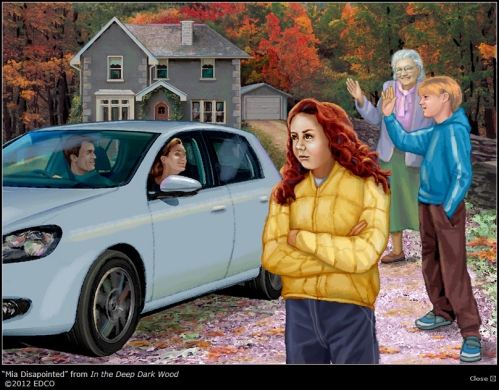
Have you gotten any work through networking or the Internet?
Almost exclusively so. As I described above, nearly all my marketing revolves around websites and on-line portfolio displays.
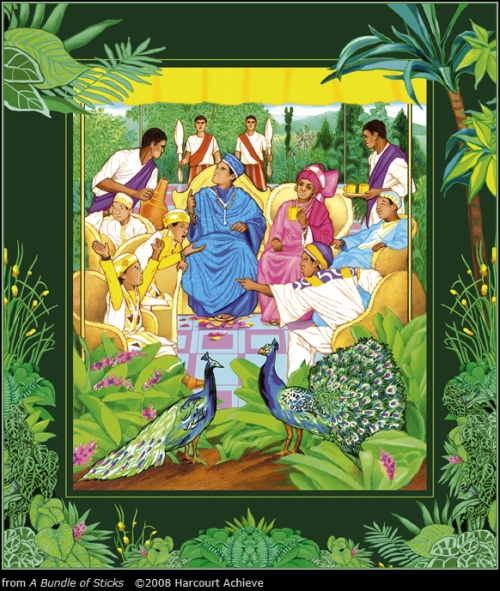
Do you use software for painting besides Photoshop?
So far, only Photoshop.
Do you own a graphic tablet? If so, how do you use it?
Yes, indeed. To reduce a complicated explanation to bare basics: I scan hand-drawn and photo-reference images into Photoshop, then use both a mouse and stylus to create layers, lines, colors, textures and draw additional images directly onto the tablet—whatever it takes to bring the illustration to finish.
How much time do you spend illustrating?
When working on a client project, I keep a very strict 10-hour, 6 day per week schedule. When creating promotional samples or working on my own books, I loosen it up to 6-hours per 5 days weekly. (This fall a family medical crisis put my work on temporary “hold,” but I’m slowly getting back on track.)
Do you have a studio set up in your house?
Yes, I do. I’m very fortunate to have a large room and loft area that accommodate a drawing table,easel, computer, printer, scanner, copier, a 8’x3.5’ work counter with horizontal storage, and 3 file cabinets full of reference clippings (some dating back to grammar school). Scads of shelves house more reference, paints, brushes , pencils and pens—not to mention a potpourri of chachkies. The closet full of dusty portfolio cases and canvases bears witness to a time before computers took over.
Any picture books on the horizon?
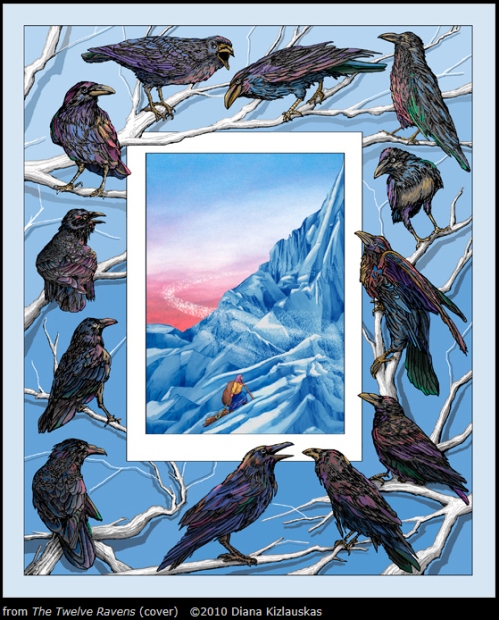
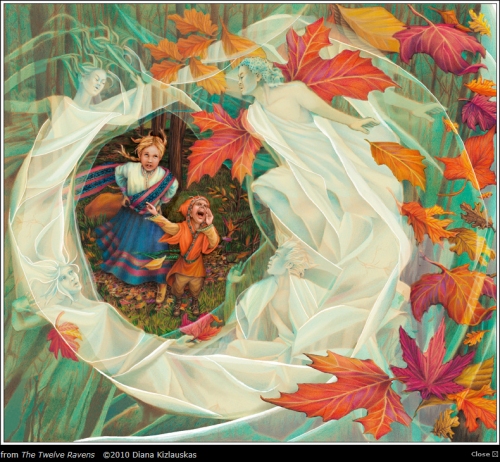
The Twelve Ravens , a Lithuanuian folktale which I have adapted, retold and illustrated, is a project I hope to have out by Fall, 2015. The eBook version is almost done, the print format awaits revision.
What are your career goals?
Beautiful books for beautiful children! I want to continue communicating to children of all colors and backgrounds through positive, bright and inspiring images. Whether my illustrations attain the stature of being published by the top trade publishers in the country or are independently made and distributed, my goal is to make each one better than the one before. I believe that concentrating on the work itself and not the fame or fortune it may bring is the only way an artist can maintain sanity in an ever-changing business world and culture.
What are you working on now?
As I mentioned, LETTUCE! and The Twelve Ravens are on my mind, but they may have to simmer on a back burner if my agent drafts me for a McGraw-Hill Education project for which I’ve recently been approved.
Are there any painting tips (materials, paper, etc.) you can share that work well for you? Technique tips?
Since I do all my “painting “ in Photoshop these days, there’s not much in the way of materials that I need to think about. But when working with colored pencils on paper or creating a “hybrid” piece where I draw onto a printed digital image, I like to use a wonderfully smooth paper called Mohawk Superfine. It is a 100 lb. “ultra white” cover stock used by the printing industry. It is receptive to the toner inks in my printer and is a perfect surface for multiple layers of Prismacolor pencils.
Any words of wisdom you can share with the illustrators who are trying to develop their career?
Like a man walking a tight rope, look straight ahead, never down. In creative, competitive fields, people who remain positive, patient, and intrinsically motivated—eventually prevail. Or as a colleague once remarked, “I can’t NOT do this…” Really, what other choice does a true artist have? So, KEEP AT IT!
Thank you Diana for sharing your journey and process with us and helping us kick off 2015. You can visit Diana at her website: http://www.dianakizlauskas.com to see more of her work.
If you have a moment I am sure Leeza would love to read your comments. I enjoy them too. Thanks!
Talk tomorrow,
Kathy
Filed under:
Advice,
authors and illustrators,
demystify,
illustrating,
Illustrator Sites,
Illustrator's Saturday,
inspiration,
Interview,
Process Tagged:
Diana Kizlauskas,
Digital Art,
Ray College of Design,
University of California 

By: Kathy Temean,
on 12/31/2014
Blog:
Writing and Illustrating
(
Login to Add to MyJacketFlap)
JacketFlap tags:
list,
Book,
success,
Happy New Year,
Holiday,
illustrating,
Wendy Wahman,
Top 10 Fiction Books of 2014,
Best Wishes for 2015,
Top 10 Non-Fiction Books of 2015,
Add a tag

Top 10 Fiction of 2014
1. All the Light We Cannot See, Anthony Doerr (20)
2. Station Eleven, Emily St. John Mandel (18)
3. A Brief History of Seven Killings, Marlon James (15)
Redeployment, Phil Klay
5. Lila, Marilynne Robinson (13)
The Paying Guests, Sarah Waters
7. The Bone Clocks, David Mitchell (11)
8. Euphoria, Lily King (10)
9. We Were Liars, E. Lockhart (9)
10. Dept. of Speculation, Jenny Offill (8)
Top 10 Nonfiction of 2014
1. Can’t We Talk About Something More Pleasant?, Roz Chast (15)
2. Being Mortal, Atul Gawande (11)
The Empathy Exams, Leslie Jamison
4. On Immunity, Eula Biss (10)
The Sixth Extinction, Elizabeth Kolbert
In The Kingdom Of Ice, Hampton Sides
7. The Short and Tragic Life of Robert Peace, Jeff Hobbs (9)
8. Bad Feminist, Roxane Gay (6)
Flash Boys, Michael Lewis
What if?, Randall Munroe
Capital, Thomas Piketty
Just Mercy, Bryan Stevenson
Sources:
These are the 53 sources counted so far — and from each we take only their most selective lists (e.g. the NYT’s Top 10, not their 100 “notable” books).
Awards (Good Reads; National Book Awards; Booker Award; Kirkus Awards; Giller Prize; Governor General’s Awards; FT McKinsey Award) Critics (Maureen Corrigan; Dwight Garner; Michiko Kakutani; Janet Maslin; Sarah Weinman; James Wood) Magazines (Entertainment Weekly; Newsweek; New York Magazine; Oprah Magazine; People Magazine; Time; Village Voice) Newspapers (Boston Globe; Chicago Tribune; Christian Science Monitor; Guardian; Houston Chronicle; Minneapolis Star Tribune; New York Times; Newsday; Seattle Times; Wall Street Journal; Washington Post) Online publications (BuzzFeed; Daily Beast; Gawker Review of Books; Grantland; Huffington Post; Slate) Other Distinctions/Lists (Monthly Indie Next No. 1 picks; monthly Library Reads No. 1 picks; BEA Buzz Panel books; PL Buzz Books titles; top Google searches) Retailers (Amazon; Amazon Canada; Barnes & Noble; BookPage; Hudson Booksellers; iBooks Store; Indigo; Kobo) Trade publications (Library Journal; Publishers Weekly; Shelf Awareness)
Talk tomorrow,
Kathy
Filed under:
Book,
Holiday,
illustrating,
list,
success Tagged:
Best Wishes for 2015,
Happy New Year,
Top 10 Fiction Books of 2014,
Top 10 Non-Fiction Books of 2015,
Wendy Wahman 

By: Kathy Temean,
on 12/22/2014
Blog:
Writing and Illustrating
(
Login to Add to MyJacketFlap)
JacketFlap tags:
Agent,
Book,
inspiration,
success,
illustrating,
authors and illustrators,
Sarah LaPolla,
Bradford Literary Agency,
Dow Phumiruk,
Avalon Writer's Retreat,
Kelly Calebrese,
Add a tag
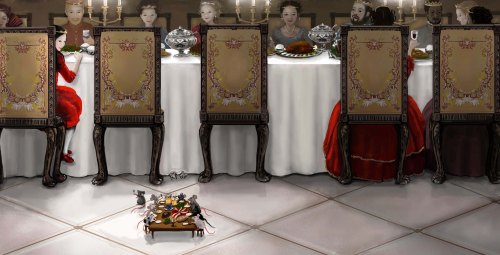
Dow Phumiruk is an aspiring children’s book illustrator. She won the 2013 SCBWI On-the-Verge Emerging Voices Award that promotes diversity in children’s books. This feast illustration is from a book idea called Arissa and the Queen’s Mice. Please visit her portfolio site at http://www.artbydow.blogspot.com or her blog at http://www.happydow.blogspot.com to see more of her work.
 I’m thrilled to share that… drum roll please… Kelly Calabrese has accepted representation with Sarah LaPolla of Bradford Literary Agency!
Kelly says, “Sarah LaPolla is a super sharp, smart, and witty agent who really *gets* the types of books that I like to write – which I believe is the most important factor in an agent/writer relationship.”
Kelly first met Sarah at the annual NJ SCBWI June Conference, and then again at the Full Manuscript Avalon Writres’ Retreat at the end of September. Sarah critiqued her full manuscript of her YA Thriller-Horror, BEAUTIFUL BLOODY DUCKLING, and gave her editorial notes that were dead-on insightful.
I asked Kelly what happened post the Avalon Writers’ Retreat, here is what she said:
I had the amazing fortune of being accepted into Brenda Drake’s Pitch Wars. As a chosen mentee in this contest, I won the editorial aid of two published mentors – Trisha Leaver and Lindsay Currie – who helped to shape my story into a much stronger version. I can’t shout loud enough from the rooftops about how life-changing Pitch Wars can be. After working day and night on revisions (Sleep? What sleep?!), I completed my manuscript a mere two days before Thanksgiving.
Sarah received my full manuscript on the 25th of November, and offered me representation within two weeks. Crazy. I know. And so very encouraging!!! It’s all very *dream come true* – WHOOT!
I truly believe that Sarah is an ideal agent for me, and that we are going to KICK ASS together. So, watch out world.
Of course, I could not have done it on my own. I am beyond grateful for Dee Falvo (my über talented CP), for the constant encouragement provided by my fellow NJ SCBWI members, and for the empowering mentorship offered through Pitch Wars.
The writing community ROCKS. And I am so thrilled to be a part of it…. #AmWriting #AmReading #Forevermore :)
— @kellycalabrese & @sarahlapolla —-
PS: I started a new BLOG called We Hear YA! It connects YA writers with their teen audience and can be found here: http://wehearya.blogspot.com/ (@WeHear_YA)
LINKS…
Sarah LaPolla: http://www.bradfordlit.com/about/sarah-lapolla-agent/
Pitch Wars: http://www.brenda-drake.com/pitch-wars/
Trisha & Lindsay’s book:
http://www.fluxnow.com/product.php?ean=9780738740805
CONGRATULATIONS KELLY AND SARAH!
FYI: If you have a Kindle, here are two books that have had their prices temporarily reduced. Can’t ever go wrong buying a Lauren Oliver book. I personally read and enjoyed. I just bought RED RISING, but have not read it yet. It has gotten a lot of buzz and awards.

Panic
By Lauren Oliver
A New York Times bestselling author delivers a “fast-paced and captivating book” (School Library Journal). In the small town of Carp, teenagers have invented a dangerous game, and newly graduated Heather and Dodge find themselves competing for thousands of dollars — putting their very lives at risk.
$1.99
Deal ends: January 5
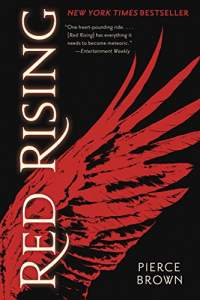 Red Rising
By Pierce Brown
For fans of The Hunger Games comes a New York Times bestseller that’s a “heart-pounding ride” (Entertainment Weekly). Darrow is a Red — part of the lowest level in his color-coded dystopia. Can he infiltrate the ruling Gold caste and bring justice to his people? “Fast-paced, gripping, well-written” (Terry Brooks).
$1.99
http://www.amazon.com/s/ref=nb_sb_noss_1?url=search-alias%3Ddigital-text&field-keywords=RED%20RISING
Deal ends: December 27
Talk tomorrow,
Kathy
Filed under:
Agent,
authors and illustrators,
Book,
illustrating,
inspiration,
success Tagged:
Avalon Writer's Retreat,
Bradford Literary Agency,
Dow Phumiruk,
Kelly Calebrese,
Sarah LaPolla 

By: Kathy Temean,
on 12/15/2014
Blog:
Writing and Illustrating
(
Login to Add to MyJacketFlap)
JacketFlap tags:
Illustrator's Saturday,
Amalia Hoffman,
Michelle Kogan,
Marie Wagner,
inspiration,
Poems,
Holiday,
Chanukah,
illustrating,
authors and illustrators,
Add a tag
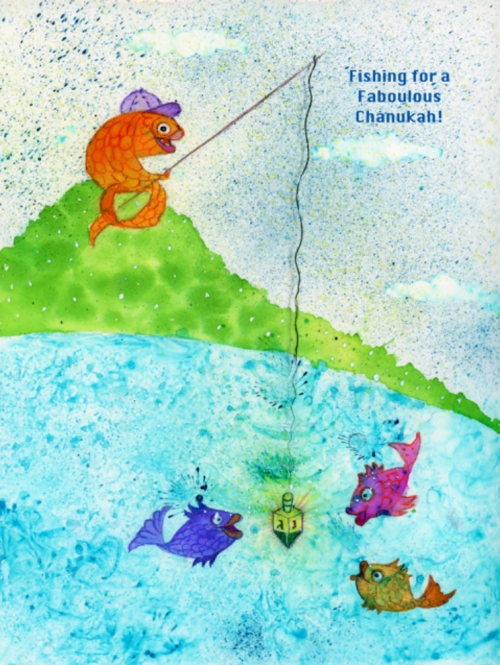
Amalia Hoffman sent this in to help us celebrate Chanukah. Amalia was featured on Illustrator Saturday: http://kathytemean.wordpress.com/2010/09/18/illustrator-saturday-amalia-hoffman/
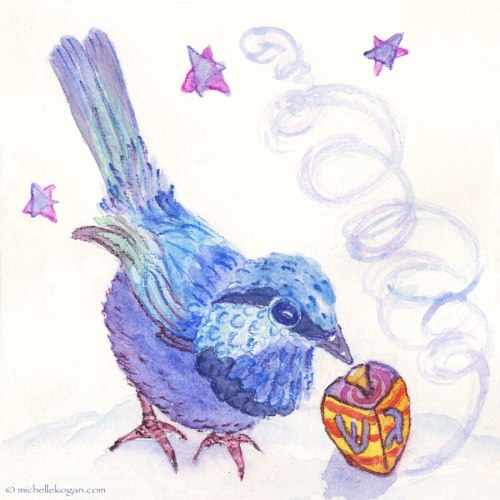
Michelle Kogan not only sent in the illustration above, but also the poem below to celebrate Hanukkah.
Hustle of Hanukkah
Michelle Kogan © 2014
Hustle of Hanukkah
somehow squeezing it in
In between holidays
falling often mid week
In between school and work
and numerous car trips
In between tradition
and finding your own way
In between Maccabees
the temples destruction
In between stolen oil
a miracle appears
In between night’s darkness
inner warmth radiates
In between lights glowing
throughout cold winter days
In between your mom’s arms
and between dad’s embrace
Making Hanukkah fit
in between for eight days
The poem below was sent in by Marie Wagner. Marie is an Artist, Author, Publisher, and Web designer. http://fineartamerica.com/profiles/marie-wagner.html?tab=artworkgalleries
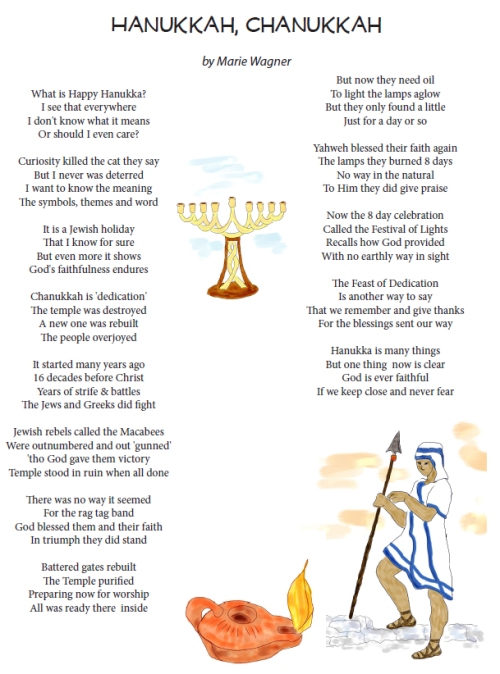
Thank you Amalia, Michelle, and Marie for sharing your work with us.
Hope all my Jewish friends around the world have a wonderful holiday!
Talk tomorrow,
Kathy
Filed under:
authors and illustrators,
Holiday,
illustrating,
Illustrator's Saturday,
inspiration,
Poems Tagged:
Amalia Hoffman,
Chanukah,
Marie Wagner,
Michelle Kogan 

By: Kathy Temean,
on 12/5/2014
Blog:
Writing and Illustrating
(
Login to Add to MyJacketFlap)
JacketFlap tags:
Illoustrator Saturday Favorites,
Which is your favorite?,
inspiration,
submissions,
illustrating,
authors and illustrators,
opportunity,
Illustrator Sites,
Illustrator's Saturday,
Add a tag
By: Kathy Temean,
on 12/5/2014
Blog:
Writing and Illustrating
(
Login to Add to MyJacketFlap)
JacketFlap tags:
Illoustrator Saturday Favorites,
Which is your favorite?,
inspiration,
submissions,
illustrating,
authors and illustrators,
opportunity,
Illustrator Sites,
Illustrator's Saturday,
Add a tag

By: Hazel Mitchell,
on 12/2/2014
Blog:
Hazel Mitchell
(
Login to Add to MyJacketFlap)
JacketFlap tags:
Hazel Mitchell,
charlesbridge publishing,
drawing digitally,
janay brown-wood,
Imani's Moon,
how to illustrate a book,
children's illustration,
digital art,
illustrating,
illustrating for children,
Add a tag
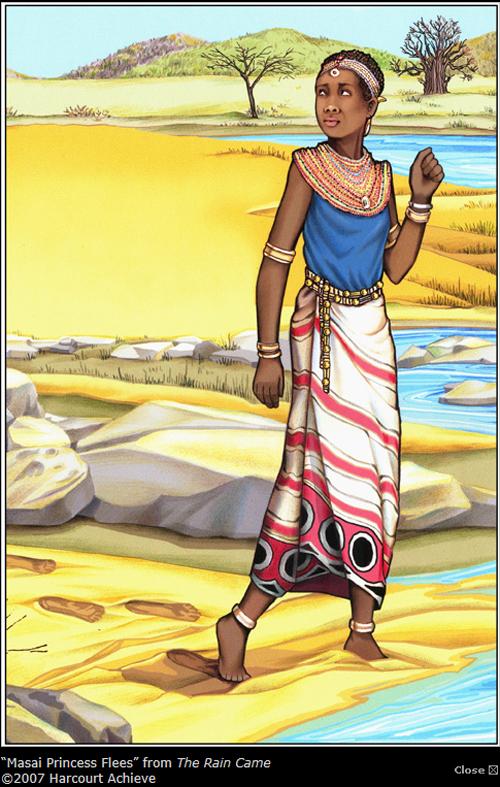
In my new book 'Imani's Moon', by JaNay Brown-Wood, I utilized traditional and digital illustration methods, much more so than in my previous books. This part-folk-part-fantastical story cried out for much more texture and depth of colour to reflect the diverse culture and life of the Maasai people.
Here's a look at how I worked up one of the illustrations ...
First thoughts on the layout for this spread. Mama is telling Imani about the legend of Moon Goddess, Olapa, I felt a great way to show the story would be in the swirling stars in the sky.
The sketch is letter size.
The finished graphite drawing, which is a little bigger than the finished book size.
I work on Archers 300lb cold press and with 2B-8B pencils.
I tape the paper and work over it with a wash of prussian blue (grumbacher) watercolour
to add value and texture, using salt, splattering, scraping and blowing techniques.
The hair dryer is a requirement to aid drying time! I try to keep the painting as loose as I can.
Here's the finished under-painting.
Next, I scan the image at 400dpi (not too high a quality as I want to keep some muzziness
and not have the art too 'sharp') and start to overpaint in photoshop, particularly paying attention
to getting the right levels in the sky tones.

I work with colour in photoshop 'descriptively'. The layers are light, mostly using 'multiply' mode so the pencil and watercolour textures show through. (I'm not into dense digital colour paintings, it doesn't work for me. And this is how I work in watercolour also ... lightly, letting the ground show through, so it is just the same way as I think, on screen). I don't use many brushes. I don't like to complicate things! Sometimes I will make notes on what I used and colour paletted. But mostly, I wing it. Usually I'm using a soft edged brush in different sizes, at 50% opacity or less. Sometimes a brush with a little texture, usually when I am burning or lightening. I use the dodge and burn tools a lot, with the same principles. I do use several layers, but I also mix colours on the same layers. For example in the skin tones and the landscape. I work in CMYK (and try and get a printer colour setup driver from the design department, to colour proof on screen, if I can). The actual colouring in photoshop takes me much longer than the drawing and underpainting. Probably 2 -3 times as long, depending on detail and size. (To those people who say painting digitally is cheating ... ok, you try it!) I love digital 'finishing', because it gives me immediate options to change and correct -er - mistakes. And I can also do things with colour much more easily than on one flat painting. AND it's fun! I've been using photoshop for over 20 years now. It's a major tool in my studio. But I'm also enjoying the fact that I can incorporate my fine art training and get the best of both worlds.
You may also notice a couple of changes in the finished painting. (That photoshop thing is handy again!) I wasn't happy with the profile of Imani, so I redrew and scanned and pasted over the first drawing. I also made the moon smaller, so it doesn't overpower the stars.

I added the stars last, and I did do them digitally. I tried them by hand first, but because the image was quite complicated, they were too lumpy and didn't look right to me. So I DID use the star brush in photoshop, then I added 'glow' around them and around the moon. I read a review that said that the watercolour images were 'enhanced' digitally (ie the stars and glowing bits). It made me chuckle as they failed to understand the extent of work I did digitally. So it quite pleased me! But digital or traditional, is the end effect pleasing? Does it serve the story? I do get tired of people trying to 'spot the digital'. So misguided in these days when so many top illustrators work with both digital and traditional methods.
Here's where the text went in the final image. Another changes along the way that worked well.
Thanks to my art director at Charlesbridge. Susan Sherman, who had so many great suggestions in the making of this book.
Toodles!
Hazel
By: Kathy Temean,
on 11/28/2014
Blog:
Writing and Illustrating
(
Login to Add to MyJacketFlap)
JacketFlap tags:
Advice,
illustrating,
How to,
Gregory Manchess,
Smithsonian,
Illustrator Sites,
Illustrator's Saturday,
Illustrated USPS Stamps,
NYC MURAL,
Time Magazine,
Add a tag
I have been trying to share Gregory Manchess’s art for most of this year. He is a very talented artist, but a very busy artist. He exhibits all over the world, teaches workshops, lectures at universities, plus everyone is trying to bang down his door for a little piece of his genius talent. I gave up on getting the answers to my too many interview questions and showing him off without the interview. But there is a lot of meat to this post with a lot of tips for illustrators, so take a look and don’t miss the link to his two hour “How to” video.
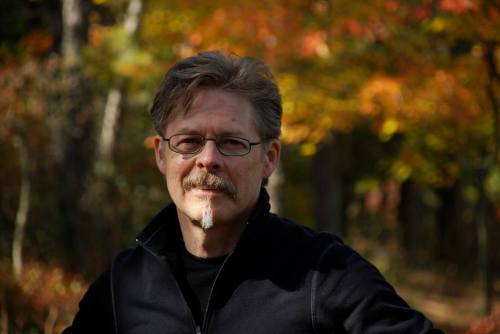
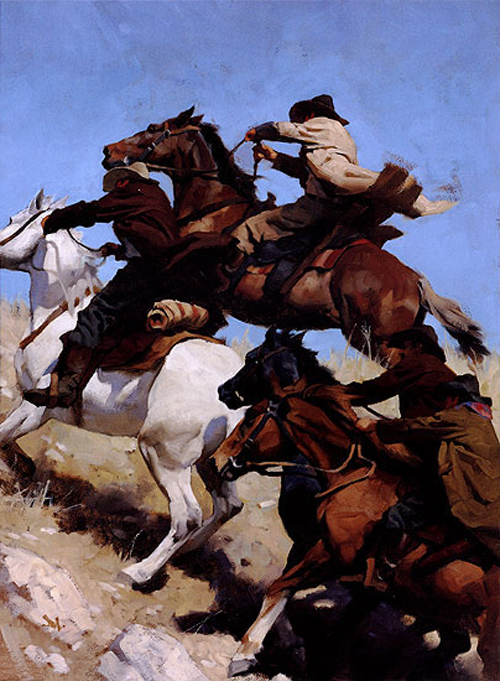
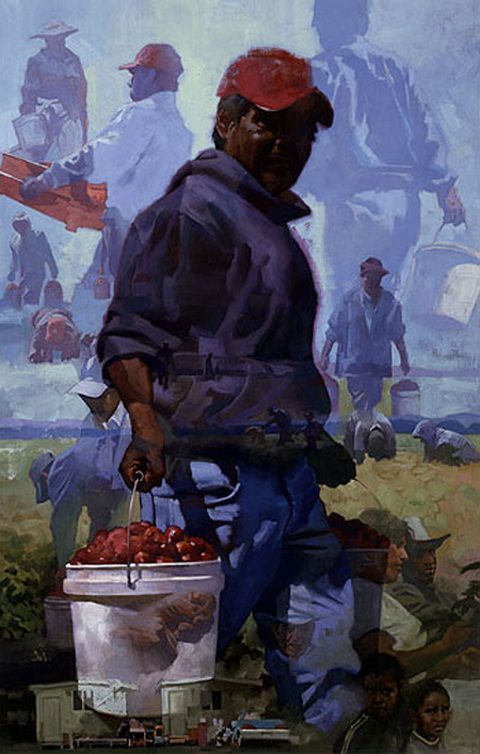
Creating a moment that communicates emotionally with the viewer is the essence of Gregory Manchess’ artwork. A native of Kentucky, he spent two years as a studio illustrator with Hellman Design Associates before striking out on his own in 1979.
He combined his love for fine art and science fiction and began his freelance career painting for OMNI magazine. His versatility and broad range of interests allowed him to crossover to mainstream illustration. There he was able to expand his client work to include covers for Time, Atlantic Monthly, spreads for Playboy, Omni, Newsweek, and Smithsonian, and numerous book covers.
Manchess’ interest in history and his excellent figure work has made his paintings a favorite choice of the National Geographic Society on many occasions, including an expedition down the Fond du Lac river in Canada for the 1996 article David Thomson: The Man Who Measured Canada.
Widely awarded within the industry, Manchess exhibits frequently at the Society of Illustrators in New York. His peers at the Society presented him with their highest honor, the coveted Hamilton King Award in 1999, and a year later, the Stephan Dohanos Award.
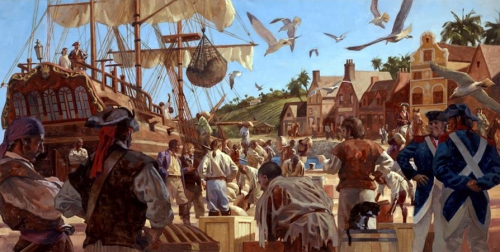
Manchess’ work has also been recognized in the children’s book market. His latest children’s book illustrations narrate the story Cheyenne Medicine Hat about wild mustangs. A lavishly illustrated limited edition of Robt. E. Howard CONAN stories with over 60 paintings, is due out in 2010. He has recently finished 10 murals for a traveling exhibition on the Pirate ship, Whydah, for the Nat’l Geographic Society. His painting of the Oregon coast was used for the 2009 Oregon Statehood Stamp by the USPS.
Gregory is included in Walt Reed’s latest edition of “The Illustrator in America, 1860-2000.” He lectures frequently at universities and colleges nationwide and gives workshops in painting at the Norman Rockwell Museum in Stockbridge, MA, and the Illustration Master Class in Amherst, MA.
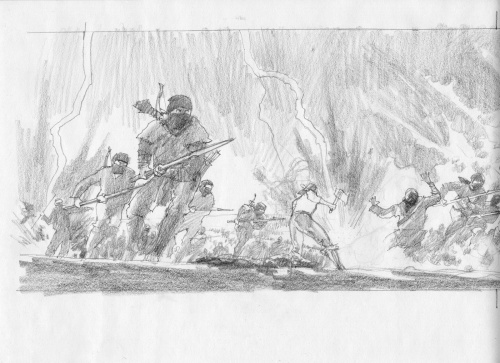
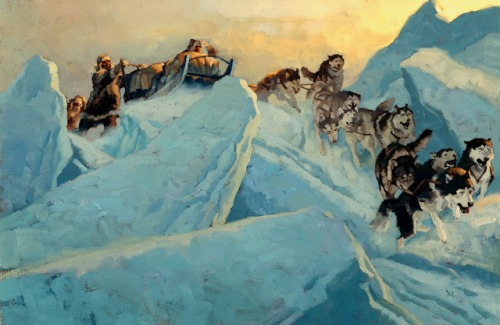
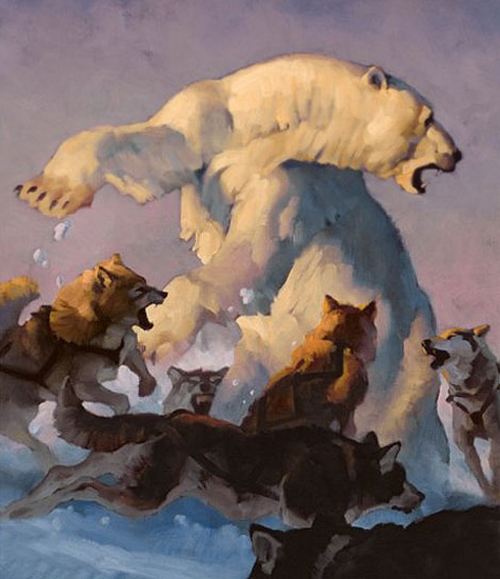
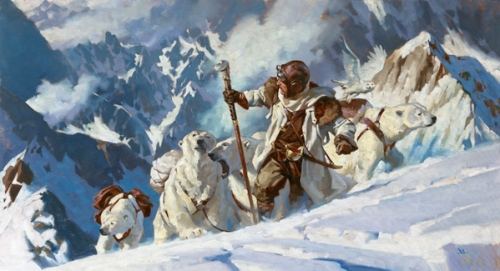
Here are a few pictures showing Gregory’s process:
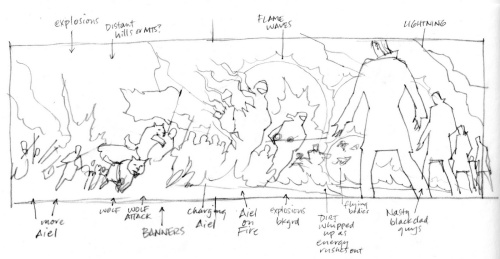
Thumbnail sketch for layout.
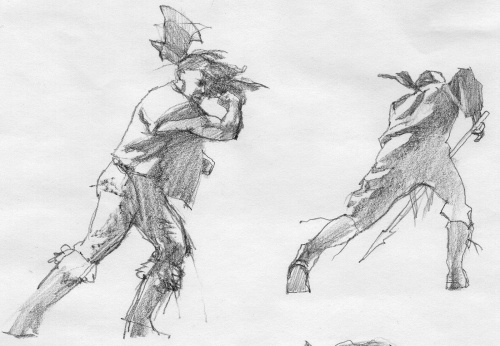
Character sketches
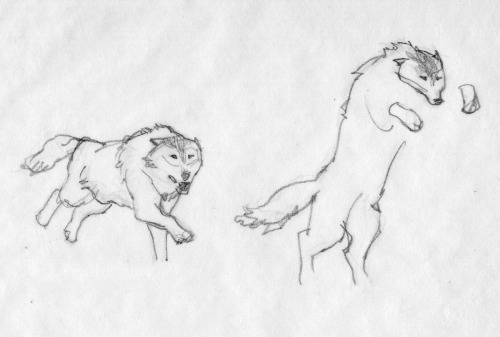
Sketches for the wolves
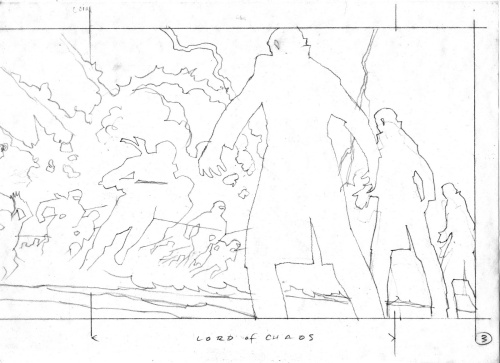
Cleaned up sketch
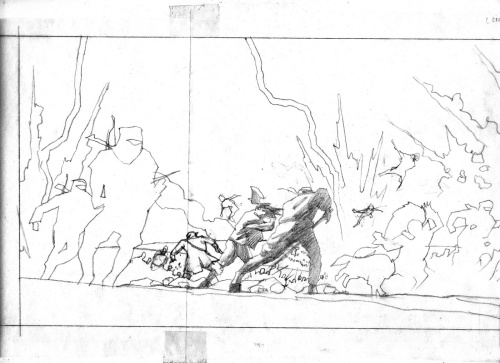
Sketching in more detail.
Adding Shadows
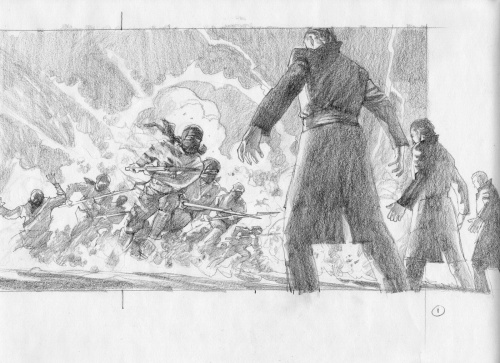
Adding foreground characters
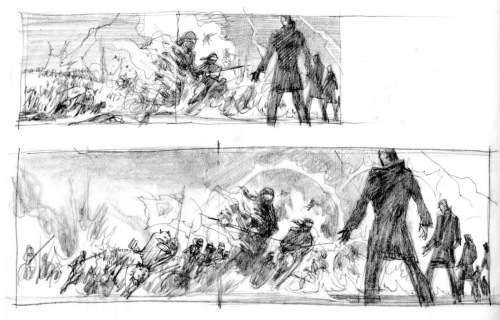
Continuing to develop sketch.
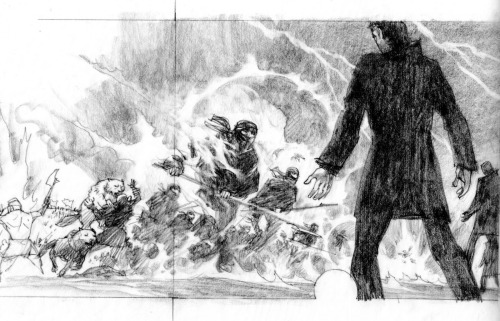
Final Sketch
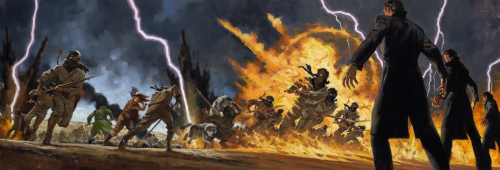
Final Painting done in oil.
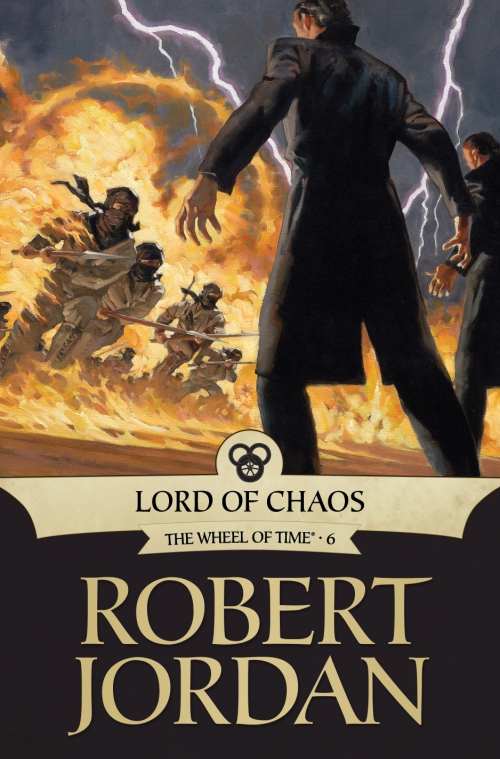
This is the final cover for LORD OF CHAOS published by Tor.
Gregory’s artist rep is Richard Solomon located in NYC. http://www.richardsolomon.com/
You can view a two hour video of Gregory’s painting process available as a download from http://Conceptart.org
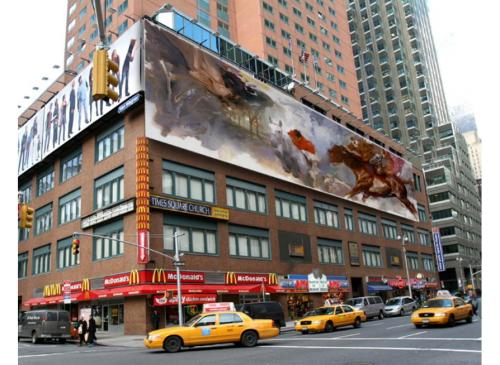
One of Gregory’s many murals. Must have been fun to see it on the top of a NYC building.
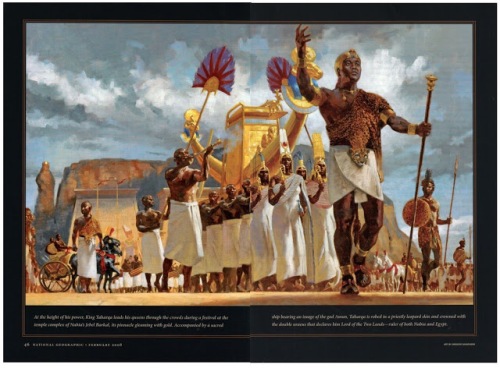
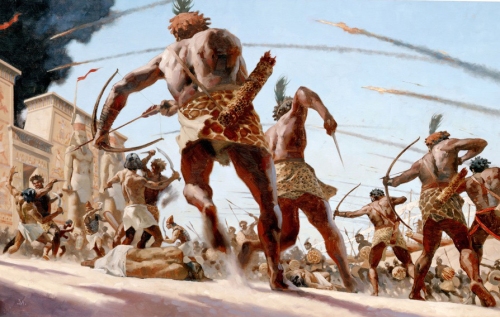
ABOVE and BELOW: Gregory’s illustrations have been in National Geographic Magazine.

Gregory also was chosen to do a few postal stamps.
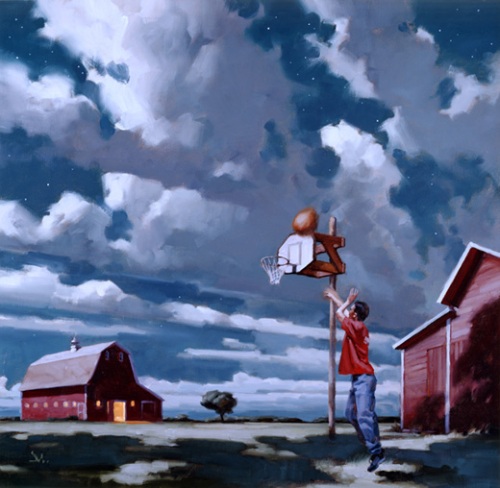
The Society of Illustrators exhibited 50 of Gregory’s illustrations in 2013.

ELEVEN GREGORY TIPS:
Value range.
I start with darks first, to get the deep shadows laid in. Obvious places: nostrils, eyelids and eyebrows, mouth line. Next, I’ll put in broader, but slightly lighter shadow shapes like under the nose, under the eye sockets, under the bottom lip, chin, deep cheek bones, hair. I place the boldest shapes to establish deeper values, then work my way up through the darker values of color to the lighter values placed on top.
Avoid highlights.
Until the last bits of painting, I avoid the highlights as long as I can. Two reasons. One, I need to work my way up, so putting them in too soon will defeat that effort. Two, I leave something fun for the last. I delay gratification as long as I can. The best part of painting in oils occurs within the last few layers and strokes.
Vary forms.
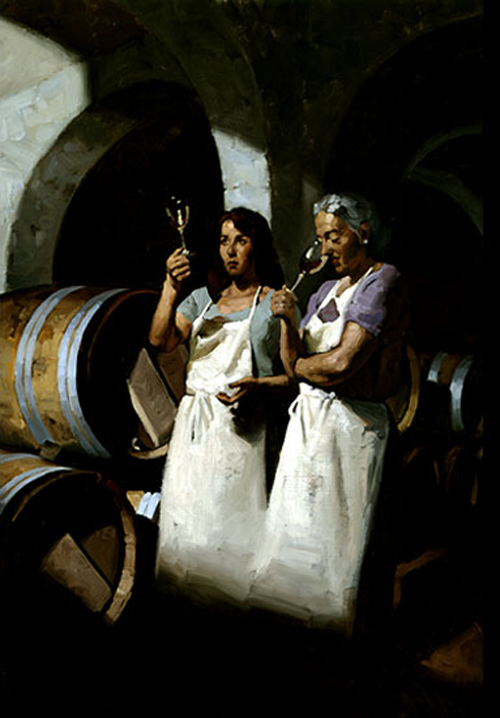
Hair is a bold shape, not individual hairs. I study folds and constantly vary them. Repeating the same folds will kill a painting as dead as an assassin’s shot through a pillow. I don’t think about the object I’m painting. I separate myself from the subject and only paint the form. I won’t ‘follow’ the form either. I cut my strokes across the surface of the forms. This adds dimension and lets objects feel sculptured.
New painters: Avoid primary colors.
Ultramarine Blue. It’s deadly. It’ll make mud faster than 35 school kids running for the bus. And no, Cadmium Yellow Light is not a miracle color. Get over it. Using it straight from the tube does not show how brilliant one is at mixing paint. Same is true for Ultramarine. New painters seem to think they are phenomenal because they used Ultramarine Blue straight from the dang tube. They step back and declare, ‘look at me, The Genius. I have explained the essence of pure painting by opening a paint tube and using yellow next to blue. Admire me.’
Using primary colors as a statement of painting brilliance screams ‘AMATEUR.’
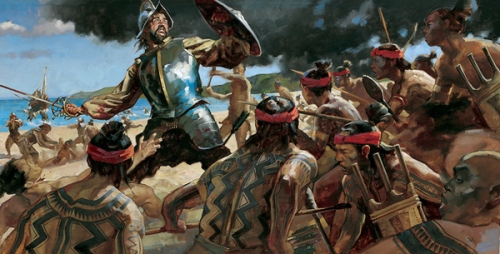
Amount of pigment.
I trained to know just how much pigment is on the end of my brush. No matter how large or small, my awareness of the amount is paramount to good layers, good coverage, good overall effect in any painting.
I studied calligraphy. It taught me how to make letterforms with a brush or pen. Knowing the amount of ink held on an instrument for calligraphy is critical to achieve a skilled work.
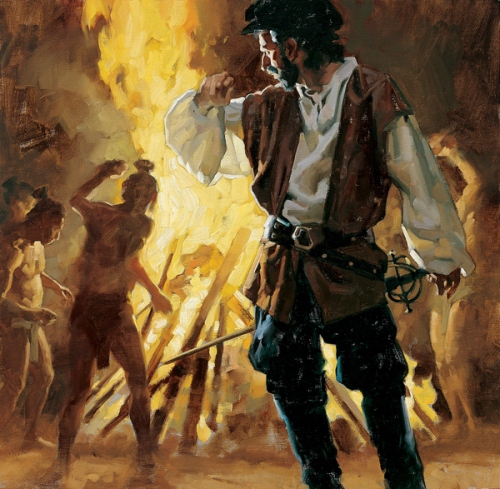
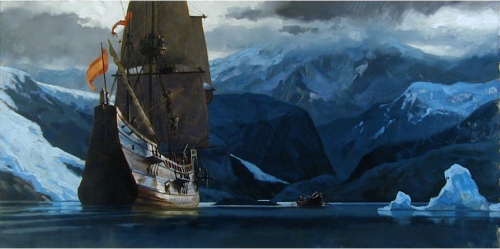
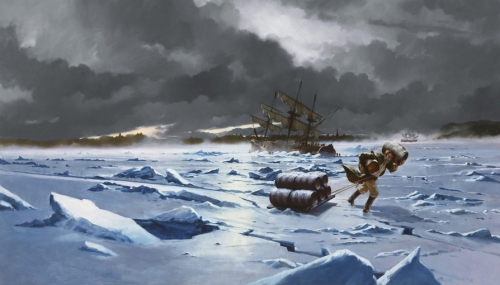
Brush angle.
Calligraphy also taught me how to angle a pen or brush. Making letterforms is a key factor in learning to paint. I know many great painters who also started by copying letter shapes, making signs, copying comics (bang! zoom! pow!). They learned to handle the brush and at what angle AT ALL TIMES.
The angle of the brush helps lay down the right amount of pigment, at the right angle, in the right direction, with the right pressure to achieve a free and confident stroke.
Brush angle.
Calligraphy also taught me how to angle a pen or brush. Making letterforms is a key factor in learning to paint. I know many great painters who also started by copying letter shapes, making signs, copying comics (bang! zoom! pow!). They learned to handle the brush and at what angle AT ALL TIMES.
The angle of the brush helps lay down the right amount of pigment, at the right angle, in the right direction, with the right pressure to achieve a free and confident stroke.
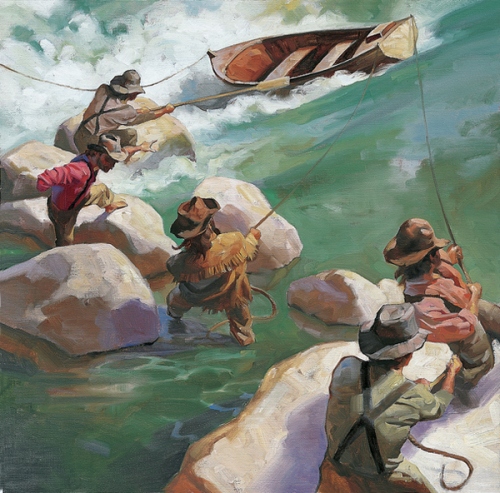
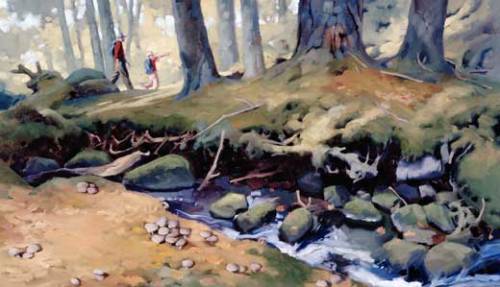
Brush size.
I start with the largest brush for as long as I can and work my way down to the smaller brushes. Many times, as I near the end of a painting, or even slightly before, I switch back and forth. It’s a good, general idea to keep things from getting too focused too early.
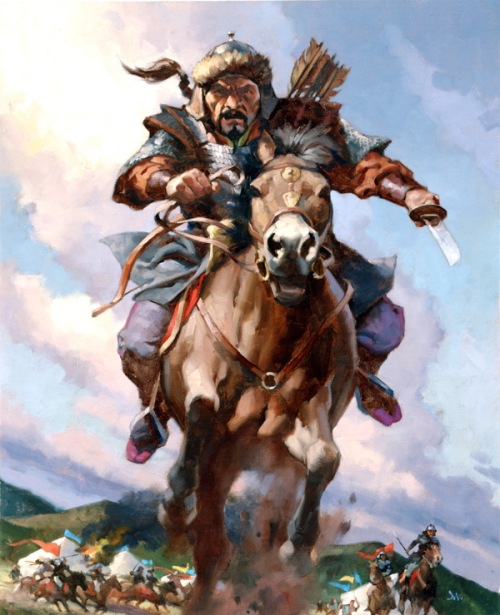
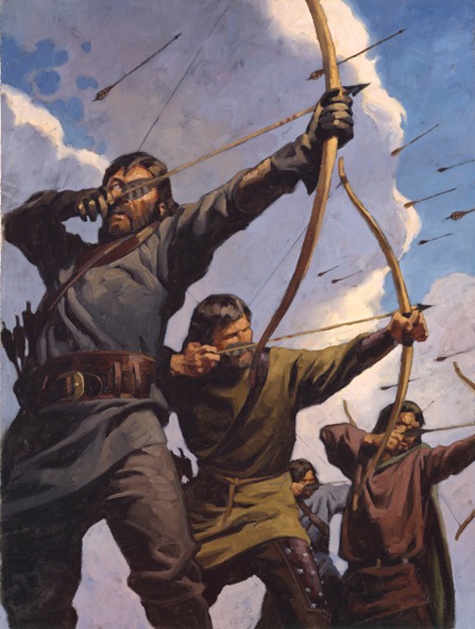
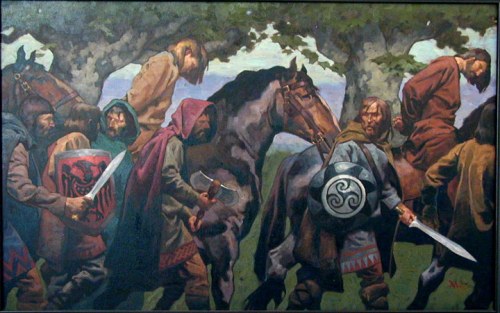
Stroke speed.
Painting fast and loose comes the same way as anything else: with time. I painted very slowly in the beginning, placing my strokes deliberately, to look as if they were painted fast. Once down, it’s usually hard to tell the speed the stroke was laid. Over the years, I built up speed through confidence. It’s just plain ol’ experience. And LOADS of training.
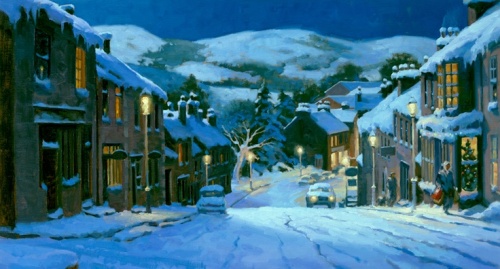
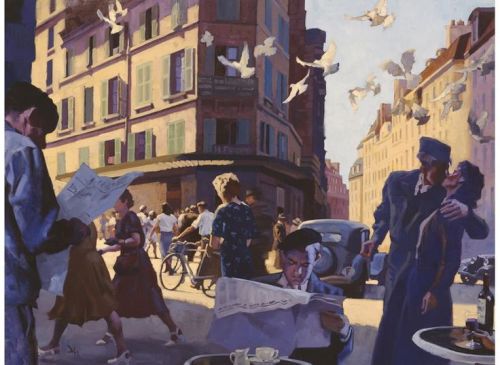
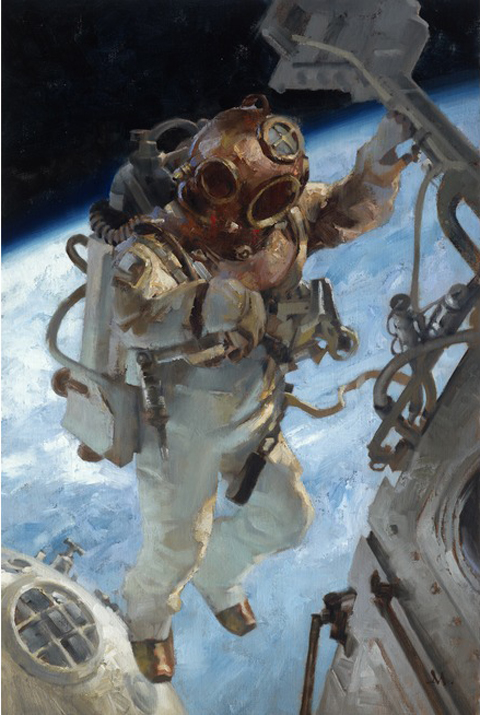
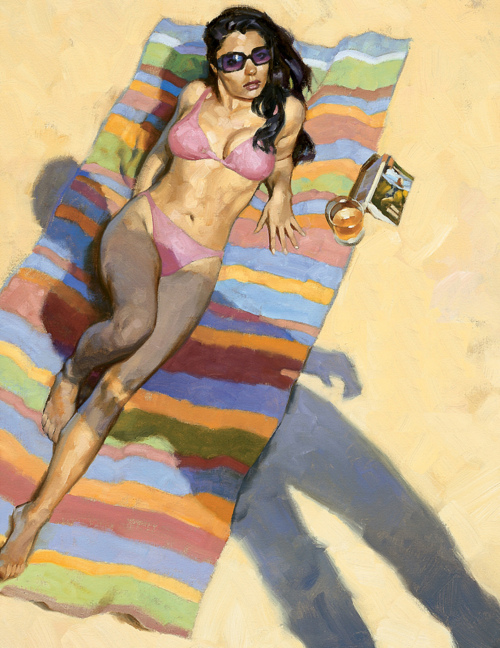
Patient strokes.
I don’t judge my strokes too quickly. I lay it down, and press on. I come back to that area after a bit to judge whether it was the correct feeling, size, color, etc. I don’t lay one down, hate it, and take it off. Or worse, try to keep changing it.
At this point in my career, I lay strokes down that don’t make sense, but I let them sit. I find that they are just fine once I come back to judge them in context, against other strokes that are adding to the whole piece. Judging too early destroys spontaneity.

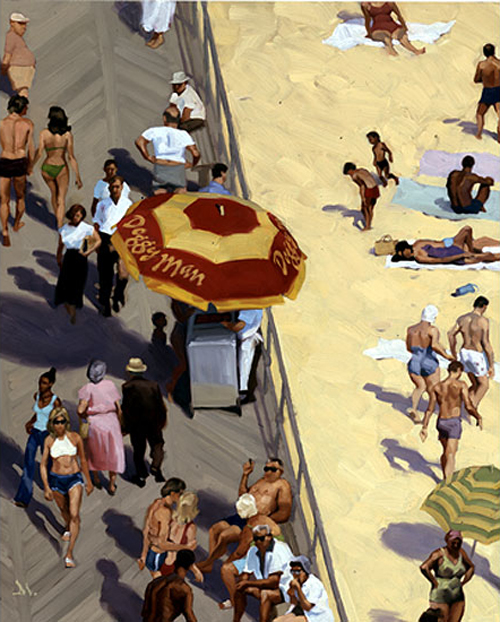
Scale.
I decide how I want the paint to feel once a piece is finished. I scale the brush size to fit the scale of the painting. If it’s a small painting in a magazine, I have to decide how clearly the strokes will be seen and what feeling they project to a reader.
If it’s a large painting and I want it to feel loose, I have to decide on the size that feels best. Paint it too large with small brushes, and when it comes down in reproduction, it can look too detailed. Too small with large brushes, and the piece can look too loose, too unfocused.
New painters can make the mistake of painting too small with too large of a brush and vice versa.
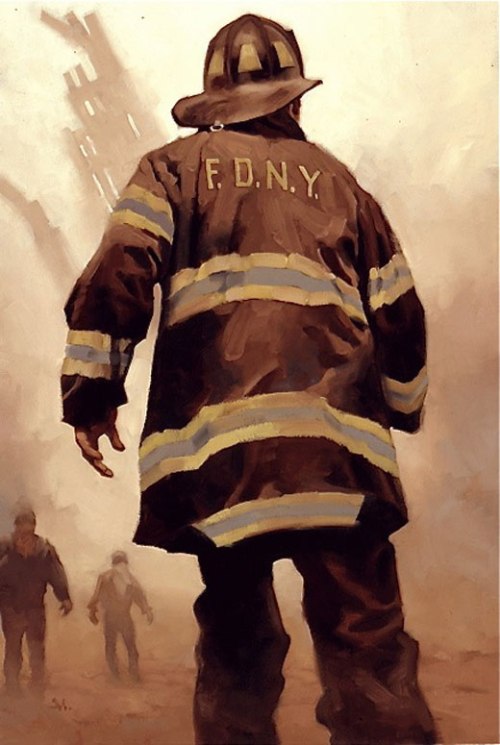
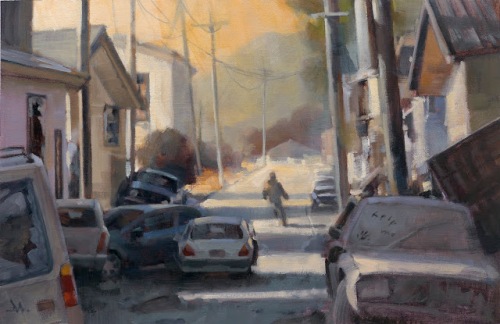
Below is Gregory explaining his thought processes for Jake and the Other Girl.
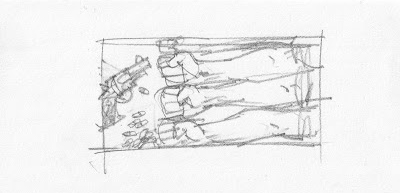
There’s another way to make successful thumbnails that can lead to a final sketch.
Get right to the research first. Instead of exploring small thumbnails on the page, searching for the right image design, there are times where I know that the assignment demands a clearer knowledge of the setting before an idea takes hold.
I read this short story for Tor.com, a follow-up for a previous story, “Dress Your Marines in White,” by Emmy Laybourne. I toyed with a short-lived idea that might connect with my illustration for the first story, based on a set of men’s arms.
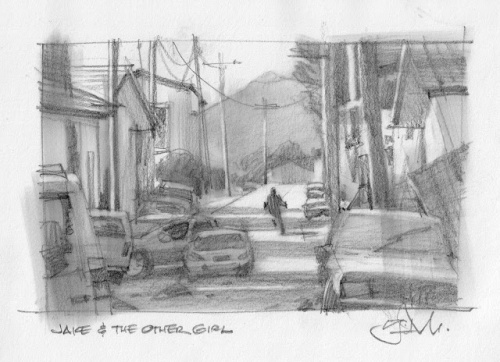
But I had a clearer idea that I needed to know & show the environment for the piece. The mood needed to be established instantly. The story is post-apocalyptic. I quickly rejected that early approach after researching, at length, war-torn cities, destroyed cities, hurricane, tornado, and earthquake damaged city streets. There is only a brief scene where the main character is outdoors, but it gives the tale a sense of place and I wanted the reader to feel that.
I gathered abandoned cars, some parked, some wrecked, some neglected. I used the status of the cars to reflect the status of the story. I researched shots of broken buildings, street scenes, and abandoned towns. I put all of these images up on my computer and freehanded a large scale thumbnail as the main sketch.
With that much information, I only needed to hit it one time. Most times, you have to create your own luck.
But the challenge after getting the idea was to pull it off. It must read fast and it must feel factual. Rendering cars is not so fun, but discovering and simplifying their shapes to read quickly was very gratifying. But I had to show more than just shiny cars parked. I wanted some to feel like they had just been abandoned, while others had been there for some time.Again, getting the value correct meant the difference here. Capturing that feeling meant I had to forget what it felt like, and pay more attention to exactly what it looked like. By doing that, I managed to capture the feeling of a dust covered car.
Not so intuitive. I had to study and mix the difference in value range to get shiny vs dusty. I wasn’t surprised to find out how much I learned from this painting about simplifying detail.
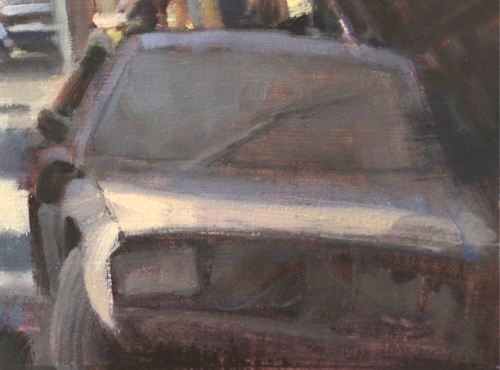
As painters, we must sometimes compartmentalize our feelings to actually capture those same feelings in the image. We start with the impression of feeling, reverse-engineer it methodically through observation and application that then re-communicates the feeling we were after originally. Using contrast was another way of projecting that feeling. I decided to have someone leave a cryptic message on the windshield, like a “wash me” note. The difference between the soft values of the dusty windshield and the crisp, hand drawn letters brought this across. To get that affect, I had to pay attention to exactly what value would be revealed if someone had haphazardly wiped away some dirt.
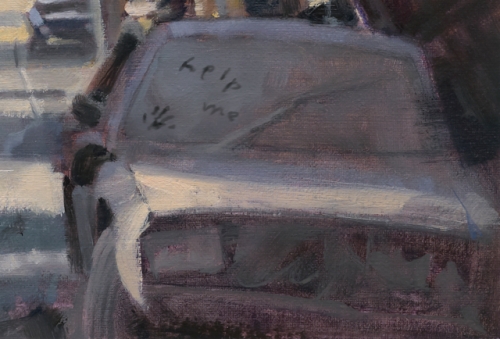
I could’ve added that passage after the oil was dry, but instead, I painted it digitally. This allowed me to give the art director, Irene Gallo, the choice to keep it or not.
This is yet another way in which digital is informing my analog painting development.
Click this link to read Gregory’s Ten Things About Painting in Oils: http://muddycolors.blogspot.com/2013/03/10-things-about-painting-in-oils.html
You can find Gregory Manchess on his website http://www.manchess.com and his facebook page: https://www.facebook.com/pages/Gregory-Manchess-Art/180916225410035
I would love to hear what you think about Gregory’s illustrations. Maybe you have taken a class with him or got to see his illustrations when he exhibited in NYC or for that matter in one of the many places he has exhibited around the world.
Talk tomorrow,
Kathy
Filed under:
Advice,
How to,
illustrating,
Illustrator Sites,
Illustrator's Saturday Tagged:
Gregory Manchess,
Illustrated USPS Stamps,
NYC MURAL,
Smithsonian,
Time Magazine 

N
N
NN
N
N
N
N
N
N
N
N
N
N
N
N
N
N
NN N
N
N
N
N
N
N
NN
NN
N
N
NN
N
N
N
NNNNNNNNNNNNNNNNNNNNNNNNNNNNNNNNNNNNNNN
Filed under:
illustrating,
Illustrator Sites,
Illustrator's Saturday Tagged:
Gregory Manchess
By: Kathy Temean,
on 11/21/2014
Blog:
Writing and Illustrating
(
Login to Add to MyJacketFlap)
JacketFlap tags:
Interview,
picture books,
inspiration,
Advice,
Process,
illustrating,
authors and illustrators,
John Lithgow,
How to,
Leeza Hernandez,
Illustrator's Saturday,
Never Play Music Right Next to the Zoo,
Add a tag
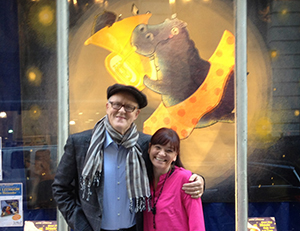
Leeza Hernandez is an award-winning illustrator and children’s book author, hails from the south of England, but has been living in New Jersey since 1999. In 2004 she switched from newspaper and magazine design to children’s books, and hasn’t looked back. With a few books now under her belt, she’s currently working on three new projects: a follow up to Dog Gone! called Cat Napped; a sequel to Eat Your Math Homework called Eat Your Science Homework, other released this year. In 2013 she illustrated a picture book written by acclaimed actor and author John Lithgow. Follow Leeza on Twitter @leezaworks. She also took over my place as the Regional Advisor for the New Jersey SCBWI chapter and is doing a great job.
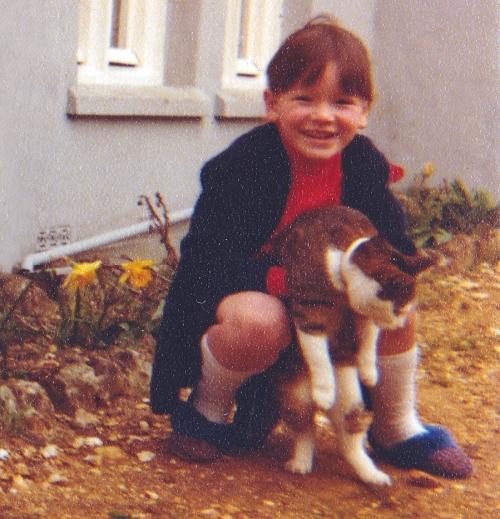
Below is Leeza at six years old with her cat Minnie Weasle!
Here is Leeza explaining her process:
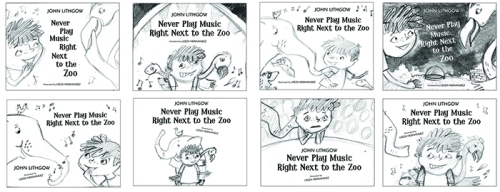
The cover of Never Play Music Right Next to the Zoo took a fair amount of working out—between not giving too much away and showing to little that it looked too vague. The images show a handful of the different covers that were sketched up, then the progression of the final color cover.
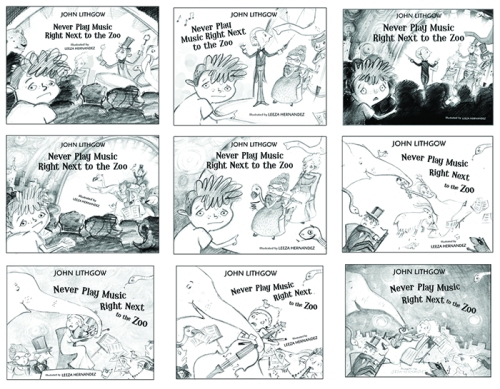
These are the thumbnail sketches for the book layout.
Because there were so many animals in Never Play Music Right Next to the Zoo, I kept all my research pictures organized in a jumbo ring binder.

But, no matter how hard I looked, I just couldn’t find an image of a yak playing a sax so had to use some creative license!

Below you can see the process of the cover art.
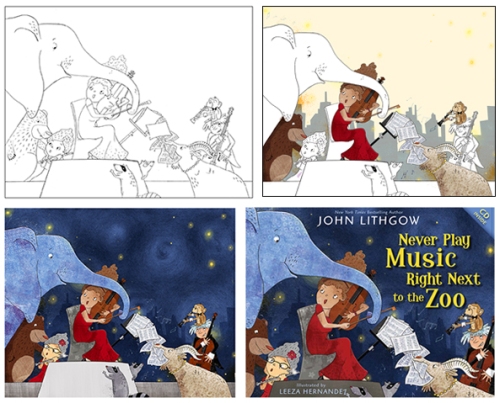
Below is an up close look at the final cover.
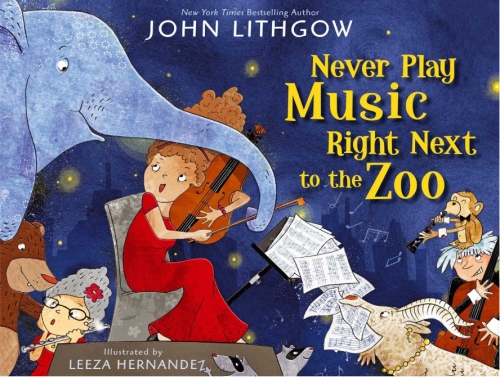
What caused you to move from the UK to the US?
Work. I took an art director position at a newspaper in the late 90s which was the field I worked in back then.
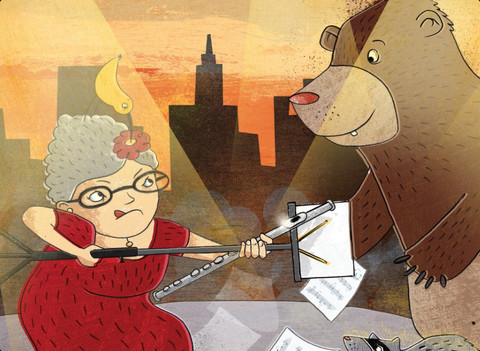
When did you decide you wanted to illustrate for children?
It wasn’t a conscious decision really, but in the early 2000s I discovered Illustration Friday (www.illustrationfriday.com)—a great source of inspiration but also a way to help you create illustrations for yourself based upon a weekly word prompt. Browsing through the site, one link led to another and I eventually landed at SCBWI (www.scbwi.org) and that was that!

This image was created for the Illustration Friday prompt “Wisdom” and received an American Illustration selection back in the early 2000s. I added it to my portfolio among a handful of painted images and it was what art directors responded to the most. I was encouraged to create more!
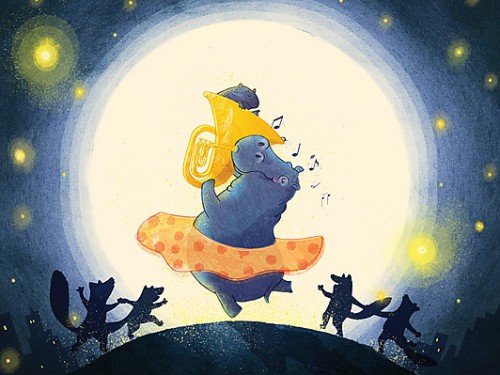
What was the first picture book that you illustrated? And how did that contract come your way?
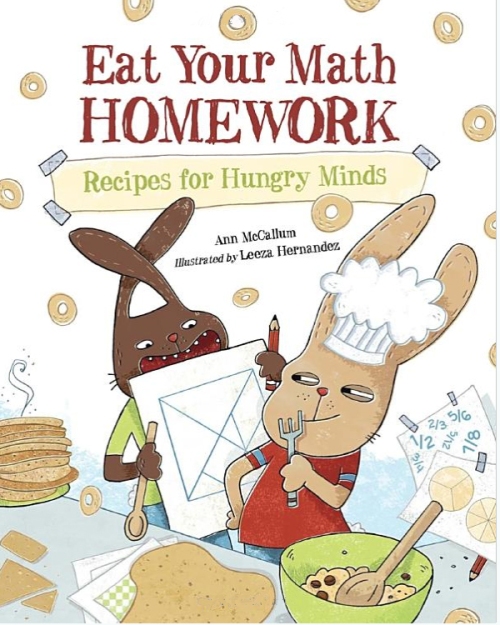
Eat Your Math Homework was the first trade picture book I was hired to illustrate, which came about after attending a Rutgers One-on-One Plus conference (ruccl.org). I met an editor at the luncheon who took my promo postcard away with her and about six months later the designer reached out to my agent asking if I was available-yay!
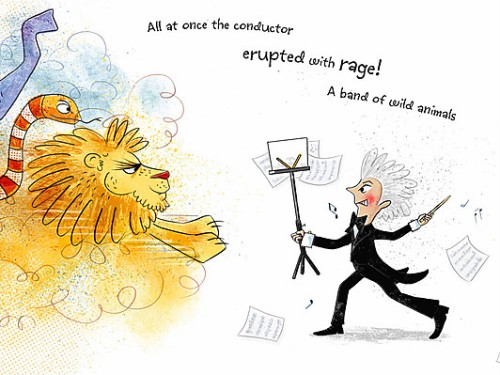
How did you connect with John Lithgow to illustrate his book, Never Play Music Right Next to the Zoo ?
I was asked to do some samples (along with some other illustrators) for a book written by a ‘high-profile’ author but I didn’t know who it was until I found out I was picked for the project. It was all very mysterious and exciting!
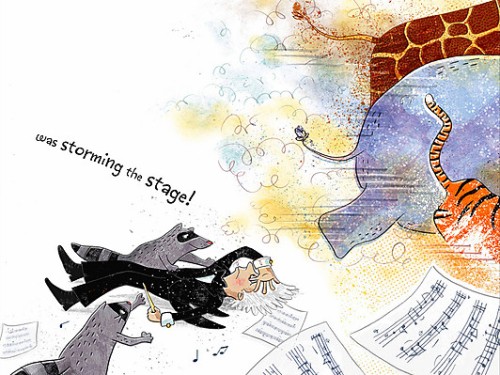
Have you met John Lithgow?
Yes, he’s lovely. We launched the book together in New York, it was so much fun. He sang his songs. I spared the audience and did not sing!
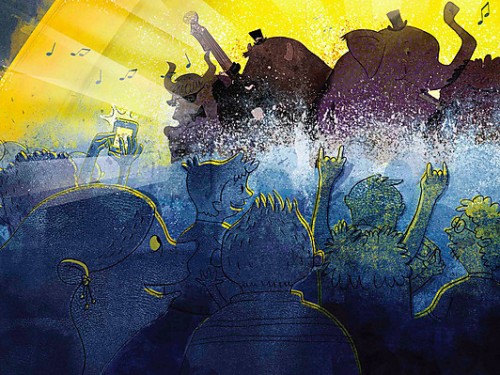
How long did you have to illustrate Never Play Music Right Next to the Zoo?
This was one of the quickest turnaround books I have worked on and it was 40 pages. From initial sketches, through revisions and to final art was a little less than eight months total.
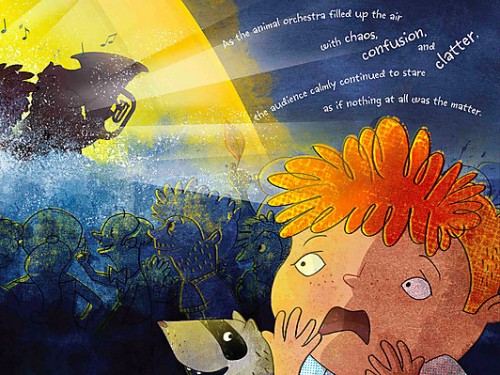
I see you illustrated a second book with Ann McCallum this year, titled Eat Your Science Homework. Did you sign a two-book deal when you illustrated Eat Your Math Homework in 2011?
No two-book deal. It was simply an organic progression. Ann had an idea and submitted her proposal for the science book and a few months after they acquired the manuscript, Charlesbridge asked if I’d
illustrate it.
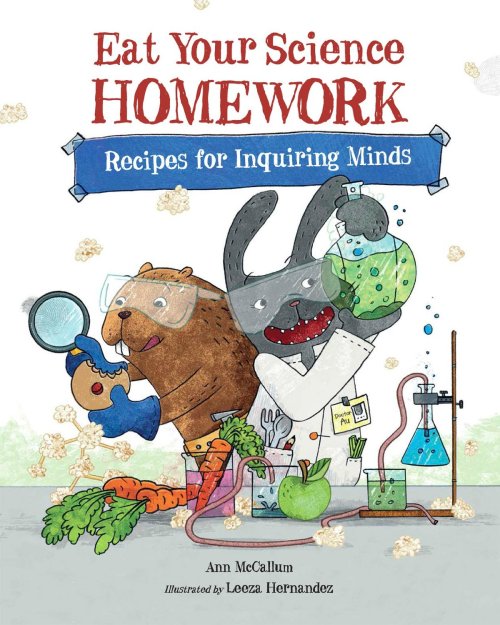
Will there be a third book with Ann?
Yes! Eat Your U.S. History Homework is due to release in late 2015.
I am assuming that Cat Napped! published by G. P. Putnam’s Sons came about due to the previous book you wrote and illustrated titled, Dog Gone! Can you tell us the story behind these two books?
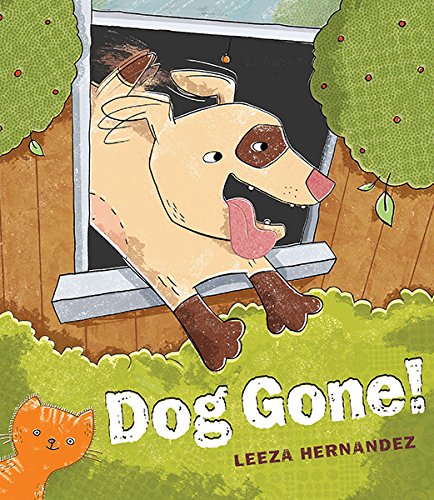
Back in 2009 I won the Tomie de Paola portfolio award at the New York SCBWI conference—which was amazing. As a result, I was invited in to the Penguin offices to meet with an editor, publisher and art director and they looked at my work as well as a sample and manuscript for Dog Gone! and they took it. I was beyond thrilled and so, so grateful for the opportunity.
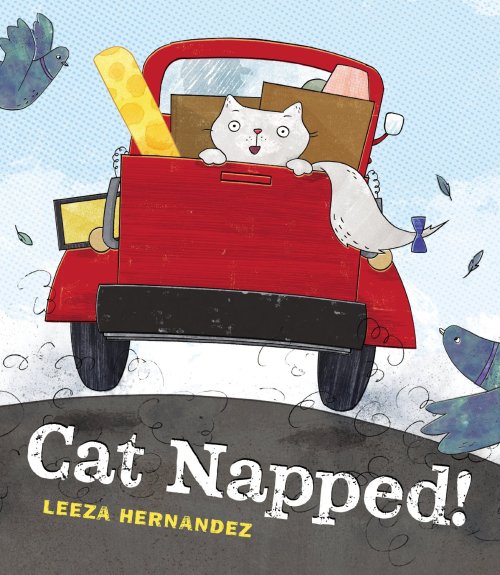
During the time I worked on Dog Gone! I had this idea that I wanted to create a cat book in the same vein and I already had the title Cat Napped! noodling around in my head, but it took a while to flesh out the story. I remember having submitted the story along with a couple of other ideas to the editor and right after Dog Gone! released they took it.
Have any of the books you worked on won any awards?
Eat Your Science Homework was awarded a 2014 Junior Library Guild selection—awesomesauce!
Do you have plans to write and illustrate another book?
Hahaha, yes of course! I hope I never stop.

What do you consider your first big success?
Wow, that’s a tough question. I’m not sure I can measure one big success that easily. Having a book published is amazing, but I also consider the ever-evolving process as a series of successful stepping-
stones and I do a little happy dance each time I move to the next one—because they all teach me something about myself and/or my work. Creative folks are such sensitive creatures and it can be
intimidating to put our work out there in front of people, so each time we are brave and face our fears head on, that’s a success. Actually, when I attended a SCBWI conference for the first time, I was so overwhelmed I almost didn’t go back the next day—so I’d say not giving up right off the bat was my first big success!
For pencil work, I use 2H, HB, 2B and 5 or 6B pencils on Arches hotpress 140lb paper.
 What is on the drawing board now?
My schedule has been a little nuts lately so I am taking a rest-of-the-year break and finally getting around to updating my website, which has been somewhat neglected.
Do you ever use Corel Painter or Photoshop when illustrating?
I ‘collage’ in Photoshop. I take all the pieces that I create by hand, scan them in, then slice ‘n’ dice them into a final illustration. I think of Photoshop as my digital scissors and glue, but I don’t actually illustrate with Photoshop if that makes sense, like, I’m not drawing or painting digitally using brushes and filters.
Do you own a graphic tablet?
No. If you mean a Cintiq or Wacom, that is. I’ve seen them in action though, wow!
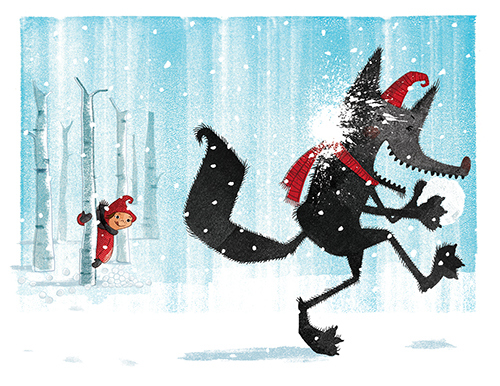
Is there one thing that you did or happened that you feel really pushed your career to the next level?
I joined SCBWI. So far, this has been an amazing journey of education, connections, opportunities, projects and rewards, but it all started with this incredible organization that continues to play a role—LOVE SCBWI!

Do you take pictures or other research before you start a project?
Before and during—yes. Having reference material gives me a much better understanding of what I am drawing than simply imagining. I like to begin by drawing realistically before I think about characterizing for a book because it gives me an accurate sense of anatomy, behavior, body language, etc., even though they’re very loose drawings. There were a number of animals in Never Play Music Right Next to the Zoo that I hadn’t drawn before, so I filled a ring binder with reference just for that project.
The original pick-up truck for Cat Napped! was a struggle, but after sharing with my editor, we realized it was too square and modern, so I went back and researched vintage trucks from the 40s and 50s. The end result was a bit of a hybrid but its softer, curvier edges suited the tone of the book far better than the angular truck I had originally drawn.
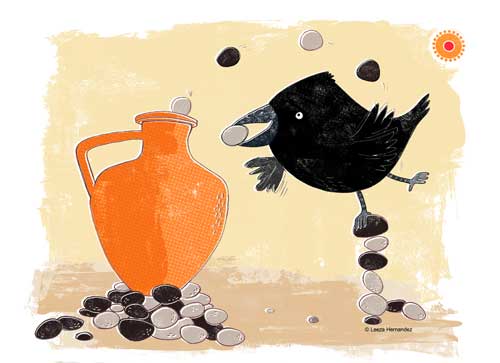
The internet is a powerful tool—National Geographic (nationalgeographic.com), Nat Geo Kids (kids.nationalgeographic.com), NASA (nasa.gov), and Pinterest (pinterest.com) are some of my favorites but discipline is key. The amount of research I do depends upon the project but I have to be careful with the amount of time I spend researching versus creating the art.
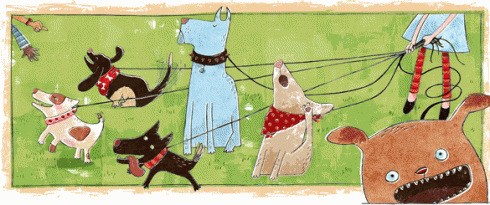
I use a timer to stay on top of it. And even if I am not researching for a particular project, I carry a sketchbook with me and either have my phone or camera for taking any pictures. Inspiration strikes when I least expect it so I like to be as prepared as possible.
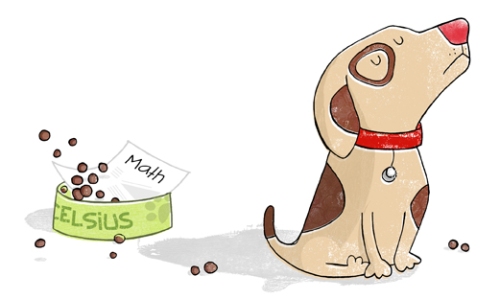
Have you found most art directors and editors give you a lot of freedom when illustrating a book? Do they want to be involved all the way through the process?
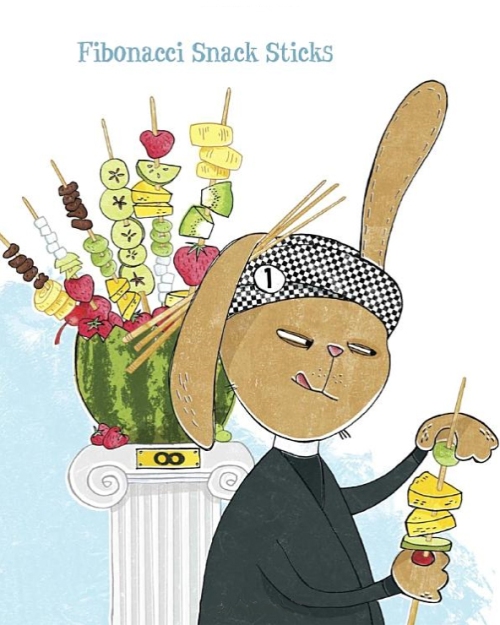
Once, I was given very specific art notes for an educational book but the turnaround time was tight, so the notes were helpful for me to jump right in. I’ve received minimal notes for nonfiction projects if there was a point that needed to be demonstrated visually for some specific text. For example: the Homework books sometimes have charts.
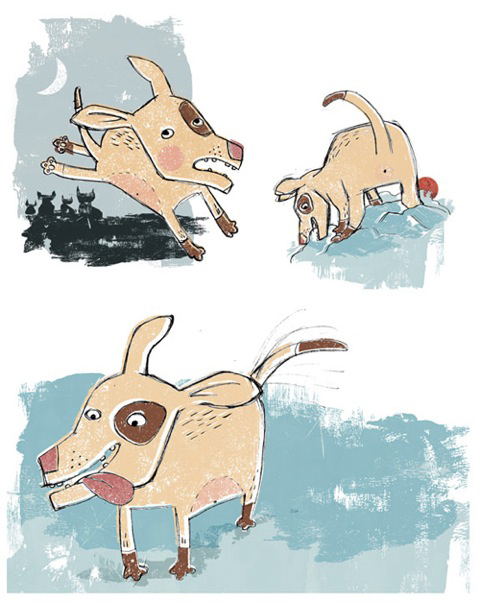
For the fictional projects, I’m pretty much left to it for the first round of sketches, then the art director and/or editor and I discuss together. Sometimes, I’ll offer up additional sketch options for a handful of spreads if I have lots of ideas and can’t decide which direction to go. There can be a lot of back and forth on the cover, though.
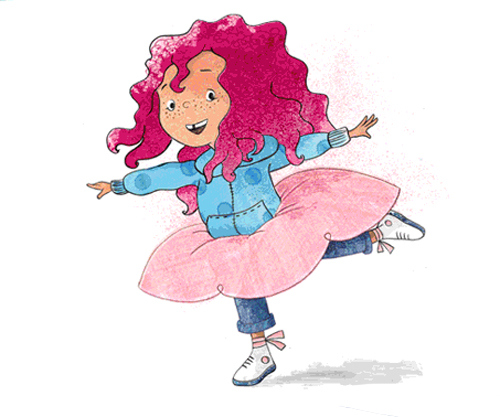
What is the one thing in your studio that you could not live without?
My art materials—pencils, brushes, paper, inks, sketchbooks—I’d be kinda lost without them!
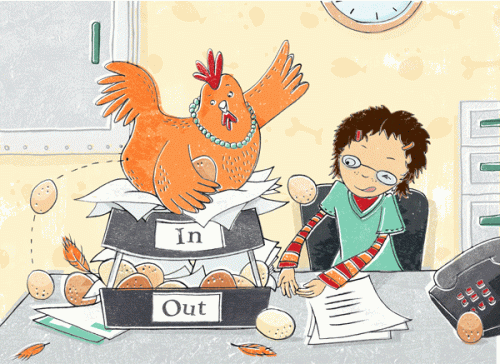
Do you try to spend a specific amount of time working on your craft?
Yes, even if it’s only for ten minutes, that’s my rule.
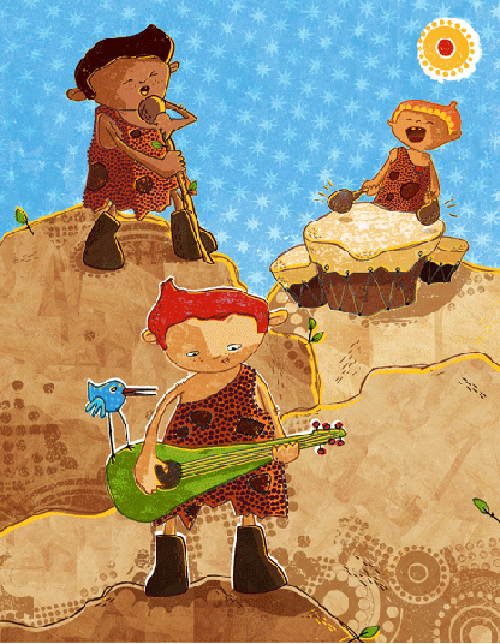
Do you have any career dreams that you want to fulfill?
To travel, keep making art, and continue creating books for young readers—that would be lovely!
Thank you Leeza haring your journey and process with us. Can’t wait to see your career go forward. You can visit Leeza at her website: http://www.leezaworks.com to see more of her work.
If you have a moment I am sure Leeza would love to read your comments. I enjoy them too. Thanks!
Talk tomorrow,
Kathy
Filed under:
Advice,
authors and illustrators,
How to,
illustrating,
Illustrator's Saturday,
inspiration,
Interview,
picture books,
Process Tagged:
John Lithgow,
Leeza Hernandez,
Never Play Music Right Next to the Zoo 

By: Kathy Temean,
on 11/14/2014
Blog:
Writing and Illustrating
(
Login to Add to MyJacketFlap)
JacketFlap tags:
Interview,
picture books,
inspiration,
Process,
illustrating,
authors and illustrators,
Illustrator's Saturday,
Maja Sereda,
Illustrator Journey,
University of Pretoria,
Add a tag
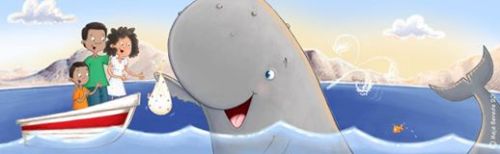
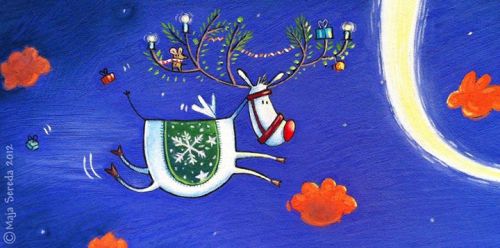
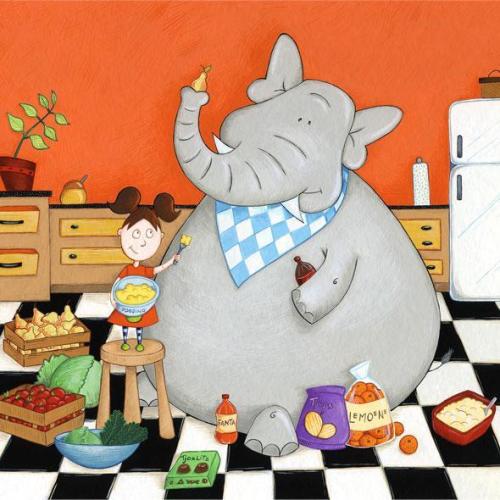
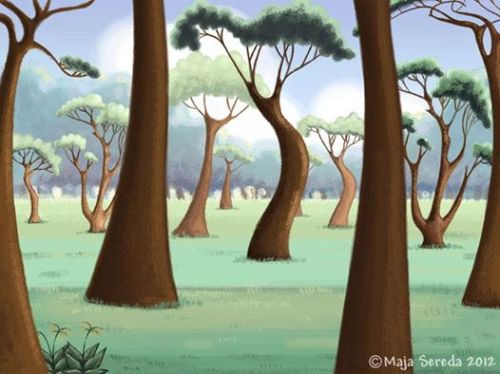
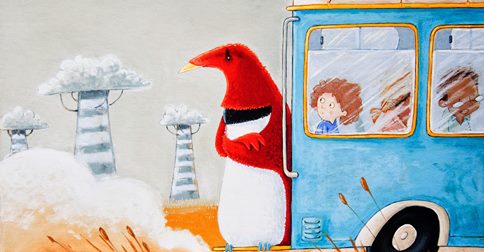
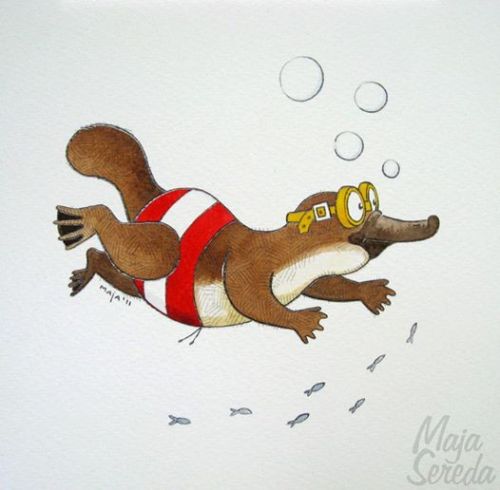
 Maja Sereda has illustrated number of picture books published in English, Afrikaans and other African languages. She has received 3 ATKV awards for best illustration (category ages 3–6) in 2008, 2009, 2011. And her book A kite’s flight written by W. Gumede won the Crystal Kite member’s choice award for the Africa region, 2011. Her latest book La Grande Fleur, written by Yves Pinguilly, was published in France (2013).
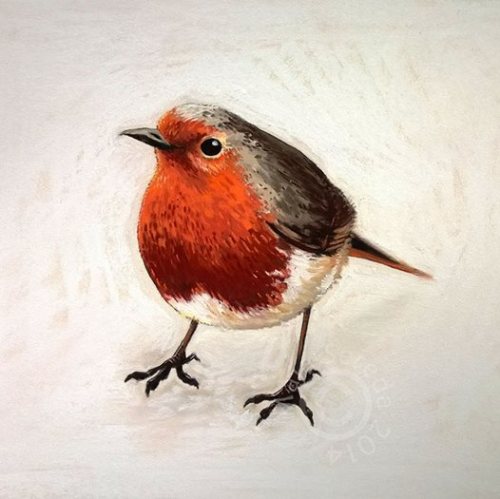
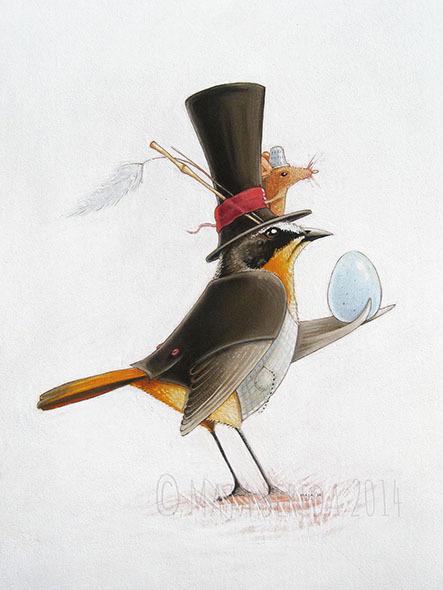
Maja tackles each project with great passion and enthusiasm, which she best communicates through her fun and quirky illustrations. Maja works in soft pastels as well as digital media. She loves drawing all creatures great and small, including little children!
Here is Maja explaining her process:

I create a sketch for my illustration using a colour pencil on 60gsm paper.

The sketch is scanned and rough colour dropped in.
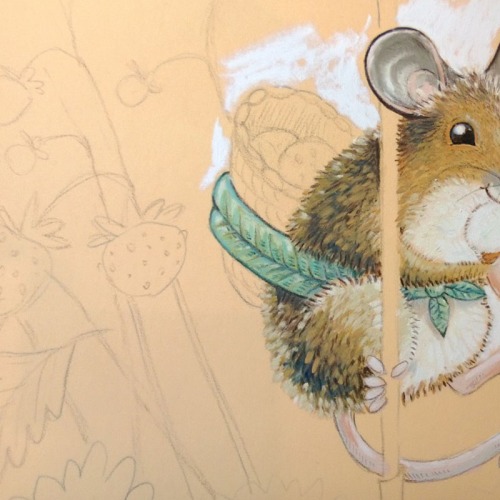
I trace image onto final pastel paper and start pasteling.

I always work from left to right or from the center outwards in order not to smudge the pastel. It is a very delicate medium.
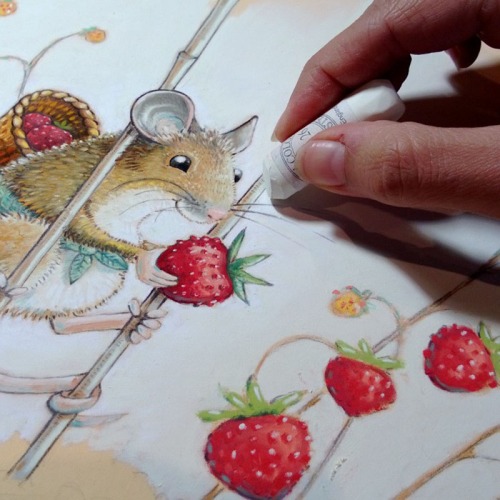
To create details I use pastel pencils, whereas for the fine outlines I once again bring in a colour pencil. Most often a brown.
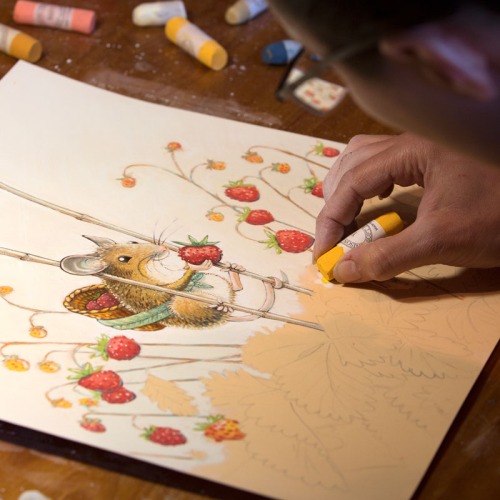
Background is drawn last.
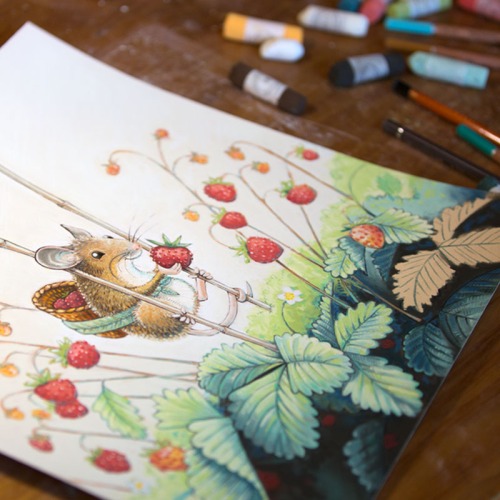
Final Illustration

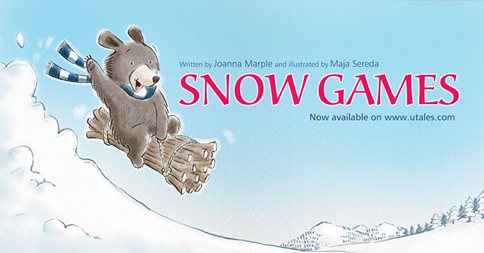
Below: Snow Games written by Joanna Marple (www.utales.com) 2012
LA GRANDE FLEUR COVER
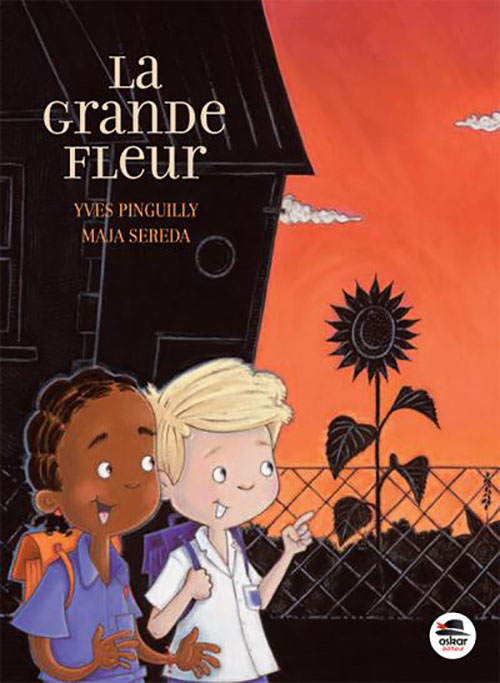
La Grande Fleur was published in France by Oscar Editeur in 2013.
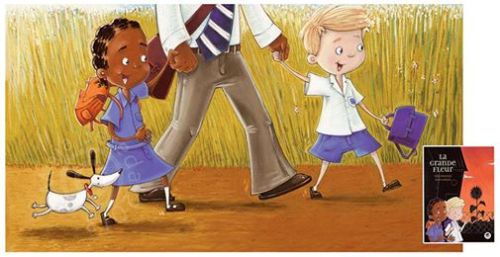
The book was part of the French/South African season.
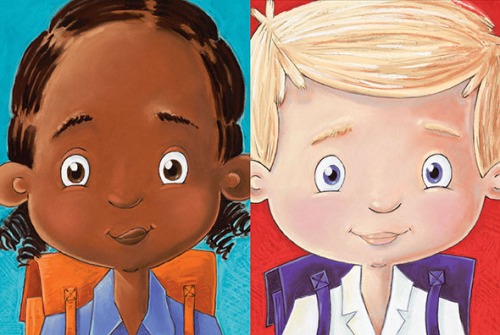
La Grande Fleur interior art.
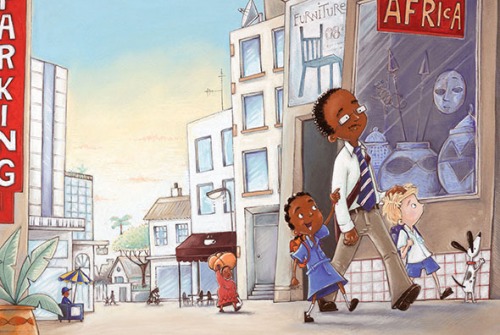
How long have you been illustrating?
I’ve been illustrating books since 2007.
What made your family move from Poland to South Africa when you were young?
My dad received a work contract and decided to take it. It was supposed to be a temporary move, but I fell in love with South Africa and persuaded my family to stay.
Have you ever gone back to Poland?
I like to visit from time to time. I still have family and primary school friends living in Poland.
What University did you attend and what did you study?
I studied BA (Information Design) aka graphic design at University of Pretoria.
What was the first painting or illustration that you did where someone paid you for your artwork?
I did a number of illustration jobs while working in the design/advertising industry, such as story boarding or product drawings. I believe the very first paid illustration job was my first book.
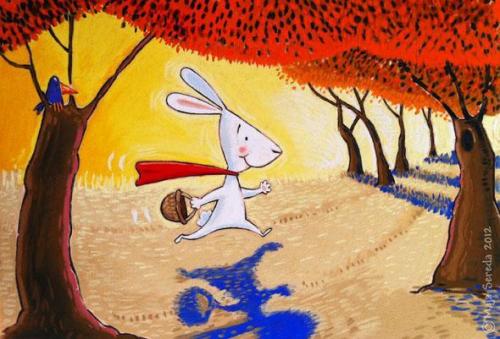
What type of job did you do right after you graduated?
I moved to Dublin, Ireland for a year where I worked for a marketing company as a junior art director.
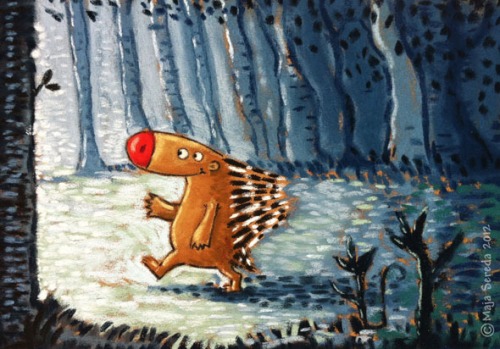
When did you decide you wanted to illustrate for children?
It was in my final year of studies. I realized that I’ve chosen the wrong field. Design was simply not for me. It took me a few years before I could start freelancing and working as a full time illustrator.
How many picture books have you illustrated?
Approximately 17 picture books, however I’m not counting illustration work done for educational books.
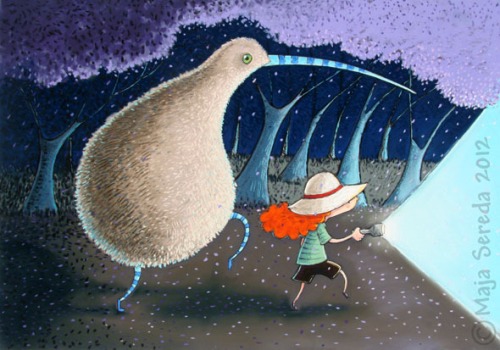
Were any of them published by a US Publisher?
Unfortunately not, however I’m hoping it will happen one day soon. I’m always dreaming and wishing.
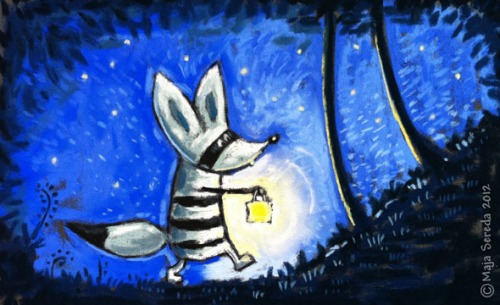
What was the first picture book that you illustrated? And how did that contract come your way?
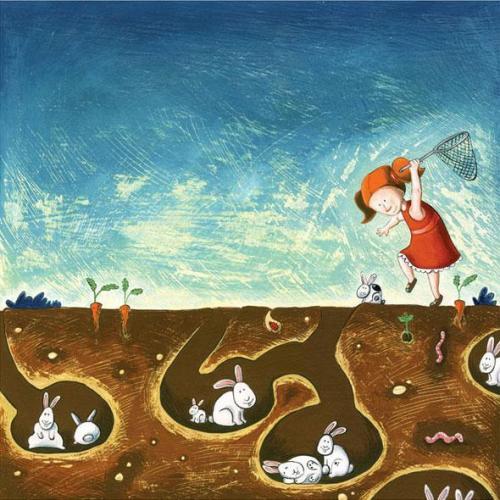
My sister put me in touch with a client who wanted to illustrate a story that her father wrote. It was small private project. Out of that book, an illustration of mine title ‘catching rabbits’ was born, which I sent to a local South African publisher. They replied immediately and asked me to pitch for a book. I had my first real book contract within in a week. I was over the moon.
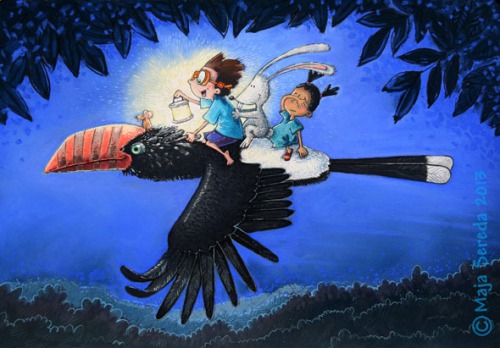
How do you connect with art directors and editors and find illustration work?
So far I’ve been very lucky. Work finds me. Nevertheless, from time to time I do like to contact a publisher via email and send them my updated portfolio.
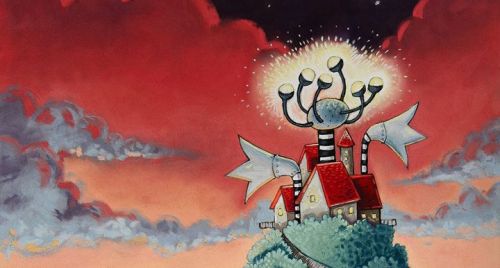
Are you represented by artist agency? If so, who? If not would you like to find one?
I’m not represented by anyone at the moment and I am currently looking for US representation. In South Africa, the market is very small and a freelance illustrator can easily approach publishers directly.
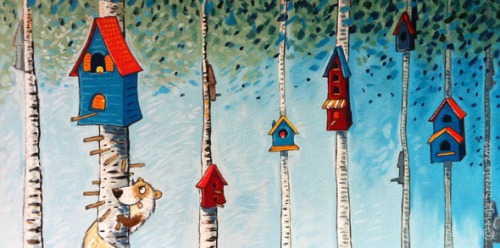
It looks like you have illustrated books in many different languages. How do publishers help you work with a book that is written in another language?
Even though my Afrikaans isn’t very good, I do understand it and therefore am able to read a manuscript without translation. Many of the other African languages are sent to me with the English translation. I’m currently studying French. One of my latest books LA GRANDE FLEUR written by Yves Pinguilly, was also translated for me into English.
Have you done any illustrating for children’s magazines?
I do regular work for a local magazine Hoezit! It is also an Afrikaans publication.
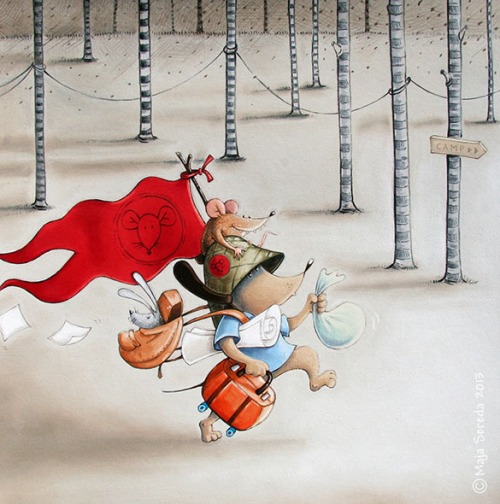
Have you done any work for educational publishers?
I work for educational publishers on a regular basis. This work however doesn’t inspire me and therefore doesn’t feature in my portfolio. I prefer to work on picture books for young children.
What is your favorite medium to use to do your illustrations?
At the moment, it’s soft pastels. I simply love the medium – the intensity and variety of colour is incredible. Most of my recent work has been done in pastels. In the past, I’ve worked with gouache, acrylic, ink, oil and Photoshop.
Has that changed over time?
I have grown a lot as an illustrator, I don’t think one ever stops growing and learning. When I started illustrating my focus was simply on creating sweet, quirky illustrations, but now I’m leaning more and more towards fantasy and also more personal work.

What do you consider is your first big success?
My first book received an award for best illustration, it definitely inspired me to keep going.
Do you ever want to write and illustrate a picture book?
Yes, mostly definitely. I write and sketch ideas often – my big aim is to set aside some time and only focus on doing my own book. Perhaps this coming year! Recent trip to Reunion Island was very inspiring and I would like to use some of the incredible imagery in my book.
Would you be open to working with an author who wants to self-publish a picture book?
Yes, and I have in the past although these projects are often tricky. There is the issue of budget, quality of the writing, etc.
Do you take pictures or do any types of research before you start a project?
I take photographs, I search the web, look through books. Research is vital for any project.
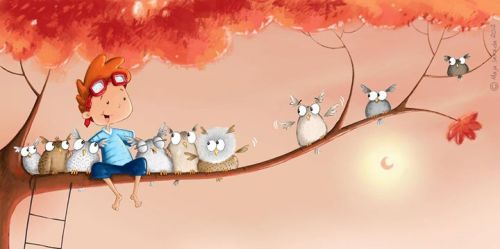
Do you think your Polish roots or the South African culture is reflected in your art?
Little bit of both, however I do feel a stronger connection with my polish roots.
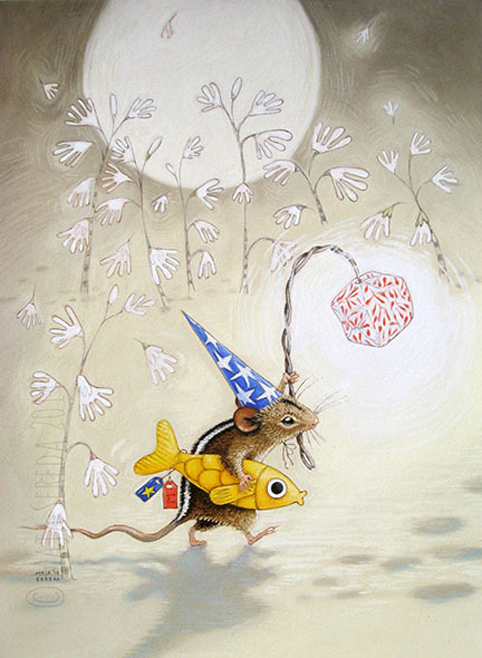
n
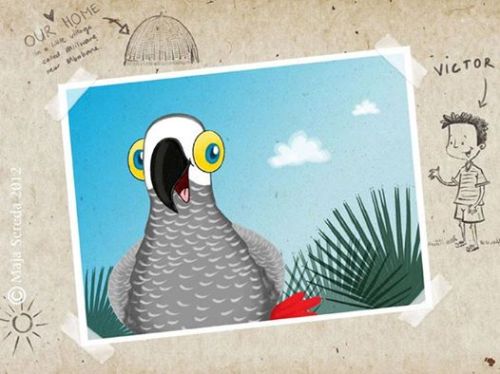
What is the one thing in your studio that you could not live without?
I have so many things, it’s difficult to choose! Pastels of course, but also colouring pencils. I find them fantastic to sketch with, much better than the graphite pencil.
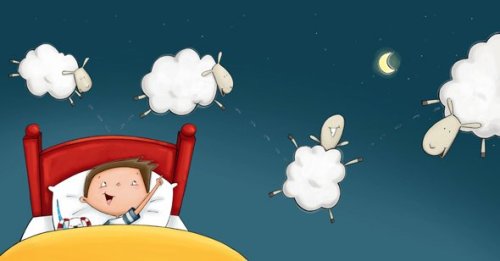
Do you try to spend a specific amount of time working on your craft?
As much as I can, but I don’t have a specific number of hours in mind. I also believe it’s good to take breaks from drawing and creating. I love spending time behind the camera lens as well, especially photographing birds and insects.
Do you think the Internet has opened doors for you?
Absolutely. Hasn’t it for everyone? It is incredible how we are all connected, we share our work and meet fantastic people online.
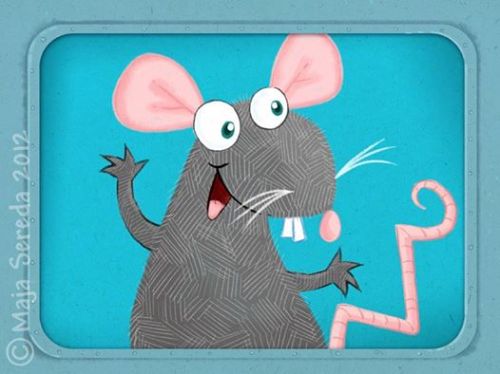
Do you use Photoshop or Corel Painter with your illustrations?
I use Photoshop for my digital artwork. I also use to help me plan layouts.
Do you own or have you used a Graphic Drawing Tablet in your illustrating?
Yes, I use a Wacom tablet.
Do you have any career dreams that you want to fulfill?
I have many dreams, it’s hard to summarize them all here. Ideally I want to have the freedom to write and illustrate my own books. Also create a product line using my art.
What are you working on now?
I have one or two potential books to create. I’m still deciding which one to take on.
Do you have any material type tips you can share with us? Example: Paint or paper that you love – the best place to buy – a new product that you’ve tried – A how to tip, etc.
I love using 60gsm layout paper for sketching because it’s slightly transparent. I can always overlay my sketches and work over them.
Any words of wisdom on how to become a successful writer or illustrator?
Work hard, believe in your dream, make sure that the work you produce is of high quality and then be brave. Not everyone is going to be a fan of your work, but sometimes you simply have to look for the right audience.
Thank you Maja for sharing your journey and process with us. Please let us know all your future successes. We’d love to hear about them and cheer you on. You can see more of Maja’s work on www.childrensillustrators.com/majasereda and see more of her portfolio on: http://www.facebook.com/MajaSeredaIllustration
If you have a moment I am sure Maja would like to read your comments. I enjoy reading them, too, even if I don’t always have time to reply. Thanks!
Talk tomorrow,
Kathy
Filed under:
authors and illustrators,
illustrating,
Illustrator's Saturday,
inspiration,
Interview,
picture books,
Process Tagged:
Illustrator Journey,
Maja Sereda,
University of Pretoria 

By: Kathy Temean,
on 11/13/2014
Blog:
Writing and Illustrating
(
Login to Add to MyJacketFlap)
JacketFlap tags:
Agent,
Contests,
inspiration,
Poems,
illustrating,
opportunity,
Agent Alex Slater,
November First Page Critiques,
Thanksgiving Poems,
Two Book Give-a-Ways,
Winner of Halloween Poem Contest,
Add a tag
OPPORTUNITY: TWO BOOK-GIVE-A-WAYS
 Gayle Aanensen’s new 88 page novella, GREATER THAN GOLD hit the book shelves this week. It is now available on Amazon and will appeal to anyone who celebrates Christmas.
Greater than Gold is the story of two troubled boys and their two Christmases—Oscar in the present day, and Omar way back in biblical time. A good description would be The Polar Express meets The Book of Luke. After all, if a magical train ride can restore a boy’s belief in Santa Claus, why can’t an angel time-travel Oscar back to Bethlehem, where he discovers the peace, joy (and danger!) of the very first Christmas. Twelve-year-old Oscar Olsen is missing his soldier Dad, and he wants nothing (repeat, nothing) to do with Christmas this year! He acts out his anger on his Mom, his friend, Melissa, and even the strange new kid in church, Albert. A young, inexperienced angel, still struggling to control her wings, appears in Oscar’s bedroom. She tells Oscar that her official alphanumerical name is too long, so he can call her Earth Angel 10. She whirls him back to 2,000 years ago, where he becomes Omar, an orphaned camel-boy, riding with the Magi. Omar is a brand-new person in the traditional nativity story. Young readers will be drawn into the boys’ two parallel stories, told in alternating chapters.
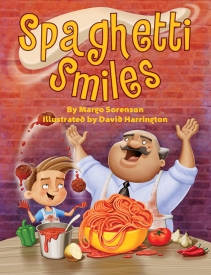
Ten days ago, I featured Margo Sorensen new book, SPAGHETTI SMILES and forgot to offer everyone a chance to win a copy her wonderful book illustrated by David Harrington who was featured on Illustrator Saturday. So we are offering the book give-a-way this week.
So if you leave a comment to this post you will automatically have a chance to win GREATER THAN GOLD OR SPAGHETTI SMILES.
If you reblog, tweet, post on your facebook page you will get an extra ticket with your name paced in the hat. This will definitely up your chances for winning one of the books. You can comment now and then do the other things later, but please come back before the deadline and let me know how many things you did. Both will make a nice gift for the holidays. Good luck!
The Unusual Stew by Robert Zammarchi was voted as the best Halloween poem. His prize is a featured post right here on Writing and Illustrating. He can choose to use it right away or hold on to it for when he wants to talk about something special. Thank you to everyone who submitted poems and to everyone who voted.
I think everyone enjoyed this, so I am going to do the same thing for Thanksgiving. If you have a poem or an illustration inspired by the holiday, please email it to me at: Kathy(dot)temean(at)gmail.com – Please put THANKSGIVING POEM or THANKSGIVING ILLUSTRATION in the Subject Box.

Agent Alex Slater
Remember to submit your first pages for this month. It is the last one for this year.
The four winning first pages will be sent to Alex Slater from Trident Media for critique. PLEASE DO NOT SUBMIT IF YOU DO NOT WANT TO HAVE YOUR CRITIQUE POSTED.
Here are the guidelines for submitting a First Page in November:
In the subject line, please write “November First Page Critique” and paste the text in the email. Please make sure you include your name, the title of the piece, and whether it is as picture book, middle grade, or young adult, etc. at the top.
Plus attach your first page Word doc. to email. Format using one inch margins and 12 point New Times Roman font – double space – no more than 23 lines. First page should not be submitted with two pages. Send to: kathy(dot)temean(at)gmail(dot)com.
PLEASE FOLLOW THE GUIDELINES: Last month a number of submissions were taken out of the mix, due to not following the directions for both the pasted email and the attached Word doc.
DEADLINE: November 24th.
RESULTS: November 28th.
Talk tomorrow,
Kathy
Filed under:
Agent,
Contests,
illustrating,
inspiration,
opportunity,
Poems Tagged:
Agent Alex Slater,
November First Page Critiques,
Thanksgiving Poems,
Two Book Give-a-Ways,
Winner of Halloween Poem Contest 

By: Kathy Temean,
on 11/7/2014
Blog:
Writing and Illustrating
(
Login to Add to MyJacketFlap)
JacketFlap tags:
inspiration,
Advice,
Process,
England,
illustrating,
authors and illustrators,
Illustrator's Saturday,
Cheltenham College of Art in Cheltenham,
Ilustrationweb.com,
Sholta Walker,
Interview,
Tips,
picture books,
Add a tag
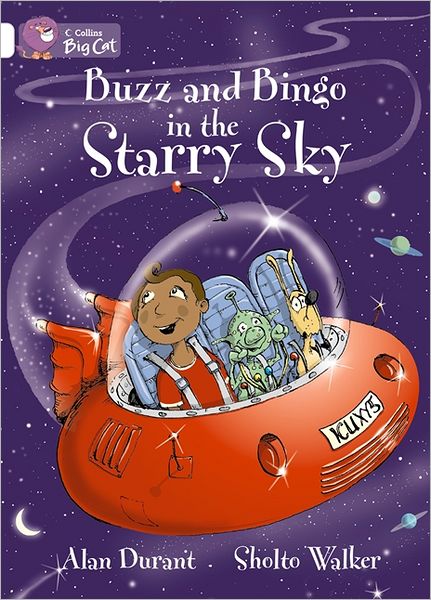
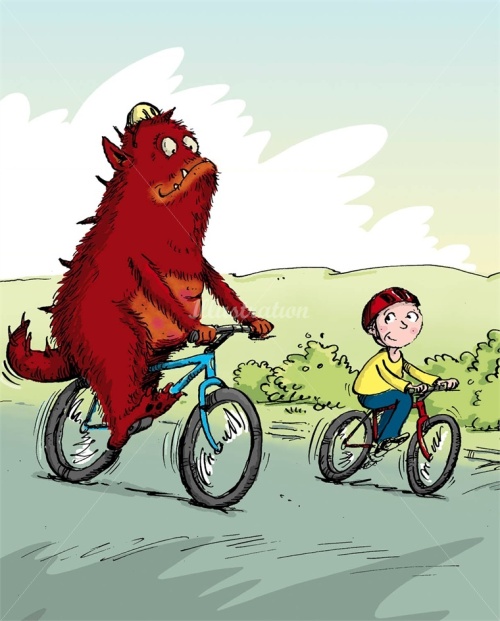
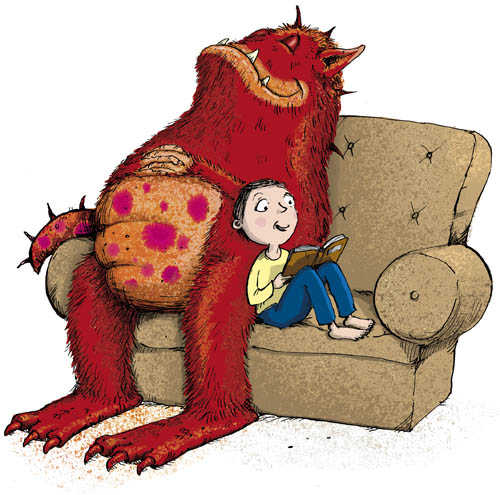
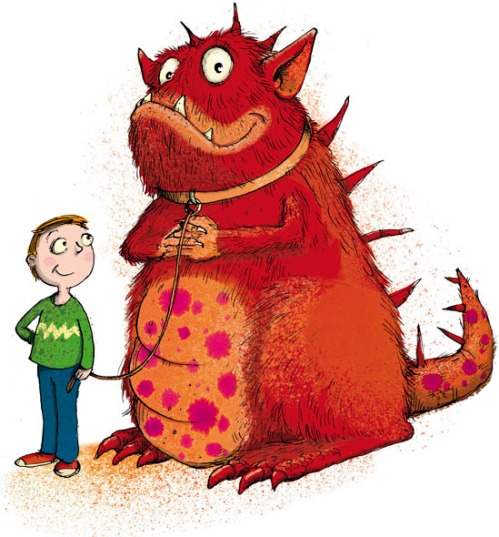
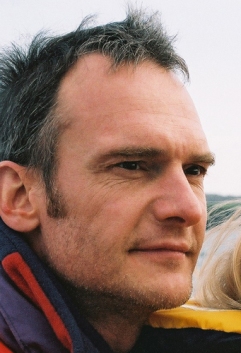 Sholta Walker was trained and graduated as a painter in 1988 and since 1995 he has worked professionally as a full-time artist and illustrator.
The great majority of his work has been for children, with clients across the World, including Harper Collins, Random House, Egmont, Annick Press, The BBC, Macmillan and Oxford University Press.
Most of the illustrations you see here combine digital techniques with more traditional skills and media. He uses vigourous ink line work, which is usually digitally coloured and enhanced. This has given him an opportunity to produce illustrations for my clients which give great scope for expressing ideas.
Some of the work shown here is also available as limited edition
prints.
His published books include Long Grey Norris, King Arthur, Bug Wars and The Beastly Beast.., a compendium of short stories by author Garth Nix. I have recently completed work for a book by Michal Kozlowski called Louis, the Tiger Who Came From the Sea.
Here is Sholta discussing his process:
Creating ‘Bug!’ and Brer Fox
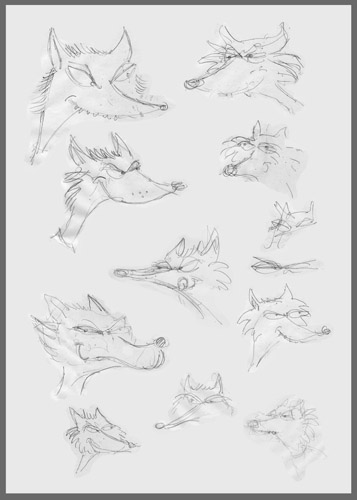
I made these drawings a few years ago. Both at the time were fairly experimental, but borrowed heavily from methods I was already regularly using. Brer Fox was a character I was asked to develop along with his nemesis Brer Rabbit, for a UK publisher. Bug! I made when I worked briefly with an animator-friend while he was working on his Masters Degree in animation.
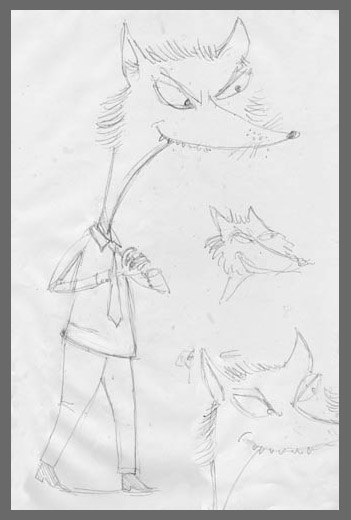
The picture always begins with a drawing on paper. If I’m working on a character I always rough him or her out in pencil. It usually takes several attempts to create the character I’m after. It’s important to get this stage right. Any decisions made now will set the tone for the whole image and are likely to remain with you to the end of the project. The drawing process helps inform the image you have in your head, which then feeds back to your drawing. At its best this busy two-way street of drawing and imagining is a marvelously efficient creative process.
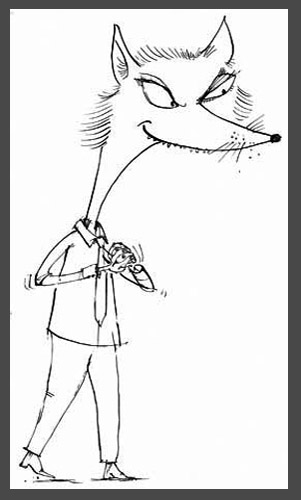
When I have the character I want, I either trace it through a lightbox or work directly over the top in Indian ink with a dip-pen. The type of commission will dictate how free and expressive I am with the pen. In the case of Brer Fox particularly, I was trying to work very freely. One way I do this is to create all the initial pencil sketches as quickly as I can. When I find the drawing I like I then reproduce it by drawing over the top with my pen at a similar speed. This gives the drawing energy and enables me to exploit the naturally temperamental nature of a traditional drawing nib when it’s loaded with ink.
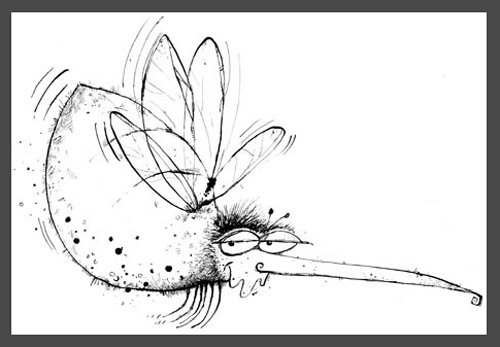
While still fairly loose, Bug! was a little more considered. Also, I created the bug character and his background as two separate drawings and combined them in Photoshop later.
Once the ink is completely dry, any pencil marks are erased and the drawing is scanned and opened in Photoshop. The ink line now has to be separated from the the paper surface. To help improve definition I usually increase the contrast before selecting out the black lines in one piece. The drawing part of the scan is then pasted into a new document, creating a new layer over a white background layer. The original scan is now discarded. At this stage I take the opportunity to have a good look at the image and to erase any dust specks and unwanted ink spots that were picked up in the selection. I may also make any adjustments or small additions to the drawing using Photoshop’s pencil and brush tools. Finally I ‘multiply’ the layer to prevent any whitening of the pixels in the final artwork. Because I like the honesty of a hand made ink drawing I make no further digital enhancements to it.
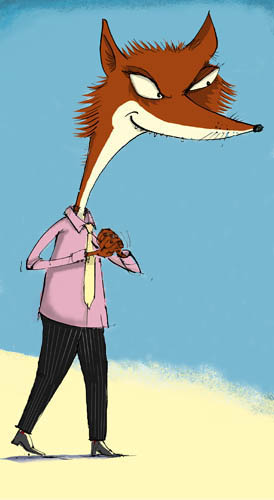
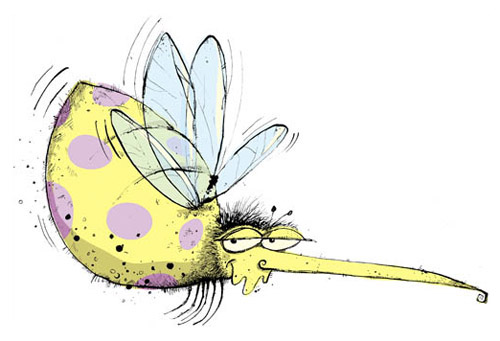
In the case of Bug!, the character’s colour was created in Illustrator. I imported the line drawing (without the garden) into Illustrator, then, on a new layer, between the white background and the drawing layer, I put in the colour in a series of simple, fairly roughly drawn shapes. In more complex images I may create the colours on several layers, but on a simple image like this, one colour layer is sufficient. Brer Fox was slightly different. He stayed in Photoshop because in this case I didn’t want the flatter look that Illustrator tends to give my drawings. The layering technique however is identical, with the basic under-painting on the figure created using the lasso tool to make a shape into which I drop the colour. Further painting, shading and colour were then added with various brush tools. A basic background layer is also quickly rendered at this stage.
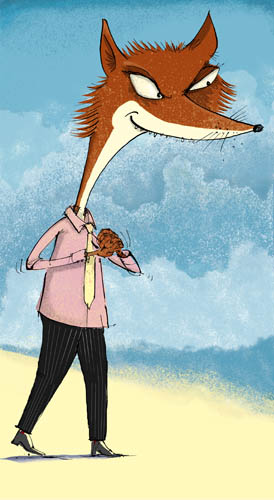

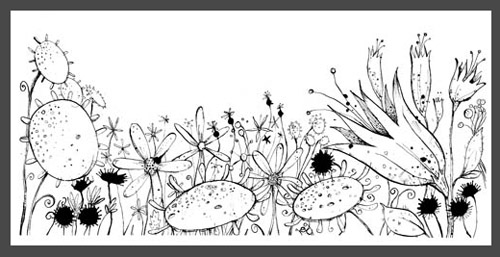
To create the textures in Brer Fox I went back to paper and ink. All the effects in this image are made using either ink applied through a mouth diffuser, (a simple breath-powered spraying device) or from an old toothbrush. The results are then scanned and separated out as in the original drawings. They are then collaged into the artwork, each on a separate layer. For Brer Fox I also experimented with some scans of torn paper. With Bug!, only the garden received this treatment. Once colouring of the insect character was complete in Illustrator, I returned him to Photoshop and combined him with the garden scene that I had drawn and coloured separately in Photoshop using the textures I made in a similar way to those previously described.
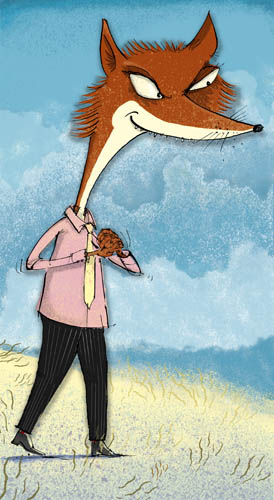
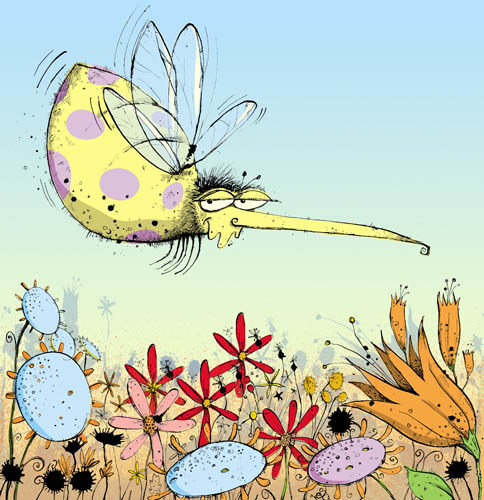
Finally, I added any extra bits and spent some time continuing to tweak the drawing. Some layers are switched off or discarded and occasionally some basic effects are added as in Brer Fox’s drop shadow. I’ll often go back at this stage and draw some new elements (extra flowers maybe) that I think might further improve the image. These will then be scanned and added to the drawing, colouring them up as necessary. A key feature of much of my work is that the process remains very fluid right up to its completion.
How long have you been illustrating?
Full-time, around twenty years. I spent a few years before that working part time on occasional commissions that came my way.
What made you choose to you study art at Cheltenham College of Art in London?
That’s Cheltenham College of Art in Cheltenham, England. Cheltenham is a large town about one hundred miles West of London. I had a bit of a shaky start in fact. In England, most visual arts degrees begin with a year-long Foundation Course, which most students are expected to complete, usually at a different college, before beginning their three-year degree proper. My foundation year was very enjoyable and successful, but I left still unsure in which direction I was going to take my art. Eventually I chose Fine Art with a painting specialism, but I think my lack of certainty was picked up during the several interviews I attended at various art colleges and found to the surprise of most people that knew me that I wasn’t offered a place at any of them on the first round. So I got a job and tried again a few months later. I was finally accepted at Cheltenham. I’d like to say this was the college I had my sights on all along; that I had studied the work of the tutors and lecturers there; that I was drawn to the verdant Cotswold Hills that rise majestically above the town, but none of that would be true. Nope. It turned out they were the only college that would have me.
What was the first painting or illustration that you did where someone paid you for your artwork?
I’m not too sure, but I think it was probably a tiny drawing for one of those classified small ads you see in the back of newspapers. It was around 1986.
What type of job did you do right after you graduated?
When I graduated I had no idea what to do. Looking back I think plenty of ex-students, particularly with art degrees find themselves in a similar situation. I’m not sure how it is now, but there was absolutely zero consideration given by the colleges as to what their students would do when they left. I don’t think this is necessarily a bad thing because fine art courses should not be job-training courses. So when I left I discovered two things pretty quickly: first, I needed to earn some money and second, degrees in Painting do not make you very employable. I was no longer comfortable at home, so I moved to London where most British students seem to pitch up after graduating. I worked briefly at the famous Cornelissen and Son art shop near the British Museum. The shop’s been trading since 1855 and has and still does supply materials to some of the greatest names in British Art. Then I bought a bike and spent a year as a bicycle courier, risking life and limb on the London streets.
How did you decide you wanted to go into the freelance art business?
After a year or two of struggling to pay my way in London, I thought I needed to make a decision. As a child, making pictures was always something I enjoyed doing and was good at. My degree had pointed me towards traditional oil painting but at that time I could see no way that I was going to be making oil paintings for a living. It was a very slow start. My dad was publishing a music magazine at the time and he managed to convince the editor (thanks Paul!) to ask me to try illustrating a few things. The jobs were very occasional and fairly straightforward, but it was these simple commissions that really got the ball rolling for me. I continued working in various low-paid jobs, but it was those occasional illustration commissions that gave me a sense of purpose. Doing something I enjoyed while being paid to do it. I decided fairly quickly that this was what I needed to pursue.
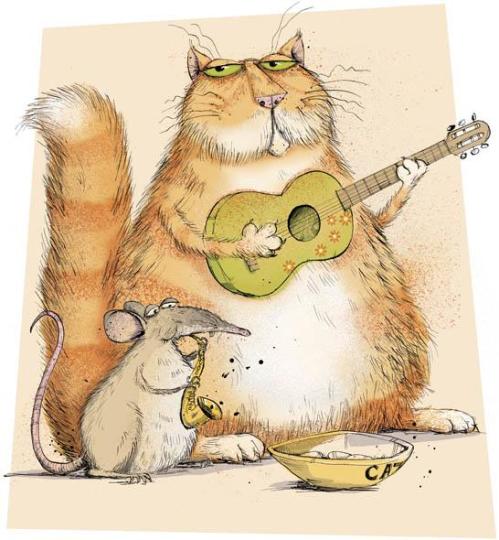
When did you decide you wanted to illustrate for children?
I never decided, my work seems to lend itself to that. When I began as an illustrator I just drew stuff. I had no idea what the illustration business was like and never gave a thought to the idea that illustration could be classified into ‘types’. After my degree, my first portfolio consisted mainly of miniature versions of what I had been producing at art college. Many were very dark and introspective, typical art student stuff really. The colours were full of dark reds and blues. Lots of angst. I was still somewhere between a painter and an illustrator. All my techniques were from three years’ training as a painter working in oils on canvas, so as an illustrator I really had to start from scratch. That meant finding new materials and methods that suited my approach and were practical. As my work developed, much of it became brighter and I found I could express and develop in my work a kind of knowing humour and a sense of the absurd that I have always enjoyed and has always been a part of my character I think. Adults seem to like this at least as much as their children and it appears in most of my best work. I think that this has always been there in my work even during my student days, but as I’ve evolved as a working illustrator I’ve learned to refine it and make it more accessible.
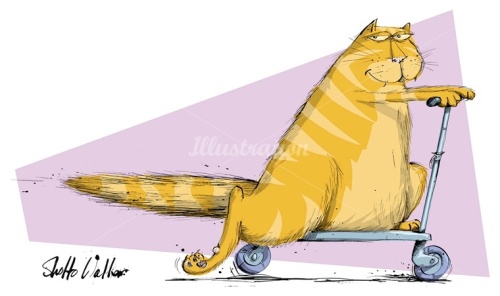
How did you get the job to illustrate Buzz and Bingo in the Starry Sky with HarperCollins?
Wow, that one was quite a while ago. It came through my agent. In fact, now I think of it, it was probably the first full book commission I had with Harper Collins. I think it was also the first book I illustrated digitally. It was actually part of a series for young readers and as far as I’m aware has been very popular in British schools. I have met several parents over the years that know me by name and then realize their son and daughter is learning to read with one of my books. It’s always nice when that happens. My sister lives in Spain and she called me one day to say that her daughter was reading a book I had illustrated as part of her reading program. That was perfect because I had included a dedication to her and her brothers on the title page. I think my sister cried.
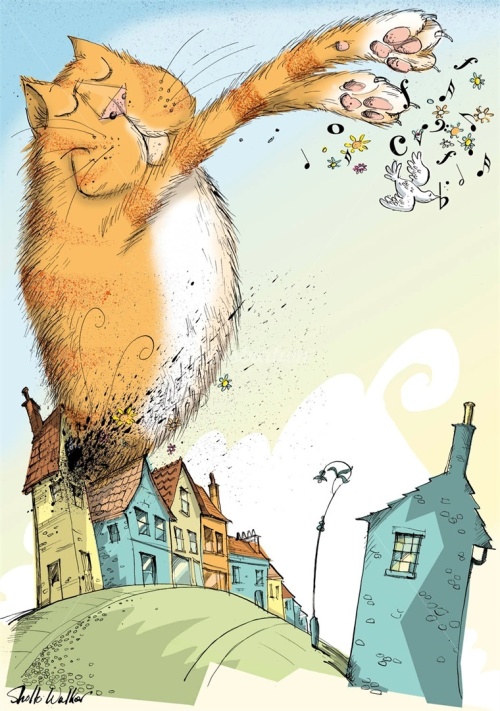
Have you done any other books with HarperCollins?
Yes several. At least four or five.
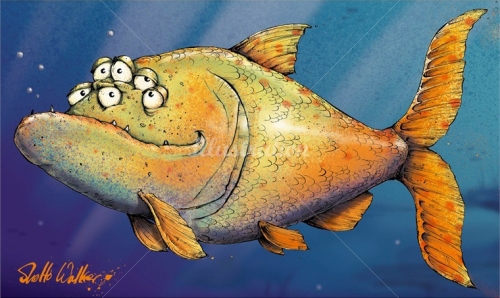
What was the first picture book that you illustrated? And how did that contract come your way?
My first picture book was probably one of the Buzz and Bingo series. I had illustrated a few books before that, but they were more for slightly older readers, so they weren’t strictly speaking ‘picture books’. I had worked on other commissions for Harper Collins prior to Buzz and Bingo so I had built up a bit of a track record. I often think that is, at least in part, how it works. Once a client is happy you can make a deadline, you are professional and reliable and assuming they like what you do of course, you are likely to be asked to take on bigger projects.

How many books have you illustrated?
Well, if you mean both part books and as full cover-to-cover commissions, then the answer’s probably hundreds. If you mean whole books, then probably around thirty.
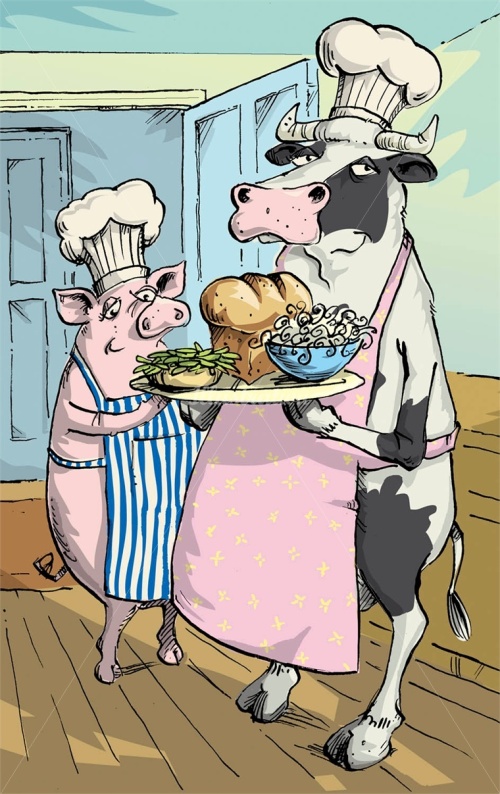
Before you had an Art Rep., what did you do to help connect with art directors and editors and find illustration work?
It was a long and painful process. Once I had set my mind to being a professional illustrator I knew I needed to start building a portfolio to show round. I put together about fifteen drawings that included several of the commissions I had been picking up as well as some of my own work. One idea I had was to buy a few magazines and find articles in them that I felt I could illustrate. If they were successful I would then include them in the portfolio. The next step was to travel to London from Bath where I was by then living and show my work around. In those days, before the internet and online portfolios, this was the only way to do it. I must have spent a fortune on fares, not to mention postage for all the mail shots I made. I picked up very little direct work from all this effort and expense, but I don’t regret it at all because I really got to see what it was I needed to do while showing me what the publishing, design and advertising world outside my studio really looked like. I also still remember to this day some of the dozens of busy art directors and designers I saw who, almost to a person, patiently leafed through my portfolio and usually sent me away with some valuable words of advice. Anyway, I did that for a year or so until I decided it was time to reassess the situation. It was then I turned my mind to getting an agent. I thought if I found the right one, they would do all that work for me.
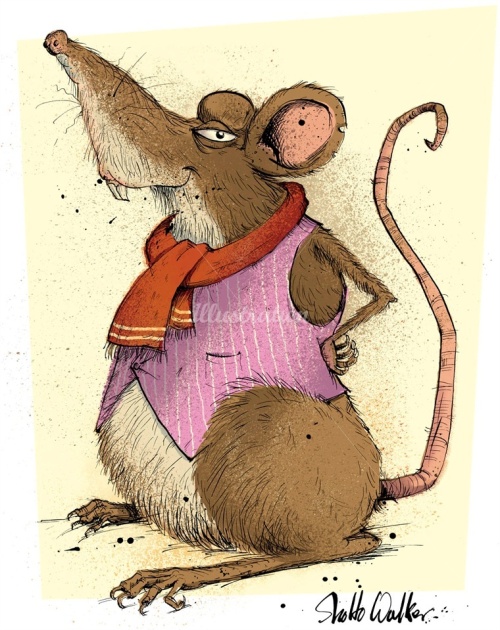
How did you connect to your artist agency, Illustrationsweb.com? How long have they been representing you?
Yet another trip to London in around 1995 with a list of illustrator’s agents in my pocket finally brought me together with Illustration, which is Illustration USA Inc’s parent company. At that time they lurked up a flight of stairs in a dusty old office in the heart of Soho, West London. They were called Garden Studio then and had been since 1929 when they were first established. It was there I met the excellent Harry Lyon-Smith who took my portfolio away and told me to come back after lunch. When I returned he offered to represent me and that was that.
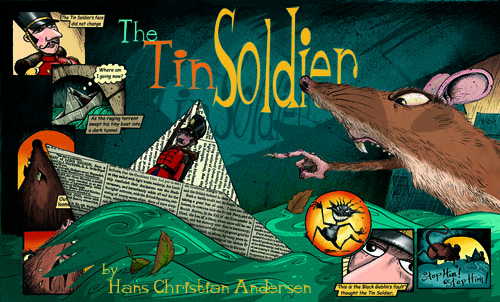
Tell us a little bit about the 200-year-old building in your backyard and the studio you have in there.
I think it was once just a simple stone outbuilding. It was converted to something reasonably habitable about twenty-five years ago and given an electricity and water supply. I’m in Somerset, England, so everything older than about a century is built from stone. The walls are two feet thick, which is normal in old buildings here, but it makes mobile (cell)-phone use next to impossible. If anyone needs to call me at work it’s landline only I’m afraid. Oh, and the roof leaks a bit. I sit beside a window that looks out onto our garden and an apple tree that produces a rare local apple called Ashmead’s Kernal. If you can ignore their gnarled and crusty appearance and take a bite you’ll find they’re incredibly juicy and sweet.
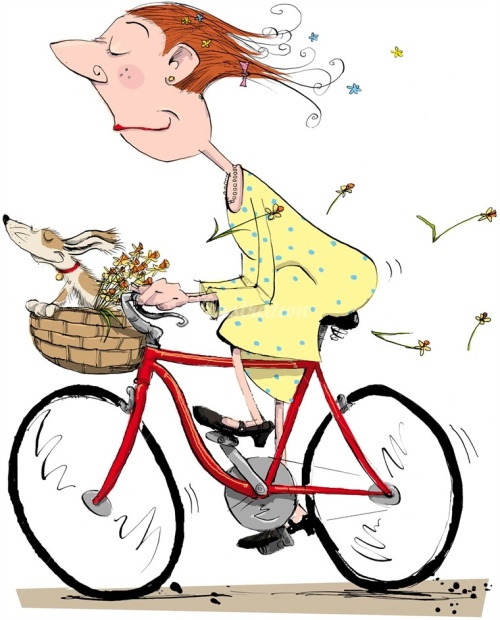
Have you done any illustrating for children’s magazines?
No, not so far.
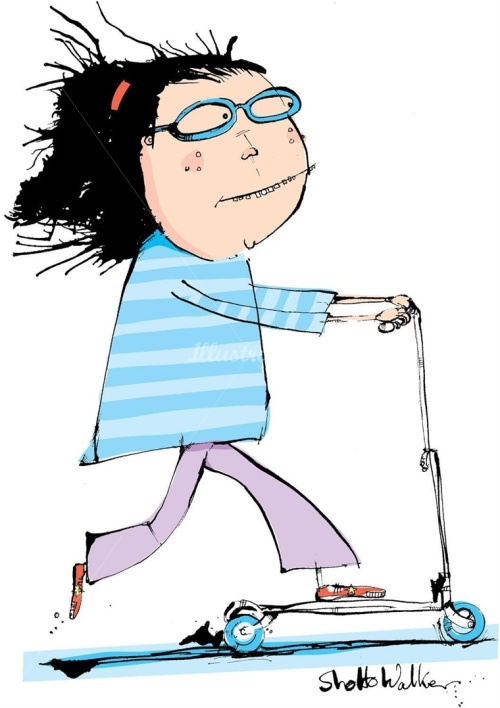
What is your favorite medium to use to do your illustrations?
Dip pen and Indian ink. Then Photoshop and Illustrator.
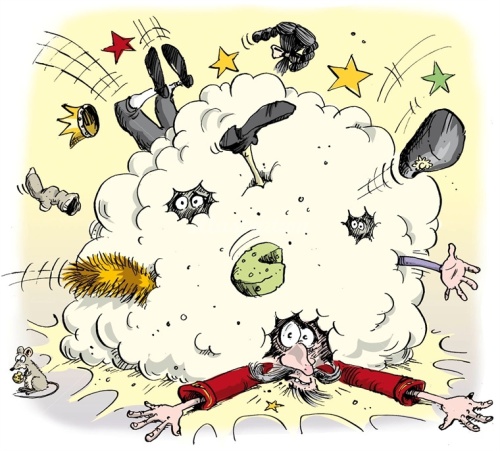
Has that changed over time?
Yes. When I began as an illustrator I developed a way of working that had its beginnings in my pre-art college mid-teens. I would create a pencil drawing that I would render in water-colour and gouache. I would then work over the whole thing in coloured pencil, before putting an ink line drawing on top. This made for beautifully vibrant illustrations, but was hugely labour-intensive. It meant I would often be up all night for even the simplest commissions. I realized this wasn’t sustainable, so in around 2000 I bit the bullet and bought an Apple Mac. Over the next year I figured out a way of working that still retained plenty of me, but was just far more efficient.
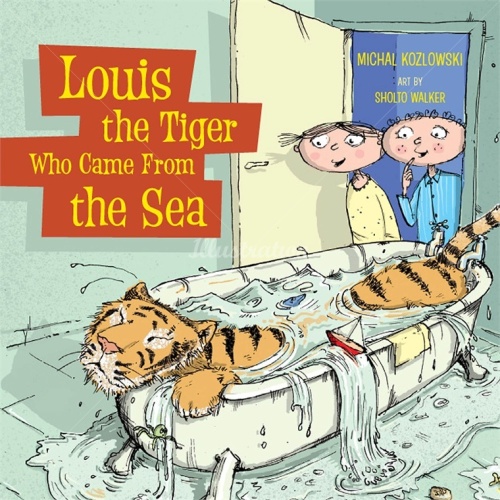
What do you consider is your first big success?
Probably Louis, the Tiger Who Came From the Sea. It’s a difficult question really because I’m very self-critical and I’m usually reluctant to pore over past work too long. I’m always thinking about the next opportunity to get it ‘right.’

How did that come about?
Apparently out of the blue. It’s how all the best work comes. You’re sitting around one day trying to remember how you ended up doing what you do when the ‘phone rings. Or the email arrives, as it usually is these days. In the case of Louis the Tiger, Colleen Macmillan at Annick Press contacted Stacey at my agent’s New York office and offered me the commission. They had seen my portfolio and decided I was the one they wanted to illustrate Michal Kozlowski’s wonderful story. It’s great when that happens.
Do you ever want to write and illustrate a picture book?
Yes
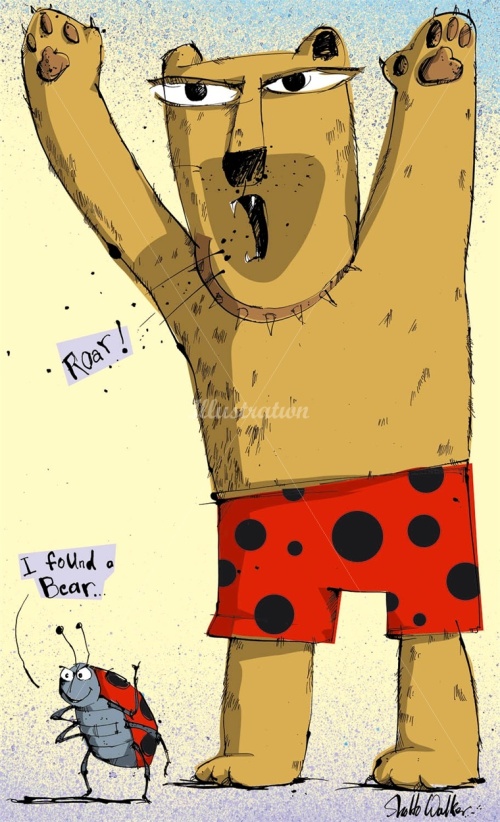
Would you be open to working with an author who wants to self-publish a picture book?
Absolutely. In fact I’ve illustrated a few of these already. Initially I was quite wary of working with self-publishing projects because commissions like these can lack structure and any real management process. I worried the job could really get out of hand. Before you commit I think it’s important to read the manuscript (don’t forget they’ve usually not been through any kind of editorial process) and also try to get a clear idea of what the client (author) is expecting from you and what if any experience they have of producing a book. The great thing about self-publishing commissions is they often give you great creative freedom because there are no sales departments controlling the process as so often happens with established publishers.
Do you take pictures or do any types of research before you start a project?
Very rarely. If an illustration requires a certain animal for example I usually reach for one of several natural history or wildlife reference books I keep. I recently completed ‘How to Slay a Werewolf’, a new book for Conran Octopus here in the UK. The story’s set in early Twentieth Century England so I had to get the clothes more or less accurate and then there was the werewolf of course, which required a fair bit of preliminary work. The internet has changed everything. In the past research usually meant repeated trips to the local library and bookshops and owning shelves groaning with reference material. Now most research is a mouse click away.
Have you done any work for educational publishers?
Yes, lots.
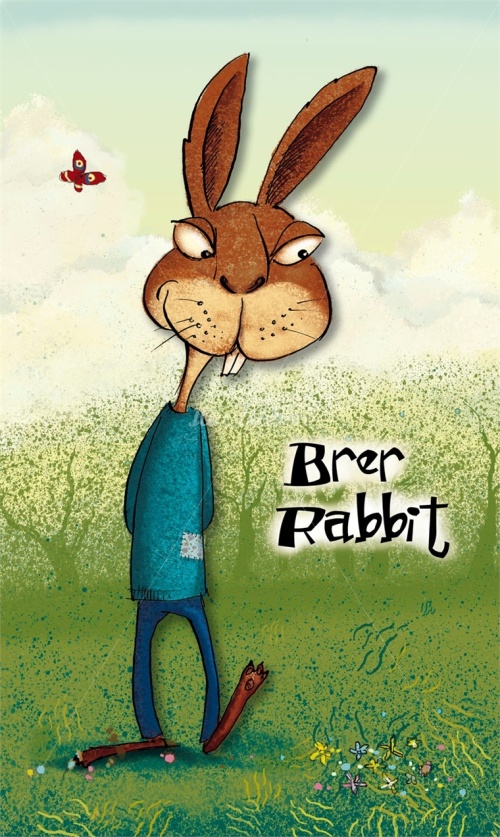
Has all your work come from European publishers?
No. I have worked on projects from around the world. My agent has seen to that. As well as most of Europe, I’ve worked for clients in the USA, Australia, Canada, South Korea and South America.
What is the one thing in your studio that you could not live without?
My bicycle, hanging on the wall.
Do you try to spend a specific amount of time working on your craft?
I don’t usually need to make a conscious effort to because I’m usually busy. This was one of the reasons I was drawn to illustration in the first place. I knew if I was a working illustrator and I was getting regular work, the commissions would keep me busy – I wouldn’t have to risk being stricken too often with that dreaded lack of motivation so many artists can suffer from.
Do you think the Internet has opened doors for you?
Absolutely! Having my work on the web is like having a private art gallery in every home and office on the planet that has access to the internet.
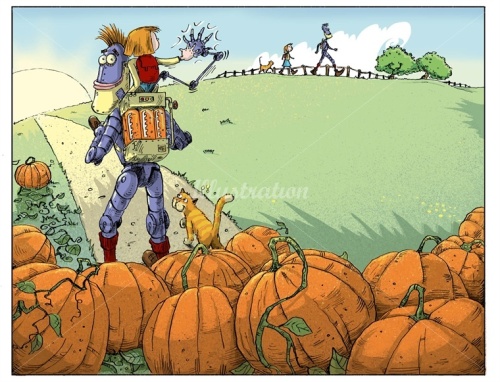
Do you use Photoshop or Corel Painter with your illustrations?
Photoshop.
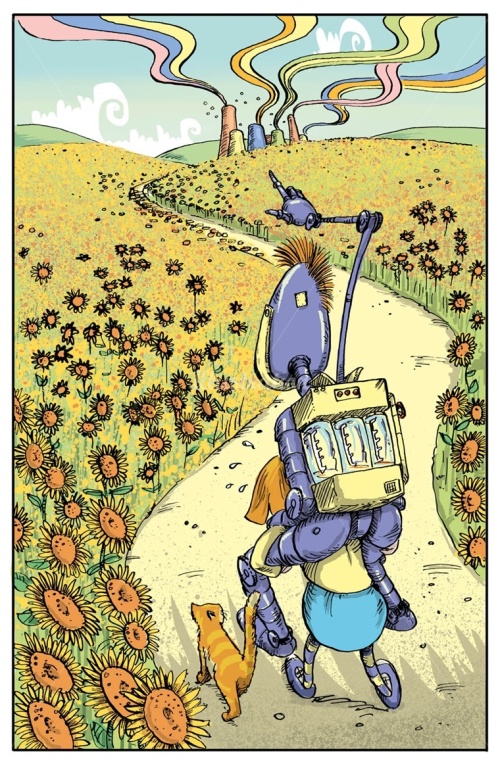 Do you own or have you used a Graphic Drawing Tablet in your illustrating?
I couldn’t work without one. Working with a mouse is about the same as drawing with a bar of soap.
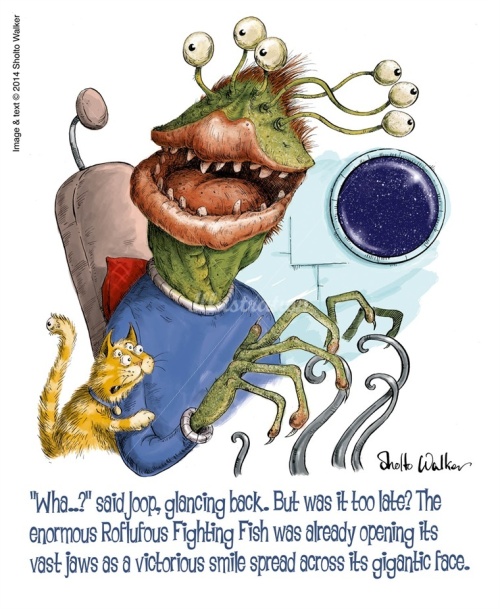 Do you have any career dreams that you want to fulfill?
One or two. I really need to write and illustrate a book.
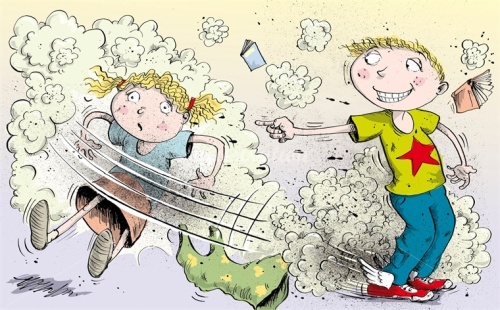
What are you working on now?
I’ve just completed the front and back cover art for a self-publishing project actually. Very imaginative. Very weird…
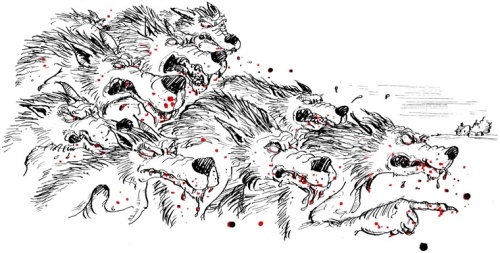 Do you have any material type tips you can share with us? Example: Paint or paper that you love – the best place to buy – a new product that you’ve tried – A how to tip, etc.
Yes: If you work digitally invest in the best and biggest display you can find. Preferably two. Don’t forget it’s your canvas. If you make your pictures on paper, remember, if you want your work to outlast you, use the best paper and media you can find.
Any words of wisdom on how to become a successful writer or illustrator?
Whatever you do don’t follow fashions. Be you and keep being you.
Thank you Sholta for sharing your journey and process with us. Please let us know all your future successes. We’d love to hear about them and cheer you on. You follow Sholta on Twitter @Sholtawalker
or visit his agency at: http://www.illustrationweb.us/artists/SholtoWalker/view
If you have a moment I am sure Sholta would like to read your comments. I enjoy reading them, too, even if I don’t always have time to reply. Thanks!
Talk tomorrow,
Kathy
Filed under:
Advice,
authors and illustrators,
illustrating,
Illustrator's Saturday,
inspiration,
Interview,
picture books,
Process,
Tips Tagged:
Cheltenham College of Art in Cheltenham,
England,
Ilustrationweb.com,
Sholta Walker 

By: Kathy Temean,
on 10/31/2014
Blog:
Writing and Illustrating
(
Login to Add to MyJacketFlap)
JacketFlap tags:
Interview,
picture books,
inspiration,
Advice,
Process,
illustrating,
University of Arizona,
demystify,
Illustrator's Saturday,
Baby Bug Magazine,
Laura-Susan Thomas,
Add a tag
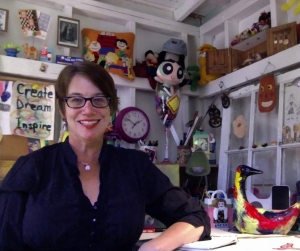 Lauren-Susan Thomas currently illustrating children’s books, on the foggy Central Coast of California. She earned my BFA in Illustration at the University of Arizona, worked as an illustrator/designer since graduating in ’87’ and worked as a ‘Walt Disney Imagineer’ for 11 years creating themed dimensional graphics and illustrations from creatures under the sea mermaids to dinosaurs to ancient Tibetan ruins.
She has illustrated for, BabyBug magazine, Kids Reading Room LA TImes and an up coming book series, ‘Reid’s Amazing Universe’ the first of which is out on ibooks for children.
Here is Laura-Susan discussing her illustrating process:
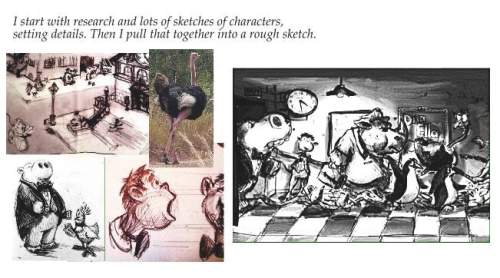
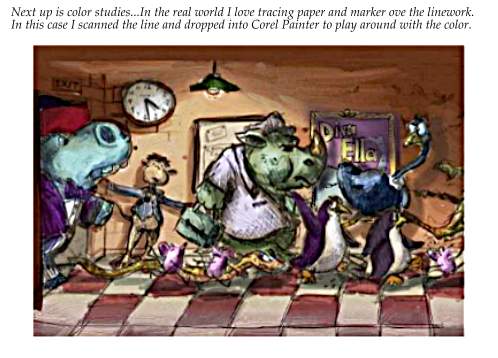

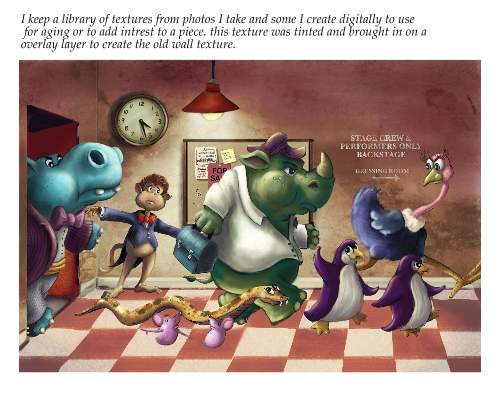
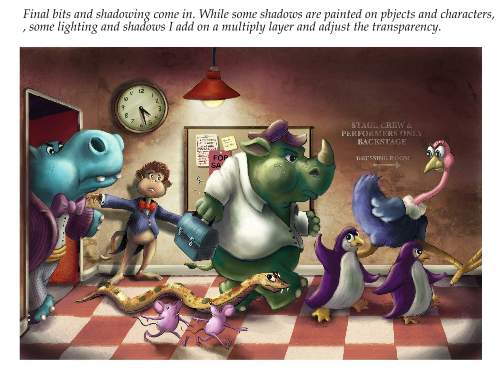
I had to share Laura-Susan’s cute little studio. It is only a few yards from her house.
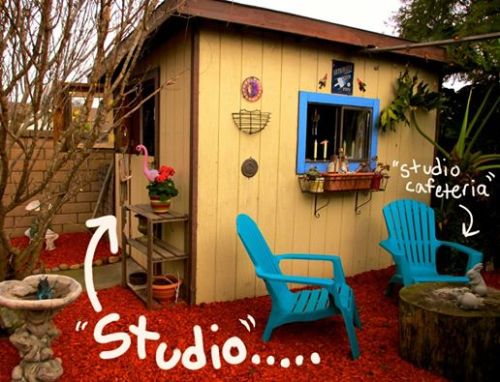
How long have you been illustrating?
I have been Illustrating since graduating from college, way back in 1987, but drawing since I was a kid. I doodled on my notebooks, school assignments and was forever thrilled when my elementary teachers uttered the word, Diorama. My dad would bring home reams of old spreadsheets from his work and I would draw on the backsides. My favorite thing to draw were characters and the worlds they inhabited in my imagination, which without realizing was a great primer for the storytelling and world building later at Disney and the children’s literature world.

What made you choose to you study art at the University of Arizona and get your BFA?
I always knew I wanted to be an artist, but I also loved archeology and the romance of ancient civilizations, so I chose U of A because they had a strong Fine Arts department and a renowned Archeology Department as well! I actually was able to combine some of my love for archeology and old civilizations with art and when I was at Disney Imagineering on some of the lands I worked on.
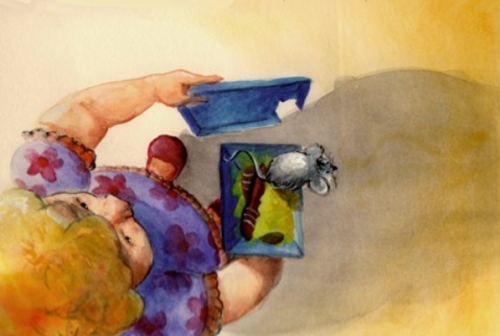
Have you taken any other art related courses after that?
Currently I am very excited and inspired, in August I started with EB Lewis in his “Visual Mentor” program. It has been such great opportunity and chance to learn and expand the feel and look of my artwork!
After graduation form college, I took some animation courses and many figure drawing courses. At Disney they encouraged their artists to keep learning and offered free Wednesday figure drawing sessions after work. I went back to school while at Disney in the evenings, for computer arts, learning vector based and digital based tools for the arts, photoshop and illustrator.
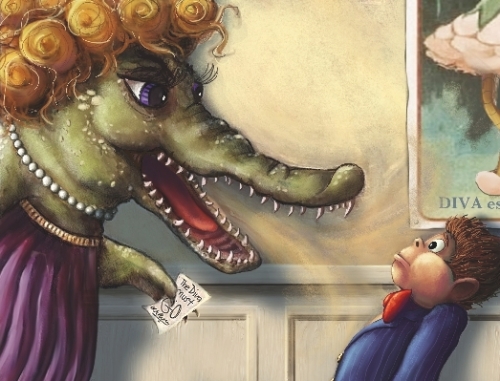
What was the first painting or illustration that you did where someone paid you for your artwork?
The first legit paying gigs I had were in College. I created the character/mascot for a yearly triathlon in Tucson, A buff bike riding, running swimming frog and I painted the billboards for the drama theater on campus for a time and did some summer theater backstage work.
What type of job did you do right after you graduated?
I worked for a screen printer creating graphics and designs for surf wear and clothing.
How did you get the job with Disney?
I applied through an industry ad for a screen printing fine arts separator. It was my fine arts background and my first job in screen printing that helped me get the job at Disney Imagineering. Our department produced the final hand done separations and the fine arts Serigraphs and posters for the parks. From there I moved on and worked in the Graphic Design department as a comp/production artist, and later as a Designer and Illustrator. As an Imagineer you are part of creating essentially the worlds biggest stage sets. Being an artist at Imagineering was a fun, nontraditional, imaginative, job. As a designer, you had the honor of working with, Blue sky designers, writers, architects, interior designers, props, sculptors, robotics experts and more. I got to be part of creating all sorts of things, from themed ancient tibetan ruins, giant carved fish characters, to dinosaur paintings and mermaids, in Euro Disney, Disney’s Animal Kingdom and Tokyo Disney Seas.
How did you decide you wanted to venture into freelance art projects?
In 1996, my husband, Hariette (our pet rabbit) and I took a a chance and an adventure and made our way from Los Angeles up to the little surf towns, ranches and rolling oak covered hills of the Central Coast of California. I continued to work for Disney full time from afar. I was one of their first full time telecommuters back in the age of dial up, conference calls and Fedex, painting away in my foggy studio. Our Fedex planes here were prop planes and our post office was actually in the back of hardware store and I admit many conference phone calls were done while working, wearing my “casual attire”. FaceTime did not exist yet thank goodness. It worked wonderfully and I would drive to LA once week and travel to job sites in Florida for many years. When my daughter and later my son arrived I took a break from travel and full time work, it seemed the perfect time to start working on a freelance basis.
Do you think Disney influenced your style?
Imagineering was all about backstory, telling the tale of the place through characters, through writing, props and themed space, that helped a guest believe they had gone from reality to another world. I think that idea greatly influenced my work and I love to be able to create art for books, that transports someone to a world they believe in and get to play in for awhile.
When did you decide you wanted to illustrate for children?
I attended a Conference in Marian Del Rey when the SCBWI was SCBW and was hooked. I began collecting children books before I had kids. When my kids were school age, I jumped in full time. Five years ago. I Attended a conference in LA, met a circle of friends who later became our fantastic illustrators critique group! Between my critique group and all the amazing people I have met through the SCBWI, I am so excited to be a part of this community!
What are you doing to help connect with art directors and editors?
I have postcards and a website with childrensillustrators.com and Carbonmade, and try to keep up by reading industry blogs. Attending conferences and smaller SCBWI events and participating in portfolio reviews whenever they are offered and portfolio showcase through the LA conference.
Have you put together a portfolio and or a book dummy?
Definitely a portfolio online and a real world portfolio. I try to update both when I have new work. Sometimes I make small dummies for ideas I am working on. It is a interesting process and great way to really see how your work flows with the page turns.
Have you done any illustrating for children’s magazines?
I had the opportunity to do a cover illustration and a full spread for Babybug Magazine. As well as Magazine work, I produced illustrations for some of the short stories featured in the, Los Angeles Time’s Kids Reading Room. It is fast turnaround but fun to focus so intently and figure out how to tell a story in one illustration.

Do you have an Artist Rep. to represent you? If not, would you like to find representation?
I don’t have an artists rep., but I would love to find representation.
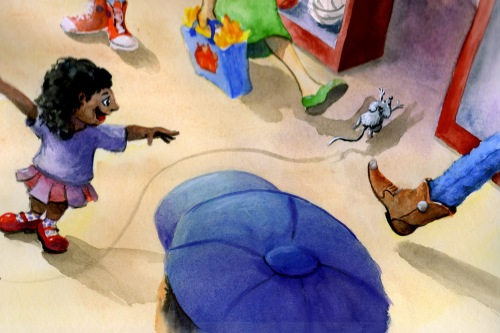
What types of things do you do to find illustration work?
I tend to be a bit of a very shy, nerdy, introvert so Social media and self promotion are the hardest parts of children illustration for me. I know it is important though so I try and get out there at conferences and talk to people, make connections, get my work into portfolio reviews and such. Sending postcards, is an introverts best friend! A great way to reach out and have your work be seen from afar. So far I have only met wonderful nurturing people in this field, so for my fellow artists introverts, take the leap and put yourself out there and take chances, it does pay off!
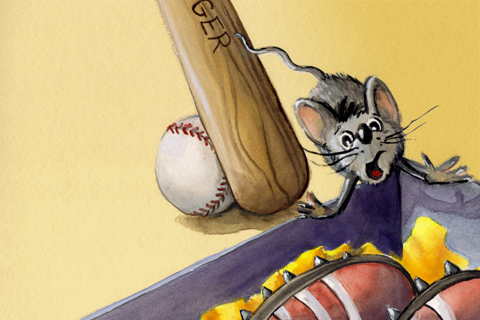
What is your favorite medium to use?
For sketching I love regular old black ball point pens. The cheaper the better. I find when you sketch with a medium where there is no eraser and no “undo” it frees you up. I also love that you can get so much variation in line and shading with those old crummy pens. For finished work, I love to work in gouache. and pen and ink in the real world, Corel Painter and my Wacom in the digital world.
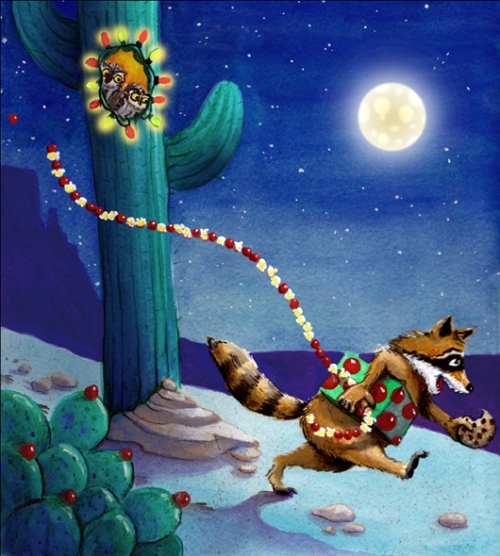
Has that changed over time?
Yes, Since the recent ebooks series I worked on was going to have some animation, I wanted to be able to manipulate the art on layers. I started using Corel painter and a wacom tablet. I love the way you can mimic real world art mediums and still maintain layers and experiment. I still start with those old crummy pens and pencil in the real world even when I am going digital. It still feels fresher to me.
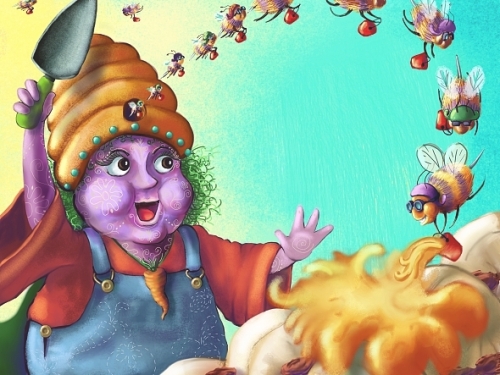
What do you consider is your first big success?
BabyBug was exciting, to be able to do not just create a spread but also the cover art for a large publication was wonderful! It was happy dance day!
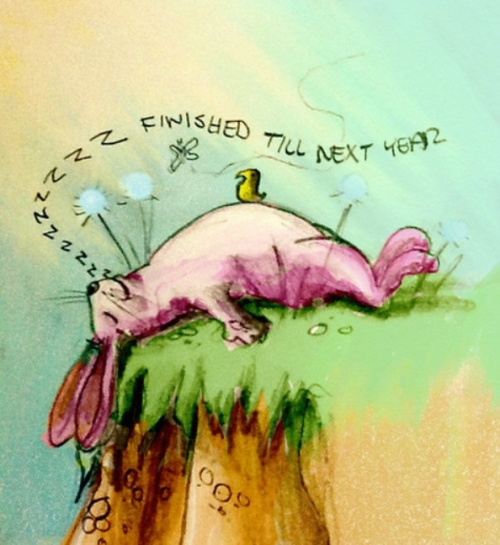
How did that come about?
I think getting your work out there with websites and postcards. The art director at Carus Publishing had seen some of my work and when a job came along that matched my style, she contacted me. I had missed the call, as I was out picking up kids, so she had left a message for me. I listened to the message three times, did a dance around the room with the kids, regained my demeanor and called her back, very excited to be working with them.
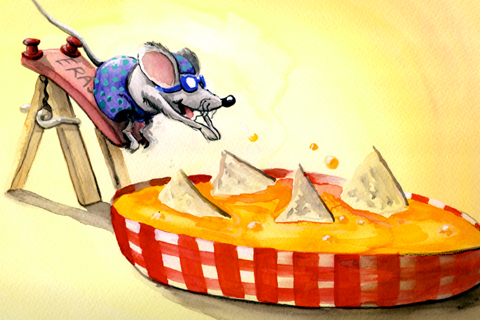
Do you ever want to write and illustrate a picture book?
Absolutely, I would love to get some of the worlds and the stories, rolling around in my imagination and my sketchbooks, onto the page and into a book! I am working on my writing craft along with my illustration.
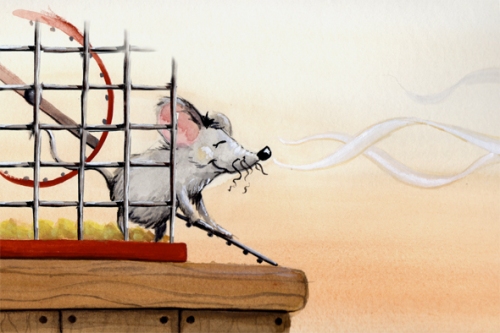
Would you be open to working with an author who wants to self-publish a picture book?
It would depend on the story and situation. I have worked with one author, self publishing an ebook series, “Reid’s Amazing Universe”. Getting a book, out there and seen, seems to be an issue in self publishing, especially in the digital realm, competing with apps and more. The author and developer in this case, are very good at self promotion and marketing and had some good connections so it seemed like a good challenge. I think the challenge to self publishing for an illustrator specifically, is not having an Art Director. It is difficult to self edit your work and having a talented art director on board is invaluable.

Do you take pictures or do any types of research before you start a project?
I get books from the library, google images and make big image boards for characters and setting and color palates. Right now my wall is filled with gorillas, smug kids, and downtown street scenes. I have a little mirror above my art table so I can make faces at myself, in order to get a great facial expression in my characters.
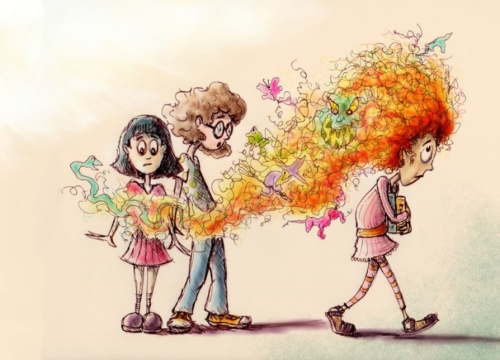
Have you done any work for educational publishers?
No, but I am interested in both this area and the Middle Grade areas, after hearing two great breakout sessions at the conference this summer in LA.
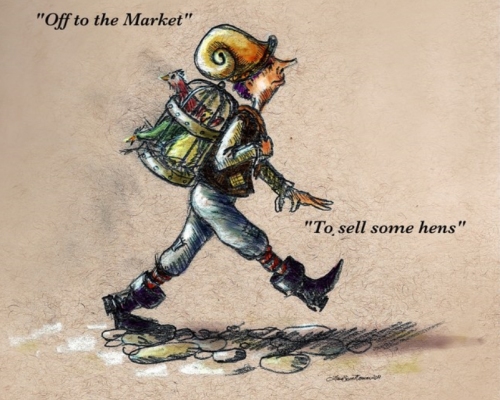
What is the one thing in your studio that you could not live without?
Music, I tend to work in different mediums and love my studio space, but I have about six different albums that play in the background when I work. It helps me to get lost in my drawings.
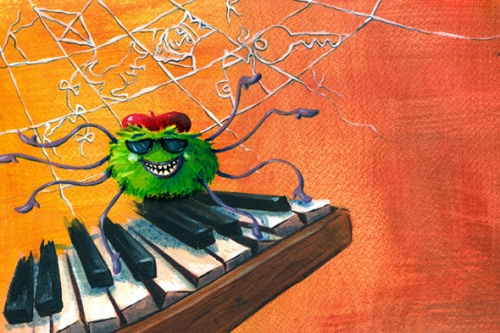
Do you try to spend a specific amount of time working on your craft?
I really believe keeping a good balance helps your creativity and with your life as a whole. I try hard to do this, even though I am an Artist-Mom/taxi driver of short people, I set aside around 5 to 6 hours each day during the week to sketch, paint, research and learn. If I have a deadline approaching then it is whatever it takes. That can mean, walking out to my studio at 4am in the quiet hours, or in the late evening hours, keeping the balance with my family’s daily life and get the deadline met. My kids love the studio. If I need to put in the extra time even as my kids get older, I will find myself working with someone reading a book under my art table and listening to my husband practice guitar in the house. It becomes creative time for everyone.
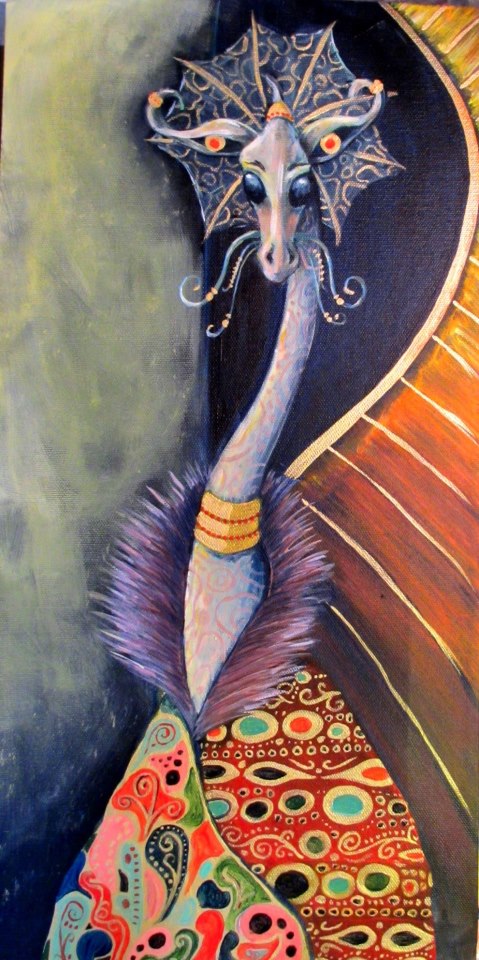
Do you have an agent? If yes, who? If not would you like to find one?
I don’t have an Agent, but yes, I’d love to have an agent. I think it can be a great partnership for an artist, to navigate the ins and outs of the children’s field and to help further their work.
Do you think the Internet has opened doors for you?
For artists I think the internet is fantastic! It allows us to share our work and inspiration and ideas and connect with other artists and people in our industry through Facebook, websites , Instagram and more. In my case, I Skype each week for the Visual Mentor program, and my critique group has maintained a strong bond and can help each other in an instant, even though we are from all different parts of the country. Once again internet a great tool for introverted artists!
Do you use Photoshop or Corel Painter with your illustrations?
For many years I used Photoshop, but I have become a Corel Painter fan. If I work digitally I tend to work in Corel with a Wacom tablet.
Do you own or have you used a Graphic Drawing Tablet in your illustrating?
I love my Bamboo Wacom tablet. it is as portable as a sketchbook!
Do you have any career dreams that you want to fulfill?
My Career Dream, I would like to have been a part of creating books with humor and heart, that are worn on the edges, because they are the ones grabbed off the bookshelf over an over again to be read We on the couch at bedtime.
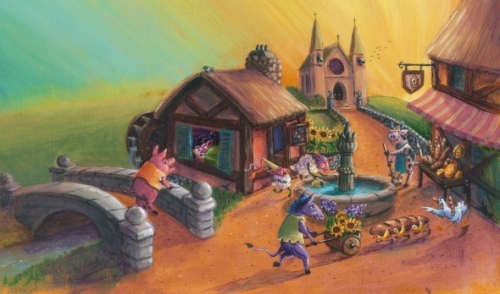
What are you working on now?
I’m starting to sketch on the third ebook series for “Reid’s Amazing Universe” and working on expanding my art and creating illustrations for a possible book in my Visual Mentor program.
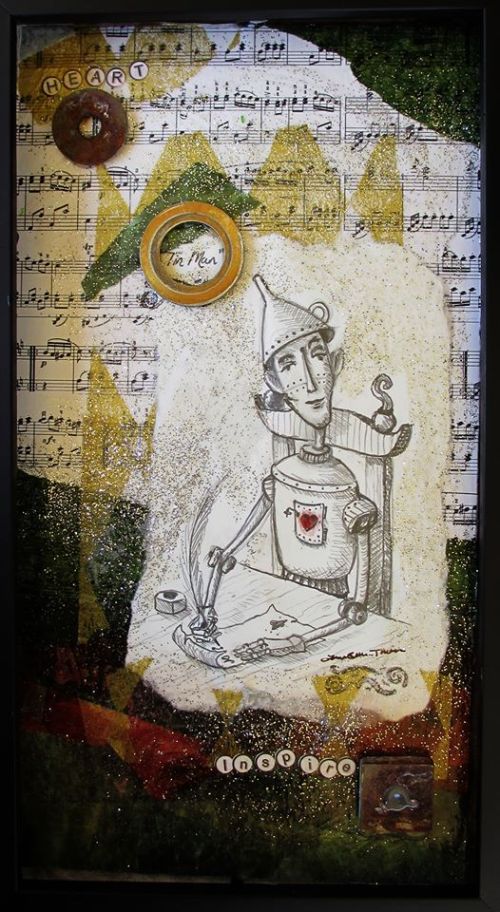
Do you have any material type tips you can share with us? Example: Paint or paper that you love – the best place to buy – a new product that you’ve tried – A how to tip, etc.
I love sketching with ball point pens but also I have a few sets of warm and cool grays, and black Faber-Castell pens and tracing paper. They come in sets of warm and cool grey and black with different sized tips and brush pens. When I am working I will have several layers of tracing paper with different shading or trying out different gestures above the original sketch. I find my work is much looser if I am sketching by hand rather than on a screen. Later I will combine what is working either in the real world or in Corel Painter to form a final sketch before going on to the finished art.
For Art supplies we live in a small coastal area so Blicks online is my go to source for supplies.
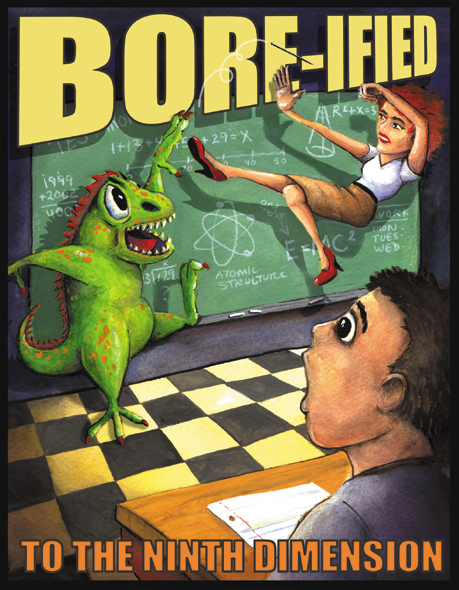
Any words of wisdom on how to become a successful writer or illustrator?
I am not nearly as far along as many of the creative and talented illustrators whom I admire, interviewed on this blog. As far as words of wisdom, I think to get where I am today with some success at being published and hopefully more opportunities in my future, for me it comes down to truly wanting to be a children’s illustrator, loving this field, and as an Artis/Mom, finding the time to truly work hard, getting your work out there to be seen.
Becoming a member of the SCBWI was an important step for me and an amazing organization with wonderful talented people. Everyone I have met has been willing to talk or help a new or emerging illustrator or writer to the find their way and welcome them into the children’s books community. It is where I have garnered friends, critique groups and contacts. Attend conferences and events through the SCBWI. Take classes, be open to opportunities!
Most importantly, find the time and the balance for your art or writing in your week and stick to it. Laundry will still be there tomorrow and I do believe Dust Bunnies qualify as pets, so give them a cute name, pat them on the head, and go sketch!
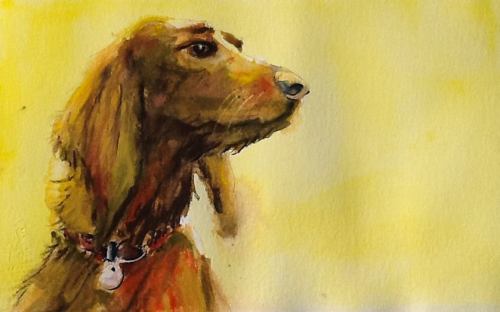
Thank you Laura-Susan for sharing your journey and process with us. Please let us know all your future successes. We’d love to hear about them and cheer you on. You can visit Susan at: www.laurasusanthomasillustrator.carbonmade.com
If you have a moment I am sure Anne would like to read your comments. I enjoy reading them, too, even if I don’t always have time to reply. Thanks!
Talk tomorrow,
Kathy
Filed under:
Advice,
demystify,
illustrating,
Illustrator's Saturday,
inspiration,
Interview,
picture books,
Process Tagged:
Baby Bug Magazine,
Laura-Susan Thomas,
University of Arizona 

By: Kathy Temean,
on 10/24/2014
Blog:
Writing and Illustrating
(
Login to Add to MyJacketFlap)
JacketFlap tags:
Anne Wertheim,
Freelance artist Maui,
Oracle Deck of Flowers,
inspiration,
Advice,
illustrating,
demystify,
Illustrator's Saturday,
Interview,
Process,
Add a tag

Anne attended College of Art in Hamburg, Germany (Fachhochschule fuer Gestaltung), from which she graduated in 1995 with a degree in illustration. Right after earning her degree she moved to Maui/Hawaii. She has been working as a freelance illustrator, painter and designer, working for advertising agencies, design studios and publishers for nearly 20 years in Maui.
She has worked on a variety of projects including product packaging, advertising, publishing, point of purchase displays and animation backgrounds.
Here is Anne explaining her process:
My work process creating one out of 44 cards for the “Oracle Deck of Flowers”.
Publisher: Llewellyn Worldwide, Author: Tess Whitehurst
For this oracle card, I am asked to show a heroic woman blowing a horn standing amidst a field of blossoming foxgloves. The title of the card is “Summon your Courage – Foxglove”

I start out with a black and white line sketch. To get the pose right, I often use the help of another application: Poser

I work on two monitors. Monitor One is the smallest of the Cintique tablets, monitor two is a 30 “ Dell. On the Dell I have several documents open showing reference images as well as an additional window of the current illustration I am working on. The Cintique will have only my illustration window open as well as show a window with my brush presets and another one for layers.

While I work I constantly go back and forth between painting on the Cintique and evaluating my illustration on the Dell. The Dell I have color calibrated. I always work in a CMYK color space when working on print projects.

I do a very quick color sketch. On this card, I feel confident about how I want the colors to be, so I decide not spend too much time on the color sketch.

I desaturate the color sketch to have it in black and white.

I add a muliply layer over my black and white sketch and use a soft brush to paint over it in orange.

I usually start with the background, in this case the sky. I always use textures in my Photoshop brushes. My main brush has a texture, I made myself by applying acrylic gel to a board, painting it black and and dry brushing white over it.
I have a texture library of splatters, ice , fabric, rocks, marble etc. anything that will make a nice texture. While I work I often choose different textures.
For the sky I chose a splatter texture. I put the sky on one layer and the clouds on another. On layer three I have my Poser
figure on layer 4 my sketch. I want to create a dramatic sky, somehow evoking a feeling of fire or a battle far away.

As soon as I have roughed in the sky, I start working on the figure. At this stage I work fairly rough, as I want to paint in all the elements of the illustration before I get into more detail. It is always so tempting to get detailed too soon, only to realize later, that some of the detail does not work with other parts of the illustration.

Next I rough in the foxgloves and start working on her face. Now that all the elements of the illustration are in place it is time to fine tune. I put several layers of paint over the sky. Sometimes lightening the sky up with heavily textured brushes and then toning everything back down by adding a multiply layer and glazing a shade of blue or magenta over the sky.

I am working similarly when working on her clothes and face. Here I just stick to my main texture brush. I lift her left arm a bit, to make the pose a little bit more dynamic and add all the highlights for her clothing and on the flowers.
Almost all elements of the illustration are on different layers. Flowers on one, leaves on another, her legs, her skirt, belts, west etc. Having everything on different layers makes it easier to work and rework each part.

And that is pretty much it!
How long have you lived in Maui?
I moved here in 1995, right after I finished art school in Germany.


How long have you been illustrating?
I have been illustrating as a professional and full time since 1995, after I got my degree in illustration from the college of art in Hamburg/Germany. But I have been pretty much done some form of art my whole life.

Did you study art in college? If so, where?
Yes! I went to the “Fachhochschule for Gestaltung” in Hamburg (college of design).

What were you favorite classes in college?
My favorite class in college was “Educational Illustration,” as well as life drawing and painting.

Did the School help you get work?
They didn’t really help us get work, but found publishers that wanted to work with us, while we were still students.
Our illustration class did several projects for different publishers.
Together with 5 students I illustrated one of my first books for a German publisher (Frankh Kosmos) with the title “Animals at the Coast and the Beach” (�Tiere an Strand und K�ste).
On another assignment we designed and illustrated an exhibition for a marine biology institute.

What was the first painting or illustration that you did where someone paid you for your artwork?
Right after High School, I interned for two years in an illustration and design studio. During my internship I was fortunate enough to illustrate some book covers that my boss otherwise would have done himself.
What type of job did you do right after you graduated?
While still in college, I worked for a big German publisher, doing layout for several magazines as well as teaching computer graphics on the Mac. After I graduated I started my career as a freelance illustrator.

Do you think the classes you took in college or living in paradise influenced your style?
Neither one and both to a certain extent. It has helped me to have an education in the arts. No doubt, all my art classes in college have given me a strong foundation to work as an illustrator. Nevertheless, I feel life has influenced me the most. Right after college, I felt I needed to learn soooo much more than what they had taught me in college and even now, almost 20 years after I graduated I am still learning with every single project that I take on. I think Maui’s abundance of natural beauty, lushness and bright colors, are in sync with my need for nature, beauty and color in my life and work.

Do you do a lot of art shows and exhibits? Is that how you got noticed?
No, I don’t do any art shows and exhibits at the moment. After I had my two children in 2001 and 2003, I wanted more freedom in my creative process. So I did a lot of plein air painting. For about three years, I painted mostly on sight in oil all over Maui. I really enjoyed this time. It taught me so much about painting, landscapes, color, light etc. I exhibited and sold my paintings in my husbands gallery close to where we live.

When did you do your the first illustration for children?
For my thesis in college we had to pick a larger project to illustrate. I decided to write and illustrate a picture book about a family of barn owls. To complete my thesis, I only needed to create the concept and 5 illustrations. I had a lot of fun writing the story and illustrating it. Instead of just the required 5 illustrations, I did all the illustrations for the book. It turned out so well, that the same publisher I worked for before, picked it up and published it the next year.

When did you decide you wanted to illustrate books?
I never was set on just illustrating books. Right now, I actually prefer shorter projects.

How did get the contract for the “Food Chain” book series?
I got the contract for the “Food Chain” series, by doing a lot of cold calls and got lucky to give Capstone/Picture Books at the right time when they were looking for somebody to illustrate “Food Chains”.


Have you worked with educational publishers?
All my children’s books have been geared towards the educational market. I just recently worked for University Press and did some illustrations for a few school books.

How many children’s books have you illustrated?
If I counted right a total of 10.

Do you have any desire to write and illustrate your own book?
Not at the moment.

Have you done any illustrating for children’s magazines?
I did some illustrations for Highlights and Cricket Magazine.


Do you have an artist rep.? If so, who? And how did you connect with them?
I am repped by Steve Munro of Munro Campagna in Chicago. When I felt In needed a rep, I looked up all the reps, who represented illustrators that I either admired or where similar in style to me. I then sent out e-mails with samples of my work and Steve took me on.

What types of things did you do to market your work?
I always think I should be doing more and I definitely could improve a lot in terms of marketing myself. I market myself by showcasing my work in the Workbook, the ISpot, as well as CreativeSource in Canada. I occasionally send out postcards. I used to do email blasts, but have not found that sending mass e-mails produces great results. I am just in the process of redoing my own webpage and am determined, once done to blog about my process on a more regular basis.

What is your favorite medium to use?
These days it is digital.

Has that changed over time?
At the beginning of my career I did all my work in acrylics and used a mix of airbrush and acrylic painting. I switched to digital in 2010 and have not regretted it, even though I miss not having originals anymore

Do you have a studio in your house?
Yes, my studio is in our house.

What is the one thing in your studio that you could not live without?
My Cintique tablet.

Do you try to spend a specific amount of time working on your craft?
I usually start my workday between 6 and 7 am. I am an early morning person, which makes communicating with the East Coast a lot easier. I take in between 30 minutes and an hour each day to do things that are not related to doing my craft. Usually these are my least favorite subjects and the ones I procrastinate the most about: marketing, office tasks, writing bills (which actually should be considered fun), blogging and currently it is working on my new webpage (which I actually really do enjoy)
The rest of the day is devoted to working on my illustrations..

Do you take pictures or do any types of research before you start a project?
Yes! Depending on the project, I might take photos, ask a friend, my children or even a stranger to model for me and /or do a lot of research on the internet.

Do you think the Internet has opened doors for you?
I couldn’t live without it. For my most recent project of illustrating 44 Tarot cards, I must have collected thousands of reference images.

What do you tell was your biggest success?
My first Celestial Seasonings illustration is just now gracing one of their new tea boxes: Apple Caramel Dreams.


Do you use Photoshop with your illustrations?
Yes. Photoshop is my main application I use when illustrating.

Do you own or have you used a Graphic Drawing Tablet in your illustrating?
I started out on an Intuous and upgraded to a Cintique last year.
Do you have any career dreams that you want to fulfill?
Next year I want to learn Maya and start getting into 3D.

What are you working on now?
I currently am working on a deck of 44 Tarot or oracle cards. The deck will be called “The Oracle Deck of Flowers”


Do you have any material type tips you can share with us? Example: Paint or paper that you love – the best place to buy – a new product that you’ve tried – A how to tip, etc.
My favorite tool is my Cintique. Before I got it, I never thought it would make such a difference in my work. I was using the Intuous graphic tablet before,which seemed fine to me at that time. But actually drawing on a monitor is such a big improvement. I love it.


Any words of wisdom on how to become a successful writer or illustrator?
A good mix of talent coupled with perseverance, stubbornness, and a burning desire to create will help a lot in becoming a successful writer or illustrator.

Thank you Anne for sharing your journey and process with us. Please let us know all your future successes. We’d love to hear about them and cheer you on. You can visit Anne at: http://www.annewertheim.com
If you have a moment I am sure Anne would like to read your comments. I enjoy reading them, too, even if I don’t always have time to reply. Thanks!
Talk tomorrow,
Kathy
Filed under:
Advice,
demystify,
illustrating,
Illustrator's Saturday,
inspiration,
Interview,
Process Tagged:
Anne Wertheim,
Freelance artist Maui,
Oracle Deck of Flowers 

By: Kathy Temean,
on 10/23/2014
Blog:
Writing and Illustrating
(
Login to Add to MyJacketFlap)
JacketFlap tags:
karen Romagna,
NJSCBWI Illustrator Coordinator,
Picture Book,
Book,
inspiration,
Process,
publishers,
illustrating,
authors and illustrators,
Voyage,
Add a tag
Here is your chance to win a copy of Karen Romagna’s new book, VOYAGE. All you have to do is leave a comment and be willing to write a short review of the book if you win. The review can be on your blog, Amazon, Barnes and Noble, Facebook, or Goodreads. (See more at bottom of this post.)
Karen Romagna has just finished illustrating her first picture book. Voyage launched at The National Book Festival in Washington, DC on August 30, 2014 and is available in bookstores October 1, 2014. Written by former US Poet Laureate, Billy Collins, Voyage is the tale of a young boy setting off for an adventure on the open sea. Karen used the softness of watercolor in illustrating this wonderful dreamlike tale.

Karen is a traditional painter. Her illustrations are primarily done in watercolor However, she also loves painting in oil.
Karen grew up surrounded by art, music, brothers, sisters and parents that always supplied paint, paper, and the freedom to try new things. She lives in rural New Jersey where she and her husband, John, raised two sons, Matt and Tim, in a house filled with music and art… and hopefully a spirit that has allowed her sons to try new things too.
For those of you who are not a member of the New Jersey SCBWI, Karen is the Illustrator Coordinator for the New Jersey Chapter of the Society of Children’s Book Writers and Illustrators.
I asked Karen if she would share the story behind Voyage and it’s beginning. Here is what she told me:
“Voyage” had an interesting beginning. Billy Collins wrote the poem back in 2003 in celebration of John Cole’s 25 years as Director of the Center of the Book in the Library of Congress. As John Cole wrote at the beginning of Voyage, “The creation and presentation of “Voyage” was wholly in the spirit of the Center of the Book, which was created to stimulate pubilc interest in books, reading and literacy.”
In 2013 Bunker Hill Publishing approached me wondering if I might be interested in “a collaboration with the poet Billy Collins!” Well…, of course! The publisher had seen a copy of the poem hanging on the wall in John Cole’s office and approached Billy with the idea of making it a picture book.
Billy Collins likes to pick the illustrators for his books and went surfing the net. He came across a painting of mine that made him think I should illustrate this poem. He asked the publisher to get in touch to see if I might be interested in this project. Well… “Of course!” Bunker Hill had an illustrator in mind for the book as well and asked me to submit a sample illustration along with a thumbnail dummy. Wanting to make sure I was giving myself the best shot, I asked the publisher if he wouldn’t mind telling me exactly which illustration Billy Collins had seen that made him feel I was the right artist for his book. “Of course!” he said “It’s the one of the boy in a boat.”
Well, my heart melted… that was not one of my illustrations… it was a portrait of my younger son, Tim. There was always something magical about my second child. He would find himself in a great adventure with a piece of rope that he’d found.
In the end I was chosen to illustrate “Voyage”. …so Tim will carry on this great adventure for a long time.
You might be interested in watching this video of Billy Collins and Karen Romagna talking about the book at the National Book Festival where she launched her book in Washington, DC. I laughed when Karen said she almost threw out the email from the publisher she received asking if she had any interest in illustrating the book thinking it was junky mail. Thank goodness she didn’t. Congratulations, Karen!
If you would like more changes to win you will get additional entries when you Tweet, reblog, or talk about Voyager on Facebook (Must check back and let me know what you did, so I can enter the right amount of tickets with you name on it.
DEADLINE: November 3rd. Winner announce November 4th.
Check back next Friday to read the four first page critiques.
Talk tomorrow,
Kathy
Filed under:
authors and illustrators,
Book,
illustrating,
inspiration,
Picture Book,
Process,
publishers Tagged:
karen Romagna,
NJSCBWI Illustrator Coordinator,
Voyage 

By: Kathy Temean,
on 10/10/2014
Blog:
Writing and Illustrating
(
Login to Add to MyJacketFlap)
JacketFlap tags:
inspiration,
Advice,
Process,
illustrating,
How to,
bio,
demystify,
Illustrator's Saturday,
Anna Guillotte,
Interview,
Add a tag
 Anna Guillotte is an American illustrator, designer, and writer living in Heidelberg, Germany. With a degree in graphic design, Anna worked as a graphic artist in the corporate world for seven years. Though she was also a mural artist and painter throughout that time, she began illustrating in 2010 when she attended a mentor program for artists in San Diego, California where she lived at the time. Through this program she realized her true calling for storytelling. She has since joined the SCBWI, attended numerous SCBWI conferences and her illustrations have been published internationally. She enjoys creating whimsical, funny, touching, and beautiful art for the advertising, book, and animation markets.
Here is Anna showing one of her techniques:
 There’s something about light and shadows that really soothes the eye. I guess I could do research on the scientific reason as to why us humans are attracted to depth in images, but I already spend too much time on the net. I’m guessing since that we live in a 3-dimensional world our eyes are built to receive and digest lovely indications of depth (i.e. shadows, light vs. dark, cool vs. warm colors) and by nature we crave that. I tend to indulge in lighting my illustrations so I thought I would share how I go about doing that – from sketch to finished image.
The key here is to make the scene believable, even if it’s not 100% accurate. So I guess in a sense you become a car salesman convincing a customer that not only is the Hyundai Elantra a great car, but the most awesome car you will ever buy in your life.
I start with a hand-drawn sketch. Why not go digital? Eh, the tablet doesn’t feel right and I guess I need to feel paper and pencils in my hand. I then scan the drawings in Photoshop.
In Photoshop I clean up the images and create separate layers for the different visual elements. This allows for more control over placement, size, coloring, and opacity. For example, in the image below I have a layer for each character, the background, and several additional details I added in later (the plane, smokestacks, birds, fence, and sticker on signpost). Keep in mind that all the coloring layers are in the “multiply” blend mode – and the texture layers are in “color burn” and “overlay” blend mode. I suggest playing around with those settings and see what you come up with : )
Here is a video tutorial on How to use Blending mode in Photoshop CC.
Now I block in the foreground shade. I imagined this bus stop scene taking place under a large tree. And as we have all observed – shade from trees are not one massive blob, but a shadow dance of many, many leaves. I made a layer of a dark blue and masked it out. Then I removed bit by bit the “shadow dance” until I thought it was convincing. Sometimes I consult with Google Images to make sure the lighting is believable.
I added additional shadowing on a separate layer.
And now the color! We begin with the background color. The blue sky on a separate layer from the tree/grass.
Another layer is added for the foreground objects.
Now the characters are colored in on another layer.
One of the biggest challenges of working in Photoshop is to make the images not look so “Photoshoppy”. So I have added a yellow layer (6%) and a water color image to add “texture”. I have also added several details, such as the balloon reflection, text on the bus sign and the little sticker on the sign post. As the image comes to life, I have fun adding in little details – this also helps with the “believability” factor.
Additionally, I have added another “texture” layer (image of paint strokes on canvas) and a faint shadow around the edge of the image to give a more old-photo look.
How long have you been illustrating?
I started focusing on illustrating in 2010, but I have been painting for over 20 years. My paintings were very illustrative and often people would ask me “Why don’t you go into children’s book illustration?”
Where did you study graphic design?
I first started my studies at the University of Hartford/Hartford Art School and took every type of art class imaginable except glass blowing and jewelry. Then I studied film for a year, then moved on to multimedia (animation and video) and that’s when I finally decided to major in graphic design. I studied and majored in graphic design at Eastern Connecticut State University – my home state.
Have you attended other art related courses since studying Graphic Design?
I took a picture book illustration class and also a children’s book writing course at University of California San Diego.
What was the first painting or illustration that you did where someone paid you for your artwork?
I painted an outdoor mural at an Elementary school in Boston.
What type of job did you do right after you graduated?
I was hired as a graphic artist at Sonalyst, Inc. in Connecticut. While there, I mostly created graphics and multimedia for US Navy computer-based training, but also did graphics and web design for private companies.
What do you think most influenced your style?
I think a lot of the shows and movies I watched as a kid influenced me. I loved the old cartoons like Tom and Jerry or Looney tunes. I’ve always been a big movie buff – not just the storytelling but also the cinematic style and I think that has carried over to my work.
When did you decide you wanted to illustrate for children?
I signed up for an artist mentor program in San Diego in 2010. It was a program designed to help professional artists get unstuck. I was painting and doing murals but I felt my art career lacked a bit of focus. My mentor took one look at my work and suggested children’s book illustration. Her coworker knew Dan Santat from a previous job so we arranged a studio visit at Dan’s home (which Dan so graciously provided). Its funny, because at the time I didn’t know anything about children’s books and had no idea who Dan Santat was. He took the time to show me his work, how he got started, and what its like to work in the industry. After a few hours of the visit, I was sold!
What type of art jobs have you landed?
I have worked as a graphic and multimedia artist, have done many children’s murals, and focusing on illustration work for the children’s book market and editorials.
What are you doing to help connect with art directors and editors?
I have gone to many SCBWI conferences and heard art directors, agents and editors speak. It’s really helped me put a face to a name, so it doesn’t feel so abstract when sending my work to them. As far as how I connect – mostly I have sent postcards or emailed my website. I have also sent out a book dummy to several editors. I’ve also just created an email newsletter too for my contact list.
Have you put together a portfolio and or a book dummy?
I found that I have only used the physical portfolio when displaying at a SCBWI conference, otherwise I almost exclusively use my online portfolio. I have several book dummies as well, but they are mostly in digital format (PDF) as opposed to the physical book dummy format.
What made you decide to move to Germany?
I had no previous plans to move to Europe, but my partner got a job offer in Germany last year so I moved as well. I wrote about the decision in more detail on my blog: http://annaguillotte.com/blog/2013/11/13/why-i-am-moving-to-germany
It’s been an interesting experience to say the least and has definitely tested my limits at times. But having lived in the US my whole life, now I have the opportunity to live on the other side of the fence. Now I am the immigrant dealing with visa, work, driving, language, and cultural barriers. But since moving, I’ve had the unique opportunity to explore Europe and a experience a different lifestyle, which I think has given me an inspirational spark and influenced my work.
How would you compare the US market to the market for art in Germany?
For one, the German market is much, much smaller and for that reason has more international artists participating. My impression is the US market is so big and has so many talented artists that you don’t see as much artwork from outside the country.
Have you exhibited your illustrations in Germany?
Not yet : )
Have you done any illustrating for children’s magazines?
I have done some children’s illustrations for magazines but they were not specifically children’s magazines.
Do you have an Artist Rep. to represent you? If not, would you like to find representation?
I don’t have an artist rep now, but I would like a rep for two reasons: 1. Help with finding illustration projects and marketing so I can spend more time focusing on the creative part 2. To have a sounding board – a mutual, creative and professional relationship with someone where we can share creative ideas on how to make a project even better and enjoy the process. Though I am coming from a visual artist background, I would like to write and illustrate my own stories as well and would ideally like a representative that would work with both my art and writing or allow me to have both an art and literary agent.
What types of things do you do to find illustration work?
I keep my website updated and have several online portfolios (Behance, LinkedIn, Devianart) so people can find me. I submit my art to magazines and illustration competitions. I also send postcards to art directors and I just made an email newsletter too.
What is your favorite medium to use?
I have gravitated towards mixed media – drawing with pen, pencil, crayon, etc. scanning in and then coloring with Photoshop.
Has that changed over time?
Definitely! I used to paint using oils, then I switched to acrylic paints, then I began to import my paintings into Photoshop to edit them. About two years ago I began using Photoshop exclusively to color and have experimented using different textures to create a more natural look.
Do you take pictures or do any types of research before you start a project?
If I have a specific pose or lighting that I want to accurately capture, I will either take a photo of myself or search pictures on google images. I like to search google images also for ideas and inspiration.
What are you working on now?
This past summer I was working on developing a story idea for one of my characters, Bearonardo. Now, I’m in a marketing mode and fine-tuning the business side of my illustrations. For example, being more consistent with contacting and updating art directors. It’s not the glamorous part, but just as important!
Do you want to write and illustrate a picture book?
I sure do! I have a bunch of stories I’ve written and made book dummies for. I’m definitely open to illustrating stories written by others too if they’re a good fit with me.
 Do you have any material type tips you can share with us? Example: Paint or paper that you love – the best place to buy – a new product that you’ve tried – A how to tip, etc.
If you use Photoshop a lot in your illustrations, I would highly suggest experimenting with using different textures and patterns (whether you scan them in or find texture images online) and using the blending mode.
Thank you Anna for sharing you journey and process with us. Please let us know when your new picture books come out. We’d love to see them and cheer you on. You can visit Anna at: http://annaguillotte.com/
If you have a moment I am sure Anna would like to read your comments. I enjoy reading them, too, even if sometimes I don’t have time to reply to all of them. Thanks!
Talk tomorrow,
Kathy
Filed under:
Advice,
bio,
demystify,
How to,
illustrating,
Illustrator's Saturday,
inspiration,
Interview,
Process Tagged:
Anna Guillotte 

By: Kathy Temean,
on 10/3/2014
Blog:
Writing and Illustrating
(
Login to Add to MyJacketFlap)
JacketFlap tags:
Interview,
picture books,
inspiration,
Advice,
Process,
illustrating,
Lita Judge,
authors and illustrators,
demystify,
Illustrator's Saturday,
Flight School,
Born in the Wild,
Red Sledge,
Add a tag

 Lita Judge is a writer and artist whose greatest passion is creating children’s books. She is the author/illustrator for over a dozen fiction and nonfiction picture books including Flight School (Simon & Schuster, 2014), Red Hat (S&S, 2013), Red Sled (S&S, 2011), Bird Talk (Roaring Brook, 2012), One Thousand Tracings, and Pennies for Elephants (Disney-Hyperion). Her background in geology, paleontology and biology inspires her nonfiction books. Lita spent several years working for the Royal Tyrrell Museum of Paleontology before turning to writing about dinosaurs and other natural history subjects. But her background with animals also inspires her whimsical fictional tales filled with characters who forge big dreams.
Several of her books have been selected as Junior Library Guild picks and they have received numerous awards including the 2013 Sterling North Award, the Jane Addams Honor Book, ALA Notable Children’s Book, the International Reading Association Children’s Book Award, Michigan Notable Book, and Kirkus Best Children’s book of 2011. She enjoys teaching both writing and illustration to students of all ages and shares much about her creative process in classrooms and on her blog and website.
Lita lives with her husband, two cats and a little green parrot named Beatrix Potter in Peterborough, New Hampshire.
Here is Lita talking about her process:
For me, creating art for one of my books involves a lot of drawing to capture a character’s gesture or body movement and expression. For example in my newest book, Born in the Wild, to be released this October, I had to draw a lot of animals. But I didn’t want my readers to just know what a chimpanzee or orangutan looks like. I want them to feel a connection to them. I want them to look into the faces of my animals and feel like there is an animal looking back at them. I also want them to get an understanding of the intimate world of animals within their own world. How does a mother panda hold her baby, or a baby orangutan curl up and feel safe with its parent? To capture all this I first do hundreds of very loose sketches, focusing on body language long before I worry about details and paint.
Once I feel like I’ve captured that intimate portrait between the animals, I start focusing on the details, which describe their faces and bodies. Slowly my drawings become more refined until at last, it is ready for a light watercolor wash at the end.
 Cover for BORN IN THE WILD
Interior and end pages
How long have you been illustrating?
The first book I illustrated came out in 2006. Then my first picture book, One Thousand Tracings, which I wrote and illustrated was released in 2007.
Above: Cover of One Thousand Tracings, 2007 Hyperion)
How did you get to work at the Royal Tyrrell Museum of Paleontology?
Many kids outgrow the dinosaur-crazed phase after elementary school, but when I was 14, during the summer before high school, I still had set my cap on becoming a paleontologist. I was eager to get started so I wrote dozens of letters to museums, curators and paleontologists who were working in the field, and basically pleaded with them to let me work on their dig. I had heard the Tyrrell Museum was working on a dig with literally thousands of dinosaurs in a bonebed and they were from the Cretaceous, the age I particularly wanted to study. I guess I ended up writing so many letters to Phil Currie, he eventually called and said welcome aboard. So the day after school let out the following summer, I was on a bus to Canada. I returned every year to work there and went on to graduate with a degree in Geology.
Lita on dinosaur dig
Did you do illustrating work for them?
Not really, we didn’t have much time for anything other than digging up fossils. But I did do a few drawings on my own, and they asked if they could use them for t-shirts and mugs. That was a boost, to think I could draw dinosaurs perhaps someday for pay.
Cover of How Big, released 2013, Roaring Brook Press
Did you go to School to study art? If so, when and where?
My only schooling was in Geology, at Oregon State University. I never studied art in school. I credit all the bird watching and sketching I did as a kid for teaching me how to see, how to observe. Then later, I traveled to many great museums all over the world which, painting on location, and looking at great art.
Field paintings from Europe. Above: Stockholm cemetery. Below: Paris museum.
What was the first painting or illustration that you did where someone paid you for your artwork?
I think I sold a painting of a humming bird for about $35 at a Christmas fair. Back when I was a Geologist, I started drawing notecard and bookmark designs to get into doing art. Eventually I had over a hundred wildlife designs and sold them all over the country with a homemade catalogue I ran on a xerox machine. Then I started doing shows and craft fairs. Eventually I sold the business because I was spending all my time folding and filling notecard orders rather than painting. The dream was to paint, not fill orders. So I started showing and selling work in galleries. But I didn’t find my real home in art until I turned to writing and illustrating children books. The element of story is what made my art feel complete for me.
What type of job did you do right after you graduated?
I was an environmental geologist for the Forest Service. Spent a lot of time in the mud and rain working on the Oregon Coast.
What do you think influenced your style?
I don’t really think in terms of style. My art changes and evolves each time I do a story. I think it’s because I also write them and I have a wide range of interests — science, nature, historical, fiction, whimsical — so I do a broad range of stories. Each time I create a story it needs it’s own approach to the art.
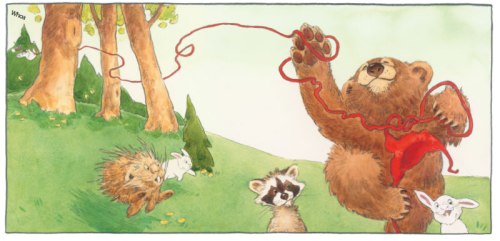
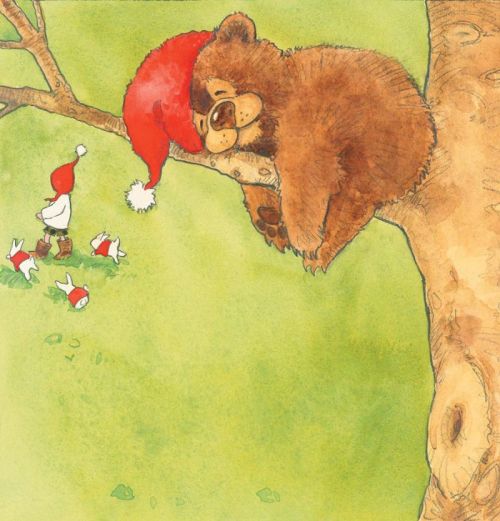
When did you do your the first illustration for children?
In 2006, my first book was to illustrate the middle grade book, Ugly, written by Donna Jo Napoli.
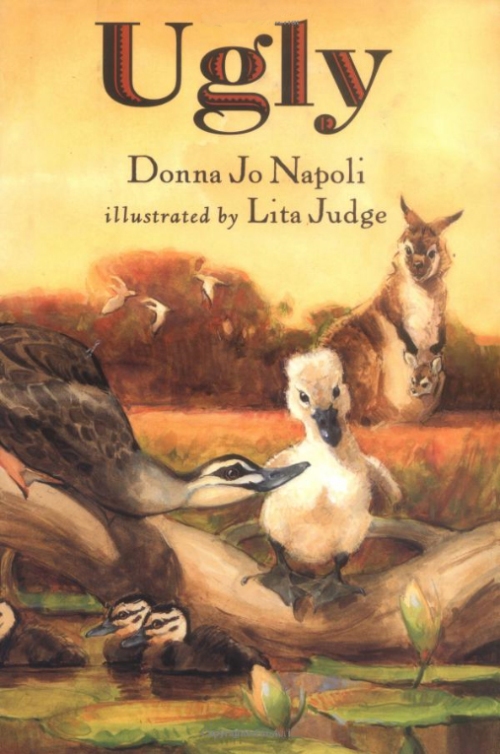
How did that come about?
I had sent an art dummy of a story I had written into Hyperion and my soon-to-be editor, Namrata Tripathi, called and asked if I’d like to do a cover for a book. Of course I said yes! I was so excited I illustrated several interior pieces as well, which made it into the book, so it turned into a nice project, and a lovely friendship with Namrata. When that was done I sent her another dummy and we were off and running on my first picture book together.
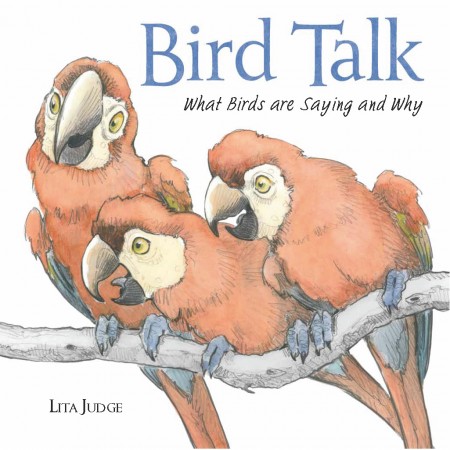
How many children’s books have you illustrated?
I’m working on my 20th right now. Several in the pipeline also.
When did you decide you wanted to illustrate a children’s book?
I’ve always wanted to on some level but when I was living in really remote areas on the west coast it just didn’t seem possible. I had never met an illustrator and really didn’t know how to go about getting published. When My husband and I moved to New Hampshire I was able to meet people in the field and soon after I began submitting work. Once my first book was in the works, I knew this would be what I would spend the rest of my life doing, I LOVE it!
How long did it take you after that to get your first picture book contract?
I was pretty fortunate. I sent out work I think in early November and got that first project on Valentine’s Day 2005. But I had been drawing and drawing and drawing, and painting for years before then. I had built up a huge body of work before attempting to get published and I think that helped me.
I see you illustrated a second book by Donna Jo Napoli. Did you know you were doing that book when you signed to do UGLY?
No, Donna Jo hadn’t even written it. It just grew naturally from the fact that Ugly was received well and we both had fun on that project.
What was the first book that you wrote and illustrated?
One Thousand Tracings. It’s a true story about a relief effort my grandparents did to help people who had lost their homes in Europe after WWII. I found letters and foot tracings in my grandmother’s attic after she died and knew immediately I wanted to write about this amazing thing they had done to help all those families.
How did you find a home for that book?
I sent it to my editor at Hyperion about a week after I turned the art in for Ugly.
What book would you say has been your most successful?
Hmmm, I really don’t think of success in terms of how many books sold or how many editions. I think a book is successful if I as an artist got to create something I feel passionately about, and it connects with readers who also feel passionately about the same thing. Some of my nonfiction books may not sell as many books as Red Sled or Flight School, but I still feel like that little girl obsessed with dinosaurs craving to make a living as an artist when I create them and that is better than any measured success. And they solicit such beautiful responses from kids who share the same obsession, so it’s a pretty wonderful feeling. And my fiction, well that’s a dream too. To create a character that people respond to, that makes them smile or feel a connection, that is the best. I leave others to worry about book sales and things, and I just worry about making the stories I love. My career feels like a dream come true, so I guess all my books are successful in their own little ways.

What book award are you the most proud of winning?
Kind of the same feeling, I’m just so grateful when any group of librarians or teachers or reviewers gathers a group of books together that they love and decides to bestow an honor on one of my books. I treasure each nod I’ve received and am thankful because they always make me believe a little more each time I really get to keep doing this beautiful, fantastic, crazy career!
Have you worked with educational publishers?
No.
Have you done any illustrating for children’s magazines?
No. I’ve been asked for both, but I can never seem to pull away on the stories I’m brewing up. My imagination seems to keep my docket pretty darn full these days.
Do you have an Artist Rep. to represent you?
I work with a literary agent, Linda Pratt, who I adore because she keeps life sane for me, juggling all the contracts and turn-in dates. But more importantly, she is my sounding board for stories. She always gives me a safe creative place to bounce around ideas.
What types of things do you do to find illustration work?
Nothing, other than I just keep writing stories. I work on them nearly every day. As soon as one is turned in to my editor and I’m waiting for feedback, I turn to the next. I don’t worry about projects, just about stories, and somehow that has kept me fully employed since the day I started.
What is your favorite medium to use?
Pencil and watercolor.
Has that changed over time?
My approach changes each time I launch into a new story. Sometimes I have a whimsical story that has to be light and fresh and very gestural. Another time, I may be working on a nonfiction that needs a more detailed approach. I’m working now on a book that takes place at night and has an element of mystery so things are dark with kind of magical lighting and a big beautiful moon. Another story I’m working on now is for much older kids and it’s kind of dark and at times very sad and scary, so that means a huge departure on my approach. I love not having a set style. It means I have to reinvent myself a lot, and that can take a lot of hours at the easel, but it is never boring.
What I really want to know is how did you find such a great studio? Did you buy the house because of that room? Had it been a church?
I build it. My husband and I found a piece of land and I designed it. We had been saving and dreaming for a very long time, so the studio grew out of that energy. I found a salvaged church window and lugged some niches home from France that were made out of 15th century oak and were in a church that was sadly destroyed in WWI, but they have a home with me now. And I carved ravens for the roofline outside to reflect my background. I was born on the Tlingit Indian reservation in Alaska and the ravens are my homage to their beautiful art and culture that inspires me. I’m grateful for everyday I get to create in this space!
What is the one thing in your studio that you could not live without?
Natural light and my critters!
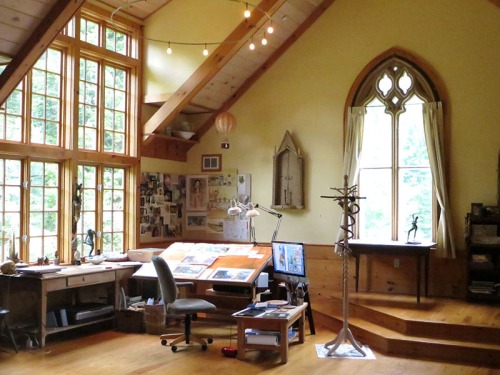
Do you try to spend a specific amount of time working on your craft?
I just work. Really I don’t keep hours. I just wake up every day eager to get back to the stories, and march on through the day and into the night and through the weekends. I hate being sick because that’s about the only time I’m not working and that for me is just plain boring. There is always at least 3 unfinished stories on my easel and a few more whispering in my ears, so as long as that is true, I’ll be working. I occasionally slip out for a bike ride, but I’m pretty much to be found with pencil or brush in hand.
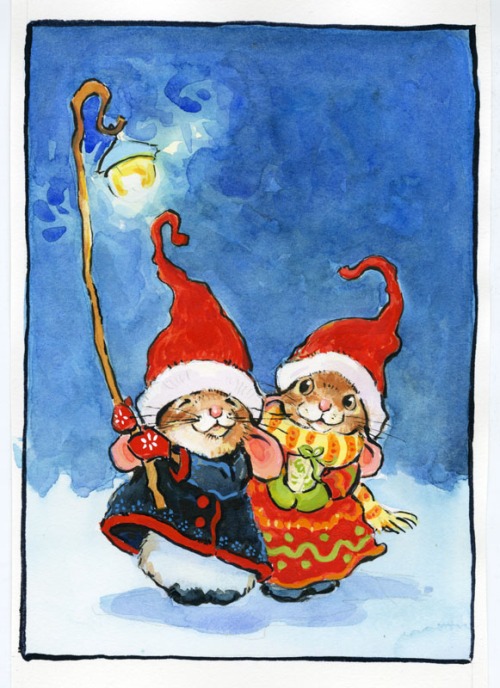
Do you take pictures or do any types of research before you start a project?
I do lots of research and quite often take pictures. That is always a fun part. My parents are wildlife photographers and my grandparents were research biologists. So I think I came to love that part of the work naturally. I do a lot of photo shoots with kids and animals, whatever the need may be. Have had fun over the years, travelling to places I paint, working with elephants, taking back trips up into the back country, feeding giraffes. Research is the fun part indeed!
Which illustrated book is your favorite?
Ah, that is like asking a mom which is her favorite kid. OK, I may have a special fondness for a certain penguin (in Flight School) but don’t tell the others. And I’m working on two books now that I’m bursting to let out in to the world, but that will have to wait. I’ll just say Paris, Owlets, moons and fun!
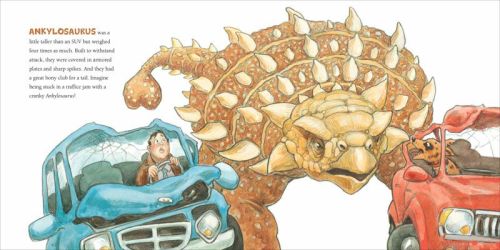
Do you think the Internet has opened doors for you?
Oh yes, it’s a wonderful way to connect with people you would never meet otherwise. I get offers to speak and all sorts of wonderful things come out of the fact that people can so easily find your website and get a sense of what you have to offer. And I’m grateful for wonderful friendships with other writers whom I rarely see but keep in touch with.
Do you use Photoshop with your illustrations?
I do a lot of planning with Photoshop. I find it a wonderful creative tool hat helps me really explore and push a composition in a way I can’t with just pencil. I love how I can really play around with values as well so that you don’t have to muck around too much in guesswork with real paint. That never works well with watercolors.
Do you own or have you used a Graphic Drawing Tablet in your illustrating?
I do use one a lot in the planning stages. And a little in the final art- again it really depends on the story and what effect I’m trying to get. They are wonderful for some things, but I find a good old fashioned brush loaded in paint my favorite tool.
Do you have any career dreams that you want to fulfill?
To keep doing books that excite and interest me for the rest of my life! To never ever have the feeling that I want to slow down. And to travel to more wonderful places that allow me to soak up their beauty and capture their essence in a story. To continue connecting with kids, teachers, and parents over stories and feel in some small way your work was a part of their imagination and life. That’s all I want.
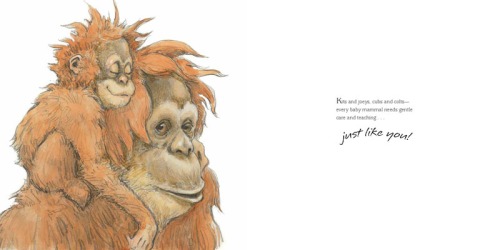
What are you working on now?
Well I have 5 books in various stages. Some I can let out of the bag, and a couple that need to stay inside where it’s safe and warm just a little longer. My next nonfiction book, BORN IN THE WILD, coming out with Roaring Brook has already gotten two starred reviews and will be released on October 21st, so that’s exciting. Then I have a picture book about my Parrot, Beatrix, coming out next spring with Atheneum entitled, GOOD MORNIGN TO ME! It’s a fun story about life with a very happy and exuberant parrot. Then I have a book I’m illustrating about a pygmy marmoset that has been a delight work on and took me on a mental journey to the Amazon, pretty fun (coming out with Boyd’s Mill). And then my owlet book set in Paris which I’m working on now (to be released with Dial), and then… oops, I can’t tell you what I’m working on after that, but it’s a big project that has pushed me to extremes and I can’t wait for it to be ready to break out of the studio and into the world.
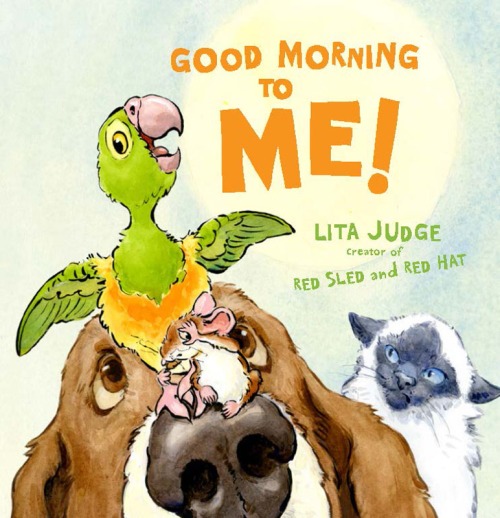
Cover of Good Morning to Me, to be released Spring 2015, Ateneum
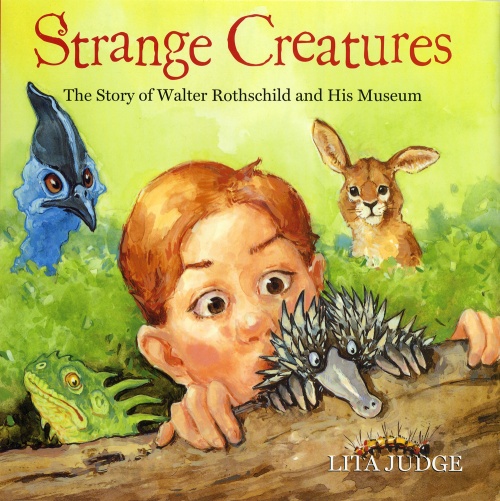
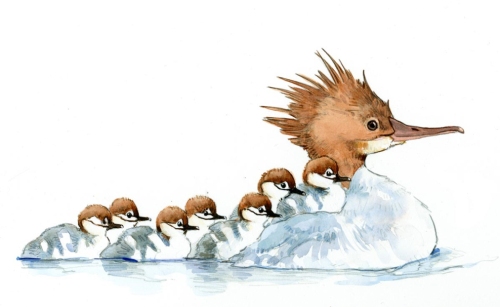
Do you have any material type tips you can share with us? Example: Paint or paper that you love – the best place to buy – a new product that you’ve tried – A how to tip, etc.
My all time favorite brush is an Isabey Petite Gris brush, all sizes. It’s shaped kind of flat and fat so it holds gobs of paint while still keeping a good point. I bought my first in Paris after I dropped my brushes in the Seine, and man am I glad I did, because this brush paints like a dream. I also love cheep bamboo calligraphy brushes as I do a lot of line work. My tools are pretty simple 4b pencils, arches watercolor paper, Windsor Newton paint.
Any words of wisdom on how to become a successful writer or illustrator?
It sounds kind of flippant, but I mean it in all sincerity – don’t worry about success. Just worry about the writing and/or the art. People want good stories, they crave them, if you focus on the craft, on making it the best piece of art or writing humanly possible, the “success” part of it will fall into place, at least enough so that you get to make a comfortable living at it and keep doing it. I honestly don’t think about number of books sold, etc, I’d go crazy second guessing every whisper of an idea that comes into my brain and I’d give up on it long before it had the time and nurturing from me to grow into a real story. But if you just focus on the art, and the writing, it will grow into something others can love. Just make a Utopia for yourself of your work, and the other “career” part of things will come out of that.
Sketch for upcoming book, Born in the Wild
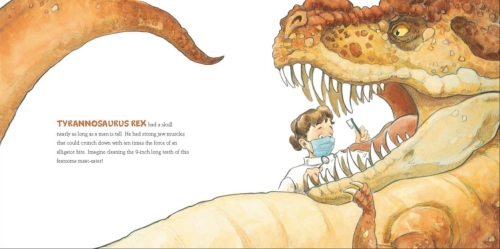
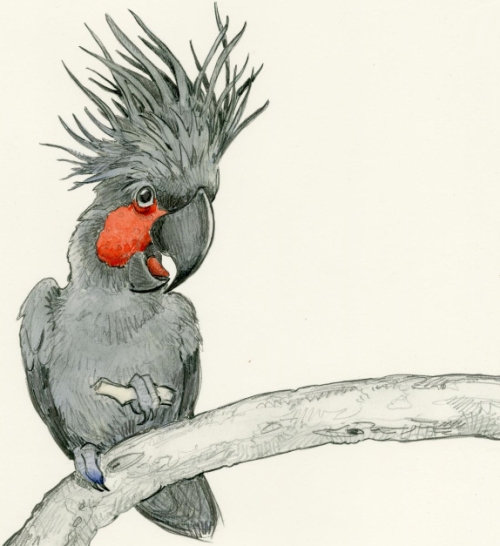
Thank you Lita for sharing you journey and process with us. Please let us know when your new picture books come out. We’d love to see them and cheer you on. You can visit Lita at: http://www.litajudge.net
If you have a moment I am sure Lita would like to read your comments. I enjoy reading them, too, even if sometimes I don’t have time to reply to all of them. Thanks!
Talk tomorrow,
Kathy
Filed under:
Advice,
authors and illustrators,
demystify,
illustrating,
Illustrator's Saturday,
inspiration,
Interview,
picture books,
Process Tagged:
Born in the Wild,
Flight School,
Lita Judge,
Red Sledge 

By: Kathy Temean,
on 9/26/2014
Blog:
Writing and Illustrating
(
Login to Add to MyJacketFlap)
JacketFlap tags:
Interview,
picture books,
inspiration,
Process,
illustrating,
authors and illustrators,
How to,
Illustrator's Saturday,
Lisa Fields,
The Ringling School of Art and Design,
Add a tag
 Lisa Fields is an illustrator based out of New York City and is represented by Chris Tugeau.
She received her BFA in Illustration from the Ringling School of Art and Design in Sarasota, Florida and attended The Illustration Academy.
Lisa is a member of the Society of Children’s Book Writers and Illustrators.
Some clients include:
Boys’ Life
Cobblestone Magazine
Cricket Magazine
Dig Magazine
Faces Magazine
Highlights for Children
Houghton Mifflin
Kaeden Books
Odyssey Magazine
Pelican Publishing
Pinata Books
Ranger Rick Magazine
Tricycle Press
1. How long have you been illustrating?
I graduated from college in 2006. After graduating I moved back home with my parents for a while so I could start my freelance illustration career…but obviously like most artists I have been drawing for as long as I can remember.
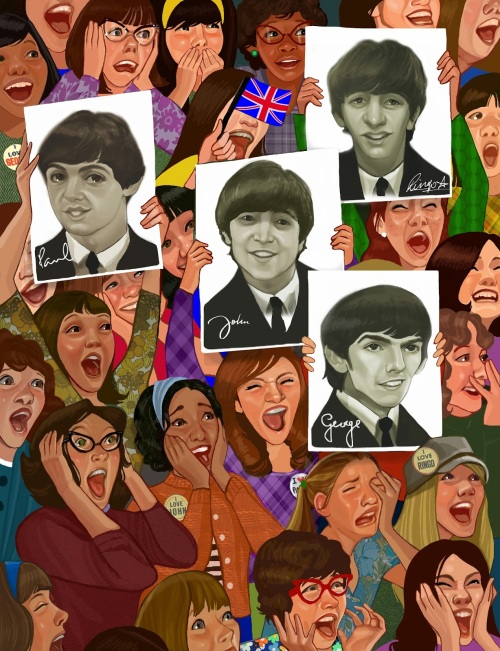
How did you end up attending the Ringling School of Art and Design in Sarasota, Florida to get your BFA?
I can’t remember how exactly I came across Ringling in my art school research. I know I had my portfolio reviewed by them at one of the school fairs. Ringling was rated one of the best art schools and it was in Florida by the beach! As an 18 year old I was very excited about both of those things. I went to visit the school with my mom and after the visit decided that out of all the art schools I had seen it was the best fit for me as a person and as an artist.
What types of classes did you take that really helped you to develop as an illustrator?
I learned a lot in figure drawing/painting classes. It is amazing how much you learn from drawing from life.
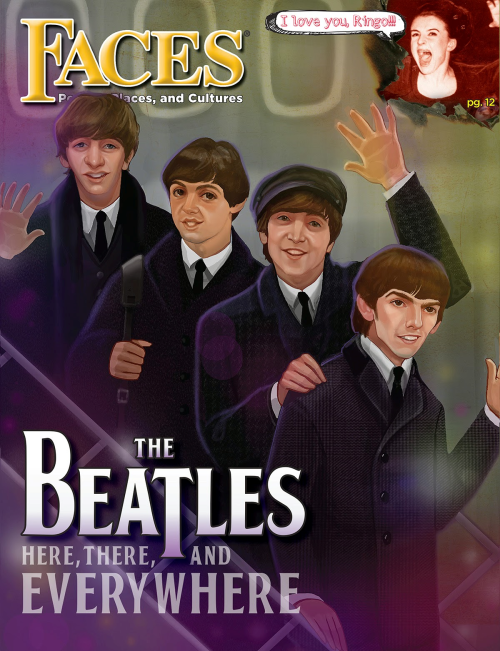
Tell us about the Illustration Academy. Is that an online college?
The illustration Academy really changed my life. It is a summer program that I attended after my junior year and then again after my senior year of College. I found out about it because Ringling actually hosted them for a few years. They gave a presentation to my school and once I saw it I knew that it was something I needed to do. Along with the amazing faculty that stays the entire workshop, every week there is a guest artist that comes in and gives you an assignment, critiques your work and talks about the industry in general. You get to meet, work with, and get advice from the top illustrators in the industry today. I encourage artists of any level to check them out: http://www.artconnectionacademy.com/IllustrationAcademy.aspx.
What did attending the Illustration Academy bring to the table for you?
I learned invaluable advice from all the faculty at the illustration academy. They helped me round out my portfolio and gave me a realistic view of what to expect once I got out of school. It was also a great time and REALLY inspiring.
What was the first things you did that you got paid to do?
The first assignment I was paid for was for a Magazine called Las Olas magazine. I illustrated portraits of five local chefs in Fort Lauderdale, Florida.
Have any of your college connections ended up helping you get work?
How did you end up leaving in Florida to live in New York?
The first assignment I was paid for was for a Magazine called Las Olas magazine. I illustrated portraits of five local chefs in Fort Lauderdale, Florida.
How and when did you decide that you wanted to illustrate children’s books?
Illustrating children’s books was something that I was always interested in but for some reason coming out of school I really did not have that many images of children in my portfolio. When I got out of school adding more images of kids to my portfolio was one of the first things I worked on.
What was the title of your first book? When and how did you get that contract?
The first children’s book I illustrated was The Triple Banana Split Boy with Pinata books. The art director contacted me after a promotional mailing that I did. I would send out postcards every couple of months to a mailing list that I had created. The mailing list was mostly compiled from this book: http://www.amazon.com/2014-Childrens-Writers-Illustrators-Market/dp/159963726X/ref=sr_1_1?ie=UTF8&qid=undefined&sr=8-1&keywords=childrens+book+artist+guide.
How long have your been represented by Christina Tugeau? How did the two of you connect?
I am fairly new to Chris’ agency. I have been represented by her for a little over a year now. One of her former artists that she used to represent was a teacher at Ringling and I remember him telling me and my friend to check out her site. I didn’t think I was ready for an agent at the time but agency with the Cat was always in the back of my mind. When I decided I wanted to get an agent she was the first person I emailed and I was thrilled that she wanted to set up a meeting the next time she came to New York City.
What types of things do you personally do to get your work seen by publishing professionals?
I still send out postcards myself every now again but that is mostly for editorial work. I try my best to stay active on social media because you never know who might end up on your page. I have a Facebook page and a twitter account. I have to admit I don’t think I have quite grasped the world of Twitter but I still tweet out new images just in case! I also try to keep my website and blog up to date with my most recent work. I am always bummed myself when I go to artists blogs that I like and it has not been updated in a few years so I try my best to keep on top of it.
Have you ever tried to write and illustrate your own story?
This is definitely something that I am interested in. I have a few ideas floating around my head that I have to get on paper. I used to write stories and illustrate them all the time when I was a kid. It is hilarious to find them and read them now. I remember in elementary school we would get to write a story every year that would be published in the “publishing center” (ie a cardboard cover wrapped in wallpaper). It was the best time of the school year. One of my masterpieces was called The Princess and the Unicorn. You can’t get any more girly than that!
What is your favorite medium to use?
These days I have been working digitally. I got a Wacom cintiq a couple of years ago and fell in love with it. I live in a little NYC apartment so it is more practical for me to sit down at the computer instead of setting out all the paints.
Have you seen your style change since you first started illustrating?
I think my style has changed a lot. I learn with every project that I do and I am always trying to do better than my last assignment. I think someone would probably be able to tell that the images were drawn by the same person but I think my work looks a little more polished and consistent now.
How many picture books have you illustrated?
I am currently working on my 4th book with Pinata books. I have illustrated two books for Pelican Publishing and one for Tricyle Press which was an imprint at Random House.
How did you get the contract with Pinata Books to illustrate GRADMA’S CHOCOLATE?
I had already illustrated The Triple Banana Split boy with Pinata Books. I think the art director I worked with thought that Grandma’s chocolate would be a good fit for me as well.
I see you, also illustrated TRIPLE BANANA SPLIY BOY with Pinata Books, too. Was that a two book deal?
It was! It was the first book that I illustrated.
What is your biggest success story? The thing you are most proud of?
I am always proud if a client comes back and asks me to do more work for them. After leaving school you don’t really get critiques anymore which is something that you were so used to all the time. When a client comes back to you and asks you to do more work for them that’s how you really know they were happy with what you did for them in the past. There are so many artists out there to choose from so it means a lot!
Are you open to working with self-published authors or is that something Christina would not let you do?
Typically I work with publishing houses but I might be open to it if it was a story that I really liked as well.
Have you thought about writing and illustrating your own books?
Is Lewis Tewanima: Born to Run your latest picture book? How did Christine get that contract for you?
Lewis Tewanima: Born to Run was the second book that I did for Pelican Publishing. I already had a contact at Pelican before I was represented by Chris. Again, I got the first book from a postcard mailing. The art director told me she had been keeping my postcards for years so you shouldn’t give up hope if you do not hear back from people right away.

Have you done any work for educational publishers?
Yes, I have done a lot of work in the past year for educational publishers through jobs that Chris has gotten me. I am currently working on my 4th reader for Heinemann Books at Houghton Mifflin. These types of jobs I think would be very hard to find without an agent so it has been really great working with Chris.
Do you use Photoshop in your work?
I do use Photoshop on my wacom cintiq.
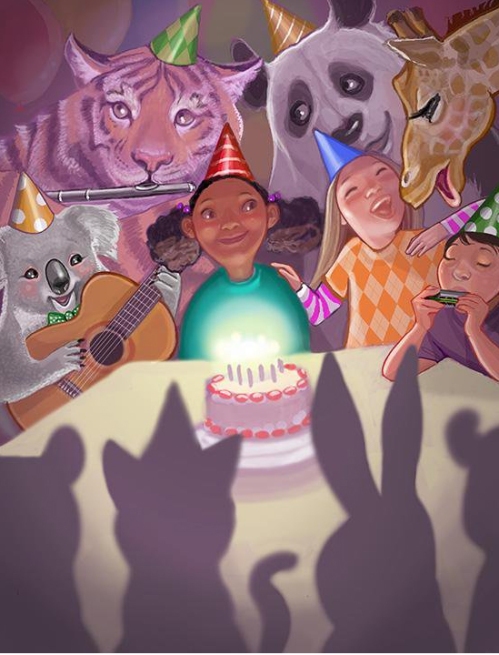
Do you own a graphic tablet?
I have a big wacom cintiq at my desk and also a portable one so I can take my illustrations on the go with me (or sometimes it is nice to just sit on the couch and work in a differnet room). I am able to sync my files between the two devices with Adobe’s cloud service.
How much time do you spend illustrating?
I draw every day. If I don’t have an assignment to work on I work on some of my own stuff.
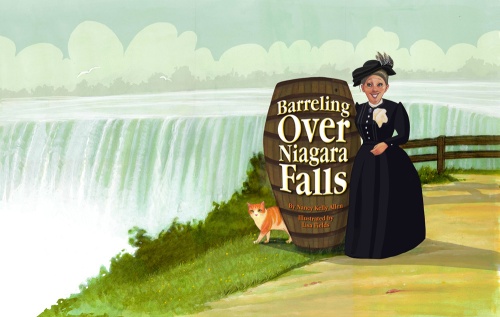
Do you have a studio set up in your house?
I have a studio area does that count?…NYC apartment living. One day I will have a house with a studio! J
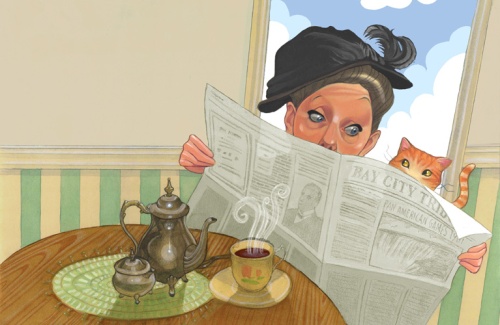
Is there anything in your studio, other than paint and brushes, that you couldn’t live without?
I have a rather large collection of children’s books and art books. I often look at them for inspiration. The children’s books have a wide range of styles. It is fun to see how different artist approach illustrating a book. My all time favorite is probably Kadir Nelson and I am loving Peter Brown and LeUyen Pham books these days as well.
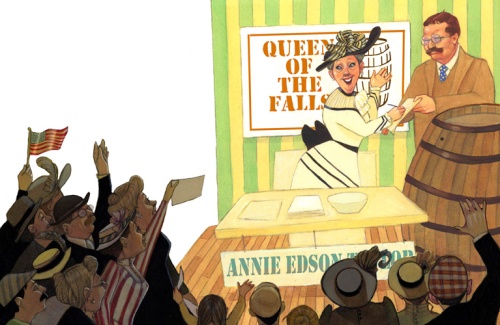
Do you take pictures or any other type of research before you start a project?
Yes, reference pictures are important for me. I usually find photos online or I take photo reference myself. The internet is an amazing tool. I don’t know what I would do without it. It would be nice to take reference pictures myself all the time but often projects call for different ages and ethnicities and the chances of knowing a model that fits the bill is not very likely in most cases.
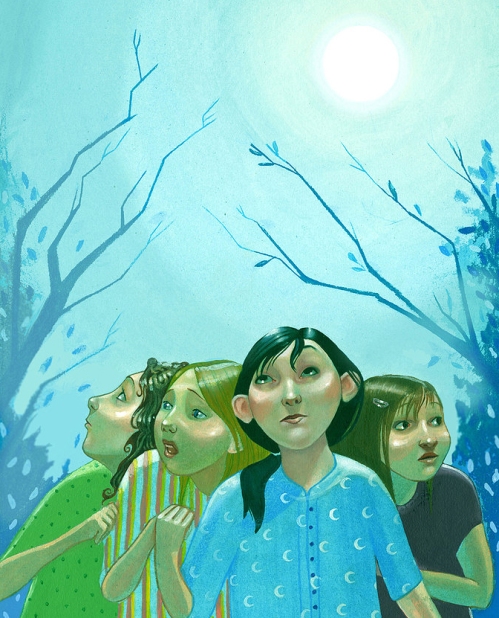
Do you think the Internet has opened doors for you?
The internet has definitely opened doors. Being able to have your portfolio online, up to date and accessible at all times is important.
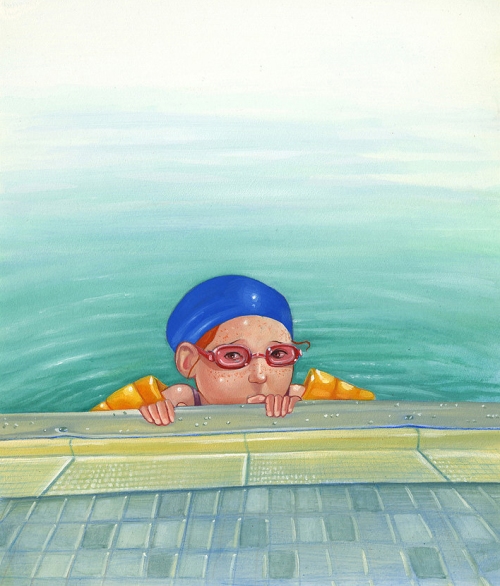
Do you have any career dreams that you want to fulfill?
I would like to write and illustrate a book.
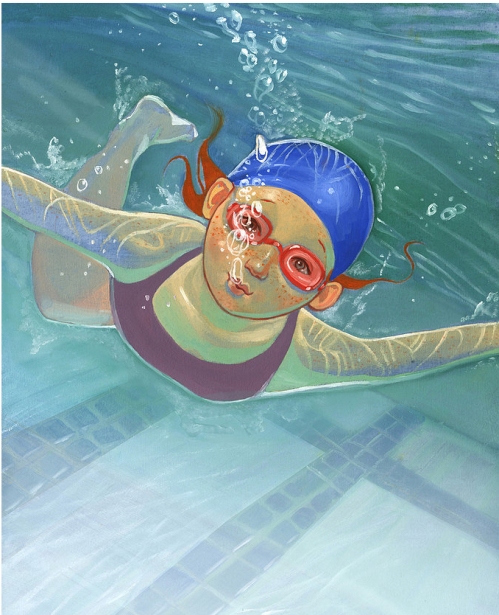
What are you working on now?
Right now I am working on some pirates for an article in Appleseeds magazine. The art director would like the pirates to be a bit menecing…which is not something that I typically do. It is a challenge and I am having a lot of fun with it! I am trying my best to make sure they are not cute, menecing pirates. I am also working on sketches for a reader for Heinemann and sketches for a book for Pinata.

Are there any painting tips (materials, paper, etc.) you can share that work well for you? Technique tips?
I know that I have mentioned it a couple of times already but I love my Wacom cintiq. If you work digitally you should definitely look into it. It is expensive…but it is so worth it!
Any words of wisdom you can share with the illustrators who are trying to develop their career?
One of my favorite things to do is go to the bookstore and check out what is on the shelves. You will be inspired and will also see what art directors are looking for. If there are books that look like something your work would be a good fit for write down the name of the publisher/imprint and add them to your mailing list. I have had multiple people tell me that they saved my postcards until a project comes along that I would be a good fit for so stick with it and don’t get discouraged if you don’t hear back from people right away.

Filed under:
authors and illustrators,
How to,
illustrating,
Illustrator's Saturday,
inspiration,
Interview,
picture books,
Process Tagged:
Lisa Fields,
The Ringling School of Art and Design 

By: Kathy Temean,
on 9/25/2014
Blog:
Writing and Illustrating
(
Login to Add to MyJacketFlap)
JacketFlap tags:
Agent,
inspiration,
Advice,
revisions,
illustrating,
authors and illustrators,
L Perkins Agency,
Free Fall Friday - Results,
Rachel Brooks,
Denise Holmes,
T2 Illustrators,
Add a tag
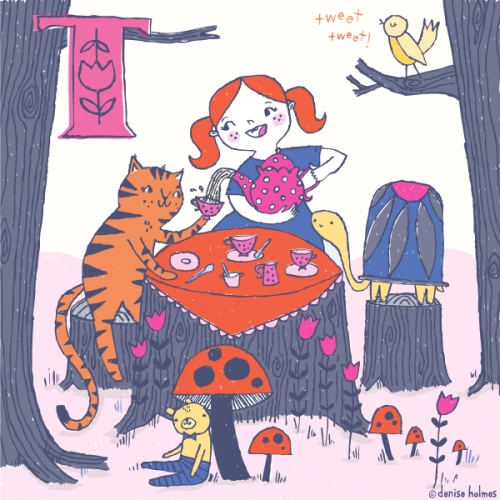
Let’s all brew a cup of tea and join the characters having tea in this illustration by Denise Holmes. Seems like a great way to enjoy reading the critiques done by Agent Rachel Brooks for September’s first page winners.
Denise Holmes created the above illustration for a collective called The Happy Happy Art Collective. She is represented by Nicole Tugeau over at T2 Illustrators. Her first picture book was released in June 2014 – If I Wrote A Book About You by Stephany Aulenback! Here is Denise’s website: www.niseemade.com
____________________________________________________________________________________
 Agent Rachel Brooks from the L Perkins Agency critiqued the following first page winners. Hope you take the time to read. You can learn a lot from listening to what the experts have to say about a first page, even if it is written by someone else.
CODENAME FOX by Donna Maloy
PROLOGUE. London. September, 1800.
I was all of seven years old, but Noreen’s iron shovel looked to me as big as a Scots battle axe. It clanged on the stone floor, not an arm’s length from my head.
“Oh, please don’t hit her!” my brother cried, yanking on her skirts.
But the scullery maid was determined. Her shovel banged down again, this time against the hearth behind me. A piece of stone whizzed past my whiskers.
“Get out o’ me way,” she told Graham. “Nasty, dirty thing that is. Tracking flour all over me clean floor.”
With a yell like a savage pirate, four-year-old Graham chomped down on her arm. The shovel flew out of her hands, clattering to a stop—right in front of Papa’s black, spit-polished boots. He’d come to see what all the noise was about. Now I was in a different sort of trouble.
With a sob, Graham pulled at Papa’s leg. “Make Noreen stop trying to kill Celia!”
Papa’s head jerked up and he looked toward the corner where I crouched.
“Celia?”
I couldn’t see any point in lying. Shaking with fear, I looked up and nodded.
He stared at me. Of course I didn’t look much like an Ashleigh right then. I looked like a small, flour-speckled mouse.
“Come here,” he said, much too calmly. I could almost feel a spanking on the way.
“Miss Ce-Celia?” Noreen frowned. “But that’s only a dirty little mousie, idn’t it? What’s wrong with killin’ it?” She backed up against the chopping table, eyeing my father and me as if she didn’t know which of us worried her more.
“Get out,” Papa said quietly, speaking to the girl but never taking his eyes from me. Oh, I was in for it now. That was the voice Papa used with stable boys who played dice.
HERE IS RACHEL:
CODENAME FOX by Donna Maloy
This title is intriguing! Sounds like a story filled with fun adventure, although it doesn’t give me a 1800s London vibe, more sci-fi or spy.
I think this opening line could be stronger. It tells us the character’s age, rather than showing us how old the character is through how he talks, the story, etc. Also, the diction of this character doesn’t feel like a seven year old, but a much older character looking back and retelling the tale? If that’s the case, then the diction fits, but if he is in fact seven, the language needs reworked.
When the “stone whizzed past my whiskers” I thought it was a cat (or even fox as the title suggests) but it is actually a mouse. Maybe you can weave in some more clues that this is a mouse talking rather than telling us “I looked like a small, flour-speckled mouse” later down the page.
There’s quite a bit of repetition in this one page about the mouse/person being in trouble, being “in for it”, having a spanking on the way, etc. I don’t think we need to be told so much, since the shovel and yelling definitely tell us this isn’t going well.
Without knowing when chapter one starts in time and events, it’s hard to recommend whether you need this prologue or not. But the prologue camp is usually pretty divided on whether you should have one or cut it. It’s something for you to consider—do readers need this info for the rest of the story to make sense or is it setup that could be woven in throughout? If the answers is yes, readers do need it, then it’s good you have lots of action.
____________________________________________________________________________________
A SPARROW IN THEHAND MG by Darlene Beck Jacobson
Helen hurried down the dirt road, clutching her lunch sack in one hand. She reached for her sister Fran’s arm with her freehand, trying to get her to move faster.
Fran pulled away from Helen’s reach and continued to plod along. They were going to be late; why couldn’t Fran see that?
The sun poked out its head between two grey clouds just as they reached the schoolyard and the bell rang. Miss Thomson stood in the doorway of the one room building glaring at the sisters.
“I don’t tolerate tardiness.”
Helen stopped at the door, gasping. Her heart dropped like heavy stone as she struggled to steady her breathing. “I’m…sorry…Miss Thomson.” She took a deep breath, feeling calmer. “Ma needed our help this morning. It won’t happen again.”
Miss Thomson stared at Helen, lips pinched closed by an invisible clothespin. “See that it doesn’t, Miss Wasekowski.” She looked at Fran. “That goes for you too.”
“Yes, Miss Thomson,” Fran said, her plump cheeks flushed from hurrying.
Helen’s breathing finally settled as she smoothed her shoulder length hair from her face. Her eyes darted around the room, searching for her friend Mary. Why wasn’t she here?
Miss Thomson marched to the front of the room. Her stiff, proper skirt stood at attention. Helen bet her laced up shoes pinched her toes as tightly as the bun in her hair pulled at the corners of her cold, dark, eyes. She was nothing like Miss Norton, the teacher who left last year to get married. Miss Norton was like a willow tree, bending and flexible when the situation called for it. Helen doubted Miss Thomson liked teaching or children for that matter.
It was Miss Norton who had given Helen a thirst for learning that never seemed to be satisfied. She’d also ignited an ember that Helen kept buried deep in her soul. That ember was dormant. Waiting. It held Helen’s hope, dream, wish, to become a teacher one day.
No one – except her best friend Mary – knew of Helen’s deepest desire. Mary also held a secret desire of her own. To become a nurse. Both girls knew their dreams were like the wings of a bird – fragile and easily broken.
HERE’S RACHEL:
A SPARROW IN THE HAND by Darlene Beck Jacobson
The description of Miss Thomson is great with her pinched bun and skirt standing at attention. I can picture her for sure! But I’d like to see what Miss Thomson looks like sooner, while she glares out the doorway, rather than waiting until the kids are seated in class to describe her. It might make their tardiness feel more threatening.
Some of the language choices don’t feel MG-aged to me. For middle grade, I’m thinking Helen and Fran are somewhere between 10 to 14 ish? For example, I’m not sure “ignited an ember” or “a thirst for learning” are phrases that a kid of that age would use in that way. The author voice rather than the character’s voice is coming through here.
I’m also a bit confused about why the dreams of becoming a nurse and teacher are so fragile? These don’t seem like farfetched ambitions on the surface. I think I’m missing something here as far as setting that would reveal why these dreams are so fragile. It’s great to know their dreams early on, so the seeds are there, and just need a little nudge to get us to connect with why they’re at risk of being shattered.
_____________________________________________________________________________________
Michelle Kogan Early Chapter Book Through a Sunflower
Rhea wanted to grow a sunflower house more than anything in the world. But even more then that, she wanted to grow it all on her own. She was going to enter it in the Petalpath 10th anniversary magazine contest and try to win $100.00. Ever since her dad lost his job everyone in the family was helping out. Rhea wanted to show she was big enough to help too!
“Come on sunflower, stand up!” Rhea said. “I’ve replanted you three times, ‘cause the squirrels ate the seeds.”
“Can I help?” called her mom.
“No, I want to do it myself!” said Rhea, “I’m growing my own sunflowers this year! I’ve been helping you for the last three years. This year you even said, I know enough to grow them all by myself!”
“You know sunflowers, you haven’t given me an easy time. This is the third time I’ve replanted your seeds, cause the squirrels kept on eating them. Now stop wiggling around so I can get you propped up!”
As Rhea wrangled with her sunflowers she noticed a caterpillar that was staring right at her. She slooowly moved closer bringing her eye-to-eye with the caterpillar, and stared right back. The next minute the caterpillar cocked it’s head and starred up, then back at Rhea, and then up again.
“Hey caterpillar, what’s going on up there?”
A goldfinch swooped down barely missing Rhea. It nosed right into her back pocket and plucked out her sketchbook. Her prize sketchbook where she had been keeping all her notes and
HERE’S RACHEL:
THROUGH A SUNFLOWER by Michelle Kogan
The idea of Rhea wanting to help out her family financially is great. It shows us how much she loves her parents, while being selfless in giving up the prize money.
Is a “sunflower house” a greenhouse for sunflowers? A house for one single special sunflower? I’m having trouble picturing this.
It switches between singular and plural for how many sunflowers Rhea’s growing, so whichever it is, don’t forget to be consistent. We need to be able to picture if she’s growing a flower or a whole bunch of them!
The transition from staring at the caterpillar to the goldfinch is a bit awkward. Why is the caterpillar important if the real action is the sketchbook getting stolen? The sketchbook list could be integrated in some way sooner too, so we know what is going on with the sunflower/contest from the start.
Integrating sunflower into the title is smart, but I think it could be tweaked, since it doesn’t sound as fun and grabbing for kids as it could be. It’s all about this awesome sunflower contest, so bouncing off of that could be cool.
____________________________________________________________________________________
Alice Golin Normal – Young Adult Novel
The calendar on the wall stares at me. Stark diagonal lines drawn through bright blue numbers. Reaching under my pillow, I curl my fingers around the thick black crayon I use to mark each day. Each daty that Dad’s been missing. Twelve so far in September. Choking back tears, I put a slash through yesterday.
Leafing back through the months I come to the end of May. A red circle like an evil eye marks Memorial Day, the day we were told of Dad’s disappearance somewhere in Afghanistan. How? Why? We get no answers. Do they even know?
My phone rings. A real call. not a text. Ignoring it, I stare at the red circle desperately hoping for some message. some sign. But the numerals 31 tell me nothing. Unless choosing Memorial Day was some hidden code.
I shudder at the thought and let the pages slip through my fingers until I’m back to September. The box for today is fresh, unmarked.
“Please God,” I whisper, “let us hear today.” But unlike those early days, I have little hope.
My phone keeps ringing. Stops. Rings again. The caller has no mercy. Giving in, I grope around on the floor until I find the intruder.
“Get out of bed, Nikkia,” Micah says gently. And then, more sharply, because he knows I don’t want to listen, “Now!”
I want to shout, ‘No, I won’t. Not until we hear from Dad.’ But Micah’s gone and besides there’s no point. If I don’t get up, Mom will come for me. And she’s got enough to deal with.
My phone rings again. I grip it tightly, tempted to throw it across the room. It’s Gillian. She and Micah must have planned this.
HERE’S RACHEL:
NORMAL by Alice Golin
It’s clear that your protagonist is in a lot of pain over missing her dad, and it’s great you let us in on this emotional connection from the first page.
It’s not clear why she isn’t answering the phone. This call seems important, but then she ignores it. Confused a bit here, since isn’t she desperately wanting to hear from her dad or any news about him? Wouldn’t she pounce on any call to see if it was news?
Micah appears, but where did he come from? It feels like the transition is a bit awkward from the phone to being told to get out of bed. Is he a friend, sibling? Was the door open, or did Micah have to open it, in which case wouldn’t she hear him coming in? I think the author is seeing this scene more clearly than I am.
This first page overall feels slower and more repetitive than it could be. The core information of her dad disappearing and not wanting to get up are there, but then the pacing and interest-level get dragged down some by talking about the calendar then searching for the ringing phone at-length. I’d rework this to keep the core info, but relay it in a more concise, emotion-heavy way. This will help us immediately feel for her that she wants to hear from her dad but hasn’t in so long.
Shorter titles can be good, but I think this one could be more grabbing. Maybe tweak it, possibly keeping NORMAL in it, but ramping up the grab-me-factor. Then we’ll be sucked in!
Thank you Rachel for sharing your time and expertise with us. It is truly appreciated.
Talk tomorrow,
Kathy
Filed under:
Advice,
Agent,
authors and illustrators,
illustrating,
inspiration,
revisions Tagged:
Denise Holmes,
Free Fall Friday - Results,
L Perkins Agency,
Rachel Brooks,
T2 Illustrators 

By: Kathy Temean,
on 9/24/2014
Blog:
Writing and Illustrating
(
Login to Add to MyJacketFlap)
JacketFlap tags:
Fall Craft Weekend,
Princeton Theological Seminary,
Events,
illustrating,
authors and illustrators,
opportunity,
NJSCBWI,
writing excercise,
Editor & Agent Info,
Conferences and Workshops,
Add a tag
Princeton Theological Seminary
Stuart Hall and Mackay Campus Center
Princeton, NJ
Event kicks off at noon on Saturday November 1, 2914 and parts run through Sunday, finishing at 5 p.m.
Editors/agents include: Amy Cloud (editor, S&S), Janine Le (agent, Sheldon Fogelman Agency), Leon Husock (agent, L. Perkins Agency), Brooks Sherman (agent, The Bent Agency), Connie Hsu (editor, Roaring Brook Press), Shauna Rossano (editor, G.P. Putnam’s Sons), Patrick Collins (creative director, Henry Holt). Author/illustrators include: Joyce Wan (author/illustrator), Darlene Jacobson (author), Kit Grindstaff (author), Laurie Calkhoven (author), Yvonne Ventresca (author), Ame Dyckman (author), … plus more to be announced!
Saturday, Nov. 1, 2014 ~ Craft Afternoon
(FREE SCBWI Members / $45 Non-SCBWI Members)
Noon to 5 p.m. (Stuart Hall)
Enjoy an afternoon of craft-related workshops with editors, agents and author/illustrator presenters, to help you further your writing/illustrating skills in the world of children’s books. Afternoon includes editor/agent panel, picture book, MG/YA workshops, and more! Bring a bag lunch.
*Registration is required, even for SCBWI members.
Saturday, Nov. 1, 2013 ~ Dinner with the faculty
($65 SCBWI members / $85 Non-SCBWI Members)
Relax for dinner with our Saturday guest editors and agents.
6:30 p.m. to 9 p.m. (The Lounge, Mackay Center)
Saturday, Nov. 1, 2014 ~ Peer Group Critique
8:30 p.m. to 10:30 p.m. (Stuart Hall)
(FREE SCBWI Members / $25 Non-SCBWI Members)
Meet with fellow PB, MG or YA writers to review each other’s manuscripts and get the feedback you need to revise, revise, revise and move forward on your path to publication.
*Registration is required for this free event.
Sunday, Nov. 2, 2014 ~ Writers Day
8:00 a.m to 5 p.m. (Stuart Hall and Mackay Center)
($240 SCBWI Members / $275 Non-SCBWI Members)
Confirmed editors and agents:
- AGENTS: Leon Husock, L. Perkins Agency; Janine Le, Sheldon Fogelman Agency; Brooks Sherman, The Bent Agency.
- EDITORS: Amy Cloud; Simon & Schuster, Connie Hsu, Roaring Brook Press; Shauna Rossano, G.P. Putnam’s Sons.
This awesome, jam-packed day, all about the craft of writing books for young readers, has been created especially for you. Enjoy the benefits of our opening editor/agent panel, participate in a first-page session, gain feedback in a one-on-one manuscript critique with an assigned editor*, attend breakout sessions, eat breakfast and lunch, and enjoy afternoon tea/coffee. The deadline to submit your manuscript for critique is September 30 at 5 pm. (Note: You can only sign up for either Writers Day or Illustrators Day, not both.) *If attending both days, your one-on-one manuscript critique may be scheduled for Saturday.
*Writers Day manuscript submissions are due no later than 5 p.m., Sept 30, 2014.
Sunday, Nov. 2, 2014 ~ Illustrators Day
8 a.m to 5 p.m. (Stuart Hall and Mackay Center)
($240 SCBWI Members / $275 Non-SCBWI Members)
Prepare to work hard! Illustrators will work with Patrick Collins (Creative Director, Henry Holt) and Joyce Wan (published illustrator/author). The intensive will begin with everyone together, then illustrators break off with their pre-assigned illustration project mentor* for their group critique. The intensive also includes artwork display, portfolio and promo card display, breakfast, lunch and afternboon tea/coffee. (Note: You can only sign up for either Writers Day or Illustrators Day, not both.)
Talk tomorrow,
Kathy
Filed under:
authors and illustrators,
Conferences and Workshops,
Editor & Agent Info,
Events,
illustrating,
opportunity,
writing excercise Tagged:
Fall Craft Weekend,
NJSCBWI,
Princeton Theological Seminary 

By: Kathy Temean,
on 9/19/2014
Blog:
Writing and Illustrating
(
Login to Add to MyJacketFlap)
JacketFlap tags:
Interview,
picture books,
inspiration,
illustrating,
authors and illustrators,
Publishing Industry,
demystify,
Illustrator's Saturday,
1st Prize (Category Children's Book) at the 'Marosvásárhely Book Fair Award,
30th edition of the exhibition 'Le immagini della fantasia',
Applied Art in Budapest,
Sarolta Szulyovszky,
Add a tag
 Sarolta Szulyovszky was born and grew up in Budapest (Hungary), she studied Applied Art, after which she moved to Italy. Since 2004 she start activity in the field of graphics and illustration working in a graphic design studio in Udine (Italy). Now she lives and works as a freelance illustrator and graphic designer in a little city in northern Italy: San Daniele del Friuli.
She works for children’ s books, magazines, cover books, Brochure Design and Packaging Design.
Sarolta works both traditionally in acrylics, pencil and digitally.
In 2012 her work has been selected for the ‘Annual Illustratori Italiani 2012′ (Society of Italian Illustrators) and for the 30th edition of the exhibition ‘Le immagini della fantasia’ (Sàrmede, Italy) – 60 illustrators from all over the world.
2011 – selected for the 23rd Biennial of Illustrations Bratislava.
In 2010 she won the 1st Prize (Category Children’s Book) at the ‘Marosvásárhely Book Fair Award (Romania).
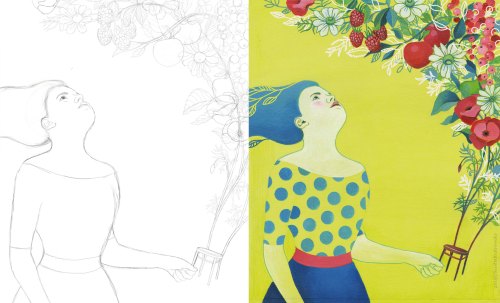
Draft drawn in Photoshop, and the final illustration for a magazine. The commission was to illustrate the month of July. (Image: Progress_1)
I needed a model to draw the woman so I photographed my son for the face and my hand for the hand!
I found the fruit and vegetables on the internet.
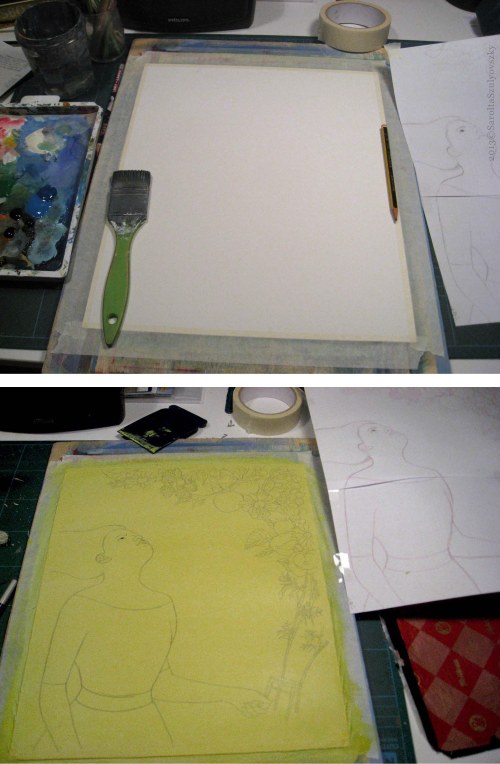
After sketching out the draft, I prepare an acrylic base for the background colour and, with carbon paper, I transfer the draft I have printed onto the base I have prepared. (Image: Progress_4)
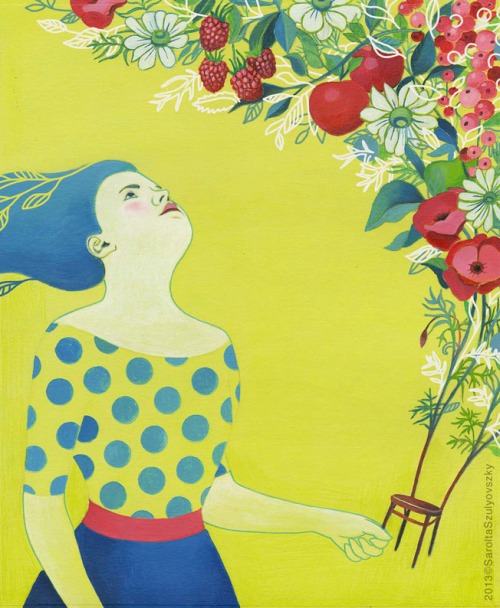
Here is the final illustration entirely painted with acrylics.
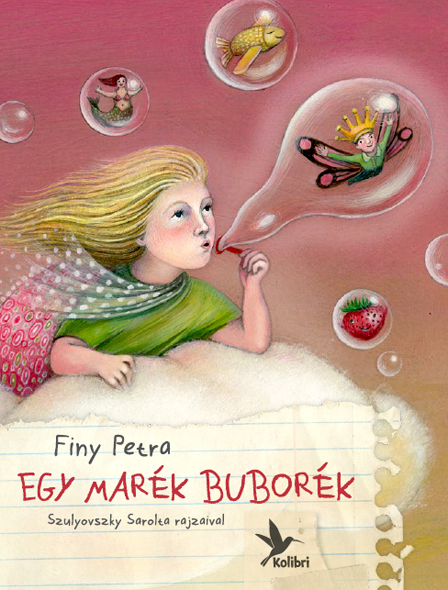
Book Covers
Book Covers
How long have you been illustrating?
I began to illustrate children’s books 11 years ago. My first publication (2003) was a drawing for an anthology of world fables published in Italy, but I have only thought of myself as an illustrator since I began to devote myself entirely to this work in 2009.
Did you go to college to study graphic design?
I began to study drawing at the age of 14, attending evening classes while I was studying at a science academy school in Budapest (Hungary). My dream was always to become a designer, so once I graduated from high school, I attended a textile design college and another college to study interior decoration, then went to the university “Nyugat-magyarországi Egyetem” on a Packaging Design course, but I never imagined that one day I would be illustrating books! I became involved in the world of children’s books illustration in Italy where I attended courses on advertising graphics and editorial illustration.
What were you favorite classes?
At university, I really liked design and drawing from life, especially portraits.
How did you decide to move from Hungary to Italy?
I moved to Italy not for work but for love. I met my husband in Budapest and, after we got married in 1997, I came with him to Italy.
Do you feel the illustrating opportunities are better in Italy?
I don’t think Italy offers more opportunities for work in the field of illustration compared to Hungary or other European countries. Italy is currently undergoing a severe social, cultural and economic crisis and illustrators (and anyone who works in the cultural sphere in general) is often considered an amateur, and not a professional, and so they are paid little or nothing. However, I do think that Italy is an excellent place to study illustration: it is a country that boasts 50% of the world’s cultural and artistic heritage, a very stimulating environment for an artist, and there are excellent schools specializing in illustration.
It is very true that “no-one is a prophet in his own land” and so the first publications I had in Italy were due to the fact I was a foreigner: they were looking for foreign artists for multicultural editorial projects. After that, I was published in my home country and in other states.
What was the first art related work that you were paid?
The first paid work was for the illustration of a children’s book translated into Italian from Hungarian, “Ha én felnőtt volnék” (If I were big) by Eva Janikovszky, published by L’Omino Rosso Editore, a small publisher in the region where I live. The book is a major classic in Hungary, a very entertaining story that I illustrated using digital techniques (Adobe Illustrator), which did not turn out to be my style.
What do you think influenced you style?
I think my style has been influenced by many things: the popular Hungarian art passed on to me by my grandmother, who taught me embroidery, the late Renaissance painters in the Fine Arts Museum in Budapest, where I acted as tourist guide when I was a student and, of course, many contemporary illustrators that I discovered in books, exhibitions and on the web (Gianni De Conno, Gabriel Pacheco, Alice Wellinger, Pierre Mornet……. the list would be very long!).
What type of work did you do right after you graduated?
After university, I gave birth to my two children and for 6 years I concentrated on being a mother….. although it was during that period that I discovered illustrated children’s books!
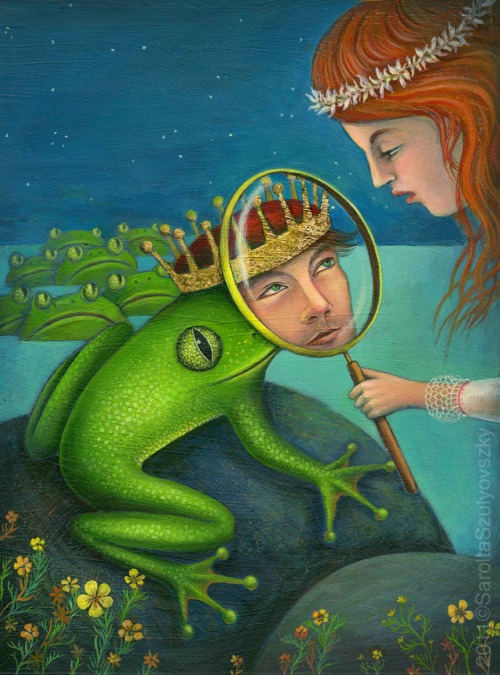
How did you connect with the Wilkinson Studios? When did you join them?
I came across Wilkinson Studios in 2011 thanks to an illustrator friend of mine who was already working for them. I sent them my portfolio and they immediately gave me a job. The client was very pleased with the illustration and so we continued to collaborate and they included me among the artists they represent. It was a great honour for me.
Do you do any exhibits to show off your work?
Yes, I am often invited to take part in joint exhibitions and I have had various personal exhibitions in Italy and abroad. In 2011 and 2013, my work was exhibited at the Biennale of Illustration of Bratislava, Slovakia and, 2007- 2012 every year at the “Le immagini della fantasia” of Sàrmede, the most important exhibition of children’s illustrations in Italy.
The last exhibition has just ended and it was “Il posto delle favole” (The place of fables), a joint exhibition by international artists in Rocca Sinibalda, a picturesque little town in central Italy. The next exhibition will be a personal exhibition of my work in Hungary in October 2014.
When and what was the first children’s book that you illustrated?
The first book that I illustrated was, luckily, the one I mentioned as my first paid work.
How did that contract come about?
The contact with the publisher came about through a friend we had in common, who was a book translator.
Do you consider that book to be your first big success?
My first book was an important experience for me, I learned a lot, but I don’t consider it a great success.
Have you published about children’s picture books for a US publisher?
So far, in the United States, they have published my illustrations in academic books and magazines, but I haven’t yet illustrated a whole book in the United States and I can’t wait to do so!
Have you tried to write and illustrate a children’s book, yet?
My first successful book was actually one that I wrote and illustrated: “A hálás virág “(The grateful flower) is an autobiographical book that deals with the subject of diversity and the Great Mystery of death, life and rebirth. The story came from an episode that actually happened in my grandparent’s garden in Budapest. In 2008, the album won first prize for the best unpublished illustrated album for children aged between 6 and 9 years at the 11th International Competition “Syria Poletti: On the wings of butterflies”. It was subsequently published in 3 languages: Italian, Hungarian and Polish.
Does the area where you live have a large artist community?
I live in the countryside near a little town in northeast Italy that lies between the Alps and the Adriatic Sea, a land of excellent white wines and ham. There isn’t a large community of artists here, but you live and eat well!
What type of illustration work do you do?
I work both on children’s books and books for adults, and on Packaging. I work both digitally and with traditional techniques. I like to adapt my style to the text and always try out new things so that I continue to grow and renew myself.
Have you won any awards for our art?
I have won various prizes but the most important was the one I received at the Frankfurt Book Fair in 2013: the cover I illustrated of “Folyékony tekintet” / Liquid gaze (published by Libri, Budapest) was selected from the 12 most beautiful covers at the Fair by the Wall Street Journal.
How many picture books have you illustrated?
So far, I have entirely illustrated 11 books, without counting the anthologies that include the drawings of several artists.
What do you consider your biggest success?
The greatest success has been the last book I illustrated, “Folyékony tekintet” (Liquid gaze), a collection of poetry for which I drew the digital illustrations using only the colours black and red.
Do you feel living in Italy has broaden your career as an illustrator?
For an illustrator, I don’t think it matters much these days where you live, an internet presence is more important because that’s where work meetings take place. 23. Yes, I have worked for Italian and Hungarian magazines and in the United States, for the Christian Reformed Church of North America’s Dwell Dive Magazine. 24. I use acrylic colours and sometimes I add some details in Photoshop.
Have you done illustrations for any children’s magazines?
Yes, I have worked for Italian and Hungarian magazines and in the United States, for the Christian Reformed Church of North America’s Dwell Dive Magazine.
What materials do you use to paint your color illustrations?
I use acrylic colours and sometimes I add some details in Photoshop.
What type of things do you do to find illustration work?
To find illustration work, it is important to have a website or a blog, send your portfolio to the illustration agencies and publishers, and go to specialist fairs, like the Children’s Book Fair of Bologna.
What is the one thing in your studio that you could not live without?
The thing I miss the most is the view from my window: the hill with the historic centre and the mountains. When I’m at home staring at a sheet of paper or a monitor all day, it is important sometimes to turn and look into the distance!
Do you try to spend a specific amount of time working on your craft?
It is very difficult to work set hours when you’re a freelance. I often work at night to meet deadlines…
Do you take pictures or do any types of research before you start a project?
Research is the first phase of working on an illustrated project and that often takes whole days. I have a folder on my computer where I collect photos and texts that inspire me and that might be useful one day. If I don’t find the photos I need on the internet, people in certain poses, for example, then I’ll use relatives or myself, taking the photos I need.
Do you think the Internet has opened doors for you?
Yes, I think the internet has opened many doors, but it has also increased the competition.
Do you use Photoshop or Corel Painter with your illustrations?
Yes, I use Photoshop and Adobe Illustrator.
Do you own or have you used a Graphic Drawing Tablet in your illustrating?
Yes, I use a Graphic Drawing Tablet to sketch out drafts and add details to my illustrations.
Do you have any career dreams that you want to fulfill?
My dream is to illustrate the Bible, especially St Paul’s Hymn to Love.
What are you working on now?
At the moment, I’m working on two books: an illustrated album: The Garden of Tears, written by the French author, Laurie Cohen, and a Hungarian novel by Zoltán Hajdú Farkas.
Any words of wisdom on how to become a successful writer or illustrator?
Above all, it is important to inquire within and understand ourselves. What would I really like to do? Devote time to personal works that haven’t been commissioned, be humble (we always need to learn), have a little entrepreneurial ability (we have to promote our work ourselves) and great steadfastness.
Thank you Sarolta for taking the time to share your process and journey with us. We look forward to hearing about all your future successes.
To see more of Sarolta’s illustrations visit her at:
Website: http://www.saroltaszulyovszky.com/
Blog: http://saroltaszulyovszky.blogspot.it/
Please take a minute to leave a comment for Sarolta, I know she would love to heard from you and I always appreciate it. Thanks!
Talk tomorrow,
Kathy
Filed under:
authors and illustrators,
demystify,
illustrating,
Illustrator's Saturday,
inspiration,
Interview,
picture books,
Publishing Industry Tagged:
1st Prize (Category Children's Book) at the 'Marosvásárhely Book Fair Award,
30th edition of the exhibition 'Le immagini della fantasia',
Applied Art in Budapest,
Sarolta Szulyovszky 

View Next 25 Posts





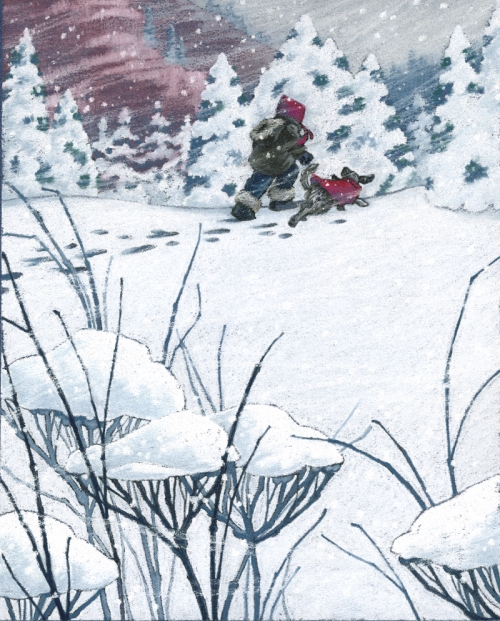
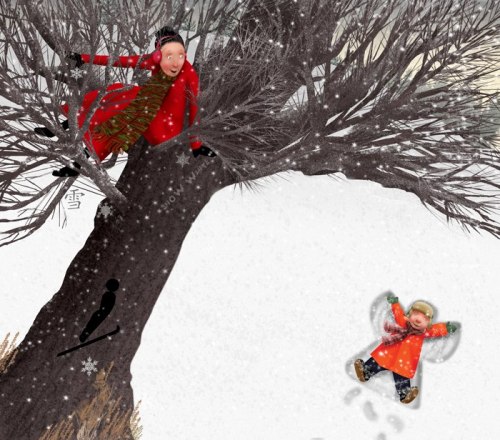





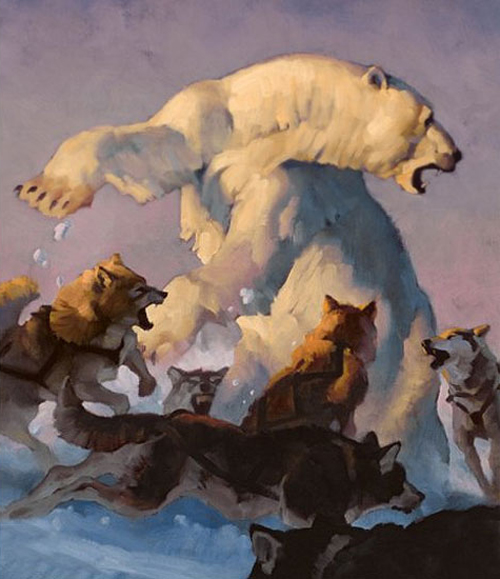


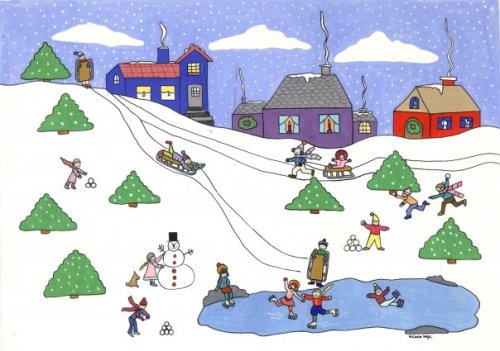
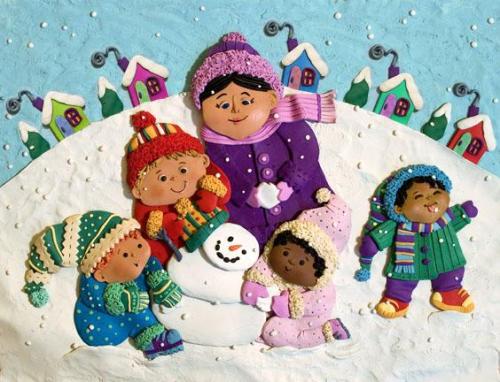
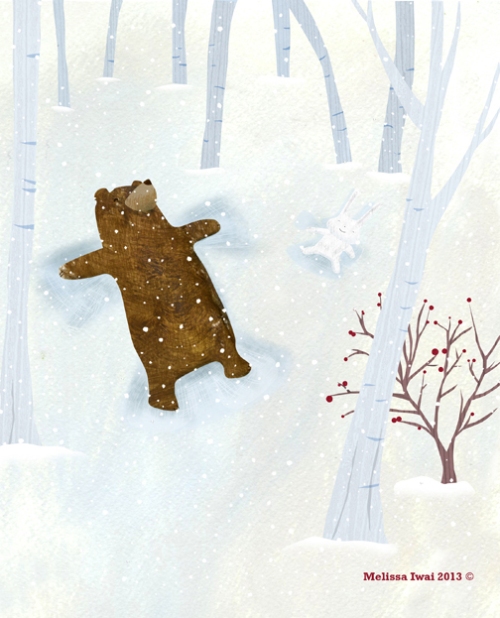

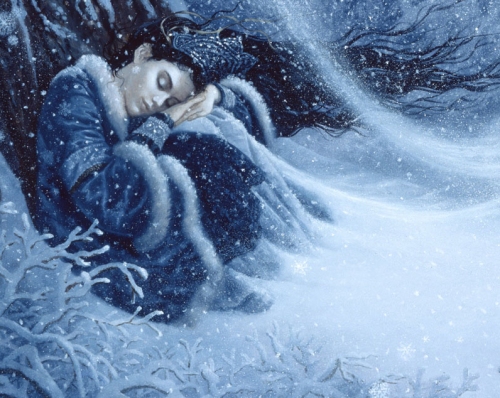




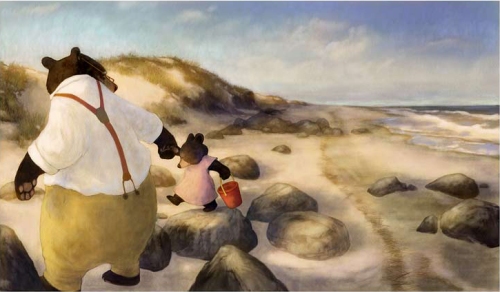
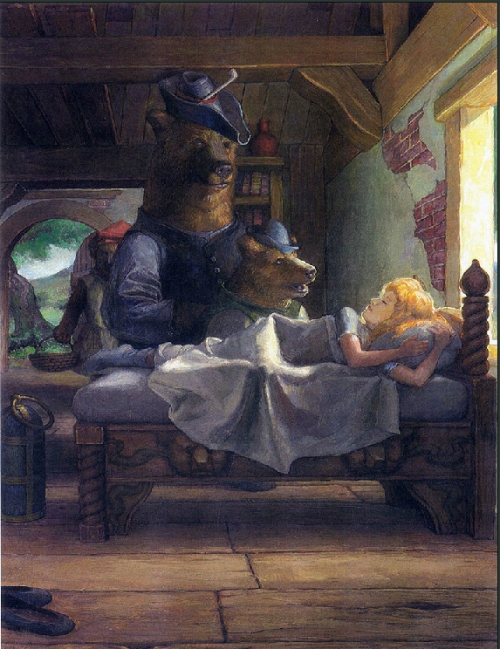

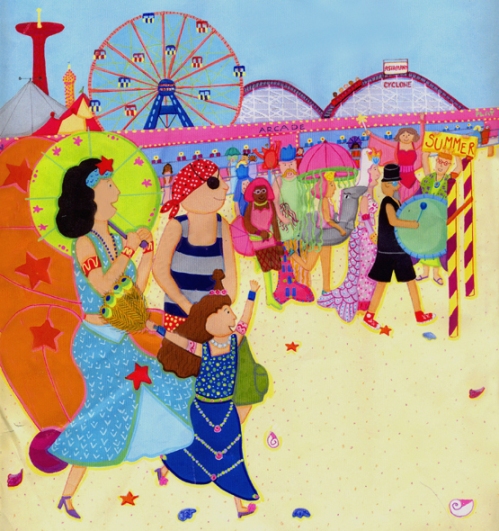
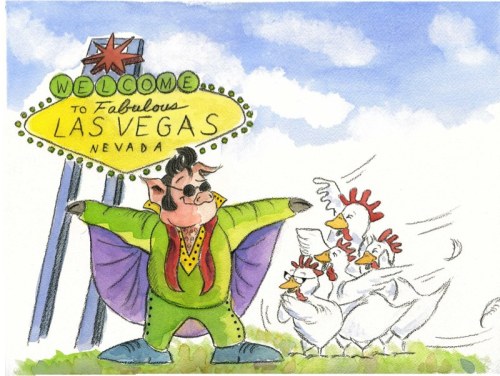
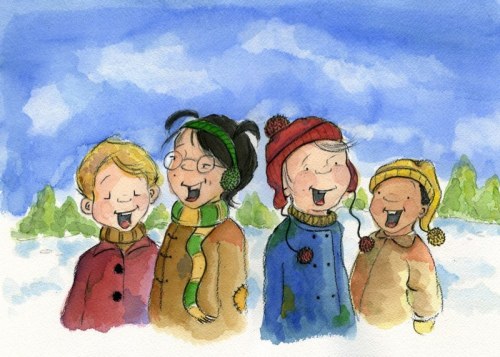
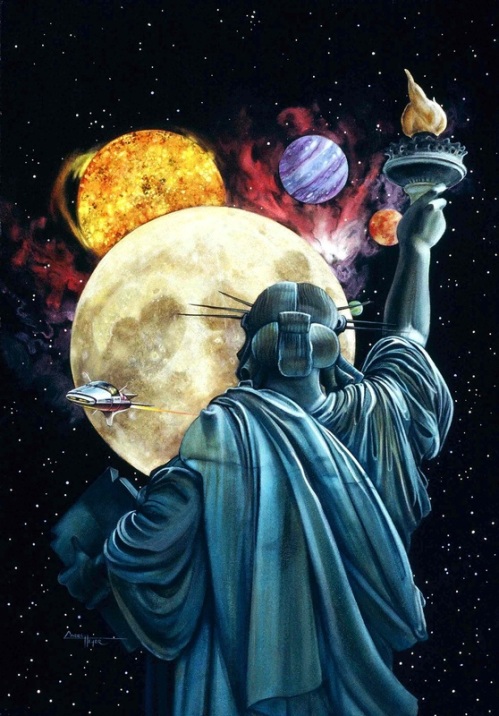
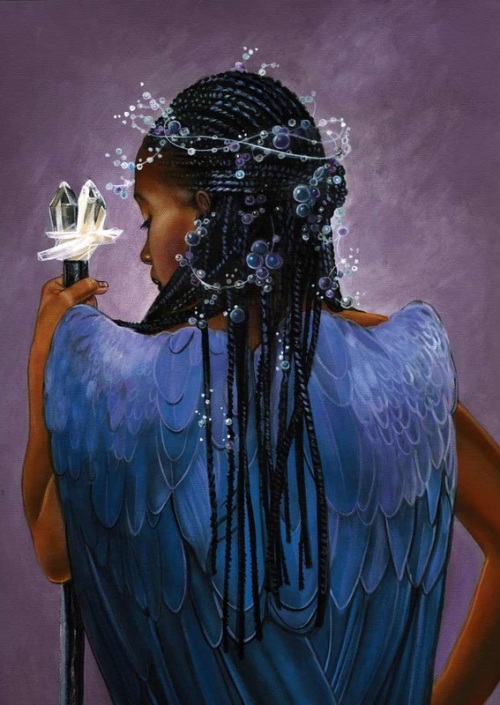
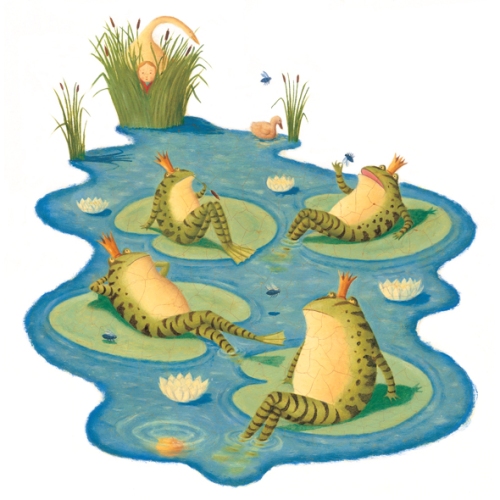


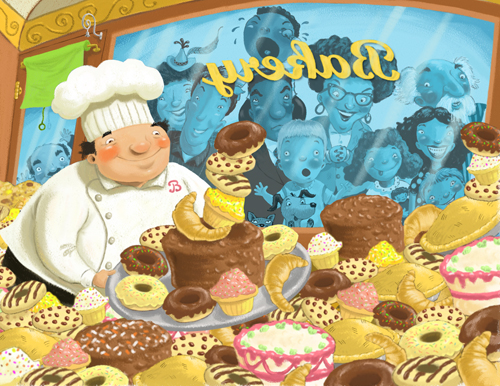


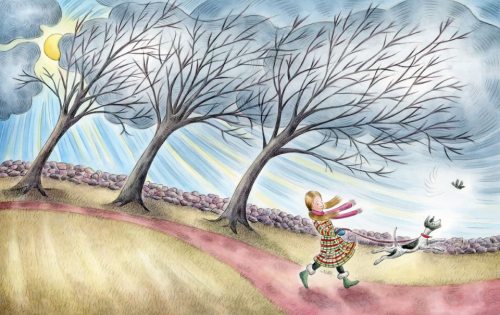


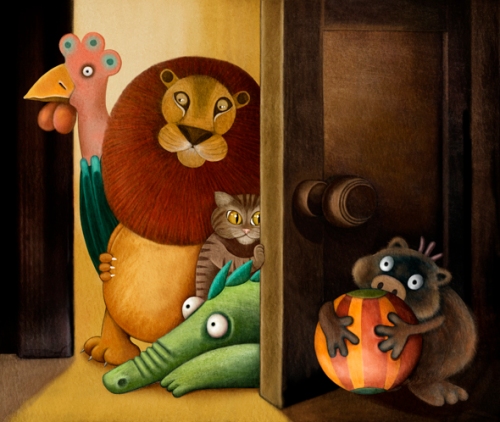
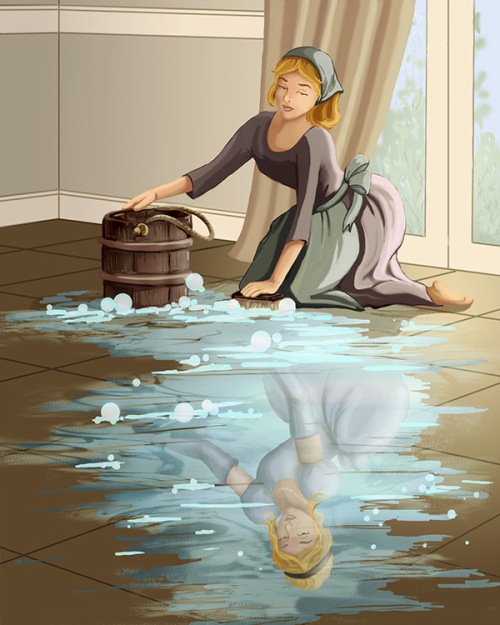

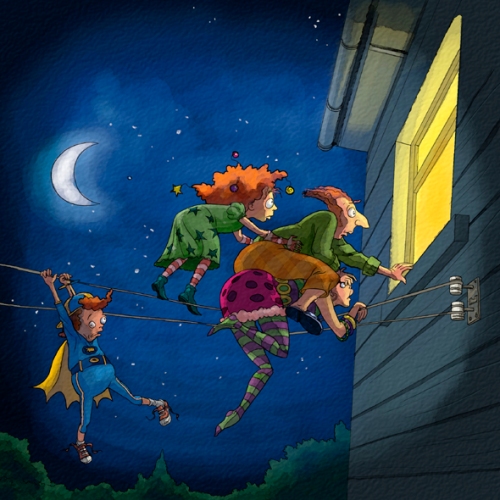
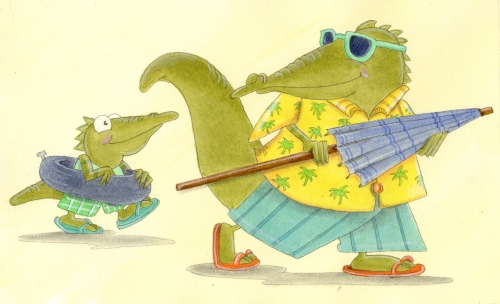

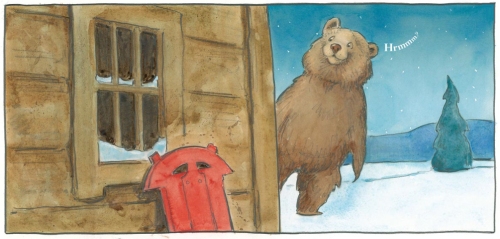
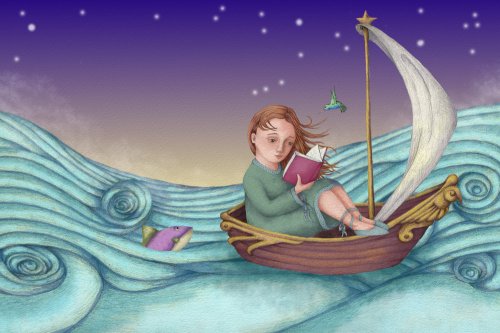
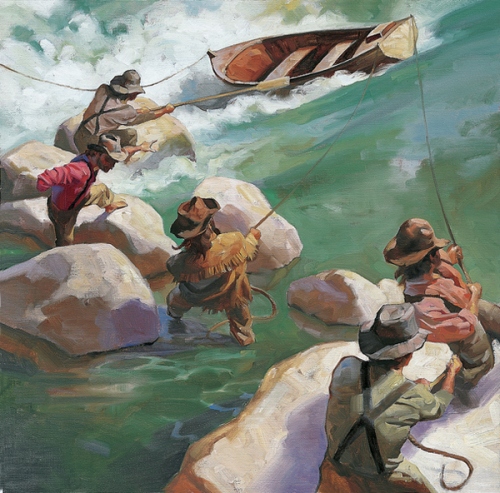
 Mike Moran: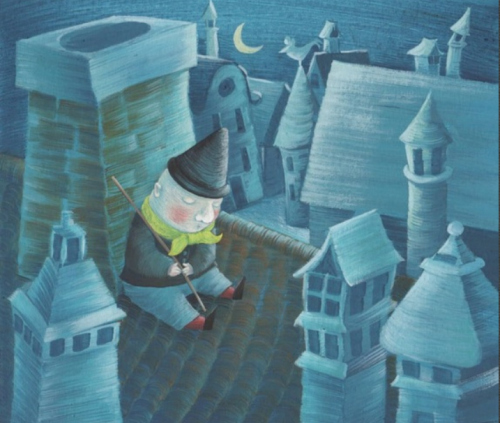
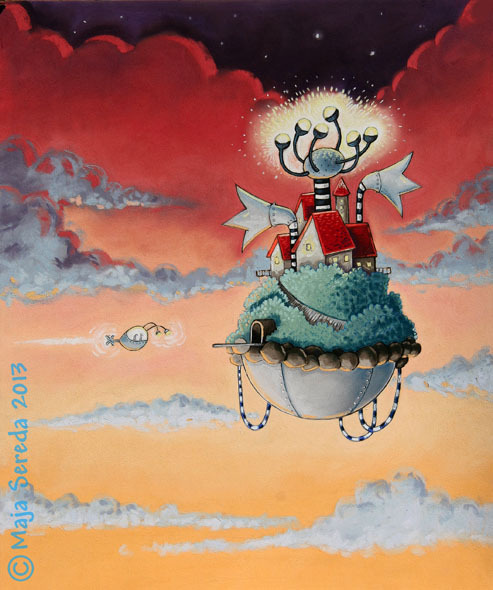
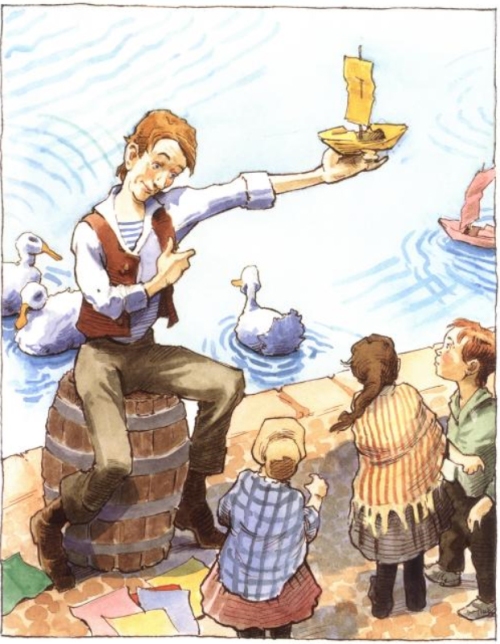
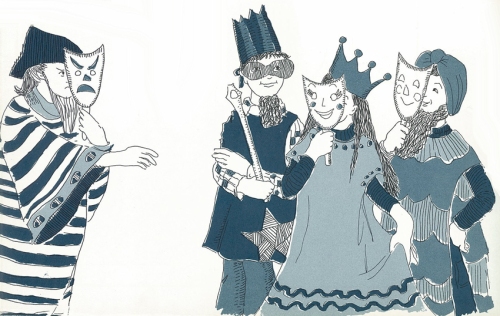
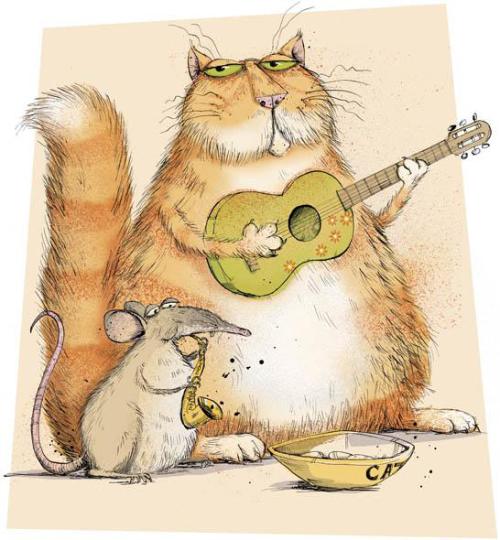


What a fantastic interview! Your encouraging advice is viable for all kinds of artists, Diana. And your beautiful artwork is breathtaking! Thank you for providing complicated, detail-enriched artwork for children to return to, again and again. It is inspiring!
Thank you, Elizabeth! So glad my “two cents” was helpful… Diana K
I’m in awe.
Thank you for such a flattering comment, Penny! You make me want to dance– better yet, to draw like I was dancing…
Diana, thank you for sharing your process and your beautiful art. Such wonderful colors! :-)
Simply lovely…my favorite is the partridge in a pear tree; that was spectacular!
Thanks, Tracy. Hope you’ll stay in touch on Facebook and my website. New artwork from HOWL OF THE MISSION OWL, which I illustrated last summer, will be going up this week…
So nice when someone appreciates my obsession with detail– thanks, Teresa!
I love details. I don’t have the patience for it myself so I always appreciate it when others put in the work and make great details. :)