new posts in all blogs
Viewing: Blog Posts Tagged with: Guest Bloggers, Most Recent at Top [Help]
Results 1 - 25 of 101
How to use this Page
You are viewing the most recent posts tagged with the words: Guest Bloggers in the JacketFlap blog reader. What is a tag? Think of a tag as a keyword or category label. Tags can both help you find posts on JacketFlap.com as well as provide an easy way for you to "remember" and classify posts for later recall. Try adding a tag yourself by clicking "Add a tag" below a post's header. Scroll down through the list of Recent Posts in the left column and click on a post title that sounds interesting. You can view all posts from a specific blog by clicking the Blog name in the right column, or you can click a 'More Posts from this Blog' link in any individual post.
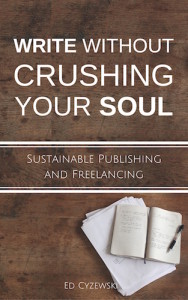 Guest Blogger: Ed Cyzewski
New authors routinely hear that they should build their marketing platforms by publishing articles in print magazines. There’s one problem with this advice: it rarely helps authors actually sell books.
There are exceptions to this, and I’ll get to them. But I’ve spoken to publicists and authors, and examined my own book releases, and I’m convinced that print magazine articles rarely convert into book sales or fans who will eventually buy a book. If a platform is supposed to help you sell books, then publishing in print magazines should be a low priority on your “platform building list.”
One award-winning reporter and widely published magazine writer I know noted that she rarely sees growth to her online platform through her magazine or newspaper work. “People just read the articles,” she shared. “They rarely look for the by-line.” One popular print and online magazine columnist shared the same experience with me after her second book failed to hit sales goals.
What should aspiring and experienced authors do to grow their marketing platforms if they aren’t writing for magazines? Are online magazine articles more effective than print magazine articles? And is there any hope for authors with experience writing for magazines?
Invest in what You Can Do
I’m not the best magazine writer around, but I genuinely enjoy blogging and have invested significant time into it. As a result, I’ve been approached by at least five editors from Christian publishing houses based on my blog. These days I aim to write something relatively long, audience-specific, and “evergreen” each week.
While I’ve seen no notable gains in my platform or my book sales from my articles in top print magazines, each blog post provides readers an opportunity to either join my email list (in exchange for two free eBooks) or follow me on social media. Blogging is a slow build, but it is a build that is working toward a viable end.
Authors need not throw themselves into blogging. A personal note each week or every other week through an email newsletter or a niche podcast can prove just as effective. Author Seth Haines has invested a great deal in his Tiny Letters (Tiny Letter is a scaled down version of MailChimp), while bestselling author Tsh Oxenreider reaches her readers through her podcast.
Build an Email List through Short eBooks
Short eBooks are a tried and true way for both commercial and independent authors to build their email lists and to prompt new readers to check out their full-length books. If you swing by NoiseTrade Books, an eBook giveaway site that lets users download eBooks by entering their email addresses and zip codes, you’ll find many bestselling Christian authors sharing books there, including Don Miller and Ally Vesterfelt. I give away several eBooks through NoiseTrade and have more than doubled my email list.
New authors should be especially eager to publish a short eBook in the 10-20,000 word range. It will provide invaluable experience in writing for a specific audience and book marketing before you have a book deal on the line with a publisher that has specific sales goals.
Learn How to Advertise Your Books
If you go the short eBook route, then you may find that publishing a few short or long independent books will help prepare you for a longer-term career with a publisher.
For instance, independent authors and commercial publishers have used price promotions and discounts as ways to spark pre-sales, encourage early reviews, or to revive an older title. Along with these price promotions, there are many services and Twitter accounts that make it easier to share these deals and give them a longer lifespan that could translate into more print sales and a longer period of time on the eBook bestseller lists when your book returns to full price.
Whether you try out Facebook ads, guest posts on high profile blogs, articles for an online news site in your niche, or some other promotion, independently releasing a book or two before querying a publisher will provide some real life book marketing experience so that you have a better idea of what works best for you and your readers.
When I promoted Write without Crushing Your Soul to my email list, I quickly learned that readers were far more receptive to a personal note about the book’s writing process than a simple overview of the book’s content.
Authentically Connect with Readers on Social Media
I entered publishing back when authors were first getting shoved onto Twitter and Facebook. We were told this would help us sell books, and far too many of us found that this wasn’t necessarily always the case.
Rather, social media provides a place for us to authentically connect with our readers, and sometimes the sales will follow if we provide the right kind of book. I’ve found that the authors who connect with readers through hashtag conversations on Twitter or niche groups on Facebook have far more meaningful interactions that are much more likely to result in readers buying a book in the future.
For instance, author Cindy Brandt (now a client of Rachelle’s at Books & Such) created an amazing group called Raising Children Unfundamentalist around her next book project, and the group is already a thriving community. On Twitter, check out the way author Emily Freeman created a conversation around the hashtag #SimplyTuesday.
So… Should Authors Write for Magazines?
While there are many other ways to promote yourself and your work outside of traditional print magazine publishing, that doesn’t mean you shouldn’t consider it. Some authors have built up a loyal following through writing for a particular magazine, especially in a niche market.
Authors with a background in journalism are especially suited for the research, querying, and unique style of writing that magazines require. In addition, a few published articles in relevant magazines can indicate to publishers that you have both the credibility and professionalism to write a book for them.
Most importantly, there’s a big difference between platform building and actively selling books. Many authors gain newsletter subscribers and social media followers through publishing articles for online magazines, but posting an article in an online magazine is not necessarily a sure bet for directly selling books from the article itself. In fact, strategies vary from project to project and from publisher to publisher.
Publicists Remain Divided Over Marketing
Having worked or spoken with several Christian publishers, I’ve found book marketing strategies and tactics vary from one publisher to another. Book marketing is a moving target, and there’s hardly a consensus on the best mix of new and old media marketing.
It’s true that some authors have used timely, shareable magazine or newspaper articles (especially online) to generate book sales. It’s especially helpful that these authors have books that are easy to find in the front of local bookstores or online retail sites!
Print magazine articles can help a few authors sell a few books. They can help most authors demonstrate credibility to an editor. They will not help the majority of authors sell books because far too many magazine readers will enjoy a well-written piece, think “That was nice,” and then go on with the day.
 This is post adapted from Write without Crushing Your Soul: Sustainable Publishing and Freelancing.
Ed Cyzewski is the author of A Christian Survival Guide, Pray, Write, Grow, and Write without Crushing Your Soul. He blogs about prayer and writing at www.edcyzewski.com.
The post Avoid this Platform-Building Mistake appeared first on Rachelle Gardner.

By: Samantha McGinnis,
on 12/15/2014
Blog:
First Book
(
Login to Add to MyJacketFlap)
JacketFlap tags:
Literacy,
Books & Reading,
Guest Bloggers,
Guest Blog Posts,
Early Learning,
Family Engagement,
Impact Stories,
Brunch Bunch,
National Children's Center,
Add a tag
Today’s guest blogger is Andrea Brunk, a physical therapist at the National Children’s Center Early Learning Center in Washington, DC.
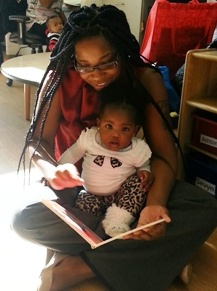 I work with children with cerebral palsy, Down syndrome, autism and other disabilities. The children in my program range from infants to five year olds.
Our families do their best to meet their child’s unique needs, but it can be a challenge. Many are single or foster parents. Others are grandparents or teens. They face balancing their own schooling and long hours at work with supporting their children. They also have few, if any, books at home.
Knowing how critical it is that kids have books at an early age, I created Brunch Bunch. Here families come together to enjoy catered breakfasts and one another’s company. They read with their kids, build attention spans and play an active role in their child’s learning. Each family gets brand new books to take home and read together.
Brunch Bunch has been extremely successful. Parents stay after our sessions to ask questions about how to work with their child. They are excited to help their children learn.
Thanks to incredible support from First Book, I’m more motivated than ever to grow Brunch Bunch and share our success with other early childhood educators and families in our community.
Please consider making a gift to First Book today to help more children and their families read, learn and grow together. Your gift today will be TRIPLED thanks to Disney.
The post Thanks To You, I’m More Motivated Than Ever appeared first on First Book Blog.

By: C. C. Gevry,
on 9/17/2014
Blog:
The Children's and Teens' Book Connection
(
Login to Add to MyJacketFlap)
JacketFlap tags:
virtual book tour,
Pump Up Your Book,
The Children's and Teens Book Connection,
Subhash Kommuru,
Sujata Kommuru,
guest bloggers,
Humor,
Hindi,
children's books,
Children's picture books,
Fairy Tales and Fables,
Chatur,
Add a tag
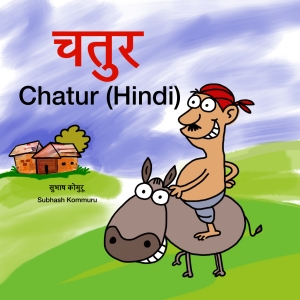 CHATUR is a hilarious and entertaining picture book written in Hindi (also with Hindi phonetics) for kids.
CHATUR is a wise laundry man. MAND is a loyal, reliable, albeit sluggish, partner in Chatur’s trade. He is a lazy donkey whose mantra is “Na Na Na hum to aaram karenge!”
Chatur’s ambition and Mand’s attitude doesn’t blend well. So Chatur comes up with a wise plan to reverse his fortune. He brings ATAL the elephant to do Mand’s job.
The plan starts out well and it did reverse his fortune substantially, but How?
Chatur(Hindi) is a comical and fun read for kids. It is sure to tickle your funny bones. Bright illustrations are sure to engage readers. Chatur has a humorous theme with a subtle message and young readers not only have a laugh, but towards the end connect with each character and sympathize with them.
The book is written in Hindi script and also in Hindi phonetics to make it easy for everyone to read.
Book Excerpt
Hindi:
Yeh kahani hai Chatur dhobhi aur mand gadha ki. Aalsi Mand ka naara hai “NaNa hum to aaram karenge” aur Chatur ki nazar sirf taraki par hai. Jab Mand ka tevar chatur ko khatakne laga, to usne dikhai apni chaturai. Kya chatur ko apni chaturai mehnga padega?
English:
This is a story about Chatur, the Dhobhi and Mand the donkey. Chatur is smart and progressive by nature and his Lazy donkey Mand’s answer to any request was “No No No, I gotta take it easy”. Chatur realized that his success is limited by Mand’s attitude, So Chatur thought of a smart idea, will it work or will it hit him back?
A Writer’s Inspiration by Subhash Kommuru
Thank for your giving me the opportunity to share my opinion on your distinctive blog and exceptional readers and besides all the other great authors visiting here. I migrated to US from India and brought with me memories of land rich in culture and beliefs. For as long as me and wife were by ourselves we never took a moment to think about our cultural heritage and our values. But once we had Arya, our son, our perspective changed. He was growing up fast and seeing American culture all around him. That’s when we realized that there is a treasure called “India” which he is not exposed to and will never get to know unless we do something about this. Sure we can take him to local gatherings, temples, celebrate one of two festivals but that simply is not enough. Kids learn a lot from many different channels, One of those most effective channel is books. For Arya any time is story time, no matter how sad or how mad he is a book can always come to rescue.
So that got me into making up stories and morals that we have learned as a kid and narrate those stories to him. But I had to pick up a pen when he started to demand that I tell the same stories over and over again and use same immersive words every single time. So I decided to pick up a pen and start writing something with cultural significance, something that he cannot learn anywhere else and put it on paper so every time I read it will be exactly the same.
Up until I wrote Chatur I have written quite a few stories just for Arya and all of them started to hit a tone or as one would say a style. It was working but I felt like I should challenge myself just a little bit and actually speak what comes to mind and tell stories that are light hearted and hence Chatur. I challenged myself to start to write a story without any objective and see where it takes me. I do have my boundaries clearly defined and that being that I will always write sensible story. So to address that I have to start with a theme that I want to hit and a moral that I want to drive towards but Chatur is reverse process, I started with no objective and just started to have fun page to page once story took shape, then I tightened up the characters and put them into play and made sense of it all to actually have a powerful learning at the end.
So now going forward I am no longer limiting myself, I am presenting lessons that can make a better person, be able to see good from bad, be able to see through evil and understand mechanics. Be able to differentiate right from wrong. But channel will always be an Indian theme.
Title is available at Amazon
Pick up your copy at Barnes & Noble
Watch the Book Trailer
Subhash and Sujata hail from India. They migrated to the United States along with their memories of childhood and youth. Now that they are parents, just like every immigrant they crave to introduce their child to the culture and values of their upbringing. Yet it is challenging to teach something while you are in the midst of adjusting to a different culture yourself. Subhash and Sujata both work in different disciplines and have different styles and backgrounds, but it is the upbringing of their son that brings them on the same page. That exact place where they meet is captured and reflected in their stories, where Subhash can express in words, and Sujata can illustrate them beautifully. Where he puts it in black and white, she adds color to it. You get the idea! These stories are their attempt to share a glimpse of their childhood days with their son. He is their inspiration to write short stories that have meaning to them and provide teaching in some shape or form.
Visit Kommuru Books


A few months ago when I realized that my manuscript was due two days after my blog post date, I asked Kerrie (my fellow CRP-mate) to please guest blog for me this month. Thankfully, she said, "Yes." Please join me in welcoming Kerrie Logan Hollihan for this month~~~
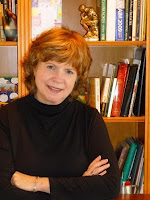
My thanks to Anna Lewis for asking me to guest post for I.N.K….this is one wonderful blog! So many good authors to learn from. So much to share. And so little time…..
Two years ago, “Electric Speed” social media guru Jane Friedman
(
http://janefriedman.com/) talked to our local SCBWI group about how to blog effectively.
Most critical, she told us, is to blog only if we could offer something
useful to our readers. Jane’s advice spoke volumes to three of us: Mary Kay Carson, Brandon Marie Miller, and me.
Among us, we’ve published 12 38,000-word books with Chicago Review Press Along with each we’ve developed something like 250 activities. Per Jane’s observations, we decided that our activities are “useful,” so we launched “Hands-on-Books” (
http://hands-on-books.blogspot.com) in the fall of 2010. We rotate posts about our books, each one with a downloadable activity.
(Which leads me off topic for a moment…. Speaking of the value of networking for aspiring authors… I met Mary Kay and Brandon through SCBWI. One night they saw me leaving the library with books up to my chin about Isaac Newton. They said their editor at Chicago Review Press was looking for a book on Newton… I got in touch, wrote my first proposal, and “the rest is history.”)
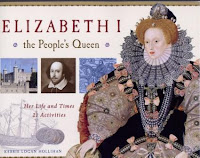
I admit it; writing activities is complicated, and our editor at CRP, the always-gracious Jerry Pohlen, helps when I get tangled up in writing directions. But I have to say I find great delight in taking a subject -- Queen Elizabeth I for instance -- and sitting down to brainstorm a bunch of activities to connect my middle grade readers to Tudor England. Granted, building a gibbet or teaching the art of pick pocketing wouldn’t sit well with our audience of parents and teachers, but it’s fun to think about how to show kids they can dance the pavanne, picture themselves as Tudor women or men, or set sail like the Spanish Armada with an umbrella and a skateboard.
As I mentioned in a recent post, sometimes our activities take hits, as when Kirkus, which otherwise praised my new book Rightfully Ours: How Women Won the Vote, had this to say:
The only downside is the activities, which range from slightly silly (dress up like an ancient Greek for suffrage!) to simply wrong (cake mix does not taste as good as a cake made from scratch).
That left me scratching my head. Yup, I rely on cake mix in an activity in Rightfully Ours. Readers can “Bake a Cake for Suffrage” iced with a recipe from the Woman Suffrage Cook Book (1890). But it was the reviewer’s take on the dress-up activity that made me wonder whether s/he had read the whole book. Suffragists did indeed dress up like Greek goddesses. (Jump to our blog to see proof of that as well as the activity in question.J)
We believe that hands-on-learning enhances a child’s nonfiction reading. Some activities we write are very simple, but teachers say that even some seventh graders have trouble with directions and assembling small projects. Other activities have long lists of materials and more complex directions -- again because we know there are kids out there who want to tackle them.
I’d like to hear back from I.N.K. readers what you think about activities in kids’ books. Do you use them? What’s your experience working with them in the classroom or at home? What works for you? What doesn’t?
One day I happened to overhear a student talking about Star Wars novels, and I told him that Del Rey Books has sent me some over the years, and that usually I donate them to libraries, since I rarely read series fiction or media tie-in novels (rarely, but not never; heck, I used Jeff VanderMeer's Predator
novel in a class once). I asked him if he'd like the ones that were currently sitting in a pile somewhere in my house, and he said sure. I had recently done a big library donation, so didn't have much more than a few advanced copies, but I brought them in anyway. When I gave them to him, at first I thought he was disappointed that they were ARCs without finished artwork, but it turned out his silence and immobility were the behaviors of a die-hard fan in bliss, as I had given him a novel that was hugely anticipated and not due to be released for at least another month.It was then that I hit upon an idea: Here was a thoughtful, articulate, well-read student who was also a knowledgeable Star Wars fan, and I wondered if he would be willing to write a post or two for this blog in which he explored not just the specific books I gave him, but the attraction of the Star Wars universe for him and other fans, since the audience for this blog, as far as I know, is not mostly composed of readers as committed to the Star Wars universe as he. I love learning how people value books and movies and art of all sorts, and this seemed like a great opportunity to learn about the attractions of Star Wars fandom.And so I give you Michael DiTommaso with a post on Star Wars: The Old Republic: Revan and the life and purpose of a Star Wars fan. He writes the "Ask a Star Wars Geek" column at T.X. Watson's Blog-Shaped Thing, and has recently joined the staff of Beyond the New Jedi Order. I hear that Michael is working on a comprehensive post about multiple Star Wars books and their attractions, and if we are kind and encouraging, perhaps he will allow me to post it here once he's finished...
Star Wars: The Old Republic: Revanreviewed by Michael DiTommaso I am not Matt Cheney, just to get that out of the way. I am instead the self-proclaimed biggest Star Wars fan in New England — a contention that's yet to be successfully challenged. How could I possibly claim such an audacious title, you may ask youself. Well, I've read about 133 Star Wars adult novels, and about 15 more young adult novels, as well as a couple of the comics. I've played several of the games, and read a maybe a dozen more short stories, all of these liscenced parts of the Star Wars franchise. Of couse I have seen the movies themselves, many times.
It's kind of my hobby. The fact that it is Star Wars and not something else derives from three factors: firstly, as a kid, I watched the original trilogy of movies, and got excited about the prequels coming out (by that time I had already begun reading the
X-Wing series, one of my favorites to date). Secondly, Star Wars was accessable (my godfath

By:
Aline Pereira,
on 5/16/2012
Blog:
PaperTigers
(
Login to Add to MyJacketFlap)
JacketFlap tags:
guest bloggers,
Into the Wardrobe,
The Wakame Gatherers,
Holly Thompson,
René Colato Laínez,
Rene has two last names,
Color Online,
The Tooth Fairy Meets El Raton Perez,
Tarie Sabido,
Asia in the Heart World on the Mind,
Global Voices,
Orchards,
anthology to support teens affected by earthquake,
Tomo,
Hatbooks,
I Am René the Boy,
Playing Loteria,
top ten new latino authors to watch,
Waiting for Papa,
Add a tag
Later today we will be launching a new feature here on the PaperTigers’ blog entitled Global Voices. Each month we will be inviting a guest to join us and write three blog posts. The posts will be published on three consecutive Wednesdays within each month under the title “Global Voices”. Our guests, located around the world, are all involved in the world of kid and YA lit and include award winning authors and illustrators, bloggers, librarians, educators and more! It is our hope that through the Global Voices posts we can better highlight the world of multicultural kid lit and YA lit in different countries around the world. The Global Voices line-up for May, June and July is:
 Holly Thompson (Japan/USA)
Holly Thompson was raised in New England and is a longtime resident of Japan. Her verse novel Orchards (Delacorte/Random House) won the 2012 APALA Asian/Pacific American Award for Literature and is a YALSA 2012 Best Fiction for Young Adults title. She recently edited Tomo: Friendship Through Fiction—An Anthology of Japan Teen Stories (Stone Bridge Press), and her next verse novel The Language Inside (Delacorte/Random House) will be published in 2013. Her picture book The Wakame Gatherers was selected by the National Council for the Social Studies in cooperation with the Children’s Book Council as ‘A Notable Social Studies Trade Book for Young People 2009′. Holly teaches creative writing at Yokohama City University and serves as the regional advisor of the Tokyo chapter of the Society of Children’s Book Writers and Illustrators. Visit her website: www.hatbooks.com
 Tarie Sabido (Philippines)
Tarie is a lecturer of writing and literature in the Philippines and blogs about children’s and young adult literature at Into the Wardrobe and Asia in the Heart, World on the Mind. She is also on the staff of Color Online, a blog about women writers of color for children, young adults and adults. Tarie was a judge for the 2009 Children’s and Young Adult Bloggers’ Literary Awards (CYBILS) and the 2010 Philippine National Children’s Book Awards. At the 2010 Asian Festival of Children’s Content, Tarie and I joined Dr. Myra Garces-Bacsal in the panel discussion Building a Nation of Readers via Web 2.0: An Introduction to the Kidlitosphere and the YA Blogsphere.
 René Colato Laínez (El Salvador/USA)
René Colato Laínez was born in El Salvador. At the age of fourteen he moved to the United States, where he later completed the MFA program in Writing for Children & Young Adults at the Vermont College. René is the author of I Am
I'm delighted to introduce author Ann Bausum, our second guest blogger of the week. As someone who was born in Memphis and still has strong family ties to the city, I'm especially fascinated by the topic she tackles in her latest book.
Ann writes:
Each year I visit frequently with middle school and high school students to talk about my work as a nonfiction author, and I don’t think a session has ever passed without someone asking: “What’s the favorite book you’ve written?”
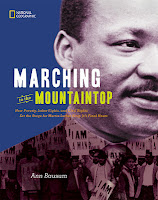 Although I’ve explained numerous times that being asked to pick my favorite book is like being asked to pick my favorite child—in other words impossible—my newest publication may make me a liar. From start to finish I’ve felt absolutely captivated by the research, writing, and production of Marching to the Mountaintop: How Poverty, Labor Fights, and Civil Rights Set the Stage for Martin Luther King, Jr.’s Final Hours. (National Geographic Children’s Books will release the title on January 10.)
The biggest reason I may start calling this my favorite book is the history itself. I literally found myself exclaiming out loud as I worked with facts that leant themselves so well to the dramatic potential of narrative nonfiction. The historical characters, the setting, the chronology, the thickening “plot” would be the envy of any novelist. “Do the history proud,” became my goal.
I wanted to give readers the context for the death of Martin Luther King, Jr. Plenty of children (and even adults) don’t know that he died in Memphis. Few people of any age can tell you that he had gone there to advocate for the labor rights of the city’s sanitation workers.
Death not only concludes this history; it starts it, too. On February 1, 1968, two sanitation workers were crushed to death while riding inside the barrel of a garbage truck. Within days more than a thousand sanitation and street repair workers decided to strike for the cause of safer working conditions, better compensation, and union recognition. Their demands quickly led to a stalemate between the all-black workforce and th
It's my pleasure today to share a guest blog post by friend and fellow critique-group member,
Elizabeth Rusch.
Elizabeth writes:
Will the Real Maria Anna Mozart Please Stand Up?
A critique of the French film Mozart’s Sister
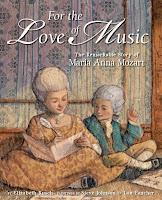
Soon after my newest nonfiction title for young readers,
For the Love of Music: The Remarkable Story of Maria Anna Mozart (Tricycle Press/Random House, 2011) was released, I began getting emails from friends telling me about a French film on the same subject called Mozart’s Sister. The film finally came to Portland, and I was invited to do a Q&A after the show on opening weekend. Thank goodness, because whether I was invited to or not, I would have wanted to stand up in front of the audience and set the record straight.
What Is Accurate: The Mozart family did indeed tour Europe for three years, traveling by carriage for more than 3,000 miles, giving concerts in 88 cities. Maria Anna, older sister of Wolfgang by five years, was a child prodigy, a gifted virtuosic pianist. She composed music, and indeed, her music has been lost.
What I Loved: The depiction of the Mozart family relationships, their affection, dedication to music, and the silliness that bordered on bawdiness (especially when Leopold and the two children stand at the bathroom door while the mother tries out the bidet) captured visually what I read in the Mozart family letters. There were other gorgeous moments in the movie that probably came from primary source material. Maria Anna writes in her journal from the European trip about watching the waves come in and out at Calais. And there it was, the beautiful Marie Féret, hair fluttering in the wind, staring dreamily at the ocean. Wolfgang loved canaries, and there he was poking one with a violin bow.
What Is Inaccurate, Misleading, and Troubling: Soon after establishing the Mozart family on their journey, a carriage wheel breaks outside Paris. Broken carriage parts are mentioned frequently in the family letters, but here the movie jumps off a solid foundation based in fact to a completely fictional account that is not only inaccurate, but also blatantly contradicts what we know about the Mozart family and their daughter.
In the movie, Maria Anna develops close friendships with a daughter of Louis XV and the crown prince. The second relationship is struck while Maria Anna cross-dresses to deliver a letter, and plays violin and sings for the prince. Maria Anna begs to stay in Paris while her family continues on the musical tour. When they leave, she continues her relationship with the prince, studies composition at a Paris academy dressed as a boy, and writes a violin concerto.
The critique: Oh, where to start! Maria Anna was closely chaperoned by her parents at all times, did not stay in Paris alone as a young, single 15 year old, developed no relationship or romance with French royalty, didn’t cross dress, or even play violin! While there are references in letters to Maria Anna singing, they usually entail Wolfgang teasing her about her singing voice. Maria Anna’s singing was not her genius, her harpsichord playing was.
The movie depicts Maria Anna burning her violin concerto and claims that she never composed again, had only one child, and that she died blind and poor. Yet later letters from Wolfgang praise Maria Anna for her compositions, she eventually married a baro

Carolyn Marsden, award-winning author of fourteen middle grade and young adult novels, (twelve out, two on the way,) has opened a new chapter in her career. She has turned from creating stories about children of other cultures, often in countries outside the U.S., to write about – and illustrate – her own bizarre multi-cultural past and how it led to her literary present. Here’s how she describes her latest book.
MEXICO, JUPITER, SUBMARINE: How I Became a Writer
Exploding volcanoes! Harrowing escapes! Ouija Boards and Gong Gong on Jupiter. UFOs, auras, and fairies. Jules Verne’s submarine, under the sea and on Mars. The Beatles as a Communist plot. And the way all of this led to my resplendent writing career.
As I began MEXICO, JUPITER, SUBMARINE, I tumbled into the unknown. With big pieces of paper, scraps of this and that, found objects, cheap paint, and glue, I set out to write and illustrate my odyssey. I loved the trial-and-error, the feeling of free fall. What I created made me laugh.
What made you want to write a memoir?
As a writer I always wanted to somehow make use of my wild and crazy childhood. But whenever I tried straight-out writing about that early life, the writing came off as self conscious.
Then I saw a trailer for David Small’s graphic memoir, Stitches, and thought AHA! that’s the way to go. Right away the idea of doing an illustrated memoir clicked for me. For years I’ve loved playing around with collage and it was natural to combine my art and my writing.
How was this experience – writing and illustrating -- different from writing a novel?
Writing a novel is a very serious and ofte
"Your Book is Great. Well, Except for the 75% That Stinks. But Other Than That..."
Guest Blogger: Keli Gwyn
This week Rachelle’s been addressing difficult conversations between agents and authors. I’ve been on the receiving end of one of those tough calls.
In December 2009 I received the best Christmas present ever: an offer of representation from Rachelle. I soared in the stratosphere—I had an agent! But something she said put a damper on my excitement—my story needed some work. I was kind of freaked.
One of my wise critique partners helped me get a grip, advising me to write a “worst case scenario” list of anything and everything I thought Rachelle might say, which I did. The trouble was, I didn’t think big enough.
When the phone rang in February, Rachelle had the unpleasant task of delivering a sobering dose of reality along with her revision notes. My story stunk—not that she used those exact words. Hers were much nicer. She explained that I’d released the tension in my story at the one-quarter point and needed to rewrite the final three-quarters, a whopping 75,000 words. I wish I could tell you I handled the news well, but I didn’t.
I answered Rachelle’s questions with a throat so thick it was a wonder I got any words out. She described the normal reaction to a call like that as being “shell shocked,” which is accurate.
What got me through the ordeal was Rachelle’s obvious compassion for me as a person and a writer. I remember her telling me how difficult it was for her to make the call. I could tell she meant it, which meant a lot to me. Of course, I had to wonder—if so much had to be rewritten, why did she offer representation in the first place? Without me verbalizing this, she explained that she saw a spark in my writing and was sure that with the revisions, I’d have a saleable book. She loved my writing style overall and said I had the basics in place—dialogue, characterization, scene-building—I just had the structure all wrong.
As difficult as that call was to receive, it changed my life. I rewrote the story, learning a great deal about structure and tension in the process. I also learned how difficult—yet gratifying—it can be to completely break down a story and rebuild it.
It was all worth it, because it wasn’t long before we’d sold it. My debut novel,
A Bride Opens Shop in El Dorado, California, will be released by Barbour Publishing in July 2012.
Rachelle and I may have more “difficult conversations” ahead as my career progresses, but I’ve learned that receiving unpleasant news is bearable and can actually be good for me. She doesn’t want to have to tell me tough stuff, and I don’t want to hear it, but I know from experience that if it happens, I have an ally who cares.
Q4U: If you were expecting a call from your agent and decided to make a “worst case scenario” list, what would be on it? What would be the most devastating thing he or she could tell you? And if they did—how would you respond?
***
Keli Gwyn is a romantic at heart and writes the stories she's loved for decades—inspirational historical romances. She lives in the heart of California's Gold Country, and sets her stories in real towns that were thriving communities in the early days of the Golden State. Visit her online at
Guest Blogger: Marcus Brotherton
Frustration seems to be part of the writing life. Lately I've realized that a major reason writers become frustrated is that we enter the game unclear on our definition of success. We assume it's all about how big a contract is landed, how quickly the top rung is climbed, or even about how many copies of a book are sold.
These faulty paradigms are ingrained in us at an early age, and they need to be consciously ferreted out.
I remember in ninth grade PE, our teacher, a steel-jawed yeller named Mr. Kingsford, was pushing us hard in a badminton unit. “Win at all costs!” he shouted, and we whacked the birdie across the net with fear and trembling.
Our final grade was determined by going one-on-one against him. When my turn came, I stepped to the line and served the birdie to Mr. Kingsford. He smashed it to the floor on my side of the net. “One point for me,” he said. I served it again. Again, he crushed it hard.
“Marcus—” he said with a scowl. “You’re serving the birdie directly to me. You’ll never win like that.”
I remember my grade precisely that day because Mr. Kingsford gathered us at the end of class and went through the roster. Each boy uttered his grade for his peers to hear. The grade was out of a maximum ten points.
“Two,” I muttered, my face crimson.
Publishing is a tough, highly competitive industry filled with its share of Mr. Kingsfords. These voices are not entirely wrong—we need to learn the craft and push hard for excellence.
But when my teacher said, “Let’s play badminton,” the game I had been picturing—the one I had always played—wasn’t competitive badminton.
It was
backyard badminton.
A different game with a different goal.
Badminton, in this parallel definition, was the game we played whenever the weather turned hot and folks came over. All ages joined in the fun, and the paradigm of success was determined by how many times you and the guy across from you could keep the birdie aloft.
Winning, in the most ferocious sense of the word, frustrates us if our main goal as writers is getting the highest score possible and crushing our opponents. This industry has its share of striving, and if you write professionally, you are in business to make a profit. But the further I get in my writing career, the more I’m convinced that true success looks more like backyard badminton, and less like the competitive game.
Our invitation as writers is to remember the joy, power, and responsibility of putting words to a page. Real skill is shown when we lob the birdie across the net and have it lobbed back. When we put our words out there, we connect with the souls of the folks who read our words. In this game, success is about playing with huge hearts.
It’s when readers recall the smell of a barbecue as it drifts across a neighborhood, the taste of hotdogs and potato salad on a summer evening, and the thrill of unlimited potential of what a book can do.
Q4U: What’s been the biggest frustration for you as a writer so far, and what’s been the biggest joy?
I'm delighted to introduce today's guest blogger, my friend Debbie Levy, whose wonderful book The Year of Goodbyes has been tagged fiction by some, nonfiction by others. Debbie has a blog of her own, and she's also created a very cool Poesiealbum Project, which invites readers to create and contribute their own "poesies." This would be a great class project. And now to Debbie...
Voice, Verse, Veracity
After years of trying to find a way to write my mother’s story of living as a Jewish girl in Nazi Germany in the 1930s, the universe gave me a gift: the discovery of Mom’s poesiealbum from 1938. A poesiealbum (po-eh-ZEE album) is like an autograph book or friendship book. Poesiealbums were popular among European pre-teens and teenagers in the mid-20th century.
This wasn’t one of these up-in-the-dusty-attic discoveries. No, my mother herself brought the poesiealbum out of her bedside table when she got together with six of her childhood friends from Germany for the first time in 62 years in 2000. (You can read about how that reunion came to be here.) I was there, too. Without even knowing what the poesiealbum entries meant—they’re mostly in German and Polish—I was moved by this beat-up little book full of handwritten poems and proverbs from my mother’s friends and relatives that she brought across the Atlantic Ocean when she left Germany at the end of 1938.
 I had the album translated (some entries more than once), studied it, and laid out photocopies of the pages on the floor. What I found was that each entry contained a truth or sentiment that related directly to the goings-on around my mother, from January through November of 1938. And so, nearly every chapter in
Guest Blogger: Erin Reel, The Lit Coach
When I was a literary agent, I wanted fiction with a strong voice. Candace Bushnell, Sherman Alexie and Frank McCourt were all great examples. Bushnell led the first wave of original, high-end chick lit. Alexie's poetically poignant Native American perspective kept the art of the short story on the publishing landscape, and Frank McCourt made the memoir more than just a tell-all. These writers came to the table with their own voice. They wrote the stories they wanted to tell.
My first trip to New York to meet with editors was memorable. I was pretty green to agenting; fresh out of my lit classes with all sorts of romantic ideas about writing. One of my first meetings was with editor Marcela Landres at Simon and Schuster. What she had to say about storytelling (not publishing) set the tone for what I would later realize was mainstream publishing gospel. "Just tell me a good story!" The message was clear. Don't write in a language that's not your own. Forget about following a genre trend just to get published. Tell a good story—one that a large audience will want to read and can identify with.
I help writers learn to do this by coaching them to find their authentic voice through several clarity-gaining sessions. The writer and I discuss why the writer wants to write, what they want out of this writing career—what kind of author they want to be known as.
What I don't encourage new writers to do is think about agents and publishing when they're in the middle of finding out their writing identity. When you're thinking about your agent wish-list while writing your novel or polishing your nonfiction book proposal, it shows in the writing: it's not as tight as it could be, it lacks polish and sophistication. Often, it lacks focus. Think about agents only when you've completed your story and you have something truly authentic and well-crafted to share.
Tips for Finding Your Original Voice•
Read. Read the competition, old and new. Identify authors’ voices that resonate with you.
•
Practice. Write like your favorite authors (as an exercise, not for the novel you want to publish!)
•
Get clear. What story do you really want to tell? Who is your audience?
•
Make it yours. Most stories have been told and told again. Make your story authentically
yours by writing many rough drafts through which your voice will eventually surface.
It takes time, stamina and persistence, but to break into the publishing world with a book that will stand the test of time, the effort to find your voice is worth it.
***
Erin Reel, The Lit Coach, is a publishing and editorial consultant, writer's life coach and blog host of
The Lit Coach's Guide to The Writer's Life. A former Los Angeles based literary agent, Erin has contr
Guest Blogger: Richard Mabry
(Book giveaway today! See below.)
 Rusty Greer is my hero. Many of you won’t know who Rusty is, but any fan of the Texas Rangers will recognize the name. It conjures up images of a red headed kid from Alabama whose uniform was always dirty at the end of the game, who never seemed to give up.
Rusty always wanted to play professional baseball. It was his dream. But like a lot of us, that dream didn’t come with talent automatically attached. So what Rusty lacked in ability he made up in hustle and ‘want-to.”
He played baseball in high school, but when he was a senior, only Alabama’s University of Montevallo showed any interest in him. No matter. He attended, played on the college team, worked hard, and caught the eye of the pro scouts. The Texas Rangers drafted Rusty (although he wasn’t chosen until the tenth round of the draft). He was on his way.
Rusty advanced through the minors, always playing hard, always giving his best. When he finally got the call-up to the major league team, he contributed with effort and hustle. During his career, his all-out style of play resulted in surgeries to fuse vertebrae in his neck, repair a rotator cuff tear in his shoulder, transplant a nerve in his arm (the so-called Tommy John surgery), and remove scar tissue from his elbow and shoulder. When he finally retired, he’d parlayed average talent and above average “want-to” into a career that made him a fan favorite.
As a young man, I wanted to be a professional baseball player, but those dreams died, and I went into medicine instead. I never thought I’d be a writer, but after my retirement from medicine, I began to try my hand at fiction. And it was tough. I wrote and revised and submitted and was rejected and wrote some more. I discovered that I wasn’t alone in this situation. There were hundreds of attendees at my first writer’s conference, and I was told that there were only a handful of slots open for publication by new authors. I could give up, just as I’d done with my own dream of playing in the big leagues, or I could persevere. It was a matter of how much “want-to” I had.
Finally, there did come a time on my road to writing when I decided to quit. But through a series of circumstances that can only be called a “God thing,” I was encouraged to try one last time. And this time it worked, although success didn’t come immediately. The process was a long one, full of more work and fraught with even more disappointments, but it paid off. My third novel of medical suspense was just published, and the fourth will be out this fall. I sometimes wonder how things would have played out if I hadn’t decided I had enough “want-to” to give it one more try.
You may sometimes want to give up, too. But I hope you’ll take a close look at your writing efforts, including the reason you’re writing, and see if there’s enough “want-to” in you to keep going. After all, the odds of succeeding may be small no matter how hard you try, but they’re zero if you don’t try at all.
Q4U: Have you ever been discouraged? Ever wanted to give up? How did you find the "want to" to continue?
***
Guest Blogger: Mary Demuth
 In the February 2011 issue of Fortune magazine, there’s an article entitled "Conan 2.0: How a late-night Luddite accidentally fought his way back into bedrooms (and computers, smartphones, and tablets) across America." The picture below is featured in the article.
The article chronicles the rise/fall/resurrection of Conan O’Brien, carried on the wings of tweets. O’Brien was a reluctant Twitterer until a friend convinced him to try. This was after NBC moved The Tonight Show from 11:35 to 12:05, prompting his departure, and the subsequent frustration voiced by many of O’Brien’s followers on the Twittersphere and Facebook.
On February 24, 2010, O’Brien and his team opened
a Twitter account. His first tweet: “Today I interviewed a squirrel in my backyard and then threw to commercial. Somebody help me.” At that time, O’Brien set a single-day record for Twitter followers. The article chronicles O’Brien’s social interaction, how he’s mobilized his demographic, and how social media has fueled his latest projects and successes.
Why is this important?
Because we’re moving away from an old model of promotion to a brand spanking new one. From TV celebrities as we knew them to TV hosts who highly interact with their fans. There are huge implications for authors.
7 Author Takeaways From the Article:1. If Conan O’Brien, a self-proclaimed Luddite in the digital realm, can open a twitter account, so can you.
2. Old ways of promotion are waning. Interacting with readers with great content, them-focused tweets, and a slice of humor goes a long way.
3. You’ll never know how your tweets (or blogs or facebook statuses) will affect your career. Recently, I received an email from a publishing executive who follows me on Twitter. This opened the door for some very exciting possibilities. He’s been following me a long time.
4. Your words matter, even in little snippets. Make them interesting. View them as part of your writing habit. See them as furthering your career.
5. This kind of publicity is FREE. For cash-strapped authors, it’s worth our time investment to garnering facebook fans, twitter followers, blog readers, and ezine subscribers.
6. Being yourself in social media is extremely important. Conan is himself. I am myself. Don’t try to be Conan or me. Be you. Folks want authentic interaction.
7. Don’t despise a setback. Conan’s leaving The Tonight Show actually turned into an epiphany, then a renewed career. See roadblocks as redirections.
Q4U: What do you think? Is social media important for the author?
by Susan Grigsby
 Susan Grigsby, author of In the Garden with Dr. Carver, spent the weekend at the Museum of Transportation in St. Louis. She had a wonderful (and windy) experience sharing her enthusiasm for George Washington Carver with the kids.
 This past weekend, the Museum of Transportation in St. Louis, MO hosted their second annual Train your Brain – Read! event. In addition to all of their regular attractions, the sprawling grounds filled for two days with entertainment for all ages, including car shows and craft tents. All of the children’s activities were connected to books, including (by a wonderful coincidence) The Boxcar Children series.
 This was the first big outdoor festival of this nature that I’d been invited to and it was great fun. In the Garden with Dr. Carver is my first children’s book and I learned a lot by participating in this festival. My new Author Visit motto is “Lean into the Wind!” So, here’s some of what I learned:
 The weekend prior to the festival, it snowed four inches. The weekend of the festival, it was 91 degrees and the winds gusted to 44 miles per hour. We could have moved inside, but that would have meant giving up a highly visible spot at the entrance gate. The tent had to come down, but thanks to the assistance of a wonderful museum employee named Jamie, we stayed outside and not a single crayon or paper escaped. We used lots of rocks, dried beans (in the crayon cups), ribbon, and some very snazzy party table weights that Jamie found hiding in a museum closet. Lesson learned: be flexible and creative, and gracefully give up on your hair staying anywhere near where you’d like it to be. Bonus: Kids love a table full of rocks and snazzy glittery party weights!
 Find a connection to the festival you’re attending. When we first met, the museum director noticed the Jesup Wagon in the book. So, we decided to feature Dr. Carver’s moveable school. I made a huge poster which we lassoed down and it drew people that might otherwise not have stopped by. The photos covered the transportation modes of the moveable school over several decades and the old photos caused many to stop and talk about their memories of those times.
 ![]()
Guest Blogger: Catherine West
In light of Rachelle’s recent post
When An Agent Gives Up on a Project, I thought it might be helpful, even encouraging, to share my experience and the truths I learned along the way.
When Rachelle first offered me representation, I had just completed a manuscript called
Yesterday’s Tomorrow. Rachelle liked it because it was different. I agreed. I certainly hadn’t seen any books about a female journalist who travels to Vietnam during wartime. I was excited to have an agent who believed in my writing and loved my story as much as I did. I had done a lot of research on the story and was completely in love with it, but of course I wasn’t objective enough to see its flaws. Rachelle made suggestions that would take it up a notch. After a rewrite and a few plot changes, we finally had a book that could sell. Or so we thought.
Truth #1 - Just because your agent loves a project does not mean it will sell.This was the fist lesson I learned. Just as Rachelle said in her post, some projects are hard sells no matter how good you think they are. Looking back, there were numerous reasons my story didn’t sell right away. Some editors assured us it wasn’t the writing, so we were left to assume it was the content. I had written a book that was, perhaps, a little too different.
Truth #2 - Listen to Good Advice.Having a wise agent is one thing, listening and taking her advice is quite another. I’m sorry to say I was pretty set against putting this book on the shelf. I was in too deep, too emotionally invested, and I refused to accept that it just wasn’t going to happen. One of the hardest emails I’ve had to read from Rachelle was the one telling me she really felt we needed to stop pursuing publication for this particular project. (How’s that for alliteration?). I’m sure she was just as disappointed as I was, but she was looking at the big picture. I was too busy chomping sour grapes.
Truth #3 - Learn to Let Go.This is where I get nauseatingly trite and throw the old
if you love something let it go saying…in your face. But seriously. Letting that project sit on the shelf whilst working on other things was probably one of the hardest things I’ve done in my writing journey. But you know what? It was absolutely the right thing to do at the time. It may not always be the right thing for you, but I know it was for me. The past couple of years allowed me to grow as a writer. I’ve been fortunate to be able to go to conferences. I’ve been learning, writing new books and simply enjoying where I am on my writing journey.
Truth #4 - Sometimes You’ve Got to Go with the Gut.They say there is a time and a season for everything under heaven. I believe that to be true. You see, that story I let go, well, it wouldn’t let me go. So I attempted one more major rewrite, and in fear and trembling, approached my lovely agent with the idea of resubmitting. She agreed, and we gave it one more go-round with some smaller publishers who seemed more open to "different" stories.
Yesterday’s Tomorrow landed on Ramona Tucker’s desk at OakTara, and Ramona loved the story. Every last bit of it. I was offered a contract, and a few short months later, I have a copy of my first published novel sitting on my desk.
I’m happy to say my instinct on th
Guest Blogger: Colleen Coble
(Bestselling author of over 40 books)
Yeah, yeah, yeah, I’ve heard you complaining about having to change your novel. I remember feeling the way you do once upon a time. But that was before I realized what a blessing it is to have another person devote such focus to my work. That was before I realized we authors are too close to our books to see them clearly.
I've come to enjoy the revision stage, and I wanted to share some thoughts on how you might enjoy it, too.
Revision letter arrives. 1. Dance! Shout out
whoohoo! Do whatever it takes before you open it to have a great attitude. If you're determined to make this a good experience, it will be much easier. Tell yourself there will be great things in there to make your book better.
2. Take down defenses. Realize that any criticism is meant to help not hurt.
3. Reinforcements have arrived! When I’m writing a book, I feel like a draft horse pulling a heavy wagon up a mountain by myself. When I get the revisions back, I’m suddenly assisted by another draft horse or two and we’re coasting down the mountain together toward a charming town in the distance. Allow yourself to brainstorm off the suggestions and see the possibilities.
Open the email and begin to read.1. The Good. A little bit of sugar makes the medicine go down. Read the good things the editor had to say. Allow yourself to savor those, all the while knowing the medicine is coming. Linger over those passages.
2. The Bad: Now comes what didn’t work. Read through the entire list of things that need shoring up.
3. The Ugly: Often after reading a revision letter, you feel overwhelmed with all that needs to be done. But ugly as it looks, it’s possible to do this work in much less time than you imagined.
Gear up for the journey.1. Read the letter again. Even a third time. I always miss some things. If you’re already excited about things, call your editor (or crit partner) and talk through some of the issues. If you’re not quite there yet, sleep on it. The next morning read it again and try to get excited. Try not to look at how much there is to do because it can be overwhelming.
2. Call your editor. Have the items up for discussion flagged. Then settle in for work.
Eat the elephant one bite at a time.1. Print it out. Highlight important plot points that need changing and things the editor says don’t make sense.
2. Make the small changes. My editor usually has small inconsistencies marked by page number. I fix those little things because they are easier to find before I make major changes.
3. Tackle plot issues. I use
Scrivener to write and I go back to my scene outline. Where can I drop in another scene or expand a current one that will allow me to fix those problems? Can I move a scene for more impact?
4. Layer in those character fixes: I get out 3 x
As mentioned on Friday, Albert Whitman author Suzanne Slade took Read Across America Day quite literally. Here are her experiences with 13 Skype visits in one day:
The Day I Read Across America (tales from the virtual author visit front)
On Read-Across-America Day, March 2nd, I woke at 3:35 am and couldn’t get back to sleep. I was too excited! I was going to read to students across the country—in CA, IL, GA, IN, PA, NH, OH, FL, AL, NC, OR, NY and NJ—all in one day! It was a reading event I’d been working on for over a year. With the help of Skype, I would visit thirteen different schools from the comfort of my home office (aka. dining room) in Libertyville, Illinois. If all went according to plan, I would connect with a different school every half hour, beginning at 8 am and running straight through until 2:30 pm, spending twenty minutes with each group of children. As I put on my striped Cat-in-the-Hat hat that morning, I wondered what fun surprises, or technical glitches, awaited me. And here’s how it went down.

The day kicked off with 118 enthusiastic fifth graders from Eaton Elementary in NC. As with all the schools I would visit, they had prepared a message for me to share with the next school. Eaton’s message was, “Get off the couch and read!” How awesome is that? Before our visit ended, I asked the class how many people they thought I would talk to during the day, as the school with the closest guess would win a free box of autographed books from me. The fifth graders had used their estimation skills and come up with a guess of 1400. I have to admit, I was a little surprised their number was so high. I’d guessed only 375.

My next stop was King’s Academy in West Palm Beach, Florida where I met children in kindergarten through second grade. I explained how a book is made using some cool show-and-tells from my newest picture book, Climbing Lincoln’s Steps (illustrated by Colin Bootman). I showed them my original 5-page manuscript, the 32-page book dummy my editor had put together, Colin’s early pencil sketches, copies of his amazing full-color paintings, the F & G (folds and gathers), and the beautiful finished book complete with dust jacket. The students had lots of interesting questions. My favorite was, “Do you have to change the words in your stories a lot?” We ended our time by reading one of my picture books together. The morning was rolling along without a hitch, although I must admit only one hour into my marathon reading event I realized I couldn’t stay sitting all day, so I put my computer on a small chair on top of my table and did the next few visits standing up.

The third school in the Bronx, New York was a del
As the reviews for my recently published book, Wheels of Change, have started to come in, I've been pleased to see that many mention the book's beautiful--one reviewer said "flawless"--design. Rather than write about the process of designing this book myself, I invited Marty Ittner to blog about it. Marty has designed all five of my books for National Geographic, and she was a true collaborator on Wheels of Change. (She's also in the process of redesigning my Web site, suemacy.com. More on that next month.) So take it away, Marty....
Why, thank you Sue. Having an author request my design for their book is a great compliment (and good for business). What’s not to love about Wheels of Change? As Sue discovered, folks go bonkers over bikes. I can vividly remember my own exhilaration the first time my father let go of my 2-wheeler seat and I sailed off on my own. And Sue does her homework. She’s that smart kid you hope to sit next to in the back row with the A+ essay and all the test answers.
Wheels of Change ironically describes our design process. It was my first project with National Geographic director of design Jonathan “Jono” Halling and art director Jim Hiscott. The digital revolution has forced us print designers to create more dynamic visuals. It is simply not business as usual. From the get-go, Jono and Jim conveyed the new mandate for Childrens Books: they’ve got to be fun, colorful, lively and engaging. J+J wanted to visually push the concept of how the simple circle of a bicycle wheel enabled women to bust out of their domestic confinements.

Guest Blogger: Maureen Lang
 Recently while watching the movie You’ve Got Mail, I noticed a theme beneath the romance. The movie is about two people who fall in love via email while professionally they’re bitter rivals—not knowing that the enemy and the budding love interest are one and the same.
Big bad Fox Books carries a gazillion titles and can afford to discount prices, while The Shop Around the Corner sells only the best children’s books at full price amid plenty of ambiance.
One store provides the goods cheaply and conveniently, the other provides a place where the love of storytelling oozes under warm lighting and homey shelves. Which would you rather buy from? Amazon proves most of us ultimately go for the lowest price—so movie viewers with any marketing savvy know the little shop is doomed.
But Kathleen won’t give up easily. She tries saving her shop by reminding the community of her store’s unique value, while unknowingly receiving email counsel from Joe Fox himself.
Joe repeatedly tells Kathleen this fight isn’t personal. It’s business. He tells her to “take it to the mattresses” and fight for all she’s worth. Even when things do get personal, when she insults Joe during a news interview, Joe realizes it isn’t personal. It’s business.
Publishing is a business, too—something we often forget because of our love for storytelling. Rejections feel far too personal to be “just business” and yet that’s the truth. Publishers must be convinced a book will appeal to the widest possible audience, and if it doesn’t (no matter how well written the book might be) then it goes to the rejection pile. Writing may be an art, but publishing is business.
The same is true after publication. When a publisher’s sales team presents upcoming titles to book buyers, the first thing buyers consider is previous sales from each author. Perhaps the new story is spectacular, with the best cover ever. Chances are a book buyer won’t even hear the salesman singing its accolades if sales figures from prior books are disappointing.
A similar scenario takes place if an author goes from one publisher to another. No matter how excited an agent might be, the first thing an editor looks at is previous sales. The truth is many houses would rather take a chance on a good idea from an unknown author than an equally good idea from a seasoned author whose numbers are less than impressive.
Neither the book buyer nor the editor have rejected the story idea, and certainly haven’t rejected the author personally. They’ve looked at the numbers and it either makes sense or doesn’t to invest more money.
In the movie, Kathleen lost her business—just as in life people get rejected. But if we’re anything like Kathleen a rejection will lead to new things, perhaps better things. And one very important lesson: It’s not personal. It’s business.
Q4U: How good are you at remembering that the difficulties and rejections in publishing are not personal?

As a big birthday fast approaches, the gulf between young peoples’ experiences and mine has widened considerably. And yet I continue to write for kids. I went from teaching high school English to photojournalism to writing and photographing children’s books. Through the years my students’ dialogue about the great themes in literature, poetry, art – ergo life – lived inside my heart and echoed in my ears. My young cousins were often about, arguing over who would recite their latest poem first, practically jumping over one another to talk about some crazy adventure. Those reverberations were a vital part of my work. The students are long grown up, and my cousins are adults with adult dispositions. Have the voices of our current generation changed? Are their issues different from mine? I think they probably are. But I’m not sure.
I dodge the “voice” problem somewhat by writing from the perspective of the person I’m interviewing. It’s not in my voice but the young person’s voice. But my books are not 100% participants’ voices. Some parts, like choosing the subject, is me, and that’s what I question. So the choice of narrative and presentation begs the questions to us all, “Are we still asking interesting, relevant questions? Are we still cool?”
A perk writing for children is that we are generous with one another. I asked a few experienced writers and illustrators to contribute their thoughts to this subject. I made it a point not to ask INK contributors because I hope you will add your thoughts in the comment section.
The first person to respond was Andrea Davis Pinkney. She said, “We all know the cliché that says, ‘real life is stranger than fiction.’ Well – when writing for children ‘real’ can also be funny, ironic, sad, thought provoking, and cool. This is why I write non-fiction and historical fiction for children. ‘Real’ can let a child see the world in a whole new way. ‘Real’ can change a young reader’s thinking about people, history, scientific facts, love, laws, wars, protests, rites of passage, family. ‘Real’ can show kids what’s real about themselves.”





.jpg?picon=160)






 Ain’t technology great?




I say YES to activities in NF books. Even if my kids do not undertake the activities, the idea of making something, reading directions, jumping between the activity and the book content, adds a fun and valuable dimension.
I absolutely agree that hands-on as well as minds-on activities can enhance what a child takes away from a nonfiction book.
Just as some readers prefer nonfiction rather than fiction, some kids really love activties and the process of doing rather than passively just reading makes all the difference in whether or nto some kids will truly understand a concept. I've seen thsi over and over in school visits and in lteers I get from kids (and teachers).
It's too bad that reviewers sometimes nitpick and that publishers sometimes worry too much about liability (a couple of publishers I know have policies that forbid activities in books). But there's usually a work around, such as creating a teachers' guide full of fun and meaningful activity ideas.
Kerrie:
Cheers for Chicago Review Press and their wonderful series of activity books for kids. I published my first book, THE WIND AT WORK, with CRP back in 1997 with a second edition out in 2013. It was so much fun to see what a broad range of activities I could come up with re: wind and windmills - science, music, cooking, art, community activism, etc. I hope readers had as much fun as I did.
As a former teacher, I think it's wonderful to have activities to go along with nonfiction. They help kids understand and relate to the material better, and they provide a fun way to repeat concepts (which is often necessary for learning.)Making activities available on your blog is a great idea!
As someone who's known for her activity books (science is learning through experiments, aka "activities") I have a LOT to say on this subject. But this is not the place. Two things:
1)Do a writing exercise with students by having them write directions for making something, going someplace, or doing something. Give the directions to a classmate and see if they can follow.
2) The simplest activity has tremendous import if it is in the context of a BIG idea. Catching air in a plastic bag is simple and boring unless you understand that you are proving that air is real stuff. It makes five-year-olds scream with delight, "I got some!" I always integrate simple activities with the concepts they demonstrate. Too often, in science, there is a disconnect between the lab and scientific ideas.