new posts in all blogs
Viewing: Blog Posts Tagged with: Where the Wild Things Are, Most Recent at Top [Help]
Results 1 - 25 of 47
How to use this Page
You are viewing the most recent posts tagged with the words: Where the Wild Things Are in the JacketFlap blog reader. What is a tag? Think of a tag as a keyword or category label. Tags can both help you find posts on JacketFlap.com as well as provide an easy way for you to "remember" and classify posts for later recall. Try adding a tag yourself by clicking "Add a tag" below a post's header. Scroll down through the list of Recent Posts in the left column and click on a post title that sounds interesting. You can view all posts from a specific blog by clicking the Blog name in the right column, or you can click a 'More Posts from this Blog' link in any individual post.

By: Samantha McGinnis,
on 6/9/2016
Blog:
First Book
(
Login to Add to MyJacketFlap)
JacketFlap tags:
games,
Maurice Sendak,
Sandra Cisneros,
Where the Wild Things Are,
Kaboom!,
play to learn,
the importance of play,
Hairs,
Pelitos,
Read and Play,
Tips and Resources,
Using the First Book Marketplace,
Add a tag

Today’s kids are playing less than any other generation.
Play is losing out to TV, recess times have declined and many children in low-income communities lack safe spaces to run, jump and be active.
But play is essential to kids’ learning. Play helps encourage kids to explore and use their imaginations, increases their ability to store more information and can improve literacy skills by building connections by oral and written expression.
As the school year ends and kids have more free time, you can incorporate play into all of your school or program’s activities – even reading and learning!
Try using the books and recommended games below to incorporate play time into reading time.
Wild Things Tag
Players: 10 or more
Space: medium to large
Materials: none
 First, read Where the Wild Things Are by Maurice Sendak
Then, mark off a large area to serve as the Island of the Wild Things. One player, the “King of the Wild Things,” stands in the middle of the island, while the rest of the players (the “Maxes”) line up on either end of the island.
When the King shouts “Let the wild rumpus start,” each Max tries to make it to the other side of the island without getting tagged by the King.If a Max is tagged by the King, he or she becomes a Wild Thing. All Wild Things (except the King) must keep one foot planted on the ground at all times while still trying to tag the Maxes.
The Maxes continue to run back and forth across the island until only one Max is left untagged. The last Max becomes King of the Wild Things and the game begins again.
All Tangled Up
Players: 6 or more
Space: medium
Materials: none
 First, read Hairs – Pelitos by Sandra Cisneros, illustrated by Terry Ybáñez
Next, have the players stand close together in a circle. Then have each player hold one hand with anyone in the group except the person standing next to him or her.
Repeat with players’ free hands – avoiding anyone standing next to them or with whom they are already holding hands.
Now have the group try to untangle itself without letting go of anyone’s hand. It takes patience and lots of cooperation!
If you have twelve or more people, split into two groups of six and see which group can get untangled first.
Need more playtime ideas? Visit the Read and Play section on the First Book Marketplace to find all of the books and activities created by First Book and Kaboom! to encourage playing to learn.
The post Make Time to Play! appeared first on First Book Blog.


By:
Betsy Bird,
on 12/6/2015
Blog:
A Fuse #8 Production
(
Login to Add to MyJacketFlap)
JacketFlap tags:
Bookish,
Reader's Advisory,
Tintin,
Newbery Award,
Where the Wild Things Are,
The Lion,
The Lion the Witch and the Wardrobe,
Joseph Conrad,
Fusenews,
Random Penguin House,
Zoobean,
d'Aulaires,
literary ornaments,
SelectReads,
Add a tag
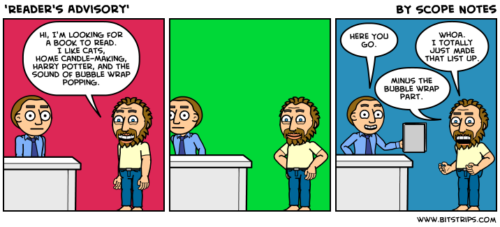 In my current job I’ve become somewhat fascinated with what could easily be considered the key tool in a librarian’s toolbelt: Reader’s Advisory. Patron asks you to recommend a book based on a set of preferences and you knock it out of the park. That’s our job and we do it well. Booksellers do it too, don’t get me wrong, but we have the advantage of an extensive backlist of out-of-print titles at our fingertips. It’s taken a little while, but recently I noticed that a LOT of folks are getting in on the Reader’s Advisory game. Companies like Bookish, Zoobean, SelectReads, certainly, and now? An actual publishing company itself. The Penguin Hotline is pretty much what it sounds like: A publishing house doing RA. Says their site, “Tell us as much as you’d like about the reader you’re buying for this holiday season and our expert staffers will find you just the right books. You’ll get personalized recommendations from real Penguins! Every request is handled individually by one of our in-house editors, marketers, designers, salespeople, publicists, and more.” And they actually do. What all this says to me is that libraries need to double down on their RA skills. Take some tips from Multnomah County’s My Librarian site for starters. That idea is crazy good. We could all learn a thing or two from it.
- Monday, January 11th. It’s almost a month away. The happiest day of the year. The day when they announce the Youth Media Awards, better known to the rest of the world as Newbery/Caldecott Day (and by “rest of the world” I mean “my brain”). In preparation, I was pleased to see Monica Edinger’s thoughtful appraisal of the Newbery itself in the piece Thoughts on Newbery: The Nature of Distinguished. In it, Monica talks quite a bit about Laura Amy Schlitz’s The Hired Girl, a book which (coincidentally) also showed up on Marjorie Ingall’s fantabulous Best Jewish Books 2015. Seriously, if you need Hanukkah gifts for any kid of any age, your prayers have been answers. For the rest of you, her voice is just so good. Downright sublime, some might say. Miss it and you’re missing out. (She also has stellar taste)
- I’m not the first, second, third, or forty-fifth children’s literature enthusiast to link to this, but nonetheless I think the Atlas Obscura article C.S. Lewis’ Greatest Fiction: Convincing American Kids That They Would Like Turkish Delight is dead on. I grew up thinking it would be akin to sugar powdered squares of chocolatey confectionary delight. Then I went to London for foreign study and I and each of my classmates individually had to make the discovery that the stuff ain’t worth betraying much of anyone, let alone your blood kin. Edmund should have held out for fudge. Thanks to mom for the link.
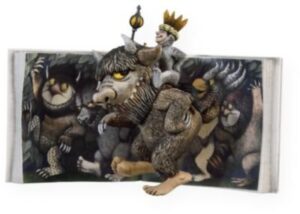
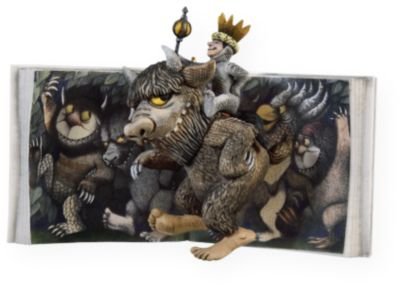
- Bookish (mentioned earlier) had a rather delightful encapsulation of fantastic literary-themed Christmas tree ornaments, just in case you’re scrambling to get something for that reader in your life. My personal favorite (aside from the library lion a.k.a. Patience which I MUST have):
- In other news, Yahoo News recently announced that a Tintin expert was just named as an official “professor of graphic fiction and comic art.” Wouldn’t mind having one of these stateside as well. Perhaps an expert in Pogo. A gal can dream.
- The resident 4-year-old is on a picture book biography kick right now, so on Saturday we went to the library’s bio section to find some new fare. We ended up in the Lincoln section and lo and behold her eyes alit on that old d’Aulaire’s Caldecott Award version of the life of Abraham Lincoln. I steered her clear, knowing its contents very well indeed. I never thought of it as the d’Aulaires’ best work, and we took home the Judith St. George/Matt Faulkner Stand Tall, Abe Lincoln instead. The d’Aulaire version had already been on my mind because of a recent PW announcement that a small publisher is bring the book back to the world. Mind you, “they made minor modifications to the original art and text to reflect contemporary views about race politics and to reflect historical accuracy.” Guess I’ll have to reserve judgement until I see it for myself.
- Joseph Conrad’s Heart of Darkness: Now with more indelible images that will haunt your nightmares until doomsday! Don’t try to unsee it. Don’t even bother.
This week in our popular series Children’s Books from 1907, we take a look at a little number that just makes me inordinately happy.
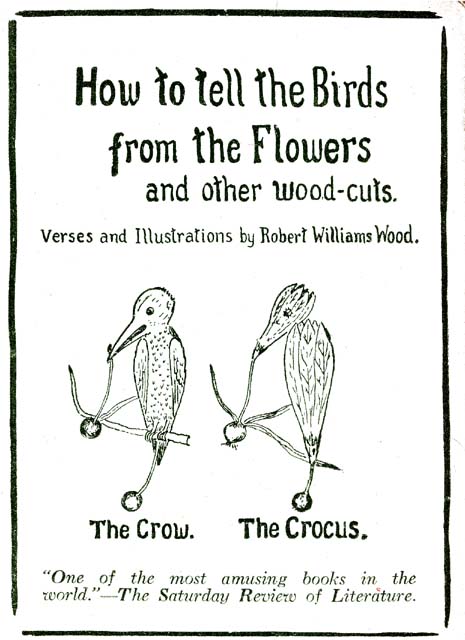
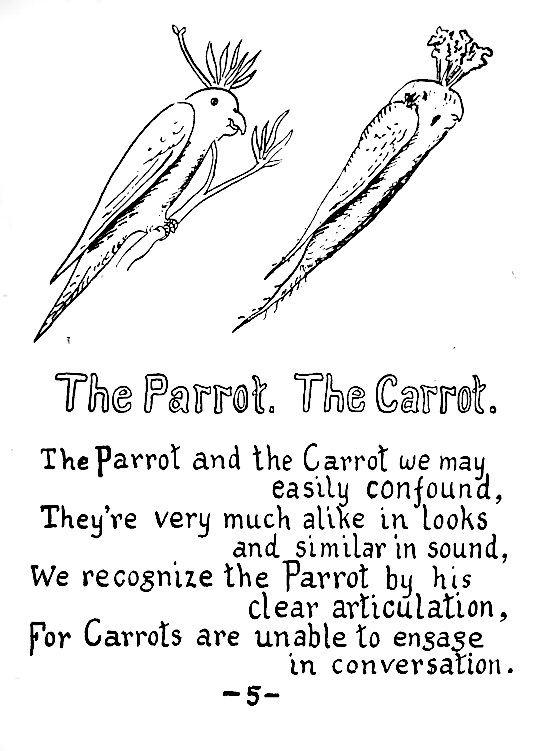
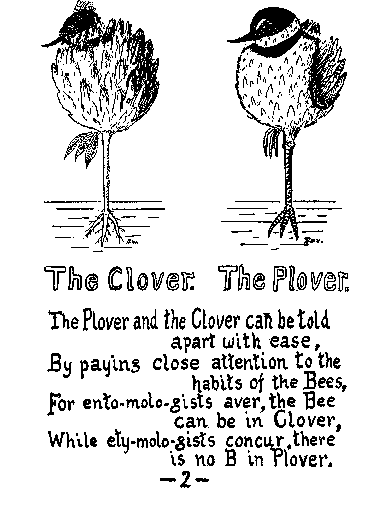
I think you get the gist. You may read the book in its entirety here. Thanks to Mara Rockliff for the link.

By:
Betsy Bird,
on 6/10/2015
Blog:
A Fuse #8 Production
(
Login to Add to MyJacketFlap)
JacketFlap tags:
Fusenews,
2011 librarian previews,
star wars,
Rebecca Stead,
Winnie-the-Pooh,
The Poky Little Puppy,
Where the Wild Things Are,
Frances Hardinge,
Me stuff,
Phoenix Award,
librarian attire,
New Podcast Alert,
Mathical Book Award,
houses of a haunted nature,
Add a tag
 Of all the most deserving, least lauded children’s book awards out there, my favorite might be The Phoenix Awards. “The award, given to a book originally published in the English language, is intended to recognize books of high literary merit. The Phoenix Award is named after the fabled bird who rose from its ashes with renewed life and beauty. Phoenix books also rise from the ashes of neglect and obscurity and once again touch the imaginations and enrich the lives of those who read them.” They’ve just announced the 2015 winner and I admit that I never read it (One Bird by Kyoko Mori). There was a time, when I was young, when I tried to read as many Phoenix books as possible. Someday, maybe, I’ll try again.
- And speaking of obscure awards, did you see the Seven Impossible Things post on Kirkus recently called The Coolest Picture Book Award You’ve Never Heard Of … A lot of you folks should know about this. I suspect your books would be eligible (it’s for wildlife and nature).
- Heck, while we’re at it let’s also mention once more the Mathical Award which is given to books that “inspire young people to engage with mathematics in the world around them.” The submission info is here. Marc Aronson’s thoughts on the matter are here.
- For those of you in the market for ideas for your next middle grade novel, I suggest checking out this Dunmore, PA housing advertisement. Have at it. Thanks to Kate for the link.
- New Podcast Alert: You know I’m just goofy for new children’s literary podcasts. Heck, I once did an entire Literary Salon on the topic. Well, Ms. Julie Sternberg has just started Play, Memory. As she describes it: “I interview authors and others about the ways in which themes that recur in children’s literature–themes like the secrets we keep in childhood; the times we disappoint our parents; and the times our parents disappoint us–have played out in their lives.”
- And in other podcast news, there’s an interview with Fuse #8 favorite Frances Hardinge over at Tor.com. Because anything that has to do with Ms. Hardinge is awesome. I recently found myself having lunch at the same table as Patrick Ness and, at a loss of anything else to say to him, I realized we both belonged to the Mutual Admiration Society of Frances Hardinge. So to speak. Thanks to Sarah Hagge for the link.
- There’s a nice big post on endpapers up and running at Nancy Vo’s Illustration blog.
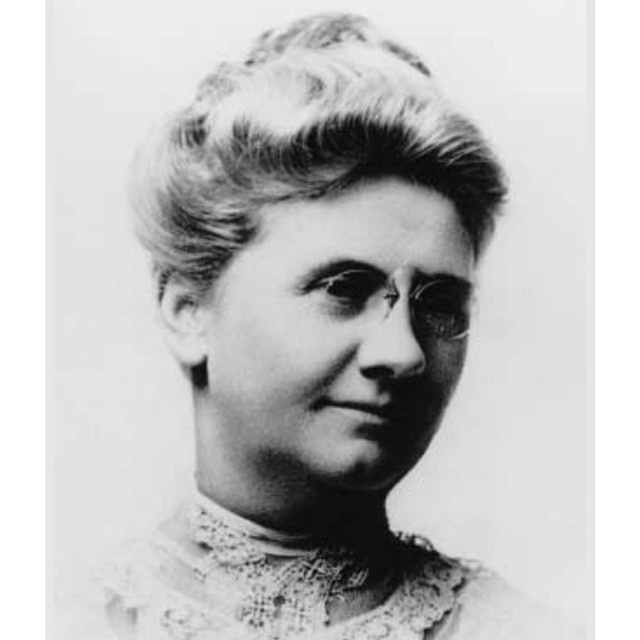
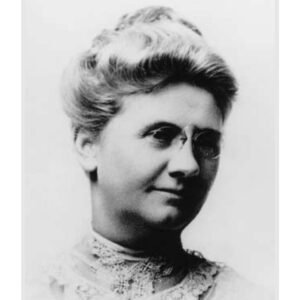 This one’s rather interesting to me. Folks in my family often send me links that have to do with libraries or librarians in some way. I find some more useful than others. Still, I was very intrigued by the recent piece called The Archivist Files: Why the woman who started LA’s branch libraries was fired. Wowzah. Them’s good reading.
Speaking of librarians, did you know there’s an entire site out there dedicated to them dressing up and posting pictures of themselves? Yup. Librarian Wardrobe. The more you know.
“But there’s a third set of children’s books: those that fall into an uncanny valley between enjoyable literature and ignorable junk. These are books that exert an irresistible pull on adult consciousness but don’t reward it. They are malign presences on the bookshelf. They hurt. One of them may be the best-selling children’s picture book of all time.” That’s a hard sentence to beat and, as it happens, I agree with author Gabriel Roth every which way from Sunday. He discusses what may be one of the worst “canonical” picture books of all time.
- This doesn’t actually have any connection to children’s literature really (though you might be able to make a case for it) but did you know that there’s a site created by NYPL where you can look at old photos of pretty much every single block in the city? It’s called OldNYC and I’ve just handed you a website that will eat away at your spare time for the rest of the day. You’re welcome.
- I was discussing this with buddy Gregory K the other day. Can you think of a single instance where a Newbery Award winner went out, after winning said award, and became an agent? Because that’s what Ms. Rebecca Stead has just done and I think it’s safe to say that it’s an unprecedented move.
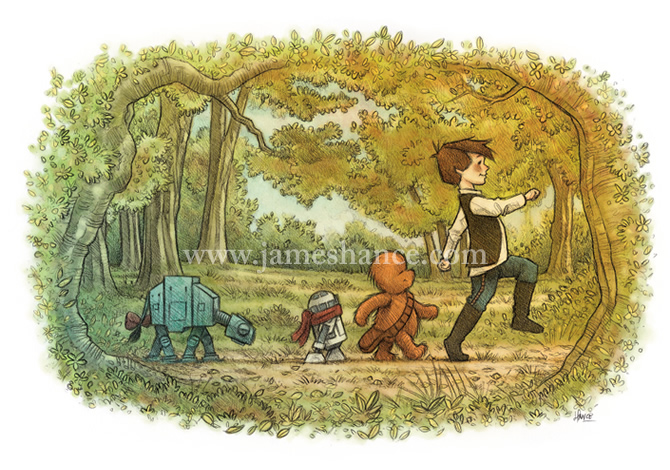
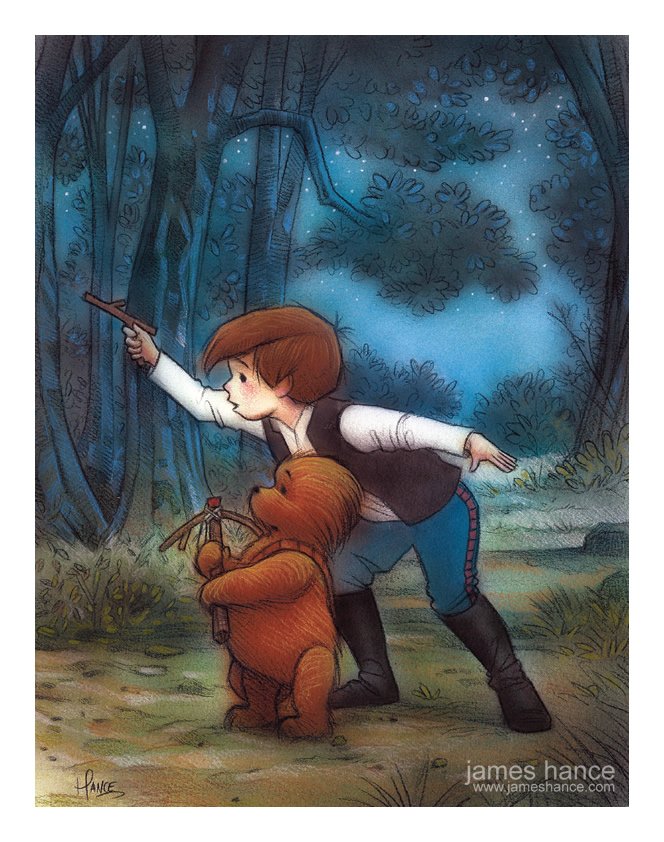
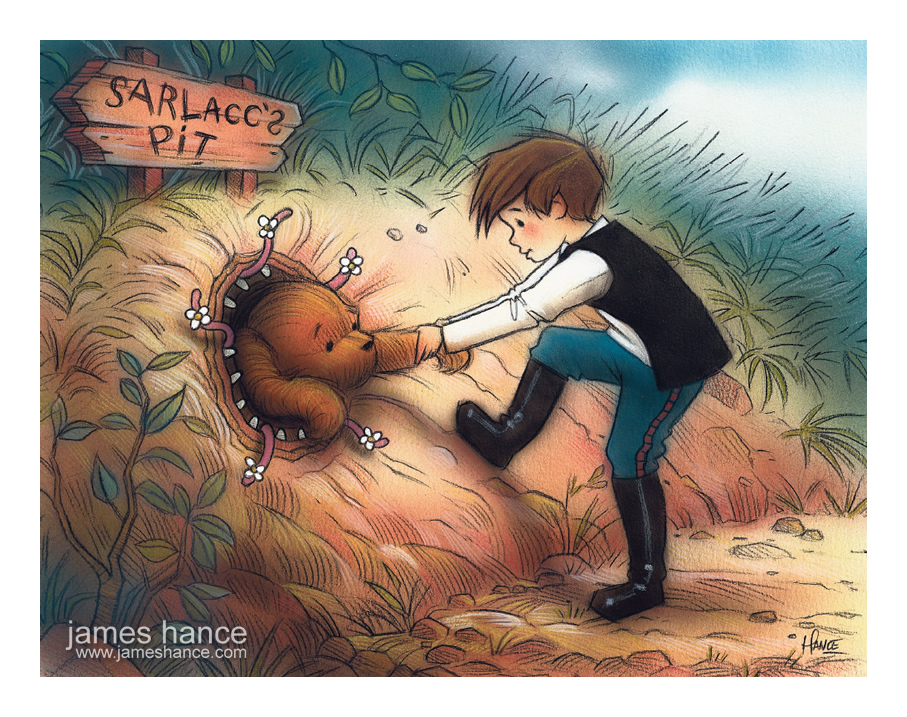
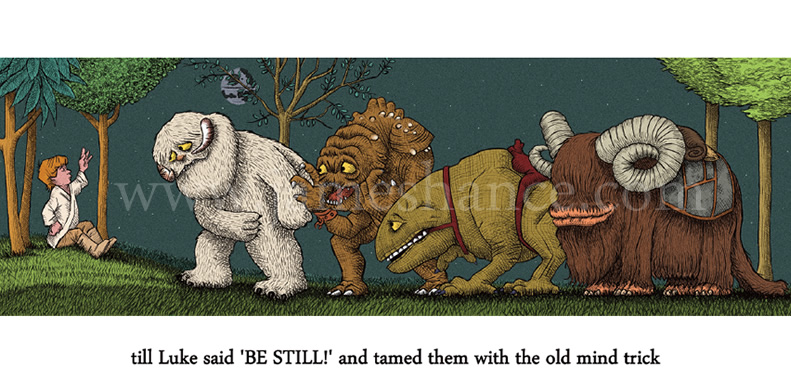
So there’s this artist out there by the name of James Hance. And this, my friends, is just the tip of the iceberg in terms of the content he has available. Here’s a taste:
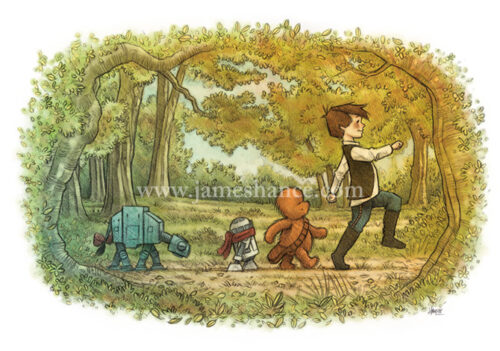
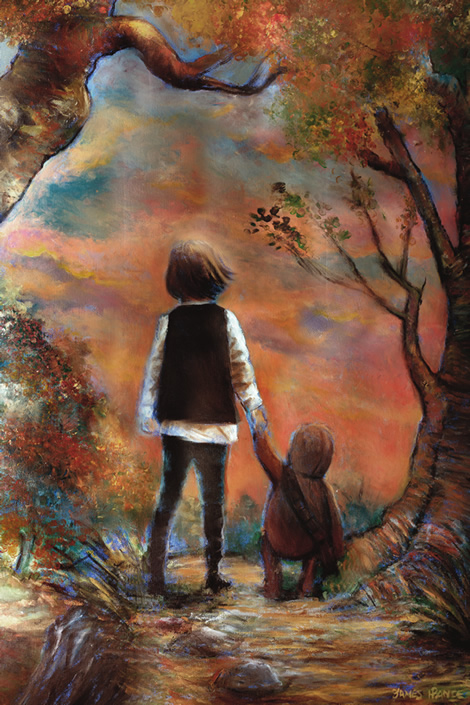
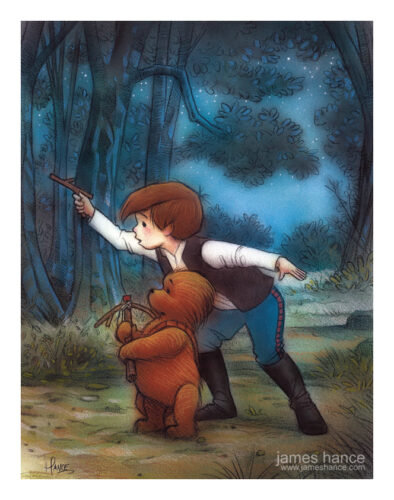
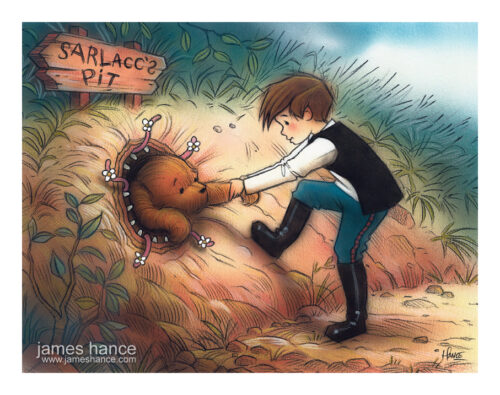
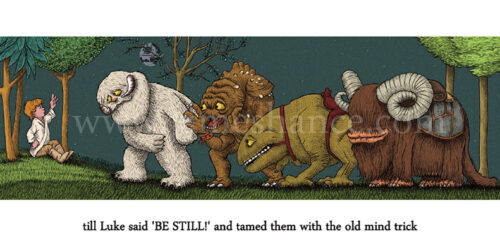
Thanks to Stephanie Whelan for the link.
By:
Betsy Bird,
on 4/21/2015
Blog:
A Fuse #8 Production
(
Login to Add to MyJacketFlap)
JacketFlap tags:
Mathical Book Award,
children's book awards,
author blogs,
Where the Wild Things Are,
Jonathan Lethem,
Jeanne Birdsall,
Miyazaki,
The Story of Ferdinand,
reading studies,
Fusenews,
Me stuff,
dangerous craft program ideas,
Holocaust books for kids,
Willy Wonka and the Chocolate Factory,
Add a tag
 Mmm. Vanity straight up. So I never quite know how to post “me stuff” news when it’s particularly nice. On the one hand I could post the link with the typical “I’m not worthy” statement attached, but that always sounds as if I doth protest too much. Or, I could go the other route, and just celebrate the link with a whole lotta hooplah and devil take the consequences. I think, in the end, I’d prefer to just preface the link with a long, drawn out, ultimately boring explanation of why these links are problematic in the vague hope that your eyes glazed over and you skipped to the next bullet point. That accomplished, here is a very nice thing I was featured in recently at Bustle. I think Anne Carroll Moore probably should have taken my slot, but insofar as I can tell, she is not around to object.
- There comes a time in every girl’s life when she realizes that all the funny stuff on the internet was written by a single person. That person’s name, it turns out, is Mallory Ortberg. And if you doubt my words, read her recent Toast piece The Willy Wonka Sequel That Charlie’s Mother Deserves. It’s applicable to the book as well, though in that case it would be “The Charlie and the Chocolate Factory Sequel That Charlie’s Mother and Father Deserve”.
- It was Jarrett Krosoczka who alerted me to the fact that Jeanne Birdsall has a blog. Jeanne, you sly devil! Why didn’t you tell us?
- Are discussions of children’s book illustrations given adequate attention when people interview authors about the books that influenced them when they were young? Mark Dery at The Ecstasist doesn’t think so. In a recent interview with Jonathan Lethem, the two discuss, amongst other things, Alice’s Adventures in Wonderland, a psychedelic children’s book by popular shrink, Dr. Eric Berne (who wrote Games People Play) called The Happy Valley, The Goops, Rabbit Hill, and the odd thickness (and hidden erotic meanings) behind Ferdinand the Bull’s neck.
- I don’t usually advertise journal’s calls for contributions, but this seemed special. Bookbird (a journal close to my heart for obvious reasons) is calling for contributions for a special issue exploring Indigenous Children’s Literature from around the world. So if you’ve a yen . . .
 Recently I hosted a Children’s Literary Salon on Jewish children’s literature, its past, present, and future. It was a really great talk and has inspired, I am happy to note, a blog post from one of the panelists. Marjorie Ingall of Tablet Magazine recently wrote the piece Enough With the Holocaust Books for Children!: Yes, we need to teach kids about our history. But our history constitutes a lot more than one tragic event. It quotes me anonymously at one point as well. See if you can find me! Hint: I’m the one who’s not Jewish.
- And to switch gears, the cutest children’s librarian craft idea of all time. A teeny tiny traffic jam. Alternate Title: Dana Sheridan is a friggin’ genius.
- Not too long ago I helped usher into completeness a brand new children’s book award. Behold, one that’s all about the math!! Yes, like you I was an English major who thought she feared the realm of numbers. Now I see the true problem: there were no good math books for me as a kid (and subsisting entirely on a diet of The Phantom Tollbooth doesn’t really work, folks). Now worry not, interested parties! The Mathical Award is here and the selections, not to put too fine a point on it, are delightful.
- Out: Dark Matter. Five Minutes Ago: Gray Matter. In: White Matter. At least when it comes to how children learn to read. The New Yorker explains. Extra points to author Maria Konnikova for the Horton Hatches the Egg reference buried in the text.
- Full credit to Aaron Zenz for turning me onto the site Sketch Dailies. Cited as a place “that gives a pop culture topic each week day for artists to interpret” there are plenty of children’s literature references to be found. Draco Malfoy. The Very Hungry Caterpillar. Hedwig (more owl than Angry Inch). Warning: You will get sucked in, possibly for a very very long time. Three of the Very Hungry Caterpillar winners recently were here, here, and here.
- Oop! The end of the voting on the Children’s Choice Book Awards is nigh. Your last chance to “voice your choice” is looming. Voting for @CBCBook’s Children’s Choice Book Awards closes at ccbookawards.com on May 3rd. And, if I might be so bold, you may notice something a little . . . um . . . interesting about this year’s hosts of the CBC Gala. *whistles*
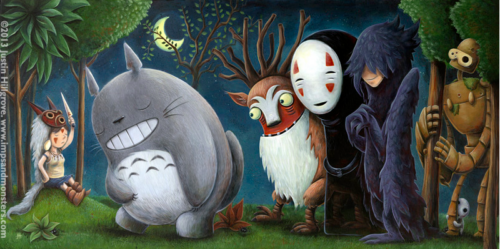
This one’s going out to all my Miyazaki fans. In the event that you ever needed a new poster for your walls. The title is “And Made Her Princess of All Wild Things:
By:
Betsy Bird,
on 9/26/2014
Blog:
A Fuse #8 Production
(
Login to Add to MyJacketFlap)
JacketFlap tags:
Harry Potter,
Philip Pullman,
Michigan,
Where the Wild Things Are,
Iron Man,
Aaron Zenz,
New Blog Alert,
Kalamazoo,
Fusenews,
death of cursive,
René Saldaña Jr.,
Add a tag
 There comes a time when I have so much news for a Fusenews that it paralyzes me and rather than write one up I just let my files accrue more and more schtoof until the vicious circle ends with a massive deletion. Today some of this stuff will strike you as a bit out of date, but the bulk is pretty darn fun.
- Anytime I write a post that involves race in some way I gird my loins and prepare for the worst. The worst did not occur yesterday, however, when I wrote about moments of surprising racism in classic children’s books. Perhaps everyone was distracted by Jonathan Hunt’s post on The Present Tense. Now THAT is a hot and heavy discussion!
- Oh, Cotsen Children’s Library. Is there anything you can’t do? Because, to be perfectly frank, I think even the prospect of interviewing Philip Pullman would render me effectively mute. And then there was that AMAZING piece on the woman who makes Harry Potter miniatures. Seriously, this is your required reading of the day.
- Because I love Kalamazoo in all its myriad forms, this caught my eye. For you Michiganders out there:
In February 2014, 95 youth librarians, youth library workers, and students gathered at Clinton-Macomb Public Library for a truly excellent day of professional development, idea-sharing, networking, and learning, unconference style. In 2015, we’ll gather April 24th at Kalamazoo Public Library. Hosted by Lisa Mulvenna (Clinton-Macomb PL), Anne Clark (Alice and Jack Wirt PL, Bay City), and Andrea Vernola (Kalamazoo PL), the MI KidLib Unconference will feature relevant and engaging sessions decided on by participants at the conference. And as is typical of an Unconference, it’s FREE to attend. Registration begins in January 2015.
Here are the session notes from last year in case you want to see what we learned together. We hope you’ll join us and spread the word to anyone who’s interested in youth services in libraries!
- If you had told me even two years ago that I would be the de facto mathematics librarian, ideal for moderating events like the Science & Mathematics Panel of Jordan Ellenberg, “Science Bob” Pflugfelder, and Benedict Carey at the Penguin Random House Author Event for NYC Educators, I would have been utterly baffled. And yet here we are. Know any teachers in the NYC area? Because the whole kerschmozzle appears to be free.
- Things That I Didn’t Know Existed Until Recently: Apparently the Smithsonian Asian Pacific American Center created a site called BookDragon that seeks to create a site for multicultural children’s literature. And not just of the Asian Pacific nature either. It’s a true multicultural site and a fun one to scroll through. Check it!
- This came out a while ago so I’m sure you already saw it, but just in case you didn’t, the Marc Tyler Nobleman Kidlit Mashups are nothing short of inspired.
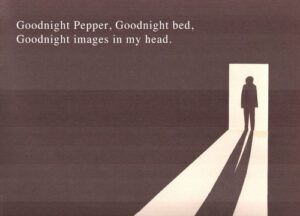 Oh man. Iron Man as a goodnight picture book done in a homemade cut paper style. Not a real book. Should be though. Thanks to Marjorie Ingall for the link.
One of my favorite illustrators, Aaron Zenz, wrote me the following message you would be very wise to read it, oh those amongst ye with an artistic bent. This art gives light and life and meaning to my day:
We play this game on our second blog every three years or so, and I believe you’ve made note of it in the past. So I thought I’d let you know this time around also that we’re letting professional illustrators and artists dip into the 8 year archive at Chicken Nugget Lemon Tooty to reimagine Z-Kid art once again:http://www.isaacgracelily.blogspot.com/2014/08/8yearcelebration.html
There have been some great kid lit contributors in the past like Nathan Hale, Charise Harper, Jarrett Krosoczka, Renata Liwska, Adam Rex… And even though the call just went out for this new round, kid lit folks Julie Phillipps and Doug Jones have already hopped on board (both of them have also played all three times!)
Go! Play!
- My sister wrote me the other day to ask for a recommendation of a great children’s book about a jellyfish. I complied then found out why she wanted to know. I love it when she succeeds in her crazy plans on her blog but truth be told she’s awfully hilarious when she fails. It’s a Jellyfish in a bottle [FAIL].
It’s nice to have friends who know boats. Particularly when they start critiquing classic works of children’s literature. My friend Stefan Driesbach-Williams recently posted this familiar illustration:
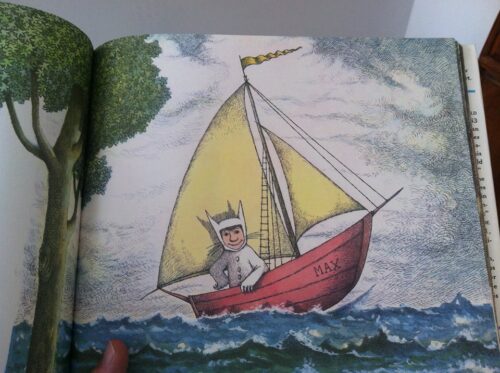
Then he wrote, “I’m seeing a cutter with a loose-footed staysail and a boomkin.”
But it was the response from his nautical friends that made my day. One Levi Austin White responded with the following:
“Aye! Captain Max has only got his smallest storm stays’l aloft like a prudent mariner, although his main looks really drafty and dangerously powered up.
He seems to have his main trimmed in all the way, but headed dead downwind. That seems like a disastrous combination considering his mains’l tuning. I don’t see any reef points on his main though, so perhaps he’s outta luck.
Any news on his journey? Did he survive the storm? The way the seafoam is scudding across the wave tops, I’d say that he’s on the lee shore of a low lying island, with 50-70 kts windspeed. Looks properly vicious.
Best of luck, Captain Max. May the seas be forever in your favor.”
By: Marissa Wasseluk,
on 9/9/2014
Blog:
First Book
(
Login to Add to MyJacketFlap)
JacketFlap tags:
Books & Reading,
Maurice Sendak,
First Book,
Where the Wild Things Are,
Back to School,
school supplies,
Virtual Book Drive,
Virtual Book Drives,
back to school fair,
wilson north carolina,
Add a tag
Wendy Moore’s best friends couldn’t wait to give her a special surprise for her 50th birthday. To honor her great love for books, they set up a virtual book drive with First Book and collectively raised over $1200 to purchase brand-new books for kids in Wendy’s hometown of Wilson, NC.
The need for books in Wilson County Schools is high. Located a little over an hour outside of Raleigh, the rural district ranks as Tier One community – a title reserved for the most distressed counties in the state. But Wilson residents like Wendy are committed to their children’s education.
Every year the county hosts a Back-to-School Fair, an event that celebrates education and equips kids with backpacks and school supplies for the upcoming school year.
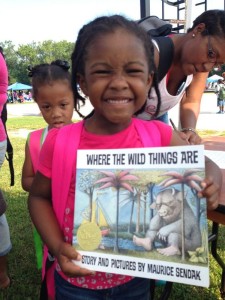
Journey received one of the free copies of Where the Wild Things Are at the Wilson County Back-to-School Fair. She said the book is her favorite!
The event draws hundreds of the community’s neediest families, many lining up as early as 10 p.m. the night before the fair in order to receive school supplies.
At this year’s fair, Moore joined staff at the Wilson County Schools booth to distribute the books purchased through First Book with the funds raised by her friends. In less than 90 minutes, all 420 copies of her selected book Where the Wild Things Are were in the hands of excited students.
“Hopefully it will inspire at least one kid to dream and do things that go far,” said Moore.
In your hometown and across the nation, kids need books to foster a love of learning. Click here to find out more about hosting your own virtual book drive.
The post A Birthday Surprise: 420 Books for Kids appeared first on First Book Blog.

 #1 Where the Wild Things Are by Maurice Sendak (1963)
533 points
Arguably the single greatest picture book ever created. – Hotspur Closser
Some argue that Sendak did better work than Wild Things during the span of his career and while I agree on some level that this is true, I think his other books appeal to people on different, individual levels. In truth, there has never been a picture book made that has reached so many people on so many levels like Wild Things. I mean, we are all a little mischievous, we are all a little bit adventurous (even if only in our hearts), and we all have a deep longing to be taken care of and fed good things to eat. – Owen Gray
Because it makes my tongue happy to speak lines such as, “And sailed back over a year and out of weeks, and through a day into the night of his very own room.” And because it makes my heart happy to end a story with, “Where he found his supper waiting for him, and it was still hot.” – DaNae Leu
There is no moment in any picture book more perfect than when Max returns to his room and his dinner is still hot. Enough said. – Katie Ahearn
The evolution of picture books can be broken down into two time periods: Pre-Wild Things and Post-Wild Things. Sendak’s 1963 book was that instrumental in ushering in the modern age of picture books. While tackling themes of anger and loneliness, Sendak created one of the few picture books that still seems fresh after decades in print. – Travis Jonker
For me this has to be number 1, not only because it’s a wonderful adventure story for little ones, not only because it demonstrates the power of imagination, not only because love, anger, defiance, and love again are so inextricably intertwined, not only because it’s a amazing example of how an illustrator combines the elements of design so successfully, but because it does all these things in 32 pages and 1200 words, AND children love it! - Diantha McBride
It is what it is, and, it is the best. It reminds you every time you read it why it is the best. You want to read it to every child you love, every child you like, and every child who drives you crazy. - Laura Reed
What is there to say about such a classic? It deserves all the accolades it has gotten through the years. It allows kids to be wild and misbehave and go off to the jungle, but wake up in their very own room and dinner is still warm. A comforting but fun book. - Christine Kelly
You can’t beat how much fun this book is to read. And, amazingly enough, I still have it memorized (even though I don’t think I’ve read it aloud in a couple of years). – Melissa Fox
Classic. When I heard they were going to make a movie out of the book I thought, “What?” Part of what makes this book so special is the wordless page spreads… just wild things making a rumpus… I love that Sendak gives children the power to just absorb those images. Awesome stuff. – DeAnn Okamura
Still perfectly crafted, perfectly illustrated. It doesn’t really matter that Maurice Sendak is sick of the thing, this is simply the epitome of a picture book. Sendak, like Shel Silverstein and Roald Dahl, rises above the rest in part because he is subversive. Max is not a sweet little boy, he’s a crazy little kid like so many are in real life. And yes, the monsters represent his wildness, but that’s boring from a young reader’s standpoint. The fact is, Max gets to go have a monstrous adventure, and then he comes home and finds, not only soup, but a slice of cake. Because p
"And when he came to the place where the Wild Things are,
they roared their terrible roars. And gnashed their terrible teeth.
And rolled their terrible eyes. And showed their terrible claws…"
"Please don't go. We'll eat you up. We love you so."
from
Where the Wild Things AreIt's hard to add anything new to the tributes to Maurice Sendak that have been flowing in since his death on Tuesday, so I'll just let the great one speak for himself. Here are some quotes that especially resonate with me.
"You cannot write for children. They're much too complicated. You can only write books that are of interest to them."
"I believe there's no part of our lives, our adult as well as child life, when we're not fantasizing, but we prefer to relegate fantasy to children, as though it were some tomfoolery only fit for the immature minds of the young. Children do live in fantasy and reality; they move back and forth very easily in a way we no longer remember how to do."
"A woman came up to me the other day and said, 'You're the kiddie-book man.' I wanted to kill her."
"Once a little boy sent me a charming card with a little drawing on it. I loved it. I answer all my children's letters--sometimes very hastily--but this one I lingered over. I sent him a card and I drew a picture of a Wild Thing on it. I wrote, "Dear Jim: I loved your card." Then I got a letter back from his mother and she said, "Jim loved your card so much he ate it." That to me was one of the highest compliments I've ever received. He didn't care that it was an original Maurice Sendak drawing or anything. He saw it, he loved it, he ate it."
"There must be more to life than having everything."
"I have a little tiny Emily Dickinson so big that I carry in my pocket everywhere. And you just read three poems of Emily. She is so brave. She is so strong. She is such a sexy, passionate, little woman. I feel better."
"I'm not Hans Christian Andersen. Nobody's gonna make a statue in the park with a lot of scrambling kids climbing up me. I won't have it, okay?"
I canceled today’s post, because even though you probably have heard of Maurice Sendak passing away yesterday, he really deserves to have it recognized.
Maurice Sendak, widely considered the most important children’s book artist of the 20th century, who wrenched the picture book out of the safe, sanitized world of the nursery and plunged it into the dark, terrifying and hauntingly beautiful recesses of the human psyche, died on Tuesday in Danbury, Conn. He was 83.
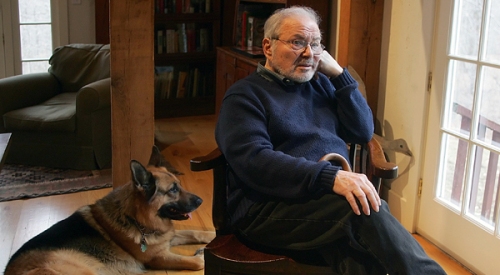
Mr. Sendak’s books were essential ingredients of childhood for the generation born after 1960 or thereabouts, and in turn for their children. He was known in particular for more than a dozen picture books he wrote and illustrated himself, most famously “Where the Wild Things Are,” which was simultaneously genre-breaking and career-making when it was published by Harper & Row in 1963.
Among the other titles he wrote and illustrated, all from Harper & Row, are “In the Night Kitchen” (1970) and “Outside Over There” (1981), which together with “Where the Wild Things Are” form a trilogy; “The Sign on Rosie’s Door” (1960); “Higglety Pigglety Pop!” (1967); and “The Nutshell Library” (1962), a boxed set of four tiny volumes comprising “Alligators All Around,” “Chicken Soup With Rice,” “One Was Johnny” and “Pierre.”
In September, a new picture book by Mr. Sendak, “Bumble-Ardy” — the first in 30 years for which he produced both text and illustrations — was issued by HarperCollins Publishers. The book, which spent five weeks on the New York Times children’s best-seller list, tells the not-altogether-lighthearted story of an orphaned pig (his parents are eaten) who gives himself a riotous birthday party.
To rest the rest of the article written by MARGALIT FOX in May 8th New York Times, click the link below:
http://www.nytimes.com/2012/05/09/books/maurice-sendak-childrens-author-dies-at-83.html
Christina Tugeau’s post: http://catugeau.wordpress.com/2012/05/08/loss/
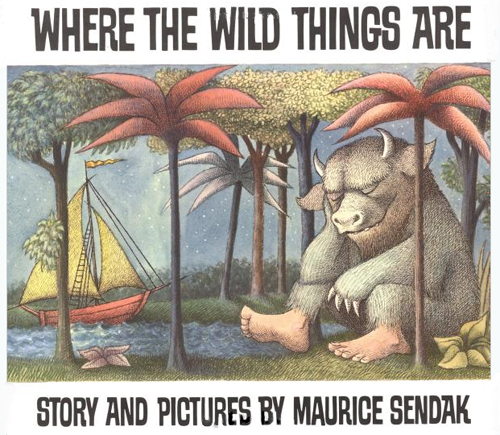
Mr. Sendak, thank you for your wonderful contribution to children’s books. You will be missed! We all are happy that we can still have a part of you and share your talent with the generations to come.
Talk tomorrow,
Kathy
Filed under:
authors and illustrators,
bio,
News,
Uncategorized Tagged:
Goodbye,
Maurice Sendak,
Where The Wild Things Are 
 9 Comments on Maurice Sendak, last added: 5/10/2012
In a Nutshell: The Worlds of Maurice Sendak, a traveling exhibit, recently came to my local library. Yesterday I went to see it and to hear a talk on how Sendak connects with his Easter European roots. The lecturer put Sendak's work in historical context, showing how Jewish immigrants (such as Sendak's parents) kept one foot in the old world, through memories and by keeping in touch with relatives who remained in Europe.
The exhibit and talk brought home what John Cech, a professor of children's literature and author of a book about Sendak, once said in an interview in the New York Times. "His whole life's work in some way is an attempt to understand and fathom the complexity of that heritage, with its almost unbearable legacy of loss."
Here's a sampling of the fascinating tidbits I discovered:
In Where the Wild Things Are, the spread of the wild rumpus is the only scene in which the monsters take their eyes off Max. Their eyes are fixed on the Moon, that mysterious orb that can change men into wolves and other beasts of the night.
The Lindbergh kidnapping always held a special horror for Sendak. During the time the story was in the news, young Sendak made his father sleep on the floor next to his bed, a baseball bat at the ready. An uncle, hearing this, inquired "Philip, who would want your children?" Sendak took offense at his uncle's remark, and years later took his revenge, turning the man into the ugliest of the monsters in Where the Wild Things Are. Which one was that? He never said.
Sendak based the illustration of the character Atzel in Isaac Bashevis Singer's Zlateh the Goat and Other Stories on a photograph of Sendak's grandfather that once hung in his bedroom. While suffering the effects of scarlet fever as a boy, a delirious Sendak tried to climb into the frame. His mother snatched the photo of her father and, in her fear, tore it up to protect her son. Years later, after his mother had died, Sendak found the torn pieces stuffed into tissue paper and had the photo restored.

Fun Fact: Remember that Re-Seussification Project I posted? And how it happened to come out the day before the birthday of the good doctor himself? Total coincidence. I had no idea. At the same time The Lorax has come out in theaters. Know how I know? Because every other minute there’s an ad on my television featuring the Lorax. Seems he’ll sell anything these days. Chaps my hide. Chaps Stephen Colbert’s too, I’m happy to report.
Full credit to this next link. This compilation of Judy Blume pop culture references has earned my respect, partly because it included the two I already knew of (Sawyer reading her book on LOST and the Saturday Night Live skit). Very fun to watch.
Which, naturally, leads to this. And I suppose it isn’t workplace appropriate. But it is sweet.
That was recorded almost half a year ago. I assume they’ve met by now, yes? I mean, she is married to a Newbery winner.
I think this is applicable to our usual subject matter today. After all, I suspect that there are a few authors out there for kids that still use typewriters. I used one as recently as 2006 in conjunction with my job. Plus this is a great little piece.
Thanks to Playing By the Book for the link.
I’ve shown the video of Christopher Walken reading The Three Little Pigs before. This one, though, is new to me. We never see him who I’m not wholly convinced it’s actually him. It’s a possibility, though. A distinct possibility.
Thanks again to Playing By the Book for the link.
And finally, for our off-topic video, what can I say?
Baby otters.
Thanks to Dan McCoy for the link.
 The Colbert Report host Stephen Colbert interviewed Where the Wild Things Are author Maurice Sendak this week. Follow these links to watch part one and part two of the interview.
According to Shelf Awareness, Colbert “turned [to Sendak] for advice on becoming a celebrity children’s author, pitched his sequel idea for Where the Wild Things Are 2: Still Wildin’ (featuring action star Vin Diesel) and generally let the wild rumpus begin.”
During the interview, some of the “rumpus” that emerged included Sendak’s opinion on the current state of children’s literature; he finds it “abysmal” and thinks that “most books for children are very bad.”
continued…
New Career Opportunities Daily: The best jobs in media.
What am I reading now? The Tree Girl by Darlene Twerdochlib
The New York Times‘ Maria Tatar published an article entitled “No More Adventures in Wonderland” on Sunday, October 9, 2011. The premise of the piece is the prevalence of darkness in children’s literature. Tatar contends that “[c]hildren today get an unprecedented dose of adult reality in their books, sometimes without the redemptive beauty, cathartic humor and healing magic of an earlier time.”
My issue with Tatar’s article is not her vehemence against darkness; I made my thoughts clear on the subject with my post Darkness Too Visible. Instead, my issue springs from the books she calls upon to give validity to her argument: J.K. Rowling‘s Harry Potter, Philip Pullman‘s “His Dark Materials” and Suzanne Collins‘ The Hunger Games. Tatar uses these books to exhibit that “the savagery we offer children today is more unforgiving than it once was … we have stories about children who struggle to survive.” The truth is, these books are detrimental to her argument because they do not fall under the genre of children’s literature. They come under the umbrella of young adult literature.
The book industry is a business like any other and the aforementioned books wouldn’t be published if there wasn’t a market for them. So, perhaps, the issue isn’t the existence of darkness in children’s literature but rather why it is so prevalent in young adult literature.


0 Comments on
“No More Adventures in Wonderland” as of 1/1/1900



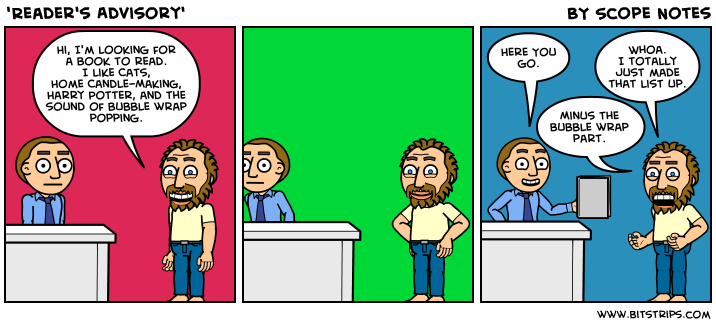
 Yes, my Bachelor’s was also in Math, and Math was my first Master’s — I taught college math for 10 years. Just between you and me, I *love* the career change to Librarian, and haven’t looked back — but I also really love doing Math-related library programs. (Did you know that Bedtime Math has a prepackaged Math Club they offer for free to libraries? It’s awesome!) And the Mathical Award? Call me totally jazzed.
 . Funny side note: I read this book to my son again the night this was announced and when I finished it he said, “You mean warm, daddy, WARM. You can’t eat if it’s HOT.”


 On September 6th, Where the Wild Things Are author Maurice Sendak will release Bumble-Ardy. This picture book will be the first publication Sendak has written and illustrated completely on his own since Outside Over There (1981).
.jpeg?picon=3514)


.jpg?picon=512)


![[info]](http://l-stat.livejournal.com/img/userinfo.gif)


Love the birds and flowers!
“One of the most amusing books in the world.” Now THERE’S a blurb! I think I need to add more birds and flowers to my book…
Will the awards be live-streamed this year? Thanks.
Thanks for the link to Monica’s article. Like most (if not all) of Monica’s writing, it was thoughtful and lovely and spot-on.
Also, the bird or flower photos – great! I’m trying to think of a way to weave this into a lesson…
So many great links, thank you! On an unrelated topic, I’ve noticed lately that when readers get to the last page of a picture book they frequently turn the page to see if there is more to be read. It seems rather anti-climactic to reach the end of a book and not realize it’s the end. Really ruins the punch line, so to speak. I would like the words THE END to come back in vogue for picture books, anyone else have thoughts on this?
But of course! I can’t find the link now (they may not have it up yet) but will keep you informed accordingly.