What is JacketFlap

  • JacketFlap connects you to the work of more than 200,000 authors, illustrators, publishers and other creators of books for Children and Young Adults. The site is updated daily with information about every book, author, illustrator, and publisher in the children's / young adult book industry. Members include published authors and illustrators, librarians, agents, editors, publicists, booksellers, publishers and fans.
    Join now (it's free).

Sort Blog Posts

Sort Posts by:

  • in
    from   

Suggest a Blog

Enter a Blog's Feed URL below and click Submit:

Most Commented Posts

In the past 7 days

Recent Comments

JacketFlap Sponsors

Spread the word about books.
Put this Widget on your blog!
  • Powered by JacketFlap.com

Are you a book Publisher?
Learn about Widgets now!

Advertise on JacketFlap

MyJacketFlap Blogs

  • Login or Register for free to create your own customized page of blog posts from your favorite blogs. You can also add blogs by clicking the "Add to MyJacketFlap" links next to the blog name in each post.

Blog Posts by Date

Click days in this calendar to see posts by day or month
new posts in all blogs
Viewing: Blog Posts Tagged with: Japanese, Most Recent at Top [Help]
Results 1 - 25 of 43
1. V&A DISPLAY- marks japan

the V&A museum in london have created an installation in collaboration with mark's tape in their store windows. the display design by debbie spink aims to offer an alternative way of thinking about an everyday object and suggests fabulous ways to decorate everything from your walls and gifts to letters, furniture and frames. the new MT casa tape will be coming in march but the current

1 Comments on V&A DISPLAY- marks japan, last added: 2/7/2013
Display Comments Add a Comment
2. TEXTILES - quarter report

having a little bit of time to spare over christmas i decided to do a little bit of browsing on a few japanese websites to see what new designs were coming out of tokyo. i discovered lots of lovely fabrics from quarter report that i hadnt seen before including a majority by designer rieko oka who has created lots of delicate florals and trees. see more from quarter report online here.

0 Comments on TEXTILES - quarter report as of 1/16/2013 3:04:00 AM
Add a Comment
3. JAPANESE - shinzi katoh

my japanese browsing then led me to these lovely 2013 shedules by legendary japanese designer shinzi katoh. as spotted at the zakka shop online here.

0 Comments on JAPANESE - shinzi katoh as of 1/16/2013 3:04:00 AM
Add a Comment
4. JAPANESE - sunny style

and finally from japan today a few choice items picked out from the cute sunny style website.

2 Comments on JAPANESE - sunny style, last added: 1/16/2013
Display Comments Add a Comment
5. Meet Mecha Mickey and the Disney Super Sentai

We’ve come a long way from Steamboat Willie. Apparently Disney and toy-maker Bandai are working together on a Voltron-like toy robot called King Robo, and according to the storyline, Mickey Mouse and his friends supposedly pilot the robot. The toy, part of the Bandai’s Chogokin line, will be released March 2013, and unlike most Disney toys, it will be aimed at ages 15 and up. If successful, the property could spawn an anime series.

And speaking of Steamboat Willie, apparently the robot’s head transforms from a toy version of the paddle boat from that landmark film! Click the image below to see how each Disney-mecha character transforms into the body and limbs of “King Robo”.

(Thanks, Liam Scanlan)

0 Comments on Meet Mecha Mickey and the Disney Super Sentai as of 1/1/1900
Add a Comment
6. JAPAN - earthquake/tsunami

everyones thoughts this week have surely been with japan following the earthquake and tsunami disaster which happened a week ago today. most of us in the design community are such fans and admirers of this great country - you only have to think of some of our favourite companies and designers such as kokka, decole, shinzi katoh, jeu de paumes, and many more. so naturally the community on etsy and

2 Comments on JAPAN - earthquake/tsunami, last added: 3/20/2011
Display Comments Add a Comment
7. Hachi the Dog, Debt, and Japanese Language

By Lisa Shoreland


Despite its reputation for outlandish costumes and outrageous practical jokes, traditional Japanese culture is one of nearly unmatched gravity and obsession with honor.  Although tourists can easily learn simple phrases like “Thank you” (arigatō) and “Excuse me” (sumimasen), serious Japanese language learners benefit from understanding the history of the nation’s shame culture.

On and Debt in Japan

Even arigatō and sumimasen—two of the first words any Japanese language learner must master—illustrate a key concept in both Chinese and Japanese culture.  The word in Japanese is on, although any literal translation to English bastardizes the concept since Westerners do not share the Far East’s attention to indebtedness.  This hasn’t stopped translators, who try to explain that on means “obligation.”

Ruth Benedict, renowned author of The Chrysanthemum and the Sword, says that “Because Westerners pay such extremely slight attention to their debt to the world and what it has given them in care, education, well-being or even in the mere fact of their ever having been born at all, the Japanese feel that our motivations are inadequate.  On is in all its uses a load, an indebtedness, a burden, which one carries as best one may.”

Hachi the Dog

Benedict cites the story of Hachi—the loyal dog made famous to Westerners by the 2009 movie Hachi: A Dog’s Tale with Richard Gere—which Japanese teachers often tell younger children in ethics classes.  In the story, a stranger takes in a stray dog and nurses him to health.  The dog feels indebted to the human, his master (nushi), and follows him to and from the train station every day.  One day, the man dies while at work; the dog waits at the train station nevertheless, waiting for his master’s return.  He repeats the habit daily until he dies nine years later.

Hachi’s romanticized sentiment—as sad, futile, and even masochistic as it may seem to outsiders—is an example of on

On as a Burden

Because on is a burden, Benedict says that the Japanese are leery of getting entangled in situations requiring it.  Even accepting a cigarette from a kind stranger makes a traditional Japanese individual uncomfortable.  In such situations, one may say, “What a poisonous feeling” (kino doku).  Although kino doku roughly translates to “Thank you” in English, the underlying concept remains foreign to most Westerners.

Benedict explains: “‘It’s easier to bear,’ a Japanese said to me, ‘if you come right out and acknowledge how bad it makes you feel.  You had never thought of doing anything for him and so you are shamed by receiving an on.’”

Even a word like “Thank you” (arigatō) carries a deep sense of on masked by its common usage.  Traditionally, the word can be roughly translated into English: “What a difficult thing.”  The “difficult thing” is receiving the on.  Also, sumimasen literally means, “This does not end.”  Although commonly said when squeezing through a crowd or thanking someone for a gift, the understood meaning (often forgotten in modern usage) is that “I can never repay you for this debt.”

On Today

Although modern Japanese citizens and Japanese language learners have no need to flagellate themselves, Japan’s culture remains one tightly bound to its notion of shame and honor.  To receive an on is still shameful in varying degrees but usually accompanied with a feeling of warmth and gratitude more than guilt these days.  Still, any arigato or

0 Comments on Hachi the Dog, Debt, and Japanese Language as of 1/1/1900
Add a Comment
8. Five lessons from Japan

By Anthony Scioli


Recently Japan’s 77 year old Emperor Akihito implored his people “not to abandon hope”.  This may have struck some Westerners as odd since Japan is an Eastern country largely dominated by Buddhism and Shinto, faith traditions that many associate with mindfulness, acceptance and renunciation rather than hope for the future, transformation, or worldly pursuits.  In fact, it is not uncommon to find Westerners who believe that “hope” does not even exist in the East.  For many American intellectuals, particularly psychologists, hope is associated with the pursuit of specific, concrete goals.  Surely the emperor did not have this kind of hope in mind when he made his appeal?

Hope is not an exclusively western, Judeo-Christian virtue.  There are words for hope in Apache (ndahondii) and Swahili (matumaini) as well as Persian (omid), to name just a few examples.  The largest lab within the International Space Station is called “Kibou”, which means “hope” in Japanese.  But what is hope?  Is it one thing or many things?  What can we learn about hope from the Japanese experience?  In turn, what can the Japanese learn from “hope”?   Can these lessons be combined to form a better psycho-social-spiritual disaster kit?

The kanji for hope

What can we learn about hope from the Japanese?

It is true that hope is partly about goals and mastery.  However, while academic psychologists have tended to conceptualize hope in terms of goal expectancies and narrow-focused probability estimates, the hopes of the common man or woman tend to be more transcendent, more global, and value-laden.  A hope is not a wish.  Unlike optimism, hope is not ego-centered but collaborative, rooted in empowerment and focused on a higher plane of success.   Ironically, the well-known “secondary” or “indirect” control processes (sometimes called “soft power” in business circles) favored in the East are more line with the nature of hopeful mastery than academic psychology’s goal-centered view of hope.   In Japan, the story of the “Fukushima Fifty” has provided a good example of collaborative mastery oriented around a higher goal.  These are the fifty employees of the damaged Fukushima nuclear power company that agreed to continue in the effort to stabilize the plant despite the inevitable exposure to toxic levels of radiation.

Hope is about attachment.  In fact, attachments are probably the most important wellspring for the development of hope. However, if you peruse mainstream psychology, you will find little on hope and attachment.  The one exception is Erik Erikson who believed that trust was the root of basic hopefulness.   The philosopher Gabriel Marcel agreed with Erikson but added openness to the attachment portion of the hope equation. Again, it is curious that this dimension of hope is brought into bolder relief through contact with Japan, albeit a collectivist society, but one not typically associated with this presumably “Christian virtue”.

During a crisis, levels of civility, trust, and openness can quickly plummet.  This is unfortunate because these attachment-related aspects of hope can function as literal life-savers during an earthquake, flood, or other major disaster.

0 Comments on Five lessons from Japan as of 1/1/1900
Add a Comment
9. Acorn needle book - redesigned

Just in time for fall, here's an update to my acorn needle book. I happened to find a little length of Japanese ribbon with squirrels on it at a sweet little shop called Polka Dot Kids. I don't have kids but for some reason... I'm not sure why... I still go into this shop anytime I'm passing by.

Often I tell myself I'd better not splurge on something just because it's adorable. But ribbon with squirrels on it? Well that's actually a logical addition to my sewing supplies. In fact, since I didn't already have ribbon with squirrels on it, I was essentially filling a gap in my supplies. You know, being practical.

So now the acorn needle book is back, with a little squirrel ribbon for a stem and quilt batting inside to give it more structure. I redesigned the shape to be more symmetrical after realizing that the front needed to match the back so that it all lines up when assembled. The acorn needle book is in my shop now, with more on the way.


2 Comments on Acorn needle book - redesigned, last added: 8/27/2011
Display Comments Add a Comment
10. JAPANESE - everyday's feel so happy

i have been mooching around on google japan again recently and came across a lovely label called 'everyday's feel so happy' from the maruwa trading co. they have lots of lovely wall stickers and beautiful paper ornaments. they also sell zakka items such as kitchenware, children's lunch boxes and melamine tableware, oil cloth bags, and books. as seen at their shop one who or contact the parent

1 Comments on JAPANESE - everyday's feel so happy, last added: 10/4/2011
Display Comments Add a Comment
11. JAPANESE - cocoena

cocoena is a japanese online shop that specialise in bringing products from america and europe to the marketplace in japan. they are currently stocking lots of lovely galison christmas lines as well as brands such as sukie, girl of all work, paperchase, and natalie lete.

1 Comments on JAPANESE - cocoena, last added: 10/26/2011
Display Comments Add a Comment
12. Japanese attack Port Arthur, starting Russo-Japanese War

This Day in World History

February 8, 1904

Japanese Attack Port Arthur, Starting Russo-Japanese War


On February 8, 1904, just before midnight, Japanese destroyers entered the harbor of Port Arthur (now Lü-shun, China). Soon after, they unleashed torpedoes against Russian ships in a surprise attack that began the Russo-Japanese War.

The conflict grew over competition between Russia and Japan for territory in both Korea and Manchuria, in northern China. Japan had won Port Arthur, at the tip of the Liaotung Peninsula, from China in an 1894–1895 war. Russia joined with other European powers to force it to relinquish the port, however — and then three years later had compelled China to grant the city to it. These actions rankled Japan, as did Russia’s refusal to honor a promise to withdraw troops from Manchuria. Japan decided to go to war.

The attack on Port Arthur resumed in the late morning of February 9, when bigger Japanese ships began shelling the Russian fleet and nearby forts. The Russians put up more resistance than expected, however, and the Japanese ships withdrew.

The attack on Port Arthur was inconclusive, but the rest of the war went largely Japan’s way. The Japanese enjoyed several victories in 1904, seizing Korea in March, and defeating Russian forces twice in Manchuria during the summer. More success followed in 1905, with the surrender of Port Arthur in January, a victory over a large Russian army in Manchuria in March, and a decisive naval battle at Tsushima Strait in May that destroyed the Russian fleet. Russia’s government, facing unrest at home, was forced to seek peace.

The Russo-Japanese War marked the first victory of a non-European nation against a European one in modern times. It also contributed to unrest in Russia that would lead, more than a decade later, to the Russian Revolution.

“This Day in World History” is brought to you by USA Higher Education.
You can subscribe to these posts via RSS or receive them by email.

0 Comments on Japanese attack Port Arthur, starting Russo-Japanese War as of 1/1/1900
Add a Comment
13. JAPANESE - new decole

from time to time i love to check in with google japan and see whats new at japanese company decole. i was pleased to discover a lovely new children's range called 'petiot petiote'. shown here are a collection of A4 boxes featuring the cute new lion, squirrel, and elephant characters.the new range also fits perfectly with their existing range 'ma petite chambre'.

2 Comments on JAPANESE - new decole, last added: 3/28/2012
Display Comments Add a Comment
14. Saturday Trailer: The girl who leapt through time

What better day for book trailers than a Saturday?

The girl who leapt through time  by Yasutaka Tsutsui(author) and David Karashima (translator) (Alma Books) originally appeared in Japan in 1966 as a science fiction novel written by Japanese writer and actor Yasutaka Tsutsui. Appearing in serial form with the title The Girl Who Runs Through Time, the story soon became a classic and was retold in both live action and anime films.   Karashima  provides the first English version which appeared in Britain in 2011 and makes its US debut this month. Today’s trailer is from the Japanese trailer for the live action movie. The first video is in Japanese with full sound while the second has English subtitles, but no sound. Six of one, half dozen of another.


Filed under: Me Being Me, Saturday Trailers Tagged: book trailer, Japanese

3 Comments on Saturday Trailer: The girl who leapt through time, last added: 9/10/2012
Display Comments Add a Comment
15. Monday Links & Language

New Thicklebit: Tats for Tots.

New interview: Writing on the Sidewalk.

Foreign language app we are finding irresistible, with a deliciously mockable edge: Earworms. (I learned about it at GeekMom. Rose and Beanie are using the German; Jane, the Japanese. Rose likes it so much she ponied up her own funds for the Arabic.)

Other resources Jane is using to learn Japanese (answering Ellie‘s question from my learning notes blog): Pimsleur Approach audio program (check your library for these); Free Japanese Lessons; Learn Japanese Adventure (another free site).

I had such a fun time yesterday recording a Brave Writer podcast with Julie Bogart and her son. I’ll let you know when it goes live! The Prairie Thief is the October selection for Brave Writer’s Arrow program—a monthly digital language arts curriculum featuring a different work of fiction in each installment. Brave Writer is one of the first resources I ever gushed about on this blog, way back in 2005. :) And as you’ll discover in the podcast, Julie Bogart was the blogger who inspired me to start Bonny Glen in the first place!


Add a Comment
16. Sakura Girl

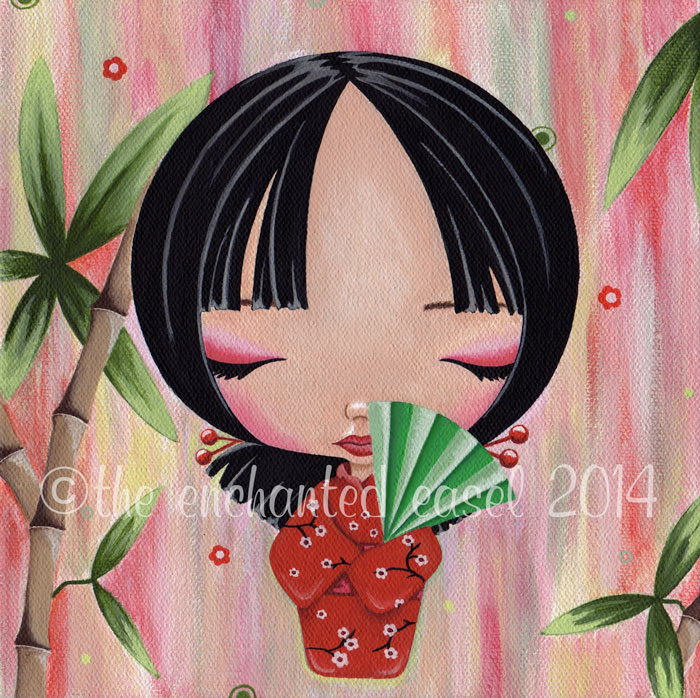
This is my last illustration, made just for fun. It really took longer than my other illos because of the details, the hair, her ornaments, the flowers, etc. Sakura Girl will be available soon at my Zazzle store, printed on T-shirts, posters and more.
sandygrafik.blogspot.com

1 Comments on Sakura Girl, last added: 9/21/2009
Display Comments Add a Comment
17. Japanese spacecraft


Cartoon for the Dutch Nu.nl news website, about a Japanese spaceship that was sent to dock with the ISS space station.

More at Sevensheaven.nl

1 Comments on Japanese spacecraft, last added: 9/21/2009
Display Comments Add a Comment
18. SCBWI Tokyo Hosts an Event with Author/Illustrator Naomi Kojima

As I mentioned the other day, SCBWI Tokyo recently hosted an event titled Storyboards and Picture Book Dummies for Good Bookmaking with picture book author/illustrator Naomi Kojima. Born in Japan, Naomi spent her childhood years in the U.S. and studied sculpture at Rhodes College in Memphis, Tennessee. Her first two picture books, Mr. and Mrs. Thief and The Flying Grandmother were published in New York soon after she joined a Massachusetts SCBWI chapter. Since then, her books have been published in the U.S. and Japan, and translated into French, Swedish, and Indonesian. Her other books include The Alphabet Picture Book and Singing Shijimi Clams which my daughter gave rave reviews to when she borrowed it recently from our local library.

Holly Thompson, Regional Advisor for SCBWI Tokyo, was kind enough to send some photos of the event (which was conducted in English and Japanese!) and writes:

Yes, Naomi Kojima gave a wonderful workshop for SCBWI Tokyo! She covered storyboarding and dummy making, and participants were given sample storyboards as well as text to divide and paste into notebooks to create dummies. Kojima shared several of her own storyboards including one for a new story she is currently developing. At the end participants had a chance to share the dummies they had created and to discuss their different approaches to dividing the text for effective page turns. In the second photo we are all holding books by Naomi.

Thank you for your continued interest in SCBWI Tokyo! We would be happy if you would share this with Paper Tiger readers.

0 Comments on SCBWI Tokyo Hosts an Event with Author/Illustrator Naomi Kojima as of 9/21/2009 9:34:00 AM
Add a Comment
19. U900

I don’t know what’s going on here and I love it and I could watch it over and over for hours. The music is by U900, a Japanese Ukulele duo. Let me repeat that because OMG I’ll never get the chance to type those words together again: Japanese Ukulele duo.

If anyone knows who produced the animation and created the toys, please let us know!


Posted by Luc Latulippe on Drawn! The Illustration and Cartooning Blog | Permalink | 3 comments
Tags: , , ,


10 Comments on U900, last added: 2/9/2010
Display Comments Add a Comment
20. Stephen Colbert Learns Japanese

… from that Scary McCreeperson robot voice simulator. He also defends his previous “racist Chinese” accent as simply brain damage.

If this doesn’t make you laugh, something is wrong with you.

The Colbert Report Mon – Thurs 11:30pm / 10:30c
Robotic Voice Simulator & Foreign Accent Syndrome
www.colbertnation.com
Colbert Report Full Episodes Political Humor Fox News

2 Comments on Stephen Colbert Learns Japanese, last added: 4/27/2010
Display Comments Add a Comment
21. Inspiration from Tokyo- Part 2

Storm Machine Graphics- Wow. I saw them at Design Festa and their table was absolutely amazing. My first thought was- "this is branding at its finest!" (My business side comes out!) They had so many merchandise but all the colors went together and I was just trying to absorb and learn from it. The ABC book is only about 3.75" x 3.75" with a cloth cover. They are probably my favorite find out of my whole trip. Check out their website!

Donut guy cup and "saucer"-those of you who may come to know my tastes probably know why I went nuts over this little guy, and only for 1000 yen! Another purchase from Design Festa but unfortunately I don't have information on the artist, I believe she was from Korea. (Lesson learned- put your name on EVERYTHING that you do!)

Cute creature in "Terrarium"-I believe the artist was there in part of a collective; there was a slight panic when they realized I didn't speak Japanese and they were trying to find someone who spoke English..it was actually quite endearing! There were a bunch of different creatures in bottles all together and it was very striking, so I had to adopt one.

Happy Birthday Pop-Up book from Sanrio Greetings- This mini book came with an envelope so you can send it out. I bought it at Itoya, a stationery store that is all over the place.

7 Comments on Inspiration from Tokyo- Part 2, last added: 6/2/2010

Display Comments Add a Comment
22. White Crane

Fussell, Sandy. 2010. White Crane. Ill. by Rhian Nest James. Somerville, MA: Candlewick.
(Advance Reader Copy)

Set in an undetermined year, after the heyday of the samurai warrior class and prior to its demise in the 19th century, White Crane is an improbable story of a ryu, or Japanese school of martial arts, inhabited by a  revered warrior teacher and his hand-picked students, each disabled in some way.  Niya Moto is White Crane, the story's one-legged narrator, so named for his spirit totem. The white crane is a kindred creature, as comfortable as Niya in standing upon only one leg. Kyoko, the White Monkey is an albino with extra fingers and toes. One-armed Mikko is the Striped Gecko, Taji is blind and guided by the Golden Bat.  Yoshi, pacifist, yet strong and sturdy, still searches for his spirit.  All are under the guidance of the wily Sensei, who is so old that the mere mention of his name usually elicits the response, "I thought he was dead." All are preparing for the yearly ceremonial competition between the Boar, Dragon, Eagle, Rabbit, Snake, Wolf and Cockroach ryus.  Niya's ryu is, of course, The Cockroach; but as Sensei reminds his pupils,
Cockroaches are small, but they are very hard to kill.
Though the characters may be improbable, White Crane is believable.  With writing reflective of the Japanese philosophical code known as Bushido, the reader is drawn into a world in which the most important concerns are Chi! Jin! Yu!, wisdom, benevolence, courage.  White Crane is not without humor, however.  When the boys travel to the village to see the master swordsmith, they bow low to honor his age, reputation and craftsmanship,
He chants as he works, I want to listen, but Onaku's singing is even worse than mine.  Covering my ears would be impolite, so I grit my teeth and hum inside my head. Om. Om. Om. "An honorable sword sings loudly with truth and purity, " Sensei teaches.  No wonder Master Onaku's swords are so prized.  They are born singing at the top of their lungs to drown out their maker's awful voice.

The chapters move swiftly, each containing an illustrated title page and a additional full page, action-packed sketch by Rhian Nest James. With five students, many competing schools, and a fascinating period in history, debut author Sandy Fussell has all the ingredients for a great new series.  Recommended for 4th grade and up.

Read a sample chapter here.
Due on shelves August 2010
Samurai warriors, circa 1880.
(Photograph from Wikimedia Commons)

Bookmark and Share
2 Comments on White Crane, last added: 7/28/2010
Display Comments Add a Comment
23. Review: Dear America: The Fences between Us

Pearl Harbor has been bombed. The government has rationed food. Piper's brother may be dead. And innocent men are going to jail. Click here to read more ...

0 Comments on Review: Dear America: The Fences between Us as of 1/1/1900
Add a Comment
24. JAPANESE - new season decole

from time to time i love to check around the japanese websites and see what decole are up to. i was pleased to see they have a new range out called bon bouquet. its a sweet mix of flowers and polka dots and gingham for a vintage look.

1 Comments on JAPANESE - new season decole, last added: 1/17/2011
Display Comments Add a Comment
25. JAPANESE - petitjam

if you've been reading print & pattern for any amount of time you'll know we love to look at japanese websites to see all the amazing cuteness that they design. here i did some googling to see what new items had been released lately by tokyo based label petitjam.

1 Comments on JAPANESE - petitjam, last added: 1/20/2011
Display Comments Add a Comment

View Next 17 Posts