Nathan here. I first met my friend Julia Forster a decade ago when we were assistants to two US and UK agents who worked closely together. She's now an accomplished author, and her novel What a Way to Go was published on Thursday by Atlantic Books in the UK. I invited her to write a guest post on the writing process. Enjoy!
In the autumn of 2002 I upped sticks from Bristol, England and rented a room in Kensington, Brooklyn for three months. I had an idea for a novel. It was to be set across two locations – New York and Venice.
The book would follow a young girl, Paige, who dreamt of being a cartographer. She was best friends with a boy called Sebastian who had dyslexia. He wanted to build gondolas.
I spent three months “researching” New York, haunting Park Slope coffee shops and bookstores. I volunteered at the Park Slope Food Co-op, and then as a magician’s assistant. I ate a lot of organic broccoli from the Food Co-op but also maxed out on American Pancakes.
One day, I walked straight into Paul Auster outside the Community Bookstore in Park Slope in which I’d had my first ever taste of Green Tea. I grinned at the author inanely, and stepped aside.
I didn’t read much (although I did obsess over Betty Smith’s
A Tree Grows in Brooklyn, which I borrowed from the Brooklyn Public Library) and I wrote even less.
In December, I came back to the UK and realised that, while I had a wealth of ethnographic research and a massive overdraft to boot, I had no book. There was also no plot, no real sense of who my characters were, nor what made them tick.
Fast-forward two years and I was now based in London and working in Soho at a small literary agency. One Friday evening, on my commute home walking alongside the Thames on the South Bank, it struck me that the canvas I had chosen was too epic for me to handle. I decided to shrink it, and write an entirely different book, this time an autobiography.
It would be set in the middle of England where I grew up. My parents had divorced when I was five, so I was brought up in two family homes, one in a town called Northampton with my Mum (population 180,000) and, every other weekend, I was based in a small village with my Dad (population 180).
Over the course of the next year, I drafted 80,000 words. Only then did I realise the two major shortcomings with this project:
1) Nothing happened to me.
2) Nobody knew who I was.
I consigned the book to live under the bed. It served as quite good sound insulation. Aged 32, I moved to rural mid-Wales, with a partner and a three year-old daughter and a nine month-old son. If I turned my back for more than two seconds, my crawling baby son would be found fingering plug sockets or head-butting skirting boards.
By the age of three, he’d been hospitalised twice for whacking his prominent forehead, once having to be put under general anaesthetic in order to stitch his wound up again.
And it was under these circumstances – when I had been reduced to survival mode and when my horizons only reached as far as when I could reasonably consume another cup of strong coffee – that I managed to write the book that would find its way into print,
What a Way to Go.
Can you picture those old-fashioned T-model Fords, the ones which needed a metal hand-crank to get the engine to fire? You’d put the crank into the front of the car, engage the ratchets, and then manually heave it round until the engine stuttered into life.
That was my brain.
My synapses hadn’t fired for that long that to begin with, the connections mis-fired.
For example, you would have thought that in order to commence a novel, you’d launch Word or Scrivener. Well, I launched the Excel application and began to compose my novel in tiny little cells on a spreadsheet.
I am not kidding when I say it took me three months to realise the error of my ways. By that time I was halfway through a six-month writers’ bursary which had been kindly awarded to me by Literature Wales.
By then, I was caffeine-addled and desperate. Turns out, this was the best state of mind in which to write.
I completed
What a Way to Go over the next 18 months. I wrote as if my life depended on it, because it turned out that it did.
More about What a Way to Go: It’s 1988. 12-year-old Harper Richardson's parents are divorced. Her mum got custody of her, the Mini, and five hundred tins of baked beans. Her dad got a mouldering cottage in a Midlands backwater village and default membership of the Lone Rangers single parents' club. Harper got questionable dress sense, a zest for life, two gerbils, and her Chambers dictionary, and the responsibility of fixing her parents' broken hearts...
Set against a backdrop of high hairdos and higher interest rates, pop music and puberty, divorce and death, What a Way to Go is a warm, wise and witty tale of one girl tackling the business of growing up while those around her try not to fall apart.
 When is it not okay to laugh at old people?
My 101-year-old mother, for instance.
Should I get serious and tell her she’s slipping away? That she only weighs about 80 lbs.
And when would I tell her? On our way to the golf course?
Or after we get there, when she’s filling her face with a Sunriser Special of sausages, eggs, toast, and extra fries? Maybe while she’s laughing at my jokes, I could just slip it in? Or perhaps later at her 5-star retirement villa, while she’s glued to the Golf Channel.
It has only occurred to me after all these years that she has been the source of my sense of humour. I always knew how to make her laugh.
I don’t know when she’ll stop laughing but until then I’m going to guiltlessly poke fun at old people.
Here’s a link to MOTHER LOVE where you’ll find a guiltless Reece’s piece about my mother.
“Mother Love” supports the launch of a great new novel by Caitlin Hicks: The Theory of Expanded Love.
Please note: you are allowed to laugh with impunity at anything you find at the end of these links.
 A good story is often inspired by a powerful experience.
One that changed the author’s mind, their very way of looking at the world.
A great story may change the reader’s life as well.
I’m stealing that opening—and the title—from Dr. John Yeoman over at Writers’ Village. John is re-running one of my recent blog posts and reframing it as a lesson for writers.
I wish I was better at addressing writers’ issues. I might have more subscribers.
Most likely, though, I’ll continue to issue my inscrutable Reece’s pieces and defer to Writers’ Village as the forum for writers looking for mentorship and encouragement.
John has recently launched Story PenPal, which is proving to be a spirited venue for writers to post their fiction and receive feedback from peers and story experts.
I’ll get back on track in a few days with a post titled:
“How to Catch an Idea Virus.”
Or, “The Virus that Ate my Brain.”
Or, I’ll ask Dr. John what he would call it.
Nathan here! I'm very pleased to have a guest post today by David Zelster, whose debut novel LUG is going on sale today!
Better yet, we're giving away three signed copies of LUG!
All you have to do is leave a comment asking to be entered (non-anonymously please!), and we'll choose three random winners.
Here's David's post:At every stage of your writing life—from newbie egg, to agented caterpillar, to published butterfly—you will be asked to revise your work. In this guest post, I’d like to share a few of the edits I’ve taken, and not taken, and my golden rule for revising.
The Newbie Egg Stage
When you’re first starting out, your friends and family will dutifully read whatever your hand them. Then they’ll come back to you with stiff little smiles and say things like “it’s good,” “nice work,” and “great job!” The temptation is to believe these oh-so-sweet big fat lies.
Don’t.
In fact, at this point, your job is to try to pry the truth from their stiff little grinning lips. It may take some convincing but, ultimately, they will reveal all.
And then, when they let loose, it’s your turn to grin and bear it.
Here’s a lesson I learned the hard way. Let’s call it:
The Newbie Egg’s Golden Rule of RevisingAlmost all readers’ suggestions have something of value. The key is not so much to take them verbatim as to find the underlying problems that inspired the suggestions--problems that the readers are often not even consciously aware of. If you can detect those issues, you can choose the best way to revise.Once you’ve dived in and taken a pass at fixing the deeper problems, show a few other people your respect. Put your manuscript away for a while. Keep repeating until you’re happy and your readers are no longer just politely grinning. Then, I hope you’ll find yourself in. . .
The Agented Caterpillar Stage
If your agent is worth her salt, she too will have revisions. My agent is Catherine Drayton of InkWell Management. With her permission, I’d like to share a few key excerpts from her LUG edit letter to me:
The Environmental message
I think that the coming of the Ice Age and the parallels with our current environmental crisis are a strong selling point for this book. Lug’s talent is that he is extremely observant and the subtle way you handle this at the moment is perfect. I do however think that you could use some more funny observations from Lug and evidence his frustration that no one else around him seems to notice what is happening to the world. Kids have an uncanny way of zoning in on what’s really important and feel powerful when they can see something that adults can’t.
Characters
I do think that the relationship between Lug and his father is important and could use development especially in the context of choosing the next big man and banishment from the tribe. I want to see more interaction between Lug and his family at the beginning of the book, especially Big Lug. If we see, clearly, what Lug has—we understand better what he is forced to leave.
Language
In terms of the language I think that I would tone down the ‘cave man’ talk. It is always risky to use dialect as it can fall very flat and draw attention to the author. Lug is speaking in perfectly formed English so I’d consider having the others do so as well – even if it is in very clipped, short bursts.
Once you and your agent are happy with your chrysalis...ur...manuscript, my hope is that you’ll emerge into . . .
The Published Butterfly StageOnce you have an editor at a publishing house, you book is in the final revision phase! Although I was excited to steal almost all of my editor’s suggestions for LUG, I thought it might be useful to share a rare example when I chose not to take one. Here’s an excerpt from an email I sent to my editor on that topic:
In a few places you've asked for the removal of certain words or concepts because they seemed too sophisticated for the Stone Age. I had thought about doing this quite a bit in my first drafts of LUG, and ultimately decided against it. Basically, I concluded that I would not write this story as hard (or even soft) science fiction, but rather as satirical comic fantasy.
She quickly took the point, helping me to fine tune the intentionally anachronistic words and concepts I used to satirize our society’s inaction on climate change. I’m grateful to all my editors/readers for their enormous help. I also want to say a big thanks to Nathan Bransford for the opportunity to guest post on a blog I’ve found very useful in my own writing life.
Watch the LUG book trailer and learn more about all the books
here.

While mucking around Africa in my last post, I ran into Dr. David Livingstone. He was dying as he lived, by the motto:
“I’ll go anywhere as long as it is forward.”
The mail poured in. Readers often tell me what they think of me—by email as much as through the Comments function on this blog.

Mu McGregor
One such e-essay came from Douglas Mu McGregor, whom I know as an artist, songwriter, and above all an incorrigible truth-seeker. With McGregor’s permission, here’s what David Livingstone’s deathbed scene stirred up for him:
Back in 1982 I arrived in Vancouver by Greyhound bus after a harrowing adventure in Mexico. I had just ended a relationship, I was sick, broke, and miserable. As I got off the bus I saw a large sign on a brick wall on the other side of the road:
“You Can Never Go Back!”
This made me highly exhilarated and incredibly sad at the same time. Going back was my comfort food, my Kraft dinner, my go-to for relief from the pressure of the now. My exhilaration came from knowing I had a blank canvas in front of me—I could do anything!
But why would the Now have pressure? Is it because the Now requires my unwavering presence, and is therefore a lot of work?
Most of us have the same idea about past-present-future. But if you are a forward-moving entity, you have to throw the conventional model in the garbage. If you are in the Now, you aren’t in the past. You are certainly not in the future. But being in the Now is moving forward.
When a contemporary artist faces a large blank canvas, it is intimidating. He makes his first stroke—he adds to that stroke—and soon he has a painting that has never existed before. Einstein said that if he wanted to create something new, he would start from a place he had never been before. This is exciting stuff because it is all newness.
I know a woman who is about 65 years old, who, 40 years previously had belonged to a cutting edge community involved in advanced psychology and meditation. She says the years spent there were the most exciting time of her life. With a far off misty look in her eyes (an indication that one is not present) she would show me photographs and explain how much she loved this time and how happy and alive she was. This was infers that she no longer is.
This is not forward-moving-ness.
My mom died last year. I celebrated her life and I loved her dearly, but if I were to continue poring sentimentally over old photographs and reminiscing about my poor old mom, I can hear her whispering loudly in my ear, “Get a life!”
Enter David Livingstone, who was quoted as saying, “Sympathy is no substitute for action”.
Forward movers are too busy to hang out in the twilight zone of what could have been, would have been, or should have been.
In the end, Livingstone was too busy meeting his maker to contemplate what could have been. Deeply religious, he was on his knees in direct communication with his God. He was in the action of the Now… or was he?
There is little sentiment in a forward mover. I like to say that forward moving is “progressive insurance for the now,” by which I mean that “forward!” is insurance against the morbidity of returning to sentiment and self-sympathy.
People in wartime often express forward-thinking. It’s hard to live in the past with bombs dropping on your head. You are too busy surviving the now to think about anything else. Interestingly, these same people will be forever reminiscing about their wartime experiences as the most alive time of their lives.
The key to being a forward-mover is to be busy as hell, to follow my passion and take no prisoners. And when I die and I meet my maker, with a straight face I can say: “God, I presume?”
That may sound like a good conclusion, but I’m not finished!
The question remains for me—was David Livingstone moving forward on his death bed? Alas, I suspect he was firmly tethered to his God. As for me, I confess to sitting out here in space tethered (umbilical-like) to the mother ship of my thoughts, feelings and emotions.
For me, an appropriate forward movement would be action arising in the black hole within me, from which no thought could escape. From the black hole, only the unthinkable is born…
A pair of scissors! Floating towards me through space!
I invite all readers of this blog to weigh in on my explorations and (often apocryphal) assertions. By email, or preferably in the COMMENTS section below.
Hey there, Internet peeps! Today I'm thrilled to kick off the blog tour for two amazing debut authors and their equally amazing books!
To start it off even sweeter, there is a giveaway! Win both books, signed!
Enter below through Rafflecopter!
 Meet Sara Kocek, author of PROMISE ME SOMETHING (Albert Whitman & Co., 2013)Sara Kocek
 is the author of
Promise Me Something (Albert Whitman Teen, 2013). She received her BA in English from Yale University and her MFA in Creative Writing from New York University, where she taught fiction and poetry to undergraduates. A freelance editor and college essay coach, Sara has served as the Program Director at the Writers’ League of Texas, a literary nonprofit. She is also the founder of Yellow Bird Editors, a team of freelance editors and writing coaches based in Austin, Texas.
Meet Sara Polsky, author of THIS IS HOW I FIND HER (Albert Whitman & Co., 2013)Sara Polsky’s debut YA novel,
This is How I Find Her, will be published by Albert Whitman in fall 2013. Her fiction has appeared in Fictitious Force and Behind the Wainscot. She is represented by Suzie Townsend. Sara is a writer and editor at Curbed NY, and her articles and essays have appeared in The Christian Science Monitor, The Forward, Poets & Writers, and other publications. She lives in New York City.
And now for the guest post...*****
Happy Monday, everyone! We are Sara Kocek and Sara Polsky, two contemporary YA authors with debut novels that release this September 1st (
Promise Me Something and
This is How I Find Her, Albert Whitman & Co.) Today we kick off our blog tour by interviewing each other about...each other! Turns out we have a lot in common, and so do our books. Thanks, PJ Hoover, for hosting us!
SP: Hi, Sara—
SK: Hi, Sara—
SP: Jinx.
SK: Very funny.
SP: Just had to get that out of the way.
SK: Understandably. It’s not everyday you kick off a blog tour with your author twin.
SP: Author twin?
SK: Don’t tell me you haven’t noticed.
SP: You mean the fact that our names are the same or that we are both from New York?
SK: Not to mention all the uncanny parallels in our books. Did you know that in Chapter 3 of
Promise Me Something, Olive and Reyna throw candy at each other to diffuse a tense situation, and in Chapter 11 of
This is How I Find Her, Sophie and Leila throw cookie dough to do the same? They all wind up laughing. It’s an important turning point in both books.
SP: That’s kind of awesome. Speaking of things we have in common, let’s talk about writing contemporary, “issue-driven” YA novels.
Promise Me Something deals with bullying, homophobia, and teen suicide. What made you want to tackle such weighty subjects in your novel?
SK: I actually didn’t set out to write about these topics. Buzz words like “homophobia” and “bullying” were nowhere in my head. What was in my head was a girl named Olive. She was tough and sarcastic and brutally honest, and I knew I wanted to tell her story. The fact that she gets bullied grew out of the behaviors and personalities of the other characters in the book, not out of my desire to “tackle” the subject. And I also think it’s important to recognize that these issues are never black and white. Olive may get bullied for being an outcast, but in a way, she also bullies Reyna into being her friend.
How about you—what made you decide to write a book that deals with the issue of Bipolar disorder?
SP: Like you with Olive, for me
This Is How I Find Her started with the characters -- particularly Sophie, the main character, and her cousin Leila. Their relationship came to me first, and I started thinking about how they grew up in the same family, in the same town, but somehow became such different people. From there I started thinking about their parents, and it made sense to me that Sophie might be the way she was, and their relationship might have evolved the way it did, if Sophie’s mom had bipolar disorder.
Speaking of characters, which of the characters in
Promise Me Something do you relate most to? Which characters were the hardest to write?
SK: I wish I were more like Olive, who always stands up for what is right even when it means putting herself out there to be made fun of. In reality, I am probably a little more like Reyna, who tries to blend in socially and not draw attention to herself. The hardest character for me to write was Gretchen Palmer, since she’s just so cruel. Every time I wrote her dialogue, I felt like getting up to wash my hands.
Both our books deal with the subtleties and complexities of friendship. In
This is How I Find Her, I love how complicated Sophie’s feelings are toward her cousin Leila. Do you think friendships with family members are different than other friendships?
SP: I love this question! Yes, I think they are -- or they can be. I think we’re often different versions of ourselves with our families than we are with our friends because our families know us in a different way, and have known us for our whole lives. Leila and Sophie were so close as children, and some of that closeness and knowledge of each other remains even though they’ve barely spoken in years.
If you could meet one of your characters in real life, who would it be?
SK: That’s easy! Levi—he’s cute AND he writes awesome song lyrics.
How about you?
SP: I’d love to meet Sophie. She feels so real to me that I’d just love to sit down and have an actual conversation. Thanks for following along on our blog tour, and thanks for reading!
*****
Thanks to Sara and Sara for being here! And I'd love to invite you all to follow along on the blog tour tomorrow by checking out
DEAR TEEN ME!
Now for the giveaway! Enter by filling out the Rafflecoptor form below!*Giveaway is US only
*Giveaway ends Wednesday, September 4th, 2013, at 11:59 pm
a Rafflecopter giveaway
This is a guest post by Jon Gibbs, which was promoted from the Forums. More info on Forum promotion here.
1: ‘What a terrible tragedy in the news today. I had a similar situation take place in the book what I wrote. Here’s a link to the purchase page, in case anyone's interested.’You don't see this one often, but when you do, it leaves a particularly bad taste.
2: ‘Buy my book and help save an orphaned kitten!’
I'm not talking about donating stories for charity anthologies, donating books; time; merchandise for auction, or any number of generous things writers do to help a worthy cause. Those are simply good deeds and not marketing techniques at all.
I'm talking specifically about when an author announces a special offer eg: 'For every book he/she sells this week, the author pledges to donate some money to [INSERT: name of worthy charity here*]. If you're doing it as part of a larger community effort, or to help out a local church, school etc. or if your personal story (or the one in your book) is somehow related to the cause in question, no reasonable person could have a problem.
However - and this is where I think writers need to take care - there's an invisible line between using your work to help a good cause, and using a good cause to sell more books. If you cross that line, or give the impression you crossed it, folks will notice, and not in a good way.
3: ‘Don’t mind me. You just carry on with your presentation while I give out my promotional info and/or pass this copy of my book around to folks in the audience.’
I know, I was surprised too, but I’ve see this happen five times this year alone.
4: ‘Welcome to this writing presentation/panel/workshop, during which I’ll plug my books at every opportunity while ostensibly talking on the writing-related subject referred to in the title of this talk.’
It doesn’t happen often, but some presenters feel obliged to continually quote from, refer to, or otherwise promote their work during a writerly talk or panel. As an audience member, this never fails to disappoint (unless the presentation is called ‘All About Me and My Work’ or something similar, in which case, I withdraw my objection).
5: ‘In case you missed the other twelve I posted this morning, here’s another [insert relevant social media post] telling you where to buy my book.’I imagine most folks have differing ideas about how much is too much, but some folks cross everyone's line.
6: ‘What a delightful writing group. I thoroughly enjoyed my first meeting. Why yes, I did leave those promo postcards on every chair before we started.’If the only reason you attend a writing group is to promote your own work, do everyone there a favor, and stay home.
7: ‘I’m trying to get myself better known, so I thought I’d add you to this Facebook group without bothering to ask you if you’d be interested. Oh, and you can also buy my book if you like.’This one works, in the sense that it will get you better known, but not in the positive way you thought – at least insofar as the people who don’t like to be taken for granted are concerned.
8: ‘Dear friend (who isn’t worth the effort of preparing a separate, personalized, email so I’ve included you on this hidden mailing list of every address I’ve ever heard of, plus a few I’ve scavenged from other people’s lists), let me tell you about my new book.’If you want to tell someone you know about your book in an email, make it a personal one (hiding the address list doesn’t count).
9: ‘Just thought I’d send this automated reply to thank you for following me back on Twitter, Facebook, Goodreads, or whatever it was. Now buy my book.’Whether or not it’s the intention, I’m always left with the feeling that the only reason the person ‘friended’ me was so he/she could get a (not too subtle) plug in for his/her book.
10: ____________________________________I left #10 blank. What would you add to the list?
Born in England, Jon Gibbs now lives in New Jersey, where he’s ‘Author in Residence’ at Lakehurst Elementary School. A member of several writing groups, including SCBWI, he’s the founder of the New Jersey Authors Network and www.FindAWritingGroup.com. His blog, An Englishman in New Jersey, is read in over thirty countries.
Jon’s debut novel, Fur-Face (Echelon Press) a middle grade fantasy about a shy teenager who meets a talking cat only he can hear, was nominated for a Crystal Kite Award. Watch out for the sequel, Barnum’s Revenge, coming in February, 2013.
When he’s not chasing around after his children, Jon can usually be found hunched over the computer in his basement office. One day he hopes to figure out how to switch it on.
Art: Advertisement card for Philip Conway, Jr., Practical Shirt Maker by G.M. Hayes
What I Keep in My Whisper Jar by Carole Lanham
Through the garden gate was the hump of an old cat grave and Penny told us to tap our foot on it three times for luck so that’s exactly what we did, tap tap tap, until all the luck was gathered up - luck, in this case, revolving entirely around the hope that we might find the dead body of our elderly neighbor still lying on the floor, or maybe catch a glimpse of a real living ghost. “Don’t open that thing yet,” Penny said, as we tromped over the paint-peeled hatch of a cyclone cellar on our way to the creepy house. “Let’s save it for last.”
Penny was the girl who lived down the street and while I can’t recall whose idea it was to go inside the scary house, I was all for seeing it – every cobweb, every shadow, every bone. There’s nothing like a good old-fashioned scare!
Whenever someone asks what a nice girl like me is doing writing horror stories, I laugh like butter wouldn’t melt in my mouth, wipe my hands on my apron, and offer them a homemade cookie. I have a strong tendency to deny all association with the dark figures who turn up in my work. I want to pretend I don’t know those crazy characters in the least. Then I remember about the haunted house in the neighborhood where I lived when I was a little girl. Truth is, I went through that garden gate once and tapped my foot on the old cat grave, hoping with all my heart to find something scary and grim. I was four years old at the time and I brought my two year old sister along with me. Even though I had yet to begin kindergarten, I already understood that someone must always be along for the ride.
I can’t remember the names of all the kids who were with me that day but bits and pieces of our adventure have followed me down the road of life in the form of clothes-less hangers jangling in empty closets and bare nails poking from scuffed walls. There were ghosts in that house to be sure, though they were not see-through spirits of the usual moaning variety. Rather, they were dents from coffee table legs engraved in the carpet, and cabinet doors that opened on shelf-paper stained with the rings of vanished Comet cans. A dead body would have been one thing, but I had probably never seen a room without furniture before and all that abandoned space was somehow more frightening than the thought of my body keeling over dead. What happened to the old guy’s shoes, I longed to know? Where was the refrigerator where he kept his milk? And where was his milk? He’d been scrubbed and swept and dusted away so thoroughly that there was nothing left to see.
I have no idea what the other kids were feeling but I’m guessing it must have spooked them too. We ran from room to room expectantly only to stop and turn in slow circles, looking.
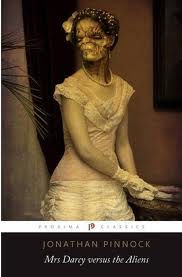
Some Answers to 20 Imaginary Questions About “Mrs Darcy versus the Aliens”
1. Basically a sequel to “Pride and Prejudice” with added aliens.
2. Why not?
3. No. Not zombies. Aliens. We do not mention the zombie book. I had the idea long before the zombie book came out. Although I’m sure it’s a very nice book. It is, however, a bit of a sensitive area, as I’m sure you’ll understand.
4. I said no.
5. Oh, you like zombies? In that case, loads.
6. The usual stuff: tentacles, probes, ghosts. And Colin the pigeon.
7. Lord Byron. He’s filthy.
8. “The truth is out there, though it is not yet universally acknowledged.”
9. Pemberley, Whitechapel, Rosings, Bath and Glastonbury.
10. Ek – ek – ek – ek – kk’Ekk!
11. Mars. Although the chances of anything coming from there…
12. Sous-pellisse and Wellington’s Fancy. But don’t ask for “a Prussian”, as you’ll probably get slapped.
13. Look, will you stop going on about zombies?
14. I serialized it for a year online and then it was picked up by Proxima Books just before the end.
15. I was very excited, I can tell you.
16. All the usual online places, and if you’re lucky enough to live in the UK, at all branches of WHSmith, where it’s on promotion and currently at number 54 in their chart.
17. If there’s demand, definitely. I deliberately left a bit of a cliffhanger at the end.
18. Only if I can get David Bamber back to play Mr Collins. Or if he’s unavailable, his hair.
19. www.mrsdarcyvsthealiens.com. And there’s a Wickhampedia at www.mrsdarcyvsthealiens.com/wiki which tells you everything you need to know, as well as a whole load you really didn’t. Oh, oh, and a Facebook page at www.facebook.com/realmrsdarcy.
20. Well, thank you for having me. It’s been fun.
***
You'll find Jonathan Pinnock's blog at www.jonathanpinnock.com and you'll find Mrs Darcy at
Amazon and other reputable bookstores (including bricks and mortar stores in the UK).
I’ve long been a fan of “found art”, more recently “found poems”, and now “found blog posts”. This one I’ve lifted (with permission) from my “Meuse”.
Meuse and I go way back, all the way to Africa. We used to sit around funky hotel lobbies drinking Lion Lager and writing poetry. But that’s another story.
Today’s story is “found” because it was written as a disposable scrap of chit-chat. I think it deserves some circulation before being chucked. And furthermore, I can’t write this kind of cultural commentary. Music, rap, Lady Gaga—they’re not my forte. But calling psychopathic behaviour to account — yes, I’m all for that.
Here’s Meuse (basically thinking out loud):
 I was out walking in the cold May Nova Scotia morning rain when blood suddenly reached my brain, and I could think for the first time since last August.
(Note: Meuse is often droll and self-deprecating.)
Inexplicably, it jogged into mind an old notion of popular art and culture being a reflection of current times. Or is it a prediction of times to come?
This notion must have come out of my recent exposure to rap music, which I managed to avoid for 20 years. I thought it would be a good idea for a brief study.
I crawled back home, in from the cold and rain, and checked out the original “Telephone” rap video by Lady Gaga. (The little Brit Gypsy rapper, Cher Lloyd, sang it in amateur competition.)
 I thought that Lady Gaga’s video would be as interesting and benign as P!NK’s “Family Portrait” video. What I found wasn’t exactly disturbing, but I did wonder what impression it leaves in the minds of the young teenage audience.
There seems to be a lot of violence and psychopathology on display in the most popular rap videos. Of course there is as much or more in newscasts and films. But I don’t recall pop musical culture in the ’50s and ’60s being as deeply violent or overtly psychopathological. Of course there was the madness of war, and the insanity of tribes like that of Charlie Manson.
Maybe young people are already far beyond what looks like excess in rap videos, and they see it entirely for the fantasy it is.
Even without rap videos there are going to be kids who bring guns to school to kill other kids. It may only be a function of news media penetration, but it appears to me that there has been an explosion of infanticide and parricide (Note: murder of parents by young children). I think it’s real.
So, does rap culture and its music cause adults and children to take up arms against each other? Or is it a reflection of a direction society is moving in? I think the latter. Rap isn’t showing the way. It’s showing where society already is. This has been an aspect of popular culture and art for 150 years or longer.
Is a shift happening now that has yet to be revealed?
I’m locked into a view of art and culture as I experienced it when I was young. Perhaps this narrow vision prevents me from seeing the social dynamic as it actually is today! Perhaps there is even more to understand
Join me over at the Barn Door for a guest blogging post. See you there…
When thinking of book marketing, there are a number of rungs on the marketing ladder. The first involves creating a quality product, in this case a book. You want a book that you’ll be proud to offer for sale, and a book that customers will want to buy.
Once you have a finished product/book, you need to move onto the promotion basics. This rung on the ladder involves establishing a presence - you’ll need to create visibility and a platform. To do this, the first step is to get a website or blog. Next, you will need to join writing groups in your genre, groups in your target market, and other social networks, such as Twitter and Facebook.
After you’ve established a presence, the next step is to create an informational funnel leading back to your website. The purpose of this funnel is to bring traffic and inbound links, to your site.
The more traffic to your site the greater your visibility in the search engines. More traffic also means a greater chance of visitors purchasing what you’re offering.
When it comes to an informational funnel, content rules. Here are three strategies to increase traffic to your site.
1. Add Content to Your BlogMake your presence known by offering information in the form of content on your blog. Content is what will make you an expert in your niche, genre, or area. But, just posting the content to your site will not create the traffic you need. Each time you publish content to your site, you need to let your social networks know about it.
Tweet it and post about it to Facebook and your other social networks. Be sure to always include a clickable url link that goes directly to the article. This is a part of inbound marketing – it leads visitors back to your site through an information funnel.
In addition, using effective keywords in your posts and the post titles, related to your site’s platform, will help the search engines index your content.
2. Article MarketingOnce you feel comfortable with adding content to your blog, you can now venture out into the article marketing arena to capture a larger audience. While most article directories have guidelines, they are fairly lenient. Follow the guidelines and post an article to one, ten, or a hundred different directories. Most of them don’t require original articles, so you can use articles you’ve posted on your blog.
Usually you will be allowed to include a brief bio in the form of a resource box. Make it short and sweet. Be sure it links back to your website or blog, whichever you want the traffic to go to (if you have more than one site).
Those who click on the link will be creating inbound links to your site which is a feature Google and the other search engines like. In fact, quality inbound links are an important aspect of search engine optimization (SEO).
3. Offer to be a Guest on Other Quality SitesAnother avenue of inbound marketing is offering your articles to other quality blogs or sites; you become a featured writer on the site by providing a guest article. It might be viewed as visiting another neighborhood. The particular site you are featured on has its own set of visitors, thereby broadening your visibility.
Do your research though, before you approach bloggers. Make sure the fit is right by checking prior posts on the site. In addition, when you approach the blog owner to ask about a guest post, let him know that you are familiar with his site.
And, be sure to always make it a win-win situation. Let the
Come visit me at http://thebarndoor.net where I’m guest blogger of the day. See you there.

Join me over at the Barn Door, where we’ll see if we can figure that out. . .

In the meantime, what do you think they have in common?
By: Kay Elam
When I was writing my first novel, I knew it was a mystery, but I wasn’t sure of its sub-genre. At a writing conference I was telling someone about my book and they said, “Oh, it’s a cozy.” I simply agreed instead of admitting I’d never heard of such a thing. Since that conference I’ve found many people (including writers) aren’t aware of this popular sub-genre even if they’ve been reading cozies for years.
A cozy is fun. It’s a fast-paced, feel-good read that, when you put it down, you can hardly wait to get back to it. Clues (as well as a few wild-goose chases) are given so the reader will want to solve the mystery along with the sleuth. The victim is not someone with whom the reader has a real emotional attachment—he’s the villain after all—so the reader isn’t dismayed by his/her death. There are twists and turns as well as surprising revelations but, in the end, justice always prevails and the sleuth is the heroine (or hero).
The cozy’s heroine is usually an amateur sleuth (think Jessica Fletcher). This is a role she’s just fallen into because she’s intelligent, intuitive, and inquisitive. She’s usually connected to the crime by someone she knows or because she was nearby when it happened. Often she solves the crime to protect someone important to her. The sleuth is likable, though flawed in a way that is not going to offend the reader. (She eats in bed, is always late, smokes, gossips, smacks chewing gum, or has some other character defect that shows she's less than perfect—just like the reader.)
The sleuth has strong relationships, though not necessarily romantic. She has lots of friends, family, acquaintances who feed her missing links to solve the mystery. These characters are often eccentric, annoying, or amusing—just like people we all know. Frequently the protagonist has a friend or spouse who know facts about the crime that aren’t yet public. This could be a member of the police force (or the sheriff), the medical examiner, the district attorney, a nosy neighbor—you get the idea.
The cozy’s sleuth usually has another job—solving crimes is just something she does because somebody has to do it. She might be a business owner (florist, bookstore, hotel, caterer, etc.), doctor, lawyer, chef, librarian, journalist, tour guide, pet sitter, and so on—or she might be retired with extra time on her hands. Instead of or in addition to a profession, a cozy might center on hobbies such as crafts, puzzles, sewing, needlework/knitting, quilting, golf, tennis, gardening, and genealogy, among others. Some cozies have a theme like the holidays, animals (cats, dogs, horses, birds, etc.), or even religion.
There is often a romantic subplot, but no explicit sex scenes, and there is little, if any, profanity.
The murder in a cozy isn’t described with a lot of details. It usually happens before the book begins or at the very beginning. Sometimes there are multiple murders, but even they are usually off the page. They’re described in general terms—no blood and gore.
A cozy is often geographically specific, usually in a small town or village, but may also be in a “closed” setting like an office, hotel, train, etc. My novel is set in a well-known medium-sized city, but is limited to a specific section of town.
Of course there has to be law enforcement—but they are often short-staffed, kidnapped, out of town, or otherwise unavailable which is why a small town setting works so well. Procedural accuracy is often overlooked in this genre and the police seldom take the protagonist seriously. A lot of cozies are written as a part of a series becau
By: Rachel Bertsche
Can you smell the sharpened pencils in the air? It's the delicious scent of another school year underway. Kids are cracking open new books and diving into the likes of Great Expectations or The Things They Carried or Roll of Thunder, Hear My Cry.
Though my school days are behind me, as the leaves start to fall (at least here in Chicago) I get the itch for new reading lists. A fresh literary start.
On my fall syllabus? The Hunger Games, of course (I'm so behind) and Freedom (I like to know what all the fuss is about) and whatever my book club demands of me. Currently that's The Weight of Silence by Heather Gudenkauf. I could go on, but thinking too much about all the to-be-read books on my shelves makes me anxious that I should stop blogging and start curling up in my book nook, pronto.
So to usher in the new school year, something light, bookish and BFFish (my personal blog, MWF Seeking BFF chronicles my search for a new, local best friend... preferably of the Babysitter's Club variety).
I present to you the literary characters (aside from the members of the BSC) with whom I would most like to be best friends:
1) Boy, The Giving Tree. Some say he’s selfish and greedy, I say he’s lonely. He loves his tree. He could use a BFF.
2) Jo March, Little Women. Or maybe Beth. For one of my college applications, I had to name which fictional character I most identified with. I chose Jo. But I wonder if we could really be best friends? We might be too similar. As much as I love her, I could see us bumping heads. I might benefit more from Beth’s warm heart… You know, before her gutwrenching end.
3) Ginny Weasley, Harry Potter series. She’s awesome. Half badass, half girly. Not as goody-two-shoes as Hermione, but just as brave. I can totally picture us whispering together in the corner.
4) Alice Cullen, Twilight. Whimsical, fiercely loyal, and loves to play dress up. That she can see into the future doesn’t hurt.
5) Harriet the Spy/Nancy Drew. I really wanted to be a child detective back in the day. Sadly, there were very few (read: zero) mysteries that needed solving in my hometown. But I would still very much like to be the sleuthy sidekick.
6) Lisbeth Salander, Millenium Trilogy. I would not want to be on her bad side. But she is crazy protective of her friends, could dig up dirt on anyone at anytime, and would be one of those never-a-dull-moment BFFs.
7) Skeeter Phelan, The Help. She’s passionate, determined, sneaky when she has to be. I think we could be good writing buddies. Read each other’s work, give honest critiques, take breaks to discuss Hilly’s horribleness.
8 ) Oskar Schell, Extremely Loud and Incredibly Close. I'm aware that most people think Jonathan Safran Foer’s first book, Everything is Illuminated, is his best. But I fell in love with Oskar, and this novel, early on. He’s eager
By: Quill
Having written five books, I have naturally developed a vast catalog of practices that work for me. Perhaps sharing a few I can help shorten someone’s path to publication. Someday I even hope to have one of mine published.
Number one: organize your material. I keep mine in plastic garbage bags. Then my research, drafts, and yes, even manuscript are set to file (curbside) when the project is done. Almost as critical is the skill of outlining. I call it outlaying. In the early stages of a book, I’ll spend many hours outlaying in the sun. Sometimes I combine this with another proven technique, mind-napping.
With fiction, pre-develop your characters. I write the names of mine on the back of my hand. That way I think of them wherever I go. Sometimes I draw little eyes on my hand and ink lips around my thumb and forefinger. Then I ask them questions and get them to speak: “s’alright?” “S’alright!”
Free your characters. Encourage them to have lives of their own. Meet them at parties, then follow them, pen in hand, on adventures you could have never dreamed of. The hero of my last novel left me, wrote his own book. A bestseller. Oprah called him. Not me. Him. I answered the phone: “Hi, Oprah! Sorry, Dirk Blowhard is indisposed. I just drowned him in the tub.”
Choose subject matter carefully. My first book idea, about the Wright Brothers’ earliest plane, didn’t fly.
Then I wrote about sexual bondage. The editor liked my submission, but couldn’t get the chain stores to stock me.
Know your subject and market. I wrote a book about car engines and then couldn’t find a distributor.
Be controversial, but not overly. While living in England, I wrote an expose on the House of Windsor. Three agents in black suits appeared at my door. They weren't literary agents. They told me I wouldn't be getting any royalties.
Stick with it. My first novel, ‘SNOWMAN IN SPRING’ ended up in a slush pile.
I wrote a guidebook, “How to get Married”. The editor rejected my proposal. I must have misinterpreted her advances, (which, it turns out, were for another writer). It was all starting to have a familiar ring.
Sure enough, when I proposed a book on antique firearms, she shot me down.
In the publishing biz, rejection happens. Take it in stride. It’s not personal, though it can feel pretty personal, right? I sent an article to a horticultural magazine, on farmstead flowers and fowl. The editor called it poppycock. Said the section on composting was pure crap.
For a barbering journal I penned, “The Race Against Hair Loss.” The editor called it balderdash. Even the part about selecting a toupee. Said the whole thing was a ‘bad piece’.
To get serious, establishing a routine that works is really the most important aspect of writing. People often ask me what specific techniques I use. Actually I would like them to.
I stand on my head for twenty minutes before writing. Blood rushing to my head sets off a neuron frenzy, prompting right brain left brain intercourse and an overall spiking of metabolic function. Then prone I utter a secret Jedi incantation that ends with "best seller come to da, Dah!" From there I go straight to the kitchen, cram a quick snack, rich in iron—raisin bran, maybe a donut. Then I might get lured by the tube for a few minutes, some old sitcoms… But soon, neural activity positively peaking (or more often starting into a post-sugar-high nose dive) I leap to my keyboard, and write!
Words flow from thoughts pent up in my mind as ideas crystallize, as in perfect mid air simpatico my fingers fly. Then, after a bit, usually I remember to turn on the computer.
A few tips worth sticky-noting to your forehead:
Index cards can be useful for outlining your plot. If your plot is in a cemetery that is windy, use rocks to weigh the cards down.
If you are subject to excessive distrac
By: Hannah Moskowitz
This post has nothing to do with writing and absolutely everything to do with being a writer.
The stereotype of a writer--the middle-aged man pounding feverishly at a typewriter, cigarette in his mouth, sending hard-copy manuscripts to his agent and protesting the change of every word--has yet to catch up with the reality of what being a writer entails today.
We are not locked in our attics alone. We are not even the romantic writers of the '20s, drinking coffee and discussing literature. We are a legion of overworked, underwashed normals, pounding away at our laptops and shooing the kids to the next room.
And more importantly, we are not alone.
If you are reading this blog, you have obviously already met at least one other writer (hello there.) Chances are, I'm not the only one. Agent, editor, and writer blogs, facebook, forums like Verla Kay and Absolute Write, and God, above all Twitter, mean that, at the very least, most writers are at least a friend of a friend of yours. The term 'networking' is so appropriate here, because, in actuality, we--writers, publishing professionals, book bloggers--are a net. A web of interconnected people.
We know the same people. The truth is, this world feels very big sometimes, and God knows everyone is talking about writing a novel, but when it comes down to it--the people who are really out there, querying, editing, submitting, representing, accepting, rejecting, publishing, copyediting, waiting...well, the truth is, there aren't that many of us after all.
Which is why the act of being a professional writer has come to mean much more than it used to. Fifty years ago, all most writers had to do was avoid getting arrested and not respond to bad reviews.
You have a much bigger job to undertake. And it's stressful, and it's scary, but it can also be one of the most rewarding parts of this job. Somedays, my writing is absolutely shitty, and the house is a mess, and I'm crying because I can't find my socks, but I have 557 blog followers and I said something funny on Twitter today, so at least this day isn't totally for the birds.
You may think that I am the worst possible person ever to talk about how to be a professional. I'm loud and I'm obnoxious and I had to edit about ten cuss words out of this post so I didn't offend Nathan's sensibilities.
Yep. That's me.
But I'm hoping all that will make me easier to listen to, because when people think 'professional,' they a lot of the time think boring, sanitized, safe. And that's not who you have to
be. I'm living proof over here. And I knew from the start that I was taking a big risk, but I hoped that people would find me interesting and remember me.
It's worked pretty well so far. And that, kittens, is the real reason you want to get out there and put on your professional face. So that people will remember you.
Now that I'm done babbling, here are some guidelines. How to be a successful professional writer, by yours truly. And these are not big, life-changing rules. These are just tricks. Tricky little tricks.
--GET ON TWITTER. I don't care what your objections are. I objected too. But it is hands-down the best way to connect with people you would never have the balls to approach any other way. You can follow someone, which causes them no pain or trouble whatsoever, and you can talk to them in a completely neutral, undemanding way.
--READ ABOUT BOOKS. What do Hunger Games, Twilight, Lord of the Rings, The Da Vinci Code, and a hell of a lot of other books have in common? Answer: I haven't read them.
I'm not proud. But I know I don't have nearly enough time to read as much as I should, so I make a point of reading *about* books I wish I had time to read. Know enough about popular books to be able to fake your way through a conversation. I can discuss Twilight with the best of 'em.
--
View Next 25 Posts





 One day, I walked straight into Paul Auster outside the Community Bookstore in Park Slope in which I’d had my first ever taste of Green Tea. I grinned at the author inanely, and stepped aside.
.jpeg?picon=3348)




.bmp)

.jpg)

 This week, I’m sending you over to the website of




This summer, I was mostly looking forward to reading a few good books...and listening to some audio books. I didn't get through as many as I had hoped, but I enjoyed reading The Unnaturalists.
Great getting to meet Sara...and Sara...and Sara? No, sorry, just Sara and Sara :-)
Somewhat different genre but I'm waiting for Jay Kristoff's Kinslayer. Thanks for the great giveaway.
I'm most looking forward to the kids going back to school and having my days free again. I will finally be able to make a huge dent in my reading pile. Thank you!
Looking forward to autumn weather and seeing more teens in the library!
Since I am retired, my time is pretty much my own. I am really looking for the return of cooler weather but that won't come until November in So Cal. That's when we get "fall".
lkish77123 at gmail dot com
Looking forward to reading more and watching the leaves change colors. Thanks for the giveaway. [email protected]
The beautiful weather and Halloween!
Thanks for the chance to win!
I'm looking forward to cooler weather so I won't sweat so much! I don't have central air, just window units and fans. I do love summer, though.
I am starting a new job at our public library! Really looking forward to it!
WhooHoo!!! I see my name in the Rafflecopter's winner box. Just tell me what I need to do. Many thanks To P.J., and Sara, and Sara!
Hey Carl! Congrats! I sent your email address to the publisher, so they should be getting in touch with you for mailing information. And you're welcome!
Thanks PJ, so cool!