JacketFlap connects you to the work of more than 200,000 authors, illustrators, publishers and other creators of books for Children and Young Adults. The site is updated daily with information about every book, author, illustrator, and publisher in the children's / young adult book industry. Members include published authors and illustrators, librarians, agents, editors, publicists, booksellers, publishers and fans. Join now (it's free).
Login or Register for free to create your own customized page of blog posts from your favorite blogs. You can also add blogs by clicking the "Add to MyJacketFlap" links next to the blog name in each post.
Blog Posts by Tag
In the past 7 days
Blog Posts by Date
Click days in this calendar to see posts by day or month
Viewing: Blog Posts Tagged with: Military, Most Recent at Top [Help]
Results 1 - 25 of 103
How to use this Page
You are viewing the most recent posts tagged with the words: Military in the JacketFlap blog reader. What is a tag? Think of a tag as a keyword or category label. Tags can both help you find posts on JacketFlap.com as well as provide an easy way for you to "remember" and classify posts for later recall. Try adding a tag yourself by clicking "Add a tag" below a post's header. Scroll down through the list of Recent Posts in the left column and click on a post title that sounds interesting. You can view all posts from a specific blog by clicking the Blog name in the right column, or you can click a 'More Posts from this Blog' link in any individual post.
When discussions arise about the utility of cyber-attacks in supporting conventional military operations, the conversation often moves quickly to the use of cyber-attacks during Russia’s invasion of Georgia in 2008, the US decision not to use cyber-attacks in the 2003 invasion of Iraq, or Russia’s behavior in cyber-space surrounding the conflict with Ukraine that began in 2014. These, however, may not really be the most useful cases to examine.
As the new year dawned on 1 January 2016, six heavily-armed men crossed through a marshy section of the Punjab border from Pakistan into India. Disguised in Indian Army fatigues, they commandeered first a taxi, then a small SUV, eventually covering the approximately 35km to reach the Air Force base at Pathankot. There, they cut through […]
What happens when dead bodies crop up where they are not supposed to be? How can this allow us to reflect on how we understand security and insecurity? For example, mass graves can be indicators of crimes against humanity. Recent satellite evidence of mass graves analyzed by Amnesty International outside of Bujumbura has led to a focus on the political violence there, a result of turmoil after Burundian President Pierre Nkurunziza announced his intention to seek a third term.
We lost the Vietnam War. There is little reasonable ambiguity about this judgment, nor can there be any apparent consolation. Losing, after all, is assuredly worse than winning. And victory is always better than defeat.
Notwithstanding the July 2015 P5+1 Vienna diplomatic agreement with Iran, Israel will soon need to forge a more comprehensive and conspicuous strategic nuclear doctrine, one wherein rapt attention is directed toward all still-plausible nuclear enemies.
Cometh the new year, cometh the fresh round of allegations that United Nations peacekeepers raped or abused some of the most vulnerable people in the world. 2016 has just begun and already reports are surfacing of UN peacekeepers paying to have sex with girls as young as 13 at a displaced persons camp in the Central African Republic.
The news seems to have gone quiet about Sangin district in Helmand. Before Christmas there was an intense media storm that the district was about to fall to the ‘Taliban’. There were reports of the SAS being deployed, and the day after, the story of multiple Taliban commanders being killed in a night raid. As I have written before, it is impossible to separate every one with guns in Helmand into two groups: the ‘government’ and the ‘Taliban’, so it is difficult to see who the SAS were targeting, and who they were supporting.
In world politics, preserving order has an understandably sacramental function. The reason is plain. Without minimum public order, planetary relations would descend rapidly and perhaps irremediably into a "profane" disharmony.
As a national security reporter, I write about war, weapons, security, and secrets. The question most commonly asked of me is, "How do you get sources to talk to you?" The Pentagon's Brain is my third book in a series about seemingly impenetrable subjects. The first one, Area 51, is about the highly classified military [...]
0 Comments on Mirrors on the Moon: A Reporter’s Story about Sources and Secrets in the Modern World as of 1/1/1900
In June 2015, the results of a new study by the Department of Veterans Affairs were released. The study examined more than 170,000 suicides of adult men and women in 23 states between 2000 and 2010, and concluded that female military veterans kill themselves at a rate that is nearly six times higher than their civilian counterparts.
In 1789, President George Washington said, “The willingness with which our young people are likely to serve in any war, no matter how justified, shall be directly proportional to how they perceive the veterans of earlier wars were treated and appreciated by their nation.” Judging by this standard, we are failing.
The centenary of the Great War has led to a renewed interest in military matters, and throughout history, war has often been the setting for medical innovation with major advances in the treatment of burns, trauma, and sepsis emanating from medical experience in the battlefield. X-rays, which were discovered in 1895 by Roentgen, soon found a role in military conflict. The first use of X-rays in a military setting was during the Italo-Abyssinian war in 1896.
Do you know your George Washingtons from your Thomas Jeffersons? Do you know your British tyrants from your American Patriots? Test your knowledge of the American Revolution with this quiz, based on Robert J. Allison’s The American Revolution: A Very Short Introduction.
I recently had the opportunity to review The Veterans' Clubhouse by Kristen Zajac. This book addresses the problems of homeless veterans from a child's point of view.
Becoming homeless can happen to anyone. But when it happens to Charlie, a Vietnam Veteran that Patrick and Hailey meet, they decide to take matters into their own hands and do something about it. With the help of their church and community, they build the Veterans’ Clubhouse to help homeless vets get back on their feet.
What a terrific message author Kristen Zajac delivers to children in showing them how they could get involved to help the homeless. I bet after reading the book, kids will come up with their own creative ideas on how to help as well.
Jennifer Houdeshell’s illustrations leap off the page and really add another dimension to this wonderful book.
This book would make a splendid addition to any home or library. It shows a way to give back to those who served this country and demonstrates how compassion plus action achieves great things. Nicely done!
0 Comments on Review of The Veterans' Clubhouse as of 8/7/2015 12:11:00 PM
As we approach the 70th anniversary of the end of Japan's War, Japan’s “history problem” – a mix of politics, identity, and nationalism in East Asia, brewing actively since the late 1990s – is at center stage. Nationalists in Japan, China, and the Koreas have found a toxic formula: turning war memory into a contest of national interests and identity, and a stew of national resentments.
War. Of all human endeavours, perhaps none demonstrates the extremes of ingenuity and barbarity of which humanity is capable. The 21st century may be the century in which the threat of perpetual war is realised. Although many innovations have been brought about as a bi-product of the challenges war presents, the psychological and physical trauma wrought on the human body may prove too high a cost.
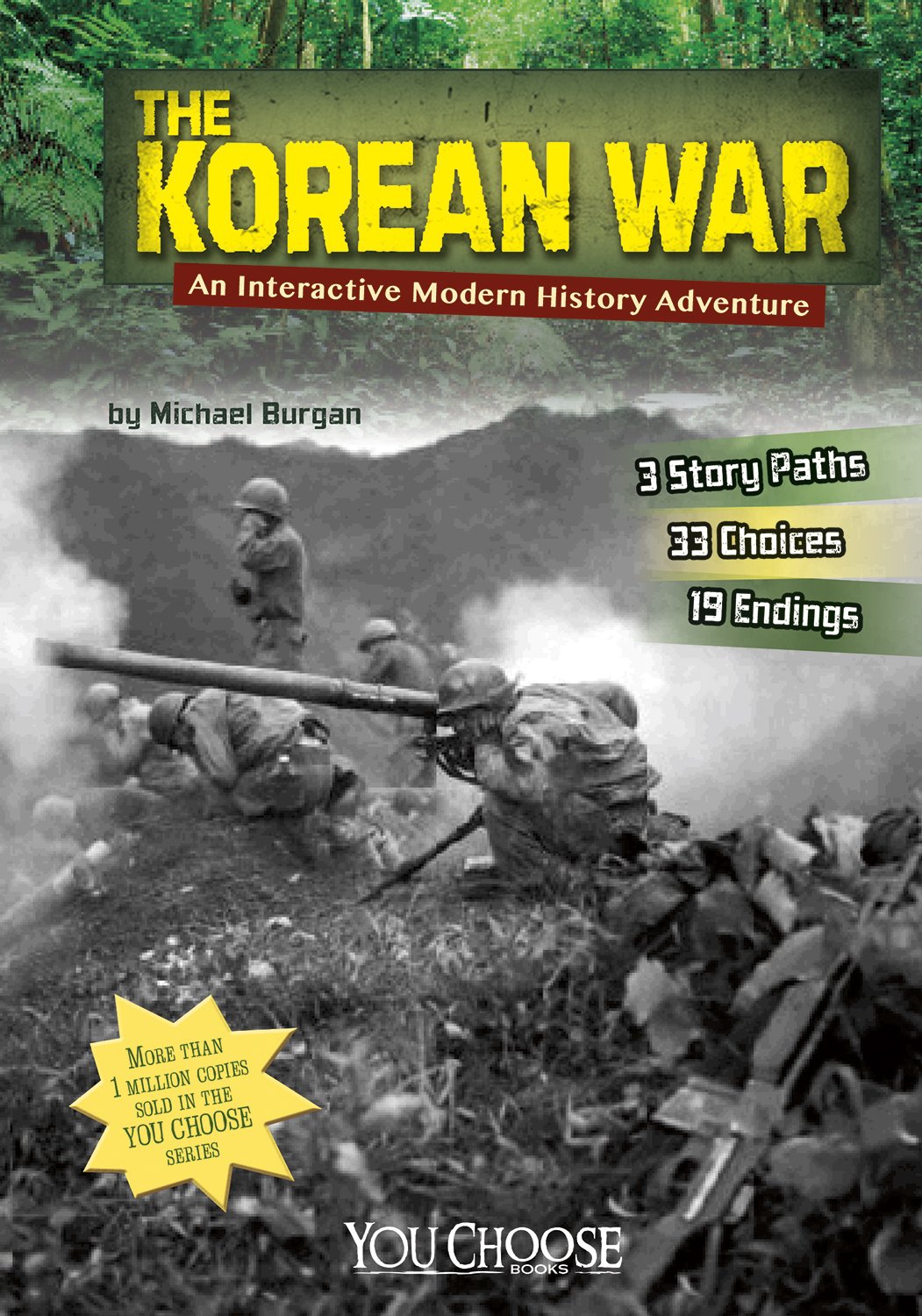
Series: You Choose Books Written by Michael Burgan Consultant: Raymond L. Puffer, PhD Capstone Press 8/01/2014 978-1-4914-0357-0 112 pages Age 8—12
“It’s 1950 and the Communist country of North Korea has invaded its neighboring country of South Korea. The United Nations has stepped in to help South Korea by providing weapons and soldiers. Nearly all of these soldiers come from the United States. Will you:
1. Serve as a pilot in Korea with the U.S. Marine Corps? 2. Lie about your age to enlist as a 16-year-old member of the U.S. military reserves? 3. Join in the fight for your country as a young South Korean man?
Everything in this book happened to real people. And YOU CHOOSE what you do next. The choices you make could lead you to survival or to death.” [back cover]
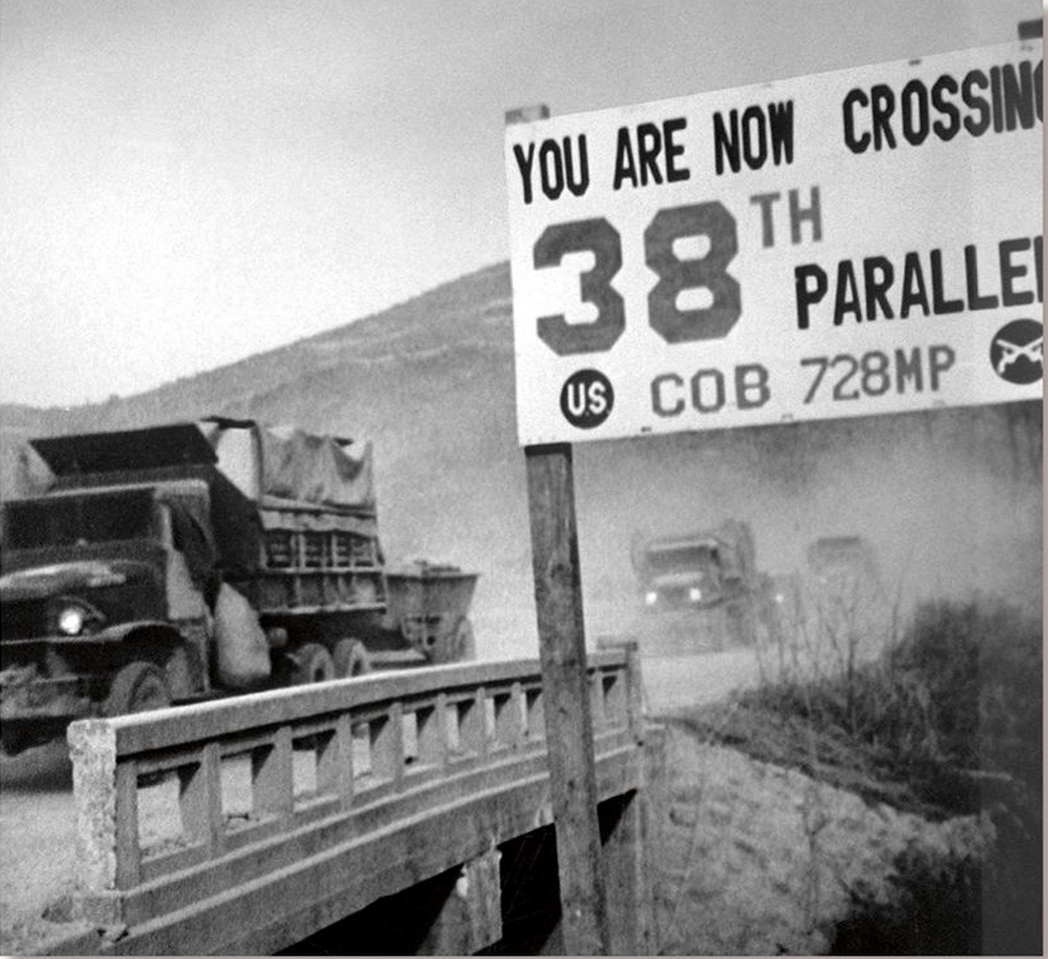
Review It is June 25th, 1950. Communist leader Kim I1 Sung controlled northern Korea. He wanted the entire country under his rule. Sung crosses the 38th parallel—dividing north from south—to lead a surprise attack on South Korea with China and the Soviet Union’s help. The United Nations agreed to support the south, sending troops from the United States and 15 other nations—but mostly soldiers came from the U.S. You join the fighting, but how? Are you a Marine pilot, a U.S. reservist, or a South Korean civilian? Choose wisely, as your fate depends upon it.
Did you choose the pilot? Your first major decision is an extremely important decision: do you fly the F4U Corsair fighter plane you know how to pilot, or do you learn how to fly the more dangerous military helicopter? If you choose helicopters, your commander, Colonel Morris (not made up), gives you a choice between a copter requiring sand bags to keep it balanced, or one that can experience engine problems and cannot fly as far as the other copter. How brave are you?
Did you choose to trick the U.S. and join up at age 16? The first year of reservist training is fairly easy and you are looking forward to the next year when the Korean War begins. You are now a full-time Marines, but without the full Marine training. A sergeant gives you a choice: do you get more training or do you think you are ready to fight? Think about this, as the decision could mean you never return home . . . alive.
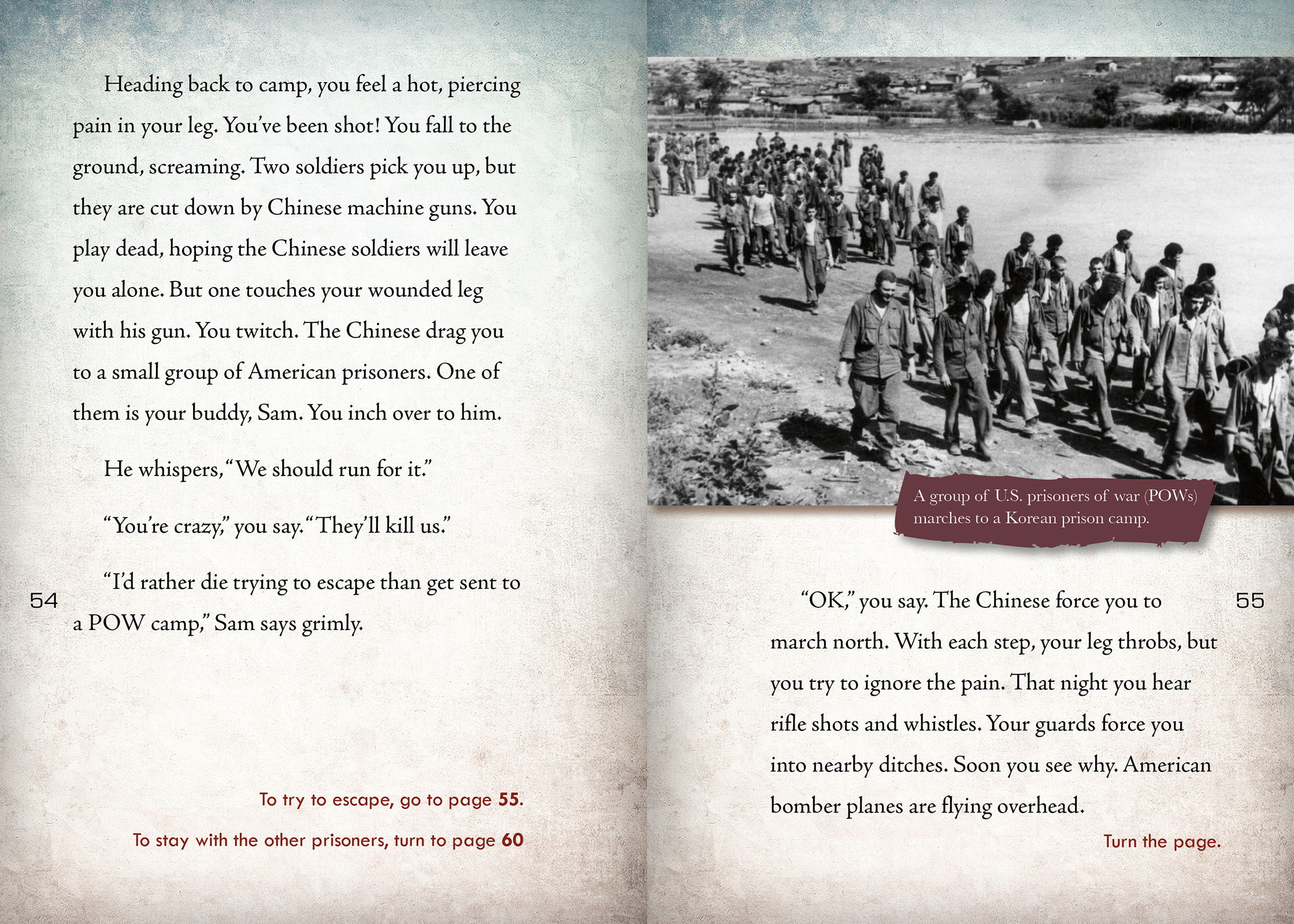
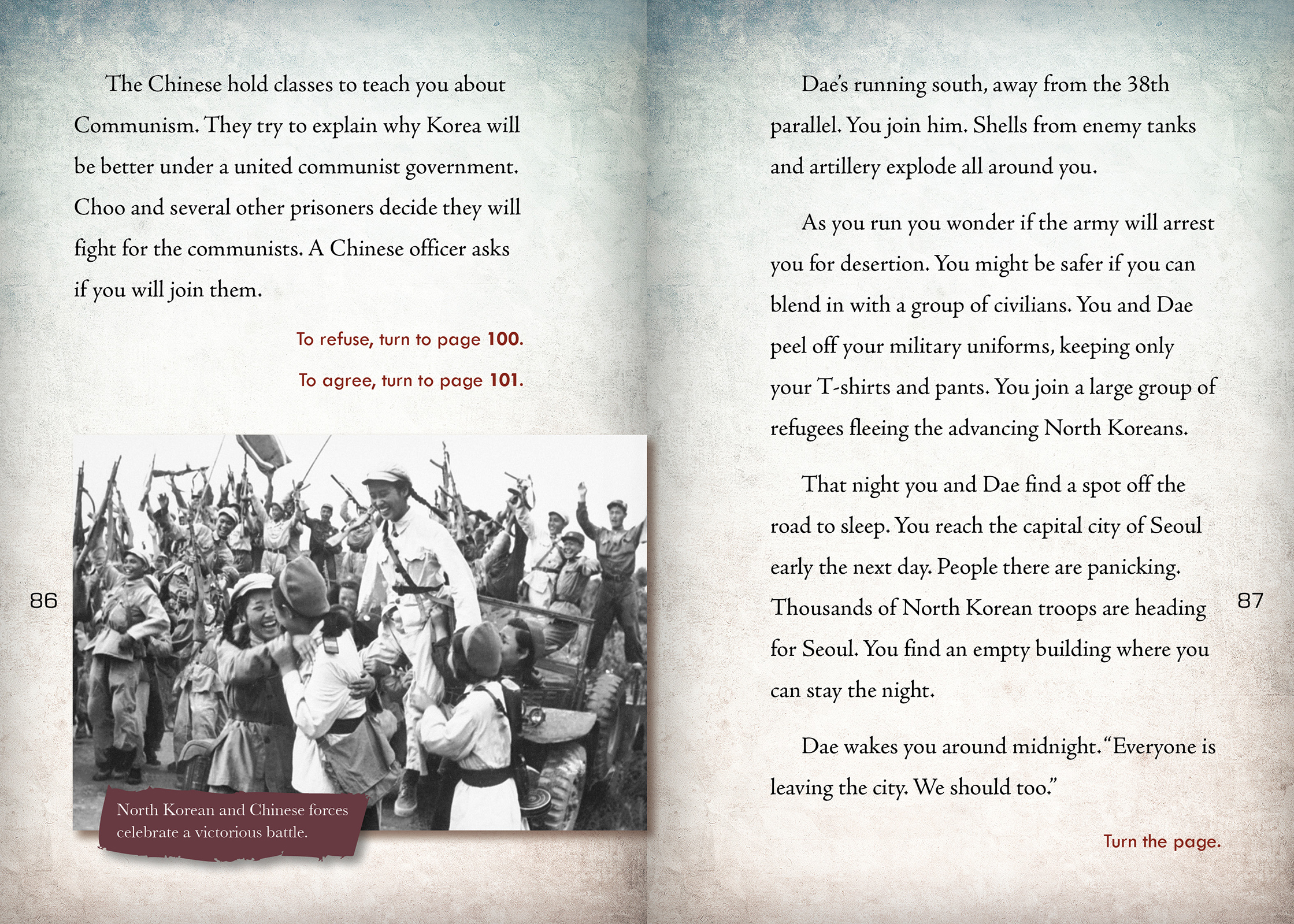
Did you choose to be a South Korean civilian, ready to fight for your homeland? You decide to volunteer, a rather rare event as most South Korean soldiers are merely grabbed off the street. You train with the Americans and then partner up when sent to the line. At one point you are captured by the Chinese, lectured on communism and its value for the entire Korean peninsula, and then told you will fight with the Chinese, not against them. Do you join or do you refuse?
A good way to get a feel for the fighting and the awful choices—none great—soldiers were forced to make is by reading The Korean War: An Interactive Modern History Adventure. This book is not a textbook-type read in that major facts are given for rote memory. Kids will find this more interesting than mere facts making The Korean War: An Interactive . . . a good adjunct text for teachers. While helping readers understand ground forces and air support decisions and the possible outcomes, the book also includes emotional responses to the fighting and choices of war. Kids will get the usual firing of bazookas, machine guns, and rifles; and the throwing of grenades, the dropping of bombs, and worst of all, napalm, yet the most important are the soldiers feelings and how those feelings affected their choices in these real stories.
Kids will learn the difference between an armistice versus a peace treaty, including North Korea’s instance that the war is not over, though fighting stopped 62 years ago. Up against unbelievable odds, South Korea has kept control of their country. The Korean War may not be the first war kids think of, but it should be in their brain’s history department. I really like these interactive books. I hated history, but these books make history come alive which heightens my interest. I had thought a peace treaty had been made. I also had not realized how influential the Chinese were to the North Korean campaign.
If an old gal of . . . well it’s impolite to ask . . . can enjoy these You Choose Books, kids certainly will enjoy them. And if I can learn a thing or two, so will kids. While not a fun subject, The Korean War: An Interactive Modern History Adventure held my interest, got me thinking, and has me wanting to know more about the Korean War. The same will happen to kids who read this inventive, yet real life, account of the Korean War.
The author included a time-line of the war, a “Read More” section, a glossary, bibliography, and an index.
You Choose Books World War II Pilots (reviewed HERE) The Vietnam War War in Afghanistan The Berlin Wall Hurricane Katrina The Making of a Social Network
We are still in the longest war in our nation’s history. 2.7 million service members have served since 9/11 in the conflicts in Iraq and Afghanistan. Thousands have been killed, tens of thousands wounded, and approximately 20 to 30% have post-traumatic stress disorder and/or traumatic brain injury.
This morning I have a spotlight and giveaway for Leslie Jones’ BAIT. Check it out!
Bait Duty & Honor # 2
By: Leslie Jones
Releasing April 28th, 2015
Witness Impulse
Blurb
In the next thrilling Duty & Honor novel, a female CIA agent and a Delta Force soldier must catch a deadly assassin… but do they know where the danger truly lies?
After several assassination attempts on an allied royal, the CIA sends in operative Christina Madison—who bears a striking resemblance to the monarch—to pose as the famous princess and draw out her would-be killer.
When Delta Force Lieutenant Gabriel Morgan’s team is assigned to Christina’s undercover protection detail, he’s less than thrilled. Gabe wants nothing to do with a woman whose rumored screw-up nearly got her last team killed. Not to mention there’s bad blood between Gabe and the CIA—he doesn’t trust anyone who lies for a living.
But once the trap is set and the assassin takes the bait, Gabe must protect her with his life … because danger lurks in the shadows, and now Christina is in the crosshairs.
Leslie Jones has been an IT geek, a graphic designer, and, much like her heroine, an Army Intelligence officer, bringing her firsthand experience to the pages of her works. She’s lived in Alaska, Korea, Belgium, Germany, and other exotic locations (including New Jersey). She is a wife, mother, and full-time writer and splits her time between Scottsdale, Arizona, and Cincinnati, Ohio.
Reports of the assassination attempt on Princess Véronique de Savoie barely made a blip on the news outside of Concordia. The tiny country rivaled Liechtenstein in size and importance. As in, very damned little. Most would be hard-pressed to find it on a map.
Inside the CIA, however, the assassination attempt caused a ripple of reaction, starting in the Office of the Director of National Intelligence, bypassing normal channels, and landing directly on case officer Jay Spicer’s desk.
“You want me to do what?” asked Christina Madison, eyes wide as she stared at her boss.
Jay Spicer looked back at her. “Have you been in front of a mirror lately?”
“Sure I have.” Every now and then, someone would comment on her eerie resemblance to the princess of Concordia. Princess Véronique made headlines inside her own country on a regular basis, though rarely outside of it. Concordian cameras and reporters followed her as she labored on various humanitarian projects. She’d been part of a BBC documentary last year on modern royalty in Europe, which Christina had watched out of curiosity. The princess remained gracious in the face of newshounds and paparazzi, even when elbow-deep in dirt planting a new strain of bacteria-resistant corn in Ethiopia or bringing clean well water to rural Bolivians.
Occasionally a European visitor to the Washington, D.C., area would ask if she were, indeed, the princess. Christina would laugh it off with a simple, “Don’t I wish.” Truth be told, she much preferred her anonymous work bringing down money laundering and smuggling operations. Having cameras shoved in her face and every word and action dissected struck her as repugnant.
For the most part, though, Véronique remained one of the royal unknowns.
Christina grabbed a handful of Skittles from the crystal ashtray on Jay’s desk. Red and yellow only. He’d already eaten the green and orange.
“Her face is well known inside Concordia. Resembling someone and taking her place are two different—”
“This comes from the top,” her boss interrupted. “From the director himself. The British government specifically asked for your help.”
Her head began to whirl. The mandatory photographs of the president and CIA director frowned down at her from behind his head. Boring pictures. Boring white walls. The only interesting thing in the whole office was the life-sized cardboard cutout of Captain America planted to the right of the door. “The British? Not the Concordians? I don’t understand, sir.”
Jay leaned forward in his chair and tugged at an earlobe, his ADHD making it impossible for him to sit still. At fifty, he still managed to retain the air of an errant schoolboy. He smirked, cracking his knuckles. Christina crossed her legs, not fooled by his antics. Jay Spicer was a shrewd, brilliant case officer. He counted on his façade to cause people to underestimate him. He would clarify the situation in his own time.
“Princess Véronique is engaged to a landed baron in the UK.”
“He has enough clout to tap the CIA for help?”
“Sort of.” Jay pushed a folder across his cluttered mahogany desk. The beige file sported the banded red and large stamps indicating that it contained classified information.
Christina uncrossed her legs in order to lean forward and snag the folder. She flipped it open. The top page contained a request from … Trevor Carswell?
Jay rocked back, the chair squeaking. He grinned, tapping his fingers.
Rafflecopter Giveaway (10 Digital Downloads of BAIT by Leslie Jones)
Spiked with suspense that builds toward inevitable disaster, this gripping story of the ill-fated luxury liner, Lusitania, demonstrates once again Larson's unparalleled skill at narrative history. For all of us who waited in anticipation of his next book, Dead Wake does not disappoint. Books mentioned in this post Dead Wake: The Last Crossing of the... [...]
0 Comments on Dead Wake as of 3/13/2015 3:22:00 PM
I've been a fan of Erik Larson's riveting brand of narrative history for years, and his latest book, Dead Wake: The Last Crossing of the Lusitania, is his finest work yet. Suspenseful and expertly researched, Dead Wake transports the reader to the Atlantic theatre of WWI, where the luxury passenger liner Lusitania and a German [...]
0 Comments on Erik Larson: The Powells.com Interview as of 1/1/1900
I am thrilled to welcome Lindsay McKenna to the virtual offices this morning! She has a special post to share, as well as an awesome giveaway for you to enter!
Post 6: A Heroine with a Cause
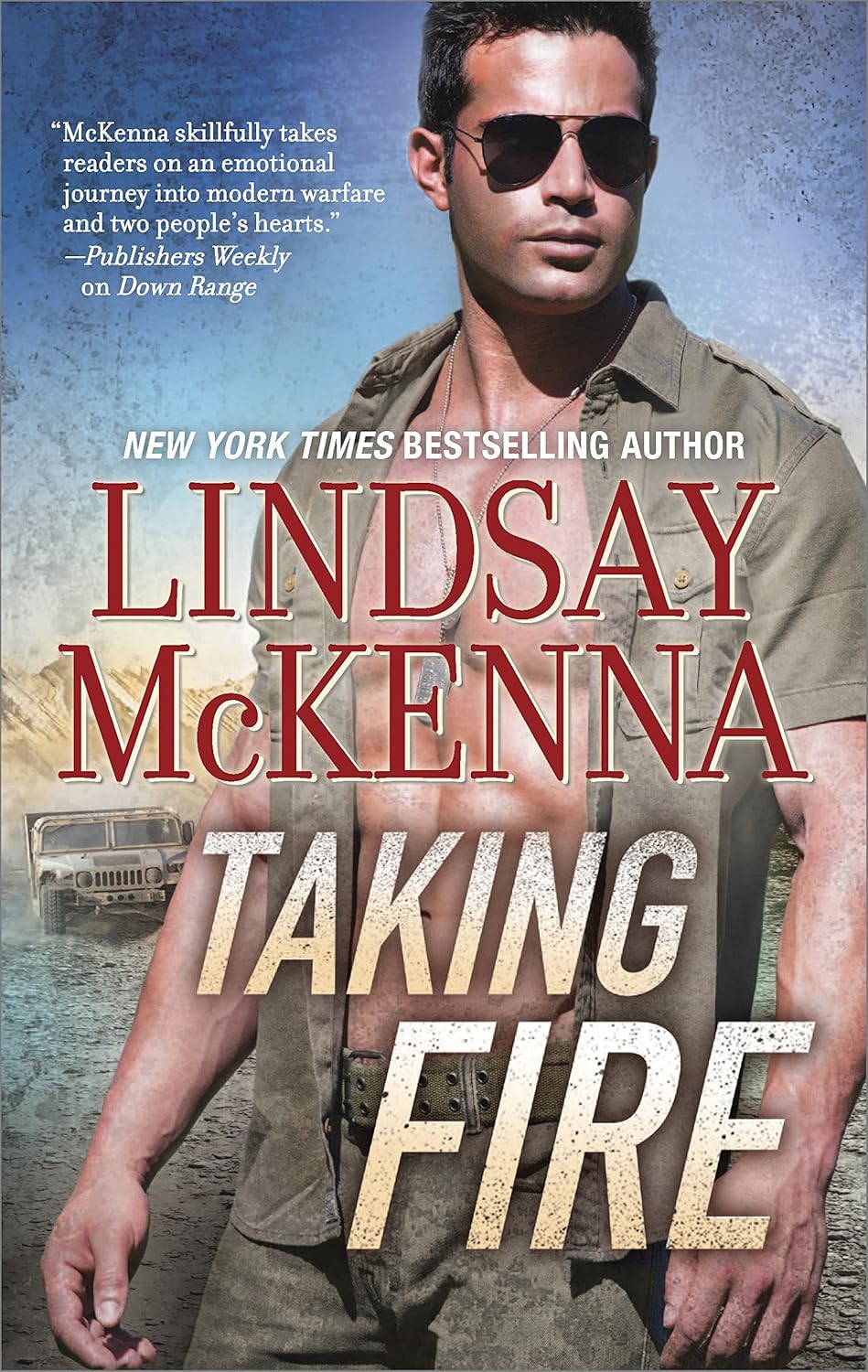
Title: TAKING FIRE by Lindsay McKenna: A heroine with a cause
One of the hallmarks of my writing, as my loyal readers will agree with, is that I write ‘fresh.’ Well, what does that mean? It means I’m not writing what everyone else is writing. I want to write from different slants and perspectives than are normally thought of to write from.
I wanted to create a heroine who was not a SEAL, but worked in deep black ops. This is an area that few can write about except those who have been in the military, or who have great military consultants who can give them useful information in defining and creating a character who is in this super secretive area of undercover work.
My heroine, US Marine Corps Sergeant Khatereh Shinwari, is someone you’ve never read about before. She’s deep black ops. Blacker than black, as they say in the trade. And when the hero, SEAL Michael Tarik meets her, he runs into a black-out on who she is. And he wants to know her—or else. So how to find out about a person that your heart is invested in and she’s not talking? In fact, a deep black ops individual will never tell you anything. They don’t give you leads and they don’t give you clues, either.
I had a great time creating scenes between these two Type A, competitive military combat people. Mike is black ops and he’s got a top secret clearance just like every other SEAL does. Most people think that’s as far as clearances go, but it doesn’t. Khat Shinwari is so above him on the black ops food chain, that it defies discovery by Mike.
Part of the fun of creating this book is the ultra-secret status of Khat. Who IS she? Why is she operating out in the Hindu Kush Mountains of Afghanistan alone with no back-up? No help if she gets in a bad situation? Mike just can’t understand her or her status. One thing SEALs are really good at? Finding out the unknowable. And you, as the reader, will be with him as he gets serious about finding out who this brave, black ops woman really is. Why? Because he is drawn to her and isn’t about to just blow her off. At the same time? Khat isn’t telling him a thing about herself.
So come along and watch how a SEAL operates in some pretty murky, deep black ops water and watch what happens!
Not all are meant to walk in the light. Marine Corps Sergeant Khat Shinwari lives among the shadows of the rocky Afghani hills, a Shadow Warrior by name and by nature. She works alone, undercover and undetected—until a small team of US Navy SEALs are set upon by the Taliban…and Khat is forced to disobey orders to save their lives.
To go rogue.
Now, hidden deep in the hills with injured SEAL Michael Tarik in her care, Khat learns that he’s more than just a soldier. In him, she sees something of herself and of what she could be. Now duty faces off against the raw, overwhelming attraction she has for Mike. And she must decide between the safety of the shadows…and risking everything by stepping into the light.
Lindsay McKenna is proud to have served her country in the U.S. Navy as an aerographer’s mate third class—also known as a weather forecaster. She is one of the original founders of the military romance subgenre and loves to combine heart-pounding action with soulful and poignant romance. Her latest book is the romantic suspense Taking Fire.
February is African American History Month. Sharing these books with young readers comes with the responsibility to discuss ... progress towards equality.
I have an excerpt and giveaway for Jessica Scott’s latest release All for You. Check it out!
ALL FOR YOU by Jessica Scott (November 25, 2014; Forever Mass Market; $8.00)
Can a battle-scarred warrior . . . Stay sober. Get deployed. Lead his platoon. Those are the only things that matter to Sergeant First Class Reza Iaconelli. What he wants is for everyone to stay out of his way; what he gets is Captain Emily Lindberg telling him how to deal with his men. Fort Hood’s newest shrink is smart as a whip and sexy as hell. She’s also full of questions-about the army, its soldiers, and the agony etched on Reza’s body and soul.
. . .open his heart to love? Emily has devoted her life to giving soldiers the care they need-and deserve. Little does she know that means facing down the fierce wall of muscle that is Sergeant Iaconelli like it’s just another day at the office. When Reza agrees to help her understand what makes a soldier tick, she’s thrilled. Too bad it doesn’t help her unravel the sexy warrior in front of her who stokes her desire and touches a part of her she thought long dead. He’s the man who thinks combat is the only escape from the demons that haunt him. The man who needs her most of all . . .
USA Today bestselling author Jessica Scott is a career army officer; mother of two daughters, three cats and three dogs; wife to a career NCO and wrangler of all things stuffed and fluffy. She is a terrible cook and even worse housekeeper, but she’s a pretty good shot with her assigned weapon. She’s currently pursuing a PhD in Sociology in her spare time and most recently, she’s been featured as one of Esquire Magazine‘s Americans of the Year for 2012. She’s written for the New York Times At War Blog, PBS Point of View: Regarding War Blog, and Iraq and Afghanistan Veterans of America. She deployed to Iraq in 2009 as part of Operation Iraqi Freedom/New Dawn and has served as a company commander at Fort Hood, Texas.
It was fate. It had to be. A slow warmth unfurled inside him as the doctor he could not get out of his head looked up at him, her cheeks flushing pink.
She was all buttoned up at work. Tonight, she looked different. Looser. Unbound.
Compelling. That’s what she was. Her fire at work. Her refusal to let him bully her. He’d admired her backbone before.
Tonight, he admired her in an entirely new light. Her hair framed her face in careless curls. He hadn’t expected to see her outside of work. He damn sure hadn’t expected to see her here. An old familiar need rose inside him. A need for touch, human and warm. A need to lose himself for an interlude in sweat and sex and stunning pleasure. He’d given up drinking but women had apparently fallen into that category as well.
It had been months since he’d felt a woman’s hands on his body.
This woman was not someone he needed to be talking to at the bar tonight but he found himself walking toward her anyway.
After the week of confrontation they’d had, he’d be lucky if she didn’t slap him the minute he approached her.
He could do this. He could talk to a woman without drinking. Right?
Emily met his gaze as he approached. He almost smiled.
“Not your usual scene?” he asked, leaning against the bar.
She shifted, putting a little space between them. That slight reclamation of power. He made a noise of approval in his throat. “I’m surprised you’re talking to me.”
“I’m surprised you’re here. Shouldn’t you be home reading medical journals or something?” Her cheeks flushed deep pink and he wondered how far down her body that color went.
She tipped her chin then and looked at him. “Have you been drinking?”
He looked down at the bottle in his hand. “I don’t drink anymore,” he said quietly. No reason to delve into his abusive history with alcohol. “You?”
“Glass of wine,” she said.
Reza shrugged and leaned on the bar, taking another pull off his water and being careful not to lean too close. She looked like she’d bolt if he pushed her. “That would explain why you’re talking to me. We haven’t exactly been friendly.”
Her hair reflected the fading sunlight that filled the room from the wide-open patio doors. He wanted to fist it between his fingers, watch her neck arch for his mouth.
She motioned toward his bottle with her glass. “‘Anymore’?”
He simply took another pull off his water. He was going to be damn good and hydrated after tonight. He wondered what she’d do if he leaned a little closer. “Long story.”
“One you’re not keen on sharing?” she asked. She leaned her cheek on one palm. The sun glinted across her cheek.
“Let’s just say alcohol and I aren’t on speaking terms. Bad things happen when I drink.” It was nothing to be ashamed of but there it was. Shame wound up his spine and squeezed the air from his lungs. He was just like his dad after all.
“You say that like giving up alcohol is a bad thing,” Emily said quietly.
Reza snorted softly. He should have guessed she wouldn’t let it alone. She had stubbornness that could last for days. “It’s not something I’m proud of.”
Her hand on his forearm startled him. Soft and strong, her fingers pressed into his skin. “But stopping is something to be proud of.”
Reza stared down at her hand, pale against the dark shadows of his own skin. A long silence hung between them.
He lifted his gaze to hers.
“It takes a lot of strength to break with the past,” she said softly.
“What are you doing?” Her eyes glittered in the setting sun and he thought he caught the sight of the tiniest edge of her lip curling.
Her fingers slipped from his skin. “Offering my professional support?”
His lips quirked. “Was that a joke?”
“Maybe,” she said. “I’m working on developing a biting sense of humor. Defense mechanism against raging asshole commanders.”
Reza barked out a laugh. “You look different out of uniform,” he said lightly, pressing his advantage at this unexpected truce.
“So do you.”
He angled his body toward hers. “You like my makeup?” he asked.
Her lips parting as she tried to figure out if he was kidding or not. Finally, she cracked the barest hint of a smile.
Something powerful woke inside him and he moved before he thought about it. He reached for her, brushing a strand of hair from her cheek. The simple gesture was crushing in its intimacy. Her lips froze in a partial gasp, as though her breath had caught in her throat.
“Sergeant Iaconelli,” she said quietly, her voice husky. But she didn’t move away. Didn’t flinch from his touch.
“Reza.” He swallowed the sharp bite of arousal in his blood, more powerful without the haze of alcohol that usually clouded his reactions. “My name is Reza.”
“Reza.”
His breath was locked in his lungs, the sound of his name on her lips triggering something dark and powerful and overwhelming.
He wanted this woman. The woman who’d stood in opposition to him this week. The woman who lifted her chin and stood steadfast between him and his soldiers.
There was strength in this woman. Strength and courage.
“I’m Emily.” Her words a rushed breath.
He lowered his hand, unwilling to push any further than he’d already gone. This was new territory for him. Unfamiliar and strange and filled with potential and fear.
“It was nice talking to you tonight, Emily,” he said when he could speak.
He waited for her acknowledgment that she’d heard him. Some slight movement of her head or tip of her chin.
Instead her throat moved as she swallowed and she blinked quickly, shattering the spell between them.
He left her then because to push further would challenge the limits of his restraint. He wasn’t ready to fall into bed with someone. No matter how compelling Emily might be.
He waited and he watched for the rest of the evening. Watched her slip out with her friend, leaving an empty space at the bar.
Leaving him alone with the fear that included the empty loneliness as well as the cold silence of sobriety.
His thoughts raced as he made sure his troopers all got home that night, and Teague crashed on his couch.
He fell into bed later, need and desire twisted up, filling the cold dead space left inside him by the lack of alcohol. A dead space he usually filled with work while deployed. Tonight, though, unfamiliar pleasure hunted his thoughts, whispering that he could still love a woman, that he didn’t have to be drunk to climb into bed with someone.
But Emily wasn’t a random someone.
And she was so far out of his league, it wasn’t even funny. Even if there was some sexual attraction there, she wasn’t likely to go slumming with a burned-out infantryman like him.
He lay there in the darkness, waiting, clinging to the single, simple pleasure of her touch, hoping that maybe tonight he could sleep, avoiding the nightmares that reminded him of the monster he’d become.
A beast who had lost his compassion somewhere on the road to Baghdad.
In July 2014, the Ukrainian President, Petro Poroshenko, claimed that Ukraine wasn’t fighting a civil war in the east of the country but rather was “defending its territory from foreign mercenaries.” Conversely, rumours abounded earlier in the year that Academi, the firm formerly known as Blackwater, were operating in support of the Ukrainian government (which Academi strongly denied). What is interesting is not simply whether these claims are true, but also their rhetorical force. Being a mercenary and using mercenaries is seen as one of the worst moral failings in a conflict.
Regardless of the accuracy of the claims and counterclaims about their use in Ukraine, the increased use of mercenaries or ‘private military and security companies’ is one of the most significant transformations of military force in recent times. In short, states now rely heavily on private military and security companies to wage wars. In the First Gulf War, there was a ratio of roughly one contractor to every 100 soldiers; by 2008 in the Second Gulf War, that ratio had risen to roughly one to one. In Afghanistan, the ratio was even higher, peaking at 1.6 US-employed contractors per soldier. The total number of Department of Defense contractors (including logistical contractors) reached approximately 163,000 in Iraq in September 2008 and approximately 117,000 in Afghanistan in March 2012. A lot of the media attention surrounding the use of private military and security companies has been on the use of armed foreign contractors in conflict zones, such as Blackwater in Iraq. But the vast majority of the industry provides much more mundane logistical services, such as cleaning and providing food for regular soldiers.
Does this help to remove the pejorative mercenary tag? The private military and security industry has certainly made a concerted effort to attempt to rid itself of the tag, given its rhetorical force. Industry proponents claim private military and security companies are different to mercenaries because of their increased range of services, their alleged professionalism, their close links to employing states, and their corporate image. None of these alleged differences, however, provides a clear—i.e. an analytically necessary—distinction between mercenaries, and private military and security companies. After all, mercenaries could offer more services, could be professional, could have close links to states, and could have a flashy corporate image. Despite the proclamations of industry proponents, private military and security companies might still then be mercenaries.
Security Watch by The U.S Army. CC-BY-2.0 via Flickr.
But what, if anything, is morally wrong with being a mercenary or a private contractor? Could one be an ethical mercenary? In short, yes. To see this, suppose that you go to fight for a state that is trying to defend itself against attack from a genocidal rebel group, which is intent on killing thousands of innocent civilians. You get paid handsomely for this, but this is not the reason why you agree to fight—you just want to save lives. If fighting as a private contractor will, in fact, save lives, and any use of force will only be against those who are liable, is it morally permissible to be a contractor? I think so, given the import of saving lives. As such, mercenaries/private contractors might behave ethically sometimes.
Does this mean that we are incorrect to view mercenaries/private contractors as morally tainted? This would be too quick. We need to keep in mind that, although the occasional mercenary/private contractor might be fully ethical, it seems unlikely that they will be in general. There are at least two reasons to be sceptical of this. First, although there may be exceptions, it seems that financial considerations will often play a greater role in the decision for mercenaries/private contractors to take up arms than for regular soldiers. And, if we think that individuals should be motivated by concern for others rather than self-interest (manifest through the concern for financial gain), we should worry about the increased propensity for mercenary motives. Second, although it may be morally acceptable to be a mercenary/private contractor when considered in isolation, there is a broader worry about upholding and contributing to the general practice of mercenarism and the private military and security industry. One should be wary about contributing to a general practice that is morally problematic, such as mercenarism.
To elaborate, the central ethical problems surrounding private military force do not concern the employees, but rather the employers of these firms. The worries include the following:
that governments can employ private military and security companies to circumvent many of the constitutional and parliamentary—and ultimately democratic—constraints on the decision to send troops into action;
that it is questionable whether these firms are likely to be effective in the theatre, because, for instance, contractors and the firms can more easily choose not to undertake certain operations; and
that there is an abrogation of a state’s responsibility of care for those fighting on its behalf (private contractors generally don’t receive the same level of support after conflict as regular soldiers since political leaders are often less concerned about the deaths of private contractors).
There are also some more general worries about the effects on market for private force on the international system. It makes it harder to maintain the current formal constraints (e.g. current international laws) on the frequency and awfulness of warfare that are designed for the statist use of force. And a market for force can be expected to increase international instability by enabling more wars and unilateralism, as well as by increasing the ability of state and nonstate actors to use military force.
These are the major problems of mercanarism and the increased use of private military force. To that extent, I think that behind the rhetorical force of the claims about mercenaries in Ukraine, there are good reasons to be worried about their use, if not in Ukraine (where the facts are still to be ascertained), but more generally elsewhere. Despite the increased use of private military and security companies and the claims that they differ to mercenaries, we should be wary of the use of private military and security companies as well.





.jpeg?picon=3310)






 My heroine, US Marine Corps Sergeant Khatereh Shinwari, is someone you’ve never read about before. She’s deep black ops. Blacker than black, as they say in the trade. And when the hero, SEAL Michael Tarik meets her, he runs into a black-out on who she is. And he wants to know her—or else. So how to find out about a person that your heart is invested in and she’s not talking? In fact, a deep black ops individual will never tell you anything. They don’t give you leads and they don’t give you clues, either.