new posts in all blogs
Viewing: Blog Posts Tagged with: Reader response, Most Recent at Top [Help]
Results 1 - 25 of 198
How to use this Page
You are viewing the most recent posts tagged with the words: Reader response in the JacketFlap blog reader. What is a tag? Think of a tag as a keyword or category label. Tags can both help you find posts on JacketFlap.com as well as provide an easy way for you to "remember" and classify posts for later recall. Try adding a tag yourself by clicking "Add a tag" below a post's header. Scroll down through the list of Recent Posts in the left column and click on a post title that sounds interesting. You can view all posts from a specific blog by clicking the Blog name in the right column, or you can click a 'More Posts from this Blog' link in any individual post.
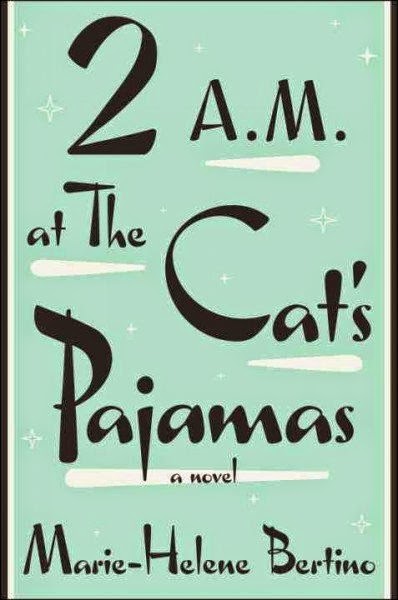
I picked up the adult novel
2 A.M. at The Cat's Pajamas by
Marie-Helene Bertino because the flap copy begins "Madeleine Altimari is a smart-mouthed, rebellious nine-year-old who also happens to be an aspiring jazz singer."
As my faithful readers are well aware, I enjoy reading adult fiction with child main characters. I liked
The Cat's Pajamas a great deal. However, because Madeline is one of three main characters (it's an episodic book that you may have to be kind of zenny to get into--and I am) and the other two are adults, I can't say this is really an adult book with a child main character. (Wait. Pedro gets a lot of time, so maybe there are four main characters. Pedro is a dog.)
Why am I mentioning this book at all, then? Because of this wonderful passage:
"Madeline has no friends: Not because she contains a tender grace that fifth graders detect and loath. Not because she has a natural ability that points her starward, though she does. Madeline has no friends because she is a jerk."
I finished that last line and thought, Why don't I see things like this in kids' books? Wouldn't child readers appreciate this kind of observation?
 I was intrigued when I read a review of The Cottage in the Woods by Katherine Coville and snatched the book off the shelf when I saw it at my local library. I mention this to make the point that sometimes reviews actually do get readers. Or, in this case, a reader.
The Cottage in the Woods has been described as Jane Eyre meets Goldilocks and the Three Bears. It certainly is. Jane Eyre fans can have a fantastic time picking out the connections. A young, powerless, single female enters a large house as the employee of a wealthy man. This is a wealthy, married man with a family, which is one of the ways this book is different from Jane Eyre. But he's also a bear, as is the young female, Ursula. (Relating to ursine, I'm guessing.) Ursula is there to act as a governess to the bear's son, Teddy. (Oh, my gosh. Teddy Bear!!! No, actually his last name is Vaughn.) Ursula has a love interest, and, shades of Mr. Rochester, he's not free to love her. There is a mystery in this house, as there is in Jane Eyre. And it's related to a female, as is the mystery in Jane Eyre. This female, though, is young, with golden hair.
However, there is a whole nonJane plot involving human bigotry toward enchanted animals like Ursula and the Vaughns. I've read that some reviewers found that aspect of the book didactic. To me it was distracting, because it wasn't part of the Jane Eyre/Three Bears premise. It seemed unnecessary. What was going on with Goldilocks was so clever and unique that I would have liked a plot sticking much closer to that, which could have been closer to the Jane Eyre source material.
But, then, I know Jane Eyre. Readers who don't could feel differently. Since this is a middle grade novel, there will be many readers who don't know Jane.
While reading this, I wondered what Ms. Yingling would think of it. Sure enough, she read The Cottage in the Woods and weighs in on the subject. I agree that while I enjoyed it, it may have trouble finding an audience.
In order to take a break from all this environmental thinking we've been doing, let's talk picture books.
I'd heard of
The Farmer and the Clown by
Marla Frazee, and it's a book that does live up to its hype. The story of the farmer who sees a little clown fall from a circus train and takes him in is told totally in pictures. It's one of the easiest to follow wordless books I've ever seen.
I "read" this is as a sad story about the farmer. But when I finished, I looked at the front flap and found a much more upbeat interpretation, one I think that works. One that's much more from the clown's point of view.
So two stories going on here, all without a word.
I snatched up
Ivan: The Remarkable True Story of the Shopping Mall Gorilla by
Katherine Applegate with illustrations by
G. Brian Karas because I'd already read Applegate's
The One and Only Ivan. My interest was in seeing an author use the same material in different ways. The picture book really is quite good. I almost thought I might like it better than the novel, but than I remembered Ivan's voice in
The One and Only Ivan.
Both novel and picture book are very well done.

I have finally found an environmental book for older readers, and it is terrific.
Sixteen-year-old Laura, the journal keeping main character in
The Carbon Diaries 2015 by
Saci Lloyd, is a member of a punk band. She has an appalling older sister, and her parents are falling apart. Sounds pretty generic YA, doesn't it? What makes this book riveting is its setting and its main character.
Are Good Environmental Books All About Setting?
The 2015 Britain of
The Carbon Diaries is one suffering from energy shortages and horrific climate problems, as is the rest of the world. Britain, however, is the first country to start carbon rationing. The book is Laura's account of her family and neighbors dealing with limited access to energy while suffering through an extreme winter, a drought, and torrential rain. Her older sister is appalling because she is bitter and angry about her gap year in America being cancelled. Her parents are falling apart because they're having trouble coping with the social change they're being hammered with. Dad, for instance, is the head of a travel and tourism school. With carbon restrictions, people can't travel. That pretty much puts an end to the tourist industry in Britain, and he loses his job.
The book isn't a cautionary tale, in my humble opinion. It's much more of a thriller. What's going to happen next and how will the characters survive it? Though Laura comments on the selfishness of others a couple of times and wants very much for the rest of the world to get on board with carbon rationing, this is not a "Let's save the planet!" story. There is no instructive message.
I'm sure many reviewers probably write about
The Carbon Diaries' environmental themes. I always have trouble determining what an environmental theme would be. I've seen some writers calls
The Carbon Diaries' theme "climate change." That seems more like a subject to me. I would say the theme of
The Carbon Diaries involves a teenager struggling to find her place as an older person in her family and her place in society, one that is dramatically changing. Those are traditional YA themes, not environmental ones. It's the environmental setting that makes those traditional YA themes interesting and makes this book environmental.
Isn't climate fiction, fiction dealing with climate change, all about setting?
A Good Character Always Does Wonders For A Book
Laura is like an edgier, smarter
Georgia Nicholson. The format of the book is even similar to the Georgia Nicholson books. It's a journal, of course, and there are several pages at the end translating British terms for American readers, which you find in Georgia's books. This is not a complaint. I like Georgia. I like Laura.
A Good Book Doesn't Have To Teach You AnythingThough
The Carbon Diaries doesn't insist that readers do anything, the characters' struggle was so intense that it has an impact. I hadn't read much before I started obsessing about whether or not I'd turned the heat down at night. I freaked out a bit over that power outage in Washington earlier this week. And, yikes! They're rationing water in California!!
Very few people like to be preached at or taught. If a piece of fiction is well done, it creates a response in readers without doing either of those things.
 I have probably mentioned before that I have an interest in books with some kind of weight-related angle. One branch of my family has been...big...for three generations, probably more. While I've only been borderline heavy at times, myself (though I still have time), I've seen what this issue can do to a lot of people. It's something I think about a lot. If my response to Big Fat Manifesto by Susan Vaught a few years ago is any indication, I over think about it.
All the time I was reading 45 Pounds (More or Less) by K.A. Barson, I was over thinking like mad.
One of the things I was over thinking about was how difficult it must be to write a book about being overweight. I definitely accept the value of the material. But can you write about the experience of being overweight without writing an issue/problem book? How can you write about being overweight without that situation being a problem? On the most superficial level, to do that the writer would have to find a way to overcome social attitudes toward the overweight in the world she creates, forget about the practical considerations Anne in 45 Pounds deals with or the health considerations my family members have dealt with. It's hard to see how this can go any other way than a problem story.
So 45 Pounds falls into the problem novel category, covering a multitude of reasons for people finding themselves a size 17, as main character Anne does. She really is hammered with far more reasons to comfort and impulse eat than anyone needs. She's very good at recognizing them. Though that probably makes sense because she's been studying weight loss for a big part of her sixteen years. Anne's big turn around comes from her desire to help someone else, not herself. That's something I could over think about with little effort. Is it better to improve yourself for yourself or for someone else? What does it all mean?
45 Pounds is definitely readable. Far more readable, in fact, than my angsting over the weight issue would lead my readers to believe. After I finished the book and while I was working on this blog post, I happened to read an article by Susan Dunne about artist Nathan Lewis. At the very end, he says, "That's the way we learn stories, through fragments. The narrative happens in our own mind." It immediately made me think of 45 Pounds, though not because its story is fragmented. Not at all. It's all there. But readers like myself, who feel they have a connection to that story, can get trapped in a narrative in our own minds.
 Meet Me at the Art Museum by David Goldin is one of the easiest to take instructive picture books I can recall reading in quite some time. It uses the old night-at-the-museum situation with a docent's name tag giving a ticket stub an after-hours tour.
This thing gets really simplistic, going so far as to explain what a coat check room is and that there are signs all over the place telling you what to do. But, you know, it's a picture book. It's for kids who presumably have never been into a museum. When I go to a museum, I like to go to the coat check first thing.
What a curator does, what a conservator does, what an archivist does, what a historical artifact is...I love this stuff. I also loved the reproductions of artwork sprinkled throughout the book. On page 14 you'll see A Sunday Afternoon on the Island of La Grand Jatte by Georges-Pierre Seurat or, as one of my kids once told me, A Picture of a Woman Walking Her Monkey. I don't know why I'm so fond of that work.
Meet Me at the Art Museum would be a fine addition for libraries, schools...and museum bookstores!
 Books for kids on the lower end of elementary school have improved over the years. Sasquatch and Aliens: Alien Encounter, a chapter book by Charise Mericle Harper has real wit and a legitimate story line. (Well, except for the underwear business at the beginning, which, though fun, sort of peters out.) Two boys, who are not exactly made for each other, stumble upon an alien in the woods. And later a sasquatch. And there's a logical explanation. One that is just a little bit disturbing.
Cartoons are liberally sprinkled throughout Sasquatch and Aliens. They do more than illustrate. They carry some of the story, replacing traditional text in the narrative. That ought to make this book attractive to readers who may not be that fond of reading.
I've just completed reading the
Montmaray Journals by
Michelle Cooper, an account of the lives of an impoverished royal family from pre-World War II into the very early 1950s
. I began the series back in 2012 with
A Brief History of Montmaray, a strange, otherworldly trilogy that I definitely enjoyed. I read Book Two,
The FitzOsbornes in Exile, right after reading Book One. I don't know why I waited so long to get to
The FitzOsbornes at War, but I didn't forget about it.
In the early pages of
FitzOsbornes at War, I was definitely sorry I hadn't binge read these books. I was having trouble getting up to speed with the characters. But I did. I won't go so far as to say I couldn't put it down, but I was anxious to get back to it.
I thought
The FitzOsbornes in Exile was probably a formulaic England-under-the-cloud-of-coming-war story.
The FitzOsbornes at War is probably a formulaic London-during-the-Blitz story. It's just a really good one. Or maybe I just really like that formula.
With the first two books, I felt that the change to the characters' lives that gets their stories started didn't really start into well into the book. The change to the characters' world in
FitzOsbornes at War is World War II, of course. Things got underway pretty early on this time. I did wonder, though, whose story this is. Sophie, who maintains these journals, is the least out-there of the royal FitzOsbornes. She's not as dramatic and charming as her brother, the king/pilot and younger sister (oh, Henry, Henry, I was in the Laundromat when I read...well, let's not go there), nor as brilliant and beautiful as her cousin. Her war experience is far more limited than theirs. Her function is to record what happens to them. Is this her story of telling their stories or the family's story?
In one of the earlier books, HRH King Tobias' personal life is revealed but barely mentioned again in this final book. In the last pages of the book, which cover what happened to the family immediately after the war and includes a genealogical chart, those of us in the know can pick up a little something that might relate to it. I found what these royals ended up doing immediately after the war very interesting.
I have to wonder if this last book is actually Young Adult. Sophie, our main character, is nineteen when the war begins at the beginning of the book, meaning she is twenty-four by the end. The war experiences aren't anything that relate specifically to adolescence.
I don't find this to be a problem. The idea of a YA trilogy transitioning to adult is interesting.
Check out this post from author Michelle Cooper's blog in which she discusses some
historical events she considered including in the Monmaray Journals and had to let go. Cooper's blog also indicates
she's been doing research on the 1950s and '60s. What is coming up?
And, finally, this trilogy is completed so you can binge read. Don't wait for the last book the way I did.
Though I certainly have always respected
Eric Carle's accomplishments (
great museum, for instance), I can't say I was ever particularly taken with his work. The whole caterpillar business kind of escapes me.
However, this weekend someone asked me to read him Carle's
Dream Snow. And now I know why Eric Carle is Eric Carle.
What a fantastic combination of story and image. Little bits of animals can be seen through barn windows. Later, the whole entire body can be found behind an overlay of snow. And then the Santa-type figure decorates a tree that lights up. (Or maybe there was music. I was kind of excited over this, and now I can't remember.) I think this book makes the best use of what some might consider gimmicks, the overlays and the music or lights, that I've ever seen.

Someone in our family was totally drawn into this book. I had told him I was looking for a
cow book in his room. He asked for
Dream Snow, pointed out the cow in the barn, and when we lifted the snow overlays, announced, "There's the cow" and then "There's the-----" whatever the next animals were. Yes, he is amazing. But this book should make it easy for all kids to be amazing.
My niece and I started a new series, beginning with
The False Prince by
Jennifer A. Nielsen. It appears to be a trilogy, not a marathon like
the last series we read. I thought it dragged just a liiiittllllle bit, but I definitely like a well done unreliable narrator. The best part? Books 2 and 3 have been published. I can whip through these things the way I like to.
Oh, wait. The best part, really? My niece compared Sage in
The False Prince to another character in a book I gave her three years ago. I can't tell you who or what or you will figure out an important, neat thing about
The False Prince. I figured it out about two-thirds of the way through the book but it was one of those figure-something-out-in-a-cool way not a oh-my-gawd-why-didn't-she-just-put-up-a-road-sign? way. But my point is, Becki made that connection between those two characters, which I, of course, had already done. She wasn't telling
me anything.
But she saw the connection between two characters from two books that
I had given her. My work as an aunt is done.
And I will be reading the sequels to
The False Prince.
 I found The 57 Lives of Alex Wayfare by M. G. Buehrlen on my Kindle. I must have gotten a sweet deal on it sometime last year. I love finding things on my Kindle.
Alex Wayfare is a time travel story. I'm not a big fan of those, mainly because I usually have trouble following the mechanics of how it happens.That's the case with The 57 Lives of Alex Wayfare, too. Alex is a Descender who can descend into her former lives. Until she's well into her teenage years, she believes she's just having very unpleasant visions. This part of the book was intriguing. As she begins to learn about who and what she is and starts time traveling, I got lost. The plot involves evil scientists who use Alex and others like her either to manipulate science for the benefit of present day or "base life" research or to steal items and hide them so they can be found in the present day or "base life." There's a lot of "who is this guy?" with a number of characters.
This could have made a TV show with Alex developing a Scooby Gang like Buffy's. Alex suggests as much, herself. Not the TV show part, but the Scooby Gang. I think base life boyfriend interest Jensen and Alex's sick sister, Audrey, should be included.
A sequel to this book was planned for this spring. However, the first book's publisher, Strange Chemistry, Angry Robot Books' YA imprint, closed last summer. I haven't found anything about the second Wayfare book, The Untimely Deaths of Alex Wayfare, being published. Now I will never know if two young characters are one and the same person. That's my theory.
 I am a big fan of Pride and Prejudice and Zombies by Jane Austen and Seth Grahame-Smith. I thought the literary mash-up of Austen and zombies worked "very well in the context of the original Pride and Prejudice story because in Austen World the hunt for a husband is life and death, much like encounters with zombies." In Pride and Prejudice and Zombies, the Bennet daughters had pledged to fight zombies until they were "dead, lame, or married." Marriage is pretty much the end for the Bennets in whatever universe they're part of. And the book is funny.
I didn't run out to read other classic/horror mash-ups because I thought it was a situation that would get old fast. Little Women and Werewolves by Louisa May Alcott and Porter Grand jumped out at me at a library book sale, though, and now I have, indeed, read it. The situation isn't old in this book. It just doesn't work the way it did with Pride and Prejudice.
Little Women and Werewolves follows the original book very closely, but with werewolves slipped in. Instead of fighting the werewolves, the way the Bennets fight zombies, the Marches are far more passive, being merely sympathetic to the werewolves' plight, seeing as they have to live in hiding or they'll be hunted down by members of the bullyish Brigade. The March girls have learned from their minister father to be tolerant of werewolves.
But here's the thing: The werewolves are cold-blooded killers. When the moon is full, they kill and eat innocents. They feel no remorse. The Marches have no problem with this. They are not horrified. That doesn't seem to make sense logically in the context of this story about these sensitive, gentle, spiritual people. I wondered if some of the gory scenes were supposed to be funny, but if so, I totally missed the humor.
Little Women wasn't my favorite Alcott book when I was young. (I am a Little Men fan.) As I was reading Little Women and Werewolves, I started wondering what the original book's attraction is. There isn't a lot of story here. Even with werewolves. I may try to reread bits and pieces of it to compare them to the werewolf version.
 John Rocco has a picture book out called Blizzard that's been getting a lot of attention the last couple of months. It would have been terrific if I read that this past week and could write about it now after the events of the last couple of days here in New England. Yeah, well, that didn't happen.
I did pick up Rocco's earlier book, Blackout, from the library a while back. It would have been terrific if we'd had a power outage this week, a threat that was hanging over our heads this past weekend, and could write about it after reading Blackout. Yeah, well, that didn't happen, either.
But I'm still going to tell you about Blackout because it is beautiful. I am not the only person who thinks so, because it was a Caldecott Honor Book in 2012. It is beautiful looking with a lovely, simple story of people having a great time when the lights go out. That simple story is told without a lot of text, something that doesn't happen as often as you'd think with picture books.
By the way, Rocco also illustrated How to Train a Train by Jason Carter Eaton, which happens to be a big hit with a member of my family.
No, I am not going to claim that
The Snowy Day by
Ezra Jack Keats is an environmental book. Though, I suppose I could. When I'm looking for environmental books, I look for
experience.
The Snowy Day is all about a child's experience of winter, of a snowy day. Peter is immersed in a winter environment.
What I'm going to do, instead, is argue that environmental children's books need a
The Snowy Day.
Back in 1962,
The Snowy Day broke the color barrier in mainstream children's publishing. Little Peter is African-Amercan. But nowhere in this book is there anything that says, "Oh, this is an important story I'm telling here. Here is a lesson for us all--we're all alike when it snows!" Deborah Pope of the
Ezra Jack Keats Foundation said in a
NPR interview that Peter's ethnic background "...wasn't important. It wasn't the point." She said that Keats "wasn't necessarily trying to make a statement about race when he created Peter." He was a white illustrator who had never used a child of color in his work and decided he would.
The Snowy Day is the story of a kid having a good time in the snow. He just happens to be black.
So many children's environmental books are heavy with lesson. The mini-lectures undermine whatever story is there and destroy the experience of being immersed in some natural element. I'd love to see an environmental equivalent of
The Snowy Day, in which child characters simply go about their business recycling or composting or living in a solar house or living as a part of some ecosystem or another without hammering readers about the significance of what they're doing.
Maybe for the time being I'll settle for
The Snowy Day as an environmental book and read and watch little Peter surround himself with winter.
I got the last
Skulduggery Pleasant book,
The Dying of the Light by
Derek Landy, in from England a few months ago. I didn't rush to read it, because I'd found the last few
Skulduggeries a little slow and long. Not this one. This one moved along, I kept wanting to find more time to read it, and I would have been happy to have read still another book about the bony one.
The last few books, including this one, jumped around with points of view. With the other books, I felt that slowed everything. With this one, not so much. I began to feel with this book that when you're using multiple points of view in a book, the book may not be one person's story as much as it is the story of some kind of event in which many people have a point. That was a bit of what was going on here. Instead of being
just Valkyrie Cain's story (these books have never really been about Skulduggery Pleasant),
The Dying of the Light is the story of how a group of magical folk battle the seemingly unbeatable Darquesse. Valkyrie is a significant part of that, but it's not just her, which is why the point of view switches seemed workable.
Two particularly interesting bits:
- Every now and then, the scene in Dying of the Light switches to what appears to be a totally different story involving an unnamed Irish woman in the U.S., a mortal, and a couple of evil types we know from an earlier book. Oh, and a dog. We're not even sure who the woman is until the end. This is the kind of thing that I would usually become very impatient with. I loved it. Who is she? What's going on here? And when?
- Unlike many fantasy authors, Landy addresses the issue of Christianity. As in, if there is a magical world with gods, as there is in the Skulduggery Pleasant universe (most are insane and Valkyrie has punched one), what about the Judeo-Christian concept of God? I've wondered about that with, say, the Percy Jackson books. If the Greek gods are real, does that mean Baby Jesus isn't? In The Dying of the Light that issue is discussed. "Is there a God?" Valkyrie's mother asks Skulduggery. And her uncle says, "My wife and I go to mass every Sunday...Don't you sit there and tell me there's no God." And Skulduggery doesn't. He just can't tell him that there is.
So, great stuff in this book, which I'll be passing on to my niece. Sigh. We've finished our series. What's next for us?

The picture book
Winston of Churchill: One Bear's Battle Against Global Warming by
Jean Davies Okimoto with illustrations by
Jeremiah Trammell teeters between being preachy and instructive and clever and witty.
Winston is a polar bear near a town named Churchill in Manitoba, Canada. He wears glasses and is always holding a lit cigar, much like another
Winston named Churchill. Bear Winston is in a position of polar bear leadership, much like British Prime Minster Winston was in a position of human leadership. The polar bears are facing the melting of ice in Hudson Bay due to human pollution, much like the Brits were facing invasion by the Na...No, that's kind of a stretch. But when Bear Winston rallies his bears, he does
sound a lot like British PM Winston rallying his people. '"We will for fight ice," boomed Winston. "We shall defend our island, whatever the cost may be. We shall fight on the beaches. We shall fight on the landing grounds. We shall fight in the fields and in the streets. We shall fight in the hills. We shall never surrender."'
That's what makes this book clever and witty, the whole whole bear-doing-Churchill thing. Because a polar bear isn't Winston Churchill, and the incongruity is funny.
But then you get to the lesson stuff. '"Ice is melting because it's getting too warm around here and people are doing it with their cars and smoke stacks. And cutting down trees."' I'm not saying that's not true, but instruction is awkward, to say the very least, in fiction.
Winston of Churchill even includes a page from a book Winston of Churchill wrote on global warming to make sure to get the educational stuff across. Though I'm going to take a wild guess that I'm not the only person who skipped it.
But here's the clever and witty thing about that book written by Winston of Churchill--Winston Churchill wrote books, too!
The illustrations in this book are marvelous and very engaging, and I think kids will be attracted to the bears and some of the humor. Some will be left recalling that human actions are wrecking ice for those neat bears. It will probably be adults with some knowledge of a World War II historical figure who will enjoy this book the most.
Winston of Churchill won the
Green Earth Book Award for Children's Fiction in 2008.

 I finished the last book I'd taken from the Cybils lists last night, and not a moment too soon. The finalists for the Cybils Award will be announced tomorrow.
I love the premise for The Blossoming Universe of Violet Diamond by Brenda Woods. Violet Diamond is an eleven-year-old biracial child whose black father died before she was born. She has never met his family because his mother originally objected to her son marrying a white woman and later, we learn, was so devastated by her only child's sudden death in an accident that she couldn't deal with the family he created with his wife. Once she'd recovered, staying away from them had become a habit.
I find that believable, by the way.
Violet's loving maternal family is extremely white, and she lives in a very white, upper-middle class world. Her mother is a neonatologist, and her late father was a medical doctor as well. Her white grandmother runs some kind of on-line business and her white grandfather is enjoying retirement, cooking and playing golf. Violet wants for nothing, materially or emotionally. Except that half her identity is missing. Just not there.
She is aware that her black grandmother is a well-known artist, and when she finds out that grandmother will be in a neighboring city for an exhibit, she gets her mother to take her to the opening. Violet and grandmother meet, and Violet ends up being exposed to the half of her family history she's never known.
As I said, I love the concept and love the artist grandmother. I felt as if the story of Violet's exposure to her family took a while to get started, though.
For another take on biracial children meeting an unknown grandparent, check out Brendan Buckley's Universe and Everything In It (Hmm, similar title.) by Sundee Frazier.
The Blossoming Universe of Violet Diamond is a Cybils nominee in the middle grade fiction category.
After a couple of months of Cybilizing, I feel more up-to-date on recent children's lit than I have in quite some time.
 I think these are the only two picture books I read off the Cybils list. (I've read myself into a mild coma, so I can't be sure.) They are both particularly engaging.
I read Gaston by Kelly DiPucchio with illustrations by Christian Robinson first and was delighted. Gaston does not exactly fit with his teapot poodle siblings, Fi-Fi, Foo-Foo, and Ooh-La-La. Does his mother care? Not a bit.
 One day this family is out at the park where they meet another family of dogs with a member, Antoinette, who doesn't fit in with her siblings, Rocky, Ricky, and Bruno. Quelle horreur! Has a terrible mistake been made?
Gaston is all about feeling right as well as looking right. It's amusing and quick and kind of deep. I did wonder if some kids reading this will learn about the possibility of being switched at birth and be a little shaken. But, hey, literature is dangerous.
 Flora and the Penguin by Molly Idle is one of those books in which the pictures tell the tale. There are no words. I can't recall when I've seen a book in which facial expressions and body language--even on the part of the penguin--did such a terrific job of conveying emotion and action.
Gaston and Flora and the Penguin are both Cybils nominees in the fiction picture book category.

 A clever, spunky girl who keeps a journal and is dealing with a parent's tragic illness. Doesn't that sound like a stereotypical children's book, the kind adult gatekeeper's just love?
That was my first impression of The Meaning of Maggie by Megan Jean Sovern. In fact, I considered giving up on this one early on. Before long, I was very glad I didn't.
Twelve-year-old Maggie Mayfield is brilliant, knows it, and loves everything that goes along with being smart. She is given a journal in which she begins writing a memoir while sitting in a hospital room with her obviously critically ill father. This is all in the prologue. You can see why I wasn't immediately entranced.
But Maggie has a truly marvelous voice. She reminded me very much of Flavia de Luce, a child character of about the same age in an adult mystery series, not just in her intelligence and enjoyment of same, but in her relationship with her two hot, older sisters. There is antagonism there, but the older sisters also keep an eye out for Maggie, which she may not always recognize. Maggie also sets out at one point to cure her father of multiple sclerosis, just as Flavia sets out to do something miraculous and impossible for a parent in one of her books.
Maggie's memoir deals with the year between her eleventh and twelfth birthdays, the year when her father's illness took a turn for the worse, something her family couldn't protect her from, try as they would. Hmm. My college knowledge of memoir is that it's a recollection of an event the significance of which is not clear until after it happens. That pretty much fits the situation here.
One thing I found odd with this book was it's 1980s setting. Why? I kept wondering. So that dad could be the aging hippy he is here? So that the author can talk about decades old music? So that Maggie wouldn't have the Internet available to her, because the Internet would have made it a lot harder to keep knowledge of her father's illness from her? No, in an author's note at the end of the book we find out that The Meaning of Maggie is autobiographical. I can't believe I've never read an autobiographical children's book before. If so, was it this good?
The Meaning of Maggie is a Cybils nominee in the middle grade fiction category.

 Here's the basic set-up for The Devil's Intern by Donna Hosie: Hell and "Up There" are just places people go to after they die. While there are definitely evil folk in Hell who suffer horribly, some people, like our teenage protagonist Mitchell, seem to end up there for random reasons. For them, Hell is pretty much a really boring, overcrowded place. They hold jobs and can change. Mitchell's good friend, a Viking prince who died in battle at sixteen, has learned to read in Hell.
Mitchell is an intern in the accounting department and through his boss is able to get his hands on a device that will allow him to time travel. His plan is to go back in time with his three best (dead) friends to relive and change their deaths. Mitchell, in particular, wants to get to live the life he missed out on because he was hit by a bus.
There's much that's entertaining and intriguing in this book. There's plenty of narrative drive once the group finally gets on the road. But I had a hard time with the "paradox" business that Mitchell kept talking about. If these dead kids changed their deaths, what does that do to their afterlives where they were best friends and even two couples? The things that happen at each of their deaths that only happen because of something else that happened and could that be changed? Well, I was watching an episode of Dr. Who this afternoon that I couldn't follow, either. The where-are-we-in-time thing is difficult for me.
While I was reading The Devil's Intern, I wondered if it was really YA or was it an adult book with teen characters? One of the big factors in determining YA is supposed to be theme. YA themes often involve young people working out how they're going to live their lives. At first, I thought the characters in The Devil's Intern were coming to terms with how they had lived their lives, which would be adult. However, you could argue that they are working out how they're going to live their afterlives, bringing us around to YA territory again.
Hellbent by Anthony McGowan is another YA book set in Hell. Interesting how totally different they are.
The Devil's Intern is a Cybils nominee in the Young Adult Speculative Fiction category.
You know how I've been whining about the
time suck that is Christmas? Yes,
I have. Well, on Saturday, the Saturday before Christmas, I was doing the run-around thing. I got less done in the morning than I'd hoped, which is always the case, and then I had a particularly draining weekly elder visit. I had to stop at the library on the way home because I'd received one of those e-mail "It's over lady! You didn't even start that book, and it's too late now" messages. I had plans for when I got home. (I can't even remember what they were now.) So I was going to just run into the library with my books, shove them in the slot, and get the hell out of there.
Really, I was.
Then I'm in the parking lot, and I think, Bring your wallet, Gail. Bring your library card. Because you know what you need? You need some new library books. You'll feel so much better, so good, after just five minutes wandering around in this building. Maybe ten.
And I was right. A library is so incredibly calming. Oh, my gosh. It's like soaking in a hot bath. Maybe because I soak in hot baths with a book.
I only picked up a few things, because I'm not greedy, one being
The Midnight Library by
Kazuno Kohara. This is a sharp looking picture book with a distinctive style. Plus it's a quick, charming story about a little girl librarian working at night to make everything right for her patrons.
Is that not the perfect library book for someone who has just had a calming experience at the library?

 I have liked some of M.T. Anderson's Thrilling Tales/Pals in Peril books better than others. (I know I'm nitpicking on this, but the name of the series changed for some reason.) I had to be won over by the first book, Whales on Stilts, but the second one, The Clue of of the Linoleum Lederhosen, was a hit. The third one I read (there are supposed to be six; I seem to have missed a couple), Jasper Dash and the Flame-Pits of Delaware wasn't a favorite. But the final book in the series, He Laughed with His Other Mouths, is an absolute gem.
The basic premise for all these books: A Tom Swift-type character named Jaspar Dash and a spunky girl (younger and spunkier than the 1930's era Nancy Drew) existed in their own book worlds that reflected the eras that created them, the 1920s/30s and the 1980s/90s. And yet, at the same time, they are existing in our own twenty-first century where Jaspar, in particular, is both having adventures but out of place.
In He Laughed with His Other Mouths, Jaspar is now that classic/stereotypical character, the young male in search of his father. Jaspar will go to the ends of the universe in search of dear old dad. He will accept some pretty outlandish behavior from his father figure. However, Jaspar is a young hero, and he recognizes evil when he sees it. Maybe he doesn't recognize it right away and maybe he needs a little push from his spunky girl companions, but he does recognize and behave as a hero should.
All of the books that I've read in this series operate on more than one level. You have the basic contemporary adventure. You have characters from an older book world trying to function in a contemporary one. You have the knowledge that children who are now old, if not dead, read the older books back when they were new and shiny.
With He Laughed with His Other Mouths, Anderson does something quite marvelous with footnotes. Using footnotes for witty asides has become a cliche since Terry Pratchett perfected doing that back in the day. But Anderson uses his clever footnotes not to be witty but to tell another story entirely, this one about a kid during World War II who was a Jaspar Dash fan. This is a complete story, a piece of serious historical fiction embedded in a fantasy satire/comedy.
As with all these books that I've read, I wonder how much of this wonderful stuff child readers will understand. Assuming they enjoy the layer with the contemporary adventure, will they get the jokes that are part of it? Will they get the nostalgic elements?
Kid readers aside, for those of us who do get He Laughed with His Other Mouths, it's pretty damn brilliant.
He Laughed with His Other Mouths is a Cybils nominee in the Elementary/Middle Grade Speculative Fiction category.

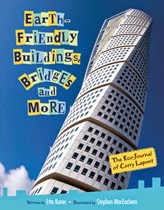 Not every page of Earth-friendly Buildings, Bridges and More by Etta Kaner with illustrations by Stephen MacEachern contains Earth-friendly content. Nonetheless, this is quite a marvelous book about the work that goes into building a variety of structures and how many of them are being built greener.
Though this is a nonfiction work, the basic premise is that an imaginary girl has been traveling with her engineer parents, and we are reading her scrapbook. She is one enthusiastic kid. Among the things I liked about Earth-friendly B, B and M:
- While there is certainly content related to large buildings being made more green, there's also material about designing buildings to withstand earthquakes and storms. It's as if technology is working with Earth, not against it.
- It gives readers a good idea of the number of people, the variety of engineers, for instance, necessary just for the planning of a big construction project. This is important because it helps to explain why building takes so long and is so expensive.
- Technology has had a bad rap for many years now. The 1950's were filled with movies about science gone amock. I've read that The China Syndrome was a turning point in how science was perceived by the public in the '70s, that technology would lead to very bad things. First some guy is messing around with creating life, and the next thing you know, dinosaurs are coming back and eating people. But in Earth-friendly Buildings, Bridges and More, technology is portrayed as a good thing. Mom, Dad, an uncle, and a cousin are all engineers, all involved in creating or fixing things. Even if you're not a fan of tech, this is different.
The stereotype about environmental living involves natural fibers, whole grains, and funny light bulbs. But it takes technology to make real environmental progress, to find ways to heat and cool enormous buildings, for instance.
Earth-friendly Buildings, Bridges and More can help young people recognize that.

 When I picked up The Misadventures of the Family Fletcher by Dana Alison Levy from the library, I told the librarian that I'd heard the book was like The Penderwicks but with boys and two gay dads. She said, "Ah, bringing the story into the present." I think that is the case. I liked The Penderwicks very much and found it contemporary, probably compared to/contrasted with Little Women, which it is a spin on. But I also thought "This book, simply by being a throw-back to Little Women and, perhaps, other pre-nineteen-fifties stories, is different." It had a retro thing going for it, it was "a story about sisters who worry about the family's honor and don't even mention a TV."
The Fletcher boys may be viewed as a little innocent and other-worldly not because they're retro in any way but because their stories and lives are very rooted in traditional child issues. This in spite of the fact that they are not genetically related, they are not even all the same ethnic background, and they are all the children of two men who are living and raising a family together. Each boy has his own storyline with his own issue:
- Boy One is a popular athlete who is considering trying something different
- Boy Two is dealing with growing apart from a friend and moving on, as well as trying to interview the crotchety old guy next door for a school project
- Boy Three is highly intelligent and has begged Dad and Papa to let him go to a school for the gifted
- Boy Four has the "stereotypical" imaginary friend. Or does he?
You know the one problem none of these kids have? Those gay dads. The men are just there, doing any kind of dad stuff. There's nothing didactic or instructive here about accepting families with nontraditional parents. These guys have had children in the school system for a number of years now. People know they're there. Halloween parties are held. Ice rinks are made. Holidays are celebrated. Life goes on.
This is not to say that no one ever raises an eyebrow over the gay family. When they are attending an open house at a new school, oldest brother Sam feels compelled to address questions. "We were all adopted as babies. Our dads have been together for ages. They got married two years ago"..."Do you have any other questions? Want to know our birthdays? Height and weight?"
That was a neat way to handle back story, by the way. The newspaper article written by an eighth grade student about the Fletchers and their annual Halloween party is also a clever way to get the back story on how the Fletcher kids became brothers.
As I was reading this book, I thought this premise would make a charming sitcom. The various chapters here could be the first season's episodes. Then the story could expand with episodes about the gay dads dealing with their boys going to camp, getting babysitting jobs, heading to high school, getting jobs, dating girls.
The Misadventures of the Family Fletcher is a Cybils nominee in the Middle Grade Fiction Category.

 I just finished three fantasy books in a row, mainly because I needed to get them back to the library in a certain order. You'd think fantasy would be different, wouldn't you? As in, it's not real world stuff, so it should be different. But when you read so much of it, there's a certain sameness. And then real world YA is often very similar in its own real world way.
Which is why The Tyrant's Daughter by J. C. Carleson is so exciting. It's real world, but very different YA real world.
Laila is a princess, daughter of the murdered king of an unnamed, presumably Middle Eastern country. Except after she has resettled with her mother and brother in a seriously modest two-bedroom apartment outside Washington, DC she realizes that no, she's not a princess at all. Mainly because her father was never a king. He was a third-generation strongman tyrant and when he wasn't being Dad at the palace, he was behaving in a typical tyrannical way.
Laila has a terrific voice, slightly reserved and stiff as she describes, for instance, her appreciation of her new American friend's kindness even though she can't help noticing that she dresses like a prostitute. She's a kind person, herself, recognizing that a classmate is suffering because her parents are divorcing and becoming attracted to that nice guy who works for the school paper. But those traditional YA experiences pale compared to those of a fifteen-year-old whose father was gunned down in his home on her uncle's command, who saw her mother covered in her father's blood, whose life was saved by a CIA operative. The Tyrant's Daughter isn't about the world of teens. It's about a teen in the world.
What's missing from this novel is cliched nasty teenagers. There are no mean girls. There are no bullies. There are no jocks trying to force themselves on girls. Adults might find the CIA operative familiar, as well as the brilliant, manipulative widowed tyrant wife. But I don't think they appear often in YA.
So that's just the basic set-up to this thing. As the truth about Laila's family is slowly revealed to her, the fact that this book is a political thriller is slowly revealed to readers. Why is that CIA op hanging around? What's he paying Laila's mother (but not very much) to do? With whom? Why is her mother talking to Laila's uncle, the tyrant who had her tyrant father killed?
And what will Laila's involvement in all this be? She is a tyrant's daughter, after all.
This is a marvelous book, extremely well written. But it's undercut a bit by the essay on women in the Middle East that follows. Even though the essayist ties it to The Tyrant's Daughter by questioning what will become of Laila after the end of the action of the novel, I think most readers are going to wonder why it's there and feel that this great reading experience is being turned into some kind of lesson.
The Tyrant's Daughter is a Cybils nominee in the YA Fiction category.
View Next 25 Posts