

Don't miss this unique opportunity to pitch your animation project at the world's biggest animation event.
The post Call For Pitches: Present Your Animation Project At Annecy 2017 appeared first on Cartoon Brew.
Add a Comment
 By: Jerry Beck,
on 12/8/2016
By: Jerry Beck,
on 12/8/2016
Don't miss this unique opportunity to pitch your animation project at the world's biggest animation event.
The post Call For Pitches: Present Your Animation Project At Annecy 2017 appeared first on Cartoon Brew.
Add a Comment By: Rachelle Gardner,
on 9/4/2015
By: Rachelle Gardner,
on 9/4/2015
 You are standing in an elevator and have two minutes to tell someone about your book. Today we’re going to talk about crafting that one-sentence summary, also known as a logline, a hook, or a one-sentence (elevator) pitch. This is not your book’s tagline!
What: About 25 words that capture your novel, memoir, or non-fiction book.
Why: To get someone interested in reading your book.
When to use it: The start of a query, or anytime someone asks you, “What’s your book about?”
What it does: A one-sentence summary takes your complex book with multiple characters and plotlines and boils it down into a simple statement that can be quickly conveyed and understood, and generates interest in the book.
What it should include:
→ A character or two
→ Their choice, conflict, or goal
→ What’s at stake (may be implied)
→ Action that will get them to the goal
→ Setting (if important)
Tips:
→ Keep it simple. One plotline, 1 or 2 characters.
→ Use the strongest nouns, verbs and adjectives.
→ Make the conflict clear but you don’t have to hint at the solution.
In your one-sentence summary, try not to pitch a theme. Pitch what happens. Examples of themes:
This book explores forgiveness.
This book looks at the thin line between right and wrong.
This book explores the meaning of independence, and asks if it’s really possible.
Here is Nathan Bransford’s simplified formula for a one-sentence pitch: “When [opening conflict] happens to [character(s)], they must [overcome conflict] to [complete their quest].”
Examples of one-sentence summaries:
Harry Potter And The Sorcerer’s Stone by J.K. Rowling
• A boy wizard begins training and must battle for his life with the Dark Lord who murdered his parents. (Thanks Randy Ingermanson for this one.)
→ Character=boy wizard
→ Conflict=battling the Dark Lord
→ Stakes=his life
→ Setting=none
→ Action=http://www.rachellegardner.com/feed/wizard training; avoiding the same fate as his parents
The Help by Kathryn Stockett
• In the south in the 1960s, three women cross racial boundaries to begin a movement that will forever change their town and the way women view one another.
When Faith Awakes by Mike Duran
• Chaos is unleashed on a quiet coastal town when an unassuming crippled woman raises a young boy from the dead, unlocking a centuries-old curse.
Medical Error by Richard Mabry
• Identity theft becomes fatal for a patient and puts a young doctor’s reputation and medical practice in jeopardy.
Chasing Superwoman by Susan DiMickele
• A successful attorney and mother of three battles discrimination, exhaustion, and a clueless boss while balancing a career, a family, and a life of faith.
NOW IT’S YOUR TURN. Leave your one-sentence summary in the comments.
The post Your Elevator Pitch appeared first on Rachelle Gardner.
Add a Comment By: Susan Sipal,
on 8/21/2015
By: Susan Sipal,
on 8/21/2015
I am personally very pleased to welcome Ava Jae back to the blog today. When I first started on Twitter years ago, Ava was one of my earliest friends. She did an awesome guest post on Harry Potter for a mutual friend's blog, and through that I discovered Ava's own blog, Writability. Like many others, I was instantly drawn into her warmth and keen insight into writing and publishing.
Since then, Ava has been a writing dynamo. Her blog has become a popular hub online for writers and readers, she signed with a fabulous agent, her debut book releases next year (see below!), and she's now an assistant editor at Entangled Publishing. Ava's putting all that wonderful experience into the post she shares with us today on how to craft a good pitch. Welcome Ava!
 Add a Comment
 By: Linda Formichelli,
on 8/11/2015
By: Linda Formichelli,
on 8/11/2015
 So the other day my husband Eric, who’s the news editor over at BoardGameGeek, told me about a board game publisher that created fun Twitter games like #BoardGameBand, where tweeters would come up with fun mashups of board game titles and band names — like “Frankie Goes to Hollywood Blockbuster” or “Dungeon Petzshop Boys.”
“Why don’t you do that?” Eric said.
Ding ding ding!
Together we came up with the hashtag #killaqueryin5words, and the premise was simple: I wanted writers to offer up five-word phrases that would cause an editor to trash their magazine query.
I launched the game on Monday morning, seeding my feed with such 5-word screw-ups as “I never read your magazine,” “You don’t publish poetry, but…” and “Google says you like chocolate.”
#killaqueryin5words took off! Writers around the web got a good laugh reading hilarious (but sadly common) query snafus. (In fact, contributions are still rolling in!)
Then I had another brainstorm: Why not pick my favorite #killaqueryin5words tweeters and offer prizes?
Here are my top picks. If you’re listed as a winner, please choose any e-book from the Renegade Writer Store that you’d like to receive for free (yes, even the $29.99 one!) and email me your choice at [email protected].
I have to give props to @GiulianoDebra because she contributed more posts than anyone! (I think someone was procrastinating on their work yesterday.  ) Congrats, Debra!
Next, I was super impressed that @NewJerseyWriter created the graphic you see at the top of this post just for the game. She used morguefile to find the photo and Canva to create the image. She also gave me permission to use her graphic on the blog. Thank you, and please choose your prize!
Another winner is @justinrbannon for his insightful tweet about the game: “Perhaps the most concerning thing about #killaqueryin5words is that it’s provided more than one actual tip.”
Finally, I had trouble choosing just one most awesome #killaqueryin5words tweet, so we have five winners:
1. @danielcasciato: I’m giving you first dibs. #killaqueryin5words @LFormichelli
2. @BretteSember: “you’re probably not interested but…”
3. @sharonnaylorwed: #killaqueryin5words “my writing group loved it!”
4. @RitaMailheau: #killaqueryin5words To Whom It May Concern
5. @BillDavisWords: I’m here in your lobby #killaqueryin5words
These tweets showcase five fatal query flaws:
1. Arrogance.
2. Under-confidence
3. Unprofessionalism
4. Laziness and lack of research, not to mention a stiff writing style!
5. Stalkerishness
Congrats to the five of you…please choose your prize!
One thing I discovered is that Twitter doesn’t seem to save hashtagged tweets for long, so if you want to check out the funny feed, do it now! It’s at https://twitter.com/hashtag/killaqueryin5words
I have a great idea for a new writer Twitter game for next week…stay tuned!
Thanks to everyone who participated in the #killaqueryin5words game. It’s been a blast!

.jpg?picon=418) By: BookEnds, A Literary Agency,
on 7/8/2015
By: BookEnds, A Literary Agency,
on 7/8/2015
It's July and that means pitches. Lots and lots of pitches.
By: BookEnds, LLC,
on 10/31/2014
I have a confession to make. I don't think of myself as a scary book reader and, to the best of my knowledge, I've never (gulp) read Stephen King. I know, I know...
I have read Dean Koontz and loved Thomas Harris so its not like I've never ready a scary book. I just haven't read the King.
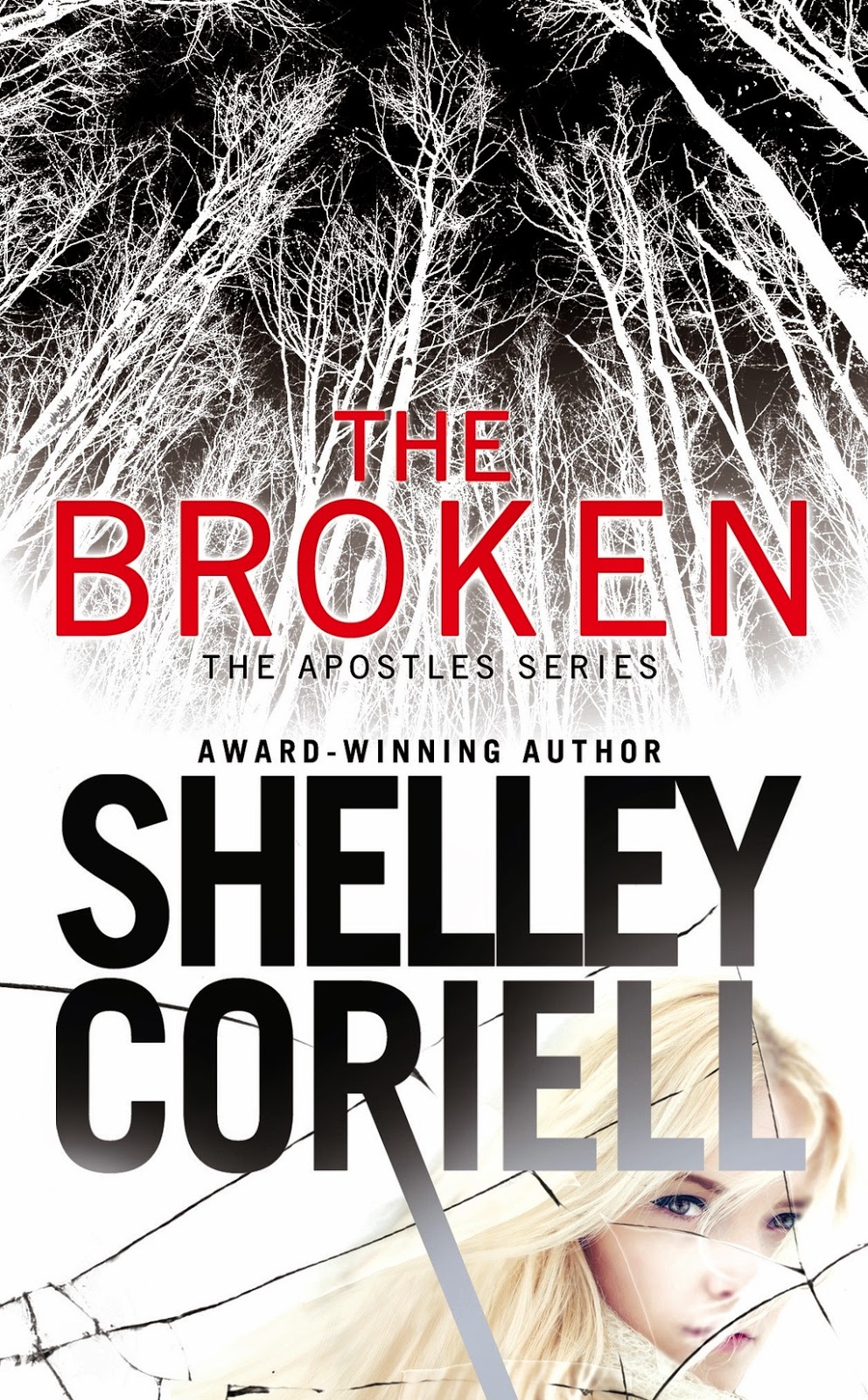
Recently I've been on a Chelsea Cain kick, as anyone who follows me on Twitter knows. And while she's not a horror writer those books are absolutely scary. In fact, I love dark books and I really love dark serial killer books. Years ago I had the absolute privilege of reading an edge-of-your seat manuscript that kept me turning pages well past closing time. The book was The Broken by Shelley Coriell.
I first met Shelley at an RWA National pitch appointment. It was one of the most memorable appointments I ever had. Shelley sat down across from me and announced that she already knew I was the agent she wanted, she just wanted to introduce herself so that I knew who she was. It was awesome. She finished up the appointment by handing me a recipe for her Blackberry Cobbler because she knew I loved to cook. Smart woman.
The minute I finished reading The Broken I knew I had to have it. I offered, Shelley said yes and together we determinedly set forth to find a publisher and bring that amazing book to readers. Sadly, we couldn't find an editor who agreed with us. Romantic suspense wasn't selling and while editors loved the book they just weren't convinced it was the right time. So Shelley decided to take a break from that and move on to writing something different. We parted ways. For a while.
A few years later I got a call from Shelley. She refused (thankfully) to let go of The Broken and since I was the agent who first handled it wanted to know if I wanted back on this wild ride. Of course I did! Within weeks (days really) we sold The Broken at auction to Grand Central.
The Broken published this past April and Shelley's second suspense, The Buried, published this week, just in time for Halloween. And these books are scary as sh**. I mean, they are amazing. So if you're looking for a great scary Halloween read, whether you think of yourself as a romantic suspense reader or not, these are the books you need to pick up.
And Shelley, feel free to correct me on any of this story. It's possible I embellished to make myself look good.

 By: Jerry Beck,
on 9/10/2014
By: Jerry Beck,
on 9/10/2014
Sony Animation has posted this nicely produced nine-minute profile of Lauren Faust, who is developing their "Medusa" feature.
Add a Comment
By: Jerry Beck,
on 8/20/2014
Why Nickelodon's public pitching spectacles are a disservice to the network and to the artists who work there.
Add a Comment
When I talk about a logline, I mean a quick and effective sales pitch for your story. It is the same as the “elevator pitch” or your snappy “meets” comparison (Harry Potter meets Where the Wild Things Are!). However, not everyone’s book fits the “meets” way of doing this, so they’re left with constructing their own short sentence to encapsulate their work. That’s where things often get hairy.
If you think queries and synopses are hard, loglines are often a whole new world of pain for writers. Boiling down an entire book into four pages? Doable. Into a few paragraphs? Questionable. Into a sentence or two?! Impossible.
Or not. The first secret to crafting a good logline is that you should probably stop freaking out about it. If you can get it, good. If not, you can still pitch an agent or editor with a query or a one-minute summation of your story at a conference or if you do happen to be stuck with them in an elevator. Nailing it in one sentence is more of an exercise for you than a requirement of getting published.
That said, my surefire way to think about loglines is as follows:
1) Connect your character to your audience
2) Connect your plot to the market
Let’s examine this. First, begin your logline with your character and their main struggle. This is a way of getting your audience on board. For example, with Hunger Games, Katniss would be “A girl hell-bent on survival…” or “A girl who volunteers herself to save those she loves…”
Now let’s bring plot into it. When you pitch your plot, you always want to be thinking about where it fits in the marketplace. At the time that the first Hunger Games was published, dystopian fiction was white hot as a genre. That’s not so much the case anymore, but if I had been pitching this story at that time, I would’ve definitely capitalized on the sinister dystopian world building. To connect the plot to the market, I would’ve said something like, “…in a world where children fight to the death to keep the population under the control of a cruel government.” This says to the book or film agent, “Dystopian! Right here! Get your dystopian!”
So to put it together, “A girl volunteers herself to save those she loves in a world where children fight to the death to keep the population under the control of a cruel government.” That’s a bit long, and not necessarily elegant, but it definitely hits all of the high notes of the market at that time, while also appealing emotionally to the audience. (Volunteering for a “fight to the death” contest is a really ballsy thing to do, so we automatically want to learn more.)
Notice that here, even the character part involves plot (it focuses on Katniss volunteering).
If I’m working on a contemporary realistic novel, the “plot to market” part is less salient because we’re not exactly within the confines of any buzzy genre. That’s fine, too. You should probably be aware early on whether you’re writing a more character-driven or plot-driven story. The Hunger Games nails some strong character work, but I would argue that it’s primarily plot-driven, or “high concept.” With character-driven books, the former part of the logline construction becomes more important. Let’s look at Sara Zarr’s excellent Story of a Girl. The title is pretty indicative of the contents. It’s literally the story of a girl, and the girl is more important than necessarily each plot point that happens to her.
With character-driven, I’d spend most of my time connecting character to audience. I’d say, for example, “A girl from a small town struggles with the gossips around her who refuse to forgive her past mistakes…” This is the girl’s situation for most of the book, and part of her biggest “pain point” as a person. Then I’ll need to indicate the rest of the plot with something like “…must step out from the shadows of her reputation and find out who she really is.”
Notice that here, even the plot part involves character (it focuses on the more subtle work of figuring herself out rather than, say, battling to the death).
Both are solid loglines because both communicate the core of the story and the emphasis of the book (plot-driven vs. character-driven, genre-focused vs. realistic). Try this two-step exercise with your own WIP.
Add a Comment
By: Jerry Beck,
on 4/5/2014
Mark Mayerson, a TV show creator, animator, and teacher, has written what may be the single best thing I've ever read about the contemporary animation pitching process.
Add a Comment
By: Rachelle Gardner,
on 2/27/2014
 I have a post up at PubSmart today. In case you haven’t heard, PubSmart is a new writers’ conference debuting this April in Charleston, SC, with the goal of bringing together self publishing, traditional, small press and hybrid. PubSmart is about introducing new models that lead to smart decisions about how to seize opportunities in today’s transformed book marketplace. I’m thrilled to be on the faculty of this terrific new conference! Keynote speakers are Hugh Howey and Jane Friedman, and the faculty includes heavy hitters from all walks of today’s expanded publishing world.Learn more on the PubSmartCon website.
Here’s a preview of my post:
Everyone attends conference for their own reasons—to learn, to network, to get a break from home. One of the primary advantages of a conference is the opportunity to talk to people, including fellow writers and others in the industry. Naturally, one thing you’ll want to talk about is your work, whether you’re in a formal pitch session or just hanging out having drinks. But talking about our work is sometimes challenging! So here are seven tips for discussing your book(s) effectively.
1. Be prepared. You never know when you’re going to come across someone who will ask, “So what’s your book about?” Mealtimes, hallway chatting, elevator rides, and designated pitch sessions. Prepare ahead of time so you’ll never be caught stammering, “Well, it’s um… it’s kind of an… uh…”
2. While preparing, remember that you’re going to be talking to someone. There are differences between verbal and written pitches. Your speaking voice is different from your writing voice. Make sure you don’t prepare something that sounds too “canned” i.e. written.
Click HERE to read the complete post.
→And don’t forget our special Facebook event today! Books for writers specially priced at 99 cents, plus all-day chats happening with the authors of these books. Click here for more info.
The post What’s Your Book About? appeared first on Rachelle Gardner.
Add a Comment
By: Rachelle Gardner,
on 9/8/2013
 I’ve posted on this topic numerous times, but since I’m going to a conference this week and will be hearing dozens of pitches, I wanted to go over (once again) some tips for pitching to agents and editors. We can probably all agree on the “don’ts” of pitching your project. Don’t pitch in the bathroom. Don’t pitch a novel that’s nowhere near ready. Don’t pitch with your mouth full. What are some positive tips we can all use?
I think the secret to making a great pitch is to start with a bit of context or background, then tell me about your book. It doesn’t have to be in-depth, considering your time restraints. But take a moment to introduce yourself and your project before pitching.
Too often, people sit down and nervously launch into some kind of story and I find myself dizzy with confusion. I sit there like a deer in the headlights and then I say something like, “Let’s back up. What’s your name? And is this fiction or nonfiction?”
To me, the best pitches include the following information without me having to ask for it:
My name is _____ and I wanted to meet with you because _____.
I’m writing ______ (what genre).
My publishing history includes _____(number of books, genres).
Today I want to tell you about my book called _____ .
Then, launch into your pitch. This should be 2 to 3 minutes long, MAX, allowing time for the agent or editor to ask questions. Have a 1-minute pitch prepared, too, in case of mealtime or elevator pitches.
Here are some guidelines:
→ Don’t try to tell the whole story. Start with the plot catalyst, the event that gets the story started.
→ Then give the set-up, i.e. what happens in the first 30 to 50 pages that drives the reader into the rest of the book. Include the pressing story question or the major story conflict.
→ Fill out your pitch with any of the following: plot elements, character information, setting, backstory, or theme. You want to include just enough information to really intrigue your listener. Note that your pitch doesn’t have to be all “plot.” If your story is more character driven, then fill out your pitch with interesting character details. If the setting is an important element, talk about that. If the backstory plays heavily, round out your pitch with that. Be intentional in how you structure your pitch.
→ Finish by giving an idea of the climactic scenes and the story resolution.
→ Try not to tell too much of the story in the pitch. The pitch is supposed to get somebody interested, not tell the whole story. Stick to the high points, but be sure to tell enough that you don’t leave your listener confused.
→ Include only a couple of characters.
→ Include one plot thread, or two if they’re closely intertwined. You can hint at the existence of other characters and plot lines.
Be prepared to answer questions that could include things like:
→ How does your story end?
→ What published author’s style would you compare your writing to?
→ Who are your favorite authors in your genre?
→ Is this a series? And if so, what are the subsequent books about?
→ Have you worked with a critique group or a professional editor?
→ Have you pitched this to publishers in the past? If so, what was the response?
Important: Know all the key points of your pitch, but don’t memorize your pitch verbatim. You want to be ready to speak it aloud and sound natural, whether during a planned meeting, a meal, in an elevator or a random encounter. Having your pitches prepared ahead of time (and adjusting them as necessary if you learn new things in workshops) will raise your confidence level.
And most important: To help raise your confidence and lower the nervousness, realize that agents and editors are regular people just like you. We clean our toilets, we change our kids’ poopy diapers, we stress over what to wear and whether we’re having a bad hair day. Also, we REALLY like chocolate. How much more normal could we be?
Have you had any mortifying experiences pitching at conferences? Any great experiences? If you haven’t pitched verbally before, what’s your biggest fear?
Pitching: Start with context or background, THEN tell me about your book. Click to Tweet.
Too often, author pitches leave me feeling like a deer in the headlights. Click to Tweet.
The pitch is supposed to get somebody interested, NOT tell the whole story. Click to Tweet.
The post Pitching Your Projects appeared first on Rachelle Gardner.
Add a Comment
By: Jerry Beck,
on 6/6/2013

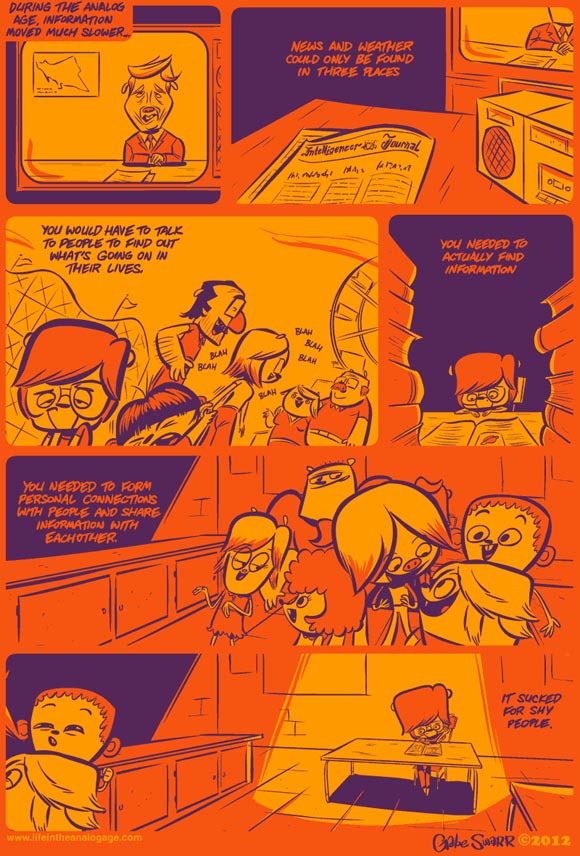
Animation veteran Gabe Swarr has been pumping out webcomics and short animated webisodes of his nostaglia-hued Life in the Analog Age for the past couple years alongside his studio day job. Earlier this week, he relaunched the property as a weekly animated series online, with the goal of new episodes every week. I chatted with Gabe via email about his decision to shift his online focus from comics to animated shorts, teaming up with Frederator’s new Allied Media label, the pros and cons of pitching, and the best advice for others who want to do their own online series.
 Cartoon Brew: You have a full-time job as the supervising producer and director of Nickelodeon’s Kung Fu Panda: Legends of Awesomeness. Where do you find the time to also write, animate and do the sound for a weekly series all by yourself?
Gabe Swarr: Everyone asks me that! I wake up very early, every morning at 6AM. I exercise, get my morning chores done, and get to my desk for at least two hours of work before going into Nickelodeon. This is the best way I’ve found to make sure I have a sizable block of focussed uninterrupted time to get stuff done. Also working in the morning insures that I’m not exhausted from my day job.
Cartoon Brew: That still doesn’t explain where you get all your energy from. What does a typical Gabe Swarr ‘power breakfast’ consist of?
Gabe Swarr: Ha! Just some cereal and a banana, nothing exciting I’m afraid. I think it’s more the exercise than the breakfast! I actually starting running in the morning over a year ago. It has made a huge difference, and hopefully I’ll be alive a little longer to make even more stuff!
Cartoon Brew: What do you hope to accomplish by turning Life in the Analog Age from a comic and occasional animated webisodes into a regular animated webseries?
Gabe Swarr: I really want to get more people to see the series. I love sharing these stories and memories. There’s always such an amazing response from the comics, and I want to really focus on translating that to the shorts. I also think that the fact that it’s animated is a more unique way to experience the series. There are a lot of “slice of life” and autobiographical comics, but very few animated series like this one.
Cartoon Brew: In Analog Age, you try to express your honest emotions as they were at the time, whereas so much of today’s entertainment culture looks back at the past with snark and irony. How did you decide on your more affable approach to storytelling?
Gabe Swarr: Analog Age started as a complete departure from the things I do in my day job. I wanted to slow down the pace and express moments or feelings that you just don’t see in too many other places. The more I did it, the more I found the real tone of the series and learned more about the way I think our brains work.
I’m pretty sure our memories aren’t just a series of remembered facts of events. When you think back and remember how things were, yes you do recall what happened, but it’s not always accurate. That’s because, yeah, it was a long time ago, but it’s mainly because you’re using how you felt at the time as a frame of reference. Our memories are wrapped up in them. That’s nostalgia to me, true nostalgia, and that’s a lot harder to capture than just making fun of pop culture, fashion, or how poofy hair styles were.
That being said, when I do go back and look and unlock those emotions and feelings, I have to find a narrative or story in them. I have to remove myself and look at that moment from my current state of mind, and sometimes some of the best humor or scenes come from making fun of myself or the poor choices I made then, like this:
Cartoon Brew: Assuming that most of the stories are rooted in truth, have your siblings or parents had any reactions to the stories you’re telling, or expressed surprise at any events you’ve depicted?
Gabe Swarr: Yes, it’s all true. There are some stories that my Mom isn’t too fond of. She is the only family member who has spoken up about how they are being portrayed. When I’m making them, I’m never thinking about that. Some of the stories that didn’t put me in a good light were the ones that got the biggest reaction or started the most online conversations like “Hero”.
Cartoon Brew: Life in the Analog Age is becoming part of something called Frederator Allied Media which is a division of Fred Seibert’s company. How does that work?
Gabe Swarr: Well, I keep everything on my YouTube channel. I have complete creative control over schedule and content, but now I’m part of their ‘network.’ My cartoons can be seen by their 75,000+ subscribers as opposed to my 1000+ subscribers. We do an ad revenue split which motivates them to find sponsored ads.
Cartoon Brew: I think pitching ideas to networks and doing pilots is stupid in this day and age of the Internet. Am I wrong?
Gabe Swarr: I can’t say that you’re wrong or right, it depends really on what you want. If you want your show to be seen on worldwide TV, collaborate with working professionals, and not pay for the actual production, then yes, that’s a great way, and it’s been done for decades. There are some drawbacks though, first be prepared to sell full ownership of your idea, and the process is a very collaborative one. Your ideas might change a lot by the time it reaches the audience.
If you want full ownership, full creative control, and having a direct line to your audience, then online is the way to go. Be ready to pay and do the entire production yourself (or with generous friends), and work very hard to build your own audience basically from scratch.
So there are pluses and minuses to both approaches. Personally, I’m doing both traditional TV development, and indie online right now.
Cartoon Brew: The way I see it is this: a creator has the same shot of getting a pilot picked up for a network series as they do having a breakout web series. Except that the web creator ends up with much greater leverage,and therefore it’s more profitable for them. The “Annoying Orange” guy, who started out on the Web, is one of the few show creators who managed to launch a show on Cartoon Network without losing his ownership rights. Or take “Simon’s Cat”—360 million views on YouTube, 8 bestselling books, and now he’s beginning to license to other media platforms while still retaining ownership of his creation.
Gabe Swarr: Yeah, I think it’s great for those people, but like I said, they had to build that audience from the ground up themselves. That’s a job in itself and not an easy one. I spend a lot of my time responding to comments, posting, reposting, revising based on feedback on top of just making everything. Some people can’t or don’t want to deal with all of that. That might be one reason they go through a TV network, but the profitability is the trade off.
Cartoon Brew: Pretend I’m an animation executive. Gimme your elevator-pitch for Analog Age.
Gabe Swarr: Life in the Analog Age is an all-ages animated webseries all about growing up in a time before the digital age. It is a collection of vignettes that follow a “Little Bear Kid” in a time of his life where he is discovering himself and the world around him. All based on true events.
Cartoon Brew: Sold! Now give one piece of advice to someone who wants to start their own online animated webseries.
Gabe Swarr: The big overall thing is when creating anything, make sure it means something to you and that it says something. There are so many things out there that are just meaningless. It’s all like candy, fun to eat, but no nutritional value. You can’t live off of it. You want your creations to have some kind of purpose in the world, something that speaks to the people, and if it doesn’t, why make it in the first place?
Cartoon Brew: If you had to give up all your digital equipment (Cintiq, iPhone, new video game systems, etc.) tomorrow, do you think you could comfortably live again in the Analog Age?
Gabe Swarr: I totally would, but as long as I magically had no foresight into how things work now. I would go crazy missing the way we can use the Internet to learn, communicate, and distribute. I would also miss how much paper I’m saving by working digitally, but I would not miss the new video game systems at all! I still fire up my old N.E.S. to beat my favorite games.
For regular weekly episodes, visit LifeInTheAnalogAge.com.
 By: Kathy Temean,
on 3/9/2013
By: Kathy Temean,
on 3/9/2013
Registration for the 2013 New Jersey Annual Conference is just days away. They are fixing last-minute glitches, crossing Is and dotting Ts (or vice-versa). I will add the link as soon as they are ready to go live. May even be later today, so check back.
June 7-9, 2013
 The Crowne Plaza-Holiday Inn Express (Formerly the Wyndham)
Princeton, NJ
Keynote speakers:
We are proud to welcome this year’s keynote speakers. Both speakers will be giving an additional presentation at the conference, too, so this is not to be missed folks!
Caldecott Honor Illusrator/Author Peter Brown
Picture book illustrator/author Peter Brown (Children Make Terrible Pets, You Will Be My Friend, Creepy Carrots)
Times Best-selling Author Lauren Oliver
YA/MG author Lauren Oliver (Delirium, Pandemonium, Requeim, Before I Fall, The Spindlers)
Are you published, but need help with marketing your books? There’s a workshop for that!
Are you brand new to the kidlit world and don’t know where to start? There’s a workshop for that!
Have you had trouble fleshing out a main character, atagonist or plot for your story? There are several worshops for that!
And we’ve got more than 50 faculty members compiled of editors, agents, art directors, librarians and author/illustrator speakers joining us this year, and more than 70 workshops to choose from. Panels, pitching sessions, keynotes, one-on-one critiques, craft workshops, lectures, intensives, a bookfair, portfolio display, juried art show, and oodles of networking opportunities, oh my!
EDITORS/AGENTS/ART DIRECTORS/LIBRARIANS
Jenne Abramowitz, Senior Editor, Scholastic
Heather Alexander, Editor, Dial BFYR/Penguin
Elizabeth (Betsy) Bird, Librarian, NYPL/SLJ
Erin Clarke, Senior Editor, Random House
John Cusick, Agent, Greenhouse Literary
Melissa Faulner, Editorial Assistant, Abrams
Louise Fury, Agent, L. Perkins Agency
Julie Ham, Editor, Charlesbridge
Erin Harris, Agent, Folio
Janine Hauber, Agent, Sheldon Fogelman
Ginger Harris, Agent, Liza Royce Agency
Lexa Hillyer, Editor/Co-Founder, Paper Lantern Literary
Connie Hsu, Senior Editor, Little, Brown
Simone Kaplan, Editor, Picture Book People
Janet Kusmierski, Art Director, Scholastic
Tricia Lawrence, Agent, Erin Murphy Literary
Steve Meltzer, Executive editor, Penguin BFYR
Rotem Moscowich, Senior Editor, Disney/Hyperion
Meredith Mundy, Executive Editor, Sterling
Rachel Orr, Agent, Prospect Agency
Jessica Regel, Agent, Jean V. Naggar Agency
Shauna Rossano, Editor, G.P. Putnams’ Sons/Penguin
Martha Sikkema, Senior Designer, Charlesbridge
Christina Tugeau, Agent/Art Rep, Cat Tugeau Agency
Carolyn Yoder, SeniorEditor, Calkins Creek Books
Marietta Zacker, Agent, Nancy Galt
Talk tomorrow,
Kathy

 By: Jerry Beck,
on 4/24/2012
By: Jerry Beck,
on 4/24/2012

Jake Friedman emailed yesterday to tell me about BabbittBlog.com, a site dedicated to all things Art Babbitt. Jake has been researching a biography of the legendary animator for the last few years, and if the blog is any indication, there’s still a lot left to learn about Babbitt.
There’s no shortage of animation tips posted online nowadays, but this mass of how-to advice isn’t particularly well organized. Thankfully, Jonah Sidhom has created the Animation Article Database, an invaluable list of links to animation tips from industry pros, organized alphabetically.
Canada’s only animator with three first names, Brandon James Scott, has an informative series of blog posts about creating Justin Time, a preschool animated series that is now in production on its second season. He takes the reader through the entire process from pitch to development to bible, and finally, production.
Cartoon Brew |
Permalink |
No comment |
Post tags: Art Babbitt, Brandon James Scott, Justin Time, Pitching
 By: April Henry,
on 1/22/2012
By: April Henry,
on 1/22/2012
There were only seven deals listed for YA in this week's Publishers Lunch, but two of them are for books that reference Black Swan:
"Jennifer L. Armentrout's DON'T LOOK BACK, pitched as Black Swan meets Pretty Little Liars, featuring a teen girl who had it all until the night she and her friend go missing, and she loses all recollection of who she is, but must piece together a life she no longer wants and the events that led to her friend's disappearance, to Emily Meehan at Disney-Hyperion, in a pre-empt, in a two-book deal, by Kevan Lyon at Marsal Lyon Literary Agency.
AND
"Anna Collomore's THE UNRAVELING, about a girl who becomes a nanny for a seemingly perfect family and slowly loses her grip on reality; pitched as The Nanny Diaries meets Black Swan, to Caroline Donofrio at Razorbill, for publication in Spring 2013, by Josh Adams at Adams Literary."
I haven't seen Black Swan, but the second book seems a better fit for what I've heard about the movie. However, the first book intrigues me more.
It seems like a lot of the one-line descriptions of books I see in Publishers Lunch are described as some combination of books and movies. More often movies. I don't know if it's sad or not that movies are considered a better touchstone even when you are talking about books. I guess that even if you haven't seen a given movie, you probably have seen the trailer.
By: BookEnds, LLC,
on 10/11/2011
All too often I read a query, or hear a pitch at a conference, and think how the author didn't take the book to the next level. I'm sure many of you will say that it's hard to convey the entire book in either a query or a pitch, but I also think it's important to stop blaming the query process and start using it as part of your writing process.
Writing queries is hard. I know. I have to write them. I also hear that from authors endlessly. Writing a synopsis stinks. Something else I hear endlessly. But instead of looking at those two things as pieces that are separate from the manuscript, I think they should be looked at as part of the process. If you're working on your query and finding it hard to come up with something that makes your book sound special, maybe it's that your book isn't special. It might be a good book, but is it good enough to grab the attention of a brand-new readership, people who already have thousands of books to choose from?
If you're having trouble nailing down the true conflict in your query, maybe you don't have enough in your story.
Changing our mind-set to think of queries and synopses as part of creating the manuscript might make them more useful to you, as they should be, than just getting an agent or publisher.
Jessica

 By: Madeline Smoot,
on 10/7/2011
By: Madeline Smoot,
on 10/7/2011
On Wednesday, I did two different pitches to illustrate the difference between good and bad. Now, keeping in mind that I wrote this pitch, this is still what the editor in me (in red -- of course) thought while reading that pitch:
In my early chapter book for young kids, Liv gets really upset after her brother goes missing after a boring field party. Wait. What? A field party in a chapter book for kids aged 7-9? How old are these characters? He's been kidnapped, but Liv doesn't know by who, kind of redundant because, really, that's not going to be very suspenseful if she does know and she spends the rest of the book looking for him and feeling guilty for hating him for most of their lives. Why does she hate him? Also, Morte Who is Morte? The brother? is a creepy looking kid that Liv thinks is somehow linked to death Wait. What? even though she doesn't have any proof for this. What on earth does that mean? The book is a mystery no this pitch is a mystery and kind of paranormal and a great thriller for kids to read. I can't wait for you to see the full manuscript. not likely
No way would I be requesting this book.
 By: BookEnds, LLC,
on 9/26/2011
By: BookEnds, LLC,
on 9/26/2011
When I first queried editors about Bella Riley’s books I asked Bella to supply the pitch. This is something I frequently do because it helps give me a starting point for my own pitch. The one thing I say to authors when sending my request is, “Feel free to keep it rough. I’ll probably edit and change it anyway.”
Not the case for Bella Riley, and not the case with many other clients. Bella’s pitch was perfect. So perfect, in fact, that when I first queried her editor at Grand Central to ask if she’d be interested in seeing the proposal, the editor responded immediately with, “Wow. I’m not sure if I’ve been desperate for a vacation to the mountains or if you need a book deal yourself—could be both—but your pitch sounds awesome. I’d love to take a look.”
Don’t I wish it was my writing? I told her the pitch was straight from Bella herself, and it wasn’t long before we had a three-book deal.
Bella Riley is the contemporary romance pseudonym for erotic romance author Bella Andre. We like to think of these books as Bella Andre meets Susan Wiggs. Home Sweet Home is her first contemporary romance with Grand Central, and here’s the pitch that got her that deal:
After thinking she had left Emerald Lake – and the girl she had once been – behind forever, Andi Powell must return for one more summer at the lake to save her family's knitting store. She isn't prepared for Nate Turner, the boy from the wrong side of the tracks that she'd always loved from afar, to have turned into a man who takes her breath away. She isn't ready for his determined sensual plays for her body . . . and her heart. And she definitely isn't prepared to discover that the darkness he hides so well from everyone else tugs at her heart – and makes her wonder if leaving again is really the right thing to do after all.
But with the help of the Thursday Night Knitting Group, Nate's sister, Andi's mother and grandmother, and a pair of missing carousel horses, Andi just might find the love she's always deserved in the arms of the one man who has waited his entire life for her to come back and heal the hole in his heart with her love.

 By: Chuck,
on 7/13/2011
By: Chuck,
on 7/13/2011
Fiction writers are, by nature, creative. And wildly so at times.
When stretching out to book-length work, I found that my own inclinations to invent,
and to innovate, quickly became a handicap. In short, I was writing all over the place.
It didn’t help that I am a pantser and not an outliner. I cannot stay interested in
writing a story or developing characters if I know what is going to happen down the
road.
Randy is excited to give away a free copy of his book
to a random commenter. Comment within one week; winners must live in Canada/US to
receive the book by mail. You can win a blog contest even if you've won before.

 By: Jerry Beck,
on 6/21/2011
By: Jerry Beck,
on 6/21/2011
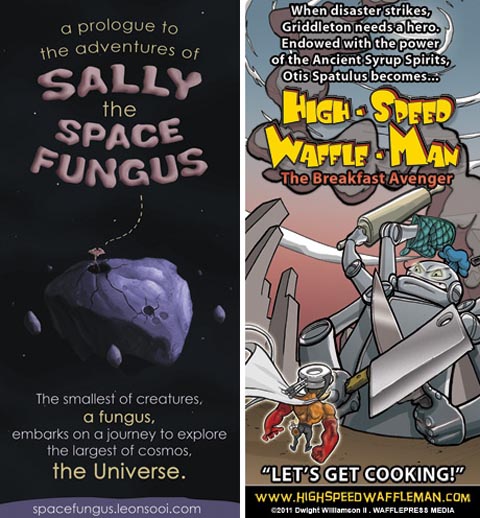
The problem with publishing a magazine about animation that nobody wants to read is that one often has to resort to questionable tactics to raise money. One of Animation Magazine’s most insanely screwball stunts is their annual Pitch Party, which they’ve been getting away with for the past ten years.
Here’s how it works. Contestants pay $375 to “pitch” their animated project. Except, they don’t really pitch anything. Instead, they submit one 2″ x 5″ image to the magazine that contains their entire idea. I can’t even fit my daily to-do list in a space that small, much less an idea for an entire animated project. But amateurs and students who don’t know better still try to do it:
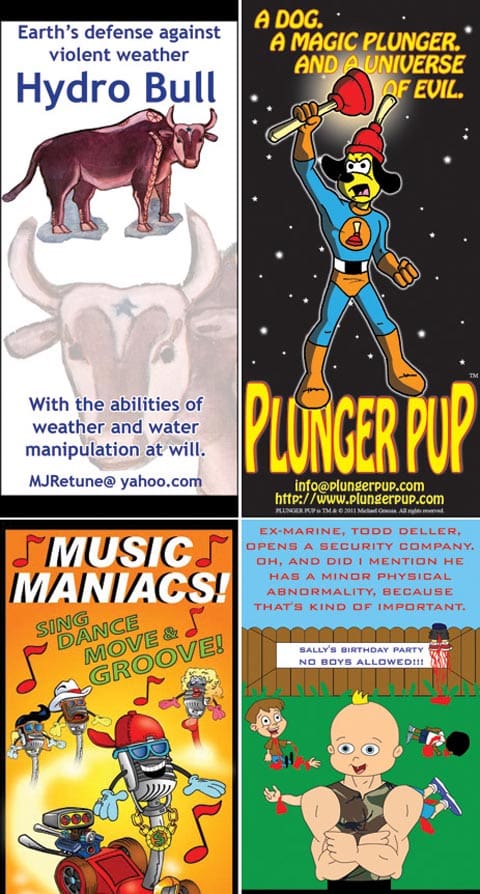
Anybody who has worked in the animation industry for more than a week knows that this isn’t an even remotely realistic way to sell a series, and anybody who hasn’t worked in the industry could learn that by spending a few bucks on David Levy’s excellent primer Animation Development: From Pitch to Production
What’s so wrong about giving industry access to amateurs and students who otherwise haven’t learned the proper (and free) way to contact executives. Nothing, if Animation Magazine billed this as an educational opportunity to develop a project and receive feedback from execs. They don’t do that though. They frame the contest as an “economical marketing campaign that lets you—the independent artist—and your animation project reach decision-makers the smart way.” In other words, they lead entrants to believe that this is a legitimate way for them to put their ideas in front of an audience of professionals. Ahh, if only it were that easy.

One of the main attractions of the event is that the entries are “judged” by development execs and producers, pictured above. Commenters on the Brew often make fun of those who judge movie posters as an indicator of a film’s quality, but guess what, professional industry execs have the magical ability to judge an entire series concept by looking at a miniature rectangle. This year’s nine judges, all respected professionals, should know better than to participate in this shakedown of budding creators. Not only are they squandering their own hard-earned reputations, they’re making our industry weaker by misleading people about how the animation business really works.
To end on a personal note, a couple weeks ago when I moved, my movers told me about their idea for an animated series. They’d even recorded tracks, but didn’t know the first thing about producing animation. I offered to meet with them for coffee and give them some basic guidance and tips. That’s how you help people. Animation Magazine and the exe
Add a Comment By: Ingrid Sundberg,
on 5/13/2011
By: Ingrid Sundberg,
on 5/13/2011
 Bloomsbury Editor Margaret Miller spoke at the 2011 Southern California SCBWI Writer’s Day event. She answered the following questions after her talk:
How Does an Editor Approach Pitching a Project?
Is YA Realism a Trend That’s on its Way Out?
What do you do if an Editor Changes Houses?
How Long Does the Editorial Process Take?
What are the Trends Coming in?
Check Out These Other Great Posts with Margaret Miller:
Margaret Miller is an editor for Bloomsbury Children’s Books USA. A former editor at HarperCollins Children’s Books, she joined Bloomsbury in 2008. She has worked closely with authors Dan Gutman, Ivy Devlin, Timothy Power, and Greg van Eekhout. At Bloomsbury, Margaret focuses on middle grade and young adult fiction, with a few select picture books.

 By: Chuck,
on 5/11/2011
By: Chuck,
on 5/11/2011
Agents are always looking for something different inside
their massive slush piles. Something unique and original—a “hook.” I became especially
aware of this last summer, while querying agents I was invited by one agent
to revise and re-submit my novel. Her main suggestion? A stronger hook.
I'll be honest—the word "hook" has always bothered me. Sure, I understand what it
entails—giving your work that extra punch, that unique story idea in order to get
the reader interested, and to stand out from the thousands of other trying-to-get-published
writers.
 By: BookEnds, LLC,
on 4/19/2011
By: BookEnds, LLC,
on 4/19/2011
If you ever have a pitch appointment with me, the one thing you’ll get is lots of feedback. Based on your pitch, and sometimes material I have read, I’ll do my best to give you my thoughts on why the book isn’t working and suggestions on what you can do to make it stronger, or make it work better.
I was thinking back the other day to a pitch appointment I had in which every suggestion I made, the author argued that it couldn’t be done. Ultimately, any changes I was suggesting didn’t work with her vision of the book. She had her heart and mind set on how the story was going to go, and any deviation from that carefully plotted outline was sending her into a panic.
Unfortunately, I think this is a common mistake many authors make: writing for themselves and not the story. What this means is that the author has plotted out the story and knows how she intends it to read, and now she must write the book to that end. The problem is that no matter how much of a plotter you are (versus a pantser) you can’t always control how a book is going to play out. For example, in your outline it might have made perfect sense for your character not to tell her husband that she dyes her hair until chapter 15. The problem is that by chapter 4 the reader is wondering why the hell the heroine doesn’t just tell her husband that she dyes her hair. It’s just not making sense anymore and the conflict is quickly getting old. We need it to evolve from hair dye and it’s not, because it didn’t in your outline.
So no matter how much of a planner you are, be ready for changes, drastic changes sometimes.
Jessica

 By: Dawn Chartier,
on 2/23/2011
By: Dawn Chartier,
on 2/23/2011
Yep. I'm going to a writers conference in Dallas this weekend. Why? Well, because I've plenty to learn. (Always learn) You are already published - you say.
Sure. But I want to be published again and again.
This weekend I'm pitching my paranormal romance novel, BURIED MAGIC. I need to find an agent that will hear my voice in this story, and someone who will share the same dreams as I do. That dream is to have a long career with the same agent, and write plenty of books and make plenty of people happy...I want to give those readers a great escape.
So wish me luck. If anything, at least I'll come back with some new friends and more knowledge...I'll be back next week to give an update.
Hugs,
Dawn
NOT AN ANGEL, OUT NOW!
WWW.DAWNCHARTIER.COM

wow, lots of familiar names and lots of new ones, too! I’m sure it’ll be a blast!
Oh if only I could hop on my magic carpet and come over for the weekend.
Tara Lazar teased us yesterday–we’re waiting for the announcement.
Gosh! What a fabulous line up! Wish I lived closer
what a grouping!!! I can’t wait to be a part of it!