new posts in all blogs
Viewing: Blog Posts Tagged with: distractions, Most Recent at Top [Help]
Results 1 - 25 of 75
How to use this Page
You are viewing the most recent posts tagged with the words: distractions in the JacketFlap blog reader. What is a tag? Think of a tag as a keyword or category label. Tags can both help you find posts on JacketFlap.com as well as provide an easy way for you to "remember" and classify posts for later recall. Try adding a tag yourself by clicking "Add a tag" below a post's header. Scroll down through the list of Recent Posts in the left column and click on a post title that sounds interesting. You can view all posts from a specific blog by clicking the Blog name in the right column, or you can click a 'More Posts from this Blog' link in any individual post.
By:
Nicola Morgan,
on 3/21/2013
Blog:
An Awfully Big Blog Adventure
(
Login to Add to MyJacketFlap)
JacketFlap tags:
getting down to writing,
resolutions,
procrastination,
writer's rooms,
writer's block,
brains,
inspiration,
deadlines,
Nicola Morgan. Know Your Brain,
distractions,
Add a tag
Note 1: No shed necessary. That's a promise!
Note 2: Those who came to the SAS Conference in Peterborough this year know all about this and know that it's called Stimulus Generalisation
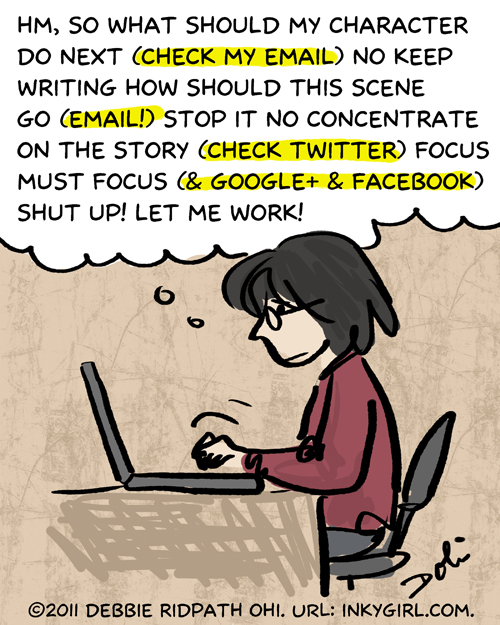
Working well shouldn’t be difficult. Make a list of things to do; tell yourself that you will do a, b and c before lunch; apply posterior to chair; do a, b and c. But most of us know what actually happens: in the absence of a boss to enforce when and where we produce a piece of work, bad habits come into play and we (I) play Spider Solitaire, go on Twitter, answer social emails, pay bills, make more coffee, dust behind the fridge…
That was me, until May 2011. Years of self-employment and working from home had created appallingly chaotic working habits. I got the work done – never missed a deadline yet – but it felt unhappily ill-disciplined, ineffective, pathetic. Social, domestic and work tasks were mixed up; the hours spent at my desk were too long and ineffective; real writing seemed to come last, if at all. Work-life not so much balance as collapsed in a heap of tangled intentions.
In May that changed. Now, if I say “shed”, you’ll roll your eyes and want to switch off, but I promise this is not about getting a writing shed. It’s about stimulus generalisation, as I now realise, thanks to my clinical psychologist friend who nodded wisely when I told her how my working habits changed instantly, the day I got a shed. Stimulus generalisation is something psychologists harness when dealing with addictions and negative habits, she said. Hmmm, sounds like me. Does it sound like you?
I’ll briefly explain the relevant aspects of stimulus generalisation but then, more importantly, unpick the elements of what I accidentally did, in order to make suggestions that anyone can use to alter poor working habits, including internet addiction. (Disclosure: I’m not a trained psychologist, though some of my work involves a degree of understanding of how our brains work; I’m just making sense of what happened to me and what might help others.)
Stimulus generalisation is akin to a Pavlovian response, although reflexes are not necessarily involved. Behaviour (leading to habits) is conditioned subconsciously by stimuli around us. So, if you tend to have a glass of wine while cooking the evening meal, cooking the evening meal becomes part of the set of triggers to have a glass of wine. Aspects of cooking the evening meal are the general stimuli around you: the clock saying 7pm, the light falling, the sound of a partner coming home, your own body clock, the smells in the kitchen, all the cues to anticipation of a relaxing evening. Together, these stimuli subconsciously reinforce a habit; and breaking the habit will be very hard if you don’t break the stimuli. In theory, you could just say, “I won’t have a glass of wine,” but the stimuli play heavily on your desires and behaviours and you are pretty likely to have that glass of wine. Thus speaks the voice of experience.
So, let’s unpick what happened with my shed. Effectively, I had suddenly changed almost all the stimuli around me, in one go. This made my existing desire to change working habits much easier; it enabled an immediate fresh slate, allowing new stimuli to create new habits. In the same way, an addict is encouraged, as part of therapy, to remove all physical aspects of the situations in which previously he took the addictive substance. Move house; throw away posters, furniture, possessions; avoid the friends who accompanied the addictive behaviour; take up new activities; change as much about your life and environs as possible. Every repeated stimulus has a hold on the person, each one like a strand within a rope.
Let’s move away from the specific shed example and generalise the conditions which may make new behaviours possible, conditions which any of us could replicate if we wanted to break undesired working habits.
1. Desire to change. We need to know what we want to change, and to want it strongly enough that we will make effort and think positively about the outcome. Part of this may involve feeling sufficiently negative about the current situation.
2. Planning ahead. Making detailed advance decisions about the changes, and setting a date on which the changes will start, help prime the mind to activate those changes.
3. Investment. It makes sense that if we have invested time, money and/or effort in the changes, this will help motivation.
4. Rising anticipation. If we have to wait eagerly for the start date, this is likely to help.
5. Support from others. Support from partner, family or friends, and their own investment in your success, are likely to have a positive effect.
6. Out with the old and in with the new. The tendency of the brain towards stimulus generalisation means that the more physical surroundings you can change, the better. You may not be able to afford a whole new room, or to replace all the furniture in it, but the more you can alter the physical surroundings, the better.
7. The use of all the senses. Our brains learn best when several senses are used.
8. Blitzing it. I suspect that doing it all at once makes a greater impact.
Based on those principles, there follow some specific suggestions to help change working habits. Some are small and may seem trivial but your brain will notice more than you think. Some of the larger things won’t be practical for everyone and I’m not suggesting anyone does them all: pick a few that suit your situation; plan when to instigate the new regime; then do them all at once. Remember: once you have selected your new stimuli, make sure you apply them to your working hours, not your social or domestic hours. The point is to use a specific setting to teach your brain that it is supposed to be working, not doing social or domestic tasks. Or playing Spider Solitaire… The new environment will perform the role of a boss.
Suggestions:
o Move your work-space to a different room.
o Rearrange the furniture in your work-space, including the position of your desk and your view.
o Redecorate with new colours, changing as much as possible.
o Choose new furniture, particularly chair and desk and whatever is in your range of sight while working.
o Create a time-table for arriving and leaving work; leave your office door open if just taking a break, but close it (lock it?) when your working day ends. Make sure you take everything you will need during the evening, just as if you worked away from home; use a briefcase?!
o Have a separate in-tray for domestic/social tasks, and only deal with them outside working hours.
o Even something small can help, such as using a specific mug during working hours, or a particular pen or notebook for “real” writing.
o Anything separate for “work” use will help: stationery, clothes, shelves, diary, etc. Make use of the visual element: eg if you use blue files for work docs, have only the blue files in front of you during work hours or in your work space.
o Use all the senses. The suggestions above are all about what you can see but consider the following: you might play music when working (or when not working); you might harness the sense of smell by lighting a scented candle when doing writing work, or enjoy the smell and taste of real coffee; and yes, you have my permission to eat chocolate to herald the start of a writing session… Anything that you can commit to doing every time you start what is supposed to be a proper working (or writing) session.
The more we can change, the more coherently we plan the changes and the more simultaneously we effect them all, the easier it is for our brain to break old habits and allow new behaviours.
But you’ve got to want to, as much as I wanted that shed, and you’ve got to keep wanting it. Old habits not only die hard, they can return. Be vigilant!
By the way, a new edition of my book, BLAME MY BRAIN - The Teenage Brain Revealed, is available from May, also with an ebook version.

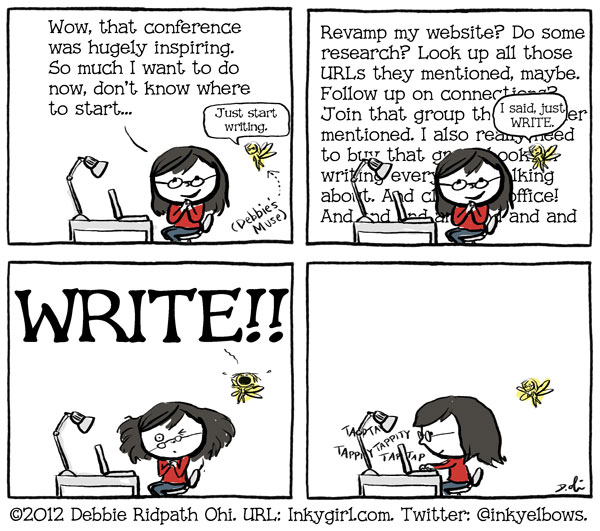
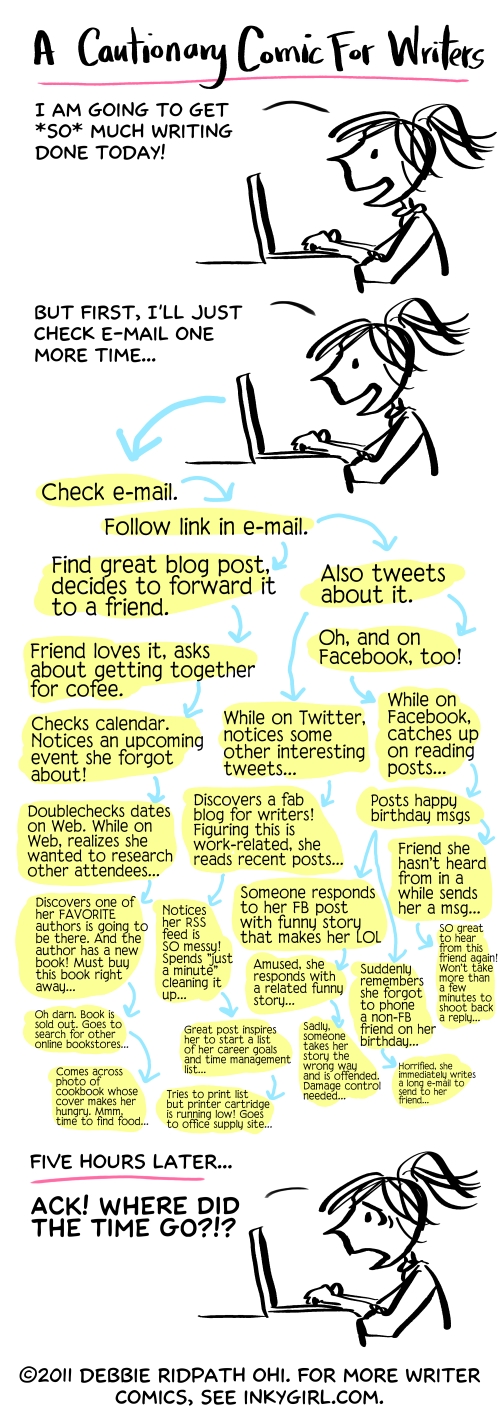
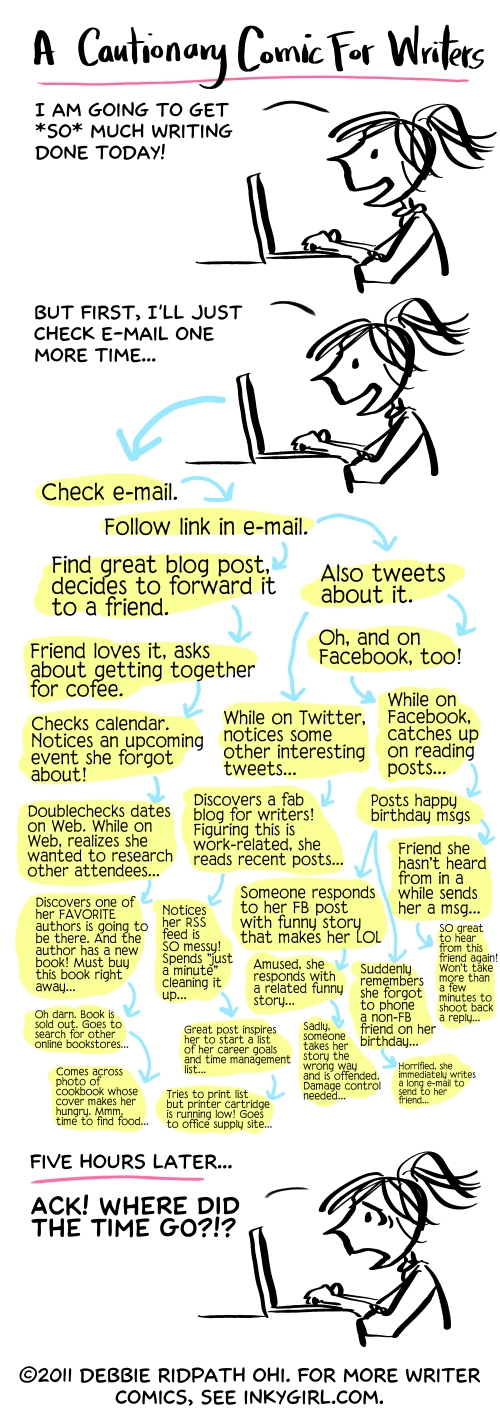
Originally posted in Writer Unboxed. See my other comics in Writer Unboxed.
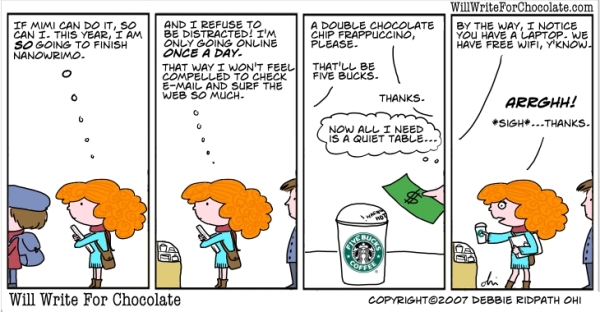
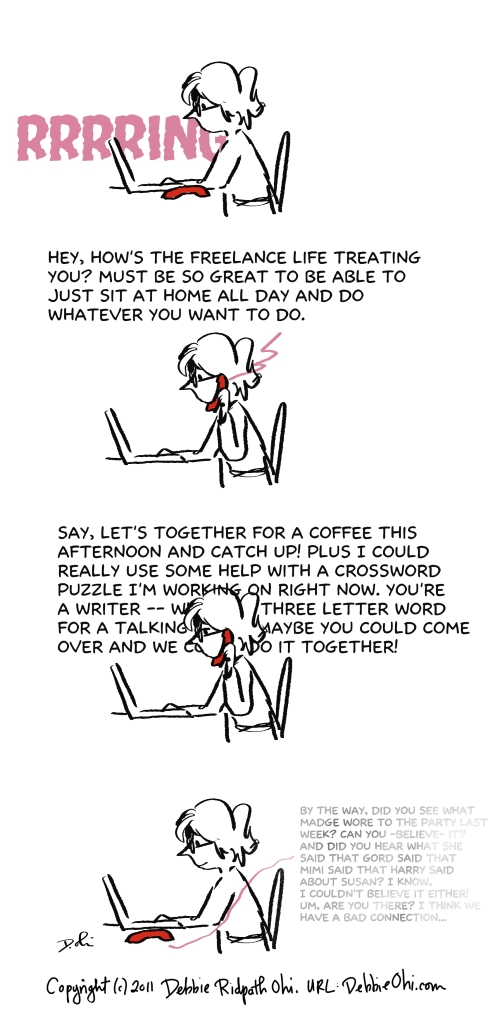
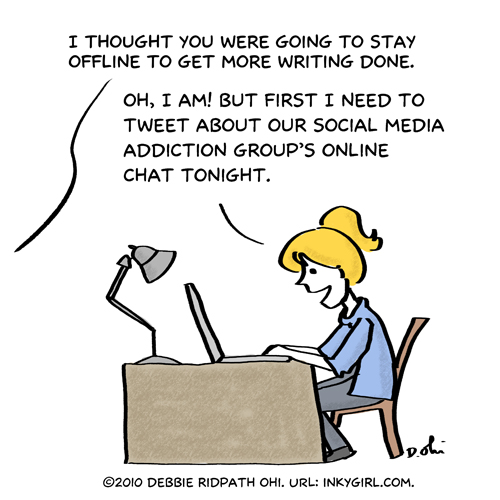
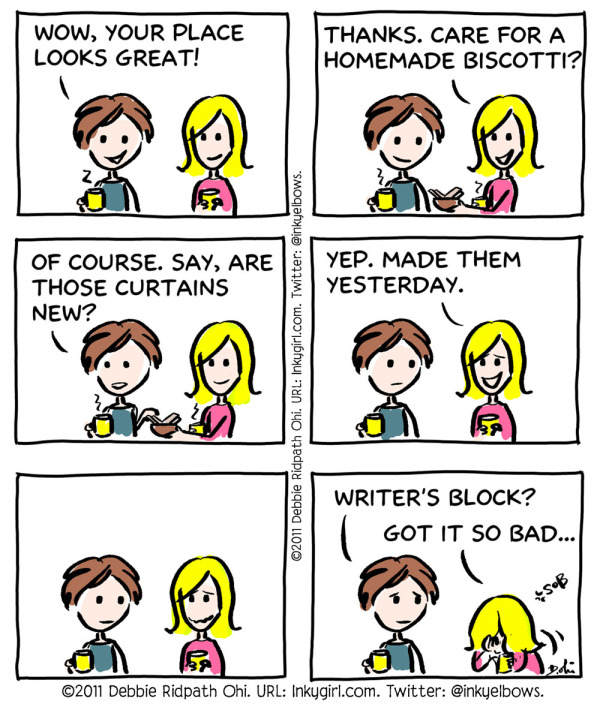
I'm gradually going through all my comic archives as I work on my Will Write For Chocolate book compilation, so am posting some of the oldies here in Inkygirl (sometimes revamped).

DISTRACTIONS
Well.
Here I am.
Left behind
yet again.
I turned to watch the shadow of a cloud
pass over the riverbank
and when I turned back
the breadcrumbs had already been tossed.
Yesterday, I was noticing
the way a seed
swirled in the current
and suddenly my siblings were nowhere to be seen.
Look,
There's an ant
climbing the crest
of that bending blade of grass.
© Mary Lee Hahn, 2012
Katya has today's Poetry Friday roundup at
Write. Sketch. Repeat.
While I’ve thought of myself as a great multi-tasker for years, I recently found that my multi-tasking was preventing me from completing writing. If I get lucky enough to be home for my… Read More →
(First read The Dynamics of Change and Stage 1: Making Up Your Mind)
Okay, we’re ready for Stage 2: Committing to Change. This is not taking action yet. Instead, this stage involves:
1) Planning the necessary steps
2) Building up your motivation
3) Considering possible distractions and/or discouraging things that might cause a setback
The change you make at this point is to shift from “passively wishing to achieve your goal to actively committing to make it happen.” (Neil Fiore in Awaken Your Strongest Self.) If you did the work in Stage 1 (thinking through the risks and benefits, plus evaluating your personal abilities), you should have fairly realistic expectations of what does–and doesn’t–work for you at your particular stage of life.
Time to Experiment
Before you plan the necessary steps to succeed in making permanent changes as a writer, you’ll want to take time to experiment in small ways. See what you like and don’t like. See what works for you–and what doesn’t.
- Try writing for 15 minutes upon awakening or right after your morning coffee.
- Stay offline until 10:00 a.m. for three days.
- Try writing at the library during two lunch hours this week.
- Read a writing blog before you get on Facebook or Twitter.
Record your thoughts and feelings when you introduce these writing changes. How do you feel? What works and what doesn’t? You can’t fail at this stage. You are only gathering information.
Some of these changes you’ll love and find so easy! Others you won’t find helpful at all. But as you succeed with certain writing changes (writing 15 minutes each evening while supper cooks, reading 5 pages per day of a writing book), your motivation will rise. You’ll feel more like a writer automatically.
Mental Rehearsals
During this stage you also need to think through strategies for dealing with obstacles, distractions and setbacks. One of the most effective (and fun!) ways to do this is using what athletes call “mental rehearsals.” They imagine how they’ll handle challenges at each step along the way. [NOTE: This is not just wishful thinking. Current books on brain chemistry show incredible studies and brain x-rays, revealing changes made in the brain after "mental rehearsals."]
Envisioning how you will handle writing distractions (toddlers wanting to be entertained, friends calling to chat, school vacations) and setbacks (an editor rejects your novel after two revisions, computer crashes) helps you build stamina or mental toughness.
Use mental movies to confront each setback or distraction. Instead of your usual reaction (chocolate, TV, surfing the ‘Net), clearly envision yourself sitting tight, working methodically through your writing problem, piling up a stack of new pages, and keeping to your deadline with ease.
Not all interruptions and distractions happen to us. Be aware that you often seek out distractions as well. In order to escape writing blocks or manuscripts that just aren’t working well, we often attempt to escape the anxiety or boredom or agitation by looking for distractions.
Are You Ready?
The final part of Stage 2 is actually committing to the change. Take time to think and journal about the strength of your commitment. If you want to succeed–and make the success permanent–it needs to be more than a wish. It needs to be a strong intention.
So, what do you intend to do? What change(s) in your writing life do you intend to make? Now is the time to commit.
By:
Kristi Holl,
on 3/23/2011
Blog:
Writers First Aid
(
Login to Add to MyJacketFlap)
JacketFlap tags:
focusing,
habits,
schedules,
writing challenges,
writing habits,
writing output,
discipline,
distractions,
encouragement,
focus,
getting started,
goals,
perseverance,
procrastination,
psychology of writing,
strategy,
Add a tag
(First re-read the post The Thought-Feeling-Behavior Cycle.)
After a couple of busy weekends (writing conferences to speak at) and other events, I was finally able to sit down for a lengthy time yesterday and write. Or so I thought.
I sat down all right, but once I finally had an uninterrupted moment to think, a certain situation that has been bothering me for months came flooding back. I couldn’t concentrate on my novel, and I was up and down. I walked. I ate. I sorted laundry. I worried. I ate some more. Later in the day, I Skyped a friend. But I didn’t write until…
Ah, Yes, I Remember
I picked up a book by Kelly L. Stone, author of Living Write: the secret to inviting your craft into your daily life. I flipped through it and landed on the chapter called “Acting As If.” I knew this was a phrase from my old recovery group days basically meaning “fake it till you make it.”
I reviewed the thoughts-feelings-action cycle. Since my thoughts were unruly, and my feelings were haywire, I figured that “acting like a writer anyway” was my best option. I read her chapter on “Acting As If.” Here are a couple snippets to think about:
- People draw conclusions about themselves through observation of their own behavior just as they draw conclusions about other people based on observation of their behavior.
- Simply act a certain way based on your ideal Writer Self-Image, and over time, you become what you are acting.
Attack that Cycle!
A licensed professional counselor, Stone had many practical suggestions about how to act “as if” you’re a confident writer, act “as if” you’re a self-motivated writer, act “as if” you’re a self-disciplined writer, act “as if” you’re a future-focused writer, and act “as if” you’re a task-oriented writer. [I definitely recommend her book.]
I used one suggestion in the “task-oriented” section, acted “as if,” and got to work. Even though it was later in the day, I had the evening free and ended up with one of the most productive writing days I’d had in a long time. (I’m re-reading that chapter first thing today though!)
Don’t give up. We’re all in this together, and I’m grateful for writers like Kelly Stone who share what works!
[NOTE: Thanks for the inquiries about the release date for the paperback of More Writer's First Aid. I thought it would be yesterday, but it looks like this weekend. I will certainly let you know!]
Return to HOME PAGE
By:
Kristi Holl,
on 4/18/2011
Blog:
Writers First Aid
(
Login to Add to MyJacketFlap)
JacketFlap tags:
creativity,
emotional balance,
writing challenges,
writing habits,
writing schedule,
distractions,
families,
focus,
habits,
healing,
psychology of writing,
strategy,
time management,
Add a tag
Creativity is a mysterious concept to most of us. We don’t really understand what it is, where it comes from, why it leaves us, and how to make it “work” consistently. We give it a lot of power because of this.
Coaxing Creativity
However, says the author of The Soul Tells a Story, “if I know from experience that inspiration arrives under certain conditions, I will make sure to re-create the conditions that invited it initially. Thus my early experience comes to determine how it is I will work.”
After our vacation took an unexpected turn, I’ve had more time to reflect this week than the past five years combined. For four blissful days, I had no Internet connection, nowhere we had to be, plenty of books to read, places to walk, and time to think. I hadn’t really realized what an incredible luxury this is in the fast-paced world in which we live.
How Things Have Changed…
Because of marketing demands the last five years–both online and elsewhere–the writing life has been a bit frantic. I don’t know about you, but frenetic activity is not conducive to coaxing out my creativity. That much I already knew. But I hadn’t given much concentrated thought to what things did work for me.
Each writer is different. I know writers who must be surrounded by noise and people or loud music in order to write. I am just the opposite, preferring quiet and solitude when I can get it.
If you’re not sure what conditions are best for you, think back to when you started writing. How did you work best then? What conditions did you just naturally create for yourself? What are the non-negotiables you must have for your creativity to flourish?
Take a Self-Inventory
Here are some things to consider:
- Before writing, do you need some quiet time to think, meditate, or pray?
- Can you write at any time of day–or only at certain times?
- Can you write any place–or do you need your “office” to be the same each day?
- Can you write in tiny bits of time–or does your creativity absolutely require large chunks of time? Does it vary depending on the stage of your book?
- How much socializing do you need in order to be your most creative? (This includes time with writers and non-writers alike, time to “talk shop” and time to just have fun.)
- When you are stuck, does it help to read a book on craft (viewpoint, research, inspiration, etc.) to get your creativity flowing again?
- Does reading other writers’ books help you be more creative–or does it make you feel anxious as you compare yourself to them?
- Do you need a healthier diet or more sleep for your creativity to be at its peak? Or do you work best on short naps and skipping meals?
- What kind of critique at what point in your project is helpful? What kind is the kiss of death to your creativity? (When is your ego more fragile?)
- Do you work best with a deadline, or do deadlines make you freeze up? Do you do well with six-month deadlines but choke on series deadlines set every two months?
- Can you be creative when dealing with emotional upset? Do you need to solve family problems before you can settle down to write?
Take Time to Know Yourself
As we’ve said before, just because conditions aren’t perfect doesn’t mean you can’t be creative. We’ve all had to produce work under some appalling conditions. But if you have a choice, it’s lovely to set up your life and home and schedule a
By:
Kristi Holl,
on 5/9/2011
Blog:
Writers First Aid
(
Login to Add to MyJacketFlap)
JacketFlap tags:
children,
encouragement,
families,
finding time,
strategy,
time management,
writing challenges,
distractions,
focus,
Add a tag
All writers are looking for time-saving strategies and tips to increase their productivity. With school getting out in a month, many writers need to streamline both their writing life and personal life. If this is YOU, you’re in luck!
If you have June’s The Writer magazine, read Kelly James-Enger’s article called “10 ways to work more efficiently.” And for some free articles on this subject…
Start Clicking!
Other Writer articles online filled with tips to improve your efficiency–and give you more time to write–include:
Reading these articles should give you several ideas to try. I found a couple I intend to put to work immediately!
By:
Kristi Holl,
on 8/8/2011
Blog:
Writers First Aid
(
Login to Add to MyJacketFlap)
JacketFlap tags:
focusing,
goals,
habits,
schedules,
time management,
tips,
writing challenges,
writing habits,
writing output,
discipline,
distractions,
focus,
procrastination,
psychology of writing,
strategy,
Add a tag
In the August edition of Randy Ingermanson’s free (wonderfully helpful) newsletter, there was a link to a free e-book describing a new time management system Randy is using. (For back issues of Randy’s newsletter, go here.)
Since “free” is one of my favorite words, and I’m always looking for ways to manage my time better, I downloaded it to skim.
Hooked!
Skimming quickly turned to reading carefully, and soon I’d read the whole 57-page e-book by Jim Stone called Clear Mind, Effective Action. It deals with the subject of “fractal planning.” Fractal has to do with breaking something large into smaller parts. (You can get the free e-book here.)
In some ways fractal planning is unique, and some parts are a combination of the best time management ideas from the past twenty years.
In the free e-book, the author explains how to implement his system on your own (on paper or spreadsheet or Word document), if you don’t want to subscribe to his service. (I’m using a Word doc–for now–to see how it goes. I have to admit that–so far–it has boosted my productivity and ability to focus significantly.) If you’d like to go directly to the Fractal Planner page and check out the features, you can do that here.
If you try the fractal planner or read the e-book, let me know. I’d like to hear about your experiences–plus or minus–if you try it out.
Back in March, I wrote about pruning some things from life in order to have more time to write. (See my former post “The ‘Not To-Do’ List”.)
In order to make time for anything new in your life, it requires some necessary endings.
Help Is on the Way
So I was thrilled yesterday when my son-in-law loaned me a book by a favorite author of mine (Henry Cloud of Boundaries fame). It’s called Necessary Endings. It’s the best “how-to” on this “pruning” subject I’ve ever seen. It covers both personal/relationships and business. [Remember: if you're a writer, you're in business.]
I don’t know about you, but I have difficulty cutting things out of my life–even when doctors say, “Cut back or die!” (or the equivalent). This book has already helped me identify more clearly what needs to go. And, as Cloud shows, it all starts with having a clear idea of what you’re pruning toward (your goal or vision.) Only when you know that can you know what/who has to go.
Free Resources
You can download a free chapter from Necessary Endings called “Pruning: Growth Depends on Getting Rid of the Unwanted or the Superfluous.” Go to Facebook, do a search for “Henry Cloud (author)”, and you’ll find it. Just click the “Like” link, and you’ll have access to the free chapter and dozens of excellent short videos he’s posted.
Also, in the “Notes” section of his Facebook page, you’ll find a group study starting today on how to do this whole process of “necessary endings” in work, relationships, outside interests, and everything else (even good things) that keep us from being able to pursue the best things.
By:
Kristi Holl,
on 8/24/2011
Blog:
Writers First Aid
(
Login to Add to MyJacketFlap)
JacketFlap tags:
goals,
habits,
schedules,
writing habits,
finding time,
psychology of writing,
focusing,
time management,
distractions,
writing challenges,
writing schedule,
Add a tag
“Habits are the little anchors that keep us from straying very far from the lifestyle to which we’ve become accustomed, whether that lifestyle makes us happy or miserable,” says Karen Scalf Linamen in her book Only Nuns Change Habits Overnight.
Habits: Help or Hindrance?
We all have habits that either support or hinder our writing lives. Habits are simply the ways we repeatedly do some things. Positive habits include daily writing practice, telling ourselves positive things about our abilities, and keeping current with publishers’ requirements.
Negative writing habits run the gamut from playing computer games and surfing the Internet during our writing time, to not keeping track of submissions and not studying to improve our craft.
Do you see any consistent patterns in your writing life? Which positive habits help you? Which habits detract from your ability to pursue your writing dreams consistently?
Habits from Scratch
If you could redesign your writing life from scratch, which patterns would you reestablish? Which habits would you drop, if you could break them? Can you even identify the habits that are getting in your way? Do you wonder where your time is going, why you can’t seem to get around to working on the project that is so dear to your heart? Try journaling about it.
“Keeping a journal can help you identify hidden habits that are
interfering with your life,” says Linamen. “You can embrace the changes you want to embrace–and getting a handle on what’s really going on is a great way to begin!”
The Art of Change
A good writing life–a productive writing life–is built on good writing habits. They keep you anchored to the writing life you want to have, both now and in the future. Building good writing habits may not sound very exciting, but discipline now will give you a lot of freedom later on–and a writing life worth having!
By:
Kristi Holl,
on 8/31/2011
Blog:
Writers First Aid
(
Login to Add to MyJacketFlap)
JacketFlap tags:
families,
focusing,
habits,
procrastination,
writing challenges,
discipline,
distractions,
focus,
writing habits,
Add a tag
When re-reading Getting It Done by Andrew J. DuBrin, PH.D., I came to a section on dealing with procrastination. One suggestion is something I’d like your feedback on.
He said you can make progress with procrastination if you “compartmentalize spheres of life.” He says that if you have multiple demands on your time that seem overwhelming, “mentally wear the same blinders placed on horses so they can concentrate better on the race and not be distracted.”
Box It Up!
I would love to be able to do that on a regular basis! Are you able to compartmentalize? I agree with the author that procrastination is more tempting when multiple demands are swirling and competing in your mind.
I think that male writers have an advantage here. They seem able to put things in boxes, tape the lids shut, and then deal with one box at a time. (I know this for a fact because I can tell when I am being put in the “wife” box!)
Women, however, mix things up. Our concern for our child’s health or marriage problems or a sibling’s financial crisis “bleeds over” into our writing time. And we tend to feel guilty if we’re happily typing away while a member of our family is in trouble or needs us.
‘Fess Up
So…please share your wisdom with me. Men, if you can explain how to put things in boxes or make blinders work, please advise. Ladies, if you’ve figured out how to push aside your other concerns while you write, please share.
I bet we could all use some tips!
By:
Kristi Holl,
on 9/26/2011
Blog:
Writers First Aid
(
Login to Add to MyJacketFlap)
JacketFlap tags:
focusing,
habits,
writing challenges,
writing habits,
creativity,
discipline,
distractions,
focus,
goals,
psychology of writing,
strategy,
success,
Add a tag
I was wrong–again.
For twenty years, I’ve told students and wannabe writers that you have to put the writing first! Do it before other things take over your day.
Fight the impulse to clean your kitchen first, or straighten your office, or clean up the mess the kids made before leaving for school.
“But I can’t work in chaos,” writers protest.
You know what? Neither can I anymore–at least not well! And when I force myself to, the work is doubly tiring. Doubly stressful. Much less satisfying.
Energy Drains in Disguise
Something I read today made me realize my advice might be a tad off. Not wrong altogether, since if we don’t make writing some sort of priority, we won’t do it. However, to eliminate energy drains in your life, you need to look at the whole picture. Certainly all the things you do in a given day take your energy. Every action you take on your lengthy “to do” list uses energy.
What you may not realize is that actions you don’t take use energy as well. Your disorganized office, the piles of laundry on the bedroom floor, the stack of bills to pay, the two birthday gifts to buy, the clothing needing repair–all this drains your energy reserves as well. It happens whether you are looking at the unfinished business or just thinking about it.
It siphons off energy that could be used in a much more positive way. “These items on your mental ‘to do’ list, the ones you’ve been procrastinating about, distract you or make you feel guilty and drain the very energy you need to accomplish your goals.” (So says Cheryl Richardson in Take Time for Your Life.)
NOT an Excuse to Procrastinate
Taking care of the unfinished business that nags at your mind–and keeps you from feeling like you can settle down to write–may be necessary before you can tackle your writing assignment. Don’t go overboard though, or you’re just procrastinating. Washing the dirty dishes is one thing–taking time to replace the shelf paper in your pantry is something else.
Figure out the things that you MUST have done to feel at peace in your environment, and do those things ONLY. (It helps to do as many of them as you can the night before too.)
Eliminate the chaos in your environment, and you’ll eliminate a LOT of the chaos that blocks your writer’s mind. Now…off to clean my office.
By:
Kristi Holl,
on 9/3/2010
Blog:
Writers First Aid
(
Login to Add to MyJacketFlap)
JacketFlap tags:
consistency,
discipline,
distractions,
focusing,
goals,
habits,
writing habits,
writing output,
focus,
writing schedule,
Add a tag
“In writing, habit seems to be a much stronger force than either willpower or inspiration.” ~~John Steinbeck
For several years, I’ve had a list of “The Seven Essential Habits of a Working Writer” on my bulletin board. I neglected to note the author when I copied the list, so I was pleased this week when going through books on my shelves to find the source.
The terrific list is from Jim Denney’s Quit Your Day Job! As he says, “Habits are constant. Inspiration is variable–it comes and goes. That’s why habits are better than inspiration. It is habit, not inspiration, that builds writing careers.”
A Writer Writes
You must begin to think like a writer–and that will lead you to acting like a writer. Then you’ll build the habits of a writer–and eventually you will get to enjoy the benefits of being a writer.
Here’s the whole list–and then for the next seven days we’re going to look at the why’s and how’s of each habit.
Seven Essential Habits of a Working Writer are:
- Write Daily
- Cultivate the Art of Solitude Amid Distractions
- Write Quickly and With Intensity
- Set Ambitious But Achievable Goals
- Focus!
- Finish What You Start and Submit What You Finish
- Believe You Can
We’ll look at each habit individually in the next seven blog posts. With all of these writing habits firmly in place, you can’t help but succeed!
By:
Kristi Holl,
on 9/8/2010
Blog:
Writers First Aid
(
Login to Add to MyJacketFlap)
JacketFlap tags:
families,
focusing,
habits,
writing challenges,
writing habits,
children,
discipline,
distractions,
finding time,
focus,
strategy,
Add a tag
Solitude is the best preparation for writing, and being alone to prepare one’s mind to write is lovely. But it’s not always possible, and you don’t want to be dependent on being alone in order to write.
According to Denney’s list of essential habits for writers, you must (#2) Cultivate the Art of Solitude Amid Distractions. (See also “Habits of a Working Writer” and “Habit #1: Write Daily.”)
The Ideal Versus the Real
Some writers have solitude all day long. Someday, after the kids are grown, or you quit your day job, or you get an assistant to handle your PR and marketing, you might have solitude without distractions. Frankly, though, that is NOT the life of 90% of writers.
As Denney says in Quit Your Day Job!, “It is possible to cultivate the art of solitude even when I am surrounded by interruptions, conversations, and people….solitude is not a physical sanctum sanctorum where I can go to shut out all the distractions of this world. Instead, my chosen form of solitude is a place in the mind, a sanctuary within the soul.”
The Eye of the Hurricane
Like Denney, I wrote with small children in the room for many years. I stopped if they truly needed me for something, but often they were content to play in the same room or the play room by my office. Still, even when children are playing amicably, there’s lots of noise.
You have to find ways to enter the eye of the hurricane, so to speak, that spot in the middle of chaos where it’s still and you can hear yourself think. It isn’t second nature to us, but it can be done. As Isaac Asimov said, “We must find our solitude within. Regardless of the noise and distractions that swirl around us, we must be undistractable.”
Change the Things You Can First
To help yourself find that quiet place inside where you can concentrate on your writing amid distractions, be sure you’re doing all you can to minimize the interruptions. Some distractions you can simply eliminate. For example, if the Internet is a big lure, close down your email and get off line instead of mentally fighting it. For more ideas, see “Practical Ways to Deal with Distractions.”
Finding your calm center takes practice, but it can be done. I wrote my first eight novels with small children underfoot. I wouldn’t have had it any other way either. They were both my joy and my inspiration. I didn’t want to remove myself from them–but I needed to be able to work within the chaos.
Start to practice now, for even five minutes at a time. Your ability to concentrate and find solitude amid distractions will grow. And we’ll talk more about how to develop this concentration with Habit #5: Focus!
By:
Kristi Holl,
on 10/25/2010
Blog:
Writers First Aid
(
Login to Add to MyJacketFlap)
JacketFlap tags:
focusing,
goals,
writing challenges,
writing habits,
discipline,
distractions,
focus,
habits,
psychology of writing,
time management,
Add a tag
Because I have company this week (my daughter home from Iraq), I’m going to re-post a previous article. Because waiting is on my mind this week (my youngest daughter’s first baby is overdue), I chose this article on waiting.
Writers need to write daily–but we also wait daily. And we need to learn the art of waiting well.
Waiting! Waiting! Waiting!
For a writer, which activity lasts longest?
A. Submitting a manuscript, proposal, or query.
B. Waiting for a reply.
C. Opening your acceptance letter. Dumb question, right?
Anyone who’s been a writer for more than six months knows that the majority of a writer’s time–perhaps as much as 80-90%–is spent waiting on the fate of a manuscript or proposal or query. Submitting requires a trip to the post office or sending an e-mail attachment. Accepting requires a trip to your mailbox or e-mail Inbox.
It’s all that waiting in the middle that separates the men from the boys, the wannabes from the real writers. It stands to reason, then, that if you’re going to enjoy the writer’s life, you’d better learn how to enjoy waiting.
Enjoy Waiting?
Over and over, seasoned writers tell us that we must learn to enjoy the writing process, the day-to-day putting words on paper that is the essence of a real writer’s life. That makes sense, and once we make up our minds to it, learning to enjoy the writing process is a fairly simple matter.
But enjoy the waiting process? How? It takes more than just knowing the reasons. Understanding intellectually why we wait so long for a reply (down-sized publishing staff, floods of submissions, holiday vacations) doesn’t make waiting any easier.
Ways We Wait
There are at least three different ways we wait, and not all of them are productive.
(1) We wait in a state of high anxiety.
When we’re anxious about a manuscript or query that we’ve submitted, we wait on pins and needles. We know the market guide said “replies within two months,” so we give the editor an extra week beyond that. Then our waiting wears thin. Nothing is happening! We decide to help the editor along by taking things into our own hands.
We call the editor. We e-mail the editor. We send an urgent reminder note on neon-pink paper. We aggravate our ulcer and irritate our writing group with our agonizing. Then we have to live with the consequences of what (in haste) we decided to do.
In a calmer, dreadful moment, we realize our strident questions angered the editor when we phoned. In retrospect we realize our pink stationery looked amateurish. Our anticipated check is already being spent on antacids, and our writer friends are ignoring our ranting e-mails.
(2) We grit our teeth and hang on.
Others of us wait by clenching our jaws and furrowing our brows. While this is better than making an irate phone call to an editor, it still isn’t an enjoyable way to live. For one thing, it tarnishes the daily joy of working on our current writing project. It can also lead to depression, a “what’s the use?” feeling about writing. As time goes by, we write less and less. Our enthusiasm wanes.
This is the time when negative things start coming out of our mouths about insensitive editors and the stupid snail mail and malfunctioning email and what rotten writers we really are. Jealousy of others’ success can rear its ugly head now, too. Waiting in this fashion will bring out the worst in you.
(3) We wait with hope.
The w
By:
Kristi Holl,
on 11/26/2010
Blog:
Writers First Aid
(
Login to Add to MyJacketFlap)
JacketFlap tags:
families,
focusing,
goals,
habits,
writing challenges,
writing habits,
writing output,
discipline,
distractions,
dreams,
emotional balance,
encouragement,
finding time,
focus,
getting started,
motivation,
perseverance,
psychology of writing,
strategy,
time management,
Add a tag
Did you read “Who’s in Charge?” (Part 1) and “Who’s in Charge?” (Part 2) first?
Life is one choice after another. We have to choose our writing thoughts, which help shape our writing attitudes, and that leads us to the next level: actions. This is where the writing rubber meets the road.
Actions
A committed attitude will make choosing your actions easier. When you’re willing to do whatever it takes to revamp your personal life so you can write, the choices become clearer.
- You will do things like choosing to write before doing the dishes, even though it bugs you to leave dirty dishes in the sink.
- You will choose to write for an hour instead of watch TV or talk on the phone.
- You will choose to have that lower carb/higher protein lunch so your writing energy is high all afternoon.
- You will choose to retire at a decent hour so you’re alert to create the next morning.
- You’ll consciously choose to make quality time with your family so you can write without feeling guilty–and without being neglectful.
- Instead of a mental wish list, you’ll choose to set goals, write them down, and even make a poster for your wall so you’re staring at them daily.
- You will choose to settle family quarrels and resolve conflicts partly because NOT doing so saps all your writing energy.
Just One Fork After Another!
You will make choices in all areas of your life that will support your writing instead of making it more difficult. Each time you come to a fork in the road, try to make a choice that will put you in charge of your writing. Each choice might look small, but these decisions add up to your writing life.
It might sound restrictive, but it’s really not. In 2011, I hope we all find that freedom that comes from being in charge of ourselves–and thus, our writing.
What is one action you would change today if you could?
I'm knee deep in revisions today so I thought I would share just one of the many distractions that keep me from getting work done. Whenever I sit down to write, I'm faced with this:

How can I say no to that? (Pay no attention to the messy house in the background!)
By:
Kristi Holl,
on 1/31/2011
Blog:
Writers First Aid
(
Login to Add to MyJacketFlap)
JacketFlap tags:
courage,
creativity,
depression,
emotional balance,
focusing,
goals,
writers block,
writing challenges,
distractions,
perseverance,
psychology of writing,
Add a tag
Yesterday on a long Skype call, I talked with a writer friend about what fuels our writing.
For me, my favorite books (both in terms of the writing and how well they did after publication) were often fueled by some kind of pain or wound. Something difficult that I was going through (or one of my children) would spark an idea for a book, and the drive to solve the problem provided the passion and energy to see the story through to completion.
Negatives to Positives
Energy from hurts and wounds and pain can be very useful to you as a writer. But, if you’re just wounded, does that automatically translate into books others will want to read? No.
As Bill O’Hanlon says in Write is a Verb, “in order to have your wound fuel your writing process, the hurt or negative energy needs to be turned into creative energy, informing or driving your writing. It’s not enough to be wounded; you must find a way to turn that wound into energy for your writing.”
Pain = Energy for Writing
He quoted many authors (some quite famous) who had tragedies befall them, but they took the pain and turned around to write some of the most gripping books of our time on the very subject that nearly destroyed them.
It doesn’t have to be a wound the size of the Grand Canyon either (a child being kidnapped, losing your home in a hurricane, both parents dying from cancer the same month). It isn’t the size of the wound–it’s what you do with it that counts.
Just Let It All Hang Out?
In order for your pain to be useful to you as a writer, you’ll need to step back a bit and distance yourself from it. Otherwise you won’t be able to see the story possibilities in it. You’ll be too hung up on the facts. (”But it really HAPPENED this way!” you protest.) Yes, but facts need to be shaped a lot if you’re going to create a story or article or book from those facts. (The truth of your experience can shine through, despite changing some facts.)
Facts will need to change in order to create well-rounded characters, and the plot still needs a beginning, middle, climax and ending. Things will be added–and subtracted–from your experience to make a better story. If you can’t do that, you’re probably still too wounded to turn the experience into a viable story.
“Make no mistake. I have seen writing full of anger, self-pity, or hate that I think will never (and should never) be published,” says O’Hanlon. “They are simply expressions of the author’s pain, more like a journal entry than a book. They are self-indulgent and should be kept private… In order to turn that pain and anger into a book, the writing needs to somehow turn the personal into the universal.” In other words, the book needs to speak to other readers in a way that helps or nourishes them.
Identify Your Writing Energy
How can you tell if your pain and wounds might be energy for your writing? Here are four questions to ask yourself, suggested by the author. They can pinpoint sources of writing energy in your life just waiting to be tapped into.
- What do you care about so deeply or get so excited about that you talk about it to anyone who will listen?
- What upsets you so much that you are compelled to write about it or include the theme in your book?
- Wha
By:
Kristi Holl,
on 2/7/2011
Blog:
Writers First Aid
(
Login to Add to MyJacketFlap)
JacketFlap tags:
Uncategorized,
career planning,
distractions,
focusing,
goals,
habits,
writing habits,
encouragement,
focus,
getting started,
motivation,
psychology of writing,
success,
Add a tag
(First read The Dynamics of Change and Stage 1: Making Up Your Mind)
Okay, we’re ready for Stage 2: Committing to Change. This is not taking action yet. Instead, this stage involves:
- 1) Planning the necessary steps
- 2) Building up your motivation
- 3) Considering possible distractions and/or discouraging things that might cause a setback
The change you make at this point is to shift from “passively wishing to achieve your goal to actively committing to make it happen.” (Neil Fiore in Awaken Your Strongest Self.) If you did the work in Stage 1 (thinking through the risks and benefits, plus evaluating your personal abilities), you should have fairly realistic expectations of what does–and doesn’t–work for you at your particular stage of life.
Time to Experiment
Before you plan the necessary steps to succeed in making permanent changes as a writer, you’ll want to take time to experiment in small ways. See what you like and don’t like. See what works for you–and what doesn’t.
- Try writing for 15 minutes upon awakening or right after your morning coffee.
- Stay offline until 10:00 a.m. for three days.
- Try writing at the library during two lunch hours this week.
- Read a writing blog before you get on Facebook or Twitter.
Record your thoughts and feelings when you introduce these writing changes. How do you feel? What works and what doesn’t? You can’t fail at this stage. You are only gathering information.
Some of these changes you’ll love and find so easy! Others you won’t find helpful at all. But as you succeed with certain writing changes (writing 15 minutes each evening while supper cooks, reading 5 pages per day of a writing book), your motivation will rise. You’ll feel more like a writer automatically.
Mental Rehearsals
During this stage you also need to think through strategies for dealing with obstacles, distractions and setbacks. One of the most effective (and fun!) ways to do this is using what athletes call “mental rehearsals.” They imagine how they’ll handle challenges at each step along the way.
Envisioning how you will handle writing distractions (toddlers wanting to be entertained, friends calling to chat, school vacations) and setbacks (an editor rejects your novel after two revisions, computer crashes) helps you build stamina or mental toughness.
Use mental movies to confront each setback or distraction. Instead of your usual reaction (chocolate, TV, surfing the ‘Net), clearly envision yourself sitting tight, working methodically through your writing problem, piling up a stack of new pages, and keeping to your deadline with ease.
Not all interruptions and distractions happen to us. Be aware that you often seek out distractions as well. In order to escape writing blocks or manuscripts that just aren’t working well, we often attempt to escape the anxiety or
By:
Kristi Holl,
on 2/11/2011
Blog:
Writers First Aid
(
Login to Add to MyJacketFlap)
JacketFlap tags:
focusing,
goals,
habits,
writing challenges,
writing habits,
career planning,
distractions,
focus,
strategy,
success,
Add a tag
(First read The Dynamics of Change, Stage 1: Making Up Your Mind, Stage 2: Committing to Change, and Stage 3: Taking Action)
You’re well on your way to achieving your major goal at this point, and you’ve probably begun several new good writing habits to support your future writing career. This is great!
You don’t want to be a quick flash that’s here today and gone tomorrow though. You want the changes to last. You want to continue to grow as a writer and build your career. But…you know yourself. The good writing habits never seem to last.
Until now.
Change and Maintain
In order to keep going and growing as a writer, you need to do two things:
- Learn to recover from setbacks
- Get mentally tough for the long haul
First let’s talk about setbacks. They come in all shapes and sizes for writers. They can be mechanical (computer gets fried), emotional (a scathing review of your new book), or mental (burn-out from an accident, divorce, or unexpected big expense). Setbacks do just what they sound like: set you back.
However, too often (without a plan), we allow a simple setback to become a permanent writer’s block or stall. Setbacks are simply lapses in our upward spiral, or small break in our new successful routine, a momentary interruption on the way to our writing goal.
Pre-emptive Strike
Warning: without tools in place to move beyond the setbacks, they can settle in permanently instead. Use setbacks as a signal that you need to get back to basics. Setbacks–or lapses–sometimes occur for no other reason than we’ve dropped our new routines. (We stopped writing before getting online, we stopped taking reward breaks and pushed on to exhaustion, we stopped sending new queries each week…)
Count each day of progress, and don’t be so hard on yourself. I used to make myself “start over” when trying to form a new habit, and it was more discouraging than helpful. For example, if my goal was to journal every morning, I’d count the days. Maybe I managed it five days in a row. Five! I felt successful! But if I missed Day 6 for any reason, I had to start over the next day at Day #1.
A Better Way
I don’t do that anymore. It doesn’t help. Now, if my goal is to develop a new habit, I still keep track, but I keep going after a lapse or setback instead of starting over. So if I were trying to develop a journaling habit, and journaled five days and then missed a day, I would begin again on Day #6.
I would count all successful days in a month, which motivates me to try to reach an even higher total number the next month. This works with words and pages written and other new writing habits you want to start.
Coping Plans
In order to recover from setbacks, think ahead. Ask yourself what types of things might cause you to go off course or lapse in your goal efforts. Prepare ways to cope ahead of time and have your plans in place. (Sometimes that’s as simple as always traveling with a “writing bag” of paper, pens, a chapter to work on, a craft book to read, etc. so that you can always work, no matter what the
By:
Kristi Holl,
on 2/14/2011
Blog:
Writers First Aid
(
Login to Add to MyJacketFlap)
JacketFlap tags:
NaNoWriMo,
focusing,
goals,
habits,
motivation,
schedules,
writing challenges,
writing habits,
creativity,
depression,
distractions,
encouragement,
finding time,
focus,
psychology of writing,
Add a tag
For the last two weeks, I’ve bombarded you with long posts on how to make changes in your writing life–and make them last.
A Breather
Today I’ll give you a breather and show you some of the treasures I found.
Sit back and enjoy!
By:
Kristi Holl,
on 2/16/2011
Blog:
Writers First Aid
(
Login to Add to MyJacketFlap)
JacketFlap tags:
dreams,
focusing,
goals,
writing challenges,
writing habits,
writing output,
distractions,
habits,
perseverance,
psychology of writing,
schedules,
success,
Add a tag
I’m down with the flu (fever, coughing) and feel rotten, so I’m going to repeat something from a year ago that seems appropriate to me today! I should be back in the swing of things by Friday. *************************************************
“Life is what happens when you’ve made other plans.” We’ve all heard that saying. I want to remind you that it’s during these unexpected “life happens” events that you most often lose sight of your writing dreams.
How do we keep that from happening?
According to Kelly Stone in Time to Write, “The only requirement to be a writer is a Burning Desire to Write, coupled with the dedication that that desire naturally creates. Follow that desire up with action and nothing will keep you from success.”
Life Interrupted
I agree with Ms. Stone. Adhere to that formula for success, and you can’t miss.
BUT life gets in the way sometimes: personal illness, job loss in the family, sick parents or children, a teen in trouble, a marriage in trouble. It’s at these times when you need to take precautions to keep your dream alive inside you.
Other writers struggle with this too, whether it’s during calm times in life or when there’s more upheaval. “It’s easy to believe that what you do doesn’t matter, but you have to think that it does matter,” says novelist Mary Jo Putney, “that you have stories to tell, and a right to tell them. You should take the time to yourself to explore this ability. You’ll always be sorry if you don’t do it.”
Practical Tips
There are many tried-and-true actions to take to keep your dream alive. Write out your goals and action plan, breaking it down into small, do-able steps. Set small daily goals, and write–even if it’s only for ten minutes–to stay in the habit. Visualize in great detail having pieces published, autographing your first novel, or quitting your day job to write full-time.
You don’t have time for all that?
Okay, then just do ONE thing. Steve Berry, NY Times bestselling author, said it well: “The number one thing you must do is write. You have to write, write, write, and when you can’t write anymore, write some more.”
Don’t go to bed tonight until you’ve spent at least ten or fifteen minutes writing. Nothing keeps a writer’s dream alive and flourishing like sitting down and writing. Absolutely nothing.
By:
Kristi Holl,
on 3/21/2011
Blog:
Writers First Aid
(
Login to Add to MyJacketFlap)
JacketFlap tags:
focusing,
habits,
writing challenges,
writing habits,
writing output,
distractions,
encouragement,
finding time,
strategy,
Add a tag
I once had an apartment with one large hall closet. At first it was roomy and organized. Over the two years I lived there, it grew more and more crowded and chaotic as I stuffed more and more junk into it. One day, I realized I couldn’t jam one more thing in there and still close the door.
Something was going to have to come OUT before more would go IN.
Time is Like a Closet
One year I took some online classes plus set up a self-study program to grow in my writing craft. It would require around four hours per day to do everything I wanted to do. Given the fact that I NEVER had four free hours in a day, where was that time going to come from?
One thing I love to do on January 1 is change calendars: wall calendars in kitchen and office, desk calendars (daily and monthly) in my office, and pocket calendars for my purse. The squares of the New Year calendar pages are virtually pristine and pure. An occasional appointment already made dots a square or two, but that’s all.
The calendars I pitch have perhaps one or two clean white squares per month with nothing scheduled. Just looking at them makes me feel tired. I know from experience, though, that the clean calendars will soon look just as jam-packed as the old calendars if I didn’t take steps NOW to prevent it.
But how?
Create a “NOT To-Do” List
To make time for some new things I wanted to do, I had to look at the calendar and find the time wasters. Some events are important to me and will stay on my new schedule: our weekly potluck supper with my grown kids and grandkids, teaching Sunday school at the Air Force base to basic trainees, my every-other-week critique group, leading DivorceCare at church, and blogging 3X/week. These activities feed my goals of a strong extended family, volunteer service, and growth as a writer.
However, I noticed a LOT of stuff on my calendar that could easily go. (Well, easily in the sense that I wouldn’t miss it. Difficult in the sense that it would mean saying “no” more often-and people pleasers like me hate that.)
My Personal “Not To-Do” List
I know the Internet eats up a lot of time for me. This year I’ve decided to stay offline until noon by adding the blog the night before so it posts automatically in the morning without me being online. Before I go to bed at night, I remove the laptop (which has the Internet connection) from my office altogether. It’s easier to deal with the temptation this way. Out of sight, out of mind! Reading other people’s blogs, posting on Twitter and Facebook, and answering e-mail can wait till later in the day.
No more “come and buy something” parties. I don’t like parties selling jewelry, home interior decorations, clothing, pots and pans, etc. I am also going to limit how many invitations I accept to showers. At my age, every woman is having grandkids and giving baby showers for friends having new grandkids. I rarely know their children or grandchildren. The shower only appears to take two hours, but by the time you’ve bought and wrapped a gift, gotten yourself ready, and driven to and from in heavy city traffic, it kills about eight hours. A gift card in the mail would be fine most of the time. (Not sure I’ll ever get up the guts to RSVP with, “Hey, I’ve never even met your kid, and I barely even know you, so I won’t be coming or sending a gift.”) Sounds very Scroogey, I know. But ooooh, so tempting.
I will no longer clean the house before the every-other-month visit by the Ork
View Next 25 Posts
I used to have an orange balloon as my boss. She was called Emerald. (I got up to no. 19 as she would go down or burst at regular intervals.) It helped me manage the transition from having a PhD supervisor who (occasionlly) checked up on what I was doing and being entirely in charge of my own time. I realise that is far more flippant than your sophisticated technique, Nicola. Sorry, I've lowered the tone...
So timely. I have been working my way around the house redecorating, moving furniture, decluttering etc. It's been wonderful. The one room I have not gone anywhere near is my study. Mainly because I rarely work in it. I prefer the morning room because it is lighter, I can watch the birds at the bird table and I can get to the kettle. I can also get to the rest of the house too darn easily too. I need and want to reclaim my study. Perhaps I shall start with paint.
Stroppy - if it works...
Skybluepinkish - excellent!
A very interesting post, Nicola, and lots of great ideas to retrain the brain. My house is being redesigned at the moment to accomodate an extension on the back of the house, so I've had no kitchen or dining room for a few months, and my new writing shed has been used as storage since it was completed! I haven't succeeded in retraining my brain to work in the temporary work space, the box room, so far. But as the house will not be back to normal for another several weeks, I'm now reorganising the box room with your tips in mind... Thank you!
You realise the first thing I did after reading this was to Google Spider Solitaire! Perhaps the wrong stimulus. (I was already eating chocolate.)
Anonymous - oh no! SORRY! You are now trapped forever.
Savita - good!
People keep telling me that they came across the link to this post while messing around on Twitter!! BAD people.
Not me, Crabbit. I came across it while messing around on Facebook. However, I'm glad I did. I am going to try dressing like I would for an office job. Just making the effort to wear something other than black jeans & t-shirt might help?