JacketFlap connects you to the work of more than 200,000 authors, illustrators, publishers and other creators of books for Children and Young Adults. The site is updated daily with information about every book, author, illustrator, and publisher in the children's / young adult book industry. Members include published authors and illustrators, librarians, agents, editors, publicists, booksellers, publishers and fans. Join now (it's free).
Login or Register for free to create your own customized page of blog posts from your favorite blogs. You can also add blogs by clicking the "Add to MyJacketFlap" links next to the blog name in each post.
Blog Posts by Tag
In the past 7 days
Blog Posts by Date
Click days in this calendar to see posts by day or month
Viewing: Blog Posts Tagged with: Latin America, Most Recent at Top [Help]
Results 1 - 25 of 48
How to use this Page
You are viewing the most recent posts tagged with the words: Latin America in the JacketFlap blog reader. What is a tag? Think of a tag as a keyword or category label. Tags can both help you find posts on JacketFlap.com as well as provide an easy way for you to "remember" and classify posts for later recall. Try adding a tag yourself by clicking "Add a tag" below a post's header. Scroll down through the list of Recent Posts in the left column and click on a post title that sounds interesting. You can view all posts from a specific blog by clicking the Blog name in the right column, or you can click a 'More Posts from this Blog' link in any individual post.
In a recently released poll this month, 22% of Mexicans approved of President Enrique Peña Nieto’s performance in office. Data released in the same survey revealed that 55 %, more than twice the percentage of those who viewed the president in a positive light, strongly disapproved of his performance. No president since Vicente Fox, who was elected in 2000 and moved Mexico significantly along the path to electoral democracy, has ever received such weak support.
Today, September 21st, is the International Day of Peace. Established in 1981 by a unanimous United Nations resolution, International Peace Day “provides a globally shared date for all humanity to commit to Peace above all differences and to contribute to building a Culture of Peace.” To commemorate Peace Day and to encourage you to think more deeply about these issues, we’ve compiled a reading list of articles from the Oxford Research Encyclopedia of Latin American History, the Oxford Encyclopedia of American History, and the Encyclopedia of Social Work that explore peace movements, policies, strategies, and global issues.
On 16 September 1810, a priest named Miguel Hidalgo y Costilla delivered a proclamation in the small town of Dolores that urged the Mexican people to challenge Spanish imperial rule, marking the start of the Mexican War of Independence. To commemorate Mexican Independence Day and the “Grito de Dolores,” we’ve compiled a reading list of articles from the Oxford Research Encyclopedia of Latin American History that explores the rich history, culture, and traditions of the Mexican people.
During the closing week of the Rio games, the biggest story was not about the pool, the mat, or the track but rather about the after-game party . . . and the after-party mess. As of Friday morning, the next-to-last day of the games, the home page of the New York Times was carrying headlines for five separate articles concerning the event. Clearly, the events that unfolded when the swimmers arrived at the gas station as well as the interviews given by American medalist Ryan Lochte, fit some powerful stereotypes about Brazilian (in)security and American hedonism and hubris.
Ten years ago Brazil was beginning to enjoy the financial boom from China’s growing appetite for commodities and raw materials. The two countries were a natural fit. Brazil had what Beijing needed – iron ore, beef, soybeans, etc. and China had what Brasilia desperately wanted – foreign exchange to address budget deficits and cost overruns on major infrastructure projects. It was a marriage made in heaven – for four or five years.
On Sunday, April 17, 2016, the Brazilian Chamber of Deputies approved a motion to forward a petition to the Senate to impeach President Dilma Rousseff. What led Brazil to this moment? Looking back, the re-election of Dilma Rousseff to a second term as President of Brazil in October 2014 was viewed by her supporters in the Workers Party (PT) as confirmation of the rise of the working class to power in Brazil.
When Simón Bolívar died on this day 185 years ago, tuberculosis was thought to have been the disease that killed him. An autopsy showing tubercles of different sizes in his lungs seemed to confirm the diagnosis, though neither microscopic examination nor bacterial cultures of his tissues were performed.
The 2014 Men’s World Cup finals pitted Germany against Argentina. Bets were made and various observations were cited about the teams. Who had the better defense? Would Germany and Argentina’s star players step up to meet the challenge? And, surprisingly, why did Argentina lack black players? Across the globe blogs and articles found it ironic that Germany fielded a more diverse team while Argentina with a history of slavery did not have a solitary black player.
0 Comments on An African tree produces white flowers: The disappearance of the black population in Argentina 110 years later as of 11/25/2015 9:42:00 AM
This has been quite a year for Cuba. Starting in January with President Obama’s announcement that the United States and Cuba will re-establish diplomatic and economic relations, followed by Pope Francis’s visit to the island earlier this month, Cuba has been under the global spotlight. Most recently, 21 September marked a new economic era for Cuba […]
Partnered social dancing has enjoyed a steady rise in popularity over the past decade as more and more people recognize its social, physical, and emotional benefits. Because “touch” dancing never fell out of fashion in Latin America, Latin dances have evolved to respond to the sensibilities of their contemporary practitioners without loosing their deep connection to a historical legacy. Two of the most popular Latin dances worldwide are salsa, with roots in the Spanish Caribbean, and the Argentine tango.
Argentina, 1976. On the afternoon of 3 August, Fr. James Weeks went to his room to take a nap while the five seminarians of the La Salette congregation living with him went to attend classes. Joan McCarthy, an American nun who was visiting them, stayed by the fireplace, knitting a scarf. They would have dinner together and discuss the next mission in Jujuy, a Northwestern province of Argentina, where McCarthy worked. Suddenly, a loud noise came from the door. Before McCarthy could reach it, a mob burst into the house. Around ten men spread all over the house, claiming to be the police, looking for weapons, guerrilla hideouts, and ‘subversive fighters.’
With the recent uproar surrounding President Obama's executive order declaring Venezuela a national security threat, it is worth reading up on how this Latin American country has changed since the end of the 20th century. This excerpt from Venezuela: What Everyone Needs to Know by Michael Tinker Salas examines the impact of the election of Hugo Chávez on Venezuelan politics.
Julia Cooke's fascinating The Other Side of Paradise is a sobering read, but it is also deeply sympathetic and remarkably apolitical. Cooke offers detailed portraits of everyday lives, as well as of her own experiences living in Havana, and allows the reader to develop his own opinions of the Castro brothers' regimes and American–Cuban relations. [...]
0 Comments on The Other Side of Paradise: Life in the New Cuba as of 1/1/1900
Ever since President Obama's December announcement that the United States is resuming full diplomatic ties with Cuba, the Powell's buyers' office has been suffering from an epidemic of reverse island fever. It turns out that almost all of us harbor a secret desire to visit Cuba. Some of us want to eat lobster, swim in [...]
0 Comments on Beyond the Headlines: How to Visit Cuba as of 1/1/1900
The Venezuelan youth orchestra scheme El Sistema is perhaps the world’s most famous music education program today. It’s lauded as a revolutionary social program that has rescued hundreds of thousands of Venezuela’s poorest children. Simon Rattle has called it “the most important thing happening in music anywhere in the world.” Classical music education is back in vogue, now aligned with the rhetoric of social justice.
However, the training of social or ethnic Others (the poor, the destitute, the non-white) as classical music performers is hardly a new idea, and delving into its long history may improve understandings of El Sistema outside Venezuela, which are currently very limited. While this training might have provided a helping hand to the most disadvantaged in society, it also had less benevolent aspects.
The music conservatoire has its roots in the conservatorios, or orphanages, of Renaissance Venice. Young female orphans were trained in music at institutions such as the Ospedale della Pietà, where Vivaldi worked. These institutions served a clear charitable purpose, providing for destitute children and aiming to turn them into productive citizens. Yet it’s worth noting a couple of further points: discipline and profit.
The Ospedali Grandi’s purpose was primarily to regulate the city’s social environment, and along with the opportunities provided to impoverished girls went strict control over their day-to-day lives. As Vanessa M. Tonelli notes, the young musicians had to submit to an inflexible monastic routine: silence, lots of work, and little leisure time. When the English music historian Charles Burney visited in the eighteenth century, he noted “good discipline observed in every particular,” and he described the orchestra as “under the most exact discipline,” with its musicians “under that kind of subordination which is requisite in a servant to a superior.” Clearly, then, musical training was an extension of the Ospedali’s social control. It also had an economic angle: concerts by the orphan girls became a major attraction, and the Ospedali were thus able to turn their musical talents into profit, enriching the institutions and their administrators by eliciting larger donations.
Naples, too, had a conservatorio system, in which, as David Yearsley writes, music “was drummed into thousands of children in a system of forced labor…. There was huge international demand for the fashionable Neapolitan style, and the conservatories fed it.” Employing a training system that was “often cruel,” these “music mills” forged highly trained performers for export across Europe. Their art “belied the inexorable regime of study, discipline, and punishment that lay behind it”: Burney described sweatshop-like conditions, with students practising ten hours a day with only a few days off per year.
Caracas Brass, El Sistema. By Agonzalez. CC-BY-SA-4.0 via Wikimedia Commons.
Yearsley posits a “dialectic of musical enlightenment: on one side of the split screen was the musical workhouse of the poor orphans, on the other, the courtly chamber filled by the most elegant music played by bewigged and fully-trained instrumentalists.” Enchanting music emerged from conditions of control and exploitation.
The alliance of coercion and beauty was not limited to Europe. The Spanish Conquest of the Americas saw missionaries fanning out across the continent and founding schools that taught music as a core subject. A key aim was to instill in the indigenous population what the Spaniards called policía–order, Christianity, and civilization. Music education thus served as a handmaiden of colonialism.
In nineteenth-century Britain, music education was promoted among the poor as part of a drive for moral and religious improvement. Howard Smither argues that a key motivation was the political protection of the upper and wealthy middle classes. Music was seen as a way of keeping the workers out of taverns, increasing their productivity and decreasing their opportunities to discuss revolutionary ideas. Similarly, David Gramit underlines how nineteenth-century educational reform in Germany reaffirmed the social and economic order; music education proponents “sought to create a disciplined but docile labor pool” and thus promote more efficient capitalism. Grant Olwage explores how the perceived efficacy of music education as social control in Britain made it an obvious tool for disciplining and “civilizing” the black population in its colony in South Africa.
What all these programs had in common was an attempt to order and control social Others. They reveal music education in its guise of disciplinary practice, and thus as profoundly ambiguous. As Michel Foucault argues, discipline is effective and productive, as the high level of performing skill attained by many of these musical trainees attests. But discipline also “imposes unequal, asymmetrical, non-reciprocal relations” (James Johnson), and produces docile, apolitical subjects. Music education thus brings benefits, but they often accrue as much to the educators as the educated (as economic and symbolic capital) and may be accompanied by significant (if hidden) costs.
Training, discipline, profit: these three threads run through the history of music education of social or ethnic Others. Let’s now turn to Venezuela.
El Sistema has been lionised by the international press as a revolution in artistic education and a beacon of social justice. Clearly, then, there has been a failure to connect it to similar music education initiatives stretching back half a millennium and to take account of the darker side of music education. For all the contemporary talk of a “revolutionary social project,” El Sistema offers little that is new—its core ideas were presaged in sixteenth-century Latin America and nineteenth-century Europe–and such programs have historically been reactionary, not revolutionary.
Historical precedents alert us to the possibility that alongside El Sistema’s undoubted productivity lie discipline and profit. And indeed, the Venezuelan program displays a familiar urge to control social Others and benefit from their musical activities. Founder José Antonio Abreu has said: “As an educator, I was thinking more about discipline than about music.” Gustavo Dudamel and the Simón Bolívar Youth Orchestra, meanwhile, have become mainstays of the global music industry, attracting the kind of international praise and wonder that Venetian orphan musicians did centuries earlier, and generating considerable revenue in the process. Like the Neapolitan conservatorios, it drills young performers intensively to fulfill the desires of audiences across Europe; once again, the musicians’ “naturalness” is celebrated, their unbending training regime overlooked.
To understand El Sistema, we need to remember music education’s two faces. The press and public have fixated on one–“rescuing” and training the poor–and have largely ignored the other: discipline and profit. Only when the second is fully grasped can a proper assessment be made.
Headline image credit: ‘Maestro. Orchestra. Conductor’. Public domain via Pixabay
Day 1:
We woke-up in Managua, Nicaragua’s Capital. We had hoped to be on the future site of the Finding Corte Magore project today on Hog Cay, but our flight to Bluefields, Nicaragua cancelled due to a tropical depression that moved in. We took advantage of the rain delay and Team Finding Corte Magore hired a driver and we traversed our way to historical Grenada. We hit the streets and really got to be tourists on foot and from inside a horse carriage. The highlight of our day was spending time out on Lago Nicaragua and getting caught in the rain.
0 Comments on The Finding Corte Magore Project, Live in Nicaragua as of 11/18/2014 4:47:00 AM
For years, social scientists have wondered about what causes political development and what can be done to stimulate it in the developing world. By political development, they mean the creation of democratic governments and public bureaucracies that can effectively respond to citizens’ demands. Early in the Cold War era, most scholars were optimistic and assumed that political development would occur quickly and easily in the developing world. They expected that countries would democratize and that their governments would generate lots of state capacity to provide new public services. But, as time wore on, many observers came to realize that the process was often fitful.
Some scholars became convinced that countries faced inherent developmental tradeoffs. In the 1970s, Samuel Huntington and Joan Nelson — in a book titled No Easy Choice — warned that developing countries could not simultaneously sustain democracy and economic growth policies. They felt that democracy led to pressures for economic redistribution, which would impede growth, but also recognized that excluding people from democratic participation created turmoil. More recently, Francis Fukuyama (writing in the Journal of Democracy) concluded that countries couldn’t have a vigorous democracy unless their governments possessed significant state capacity. Herein lay a tradeoff: for a central government to uphold the rule of law — something necessary for a robust democracy — it has to concentrate power. But citizens in fledgling democracies often (justifiably) worry about governments holding too much power. Fukuyama suggested that political development was double-edged: implanting a strong democracy and building state capacity were in tension.
Around the time Fukuyama wrote his cautionary article, I set out to investigate how countries in the developing world had acquired state capacity in the past. I embarked on this research as American involvement in Afghanistan and Iraq was making one thing clear: it’s really hard to build functional and effective states. I thought case studies might clarify how some countries had historically generated state capacity through more organic means, which might be useful knowledge for policymakers wanting to build up weak or failed states today.
Sheep Mustering In Argentinian Patagonia. CC-BY-2.0 via Wikimedia Commons.
I studied six countries in Latin America and Africa — Argentina, Chile, Colombia, Ghana, Mauritius, and Nigeria — and discovered a striking pattern. I found that when each of them experienced their first major commodity boom (in commodities as diverse as cattle, copper, sugar, and wheat), there were groups involved in the production and marketing of these goods that asked their governments for similar things. They wanted the state to provide new transportation infrastructure and help them obtain finance, so they could enlarge their operations. The situation seemed like a “win-win”: exporters could expand their businesses, and governments would stimulate economic growth.
But, curiously, governments often spurned these requests. I found that only when exporters were part of the governing coalition — meaning they were closely allied with politicians — did the government assist them. This was the case in Argentina, Chile, and Mauritius. When exporters were politically marginalized, governments refused to help them. In fact, governments worked against them, taxing their goods heavily and redistributing that wealth into boondoggles. Governments in Colombia, Ghana, and Nigeria essentially chose to sacrifice economic growth in order to redirect export wealth to their political cronies. These choices had lasting consequences. Over the longer term, Argentina, Chile, and Mauritius built fairly capable states, while the other countries did not.
My professional self was elated by these findings, since researchers hadn’t emphasized this coalitional perspective to analyze state building. And yet I was troubled by what seemed to be a tradeoff present in my “success” stories. The countries that expanded their state capacity often did so repugnantly. The Chilean government invaded and “pacified” the lands of the Mapuche Indians. It then sold the land to established landed elites, who wanted to prevent others from ending their stranglehold on the country’s farmland. In Argentina, ranchers in Buenos Aires province got the government to go to war with the country’s other littoral provinces, where upstart ranchers were challenging the economic hegemony of Buenos Aires pastoralists. The government also launched a ghastly military campaign to subjugate Indian tribes that were preventing ranchers from moving their herds southward into Patagonia. And Mauritius created a legal labyrinth to harass people who had legally left the harsh conditions of sugar estates in search of a better life. The government intimidated many of them back onto plantations, where some historians liken the working conditions to slavery. State building came at the expense of the weak.
I wrestle with these findings because governments with considerable state capacity can do lots of good things, especially for the powerless. They can uphold the rule of law, ensure democratic accountability, and provide public goods, such as education systems and clean water. And weak or failing states are environments where insurgent and terrorist groups can flourish. So there are manifest reasons why we should want countries to expand their state capacity. Nevertheless, the lessons from my book do not translate easily into sensible policy, since state building was doubled-edged. I hope that state building doesn’t require a tradeoff between enhancing government capabilities and treating vulnerable groups fairly. But one thing is clear: state building is politically charged. Building effective states isn’t simply a technical endeavor, but a deeply political process — one with enduring consequences.
Featured image: USAID works with Nigerians to improve agriculture, health, education, and governance. By USAID Africa Bureau. Public domain via Wikimedia Commons.
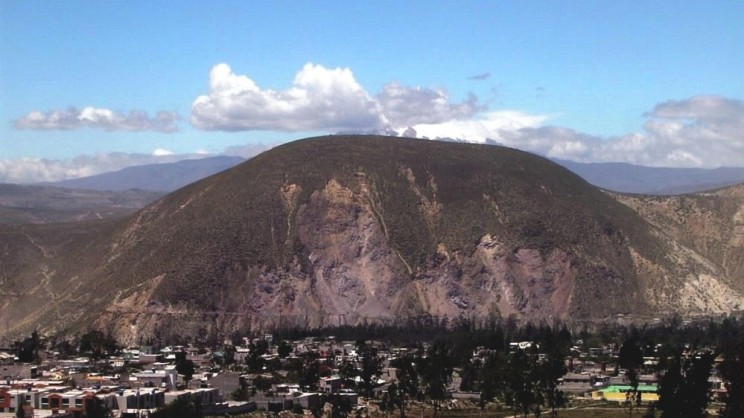
On 12 August 2014 at precisely 2:58 a.m., a 5.1 earthquake struck, centered at the hilltop lightning huaca San Catequilla de Pichincha. Since this initial earthquake, there have been 57 aftershocks, all centered at or close to this hill. Cerro Catequilla is situated where the Río Monjas empties into the Río Guayllabamba, approximately 15 kilometers north of Quito in the Pomasqui Valley directly east of the town of San Antonio. This is the only known Inca huaca located directly under the equator at 0°0’02″ S by 78°25’43″ W at 2,683 meters above sea level, making this the paradigmatic place of the astral positioning. The southern terminus of the summit is situated directly on the Mitad del Mundo at the equator, 0º0’00” S, beside a series of natural springs. The mountains surrounding Cerro Cetquilla range from 3,000 to 4,000 meters above sea level and the Cerro Pululagua volcano is located due west.
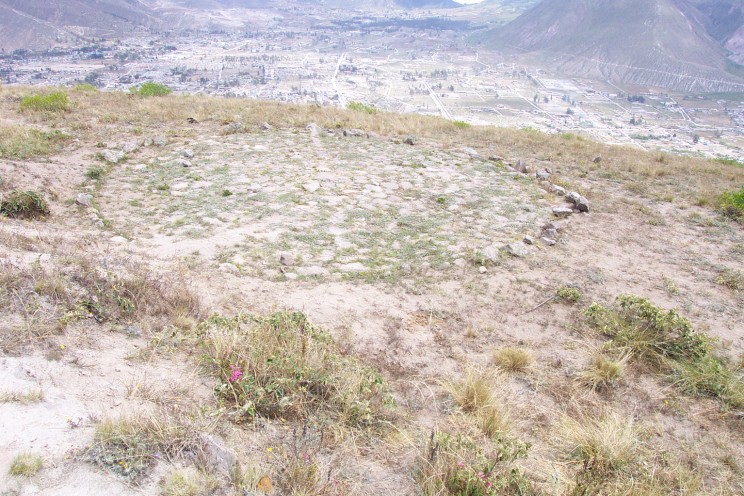
Northwest circular platform. The small circular platform is still visible on the summit of San Catequilla, as it appeared in July 2008. Photo by John E. Staller.
Volcanoes have symbolic associations to lightning and the importance of this valley is evidenced by the two branches of the Inca road, or Camino Real, one to the east and the other to the west side of the hill. Numerous Inca sites are in the surrounding landscape, including Pucara de Rumicucho, an Inca fortress and administrative center. The lightning huaca is made up of two superimposed earthen platforms; a buried rectangular platform measuring about 100 meters N/S and about 80 meters E/W, below a large circular earthen platform measuring 60 meters in diameter. The locations of these superimposed platforms on the southwestern slopes of Cerro Catequilla are the only places on the 200-meter long hilltop where the equator is directly overhead. This is one of three Inca huacas with Catequilla toponyms between the equator and 3° N. Catequilla de Pichincha was the most highly venerated because of its location under the equator.
In 1609, the chronicler Garcilaso de la Vega stated that the pillars and columns on many platforms around Quito and to the north in Cayambe and Ibarra were “broken to pieces” by the Conquistador Sebastián de Benalcázar, who tore them all down because the Andeans worshiped them idolatrously. There is very little information in the Spanish chronicles or from the Audiencia de Quito on how temporal cycles were recorded in and around Quito during the Contact Period. Most scholars have found astronomical calculation regarding the solar calendar was achieved through shadow casting. The most highly venerated gnome was Catequilla de Pichincha, primarily because when the sun was overhead during certain parts of the annual cycle there was increasingly diminished shadow around the pillar or gnome at this lightning huaca.
Cerro Catequilla, Pichincha Province, Ecuador, looking east from the town of San Antonio. Archaeological evidence of earlier occupation pertaining to Panzaleo culture at the base of the hill and the earthen architecture at the huaca on the summit suggests it was venerated before Inca expansion into this region. Cerro Catequilla stands at 2638 masl at the southern terminus of the summit directly under the Mitad del Mundo, or the equator. Indigenous informants mentioned that only maize may be cultivated on the summit and every year around the December solstice, rituals are still carried out and offerings are made to thehuaca. Photo courtesy of Cristóbal Cobo.
The Inca constructed over a hundred ceremonial platforms and shrines (villcas), some on mountain passes (apachitas), others on the summits of the highest mountains in their empire, between 1438 and the Spanish Conquest in 1532. Lightning was the major theophany of weather in Inca religion, known as Ilapa, now Illapa, the Hispanic spelling. Huacas with “Catequil” or “Catequilla” toponyms were associated with the spread of Catequil, a religious cult to lightning throughout their empire. Lightning veneration extended from Quito to Cuzco during the early Colonial Period. The principal huaca associated with lightning, was another hilltop huaca in northern highland Peru, Catequil de Huamacucho, a huaca said to make other huacas “speak,” and therefore believed to have the ability to predict earthquakes. Spirits associated with lightning are malevolent, have ancient origins in Andean cosmology and religion, and are symbolically depicted in various cultural traditions.
Many lightning huacas around the equator and regions to the north have circular stone enclosures or platforms which local Andean informants have said to me are places where lightning struck and are therefore sanctified. Such features have also been identified archaeologically in and around the nearby Inca fortress at Pucara de Rumicucho. Circular stone enclosures or platform features generally measure between three to four meters in diameter and are dispersed throughout this region. However, these were not destroyed by the Spanish conquistadores because they were not venerated in an “idolatrous” manner. Some are located in indigenous towns in the surrounding valley and those in the nearby towns are clearly visible from the summit of Cerro Catequilla. My preliminary research at this site indicates that such features also had astronomical function in association with sight lines to the surrounding horizon, solar cycles, and constellations in the night sky. In the Andes, thunder and lightning have symbolic associations with rain, hail, earthquakes, and the metallurgical arts, particularly gold and silver, agricultural fertility, and fire and damaging hail storms.
Featured image: Andean landscape, north of Quito. This photo is looking north across Cerro Catequilla and was taken from the lightning huaca at 0°.00 latitude. This valley has historically been of critical importance to cultivation, transport, and the movement people and food crops into northern Ecuador and Colombia. Photo by John E. Staller.
As we gear up for the conclusion of the 2014 FIFA World Cup, we’re highlighting some interesting facts about the final four competing nations with information pulled right from the pages of the latest edition of Oxford’s Atlas of the World. Argentina and the Netherlands battled it out in a semi-final match on Wednesday 9 July; Argentina pulled through after a penalty shootout. The team will go head-to-head with Germany on Sunday, 13 July to determine the champion.
Argentina, a two-time World cup winner reached its fifth final when it defeated the Netherlands. The last time it had advanced that far was 24 years ago in 1986. To celebrate their achievement, here are a few facts to think about until then next Cup.
In 2007 Cristina Fernández De Kirchner was the first directly elected woman president in Argentina. She succeeded her late husband, Néstor Carlos Kirchner, who had previously served for four years. She was later reelected in 2011.
The country had a large indigenous population prior to European colonization; however 86% of Argentina’s population is now of European ancestry.
Argentina is South America’s second largest nation after Brazil, and the world’s eighth largest country. It is the fourth largest Spanish-speaking nation in the world.
Spain took control of Argentina in the 16th century and continued its reign until 1816, when the country won back its independence. Argentina later suffered from instability and periods of military rule.
The World Bank classifies Argentina as an “upper-middle-income” developing country. Its form of currency is the Argentine Peso which is equivalent to 100 centavos.
In 1991, Argentina, Brazil, Paraguay, and Uruguay set up an alliance, Mercosur, aimed at creating a common market. The agreement’s main purpose is to facilitate free trade.
Roman Catholicism accounts for a whopping 92% of the country’s population (Pope Francis was born and raised there). Protestantism and Judaism tie at a distant second making up 2% each of the population.
Oxford’s Atlas of the World – the only world atlas updated annually, guaranteeing that users will find the most current geographic information — is the most authoritative resource on the market. The milestone Twentieth Edition is full of crisp, clear cartography of urban areas and virtually uninhabited landscapes around the globe, maps of cities and regions at carefully selected scales that give a striking view of the Earth’s surface, and the most up-to-date census information. The acclaimed resource is not only the best-selling volume of its size and price, but also the benchmark by which all other atlases are measured.
Subscribe to the OUPblog via email or RSS.
Subscribe to only geography articles on the OUPblog via email or RSS.
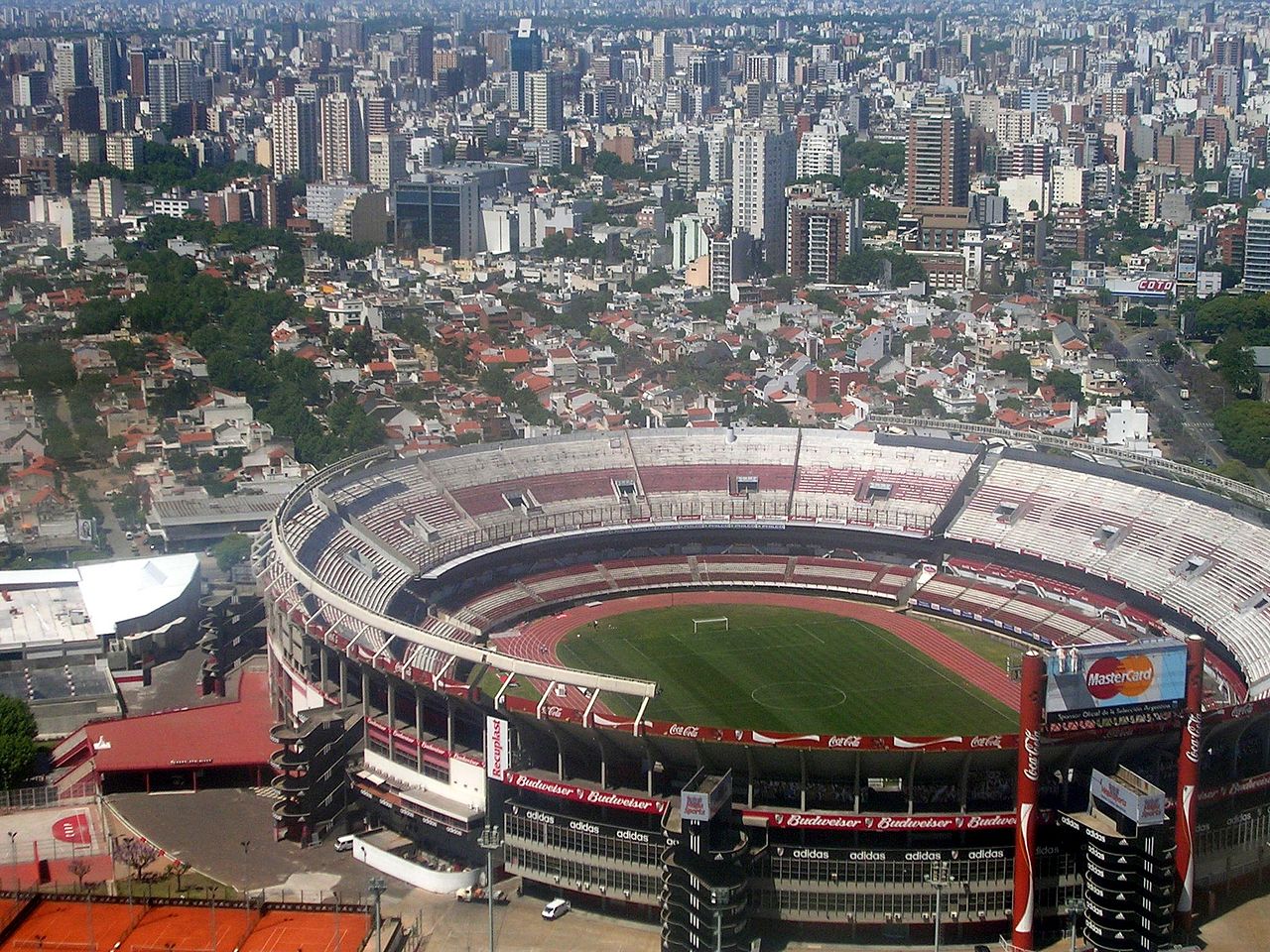
Image credit: Buenos Aires desde el cielo (Estadio de River). By Elemaki. CC BY 3.0 via Wikimedia Commons.
As we gear up for the conclusion of the 2014 FIFA World Cup, we’re highlighting some interesting facts about the final four competing nations with information pulled right from the pages of the latest edition of Oxford’s Atlas of the World. If you’re one of the few who hasn’t caught onto World Cup fever, the winner of the World Cup is near! Brazil and Germany faced off on Tuesday, 8 July. The shocking game left Germany the victor, with Argentina and the Netherlands battling it out on Wednesday 9 July. Argentina pulled through after a penalty shootout. The third place finalist will be determined on Saturday, 12 July with the final two teams going head-to-head on Sunday, 13 July to determine the champion.
The Federative Republic of Brazil, also known by the spelling Brasil, the world’s fifth largest country with a population of over 199 million, has the honor and distinction of hosting the World Cup this year, a fact that had this fútbol-centric nation even more hyped than usual.
A large country of over 3 million square miles, the area contains three main regions. Manaus, one of the host cities, has high temperatures all throughout the year. A tropical climate, rainfall is normally heavy, but lucky for players and cheering fans, the weather tends to be a bit drier from June through September.
Brazil is a leading economy in South America, described as a “rapidly industrializing economy.” You might not know that is the world’s top producers of products including cars, paper, aircrafts, and even materials ranging from diamonds to tin. With coffee as it’s leading export, agriculture employs 16% of the population. A major farming nation, products also include bananas, coca, rice, sugarcane, and maize.
With the Amazon, the world’s second largest river, in its backyard, forestry is a major industry although the fear that destroying the rainforests can accelerate global warming is a real concern. On a positive environmental note, Brazil is the second highest producer of hydroelectricity in the world, accounting for 12.3% of total world production.
Politically, the nation sets an example for progress in gender equality, having elected its first female president, Dilma Rousseff of the Workers Party, in 2010. It’s government is a Federal Republic, having first declared itself an independent empire in 1822 after originally being claimed by Portugal in 1500. After periods of material rule from the 1930s, civilian rule was restored in 1985 with a new constitution adopted in 1988.
Oxford’s Atlas of the World – the only world atlas updated annually, guaranteeing that users will find the most current geographic information — is the most authoritative resource on the market. The milestone Twentieth Edition is full of crisp, clear cartography of urban areas and virtually uninhabited landscapes around the globe, maps of cities and regions at carefully selected scales that give a striking view of the Earth’s surface, and the most up-to-date census information. The acclaimed resource is not only the best-selling volume of its size and price, but also the benchmark by which all other atlases are measured.
Subscribe to the OUPblog via email or RSS.
Subscribe to only geography articles on the OUPblog via email or RSS.
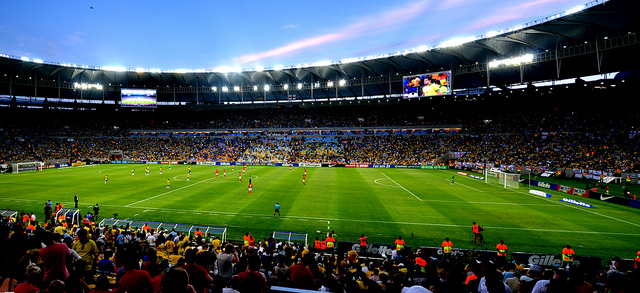
Image credit: Photo by Digo_Souza>, CC BY 2.0 via Flickr
Recent talk of declining US influence in the Middle East has emphasized the Obama administration’s diplomatic blunders. Its poor security in Benghazi, its failure to predict events in Egypt, its difficulty in reaching a deal on withdrawal in Afghanistan, and its powerlessness before sectarian violence in Iraq, to be sure, all are symptoms of this loss of influence.
Yet all miss a crucial point about a region of the world crawling with US troops. What makes a foreign military presence most unpopular is simply that it is, well, military. It is a point almost too obvious to make, but one that is forgotten again and again as the United States and other nations keep sending troops abroad and flying drones to take out those who violently oppose them.
The warnings against military occupation are age-old. The Founding Fathers understood the harshness of an occupying force, at least a British one, and thus declared in the Third Amendment that “no soldier shall, in time of peace be quartered in any house, without the consent of the owner, nor in time of war, but in a manner to be prescribed by law.”
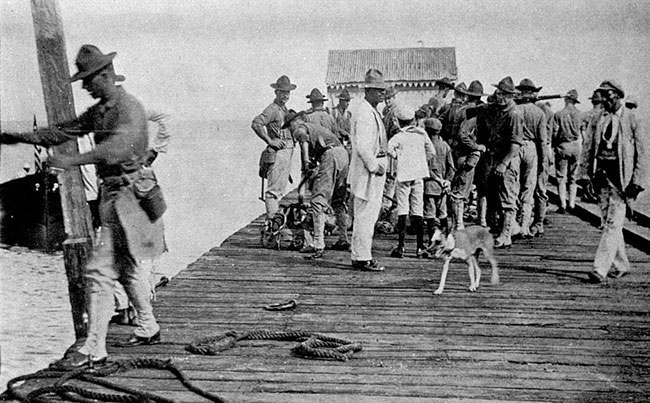
US occupations of small Latin American countries a century ago taught a similar lesson. What was most irksome for those who saw the US marines occupy Nicaragua, Haiti, and the Dominican Republic between 1912 and 1934 was not the State Department’s desire to protect US lives and property. It also wasn’t its paranoia about German gunboats during World War I. It wasn’t even the fact itself of intervention. While some of these occupations began with minimal violence and a surprising welcome by occupied peoples, as months turned into years, the behavior of US troops on the ground became so brutal, so arbitrary, and so insensitive to local cultures that they drove many to join movements to drive the marines back into the sea.
Ocupación militar del 1916 en República Dominicana by Walter. CC-BY-SA-3.0 via Wikimedia Commons.
It was one thing to subdue armed supporters of the regimes overthrown by the United States in all three countries. Latin Americans often met the demise of those unpopular governments with relief. Besides, armed groups recognized the overwhelming training and firepower of the marines and agreed readily to disarmament. As one Haitian palace guard recalled of the marine landing of 1915, “Everyone fled. Me too. You had only to see them, with their weaponry, their massive, menacing appearance, to understand both that they came to do harm to our country and that resistance was futile.”
It was the violence during “peace” time that turned the masses against occupation. At times marines and their native constabularies hunted small groups of insurgents and treated all locals as potential traitors. Other times they enforced new regulations, replaced local political officials, or militarized borders. And they could do it all with virtual impunity since any of their crimes would be tried by their own in US-run military provost courts.
Abuses were particularly frequent and grave either when no marines supervised constabularies or when a single marine — often a non-commissioned officer elevated to officer status in the constabulary — unleashed a reign of terror in a small town.
The residents of Borgne, in Haiti, for instance, hated a Lieutenant Kelly for approving beatings and imprisonments for trivial crimes or for no apparent reason at all. While in the Dominican Republic, around Hato Mayor, Captain Thad Taylor riled over his own fear-filled fiefdom. As one marine described it, Taylor “believed that all circumstances called for a campaign of frightfulness; he arrested indiscriminately upon suspicion; then people rotted in jail pending investigation or search for evidence.” In Nicaragua, the “M company” was widely accused of violence against children, especially throwing them into the air and spearing them with bayonets. In Haiti, a forced labor system known as the corvée saw Americans stop people, peasants, servants, or anyone else, in the street and make them work, particularly to build roads. The identification of the corvée with occupation abuse was so strong that, years later, Haitians gladly worked for foreign corporations but refused to build roads for them.
Rape added an element of gendered terror to abuses. The cases that appear in the historical record — many more likely went unreported — indicate an attitude of permissiveness, fed by the occupations’ monopoly of force, that bred widespread fear among occupied women. Assault was so dreaded that Haitian women stopped bathing in rivers.
Marines were none too careful about keeping abuses quiet and perhaps wanted them to be widely known so as to terrorize the populace. They repeatedly beat and hanged occupied peoples in town plazas, walked them down country roads with ropes around their necks, and ordered them to dig graves for others.
Brutality also marked the behavior of US troops in the cities, where there was no open rebellion. Often, marines and sailors grew bored and turned to narcotics, alcohol, and prostitution, vices that were sure to bring on trouble. A Navy captain suggested the humiliation suffered by Nicaraguan police, soldiers, and artisans, who all made less money than local prostitutes. He also noted the “racial feeling, . . . which leads to the assumption of an air of superiority on the part of the marines.” In response, the US minister requested that Nicaragua provide space for a canteen, dance hall, motion picture theatre, and other buildings to occupy the marines’ time.
Even the non-violent aspects of occupation were repressive. A French minister in Haiti noted that all Haitians resented intrusions in their daily freedoms, especially the curfew. Trigger-happy US soldiers on patrol also exhibited “an extraordinary lack of discipline and in certain cases, an incredible disdain for propriety.” Dominicans considered US citizens to be “hypocrites” because they drank so much abroad while living under prohibition at home. Reviewing such cases, a commanding officer assessed that 90 percent of his “troubles with the men” stemmed from alcohol. In a particularly terrifying incident, private Mike Brunski left his Port-au-Prince legation post at 6 a.m. and started shooting Haitians “apparently without provocation,” killing one and wounding others. He walked back to the legation “and continued his random firing from the balcony.” Medical examiners pronounced Brunski “sane but drunk.”
Abuse proved a recruiting bonanza for insurgents. Little useful information, and even less military advance, was gained from abuse and torture in Nicaragua. A Haitian group also admitted that “internal peace could not be preserved because the permanent and brutal violation of individual rights of Haitian citizens was a perpetual provocation to revolt.” Terror otherwise hardened the population against the occupation. Many in the Dominican Republic later testified with disgust to having seen lynchings with their own eyes. There and in Haiti, newspaper editors braved prison sentences to publish tales of atrocities.
By 1928, the State Department’s Sumner Welles observed that occupation “inevitably loses for the United States infinitely more, through the continental hostility which it provokes, through the fears and suspicions which it engenders, through the lasting resentment on the part of those who are personally injured by the occupying force, than it ever gains for the United States through the temporary enforcement of an artificial peace.”
Hostile, troublesome, horrifying: the US military in Latin America encountered a range of accusations as they it on believing that it brought security and prosperity to the region. Sound familiar? The lessons of Latin American resistance a century ago are especially relevant today, when counterinsurgency doctrine posits that a successful occupation, such as the one by coalition forces in Afghanistan, must win over local public opinion in order to bring lasting security. Thankfully, it appears that the lesson has sunk in to a certain extent, with diplomats increasingly reclaiming their role from the military as go-betweens with locals. Yet much of the damage has been done, and in the case of drones, no amount of diplomacy can assuage the feeling of terror felt throughout the countryside of Afghanistan and Pakistan when that ominous buzzing sound approaches overhead. It is, perhaps for better and certainly for worse, the new face of US military occupation.
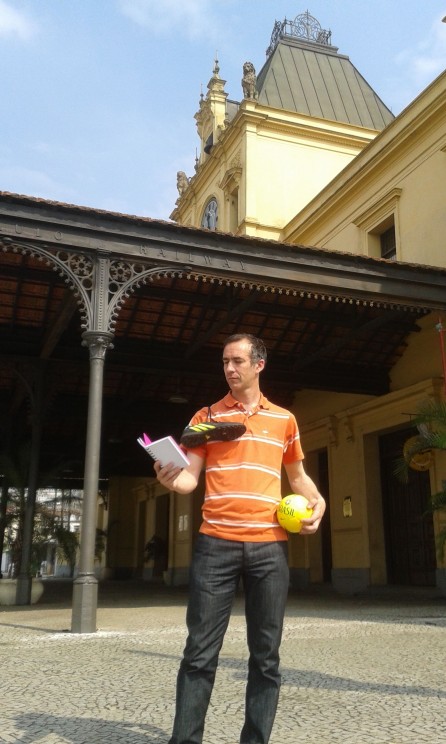
Charles Miller claimed to have brought the first footballs to Brazil, stepping off the boat in the port of Santos with a serious expression, his boots, balls and a copy of the FA regulations, ready to change the course of Brazilian history. There are no documents to record the event, only Miller’s own account of a conversation, in which historians have picked numerous holes. There are no images either, which is why to mark the impending Miller-mania surrounding English participation in the World Cup in Brazil, I recreated the scene on the docks at Santos, today South America’s biggest and busiest port. (Thanks to my colleague Gloria Lanci for capturing the solemnity of the occasion).
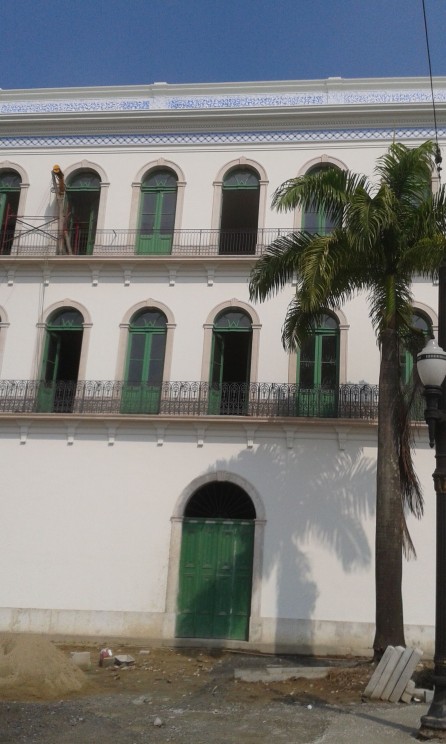
Opposite the passenger terminal, where the photo was taken, an old building is being converted into the Museu do Pelé, to house the history of Santos Futebol Clube’s most famous player, heralded by many as the greatest footballer of the twentieth century – though it will not be ready to open in time for the World Cup. The stories of Miller and Pelé are often linked to illustrate the development of football in Brazil. Gilberto Freyre, the Brazilian sociologist and historian, was one of the first:
‘[It was] Englishmen who introduced into Brazil the principal sporting and recreational replacements for our colonial jousting tournaments: horse-racing, tennis, cycling and football itself, which here became fully naturalised as a game not for fair-haired European expatriates in the tropics but for local people: […] people increasingly of varying shades of brown; with de-Anglicisation culminating in the admirable Pelé, after shining with Leônidas.
[Football] has become a veritable Afro-Brazilian dance, with footwork never imagined by its inventors. Has it stopped being British? Not in the slightest. Association football cannot be separated from its British origins to be considered a Brazilian or Afro-Brazilian invention. What it is, in its current, triumphant expression, is an Anglo-Afro-Brazilian game’. (Gilberto Freyre, The British in Brazil, London, 2011, first published in Portuguese in 1954, p.13.)
Charles Miller was born in São Paulo to a Scottish father and a Brazilian mother whose surname, Fox, reveals her English origins. During his lifetime the population of São Paulo ballooned from around 100,000 in 1874 to well over 2 million in 1953. Most of those new citizens were migrants and their children. São Paulo and Brazil were remaking themselves. Football and music became central ways for Brazilians to express a new inclusive identity after the abolition of slavery (1888) and the establishment of a new republic to replace monarchy (1889).
The sense of Brazilian football leaving its British origins behind as it headed for global domination on and off the pitch, as suggested by Freyre, is why there is no statue or plaque to Miller in the city, not even in the Praça Charles Miller, the square at the front of the Pacembu stadium which houses the Museu do Futebol. Though he was born and died in Brazil, and lived almost his entire life in Brazil (the exception was his schooling in Hampshire, England) Miller’s legend is that of an immigrant, stepping off the ship in Santos to begin a new life. His ambiguous identity, floating between Scottish, British and Brazilianmight explain why his simple grave in the Cemeterio de Protestantes in São Paulo is so modest (a cross marked C.W.M, which the director of the cemetery asked me not to photograph, “out of respect”). The Museu Charles Miller, housed in the exclusive Clube Athletico Sao Paulo, and available to visit on appointment, contains old photographs, trophies and a letter from Pelé.
In Brazilian football historiography, “Charles Miller” has become a cipher for the elite, foreign origins of a game which was were subsequently embraced by the Brazilian povo (the people). Something similar is true of Alexander Watson Hutton for Argentina, a more conventional immigrant figure, a Scot who arrived in Buenos Aires as an adult and set about institutionalising and regulating the game of football through schools, teams and leagues. At the II Simpósio Internacional de Estudos Sobre Futebol that I attended in São Paulo last week, Miller was referenced by many of the researchers as a scene-setter to establish their credentials, his name alone enough to conjure images of moustachioed elite white men in blazers tapping a ball around.
At the Simposio, discussing museums and football with Richard McBrearty, director of the Scottish Football Museum, and Daniela Alfonsi, Diretora de Conteudo do Museu de Futebol, Kevin Moore, director of the [English] National Football Museum, noted that Miller’s story is ‘the very epitome of the multinational, global nature of the origins of football’. But they also pointed out that the origins of football were anything but a one man show. Hundreds of people played football in Brazil at the end of the nineteenth century, and historian José Moraes dos Santos Neto has argued pretty convincingly that football was being played in several places in Brazil before Miller’s much-heralded return from England. The ways in which Brazilians took on the game and made it their own is the subject of many wonderful books, including Alex Bellos’ Futebol: The Brazilian Way of Life and David Goldblatt’s Futebol Nation: A Footballing History of Brazil. The importance of Charles Miller lies not in any individual greatness but in the way that his story has captured something of the essence of being Brazilian, and of the ways in which football was adopted, regulated, internationalised and embraced around the world.
Dr Matthew Brown is a reader in Latin American Studies at the University of Bristol, and specialises in the history of sports in South America. In particular, the history of the very first football teams to be established. He contributed the biographies of Charles Miller and Alexander Hutton to Oxford Dictionary of National Biography’s May update.
The Oxford Dictionary of National Biography online is freely available via public libraries across the UK. Libraries offer ‘remote access’ allowing members to log-on to the complete dictionary, for free, from home (or any other computer) twenty-four hours a day. In addition to 58,800 life stories, the ODNB offers a free, twice monthly biography podcast with over 190 life stories now available. You can also sign up for Life of the Day, a topical biography delivered to your inbox, or follow @ODNB on Twitter for people in the news.
Many hope, even count on, photography to function as an agent of social change. In his 1998 book, Photojournalism and Foreign Policy: Icons of Outrage in International Crises, communications scholar David Perlmutter argues, however, that while photographs “may stir controversy, accolades, and emotion,” they “achieve absolutely nothing.”
In my current research project, I examine the difficult question of what contribution photography has made to social change through an examination of images documenting events from the Central American civil wars — El Salvador and Nicaragua, more specifically — that circulated in the United States in the 1980s. Rather than measure the influence of these photographs in terms of narrowly conceived causal relationships concerning issues of policy, I argue that to understand what these images did and did not achieve, they need to be situated in terms of their broader social, political, and cultural effects — effects that varied according to the ever shifting relations of their ongoing reproduction and reception. Below are three platforms across which photographs from the wars in Central America circulated and recirculated in the United States in the 1980s.
(1) In the early 1980s, the US government adopted a dual policy of military support in Central America. In El Salvador, they provided aid against the guerilla forces or FMLN while in Nicaragua they backed the contra war against the Sandinistas. Many Americans learned and formulated opinions about these policies through photographs that circulated in the news media. The cover of the 22 March 1982 issue of Time, for instance, featured a photograph of a gunship flying over El Salvador. Taken by US photojournalist Harry Mattison, the editors at Time used the photograph as part of their cover story questioning the use by the US government of aerial reconnaissance photographs of military installations in Nicaragua to establish a causal link between the leftist insurgents in El Salvador and Communist governments worldwide.
(2) In addition to these reconnaissance photographs, the Reagan administration also turned to photography in an eight-page State Department white paper entitled Communist Interference in El Salvador, which was released to the American public on 23 February 1981. In this white paper, the US government included two sets of military intelligence photographs of captured weapons, which they believed would help them to further provide the American public with “irrefutable proof” of Communist involvement via Russia and Cuba in Central America, and thereby justify the escalation of US military and economic aid to the supposedly moderate Salvadoran government. The aforementioned article in Time also questioned the validity of the sources used in this document.
(3) While photography played a prominent role in debates over the existence of a communist threat in Central America, beginning in 1983, a number of artists and photographers — Harry Mattison, Susan Meiselas, Group Material, Marta Bautis, Mel Rosenthal, among others — put photographs from the Central American conflicts, some of which had circulated directly in the aforementioned contexts and others which had not, to a different use. Rather than employ photographs to perpetuate or even question the accuracy of communist aggression in the region, these artists and photographers instead used the medium to examine the imperialist underpinning of the Reagan administration’s foreign policy in Central America as well as the longstanding geopolitical and historical implications of US involvement there. To this end, they produced the following: the 1983 photography book and exhibition El Salvador: Work of Thirty Photographers, which was edited by Harry Mattison, Susan Meiselas, and Fae Rubenstein and toured various US cities in 1984 and 1985; Group Material’s 1984 multi-media installation Timeline: A Chronicle of US Intervention in Central and Latin America, on view at the P.S. Contemporary Art Center in Queens, New York, as part of the ad hoc protest organization Artists Call Against US Intervention in Central America; and the exhibition The Nicaragua Media Project that toured various US cities in 1984 and 1985. Together these three photography books and art exhibitions provided, what I call, a “living” history for photographs from the Central American civil wars.
In his 1978 essay “Uses of Photography” that was anthologized in his 1980 book About Looking, cultural critic John Berger argues that for photographs to “exist in time,” they need to be placed in the “context of experience, social experience, social memory.” Using Berger’s definition of a “living” history as a model, my research project offers a novel way to think about how, within the contexts of these exhibitions and books, photographs from the conflicts in El Salvador and Nicaragua functioned as dynamic, even affective objects, whose mobility and mutability could empower contemporary viewers to look beyond the so-called communist threat in the region that was perpetuated through the Reagan administration as well as the news media and begin to think more carefully about past histories of US imperialism and global human oppression in Central America.
Erina Duganne is Associate Professor of Art History at Texas State University where she teaches courses in American art, photography, and visual culture. She is the author of The Self in Black and White: Race and Subjectivity in Postwar American Photography (2010) as well as a co-editor and an essayist for Beautiful Suffering: Photography and the Traffic in Pain (2007). She has also written about her current research project for the blog In the Darkroom.
Oxford Art Online offers access to the most authoritative, inclusive, and easily searchable online art resources available today. Through a single, elegant gateway users can access — and simultaneously cross-search — an expanding range of Oxford’s acclaimed art reference works: Grove Art Online, the Benezit Dictionary of Artists, the Encyclopedia of Aesthetics, The Oxford Companion to Western Art, and The Concise Oxford Dictionary of Art Terms, as well as many specially commissioned articles and bibliographies available exclusively online.
Subscribe to the OUPblog via email or RSS.
Subscribe to only art and architecture articles on the OUPblog via email or RSS.
This March we celebrate Women’s History Month, commemorating the lives, legacies, and contributions of women around the world. We’ve compiled a brief reading list that demonstrates the diversity of women’s lives and achievements.
Discover the distinct strategies through which men and women constituted their identities in India for all their implications, tensions, and inconsistencies.
Learn about Sorabji’s decisive role in opening up the legal profession to women long before they were allowed to plead before the courts of law, including her writings and personal correspondence.
Study the life and reign of Queen Anne through literature, art, and music from Dryden, Pope, Purcell, Handel, Lely, Kneller, Wren, Vanbrugh, Addison, Swift, and many other artists.
Illuminate the brilliant life and tragic death of Isabella de Medici, one of the brightest stars in the dazzling world of Renaissance Italy, the daughter of Duke Cosimo I, ruler of Florence and Tuscany.
Delve into the cultural, social, and economic conditions of the lives of poor women in a seafaring society from the perspectives of prostitutes, their bawds, their clients, and the police.
Trace the hopes and tensions generated by expectations of gender and class from the first New England operatives in the early 19th century to immigrant sweatshop workers in the early 20th.
Connect to the lives of African America women chemists, from the earliest pioneers through late 1960′s when the Civil Rights Acts were passed, to today.
Uncover the key role “invisible” Spanish-Mexican women played in the US takeover of Mexico’s northern territory and gain a greater understanding of conquest and colonization.
Reach back through women’s long history of labor, political activism, and contributions to — or even support of — family and community well-being.
Women’s history encompasses the history of humankind, including men, but approaches it from a woman‐centered perspective. It highlights women’s activities and ideas and asserts that their problems, issues, and accomplishments are just as central to the telling of the human story as are those of their brothers, husbands, and sons. It places the sociopolitical relations between the sexes, or gender, at the center of historical inquiry and questions female subordination.
Subscribe to the OUPblog via email or RSS.
Subscribe to only history articles on the OUPblog via email or RSS.