“Net Neutrality” is the simple but powerful principle that cable and broadband providers must treat all internet traffic equally. Whether you’re loading a blog post on WordPress.com, streaming House of Cards on Netflix, or browsing handcrafted tea cozies on Etsy, your internet provider can’t degrade your connection speed, block sites, or charge a toll based on the content that you’re viewing.
Net neutrality has defined the internet since its inception, and it’s hard to argue with the results: the internet is the most powerful engine of economic growth and free expression in history. Most importantly, the open internet is characterized by companies, products, and ideas that survive or fail depending on their own merit — not on whether they have preferred deals in place with a broadband service provider. Unfortunately, the principle of net neutrality, and the open internet that we know and love, is under attack.
Net Neutrality under attack
The Federal Communications Commission has proposed rules that would, for the first time, expressly allow internet providers — like Comcast, Verizon and AT&T — to charge internet companies like Automattic, Netflix or Etsy for access to their subscribers. This means there could be “fast lanes” for companies who are able to pay providers for preferred internet access, while everyone else gets stuck in the “slow lane”…which means applications won’t perform as quickly, webpages will load slowly, and of course, buffering. A slow “still loading” spinner will be an unfortunate, but common sight on the new, closed internet that the big providers want.
Unsurprisingly, the large telecom companies who stand to benefit from the FCC’s proposed rules fully support their passage. They have nearly unlimited funds and hundreds of lobbyists in Washington to promote these harmful new rules.
But what they don’t have is you.
What can we do to fight back?
Automattic strongly supports a free and open internet. After all, WordPress.com, and the WordPress open source project are living examples of what is possible on an unthrottled internet, open for creation, collaboration, and expression. Over the last few months, we’ve joined 150 major tech companies in sending a letter to Washington in support of net neutrality, and met with FCC Chairman Tom Wheeler to urge him to preserve the internet we’ve always known.
Now it’s your turn.
Automattic, along with many other companies and digital rights organizations, is proud to participate in the Internet Slowdown on September 10. For this day of action, we’ve built a “Fight for Net Neutrality” plugin that you can enable now on your WordPress.com blog to show support for this important cause.
You can turn the plugin on by going to your Dashboard, Settings → Fight for Net Neutrality.
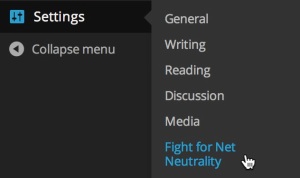
When you enable the plugin, we’ll replace a few of the posts on your site with a “Still Loading” spinner…to show what life will be like on an internet that features dreaded slow lanes.

The plugin will also display a banner that shows your support for Net Neutrality, and links to battleforthenet.com, where visitors to your site can sign a letter to the FCC about this important issue.
Please take a few minutes to enable the Fight for Net Neutrality on your site today, and visit battleforthenet.com to send a message to Washington that net neutrality must be preserved. Together we can make a difference, and we hope you’ll join us in this important battle for the open internet!
Filed under:
Community,
WordPress.com 


Each day we boot up, check our email, send out queries, research information, engage in online classes or discussions, pay our bills and perhaps check the headlines or the weather. As writers and editors we live by our computer—and perhaps a multi-use cell phone contraption. We need access to a wide array of sites and services. We need unbiased information--and we need it now!
The Internet is our constant companion and hardiest coworker, and we take it for granted. What if you booted up one day only to find that your provider was no longer allowing access to the sites you needed? What if all the information you found was one-sided. What if your website and links took so long to download that the editor decided you weren’t worth the hassle? What if you suddenly found that you only had access to the “Public Internet” or the “Family Tier” and that the “Business Tier” would cost extra. Unlike radio or television, the Internet has been our source for uncensored, equally available information—and there is a battle going on to maintain the status quo.
The Low-Down
Net Neutrality is the ability to access anyone or any site regardless of race, creed, political party or service provider, uninterrupted and at an equal rate of speed.Big Business wants to control your access to the Internet. As we know, money talks, and certain providers such as AT&T, Verizon and Comcast would like to regulate content, give the right-of-way to their own network—slowing down all other traffic crossing their path, and institute payment-tiers of service (much like the cable television channels).
Enter The FCC
In an attempt to maintain the integrity of the Internet as we know it, the FCC stepped in. On December 21st they passed rulings in an effort to insure that content not be blocked or censored and that it remains equally available to everyone. The rulings only covered line-wired access (not wireless services) and left an opening for tiering or “paid prioritization”.
Verizon Fires Back
Not only did Verizon file for reversal of the ruling, they also filed a joint proposal along with Google which suggests, among other things, that the FCC enforce the protection and nondiscriminatory requirements but have no rule making authority. In other words, you can watch us but can’t control us. Some customers already report being notified that Verizon will be throttling data speeds “to ensure high quality network performance for other users at times of peak demand”. At risk are people whose ISP shows a lot of usage. That kid playing on the iPhone might be more important than your business access; how do you feel about having you Internet speed cut in half after 2pm?
What Can You Do?
You can write to your representative, join the discussion at OpenInternet[dot]gov, or speak with your pocket-book.
You work hard for your money and you owe it to yourself to make wise choices with it. When we purchase services we do more than satisfy a need, we become partners with the company we have chosen. Do a little research on where your provider stands, both for your hard-wired system and your wireless provider. If you decide they are not acting in your best interest consider switching.
By Robyn Chausse
(photo by R. Chausse)
How do you feel about Net
Very interested article in the NY Times by Adam Raff, co-founder of Foundem. In the context of the FCC’s request for public comments on net neutrality rules, he raises the question of “”search neutrality”: the principle that search engines should have no editorial policies other than that their results be comprehensive, impartial and based solely on relevance.” He gives many interesting examples where Google uses its market dominance to alter search results in ways that can be damaging to competitors. And what will this mean in the era of new “personalized” searches on Google? Will this be another way to boost Google products and “disappear” competitors?
Ars Technica talks about an article in the WSJ about a possible antitrust investigation of At&T and Verizon who apparently own 90% of landlines and 60% of the mobile market. The article also mentions that non-net neutrality may be examined as it pertains to wireless providers.
I wish the CRTC was having a look at what is happening in the US regarding telecoms. I’ve been listening to and reading tweets (#netneutrality or #crtc) today from the net neutrality hearings in Gatineau. In my opinion, Chairman von Finckenstein is blatently biased and poorly informed, siding with ISPs at every opportunity. It’s extremely frustrating.
And why has no one yet mentioned that I just noticed that yesterday, the Open Internet Coalition (which includes Google) mentioned that the FCC found Comcast guilty of discriminatory behaviour when it was caught throttling P2P. Yet, I feel as though von Finckenstein is always alluding to the fact that throttling is not discriminatory. Maybe he should read the FCC ruling. The first three lines say:
We consider whether Comcast, a provider of broadband Internet access over cable lines, may selectively target and interfere with connections of peer-to-peer (P2P) applications under the facts of this case. Although Comcast asserts that its conduct is necessary to ease network congestion, we conclude that the company’s discriminatory and arbitrary practice unduly squelches the dynamic benefits of an open and accessible Internet and does not constitute reasonable network management. Moreover, Comcast’s failure to disclose the company’s practice to its customers has compounded the harm.
Also, why hasn’t anyone mentioned that The Open Internet Coalition also mentioned that Comcast can manage it’s network (and was forced to by the FCC) without DPI.
This morning, someone mentioned Comcast as an example of an ISP gone wild and the Chairman would not believe that Canadian ISPs would act in the same way. Perhaps the methods used to discriminate against P2P are different (I don’t think Canadian ISPs are using RST injections), but the result is the same.
SaveOurNet.ca had a town hall meeting in Ottawa yesterday that I was fortunate enough to attend. I’m not sure if it will be podcasted, but the Toronto one was.
Here is a summary of the Ottawa event. (I hope I was able to get everything right):
Steve Anderson’s introduction:
Anderson defined net neutrality and went on to mention that net neutrality is like electricity. You can plug any toaster into an electrical outlet, and it will work. That’s because Hydro companies do not tell you which toasters can or cannot function. Similarly, if two guys in a garage make something (an application or service, etc.) for the Internet, it should just work, no questions asked.
Speaker #1: Michael Geist:
Geist mentioned “four” hanging fruit relating to Net Neutrality that need to be addressed by a combination of groups such as the CRTC, the Competition Bureau, the legislature, the privacy commissioner, etc.:
- No content blocking
- Transparency (all ISPs should disclose their network management practices, etc.)
- No undue preference (ISPs should not provide preferential treatment to their own content. Pelmorex gave a good example of this happening by wireless service providers (WSPs) during the new media hearings.)
- Deep Packet Inspection (the privacy commissioner has raised serious privacy concerns regarding this technology).
Speaker #2: Charlie Angus:
Charlie Angus (NDP MP for Timmins) talked about how the Internet is a tool that empowers citizens. According to his website “Charlie Angus was a major organizer in the fight to stop the Adams Mine dump and the battle to stop toxic waste imports into [his] region.” He said that it was the Internet that allowed the organizers to win these battles by educating themselves on the issues.
Speaker #3: Rocky Gaudrault (Teksavvy):
In his short speech, he mentioned that we need to challenge the use of the word “choice” in the context of choosing ISPs in Canada since the large telcos and cablecos own 96% of the market.
Question Period and Discussion:
Marita Moll, the discussion facilitator, summarized the issues and themes that were discussed. These are the issues that we need to move forward on regarding Net Neutrality advocacy:
- Spectrum reform: It was mentioned that we need to get prepared on the issue of auctioning off the white space (it should happen in 2010) which will become available in the analog to digital transition in 2011. Geist mentioned that it should be allocated for unlicensed use (like WiFi) so that anyone can connect to it.
- Net neutrality is an economic issue just as much as it is a social one. The Internet drives a big part of our economy and we cannot let that be controlled by a few ISPs.
- Innovation: There is less innovation in Canada because the prices to access the networks are so high. There will also be less innovation on the network if ISPs can decide what runs (applications, services, content, etc.) on their networks and what doesn’t.
- Competition: There needs to be much more competition to lower prices and increase innovation and improvements on the network (speeds, access, etc.)
- Geist’s four hanging fruit (see above)
- We need to enable legislation to protect Net Neutrality (Charlie Angus and his private member’s bill C-398)
- Create toolkits to help citizens get involved (SaveOurNet is working on this)
- Infrastructure buildout: Australia, for example, is spending billions on their broadband infrastructure. We also learned that Industry Canada is planning on building a map that will show broadband deployment in Canada that will include speed of connection as well.
- The debate needs to be framed as a free speech issue
- The debate needs to be framed as an access issue
- The debate needs to be framed as a citizens rights issue (Charter of Rights and Freedoms states that everyone has the right to freedom of thought, belief, opinion and expression, including freedom of the press and other media of communication)
Other people in the room commented on the fact that we need to engage the research, medical and educational communities as this will affect all of them. It was mentioned how so much research is being done in the Arctic now, but because there is so little broadband penetration there, it is actually quite difficult to send the data back to the researchers’ institutions.
All in all, it was an excellent and well attended evening with a lot of pertinent and interesting discussions.
Great video on Geek Enternainment TV features Tim Wu and his take on the future of the Internet without Net Neutrality.
A colleague and I will be giving a presentation at the upcoming CLA conference in Montreal on Net Neutrality and What it Means for Libraries. I’d like to do a small informal survey targetted to librarians, faculty or staff working in Universities in Canada by asking the following two questions:
- Does your university (or library) network adminstrator shape traffic (i.e. slow down or block traffic from certain sites or for certain applications – for example MySpace, Facebook, YouTube or streaming video or P2P traffic)
- How does this affect you?
At Concordia University, for example, Facebook is blocked (but not on the wireless network) and traffic is throttled at certain times of the day in order to “manage the network”. (I think the idea is to limit the amount of video streaming that occurs, you know that web 2.0, user generated world that we live in? Apparently a University is not the appropriate place for living and learning in the 21st century.)
This has obvious consequences on the library. For Facebook, it means that if we want to advertise there or keep in contact with University groups that have pages there, we have to work from home (not with the VPN, of course) or we have to work on a laptop using the wireless network (when it’s working. The connection in the library at Concordia is not very reliable).
As for traffic throttling at Concordia, it affects library databases that have streaming video, such as Theatre in Video. (Notice the warning we’ve put up)
Other possibilities include how it can affect teaching and research. See this great post by a professor at the University of Ottawa: The University Shouldn’t Shape My Traffic
So please forward this post around, and contact me with your experiences. (danielle dot dennie at concordia dot ca)
This is the title of a great podcast over at the ever enlightening Search Engine (on CBC). Many things are covered, from the exaflood, to dark fiber, to Internet access as a public utility.
On Thursday November 20, the CRTC will finally give its ruling on the Bell throttling case. (Last spring, Bell started throttling internet service to its wholesale customers, after having done it since October 2007 to its Sympatico customers). Although the ruling will only look at whether this throttling of wholesale customers violates the Telecommunications Act, it will no doubt bring about much larger discussions on Net Neutrality in general. The CBC has a good article describing the issue. Bell has also recently put up a page describing its throttling practices.
If you plan on being in Vancouver on October 23 - 24, you should think of attending what looks like a very interesting conference put together by the BCLA Information Policy Committee: Jumpstarting the Public Sphere: Information Policy Issues for the 21st Century. The issues convered include net neutrality, media concentration, telecommunications policy, TILMA, access to information, and intellectual property. For a very cheap price, you’ll get to hear some fascinating speakers. Thanks to the committee for organizing this!!
This week’s episode of Spark on the CBC gives an interview with Ron Deibert who runs the Citizen Lab at the Munk Centre for International Studies at the University of Toronto. His digital wishlist for the Canadian election is available as a video and can be summarized in three excellent points:
- An elected government should ensure net neutrality
- An elected government should protect the Internet internationally to ensure free, unfettered access to information in all countries
- An elected government should support technological innovations that have goals other than those of making money (or those that follow the market rationale). For example, technological innovations that can support human rights.
Ron Deibert says that the Internet is a shared global communication medium but it’s being “carved up, colonized, and militarized” and an elected government in Canada should do all it can to stop this.
In June, the OECD had a Ministerial Conference on the Future of the Internet Economy. They published a report which is intended to help countries shape policies concerning the Internet economy. The themes that are addressed are the following:
- Making Internet access available to everyone and everywhere.
- Promoting Internet-based innovation, competition and user choice.
- Securing critical information infrastructures and responding to new threats.
- Ensuring the protection of personal information, respect for intellectual property rights, and more generally a trusted Internet-based environment which offers protection to individuals, especially minors and other vulnerable groups.
- Promoting secure and responsible use of the Internet; and,
- Creating an environment that encourages infrastructure investment, higher levels of connectivity and innovative services and applications.
There were some positive policy suggestions that were made, such as:
- Promote a culture of openness and sharing of research data among public research communities.
- Raise awareness of the potential costs and benefits of restrictions and limitations on access to and sharing of research data from public funding.
The OECD Civil Society Forum, comprised of the OECD Civil Society Reference Group and the The Trade Union Advisory Committee, produced a paper (and their own conference) intended to bring to the attention of the OECD Ministers assembled and the OECD member countries the concerns of those not represented at the Ministerial conference.
Their paper highlights the following:
The policy goals for the Future Internet Economy should be considered within the broader framework of protection of human rights, the promotion of democratic institutions, access to information, and the provision of affordable and non-discriminatory access to advanced communication networks and services.
Their recommendations cover
- Freedom of expression
- Protection of Privacy and Transparency
- Consumer Protection
- Promotion of Access to Knowledge
- Internet Governance
- Promotion of Open Standards and Net Neutrality
- Balanced Intellectual Property Policies
- Support for Pluralistic Media
The Canadian Telecom Summmit has allowed the Chairman of the CRTC, Konrad von Finckenstein, and the head of Canada’s Competition Bureau, Sheridan Scott, to bring Net Neutrality to the forefront as “one of the polarizing issues of the day [that] will have to be addressed and debated.” The CRTC is perhaps planning on holding a “major public consultation in order to obtain the views of interested parties.” Thankfully, the CLA and BCLA recently voted on a Net Neutrality Resolution. (see also the BCLA backgrounder (pdf) nicely put together by Devon Greyson)
SaveOurNet (here and here) and Michael Geist have more to say on the CRTC and Competition Bureau speeches.
In the meantime, SaveOurNet is having a party on Sunday June 22 to strategize about the next steps that need to be taken. The discussion will be led by Steve Anderson from the SaveOurnet.ca Coalition and Campaign for Democratic Media.
From 11h30 to 13h30 today, there will be a Net Neutrality Rally on Parliament Hill. (See CBC article). There will be some great speakers, like Charlie Angus (NDP MP) and Phillipa Lawson (CIPPIC). Ottawa-Gatineau WiFi will be providing roaming WiFi, so hopefully we’ll get some live bloggers?
To keep up to date on Net Neutrality info, Michael Geist has been writing a great blog on Neutrality.ca. Also consider joining the SaveOurNet coalition.
During Question Period in the House of Commons yesterday, Charlie Angus (NDP MP for Timmins) questioned the Minister of Industry, Jim Prentice about the practice of throttling by some ISPs. Watch the video on Kevin McArthur’s great website “Mycelium“. Or read the transcript (see below) from the House Publications.
Jim Prentice says there is nothing he can do about throttling since the Internet is not publicly regulated. According to a colleague, Bell or Rogers subscribers should complain about ISP service to the Commissioner for Complaints for Telecommunications Services, since “this may be the only recourse for consumers who are being charged additionally for bandwidth, even as that bandwidth is being unfairly limited”.
In the meantime, Canadians for Democratic Media have set up an action alert “Stop the Throttler!”, where you can send a letter to Minister Prentice.
House of Commons Question Period transcript from April 2.
Mr. Charlie Angus (Timmins—James Bay, NDP):
Mr. Speaker, average Canadians are being ripped off by the telecom giants which are arbitrarily throttling information on the Internet. This is about a practice of a few large players being able to squeeze out smaller competition.
What steps will the Minister of Industry take to ensure that consumers who paid for access are not going to be ripped off, that badly needed competition will not be squeezed off, and send a message to the telecom giants that they have no business monkey wrenching with the free flow of information?
Hon. Jim Prentice (Minister of Industry, CPC):
Mr. Speaker, for the edification of my friend, the Internet is not regulated in Canada. We continue to monitor the discussion that is taking place, but there is no regulation of the relationship between Internet providers and consumers.
We will continue to see how the issue unfolds.
Mr. Charlie Angus (Timmins—James Bay, NDP):
Mr. Speaker, the minister’s hands-off approach to hands-on interference is bad news for the development of a Canadian innovation agenda. Net neutrality is the cornerstone of an innovative economy, because it is the consumer and the innovator who need to be in the driver’s seat, not Ma Bell, not Rogers, not Vidéotron. They have no business deciding what information is in the fast lane or what information is in the slow lane.
Will the minister come out of the Gestetner age and take action on the issue of net throttling?
Hon. Jim Prentice (Minister of Industry, CPC):
Mr. Speaker, I think virtually all members of the House could agree that if anyone inhabits the Gestetner age, it is the New Democratic Party. Members of that party would carry our country into the economic backwater that they propose.
We have a well advanced Internet system in this country. It is not publicly regulated. At this point in time we will continue to leave the matter between consumers on the one hand and Internet service providers on the other.
The National Union of Public and General Employees sent a letter to the CRTC last week asking it to investigate ISP traffic shapping and its effect on Canadians. More info here and the actual letter here.
There has been some news in the Canadian blogosphere about Bell Canada’s introduction of traffic shapping (or throttling - “or the practice of shaping Internet traffic by selectively limiting bandwidth”). Essentially, Bell will be slowing down access in peak hours to P2P applications, like BitTorrent. This has affected legal uses of this technology, like downloading TV programmes from the CBC who have chosen to experiment with this technology to offer their programming in a new way.
Michael Geist wrote a great post about the whole thing two days ago, and points to a Facebook group. The Council of Canadians has also set up an action alert, asking Canadians to write to the Minister of Industry, Jim Prentice.
This is another issue of Net Neutrality.
. Comcast in the US has been taken to task for doing the exact same thing. The Canadian government and the CRTC should definitely be looking at setting up clear and enforceable rules to protect Net Neutrality. No one gave the right to ISPs to police our networks.
There has been some news in the Canadian blogosphere about Bell Canada’s introduction of traffic shapping (or throttling - “or the practice of shaping Internet traffic by selectively limiting bandwidth”). Essentially, Bell will slowing down access in peak hours to P2P applications, like BitTorrent. This has affected legal uses of this technology, like downloading TV programmes from the CBC who have chosen to experiment with this technology to offer their programming in a new way.
Michael Geist wrote a great post about the whole thing two days ago, and points to a Facebook group. The Council of Canadians has also set up an action alert, asking Canadians to write to the Minister of Industry, Jim Prentice.
This is another issue of Net Neutrality.
Comcast in the US has been taken to task for doing the exact same thing (traffic shaping). The Canadian government and the CRTC should definitely be looking at setting up clear and enforceable rules to protect Net Neutrality.
Watch this video over at Save the Internet on how Comcast paid people to fill the room at the FCC hearings so that ordinary citizens concerned about Net Neutrality could not have their voices heard.
On February 25, the FCC (Federal Communications Commission) held hearings into the allegations that Comcast (an ISP in the US) degrades P2P traffic. (The FCC makes the hearings available as an audio or video file. Listed under the February, 25 2008 “Public En Banc Hearing”). Ars Technica has a series of very good articles relating to the issue:
The hearings occured because of a complaint made last year by the Electronic Frontier Foundation charging that Comcast interfers with BitTorrent. (BitTorrent is an application that allows people to quickly download large files such as videos, movies, and music . See Wikipedia’s entry.)
All five FCC commissioners were present at the hearings, as well as net neutrality advocates, academics, and industry representatives. Comcast’s Executive Vice President David Cohen vowed that Comcast does not malvolently degrade BitTorrent but simply engages in reasonable network management. Some experts at the hearings agreed that network management is necessary, however, if it has to be done, it should be nondiscrimatory (degrading ALL Internet traffic, not just certain applications like BitTorrent, for example). Furthermore, this degradation should be disclosed to customers ahead of time.
Comcast says that BitTorrent applications eat up a lot of bandwidth, and slow down the network for everyone. However, some believe that by discriminating against and blocking (or degrading) BitTorrent specifically, Comcast is engaging in unfair competition, since some uses of BitTorrent can be competition for Comcast’s own video business. (reference)
In a Wall Street Journal op-ed, Andy Kessler argues that the problem is not about net neutrality but about competition in the broadband market. If there were more than two major ISP companies in your city (as there is now in most cities), and if your ISP company degraded your access to BitTorrent applications, it would be easy to switch to another company that didn’t. (Personally, I don’t think increasing competition and regulating in favour of net neutrality are mutually exclusive.)
Another issue is the network itself. One of the presenters at the hearings, Eric Klinker, CTO of BitTorrent, argued that the United States falls far behind other nations in terms of its Internet infrastructure: “Geopolitically, we might think of ourselves as a superpower, but when measured against network power we’re a third-world country at best.” (reference)
Graham Longford wrote an excellent research paper (pdf) on net neutrality and he briefly covers the network infrastructure problem in North America by comparing it to the one in Japan:
While Japan does not have specific network neutrality legislation, its national policy does mandate network sharing by telecommunications firms like NTT East and NTT West, including in the last mile, so that competitors do not have to build rival network infrastructures in order to reach customers (Gross, 2007). As Bleha describes, open access and interconnection rules were key ingredients enabling Japan to leapfrog ahead of the U.S. in broadband deployment and penetration in recent years. The Japanese government “compelled regional telephone companies to grant outside competitors access to all their residential telephone lines in exchange for a modest fee (about $2 per line a month). The antitrust authorities also ensured that these companies did not create obstacles for their competitors, helping provide a level playing field†(Bleha, 2005). The Japanese case is worth noting, as it stands in contrast to the U.S. example, where the FCC has eliminated network sharing obligations over the last few years. It is also worth noting that such network sharing obligations have had little if any negative impact on broadband deployment and investment in Japan. While opponents of network neutrality in the U.S. and Canada allege that such requirements dampen investments in broadband infrastructure, the Japanese example appears to counter such claims. Major Japanese incumbents have proceeded with major new network deployments and upgrades despite obligations to share their networks. Consumers appear to have been well-served in the process. Japan’s predominantly DSL broadband market is far more competitive than in the U.S., and consumers enjoy 50 Mbps service for roughly $30 (US) per month, whereas an equivalent amount buys 3 Mbps service from AT&T in the U.S.
It will be interesting to see the FCC’s conclusions on this investigation.
The National Union of Public and General Employees (NUPGE) has a good site on internet accessibility and net neutrality. The latest news is that they’ve sent a letter to Industry Minister Jim Prentice over his government’s lack of action on the protection of net neutrality. The letter was accompanied by a report (pdf) written in July 2007 on Internet Accessibility and Net Neutrality.
Source: BCLA-IPC listserv
Maybe I’m a little late on this, but last week, two congressman introduced the Internet Freedom Preservation Act (a bill to amend the Communications Act of 1934 to ensure net neutrality.) . Here are some sections of the bill:
With respect to any broadband service offered to the public, each broadband service provider shall—
(1) not block, interfere with, discriminate against, impair, or degrade the ability of any person to use a broadband service to access, use, send, post, receive, or offer any lawful content, application, or service made available via the Internet;
(2) not prevent or obstruct a user from attaching or using any device to the network of such broadband service provider, only if such device does not physically damage or substantially degrade the use of such network by other subscribers;
(3) provide and make available to each user information about such user’s access to the Internet, and the speed, nature, and limitations of such user’s broadband service;
(4) enable any content, application, or service made available via the Internet to be offered, provided, or posted on a basis that—
- (A) is reasonable and nondiscriminatory, including with respect to quality of service, access, speed, and bandwidth;
- (B) is at least equivalent to the access, speed, quality of service, and bandwidth that such broadband service provider offers to affiliated content, applications, or services made available via the public Internet into the net work of such broadband service provider; and
- (C) does not impose a charge on the basis of the type of content, applications, or services made available via the Internet into the network of such broadband service provider;
(5) only prioritize content, applications, or services accessed by a user that is made available via the Internet within the network of such broadband service provider based on the type of content, applications, or services and the level of service purchased by the user, without charge for such prioritization; and
(6) not install or utilize network features, functions, or capabilities that impede or hinder compliance with this section.
More info from the Washington Post
- DD
A colleague has informed me that Robert McChesney’s new book “Communication Revolution - Critical Junctures and the Future of Media” has been reviewed in Countercurrents. On Net Neutrality, the reviewer states:
Central to [media reform] is an emerging “classic struggle” very much in play but with no certain outcome over the most important issue of all - the future of the Internet and battle for Net Neutrality. That fight must be won, doing it is daunting, and the opposition is powerful media and other monied interests with friends in high places matched against others supporting the public. McChesney calls Net Neutrality “a defining issue for this critical juncture (and) the First Amendment for the Internet.” Media reform activists have drawn a line in the sand. This corporate-free and open space must be defended at all costs. The stakes are that high.
- DD
View Next 3 Posts








.jpeg?picon=893)

An extremely interesting post. I am 100% behind thi campaign. It would very disappointing for the vast majority of internet users if there ever were a fast and slow lane for internet traffic
The Science Geek
LikeLiked by 2 people
Enabled!
Love the joined fight!
Speed onward!
LikeLike
I’m in the fight too! Thank you WordPress for giving us a voice!!
LikeLike
What is happening outside the US? Anyone know?
LikeLiked by 3 people
I love this idea I will definitely support this cause
LikeLike
Done and done.
LikeLike
right behind you
LikeLike
Set my banner. Thanks for keeping us aware. Sometimes things aren’t noticed due to the business of life. This is definitely something I want to stop my rush, read and be a part of spreading the word. Mahalo for sharing not only the post, but the chance for us to share with our readers.
LikeLiked by 2 people
Enabled, Godspeed!
LikeLike
This is a great idea! Thank you, Automattic, for jumping in and making it easy for WP devs and bloggers to join in. Now, to go and convince those clients that this is a necessary one-day evil…
LikeLike
Done and done. Thank you.
LikeLike
Am onboard for this worthy cause!
LikeLike
Reblogged this on nuriandnerdpower and commented:
Because the internet belongs to us all.
LikeLike
thanks for the great idea.it’s done
LikeLiked by 1 person