I'm glad the holidays are over and everyone is off their ass making back to making some comic books. Something's in the water or there just are some great project with a lot of heart and soul. We have some bright new faces, an industry favorite and a successful project manager looking for repeated success.
Viewing: Blog Posts Tagged with: Indie Comics, Most Recent at Top [Help]
Results 26 - 50 of 117
Blog: PW -The Beat (Login to Add to MyJacketFlap)
JacketFlap tags: Crowdfunding, Indie Comics, Kickstarter, News, greg rucka, Sean "Cheeks" Galloway, Add a tag
Blog: PW -The Beat (Login to Add to MyJacketFlap)
JacketFlap tags: Awards, Events, Indie Comics, Add a tag
Tweet It looks like award season for comics is in full swing, and here’s another prize announcement: The 2012 SPACE PRizes, given to the best of books collected from the SPACE Festival in Columbus Ohio. And the winners are: General Category 1st Place (Tie) Kiss & Tell A Romantic Resume Ages 0 to 22 Harper [...]
Blog: PW -The Beat (Login to Add to MyJacketFlap)
JacketFlap tags: Indie Comics, News, Add a tag

90s/00s publisher Devil’s Due has been on the bench for a while following cash flow problems and the loss of most of its top titles—The GI Joe license, which Devils Due pioneered, went to IDW, and so forth. However, no one in comics ever really goes away, and they’ve just launched a new website and a new brand:
Heard about Devil’s Due’s recent rebranding and relaunch? Devil’s Due Entertainment is an incubator and producer of pop culture content. As cartographers drawing the maps in an uncharted world of new media, Devil’s Due brings together a vertically integrated platform to develop stories and fantasy worlds, and implement the circulation of that content.
In addition to its own creations, the company is servicing the needs of its partners who want to draw attention to and monetize their brands in the pop culture space.

Projects include a new print edition of the webcomic PLUME, and DD founder Josh Blaylock’s HOW TO SELF PUBLISH COMICS, NOT JUST CREATE THEM, a how to:
Josh Blaylock’s ultimate guide to Self Publishing is UPDATED to include the newest conditions in the industry – most notably the rise of digital comics, changes in the book store landscape, and crowd source funding. This guide is a MUST for anyone seeking the REAL scoop on just what it takes to get your comic book ideas out into the world.
Devil’s Due is also publishing MERCY SPARX, which we originally read as MERCY SPANX, and while we’ll go with the original, a comic about runway-ready, fat compressing undergarments is long overdue.
Blog: PW -The Beat (Login to Add to MyJacketFlap)
JacketFlap tags: Events, Indie Comics, Add a tag
by Dre Grigoropol

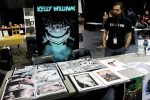
This past Sunday marked the first Locust Moon Comics Fest, a rookie comics show in West Philadelphia organized by the two owners of Locust Moon Comics. This show filled the hole left behind by Philadelphia Alternative Comic Con when organizer Pat Aulisio decided to focus more strongly on creating comics. It was held at the Rotunda, the same venue as the past two PACCs, and featured a few of the same exhibitors. But this show had a different vibe than PACC, offering more of a mix between mainstream and indie comics, and displaying a wide range of artistic styles. Some of the featured guests included Farel Dalrymple, J.G. Jones, Jim Rugg, Jasen Lexx, Terry LaBan, Box Brown, Ben Marra, Ed Piskor, Jeffro Kilpatrick, Ad House Books, Meathaus Enterprises, Secret Acres, and Koyama Press.

Refreshments were provided by Philly’s very own Little Baby’s Ice Cream, an independent ice cream business known for their unusual flavors and strange promotional videos. The show ran from 10 am until 7 pm. The busiest time for the show was from noon to 4pm.
Some notable small press debuts included Copra #2 by Michel Fiffe (self-published), The Black Well by Jamie Tanner (self-published), Gray is Not a Color by Sally Madden (Retrofit), Bottom Feeders by Jasen Lex (self-published), Sock by Box Brown (self-published), Dirty Diamonds #3, an anthology of women’s work edited by Kelly Phillips and Claire Folkman (self-published), and the Phinkwell Collective, who each debuted their own books (self-published).

The unofficial award for most interesting display went to Pete Stathis and Phil Kahn. They had a “Ye Olde Item Shop” theme going on. They kept creating more magic items out of paper inspired by Dungeons and Dragons and other role-playing games. Stathis had some feedback to share about this experience. “Fantastic show,” he said. “There was a real variety of art and genres there, and I actually sold much better at the Locust Moon Fest than at a larger show like a Wizard World, for example. A good show with a friendly atmosphere and opportunities to meet gobs and gobs of talented creators.”

There were many great opportunities to meet fantastic talent in the comics industry, such as Charles Brownstein of the Comic Book Legal Defense Fund. “This was a very positive first year event for the Locust Moon crew,” Brownstein said. “They attracted a good mix of local and regional creators, had some solid debuts. I was pleased to see a mix of talent that came from as far south as Richmond, as well as New York and Pittsburgh out in force alongside the local scene. I liked the location in the college district, and think they did a good job attracting first year attendance. Overall, this was a good opening con that presents a solid foundation for future growth.”
Exhibitor Kelly Phillips of the Dirty Diamonds Anthology shared her point of view: “The fest was a little slow at spots, but there were a ton of really interesting people exhibiting and it was great to get a chance to talk with them. The only thing that was worse than being sick through the whole fest was having to sit across from the incredibly weird and out of place puppet show all day…”

“I had a good time,” said Box Brown of Retrofit comics. “I actually did pretty decent business. It got slow at times, but there was a good crowd at some points.” Mike Sgier, another West Philly indie cartoonist, said he “had a really good time at the Locust Moon festival. The vibe was relaxed and fun, and the people who came out for the show seemed to have a good time. I think it’s a strong start for the show, and I’m looking forward to seeing how they build upon it for future shows. There’s so much talent in Philly and the region, and I think we need shows like this to highlight independent creators.”
However, the energy of the festival did not flow into a less visible section of the exhibitor space which was near the men’s bathroom. The exhibitors in this corridor were isolated from much of the foot traffic of the main show floor like a bonus level of a video game where you need to beat the game and get the password to enter.
Next year the show will be held in October 2013; Locust Moon plans on expanding by using another exhibiting space in the Rotunda in addition to the space they used this year. The local scene will be looking forward to it.
[Dre Grigoropol is a writer and illustrator. Her website is www.Dretime.org and her twitter handle is dretimecomics]
Blog: PW -The Beat (Login to Add to MyJacketFlap)
JacketFlap tags: Indie Comics, Sports, Top Comics, NFL Rush Zone, NFL Superpro, Add a tag
After our mentioning how much the world needs the return of NFL Superpro just the other day, a well-sourced rumor claims that NFL Superpro may make an appearance in Action Lab's new NFL RUSH ZONE comics.
Blog: PW -The Beat (Login to Add to MyJacketFlap)
JacketFlap tags: Blogosphere, Comics, Indie Comics, Tumbling Tumblr Blogs, Jane Mai, poop, Add a tag
TweetAt the risk of lowering the tone, I relay to you the news of Jane Mai’s Poop Nightmare: so bad it needed capitalization As someone who lives in an old Victorian house, I can say with the weight of experience that there’s nothing worse than burst pipes, leaky drainage and overflowing toilet: the water seeps everywhere [...]
Blog: PW -The Beat (Login to Add to MyJacketFlap)
JacketFlap tags: Indie Comics, Small Presses, Charles Forsman, Mini Comics, Oily Comics, Subscriptions, Add a tag
BY JEN VAUGHN – Forget Kickstarter! Let’s talk OLD SCHOOL SUBSCRIPTIONS! Micropublisher Oily Comics has a DEAL for you. Center for Cartoon Studies alum, two-brick Ignatz winner and future Fantagraphics author, Charles Forsman is offering a subscription service for a few more hours! Days after subscribing I received a package full of comics. BAM!

Being a Friends of Oily Comics means you get a monthly shipment of comics made each month featuring the works of D&Q’s former jane-of-all-trades Jessica Campbell, Andy Burkholder, Melissa Mendes, Belgian cartoonist Max de Radigués, Aaron Cockle, Dane Martin, and soon Joseph Lambert, Warren Craghead III, Marian Runk, Alex Kim, Dan Zettwoch, Sammy Harkham, Zach Worton, Michael DeForge, and more on the way. How can you say no to that? Preview page of Charles Forsman’s comic:
$30 gets you monthly shipments from July-September, $50 gets you monthly shipments from July-December and a suh-weet patch for that bag/jacket/hat. Oh and a Michael DeForge-designed card and original portrait. Check mine out! Read more here and Order now!
Blog: PW -The Beat (Login to Add to MyJacketFlap)
JacketFlap tags: Indie Comics, Mini Comics, Canada, Colosse, comic book collective, Add a tag
BY JEN VAUGHN – From solid cartoonist, Sophie Yanow, a mini-comics TOUR is happening in TWO different countries. Deets below:
MONTREAL COMIC ARTISTS – August West Coast Book Tour
MONTREAL, QC, JULY 30, 2012 — August 17-25, members of Canadian independent comic book collective Colosse tour from San Francisco to Vancouver BC with multimedia readings of their acclaimed and edgy works, followed by book signings. Authors include Sophie Yanow (In Situ, a graphically daring, poetic journal strip) and Francois Samson-Dunlop and Alexandre Fontaine Rousseau (Pinkerton, an indie-rock rom com about getting over a truly 90s breakup in a post-90s world). Don’t miss this rare West Coast appearance!
Friday, Aug. 17 • Mission: Comics and Art, San Francisco, CA
Saturday, Aug. 18 • The Escapist Comic Bookstore, Berkeley, CA
Tuesday, Aug. 21 • Spine and Crown Books, Seattle, WA
Thursday, Aug. 23 • Lucky’s Comics, Vancouver, BC
Friday, Aug. 24, • The Waypost, Portland, OR
Saturday, Aug. 25 • Floating World Comics, Portland, OR

In Situ by Sophie Yanow
“This is an innovative, clever diary strip book that is strongly influenced by the poetic abstraction of John Porcellino… a beautiful first major work by an artist who is quite clearly concerned about how she affects the world, in terms of both art and politics.” – Rob Clough, THE COMICS JOURNAL
In Situ is Sophie Yanow’s poetic and humorous treatment of daily life, begun in Oakland in her native California, and continued throughout her residency at La Maison de la Bande Dessinée in Montreal. As the political climate in Oakland heats up, Yanow captures the tension between excitement for a new place, and the loss and longing for old homes and loves. Shifting through visual styles as often as philosophies, In Situ recounts a life in transition.
Yanow’s decision to stay in Montreal is reflected in In Situ no. 2, and finds the author sleeping on couches, bewildered at doom metal shows, and settling into a queer new city. A graphically daring, artistically ambitious endeavour as well as a revealing glance into the daily travails & hurdles of a politically aware cartoonist far from home.
Sometimes funny, sometimes touching, always quotidian.
Sophie Yanow’s work has appeared online in places like Top Shelf Comix and The Rumpus. She grew up in the woods just north of San Francisco, and in Fall 2011 moved to Montreal, Quebec for an artist residency at La Maison de la Bande Dessinée. Here she began her more experimental journal comics, published under the title In Situ, a nod to site-specificity in her creative process. She lives in Montreal.
IN SITU
Journal comics by Sophie Yanow
$11.00 Softcover • 40 pages black and white
ISBN 978-2-924001-17-2
Publication Date: November 26, 2011<
Blog: PW -The Beat (Login to Add to MyJacketFlap)
JacketFlap tags: Indie Comics, Sales Charts, Add a tag

By Paul Mellerick
Walking Dead rules the top of the charts again, in preparation for next month’s centennial issue, while new entries for Mars Attacks and Harbinger sandwich the ever improving Saga. Elsewhere, Spawn celebrates its 20th anniversary by almost tripling its regular sales and Brian Wood’s The Massive launches encouragingly high, while a bunch of successful recent launches consolidate their figures. Lots of books dropping, further down the charts though.
135 indie books charted this month, up on last month’s 128. The bottom book sold 3,302, down on last month’s 4,477. They sold approximately 1,344,491, down on last month’s 1,392,594. Average sales are 9,959 per book, also down on last month’s 10,880. As usual, UK and European sales from Diamond UK are not reported in this chart.
Out of the 135 books, only 29 went up in sales, far less than last month, and 87 went down, with the rest made up of one-shots and debuts.
Image are number one again this month of the indie publishers, with a 7.36% dollar share and a 6.45 market share, IDW with 6.22% dollar share and 4.16% market share, Dark Horse with a 4.51% dollar share and a 3.49% market share, Dynamite with a 2.82% dollar share and a 2.35% market share and Boom with 1.25% dollar share and 1.49% market share.
Thanks to icv2.com and Milton Griepp for permission to use these numbers, which are estimates, and can be found here.
30, 274. The Walking Dead (Image) 06/2007: The Walking Dead #38 - 22,193 06/2008: - 06/2009: The Walking Dead #62 - 23,910 06/2010: The Walking Dead #73 - 25,645 06/2011: The Walking Dead #86 - 32,187 ==== 07/2011: The Walking Dead #87 - 32,126 (-0.2%) 08/2011: The Walking Dead #88 - 31,839 (-0.9%) 09/2011: - 10/2011: The Walking Dead #89 - 31,351 (-1.5%) 10/2011: The Walking Dead #90 - 31,778 (+1.4%) 11/2011: The Walking Dead #91 - 31,813 (+0.1%) 12/2011: The Walking Dead #92 - 31,496 (-0.1%) 01/2012: The Walking Dead #93 - 31,596 (+0.1%) 02/2012: The Walking Dead #94 - 32,361 (+2.4%) 03/2012: The Walking Dead #95 - 33,916 (+4.8%) 04/2012: The Walking Dead #96 - 36,931 (+8.9%) 05/2012: The Walking Dead #97 - 53,733 (+45.5%) 05/2012: The Walking Dead #98 - 49,974 (54,073)(+0.6%) 06/2012: The Walking Dead #99 - 55,710 (+3.0%)
Another high-point, although it’ll fade somewhat compared to the hundreds of thousands of copies the next issue has sold at this point. The sixteenth collection sells an amazing 28,284 copies, only a few copies less than the monthly sells normally and most of the other collections chart as well. As usual.
44. Mars Attacks (IDW) 06/2012: Mars Attacks #1 - 43,514
59 covers, one for each of the original trading cards plus one or two more, have helped propel this to very good sales, although I’m sure that won’t be repeated next month.
47, 267. Saga (Image) 03/2012: Saga #1 - 37,641 (51,766) 04/2012: Saga #2 - 36,885 (43,137)(-2.0%) 05/2012: Saga #3 - 38,895 (+5.4%) 06/2012: Saga #4 - 41,143 (+5.8%)
Another good increase, and also a third appearance for the first issue, selling a further 4,484 copies. I can’t help feeling that Brian Azarello’s Spaceman would have sold
Blog: PW -The Beat (Login to Add to MyJacketFlap)
JacketFlap tags: Indie Comics, SPX, SPX 2012, Untitled, Add a tag

This year’s Small Press Expo, to be held September 15-16 in Bethesda, has one of the most amazing guest line-ups in forever, with Jaime Hernandez, Gilbert Hernandez, Chris Ware, Dan Clowes, Francois Mouly, Adrian Tomine and MORE. Programming director Bill Kartalopoulos has out done him self with a program that covers all the bases and more. Suffice to say we’ll be glued to the two programming tracks.
British Comics: Does it Translate?
11:30 am | White Flint Auditorium
The UK has a deep comics tradition of both mainstream and alternative production, and has seen a recent resurgence in the hands of enterprising young artists and a new breed of publishers with an international outlook. Panelists Nick Abadzis (Laika, Hugo Tate), Sam Arthur (Nobrow), Glyn Dillon (The Nao of Brown), Ellen Lindner (Undertow), and Luke Pearson (Everything We Miss) will discuss the British comics landscape and its connections to European and American comics culture with critic Rob Clough.
Crockett Johnson’s Barnaby and the American Clear Line School
12:00 pm | Brookside Conference Room
In a canny mix of fantasy and satire, amplified by the clean minimalism of Crockett Johnson’s line, Barnaby (1942-1952) expanded our sense of what comics can do. Though it never had a mass following, this tale of a five-year-old boy and his endearing con-artist of a fairy godfather influenced many. To mark the launch of The Complete Barnaby, Dan Clowes, Mark Newgarden, Chris Ware, and the book’s two co-editors — Fantagraphics’ Eric Reynolds and Crockett Johnson biographer Philip Nel — discuss the wit, the art, and the genius of Barnaby.
Jaime Hernandez: The Love Bunglers
12:30 pm | White Flint Auditorium
Jaime Hernandez and his brothers launched the alternative comics era with their epoch-defining series Love and Rockets. From 1981 to the present, Hernandez has produced a singular body of work tracing the life of Maggie Chascarillo and her vast network of friends, family, neighbors, rivals and lovers. In recent years, Jaime has, again, broken new ground with brilliant comics novellas that remain accessible to new readers while building upon years of narrative to invest his stories with a profound emotionality. He will discuss his work with artist Frank Santoro.
Publishing During the Apocalypse
1:00 pm | Brookside Conference Room
It is the best and worst of times for small press publishers. As the greater publishing industry faces major economic contractions and challenges from new media, smaller publishers must navigate the same difficult waters with fewer resources, while taking advantage of the opportunities that arise in times of turmoil. Leon Avelino (Secret Acres), Box Brown (Retrofit Comics), Anne Koyama (Koyama Press), and John Porcellino (King-Cat/Spit and a Half) will discuss the current publishing landscape with comics journalist Heidi MacDonald.
Françoise Mouly: A Groundbreaking Career
1:30 pm | White Flint Auditorium
In 1980 Françoise Mouly co-founded RAW Magazine, the groundbreaking avant-garde comics anthology she co-edited with Art Speigelman. In 1993 she became Art Editor of The New Yorker, choosing and developing the iconic magazine’s cover images in an ongoing national conversation on the issues of the day. In 2008 she launched TOON Books: an2 Comments on SPX announces incredible programming slate, last added: 8/17/2012Display Comments Add a Comment
Blog: PW -The Beat (Login to Add to MyJacketFlap)
JacketFlap tags: Comics, Digital Comics, Downloadable Comics, Indie Comics, Interviews, News, Reviews, Top Comics, comixology, Dan Goldman, Jude Tobin, miami, Monkeybrain Comics, occult, paranormal, psychedelia, RED LIGHT PROPERTIES, Add a tag
RED LIGHT PROPERTIES, now available in its first five issues through Monkeybrain Comics on Comixology, is a genre mixer with a gritty dose of realism that, for Eisner-nominated writer and artist Dan Goldman, hits close to home. Growing up in Miami, and aware of its hectic combination of cultures, crime, and mystery, Goldman ingested plenty of fodder for comics creation. A lifelong interest in the paranormal and occult has taken him down some unusual roads in storytelling, and his unlikely but all too human hero Jude Tobin couldn’t have a stranger profession: exorcist for haunted properties in Miami during the current economic slump. His methods “green light” properties that are bedeviled by hangovers from their violent pasts with a practical result of money in the pocket for our occult explorer as well as downtrodden home owners. It’s just a day in the life of a guy who ingests psychedelic substances to boost his own natural sensitivity to the spirit world in order to sell houses.
Goldman’s approach to comics storytelling establishes belief in a number of intriguing ways. Not only does Goldman emphasize the personal relationships in Jude’s life, dealing with a live-in ex wife who still has feelings for him, a step-son who is starting to display his own occult abilities, and wrestling with his own personal demons including his dead father’s ghost, but he also explores a relationship crux in the stories of many of the haunted properties. Many of the darkest emotions that haunt “red light” real estate spring from love and loss, and owners themselves benefit from Jude’s exorcisms by making peace with traumas in their past. Add to that the artistic methods that Goldman pursues, including use of photography and digital imaging, as well as increasingly experimental page layouts, and RLP delivers a hefty sense of realism alongside its phantasmagorical subject matter.
RLP has been a long-term project for Goldman as an indie creator, and he’s particularly enthused that the comic has now found a home at Monkeybrain. It’s the kind of comic that naturally makes you want to fire questions at the creator. It’s the equivalent of seeing a circus performer pull off a remarkable high-wire act while juggling weighty and disparate materials to create a unique spectacle. You want to ask, “How on earth did you do that?”. But I tried to ask him a few intelligent questions rather than just gawking at his handiwork.
HM-S: How did you come up with the unusual concept for RED LIGHT PROPERTIES?
Dan Goldman: It comes from the collision of a few things kicking around my head for many years: waking up at night and feeling someone watching you from the empty hallway, listening to my mom rattle off war stories of Miami real estate drama for twenty-odd years, my own experiences growing older in this body while trying to figure life out. I was working RLP for nine years before I drew the first page, trying to develop my visual style because the characters were already walking around in my head and I needed the chops to do them justice.
Red Light Properties’ owner/shaman Jude Tobin serves a dark mirror for me, person I’ve looked deep into and decided I don’t want to be. He comes off as an asshole but he’s really just misunderstood with bad communication skills. He and his family are utterly real to me, and that makes RED LIGHT PROPERTIES a great platform stand on and poke all these ideas about life and death and love and consciousness and failure, all using the language of comics.
HM-S: I notice that the setting is not only Miami, but multi-ethnic. What does this bring to the comic for you?
DG: The whole world is multi-ethnic now, I’m just reflecting it. The world grows richer and more interesting in places where cultures bump up against each other. I grew up in Miami, where the series takes place, before I ever traded it for New York City (or more recently São Paulo). All three of these cities are massive destinations for immigrants. It’s how I’ve always seen the world, so it’s only natural that it’s a part of this one too.
HM-S: Has researching the occult and haunted property taken you into some strange places mentally or physically, or is the background for the work purely imaginative?
DG: I’ve been researching the occult/paranormal since I was a boy. My grandfather died right after my fifth birthday and I used to see him around the house for years. After he passed, my mother shared with me something she’d read about Peter Seller’s death experiences during a heart attack and it just sunk down into my consciousness, emerging again around the time I got a library card. I think it was the same summer GHOSTBUSTERS came out. I was a weird little nerdling then; I used to ride my bike to the library during the summer (they had cold A/C) and I stayed mostly in the back aisle of the library, poring over musty old spirit photography books.
So whether it’s perception or just my overactive imagination, I’ve been plenty of places that made me feel things and theorize about them: my brother lived in an apartment that made my skin crawl the moment I set foot there. It turned out that the landlady’s sister committed suicide and she kept her ashes in a box in top of the closet (while he lived there). There are always touches everywhere I went and sensitivities to energies that I’ve been aware of… and whenever I dug deeper, usually found a cool story in answer to my questions.
That desire for the underlying pattern that explains how life/death works is where Jude Tobin comes from.
HM-S: Jude is a pretty extreme character who appears to struggle with a reason to live, “whacked out on drugs and living with ghosts”. What is it about Jude’s character that appeals to you and how do you think he appeals to readers?
DG: Jude’s tragedy is that he needs to take hallucinogenic drugs to fully access the spirit world and accomplish exorcisms, which is rough on the body and the mind. Cecilia asks this of him on a daily basis, knowing that it keeps him straddled between the living and spirit worlds… but without his work, they’re just another real estate agency in a depressed market. It’s Jude’s talent that drives the office, and she’s determined to be successful, even though she knows it comes at a huge price for her family.
He appeals to me because as any cartoonist knows, when you sit down to draw pages, you’re separated from everyone else’s world, coming up for air to eat with your loved ones and get a little rest. To Jude, his shamanism is a kind of art, so I relate to him artist-to-artist. I think that’s clear to readers too.
HM-S: Jude seems to have a sensitivity to the supernatural without the use of drugs, but he uses them to boost his consciousness, often further than he expects. Do you find it difficult to depict these kinds of altered states in comics form?
DG: Yes, as a baseline, Jude was born with a sensitivity to spirits. He knows when they’re around and can sometimes see them, but he needs a heavy entheogenic agent from his toolkit to amplify his abilities enough to project himself into the spirit realm and interact with them directly. There’s a whole logic to the way ghosts function in relation to the life/death membrane that I get into the book and how Jude’s drug-mixes relate to that.
Is it difficult to depict? Yeah. But it’s also the most fun part of drawing RLP. I love weird brain-melty comic page designs and surreal storytelling dropped in the middle of mostly-realistic stuff, so Jude’s work-trips are a perfect excuse for me to let any story off the leash and maul the reader’s eyeballs for a while.
HM-S: What about this comic makes you want to write and draw it?
DG: The initial germ started off as metaphysical questions but now all these characters are ALIVE IN MY HEAD AND THEY HAVE TO GET OUT. Getting the first chunk of the story done was literally a release of a decade’s worth of pressure in my skull — trepanning by comics — but the more I tickle them to understand their life stories, the more the whole story starts growing. I think I’m gonna be at this a while…
HM-S: What’s it like both drawing and writing the comic? Are there pros and cons to being your own creative team?
DG: The drawing for me is a lot hard harder than the writing, which just kinda flows out of me when I sit down. The art — especially getting it just the way I want it — is a brutal process, like squeezing juice out of oranges until there’s just nothing left. I’m always destroyed at the end of a story. It also takes longer; I think I’d be much more prolific if I worked with artists and just worried about the script… but I don’t know anyone who can do RLP the way I do it.
HM-S: I notice the use of photographs blended with artwork. Is that a form you think is particularly suited to comics?
DG: It’s just a style that I’m playing in; RED LIGHT PROPERTIES actually combines photography and rendered 3D models and digital artwork together into its comic pages. I’m comfortable using whatever tools are at my fingertips to give the stories the most impact I can.
Comics are a fluid and evolving medium anyhow, stories made using words and pictures. I have zero patience with anyone who insists otherwise; I just smile and nod as they tell me about which Windsor & Newton brush they like best.
HM-S: While there’s the overarching theme of the occult and supernatural, relationships seem to be a major focus of the series, from Jude and his ex-wife Cecilia, to the stories behind the properties. What role do you think relationships play in the comic?
DG: The relationships are everything in RLP because that’s what makes characters worth caring about. I purposefully make their little tensions and joys as dramatic than the supernatural events, things that would be horrifying to us but they’re totally desensitized to after years in the business. That’s interesting to me as a creator and reader: I want to know what this kind of work, and what trying find meaning in the living world while surrounded by spirits of the dead feels like.
Where the casework, the haunted properties, come in is to ground every ghost stories in something human. Having a poltergeist throwing dishes around is neat visually but it’s got no emotional meat to it. When you find out the tragic reasons and complicated metaphysical structures behind those flying dishes and how to “treat” the house, suddenly the scenario demands more of your attention than just a Hollywood BOO!-type scare.
HM-S: A lot of the more seemingly fantastic elements of the comic, from occult rituals to bizarre murder cases, are actually pretty firmly grounded in reality, aren’t they? What do you think is the value of talking about subjects like pedophilia, murder, and the afterlife?
DG: Placing RLP in the “real world” demands that, doesn’t it? Miami is a violent and vapid city where crazy things happen every day, and these good and bad things are all part of human experience. When you’re delving into the reasons why spirits linger in a structure, that’s historically been the explanation for hauntings (though I’ve got a doozey coming up that gets into the inverse of that).
What draws me to telling ghost stories (versus, say, zombies) is that they’re not just the shells that remain of who we were but echoes of the dreams and experiences that aren’t ready to let go, for whatever reason. And the spectrum of reasons behind that is rich material to tell all kinds of stories with.
HM-S: I notice that “A Series of Tubes”, issue #5, really branches out in terms of panel design. In creating and designing the artwork for the comic, have you had any surprises or discoveries?
DG: I’m so happy you brought that up. I’m very proud of A SERIES OF TUBES… I’m not sure what started happening there, maybe I just really let myself go with those layouts and got all free-jazz with them. The end result is a direction I’m continuing to push in with the new stories I’ve been working on.
The biggest discovery that came from that was how little of it was conscious. I’m a heavy full-scripter and a very loose sketcher, and when I finished the story and read it, I was transported, like I was reading someone else’s work. That’s a good sign to me.
[Photo by Seth Kushner]
HM-S: So what’s the history of RED LIGHT PROPERTIES in terms of production? How did it end up at Monkeybrain?
DG: In the three years I’ve been creating this series digitally, I’ve stayed free enough approach the series from different directions without being locked down to a single format or system. RLP started off as a free publisher-sponsored webcomic serial, it became DRM-free digital issue downloads on its own site, and now it lives at Monkeybrain Comics as an exclusive part of Comixology.
It was always the intention to tell these characters’ stories in an ongoing series like this, though at launch I saw it as a series of graphic novels because the digital marketplace hadn’t really happened yet. This whole time, I’ve been watching my creator friends having a blast in a floppy-to-trade world, and I’ve developed a really intense case of “ongoing series envy.” Until now, all my books have been for the book trade; the only time a comics publisher has ever published my work was a 4-pager I had in Image’s POPGUN anthology. But comics are born from serializing, designed for series. In the book trade, it’s something they’ve learned from us and had great success with. So when it came time to make a new change, doing an ongoing series of digital issues seemed like the cleverest route. No shipping delays, shortages, returns, or waiting on the publisher.
And in the digital-first series world, becoming part of Monkeybrain Comics was an obvious choice. They speak fluent internet. They’re the tiny mammals eating dinosaur eggs, poised to inherit the landscape. That’s something was already a part of, but we are stronger together. Being able to publish easily and quickly to Comixology in multiple languages on all major platforms (except videogame consoles, right boys?) means I’m maintaining almost as much control as I had rolling solo, but now I’ve got distribution and discovery on my side as well. It’s a huge flaming sword to cut through the noise with.
[Photo by Seth Kushner]
HM-S: What’s coming up for RED LIGHT PROPERTIES? What are you most excited about?
DG: Word of mouth around Miami is going to bring the Tobins a lot more success and attention than they’re prepared to handle, which is going to cause all kinds of problems for them, professional and personal. There’s a long road ahead for Jude and Cecilia, and I’ve got many stories in the can, just waiting to get out.
Presently, I’m finishing up the remastering work on the existing part of the series, making the early pages and script the best I can before releasing them as digital issues through Monkeybrain. There are print collections coming too but it’s not the time to announce anything just yet.
I’m probably most excited about finally seeing these characters in print; for three years, I’ve been watching them jump screens with nothing new for comic shops or book stores or my table at conventions. That’s all going to change soon, and it’s gonna be glorious.
HM-S: Thanks for the in-depth insights, Dan! You do realize that you’re going to make all your readers think twice before buying a new house, don’t you? Well, we know who to call, at least.
Hannah Means-Shannon writes and blogs about comics for TRIP CITY and Sequart.org and is currently working on books about Neil Gaiman and Alan Moore for Sequart. She is @hannahmenzies on Twitter and hannahmenziesblog on WordPress.
Blog: PW -The Beat (Login to Add to MyJacketFlap)
JacketFlap tags: Comics, Comics Collections, Indie Comics, Interviews, News, Small Presses, Top News, Blank Slate, Leeds Thought Bubble, Nelson, Rob Davis, Woodrow Phoenix, Add a tag
Woodrow Phoenix is one of the two editors who compiled Nelson, a 250-page anthology featuring work from over 50 different writers and artists. The idea of Rob Davis, the Blank Slate-published anthology tells a single tale, as told by a variety of different artists and writers. Amongst the incredible range of creators involved are people such as Roger Langridge, Paul Grist, Kate Brown, Posy Simmonds and Philip Bond.
I caught Woodrow by surprise and cornered him on the morning after he found out Nelson had won Best Book at the British Comic Awards, to ask him a few questions about the book and how it came together.
Steve: Last night Nelson won Best Book at the British Comic Awards!
Woodrow Phoenix: We’re very pleased and thrilled that people whose opinions we respect have seen fit to bestow this honour on us!
Steve: What first inspired yourself and Rob Davis to create Nelson?
Woodrow: Rob had this idea which I thought was a great concept I’ve never seen before. Nelson tells a complete story, as written and drawn by a series of gifted creators. It’s an anthology with just one story. It was such a great concept that I immediately thought ‘we have to do this’! I work as a designer as well as an illustrator, and I knew that something like this would need a strong sense of design, so I felt that was something I could bring to the project.
For example, I designed the cover for the anthology – we wanted something that would stand out and have something immediately compelling. Rob sketched the character, I did the type treatment, we put them together and we literally had the cover design in only a few hours.
Steve: How did you go about finding writers and artists to work on the anthology?
Woodrow: Between Rob and I we know a lot of people who we think are doing different, interesting things in comics, and we reached out to them. We also wrote a list of people who perhaps hadn’t done as much experimental, different stuff, and we wanted to challenge by inviting to work on Nelson. We picked people we wanted to see work, and then emailed everyone on our lists to see if they were interested. We thought it’d take a long time, but surprisingly, almost immediately everybody said “yes!”
Steve: With the now award-winning success of Nelson, are there perhaps now plans for a sequel project?
Woodrow: When we first finished, I vowed to never do something like this again! It was complicated and tiring, but enough time has passed that I’m thinking maybe there is something we could do. Something which would have some of the same features to it. It’s exciting to do something as ambitious and wide-ranging, and I’m considering trying it again.
Steve: Do you have anything else coming up on a personal level? Any other projects on the horizon?
Woodrow: I’m working on something else – a silent comic, where each page is a metre wide. I won’t be finishing it for a while!
I’ve reached a point now where I feel I’ve got all these crazy ideas, and it’s time to start trying them.
I think it’s important for the comics medium that we don’t keep doing the same things all the time. If you think about what we could do, you realise that there are a million subjects and styles we can work in. Rather than confining ourselves to capes we can do whatever we want, and I think we have to start taking that freedom to make work which isn’t predictable, doesn’t rely on old concepts, and isn’t always the same thing. We’ve got nothing to lose! We can afford to just try things out and be different.
Many thanks to Woodrow for his time! You can find more from him on his website, or on his twitter @mrphoenix. Also, if you google his name, you’ll see a picture which reveals he has the most suggestive eyebrows since Roger Moore. True!
Blog: PW -The Beat (Login to Add to MyJacketFlap)
JacketFlap tags: Comics, Indie Comics, Interviews, Reviews, Small Presses, Top Comics, Center for Cartoon Studies, Denis St. John, horror, Joseph A. Citro, Monster Pie, Monsters, Stephen R. Bissette, The Vermont Monster Guide, Vermont, Add a tag
Weird tales and comics naturally go together. From the days of pulp stories with enthralling illustrations, through EC’s Wertham-harried evocation of the fantastic and grotesque, to the heydays of Vertigo and Darkhorse, readers want to see an artist’s interpretation of the strange and bizarre. And the most exciting weird comics bring visual elements to the narrative that the reader could never have predicted or expected. Stephen Bissette has spent a great deal of his life contributing to shock and wonder for readers, and through his work teaching at the Center for Cartoon Studies, making sure that tradition continues.
As mythology and urban legends attest, some of the greatest frisson when it comes to monster stories comes from attaching them to a particular landscape, the spookier and more remote, the better. Bissette and friend Joseph A. Citro started constructing geographical maps of Vermont’s own ghost tales, and then monster tales, which culminated in the publication THE VERMONT MONSTER GUIDE from University Press of New England. It features “fiends, winged weirdos, terrestrial terrors, and water whatzits”. If the cover seems playful, be prepared for a number of surprises lurking within its covers ready to pounce. Firstly, the table of contents arranges the Vermont-native beasties according to their elemental homes like a creepy medieval grimoire, giving the impression that the state is not safe by land, mountain, or sea, and add to that the chilling category “town”. Town?! But that’s only the first indication of the genuinely spooky stuff Citro and Bissette have catalogued. Then there are the names. They are disarmingly simple, and have that ring of folksy authenticity that makes a particular mark on the imagination: there’s “Pigman”, “Human-Faced Calf” and “Serpent of Dead Creek”. Shudder.
Maybe it’s the fact that these creatures are not easily identifiable within wider horror tradition. They have their own unique dwelling place in remote and rural imagination. The “Hopping Horror”, for instance, has a very specific haunt along “Route 7”, and is simply described as a “naked, hopping, man-like critter”. Honestly, that would be enough to freak me out on a dark autumn night, but Bissette’s illustrations conjure far more than your own imagination is likely to construct on its own. A personal favorite of mine is the “Man-Eating Stone”, which Citro explains is a rock which “becomes less solid, and like a living thing, swallows the unfortunate trespasser”. Bissette builds fear from the ground up by working with the familiar. The stone surface subtly shifts into glowering eyes and sprouts a tortured human arm reaching skyward in the wilderness. Bissette’s “stomach dwelling snakes” are not for the faint of heart, to say the least. I had to know more about this project that made me uneasy about road-trips from several states away, so I asked Bissette a couple of questions.
HM-S: What was the genesis of this book?
SB: I’ve been friends with the author, Joe Citro, for a couple of decades or more now. Joe is one of my best friends on planet Earth, that’s all there is to it. Sometime in the 1990s, we decided to “get into some foolishness,” as Joe calls it, and we self-produced and self-published the first version of a cartoon map of Vermont entitled VERMONT’S HAUNTS. I drew up a template map, Joe tagged where peculiar events had happened, and I illustrated the key “weird” sightings and events around the state, what would fit of them, and Joe wrote captions for them. We did pretty well with that, and every so many years we get a hankering to “get into some mischief” and work up another project. THE VERMONT GHOST GUIDE was one of those, which was published in 2000 and is still in print and selling well in and around our home state. THE VERMONT MONSTER GUIDE was our sequel/companion to that book. I pitched the book to our GHOST GUIDE publisher, University Press of New England, and got the best deal I could for Joe and I, and we got to work.
HM-S: Is there still a strong monster storytelling element up in Vermont?
SB: I wouldn’t have said or thought so, but since doing the book, I’ve been approached by more than one person or couple claiming to have seen “things” around Vermont. So I reckon there is.
HM-S: What did you most enjoy about illustrating the book?
SB: It was just a pleasure to draw, period. It was great working with the art director and team at UPNE, but nothing was as much fun as just drawing the creatures. It was a path to getting my own drawing chops back up to speed after a lengthy period in which I really didn’t do much drawing, save for my work in the classroom at the Center for Cartoon Studies.
As unexpectedly frightening as THE VERMONT MONSTER GUIDE is, it works on the basis of a kind of subtlety that blends the urban legend with the uncanny. Bissette’s imagination runs wild on a very personal new project, an old-fashioned ‘zine called MONSTER PIE, created alongside Center for Cartoon Studies graduate Denis St. John. The indie monster ‘zine is a no-holds-barred freefall into the play of the darker side of the imagination, featuring illustration, short comics, and informative discussions about the horror genre. It’s inspiration lies in monster movies that both Bissette and St. John grew up with, and expresses with gusto their mutual enthusiasm for stretching the boundaries of horror illustration. Glancing through its pages proves the point that horror actually crosses genre boundaries regularly, from the folk-tale, to the sci-fi, to gothic tradition. A healthy does of mixing brings you the ingeniously “baked”, MONSTER PIE.
It packs a particular punch for this very reason: I’ve seen few mainstream or indie works that truly made me feel unsure of what lay beyond the next page. There’s a certain exhilaration in going off the map in this way, and as a ‘zine, it doesn’t have to follow the constraints of sequential narrative in doing so. That feature may, in fact, make it more spine-chilling than even THE VERMONT MONSTER GUIDE. You’ll find features of pulp sci-fi, literary horror tradition, and monster films that should be recognizable, but they are combined in sensory-twisting combinations and in widely differing art styles that both Bissette and St. John adopt. Bissette was kind enough to comment on MONSTER PIE and on his close collaboration with St. John. It still doesn’t explain how the two manage to bring the nether-reaches of the imagination to the page in such a fluid manner, but it does bring some new angles to the question.

HM-S: How did you and Dennis St. John get together on such a unique project?
SB: We would throw together these little monster minicomics for movie events—when we screened a double-bill of THE KILLER SHREWS (1959) and NIGHT OF THE LIVING DEAD (1968) for the Main Street Museum in White River Junction, VT a few summers ago, Denis, Tim Stout, and I did this little “Killer Shrew/Zombie Survival Guide” minicomic. This past summer, Denis and I did the same for a 35mm Saturday Fright Special (a Keene, NH-based cable-access horror host TV series) theatrical showing of the Chiodo Brothers’ KILLER KLOWNS FROM OUTER SPACE. We threw together, in a few days, a sick little book of ersatz parody poetry and monstrous clown sketches, and that was fun.
Cartoonists in Denis’s circle, including me, also contributed “pin-up” portraits of Denis’s characters in his serialized graphic novel AMELIA to his own comics zine MONSTERS & GIRLS over the past couple of years. AMELIA was Denis’s first expansive graphic novel, taking five years to complete, and major commitment, and he just finished it in the spring of 2012. He wasn’t sure what he wanted to tackle next, but he needed a breather, without stopping the flow of ink and drawings. That prompted me to suggest we just do our own free-form monster zine, mixing art, articles, and a smattering of comics in light enough combination to keep it from ever being anything but fun. No heavy lifting or content: just fun stuff. Denis was up for that.
This past Halloween, the Spooktacular folks screened a gorgeous 35mm print of the original British TALES FROM THE CRYPT (1972), based on the EC horror comics, so we got ambitious and did two zines for that event, and one of them was MONSTER PIE.
Denis goes way back with this stuff: he was part of a collective in his home state of Indiana called Atomic Age Cinema, another “horror host” live-monster-introduction-and-stage-act accompanying revivals of vintage public-domain horror, sf, and fantasy films. I met Denis when he was among my students at CCS, and we shared a lot of common interests. Denis graduated from CCS some years ago, and has made a commitment to the CCS community by sticking around, and we’re now colleagues and friends. So, MONSTER PIE is our way of keeping our hand in just drawing what we love to draw—movie monsters—for the sheer pleasure of it. I was the one who pushed to include zine features like the monster movie review and the archival monster movie article in each issue, and we’re going to keep doing MONSTER PIE until it’s not fun anymore, or our brushes give out.
HM-S: What can an old-fashioned ‘zine bring to readers today, as suffused as we are with digital content, corporate comics, and media-hyped magazines?
SB: Zine culture was part and parcel of my experience growing up; some of my first published artwork appeared in 1970s genre movie fanzines like CRYPT OF TERROR, JAPANESE FANTASY FILM JOURNAL, and Ted Rypel’s OUTER LIMITS fanzine, and I contributed a fair amount to comics zines of the late 1970s and early 1980s, too. Zine culture was also central to Denis’s generation, via other kinds of comics and media zines; CCS’s first Fellow who became a fellow instructor, Robyn Chapman, rekindled my own enthusiasm for zines of all kinds with her sheer passion for zines. Robyn’s love for zines was absolute and genuine, and fueled the whole CCS zine culture in many ways. CCS is a zine and comic factory in its own right, its incredible what comes out of the basement production lab on a monthly basis.
Zines just don’t go away. I’m started experimenting with ebooks, which I’ll be into in a major way in 2013 and 2014—I see that as an extension and mutation of zines, in a more expansive way. But there’s a tactile experience on both ends of the equation—the zine maker, and the zine reader—that digital media can’t supplant. I don’t get that from blogs or ebooks or online zines. There’s something about holding a zine in your hands, spending time with the physical object, that’s irreplaceable.
There’s also a purity and playfulness to zines that I love. However much work one pours into it, it IS play. The fact that there are no gatekeepers, save the access to a photocopier and enough money to print a few copies, remains a central attraction, too—and Denis and I have an entire production lab at our fingertips at CCS. We don’t need permission, we just need to be able to pay for the printing. Given all the gatekeepers corporate and mass culture erects and maintains between inspiration and publication, zines remain the personal steamroller over all of that—you think of it, you make it, you publish it, it’s in your hands. That’s still a real kick, in 2012.
A gargantuan “thank you” from The Beat goes out to Stephen Bissette for his insider view of monster-creating. Both THE VERMONT MONSTER GUIDE and MONSTER PIE are certainly a “kick” even in 2012, and for fans of the messy roots of horror tradition, they are two mileposts to look out for, particularly if you find yourself wandering in remote Vermont. After reading these, I don’t think I’ll venture up there without an armored vehicle. Just saying.
Hannah Means-Shannon writes and blogs about comics for TRIP CITY and Sequart.org and is currently working on books about Neil Gaiman and Alan Moore for Sequart. She is @hannahmenzies on Twitter and hannahmenziesblog on WordPress
Blog: PW -The Beat (Login to Add to MyJacketFlap)
JacketFlap tags: Comics, Image, Indie Comics, Reviews, Top Comics, "Blood and Brains", "KillSwitch", "Meatbag", "The Deadly Book", Brandon Seifert, Chris Miskiewicz, Christopher Irving, COMPLEX, Creator Owned Heroes, Creator Owned Heroes #7, Darwyn Cooke, Dean Haspiel, Evan Dorkin, Jeffrey Burandt, Jerry Lando, Jimmy Palmiotti, justin gray, Paul Mountis, Scott Morse, seth kushner, Steve Niles, Add a tag
Earlier this week, Jimmy Palmiotti announced that the noble experiment CREATOR OWNED HEROES would conclude after its 8th issue. Over the course of the magazine’s publication, outreach on social media emphasized the need to raise awareness and increase solicitation from comic shops to keep the multi-contributor series in motion. Consistently strong reviews appeared on media, fan, and blog sites with each issue, and as COH developed, it continued to raise the bar on high-quality content. The ascent has been dizzying, and exhilarating for readers and comics creators alike in an era of increasing awareness about the ups and downs of self-publication. It has been like watching crucial surgery in a live operating theatre in the hands of celebrated practitioners where the audience has come to play an integral role. The life of the patient has depended on their rapt attention in increasing numbers. Depending on your perspective, issue #8 will represent the final bow of an effort exploratory and unique, or perhaps somber flat-lining during a risky procedure that practitioners will attempt to learn from for some time to come. But either way, COH won’t be concluding in obscurity. Ironically, there will be more people in the operating theatre than ever before to witness its final moments and draw their own conclusions.
CREATOR OWNED HEROES #7 represents a particular crescendo in the magazine’s development, a point at which even those who have been following the series closely lean forward, aware that something unprecedented is unfolding before their eyes. It expresses a remarkable energy and a confluence of its methods and its goals due, in part, to the team of contributors it brings together. As Justin Gray says introducing his Brandon Seifert interview, “When we started Creator Owned Heroes, it wasn’t just a desire to self-publish; it was a multilevel dedication to comics that were being produced outside the work for hire landscape”. Gray also cites “ a fundamental desire to tell stories” as a common feature among the creators chosen as contributors. Issue #7 is a tour de force illustration of those criteria.
The powerhouse comic in the anthology is clearly Darwyn Cooke’s irreverent, rapidly paced and verbally exuberant “The Deadly Book”. Cooke hits high notes across the board of comic storytelling elements, from a lush, contrasty color palette in sky-blue, blood-red, and ink-black, to unexpected vantage points, compressed action, and even a very indie take on relating past events in short form via substantial narrative blocks. The comic displays the best possible outcomes for a skilled creator taken off the leash to tell the kind of story that they want to tell in the way that they see fit to tell it.
Jimmy Palmiotti, Justin Gray, Jerry Lando, and Paul Mountis follow Cooke with “Killswitch” in its 3rd installment of 4. They put the action back in indie in a big way and display a particular virtuosity in reversing a typical paradigm in espionage/hitman themed comics. Rather than telling the story with several panels, if not pages, of heavy exposition followed by the action sequences readers have been waiting for, they manage to reveal a wealth of exposition during an installment that, arguably, is one big action arc. They keep it interesting by demanding the reader put the pieces of information together for themselves, from Kill Switch’s complicated pseudo family life to the developing role of a nemesis. Rather than just telling a story well, which is a quite an achievement in itself, they manage to tell a story differently, once again illustrating the surprising results when creators have sufficient room for experimentation.
Steve Niles and Scott Morse bring an even greater variation in style and content to COH #7, pushing the boundaries of typical narrative structures while giving a nod to still-rich veins of comics tradition. They break down confined panel layout, and do away with textboxes and speech balloons to tell a noirish private-eye tale with disturbing gusto. “Meatbag’s” full page-feel conjures up Eisner’s SPIRIT while the first-person narrator places the storytelling firmly in Raymond Chandler territory. Add to these elements the use of limited color palette, heavy brush-stroke illustration and moody lettering, and you’ve got a finely balanced combination of old and new, making this a 21st century comic with a lot of room for innovation.
Then we have zombies. The subject-matter is in danger of being done into the ground in the TV, film, and comics medium, but in keeping with the challenges set by COH #7, Dean Haspiel and Jeffrey Burandt deliver something readers have simply never seen before, imploding any expectation of the familiar. Haspiel’s zombie artwork avoids the basic emphasis on blood and gore flooding zombie media these days and emphasizes, in a visceral way, the disjointedness of decomposition through trailing limbs and chunks of missing anatomy. This makes Haspiel and Burandt’s heroine seem all that much more solid, active, and vital as she spikes a zombie noggin and blasts through zombie brains. This is zombie-storytelling streamlined to basic psychological elements: loneliness, companionship, and, finally, the pulse-poundingly unexpected that makes the genre so popular. “Blood and Brains” retools zombie narrative by removing excess accretion and celebrating its potential in creator-owned style.
Photo-comic COMPLEX: “Luv_Underscore’s_U” by Seth Kushner, Chris Miskiewicz, and Dean Haspiel reminds us that the comics medium is expansive, varied, and should never feel too comfortable. Katelan Foisy and Miskiewicz star in this futuristic psychological landscape where the solid realities of the photo images help readers keep a grip on the otherwise shifting definitions of reality in the narrative. There’s a subtle ambiguity in the nature and future of technology, it’s use and misuse to contribute to human experience, and on the whole the photo-comic not only tells the reader but shows the reader the spell-like suspension of disbelief comics, in the right hands, are still capable of creating.
The prose content of COH #7 also contributes greatly to the purpose of the series, present from issue #1, of taking readers inside the world of creator-owned projects, an on the ground approach that not only educates but instructs. Justin Gray’s interview with Brandon Seifert allows the reader to hear straight from the horse’s mouth, “Want to be a writer? Start writing. It’s that simple, and that hard”. A “social media press conference” included in the issue also brings together advice and insight from creators and Steve Bunche concludes a full-on bootcamp for aspiring comics writers with plenty of solid advice that may seem counter-intuitive like “avoid topical subjects”. It’s clear that the meta-text of COH #7 is not there simply to sell books but to actually aid aspiring creators in avoiding the pitfalls that contributors have faced.
From issue #1, COH has given a strong impression of community among indie creators, and #7 continues to follow through in inclusiveness. A major profile of legendary tide-fighter Evan Dorkin, written by Christopher Irving, and photographed by Seth Kushner, only further illustrates the point. Creator-owned projects may seem like a new thing, maybe even a fad, but they aren’t. They’ve been breaking new ground for some time, and there’s plenty to be learned from observing the struggles of greats like Dorkin. Dorkin’s legacy in brief could be summed up in his statement: “I’ve come to hate when people say ‘Don’t get into comics’. I learned to say ‘Fuck that. If you want to get into comics, get into comics’”. But Dorkin, like many other creators, is also prepared to try to inform readers about what exactly they are getting into because a few tips a long the way can make all the difference.
The combined tone and attitude of the comics and prose in CREATOR OWNED HEROES #7 avoids even the faintest whiff of defeatism. The series’ message is still going strong, and the works it presents don’t even aspire to meet the professionalism of company-owned comics, they aspire to go beyond company-owned projects in terms of high-quality story-telling, artwork and design. After all, what’s the point in trying to keep up with the Joneses when you really want to set a new standard all your own? As an experiment, the COH series is winding down, but the data is being collected, the procedure is nearly complete, and no one doubts the skill of the team involved. The increasing momentum generated in the pages of COH #7 has, certainly, guaranteed that no one will stop reading until the experiment is complete.
Hannah Means-Shannon writes and blogs about comics for TRIP CITY and Sequart.org and is currently working on books about Neil Gaiman and Alan Moore for Sequart. She is @hannahmenzies on Twitter and hannahmenziesblog on WordPress.
Blog: PW -The Beat (Login to Add to MyJacketFlap)
JacketFlap tags: Indie Comics, Sales Charts, Add a tag

By Paul Mellerick
A fantastic launch for Dynamite’s Shadow relaunch snags them the number one spot for indie books this month, while Walking Dead just pips Saga to the second spot, by less than 50 copies. A little further down Fanboys vs Zombies, Star Wars Boba Fett is Dead and America’s Got Powers get off to very strong starts.
We had a very interesting comments section last month, with Ed Brubaker and Brian Wood amongst others commenting that the figures reported here are quite far below what the actual sales are. The general consensus seems to be that actual sales are at least 10-20% higher than reported, which makes sense when you account for reorders and foreign sales. I considered adding a percentage to the figures here, but I think that’s likely to make these already estimated figures utterly meaningless, so I’ll stick with the ICv2 figures for the moment. However, if a creator or publisher would like to contribute completed figures, I’m happy to consider including them, as I’m doing with Fatale #1 this month.
143 indie books charted this month, 10 up on last month. The bottom book sold 3,477, only 200 up on last month. In total those books sold approximately 1,338,413, almost 200,000 more than last month’s 1,153,980. Average sales are 9,360 per book, up on last month’s 8,677. As usual, UK and European sales from Diamond UK are not reported in this chart.
Out of the 143 books, 31 went up in sales, which is quite a lot, just over 20% of all books, and 79 went down, with the rest made up of one-shots and debuts. Compare that to DC, who had 10 books go up, and 64 go down out of 82 books. Marvel do a lot better, but they do have a lot of books increasing due to the Avengers vs X-Men crossovers, 24 out of 75, with 40 going down.
This month Image keep the top indie publisher spot by quite some margin, with 8.60% dollar share and a 6.61 market share, followed by Dark Horse with 5.37% dollar share and 4.64% market share, IDW with a 4.22% dollar share and a 3.40% market share, Dynamite with a 3.89% dollar share and a 3.90% market share and Boom with 1.67% dollar share and 1.92% market share.
Thanks to icv2.com and Milton Griepp for permission to use these numbers, which are estimates, and can be found here.
31. The Shadow (Dynamite) 04/2012: The Shadow #1 - 45,548
An astonishing debut for the relaunch, and I suspect these are Garth Ennis’ best sales since his Punisher days. I’m sure it’ll drop off massively next month, but I’d imagine Dynamite are very pleased with these sales.
47. The Walking Dead (Image) 04/2007: The Walking Dead #37 - 21,737 04/2008: The Walking Dead #48 - 22,465 04/2009: The Walking Dead #60 - 23,585 04/2010: The Walking Dead #71 - 24,567 04/2011: The Walking Dead #84 - 31,930 ==== 05/2011: The Walking Dead #85 - 37,552 (+17.6%) 06/2011: The Walking Dead #86 - 32,187 (-14.3%) 07/2011: The Walking Dead #87 - 32,126 (-0.2%) 08/2011: The Walking Dead #88 - 31,839 (-0.9%) 09/2011: - 10/2011: The Walking Dead #89 - 31,351 (-1.5%) 10/2011: The Walking Dead #90 - 31,778 (+1.4%) 11/2011: The Walking Dead #91 - 31,813 (+0.1%) 12/2011: The Walking Dead #92 - 31,496 (-0.1%) 01/2012: The Walking Dead #93 - 31,596 (+0.1%) 02/2012: The Walking Dead #94 - 32,361 (+2.4%15 Comments on Indies Sales Month-to-Month – April 2012, last added: 6/13/2012Display Comments Add a Comment
Blog: PW -The Beat (Login to Add to MyJacketFlap)
JacketFlap tags: Indie Comics, Add a tag

The show is curated so just applying doesn’t mean you get in, but it should be pretty lively and awesome.
Blog: PW -The Beat (Login to Add to MyJacketFlap)
JacketFlap tags: Conventions, Indie Comics, indie, Add a tag
This past weekend’s CAKE show in Chicago was important for a few reasons, but mostly because CHicago has a rich vibrant indie/mainstream comics scene, and having an event to take advantage of it is a boon to the entire Midwest. The show had a stellar guest list, so we’ve been eagerly awaiting word on how it did.
So, from reading a few reports the word seems to be: great show, so-so sales but awesome atmosphere.
First, local boy Kiel Phegley has one of his insanely detailed and cogent reports:
Though it was held almost entirely on the eighth floor which also served as partial home to the Zine Fest (some CAKE panels took place on a stage downstairs), the layout for the festival distributed the well known talent and first timers evenly in a circular pattern. So while one room may lay off the main stretch of tables for the show, it would be anchored by the likes of Jeffrey Brown, Kevin Huizenga and Ted May. Meanwhile, the hall stretch on the far side of the auditorium was the weekend home of Anders Nilsen, Box Brown and Charles Forsman. Moves like that meant that fans of Gabrielle Bell or Julia Wertz or whomever was set up at CAKE would circulate around, and there were few complaints of dead spots or “no man’s land” areas for the festival.
This observation is actually refuted in what we consider the Romanesko of the indie comics world, the Secret Acres report. It too is overall positive:
But the truth is that nothing went horribly wrong this past weekend in Chicago, and the CAKE gang are due some deep thanks and heartfelt congratulations from the comics world. For its inaugural weekend, CAKE was meticulously organized and executed, and pretty much everything that you’d hope for with a debut comics festival.
But also frank about some shortcomings:
Sales were soft. We’re not going to gloss over that one, so it might as well be the first thing we hash out in the blog. Some tables did well, but most people we talked to were at least mildly disappointed in their earnings. While traffic was generally steady over the course of the weekend, there were some major lulls in activity. We weren’t wowed by our own earnings, but we weren’t crushed, either. It was right in line with how we did at our first Stumptown or our first BCGF. Taking into account airfare, hotel, shipping books and table fees, we ended up a bit in the red, but it doesn’t sting much considering we went to Chicago with CAKE being a total unknown. We could have hedged our bets, waited for year two, or put all the chips on the table and treated CAKE like a proper festival. Because our guy Edie Fake was working on CAKE, this was a no-brainer for us. We’d follow him into hell. We debuted Gabby Schulz’s Weather, flewSean Ford out to promote his Only Skin, and generally behaved as if we were going to SPX(minus the banners and our mini-comics ranch, which was a mistake on our part, but we’ll get to that). The fact that we didn’t come home with cash to spare strikes us as eminently tolerable given that this was the first CAKE ever and we were high rollin’ it a bit.
Secret Acres take is that the show is incredibly promising, and that kind of enthusiasm will hopefully give it the support to get to the level it should be.
And finally, Gabrielle Bell also attended and reports in the way only she can:

Blog: PW -The Beat (Login to Add to MyJacketFlap)
JacketFlap tags: Crowdfunding, Indie Comics, Add a tag
J.T. Yost writes to alert us to a successful Kickstarter for a great sounding project called DIGESTATE, a food-theme anthology:
The DIGESTATE food & eating themed anthology will collect about 265 pages worth of comics by over 50 cartoonists. Originally the anthology was going to include half vegan artists and half carnivorous (omnivorous?) artists, but it has since expanded to include everyone in between those two extremes (there were just too many talented people, and we couldn’t bear to exclude them!).
Each artist has approached the theme in a manner exclusive to their own personality. There are some autobiographical comics (both funny and heart-wrenching), some fictional comics, some akin to an essay and others that defy categorization altogether.
Contributors include Jeffrey Brown, James Kochalka, Renee French, Brian Ralph, Noah Van Sciver, Box Brown, and the proverbial “more”, all being profiled at Yost’s blog, with some notewrothy observations.


Blog: PW -The Beat (Login to Add to MyJacketFlap)
JacketFlap tags: Digital Comics, Indie Comics, Add a tag
Well, well, well . This is gold rush time for new digital comics imprints/initiatives.
Not only did MonkeyBrain roll out its lineup today, but we also have The Whole Story, a new portal for original graphic novels for some of the top indie creators including:
A new graphic novel by Ryan Estrada (Flight: Volume 4) , Box Brown (Everything Dies) and the English-language debut of Korean cartoonist Nam Dong Yoon.
Ryan North (Adventure Time, Dinosaur Comics)
Meredith Gran (Marceline and the Scream Queens, Octopus Pie)
Jeffrey Brown (Clumsy, Incredible Change-Bots)
Malachai Nicolle (the 7 year old writer of Axe Cop)
Katie Cook (Star Wars Comics, Fraggle Rock)
Zach Weiner
KC Green
C. Spike Trotman
Audra Furuichi
Michael “Mookie” Terracciano
Anthony Clark
Shaenon Garrity
and Dorothy Gambrell.
Strips written by
Don Hertzfeldt (the Oscar-nominated director of Rejected)
Doug TenNapel (the creator of Earthworm Jim)
David Malki! (Wondermark, Machine of Death)
David Hellman (the artist behind Braid)
Nicholas Gurewitch
Erika Moen
Andrew Hussie
Rebecca Clements
Jessica Mcleod
Gordon McAlpin
Josh “The Comics Curmudgeon” Fruhlinger.
The site has debuted with a downloadable preview – which looks fantastic — and best of all after you read the preview you can download the final for name-your-own-price through July 22nd.
BUT, in a nod to the appeal of Kickstarter, the more you pay, the more exclusive content you unlock, like additional stories and podcasts.
Like you are not going to want a story called Robot Cat.
More previews:


Blog: PW -The Beat (Login to Add to MyJacketFlap)
JacketFlap tags: Announcements, Digital Comics, Indie Comics, Add a tag
After teases over the last few weeks, details on the new MonkeyBrain Comics imprint from Chris Roberson and Alison Baker have been announced. The line launches on July 4th with five titles:
Aesop’s Ark by J. Torres and Jennifer L. Meyer
Amelia Cole and the Unknown World by Adam P. Knave, DJ Kirkbride and Nick Brokenshire
Bandette by Paul Tobin and Colleen Coover
Edison Rex by Chris Roberson and Dennis Culver
October Girl by Matthew Dow Smith
The line will be distributed digitally, exclusively with ComiXology. As Roberson explained in a press conference this afternoon, it’s essentially an Image Comics like deal: MonkeyBrain will take a small cut for packing and marketing, but all copyright will remain with the creators. According to Roberson, the line is very focused on completely creator owned projects. “Neither writer or artist can be working in a work for hire capacity. We do ask the projects that come to us if it’s a collaborative team, that everyone share share some level of ownership in the property.”
More projects will be annoucned at a panel at Comic-Con on Friday, July 13th at 7PM. The creative line-up:
Grace Allison, Nick Brokenshire, J. Bone, Chad Bowers, Wook-Jin Clark, Colleen Coover, Kevin Church, Dennis Culver, Matt Digges, Ming Doyle, Curt O. Franklin, Ken Garing, Chris Haley, David Hahn, Phil Hester, Joe Keatinge, D.J. Kirkbride, Adam Knave, Axel Medellin, Jennifer L. Meyer, Michael Montenat, Ananth Panagariya, Thomas Perkins, Adam Rosenlund, Chris Schweitzer, Brandon Seifert, Chris Sims, Matthew Dow Smith, Paul Tobin, J. Torres, Josh Williamson and Bill Willingham, among others.
Titles will have a variety of formats and lengths, and be priced at either 99¢ or $1.99 depending on the length. At least one future project will be in a more explicitly digital format., meaning an eventual print collection might need to be adapted
As for eventual printing, print rights will remain entirely with the creators, said Roberson. Although he wouldn’t rule out a potential MonkeyBrain line at Image, creators are free to go where they want in print.
One of a number of creator-spearheaded digital lines announced in recent days (MadeFire, The Whole Story), As Roberson explained it , taking advantage of the low overhead of digital make s lot of sense in a world where retail and distribution options for independent print publishing have shrunk.
Previews of all five titles were released which you can see below. This is one sharp looking line — we’re expecially taken with the adorable “Bandette” from Tobin and Coover.
Blog: PW -The Beat (Login to Add to MyJacketFlap)
JacketFlap tags: Indie Comics, World Comics, finland, notcon, Add a tag

For all you stay at homes who are sick and tired of endless San Diego talk, we hope to provide a distraction or two. Like KUTI, a Finnish comics anthology drawn mostly by members of a comics association called Kuti Kuti. You can download all the issues as pdfs. We’ve always found Finnish humor to be equally fatalistic and merry, and so is Kuti. Contributors to the new issue include:
Zven Balslev (DEN), Benjamin Bergman (FIN),
Lilli Gärtner (GER), Roope Eronen (FIN),
Jeffrey Kriksciun (USA), Tiina Lehikoinen (FIN),
Søren Mosdal (DEN), Michael Olivo (USA),
Boris Peeters (NED), Aapo Rapi (FIN),
Martin Romero (ESP), Maria Rostocka (POL),
Kari Sihvonen (FIN), Jari Vaara (FIN),
Brecht Vandenbroucke (BEL),
Emelie Östergren (SWE) & Jacob Ørsted (DEN).
The above it the cover by Kari Sihvonen.
Blog: PW -The Beat (Login to Add to MyJacketFlap)
JacketFlap tags: Indie Comics, Add a tag
Well it looks like things are just about back to normal with the arrival of outstanding indie publishing news. Toronto-based indie publisher Koyama Press has announced three fall releases from Julia Wertz, Michael DeForge and the Team Society League collective. Details below:
Koyama Press is pleased to announce three new titles debuting in September 2012: THE INFINITE WAIT AND OTHER STORIES by Julia Wertz, LOSE # 4 by Michael DeForge, and THE BIG TEAM SOCIETY LEAGUE BOOK OF ANSWERS by comics collective Team Society League.
The Infinite Wait and Other Stories is latest book from Julia Wertz, the critically acclaimed author of The Fart Party Vols. 1 and 2 (Atomic Books, 2007 and 2009) and Drinking at the Movies (Random House, 2010). In contrast to her last book, which was a full-length graphic memoir, The Infinite Wait is not a sustained narrative, but rather a collection of three short stories or graphic novellas. The stories in this collection contain Wertz’s signature acerbic wit, ribald humour and keen eye for the everyday, but they also find the cartoonist delving into the personal. “Industry” catalogues 25 years of alternately terrible and terrific jobs, from selling golf balls, feeding and failing to feed animals, waitressing, and finally to cartooning and the publication of her first book. “A Strange and Curious Place” is a love letter to Wertz’s hometown library; its mysteries and revelations, and its ability foster growth, rebellion and even artistic affirmation. The most sustained narrative in the collection, the eponymous “The Infinite Wait,” chronicles Wertz’s move from her small hometown to San Francisco, her diagnosis with an incurable, auto-immune disease and her subsequent discovery of comics and comic making.
The collection’s title, The Infinite Wait and Other Stories, intentionally and ironically recalls the vacuous and pretentious book titles of the literary elite, but these stories are the polar opposite of pretension. They are comics born out of illness, but not defined by it, and they are filled with the sometimes messy, heartbreaking and hilarious moments that make up a life.
The fourth installment of Michael DeForge’s award-winning, one-artist anthology series Lose is another genre-defying mix of visual styles and cartooning. This issue—“The Fashion Issue”—features a post-adolescent punk’s leather-and-spike-laced metamorphosis, a look at the lives and fashions of the exquisite corpses that make up the Canadian Royalty, and a town that is haunted by its past, which happens to look a lot like its present. Along with these longer stories, Lose #4 also features shorter strips and pin-ups including Abbey Loafer whose adventures also grace the pages of Toronto’s Offerings zine. Lose #4 is a comic that blends the banal with the bizarre to create a mélange that is filled with horror and discomfort, humanity and humour.


Hey, congrats to my fellow PANEL Collective members Tony Goins and Andy Bennett on their 2nd place finish in the short story category! Right on.