JacketFlap connects you to the work of more than 200,000 authors, illustrators, publishers and other creators of books for Children and Young Adults. The site is updated daily with information about every book, author, illustrator, and publisher in the children's / young adult book industry. Members include published authors and illustrators, librarians, agents, editors, publicists, booksellers, publishers and fans. Join now (it's free).
Login or Register for free to create your own customized page of blog posts from your favorite blogs. You can also add blogs by clicking the "Add to MyJacketFlap" links next to the blog name in each post.
Blog Posts by Tag
In the past 7 days
Blog Posts by Date
Click days in this calendar to see posts by day or month
Viewing: Blog Posts Tagged with: Italy, Most Recent at Top [Help]
Results 1 - 25 of 106
How to use this Page
You are viewing the most recent posts tagged with the words: Italy in the JacketFlap blog reader. What is a tag? Think of a tag as a keyword or category label. Tags can both help you find posts on JacketFlap.com as well as provide an easy way for you to "remember" and classify posts for later recall. Try adding a tag yourself by clicking "Add a tag" below a post's header. Scroll down through the list of Recent Posts in the left column and click on a post title that sounds interesting. You can view all posts from a specific blog by clicking the Blog name in the right column, or you can click a 'More Posts from this Blog' link in any individual post.
The beautiful and rugged Liguria region of the Italian Riviera is host to five villages that comprise the Cinque Terre. Rugged indeed and absolutely stunning. A national park, the area is protected by UNESCO, and is most assuredly worth a visit. We stopped in three of the five villages, Manarola, Vernazza and Monterosso.
I would love to go back and stay a few days, but I was happy to have spent a little time in each village. The ship docked in La Spezia, and from there we took a ferry to our first stop, Manarola. The village isset atop a rock outcrop, with medieval hamlets perched on the rocks. The bedrock juts from the soil and sea below, and the effect is stunning.
Cinque Terre has become a popular tourist destination, and you will find the obligatory souvenir shops, restaurants, and cafes that serve delicious coffees and pastries, along with gelaterias. Yet it retains an old age charm, with small fishing boats moored on the street, sort of like parking a car on a sidewalk, except they’re boats. We had enough time to walk down the main street and a few narrow and twisting passage ways that further illustrated the charm of the village.
Our next stop was Vernazza, the villages are similar, yet have a unique flavor all their own. Towering buildings flank narrow alleys, and they lead down to a magnificent bay. I stopped for an espresso in a cafe overlooking the bay. The coffee and view were sublime. The walk along the narrow streets, and the main tourist area was relaxing and everything is forgotten except the sheer age and natural beauty that surrounds you. Fortified with another espresso, I was ready for more.
From Vernazza, the local train took us to Monterosso. The village is a bit bigger, and far moretouristy. A restaurant with a fantastic view of the sea offered the local dish, a seafood pasta cooked al dente, the seafood fresh, and the tomato sauce was light and well seasoned. Perfection on a plate. A feast for the eyes and the palate.
Along the way, we tasted some of the local wines, and amaretti con limone cookies; the Monterosso specialty-macaroons made with lemon, and delicious a Pesto that was served on a piece of toasted Italian bread, and sprinkled with Parmesan cheese.
It was a long day, and well worth the effort. The views were stunning and unspoiled, and it beckons back.
Cheers,
MargotJustes
Blood Art
A Hotel in Paris
A Hotel in Bath
A Hotel in Venice
A Fire Within
www.mjustes.com
0 Comments on Cinque Terre by Margot Justes as of 7/4/2016 11:19:00 AM
This article is posted on my website on the travel page. I love Venice, and wanted to share its magic here too. Hope you enjoy my impressions of this incredible city.
The magic is powerful, simply strolling along the narrow ancient streets allows your imagination to soar. No matter the adventure you seek, the eerily lit side paths, or some not atall, theglow in the canals and ancient brick walls, summon you forth. In the distance a single house light shines upon a small canal and reflects in the water, and as you cross that old bridge, you wonder who else walked along the same trail.
Was it Casanova in search of a damsel in distress to whisk away for some fun? His face covered by a mask as he celebrated Carnivale? Maybe it’s the shadow of Andrea Palladio, admiring his design of Il Redentore, the glorious church built in the 16th Century on the waterfront of the Canale della Giudecca to save Venice from an outbreak of the plague. Such is the lure of Venice. Steeped in history and romance, the stunning architecture, the art, and the beautiful tranquil canals, all pull together to form this magical place.
I can’t possibly detail everything, but I can give you a glimpse of my Venice. If I see a church I go in, the same for a museum, an interesting side street, and in Venice there are many. As the saying goes, I leave no stone unturned. Visit an old church, and you might find a concert being given. Tour the Church and stay for the concert.
There is a moment in A Hotel in Venice where Minola comes upon a few ladies sitting on a bridge enjoying their dinner, an opened bottle of wine resting on a stair, and they were deep in discussion, linguistics was one of the topics-that happened to me, and I participated in the lively conversation, and along the way learned a few things. I was so taken with the scene that I decided to include it in my book. Those are the moments I treasure when I travel. I’m normally a rather shy person, but somehow find it easy to chat up strangers when on the road.
Venice often called the “Floating City” began in the 5th Century AD. There are 118 or so small islands connected by canals and bridges. It is amazing that Venice is built upon a wooden platform, driven by wooden stakes. The wood has survived because it is underwater and not exposed to oxygen, and the fact that the flowing salt water petrified the wood, and turned into a hard as stone substance is remarkable. More amazing are all those gorgeous buildings that seemingly are floating on water.
That in itself is stunning, and must be seen, add to that the architecture, the incredible art, music, and history, and you have the perfect venue for an incredible vacation, and in my case an added bonus, the perfect setting for my third book in the hotel series. I also happen to love the food, a definite added bonus. The black pasta made with cuttlefish ink is incomparable, the sardines with onions another favorite, along with an abundance of gelaterias, not to mention I love pizza, and the grilled vegetable pizza, especially the ones that include roasted eggplant are superb.
Much of the delight centers around the Grand Canal, as it flows majestically, alive with commerce and joie de vivre as palaces, vaporettos, water taxis and gondolas, and various working boats seem to glide on water, swiftly shifting to and fro to evade a collision, it is a choreographed waltz on water, a persistent and expert dance of avoidance.
Along the way there are palaces, homes, cafes and shops that line the Grand Canal and the sound of music and traffic echoes in the distance, and you seem to sway to the sound of life, as the famous Rialto Bridge stands guard. The bridge offers shopping, restaurants, but most of all, it offers a superb view of the Grand Canal.
I stood on top for quite a while, mesmerized by the intense machinations of the traffic below. The Grand Canal is essentially a grand street, comparable to Paris, New York and Chicago. It meanders through the heart of Venice, two and a half miles long, and offers terrific public and commercial transport,and of course romance-just like the major avenues of the world, only better, because it’s all on water.
I always think that the magnificent Rialto Bridge stands guard over the Grand Canal. The outside stairs have an unmatched and spectacular view of the Grand Canal, inside the bridge, the street is lined with tourist shops and even a Rialto Market that has been in business for over a thousand years; if you plan to visit the market, best to arrive early before the crowds do.
The Rialto is the oldest bridge crossing the Grand Canal, its origin in one shape or another dates back to 1181. The stone bridge as it stands today was completed in 1591, and I would say every visitor to the city visits the bridge. Pundits said the design was too risky, and predicted it would collapse. It still stands today and is one of the most iconic architectural delights in Venice.
Take a day and evening vaporetto ride along the Grand Canal, travel like the locals. There is a marked difference in a morning ride and an evening ride. Sunlight provides the hustle and bustle of people going to work, going about their daily business, the city comes to life, deliveries are made, restaurants open, the jostle of life begins.
Shadowy lights during the evening vaporetto ride envelopes Venice in a mysterious glow, that mystifying allure you won’t find anywhere else, where shadows beckon you to follow. The moonlight glows and shimmers, the dimly lit palaces reflect in the water, and the sound of music resonates and amplifies to create that perfect moment. The trips are remarkable and since it’s public transport it is affordable
Venice is expensive, that is not a secret, yet reasonable meals can be had, but if you eat in the tourist areas, you will pay handsomely for the privilege. I always include breakfast with my hotel stay, prices tend to be sensible when booked with room. For one, I need my coffee first thing in the morning, for another it takes less time than looking for a spot other than cafes. I’m a breakfast person, it is my time to relax, plan the daily activities, and if I’m lucky chat with a few tourists.
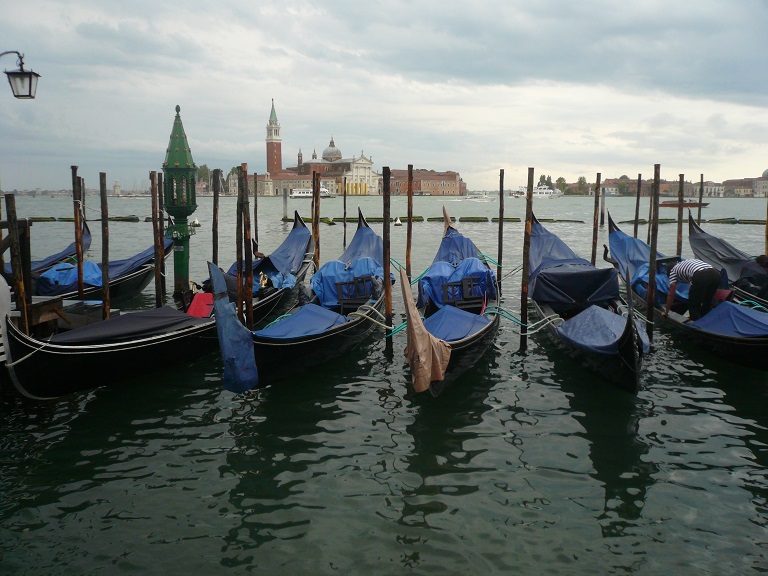
There are things you may not want to miss, and need to include in your budget, like a gondola ride, that will set you back about a hundred dollars, it is far more romantic than a vaporetto ride, and it will take you where a vaporetto won’t-the small canals and intimate side alleys. Watching a gondolier in action is a delight in its own right, often times the ride includes a passionate Italian love song, and the swish of the oars as they hit the water adds to the sublime moment.
The biggest tourist draw, and there are so many to choose from, is the Piazza San Marco, it is a piazza like no other, and again to simply walk around it, is best to arrive early in the morning, and in the evening-the time in between is packed with tourists, and I do mean packed. The lighting in the evening is subdued, and if it’s a moonlit night, magical.
I now book tours to the must see places, the lines are horrifically long, you pay a little extra but you get in much faster, and an added bonus are the lectures on the history of the place you are seeing. You can linger long after the tour guide finishes, and this way you do get a little history, a bit of background and sometimes a little about the daily life of the Venetians.
There is of course a great deal of free information on the many sites-it is up to you and your budget how you want to view them. Many travel books offer all the advice you can possibly need, all the places that should be seen, taking into consideration how much time you have, they list hotels in all price ranges, and if budget is really tight, you can borrow the book from your library and take it on your trip-just remember to return it when you get back.
The treasures at the Piazza San Marco are not to be missed, it is one of the key tourists sites. Given that the Basilica San Marco was began in 832, the history is vast and rich, and for almost a thousand years it served as the Doge’s private chapel, you can just imagine the political intrigues within these walls.
The Ducal or Doge’s Palace was home to many leaders of Venice for almost a thousand years. It is filled with art, sumptuous rooms, and the famous Bridge of Sighs so aptly named by Lord Byron; it was a last lonely view of Venice for those who were going from the palace to prison.
The first palace was a fortress finished in 814, change through history included fires in 976, in 1106, 1574, and 1577. Many masterpieces were destroyed, and restoration continued slowly until the 1880’s.The palace survived and to this day reflects the massive and majestic power that was once Venice.
It is evocative to be sure, it’s a place where you can get lost in the history, go back in time, daydream, and imagine as things were, and still come back to the present enjoy the sites, delicious coffee, black pasta and incomparable gelato.
Visiting the Companile or Bell Tower is easy, a small elevator will take you to the top, from where you have a bird’s eye view of the piazza, and the rest of Venice, and sometime on a clear day the Alps are visible. It has been written that the tower was started in 912. Due to erosion and a shallow foundation, theCompanile collapsed in 1902. It was rebuilt in 1912 as the Venetians wanted,“where it was and how it was.”
There are of course the must see things, but there are others that are a surprise. Walk into a small church, and wonder at the beauty, peace and charm that is offered. Go during the Biennale Art Festival and you just might see the church converted into an art gallery, and not necessarily religious art. Many of the places I found just by accident are free. There are many little niches filled with flowers, and little gardens, a piazza with beautiful fountains and charming cafes. Many of these places become galleries during the festival.
You will not get lost, there are signs everywhere that will point you to a landmark. Unless of course you’re like me, have no sense of direction, and easily gets lost. On my first trip to Venice upon settling in the hotel the first evening, I was determined to see Piazza San Marco. I was given the routine hotel map, the concierge circled the hotel location, and the location of the piazza.
I wondered for two hours, followed all the signs marked on the walls, there were arrows pointing where to turn next. I turned and circled places so many times I was dizzy, and I never found the piazza. By the time I found my way back to the hotel, I was convinced the piazza was not real, and could not possibly exist. The following morning, after a hearty breakfast and many cups of coffee, I found it.
Returning to the hotel was an adventure in itself,holding a map upside down and looking lost, exhausted and downright pitiful helped in my attempt to find my way back to a shower and bed. At that point I was so tired, any hotel would have done-jet lag was beginning to take its toll.
If you like glass, Venice offers that too, many buildings and hotels proudly show their Murano masterpieces in the shape of sconces, table lamps, vases and of course chandeliers.
If you want to see for yourself how glass is blown and the intricacies involved, visit a furnace.Murano is thirty minutes away by vaporetto, or fifteen minutes by water taxi, a choppy fast ride, and since the traffic is considerable as you head to more or less open water, the taxi basically rides the waves. It is a fun and often times bumpy ride.
Murano does not have the charm, or majesty of Venice. It is more or less a working island that produces world renowned, magnificent glass, and the economy revolves around glass that is shipped all over the world, and of course there is the tourist trade. One store after another lures you in. There are the inexpensive shops that sell glass trinkets made in China, some blown in Murano, you have many options, and as always know your product. There is a logo on many of the bigger pieces that identify it as Murano glass, but be vigilant.
There are galleries where you can spend thousands of dollars and pick up a unique treasure, some of the chandeliers are beyond elaborate, and I always wonder who would clean them. The selection is vast, from the modern to period pieces, and anything in between. On my last trip, I was fortunate to have the concierge at the hotel arrange a visit to the Schiavon Art Team furnace. I was allowed to take pictures, and speak with the master designer. Even in a gift shop I always ask if I can take pictures.
He was generous with his time, and I received a great deal of information that helped with my research for A Hotel in Venice. Their work is imaginative, creative, and simply amazing, and on my next visit to Venice, I plan on going back. There is something magical about seeing glass in liquid form and watch as it changes and becomes a solid. It is hard work, but the results are sublime.
Glass is the business of Murano, and has been for centuries, since the guild moved from Venice in 1291, because the citizens were afraid of fires. The first documented Venetian glass product dates back to 982. In 1224 the Guild of Glassmakers, Arts Fiolaria was established, and the guild protected the glassmakers under strict guidelines, but the guild was now controlled directly by the Republic of Venice.
The glass blowers became the elite members of society and mingled with the aristocracy and the very wealthy, powerful marriages were formed influencing the political climate of the time. It was a mysterious and sometimes deadly world of secrets, the formulas for blending and glass blowing techniques were protected sometimes with fatal results. I’ve been assured that the secrecy prevails even today. It is an ever changing and evolving industry, much like many others, but with a creative insight that for me is hard to beat-sheer artistry at work. I can watch glass being blown for hours, to me it is a mesmerizing process, and the final result be it a vase, or hat that looks real is astonishing.
Venice is enchanting, and I’m looking forward to my return trip to this mysterious, romantic and magical city. The ideal trip would include a book signing in a bookstore or maybe a furnace in Murano.
Cheers,
Margot Justes
A Hotel in Paris
A Hotel in Bath
A Hotel in Venice
Blood Art
A Fire Within
www.mjustes.com
http://acmeauthorslink.blogspot.com
0 Comments on A Visit to Venice by Margot Justes as of 1/1/1900
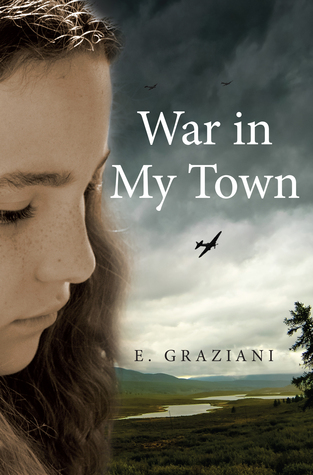
Even as late as March 1940, life in her small mountain village of Eglio, in northern Tuscany was still relatively pleasant for 11 year-old Bruna Pucci Guazzelli , despite the war in Europe and not having ever met her father, living in Brazil. Bruno is the youngest of her siblings - two brothers - Cesar, 25; Alcide, 17; and four sisters - Aurelia, 27; Eleonora, 23; Pina, 21; Mery, 15. Eglio is a village where everyone knows everyone else, and whenever hard times hit, the villagers rally to help one another.
But when Mussolini declared war on Britain that France on June 10, 1940, things all over Italy begin to change. First, all the Italian men and eldest sons were drafted into the army. For the Guazzelli family, that meant Cesar, followed by Alcide, who is sent to the Russian Front; meanwhile, for the eldest girls, it meant working away from home, either as cooks for other people, or for Eleonora, working in an orphanage.
At first, Bruna says, most Italians supported Mussolini and his alliance with Adolf Hitler, but as rationing, separation and hardship begin to take their toll on the home front, and after learning that even the Italian army fighting for Mussolini is so poorly supplied as the war escalates, people begin to turn against him. In September, 1943, Mussolini is removed from power and Italy forms a new alliance with the Allies.
These are major events, but Bruna and the rest of the people of Eglio still remain relatively isolated from the fighting in Italy and the rest of Europe, mainly because Eglio is a far removed mountain village, so no one really expects anything to happen there.
Elio, Northern Tuscany, Italy
That is until the spring of 1944, when the Nazis arrive and life for the villagers changes drastically. Elgio lay in a direct path of what was called the Gothic Line, one of the last fronts in WWII. First, all food and blankets and even houses are taken by the German soldiers, and because they know where the Germans are, it doesn't take long for Allied bombing to begin. But, when the villagers of Eglio are used as human shields in a last ditch effort by the Nazis, not everyone is lucky enough to survive the arrival of the Allies.
War in My Town is a fictionalized version of author E. Graziani's mother Bruna's true story. It is told in the first person by the young Bruna, as she recounts the events that impacted her family and her neighbors between 1940 and 1945.
Bruna's personal story is emotional and compelling, but as the title indicates, it is really more about her town and the people who lived there. That being said, I am sorry to say I found the writing style to be very dry and it was hard to stay focused. I also found the chronology of historical events to be confusing at times and found myself having to backtrack a lot.
Despite that, I would still recommend this book simply because there aren't many narratives about life in Italy during WWII and since War in My Town is based on actual experience, it gives a more realistic picture of what life was like then.
This book is recommended for readers age 12+
This book was an EARC received from NetGalley
0 Comments on War in My Town by E. Graziani as of 1/1/1900
Do you have your passaporto (passport) handy? It’s time to merriggiare (rest at noon in a shady spot) with a copy of If You Were Me and Lived In .. Italy and introduce your kids to the wealth of culture that abounds in the Republic of Italy—the famous country shaped like a boot.
Enter to win a complete autographed set of the If You Were Me series, written by award-winning author Carole P. Roman and illustrated by Kelsea Wierenga; including If You Were Me and Lived in … Italy: A Child's Introduction to Culture Around the World! Plus, the grand prize winner will also receive the Educational Insights Geosafari Jr Talking Globe.
Giveaway begins January 10, 2016, at 12:01 A.M. PST and ends February 16, 2016, at 11:59 P.M. PST.
Join us as we go on tour with award-winning author Carole P. Roman and explore If You Were Me and Lived In ... Italy: A Child's Introduction to Culture Around the World.
I write romantic mysteries for a niche market, my stories deal with art, travel, a bit of mayhem and romance. I might preface that with-I love art and I love to travel-and have been fortunate to be able to do so. The old adage write what you know and love is true.
When I started writing, I knew my novel would be set in Paris. In my youth, I lived there for a year, and have since gone back a few times. It stood to reason that my first romance should be set there. I’m familiar with the city, and over the years from my perspective, little has changed in the City of Light. The Louvre now has Pei’s Pyramid at the entrance, a few buildings have been added, but the age old charm, the cobblestones, the meandering streets, the essence and soul are still very much there.
The first time I visited Bath, England, many years ago, I said I must come back, and I did. My second book is set there. My third hotel book, is set in magical and mysterious Venice. All three cities are unique and romantic places.
My heroine is an artist, and through her eyes, I introduce my readers to my favorite artists, allow her to live in exciting places, give her mysteries to solve, and someone to love. The best of all worlds.
For me it is essential to visit the place I write about, get a sense of the culture, the everyday, mundane activities that make up our lives. The magical moment of sitting in a cafe, sipping an espresso, and watching people go by. An image is created that will allow a glimpse of that perfect intimate moment. A sculpture in a garden described so well that the reader can almost reach out and touch a sinew, that is the wonder of the written word.
Rodin has always set my pulse racing, his work is strong, exuberant, poignant to the point of agony, and sometimes even mischievous. I tried to bring that sense of joy and discovery to my hero in A Hotel in Paris, and hopefully to my readers. I find solace in art, for me it’s therapeutic. You don’t have to be an art scholar to enjoy it, it’s everywhere we turn, it surrounds us, all we have to do is take note.
Imagine tea at the Pump Room in Bath, and that first sip of the heavily scented Earl Grey tea, you take a deep whiff to savor the smell of the bergamot oil, take a bite of that a fresh scone still warm, loaded with clotted cream and strawberry preserves-except that I skip the cream and go directly for the jam, lots of jam. Those are all real memories that will enrich a story.
Visit a restaurant that has been in business since the early 1600s, watch out as you step down on the crooked stairs and touch the warped wall, coated with gobs of thick paint as you continue your descent that doesn’t seem to end, and then you gingerly sit down in a rickety old chair and hope you won’t be sitting on the ancient brick floor instead.
From the Rodin Museum in Paris, to the Pump Room in Bath, to the dark and narrow canals in Venice, where the water mysteriously shimmers in the moonlit night. It’s all there. Familiarity with a location makes it easier to write about, it makes it come alive.
Even though I write contemporary romance mysteries, I love history and art, and that is what I write about. It goes back to the beginning, write what you know and love.
Cheers,
Margot Justes
A Hotel in Paris
A Hotel in Bath
A Hotel in Venice
A Fire Within
Blood Art
www.mjustes.com
0 Comments on Setting the Story by Margot Justes Redux as of 11/28/2015 6:31:00 AM
I’m immersed in Venice. My latest release is set there. Memories of my trip are flooding back, and I hope to return next year.This is a city that has captured my heart and soul.
Venice is mystical, its magic powerful, and just walking along the narrow ancient streets allows your imagination to soar. The eerily lit side streets, the reflecting glow in the canals and ancient brick walls, summon you forth. You cross an old bridge and you wonder who else walked along the same path.
Was it Casanova? His face covered by a mask as he celebrated Carnivale, and waited for a damsel. Such is the evocative power of Venice. Steeped in history and romance, the stunning architecture,the art, and the beautiful tranquil canals, all pull together to form this magical place called Venice.
The Grand Canal flows majestically, along the way, palaces and homes seem to float in the water, as the famous Rialto Bridge stands guard. It’s an evocative place to be sure. It’s a place where you can get lost in the history, go back in time, daydream, and imagine as things were, and still come back to the present and enjoy delicious coffee, black pasta and incomparable gelato.
If you like glass, Venice offers that too, many buildings and hotels show proudly their Murano masterpieces. If you want to see for yourself, visit a furnace, or a gallery,Murano is thirty minutes away by vaporetto, and fifteen minutes by water taxi. A beautiful way to travel on the Grand Canal.
I’m looking forward to my return trip to a mysterious and magnificent city. If you want more of Venice, I posted a rather lengthy travel article on my website on the travel page.
Cheers,
Margot Justes
A Hotel in Paris
A Hotel in Bath
A Hotel in Venice
Hot Crimes Cool Chicks
www.mjustes.com
0 Comments on Magical Venice by Margot Justes as of 8/22/2015 11:22:00 AM
Today, with her vivid reimagining of EM Forster's A Room With a View in a YA novel she titled Love, Lucy, April Lindner has returned me to that city of art—Florence, Italy. She has given me Lucy, torn between two cities and two boys, a father's demands and her own instincts. She has taken me to Fiesole, a village outside Florence where I traveled many years ago—a town that, in fact, became the setting of my favorite published short story.
It's all so clear, in April's book. I see the streets as if I am walking them, the red-tiled roofs as if I am up above them, that Arno as if I am Vespa-ing by.
And that first photo in this post, right down to the red bike, is a picture I took in back in September 2012, when I was researching my own Florence novel, One Thing Stolen. That precise scene and angle, right down to the the red bike, is pictured on the back of April's novel.
We wrote our Italy novels at the same time. Worried them through together. Gave each other the support novelists need. Indulged in all flavors of gelato.
And so, April, it was a pleasure this afternoon to read your story, to find your gelato, your streets, your romance, and, of course, your music, in the pages of Love, Lucy. Congratulations on another wonderful reimagining.
0 Comments on returning to Florence, Italy, with April Lindner's LOVE, LUCY as of 1/1/1900
After a string of Australian books both adult and children's, I was beginning to feel like a serial Aussie reader and decided to get out from down under if only to vary my reading.
So, I went to Italy. I've been craving gelato and chianti ever since.
There is a significant difference between old-world writing and stories from the "colonies", penal and otherwise. The old-world has, not always, but very often, a very melancholy feel to it, whereas "newbies" from the colonies seem to have been able to free themselves somewhat from that melacholy. Their more upbeat feel may be what's so alluring to me. Or the accent. These have all been audio books.
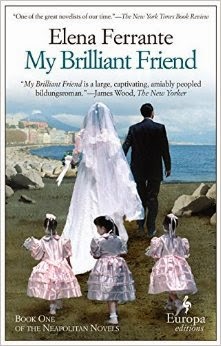
Nevertheless, a little melancholia isn't a bad thing. What's more, My Brilliant Friend is jam-packed with writing tricks. But first, a synopsis:
My Brilliant Friend is the story of two young Neapolitan girls growing up in the harsh conditions of a very working class, poor neighborhood, their dreams, the diversions those dreams have to take due to economic hardship - one girl gets to go on to school, while her smarter friend is forced to quit school and try to marry up - and the successful, but flawed, women the girls become.
What is the absolute, most brilliant aspect of My Brilliant Friend, is its final line and how it ties the entire book together and then rips it apart, much like the last line of Gabriel Garcia Marquez's last sentence to One Hundred Years of Solitude deconstructs and erases the entire story that has gone before with one slash of the pen. Ferrante is brilliant in her alteration of this trick, to tie and deconstruct her story at the same time - all was for nothing - or so it seems since this is the first in a series of books called the Neapolitan Novels. However, I didn't know that as I listened to the last line and actually stopped my car from the force of that line. It made me think, reponder, rethink, re-reflect. It's that brilliant.
It's usually first lines that are so mesmerizing, pulling the reader in, hooking her, and making her want more. But if the last line snags in a reader's heart, it really never lets go. It haunts the reader, challenging her to think and think and think. It's an amazing writer tool I can't wait to use.
After three inconclusive rounds in the preceding days, in which nobody secured the two-thirds majority needed to win, on the morning of 31 January 2015 a fourth round of voting was held in the Italian Parliament to elect the country’s President. This time, a simple majority of the 1,009 eligible voters (the members of both Chambers of the Parliament plus some delegates from the Regions) was enough to decide the election.
A happy sight this morning—an image of One Thing Stolenin the window of Paperback Exchange, the Anglo-American bookstore in Florence, Italy, where some of the original research for this book took place in the form of interviews with the shop's owners, Maurizio Panichi and Emily Rosner.
I had gone to the shop in October 2012 in order to write a story titled "Florence's Timeless Bookstore for Expats and Travelers" (Publishing Perspectives). I soon found myself engaged in a conversation about the 1966 flooding of the Arno and the work of the Mud Angels, for Maurizio had played an important role during that terrifying time. Soon thereafter Emily and I became friends. Emily answered questions about Italian and about history as I worked through many drafts. She told me tales about her life. And she was one of the very first readers of this book, sending me a series of encouraging notes while I was traveling by train—just when I needed them most.
Today Emily posted this picture on Facebook. I'm stealing it for my blog, in Nadia fashion.
Thank you, Emily. For all of it.
0 Comments on One Thing Stolen in a storefront in Florence, Italy, where it all began as of 4/22/2015 7:37:00 AM
Philadelphia Inquirer editor Kevin Ferris and I have been working together through many columns now, and I am always—always—grateful for his generosity. He has a huge heart. He allows me to write from mine. I'm neither a journalist nor an academic, and I'll never be famous. Kevin doesn't mind.
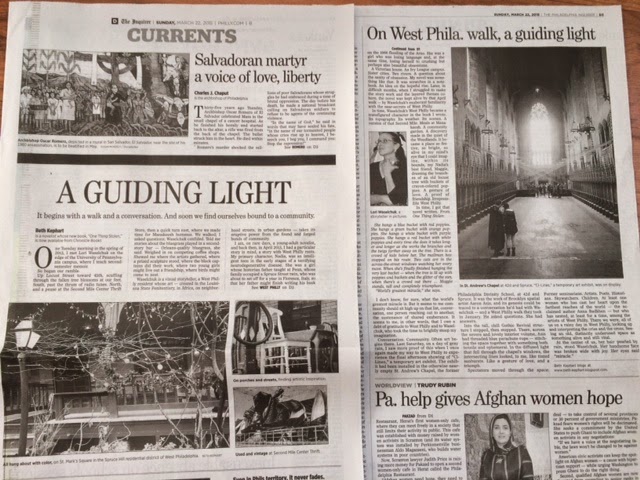
This month I wanted to celebrate West Philadelphia, where part of my new novel, One Thing Stolen (Chronicle Books), is rooted (much of the book also takes place in Philadelphia's sister city, Florence, Italy). I wanted to return to those images and places that inspired scenes in the book—and to Lori Waselchuk, a West Philadelphian who walked me through those streets two years ago to help me see them with insiderly eyes.
To Kevin, who lets me love out loud, and to Lori, who gave me ideas that kept me writing forward, thank you. A note of thanks here, as well, to Hassen Saker, who offered kindness this week, and to Anna Badkhen, whose work inspired this blog a few days ago.
When the link to this story is live, I will post it here.
0 Comments on Walking West Philly with Lori Waselchuk and Writing ONE THING STOLEN, in this Sunday's Inquirer as of 3/21/2015 11:42:00 AM
I have made reference to the challenges that beset me (self-afflicted, surely) as I set out to write One Thing Stolen. Today, in Huffington Post, I'm write of the fears I was writing toward during the process.
The piece begins like this, below, and carries forward here.
There is a girl who only just recently knew who she was, what she wanted, the dimensions of now. A girl who has a retro-minded best friend and a reputation for ingenious ideas about night snow, urban gardens, and the songs that rise up from Philadelphia streets. She has a mother and a brother, both loved. She has a father obsessed with the Florentine flood of November 1966--that unforeseen spill of the Arno River, that mud that clawed through homes and stores and across the face of Cimabue's "Crucifix," among so many other treasures. This girl has moved with her family to Florence. This girl is losing herself.
It's hard to say, precisely, when she began to peel away. When an obsession with nests and nest building became her terrible secret. When thieving erupted as a necessary part of her existence. When words began to clot and clog and answers became elusive.
It's hard to say when all this started. It's impossible to know how it will end.
0 Comments on In today's HuffPo: writing toward fear, as I wrote toward One Thing Stolen as of 1/1/1900
A photograph taken in the Santa Croce Cathedral, October 2012, while researching the book that would become One Thing Stolen.
To the left, the mosaics of colored glass tell us stories, suggest a beginning or an end.
To the right, no colors, no stories, just a little framing and the blast of temporal sun. My story, the one I was writing, lived somewhere in there. Still amorphous, still radically strange, but beckoning. It hurt to look at it. I could not stop looking at it. It suffered itself into being.
I suffered, too.
Now, less than two months from the book's launch date, I ponder this strange existence of wading through the formidable dark toward a fledging, heartbreaking story, while thinking not at all about what the market will actually bear. What is the category? What is the tagline? What is the label? This book has none. I have flirted with doom. And persisted.
Why?
Because we can only write toward our obsessions.
Because we must be who we are.
0 Comments on we can only write toward our obsessions as of 2/10/2015 10:40:00 AM
The unbelievable story of the Roman convent of Sant’Ambrogio in Rome is about crime and murder, feigned holiness, forbidden sexuality, and the abuse of power over others. Does this controversial story, which casts high dignitaries of the 19th century Catholic Church in a less than flattering light, need to be retold for the 21st century?
The answer is: absolutely. It is a mere stroke of luck for Church historical research that the well-hidden files from the Inquisition trial have been unearthed in the Archive of the Congregation for the Doctrine of the Faith.
What happened to the German Princess Katharina von Hohenlohe at the place of her yearning, a contemplative convent in Rome, is most probably an isolated case: the young novice mistress Maria Luisa feigned to have visions and to work miracles in order to manipulate her surroundings and to satisfy her needs. Supported by various accomplices and protected by mighty men she swept her opponents out of her way – literally under the pope’s eyes.
The files provide evidence of how dangerous exaggerated piety and blind obedience can be, producing a disastrous combination of power, sex, and false holiness within the Roman convent of Sant’Ambrogio.
The nuns were deemed to be “buried alive”; shielded from the outer world that was perceived as threatening by superiors who demanded strict obedience. However, the nuns of the convent weren’t dumb and the supposed saint, Maria Luisa, was always confronted with antagonists. Ultimately, however, she managed to cover up even her worst crimes with outrageous lies about the devil in human form, letters written by the Virgin Mary, and divine punishments. She established a perfidious system that brought unpopular young nuns to the point of praying for their own death. The confessors were no critical authority at all – on the contrary, they themselves were Maria Luisa’s greatest admirers. However the history of Sant’Ambrogio is full of surprises: in the end, Maria Luisa, for instance, appears as the distressed victim of a system that she herself had perfected, and the Roman Inquisition proves to be comparably mild despite its ill fame.
The Sistine Hall, commissioned by pope Sixtus V in the end of the 16th century. Originally part of the Vatican Library, now used by the Vatican Museums. CC-BY-2.0 via Wikimedia Commons.
But how did a false saint manage to turn the heads of half of the curia? In order to understand how Maria Luisa achieved this, it must be considered in its context in 19th century Rome. Maria Luisa would have never got away with her lies if she was not part of an environment that wanted to believe her at all costs. The atmosphere in the Vatican was heavy with anxiety, as Pope Pius IX had long lost the support of broad circles of the population and rightly feared he might lose power in the Church state. In 1848, he was forced to flee the Revolution and go into exile. The pope himself increasingly sought refuge in a naïve childish faith. He was convinced that the Mother of God had saved him from drowning when he was a child and that one day she would descend from heaven in order to defend the Church state with the angelic hosts. Simply put, he and those around him wistfully longed for miracles.
The Sant’Ambrogio scandal reveals the dark side of this superficially pious environment, and it put an indelible stain on the history of the Catholic Church that can still be seen today. This is because Pope Pius IX and his predecessors were involved in the scandal of Sant’Ambrogio. Maria Luisa was very close to some figures connected to Neo-scholasticism, the predominant theological orientation at the time, and to the most eminent fathers of the First Vatican Council, which proclaimed the controversial dogmas of the infallibility of the pope and of his primacy of jurisdiction. The story of the convent in scandal tells a lot about the dialectics of enlightened modernity: it is about canting zealots put on the defensive and their longing for a newly enchanted world, in which saints proclaim simple truths, good and evil are easily discernible, the end justifies the means, and in which there always is hope for a miracle. Furthermore, Maria Luisa’s power strategies tell much about the role of women in the Catholic Church of the time, which was clearly dominated by the clergy.
Not even in the 19th century was the Catholic Church as monolithic as it appears from anticlerical clichés. The adherents of mysticism as well as the supporters of rationalism contended for influence in the Vatican. On a church-political level they pursued different strategies; the ultramontane adherents of anti-modernism were confronted with the moderate liberals. The Inquisition trial became a struggle for power between the two most important parties in the Curia; the basic conflict in the background is recognizable if put under a microscope.
I write romantic mysteries for a niche market, my stories deal with art, travel, a bit of mayhem and romance. I might preface that with-I love art and I love to travel-and have been fortunate to be able to do so. The old adage write what you know and love is true.
When I started writing, I knew my novel would be set in Paris. In my youth, I lived there for a year, and have since gone back a few times. It stood to reason that my first romance should be set there.
New architectural structures reflect a modern appeal, but the old is appreciated and treasured. The Louvre now has Pei’s Pyramid at the entrance, a few buildings have been added, but the age old charm, the cobblestones, the meandering streets, the essence and soul are still very much there.
The first time I visited Bath, England, I told myself I must come back, and I did. My second book is set there. My third hotel book, my current WIP is set in magical and mysterious Venice. All three cities are mystical and romantic places. Venice has captured my heart perhaps as no other city-there is a constant pull to go back and see what I have missed.
My heroine is an artist, and through her eyes, I introduce my readers to my favorite artists, allow her to live in exciting places, give her mysteries to solve, and someone to love. The best of all worlds.
For me it is essential to visit the place I write about, get a sense of the culture, the everyday, mundane activities that make up our lives. The magical moment of sitting in a cafe, sipping an espresso, and watching people go by. An image is created that will allow a glimpse of that perfect intimate moment. A sculpture in a garden described so well that the reader can almost reach out and touch a sinew, that is the wonder of the written word.
Rodin has always set my pulse racing, his work is strong, exuberant, poignant to the point of agony, and sometimes even mischievous. I tried to bring that sense of joy and discovery to my hero in A Hotel in Paris, and hopefully to my readers. I find solace in art, for me it’s therapeutic. You don’t have to be an art scholar to enjoy it, it’s everywhere we turn, it surrounds us, all we have to do is take note.
Imagine tea at the Pump Room in Bath, and that first sip of the heavily scented Earl Grey tea, you take a deep whiff to savor the smell of the bergamot oil, take a bite of that a fresh scone still warm, loaded with clotted cream and strawberry preserves-except that I skip the cream and go directly for the jam, lots of jam. Those are all real memories that will enrich a story.
Visit a restaurant that has been in business since the early 1600s, in Bath and watch out as you step down on the crooked stairs and touch the warped wall, coated with gobs of thick paint as you continue your descent that doesn’t seem to end, and then you gingerly sit down in a rickety old chair and hope you won’t be sitting on the ancient brick floor instead.
Stand on top of the Rialto Bridge in Venice, look down at the Grand Canal, and the mesmerizing traffic below, boats gliding on water expertly and avoid contact. Sip an espresso in a cafe and listen to a gondolier serenade you from afar.
From the Rodin Museum in Paris, to the Pump Room in Bath, to the dark and narrow canals in Venice, where the water mysteriously shimmers in the moonlit night. It’s all there. Familiarity with a location makes it easier to write about the experience, it makes it come alive.
Even though I write contemporary romance mysteries, I love history and art, and that is what I write about. It goes back to the beginning, write what you know and love.
Cheers,
Margot Justes
A Hotel in Paris
A Hotel in Bath
Blood Art
Hearts & Daggers
Hot Crimes Cool Chicks
www.mjustes.com
0 Comments on Setting the Story by Margot Justes as of 1/20/2015 11:45:00 AM
When I am writing everywhere I go, everyone I meet and everything I hear someone say has the potential to feed into my story, particularly when it is a place removed from my everyday life and experiences. When I travel I find images, scents, stray bits of conversation take seed and create stories of their own. I've just returned from a week in the south of Italy where I visited family many times as a child, and over the years since but I'd not been there for a few years. I have returned, my head full of all the different characters and situations I encountered, conversations, tastes and sounds.
I was staying with family and that meant I was not a tourist, just skimming the surface and seeing the tourist sights. I chatted to two different couples at the airport one the way there and the other on the way back. Both couples were on holiday to Rome to enjoy the Italy of the holiday brochures and I was aware of how different their experiences and perceptions of Italy, and the Italians, are to mine. I, too, enjoyed the beautiful blue skies and scenery and of course the wonderful food - a very important part of life there. I also fed my creative brain on the differences in culture, the language and particularly the use of language - the ways that expressions change from one language to another and where direct translations can be quite humorous. But for me there were also the discussions that happen in families and amongst friends and acquaintances about everything from Italian politics, the economy, the corruption and their perceptions of world affairs, to the moans about day to day life and memories of family who have now sadly passed away. I often find it frustrating as a wordsmith whenI do not have quite the facility with words that I am used to in English - my Italian is conversational and my vocabulary is not really as extensive as I would wish. But thankfully, it was adequate to join in conversations and to understand most of what was being discussed, except at times when the speaker's language was thick with dialect!
I was able to spend time writing beside a cosy log fire - it is January after all - although to me it was like a Scottish spring, bright and sunny most days with a bit of a chill in the air, but most people there thought it was very cold! I met some people who will make colourful characters, some so 'colourful' that they and their view of life may seem hardly credible to most people. Those are the most interesting to store away for future use.
Michela
I had a horse riding lesson and I learned even more when I acted as translator for someone who only spoke English and came for a riding lesson. I found out a lot about looking after horses, too. As far as I am concerned nothing is wasted because basically everything is research! This is Michela. A delightful character who was hand-reared when her mother died giving birth to her. She appeared to have an opinion about almost everything, if only I could speak Donkey! I am sure she deserves a story of her own. When chatting to an old aunt, I was told forcefully several times not to forget that she expected me to write the story of her and her siblings and parents, so that the future generations would not forget them all. I suppose that is the wish of many older people who see their own time and family becoming part of a forgotten past as the new generations appear. By the time the younger ones are old enough to ask questions so much is often lost and forgotten. It will be interesting to write something about the family members like my aunt and her parents, just for the family, to record these people and their lives.
Back home now I am distilling my thoughts and memories, images and ideas. I managed to get quite a bit of writing done while I was away and now I am keen to get back to the book again. My head is full of memories of crisp blue skies, lovely food and strong coffee, as well as stray thoughts in Italian, as my brain tries to switch gear back to English!
Travel, as has been often said, broadens the mind and it creates great images and ideas to feed the soul and the creative mind. So now it is time to get back to my desk and use all that inspiration!
------------------------------------------------------------------------------ Linda Strachan is the author of over 60 books for all ages from picture books to teenage novels and the writing handbook Writing For Children
She has written 10 Hamish McHaggis books illustrated by Sally J. Collins who also illustrated Linda's retelling of Greyfriars Bobby
Linda's latest YA novel is Don't Judge Me Linda isPatron of Reading to Liberton High School, Edinburgh
It took a long time and a lot of heartache to find my way through One Thing Stolen. I had an idea about vanishing and effacement. I am obsessed with birds and floods. I sometimes misplace things, especially names, and I have, therefore, a growing obsession with the mind and where it puts the things that once were.
I also have students I love. And I believe that language is plastic, that it must be taken apart and put back together again so that it might remain alive, so that our stories might live, too.
All of this became the web of the book called One Thing Stolen, and by the time I had finished it for real and taken the first 100 pages apart yet again— nanoseconds before it went off to the copy editor—I was in a quiet place. Bewildered by—and grateful to—the strange workings of the literary imagination.
I sought no blurbs for the book. It was going out there, bravely, on its own.
Two nights ago, a friend alerted me to some goings-on on Twitter. Did you see what A.S. King has written about One Thing Stolen? the friend asked. What I found there, on the Twitter stream, made me cry. It kept me up through most the night. An act of friendship so remarkable. Words I needed to hear.
When I wrote to thank Amy for her generosity, she offered to write a blurb for the book. Really? I said. Really, she said. Or something like that. She wrote not one, but two, and because I like them both so much I will share them here. These words will appear on reprint editions of One Thing Stolen (for the book has already gone to press) and everywhere else, starting now.
Grateful doesn't begin to describe it. Thank you, A.S. King.
Kephart at her poetic and powerful best. ONE THING STOLEN is a masterwork—a nest of beauty and loss, a flood of passion so sweet one can taste it. This is no ordinary book. It fits into no box. It is its own box—its own language.
ONE THING STOLEN is a tapestry of family, friendship, Florence, and neuroscience. I’ve never read anything like it. Kephart brings the reader so deep inside Nadia we can feel her breathe, and yet her story leaves us without breath.
A.S. King is the author of Glory O’Brien’s History of the Future, Reality Boy, Ask the Passengers, Everybody Sees the Ants, Please Ignore Vera Dietz, and The Dust of 100 Dogs
0 Comments on And then A.S. King read One Thing Stolen as of 1/9/2015 3:21:00 PM
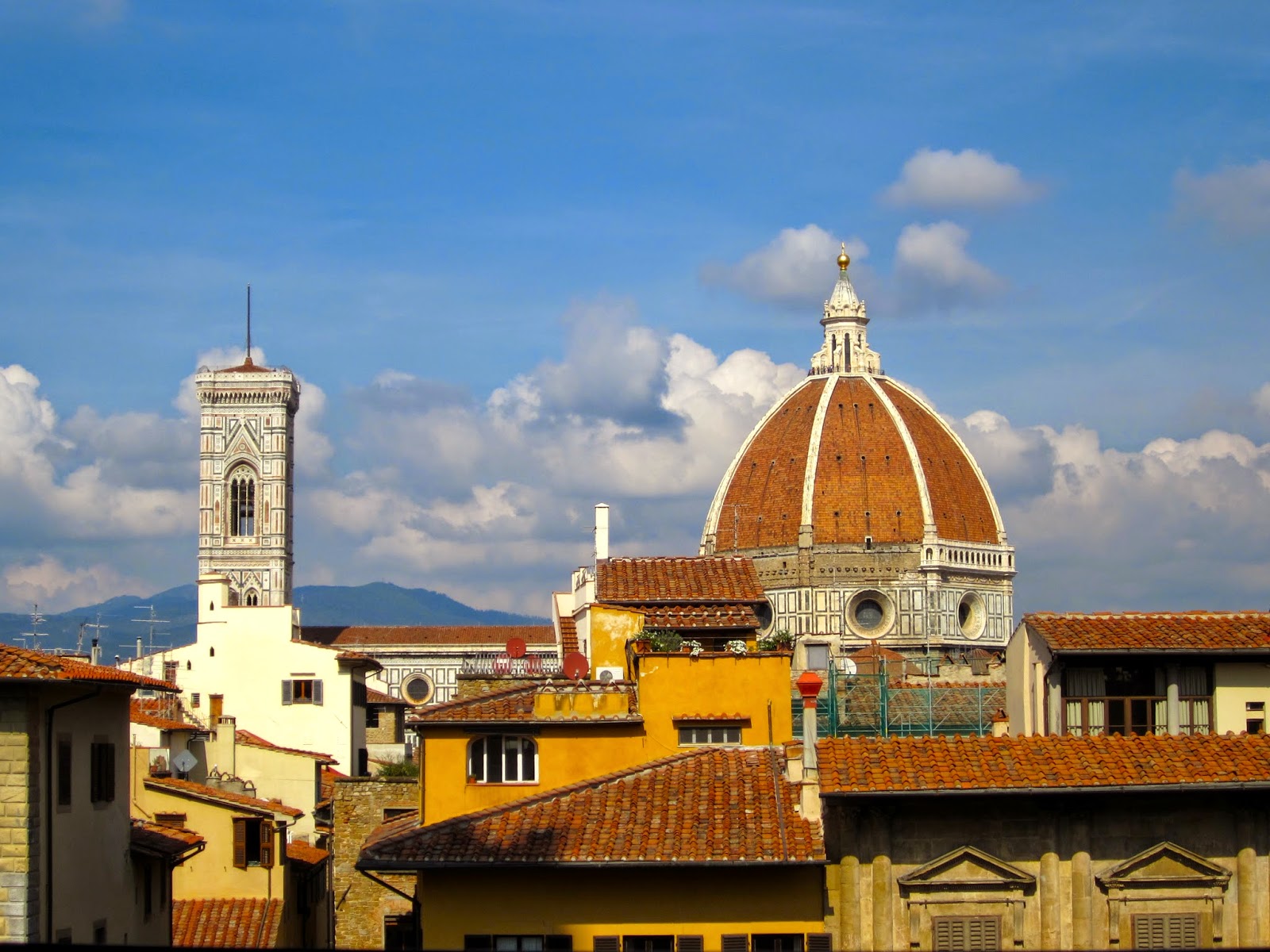
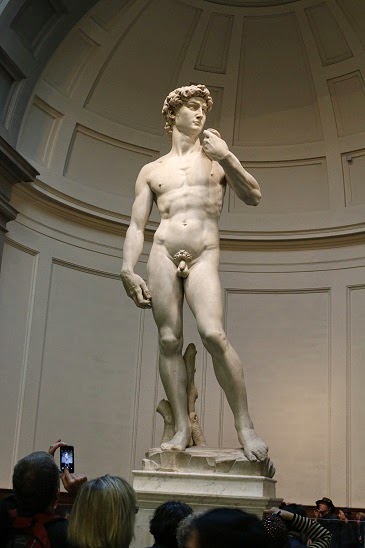
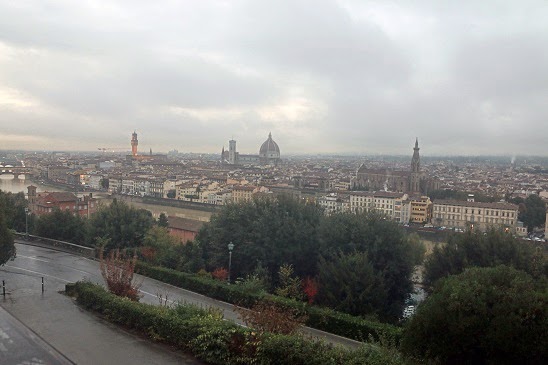
Our first stop was in Livorno, Italy, the port city in Tuscany that took me to Florence. It was love at first sight. Even on a cold and rainy day, it was one of the most astounding cities I have ever seen. Florence is said to be the birth place of the Renaissance, and to celebrate our first stop was the Accademia Museum to visit Michelangelo’s David.
To say it is magnificent would be an understatement. It is powerful, the hands are large beyond even the size of the 14 foot sculpture that weighs in at about 6 tons. It radiates power, it was meant to do so; those hands will ultimately destroy Goliath. They are bigger than perceived reality.
The piece is an astounding work of artistry. There is a reason Michelangelo dissected cadavers and spent many hours in the Carrere Marble quarries watching the men work. It’s all there in David’s body, every nuance, every muscle, every vein is defined to perfection.
The face is that of someone older than the young teen David, emanating age and wisdom beyond the teen years, and of course the sheer male beauty. The face appears to be that of a Greek god, the look is wistful. It is pure perfection, right down to the veins in the powerful hand that holds the rock. The one holding the sling is relaxed, since little effort will be needed. The white Carrere marble seems to add strength and purity to the piece.
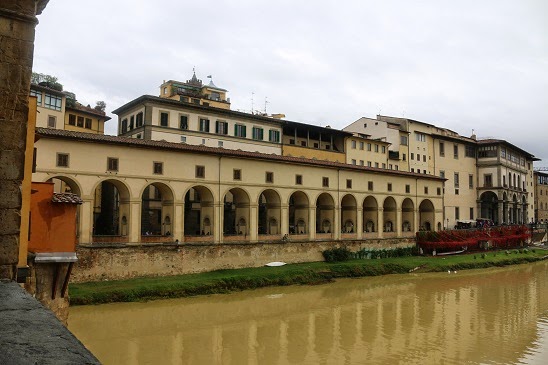
The day was packed with museum visits, the Church of Santa Croce (Church of the Holy Cross) and the old medieval bridge Ponte Vecchia crossing the Amo River.The narrow streets were filled with shops selling anything from cheeses and salamis to leather goods and gold.
Lunch at Piazza della Signorina, at Il Bargello was a welcome respite for a bit of warmth and away from the continuous rain, the pasta delicious, and the large bottle of Chianti didn’t hurt either. The creamy hazelnut gelato and espresso complimented the end of the meal. The Piazza also has a copy of David.
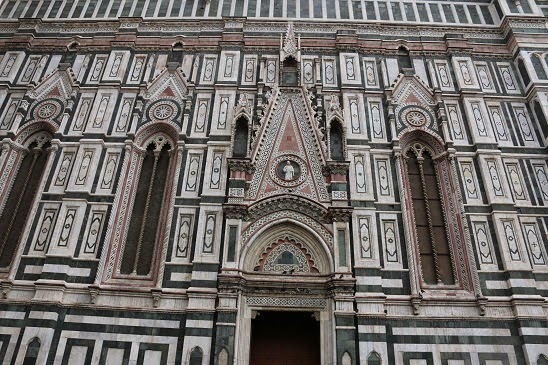
The rain continued throughout the day and somehow made the city more captivating and magical; the gloomy sky cast murky shadows on the striking and famed multi colored marble buildings as they glistened in the mist. Odd to say, but it was a joyful experience, the place is magical. Florence, once seen is never to be forgotten.
Florence deserves a few days not a few hours, and I have plans to be back and see the rest of this glorious place. In the meantime, I’m happy I was able to see just a little bit.
Cheers,
MargotJustes
Blood Art
A Fire Within
A Hotel in Paris
A Hotel in Bath
Hot Crimes Cool Chicks
www.mjustes.com
0 Comments on Florence, Italy by Margot Justes as of 12/24/2014 2:34:00 AM
I’m just waking up on Giudecca Island to a volley of sights and sounds – a deliverance from the cathartic, but brooding history of Rome, from where we just came. Here, in Venice, I imagine I’m in a living painting, and an artist, with his paintbrush in hand, captures me peeking out my window – just now at the Hilton Molino Stucky, his studio across the way.
Outside, I hear the echoing serenade of tolling church bells, which I can pinpoint with my own eyes, to various steeples throughout the city that traipse along the river. Splashing waves steadily rise and fall onto green and blue algae-covered seawalls, looming directly below me, while power boats dot the landscape like steed on an aqua-colored field, gliding in various directions through the water carrying townspeople and holiday tourists about the city. And, in the foggy haze, we’re graced with this omnipotent view – and it occurs to me, I must be Dickens’ modern Venice in his “Italian Dream.”
0 Comments on A Writer’s Dream from Venice, Italy as of 12/22/2014 11:48:00 PM
Title: A Letter for Leo Written and illustrated by: Sergio Ruzzier Published By: Clarion Books, New York, 2014 Themes/Topics: postmen, friendship, letters, birds, weasels Suitable for ages: 3-5 Fiction, 32 pages Opening: Leo is the mailman of a little old town Synopsis: Postman Leo … Continue reading →



 By: Jerry Beck,
on 10/11/2016
By: Jerry Beck,
on 10/11/2016






 By: Beth Kephart ,
on 6/22/2015
By: Beth Kephart ,
on 6/22/2015


 By: Stacy A. Nyikos,
on 5/5/2015
By: Stacy A. Nyikos,
on 5/5/2015
 By: RachelM,
on 5/3/2015
By: RachelM,
on 5/3/2015



.jpg?picon=1806) By: Linda Strachan,
on 1/18/2015
By: Linda Strachan,
on 1/18/2015

 But for me there were also the discussions that happen in families and amongst friends and acquaintances about everything from Italian politics, the economy, the corruption and their perceptions of world affairs, to the moans about day to day life and memories of family who have now sadly passed away.
  I was able to spend time writing beside a cosy log fire - it is January after all - although to me it was like a Scottish spring, bright and sunny most days with a bit of a chill in the air, but most people there thought it was very cold!






 By: Tonia Allen Gould,
on 12/18/2014
By: Tonia Allen Gould,
on 12/18/2014


 By: JOANNA MARPLE,
on 12/12/2014
By: JOANNA MARPLE,
on 12/12/2014