JacketFlap connects you to the work of more than 200,000 authors, illustrators, publishers and other creators of books for Children and Young Adults. The site is updated daily with information about every book, author, illustrator, and publisher in the children's / young adult book industry. Members include published authors and illustrators, librarians, agents, editors, publicists, booksellers, publishers and fans. Join now (it's free).
Login or Register for free to create your own customized page of blog posts from your favorite blogs. You can also add blogs by clicking the "Add to MyJacketFlap" links next to the blog name in each post.
Blog Posts by Tag
In the past 7 days
Blog Posts by Date
Click days in this calendar to see posts by day or month
Viewing: Blog Posts Tagged with: Junot Diaz, Most Recent at Top [Help]
Results 1 - 25 of 36
How to use this Page
You are viewing the most recent posts tagged with the words: Junot Diaz in the JacketFlap blog reader. What is a tag? Think of a tag as a keyword or category label. Tags can both help you find posts on JacketFlap.com as well as provide an easy way for you to "remember" and classify posts for later recall. Try adding a tag yourself by clicking "Add a tag" below a post's header. Scroll down through the list of Recent Posts in the left column and click on a post title that sounds interesting. You can view all posts from a specific blog by clicking the Blog name in the right column, or you can click a 'More Posts from this Blog' link in any individual post.
Junot Díaz has lost an award in the Dominican Republic following an act of political activism in Washington.
The Dominican Republic’s consul in New York, Eduardo Selman, reportedly revoked the merit award which was given to Diaz in 2009. The Guardian has the scoop:
Diaz, who was born in the Dominican Republic and moved to New Jersey at the age of six, went to Washington on Thursday with the Haitian American author Edwidge Danticat, there to urge the US government to take action to curb what they said was the persecution of large numbers of immigrants, mainly Haitians, in the Dominican Republic.
Interviewing the Caribbean (IC)—has been founded by Jamaican poet and educator Opal Palmer Adisa. IC seeks poems, stories, creative non-fiction, and visual art in all media that celebrate Caribbean life. Caribbean artists at home and in the Diaspora are invited to participate. Submit by September 5, 2015u, to be included in the inaugural issue along with Junot Diaz, Leroy Clarke, Tamara Natalie Madden, and others. The topic for the inaugural issue is “Intellectual Property” (IP).
Description: “All too often, when it comes to intellectual property, black artists are the ones who lose the rights to their work (The Root, LaToya Peterson, May 15, 2011). Who owns your work? Does it matter? Many are the black creators who have not reaped the monetary benefits of their success. How do you, as a creative voice, ensure that ownership of your work—and the royalties that go with it—accrues to you? In recent years, prominent black artists—and their estates—have challenged intellectual property misappropriation in the courts.
Some well-known cases: The artist formerly known as Prince did battle with Warner Bros. Records for years before winning back ownership of the master tapes for his hit albums. Just this year, Marvin Gaye’s estate challenged Pharrell Williams and Robin Thicke on the similarity of their song “Blurred Lines” and Gaye’s “Got to Give it Up”—and won.
Some possibilities to consider: How is the concept of IP experienced by Caribbean artists—writers, visual artists, musicians, and others? How are ideas about IP evolving in Caribbean society at large? What is the future for intellectual property rights for artists in the Caribbean context? (Works that cover other, but related, themes will be considered.)
Please send submissions of writing as Word documents. Visual artists, please send photographs as jpegs at 300 dpi resolution.
For the past few months, the three library systems of New York City (the New York Public Library, the Queens Library, and the Brooklyn Public Library) have been pushing Mayor Bill de Blasio and the New York City Council for an increase in funding. The campaign has proved successful; a $43 million increase has been approved for the Fiscal Year 2016.
According to the press release, this budget increase “will allow for citywide six-day branch service, as well as an increase in hours and programming seats, more expert library staff, and more. The budget — adopted today — also includes a capital allocation of at least $300 million to libraries over 10 years, which will go towards improving, renovating, modernizing, and repairing library facilities across the city. This is the first time libraries have received such a large, long-term investment, allowing them to adequately plan for the future.”
A group of high-profile celebrities and authors have come together to advocate for the library systems of New York. Each participant has signed their name to a letter calling on Mayor Bill de Blasio and city council members to increase the funding for the New York Public Library, the Brooklyn Public Library, and the Queens Library.
Here’s an excerpt: “New York City’s libraries offer inspiring programs, welcoming staff, and safe spaces for people of all ages, as well as free access to technology and, of course, millions of books. Libraries are the great equalizers…Now is the time to restore $65 million in operating funding for libraries, and to invest $1.4 billion in capital funding over the next decade to repair and renovate our 217 neighborhood branches. It’s time for New York City to Invest in Libraries.”
Junot Díaz has become an advocate for the New York Public Library. The Pulitzer Prize-winning novelist credits libraries for helping him grow and develop into a creative professional.
Here’s an excerpt from Díaz’s letter: “Libraries are one of the greatest American institutions — they are not only treasure houses of knowledge, they are also fiercely democratic spaces. It kills me that New York City — the home of one of the greatest library systems in the world — has been under-funding libraries for over a decade. This has to stop.”
BBC Culture conducted a critics’ poll to select the “21st Century’s 12 greatest novels.” Junot Díaz’sThe Brief Wondrous Life of Oscar Wao captured the top spot.
The participating critics reviewed 156 books for this venture. Most of them named Díaz’s Pulitzer Prize-winning book as their number one pick.
The other eleven titles that made it include Middlesex by Jeffrey Eugenides, White Teeth by Zadie Smith, Half of a Yellow Sun by Chimamanda Ngozi Adichie, Atonement by Ian McEwan, Billy Lynn’s Long Halftime Walk by Ben Fountain, A Visit from the Goon Squad by Jennifer Egan, The Amazing Adventures of Kavalier & Clay by Michael Chabon, The Corrections by Jonathan Franzen, Gilead by Marilynne Robinson, Wolf Hall by Hilary Mantel, and The Known World by Edward P. Jones. Did one of your favorites make it onto the list? (via The Guardian)
This week Junot Diaz’s The Brief Wondrous Life of Oscar Wao was named the best book of the century so far. I found the book to be absorbing, especially for the historical passages, but had some problems with it: there is a lot of gratuitous violence, especially against women, an unconvincing love story driving the plot, and unsatisfying conclusion. But obviously I’m alone, because it won the Pulitzer Prize (among other honors), launched Diaz into the stratosphere of prestigious authors, and is now apparently the best book of the last fifteen years.
Oscar Wao is described as the quintessential “nerd of color” book. I’m not crazy about the word, “nerd,” but if nerd identity is a thing, Oscar Wao is the kind of nerd you see on The Big Bang Theory: absorbed equally by all things nerdy without any particular favorite, emotionally (even intellectually) stunted, and socially inept. To me, he seemed like a non-nerd’s conception of a nerd.
Well, that’s my opinion, and I probably wouldn’t blog about it, but this morning heard a terrific passage in The Round House where Joe, the narrator and protagonist, describes his love for Star Trek: The Next Generation. For me this was a much better execution of the “nerd of color” trope that Oscar Wao.
First, Joe is really into Star Trek, and is very specific he means the new Star Trek, The Next Generation (it takes place in the 1980s). He particularly likes Worf. This fealty to one show and one character, the specificity of it, is more true to the nerds I’ve been and known than the all-things-nerdy caricature. Second, in a few nimble paragraphs Erdrich integrates this fandom into Joe’s personality and social context, describing how the show figures into Joes’ emerging identity, how aspects of the show work as metaphor for his experience as a kid-of-color and as a sex-obsessed teen, how the show fosters a community and code among his peers. Oscar Wao didn’t do any of these things. Oscar’s nerdiness makes him an outcast among other Dominican boys and later seems to limit his potential academically and professionally.
The Round House shows how this classic “nerd” interest helps foster a kid’s self-identity, instead of warping it. It shows how the social experience of a television program helps Joe cement his relationships, instead of making him an outcast. It doesn’t use the word nerd, but in one chapter Louise Erdrich does for Joe what Diaz never does for Oscar: take a nerd-positive view.
Do you want to take your NaNoWriMo story in an unfamiliar direction? Back in 2013, Toni Morrison and Junot Díaz headlined a “Live From the NYPL” event.
“I tell my students; I tell everybody this. When I begin a creative writing class I say, I know you’ve heard all your life, ‘Write what you know.’ Well I am here to tell you, You don’t know nothing. So do not write what you know. Think up something else. Write about a young Mexican woman working in a restaurant and can’t speak English. Or write about a famous mistress in Paris who’s down on her luck.”
This is our sixteenth NaNoWriMo Tip of the Day. To help GalleyCat readers take on the challenge of writing a draft for a 50,000-word novel in 30 days, we will be offering advice throughout the entire month.
OR Books will publish an anthology focusing on income inequality within New York City called Tales of Two Cities: The Best & Worst of Times in New York. A portion of the proceeds will be donated to Housing Works.
How to Read a Novelist author John Freeman served as the editor for this book and wrote one of the pieces. Some of the other contributors include Pulitzer Prize winner Junot Díaz, The Circle author Dave Eggers, and White Teeth author Zadie Smith.
School finally ended. I took a week off to empty my brain of all things MICA and am now ready to wrap up this book. My plan was to finish et the end of the semester, but like a few of my students, I fell shy of my original goal by about three pieces. Those that follow me on facebook know how excited I get about my students and their work. My Advanced Book Illustration class ended with a bang with their end of semester reading to students at the Enoch Pratt Library. What a treat! You can see a few pics from that day on the MICA blog.
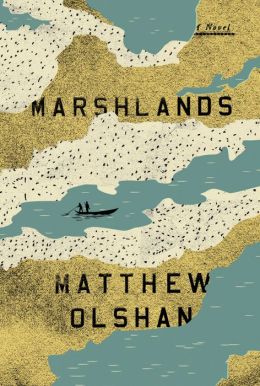
Since school ended, I read Matthew David Olshan’s “Marshlands“, an allegory of the excesses of empire. I liked the story and felt that Matthew did a wonderful job of painting the portrait of life in the desert marshes. I did feel that there was an emotional distance from some of the horrible punishments inflicted upon the inhabitants of the land. Some of the described tortures hit hard, but there was still a calmness in the reporting. I wondered after I read it, if that was the reason I was able to read it so quickly. I never needed any distance from the story, and with the backward story structure, my interest was held throughout.
The structure was a little disorienting at first. While reading it, I was lost and knew that the experience of reading it would be akin to assembling a jigsaw puzzle…which bothered me a little at first, but again, the visuals of the story wer
e so rich that it stayed with me. I do enjoy stories that make you wait for answers later. I don’t enjoy being spoon fed details from beginning to end.
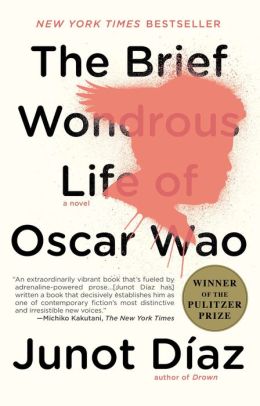
I am now finishing “The Brief and Wondrous Life of Oscar Wao” by Junot Diaz. It is mesmerizing, but pretty taxing. In contrast to Olshan’s calm and matter-of-fact telling of Marshlands, Diaz’s storytelling is full of colorful language, historical footnotes (still told in a conversational tone) and current cultural references that crack me up, but also wear me out. It’s a sad sad story of one Dominican family and how they came to continue their lineage in the US showing us what it meant to live in the time of Trujillo and how long-lasting and far-reaching his dictatorship was. Diaz intersperses the story with Spanish phrases (that make me wish I paid more attention in Spanish during high school). Fortunately, my Spanish is decent enough that I can keep up without having to translate too much, and most of the phrases are easily understood in the context.
Next up, I will read “This One Summer” by Mariko Tamaki and Jillian Tamaki. I plan to digest some NK Jemisin and Danzy Senna on the recommendation of Deb Taylor. I also want to reread “The Summer Prince”, another story that had me disoriented at the beginning, but which I fell in love with completely by the end.
As for my own books, well, I am finishing one project and then beginning another, both written by other authors. After that I will begin work on my first story where I am author and illustrator. This summer, alongside my making and reading, I will write as well. No ideas are bursting forth at the moment, but my mind is too focused on current projects to allow any other story ideas to bubble up. I am sure that once I finish this book, my mind will relax a bit.
Oh! I do plan to get out and about in July. I will head to Maine with my mom and Deb Taylor to visit Ashley Bryan and The Ashley Bryan Center in the first week of July and after that, I will head to Seoul to visit with Taeeun and work on sketches for the next book. So, big plans ahead.
What are you reading this summer?
0 Comments on Summer Reading…and a little fun. as of 5/27/2014 1:05:00 PM
At Powell's, our book buyers select all the new books in our vast inventory. If we need a book recommendation, we turn to our team of resident experts. Need a gift idea for a fan of vampire novels? Looking for a guide that will best demonstrate how to knit argyle socks? Need a book for [...]
0 Comments on Ask a Book Buyer: The Answer Is Robin Hobb (and More) as of 5/2/2014 4:29:00 PM
St. Mark’s Bookshop, a New York City-based independent bookstore, plans to move to a new location within the East Village neighborhood.
To help generate the money for a financial push, the owners have turned to the crowd-funding site indiegogo. According to the indiegogo page, the funds will be used to “build out the space and pay for moving costs, as well as maintaining its inventory for the remaining months at 31 Third Avenue.”
Some of the rewards that are up for grabs include signed first edition books by Junot Diaz, Patti Smith, and Paul Auster. The campaign will run until April 26, 2014.
The New York Public Library has revealed the 2013 Library Lions.
The five honorees include New York City mayor Michael R. Bloomberg, Pulitzer Prize-winning journalist Katherine Boo, MacArthur Genius Junot Diaz, and noted essayist Marilynn Robinson. Tony Award-winning composer Stephen Sondheim. The Library Lions Gala for this year’s honorees will be held on November 4, 2013.
Author Claire Vaye Watkins won the $20,000 Story Prize for Battleborn, a short story collection that spanned from the California gold rush to contemporary times.
The other finalists for the prize were Dan Chaon (for Stay Awake) and Junot Diaz (for This Is How You Lose Her). They each received $5,000. Here’s more from the release:
Ms. Watkins is the ninth-ever winner of The Story Prize and the first woman to win the prestigious book award since Mary Gordon took the top prize for The Stories of Mary Gordon in 2007. The first woman to take the top prize was Edwidge Danticat for The Dew Breaker in 2005.
Three short story writers, Dan Chaon, Claire Vaye Watkins and Junot Diaz, have been named finalists for the 2013 Story Prize. The winner will be revealed at The New School’s awards ceremony on March 13th. Whoever emerges victorious will receive $20,000 and an engraved silver bowl.
Here’s more from the release: “Collections by two accomplished short story writers and an outstanding debut vie for the richest top prize of any annual U.S. book award for fiction…The Story Prize, an annual award for books of short fiction, is pleased to honor three outstanding short story collections chosen from among a record field of 98 books that 65 different publishers or imprints submitted in 2012.”
The bookseller and community space in Washington Heights, New York City only has five days left to reach its goal of $60,000 on the fundraising site.
Here’s more from Diaz: “The pressure is immense. These folks have a lot on the line, they are almost all volunteers and they are doing this out of love. If we can get them the money by this Sunday, it will not only mean that they will get the money from the campaign, but there’s also a matching grant out there. That little money we are going to spend is going to be of enormous and endless benefit for a beloved community that doesn’t have enough art space, that doesn’t have enough literary space–without which, I don’t think we can be complete.”
Goodreads has opened up voting for the 2012 Goodreads Choice Awards, a contest in which readers can decide on the best books of the year. Books up for nomination include titles from Junot Díaz, Barbara Kingsolver, Damien Echols, Cheryl Strayed, Baratunde Thurston and many more.
The site, which now counts 12 million members, has nominated 15 books in each category and users are invited to vote on their favorites. The nominees are based on the number of ratings and average ratings on the site. Here is more from the Goodreads blog: “We analyzed statistics from the 170 million books added, rated, and reviewed on the site in 2012 and nominated books based on the number of ratings and average rating. A nomination is truly an honor because it comes straight from the readers!”
This opening round of voting lasts through November 12th. Readers will have two more chances to vote after this round.
Junot Diaz, Dave Eggers, and Louise Erdrich led the list of fiction finalists for the National Book Awards this year.
Follow the links below to read free samples of the finalists in every category–who is your favorite?
The finalists were announced on MSNBC this year, a new twist for the prestigious award. The winners will be revealed at a gala ceremony on November 14 in New York City at Cipriani Wall Street.
Novelists Junot Diaz and Dinaw Mengestu were among the 23 fellows who have won a $500,000 “genius grant” from the John D. and Catherine T. MacArthur Foundation this year.
Here’s more about the awards, from the Foundation: “The recipients learned, through a phone call out of the blue from the Foundation, that they will each receive $500,000 in no-strings-attached support over the next five years. MacArthur Fellowships come without stipulations or reporting requirements and offer Fellows unprecedented freedom and opportunity to reflect, create, and explore. The unusual level of independence afforded to Fellows underscores the spirit of freedom intrinsic to creative endeavors. The work of MacArthur Fellows knows neither boundaries nor the constraints of age, place, and endeavor.”
What book are you most excited about this year? Over at Library Journal, Barbara Hoffert has published her annual “BEA Galley & Signing Guide.” The handy resource will help you make sure you can find all the galley copies and authors you need at BookExpo America.
Check it out: “Because hunting through the aisles for the book or author you love can be a challenge, I’ve been tracking some of the show’s top titles, from large publishers and small, focusing on tote-away galleys from adult authors and key in-booth signings, always harder to pin down than signings in the Autographing Area. Plus, for the digitally inclined, I’ve embedded icons that will guide you straight to NetGalley—just another sign that those titles are hot.”
If you want to sample the books, Publishers Marketplace and NetGalley teamed up to create BEA Buzz Books, a digital collection of more than 30 samples of highly anticipated books–including excerpts from books by Junot Diaz, Barbara Kingsolver, Dennis Lehane and Neil Young. Follow this link to download the free consumer edition.
After a five year wait, Junot Diaz will release his second collection of short stories on September 11, 2012. Riverhead will publish the book, This Is How You Lose Her.
Diaz (pictured, via Joey L.) hasn’t published a book since winning the Pulitzer Prize for The Brief Wondrous Life of Oscar Wao in 2008. Diaz took ten years to publish that novel after his first collection of stories, Drown.
Here’s more from the release: “[The stories] capture the heat of new passion, the recklessness with which we betray what we most treasure, and the torture we go through – ‘the begging, the crawling over glass, the crying’ – to try to mend what we’ve broken beyond repair. They recall the echoes that intimacy leaves behind, even where we thought we did not care. They teach us the catechism of affections: that the faithlessness of the fathers is visited upon the children; that what we do unto our exes is inevitably done in turn unto us; and that loving thy neighbor as thyself is a commandment more safely honored on platonic than erotic terms. Most of all, these stories remind us that the habit of passion always triumphs over experience, and that ‘love, when it hits us for real, has a half-life of forever.’”
Orchards is Thompson’s debut novel for young adults and is written in verse. It tells the story of Kana Goldberg, a half-Jewish, half-Japanese American teenager who, after a classmate’s unexpected death, is sent to her family’s farm in Japan to reflect on her participation in the events that led up to the classmate’s suicide.
Holly has been keeping extremely busy this year (click here to visit her blog) and has just returned from the Manila International Literary Festival where she presented three panel discussions:
“Writing for Young Adults” with author Perpi Alipon-Tiongson and publisher RayVi Sunico;
“The Many Forms of the Novel” in which she spoke about writing in verse and read an excerpt from Orchards; and
“The Stranger Experience” on writing away from home, cross-cultural experiences, and the multi-faceted immigration experience with Gemma Nemenzo and Pulitzer Prize winner Junot Diaz. The immigrant’s experience plays a vital role in Junot’s work and I have to share this amazing quote from him that I found on Tarie Sabido’s blog Asia in the Heart, World on the Mind:
“You guys know about vampires? … You know, vampires have no reflections in a mirror? There’s this idea that monsters don’t have reflections in a mirror. And what I’ve always thought isn’t that monsters don’t have reflections in a mirror. It’s that if you want to make a human being into a monster, deny them, at the cultural level, any reflection of themselves. And growing up, I felt like a monster in some ways. I didn’t see myself reflected at all. I was like, Yo, is something wrong with me? That the whole society seems to think that people like me don’t exist? And part of what inspired me, was this deep desire that before I died, I would make a couple of mirrors. That I would make some mirrors so that kids like me might see themselves reflected back and might not feel so monstrous for it.” — Junot Diaz
0 Comments on Cynthia Leitich Smith’s Special Guest Post With Holly Thompson as of 1/1/1900
The Asian American Writers Workshop is celebrating its 20th anniversary by hosting the third annual Page Turner literary festival. The all-day event will take place on Saturday, October 29th at Brooklyn’s powerHouse Arena. Follow this link to view the full schedule.
Here’s more from the release: “Multi-dimensional program includes: a staged reading directed by Ralph Peña; artist Wangechi Mutu (MOMA, Guggenheim) talking about immigration; an open mic featuring Jen Kwok (Date an Asian), Negin Farsad (Nerdcore Rising) and others; stories from twenty years of the Workshop; and hard-hitting conversations about Occupy Wall Street, Islam and the West, the rise of China and India, and the national crackdown on immigration.”
The festival will feature appearances by Junot Díaz, Amitav Ghosh, Jessica Hagedorn, Kimiko Hahn, Hari Kunzru, Jayne Anne Phillips, Suketu Mehta, Min Jin Lee, Mark Nowak, Amitava Kumar,Granta editor John Freeman, and Guernica editor Joel Whitney. Attendees will also get a chance to hear from two stand-up comedians, five National Book Award finalists and seven Guggenheim Fellows.
The Daily Beast asked some writers — Donna Tartt, Junot Díaz, Chris Adrian, Geoff Dyer, Karen Russell, Sherman Alexie, Siri Hustvedt, Darin Strauss, Téa Obreht, Kathryn Stockett, Alexandra Fuller, Anne Enright, Elisabeth Kostova, Alexander McCall Smith, and me — about our favorite summer books.
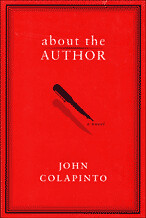
Mine is John Colapinto’s first (and, so far, only) novel, About the Author. What I said:
I read John Colapinto’s hilarious, propulsive, and gorgeously written About the Author in a single day almost exactly eight years ago, before the rise, demise, and resurrection of James Frey, when I knew next to nothing about publishing but had great expertise in planning to write and not writing. The novel’s narrator, Cal Cunningham, has also perfected this skill. A supposed wordsmith, he spends his days shelving books at a big midtown bookstore, nights going from bar to bar picking up girls and getting laid, and Sunday mornings filling his dull law student roommate in on his escapades. Our hero’s sense of superiority is shattered when he discovers that the roommate hasn’t been locked in his room typing tedious legal briefs but working on a novel, one that’s actually good, one that sounds suspiciously like Cunningham’s own life, so much so that when the roommate dies unexpectedly… Well, I’ve already said too much, but it’s a remarkable book, a confessional literary thriller that makes you care about its plagiarist narrator even as it reveals him to be a coward and a liar and satirizes the publishing and media world that exalts him.
On Saturday, Joan Acocella (author of the vampire essay, “In the Blood”) moderated the Vampires Revival panel. On board to speak were philosophy professor Noel Carroll, horror novelist Stephen King, vampire film director Matt Reeves, and Twilight screenwriter Melissa Rosenberg. A video preview of the panel discussion is embedded above.
Several dozen King fans waited outside the venue only to be disappointed by King’s unwillingness to sign books. As he walked away with his arms in the air, he told the crowd: “I can’t sign guys, I got to get something to eat.” Alas, just because he’s a “king” doesn’t mean he isn’t human.





 OR Books will publish an anthology focusing on income inequality within New York City called Tales of Two Cities: The Best & Worst of Times in New York. A portion of the proceeds will be donated to Housing Works.
.jpeg?picon=1639)
 I am now finishing “The Brief and Wondrous Life of Oscar Wao” by Junot Diaz. It is mesmerizing, but pretty taxing. In contrast to Olshan’s calm and matter-of-fact telling of Marshlands, Diaz’s storytelling is full of colorful language, historical footnotes (still told in a conversational tone) and current cultural references that crack me up, but also wear me out. It’s a sad sad story of one Dominican family and how they came to continue their lineage in the US showing us what it meant to live in the time of Trujillo and how long-lasting and far-reaching his dictatorship was. Diaz intersperses the story with Spanish phrases (that make me wish I paid more attention in Spanish during high school). Fortunately, my Spanish is decent enough that I can keep up without having to translate too much, and most of the phrases are easily understood in the context.
 As for my own books, well, I am finishing one project and then beginning another, both written by other authors. After that I will begin work on my first story where I am author and illustrator. This summer, alongside my making and reading, I will write as well. No ideas are bursting forth at the moment, but my mind is too focused on current projects to allow any other story ideas to bubble up. I am sure that once I finish this book, my mind will relax a bit.
 St. Mark’s Bookshop, a New York City-based independent bookstore, plans to move to a new location within the East Village neighborhood.
 The New York Public Library has revealed the 2013 Library Lions.
 Three short story writers, Dan Chaon, Claire Vaye Watkins and Junot Diaz, have been named
  Goodreads has opened up voting for the
  Junot Diaz, Dave Eggers, and Louise Erdrich led the list of fiction finalists for the National Book Awards this year.
 Novelists Junot Diaz and Dinaw Mengestu were among the 23 fellows
  What book are you most excited about this year? Over at Library Journal, Barbara Hoffert has published her annual “
 After a five year wait, Junot Diaz will release his second collection of short stories on September 11, 2012. Riverhead will publish the book, This Is How You Lose Her.
 Take some time today and head on over to author Cynthia Leitich Smith’s blog
  The Asian American Writers Workshop is celebrating its 20th anniversary by hosting the third annual Page Turner literary festival. The all-day event will take place on Saturday, October 29th at Brooklyn’s powerHouse Arena.