



“Mediocre writers borrow. Great writers steal.” T. S. Eliot
A couple of recent articles by writers have made me think about the process of writing and the question of theft in writing. I’m often asked the question, “Where do you get your ideas from?” I’m pretty sure every writer gets asked this question at some point in time.
My imagination is pretty vivid, I would usually respond. So when I hear a story, or a piece of news, or someone relates an incident that has happened to them, I store it away – to perhaps use one day. My imagination will usually do the rest, amplify it, alter it, assign it to a character, incorporate it into a story line, perhaps even make it the whole crux of a plot. As William S Burroughs said, “All writing is in fact cut-ups. A collage of words read heard overheard. What else?”
 I’m not sure anyone would really call it theft or stealing – unless you ‘borrow’ whole sentences or paragraphs, and that’s a whole different blog! What makes stories relevant, individual and original is how the source of inspiration is used and manipulated by writers. If a number of writers are asked to use the same news item as the inspiration for a story, you can be assured that it will result in several very different stories. I ran a creative writing workshop last week where I gave fifteen students the same opening sentence. By the end of the session, each of the students had taken that sentence and continued it into a whole variety of stories ranging from ghost stories, adventure, romance, fantasy and science fiction. In Jean-Luc Godard’s words: “It’s not where you take things from—it’s where you take them to.”

In a recent essay describing his creative process, Ian Fleming, said that many of the scenes in his books are drawn from real incidents that he “dolled up, attached a hero, villain and heroine to, and there was the book.”
He may have over-simplified it, but perhaps not – he used to write the first draft of a story in six weeks, which is pretty astounding. Here’s a link to the rest of his essay. It’s an interesting read. http://www.mi6-hq.com/sections/articles/literary-ian-fleming-how-to-write-a-thriller?t&s&id=03763
 My writing process has come under pressure these past few months, and my motivation and staying-power is not quite what it used to be. I’ve tried working in different places and at different times, but I have felt stuck. October is the month that that will all change. Or, at least, that’s what I’ve told myself. Fleming had a tropical island hideaway where he wrote, uninterrupted, 2000 words a day. I may not be in the fortunate position to be able to fly away to Jamaica and work four solid hours a day so that at the end of just six weeks I could have a first draft of 60,000 words under my belt, but I’m damned well going to try and get the current work in progress from draft to manuscript.
Viewing: Blog Posts Tagged with: the craft of writing, Most Recent at Top [Help]
Results 1 - 25 of 113
.jpg?picon=1806) By: Savita Kalhan,
on 10/4/2014
By: Savita Kalhan,
on 10/4/2014
Blog: An Awfully Big Blog Adventure (Login to Add to MyJacketFlap)
JacketFlap tags: T. S. Eliot, Savita Kalhan, inspiration, the craft of writing, Ian Fleming, Add a tag
.jpeg?picon=2049) By: Robin Constantine,
on 4/21/2013
By: Robin Constantine,
on 4/21/2013
Blog: The Paper Wait (Login to Add to MyJacketFlap)
JacketFlap tags: The Promise of Amazing, YA, The Craft of Writing, Robin Constantine, Add a tag
Years ago I had the opportunity to hear Anne Lamott speak. A friend in my critique group happened to have an extra ticket for her lecture and I JUMPED at the chance to listen to one of my favorite authors discuss the writing process. I don’t quite remember the venue, suffice to say a large, old, theater/auditorium somewhere in mid-town Manhattan, and I’d be hard pressed to come up with an exact quote, but I remember nervously handing Ms. Lamott my copy of Bird by Bird, and squeaking out something that was supposed to sound like thank you as I scuttled away. I do remember laughing a lot as she talked about her process. And I do remember leaving inspired to dive into my own writing.
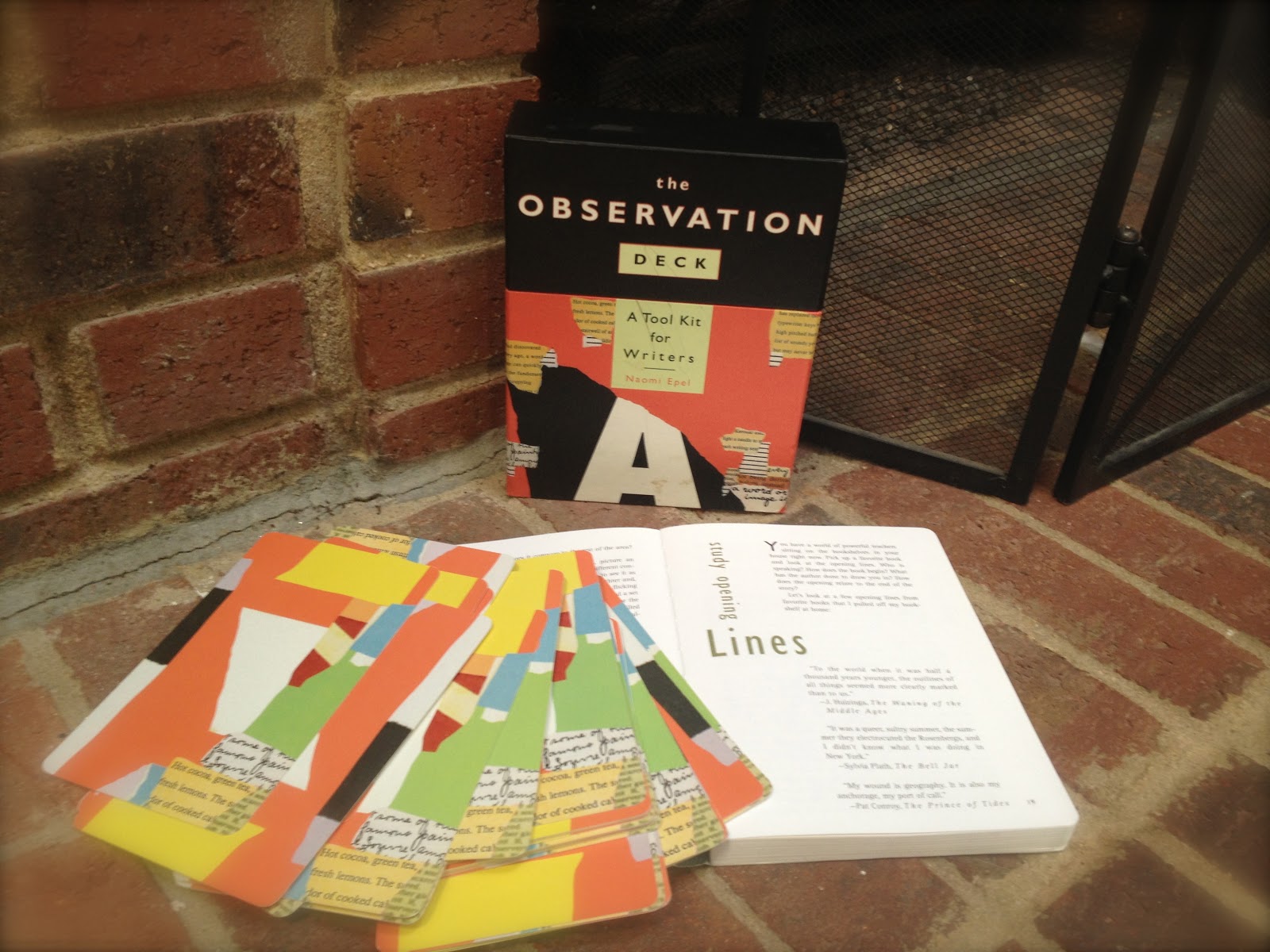
One of the writing tricks/tools that Ms. Lamott spoke about that day was The Observation Deck – A Tool Kit for Writers by Naomi Epel. I may have ordered it that night when I got home, but I think if Anne had said that it was important to eat artichokes and hop on one leg for ten minutes before sitting down to write, I probably would have done that too. (So glad she didn’t recommend that, btw.)
The Observation Deck is a handy-dandy deck of cards that can inspire you to action when you’re feeling stuck or just in the mood for a nudge in any direction. For instance, I just drew a card that reads “Study Opening Lines” – this one is pretty self explanatory, but if you need to dig deeper you can turn to the corresponding book to look up the meaning of the card. The gist of this card is that “You have a world of powerful teachers sitting on the bookshelves in your house right now…” and goes on to give examples of famous first lines from novels and how they resonate with readers. And now I bet you are thinking of some of your favorite first lines of novels, maybe even revisiting the first sentence of your own WIP and wondering how you can make it pack a punch. See? All from a card that helped you think about something different. And sometimes, that’s all we need.
A few summers ago, I turned to The Observation Deck when I was trying to decide what direction to take with my new WIP. I’d been toying with the idea of writing a story about a shy girl who is suddenly thrust into the spotlight after she saves someone. My character was whispering to me at that point and I couldn’t find the inspiration to get the engine started. The card I picked was “Combine Elements” – take two totally different ideas and put them together and see what happens. I’d had this other story in my brain too – about a teenage thief who wanted to reform his ways – but I’d never written from a male POV before and I just didn’t know where I was heading even though that particular character was practically screaming in my head.
So…I put them together.
What if shy girl saves teen thief and he sees that as his opportunity for a second chance? What if they fall in love? What if just when things seem to be changing his past comes back to haunt him and threatens their relationship? That was the day Wren met Grayson…and the day my 2014 debut novel THE PROMISE OF AMAZING was born. Maybe I would have eventually put the two together, but drawing that “Combine Elements” card made it feel like putting those characters together was no big deal and if I wanted to change it up at some point, no harm done. Of course the story evolved a lot from that first seed, but I’m so glad I pulled that card that day, and continue to include The Observation Deck in my little bag o' writer tricks.
So how about you? What are some of your favorite tools/tricks to help you along in your writing process?
By: Ariel Zeitlin Cooke,
on 4/15/2013
Blog: The Paper Wait (Login to Add to MyJacketFlap)
JacketFlap tags: character, The Craft of Writing, Ariel Zeitlin Cooke, Add a tag
I despise a story with weak characters. No matter how many car races or love-stories the author throws in, a novel is boring unless it centers around vivid, interesting characters who are changing and growing in unexpected ways to respond to their situations--or sometimes resisting change and growth, like Scarlett O'Hara in GONE WITH THE WIND. I loved Katniss Everdeen in HUNGER GAMES for defying the Capitol to protect her sister. Though mostly I hated Bella Swan in TWILIGHT for being so passive and whiny, at least she had the guts to love a vampire.
Young adult literature is so particularly compelling partly because kids by their very nature are always changing and growing and on cusp of such critically important changes. They are constantly being forced to make choices about their own characters. As GraceAnne diCandido, my literature instructor at Rutgers used to put it, the central question of a young adult novel is "Who am I and what am I going to do about it?"
How do you create your own unforgettable characters? Or is there a character in recent literature that you find especially compelling?
By: Sharon Wildey Calle,
on 4/10/2013
Blog: The Paper Wait (Login to Add to MyJacketFlap)
JacketFlap tags: inspiration, The Writer's Life, The Craft of Writing, writers on writing, The Challenge of Writing, Sharon Wildey Calle, Add a tag
 |
| Sharon Wildey Calle |
After a week's vacation in the "Land of Enchantment" (New Mexico), I have come home inspired and ready to write.
My only challenge... How do I recreate the diverse and magical spirit of this environment as a setting for a story?
Literature has long been inspired by place. The Grapes of Wrath, Gone With the Wind, To Kill a Mockingbird- each of these transports us to a very specific time and environment.
Much is involved in scene setting. To give a true sense of place, one must incorporate the following: physical environment, people, culture, language, and history. It is challenging to not let your setting interfere with (or upstage) your plot. It must be seamlessly woven in between your characters' actions and dialogue.
As I sort through my photos, maps, and free brochures, I think of the people I met, the cultures I experienced, the landscapes I hiked through. I'm not ready to resign my memories to a scrapbook or picasa gallery just yet.
But I am ready to share this adventure through storytelling.
What are some of the ways you incorporate a sense of place into your writing?
Are there certain children's books/authors that you feel do this exceptionally well?
By: Ariel Zeitlin Cooke,
on 3/17/2013
Blog: The Paper Wait (Login to Add to MyJacketFlap)
JacketFlap tags: inspiration, fantasy, The Craft of Writing, Ariel Zeitlin Cooke, Add a tag
The best fiction is like a pyramid mostly submerged in water; only the very top pokes above the page but it must give us the sense that we will find a solid, three-dimensional creation no matter how far down we dive to explore it. This is true whether you're writing about aliens with three genders and lavender tentacles, twelfth-century Scots clansmen in kilts, or just a bunch of kids hanging out behind a 7-11 in Cranford, NJ.
The question is, how far do you have to go to create that sense of reality, of faithfulness? 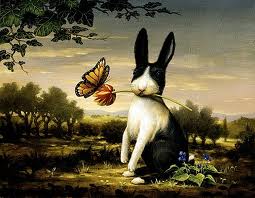
When it comes to research, no one could say I'm a shirker. My WIP is a fantasy novel based on Jewish folklore, so for years now I've been reading everything from the Biblical books of the Prophets, medieval wonder tales, the novels of Isaac Baashevitz Singer, Hasidic tales of the Holocaust, collected Jewish folk tales and Apochrypha, scholarly treatments of ancient Jewish magic and the like.
But now that I've gotten my characters to my fantasy world, I'm having trouble imagining myself there and I couldn't figure out why...until I read Jane Yolen's wonderful essay, Turtles All the Way Down (first published in Writing Fantasy and Science Fiction, edited by Isaac Asimov and published by St. Martins Press in 1991). The prolific Yolen, no slouch at building worlds herself, suggests that we base our fantasy worlds on landscapes we know intimately. "In fantasy, outer landscape reflects inner landscape…. If the place is real enough, then the fantasy creatures and characters--dragon or elf lord or one-eyed god or the devil himself--will stride across that landscape leaving footprints that sink down into the mud. And if those creatures are also compelling, having taken root in the old lore and been brought forward in literary time by the carefully observing author, those footprints in the mud can be taken out, dried, and mounted on the wall."
How do YOU make your writing come to life? How do you build a world?
By: Sharon Wildey Calle,
on 3/10/2013
Blog: The Paper Wait (Login to Add to MyJacketFlap)
JacketFlap tags: inspiration, Critique Groups, Writer's block, The Writer's Life, The Craft of Writing, writers on writing, resources for writers, The Challenge of Writing, Sharon Wildey Calle, Add a tag

- If an idea excites you, go with it.
- Be open to revision, and then be courageous and submit!
- Reach out, make friends, and support other writers.
By: J.A. Palermo,
on 3/1/2013
Blog: The Paper Wait (Login to Add to MyJacketFlap)
JacketFlap tags: The Craft of Writing, J.A. Palermo, The Challenge of Writing, Add a tag
Confession. I'm a victim of the Palmer Method. I went to Catholic School and learned to write cursive in those notebooks with the dotted lines through the center. I spent many an hour looping my ds, ps, and qs to just the right height, my wrist never touching the desk. Somewhere along the line, I rebelled, and now even I have a hard time reading my scrawl.
But that doesn't stop me from filling up notebooks.
Recent circumstances have led me to a block of time here, a block of time there, and a lot of travel in between. Firing up a laptop became cumbersome and my writing time dwindled. I knew I needed a different approach, so I went back to basics. Marble notebooks.
I bought one in hot pink for my WIP. It makes me happy to open it up and write in it. It's completely portable and I'm finding a different connection to my writing in putting pen to paper. Typing up my scrawl a day or two later gives me another opportunity to add emotional depth and description I missed in my first go round.
I'm liking this notebook thing.
Anybody else out there going Luddite on their drafts?
Photo credit: npclark2k from morguefile.com
By: Gale Sypher Jacob,
on 2/16/2013
Blog: The Paper Wait (Login to Add to MyJacketFlap)
JacketFlap tags: Digital Publishing, The Craft of Writing, Gale Sypher Jacob, writers on writing, Add a tag
 Mo Willems and his pigeon. Smile material. Masterful picture books!
In 2011, Mo was invited to give the prestigious Zena Sutherland Lecture. He titled his talk "Why Books?"
Here are some highlights:
"Always think of your audience; never think for your audience."
"If I re-read one of my manuscripts and I understand exactly what is happening, then the manuscript has too many words. And if I look at the images without the words and I can fully understand the story, there are too many drawings."
On enhanced digital books: ". . . after we turn them on, they don't need us. Turn it on and leave the room, and the book will read itself."
On real books: "But a real book is helpless. It needs us desperately. We have to pull it off the shelf. We have to open it up. We have to turn the pages, one by one. We even have to use our imagination to make it work. . . . So maybe books work because they make us work. Maybe we need them for needing us, just like we need real friends, not the digital imitations on Facebook."
Well said. Do you agree?
Photo credit: Marty Umans
By: J.A. Palermo,
on 2/1/2013
Blog: The Paper Wait (Login to Add to MyJacketFlap)
JacketFlap tags: The Craft of Writing, J.A. Palermo, writers on writing, The Challenge of Writing, Add a tag

Like many writers, I suffer from a dreaded writerly disease: trying to write it right the first time. I agonize over sentence structure, search my thesaurus for the perfect synonym, and doubt every plot line.
So when I came across this New York Times Magazine Article that reminded me how important it is to be wrong -- and "to be wrong as fast as you can," I considered once again how overrated right is. In the article, Hugo Lindgren reviews a list of ideas he's had throughout the years and wonders why he hasn't written them. He recounts a Charlie Rose interview with Pixar's John Lasseter:
Pixar’s in-house theory is: Be wrong as fast as you can. Mistakes are an inevitable part of the creative process, so get right down to it and start making them. Even great ideas are wrecked on the road to fruition and then have to be painstakingly reconstructed. “Every Pixar film was the worst motion picture ever made at one time or another,” Lasseter said. “People don’t believe that, but it’s true. But we don’t give up on the films."
We've all heard it a million times -- the stories of successful writers slogging through page after page of mediocrity, never giving up. And that is the real difference between success and failure. Never giving up.
So as I finish what I hope is my last major revision of this novel, I'll welcome making mistakes that can be fixed. I'll keep my eye on the light at the end of the tunnel and take the express.
By: Julie Whelan,
on 1/23/2013
Blog: The Paper Wait (Login to Add to MyJacketFlap)
JacketFlap tags: The Craft of Writing, writers on writing, resources for writers, Julie Whelan, Add a tag

I picked up a great tip on this recently. Use your critique partners – not just for review, but for breaking through plot bottlenecks.
Try this exercise: set the stage (your MC had a huge fight with her best friend), and ask your critique partners what might happen.
Wait for the first answer (she storms off and refuses to
Remember: “Your main character is not your best friend.” You are not only allowed to put this ‘person’ into uncomfortable situations, you are supposed to. That’s your job.
By: Ruth Symes,
on 1/20/2013
Blog: An Awfully Big Blog Adventure (Login to Add to MyJacketFlap)
JacketFlap tags: a writer's life, series fiction, the craft of writing, vegan, the business of writing, Ruth Symes, Megan Rix, Add a tag
5 Misconceptions I used to have about writers and writing:
Now I know that most writers barely make a living from their work - so cash-wise they're poor.
But they're also rich: Rich in having time to do the thing they love, the pleasure of knowing they're doing work that their innermost core calls them to do, flexibility of working space and flexibility of working hours.
2. I used to think a writer could write anything they wanted.
But I soon found out if you want to be published by a regular publisher you need to take into account the word count publishers are looking for (especially for younger readers) and if you want to use your writing to express your ideals and be published by a regular publisher its better to do this subtly. (Of course with e-boooks you can do what you like!)
 |
| Bella Donna's favourite meal |
My first book published was very close to my heart and expressed my life view and because it got published relatively easily I thought I could do that all the time - but my manuscripts then started to turn a bit crusader-ish and got turned down. I still want to share what I believe in but I put it within a fun story. My Megan Rix books are all about how amazing I think animals are. In November I took part in the World Vegan Month and blogged for Animal Aid. I realised that my characters in the Bella Donna books (apart from the cats) only ever eat vegan or vegetarian food - and that's how I'd like to be (I count myself as a nearly vegan as I can't always manage it.)
 |
| is Munchkin |
3. I used to think once your first book was published it'd be plain sailing.
Hohoho! How wrong could I be. But not having my second or third novel manuscripts published was the best thing that could have happened because it meant I learnt to diversify and write for a range of ages and media and publishers rather than just one slot.
4. I used to think the writing life was easy.
 |
| Risotto |
5. I used to think you needed an agent.
But that isn't true. I think I'm up to my fifth agent now - one for children's books and one for adult non-fiction. I like having an agent because it lets me have more time to write and also gives me professional back-up, editorial help, sorts out my contracts and makes sure my finances are in order. But my first three books were published without having an agent so it isn't always true (and certainly not true now when you can publish yourself.)
What misconceptions did you have or maybe you went into writing with your eyes wide open - and if you did then good for you!
Ruth Symes website is Ruthsymes.com and her Bella Donna website is Belladonnaseries.com
She also writes as Megan Rix and her latest book 'The Great Escape' has been shortlisted for the East Sussex Children's Book Award.
By: Sharon Wildey Calle,
on 1/13/2013
Blog: The Paper Wait (Login to Add to MyJacketFlap)
JacketFlap tags: inspiration, The Writer's Life, The Craft of Writing, writers on writing, resources for writers, The Challenge of Writing, Sharon Wildey Calle, Add a tag
 |
| Peter Pan Illustration by Kathleen Atkins |
By: J.A. Palermo,
on 12/1/2012
Blog: The Paper Wait (Login to Add to MyJacketFlap)
JacketFlap tags: Humor, Writer's block, The Craft of Writing, J.A. Palermo, The Challenge of Writing, Add a tag

I like to inject a fair amount of humor into my work. I don't write a lot of slapstick or ROTFLMAO stuff, but I hope my readers are giggling frequently. Lately, due to some personal circumstances, I've had a hard time writing at all, let alone writing funny.
I needed a way to combat my writing inertia and get me and my characters out of their gloom. So I invented a writing exercise. At least, I don't know of anyone else who has done this before. Oh, except maybe Second City and other improvisational acting troops.
So here's what I do when the funny is missing.
I put my characters in ridiculous situations and see what happens. Like an audience calling out ideas to an improv troop, I don't spend a lot of time thinking of circumstances. I work with any idea that pops into my head and go for it. I'm not looking to use what I write in my novel, I'm just trying to make myself laugh -- at my characters or with my characters.
My MC has tripped into a ring at a three ring circus and found himself face to face with a lion. He and his love interest witnessed a nun boost some cash from the poor box and followed her around town as she made some purchases. His entire group of friends spent the night in one hotel room -- oh, wait, some of that may end up in the novel.
The point of this exercise is to relax and be silly. No one has to see it but me. Unless, like Julie said in her last post, I save it for some added value down the road.
 By: Melinda Meister,
on 11/5/2012
By: Melinda Meister,
on 11/5/2012
Blog: The Paper Wait (Login to Add to MyJacketFlap)
JacketFlap tags: The Craft of Writing, Add a tag
All of you, I'm sure, have read a book so exquisitely crafted that at the story's end the main character seems to be shadowing you. You feel like asking him to sit down and tell you more. This can't be all, you say. I just finished "Old Filth," a highly praised 2005 novel by British writer, Jane Gardam. It could easily be a young adult book, so I'll use it as the subject for my comments. Gardam's work encompases Edward Feather's long life, starting at the end, then switching to the beginning, with his birth in Malaya, then to his miserable seven-year old existence in Wales, then to teenage years, back and forth, each chapter revealing a piece of the puzzle Feathers was. Nevertheless, it is a perfect page turner; only in the last pages of the novel are the multitude of mysteries that make up Feather's life resolved. What I'm sure Gardam did prior to writing was to create a very thorough biography (not just a character sketch) of Edward Feathers, and probably biographies of all the story's characters. Her meticulous character development paid off. I'm afraid I have been careless, writing and hoping my characters catch my reader's attention with minimal effort on my part. I could improve. Vastly.
 By: Melinda Meister,
on 10/4/2012
By: Melinda Meister,
on 10/4/2012
Blog: The Paper Wait (Login to Add to MyJacketFlap)
JacketFlap tags: The Craft of Writing, Add a tag
"He's such a character," someone says. Well, aren't we all? Or are we? Some fictional characters seem to have stepped out of real life right into the book. They are made to order for an exciting story. The writer has only to change their name. Other people in real life are so dull they couldn't even make it into a newspaper story. How does a writer construct a character? Does she, like Laura Ingalls Wilder, develop sweet, charming characters out of three or four people in her life? Or like Carl Hiaasen, does she create bizarre characters that emerge from the Florida Everglades like alligators with a bad attitude? Characters drive the story. If a reader doesn't fall in love with them or find them creepy, or frightening, or funny, or thoroughly distasteful, he'll drop the book and log on to Facebook. Lots of characters there.
 By: Liz Kessler,
on 10/3/2012
By: Liz Kessler,
on 10/3/2012
Blog: An Awfully Big Blog Adventure (Login to Add to MyJacketFlap)
JacketFlap tags: editing, Liz Kessler, plotting, the craft of writing, Add a tag


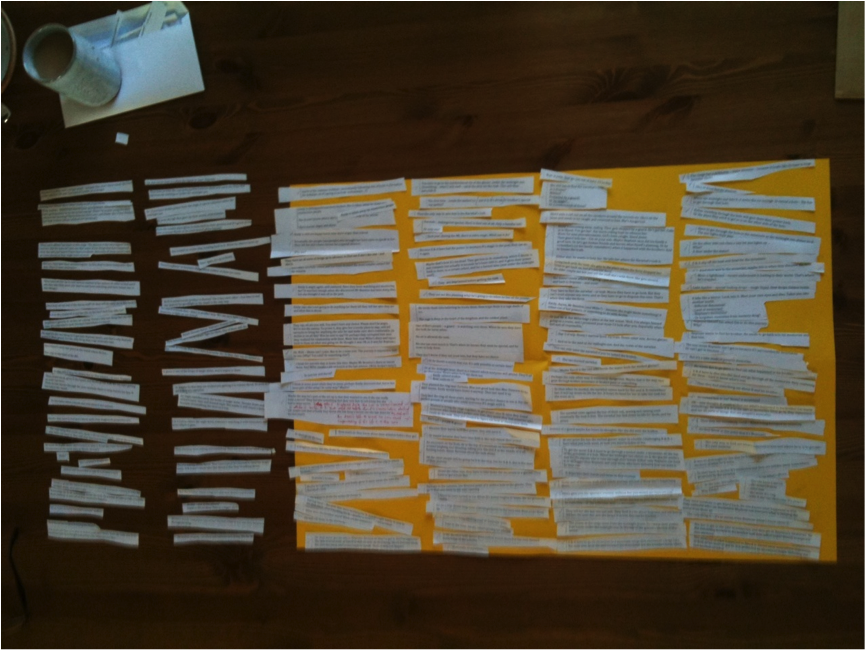


Bear in mind – not every page ends up looking like this! But quite a few of them do. Sometimes it can be quite a job figuring out how to type up all the changes I’ve made, as there are so many squiggles and arrows and numbers that all made perfect sense when I was writing them but take a bit of imagination to unravel later! Other pages just have smiley faces on them or things like ‘Ooh lovely!’ or ‘I like this!’ That’s because my editor is really, really nice as well as really clever!
 By: Robin Constantine,
on 9/20/2012
By: Robin Constantine,
on 9/20/2012
Blog: The Paper Wait (Login to Add to MyJacketFlap)
JacketFlap tags: YA, Humor, The Craft of Writing, Robin Constantine, Add a tag

I was impressed because I don't remember learning something so fun in my own fourth grade class. I remember doing a report on the natural resources of Alabama.
But then I thought, is this really the right lesson for a writer?
Said gets a bad rap, doesn't it? Use it too much it gets redundant and boring. Don't even think of spicing it up with an adverb (shudder) because the literary police will actually come knocking on your door and ticket you for lazy writing. "Then of course there are using other words in its place," she scoffed.
Just the other night I had a conversation with my daughter that went something like this...
G - "Mom, what's another word for said?"
Me - "What do you mean?"
G-"You know, what can I use instead of said?"
Me - "Um, hmm, well, you see..."
No, really, try and answer that question easily. It wasn't that I was stumped, but I had to ask her what was going on in the scene. And then suddenly I was getting into dialogue mechanics* and the tone of the scene and what point did she want to get across and really all she wanted to do was finish her work, watch some Phineas and Ferb and then go to bed herself.
To be clear, I don't have a problem teaching fourth graders to find different words for overused ones. I get it. This is for creativity, not creating a Printz-worthy masterpiece. It expands their minds, makes them think. As I revised some of my own writing this week, that little phrase kept going through my head. And while I didn't put said to bed on every page, I did give it some warm milk and made the suggestion on quite a few. The result was tighter, more concise dialogue.
Maybe not a bad lesson for writers after all.
So how about you? Do you have trouble putting said to bed?
*For a great lesson on dialogue mechanics and the word said please refer to the book Self-Editing for Fiction Writers by Renni Browne and Dave King.
 By: Julie Whelan,
on 9/16/2012
By: Julie Whelan,
on 9/16/2012
Blog: The Paper Wait (Login to Add to MyJacketFlap)
JacketFlap tags: The Writer's Life, The Craft of Writing, The Challenge of Writing, Julie Whelan, Picture Books, Add a tag
In our village in Ireland this summer, a 58 foot fin whale swam into our harbor, settled in to a corner where shore meets pier and rested in shallow water. The chest-high cement wall along the pier overflowed with villagers craning their necks to see over and down towards the water below.
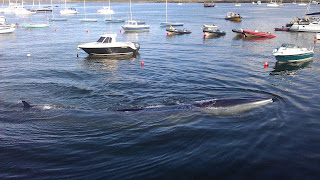
With her nose into the apex of cement walls, able to submerge just inches beneath the surface, she rose and blew, spraying seawater from her blowhole and puffing every few minutes. It was a fascinating spectacle. How often can you watch a whale, and see its face, with protruding gray balls for eyes, and a white horseshoe mouth bigger than my kitchen, up close, for hours on end?
Sadly, it was soon apparent that our whale friend was not well.
Muddy red water let everyone know that Fineena, (Irish for ‘beautiful child’, the name dubbed her by locals) was bleeding internally. No one, not the veterinarian, the whale specialist, nor the fishermen could help. This was real life, not a children’s story. Fineena lay ill for three days before dying, enduring tidal shifts which left her slick black skin half exposed above the water, scratched ragged from a gale-force storm which tossed her helplessly against the cement pier and rocky bottom.
Simultaneously macabre and inspirational, from a writer’s point of view, I wonder where I should take this story. Children’s reactions were as varied as their accents. One teenage boy broke into tears. Others watched wide-eyed with obvious questions. Some just accepted it, with “That’s nature.”
Can I use this emotive experience to write a happy picture book ending for Fineena? Can I use the powerful death scene I witnessed in a middle grade novel and how? Her behavior brings up so many questions and infinite story possibilities. Why did she choose our village as her final resting place? Why not the shallow creek where the seal colony lives, or another of the limitless, uninhabited coves nearby? Fineena swam past hundreds of boats with low keels, their thick-roped moorings stretching from the water’s surface to the bay floor, creating an underwater maze. How did she manage to cause no damage? Why was she so determined – was it something about the echo of human voices across the water?
I wrote my initial impressions as the story unfolded. When I look back at that draft, I am struck by the richness of detail and emotion, and authenticity. The voice, using the point of view of the whale, is much more powerful than my remote efforts. So writers, you’ve heard it before: write it down, right away! Take copious notes. It matters. Readers will feel it.
I don’t yet know what my final choice will be for the story, but it feels like a story worth sharing.
 By: Melinda Meister,
on 9/4/2012
By: Melinda Meister,
on 9/4/2012
Blog: The Paper Wait (Login to Add to MyJacketFlap)
JacketFlap tags: The Craft of Writing, Add a tag
In an attempt to understand how to handle plot, back story and character development, I am rereading Carl Hiaasen's books for children: "Hoot," (Newbery Award,2003) "Flush," "Scat," and "Chomp." There are three elements common to his work. One, the main character, always a decent kid, is confronted by a problem or challenge developing either from a family or school situation. He immediately elicits reader sympathy as he moves to solve the problem by himself, often against overwhelming odds. Parents and adults are present, but they are often feckless or have their own problems, or, are sometimes part of the problem. The main character loves and respects his parents but does not ask for their help. He is often protective of them. Supporting characters are edgy, weird and raunchy, definitely "over the top." Second, the plot moves quickly from the first chapter, often from the second page, and there are several threads, all connected with the main plot. As one plot solution develops, another problem arises, and another, until the final solution is reached. The bullies are "taken out," but they return again and again to attack the main character. Third, back story is inserted sparingly and intermittantly, often in a short paragraph, always from the protagonist's point of view. It is rarely presented in dialogue. Hiaasen's books feature south Florida environmental issues, and additional information is always necessary. It is done so well, the reader scarcely realizes he is reading it. I think these three points alone make Hiassen's work appealing to middle graders...and obviously to the Newbery Award Committee.
 By: Robin Constantine,
on 8/19/2012
By: Robin Constantine,
on 8/19/2012
Blog: The Paper Wait (Login to Add to MyJacketFlap)
JacketFlap tags: YA, The Craft of Writing, Robin Constantine, Add a tag

The ladies I was with apparently. As the credits rolled, more than a few of them thought our choice for movie night was entertaining but somewhat cheesy.
Oddly enough, I agreed.
For me, what had been magical on the big screen came across as slightly unbelievable and forced in my friend’s living room. But what had happened? Maybe since I wasn’t distracted by the larger than life gorgeous scenery and hot buttered movie popcorn, I had the chance to dissect the plot? Was my mood different? Or was I affected by my friends reactions? I’m not entirely sure but the question that remained with me, especially as a romance writer, is how do you let a character express their feelings without making it seem cheesy or forced?
Romance is different to all people, isn’t it? What may come across as mawkish to one person might ring true to someone else. If I’m writing something from the heart and a person deems it cheesy – does that mean I'm trying too hard? Or is it just a matter of opinion? And the bigger question is this – if the literary world can accept dystopian societies where kids fight to the death, angels and demons battling over doomed love, and any number of dead girls reflecting on their life who are given the chance to make it better - why is the act of falling in love and forging a relationship so hard to believe?
Are we all just too cynical for a dose of cheesiness now and then?
 By: Melinda Meister,
on 8/4/2012
By: Melinda Meister,
on 8/4/2012
Blog: The Paper Wait (Login to Add to MyJacketFlap)
JacketFlap tags: The Craft of Writing, Add a tag
I am considering further revision of a book I wrote some years ago. Well, that's a lot of time to think of changes. One of the problems with the novel is that I had placed the story in a contemporary setting. Each time I revised the manuscript, technology, such as phones, fax machines, cell phones, cars, and all their possibilities had changed, and I had to bring the manuscript up to date, leading to other changes, ambiguities and incongruities, etc., etc. I think in my next revision I will place the story in 1980, and by doing so, eliminate some of these stumbling blocks. Now, in your opinion, will this make it a historical novel?
 By: Gale Sypher Jacob,
on 6/16/2012
By: Gale Sypher Jacob,
on 6/16/2012
Blog: The Paper Wait (Login to Add to MyJacketFlap)
JacketFlap tags: The Craft of Writing, Gale Sypher Jacob, Add a tag
In "My Life's Sentences" a brilliant article about writing, (New York Times, 3/18/12) Jhumpa Lahiri claims: "They (sentences) remain the test, whether or not to read something. The most compelling narrative, expressed in sentences with which I have no chemical reaction, or an adverse one, leaves me cold." So what sort of sentence keeps the reader hooked?
"Certain sentences breathe and shift about, like live matter in soil. The first sentence of a book is a handshake, perhaps an embrace. Style and personality are irrelevant. They can be formal or casual. They can be tall or short or fat or thin. But they need to contain a charge. A live current, which shocks and illuminates ... Sentences are the bricks as well as the mortar, the motor as well as the fuel. They are the cells, the individual stitches. Their nature is at once solitary and social. Sentences establish tone, and set the pace."
How does Jhumpa Lahiri create the sentences in her fiction? "After an initial phase of sitting patiently, not so patiently, . . . they begin arriving fully formed. . . I hear sentences as I'm staring out the window, or chopping vegetables. They are pieces of a jigsaw puzzle, handed to me in no particular order."
Later, they are "sorted, picked over, organized, changed. Most will be dispensed with. All the revision I do - and this process begins immediately, accompanying the gestation - occurs at the sentence level. It is by fussing with sentences that a character becomes clear to me, that a plot unfolds. . . As a book or story nears completion, I grow acutely, obsessively conscious of each sentence in the text. Each sentence is "confronted, inspected, turned inside out."
Does her writing process seem unusual? Or do you also work this way?
 By: Melinda Meister,
on 6/4/2012
By: Melinda Meister,
on 6/4/2012
Blog: The Paper Wait (Login to Add to MyJacketFlap)
JacketFlap tags: The Craft of Writing, Add a tag
"Tt was a dark and stormy night." This opening line in Bulwer Lytton's "The Last Days of Pompeii," is considered a literary joke. For years the sentence has been used as an example of how not to open a novel. Today one must start in the middle of the action. Hook the reader, expecially the younger reader. No more scene painting. Description is to be used like salt or vinegar. Sparingly. I'm not so sure I agree with this. Wouldn't a good opening paragraph with time, place, weather, scenery, be beneficial to the reader? Guess not. Like a TV viewer surfing channels for an eyecatching flick, the young reader wants the first line to pull him in. "Lights, camera, action" works best. So I've been examining my manuscript for the eyecatcher. Apparently it is not a teenage farm girl in front of a hot stove. Guess I have to trot out the dead body a little earlier.
 By: Julie Whelan,
on 5/25/2012
By: Julie Whelan,
on 5/25/2012
Blog: The Paper Wait (Login to Add to MyJacketFlap)
JacketFlap tags: The Craft of Writing, writers on writing, The Challenge of Writing, Julie Whelan, Add a tag
This year I have made progress on several projects, although I haven’t written as much as I intended. As the summer looms, and the inevitability of children rushing through my house all day approaches, I realize I will get even less done each day than I do now. How can I write more, and write it faster?
Many authors measure their progress in words per day. This doesn’t seem to work for me. I need to be a more ‘effective writer.’
 By: Robin Constantine,
on 5/21/2012
By: Robin Constantine,
on 5/21/2012
Blog: The Paper Wait (Login to Add to MyJacketFlap)
JacketFlap tags: YA, The Craft of Writing, Robin Constantine, Add a tag

lip biting,
breath-catching,
heart-thumping kisses,
and wonder where am I going wrong?
See, my first kiss was amazing. No awkward nose-bumping, no fumbling. He was the boy next door (okay, not right next door, but close enough), two years older and suffice to say, had skilled lips. Being kissed by someone with experience was like getting a hit of the most delicious, pleasure-inducing drug imaginable. If I'd only known the side effects - confusion (Does he like me?)...despair (Why is he ignoring me?)...desire (When can we do that again??!!)...I would have run in the other direction.
Yeah, right. A kiss in NOT just a kiss for me. It's a life altering experience.
And so began, as kd lang sings, this constant craving for those yummy feelings that come with the territory. Romance - even just the hint of it - is an essential part of a book for me. And it's part of who I am as a writer. Most stories I've written have some element of l'amour in them. Does that make me a sap?
Over the years, some of the most biting editorial remarks I've received regarding my writing have included words like "melodramatic" and "cheesy" - yeah, ouch. My cheeks are reddening as I type this. Not exactly buzz words you want on your jacket flap.
So Paper Waiters, I know there's a fine line between true romance and mawkish romance, but how do you know when you've crossed it? What are some good, contemporary YA romances that have gotten it right?
*photo credit Alfred Eisenstaedt (photographer of The Kiss)

View Next 25 Posts
I don't have a favorite tool now, but it sounds as though I should buy the OBSERVATION DECK toute suite! Thanks for alerting us to a potential game changer.
Great post, Robin. In addition to OBSERVATION DECK as a tip, I think you've got another very important tip in there: "drawing that “Combine Elements” card made it feel like putting those characters together was no big deal and if I wanted to change it up at some point, no harm done."
To me, that is one of the most important writing tips. There is no harm done by writing something. I think that fear stops so many people. Don't be afraid to write the wrong thing. That is what new files are for.
Thanks for sharing an exciting resource, Robin! The OBSERVATION DECK sounds very helpful! Combining elements can definitely be exciting. So wonderful that you drew a card that set you on the track to writing THE PROMISE OF AMAZING!
I think my favorite trick is just the simple writing question, "What if?" For me, that question can sometimes jump start an idea.
I love Anne Lamott too and I will look for the Observation Deck. Combining Elements is a great idea. I also use the 'what if' exercise. Sometimes I play the 'why' game with myself -- why would a MC, or even a person on the news, or a character from history, do something? It spins off ideas for me.