Pondering about the mix and match of traits that make her who she is, Janet Wong writes:

Face It
My nose belongs
to Guangdong, China–
short and round, a Jang family nose.
My eyes belong
to Alsace, France–
wide like Grandmother Hemmerling’s.
But my mouth, my big-talking mouth, belongs
to me, alone.
Hurray for Janet’s “big-talking mouth”, which has given us many wonderful words such as these to savor! You can listen to Janet telling stories and reading her magical poems here.
Poetry Friday today is being hosted by Anastasia Suen at Picture Book of the Day.
This time last week, poet Janet S. Wong allowed me to share her poem, “The License Plate Game” in honor of the first minting of license plates in the U.S. However, not only did she allow me to post her poem, she encouraged me to share SEVEN different versions of the poem she had contemplated. Then several of you responded with interesting observations (Emily, Cloudscome, and Linda). Well, to top it off, Janet invited some of her poet-friends to comment on the different versions and and several took her up on her offer, including J. Patrick Lewis, Lorie Ann Grover, Rebecca Kai Dotlich, Marilyn Singer, Alice Schertle. Check out the comments area for April 25, 2008. Finally, Janet offered yet another revision of her poem based on all this collective input (posted in the Comments area). HOW COOL IS THAT?

And just for fun, I’ll post a fresh poem by Janet from an older collection I love (A Suitcase of Seaweed) .
Poetry
by Janet S. Wong
“What you study in school?” my grandfather asks.
“Poetry,” I say, climbing high to pick a large ripe
lemon off the top limb.
“Po-tree,” he says, “It got fruit?”
From Wong, Janet S. 1996. A Suitcase of Seaweed, and Other Poems. New York: Margaret K. McElderry Books, p. 18.
Thank you, Janet, for all you do for poets and poetry and kids!
For the rest of the Poetry Friday Round Up, go to Big A, little a. Thanks for hosting, Kelly!
Picture credit: www.wildcrafted.com.au
 On this date in 1901, New York became the first state to require license plates for cars. Each plate carried the initials of the car’s owner and cost $1. In honor of this occasion, I have a not-yet-published poem by Janet Wong to share with her permission. She was kind enough to write the following poem for my “Everyday Poetry” column for Book Links magazine scheduled to be published in July. When I asked her if I could post it, she suggested I share some of the different versions she went through as she revised the poem and we dialogued back and forth about it. What a great idea and such a generous gesture! So, this is for all of you who work with children—who, in my experience, are often shocked and surprised to see that adults don’t create perfect poems in single drafts. Showing them the PROCESS of writing can be helpful and eye-opening. Here are SEVEN, count ‘em, seven versions of Janet’s poem about the age-old favorite car game, the License Plate Game.
First version:
(Notice the couplets with some end rhyme)
THE LICENSE PLATE GAME
by Janet S. Wong
Take the letters
in a license plate—
RSN
MST
And see what you can say.
Play with words:
Rest Stop Now!
Milk Shake Time!
Find words to steer
the driver’s mind
to places where
you want to go—
You can use
The License Plate Game
to disengage
the cruise control.
Second version:
(Notice the new title)
THE LICENSE PLATE LETTERS GAME
by Janet S. Wong
1RBT296 could mean
one Really Boring Trip.
Or if you’re hungry, just think quick:
say, it’s Really Burger Time!
The license plate letters game
lets you steer the driver’s mind.
Nothing jams a driver’s ear
more than asking, “Are we there?”
Find some letters, play things smart,
use your words to take aim:
Master
the License Plate Letters Game.
Third version:
(Back to the old title; notice fewer words, the tighter structure)
THE LICENSE PLATE GAME
by Janet S. Wong
1RBT296 could be
one Really Boring Trip.
So brainstorm silly things,
think quick:
Root Beer - Thirsty?
Rest - Burger Time!
Use words to steer
the driver's mind
to the destinations
that you name:
you control the cruise
with the License Plate Game.
Two fourth versions:
(Notice the shift from couplets to tercets in the first option)
THE LICENSE PLATE GAME
by Janet S. Wong
When you’re aching
to complain,
when the drive is driving you insane,
play with the letters
in a license plate.
Think silly things, concentrate.
If the plate says
RSN 225,
you might suggest the family drive
to a nearby ReStauraNt.
Or what about a Rest Stop Now?
It really doesn’t matter how
you play the game.
Just try to find
words to steer the driver’s mind.
When you’re aching to complain,
and your legs are numb and your seat’s aflame,
why not try The License Plate Game?
Or
THE LICENSE PLATE GAME
by Janet S. Wong
Take the letters in a license plate—
RSN
MST
and see what you can say.
Play the License Plate Game!
All three letters in one word:
RaiSiN, ReStauraNt, gingeRSNap
MuSTard, MySTery, druMSTick
Or choose a string of three:
Rest Stop Now
Milk Shake Time
The trick is, you have got to find
words to steer the driver’s mind.
When you’re aching to complain,
it’s time to try the License Plate Game.
Fifth version:
(Notice the tercet form prevails, but the end lines come from the second version)
THE LICENSE PLATE GAME
by Janet S. Wong
When you're aching
to complain,
when the drive is driving you insane,
play with the letters
in a license plate.
Think silly things, concentrate.
Suppose you see
RSN 325.
You might suggest the family drive
to a nearby ReStauraNt.
Or what about a Rest Stop Now?
It really doesn't matter how
you play. Three words? OK.
Or use just one.
The thing is, try to have some fun
and search
and search until you find
words to steer the driver's mind.
When you're aching to complain,
all numb feet and seat aflame,
don't forget: The License Plate Game.
Final version:
(Notice the new ending stanza)
THE LICENSE PLATE GAME
by Janet S. Wong
When you’re aching
to complain,
when the drive is driving you insane,
play with the letters
in a license plate.
Think silly things. Concentrate.
Suppose you see
RSN 325.
You might suggest the family drive
to a nearby ReStauraNt.
Or what about a Rest Stop Now?
It really doesn’t matter how
you play. Three words? OK.
Or use just one.
The thing is, try to have some fun
and search
and search until you find
words to steer the driver’s mind.
When your toes are numb
and your bottom’s blue,
the LPG will rescue you!
Thank you, Janet, for writing and sharing your poem and your poetry writing process!
For more poetry gems, check out the Poetry Friday Round Up at The Miss Rumphius Effect.
Picture credit: www.euro-sign.com
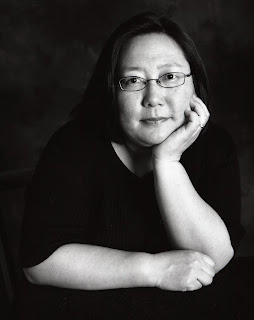
JANET WONG
Believe it or not—I first heard about
Janet Wong when I was traveling with a Children’s Literature and Language Arts Delegation in the People’s Republic of China in the autumn of 1994. One of the other delegates, with whom I became friends, was a professor at a college in Southern California. She was all excited when she told me about this “talented new Chinese American author” who had just published her first collection of children’s poems entitled
Good Luck Gold. Of course, I had to have the book! I’m always looking for bright new voices in children’s poetry. I ordered
Good Luck Gold soon after I returned home.
In
Good Luck Gold and in her second book,
A Suitcase of Seaweed, Janet reflected on her years growing up as an Asian-American child. Both books received the prestigious Claremont Stone Center Recognition of Merit Award. Here is the first poem from
Good Luck Gold:
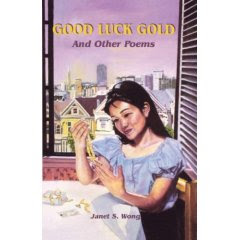 Good Luck Gold
By Janet Wong
(Poem copyright 1994 by Janet Wong.
Good Luck Gold published by M. K. McElderry, an imprint of Simon & Schuster Children’s Publishing Division. All rights reserved.)
When I was a baby
one month old,
my grandparents gave me
good luck gold:
a golden ring
so soft it bends,
a golden necklace
hooked at the ends,
a golden bracelet
with coins that say
I will be rich
and happy someday.
I wish that gold
would work
real soon.
I need my luck
this afternoon 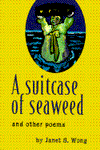
Janet had me hooked with her first collection. I’ve bought every poetry book that she has published since then. Janet writes not only poetry that speaks to her ethnic heritage (Chinese and Korean), she also writes of one’s unconscious imagination in
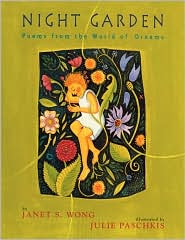
Night Garden: Poems from the World of Dreams. She writes about relationships in her book
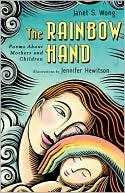
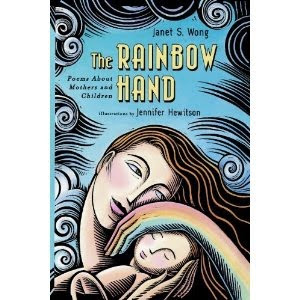
The Rainbow Hand: Poems About Mothers and Children, which was the recipient of a Lee Bennett Hopkins Poetry Award Honor. Janet’s most recent collection,
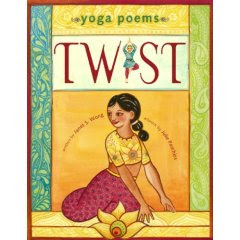
Twist: Yoga Poems, was written for her friend
Julie Paschkis, the award-winning children’s picture book illustrator. Julie loves doing yoga—so Janet wrote a book of poems about different yoga poses, which Julie illustrated. (Click
here to read my review of
Twist: Yoga Poems and my interview with Janet and Julie.)
I had the great pleasure of meeting Janet at a Children’s Literature Institute at Simmons College in Boston several summers ago. Since that time, Janet and I have become friendly. I have gotten to know this woman who is a tiny, determined dynamo and force of nature. She’s a talented writer and a great speaker—straightforward, ebullient, and funny. She has been featured on the Oprah Winfrey Show and, in 2003, was invited to read her picture book
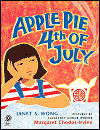
Apple Pie Fourth of July as part of the Easter festivities at the White House. I have no doubt in my mind that Janet Wong could accomplish anything she sets her mind to.
 About the Interview
Janet and I decided to focus my interview with her on her experience as a student in a master class on poetry taught by the late
Myra Cohn Livingston, one of America’s foremost children’s poets and anthologists. In addition to Janet, other students in the class included
April Halprin Wayland,
Tony Johnston,
Ann Whitford Paul,
Joan Bransfield Graham,
Alice Schertle, and
Kristine O’Connell George.
INTERVIEW WITH JANET WONG
Elaine: You were a student in the master class in poetry that the late Myra Cohn Livingston taught at UCLA. How did you come to know Myra and when did you become interested in writing poetry for children?
Janet: I heard Myra speak at a one-day UCLA Extension seminar, an “everything you need to know about writing a children’s book” class. I didn’t want to write poetry; I was there to hear an editor speak about the acquisition process.
When I heard Myra, I knew I could learn something from her. She was so confident and smart, and clearly a demanding teacher. Myra taught a Beginning Poetry class through UCLA Extension and also a Master Class (which was invitation-only). I signed up for her class in Beginning Poetry after receiving a pile of rejection letters. I had decided that it was time to learn to write for children—to learn about rhyme, repetition, and rhythm, poetic devices that would help me write a picture book. Picture books were my passion, and I simply wanted to use poetry to “sharpen my prose.” I only became interested in writing poetry for publication several months later, once I’d started raiding the 811 shelf at the library (fifty books at a time, at Myra ’s urging) and had fallen in love with poetry.
The next term I was invited to take the Master Class—because of luck, the bad luck of Ruth Bornstein (author/illustrator of the simple but brilliant book Little Gorilla), who had to skip the term because of a family emergency. It was truly incredibly good luck for me: many people had waited for years to get into the Master Class, yet I was invited to take Ruth’s spot very soon, probably because I happened to talk to Myra shortly after Ruth called her. Tony Johnston, Alice Schertle, Monica Gunning, April Halprin Wayland, Ann Whitford Paul, Kristine O’Connell George, Deborah Chandra, Joan Bransfield Graham, and more: this was quite an accomplished and talented group!
Elaine: Can you tell us anything about your experience in Myra’s class?
Janet: During class, we would go around the room and we would read a homework poem aloud, in rapid succession, without explanation. If someone started to apologize or give background info, they would be interrupted and reminded of the rule. Then we’d return to hear some poems again, and discuss briefly which parts we remembered. This was an excellent way to teach form and rhythm; after hearing a dozen poems that used anapest or a dozen sonnets, you’d have a great feel for what that rhythm or form was all about.
For the rhythm exercises, Myra would allow us to break a rhythm only if we could explain why. For instance, I might break a bunch of happy anapests with an iamb to draw attention to a couple of words that were more poignant. I rarely write in set forms and strict rhythms now, but these exercises gave me a great education, and many of my free verse poems do have a loose rhythmic structure that holds the poem together.
One exercise that Myra used to do every few months was a “grading” exercise—which helped spur a discussion of what makes a poem good. She would read a stack of poems in rapid succession, not identifying the poet, and we’d make a list of grades. When you don’t know that a poem is written by a “brand name” poet, you sometimes give his poems lower grades than you would if you knew. After our grades were marked, we’d go back over the poems, hear them and discuss them. I felt, early on, that I had such “McDonald’s taste” in poems, while Alice Schertle’s taste was clearly “gourmet.” After studying with Myra for about two years, I was finally able to give grades that matched Alice’s. My taste had “developed”—either that, or I had become really good at guessing which poems I was supposed to like!
Elaine: What kinds of writing assignments did Myra give her students to work on at home?
Janet: Myra’s weekly homework assignments usually required us to write a half-dozen poems: a poem using a certain metrical structure (iamb, trochee, dactyl, or anapest), another poem in a certain form (villanelle, triolet, limerick, tanka, etc.), a haiku (always a haiku), a poem on a certain subject theme, poems exploring voice or another technique (assonance, consonance, alliteration, personification, metaphor, simile).
One of my favorite homework assignments was the “voice change” exercise. If we had written a poem in a third-person narrative voice, we’d have to do a second poem in the first-person lyrical voice. After that, we’d write versions in the voice of the mask, and apostrophe, and conversation. The change of voice often resulted in fresh new language and insights. For instance: a narrative poem about the wind might simply describe a scene where the wind blows the hat off a girl’s head. In the lyrical version, the girl might talk about losing her hat to the wind. In the voice of the mask, though, the poet would become the wind, and all of a sudden new ideas might arise: perhaps the wind is no longer just “blowing” but actually “stealing” the coveted hat. Using apostrophe, the girl would talk to the wind, and might plead with it to return her hat, or might threaten or cajole. In a conversation version, the girl and wind (or girl and hat) might scream at each other, or tease. The voice change exercise reliably creates elements and introduces words that will not arise in the course of revising a poem over and over in one voice only.
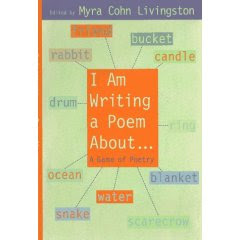
Another favorite homework assignment is explained in Myra’s book I Am Writing a Poem About…, sadly out-of-print but available at many libraries. Young poets raised on the Magnetic Poetry craze enjoy this exercise, but I rarely use it when I visit schools for just a day or two; instead, I usually use our limited workshop time to do a metaphor/simile poem instead. Recently, though, I did the “Ring/Blanket/Drum” exercise with a group of teachers during a lunchtime workshop at Collegiate School in Richmond, Virginia, and the results were fantastic. First I told them that they’d be writing a poem using the words ring, blanket, and drum. Then I read a few examples from the book, which contains the homework assignments of Myra’s Master Class students. Here is my ring/blanket/drum poem:
Oh, Brother!
By Janet Wong
The little squirt,
begging for boiled eggs and toast,
circles me like a wrestler in the ring,
bouncing on my bed,
bouncing,
bouncing,
bouncing,
bouncing,
and when I try to hide my head,
he dives under the blanket,
to drum my stomach
until it surrenders
a growl.
I spoke for three minutes about rhyme, off-rhyme, repetition, and rhythm—and they wrote for five minutes. Here are three examples of what they accomplished:
The Ring
By Stephanie Franz
She sees his ring
Memories
Her wedding day, the children, the trips, the
first time they conquered a mountain,
the last time they struck a golf ball...
Memories
Soon she will remove the ring
while wrapping him in a blanket of love
His soul will soar to meet his maker
while the drum of her heart carries on their tune
She will wear his ring.
A Poem
By Fletcher Collins
A blanket of silent fog
The glasslike ring of an invisible mast
No need for a drum
A Poem
by Nathan Goodwyn (7th/ 8th grade English)
A drum ring:
a place where
hands cackle together
throwing aside the day's more mundane obligations
as if they were the morning's blanket
I told Janet that I would also try writing a Ring/Drum/Blanket Poem. Here’s my contribution:
The Early Sixties: A Summer Day
By Elaine Magliaro
On an old army blanket,
a rough, khaki-colored island
floating on a sea of sand
at Devereaux Beach,
we sit in a circle…
a ring of friends
playing kitty whist,
drinking cola,
talking about boys, and
listening to rock and roll music…
to the sexy sound of the sax
wafting over us
moaning about love,
to a drum beating
like a young heart in overdrive.
Invitation to Write a Poem
Janet and I would like to invite all of you reading this interview to try writing your own poem using the three words—ring, drum, and blanket. You can post your poem at your own blog, if you have one, and send me the link—or email me your poem and I will post it at Wild Rose Reader.
NOTE: I would like to thank Janet Wong for this informative interview in which she discussed her experiences as a student in the master class on poetry taught by Myra Cohn Livingston. I would also like to extend my appreciation to Janet, Stephanie Franz, Fletcher Collins, and Nathan Goodwyn for granting me permission to post their original poems at Wild Rose Reader.
******************************
At Blue Rose Girls, I have a poem by Billy Collins entitled Workshop.
Cloudscome has the Poetry Friday Roundup at A Wrung Sponge.
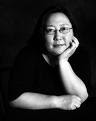 What’s with all these poets born in September? Clearly many poets’ parents were having a very merry Christmas, happy Hanukkah, or happy new year in years gone by! All of these poets were born in September: Helen Frost, Paul Fleischman, Jack Prelutsky, Aileen Fisher, Sara Holbrook, Harry Behn, and Shel Silverstein. Let’s celebrate one more September poet’s birthday: Janet S. Wong!
Janet S. Wong was born on September 30, 1962, and grew up in California, the child of Korean and Chinese immigrants. She graduated from UCLA with a bachelor’s degree in History and then obtained her law degree from Yale. However, she was not happy practicing law and decided to make a change, focusing on writing for young people instead. She has since authored nearly two dozen picture books and poetry collections. Her poems have been featured in some unusual venues, including a car-talk radio show, on 5,000 subway and bus posters as part of the New York City Metropolitan Transit Authority's "Poetry in Motion" program, and on the “Oprah” television show. She and her books have received numerous awards and honors, such as the International Reading Association's "Celebrate Literacy Award" for exemplary service in the promotion of literacy.
Janet Wong’s first two poetry collections, Good Luck Gold and Other Poems (Simon & Schuster, 1994) and A Suitcase of Seaweed, and Other Poems (Simon & Schuster, 1996) focus on her own background, exploring cultural connections and growing up with Korean and Chinese traditions. Many of the poems in these two collections lend themselves to poetry performance. For example, try "Face It" (A Suitcase Of Seaweed) with three stanzas that reflect the writer’s musings on her nose, her eyes, and her mouth and how each represents a different part of her identity. Three groups could each read a different stanza, using motions to point to each body part in turn.
Face It
by Janet Wong
My nose belongs
to Guangdong, China--
short and round, a Jang family nose.
My eyes belong
to Alsace, France--
wide like Grandmother Hemmerling's.
But my mouth, my big-talking mouth, belongs
to me, alone.
Wong also has authored several poetry collections on a variety of other topics. Behind the Wheel: Poems About Driving (Simon & Schuster, 1999) is a wonderful gift for the teenager who is learning to drive. The Rainbow Hand: Poems About Mothers and Children (Simon & Schuster, 2000) is an homage to mothers and our relationships with them and includes perfect “Mother’s Day” poem tributes. Wong has two collections of poems that address children's curiosity about dreams and superstitions with Night Garden: Poems from the World of Dreams (Simon & Schuster, 2000) and Knock on Wood: Poems about Superstitions (Simon & Schuster, 2003). Both are beautifully illustrated by Julie Paschkis and invite children to express their own beliefs and concerns-- perhaps poetically. Wong and Paschkis also teamed up for a third illustrated poetry collection this year, Twist, Yoga Poems (Simon & Schuster, 2007), which School Library Journal called “lovely to listen to and to look at.” For more information about Wong and her work, check out Poetry People.
Janet is a dynamic personality, a frequent presenter, and an advocate and mentor for many other authors, poets, and illustrators. I’m a big fan, as you can tell by many of my previous postings, including:
Tuesday, March 20, 2007 about her online chat with kids and her new photo-autobiography, When It Wriggles Away.
Tuesday, August 29, 2006 about the first anniversary of Hurricane Katrina and her poem about it, “Coin Drive.”
Happy birthday, Janet!
Thanks to AmoxCalli for hosting the Poetry Friday Roundup this week.
Picture credit: www.rfbdnj.org
Photo by Anne Lindsay
Today, I thought I’d write a review of one of my favorite multicultural pictures books. It is perfect for reading on Independence Day.

APPLE PIE 4TH OF JULY
Written by Janet Wong
Illustrated by Margaret Chodos-Irvine
Harcourt, 2002
This story takes place on Independence Day. The book’s main character is a Chinese-American girl whose parents were not born in the United States. Her parents own a store that is open 364 days a year—even on Thanksgiving. She feels that they don’t understand all “American things.”
The girl smells an apple pie baking in a neighbor's oven upstairs. She thinks her parents are foolish for cooking Chinese food. She is sure that no one will want to eat sweet-and-sour pork, egg rolls, noodles, or chow mein on the Fourth of July. She tells her parents—but they don’t listen.
Throughout most of the day the young girl is proven right. People come into the store to buy soda and potato chips…to buy ice cream and ice and matches. Then at five o’clock, a steady stream of "Americans" begins filing into the store until closing time to pick up…Chinese food! The story ends after the store closes and the girl and her family climb the stairs to the rooftop where they watch the fireworks display…and eat apple pie.
Wong's APPLE PIE 4TH OF JULY is a straightforward tale that expresses the feelings that many children who are first generation Americans experience—feelings that their parents don’t quite “get it”…that their families aren’t truly American. It is a simply told story with a brief text. Chodos-Irvine’s illustrations add meaning and capture the emotions of the young girl—her boredom, her frustration, her embarrassment and wistful sadness—with facial expressions and body language. This is a picture book in which art and text meld perfectly to tell a truly American tale.
Click here to see some of Chodos-Irvine's illustrations from APPLE PIE 4TH OF JULY.
Click here to see a video of Janet Wong reading APPLE PIE 4TH OF JULY for Easter at the White House in 2003.
How neat is this?! Janet Wong wrote a poem for me about all the poems I posted at Wild Rose Reader during the month of April. She left her poem in the comment section of A Poem a Day #30, which I dedicated to her. I thought I’d post Janet’s poem here today for all of you to read.
APRIL
by Janet Wong
April is a welcoming
to honeybees as muses,
rocket trips to wishing stars,
lion(esses) singing the blues(es).
April takes you wandering
past the sleek eelectric chef,
lions suffering tangled manes,
the Queen who’s feeling somewhat plain,
gnus who cruise pursued by winter, weary and worn.
April is piggy! April is pink.
April is whispers, friendship-hush.
A sorrowful planet demoted to slush.
Ribbons of muscle, snaking along.
The song of a whale, the spray of a skunk.
Unicorns born while ladies roll dice.
Fried (let’s say) Egg (keep it nice).
April is a hungry bear,
a giraffe, head high in the warm spring air,
creases smoothed with wrinkle cream.
Crater romance, beetles in armor,
rivers of sun and pools of shade.
Buds bursting, stretching awake,
and potatoes, parsley, parsnip and peas—
whatever a poet may happen to see
from her windows in Beverly—
in her mind in reverie—
whatever a poet may happen to type
in a quiet basement, some late-blogging night—
this was April, this year.
Thanks, Janet, for writing this special poem for me!





.jpg?picon=590)


 We are extra lucky today as not one but two experts have concocted a gourmet feast of their
  Whether it’s a big platter of noodles, warm-from-the-oven flatbread, fried dumplings, or a steamy bowl of Ugly Vegetable Soup, there’s nothing tastier than a picture book about food. You eat with your eyes first, then step into the kitchens or sit at the tables of friends and family from faraway places, all of whom seem to agree that love is the best seasoning for any dish, and food tastes best when it is happily shared. These tasty tales always make me say, “More, please!”
 In my family instead of saying hello, we say, “Have you eaten yet?” Eating and food has always been a successful way to connect us to culture, familiar as well as exotic–perhaps because it’s so enjoyable! So these books about food can be an appetizer to another country, a comfort food of nostalgia or a delicious dessert of both. Hen hao chi!



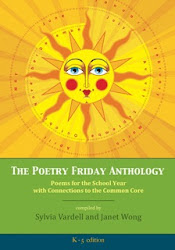
 fifth grade by 75 popular poets including J. Patrick Lewis, Jack Prelutsky, Jane Yolen, Margarita Engle, X. J. Kennedy, Kathi Appelt, Guadalupe Garcia McCall, Georgia Heard and Nikki Grimes and many more.



 I’ve just bought my first e-book. I realise that might fill some people with horror at how long it’s taken me to jump on the bandwagon, but it was always going to have to be something special that would propel me into action. Perhaps if I spent more time on public transport, I might have succumbed to an e-reader by now, but as it is… Anyway, I’ve just downloaded the free Kindle for PC and have taken the leap, tempted as I was by





.jpg?picon=380)
 This episode of Just One More Book! is part of our showcase coverage of the
I won this book a while ago, Elaine, so don't put me into the drawing. But just wanted to tell others who read this that it's such a great book. I've shared it with many classrooms as something to help with election conversations.
Thanks for offering the giveaway, Elaine. And thanks to Janet for giving the copies.
bridgetwilson4765(at)gmail(dot)com
Thank you Janet for encouraging everyone to inform his/herself and then VOTE through your poetry. I will share this with my granddaughters.
Janet gave me this book last year. I am excited to use it next week, when I prepare my students for the VFW essay contest.
I would love to have this book to share with my grandgirls!
I would love this book to share with my 6th graders! I have to say I have been a silent reader of yours for a few years now and I greatly appreciate your knowledge of poetry and sharing of great books!
I know Janet's book must be super. Love the poem you shared. Don't enter me in the giveaway, because teachers should really win. But thanks for sharing this!
Thanks, everyone, for your comments! So happy to hear that you've had success with this book in classrooms, Linda. And Mary Jane: I hope that it inspires your students to write stellar VFW essays! The whole point of this book was to create discussion. Many of the poems are lighthearted and whimsical because I just wanted to suggest a jumping-off point (for talking about what red and blue states mean, or the electoral versus the popular vote, etc.). A lot of kids hear NOTHING about the election at home, so it's really important that it's at least mentioned in school!
Followed a link on Kenn Nesbitt's twitter to here, as we read a lot of Kenn's poetry in our class - love the sample and lots of folks have good things to say about it too! Although we live in Ireland, we're learning all about how the President is elected, we'll be having our own class election, and following the real thing very closely too. Keep up the good work!
Hooray for Mr. Russell's class! I think it's SO neat that you're in Ireland and yet you're learning about the American presidential election. It's extra neat that you're holding a class election of your own. What a great reminder of how we're all connected and we enrich our lives by keeping up with each other's news!
I love Janet's writing and I love your too!!!! Thanks for highlighting her.
Elaine,
Thank you for this great opportunity to win another wonderful book by Janet.
I think that motivating students’ discussion with poems about topics related to the elections is just a wonderful idea. I truly admire Janet’s way of thinking and writing—it’s creative and inspiring and yet simple and understandable to her readers regardless of age.
It would be great to have this unique book on the shelf in my library with elections just around the corner. I’ll keep my fingers crossed. :)
Vida