Click & listen 1 min 37 sec. audio Smile Please स्माईल, मुस्कान, मुस्कुराहट Smile, Smiling Fece हमारी जिंदगी में बहुत खुशियां भर देती है इती सी हंसी, इती सी खुशी जीने का नजरिया ही बदल देती है… !! कैसे ?? जानने के लिए सुने ऑडियो स्माईल प्लीज – मुस्कुराते रहना – ऑडियो मोनिका गुप्ता […]
The post स्माईल प्लीज – मुस्कुराते रहना – ऑडियो appeared first on Monica Gupta.
When life throws you down a crooked track, hold close your family, latch onto new friends, throw up your hands and find something to smile about.
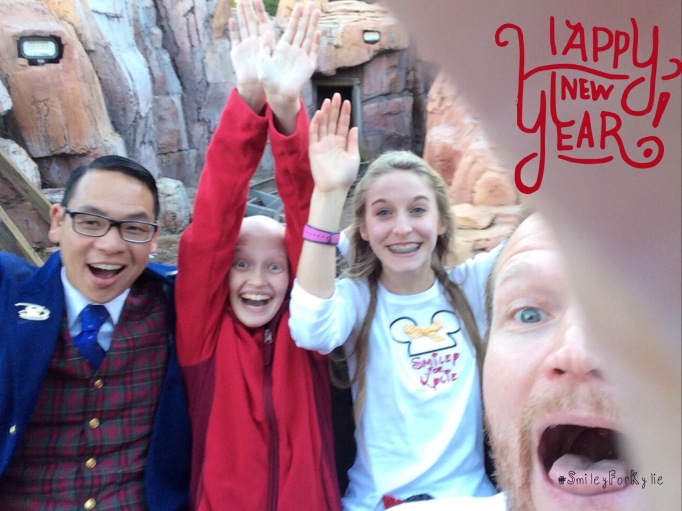
While 2014 was definitely a crooked track for us, I want to close it with a look to the good. Shortly after our diagnosis, I had a friend reach out to me amidst his own health crisis. My advice to him was, “Hear the negative, focus on the positive and know that God has both covered.”
Good advice? I think so – but much easier said than done. This world screams negative. We are bombarded with the bad. The nightly news covers everything wrong with our world first and longest before they throw in one human interest story just before saying good night. (If you missed Kylie on the news, you can watch it HERE)
While sifting through the ruins of this broken world, how do we see what is good? I have seen a lot of things in my 47 years. To borrow the movie title, I’ve seen the good, the bad, and the ugly. I have driven a man out of the slum of Port ‘au Prince, Haiti and watched as he was given the keys to his new home. I have been fortunate enough to help put a roof on a hut in Swaziland for a family decimated by HIV. Beauty plucked from ugly, good snatched from bad. Both started with a choice to engage.
Despite my experiences, never in my life have I seen the good side of humanity than from the day Kylie was diagnosed with cancer. The flood of well-wishes, prayers, and support for our family has been as overwhelming as the diagnosis itself. When you hear the words, “Your child has cancer,” the temptation is to curl up in the fetal position, shut out the world and cry. When I was at my weakest, I found an abundance of arms to hold me.
Friends, family, our school and church rallied to our side.
The nurses, doctors, childlife specialists, and staff of the Aflac Cancer Center at Children’s Healthcare of Atlanta became dear partners in this journey. We also found great care at Levine Children’s Hospital in Charlotte.
Organizations came alongside to help navigate and let us know we aren’t alone: 1 Million for Anna, Make-A-Wish, Cure Childhood Cancer, The Truth 365, Rally Foundation, Melodic Caring Project, The Jesse Rees Foundation, Along Comes Hope, 3/32 Foundation, Blessed Beauty, Open Hands Overflowing Hearts, Kingdom Kids, Lily’s Run.
We have seen built a network of people who pray faithfully for Kylie. To be totally honest, I admit there are times when I cannot lift a word to heaven. Maybe a grunt, maybe an angry shake of the fist. Without a doubt, I know there are many people praying for my little girl when I can’t. That is incredibly humbling.
Then there is encouragement and love. Kylie gets cards and letters daily. At least a dozen young ladies have donated their hair in Kylie’s honor. People all across the country and literally around the world have been #SmileyForKylie. As of today, 87 countries have done it. Grown men have written it on their bald heads.
Between Twitter, Instagram, and Facebook, we have received over 10,000 smiling selfies for Kylie. Unreal. We have gotten them from celebrities, athletes, and Kylie’s beloved Broadway performers. Idina Menzel made a video. Kristin Chenoweth made two pics and talked about her on a radio show. Laura Osnes posted a word of encouragement to her. She got a box of Broadway treats from Hunter Foster. She had pics from 9 out of 12 musicals nominated for Tony Awards, and the cast of her favorite show, Aladdin have reached out to her over and over again. Sometimes we can trace the web that led to the picture, but most of the time we have no idea how they happen – we have no line to these people. It’s just good. And it is out there – making a choice to engage with our little girl in a time when she so desperately needs it. A thank you will never be enough, but all I can offer.
Regardless of your view of the Bible, Philippians 4:8 gives us sage advice:
“Finally, brothers, whatever is true, whatever is honorable, whatever is just, whatever is pure, whatever is lovely, whatever is commendable, if there is any excellence, if there is anything worthy of praise, think about these things.”
I’ll not be able to change everyone’s mind. You can remain a cynic if you choose to. But the things I have experienced in 2014 prove to me that there is good in this world. I choose to think about such things – it is what has kept me going.
In 2015, we look forward to hearing the words: No Evidence of Disease and watching Kylie resume a normal life. That will be something worth throwing up our hands and smiling about.
Happy New Year from Portsong, your humble mayor & Kylie
Filed under:
Learned Along the Way 

 Today’s post comes to us from Laura, a Youth Advisory Board member who is active on Pinterest and eager to share her thoughts about why the social network has quickly taken off, especially among Millennials. She uses the site for a variety of... Read the rest of this post
By John McCormick
Few times have been worse than the present to say anything good about the European Union (EU). It has faced many crises over the years, but none have been as serious as the current problems in the eurozone. Since news first broke of the difficulties in Greece in late 2009, pundits and political leaders have been falling over themselves in their efforts to ratchet up the language of doom and gloom. Under the circumstance, euro-optimists might be well-advised to lay low, and certainly they seem hard to find at the moment.
And yet this is the very time to remind ourselves of the achievements of the EU, because if we are to make sensible choices about where we go from here, we will need to have a clear idea of both its successes and its failures. Whatever happens to the euro, the EU is obviously on the brink of some major changes, generated not just by its immediate problems but also by some broader political and philosophical questions about the meaning and purposes of the European project.
Critics have focused on numerous themes in their recent attacks on the EU, among which is the recurring question of just what it means to be European. The EU is regularly accused of lacking clear purpose, and conventional wisdom suggests that Europeans have too little in common to weather the crises. After decades of convergence, we are now often told that Europeans are moving apart, with a growing backlash against European integration and – more specifically – a right-wing reaction against immigration, and talk of the failure of multiculturalism.
In truth, however, Europeans have a great deal in common , but they are often the last to realize this because they are repeatedly told about their differences, and the EU is repeatedly castigated for its lack of leadership and its failure to make a mark as an actor in the international system. The result is that many can no longer see the wood for the trees. It is only when we compare the European experience with that of other parts of the world that the patterns begin to emerge.
One of the clearest examples of Europeanism (if we understand this term as meaning the distinctive set of values and preferences that drive choices and preferences in Europe) is its secularism. Where support for organized religion is growing in almost every other part of the world, in Europe it is declining, and this is impacting the way Europeans think about politics, science, social relations, and moral questions.
Another example is offered by the redefinition of the role of states. It was in Europe that the Westphalian state system was born, and yet Europeans since the end of the Second World War have been reviewing their association with states: more are thinking of themselves as Europeans, while identity with nations has been growing. Meanwhile, Europeans have been rejecting traditional notions of patriotism, which – thanks to its long association with nationalism – has a bad reputation in Europe.
On the international front, the Europeanist model is notable for its support of civilian over military means for dealing with threats to security, its support for multilateralism over unilateralism, a

I fully admit that I am very picky when it comes to picture books. I have certain favorites that I revisit over and over, and I am very happy when a new book tickles my fancy.
Some Helpful Tips for a Better World and a Happier Life has indeed tickled my fancy. From the wonky illustrations, to the suggestions themselves, this book will have readers smiling. Some of the suggestions are "Begin each day by making funny faces in the mirror" and "Splash in puddles whenever possible". My little ones are already trying to decide on some special occasions to invent.
Short, sweet and simply lovely.








yes, i fully agree and believe everything you said so beautifully here, mark. here’s to 2015 and a new beginning and second chance for kylie, and for your entire family. it does not surprise me how kind and giving people have been, the world is a wonderful place and people are overflowing with kindness. sharing it is what keeps us all going. happy new year to your and yours, ) b
May Portsong be blessed with health and happiness in 2015
Happy New Years – cheers >-I
And Almost Iowa as well! Cheers!
Exactly. We just tend to focus on what is wrong too much. Thanks Beth. Happy New Year to you!
Thank you. Happy New Year to you as well. Cheers!